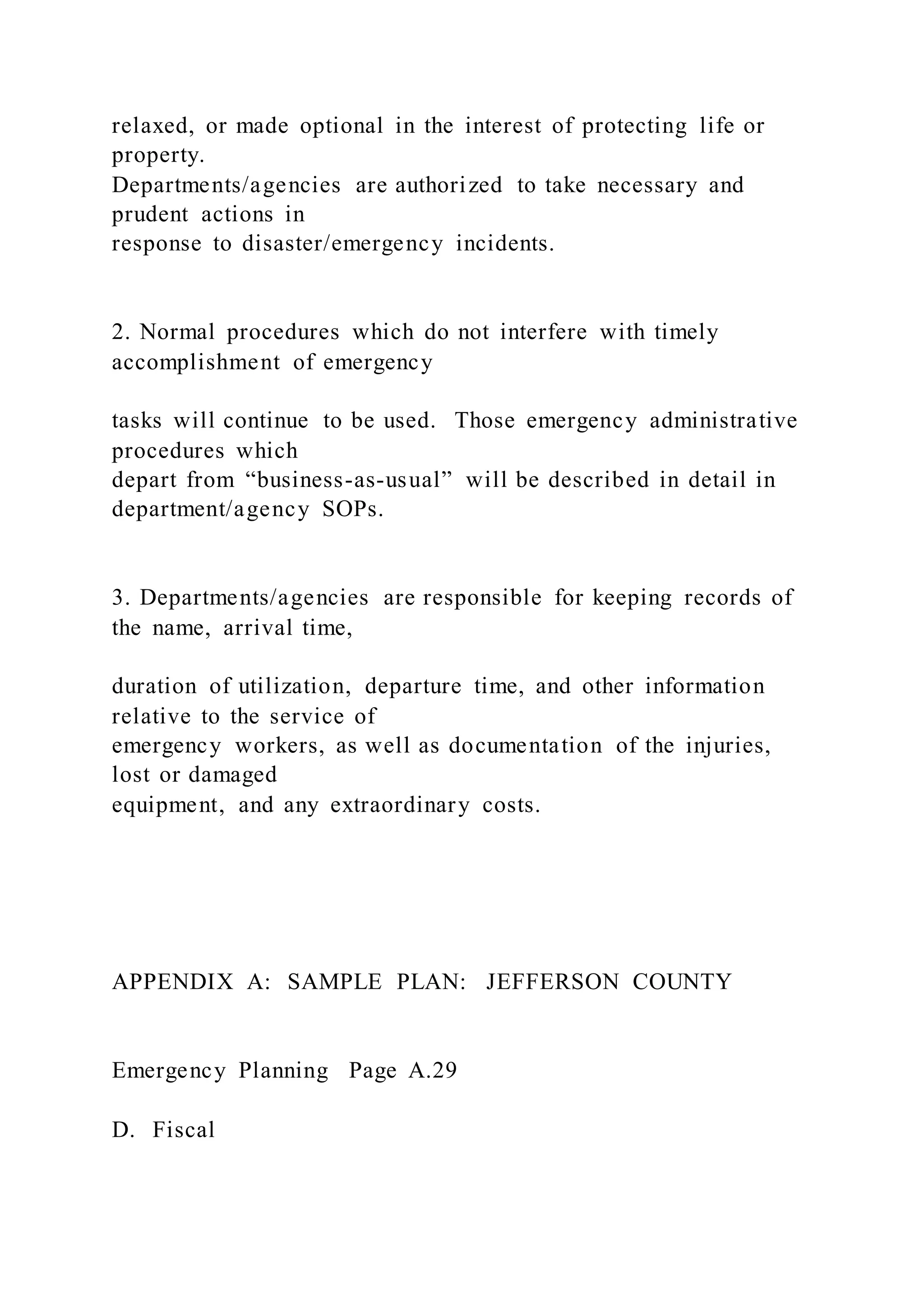
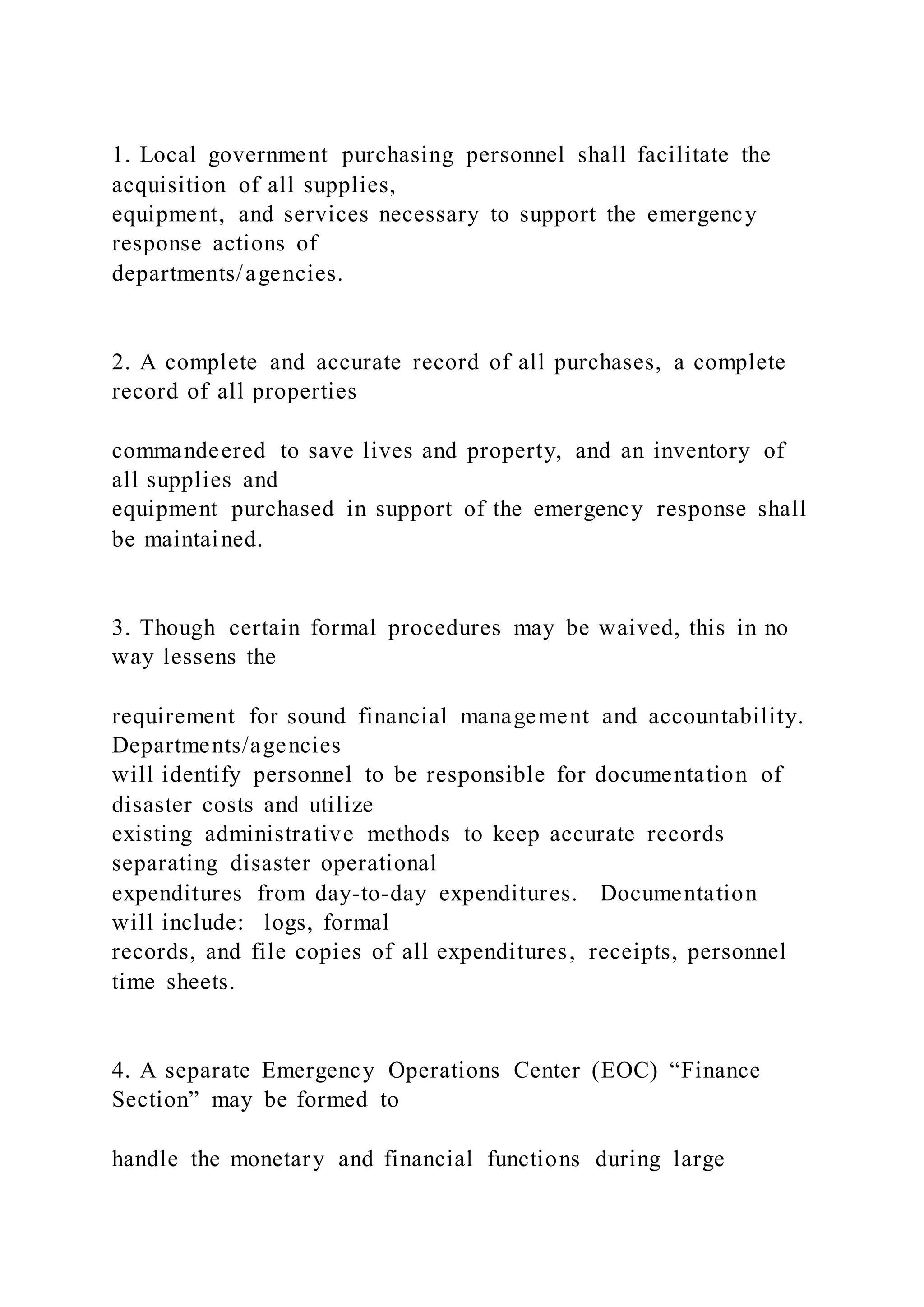
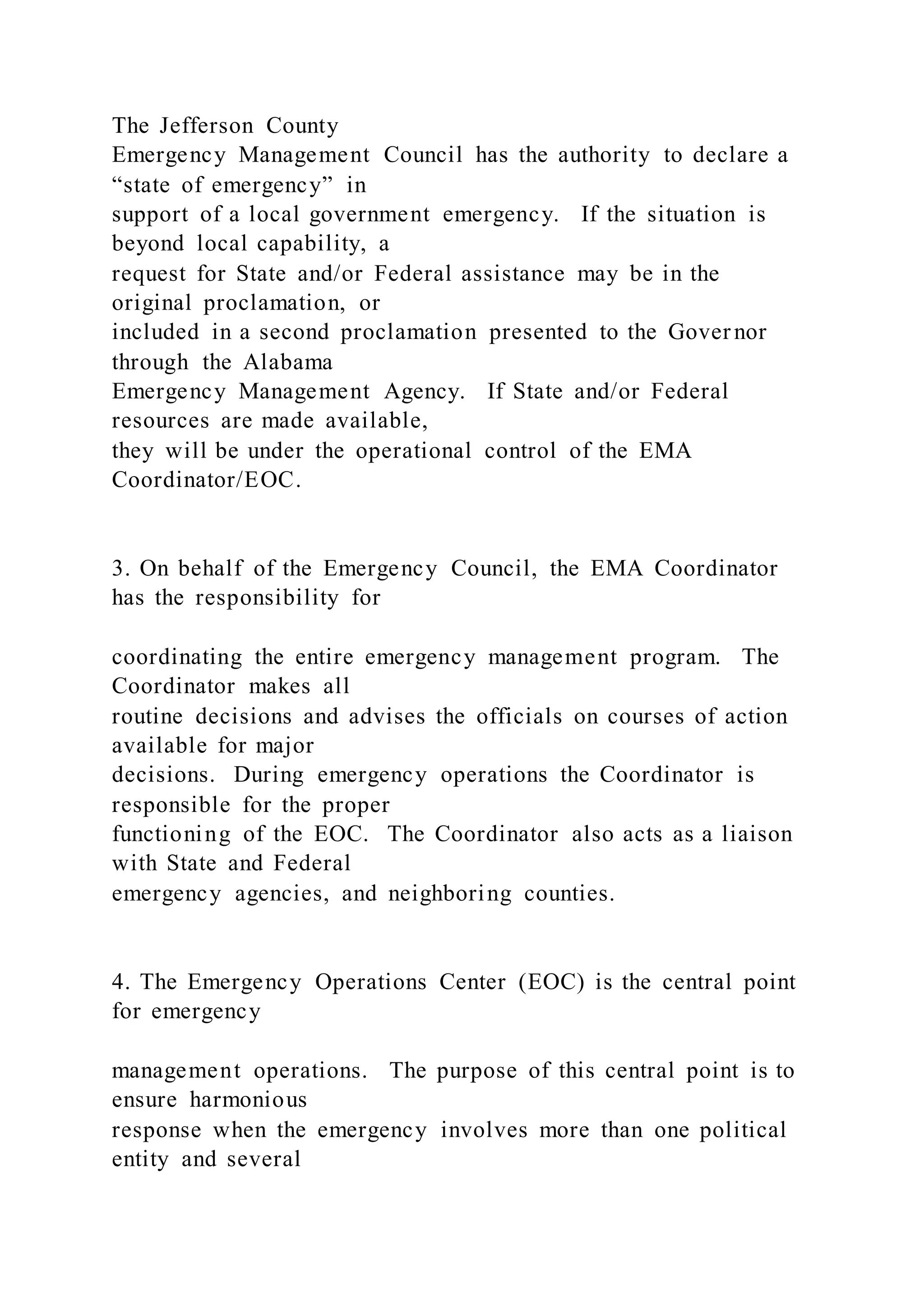
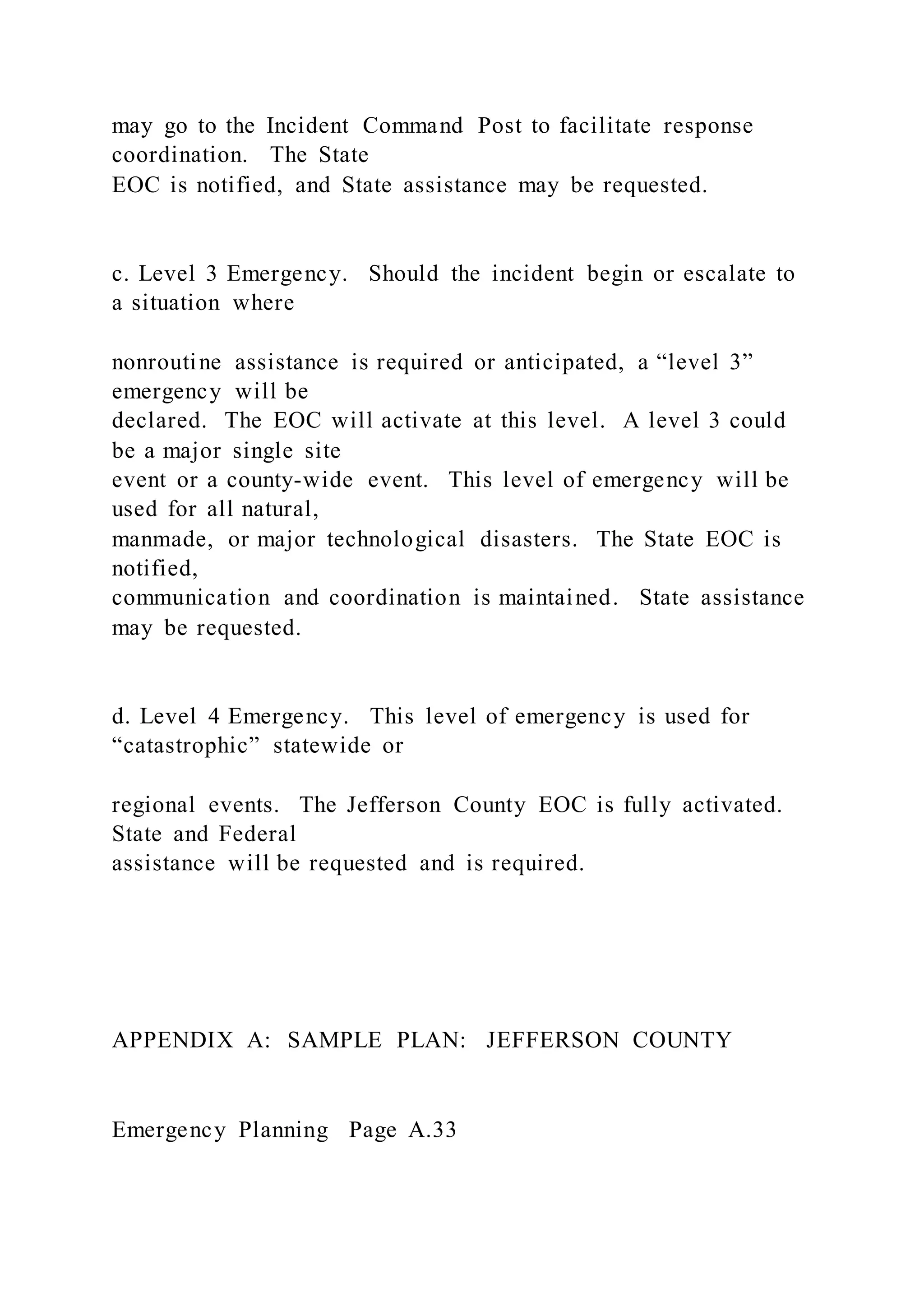
Emergency Planning
Independent Study 235.b
December 2011
FEMA
TABLE OF CONTENTS
Emergency Planning Page i
Page
Course Overview
...............................................................................................
.......................... 1
Unit 1: Course Introduction
Introduction
...............................................................................................
................................. 1.1
How To Take This Course
...............................................................................................
.......... 1.1
Case Study: Why Plan?
...............................................................................................
............. 1.4
Course Goals
...............................................................................................
.............................. 1.6
Goal Setting
...............................................................................................
................................ 1.6
Activity: Personal Learning Goals
.............................................................................................
1.7
Unit Summary
...............................................................................................
............................. 1.8
For More Information
...............................................................................................
.................. 1.8
Unit 2: The Planning Process
Introduction and Unit Overview
...............................................................................................
... 2.1
Mandates: Incident Management and Coordination Systems
.................................................. 2.1
The Emergency Planning Process
.............................................................................................
2.5
Who Should Be Involved?
...............................................................................................
........... 2.6
How To Get the Team Together
..............................................................................................
2.10
How Should the Team Operate?
.............................................................................................
2.11
Activity: Organizational Roles and Individual Skills
................................................................. 2.14
Unit Summary
...............................................................................................
........................... 2.15
Knowledge Check
...............................................................................................
..................... 2.16
Unit 3: Threat Analysis
Introduction and Unit Overview
...............................................................................................
... 3.1
The Threat Analysis Process
...............................................................................................
...... 3.1
Step 1: Identifying Threats
...............................................................................................
......... 3.2
Step 2: Profiling Threats
...............................................................................................
............ 3.4
Activity: Profiling a Threat
...............................................................................................
.......... 3.5
Step 3: Developing a Community Profile
.................................................................................. 3.7
Step 4: Determining Vulnerability
..............................................................................................
3.8
Activity: Prioritizing Risks
...............................................................................................
......... 3.10
Step 5: Creating and Applying Scenarios
............................................................................... 3.11
Activity: Threat Analysis
...............................................................................................
........... 3.12
Unit Summary
...............................................................................................
........................... 3.15
For More Information
...............................................................................................
................ 3.16
Knowledge Check
...............................................................................................
..................... 3.17
Unit 4: The Basic Plan
Introduction and Unit Overview
...............................................................................................
... 4.1
Components of a Basic Plan
...............................................................................................
....... 4.1
Activity: Basic Plan Review
...............................................................................................
........ 4.6
Activity: Reviewing Your Community’s Basic Plan
.................................................................... 4.9
Unit Summary
...............................................................................................
........................... 4.11
Knowledge Check
.................................................................................... ...........
..................... 4.12
TABLE OF CONTENTS
Emergency Planning Page ii
Unit 5: Annexes
Introduction and Unit Overview
...............................................................................................
... 5.1
Annexes
...............................................................................................
...................................... 5.1
Functional Annexes
...............................................................................................
.................... 5.2
Activity: Reviewing Your EOP’s Functional Annexes
................................................................ 5.4
Hazard-, Threat-, and Incident-Specific Annexes
...................................................................... 5.6
Annex Implementing Instructions
...............................................................................................
5.8
Activity: Hazard-Specific Annex Review
................................................................................... 5.9
Unit Summary
...............................................................................................
........................... 5.10
Knowledge Check
................................................................................. ..............
..................... 5.11
Unit 6: Implementing Instructions
Introduction and Unit Overview
...............................................................................................
... 6.1
What Are Implementing Instructions?
........................................................................................ 6.1
Activity: Which Type Is Best?
...............................................................................................
..... 6.6
Who Uses Implementing Instructions?
...................................................................................... 6.8
Activity: Identifying Possible Agency Implementing
Instructions ............................................... 6.9
Unit Summary
...............................................................................................
........................... 6.10
Knowledge Check
...............................................................................................
..................... 6.11
Unit 7: Course Summary
Introduction
...............................................................................................
................................. 7.1
The Planning Process
...............................................................................................
................. 7.1
Threat Analysis
...............................................................................................
........................... 7.3
The Basic Plan
...............................................................................................
............................ 7.5
Annexes
...............................................................................................
...................................... 7.6
Implementing Instructions
...............................................................................................
........... 7.7
Final Steps
...............................................................................................
.................................. 7.8
Appendix A: Sample Plan: Jefferson County
Appendix B: Job Aids
Appendix C: Acronym List
Course Overview
COURSE OVERVIEW
Emergency Planning Page 1
About This Course
This course is designed for emergency management personnel
who are
involved in developing an effective emergency planning system.
This course offers training in the fundamentals of the
emergency planning
process, including the rationale behind planning. It will
develop your capability
for effective participation in the all-hazards emergency
operations planning
process to save lives and protect property threatened by
disaster.
FEMA’s Independent Study Program
The Federal Emergency Management Agency’s (FEMA’s)
Independent Study
Program is one of the delivery channels that the Emergency
Management
Institute (EMI) uses to provide training to the general public
and specific
audiences. This course is part of FEMA’s Independent Study
Program. In
addition to this course, the Independent Study Program includes
other courses
in the Professional Development Series (PDS) as well as
courses in floodplain
management, radiological emergency management, the role of
the emergency
manager, hazardous materials, disaster assistance, the role of
the Emergency
Operations Center (EOC), and an orientation to community
disaster exercises.
FEMA’s independent study courses are available at no charge
and include a
final examination. You may apply individually or through
group enrollment.
When enrolling for a course, you must include your name,
mailing address,
Social Security number, and the title of the course in which you
wish to enroll.
If you need assistance with enrollment, or if you have questions
about how to
enroll, contact the Independent Study Program Administrative
Office at:
FEMA Independent Study Program
Administrative Office
Emergency Management Institute
16825 South Seton Ave.
Emmitsburg, MD 21727
(301) 447-1200
Information about FEMA’s Independent Study Program also is
available on the
Internet at:
http://www.training.fema.gov/IS
Each request will be reviewed and directed to the appropriate
course manager
or program office for assistance.
http://www.training.fema.gov/IS�
COURSE OVERVIEW
Emergency Planning Page 2
Course Completion
The course completion deadline for all FEMA Independent
Study courses is
1 year from the date of enrollment. The date of enrollment is
the date that the
EMI Independent Study Office will use for completion of all
required course
work, including the final examination. If you do not complete
this course,
including the final examination, within that timeframe, your
enrollment will be
terminated.
Course Prerequisites
Emergency Planning has no prerequisites.
Final Examination
This course includes a final examination, which you must
complete and return
to FEMA’s Independent Study Office for scoring. To obtain
credit for taking this
course, you must successfully complete this examination with a
score of 75
percent or above. You may take the final examination as many
times as
necessary.
When you have completed all units, you must take the final
examination online.
EMI will score your test and notify you of the results.
Unit 1: Course Introduction
UNIT 1: COURSE INTRODUCTION
Emergency Planning Page 1.1
Introduction
The knowledge of how to plan for disasters is critical in
emergency
management. Planning can make a difference in mitigating
against the effects
of a disaster, including saving lives and protecting property,
and helping a
community recover more quickly from a disaster.
This course, Emergency Planning, is designed to aid emergency
management
personnel in developing an effective emergenc y operations plan
(EOP). Topics
covered include selecting the planning team, the planning
process, hazard
analysis, and plan format. This course also prepares you to take
the classroom
course, Workshop in Emergency Management (WEM).
How To Take This Course
This independent study course is designed so that you can
complete it on your
own, at your own pace. Take a break after each unit, and give
yourself time to
think about the material, particularly as it applies to your work
as an emergency
management professional and the situations you have
encountered or
anticipate encountering on the job.
Emergency Planning contains seven units. Each of the units is
described
below.
• Unit 1, Course Introduction, provides an overview of the
course objectives
and instructions for taking the course.
• Unit 2, The Planning Process, provides an overview of the
emergency
planning process, including the steps involved and how to
determine who
should be a part of the emergency planning team.
• Unit 3, Threat Analysis, describes the threat analysis process
and explains
why conducting a thorough threat analysis is a critical first step
in
emergency operations planning.
• Unit 4, The Basic Plan, introduces the purpose of the basic
EOP and
describes its components.
• Unit 5, Annexes, introduces functional and hazard-, threat-,
and incident-
specific annexes.
• Unit 6, Implementing Instructions, introduces the different
types of
implementing instructions that may be developed at the agency
level and
how they are used.
• Unit 7, Course Summary, reviews and summarizes the course
content and
serves as preparation for the final exam.
UNIT 1: COURSE INTRODUCTION
Emergency Planning Page 1.2
Activities
This course will involve you actively as a learner by including
activities that
highlight basic concepts. Through the use of case studies, the
course will also
provide you with guidance on actions required in specific
situations. These
activities emphasize different learning points, so be sure to
complete all of
them. Compare your answers to the answers provided following
the activity. If
your answers are correct, continue on with the material. If any
of your answers
are incorrect, go back and review the material before
continuing.
Knowledge Checks
To help you know when to proceed to the next unit, Units 2
through 6 are
followed by a Knowledge Check that asks you to answer
questions pertaining to
the unit content, followed by the answers. When you finish
each Knowledge
Check, check your answers, and review the parts of the text that
you do not
understand. It will be to your benefit to be sure that you have
mastered the
current unit before proceeding to the next unit.
Appendixes
In addition to the course units, this course includes three
appendixes. Appendix
A contains a sample plan that will be used to complete an
activity in Unit 4.
Appendix B provides Job Aids, and Appendix C gives a list of
the acronyms
used in the course.
Final Examination
This course includes a written final examination, which you
must complete and
submit to FEMA’s Independent Study Office. To obtain credit
for taking this
course, you must successfully complete the examination with a
score of 75
percent or above. You may take the final examination as many
times as
necessary.
When you have completed all units, take the final examination
online. EMI will
score your test and notify you of the results.
UNIT 1: COURSE INTRODUCTION
Emergency Planning Page 1.3
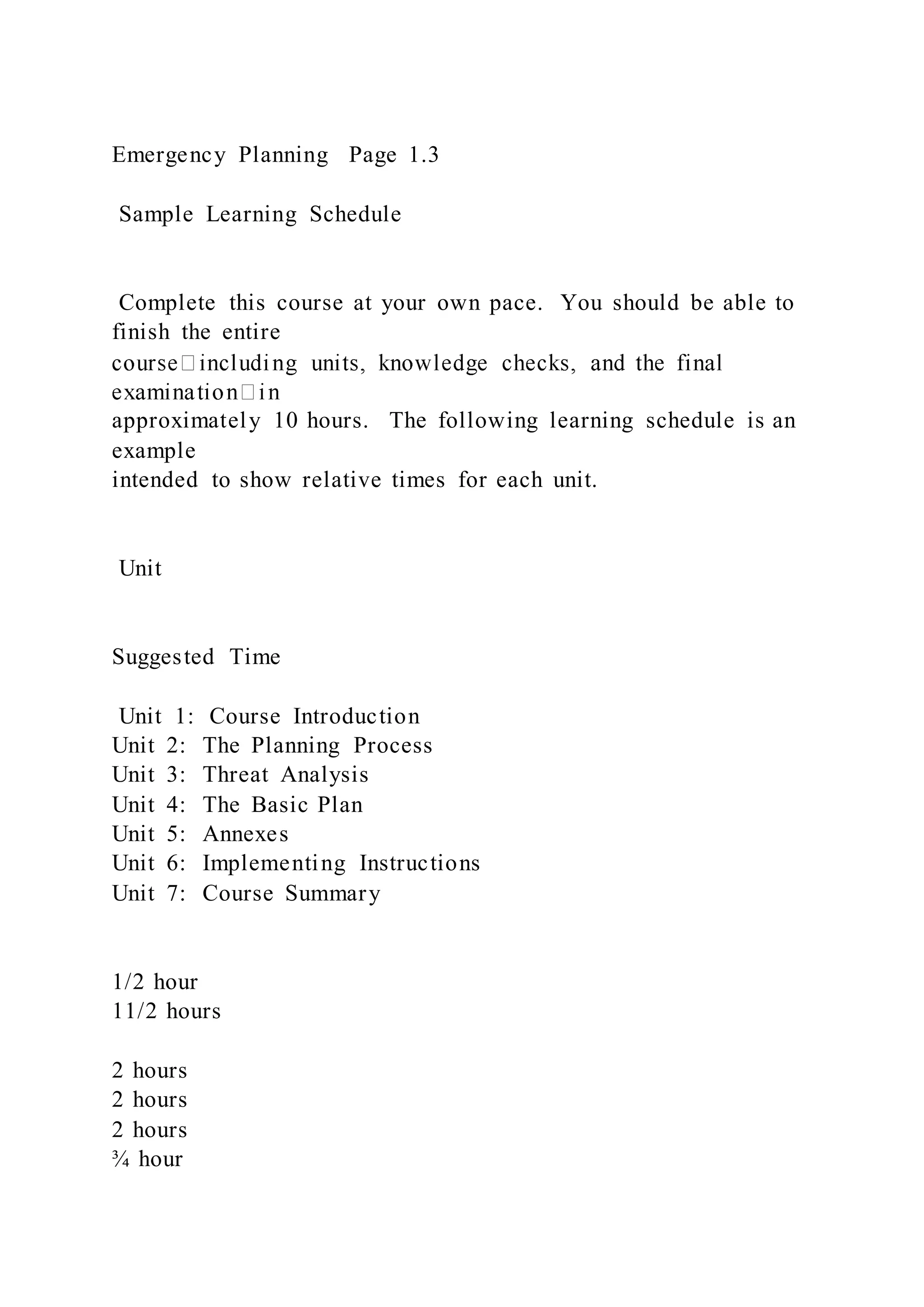
Sample Learning Schedule
Complete this course at your own pace. You should be able to
finish the entire
approximately 10 hours. The following learning schedule is an
example
intended to show relative times for each unit.
Unit
Suggested Time
Unit 1: Course Introduction
Unit 2: The Planning Process
Unit 3: Threat Analysis
Unit 4: The Basic Plan
Unit 5: Annexes
Unit 6: Implementing Instructions
Unit 7: Course Summary
1/2 hour
11/2 hours
2 hours
2 hours
2 hours
¾ hour
1¼ hours
UNIT 1: COURSE INTRODUCTION
Emergency Planning Page 1.4
Case Study: Why Plan?
Instructions: Read the following case study. As you read,
think about how
the planning ability of these communities compares with that in
your own
community. Answer the questions that follow the case study.
Then turn the
page to check your answers against the answers provided.
At 6:53 p.m. on Friday, October 6, Hurricane Frieda slammed
into the Carolinas. A Category 3
hurricane, Frieda dumped 12 inches of rain in as many hours,
causing coastal flooding that,
combined with wind speeds of 115 m.p.h., demolished 1,000
homes, seriously damaged 25,000
others, and left 150,000 people homeless. Mass evacuation in
coastal counties was required.
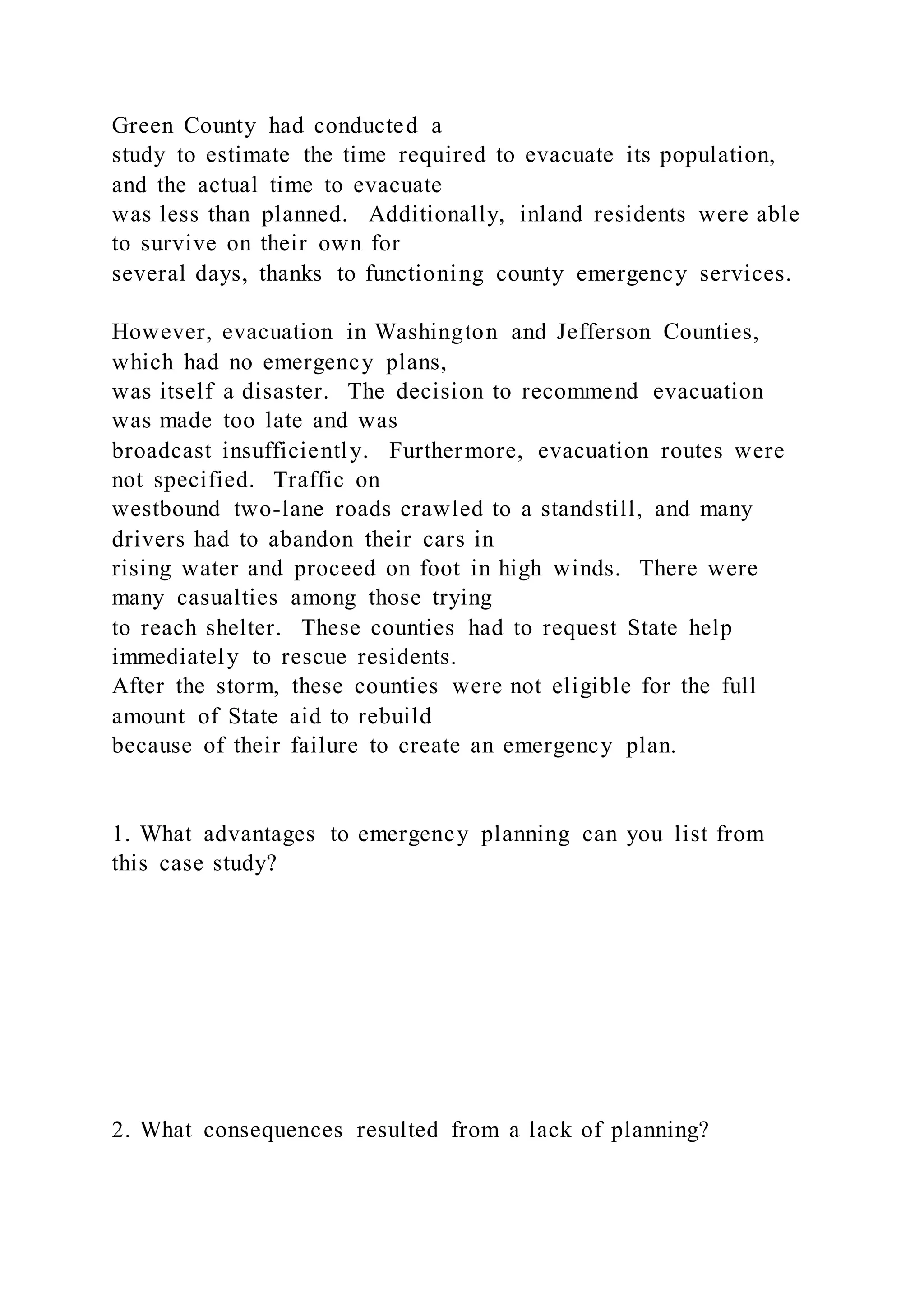
Evacuation in most counties went well. Prior to the hurricane,
Green County had conducted a
study to estimate the time required to evacuate its population,
and the actual time to evacuate
was less than planned. Additionally, inland residents were able
to survive on their own for
several days, thanks to functioning county emergency services.
However, evacuation in Washington and Jefferson Counties,
which had no emergency plans,
was itself a disaster. The decision to recommend evacuation
was made too late and was
broadcast insufficiently. Furthermore, evacuation routes were
not specified. Traffic on
westbound two-lane roads crawled to a standstill, and many
drivers had to abandon their cars in
rising water and proceed on foot in high winds. There were
many casualties among those trying
to reach shelter. These counties had to request State help
immediately to rescue residents.
After the storm, these counties were not eligible for the full
amount of State aid to rebuild
because of their failure to create an emergency plan.
1. What advantages to emergency planning can you list from
this case study?
2. What consequences resulted from a lack of planning?
UNIT 1: COURSE INTRODUCTION
Emergency Planning Page 1.5
Case Study: Why Plan? (Continued)
Answers to the Case Study
Advantages to counties with emergency plans were their ability
to:
• Evacuate successfully.
• Survive on their own for several days.
Consequences to counties without emergency plans were:
• Their need for immediate assistance.
• The casualties resulting from attempted evacuation.
• Their ineligibility for the full amount of State aid. (In most
States, counties that do not have
emergency plans cannot declare an emergency and are ineligible
for any aid or for the full
amount of aid.)
The bottom line is that laws require counties to do everything
reasonable and prudent to protect
lives and property, including emergency planning.
In the space below, consider your own community, and list at
least three benefits it could gain
from having an up-to-date plan.
UNIT 1: COURSE INTRODUCTION
Emergency Planning Page 1.6
Course Goals
In Emergency Planning, you will learn how to plan for a
disaster. This course
will provide you with a foundation that will enable you to:
• Answer the question, “Why plan?”
• Describe the threat analysis and capability assessment process.
• Describe the EOP format and content.
• Identify types of community support available and required for
response and
recovery.
• State the rationale for a team approach to planning.
• Describe and demonstrate EOP coordination and marketing.
• Relate exercises to the planning process.
• Develop a plan maintenance program.
• Develop and present a personal action plan for emergency
planning.
Goal Setting
What do you hope to gain through completing Emergency
Planning?
Depending on your role in emergency management, your prior
experience, and
your current level of expertise, your goals may be slightly
different from those of
other emergency management professionals.
Clarifying your goals will help you gain the most from the time
you spend
completing this course. Take a few minutes to complete the
following activity.
UNIT 1: COURSE INTRODUCTION
Emergency Planning Page 1.7
Activity: Personal Learning Goals
The purpose of this activity is to help you develop personal
goals for this
course. Consider the following information:
• The course goals
• Your own experience with emergency planning
Think about what you would like to accomplish through this
course. Then list
three (or more) personal goals for improving your ability to
plan for an
emergency.
Goals
1.
_____________________________________________________
_
2.
_____________________________________________________
_
3.
_____________________________________________________
_
UNIT 1: COURSE INTRODUCTION
Emergency Planning Page 1.8
Unit Summary
Knowing how to plan for a disaster is critical because effective
planning can
make a difference in:
• Mitigating against a disaster’s effects.
• Helping a community recover more quickly.
This course is designed to aid in developing an effective
emergency operations
plan. You can complete this course on your own, at your own
pace.
The course contains components that will guide you through the
learning,
including:
• Activities to provide guidance on actions required in specific
situations.
• Knowledge Checks to test yourself on what you have learned
and review
the parts that you do not understand.
• An Appendix that contains an acronym list.
Unit 1 gave you an overview of Emergency Planning and
instructions on how to
take the course. Unit 2 will examine the planning process.
For More Information
• Comprehensive Preparedness Guide (CPG) 101, “Developing
and
Maintaining Emergency Operations Plans”:
http://www.fema.gov/media-library-
data/20130726-1856-25045-1727/cpg_101_v2.pdf
• Electronic Journal of Emergency Management (available free
online):
http://members.tripod.com/~Richmond_ESM/index.html
http://www.fema.gov/media-library-data/20130726-1856-25045-
1727/cpg_101_v2.pdf
http://members.tripod.com/~Richmond_ESM/index.html�
Unit 2: The Planning Process
UNIT 2: THE PLANNING PROCESS
Emergency Planning Page 2.1
Introduction and Unit Overview
This unit will provide an overview of the emergency planning
process, including
who should participate on the planning team. After you
complete this unit, you
should be able to:
• Describe the key steps in the emergency planning process.
• Identify agencies that should be involved in emergency
planning.
• Describe where you fit into the emergency planning process.
Mandates: Incident Management and Coordination Systems
On February 28, 2003, the President issued Homeland Security
Presidential
Directive 5 (HSPD–5), “Management of Domestic Incidents,”
which directed the
Secretary of Homeland Security to develop and administer a
National Incident
Management System (NIMS). This system provides a consistent
nationwide
template to enable Federal, State, tribal, and local governments,
nongovernmental organizations (NGOs), and the private sector
to work together
to prevent, protect against, respond to, recover from, and
mitigate the effects of
incidents, regardless of cause, size, location, or complexity.
This consistency
provides the foundation for utilization of NIMS for all
incidents, ranging from
daily occurrences to incidents requiring a coordinated Federal
response.
National Incident Management System (NIMS)
NIMS is not an operational incident management or resource
allocation plan.
NIMS represents a core set of doctrines, concepts, principles,
terminology, and
organizational processes that enables effective, efficient, and
collaborative
incident management.
Building on the foundation provided by existing emergency
management and
incident response systems used by jurisdictions, organizations,
and functional
disciplines at all levels, NIMS integrates best practices into a
comprehensive
framework for use nationwide by emergency
management/response personnel
in an all-hazards context. These best practices lay the
groundwork for the
components of NIMS and provide the mechanisms for the
further development
and refinement of supporting national standards, guidelines,
protocols, systems,
and technologies. NIMS fosters the development of specialized
technologies
that facilitate emergency management and incident response
activities, and
allows for the adoption of new approaches that will enable
continuous
refinement of the system over time.
UNIT 2: THE PLANNING PROCESS
Emergency Planning Page 2.2
NIMS (Continued)
Five major components make up the NIMS approach:
• Preparedness: Effective emergency management and incident
response
activities begin with a host of preparedness activities conducted
on an
ongoing basis, in advance of any potential incident.
Preparedness involves
an integrated combination of assessment; planning; procedures
and
protocols; training and exercises; personnel qualifications,
licensure, and
certification; equipment certification; and evaluation and
revision.
• Communications and Information Management: Emergency
management and incident response activities rely on
communications and
information systems that provide a common operating picture to
all
command and coordination sites. NIMS describes the
requirements
necessary for a standardized framework for communications and
emphasizes the need for a common operating picture. This
component is
based on the concepts of interoperability, reliability, scalability,
and
portability, as well as the resiliency and redundancy of
communications and
information systems.
• Resource Management: Resources (such as personnel,
equipment, or
supplies) are needed to support critical incident objectives. The
flow of
resources must be fluid and adaptable to the requirements of the
incident.
NIMS defines standardized mechanisms and establishes the
resource
management process to identify requirements, order and
acquire, mobilize,
track and report, recover and demobilize, reimburse, and
inventory
resources.
• Command and Management: The Command and Management
component of NIMS is designed to enable effective and
efficient incident
management and coordination by providing a flexible,
standardized incident
management structure. The structure is based on three key
organizational
constructs: the Incident Command System, Multiagency
Coordination
Systems, and Public Information.
• Ongoing Management and Maintenance: Within the auspices
of Ongoing
Management and Maintenance, there are two components: the
National
Integration Center (NIC) and Supporting Technologies.
Additional information about NIMS can be accessed online at
https://www.fema.gov/national-incident-management-system or
by completing
EMI’s IS 700 online course.
https://www.fema.gov/national-incident-management-system
UNIT 2: THE PLANNING PROCESS
Emergency Planning Page 2.3
National Response Framework (NRF)
The NRF is a guide to how the Nation conducts all-hazards
response—from the
smallest incident to the largest catastrophe. This key document
establishes a
comprehensive, national, all-hazards approach to domestic
incident response.
The Framework identifies the key response principles, roles,
and structures that
organize national response. It describes how communities,
States, the Federal
Government, and private-sector and nongovernmental partners
apply these
principles for a coordinated, effective national response.
The NRF is:
• Always in effect, and elements can be implemented as needed
on a
flexible, scalable basis to improve response. It is not always
obvious at
the outset whether a seemingly minor event might be the initial
phase of a
larger, rapidly growing threat. The NRF allows for the rapid
acceleration of
response efforts without the need for a formal trigger
mechanism.
• Part of a broader strategy. The NRF is required by, and
integrates under,
a larger National Strategy for Homeland Security that:
• Serves to guide, organize, and unify our Nation's homeland
security
efforts.
• Reflects our increased understanding of the threats
confronting the
United States.
• Incorporates lessons learned from exercises and real -world
catastrophes.
• Articulates how we should ensure our long-term success by
strengthening the homeland security foundation we have built.
• Comprised of more than the core document. The NRF is
comprised of
the core document; the Emergency Support Function (ESF),
Support, and
Incident Annexes; and the Partner Guides. The core document
describes
the doctrine that guides our national response, roles and
responsibilities,
response actions, response organizations, and planning
requirements to
achieve an effective national response to any incident that
occurs.
The following documents provide more detailed information to
assist
practitioners in implementing the Framework:
• Emergency Support Function Annexes group Federal resources
and
capabilities into functional areas that are most frequently
needed in a
national response (e.g., Transportation, Firefighting, Search and
Rescue).
UNIT 2: THE PLANNING PROCESS
Emergency Planning Page 2.4
NRF (Continued)
• Support Annexes describe essential supporting aspects that are
common to all incidents (e.g., Financial Management, Volunteer
and
Donations Management, Private-Sector Coordination).
• Incident Annexes address the unique aspects of how we
respond to
seven broad incident categories (e.g., Biological,
Nuclear/Radiological,
Cyber, Mass Evacuation).
Additional information about the NRF can be accessed online at
https://www.fema.gov/national-response-framework or by
completing EMI’s IS-800.b online
course.
What This Means to You
Your jurisdiction is required to:
• Use NIMS to manage all incidents, including recurring and/or
planned
special events.
• Integrate all response agencies and entities into a single,
seamless system,
from the Incident Command Post, through department
Emergency
Operations Centers (DEOCs) and local Emergency Operations
Centers
(EOCs), through the State EOC, to the regional- and national-
level entities.
• Develop and implement a public information system.
• Identify and type all resources according to established
standards.
• Ensure that all personnel are trained properly for the job(s)
they perform.
• Ensure communications interoperability and redundancy.
Remember the importance of working with Voluntary
Organizations Active in
Disaster (VOADs), NGOs, business and industry, and others to
develop a plan
for addressing volunteer needs before an incident to help
eliminate some of the
potential problems that can occur during an incident.
https://www.fema.gov/national-response-framework
UNIT 2: THE PLANNING PROCESS
Emergency Planning Page 2.5
The Emergency Planning Process
Emergency planning is not a one-time event. Rather, it is a
continual cycle of
planning, training, exercising, and revision that takes place
throughout the five
phases of the emergency management cycle (preparedness,
prevention,
mitigation, response, and recovery).
The planning process does have one purpose—the development
and
maintenance of an up-to-date emergency operations plan (EOP).
An EOP can
be defined as a document maintained by various jurisdictional
levels describing
the plan for responding to a wide variety of potential hazards.
Although the emergency planning process is cyclic, EOP
development has a
definite starting point.
There are six steps in the emergency planning process:
1. Form a collaborative planning team. Using a team or group
approach
helps organizations define their perception of the role they will
play during
an operation. One goal of using a planning team is to build and
expand
relationships that help bring creativity and innovation to
planning during an
event. This approach helps establish a planning routine, so that
processes
followed before an event occurs are the same as those used
during an
event.
2. Understand the situation. Hazards and threats are the general
problems
that jurisdictions face. Researching and analyzing information
about
potential hazards and threats a jurisdiction may face brings
specificity to the
planning process. If hazards and threats are viewed as problems
and
operational plans are the solution, then hazard and threat
identification and
analysis are key steps in the planning process.
3. Determine goals and objectives. By using information from
the hazard
profile developed as part of the analysis process, the planning
team thinks
about how the hazard or threat would evolve in the jurisdiction
and what
defines a successful operation. Starting with a given intensity
for the hazard
or threat, the team imagines an event’s development from
prevention and
protection efforts, through initial warning (if available), to its
impact on the
jurisdiction (as identified through analysis) and its generation
of specific
consequences (e.g., collapsed buildings, loss of critical services
or
infrastructure, death, injury, or displacement).
4. Develop the plan. The same scenarios used during problem
identification
are used to develop potential courses of action. For example,
some
prevention and protection courses of action can be developed
that may
require a significant initial action (such as hardening a facility)
or creation of
an ongoing procedure (such as checking identity cards.).
Planners consider
the needs and demands, goals, and objectives to develop several
response
alternatives.
UNIT 2: THE PLANNING PROCESS
Emergency Planning Page 2.6
The Emergency Planning Process (Continued)
5. Prepare, review, and approve the plan. The planning team
develops a
rough draft of the base plan, functional or hazard annexes, or
other parts of
the plan as appropriate. As the planning team works through
successive
drafts, the members add necessary tables, charts, and other
graphics. A
final draft is prepared and circulated to organizations that have
responsibilities for implementing the plan to obtain their
comments.
6. Implement and maintain the plan. Exercising the plan and
evaluating its
effectiveness involve using training and exercises and
evaluation of actual
events to determine whether the goals, objectives, decisions,
actions, and
timing outlined in the plan led to a successful response.
Similarly, planners
need to be aware of lessons and practices from other
communities.
The planning process is all about stakeholders bringing their
resources and
strengths to the table to develop and reinforce a jurisdiction’s
emergency
management and homeland security programs. Properly
developed, supported,
and executed operational plans are a direct result of an active
and evolving
program.
Who Should Be Involved?
Emergency planning is a team effort because disaster response
requires
coordination between many community agencies and
organizations and
different levels of government. Furthermore, different types of
emergencies
require different kinds of expertise and response capabilities.
Thus, the first
step in emergency planning is identification of all of the parties
that should be
involved.
Obviously, the specific individuals and organizations involved
in response to an
emergency will depend on the type of disaster. Law
enforcement will probably
have a role to play in most events, as will fire, emergency
medical services
(EMS), voluntary agencies, and the media. On the other hand,
hazardous
materials (hazmat) personnel may or may not be involved in a
given incident but
should be involved in the planning process because they have
specialized
expertise that may be called on.
You will be determining the types of hazards that pose a risk to
your community
in Unit 3, Threat Analysis. In the meantime, think broadly.
Most of the
individuals and organizations listed on the next page have a role
to play in
planning for different types of emergencies.
UNIT 2: THE PLANNING PROCESS
Emergency Planning Page 2.7
Who Should Be Involved? (Continued)
Individuals/Organizations What They Bring to the Planning
Team
Senior Official (elected or appointed)
or designee
• Support for the homeland security planning process
• Government intent by identifying planning goals and
essential tasks
• Policy guidance and decisionmaking capability
• Authority to commit the jurisdiction’s resources
Emergency Manager or designee • Knowledge about all-hazards
planning techniques
• Knowledge about the interaction of the tactical,
operational, and strategic response levels
• Knowledge about the prevention, protection, mitigation,
response, and recovery strategies for the jurisdiction
• Knowledge about existing mitigation, emergency,
continuity, and recovery plans
EMS Director or designee • Knowledge about emergency
medical treatment
requirements for a variety of situations
• Knowledge about treatment facility capabilities
• Specialized personnel and equipment resources
• Knowledge about how EMS interacts with the Emergency
Operations Center and incident command
Fire Chief or designee • Knowledge about fire department
procedures, on-scene
safety requirements, hazardous materials response
requirements, and search-and-rescue techniques
• Knowledge about the jurisdiction’s fire-related risks
• Specialized personnel and equipment resources
Police Chief or designee • Knowledge about police department
procedures; on-scene
safety requirements; local laws and ordinances; explosive
ordnance disposal methods; and specialized response
requirements, such as perimeter control and evacuation
procedures
• Knowledge about the prevention and protection strategies
for the jurisdiction
• Knowledge about fusion centers and intelligence and
security strategies for the jurisdiction
• Specialized personnel and equipment resources
Public Works Director or designee • Knowledge about the
jurisdiction’s road and utility
infrastructure
• Specialized personnel and equipment resources
UNIT 2: THE PLANNING PROCESS
Emergency Planning Page 2.8
Who Should Be Involved? (Continued)
Individuals/Organizations What They Bring to the Planning
Team
Public Health Officer or designee • Records of morbidity and
mortality
• Knowledge about the jurisdiction’s surge capacity
• Understanding of the special medical needs of the
community
• Knowledge about historic infectious disease and
syndromic surveillance
• Knowledge about infectious disease sampling procedures
Hazardous Materials Coordinator • Knowledge about hazardous
materials that are produced,
stored, or transported in or through the community
• Knowledge about U.S. Environmental Protection Agency
(EPA), Occupational Safety and Health Administration
(OSHA), and U.S. Department of Transportation (DOT)
requirements for producing, storing, and transporting
hazardous materials and responding to hazardous
materials incidents
Hazard Mitigation Specialist • Knowledge about all-hazards
planning techniques
• Knowledge of current and proposed mitigation strategies
• Knowledge of available mitigation funding
• Knowledge of existing mitigation plans
Transportation Director or designee • Knowledge about the
jurisdiction’s road infrastructure
• Knowledge about the area’s transportation resources
• Familiarity with the key local transportation providers
• Specialized personnel resources
Agriculture Extension Service • Knowledge about the area’s
agricultural sector and
associated risks (e.g., fertilizer storage, hay and grain
storage, fertilizer and/or excrement runoff)
School Superintendent or designee • Knowledge about school
facilities
• Knowledge about the hazards that directly affect schools
• Specialized personnel and equipment resources (e.g.,
buses)
Social services agency representatives • Knowledge about
special-needs populations
Local Federal asset representatives • Knowledge about
specialized personnel and equipment
resources that could be used in an emergency
• Facility security and response plans (to be integrated with
the jurisdiction’s EOP)
• Knowledge about potential threats to or hazards at
Federal facilities (e.g., research laboratories, military
installations)
UNIT 2: THE PLANNING PROCESS
Emergency Planning Page 2.9
Who Should Be Involved? (Continued)
Individuals/Organizations What They Bring to the Planning
Team
NGOs (includes members of National
VOAD [Voluntary Organizations Active
in Disaster]) and other private, not-for-
profit, faith-based, and community
organizations
• Knowledge about specialized resources that can be
brought to bear in an emergency
• Lists of shelters, feeding centers, and distribution centers
• Knowledge about special-needs populations
Local business and industry
representatives
• Knowledge about hazardous materials that are produced,
stored, and/or transported in or through the community
• Facility response plans (to be integrated with the
jurisdiction’s EOP)
• Knowledge about specialized facilities, personnel, and
equipment resources that could be used in an emergency
Amateur Radio Emergency Service
(ARES)/Radio Amateur Civil Emergency
Services (RACES) Coordinator
• List of ARES/RACES resources that can be used in an
emergency
Utility representatives • Knowledge about utility
infrastructures
• Knowledge about specialized personnel and equipment
resources that could be used in an emergency
Veterinarians/Animal shelter
representatives
• Knowledge about the special response needs for animals,
including livestock
Expanded planning teams should include representatives from
partners within
the identified planning area, surrounding jurisdictions, and
facilities or locations
of concern and must include stakeholder organizations
responsible for
infrastructure, the economy, the environment, and quality of
life.
Such organizations include those responsible for:
• Building codes.
• Land use and zoning.
• Transportation corridors.
• Utilities.
• Economic development.
UNIT 2: THE PLANNING PROCESS
Emergency Planning Page 2.10
How To Get the Team Together
Getting everyone to take an active interest in emergency
planning will be no
easy task. To schedule meetings with so many participants may
be even more
difficult. It is critical, however, to have everyone’s
participation in the planning
process and to have them feel ownership in the plan by
involving them from the
beginning. Also, their expertise and knowledge of their
organizations’
resources is crucial to developing an accurate plan that
considers the entire
community’s needs and the resources that could be made
available in an
emergency.
It is definitely to the community’s benefit to have the active
participation of all
players. But what can you do to ensure that everyone who
should participate
does? Some tips for gathering the team together include:
• Plan ahead. Give the planning team plenty of notice of where
and when the
planning meeting will be held. If time permits, you might even
survey the
team members to find the time and place that will work for
them.
• Provide information about team expectations. Explain why
participating on
the planning team is important to the participants’ agencies and
to the
community itself. Show the participants how they will
contribute to a more
effective emergency response.
• Ask the senior elected or appointed official to sign the
meeting
announcement. A directive from the executive office will carry
the authority
of the CEO and send a clear signal that the participants are
expected to
attend and that emergency planning is important to the
community.
• Allow flexibility in scheduling after the first meeting. Not all
team members
will need to attend all meetings. Some of the work can be
completed by
task forces or subcommittees. Where this is the case, gain
concurrence on
timeframes and milestones but let the subcommittee members
determine
when it is most convenient to meet.
• Consider using external facilitators. Third-party facilitators
can perform a
vital function by keeping the process focused and mediating
disagreements.
Also, talk to some emergency managers from adjacent
communities to gain
their ideas and input on how to gain and maintain interest in the
planning
process.
UNIT 2: THE PLANNING PROCESS
Emergency Planning Page 2.11
How Should the Team Operate?
Working with personnel from other agencies and organizations
requires
collaboration. Collaboration is the process by which people
work together as a
team toward a common goal—in this case, development of a
community EOP.
Successful collaboration requires:
• A commitment to participate in shared decisionmaking.
• A willingness to share information, resources, and tasks.
• A professional sense of respect for individual team members.
Collaboration can be made difficult by differences among
agencies and
organizations in:
• Terminology.
• Experience.
• Mission.
• Culture.
Collaboration under these conditions requires the flexibility to
reach agreement
on common terms and priorities, and humility to learn from
others’ ways of
doing things.
Collaboration among EOP planning team members benefits the
community by
strengthening the overall response to the disaster. For example,
collaboration
can:
• Eliminate duplication of services, resulting in a more efficient
response.
• Expand resource availability.
• Enhance problem-solving through cross-pollination of ideas.
UNIT 2: THE PLANNING PROCESS
Emergency Planning Page 2.12
How Should the Team Operate? (Continued)
However, collaboration does not come automatically. Building
a team that
works well together takes time and effort and typically evolves
through the
following stages:
1. Forming
: Individuals come together as a team. During this stage the
team
members may be unfamiliar with each other and uncertain of
their roles on
the team.
2. Storming
: Team members become impatient, disillusioned, and may
disagree.
3. Norming
: Team members accept their roles and focus on the process.
4. Performing
: Team members work well together and make progress toward
the goal.
5. Adjourning
: Their task accomplished, team members may feel pride in
their
achievement and some sadness that the experience is ending.
(Note that
the planning team should never really adjourn. They will meet
less
frequently as they plan and conduct exercises and revise the
plan, but the
core of the team should remain intact.)
Team Roles
The team leader plays a key role in the development of effective
teams through
all stages of the team’s development. The team leader can
initiate appropriate
team-building activities that move the team through the stages
and toward its
goal.
Other team roles besides the team leader include:
• Task Master: Identifies the work to be done and motivates the
team.
• Innovator: Generates original ways to get the group’s work
done.
• Organizer: Helps groups develop plans for getting the work
done.
• Evaluator: Analyzes ideas, suggestions, and plans made by
the group.
• Finisher: Follows through on plans developed by the team.
UNIT 2: THE PLANNING PROCESS
Emergency Planning Page 2.13
Team Roles (Continued)
You will know your EOP planning team is on track when it
displays the following
characteristics:
• A common goal (i.e., development of an EOP)
• A leader who provides direction and guidance
• Open communication
• Constructive conflict resolution
• Mutual trust
• Respect for each individual and his or her contributions
The activity that follows asks you to think about what your
contribution to the
EOP planning team might be.
UNIT 2: THE PLANNING PROCESS
Emergency Planning Page 2.14
Activity: Organizational Roles and Individual Skills
This activity will give you the opportunity to think about what
role you play in the
emergency planning process. Answer the questions below.
1. What is your organization’s role in emergency response?
2. What are your current emergency management
responsibilities?
3. What other expertise do you have that could be useful to the
emergency
planning process (e.g., group facilitation skills, knowledge of
building
methods and materials, ability to simplify complex information
so that it is
readily understandable by a layperson)? Think expansively.
4. What do your skills, knowledge, and abilities contribute to
the process?
UNIT 2: THE PLANNING PROCESS
Emergency Planning Page 2.15
Unit Summary
Emergency planning is a cycle of planning, training,
exercising, and revision
that continues throughout the five phases of the emergency
management cycle
(preparedness, prevention, response, recovery, and mitigation).
One purpose of the planning process is the development and
maintenance of
an up-to-date EOP. The six steps of the planning process are:
1. Form a collaborative planning team.
2. Understand the situation.
3. Determine goals and objectives.
4. Develop the plan.
5. Prepare, review, and approve the plan.
6. Implement and maintain the plan.
Emergency planning is a team effort and requires collaboration
with personnel
from other agencies and organizations. Building an effective
team takes time
and effort as members go through several stages. The team
leader plays a key
role.
An effective EOP planning team displays the following
characteristics:
• A common goal (development of the EOP)
• A leader who provides direction and guidance
• Open communication
• Constructive conflict resolution
• Mutual trust
• Respect for each individual and his or her contributions
Think about your role in the planning process—how you fit in.
This unit provided an overview of the emergency planning
process and
described who should participate on the planning team, how to
get everyone
involved, and how to get everyone working toward a common
goal. Unit 3 will
discuss the hazard analysis process.
UNIT 2: THE PLANNING PROCESS
Emergency Planning Page 2.16
Knowledge Check
Carefully read each question and all of the possible answers
before selecting
the most appropriate response for each test item. Fill in the
blank, or circle the
letter corresponding to the answer you have chosen.
1. The first step in the emergency planning process is to
__________________.
2. The second stage in team-building is performing.
a. True
b. False
3. Which of the following team roles is key in motivating the
team?
a. Leader
b. Organizer
c. Evaluator
d. Finisher
4. Which of the following is not a characteristic of effective
teams?
a. Open communication
b. Constructive conflict resolution
c. Mutual trust
d. A preference for certain members’ contributions over others
5. Collaboration among agencies is _________ by differing
experiences.
a. Enhanced
b. Made more difficult
UNIT 2: THE PLANNING PROCESS
Emergency Planning Page 2.17
Knowledge Check (Continued)
1. Form the planning team.
2. b
3. a
4. d
5. b
Unit 3: Threat Analysis
UNIT 3: THREAT ANALYSIS
Emergency Planning Page 3.1
Introduction and Unit Overview
In Unit 2, you learned about the planning process and about
forming a planning
team. In this lesson, you’ll learn about the second step of the
planning process:
understanding the situation.
In this unit, you will be introduced to research and analysis
tools that can be
used to:
• Identify potential threats to your community.
• Develop hazard profiles.
• Quantify and prioritize risks.
The Threat Analysis Process
Threat analysis determines:
• What can occur.
• How often it is likely to occur.
• The damage it is likely to cause.
• How it is likely to affect the community.
• How vulnerable the community is to the threat.
The steps in the threat analysis process are:
1. Identify threats.
2. Profile each threat.
3. Develop a community profile.
4. Determine vulnerability.
5. Create and apply scenarios.
Each of these steps will be covered in the sections that follow.
UNIT 3: THREAT ANALYSIS
Emergency Planning Page 3.2
Step 1: Identifying Threats
The first step is to develop a list of threats the community may
face. This list
usually is based on historical data about past events.
Information about recent
events is relatively easy to gather, while information about
older events may be
more difficult to find. Threats can be:
• Natural. Natural threats tend to occur repeatedly in the same
geographical
locations because they are related to weather patterns and/or
physical
characteristics of an area. Examples include: severe weather,
fire, drought,
typhoons, epidemics, etc.
• Technological. Technological threats originate from
technological or
industrial accidents, infrastructure failures, or certain human
activities.
Technological threats may include: cyber/database failures,
urban fires,
radiological or hazardous material releases, power failures,
transportation
accidents, dam failures, bridge collapses, etc.
• Adversarial or Human-Caused. Human-caused threats arise
from
deliberate, intentional human actions to threaten or harm the
well-being of
others. Human-caused threats may include: kidnappings,
hostage
situations, sabotage, civil disturbances, bombings, hijackings,
terrorist acts,
etc.
There are many potential sources of threat information. Some
sources, such as
local newspapers, are fairly obvious. To get a more complete
picture of the
types of hazards that a community has faced historically, it may
be necessary to
check other sources, such as:
• The State Department of Agriculture, Bureau of Labor
Statistics, or other
agencies.
• The National Weather Service (NWS).
• Local historical societies.
• Anecdotal information from long-time residents.
There may be other sources of information, and you should take
some time to
check them so that your threat analysis is as complete as
possible.
If your community has an existing threat analysis, the best way
to begin is by
reviewing it and identifying any changes that may have
occurred since it was
developed or updated last.
UNIT 3: THREAT ANALYSIS
Emergency Planning Page 3.3
Step 1: Identifying Threats (Continued)
Some possible changes within or near the community that could
cause threat
analysis information to change over time include:
• New mitigation measures (e.g., stronger building codes,
addition of roof or
foundation braces).
• The opening or closing of facilities or structures that pose
potential
secondary hazards (e.g., hazardous materials facilities and
transport
routes).
• Local development activities.
• Climatic changes.
• Terrorist threats.
There may be other long-term changes to investigate as well.
These changes,
such as climatic changes in average temperature or
rainfall/snowfall amounts,
are harder to track but could be very important to the hazard
analysis.
The following is a sample threat list:
Natural Threats Technological Threats Human-Caused Threats
• Avalanche
• Drought
• Earthquake
• Epidemic
• Flood
• Hurricane
• Landslide
• Tornado
• Tsunami
• Volcanic eruption
• Wildfire
• Winter storm
• Airplane crash
• Dam failure
• Hazmat release
• Power failure
• Radiological release
• Train derailment
• Urban conflagration
• Civil disturbance
• School violence
• Terrorist act
• Sabotage
UNIT 3: THREAT ANALYSIS
Emergency Planning Page 3.4
Step 2: Profiling Threats
Threat profiles should address each threat’s:
• Type.
• Probability of occurring.
• Past history.
• Potential consequences.
The availability of warnings will also become a crucial part of
the threat profile.
A threat analysis worksheet will help you identify and prioritize
threats. Below is
an example of completed sections from the worksheet:
Threat: Seasonal Floods
Potential Consequences:
and essential
services, widespread damage)
services, and widespread
damage)
es and damage
to property)
Probability of Occurring:
Past History:
Has this type of incident occurred before?
If yes, when? 6 months ago
UNIT 3: THREAT ANALYSIS
Emergency Planning Page 3.5
Activity: Profiling a Threat
This activity will give you an opportunity to complete a simple
analysis of a
threat that could affect your community. To complete this
activity, think of a
threat that your community has faced in the past, or that is
predicted to occur in
the future, and write the threat on the line below. (Note: Do
not limit yourself to
natural hazards.)
Threat:
_____________________________________________________
___
1. Think of several sources of information that you could check
to investigate
this threat.
2. Complete the threat profiling activity on the following pages
to develop a first
draft of a threat profile for the threat you chose. (Note: To
complete the
profile, you will need to consult your sources and gather all
needed
information on this threat.)
UNIT 3: THREAT ANALYSIS
Emergency Planning Page 3.6
Activity: Profiling a Threat (Continued)
Threat Profile Worksheet
Threat:
Potential Consequences:
and essential services, widespread
damage)
services, and widespread damage)
ber of fatalities/casualties and damage
to property)
Probability of Occurring:
Past History:
Has this type of incident occurred before?
If yes, when? _________________
Areas Likely To Be Affected Most:
Probable Duration:
Potential Speed of Onset (Probable amount of warning time):
• Minimal (or no) warning
• 6 to 12 hours warning
• 12 to 24 hours warning
• More than 24 hours warning
Existing Population Warning Systems:
Does a Vulnerability Analysis Exist?
Note that some threats may pose such a limited risk to the
community that additional analysis is
not necessary.
UNIT 3: THREAT ANALYSIS
Emergency Planning Page 3.7
Step 3: Developing a Community Profile
The next step in the threat analysis process is to combine
threat-specific
information with a profile of your community to determine the
community’s
vulnerability to the threat (or risk of damage from the threat).
Because different communities have different profiles,
vulnerabilities to the
same disaster will vary.
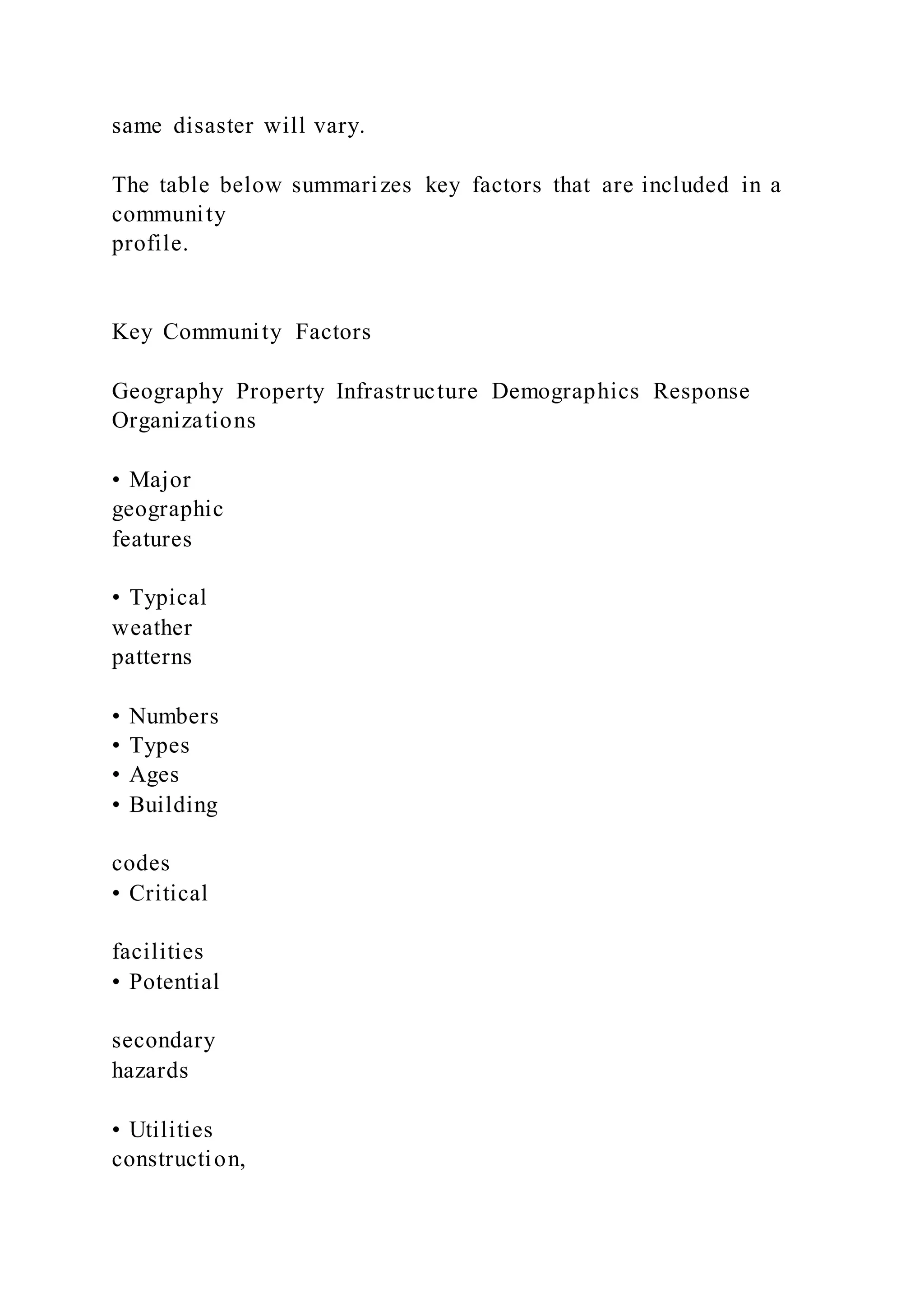
The table below summarizes key factors that are included in a
community
profile.
Key Community Factors
Geography Property Infrastructure Demographics Response
Organizations
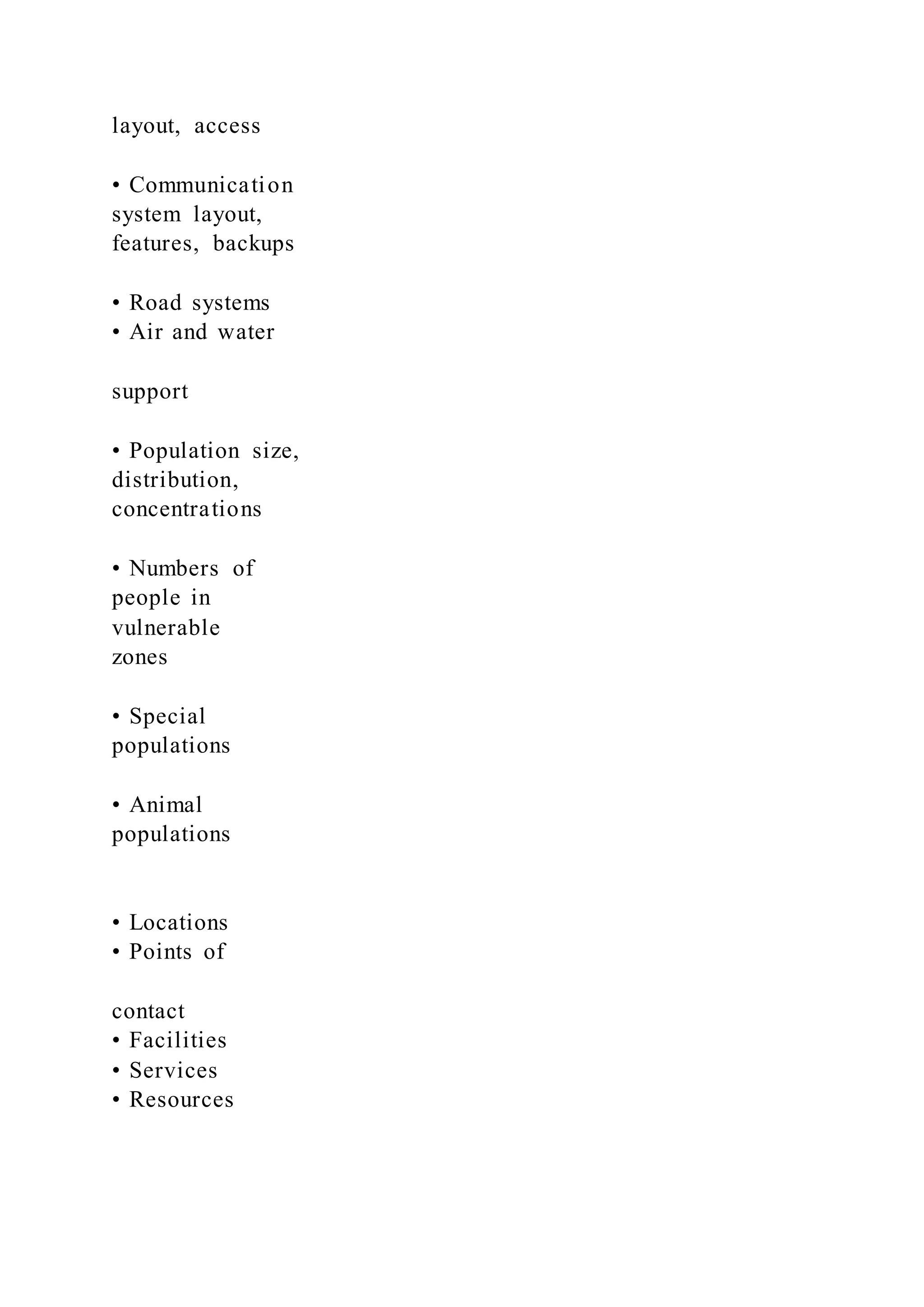
• Major
geographic
features
• Typical
weather
patterns
• Numbers
• Types
• Ages
• Building
codes
• Critical
facilities
• Potential
secondary
hazards
• Utilities
construction,
layout, access
• Communication
system layout,
features, backups
• Road systems
• Air and water
support
• Population size,
distribution,
concentrations
• Numbers of
people in
vulnerable
zones
• Special
populations
• Animal
populations
• Locations
• Points of
contact
• Facilities
• Services
• Resources
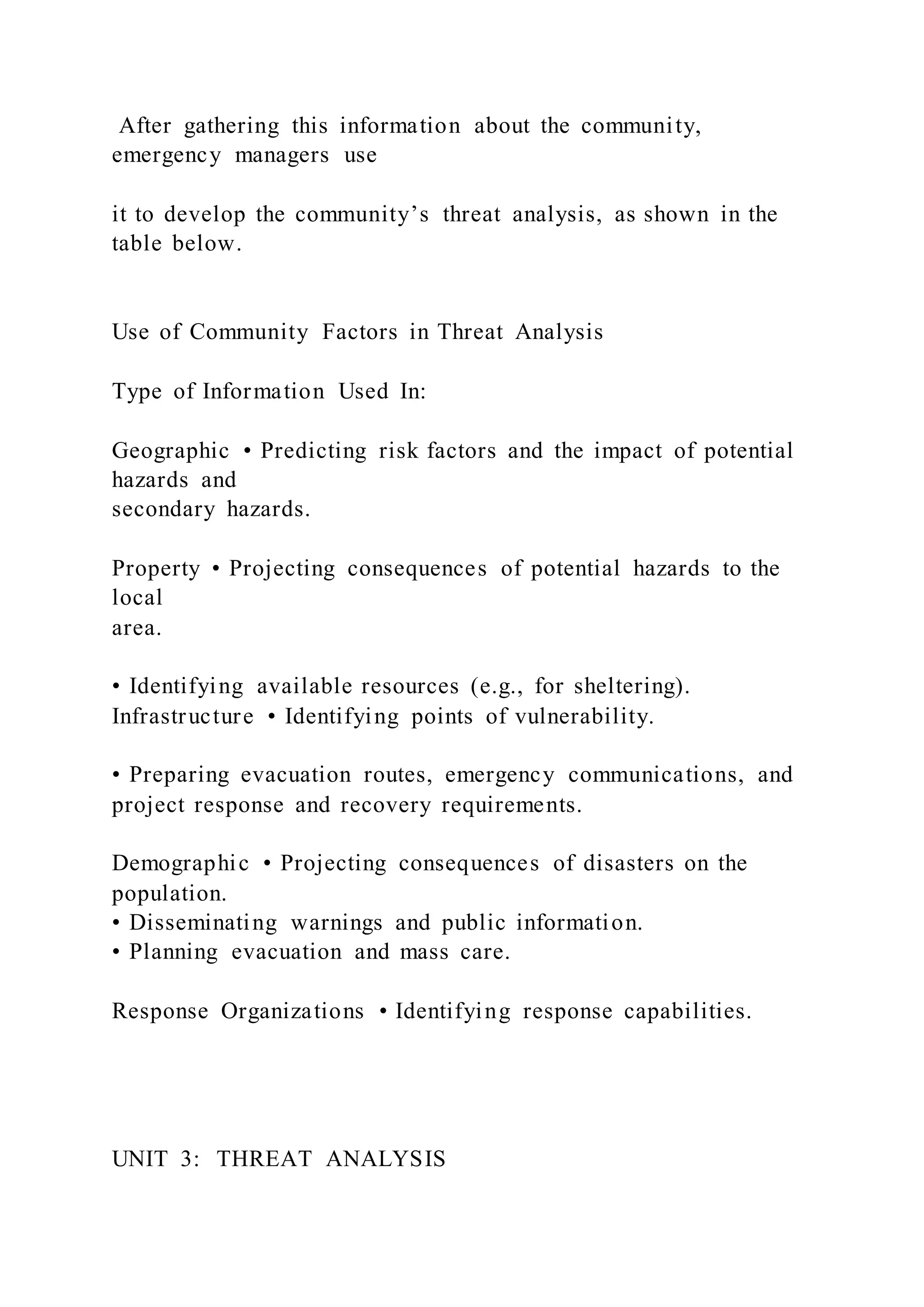
After gathering this information about the community,
emergency managers use
it to develop the community’s threat analysis, as shown in the
table below.
Use of Community Factors in Threat Analysis
Type of Information Used In:
Geographic • Predicting risk factors and the impact of potential
hazards and
secondary hazards.
Property • Projecting consequences of potential hazards to the
local
area.
• Identifying available resources (e.g., for sheltering).
Infrastructure • Identifying points of vulnerability.
• Preparing evacuation routes, emergency communications, and
project response and recovery requirements.
Demographic • Projecting consequences of disasters on the
population.
• Disseminating warnings and public information.
• Planning evacuation and mass care.
Response Organizations • Identifying response capabilities.
UNIT 3: THREAT ANALYSIS
Emergency Planning Page 3.8
Step 4: Determining Vulnerability
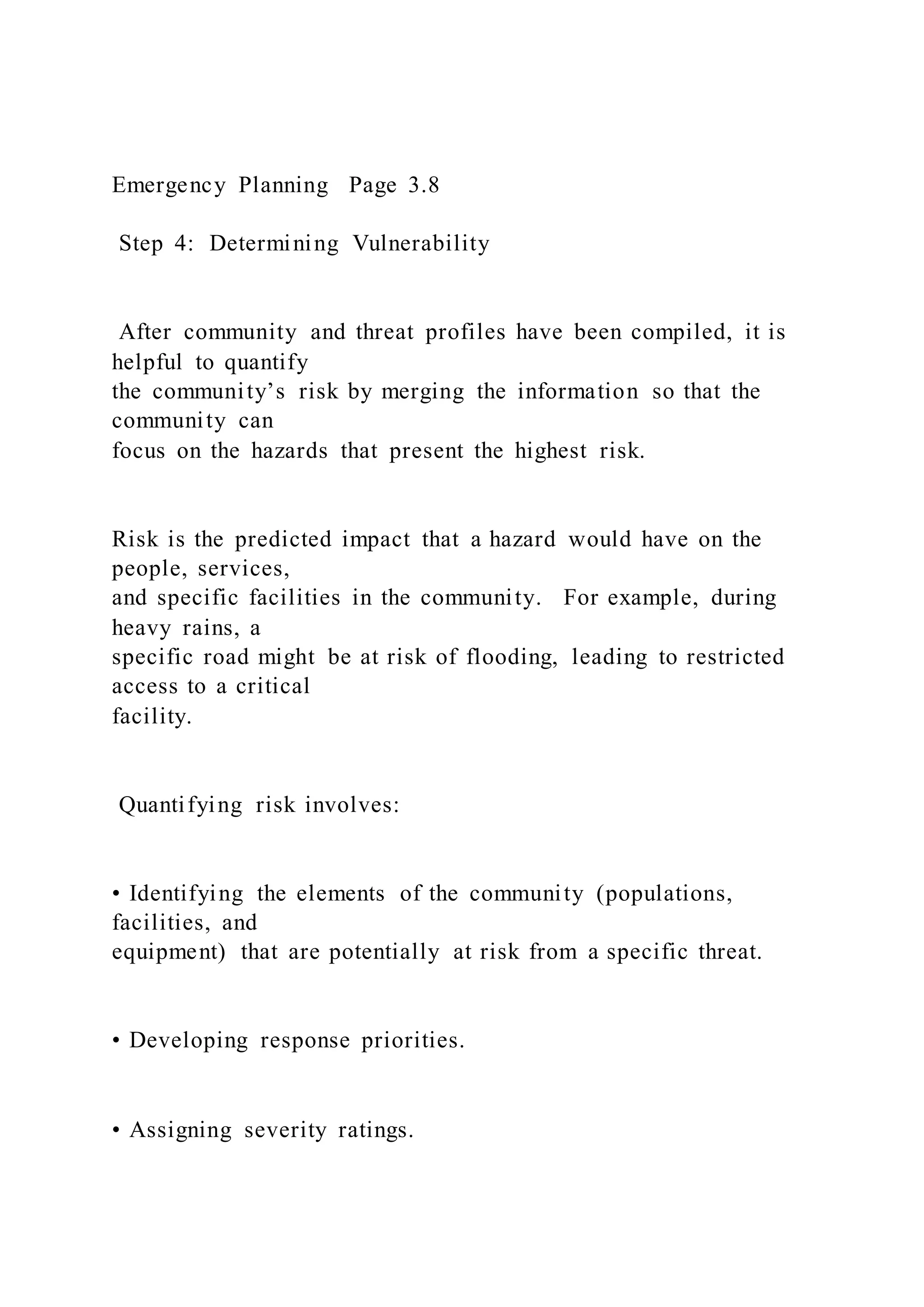
After community and threat profiles have been compiled, it is
helpful to quantify
the community’s risk by merging the information so that the
community can
focus on the hazards that present the highest risk.
Risk is the predicted impact that a hazard would have on the
people, services,
and specific facilities in the community. For example, during
heavy rains, a
specific road might be at risk of flooding, leading to restricted
access to a critical
facility.
Quantifying risk involves:
• Identifying the elements of the community (populations,
facilities, and
equipment) that are potentially at risk from a specific threat.
• Developing response priorities.
• Assigning severity ratings.
• Compiling risk data into community risk profiles.
In surveying risk, it is helpful to develop response priorities.
The following is a
suggested hierarchy for setting priorities:
• Priority 1
: Life safety (including hazard areas, high-risk populations, and
potential search and rescue situations). Keep in mind that
response
personnel cannot respond if their own facilities are affected.
• Priority 2
: Essential facilities.
• Priority 3: Critical infrastructure (utilities, communication,
and transportation
systems).
UNIT 3: THREAT ANALYSIS
Emergency Planning Page 3.9
Prioritizing Risks
The community should assign each hazard a severity rating—or
risk index—
that will predict, to the degree possible, the damage that can be
expected in
that community as a result of that threat.
This rating quantifies the expected impact of a specific hazard
on people,
essential facilities, property, and response assets.
The following is an example of severity ratings that may be
used:
Severity Characteristics
Catastrophic • Multiple deaths.
• Complete shutdown of critical facilities for 30 days or more.
• More than 50 percent of property severely damaged.
Critical • Injuries and/or illnesses result in permanent disability.
• Complete shutdown of critical facilities for at least 2 weeks.
• More than 25 percent of property is severely damaged.
Limited • Injuries and/or illnesses do not result in permanent
disability.
• Complete shutdown of critical facilities for more than 1
week.
• More than 10 percent of property is severely damaged.
Negligible • Injuries and/or illness treatable with first aid.
• Minor quality of life lost.
• Shutdown of critical facilities and services for 24 hours or
less.
• Less than 10 percent of property severely damaged.
Next, develop a risk index for each threat by assigning a value
to each severity
level (use the following values: 1 = catastrophic; 2 = critical; 3
= limited; 4 =
negligible) for the following types of threat data.
• Magnitude.
• Frequency of occurrence.
• Speed of onset.
• Community impact (severity rating).
• Special characteristics.
Finally, average the severity level for each factor to determine
the overall risk
level for that threat.
UNIT 3: THREAT ANALYSIS
Emergency Planning Page 3.10
Activity: Prioritizing Risks
This activity will provide you with an opportunity to develop a
risk index for the
threat you identified earlier in this unit. To complete this
activity, assign a
severity level to each type of threat data. Then, average the
severity level to
determine the overall risk to your community.
Hazard: __________________________
Characteristic Severity
Magnitude 1. Catastrophic
2. Critical
3. Limited
4. Negligible
Frequency of Occurrence 1. Catastrophic
2. Critical
3. Limited
4. Negligible
Speed of Onset 1. Catastrophic
2. Critical
3. Limited
4. Negligible
Community Impact 1. Catastrophic
2. Critical
3. Limited
4. Negligible
Special Characteristics 1. Catastrophic
2. Critical
3. Limited
4. Negligible
Total Risk 1. Catastrophic
2. Critical
3. Limited
4. Negligible
Note: When you prioritize all of the risks for your community,
it will be easier if you develop a
form that shows all of the threats on one or two pages.
UNIT 3: THREAT ANALYSIS
Emergency Planning Page 3.11
Step 5: Creating and Applying Scenarios
The final step in the threat analysis process is to develop
scenarios for the top-
ranked threats (or those that rank above a specified threshold)
that lay out the
threat’s development into an emergency. Scenarios should be
realistic and
based on the community’s threat and risk data.
To create a scenario, emergency managers brainstorm to track
the
development of a specific type of emergency. A scenario
should describe:
• The initial warning of the event.
• The potential overall impact on the community.
• The potential impact of the event on specific community
sectors.
• The potential consequences, such as damage, casualties, and
loss of
services.
• The actions and resources that would be needed to deal with
the situation.
Creating scenarios helps to identify situations that may exist in
a disaster.
These situations should be used to help ensure that your
community is
prepared should the threat event occur.
UNIT 3: THREAT ANALYSIS
Emergency Planning Page 3.12
Activity: Threat Analysis
Follow the steps below to complete this activity.
1. Imagine a scenario based on the threat you profiled earlier.
(Note: The
scenario may not give all of the information needed to
completely fill out
some of the charts.)
2. Answer the questions on the following pages.
UNIT 3: THREAT ANALYSIS
Emergency Planning Page 3.13
Activity: Threat Analysis (Continued)
3. Using the table below as a guide, make notes in the space
below about the key community
factors in your community.
Geography Property Infrastructure Demographics
Response
Organizations
Major geographic
features:
Numbers:
Utilities
construction,
layout, access:
Population size,
distribution,
concentrations:
Locations:
Types:
Communication
system layout,
features, backups:
Numbers of people
in vulnerable
zones:
Points of contact:
Ages:
Typical weather
patterns:
Building codes:
Road systems:
Special
populations:
Facilities:
Critical facilities:
Services:
Potential
secondary
hazards:
Air and water
support:
Animal
populations:
Resources:
UNIT 3: THREAT ANALYSIS
Emergency Planning Page 3.14
Activity: Threat Analysis (Continued)
4. Develop a risk index for the hazard by assigning a value to
each characteristic (using the
following values: 1 = catastrophic; 2 = critical; 3 = limited; 4 =
negligible) for the following
types of threat data. (Note: Ignore frequency of occurrence for
this exercise.)
• Magnitude
• Frequency of occurrence
• Speed of onset
• Community impact (severity rating)
• Special characteristics
Finally, average the values to arrive at a single risk index figure
for the threat event.
UNIT 3: THREAT ANALYSIS
Emergency Planning Page 3.15
Unit Summary
Threat analysis determines:
• What can occur.
• How often it is likely to occur.
• The damage it is likely to cause.
• How it is likely to affect the community.
• How vulnerable the community is to the threat.
There are five steps in the threat analysis process:
1. Identify threats.
2. Profile each threat.
3. Develop a community profile.
4. Determine vulnerability.
5. Create and apply scenarios.
In this unit, you have learned ways to identify what threats can
occur in your
community, the likelihood and severity of specific threats, and
community
vulnerability to various threats. Unit 4 will discuss the
components of a basic
EOP.
UNIT 3: THREAT ANALYSIS
Emergency Planning Page 3.16
For More Information
• HAZUS: National Hazard Loss Estimating Methodology:
https://www.fema.gov/hazus/
• Understanding Your Risks: Identifying Hazards and
Estimating Losses
(FEMA 386-2). Step-by-step guidance on how to accomplish a
risk
assessment:
http://www.fema.gov/library/viewRecord.do?id=1880
• The Natural Hazards Center, University of Colorado, Boulder.
Continuously
updated comprehensive list of links related to natural hazards:
www.colorado.edu/hazards
https://www.fema.gov/hazus/
http://www.fema.gov/library/viewRecord.do?id=1880�
http://www.colorado.edu/hazards�
UNIT 3: THREAT ANALYSIS
Emergency Planning Page 3.17
Knowledge Check
Carefully read each question and all of the possible answers
before selecting the most
appropriate response for each test item. Circle the letter
corresponding to the answer you have
chosen.
1. The first step in a threat analysis is to:
a. Divide the community into emergency management sectors.
b. Create scenarios to test response capabilities.
c. Develop a list of threats your community may face.
d. Quantify the community’s risks from identified threats.
2. A community profile should include information about the
community’s:
a. Voting patterns.
b. Congressional delegation(s).
c. Local ordinances.
d. Geography.
3. Information is collected about the community infrastructure
in order to identify response
capabilities.
a. True
b. False
4. Threat profiles should address each threat’s:
a. Sector population.
b. Quantification of risk.
c. Seasonal pattern.
d. Event severity.
5. Risk is the predicted impact that a threat would have on
people, services, and specific
facilities and structures in the community.
a. True
b. False
UNIT 3: THREAT ANALYSIS
Emergency Planning Page 3.18
Knowledge Check (Continued)
1. c
2. d
3. b
4. c
5. a
Unit 4: The Basic Plan
UNIT 4: THE BASIC PLAN
Emergency Planning Page 4.1
Introduction and Unit Overview
This unit will introduce and describe the purpose of the basic
plan. After
completing this unit, you should be able to:
• Identify the parts of an EOP.
• List the components of a basic plan.
• Describe the purpose of each component of the basic plan.
Components of a Basic Plan
Let’s begin by reviewing our definition of an EOP from Unit 2.
An EOP is a
document describing how citizens, property, and the
environment will be
protected in a disaster or emergency.
The EOP describes actions to be taken in response to natural,
manmade, or
technological hazards, detailing the tasks to be performed by
specific
organizational elements at projected times and places based on
established
objectives, assumptions, and assessment of capabilities.
An EOP should be:
• Comprehensive. It should cover all aspects of emergency
prevention,
preparedness, and response and address mitigation concerns as
well.
• All-hazards in approach and, thus, flexible enough to use in
all
emergencies—even unforeseen events.
• Risk-based. It should include hazard-specific information,
based on the
hazard analysis.
The purposes of the basic plan are to:
• Give an overview of the community’s emergency response
organization and
policies.
• Provide a general understanding of the community’s approach
to
emergency response for all involved agencies and organizations.
UNIT 4: THE BASIC PLAN
Emergency Planning Page 4.2
Components of a Basic Plan (Continued)
Although the basic plan provides the general approach to
emergency response,
it does not stand by itself. Rather, it forms the basis for the
remainder of the
plan, which also includes:
• Functional annexes that address the performance of a
particular broad task
or function, such as mass care or communications.
• Hazard-specific annexes that provide additional information
specific to a
particular hazard.
Annexes will be discussed in the next unit.
In addition, each part of the EOP may have addenda in the form
of standard
operating procedures (SOPs), maps, charts, tables, forms,
checklists, etc.
These addenda may be included as attachments or incorporated
by reference.
Although there is no mandatory format, the recommended
format (for the sake
of compatibility with other jurisdictions and levels of
government) for the local
basic plan includes the following components:
• Introductory Material. The introductory material consists of
the following
elements:
• Cover page, which includes the plan title, date, and
jurisdiction.
• Promulgation document. This document is signed by the
jurisdiction’s
CEO, affirming his or her support for the emergency
management
agency and planning process. It gives organizations the
authority and
responsibility to perform their tasks. It also mentions the
tasked
organizations’ responsibility to prepare and maintain
implementing
instructions, gives notice of necessary EOP revisions, and
commits to
the training necessary to support the EOP.
• Approval and implementation page, which introduces the
plan, outlines
its applicability, and indicates that it supersedes all previous
plans. It
includes a delegation of authority for specific modifications that
can be
made to the plan and by whom they can be made without the
senior
official’s signature. It is signed by the senior official(s)—e.g.,
Governor,
tribal leader(s), mayor, county judge, commissioner(s).
• Record of changes to the EOP (change number, date,
description, who
made the change, and affected parts).
• Record of distribution, which lists EOP recipients, including
title, name,
agency, date, and number of copies. EOP copies should be
numbered
and recorded.
• Table of contents.
UNIT 4: THE BASIC PLAN
Emergency Planning Page 4.3
Components of a Basic Plan (Continued)
• Purpose Statement, which includes:
• A broad statement of what the EOP is meant to do.
• A synopsis of the EOP and annexes.
The Purpose Statement need not be complex but should include
enough
information to establish the direction for the remainder of the
plan.
• Scope. The operations plan should also explicitly state the
scope of
emergency and disaster response to which the plan applies and
the entities
(departments, agencies, private sector, citizens, etc.) and
geographic areas
to which it applies.
• Situation Overview. The Situation Overview includes a
hazard analysis
summary, capability assessment, and mitigation overview. This
part of the
plan characterizes the planning environment, making clear why
emergency
operations planning is necessary. It draws from the threat
analysis to
narrow the scope of the EOP and includes the following types of
information:
• Hazards addressed by the plan
• Relative probability and impact
• Areas likely to be affected
• Vulnerable critical facilities
• Population distribution
• Special-needs populations
• Interjurisdictional relationships
• Actions taken in advance to minimize an incident’s impacts
• Planning Assumptions. The Assumptions statement
delineates what was
assumed to be true when the EOP was developed. The
Assumptions
statement shows the limits of the EOP, thereby limiting
liability. It may be
helpful to list even “obvious” assumptions, such as:
• Identified hazards will occur.
• Individuals and organizations are familiar with the EOP.
• Individuals and organizations will execute their assigned
responsibilities.
• Assistance may be needed and, if so, will be available.
• Executing the EOP will save lives and reduce damage.
• Concept of Operations. This section explains the
community’s overall
approach to emergency response (i.e., what, when, by whom).
It includes:
• The division of local, State, and Federal responsibilities.
• When the EOP will be activated—and when it will be
inactivated.
• Alert levels and the basic actions that accompany each level.
• The general sequence of actions before, during, and after an
event.
• Forms necessary to request assistance of various types.
UNIT 4: THE BASIC PLAN
Emergency Planning Page 4.4
Components of a Basic Plan (Continued)
• Organization and Assignment of Responsibilities. This
section:
• Lists the general areas of responsibility assigned by
organization and
position.
• Identifies shared responsibilities (and specifies which
organization has
primary responsibility and which have supportive roles).
The Organization and Assignment of Responsibilities section
specifies
reporting relationships and lines of authority for an emergency
response. In
addition, this section is where a jurisdiction discusses the
response
organizing option that it uses for emergency management:
emergency
support function (ESF), or agency and department, or functional
areas of
ICS/NIMS, or a hybrid.
• Direction, Control, and Coordination. This section:
• Describes the framework for all direction, control, and
coordination
activities.
• Identifies who has tactical and operational control of response
assets.
• Discusses multiagency coordination systems and processes
used during
an emergency.
• Provides information on how department and agency plans
nest into the
EOP (horizontal coordination) and how higher-level plans are
expected
to layer on the EOP (vertical integration).
• Information Collection, Analysis, and Dissemination. This
section:
• Describes the required critical or essential information
common to all
operations identified during the planning process.
• Identifies the type of information needed, where it is expected
to come
from, who uses the information, how the information is shared,
the
format for providing the information, and any specific times the
information is needed.
• Communications. This section:
• Describes the response-organization-to-response-organization
communication protocols and coordination procedures used
during
emergencies and disasters.
• Discusses the framework for delivering communications
support and
how the jurisdiction’s communications integrate into the
regional or
national disaster communications network.
• May be expanded as an annex and is usually supplemented by
communications SOPs and field guides.
UNIT 4: THE BASIC PLAN
Emergency Planning Page 4.5
Components of a Basic Plan (Continued)
• Administration, Finance, and Logistics. This section
includes:
• Assumed resource needs for high-risk hazards.
• Resource availability.
• Mutual aid agreements and assistance agreements.
• Policies on augmenting response staff with public employees
and
volunteers.
• A statement that addresses liability issues.
• Resource management policies (acquisition, tracking, and
financial
recordkeeping).
• Plan Development and Maintenance. Responsibility for the
coordination of
the development and revision of the basic plan, annexes, and
implementing
instructions must be assigned to the appropriate persons. This
section,
therefore:
• Describes the planning process.
• Identifies the planning participants.
• Assigns planning responsibilities.
• Describes the revision cycle (i.e., training, exercising, review
of lessons
learned, and revision).
• Authorities and References. This section cites:
• The legal bases for emergency operations and activities,
including:
laws, statutes, ordinances, executive orders, regulations, formal
agreements, and predelegation of emergency authorities.
• Pertinent reference materials (including related plans of other
levels of
government).
UNIT 4: THE BASIC PLAN
Emergency Planning Page 4.6
Activity: Basic Plan Review
This activity will give you the opportunity to review an EOP.
In Appendix A you
will find Section 1: Basic Plan from Jefferson County,
Alabama’s
Comprehensive Emergency Management Plan. Refer to the
Jefferson County
plan to answer the questions below. The answers follow the
activity.
Organization and Assignment of Responsibilities
1. The plan specifies use of the Incident Command organization
and structure
at incident sites.
a. Yes
b. No
2. In the Specific Local Government Responsibilities, the
Emergency
Management Council responsibilities include: (Check all that
apply.)
a. Extending or terminating emergency/disaster declarations.
b. Maintaining 800MHz radio system.
c. Ensuring payroll system setup to pay employees.
d. Providing overall direction and control.
e. Making disaster declarations and requesting State and Federal
assistance.
Concept of Operations
3. For a particular disaster event, the
___________________________
decides which functional annexes are activated to meet the
disaster
response needs.
Administration and Logistics
4. The plan specifies that administrative procedures may not be
relaxed,
suspended, or made optional to respond to emergencies.
a. Yes
b. No
UNIT 4: THE BASIC PLAN
Emergency Planning Page 4.7
Activity: Basic Plan Review (Continued)
Direction and Control
5. Write the letter of the emergency level in the left-hand
column next to the
matching description in the right-hand column.
a. Level 1 Emergency
b. Level 2 Emergency
c. Level 3 Emergency
c. Level 4 Emergency
_____ Non-routine assistance is
required or anticipated, and the EOC
is activated.
_____ Incidents at this level are
common, and the responding
department is responsible for
controlling them.
_____ State and Federal assistance
will be requested and is required.
_____ Internal and/or external
agencies provide routine assistance,
including mutual aid. Command and
control remain the responsibility of the
primary response department.
6. In G. Facilities, Emergency Operations Center, jurisdictions
are encouraged
to establish a(n) _______________________ to link to the
county EOC via
radio or telephone.
Attachment A: Primary Support Matrix
7. After heavy rains, a sewage treatment plant was inundated
and pumping
stations quit operating. The community water supply is
contaminated.
Annexes that definitely would apply to this situation include:
(Circle all that
apply.)
a. Annex 2, Situation Reporting
b. Annex 10, Public Works
c. Annex 11, Public Health Services
d. Annex 15, Law Enforcement Services
e. Annex 13, Fire Services
UNIT 4: THE BASIC PLAN
Emergency Planning Page 4.8
Activity: Basic Plan Review (Continued)
Suggested Answers:
1. a
2. a, d, e
3. EMA Coordinator
4. b
5. c, a, d, b
6. On-scene command post
7. a, b, c
UNIT 4: THE BASIC PLAN
Emergency Planning Page 4.9
Activity: Reviewing Your Community’s Basic Plan
Now that you have reviewed the contents and organization of a
sample basic
plan, you should review your community’s plan to see what it
contains and how
it is organized. To complete this activity, obtain a copy of your
community’s
basic plan and review it to see what types of information it
contains and how it
is organized. The questions below will help you organize your
review.
Be aware that your community’s plan may not be organized as
described in this
unit. Some States require a different structure. The important
point to
remember in your review is that, to be effective, the plan must
include the types
of content described in this unit.
1. Does your community’s plan include a promulgation
document signed by
the CEO?
2. What organizations are signatories to the plan?
3. What threats or hazards are addressed by the plan?
4. Who has the authority to activate part or all of the plan?
UNIT 4: THE BASIC PLAN
Emergency Planning Page 4.10
Activity: Reviewing Your Community’s Basic Plan
(Continued)
5. With what jurisdictions does your community have mutual
aid agreements or
assistance agreements?
6. When was the last time that the plan was revised?
UNIT 4: THE BASIC PLAN
Emergency Planning Page 4.11
Unit Summary
The EOP describes actions to be taken in response to hazards.
It details the
tasks to be performed, specifies which organizational elements
perform the
tasks, and at what times and places.
An EOP should be:
• Comprehensive.
• All-hazards.
• Risk-informed.
The components of the basic plan include:
• Introductory Materials.
• Purpose Statement, Scope, Situation, and Assumptions.
• Concept of Operations.
• Organization and Assignment of Responsibilities.
• Direction, Control, and Coordination.
• Information Collection and Dissemination.
• Communications.
• Administration, Finance, and Logistics.
• Plan Development and Maintenance.
• Authorities and References.
The basic plan provides the general approach to emergency
response, but it
does not stand alone. Unit 5 will discuss functional and hazard-
, threat-, and
incident-specific annexes to the EOP.
UNIT 4: THE BASIC PLAN
Emergency Planning Page 4.12
Knowledge Check
Carefully read each question and all of the possible answers
before selecting the most
appropriate response for each test item. Circle the letter
corresponding to the answer you have
chosen, or fill in the blank.
1. Which section of the EOP includes information about
hazards?
a. Purpose Statement
b. Situation and Assumptions
c. Concept of Operations
d. Administration and Logistics
2. The _____________ section of the EOP lists organizations
and their responsibilities in
emergency response.
3. Which section of the EOP specifies the sequence of actions
before, during, and after an
event?
a. Concept of Operations
b. Organization and Assignment of Responsibilities
c. Plan Development and Maintenance
d. Authorities and References
4. The Administration and Logistics section addresses resource
needs and availability.
a. True
b. False
5. Which of the following is not described in the Plan
Development and Maintenance section?
a. Planning participants
b. Planning responsibilities
c. The revision cycle
d. Resources
UNIT 4: THE BASIC PLAN
Emergency Planning Page 4.13
Knowledge Check (Continued)
1. b
2. Organization and Assignment of Responsibilities
3. a
4. a
5. d
Unit 5: Annexes
UNIT 5: ANNEXES
Emergency Planning Page 5.1
Introduction and Unit Overview
This unit introduces two types of supporting annexes:
functional annexes and
hazard-, threat-, and incident-specific annexes. After you
complete this unit,
you should be able to:
• List the functional annexes recommended for inclusion in
every EOP.
• Identify factors for deciding whether to develop an annex.
• Describe the basic structure for annexes.
• Determine when other documentation (e.g., maps) is needed to
accompany
annexes.
Annexes
How do you know whether to develop a supporting annex to
your community’s
EOP?
An annex:
• Explains how the community will carry out a broad function,
such as warning
or resource management, in any emergency.
• Adds information about special planning needs related to a
specific hazard,
threat, or incident type. Which hazard-specific annexes are
included
depends on the community’s hazard analysis. For example, a
community in
California would probably include an earthquake annex in its
EOP; a
community in Florida would probably include a hurricane
annex; and a
community in the Midwest would undoubtedly include an annex
that
addresses tornadoes. The decision about whether to develop an
annex
rests with the planning team.
In general, the organization of annexes parallels that of the
basic plan. Specific
sections can be developed to expand upon—but not to repeat—
information that
is contained in the basic plan.
UNIT 5: ANNEXES
Emergency Planning Page 5.2
Functional Annexes
It is important early in the planning process to choose the
functions that will be
included in the basic plan as annexes. Factors that you should
consider when
making these choices include the:
• Organizational structure of the State and local governments.
• Capabilities of your jurisdiction’s emergency services
agencies.
• Established policy in regard to the concept of operations.
Keep in mind the threat analysis information that you learned in
Unit 3. What
you and your planning team know about the vulnerability of
your community is
key to developing meaningful functional annexes to your basic
plan.
Because communities vary so widely, no single listing of
functional annexes can
be prescribed for every one. However, nine core functions are
typically
addressed in annexes in every EOP:
• The Direction, Control, and Coordination Annex allows a
jurisdiction to
analyze the situation and decide on the best response, direct the
response
teams, coordinate efforts with other jurisdictions, and make the
best use of
available resources.
• The Information Collection, Analysis, and Dissemination
Annex
describes the required critical or essential information common
to all
operations identified during the planning process.
• The Communications Annex provides detailed focus on the
entire
communications system and how it will be used.
• The Population Warning Annex describes the warning systems
in place
and the responsibilities and procedures for using them.
• The Emergency Public Information (EPI) Annex provides the
procedure
for giving the public accurate, timely, and useful information
and instructions
throughout the emergency period.
Note that while a Population Warning Annex focuses on the
procedures that
the government uses to alert those at risk, an EPI Annex deals
with
developing messages and accurate information, disseminating
the
information, and monitoring how the information is received.
Because the
warning system is one means for an EPI organization to get
information out,
an EPI Annex must address coordination with those responsible
for the
warning system.
UNIT 5: ANNEXES
Emergency Planning Page 5.3
Functional Annexes (Continued)
• The Public Protection Annex describes the provisions (e.g.,
for evacuation
or in-place sheltering) that have been made to ensure the safety
of people
threatened by the hazards the jurisdiction faces.
• The Mass Care and Emergency Assistance Annex deals with
the actions
that are taken to protect evacuees and other disaster victims
from the
effects of the disaster, including providing temporary shelter,
food, medical
care, clothing, and other essential needs.
• The Health and Medical Services Annex describes policies and
procedures for mobilizing and managing health and medical
services under
emergency or disaster conditions.
• The Resource Management Annex describes the means,
organization,
and process by which a jurisdiction will find, obtain, allocate,
and distribute
resources to satisfy needs that are generated by an emergency or
disaster.
In addition to the above listed annexes, the EOP planning team
should include
annexes that make sense for your community. For example, if
your community
has a nuclear power plant, you may want to include an annex on
radiological
protection. Other functional annexes that may be included are:
• Damage Assessment.
• Search and Rescue.
• Emergency Services.
• Aviation Operations.
Some jurisdictions may want to modify their functional annex
structure to use
the 15 Emergency Support Functions (ESFs) identified in the
NRF. Some
communities that have adopted the ESF approach have also
added additional
ESFs to meet local needs. The ESF structure facilitates the
orderly flow of local
requests for governmental support to the State and Federal
levels and the
provision of resources back down to local government during an
emergency.
State and local jurisdictions that choose not to adopt the ESF
structure should
cross-reference their functional annexes with the ESFs.
UNIT 5: ANNEXES
Emergency Planning Page 5.4
Activity: Reviewing Your EOP’s Functional Annexes
To complete this activity, refer to your community’s basic plan
that you reviewed
in Unit 4. The questions below will help you organize your
review.
Again, while no single listing of annexes can be prescribed for
every
community, you must be aware of which annexes (if any) your
EOP contains
and which annexes are required for your jurisdiction based on
your resources,
size and type of government, etc.
Remember that, to be effective, the annexes in your EOP must
include core
functions as well as functions that address the hazards that you
learned to
profile in Unit 3.
1. Does your community’s plan include a(n):
Direction, Control, and Coordination Annex?
Information Collection, Analysis, and Dissemination Annex?
Communications Annex?
Population Warning Annex?
Emergency Public Information (EPI) Annex?
Public Protection Annex?
UNIT 5: ANNEXES
Emergency Planning Page 5.5
Activity: Reviewing Your EOP’s Functional Annexes
(Continued)
Mass Care and Emergency Assistance Annex?
Health and Medical Services Annex?
Resource Management Annex?
2. What other annexes, if any, does your EOP contain?
3. Based on the knowledge of threat analysis that you gained in
Unit 3, what, if
any, additional annexes should your EOP contain?
4. What threats are addressed by the plan?
5. Who has the authority to activate part or all of the plan?
UNIT 5: ANNEXES
Emergency Planning Page 5.6
Hazard-, Threat-, and Incident-Specific Annexes
Hazard-, threat-, and incident-specific annexes focus on the
special planning
needs generated by a particular hazard, threat, or incident.
Topics addressed
in these annexes include:
• Special planning requirements.
• Priorities identified through threat analysis.
• Unique characteristics of the hazard, threat, or incident
requiring special
attention.
• Special regulatory considerations.
Hazard-specific annexes follow the basic plan’s content
organization. Hazard-
specific operations information is typically provided i n the
Concept of
Operations section and includes:
• Assessment and control of the hazard.
• Identification of unique prevention and critical infrastructure
and key
resources (CIKR) protection activities to be undertaken to
address the
hazard or threat, as appropriate.
• Selection of protective actions.
• Conduct of public warning.
• Implementation of protective actions.
• Implementation of short-term stabilization actions.
• Implementation of recovery actions.
The following table provides examples of specific types of
information that can
be included in a hazard-specific annex in relation to the nine
functional areas.
UNIT 5: ANNEXES
Emergency Planning Page 5.7
Hazard-, Threat-, and Incident-Specific Annexes (Continued)
Functions Hazard-Specific Information
Direction, Control,
and Coordination
• Response actions keyed to specific time periods and phases
• Urban search and rescue (US&R) inspection
• Inspection, condemnation, and demolition of structures and
buildings
• Protective gear for responders
• Detection equipment and techniques
• Laboratory analysis services
• Containment and cleanup teams
• Actions to ensure that the area directly affected by the disaster
is secure and
safe enough for the return of evacuated populations or for the
continued
presence of those who did not evacuate
Information
Collection,
Analysis, and
Dissemination
• Hazard-unique provisions for information sharing (e.g.,
sharing terrorism
information between EOCs and fusion centers)
Communications • Provisions made to ensure that the effects of
a specific hazard do not prevent
or impede the ability of response personnel to communicate
with each other
during response operations
Population
Warning
• Hazard-unique public warning protocols
• Required or recommended notifications of State and Federal
officials
Emergency Public
Information
• Information the public will need to know about the specific
hazard (e.g., special
evacuation routes and shelters, in-place protective actions, etc.)
• The means (i.e., particular medium/media) that will be used to
convey that
information to the public
Public Protection • Public protection options and timing
• Special exclusion zones for a specific hazard (e.g., downwind
and crosswind
areas for nuclear power and chemical plants; coastal areas
subject to flooding
caused by storms, hurricanes, and/or tidal surge, etc.)
• Evacuation routes
• Transportation resources to support mass evacuation
Mass Care and
Emergency
Assistance
• Shelter locations outside the hazard’s vulnerable area
• Structural survivability requirements for building in the
hazard vulnerability
zone and the application of mitigation measures
• Protection of shelter occupants from the effects of the hazard
• Special medicines and/or antidotes for shelter occupants
• Food and water stocks to support extended shelter stays
• Capability to decontaminate people exposed to hazardous
materials
Health and
Medical Services
• Unique health consequences and treatment options for people
exposed to the
hazard
• Environmental monitoring and/or decontamination
requirements
Resource
Management
• Provisions for purchasing, stockpiling, or otherwise obtaining
special protective
gear, supplies, and equipment needed by response personnel and
disaster
victims
UNIT 5: ANNEXES
Emergency Planning Page 5.8
Annex Implementing Instructions
Each supporting annex (as well as the basic plan) may use
implementing
instructions in the form of:
• Standard operating procedures (SOPs).
• Maps.
• Charts.
• Tables.
• Forms.
• Checklists.
Implementing instructions may be included as attachments or
referenced. Your
EOP planning team may use supporting documents as needed to
clarify the
contents of the plan or annex. For example, the Evacuation
Annex may be
made clearer by attaching maps with evacuation routes marked,
because these
routes may change depending on the location of the hazard.
Similarly, the
locations of shelters may be marked on maps supporting the
Mass Care Annex.
An example of the kind of forms that may be attached is a
resource request
form. Charts, tables, and checklists are appropriate for the
Resource
Management Annex (e.g., resource checklists).
UNIT 5: ANNEXES
Emergency Planning Page 5.9
Activity: Hazard-Specific Annex Review
Refer to your community’s basic plan to complete this activity.
Choose one of
your EOP’s hazard-specific annexes and use the checklist below
to review it for
completeness.
Annex ______________________________
Does this annex address one or more of the following:
ific hazard?
-specific information not covered in other parts of the
plan?
Does this annex:
graphics?
the function?
appropriate?
Is the organization of this annex consistent with other parts of
the EOP (i.e.,
Purpose, Situation and Assumptions, etc.)?
What modifications or additions would you suggest to make this
annex more
effective?
UNIT 5: ANNEXES
Emergency Planning Page 5.10
Unit Summary
A functional annex explains how the community will carry out
a broad function in
any emergency. There are nine core functions that typically are
addressed in
annexes in every EOP:
• Direction, Control, and Coordination
• Information Collection, Analysis, and Disseminatio n
• Communications
• Population Warning
• Emergency Public Information (EPI)
• Public Protection
• Mass Care and Emergency Assistance
• Health and Medical Services
• Resource Management
A hazard-, threat-, or incident-specific annex contains special
requirements or
regulatory response details that apply to a single hazard.
Each annex (as well as the basic plan) may use supporting
documents in the
form of:
• SOPs.
• Maps.
• Charts.
• Tables.
• Forms.
• Checklists.
Each jurisdiction’s planning team should ensure the inclusion in
their EOP of
the functional and hazard-specific annexes that will meet the
requirements of
their community during emergencies and disasters.
Unit 6 will discuss implementing instructions for carrying out
the tasks that are
assigned in the EOP.
UNIT 5: ANNEXES
Emergency Planning Page 5.11
Knowledge Check
Carefully read each question and all of the possible answers
before selecting the most
appropriate response for each test item. Circle the letter
corresponding to the answer you have
chosen.
1. Which of the following describes a particular disaster
response function?
a. Annex
b. Standard operating procedures
2. The Planning Committee decides which hazard-specific
annexes to add to the EOP.
a. True
b. False
3. All of the following are examples of functional annexes,
EXCEPT FOR:
a. Direction and Control
b. Communications
c. Terrorism Response
d. Population Warning
4. All of the following are examples of supporting documents,
EXCEPT FOR:
a. Map
b. Recordkeeping form
c. Checklist
d. References
5. Response protocols for a tornado would be outlined in a:
a. Functional annex.
b. Hazard-specific annex.
UNIT 5: ANNEXES
Emergency Planning Page 5.12
Knowledge Check (Continued)
1. a
2. b
3. c
4. d
5. b
Unit 6: Implementing
Instructions
UNIT 6: IMPLEMENTING INSTRUCTIONS
Emergency Planning Page 6.1
Introduction and Unit Overview
This unit will introduce the different types of implementing
instructions that may
be developed at the agency level and how they are used. After
you complete
this unit, you should be able to:
• Describe the different types of implementing instructions and
the purpose
for each.
• Explain why implementing instructions must be developed at
the agency
level.
• Identify an implementing instruction that would be appropriate
for a tasking
or an area of responsibility assigned to your agency.
What Are Implementing Instructions?
Implementing instructions are documents, developed by
individual agencies,
that provide detailed instructions for carrying out tasks assigned
in the EOP.
Typically, implementing instructions are included in the EOP by
reference only.
Implementing instructions provide tools for carrying out the
community’s plan.
They help ensure that those who are responsible for
implementing the EOP are
able to carry out their roles effectively.
There are several types of implementing instructions that
organizations can
develop:
• Standard operating procedures (SOPs)
• Job aids
• Checklists
• Information cards
• Recordkeeping and combination forms
• Maps
Each of these types of implementing instructions will be
discussed in the
sections that follow.
UNIT 6: IMPLEMENTING INSTRUCTIONS
Emergency Planning Page 6.2
Standard Operating Procedures
SOPs:
• Provide step-by-step instructions for carrying out specific
responsibilities.
• Describe who, what, where, when, and how.
• Are appropriate for:
• Complex tasks requiring step-by-step instructions.
• Tasks for which standards must be specified.
• Tasks for which documentation of performance protocols is
required as
protection against liability.
To develop SOPs:
• Develop a task list.
• Determine who, what, where, when, and how. Note that
“who” includes:
• Who performs the activity.
• To whom he or she reports.
• With whom he or she coordinates.
• Identify the steps for each task.
• Identify the standards for task completion.
• Test the procedures.
Keep the SOPs up to date through review and revision.
UNIT 6: IMPLEMENTING INSTRUCTIONS
Emergency Planning Page 6.3
Job Aids
SOPs, or parts of SOPs, can be presented as job aids. A job aid
is a written
procedure that is intended to be used on the job while the task is
being done.
Job aids are appropriate for complex tasks, critical tasks that
could result in
serious consequences, tasks that are infrequently done, and
procedures or
personnel that change often. Job aids are also useful when
conformity is
needed among workers and/or across locations. Job aids should
specify:
• The task title.
• The purpose of the task.
• When to do the task.
• Materials needed to perform the task.
• How to perform each step of the task.
• The desired result(s).
• Standards to which the task must be performed.
• How to check the work.
A job aid may include:
• Examples.
• Graphics.
• Flow charts.
• If…then decision tables.
• Do’s and don’ts.
Because job aids are designed to be used in the midst of
completing a task, to
be effective they must be clear. They should use action verbs
and everyday
language, highlight important information, and place warnings
before the steps
to which they apply.
Formatting is also important when creating job aids.
Numbering steps and
using space, boxes, or lines to separate steps allows users to
find their place
easily after looking away.
UNIT 6: IMPLEMENTING INSTRUCTIONS
Emergency Planning Page 6.4
Job Aids (Continued)
You should keep in mind that job aids may not be useful for all
tasks, especially
simple tasks that are performed regularly, or must be
accomplished quickly,
from memory. If a task cannot be performed while referring to
a job aid at the
same time, a job aid is not appropriate for the task.
Checklists
Checklists provide a list of tasks, steps, features, contents, or
other items to be
checked off. They often take the form of boxes to be checked
off (e.g., yes/no,
done/not done, present/not present). They may also take the
form of a rating
scale.
Checklists are useful for tasks that are made up of multiple
steps or for when it
might be necessary to document the completion of the steps.
Checklists are
less useful when observations must be recorded or when
calculations or
evaluations must be made.
Information Cards
Information cards provide information that is needed on the job
in a
convenient—often graphic—form. Examples include:
• Reference lists.
• Diagrams, labeled illustrations, charts, or tables.
• Information summarized in matrix form (e.g., a tax table).
Information that might be usefully presented on information
cards includes:
• Call-down rosters.
• Contact lists.
• Resource lists.
• Organizational charts.
• Task matrices.
• Equipment diagrams.
UNIT 6: IMPLEMENTING INSTRUCTIONS
Emergency Planning Page 6.5
Forms
Common forms used as implementing instructions include:
• Recordkeeping forms on which calculations, observations, or
other
information (e.g., damage assessment) can be recorded.
• Combination forms that serve multiple functions, such as
checklists with
recordkeeping sections.
Maps
Finally, maps may also be used as implementing instructions to
highlight:
• Geographic features and boundaries.
• Jurisdictional boundaries.
• Locations of key facilities.
• Transportation or evacuation routes.
When a map is designed to show a particular feature, extraneous
details are
often eliminated.
Creating Effective Implementing Instructions
To be effective, implementing instructions must be appropriate
for both the
intended use and audience. They must also be:
• Complete in that they cover all of the components or steps.
• Clear, concise, and easy to use. They should avoid jargon and
ambiguity,
be organized logically (the way the task is actually done), and
include
instructions that identify the purpose and applicability of the
particular
implementing instruction.
• Sufficiently detailed in that they give all of the necessary
information.
• Up to date. The latest revision date should be included.
• Sufficient in scope in that, together, they cover each function
fully.
• Identified in the EOP so that their existence is recorded.
Implementing
instructions can be incorporated or referenced.
The activity that follows asks you to choose the appropriate
type of
implementing instruction for the stated purpose.
UNIT 6: IMPLEMENTING INSTRUCTIONS
Emergency Planning Page 6.6
Activity: Which Type Is Best?
For each item in the first column, choose the type of
implementing instruction
that best fits from the second column. Then turn the page to
check your
answers.
____ 1. A task for which it is necessary to document
completion of multiple steps
____ 2. A call-down roster
____ 3. A complex task
____ 4. Evacuation routes
____ 5. An aid to be used on the job
____ 6. A means to record observations and/or
calculations (e.g., damage assessment)
A. SOPs
B. Job aid
C. Checklist
D. Information card
E. Form
F. Map
UNIT 6: IMPLEMENTING INSTRUCTIONS
Emergency Planning Page 6.7
Activity: Which Type Is Best? (Continued)
1. c
2. d
3. a
4. f
5. b
6. e
UNIT 6: IMPLEMENTING INSTRUCTIONS
Emergency Planning Page 6.8
Who Uses Implementing Instructions?
Implementing instructions are used by all agency personnel
who respond to
disasters, whatever their function.
Implementing instructions are developed at the agency level for
two reasons:
• Personnel from an agency with a specific function (e.g.,
communications)
will have no idea how to tell another agency’s personnel (e.g.,
firefighters)
how to do their jobs.
• Agency personnel will be the persons who use the
implementing
instructions and therefore will know if they are helpful and
effective.
The implementing instructions used by your agency personnel
should support
your agency’s roles and responsibilities as described in the
basic plan. Thus,
probably only some types of implementing instructions will be
useful to your
agency, depending on its function in disaster response.
The following activity gives you an opportunity to identify
which implementing
instructions would be helpful for your agency to develop to
carry out its
responsibilities in an emergency.
UNIT 6: IMPLEMENTING INSTRUCTIONS
Emergency Planning Page 6.9
Activity: Identifying Possible Agency Implementing
Instructions
Answer the questions below to identify which implementing
instructions would
be useful to develop for your agency.
1. What are your agency’s primary responsibilities in disaster
response?
2. Which implementing instructions would be useful for helping
personnel carry
out those responsibilities?
UNIT 6: IMPLEMENTING INSTRUCTIONS
Emergency Planning Page 6.10
Unit Summary
Implementing documents, developed by individual agencies,
provide agency
personnel with detailed instructions for carrying out their tasks,
as assigned in
the EOP.
Depending on an agency’s roles and responsibilities, different
types of
implementing instructions may be appropriate tools to help
personnel carry out
various tasks.
Types of implementing instructions include:
• SOPs, appropriate for complex tasks that require step-by-step
instructions
or tasks for which standards must be specified.
• Job aids to help complete on-the-job tasks that are complex,
infrequently
performed, or that require conformity among personnel or
locations.
• Checklists that provide a list of tasks, steps, or other items to
be checked
off—useful for tasks with multiple steps or when documentation
of
completion of steps is required.
• Information cards that provide convenient, graphic, on-the-job
information
such as diagrams, illustrations, tables, or charts.
• Recordkeeping forms for recording calculations, observations,
or
information such as damage assessments.
• Combination forms that serve multiple functions.
• Maps that indicate information such as geographic features,
boundaries,
key facilities, evacuation routes, etc.
Unit 7 will review the course content and help you prepare to
take the final
exam.
UNIT 6: IMPLEMENTING INSTRUCTIONS
Emergency Planning Page 6.11
Knowledge Check
Carefully read each question and all of the possible answers
before selecting the most
appropriate response for each test item. Circle the letter
corresponding to the answer you have
chosen, or fill in the blank.
1. Some SOPs can be presented as job aids to be used in the
midst of completing a task.
a. True
b. False
2. A job aid provides convenient, sometimes graphic,
information that is most useful when
completing simple tasks that can be done quickly from memory.
a. True
b. False
3. A(n) ____________ would be the best type of implementing
instruction for a contact list.
4. Implementing instructions are developed at the
____________ level.
a. Federal
b. State
c. Agency
5. Implementing instructions must be attached directly to the
EOP, not simply incorporated by
reference.
a. True
b. False
UNIT 6: IMPLEMENTING INSTRUCTIONS
Emergency Planning Page 6.12
Knowledge Check (Continued)
1. a
2. b
3. Information card
4. c
5. b
Unit 7: Course Summary
UNIT 7: COURSE SUMMARY
Emergency Planning Page 7.1
Introduction
This course was designed to provide you with training in the
fundamentals of
the emergency planning process. This unit will review the
important information
from the entire course and serve as preparation for the final
examination. After
you complete this unit, you should be able to summarize the key
points of the
course and complete the final exam.
The Planning Process
Emergency planning is a continual cycle of planning, training,
exercising, and
revision that takes place throughout the five phases of the
emergency
management cycle: prevention, preparedness, mitigation,
response, and
recovery.
The end product of emergency planning is a communi ty EOP.
An EOP can be
defined as a document describing how citizens and property will
be protected in
a disaster or emergency.
There are six steps in the emergency planning process:
1. Form a collaborative planning team.
2. Understand the situation.
3. Determine goals and objectives.
4. Develop the plan.
5. Prepare, review, and approve the plan.
6. Implement and maintain the plan.
Emergency planning necessitates a coordinated team effort
involving different
levels of government and many community agencies and
organizations.
UNIT 7: COURSE SUMMARY
Emergency Planning Page 7.2
The Planning Process (Continued)
Working with personnel from other agencies and organizations
requires
collaboration. Collaboration is the process in which people
work together as a
team on a common mission—in this case, development of a
community EOP.
Collaboration is more difficult, however, in the face of
differences among
agencies in terminology, experience, mission, and culture.
Thus, collaboration
also requires flexibility to agree on common terms and
priorities, and humility to
learn from others’ ways of doing things.
Collaboration does not come automatically. Building a team
that works well
together takes time and effort.
Teams go through stages in the process of becoming productive:
• Forming
• Storming
• Norming
• Performing
• Adjourning
The team leader is important in motivating members to work
through their
differences and focus on the common goal of developing an
EOP. Other team
members may also play different roles, including task master,
innovator,
organizer, evaluator, and finisher.
A productive team displays the following characteristics:
• Commitment to a common goal (i.e., development of an EOP).
• A leader who provides direction and guidance.
• Open communication.
• Constructive conflict resolution.
• Mutual trust.
• Respect for each individual and his or her contributions.
UNIT 7: COURSE SUMMARY
Emergency Planning Page 7.3
Threat Analysis
Threats are indications of possible violence, harm, or danger.
Threat analysis determines:
• What can occur.
• How often it is likely to occur.
• The damage it is likely to cause.
• How it is likely to affect the community.
• How vulnerable the community is to the threat.
The steps in the threat analysis process are:
1. Identify threats. Develop a list of threats the community may
face based
on historical data about past events. If your community has an
existing
threat analysis, review it and identify any changes that have
occurred since
it was developed.
2. Profile threats, considering the duration, seasonal pattern,
and speed of
onset. A crucial part of the threat profile is the availability of
warnings.
3. Develop a community profile, considering geography,
property,
infrastructure, demographics, and response organizations.
4. Determine vulnerability by merging information from the
community and
hazard profiles to focus on the threats that present the highest
risk.
5. Create and apply scenarios based on the community’s threat
and risk
data.
UNIT 7: COURSE SUMMARY
Emergency Planning Page 7.4
Threat Analysis (Continued)
Risk is the predicted impact that a hazard would have on the
people, services,
and specific facilities in the community. Quantifying risk
involves:
• Identifying the elements of the community that are potentially
at risk from a
specific threat.
• Developing response priorities.
• Assigning severity ratings.
• Compiling risk data into community risk profiles.
In surveying risk, it is helpful to develop response priorities.
The following is a
suggested hierarchy for setting priorities:
1. Life safety
2. Essential facilities
3. Infrastructure lifelines
The final step in the hazard analysis process is creating and
applying scenarios
based on the community’s threat and risk data. A scenario
should describe the:
• Initial warning of the event.
• Potential impact on the community.
• Potential impact on specific community sectors.
• Potential consequences.
• Actions and resources needed to deal with the situation.
UNIT 7: COURSE SUMMARY
Emergency Planning Page 7.5
The Basic Plan
The format of the EOP includes three parts:
• The basic plan.
• Functional annexes.
• Hazard-, threat-, or incident-specific annexes.
The recommended format for the basic plan includes the
following components:
• Introductory Material, which includes:
• Cover page.
• The promulgation document, signed by the jurisdiction’s CEO.
• Approval and implementation page, signed by the senior
official(s).
• Record of changes to the EOP.
• Record of distribution, which lists EOP recipients.
• Table of contents.
• Purpose Statement, which includes the EOP’s purpose and a
synopsis.
• Scope, which states the scope of emergency and disaster
response to
which the plan applies and the entities and geographic areas to
which it
applies.
• Situation Overview, which characterizes the planning
environment
community, including hazards and populations.
• Assumptions Statement, which delineates what was assumed to
be true
when the EOP was developed.
• Concept of Operations, which explains the community’s
approach to
emergency response, including activation levels and the
sequence of
actions before, during, and after an emergency.
• Organization and Assignment of Responsibilities, which
assigns
responsibilities by organization and position and identifies
shared
responsibilities (specifying who has primary responsibility and
who plays a
support role).
• Direction, Control, and Coordination, which describes the
framework for
all direction, control, and coordination activities.
• Information Collection, Analysis, and Dissemination, which
describes
the required critical or essential information common to all
operations
identified.
UNIT 7: COURSE SUMMARY
Emergency Planning Page 7.6
The Basic Plan (Continued)
• Communications, which describes communication protocols
and
coordination procedures.
• Administration, Finance, and Logistics, which addresses
resources.
• Plan Development and Maintenance, which assigns planning
responsibilities to participants and describes the revision cycle.
• Authorities and References, which cites the legal basis for
emergency
operations and relevant reference materials.
Annexes
There are two types of supporting annexes: functional annexes
and hazard-,
threat-, or incident-specific annexes.
A functional annex explains how the community will carry out a
broad function,
such as warning or resource management, in any emergency.
There are nine
functions that typically are addressed in annexes in every EOP
(one function
per annex):
• Direction, Control, and Coordination
• Information Collection, Analysis, and Dissemination
• Communications
• Population Warning
• Emergency Public Information
• Public Protection
• Mass Care and Emergency Assistance
• Health and Medical Services
• Resource Management
In addition, communities may choose to add other annexes that
make sense for
their situations (e.g., radiological protection if the community
has a nuclear
power plant).
UNIT 7: COURSE SUMMARY
Emergency Planning Page 7.7
Annexes (Continued)
A hazard-, threat-, or incident-specific annex focuses on the
special planning
needs generated by a particular hazard. The annexes to be
included in the
plan depend on the community’s hazard analysis.
Topics addressed in hazard-specific annexes include special
regulatory
considerations, planning requirements, priorities, and unique
hazard
characteristics that require special planning.
In general, the organization of annexes parallels that of the
basic plan.
Specific sections can be developed to expand upon—but not to
repeat—
information that is contained in the basic plan.
In addition, each annex may use supporting documents as
needed to clarify
the contents (e.g., a map to show evacuation routes, a form to
request
resources, or a table to list position responsibilities).
Implementing Instructions
Implementing instructions are documents, developed by
individual agencies,
that provide detailed instructions for carrying out tasks assigned
in the EOP.
There are several types of implementing instructions that
organizations can
develop:
• SOPs, which provide step-by-step instructions for carrying out
specific
responsibilities.
• Job aids, which are written procedures that are intended to be
used on the
job while the task is being done.
• Checklists, which provide a list of tasks, steps, contents, or
other items to
be checked off.
• Information cards, which provide information such as lists of
contacts or
resources in a convenient form. Information cards sometimes
use graphics
such as diagrams.
• Recordkeeping and combination forms on which to record
calculations
and observations.
• Maps on which to mark boundaries, key facilities, and routes.
UNIT 7: COURSE SUMMARY
Emergency Planning Page 7.8
Final Steps
You have now completed IS-235 and should be ready to take
the final exam.
To take the final exam:
• Go to http://training.fema.gov/IS and click on the “ISP Course
List” link.
• Locate and click on the title for this course, and then click on
“Take Final
Exam.”
http://training.fema.gov/IS/�
Appendix A: Sample Plan:
Jefferson County
APPENDIX A: SAMPLE PLAN: JEFFERSON COUNTY
Emergency Planning Page A.1
Record of Changes
The Emergency Management Agency (EMA) ensures that
necessary changes and revisions to
plan are prepared, coordinated, published, and distributed.
The plan will undergo revision whenever:
• Any other condition occurs that causes conditions to change.
• It fails during emergency.
• Exercises, drills reveal deficiencies or “shortfall(s).”
• Local government structure changes.
• Community situations change.
• State requirements change.
EMA will maintain a list of individuals and organizations which
have controlled copies of the
plan. Only those with controlled copies will automatically be
provided updates and revisions.
Plan holders are expected to post and record these changes.
Revised copies will be dated and
marked to show where changes have been made.
“Record of Changes” form is on the following page.
APPENDIX A: SAMPLE PLAN: JEFFERSON COUNTY
Emergency Planning Page A.2
Record of Changes
Nature of
Change
Date of Change Page(s)
Affected
Changes Made by (Signature)
APPENDIX A: SAMPLE PLAN: JEFFERSON COUNTY
Emergency Planning Page A.3
How To Use This Plan
Note: This is a generic, strategic plan, organized by
“emergency functions.” The “Basic Plan”
section provides a general overview and summary of the
purpose, responsibilities, and
operational concepts. Annexes are functions that may be
activated and performed during
emergencies and disasters. While the concept of operations
should always remain the same,
the functions activated will be dependent on the
emergency/disaster type and scope.
1. Read Section 1, the “Basic Plan.” Take note of your
department’s/agency’s general
responsibilities contained within the Basic Plan.
2. Look at the “Primary/Support Matrix” appended to the Basic
Plan (Section 1, VI. Attachment
A). Find the name of your agency/organization. Note which
annex(es) your
department/agency appears in. Within each annex that your
agency is a part of, you will
find additional specific responsibilities.
3. Your department/agency must develop and maintain standard
operating procedures (SOPs)
in such detail as necessary that will result in successful
activation and completion of your
responsibilities as stated. Refer to the Basic Plan (Section 1, II.
Organization and
Responsibilities, Part B) for additional information and
guidance.
Helpful Hint: Make a list of your general responsibilities
(found in Section 1, II.
Organization and Responsibilities, Part B of the Basic Plan) and
specific responsibilities
(found in each annex that your department/agency is involved
with). This responsibilities
listing is the basis for internal, tactical SOPs and personnel
action guides.
4. Each annex contains a “cover page summary.” This summary
lists the
departments/agencies/organizations providing primary support
to this function. The county,
State, and Federal agencies, who would provide additional
assistance if requested, are also
shown.
Jefferson County Department/Agency
SOP’s
The “How To”
Each Department/Agency
“Constructs Their Own”
Action Guides To Perform Their
Responsibilities As Stated In The Jefferson
County CEMP
Tac
tics
The Jefferson County CEMP Is
The Document Used To
Develop Department/Agency
SOPs
Jefferson
County
CEMP
Strategy
Contents:
Laws
Authorities
Policies
Responsibilities
Tasks
Functional Annexes
General Guidance Only:
Who
What
When
Where
How
Jefferson County Department/Agency
SOP’s
The “How To”
Each Department/Agency
“Constructs Their Own”
Action Guides To Perform Their
Responsibilities As Stated In The Jefferson
County CEMP
Tac
tics
Jefferson County Department/Agency
SOP’s
The “How To”
Each Department/Agency
“Constructs Their Own”
Action Guides To Perform Their
Responsibilities As Stated In The Jefferson
County CEMP
Tac
tics
Tac
tics
The Jefferson County CEMP Is
The Document Used To
Develop Department/Agency
SOPs
Jefferson
County
CEMP
Strategy
Jefferson
County
CEMP
StrategyStrategy
Contents:
Laws
Authorities
Policies
Responsibilities
Tasks
Functional Annexes
General Guidance Only:
Who
What
When
Where
How
APPENDIX A: SAMPLE PLAN: JEFFERSON COUNTY
Emergency Planning Page A.4
Jefferson County, Alabama
Comprehensive Emergency Management Plan
Section 1: Basic Plan
I. Mission
A. Purpose, Goals, and Definitions
B. Authorities, Guidance Documents, and Mutual Aid
Agreements
C. Situations
D. Assumptions
E. Limitations
F. Policies
II. Organization and Responsibilities
A. Organization
B. Responsibilities
III. Concept of Operations
A. General
B. Emergency Management Phases
C. Functional Annex Concept
IV. Administration and Logistics
A. General
B. Policies
C. Administration
D. Fiscal
E. Logistics
F. Insurance
V. Direction and Control
A. General
B. Crisis Monitoring
C. Levels of Emergency
D. On-scene Management/ICS
E. EOC Activations and Staffing
F. Controls, Continuity of Operations
G. Facilities
H. Military Support
I. Continuity of Government
J. Plan Maintenance
VI. Attachments
A. Primary/Support Matrix
APPENDIX A: SAMPLE PLAN: JEFFERSON COUNTY
Emergency Planning Page A.5
Jefferson County, Alabama
Comprehensive Emergency Management Plan
Section 1: Basic Plan
I. Mission
A. Purpose, Goals, and Definitions
1. Purpose
a. This plan describes the basic strategies, assumptions and
mechanisms through
which the departments/agencies within the county will mobilize
resources and
conduct activities to guide and support local emergency
management efforts through
response and recovery. To facilitate effective
intergovernmental operations, this
plan adopts a functional approach that groups the type of
assistance to be provided
under annexes to address functional needs at the local
government level. Each
“functional annex” is headed by a primary agency, which has
been selected based
on its authorities, resources, and capabilities in the functional
area. The “functional
annexes” serve as the primary mechanism through which
assistance is managed in
an affected area.
b. This plan provides for an orderly means to prevent or
minimize (mitigation
strategies), prepare for, respond to, and recover from
emergencies or disasters that
threaten life, property, and the environment within Jefferson
County boundaries by:
• Identifying major natural and manmade hazards, threats to
life, property, and/or
the environment that are known or thought to exist.
• Assigning emergency management responsibilities and tasks.
• Describing predetermined actions (responsibilities, tasks) to
be taken by
departments/agencies, and other cooperating organizations and
institutions, to
eliminate or mitigate the effects of these threats, and to respond
effectively and
recover from an emergency or disaster.
• Providing for effective assignment and utilization of local
government employees.
• Documenting the current capabilities and existing resources of
departments/agencies and other cooperating organizations and
institutions which
must be maintained to enable accomplishment of those
predetermined actions.
• Providing for the continuity of local government during and
after an emergency or
disaster.
• Enhance cooperation (mutual aid agreements and
memorandums of
understanding) and coordination with cooperating community
agencies,
neighboring jurisdictions, and State and Federal agencies.
APPENDIX A: SAMPLE PLAN: JEFFERSON COUNTY
Emergency Planning Page A.6
• Providing for an emergency planning team comprised of
representatives from all
departments as identified and utilized through this plan
development for
containing review and revision of the plan; exercise planning
and evaluation; and
reviewing and offering recommendations on emergency
management initiatives.
c. This plan provides guidance for:
• Mitigation, preparedness, response, and recovery policy and
procedures.
• Disaster and emergency responsibilities.
• Training and public education activities.
d. This plan is strategic and “responsibility oriented,” and
addresses:
• Coordinated regional and interregional evacuation, shelter,
and post-disaster
response and recovery.
• Rapid deployment and predeployment of resources.
• Communications and warning systems.
• Annual exercises to determine the ability to respond to
emergencies.
• Clearly defined responsibilities for departments/agencies
through a “functional
annex” approach to planning and operations.
2. Goals
a. Develop citizen self-sufficiency.
b. Develop first responder capabilities.
c. To have a plan (framework, strategy) that will guide
organizational behavior
(response) during emergency(ies) or disaster(s).
d. Create a framework of interagency and community-wide
cooperation to enhance
disaster mitigation, preparedness, response, and recovery.
3. Definitions
a. The term “emergency” as used in this plan means a set of
circumstances which
demand immediate action to protect life; preserve public safety,
health, and essential
services; or protect property and the environment.
b. “Disaster” means the situation requires all available local
government resources
and/or augmentation, and is beyond the capabilities of the
county or a city(ies). A
state of “emergency” or “disaster” can be proclaimed by a chief
elected official and/or
Emergency Council Chairperson, Vice Chairperson, or
Emergency Management
Agency (EMA) Coordinator.
APPENDIX A: SAMPLE PLAN: JEFFERSON COUNTY
Emergency Planning Page A.7
B. Authorities, Guidance Documents, Mutual Aid Agreements
1. Authorities
a. Federal
• Public Law (P.L.) 93-288, Disaster Relief Act of 1974, as
amended by P.L. 100-
707 (“The Stafford Act”)
• Emergency Management and Assistance, 44 U.S. Code 2.1
(Oct. 1, 1980)
• P.L. 81-920, Federal Civil Defense Act of 1950 as amended
• P.L. 99-499, Title III, Emergency Planning and Community
Right-to-Know, Oct.
17, 1986
b. State
• Public Law (P.L.) 31-9, Act 47, Alabama Civil Defense Act of
1955
• P.L. 29-3, Act 875, Emergency Interim Succession Act, 1961
• P.L. 83-612, Alabama Department of Civil Defense name
changed to Alabama
Emergency Management Agency, 1983
• Alabama Executive Order Number 4, March 6, 1987
• Alabama Executive Order Number 40, July 23, 1985
c. Local
• Jefferson County Commission Resolution of November 13,
1951
• City of Birmingham General Ordinances, 1980, sections 2-3-1
and 9-4-1 through
9-4-4
• Birmingham/Jefferson County Emergency Management
Agency Mayor’s Council
Resolution of October 10, 1984
2. Guidance Documents
a. State of Alabama Guide for Developing an Emergency
Operations Plan, 1996
b. National Response Framework, 2008
3. Agreements and Understandings
Central Alabama Fire Chief’s Association Disaster Assistance
Agreement
C. Situations
1. Hazard Analysis
a. The Jefferson County Hazard Vulnerability Analysis
(published separately) provides
details on local hazards to include type, effects, impacts, risk,
capabilities, and other
related data.
APPENDIX A: SAMPLE PLAN: JEFFERSON COUNTY
Emergency Planning Page A.8
b. Due to its location and geological features, Jefferson County
is vulnerable to the
damaging affects of certain hazards that include, but are not
limited to:
Natural: Drought, extreme cold, extreme heat, forest fire,
riverine flood, flash flood,
landshift (earthquake, earthslide, erosion, subsidence),
snow/ice/hail, windstorm,
lightning storm, hurricane, tornado, epidemic (human/animal).
Technological: Hazardous materials (fixed facility,
transportation), fire/explosion,
building/structure collapse, dam/levee failure, power/utility
outage, extreme air
pollution, transportation accident (rail, marine, aircraft, motor
vehicle).
Civil/Political Disorder: Economic emergency, riot, strike,
demonstration/special
events, terrorism/sabotage, hostage situation, attack
(conventional, nuclear,
biological, chemical).
c. Disaster response efforts are often hampered by equipment
and facility damage,
communication failures, inclement weather, responder injury
and death, and many
other limiting factors. In the event of an emergency or disaster
that exceeds the
available resources, the public should expect and be prepared
for a minimum 72
hour delay for emergency response service.
D. Assumptions
1. Governmental officials within the county recognize their
responsibilities regarding the
safety and well being of the public and they will assume their
responsibilities when the
Comprehensive Emergency Management Plan is implemented.
2. General Conditions. When a community experiences a
disaster, its surviving citizens fall
into three broad categories: those directly affected through
personal or family injury or
property damage; those indirectly affected by an interruption of
the supply of basic
needs; and those who are not personally impacted. These
guidelines were designed to
promote citizen self-confidence and independence in the face of
a disaster. Following
these guidelines will allow the emergency organization within
the county to concentrate
first on helping those citizens directly affected by a disaster.
3. It is expected that each individual or head of a household will
develop a family disaster
plan and maintain the essential supplies to be self-sufficient for
a minimum of 72 hours.
4. Businesses are expected to develop internal disaster plans
that will integrate and be
compatible with local government resources and this plan.
Note: This plan is not intended to limit or restrict initiative,
judgment, or independent
action required to provide appropriate and effective emergency
and disaster mitigation,
preparation, response, and recovery.
APPENDIX A: SAMPLE PLAN: JEFFERSON COUNTY
Emergency Planning Page A.9
E. Limitations
1. It is the policy of the Jefferson County Emergency
Management Council that no
guarantee is implied by this plan. Because local government
assets and systems may
be damaged, destroyed, or overwhelmed, the Council can only
endeavor to make
responsible efforts to respond based on the situation,
information, and resources
available at the time.
2. Adequate funding is needed to support this plan and its
programs. The performance of
the assigned tasks and responsibilities will be dependent on
appropriations and funding
to support the plan. Lack of funding may degrade the services
envisioned under this
plan.
Note: The inability of Departments/Agencies to carry out their
responsibilities as
indicated in both the Basic Plan and annexes due to lack of staff
and funding may lower
“emergency declaration threshold.”
F. Policies
1. In order to protect lives and property and in cooperation with
other elements of the
community (e.g., business, volunteer sector, social
organizations, etc.), it is the policy of
the Jefferson County Emergency Management Council to
endeavor to mitigate, prepare
for, respond to, and recover from all natural and manmade
emergencies and disasters.
2. It is the policy of the Jefferson County Emergency
Management Council that it will take
appropriate action in accordance with this plan to mitigate any
harm to the citizens or
property in the county.
3. Because of the nature of emergencies and disasters (causing
damages, interruptions
and shortfalls to local government resources), it is the policy of
the Jefferson County
Emergency Management Council that citizens are encouraged to
be self-sufficient for a
minimum of 72 hours should an emergency or disaster occur.
4. It is the policy of the Jefferson County Emergency
Management Council to make this
plan a “user friendly” document.
5. Non-discrimination. It is the policy of the Jefferson County
Emergency Management
Council that no services will be denied on the basis of race,
color, national origin,
religion, sex, age, or inability, and no special treatment will be
extended to any person or
group in an emergency or disaster over and above what
normally would be expected in
the way of local government services. Council activities
pursuant to the Federal/State
Agreement for major disaster recovery will be carried out in
accordance with Title 44,
Code of Federal Regulations (CFR), Section 205.16—
nondiscrimination. Federal
disaster assistance is conditional on full compliance with this
rule.
APPENDIX A: SAMPLE PLAN: JEFFERSON COUNTY
Emergency Planning Page A.10
Jefferson County, Alabama
Comprehensive Emergency Management Plan
Section 1: Basic Plan
II. Organization and Responsibilities
A. Organization
1. Emergency Management Council
a. The Jefferson County Commission by November 13, 1951,
resolution (pursuant to
Federal and State law) created the Birmingham/Jefferson
County Civil Defense
Corps. The local governing bodies within the county passed
resolutions/ordinances
joining in this organization creating a “Civil Defense Council”
to govern the joint “civil
defense program.” The Council is authorized and empowered to
make, amend, and
rescind any and all necessary orders, rules, and regulations for
direction and control
of the “program.” As needed the Council requests
municipalities to adopt proper
ordinances implementing within each municipality the orders
rules, and regulations
of the council.
b. As per the 1951 resolution and current State law, the Council
is charged with
establishing and maintaining an emergency management
organization, and
developing policies to prepare for, respond to, and recover from
emergencies and
disasters that threaten or occur in Jefferson County. The
policies will be established
through the promulgation of a comprehensive Emergency
Management Plan.
c. The Council is governed by a Chairperson and Vice
Chairperson. In the absence of
the Chairperson and the Vice Chairperson, the EMA
Coordinator has the
responsibility to carry out Council policy in all matters.
d. The Jefferson County Emergency Management Council has
designated the EMA
Coordinator as being responsible for day-to-day operations,
including the
implementation of policies and procedures issued by the
Council. The EMA
Coordinator reports to the Emergency Management Council
Chairperson.
2. Emergency Organization
a. The Chief Elected Official of the municipalities, together
with the President of the
Jefferson County Commission, constitute the Jefferson County
Emergency
Management Council. The Council is, and has been from its
inception, the body
charged with the overall responsibility for developing and
implementing
comprehensive emergency management policies in Jefferson
County, Alabama.
b. The Jefferson County Emergency Management Council has
selected two members
to serve as General Chairperson and Vice Chairperson and to
represent the Council
in the conduct of emergency operations.
APPENDIX A: SAMPLE PLAN: JEFFERSON COUNTY
Emergency Planning Page A.11
c. The Primary/Support Matrix (see Basic Plan Attachment A)
reflects the
organizational structure of the Jefferson County Emergency
Management network
and indicates the various activities which can support
emergency operations.
d. This plan establishes the emergency management
organization within the county.
All officers and employees of local government are part of the
emergency
organization. All appointments and work assignments in an
emergency situation
shall be documented. All departments/agencies will submit
documentation as to
staffing allocation, equipment distribution, and other emergency
related needs as
requested by the EMA Coordinator.
3. Incident Command System
This plan formalizes the Incident Command organization and
structure at incident sites.
4. EMA Planning Team
An EMA Planning Team is hereby established through
promulgation of this plan. The
team shall be composed of representatives or alternates from
selected
departments/agencies. The team shall formulate emergency
management
recommendations to the EMA Coordinator. This includes
development and
maintenance of this plan, exercise planning and evaluation, and
related initiatives.
Members of the planning team shall be appointed by the EMA
Coordinator. The EMA
Coordinator will chair the team and will schedule periodic
meetings as needed.
B. Responsibilities
1. General Preparedness Responsibilities (All
departments/agencies within Jefferson
County). The following common responsibilities are assigned
to each department/agency
listed in this plan. Further, each department/agency shall create
an internal emergency
management organization and develop Standard Operating
Procedures (SOPs) in
accordance with the provisions of this plan. Preparation
activities include:
• Establishing departmental and individual responsibilities (as
indicated in this plan);
identify emergency tasks.
• Working with other departments/agencies to enhance
cooperation and coordination, and
eliminate redundancy. Departments having shared
responsibilities should complement
each other.
• Establishing education and training programs so that each
division, section, and
employee will know exactly where, when, and how to respond.
• Developing site specific plans for department facilities as
necessary.
• Ensuring that employee job descriptions reflect their
emergency duties.
• Training staff and volunteer augmentees to perform emergency
duties, tasks.
• Identifying, categorizing, and inventorying all available
departmental resources.
APPENDIX A: SAMPLE PLAN: JEFFERSON COUNTY
Emergency Planning Page A.12
• Developing procedures for mobilizing and employing
additional resources.
• Ensuring communication capabilities with the EOC.
• Filling positions in the emergency organization as requested
by the EMA Coordinator
acting in accordance with this plan.
• Preparing to provide internal logistics support to department
operations during the initial
emergency response phase.
2. General Response Responsibilities (All departments/agencies
within Jefferson
County). The following common responsibilities are assigned
to each department listed in
this plan.
• Upon receipt of an alert or warning, initiate notification
actions to alert employees and
volunteer augmentees assigned response duties.
• As appropriate:
• Suspend or curtail normal business activities.
• Recall essential off-duty employees.
• Send nonessential employees home.
• Evacuate departmental facilities.
• As requested, augment the EOC’s effort to warn the public
through use of vehicles
equipped with public address systems, sirens, employees going
from door to door, etc.
• Keep the EOC informed of field activities, and maintain a
communications link to the
EOC.
• Activate a control center to support and facilitate department
response activities,
maintain events log, and report information to the EOC.
• Report damages and status of critical facilities to the EOC.
• If appropriate or requested, send a representative to the EOC.
• Ensure staff members tasked to work in the EOC have the
authority to commit
resources and set policies.
• Coordinate with the EOC to establish protocols for interfacing
with State, Federal
responders.
• Coordinate with the EOC Information Officer before releasing
information to the media.
• Submit reports to the EOC detailing departmental emergency
expenditures and
obligations.
APPENDIX A: SAMPLE PLAN: JEFFERSON COUNTY
Emergency Planning Page A.13
3. Specific Local Governmental Responsibilities
a. Ambulance Services
• Perform functions in the EOC or on-scene as assigned.
• Provide EMA and/or EOC initial situation/damage reports as
per field units’
observations and reports from the general public.
• Provide supplies, equipment, and personnel as requested.
• Provide emergency medical transportation and emergency
medical services in
the field.
b. Birmingham Communications Department
• Perform functions in the EOC or on-scene as assigned.
• Provide EMA and/or EOC initial situation/damage reports as
per field units’
observations and report from the general public.
• Provide supplies, equipment, and personnel as requested.
• Maintain communication systems.
c. Birmingham Equipment Management
• Perform functions in the EOC or on-scene as assigned.
• Provide EMA and/or EOC initial situation/damage reports as
per field units’
observations and reports from the general public.
• Provide supplies, equipment, and personnel as requested.
• Operate fleet repair facility.
• Provide for availability of motor fuels for all county vehicles,
American Red Cross
vehicles, and fuel driven facility.
• Provide for storage of equipment and vehicles in a safe place.
• Provide for security of county complex.
• Provide comprehensive list of county vehicles and equipment
to EMA.
d. Birmingham Regional Emergency Medical Services System
(BREMSS)
• Perform functions in the EOC or on-scene as assigned.
• Provide EMA and/or EOC initial situation/damage reports as
per field units’
observations and reports from the general public.
• Provide supplies, equipment, and personnel as requested.
• Provide training and equipment.
• Develop and coordinate field medical protocols.
• Provide trauma coordination through the Trauma Control
Center.
• Assist in mass fatality incidents.
e. Business and Industry
• Perform functions in the EOC or on-scene as assigned.
• Provide EMA and/or EOC initial situation/damage reports as
per field units’
observations and reports from the general public.
• Provide supplies, equipment, and personnel as requested.
APPENDIX A: SAMPLE PLAN: JEFFERSON COUNTY
Emergency Planning Page A.14
f. Building Inspection Services
• Perform functions in the EOC or on-scene as assigned.
• Provide EMA and/or EOC initial situation/damage reports as
per field units’
observations and reports from the general public.
• Provide supplies, equipment, and personnel as requested.
g. Campuses, Universities
• Perform functions in the EOC or on-scene as assigned.
• Provide EMA and/or EOC initial situation/damage reports as
per field units’
observations and reports from the general public.
• Provide supplies, equipment, and personnel as requested.
• Provide the estimated number of people requiring emergency
shelter, food, and
water distribution points, check car facilities as need.
h. Churches
• Perform functions in the EOC or on-scene as assigned.
• Provide EMA and/or EOC initial situation/damage reports as
per field units’
observations and reports from the general public.
• Provide supplies, equipment, and personnel as requested.
• Provide facilities for emergency shelter, food, and water
distribution points, check
car facilities as need.
i. Civil Air Patrol
• Perform functions in the EOC or on-scene as assigned.
• Provide EMA and/or EOC initial situation/damage reports as
per field units’
observations and reports from the general public.
• Provide supplies, equipment, and personnel as requested.
• Augment search and rescue missions as requested and within
their capabilities.
j. Community Service Organizations
• Perform functions in the EOC or on-scene as assigned.
• Provide EMA and/or EOC initial situation/damage reports as
per field units’
observations and reports from the general public.
• Provide supplies, equipment, and personnel as requested.
• Assist with meeting the needs of special populations and
individuals.
k. Data Processing (Jefferson County Information Services)
• Perform functions in the EOC or on-scene as assigned.
• Provide EMA and/or EOC initial situation/damage reports as
per field units’
observations and reports from the general public.
• Provide supplies, equipment, and personnel as requested.
• Maintain computers for payroll.
APPENDIX A: SAMPLE PLAN: JEFFERSON COUNTY
Emergency Planning Page A.15
l. Department of Human Resources (DHR)
• Perform functions in the EOC or on-scene as assigned.
• Provide EMA and/or EOC initial situation/damage reports as
per field units’
observations and reports from the general public.
• Provide supplies, equipment, and personnel as requested.
• Assist with the assessment of human needs during and after a
disaster.
• Identify requirements for individuals and populations with
“special needs.”
• Coordinate transportation requirements for special needs
agencies/individuals.
• Coordinate with the American Red Cross, and other agencies
as necessary to
provide emergency programs for basic human needs to include
reception
centers, shelters, mass feeding.
• Work in close concert with American Red Cross and others in
the activation and
operation of short-term temporary “holding centers” and long-
term
shelters/disaster centers.
m. Emergency Management Council
• Provide overall direction and control.
• Proclaim a county-wide “state of emergency,” when necessary.
• Make disaster declarations and request State and Federal
assistance.
• Issue emergency rules and proclamations that have the force
of law during the
proclaimed emergency period.
• Ensure that the county continues to function administratively
and make
administrative policy decisions.
• Appropriate funds to meet disaster expenditure needs.
• Extend or terminate emergency/disaster declarations.
n. Finance
• Perform functions in the EOC or on-scene as assigned.
• Provide EMA and/or EOC initial situation/damage reports as
per field units’
observations and reports from the general public.
• Provide supplies, equipment, and personnel as requested.
• Provide appraisers to assist with damage assessments.
• Process emergency purchases/procurement.
• Establish and maintain a system whereby incident costs are
identified and
accumulated for State and Federal reimbursement.
• Ensure payroll system setup to pay employees.
APPENDIX A: SAMPLE PLAN: JEFFERSON COUNTY
Emergency Planning Page A.16
o. Fire Departments
• Perform functions in the EOC or on-scene as assigned.
• Provide EMA and/or EOC initial situation/damage reports as
per field units’
observations and reports from the general public.
• Provide supplies, equipment, and personnel as requested.
• Provide and coordinate fire and rescue services.
• Provide initial emergency medical services and prehospital
care.
• Contain, control hazardous materials.
• Provide limited response to search and rescue off-road
situations, and coordinate
heavy rescue operations.
• Augment warning system by providing siren-equipped and/or
public address
mobile units, and/or manpower for door-to-door warning.
• Support other public safety operations.
• Order evacuation whenever necessary to protect lives and
property.
p. Funeral Directors Association
• Assist in mass fatality incidents by providing recovery,
evacuation, mortuary
operations, identification, and notification.
q. Greater Birmingham Humane Society
• Provide assistance in the prevention, detection, and control of
rabies.
• Provide animal control and services assistance.
r. Hospitals
• Provide medical care.
• Resupply field units with consumable medical supplies.
• Make assessment of hospital capabilities and damages.
• Mobilize staff to provide teams to respond to mass casualty
incidents.
• Coordinate with Blood Bank and assist in blood procurement
for community
needs.
• Participate in hospital radio net that links hospitals,
Emergency Operations
Center, fire dispatch, and FD/EMS.
s. Jefferson County Communications
• Perform functions in the EOC or on-scene as assigned.
• Provide EMA and/or EOC initial situation/damage reports as
per field units’
observations and reports from the general public.
• Provide supplies, equipment, and personnel as requested.
• Maintain 800mhz radio system.
APPENDIX A: SAMPLE PLAN: JEFFERSON COUNTY
Emergency Planning Page A.17
t. Jefferson County Coroner/Medical Examiner’s Office
• Perform functions in the EOC or on-scene as assigned.
• Provide EMA and/or EOC initial situation/damage reports as
per field units’
observations and reports from the general public.
• Provide supplies, equipment, and personnel as requested.
• Establish fatality collection areas to facilitate recovery
operations.
• Identify mass burial sites.
• Protect the property and personal effects of the deceased.
• Notify relatives.
• Establish and maintain a comprehensive recordkeeping system
for continual
updating and recording of fatality numbers.
u. Jefferson County Department of Health
• Perform functions in the EOC or on-scene as assigned.
• Provide EMA and/or EOC initial situation/damage reports as
per field units’
observations and reports from the general public.
• Provide supplies, equipment, and personnel as requested.
• Perform disease control operations, to include epidemic
intelligence, evaluation,
prevention (including mass inoculations) and detection of
communicable
diseases.
• Issue general health advisories, information, and instructions.
• Conduct environmental health activities in regard to waste
disposal, refuse, food,
water control, and vector control.
v. Jefferson County Emergency Management Agency
• Designated by the Emergency council to develop and maintain
county-wide
emergency management program.
• Develop and maintain the county-wide Comprehensive
Emergency Management
Plan (CEMP).
• Provide coordination among local, State, Federal, private, and
volunteer
organizations.
• Maintain liaison with neighboring jurisdictions.
• Develop, coordinate, and maintain warning and emergency
communication
systems.
• Disseminate emergency alerts and warnings to key officials,
department/agencies and the public.
• Disseminate emergency information and instructions.
• Develop, maintain, and disseminate emergency preparedness
education
materials to include hazard awareness programs.
• Schedule tests, exercises.
• Maintain inventories of resources and equipment.
• Develop mutual aid agreements.
• Monitor situations for CAT or EOC activation.
• Ensure a functional county EOC.
• Coordinate requests for emergency assistance.
APPENDIX A: SAMPLE PLAN: JEFFERSON COUNTY
Emergency Planning Page A.18
• Coordinate and use all available resources during an
emergency or disaster.
• Develop and maintain a county-wide damage assessment
program, and
coordinate assessment procedures with local government.
w. Jefferson County Fleet Services
• Perform functions in the EOC or on-scene as assigned.
• Provide EMA and/or EOC initial situation/damage reports as
per field units’
observations and reports from the general public.
• Provide supplies, equipment, and personnel as requested.
• Operate fleet repair facility.
• Provide for availability of motor fuels.
• Provide for storage of equipment and vehicles.
x. Jefferson County General Services
• Perform functions in the EOC or on-scene as assigned.
• Provide EMA and/or EOC initial situation/damage reports as
per field units’
observations and reports from the general public.
• Provide supplies, equipment, and personnel as requested.
• Manage and coordinate volunteers and donations through the
EOC.
y. Law Enforcement (Agencies)
• Perform functions in the EOC or on-scene as assigned.
• Provide EMA and/or EOC initial situation/damage reports as
per field units’
observations and reports from the general public.
• Provide supplies, equipment, and personnel as requested.
• Augment warning system by providing siren-equipped and/or
public address
mobile units, and/or manpower for door-to-door warning.
• Responsible for lost person search and rescue, and
coordination of heavy rescue
operations.
• Maintain law and order and provide public safety activities as
required.
• Provide security for key facilities.
• Protect property in evacuated areas.
• Provide assistance in the capture and control of animals.
• Enforce orders of fire officers and implement/enforce
evacuation orders, when
necessary.
• Provide law enforcement and traffic control in support of fire
department actions.
• Order/conduct evacuations when necessary to save lives and
property.
z. Law Enforcement (Campuses)
• Perform functions in the EOC or on-scene as assigned.
• Provide EMA and/or EOC initial situation/damage reports as
per field units’
observations and reports from the general public.
• Provide supplies, equipment, and personnel as requested.
• Assist law enforcement services on campuses.
APPENDIX A: SAMPLE PLAN: JEFFERSON COUNTY
Emergency Planning Page A.19
aa. Law Enforcement (Explorers)
• Perform functions in the EOC or on-scene as assigned.
• Provide EMA and/or EOC initial situation/damage reports as
per field units’
observations and reports from the general public.
• Provide supplies, equipment, and personnel as requested.
• Assist law enforcement agencies within their capabilities.
bb. Law Enforcement (Reserves)
• Perform functions in the EOC or on-scene as assigned.
• Provide EMA and/or EOC initial situation/damage reports as
per field units’
observations and reports from the general public.
• Provide supplies, equipment, and personnel as requested.
• Assist law enforcement agencies within their capabilities.
cc. Management Information Services
• Perform functions in the EOC or on-scene as assigned.
• Provide EMA and/or EOC initial situation/damage reports as
per field units’
observations and reports from the general public.
• Provide supplies, equipment, and personnel as requested.
• Provide for the use of computer resources to record and
maintain emergency
information, data on the organization and operation of
congregate care facilities
(shelter/mass feeding), and registration of displaced persons.
• Provide assistance in the registration of people at congregate
care facilities
(shelter/mass feeding).
dd. Media
• In general, disseminate warning messages provided by
authorized sources to the
general public as rapidly as possible in the event of an
impending or actual
disaster.
• Commercial Print Media: Assist with emergency information
dissemination.
• Commercial Radio and Television Systems: Assist with
emergency information
dissemination.
• Commercial Radio and Television Systems: Maintain
Emergency Alert System.
ee. Metro Area Express
• Perform functions in the EOC or on-scene as assigned.
• Provide EMA and/or EOC initial situation/damage reports as
per field units’
observations and reports from the general public.
• Provide supplies, equipment, and personnel as requested.
• Provide buses for evacuations and temporary shelters.
• Provide bus transportation resources.
• Coordinate mobilization of emergency transportation services.
• Use transportation communication links to provide damage
assessment
information.
APPENDIX A: SAMPLE PLAN: JEFFERSON COUNTY
Emergency Planning Page A.20
ff. Metro Humane Shelter
• Perform functions in the EOC or on-scene as assigned.
• Provide EMA and/or EOC initial situation/damage reports as
per field units’
observations and reports from the general public.
• Provide supplies, equipment, and personnel as requested.
• Provide assistance in the prevention, detection, and control of
rabies.
gg. National Guard
• Perform functions in the EOC or on-scene as assigned.
• Provide EMA and/or EOC initial situation/damage reports as
per field units’
observations and reports from the general public.
• Provide supplies, equipment, and personnel as requested.
• Provide aircraft for search and rescue operations.
hh. Parks and Recreation
• Perform functions in the EOC or on-scene as assigned.
• Provide EMA and/or EOC initial situation/damage reports as
per field units’
observations and reports from the general public.
• Provide supplies, equipment, and personnel as requested.
• Provide facilities for emergency shelter, food, and water
distribution points, child
care facilities, as needed.
• Provide receiving and distribution sites.
• Assist with the delivery of donated goods.
ii. Personnel Board
• Perform functions in the EOC or on-scene as assigned.
• Provide EMA and/or EOC initial situation/damage reports as
per field units’
observations and reports from the general public.
• Provide supplies, equipment, and personnel as requested.
• Provide for the recruitment of manpower needs by the city for
the organization
and operation of the congregate care facilities (shelter/mass
feeding).
• Coordinate employee issues with Finance.
• Provide emergency hire program.
jj. Public (General)
• Provide observations and reports to EMA and/or EOC.
• Provide manpower, supplies, and equipment.
APPENDIX A: SAMPLE PLAN: JEFFERSON COUNTY
Emergency Planning Page A.21
kk. Purchasing Department
• Perform functions in the EOC or on-scene as assigned.
• Provide EMA and/or EOC initial situation/damage reports as
per field units’
observations and reports from the general public.
• Provide supplies, equipment, and personnel as requested.
• Establish a system for the coordination and acquisition of
supplies, equipment,
and services in support of emergency response efforts.
ll. Public Works
• Perform functions in the EOC or on-scene as assigned.
• Provide EMA and/or EOC initial situation/damage reports as
per field units’
observations and reports from the general public.
• Provide supplies, equipment, and personnel as requested.
• Assist with initial infrastructure damage assessment of
horizontal construction,
i.e., roads, bridges, storm sewers, dams, etc.
• Provide heavy equipment to support rescue operations.
• Provide technical information on damaged structures.
• Provide traffic control signs and barricades, and operational
control of traffic
signals.
• Assist with the identification of evacuation routes and keep
evacuation routes
clear of stalled vehicles.
• Coordinate the disposal of solid waste from congregate care
facilities
(shelter/mass feeding).
• Coordinate emergency utility support requirements with public
and private
utilities.
mm. Radio Amateur Civil Emergency Services (RACES)
• Perform functions in the EOC or on-scene as assigned.
• Provide EMA and/or EOC initial situation/damage reports as
per field units’
observations and reports from the general public.
• Provide supplies, equipment, and personnel as requested.
• Assist with the warning and emergency information
dissemination.
• Provide communications support.
• Within capabilities, provide emergency radio communication
links between the
CAT/EOC and shelters.
APPENDIX A: SAMPLE PLAN: JEFFERSON COUNTY
Emergency Planning Page A.22
nn. American Red Cross
• Perform functions in the EOC or on-scene as assigned.
• Provide EMA and/or EOC initial situation/damage reports as
per field units’
observations and reports from the general public.
• Provide supplies, equipment, and personnel as requested.
• Provide and deploy damage assessment teams to augment local
damage
assessment.
• Assist with emergency information dissemination.
• Provide supplementary medical and nursing care in American
Red Cross
shelters and other public health services upon request, and
within their
capabilities.
• Provide mass care for major fire scenes.
• Provide fire aid centers for noncritical injuries.
• Assist with coordination of needed blood, blood products, and
vaccines.
• Coordinate with Jefferson County EMA and other
organizations to establish and
provide shelter reception centers.
• Establish and coordinate mass feeding.
• Provide mobile canteen service to victims and emergency
service workers.
• Provide food, clothing, housing, household furnishings,
medical, bedding and
linens, occupational supplies, and other necessities to disaster
victims.
oo. Risk Management
• Perform functions in the EOC or on-scene as assigned.
• Provide EMA and/or EOC initial situation/damage reports as
per field units’
observations and reports from the general public.
• Provide supplies, equipment, and personnel as requested.
• Coordinate, administer county insurance programs.
pp. Salvation Army
• Provide supplies, equipment, and personnel as requested.
• Provide mass care for major fire scenes.
• Provided fixed and mobile feeding sites.
• Provide various emergency services to include case work
services, financial
counseling, and a wide variety of emergency aid to people in
need (e.g., food
boxes, clothing, bedding, cash grants for emergency lodging,
cleanup kits and
many other specific assistance needs).
• Provide counseling to disaster victims.
qq. Schools (Facilities)
• Provide supplies, equipment, and personnel as requested.
APPENDIX A: SAMPLE PLAN: JEFFERSON COUNTY
Emergency Planning Page A.23
rr. Schools (Districts)
• Provide supplies, equipment, and personnel as requested.
• Provide buses in support of evacuation and shelters.
• Provide school facilities for shelter and feeding.
ss. Specialists (When Necessary)
• Perform functions in the EOC or on-scene as assigned.
tt. Tax Assessor
• Provide appraisers to assist with damage assessment.
uu. Utilities
• Conduct infrastructure damage assessment of utility “life
lines” (water, power,
natural gas, telecommunications, sewer, waste services) owned
by each utility.
• Provide supplies, equipment, and personnel as requested.
• Provide EOC management oversight of utility actions to
ensure that the needs of
special populations and individuals are provided for.
vv. Veterinarians
• Provide assistance in the prevention, detection, and control of
rabies.
ww. Volunteer Organizations
• Perform functions in the EOC or on-scene as assigned.
• Provide EMA and/or EOC initial situation/damage reports as
per field unit
observations and reports from the general public.
• Provide supplies, equipment, and personnel as requested.
• Respond to search and rescue missions as requested and within
their
capabilities.
• Assist with meeting the needs of special populations and
individuals.
• Assist in response and recovery involving donated goods and
services.
4. State of Alabama
a. If local capabilities are exceeded, and a local emergency has
been declared, State
government agencies can augment assistance to local
government to meet the
emergency needs of victims during declared
emergencies/disasters. Requests for State
assistance are processed through the Jefferson County EMS.
b. The Alabama Emergency Management Agency (AEMA)
receives and coordinates
requests for State assistance. The Governor may declare a
“state of emergency” to
authorize use of State resources.
APPENDIX A: SAMPLE PLAN: JEFFERSON COUNTY
Emergency Planning Page A.24
5. Federal Government
The National Response Framework (NRF) facilitates the
provision of Federal assistance to
State and local governments during major disasters. The FRP
uses a functional approach
to group the type of Federal assistance which State/local
government is most likely to need
under Emergency Support Functions (ESF). Each ESF is headed
by a primary Federal
agency which has been selected based on its authorities,
resources, and capabilities in the
particular functional area.
APPENDIX A: SAMPLE PLAN: JEFFERSON COUNTY
Emergency Planning Page A.25
Jefferson County, Alabama
Comprehensive Emergency Management Plan
Section 1: Basic Plan
III. Concept of Operations
A. General
1. The Emergency Management Council is responsible for the
direction, control, and
coordination of emergency management activities in Jefferson
County.
2. The primary objective for emergency management in
Jefferson County is to provide a
coordinated effort from all supporting county and city
departments in the preparation for,
response to, and relief from injury, damage, and suffering
resulting from either a
localized or widespread disaster. The EMA Coordinator is the
focal point for emergency
management activities within the county. However, emergency
management
responsibilities extend beyond this office, to all city/county
government
departments/agencies, and ultimately, to each individual citizen.
3. It is important to note that a basic responsibility for
emergency planning and response
also lies with individuals and heads of households. When the
situation exceeds the
capabilities of individuals, families, and volunteer
organizations, a city/county emergency
may exist. It is then the responsibility of government to
undertake the effects of
disasters. Local government has the primary responsibility for
emergency management
activities. When the emergency exceeds local government
capability to respond, the
EMA Coordinator will request assistance from mutual aid
counties and/or the State
government; the Federal Government will provide assistance to
the State when
requested, if possible. In addition, private sector and voluntary
organizations may be
requested to provide aid and assistance.
4. In addition to the EMA Coordinator, emergency management
is the day-to-day function
of certain city and county agencies, such as the Police and Fire
Departments. While the
routine functions of most city and county agencies are not of an
emergency nature,
pursuant to this plan, all officers and employees of the cities
and county will plan to meet
emergencies threatening life or property. This entails a day-to-
day obligation to assess
and report the impact of an emergency or disaster event. It
requires monitoring
conditions and analyzing information that could signal the onset
of one of these events.
Disasters will require city and county departments to perform
extraordinary functions. In
these situations, every attempt will be made to preserve
organizational integrity and
assign tasks which parallel the norm. However, it may be
necessary to draw on people’s
basic capacities and use them in areas of greatest need. Day-to-
day functions that do
not contribute directly to the emergency operation may be
suspended for the duration of
any emergency. Efforts that would normally be required to
perform those functions may
be redirected to accomplish emergency tasks.
APPENDIX A: SAMPLE PLAN: JEFFERSON COUNTY
Emergency Planning Page A.26
5. This plan does not contain a listing of resources. The EMA
Coordinator will ensure that
a resource inventory including source and quantity is kept
current. The resource list will
be maintained in the EOC. The EMA Coordinator should also
be familiar with resources
available from local private sector and volunteer organizations
as well as from State
government. Unique resources which may not be available
locally (i.e., radiological and
chemical analysis, environmental assessment, biological
sampling, contamination
survey, etc.) should be requested through the AEMA.
B. Emergency Management Phases
The county will meet its responsibility for protecting life and
property from the effects of
hazardous events by acting within each of the four phases of
emergency management.
1. Mitigation. Actions accomplished before an event to prevent
it from causing a disaster,
or to reduce its effects if it does, save the most lives, prevent
the most damage, and are
the most cost effective. See also Section 2, Mitigation of this
plan. County and city
departments will enforce all public safety mandates including
land use management and
building codes; and recommend to governing bodies legislation
required to improve the
emergency readiness of the county.
2. Preparedness. Preparedness consists of almost any
predisaster action which is
assured to improve the safety or effectiveness of disaster
response. Preparedness
consists of those activities that have the potential to save lives,
lessen property damage,
and increase individual and community control over the
subsequent disaster response.
Departments/agencies within the county will remain vigilant to
crises within their areas of
responsibility. All departments/agencies shall prepare for
disasters by developing
detailed SOPs to accomplish the extraordinary tasks necessary
to integrate the
department/agency’s total capabilities into a city/county
disaster by response. Disaster
SOPs must complement this plan. Departments/agencies shall
ensure that their
employees are trained to implement emergency and disaster
procedures and
instructions. Departments/agencies shall validate their level of
emergency readiness
through internal drills and participation in exercise selected by
the EMA Coordinator.
Other government jurisdictions within and outside city/county
boundaries shall also be
encouraged to participate in these exercises. Exercise results
shall be documented and
used in continual planning effort to improve the county’s
emergency readiness posture.
This joint, continuous planning endeavor shall culminate in
revisions to this plan in the
constant attempt to achieve a higher state of readiness for an
emergency or disaster
response.
APPENDIX A: SAMPLE PLAN: JEFFERSON COUNTY
Emergency Planning Page A.27
3. Response. The active use of resources to address the
immediate and short-term
effects of an emergency or disaster constitutes the response
phase and is the focus of
department/agency emergency and disaster Standard Operating
Procedures, mutual-aid
agreements, and this plan. Emergency and disaster incident
responses are designed to
minimize suffering, loss of life, and property damage, and to
speed recovery. They
include initial damage assessment, emergency and short-term
medical care, and the
return of vital life-support systems to minimum operating
conditions. When any
department/agency within the county receives information about
a potential emergency
or disaster, it will conduct an initial assessment, determine the
need to alert others, and
set in motion appropriate actions to reduce risk and potential
impacts. Emergency
response activities will be as described in department/agency
SOPs and may involve
activating the Emergency Operations Center (EOC) for
coordination of support.
Departments/agencies will strive to provide support to warning
and emergency public
information, save lives, and property, supply basic human
needs, maintain or restore
essential services, and protect vital resources and the
environment. Responses to
declared emergencies and disasters will be guided by this plan.
4. Recovery. Emergency and disaster recovery efforts aim at
returning to pre-disaster
community life. They involve detailed damage assessments,
complete restoration of
vital life-support systems, financial assistance, and long-term
medical care. There is no
definite point at which response ends and recovery begins.
However, generally
speaking, most recovery efforts will occur after the emergency
organization is
deactivated and departments/agencies have returned to
predisaster operation, and will
be integrated with day-to-day functions.
C. Functional Annex Concept
1. “Functional annexes” represent groupings of types of
assistance activities that citizens
are likely to need in times of emergency or disaster. In
Alabama, county and State
Comprehensive Emergency Management Plans are organized by
related emergency
functions. The National Response Framework is similarly
organized into Emergency
Support Functions (ESFs). During emergencies within Jefferson
County, the EMA
coordinator will determine which functional annexes or ESFs
are activated to meet the
disaster response needs. See “Section 4, Response-Functional
Annexes” for further
details. The Federal Government, through the State EOC will
respond to Jefferson
county requests for assistance through the Federal ESF
structure.
2. Within the EOC, requests for assistance will be tasked to the
particular “emergency
function” or “EOC Branch or Unit” for completion. A lead
agency for each emergency
function is indicated, and will be responsible for coordinating
the delivery of that
assistance to the emergency area. The lead agency will be
responsible for identifying
the resources that will accomplish the mission, and will
coordinate the resource delivery.
APPENDIX A: SAMPLE PLAN: JEFFERSON COUNTY
Emergency Planning Page A.28
Jefferson County, Alabama
Comprehensive Emergency Management Plan
Section 1: Basic Plan
IV. Administration and Logistics
A. General
During and after emergency/disaster events normal fiscal and
administrative functions and
regulations may need to be temporarily modified or suspended
in order to support
emergency operations in a timely manner. Additionally, if
certain emergency costs can be
documented, certain reimbursements from State and Federal
sources may be possible.
B. Policies
It is the policy of the Jefferson County Emergency Management
Council that:
1. All departments/agencies shall assure the safety of cash,
checks, accounts receivable,
and assist in the protection of other valuable documents/records.
2. All departments/agencies shall designate personnel to be
responsible for documentation
of disaster operations and expenditures. Emergency
expenditures will be incurred in
accordance with existing jurisdictional emergency purchasing
procedures.
3. During the emergency operations, nonessential administrative
activities may be
suspended, and personnel not assigned to essential duties may
be assigned to other
departments to provide emergency support.
4. Each department/agency shall keep an updated inventory of
its personnel, facilities, and
equipment resources as part of their SOPs.
C. Administration
1. During an emergency or disaster, administrative procedures
may have to be suspended,
relaxed, or made optional in the interest of protecting life or
property.
Departments/agencies are authorized to take necessary and
prudent actions in
response to disaster/emergency incidents.
2. Normal procedures which do not interfere with timely
accomplishment of emergency
tasks will continue to be used. Those emergency administrative
procedures which
depart from “business-as-usual” will be described in detail in
department/agency SOPs.
3. Departments/agencies are responsible for keeping records of
the name, arrival time,
duration of utilization, departure time, and other information
relative to the service of
emergency workers, as well as documentation of the injuries,
lost or damaged
equipment, and any extraordinary costs.
APPENDIX A: SAMPLE PLAN: JEFFERSON COUNTY
Emergency Planning Page A.29
D. Fiscal
1. Local government purchasing personnel shall facilitate the
acquisition of all supplies,
equipment, and services necessary to support the emergency
response actions of
departments/agencies.
2. A complete and accurate record of all purchases, a complete
record of all properties
commandeered to save lives and property, and an inventory of
all supplies and
equipment purchased in support of the emergency response shall
be maintained.
3. Though certain formal procedures may be waived, this in no
way lessens the
requirement for sound financial management and accountability.
Departments/agencies
will identify personnel to be responsible for documentation of
disaster costs and utilize
existing administrative methods to keep accurate records
separating disaster operational
expenditures from day-to-day expenditures. Documentation
will include: logs, formal
records, and file copies of all expenditures, receipts, personnel
time sheets.
4. A separate Emergency Operations Center (EOC) “Finance
Section” may be formed to
handle the monetary and financial functions during large
emergencies, disasters. See
the Jefferson County EMA EOC Position Checklists Manual for
details.
E. Logistics
1. Departments/agencies responding to emergencies and
disasters will first use their
available resources. When this plan is implemented, the EOC
Logistics Section
becomes the focal point of procurement, distribution, and
replacement of personnel,
equipment, and supplies. The Logistics Section will also
provide services and
equipment maintenance beyond the integral capabilities of
elements of the emergency
organization. Scarce resources will be allocated according to
established priorities and
objectives of the EOC.
2. Logistics will be needed to support the field operations, the
EOC operations, and
disaster victims.
3. All departments/agencies are expected to maintain an
inventory of all nonconsumable
items, to include their disposition after the conclusion of the
emergency proclamation.
Items that are not accounted for, or that are placed in local
government inventory as an
asset will not be eligible for reimbursement.
F. Insurance
Local governments, agencies shall maintain insurance for
property, workers’ compensation,
general and automotive liability. Insurance coverage
information will be required by the
Federal Government in the post disaster phase as per 44 CFR
“subpart 1.” Information on
insurance needs to be available following a disaster.
Further, all local jurisdictions and departments are responsible
to maintain adequate levels
of insurance.
APPENDIX A: SAMPLE PLAN: JEFFERSON COUNTY
Emergency Planning Page A.30
Jefferson County, Alabama
Comprehensive Emergency Management Plan
Section 1: Basic Plan
V. Direction and Control
A. General
1. The chief executive of the local government in the
jurisdiction in which the emergency
occurs will exercise direction and control activities within that
jurisdiction. He/she will
coordinate with the EMA Coordinator who is responsible for
implementing this Plan or
portions of this Plan. Each jurisdiction shall establish Standard
Operating Procedures
(SOPs) to control and direct response actions. The EMA
Coordinator will coordinate
actions between local governments and agencies as necessary,
and direct response
actions in unincorporated areas of the county. In cases where
local resources to
contend with an emergency do not exist or have been depleted,
the affected chief
executive, in coordination with the EMA Coordinator, should
request State aid through
the State EOC.
2. The chief executive of the local government may declare a
“State of Emergency” to
expedite access to local resources needed to cope with the
incident. If the needed
response exceeds these local capabilities, a disaster has
occurred. The chief executive
may, by emergency proclamation, use local resources and
employees as necessary,
and alter functions of departments and personnel, as necessary.
The Jefferson County
Emergency Management Council has the authority to declare a
“state of emergency” in
support of a local government emergency. If the situation is
beyond local capability, a
request for State and/or Federal assistance may be in the
original proclamation, or
included in a second proclamation presented to the Gover nor
through the Alabama
Emergency Management Agency. If State and/or Federal
resources are made available,
they will be under the operational control of the EMA
Coordinator/EOC.
3. On behalf of the Emergency Council, the EMA Coordinator
has the responsibility for
coordinating the entire emergency management program. The
Coordinator makes all
routine decisions and advises the officials on courses of action
available for major
decisions. During emergency operations the Coordinator is
responsible for the proper
functioning of the EOC. The Coordinator also acts as a liaison
with State and Federal
emergency agencies, and neighboring counties.
4. The Emergency Operations Center (EOC) is the central point
for emergency
management operations. The purpose of this central point is to
ensure harmonious
response when the emergency involves more than one political
entity and several
response agencies. Coordination and supervision of all services
will be through the
EOC section chiefs and the EMA Coordinator to provide for the
most efficient
management of resources.
APPENDIX A: SAMPLE PLAN: JEFFERSON COUNTY
Emergency Planning Page A.31
5. During emergency situations, certain agencies will be
required to relocate their center of
control to the EOC. During large scale emergencies, the EOC
will become the seat of
government during the duration of the crisis. However, in some
situations it may be
appropriate for some agencies to operate from an alternate site
other than the EOC or
their primary location.
6. Specific persons and agencies are responsible for fulfilling
their obligations as presented
in the Basic Plan and individual annexes. Department/agency
heads will retain control
over their employees and equipment. Each department/agency
shall develop Standard
Operating Procedures (SOPs) to be followed during response
operations.
7. Department/agency heads and other officials legally
administering from their office may
perform their emergency functions(s) on their own initiative if,
in their judgment, the
safety or welfare of citizens of the county are threatened. The
EMA Coordinator should
be notified as rapidly as possible.
8. During an EOC activation, the appropriate emergency
services will be represented in the
EOC and will coordinate their activities under the supervision
of the EMA Coordinator.
EOC procedures are described in Annex 1.
9. Additional information on Direction and Control is found in
Annex 1.
B. Crisis Monitoring
1. The Jefferson County EMA is the county’s 24 hour “crisis
monitor.” The EMA
Coordinator provides an ongoing independent analysis of
incoming information. As
emergency situations threaten or occur, the EMA Coordinator
may convene a “Crisis
Action Team (CAT)” to facilitate the process of evaluation and
incident planning, and
possible activation and implementation of emergency functions
and resources. The CAT
will also be used to support “Incident Commanders” in field
situations.
2. The CAT is a flexible, supporting/coordinating service that
could be one person at home
facilitating the coordination of personnel and resources to an
incident scene or several
people convening in the EOC or on-scene to assist the ”Incident
Commander” as
needed.
3. Core members of the EMA CAT include Emergency
Management Council Chairperson,
EMA Coordinator, Fire Services Coordinator, Law Enforcement
Coordinator, Public
Works Coordinator, Health Services Coordinator, Legal
Services Coordinator, and other
services coordinators as required. However, any department
(division)/agency could be
called upon to provide a representative to the CAT. Exactly
who is called and ultimately
how many people will serve on the CAT is dependent upon the
situation and the
emergency functions that will be activated.
4. A CAT may be activated in support of an emergency situation
within a particular local
government. Normal local government CAT membership
includes the Mayor, County
EMA Coordinator, Fire Chief, Police Chief, Public Works
Director, City Attorney, County
Health Officer as needed, and any other municipal department
as required.
APPENDIX A: SAMPLE PLAN: JEFFERSON COUNTY
Emergency Planning Page A.32
C. Levels of Emergency
1. Localized Emergency. The principal of graduated response
will be used in responding
to localized disasters defined as an incident within a local
government. The initial
response will be from emergency personnel dispatched by
normal procedures. Their
assessment of the situation will determine if additional
resources are needed.
Departments/agencies may be called upon to provide additional
resources. Mutual aid
and the local government CAT Team/EOC may provide
additional support if resource
needs are beyond existing city capability. Activation of the
Jefferson County EOC may
not be necessary during a “localized” emergency.
2. Widespread Disaster. Hurricanes, tornadoes, floods,
snow/ice storms are considered
the most probable widespread disaster which could impact the
entire county and
adjacent areas. It is anticipated that a full activation of the
EOC will be required to
coordinate the county’s response.
3. Graduated Response. Most disasters will require a graduated
response involving only
those persons necessary to handle the situation. For this
purpose, four levels of
response will be used:
a. Level 1 Emergency. A “level 1” emergency is a common
emergency situation that
occurs on a frequent basis. The responsibility for control of the
incident rests with
the responding department.
b. Level 2 Emergency. Should an incident remain unresolved,
the emergency status
will rise to a “level 2” emergency. Level 2 incidents involve
routine assistance from
internal and/or external agencies including mutual aid.
Command and control is still
the responsibility of the primary response department.
Notification of the EMA
Coordinator and Emergency Council is necessary. A CAT Team
may be activated
and/or partial activation of the EOC may occur. The EMA
Coordinator or designee
may go to the Incident Command Post to facilitate response
coordination. The State
EOC is notified, and State assistance may be requested.
c. Level 3 Emergency. Should the incident begin or escalate to
a situation where
nonroutine assistance is required or anticipated, a “level 3”
emergency will be
declared. The EOC will activate at this level. A level 3 could
be a major single site
event or a county-wide event. This level of emergency will be
used for all natural,
manmade, or major technological disasters. The State EOC is
notified,
communication and coordination is maintained. State assistance
may be requested.
d. Level 4 Emergency. This level of emergency is used for
“catastrophic” statewide or
regional events. The Jefferson County EOC is fully activated.
State and Federal
assistance will be requested and is required.
APPENDIX A: SAMPLE PLAN: JEFFERSON COUNTY
Emergency Planning Page A.33
D. On-Scene Management/ICS
1. On-scene response to emergencies follows the concept of the
Incident Command
System (ICS).
2. The person in charge at the incident is the on-scene Incident
Commander who is
responsible for ensuring each agency on scene can carry out its
responsibilities.
3. Upon arriving at an incident scene, the Incident Commander
should:
• Assess the situation and identify hazards.
• Develop objectives (tasks to be done).
• Ensure appropriate safety and personnel protective measures.
• Develop an action plan and priorities.
• In coordination with the EOC, contact appropriate agencies or
personnel with
expertise and capability to carry out the incident action plan.
• Coordinate, as appropriate, with other first responders.
4. When more than one agency is involved at an incident scene,
the Incident Command
Agency and other responding agencies should work together to
ensure that each
agency’s objectives are identified and coordinated.
5. Team problem solving should facilitate effective response.
Other agency personnel
working in support of the Incident Command Agency will
maintain their normal chain of
command, but will be under control of the on-scene Incident
Commander.
6. The on-scene Incident Commander may designate an
Information Officer to work with
the news media at an incident. This may include coordinating
agency media releases
and arranging contacts between the media and response
agencies. If additional support
is needed, a Crisis Action Team (CAT) and/or the EOC may be
activated.
E. EOC Activation and Staffing
1. The Emergency Operations Center (EOC) is the key to
successful response and
recovery operations. With decision and policymakers located
together, personnel and
resources can be used efficiently. Coordination of acti vities
will ensure that all tasks are
accomplished, minimizing duplication of efforts.
2. Depending upon the severity and magnitude of the disaster,
activation of the EOC may
not be necessary, may only be partially required, or may require
full activation. Partial
activation would be dictated by the characteristics of the
disaster and would involve only
those persons needing to interact in providing the coordinated
response.
3. The EOC may be fully activated by decision of the Crisis
Action Team (CAT) or the EMA
Coordinator. When the decision is made to activate the EOC,
the EMA Coordinator will
notify the appropriate EOC organization staff members to report
to the EOC. The EOC
Management staff will take further action to notify and mobil ize
the appropriate
organizations and dispatch centers which they are responsible
for coordinating.
APPENDIX A: SAMPLE PLAN: JEFFERSON COUNTY
Emergency Planning Page A.34
4. EOC activation levels will generally follow the “emergency
levels” as discussed in
Section C above.
5. EOC Operations and Staffing. (See Annex 1, Managing
Emergency Operations, for
further information.) Complete details, job descriptions, and
checklist of tasks are
contained in the Emergency Operations Center (EOC) Position
Checklists Manual,
published separately.
F. Controls, Continuity of Operations
1. In an emergency there will be two levels of control. The first
level of control will be at the
scene of the incident. The second level will be at the EOC
where overall coordination
will be exercised.
2. In a single site emergency, the governing body having
jurisdiction will respond to the
scene. The on-scene management will fall under the
jurisdiction of the local department
best qualified to conduct the rescue, recovery, and control
operations. The department’s
senior representative at the scene will become the on-scene
commander and will be
responsible for the overall recovery operations. The field
Incident Commanders are
local officials, usually fire or police officers. The local
coordination and commitment
authority for local resources is retained by the local elected
officials, and delegated as
appropriate.
3. During wide-spread emergencies, decision making authority
and control of the
emergency is retained by the Emergency Management Council
through the actions of
CAT Team or activation of the county EOC.
4. The county EOC, once activated, directs and controls a
response to an emergency or
disaster. It is organized and will function according to the
National Interagency Incident
Management System’s (NIIMS) Incident Command System
(ICS) principles.
5. EOC Incident Command (EOC Incident Manager position)
will normally be vested in the
department deciding to activate the EOC to support their
emergency response activities,
unless otherwise specified by the Emergency Management
Council, who will be notified
and briefed by the EMA Coordinator as soon as possible.
Consistent with the modular
component of National Interagency Incident Management
System’s (NIIMS) Incident
Command System (ICS), the EOC may be partially activated to
coordinate support for
an on-scene incident commander, without activating the full
emergency organization.
6. During the effective period of any declared emergency, the
EMA Coordinator through the
EOC Incident Manager directs and controls all emergency
response activities and
employs all necessary emergency resources according to the
provisions of this plan.
7. To ensure a line of succession, each department/agency is
directed to assign 3 or more
alternates for each key emergency position. Lines of succession
shall be provided to
the EMA Coordinator.
APPENDIX A: SAMPLE PLAN: JEFFERSON COUNTY
Emergency Planning Page A.35
G. Facilities
1. Emergency Operations Center
a. The county EOC is located underneath the parking deck
adjacent to Birmingham
City Hall.
b. Each jurisdiction is encouraged to establish an on-scene
command post. These
facilities will link to the county EOC via radio or telephone.
2. Department/Agency Operating Locations
a. Each department/agency is directed to establish a primary
location and alternate
location from which to establish direction and control of its
respective activities in an
emergency or disaster. This may be from the EOC, or other
location, depending
upon the circumstances.
3. Communications (Also see Annex 5, Communication
Systems)
a. Most departments/agencies involved in disaster operations
will maintain operations
or dispatch centers that will control the operations of the
emergency forces under
their control.
b. Any department/agency operating from another location will
maintain contact with
the EOC through direct redundant communication, such as
telephone and radio.
c. All departments/agencies are responsible to ensure that
communication systems are
in place between EOC representatives and their
department/agency.
d. Each department/agency will bring to the EOC their own
portable radio, charger,
spare batteries, and cellular telephones. Additional
communications equipment will
be provided at the EOC.
H. Military Support
Military support to Jefferson County will be requested through
the AEMA. Once assigned,
resources shall be coordinated by the county EOC.
I. Continuity of Government
1. Succession of Authority (Alabama Code 29-3-15/16)
a. A community’s ability to respond to an emergency must not
be restrained by the
absence of an elected official or key department head.
Therefore, to ensure
continuity of government, each local government in the county
will develop a
Continuity of Government Succession List. This list will name
who will be the
decision maker if an elected official or department head is not
available. At least two
people should be listed and prioritized for each key position.
APPENDIX A: SAMPLE PLAN: JEFFERSON COUNTY
Emergency Planning Page A.36
b. The line of succession for the County Commission is from the
President to the
members of the Commission in order of their seniority on the
Commission.
c. The City Councils will determine the line of succession to the
Mayors.
d. The senior EMA officer will succeed the EMA Coordinator
followed by officers in
order of their seniority.
e. Lines of succession to each department head will be
determined by the appropriate
county or city governing body or by the department’s Standard
Operating
Procedures.
2. Preservation of Records
All departments/agencies will develop SOPs to guarantee the
preservation of vital public
records, to include their reconstitution if necessary, during and
after emergencies. In
general, vital public records include those considered absolutely
essential to the
continued operation of local government; considered absolutely
essential to the local
government’s ability to fulfill its responsibilities to the public;
required to protect the rights
of individuals and the local government; and essential to
restoration of life support
services. Documentation of actions taken during an emergency
or disaster is a legal
requirement.
J. Plan Maintenance
1. If a plan is to be effective, its contents must be known and
understood by those who are
responsible for its implementation. The EMA Coordinator will
brief the appropriate
officials concerning their roles in emergency management and
this plan in particular.
2. All agencies will be responsible for developing and
maintaining their respective
segments of the plan. The EMA Coordinator will be responsible
for ensuring all officials
involved in this plan conduct an annual review of the plan.
3. The EMA ensures that necessary changes and revisions to the
plan are prepared,
coordinated, published, and distributed. The plan will undergo
revision whenever:
• It fails during emergency.
• Exercises, drills reveal deficiencies or “shortfalls.”
• City or county government structure changes.
• Community situations change.
• State requirements change.
• Any other condition occurs that causes conditions to change.
4. EMA will maintain a list of individuals and organizations
which have controlled copies of
the plan. Only those with controlled copies will automatically
be provided updates and
revisions. Plan holders are expected to post and record these
changes. Revised copies
will be dated and marked to show where changes have been
made.
APPENDIX A: SAMPLE PLAN: JEFFERSON COUNTY
Emergency Planning Page A.37
5. The plan shall be activated at least once a year in the form of
a simulated emergency to
provide practical controlled operational experience to those
individuals who have EOC
responsibilities. Response to radiological and hazardous
materials incidents must be
exercised at least once a year.
6. The Title III, Local Emergency Planning Committee, as a
State Advisory Agency, will
review applicable portions of this plan.
APPENDIX A: SAMPLE PLAN: JEFFERSON COUNTY
Emergency Planning Page A.38
Jefferson County, Alabama
Comprehensive Emergency Management Plan
Section 1: Basic Plan
VI. Attachments
This section of the Basic Plan contains the following
information:
Attachment A. Primary/Support Matrix
APPENDIX A: SAMPLE PLAN: JEFFERSON COUNTY
Emergency Planning Page A.39
Attachment A. Primary/Support Matrix
Annexes
Agencies/
Departments M
an
ag
in
g
E
m
er
ge
nc
y
O
pe
ra
tio
ns
S
itu
at
io
n
R
ep
or
tin
g
D
am
ag
e
A
ss
es
sm
en
t
A
le
rt
, W
ar
ni
ng
, N
ot
ifi
ca
tio
n
E
m
er
ge
nc
y
P
ub
lic
In
fo
rm
at
io
n
C
om
m
un
ic
at
io
n
S
ys
te
m
s
R
es
ou
rc
e
M
an
ag
em
en
t
H
um
an
R
es
ou
rc
es
S
ea
rc
h
&
R
es
cu
e
P
ub
lic
W
or
ks
P
ub
lic
H
ea
lth
S
er
vi
ce
s
A
ni
m
al
C
on
si
de
ra
tio
ns
F
ire
S
er
vi
ce
s
E
m
er
ge
nc
y
M
ed
ic
al
S
er
vi
ce
s
La
w
E
nf
or
ce
m
en
t S
er
vi
ce
s
C
or
on
er
/M
ed
ic
al
E
xa
m
in
er
P
op
ul
at
io
n
R
el
oc
at
io
n
T
ra
ns
po
rt
at
io
n
H
um
an
S
er
vi
ce
s
D
on
at
ed
G
oo
ds
&
S
er
vi
ce
s
E
m
er
ge
nc
y
F
is
ca
l &
A
dm
in
is
tr
at
iv
e
1 2 3 4 5 6 7 8 9 10 11 12 13 14 15 16 17 18 19 20 21
Ambulance Service S S S S S S S S S S
American Red Cross S S S S S S S S S S S S S P S
Birmingham
Communications Dept.
S S S S S S S
Birmingham Equipment
Management
S S S S S S S S
BREMSS S S S S S S S S
Building Inspection Services S S S S S S S S
Business & Industry S S S S S S S S S S S S
Campuses, Universities S S S S S S S S
Churches S S S S S S S S
Civil Air Patrol S S S S S S S S
Community Service
Organizations
S S S S S S S S
Data Processing S S S S S S S
Department of Human
Resources
S S S S S S S S P S
Emergency Management
Council
P S S S S S S
Finance S S S S S S S
Fire Services S S S S S S S S S P P S S S S
Funeral Directors;
Associations
S S S S S S S S
Greater Birmingham
Humane Society
S S S S S S S P S
Hospitals S S S S S S S S S
Jefferson County
Communications
S S S S S S S
Jefferson County
Coroner/Medical
Examiner’s Office
S S S S S S P S
P = Primary Agency
S = Support Agency
APPENDIX A: SAMPLE PLAN: JEFFERSON COUNTY
Emergency Planning Page A.40
Attachment A. Primary/Support Matrix (Continued)
Annexes
Agencies/
Departments M
an
ag
in
g
E
m
er
ge
nc
y
O
pe
ra
tio
ns
S
itu
at
io
n
R
ep
or
tin
g
D
am
ag
e
A
ss
es
sm
en
t
A
le
rt
, W
ar
ni
ng
, N
ot
ifi
ca
tio
n
E
m
er
ge
nc
y
P
ub
lic
In
fo
rm
at
io
n
C
om
m
un
ic
at
io
n
S
ys
te
m
s
R
es
ou
rc
e
M
an
ag
em
en
t
H
um
an
R
es
ou
rc
es
S
ea
rc
h
&
R
es
cu
e
P
ub
lic
W
or
ks
P
ub
lic
H
ea
lth
S
er
vi
ce
s
A
ni
m
al
C
on
si
de
ra
tio
ns
F
ire
S
er
vi
ce
s
E
m
er
ge
nc
y
M
ed
ic
al
S
er
vi
ce
s
La
w
E
nf
or
ce
m
en
t S
er
vi
ce
s
C
or
on
er
/M
ed
ic
al
E
xa
m
in
er
P
op
ul
at
io
n
R
el
oc
at
io
n
T
ra
ns
po
rt
at
io
n
H
um
an
S
er
vi
ce
s
D
on
at
ed
G
oo
ds
&
S
er
vi
ce
s
E
m
er
ge
nc
y
F
is
ca
l &
A
dm
in
is
tr
at
iv
e
1 2 3 4 5 6 7 8 9 10 11 12 13 14 15 16 17 18 19 20 21
Jefferson County
Department of Health
S S S S S S P S S
Jefferson County
Emergency Management
Department
P P P P P P P S P S S S S S S S P P S P P
Jefferson County Fleet
Services
S S S S S S S S
Jefferson County General
Services
S S S S S S S S
Law Enforcement S S S S S S S P S S S P S P S S
Management Information
Services
S S S S S S S S S
Media S S S S S S S S
Metro Area Express S S S S S S S P S S
Metro Humane Shelter
(Note: Name will Change)
S S S S S S S P S
National Guard S S S S S S S S
Parks & Recreation S S S S S S P S S S
Personnel Board S S S S S S S S S
Public (General) S S S S S S S
Purchasing Department S S S S S S S
Public Works S S S S S S S P S S S S S S
RACES S S S S S S S S S
Risk Management S S S S S S S
Salvation Army S S S S S S S S S S
Schools (Districts) S S S S S S S S P S S
Tax Assessor S S S S S S S
Utilities S S S S S S S S S
Veterinarians S S S S S S S S S S
Volunteer Organizations S S S S S S S S S S
P = Primary Agency
S = Support Agency
Appendix B: Job Aids
APPENDIX B: JOB AIDS
Emergency Planning Page B.1
Job Aid 2.1: Planning Team Participants
Individuals/Organizations What They Bring to the Planning
Team
Senior Official (elected or appointed)
or designee
• Support for the homeland security planning process
• Government intent by identifying planning goals and
essential tasks
• Policy guidance and decisionmaking capability
• Authority to commit the jurisdiction’s resources
Emergency Manager or designee • Knowledge about all-hazards
planning techniques
• Knowledge about the interaction of the tactical,
operational, and strategic response levels
• Knowledge about the prevention, protection,
mitigation, response, and recovery strategies for the
jurisdiction
• Knowledge about existing mitigation, emergency,
continuity, and recovery plans
EMS Director or designee • Knowledge about emergency
medical treatment
requirements for a variety of situations
• Knowledge about treatment facility capabilities
• Specialized personnel and equipment resources
• Knowledge about how EMS interacts with the
Emergency Operations Center and incident
command
Fire Chief or designee • Knowledge about fire department
procedures, on-
scene safety requirements, hazardous materials
response requirements, and search-and-rescue
techniques
• Knowledge about the jurisdiction’s fire-related risks
• Specialized personnel and equipment resources
Police Chief or designee • Knowledge about police department
procedures; on-
scene safety requirements; local laws and
ordinances; explosive ordnance disposal methods;
and specialized response requirements, such as
perimeter control and evacuation procedures
• Knowledge about the prevention and protection
strategies for the jurisdiction
• Knowledge about fusion centers and intelligence and
security strategies for the jurisdiction
• Specialized personnel and equipment resources
Public Works Director or designee • Knowledge about the
jurisdiction’s road and utility
infrastructure
• Specialized personnel and equipment resources
APPENDIX B: JOB AIDS
Emergency Planning Page B.2
Job Aid 2.1: Planning Team Participants (Continued)
Individuals/Organizations What They Bring to the Planning
Team
Public Health Officer or designee
• Records of morbidity and mortality
• Knowledge about the jurisdiction’s surge capacity
• Understanding of the special medical needs of the
community
• Knowledge about historic infectious disease and
syndromic surveillance
• Knowledge about infectious disease sampling
procedures
Hazardous Materials Coordinator • Knowledge about hazardous
materials that are
produced, stored, or transported in or through the
community
• Knowledge about U.S. Environmental Protection
Agency (EPA), Occupational Safety and Health
Administration (OSHA), and U.S. Department of
Transportation (DOT) requirements for producing,
storing, and transporting hazardous materials and
responding to hazardous materials incidents
Hazard Mitigation Specialist • Knowledge about all-hazards
planning techniques
• Knowledge of current and proposed mitigation
strategies
• Knowledge of available mitigation funding
• Knowledge of existing mitigation plans
Transportation Director or designee • Knowledge about the
jurisdiction’s road infrastructure
• Knowledge about the area’s transportation resources
• Familiarity with the key local transportation providers
• Specialized personnel resources
Agriculture Extension Service • Knowledge about the area’s
agricultural sector and
associated risks (e.g., fertilizer storage, hay and
grain storage, fertilizer and/or excrement runoff)
School Superintendent or designee • Knowledge about school
facilities
• Knowledge about the hazards that directly affect
schools
• Specialized personnel and equipment resources
(e.g., buses)
Social services agency
representatives
• Knowledge about special-needs populations
APPENDIX B: JOB AIDS
Emergency Planning Page B.3
Job Aid 2.1: Planning Team Participants (Continued)
Individuals/Organizations What They Bring to the Planning
Team
Local Federal asset representatives • Knowledge about
specialized personnel and
equipment resources that could be used in an
emergency
• Facility security and response plans (to be integrated
with the jurisdiction’s EOP)
• Knowledge about potential threats to or hazards at
Federal facilities (e.g., research laboratories, military
installations)
NGOs (includes members of
National VOAD [Voluntary
Organizations Active in Disaster])
and other private, not-for-profit,
faith-based, and community
organizations
• Knowledge about specialized resources that can be
brought to bear in an emergency
• Lists of shelters, feeding centers, and distribution
centers
• Knowledge about special-needs populations
Local business and industry
representatives
• Knowledge about hazardous materials that are
produced, stored, and/or transported in or through
the community
• Facility response plans (to be integrated with the
jurisdiction’s EOP)
• Knowledge about specialized facilities, personnel,
and equipment resources that could be used in an
emergency
Amateur Radio Emergency Service
(ARES)/Radio Amateur Civil
Emergency Services (RACES)
Coordinator
• List of ARES/RACES resources that can be used in
an emergency
Utility representatives • Knowledge about utility
infrastructures
• Knowledge about specialized personnel and
equipment resources that could be used in an
emergency
Veterinarians/animal shelter
representatives
• Knowledge about the special response needs for
animals, including livestock
APPENDIX B: JOB AIDS
Emergency Planning Page B.4
Job Aid 3.1: Threat Profile Worksheet
Threat Profile Worksheet
Threat:
Potential Consequences:
and essential services, widespread
damages)
services, and widespread damage)
number of fatalities/casualties and damage
to property)
Probability of Occurring:
Past History:
Has this type of incident occurred before?
If yes, when? _________________
Areas Likely to be Affected Most:
Probable Duration:
Potential Speed of Onset (Probable amount of warning time):
• Minimal (or no) warning
• 6 to 12 hours warning
• 12 to 24 hours warning
• More than 24 hours warning
Existing Warning Systems:
Does a Vulnerability Analysis Exist?*
* Developing a Vulnerability Analysis is Step 4 of the threat
analysis process.
Appendix C: Acronym List
APPENDIX C: ACRONYM LIST
Emergency Planning Page C.1
Listed below are all of the acronyms that are used in this
course.
ARES Amateur Radio Emergency Service
CEO Chief Elected Official
CFR Code of Federal Regulations
CIKR Critical Infrastructure and Key Resources
CPG Comprehensive Preparedness Guide
DEOC Department Emergency Operations Center
DOT Department of Transportation
EMA Emergency Management Agency
EMI Emergency Management Institute
EMS Emergency Medical Services
EOC Emergency Operations Center
EOP Emergency Operations Plan
EPA Environmental Protection Agency
EPI Emergency Public Information
ESF Emergency Support Function
FEMA Federal Emergency Management Agency
FRP Federal Response Plan
HSPD Homeland Security Presidential Directive
ICS Incident Command System
INRP Initial National Response Plan
NGO Nongovernmental Organization
NIC National Integration Center
NIMS National Incident Management Plan
NRF National Response Framework
NWS National Weather Service
OSHA Occupational Safety and Health Administration
PDS Professional Development Series
RACES Radio Amateur Civil Emergency Services
SOP Standard Operating Procedure(s)
US&R Urban Search and Rescue
VOAD Voluntary Organization Active in Disaster
WEM Workshop in Emergency Management
Emergency PlanningPageAnswers to the Case StudyAbout This
CourseFEMA’s Independent Study ProgramInformation about
FEMA’s Independent Study Program also is available on the
Internet at:http://www.training.fema.gov/ISEach request will be
reviewed and directed to the appropriate course manager or
program office for assistance.Course CompletionCourse
PrerequisitesFinal ExaminationIntroductionHow To Take This
CourseActivitiesKnowledge ChecksAppendixesFinal
ExaminationSample Learning ScheduleComplete this course at
your own pace. You should be able to finish the entire
course(including units, knowledge checks, and the final
examination(in approximately 10 hours. The following learning
schedule is an example intended to show relative times for each
unit.Suggested TimeUnitCase Study: Why Plan?Case Study:
Why Plan? (Continued)Course GoalsGoal SettingActivity:
Personal Learning GoalsUnit SummaryFor More
InformationIntroduction and Unit OverviewMandates: Incident
Management and Coordination SystemsNIMS
(Continued)National Response Framework (NRF)NRF
(Continued)What This Means to YouThe Emergency Planning
ProcessThe Emergency Planning Process (Continued)Who
Should Be Involved?Who Should Be Involved?
(Continued)What They Bring to the Planning
TeamIndividuals/OrganizationsWho Should Be Involved?
(Continued)What They Bring to the Planning
TeamIndividuals/OrganizationsWho Should Be Involved?
(Continued)Hazard: __________________________What They
Bring to the Planning TeamIndividuals/OrganizationsHow To
Get the Team TogetherHow Should the Team Operate?How
Should the Team Operate? (Continued)Team RolesTeam Roles
(Continued)Activity: Organizational Roles and Individual
SkillsUnit SummaryKnowledge CheckCarefully read each
question and all of the possible answers before selecting the
most appropriate response for each test item. Fill in the blank,
or circle the letter corresponding to the answer you have
chosen.Knowledge Check (Continued)Introduction and Unit
OverviewThe Threat Analysis ProcessStep 1: Identifying
ThreatsStep 1: Identifying Threats (Continued)The following is
a sample threat list:Step 2: Profiling ThreatsActivity: Profiling
a ThreatActivity: Profiling a Threat (Continued)Does a
Vulnerability Analysis Exist?Step 3: Developing a Community
ProfileStep 4: Determining VulnerabilityPrioritizing
RisksActivity: Prioritizing RisksTotal RiskStep 5: Creating
and Applying ScenariosActivity: Threat AnalysisActivity:
Threat Analysis (Continued)Activity: Threat Analysis
(Continued)Unit SummaryFor More InformationKnowledge
CheckKnowledge Check (Continued)Introduction and Unit
OverviewComponents of a Basic PlanComponents of a Basic
Plan (Continued)Although the basic plan provides the general
approach to emergency response, it does not stand by itself.
Rather, it forms the basis for the remainder of the plan, which
also includes:Annexes will be discussed in the next unit.In
addition, each part of the EOP may have addenda in the form of
standard operating procedures (SOPs), maps, charts, tables,
forms, checklists, etc. These addenda may be included as
attachments or incorporated by reference.Components of a Basic
Plan (Continued)Components of a Basic Plan
(Continued)Components of a Basic Plan (Continued)Activity:
Basic Plan ReviewConcept of OperationsActivity: Basic Plan
Review (Continued)Activity: Basic Plan Review
(Continued)Activity: Reviewing Your Community’s Basic
PlanActivity: Reviewing Your Community’s Basic Plan
(Continued)Unit SummaryKnowledge CheckCarefully read each
question and all of the possible answers before selecting the
most appropriate response for each test item. Circle the letter
corresponding to the answer you have chosen, or fill in the
blank.Knowledge Check (Continued)Introductio n and Unit
OverviewAnnexes Functional AnnexesFunctional Annexes
(Continued)Activity: Reviewing Your EOP’s Functional
AnnexesActivity: Reviewing Your EOP’s Functional Annexes
(Continued)Hazard-, Threat-, and Incident-Specific
AnnexesHazard-, Threat-, and Incident-Specific Annexes
(Continued)Annex Implementing InstructionsActivity: Hazard-
Specific Annex ReviewUnit SummaryKnowledge
CheckCarefully read each question and all of the possible
answers before selecting the most appropriate response for each
test item. Circle the letter corresponding to the answer you
have chosen.Knowledge Check (Continued)Introduction and
Unit OverviewWhat Are Implementing Instructions?Standard
Operating ProceduresJob AidsJob Aids
(Continued)ChecklistsInformation CardsFormsMapsCr eating
Effective Implementing InstructionsActivity: Which Type Is
Best?Activity: Which Type Is Best? (Continued)Who Uses
Implementing Instructions?Activity: Identifying Possible
Agency Implementing InstructionsUnit SummaryKnowledge
CheckCarefully read each question and all of the possible
answers before selecting the most appropriate response for each
test item. Circle the letter corresponding to the answer you
have chosen, or fill in the blank.Knowledge Check
(Continued)IntroductionThe Planning ProcessThe Planning
Process (Continued)Threat AnalysisThreat Analysis
(Continued)The Basic PlanThe Basic Plan
(Continued)Implementing InstructionsFinal StepsRecord of
ChangesRecord of ChangesHow To Use This PlanJob Aid 2.1:
Planning Team ParticipantsWhat They Bring to the Planning
TeamIndividuals/OrganizationsWhat They Bring to the Planning
TeamIndividuals/OrganizationsJob Aid 2.1: Planning Team
Participants (Continued)What They Bring to the Planning
TeamDoes a Vulnerability Analysis
Exist?*Individuals/OrganizationsJob Aid 3.1: Threat Profile
Worksheet

Emergency Planning Independent Study 235.b

  • 1.
    Emergency Planning Independent Study235.b December 2011 FEMA TABLE OF CONTENTS Emergency Planning Page i Page Course Overview ............................................................................................... .......................... 1 Unit 1: Course Introduction Introduction ...............................................................................................
  • 2.
    ................................. 1.1 How ToTake This Course ............................................................................................... .......... 1.1 Case Study: Why Plan? ............................................................................................... ............. 1.4 Course Goals ............................................................................................... .............................. 1.6 Goal Setting ............................................................................................... ................................ 1.6 Activity: Personal Learning Goals ............................................................................................. 1.7 Unit Summary ............................................................................................... ............................. 1.8 For More Information ............................................................................................... .................. 1.8 Unit 2: The Planning Process Introduction and Unit Overview ............................................................................................... ... 2.1 Mandates: Incident Management and Coordination Systems .................................................. 2.1 The Emergency Planning Process ............................................................................................. 2.5 Who Should Be Involved? ............................................................................................... ........... 2.6 How To Get the Team Together
  • 3.
    .............................................................................................. 2.10 How Should theTeam Operate? ............................................................................................. 2.11 Activity: Organizational Roles and Individual Skills ................................................................. 2.14 Unit Summary ............................................................................................... ........................... 2.15 Knowledge Check ............................................................................................... ..................... 2.16 Unit 3: Threat Analysis Introduction and Unit Overview ............................................................................................... ... 3.1 The Threat Analysis Process ............................................................................................... ...... 3.1 Step 1: Identifying Threats ............................................................................................... ......... 3.2 Step 2: Profiling Threats ............................................................................................... ............ 3.4 Activity: Profiling a Threat ............................................................................................... .......... 3.5 Step 3: Developing a Community Profile .................................................................................. 3.7 Step 4: Determining Vulnerability .............................................................................................. 3.8 Activity: Prioritizing Risks
  • 4.
    ............................................................................................... ......... 3.10 Step 5:Creating and Applying Scenarios ............................................................................... 3.11 Activity: Threat Analysis ............................................................................................... ........... 3.12 Unit Summary ............................................................................................... ........................... 3.15 For More Information ............................................................................................... ................ 3.16 Knowledge Check ............................................................................................... ..................... 3.17 Unit 4: The Basic Plan Introduction and Unit Overview ............................................................................................... ... 4.1 Components of a Basic Plan ............................................................................................... ....... 4.1 Activity: Basic Plan Review ............................................................................................... ........ 4.6 Activity: Reviewing Your Community’s Basic Plan .................................................................... 4.9 Unit Summary ............................................................................................... ........................... 4.11 Knowledge Check .................................................................................... ........... ..................... 4.12
  • 5.
    TABLE OF CONTENTS EmergencyPlanning Page ii Unit 5: Annexes Introduction and Unit Overview ............................................................................................... ... 5.1 Annexes ............................................................................................... ...................................... 5.1 Functional Annexes ............................................................................................... .................... 5.2 Activity: Reviewing Your EOP’s Functional Annexes ................................................................ 5.4 Hazard-, Threat-, and Incident-Specific Annexes ...................................................................... 5.6 Annex Implementing Instructions ............................................................................................... 5.8 Activity: Hazard-Specific Annex Review ................................................................................... 5.9 Unit Summary ............................................................................................... ........................... 5.10 Knowledge Check ................................................................................. .............. ..................... 5.11 Unit 6: Implementing Instructions
  • 6.
    Introduction and UnitOverview ............................................................................................... ... 6.1 What Are Implementing Instructions? ........................................................................................ 6.1 Activity: Which Type Is Best? ............................................................................................... ..... 6.6 Who Uses Implementing Instructions? ...................................................................................... 6.8 Activity: Identifying Possible Agency Implementing Instructions ............................................... 6.9 Unit Summary ............................................................................................... ........................... 6.10 Knowledge Check ............................................................................................... ..................... 6.11 Unit 7: Course Summary Introduction ............................................................................................... ................................. 7.1 The Planning Process ............................................................................................... ................. 7.1 Threat Analysis ............................................................................................... ........................... 7.3 The Basic Plan ............................................................................................... ............................ 7.5 Annexes ............................................................................................... ...................................... 7.6 Implementing Instructions
  • 7.
  • 8.
    This course isdesigned for emergency management personnel who are involved in developing an effective emergency planning system. This course offers training in the fundamentals of the emergency planning process, including the rationale behind planning. It will develop your capability for effective participation in the all-hazards emergency operations planning process to save lives and protect property threatened by disaster. FEMA’s Independent Study Program The Federal Emergency Management Agency’s (FEMA’s) Independent Study Program is one of the delivery channels that the Emergency Management Institute (EMI) uses to provide training to the general public and specific audiences. This course is part of FEMA’s Independent Study Program. In addition to this course, the Independent Study Program includes other courses in the Professional Development Series (PDS) as well as courses in floodplain management, radiological emergency management, the role of the emergency manager, hazardous materials, disaster assistance, the role of the Emergency Operations Center (EOC), and an orientation to community
  • 9.
    disaster exercises. FEMA’s independentstudy courses are available at no charge and include a final examination. You may apply individually or through group enrollment. When enrolling for a course, you must include your name, mailing address, Social Security number, and the title of the course in which you wish to enroll. If you need assistance with enrollment, or if you have questions about how to enroll, contact the Independent Study Program Administrative Office at: FEMA Independent Study Program Administrative Office Emergency Management Institute 16825 South Seton Ave. Emmitsburg, MD 21727 (301) 447-1200 Information about FEMA’s Independent Study Program also is available on the Internet at: http://www.training.fema.gov/IS Each request will be reviewed and directed to the appropriate course manager or program office for assistance.
  • 10.
    http://www.training.fema.gov/IS� COURSE OVERVIEW Emergency PlanningPage 2 Course Completion The course completion deadline for all FEMA Independent Study courses is 1 year from the date of enrollment. The date of enrollment is the date that the EMI Independent Study Office will use for completion of all required course work, including the final examination. If you do not complete this course, including the final examination, within that timeframe, your enrollment will be terminated. Course Prerequisites Emergency Planning has no prerequisites. Final Examination
  • 11.
    This course includesa final examination, which you must complete and return to FEMA’s Independent Study Office for scoring. To obtain credit for taking this course, you must successfully complete this examination with a score of 75 percent or above. You may take the final examination as many times as necessary. When you have completed all units, you must take the final examination online. EMI will score your test and notify you of the results. Unit 1: Course Introduction UNIT 1: COURSE INTRODUCTION
  • 12.
    Emergency Planning Page1.1 Introduction The knowledge of how to plan for disasters is critical in emergency management. Planning can make a difference in mitigating against the effects of a disaster, including saving lives and protecting property, and helping a community recover more quickly from a disaster. This course, Emergency Planning, is designed to aid emergency management personnel in developing an effective emergenc y operations plan (EOP). Topics covered include selecting the planning team, the planning process, hazard analysis, and plan format. This course also prepares you to take the classroom course, Workshop in Emergency Management (WEM). How To Take This Course This independent study course is designed so that you can complete it on your own, at your own pace. Take a break after each unit, and give yourself time to think about the material, particularly as it applies to your work
  • 13.
    as an emergency managementprofessional and the situations you have encountered or anticipate encountering on the job. Emergency Planning contains seven units. Each of the units is described below. • Unit 1, Course Introduction, provides an overview of the course objectives and instructions for taking the course. • Unit 2, The Planning Process, provides an overview of the emergency planning process, including the steps involved and how to determine who should be a part of the emergency planning team. • Unit 3, Threat Analysis, describes the threat analysis process and explains why conducting a thorough threat analysis is a critical first step in emergency operations planning. • Unit 4, The Basic Plan, introduces the purpose of the basic EOP and describes its components.
  • 14.
    • Unit 5,Annexes, introduces functional and hazard-, threat-, and incident- specific annexes. • Unit 6, Implementing Instructions, introduces the different types of implementing instructions that may be developed at the agency level and how they are used. • Unit 7, Course Summary, reviews and summarizes the course content and serves as preparation for the final exam. UNIT 1: COURSE INTRODUCTION Emergency Planning Page 1.2 Activities This course will involve you actively as a learner by including
  • 15.
    activities that highlight basicconcepts. Through the use of case studies, the course will also provide you with guidance on actions required in specific situations. These activities emphasize different learning points, so be sure to complete all of them. Compare your answers to the answers provided following the activity. If your answers are correct, continue on with the material. If any of your answers are incorrect, go back and review the material before continuing. Knowledge Checks To help you know when to proceed to the next unit, Units 2 through 6 are followed by a Knowledge Check that asks you to answer questions pertaining to the unit content, followed by the answers. When you finish each Knowledge Check, check your answers, and review the parts of the text that you do not understand. It will be to your benefit to be sure that you have mastered the current unit before proceeding to the next unit. Appendixes
  • 16.
    In addition tothe course units, this course includes three appendixes. Appendix A contains a sample plan that will be used to complete an activity in Unit 4. Appendix B provides Job Aids, and Appendix C gives a list of the acronyms used in the course. Final Examination This course includes a written final examination, which you must complete and submit to FEMA’s Independent Study Office. To obtain credit for taking this course, you must successfully complete the examination with a score of 75 percent or above. You may take the final examination as many times as necessary. When you have completed all units, take the final examination online. EMI will score your test and notify you of the results. UNIT 1: COURSE INTRODUCTION
  • 17.
    Emergency Planning Page1.3 Sample Learning Schedule Complete this course at your own pace. You should be able to finish the entire approximately 10 hours. The following learning schedule is an example intended to show relative times for each unit. Unit Suggested Time Unit 1: Course Introduction Unit 2: The Planning Process Unit 3: Threat Analysis Unit 4: The Basic Plan Unit 5: Annexes Unit 6: Implementing Instructions Unit 7: Course Summary 1/2 hour 11/2 hours 2 hours 2 hours 2 hours ¾ hour
  • 18.
    1¼ hours UNIT 1:COURSE INTRODUCTION Emergency Planning Page 1.4 Case Study: Why Plan? Instructions: Read the following case study. As you read, think about how the planning ability of these communities compares with that in your own community. Answer the questions that follow the case study. Then turn the page to check your answers against the answers provided. At 6:53 p.m. on Friday, October 6, Hurricane Frieda slammed into the Carolinas. A Category 3 hurricane, Frieda dumped 12 inches of rain in as many hours, causing coastal flooding that, combined with wind speeds of 115 m.p.h., demolished 1,000 homes, seriously damaged 25,000 others, and left 150,000 people homeless. Mass evacuation in coastal counties was required. Evacuation in most counties went well. Prior to the hurricane,
  • 19.
    Green County hadconducted a study to estimate the time required to evacuate its population, and the actual time to evacuate was less than planned. Additionally, inland residents were able to survive on their own for several days, thanks to functioning county emergency services. However, evacuation in Washington and Jefferson Counties, which had no emergency plans, was itself a disaster. The decision to recommend evacuation was made too late and was broadcast insufficiently. Furthermore, evacuation routes were not specified. Traffic on westbound two-lane roads crawled to a standstill, and many drivers had to abandon their cars in rising water and proceed on foot in high winds. There were many casualties among those trying to reach shelter. These counties had to request State help immediately to rescue residents. After the storm, these counties were not eligible for the full amount of State aid to rebuild because of their failure to create an emergency plan. 1. What advantages to emergency planning can you list from this case study? 2. What consequences resulted from a lack of planning?
  • 20.
    UNIT 1: COURSEINTRODUCTION Emergency Planning Page 1.5 Case Study: Why Plan? (Continued) Answers to the Case Study Advantages to counties with emergency plans were their ability to: • Evacuate successfully. • Survive on their own for several days. Consequences to counties without emergency plans were: • Their need for immediate assistance. • The casualties resulting from attempted evacuation. • Their ineligibility for the full amount of State aid. (In most States, counties that do not have emergency plans cannot declare an emergency and are ineligible for any aid or for the full amount of aid.)
  • 21.
    The bottom lineis that laws require counties to do everything reasonable and prudent to protect lives and property, including emergency planning. In the space below, consider your own community, and list at least three benefits it could gain from having an up-to-date plan. UNIT 1: COURSE INTRODUCTION Emergency Planning Page 1.6 Course Goals In Emergency Planning, you will learn how to plan for a disaster. This course will provide you with a foundation that will enable you to: • Answer the question, “Why plan?” • Describe the threat analysis and capability assessment process. • Describe the EOP format and content. • Identify types of community support available and required for response and
  • 22.
    recovery. • State therationale for a team approach to planning. • Describe and demonstrate EOP coordination and marketing. • Relate exercises to the planning process. • Develop a plan maintenance program. • Develop and present a personal action plan for emergency planning. Goal Setting What do you hope to gain through completing Emergency Planning? Depending on your role in emergency management, your prior experience, and your current level of expertise, your goals may be slightly different from those of other emergency management professionals. Clarifying your goals will help you gain the most from the time you spend completing this course. Take a few minutes to complete the following activity.
  • 23.
    UNIT 1: COURSEINTRODUCTION Emergency Planning Page 1.7 Activity: Personal Learning Goals The purpose of this activity is to help you develop personal goals for this course. Consider the following information: • The course goals • Your own experience with emergency planning Think about what you would like to accomplish through this course. Then list three (or more) personal goals for improving your ability to plan for an emergency. Goals 1. _____________________________________________________ _ 2. _____________________________________________________ _
  • 24.
    3. _____________________________________________________ _ UNIT 1: COURSEINTRODUCTION Emergency Planning Page 1.8 Unit Summary Knowing how to plan for a disaster is critical because effective planning can make a difference in: • Mitigating against a disaster’s effects. • Helping a community recover more quickly. This course is designed to aid in developing an effective emergency operations plan. You can complete this course on your own, at your own pace. The course contains components that will guide you through the learning, including: • Activities to provide guidance on actions required in specific situations.
  • 25.
    • Knowledge Checksto test yourself on what you have learned and review the parts that you do not understand. • An Appendix that contains an acronym list. Unit 1 gave you an overview of Emergency Planning and instructions on how to take the course. Unit 2 will examine the planning process. For More Information • Comprehensive Preparedness Guide (CPG) 101, “Developing and Maintaining Emergency Operations Plans”: http://www.fema.gov/media-library- data/20130726-1856-25045-1727/cpg_101_v2.pdf • Electronic Journal of Emergency Management (available free online): http://members.tripod.com/~Richmond_ESM/index.html http://www.fema.gov/media-library-data/20130726-1856-25045- 1727/cpg_101_v2.pdf http://members.tripod.com/~Richmond_ESM/index.html�
  • 26.
    Unit 2: ThePlanning Process UNIT 2: THE PLANNING PROCESS Emergency Planning Page 2.1 Introduction and Unit Overview This unit will provide an overview of the emergency planning process, including who should participate on the planning team. After you complete this unit, you should be able to: • Describe the key steps in the emergency planning process. • Identify agencies that should be involved in emergency planning. • Describe where you fit into the emergency planning process.
  • 27.
    Mandates: Incident Managementand Coordination Systems On February 28, 2003, the President issued Homeland Security Presidential Directive 5 (HSPD–5), “Management of Domestic Incidents,” which directed the Secretary of Homeland Security to develop and administer a National Incident Management System (NIMS). This system provides a consistent nationwide template to enable Federal, State, tribal, and local governments, nongovernmental organizations (NGOs), and the private sector to work together to prevent, protect against, respond to, recover from, and mitigate the effects of incidents, regardless of cause, size, location, or complexity. This consistency provides the foundation for utilization of NIMS for all incidents, ranging from daily occurrences to incidents requiring a coordinated Federal response. National Incident Management System (NIMS) NIMS is not an operational incident management or resource allocation plan. NIMS represents a core set of doctrines, concepts, principles, terminology, and organizational processes that enables effective, efficient, and collaborative incident management. Building on the foundation provided by existing emergency management and incident response systems used by jurisdictions, organizations, and functional
  • 28.
    disciplines at alllevels, NIMS integrates best practices into a comprehensive framework for use nationwide by emergency management/response personnel in an all-hazards context. These best practices lay the groundwork for the components of NIMS and provide the mechanisms for the further development and refinement of supporting national standards, guidelines, protocols, systems, and technologies. NIMS fosters the development of specialized technologies that facilitate emergency management and incident response activities, and allows for the adoption of new approaches that will enable continuous refinement of the system over time. UNIT 2: THE PLANNING PROCESS Emergency Planning Page 2.2 NIMS (Continued) Five major components make up the NIMS approach: • Preparedness: Effective emergency management and incident response activities begin with a host of preparedness activities conducted on an ongoing basis, in advance of any potential incident. Preparedness involves an integrated combination of assessment; planning; procedures
  • 29.
    and protocols; training andexercises; personnel qualifications, licensure, and certification; equipment certification; and evaluation and revision. • Communications and Information Management: Emergency management and incident response activities rely on communications and information systems that provide a common operating picture to all command and coordination sites. NIMS describes the requirements necessary for a standardized framework for communications and emphasizes the need for a common operating picture. This component is based on the concepts of interoperability, reliability, scalability, and portability, as well as the resiliency and redundancy of communications and information systems. • Resource Management: Resources (such as personnel, equipment, or supplies) are needed to support critical incident objectives. The flow of resources must be fluid and adaptable to the requirements of the incident. NIMS defines standardized mechanisms and establishes the resource management process to identify requirements, order and acquire, mobilize, track and report, recover and demobilize, reimburse, and inventory resources.
  • 30.
    • Command andManagement: The Command and Management component of NIMS is designed to enable effective and efficient incident management and coordination by providing a flexible, standardized incident management structure. The structure is based on three key organizational constructs: the Incident Command System, Multiagency Coordination Systems, and Public Information. • Ongoing Management and Maintenance: Within the auspices of Ongoing Management and Maintenance, there are two components: the National Integration Center (NIC) and Supporting Technologies. Additional information about NIMS can be accessed online at https://www.fema.gov/national-incident-management-system or by completing EMI’s IS 700 online course. https://www.fema.gov/national-incident-management-system UNIT 2: THE PLANNING PROCESS Emergency Planning Page 2.3 National Response Framework (NRF) The NRF is a guide to how the Nation conducts all-hazards response—from the smallest incident to the largest catastrophe. This key document
  • 31.
    establishes a comprehensive, national,all-hazards approach to domestic incident response. The Framework identifies the key response principles, roles, and structures that organize national response. It describes how communities, States, the Federal Government, and private-sector and nongovernmental partners apply these principles for a coordinated, effective national response. The NRF is: • Always in effect, and elements can be implemented as needed on a flexible, scalable basis to improve response. It is not always obvious at the outset whether a seemingly minor event might be the initial phase of a larger, rapidly growing threat. The NRF allows for the rapid acceleration of response efforts without the need for a formal trigger mechanism. • Part of a broader strategy. The NRF is required by, and integrates under, a larger National Strategy for Homeland Security that: • Serves to guide, organize, and unify our Nation's homeland security efforts.
  • 32.
    • Reflects ourincreased understanding of the threats confronting the United States. • Incorporates lessons learned from exercises and real -world catastrophes. • Articulates how we should ensure our long-term success by strengthening the homeland security foundation we have built. • Comprised of more than the core document. The NRF is comprised of the core document; the Emergency Support Function (ESF), Support, and Incident Annexes; and the Partner Guides. The core document describes the doctrine that guides our national response, roles and responsibilities, response actions, response organizations, and planning requirements to achieve an effective national response to any incident that occurs. The following documents provide more detailed information to assist practitioners in implementing the Framework: • Emergency Support Function Annexes group Federal resources and capabilities into functional areas that are most frequently needed in a
  • 33.
    national response (e.g.,Transportation, Firefighting, Search and Rescue). UNIT 2: THE PLANNING PROCESS Emergency Planning Page 2.4 NRF (Continued) • Support Annexes describe essential supporting aspects that are common to all incidents (e.g., Financial Management, Volunteer and Donations Management, Private-Sector Coordination). • Incident Annexes address the unique aspects of how we respond to seven broad incident categories (e.g., Biological, Nuclear/Radiological, Cyber, Mass Evacuation). Additional information about the NRF can be accessed online at https://www.fema.gov/national-response-framework or by completing EMI’s IS-800.b online course. What This Means to You Your jurisdiction is required to: • Use NIMS to manage all incidents, including recurring and/or planned
  • 34.
    special events. • Integrateall response agencies and entities into a single, seamless system, from the Incident Command Post, through department Emergency Operations Centers (DEOCs) and local Emergency Operations Centers (EOCs), through the State EOC, to the regional- and national- level entities. • Develop and implement a public information system. • Identify and type all resources according to established standards. • Ensure that all personnel are trained properly for the job(s) they perform. • Ensure communications interoperability and redundancy. Remember the importance of working with Voluntary Organizations Active in Disaster (VOADs), NGOs, business and industry, and others to develop a plan for addressing volunteer needs before an incident to help eliminate some of the potential problems that can occur during an incident. https://www.fema.gov/national-response-framework UNIT 2: THE PLANNING PROCESS Emergency Planning Page 2.5
  • 35.
    The Emergency PlanningProcess Emergency planning is not a one-time event. Rather, it is a continual cycle of planning, training, exercising, and revision that takes place throughout the five phases of the emergency management cycle (preparedness, prevention, mitigation, response, and recovery). The planning process does have one purpose—the development and maintenance of an up-to-date emergency operations plan (EOP). An EOP can be defined as a document maintained by various jurisdictional levels describing the plan for responding to a wide variety of potential hazards. Although the emergency planning process is cyclic, EOP development has a definite starting point. There are six steps in the emergency planning process: 1. Form a collaborative planning team. Using a team or group approach helps organizations define their perception of the role they will play during an operation. One goal of using a planning team is to build and expand relationships that help bring creativity and innovation to planning during an
  • 36.
    event. This approachhelps establish a planning routine, so that processes followed before an event occurs are the same as those used during an event. 2. Understand the situation. Hazards and threats are the general problems that jurisdictions face. Researching and analyzing information about potential hazards and threats a jurisdiction may face brings specificity to the planning process. If hazards and threats are viewed as problems and operational plans are the solution, then hazard and threat identification and analysis are key steps in the planning process. 3. Determine goals and objectives. By using information from the hazard profile developed as part of the analysis process, the planning team thinks about how the hazard or threat would evolve in the jurisdiction and what defines a successful operation. Starting with a given intensity for the hazard or threat, the team imagines an event’s development from prevention and protection efforts, through initial warning (if available), to its impact on the jurisdiction (as identified through analysis) and its generation of specific consequences (e.g., collapsed buildings, loss of critical services or
  • 37.
    infrastructure, death, injury,or displacement). 4. Develop the plan. The same scenarios used during problem identification are used to develop potential courses of action. For example, some prevention and protection courses of action can be developed that may require a significant initial action (such as hardening a facility) or creation of an ongoing procedure (such as checking identity cards.). Planners consider the needs and demands, goals, and objectives to develop several response alternatives. UNIT 2: THE PLANNING PROCESS Emergency Planning Page 2.6 The Emergency Planning Process (Continued) 5. Prepare, review, and approve the plan. The planning team develops a rough draft of the base plan, functional or hazard annexes, or other parts of the plan as appropriate. As the planning team works through successive drafts, the members add necessary tables, charts, and other
  • 38.
    graphics. A final draftis prepared and circulated to organizations that have responsibilities for implementing the plan to obtain their comments. 6. Implement and maintain the plan. Exercising the plan and evaluating its effectiveness involve using training and exercises and evaluation of actual events to determine whether the goals, objectives, decisions, actions, and timing outlined in the plan led to a successful response. Similarly, planners need to be aware of lessons and practices from other communities. The planning process is all about stakeholders bringing their resources and strengths to the table to develop and reinforce a jurisdiction’s emergency management and homeland security programs. Properly developed, supported, and executed operational plans are a direct result of an active and evolving program. Who Should Be Involved? Emergency planning is a team effort because disaster response requires coordination between many community agencies and organizations and
  • 39.
    different levels ofgovernment. Furthermore, different types of emergencies require different kinds of expertise and response capabilities. Thus, the first step in emergency planning is identification of all of the parties that should be involved. Obviously, the specific individuals and organizations involved in response to an emergency will depend on the type of disaster. Law enforcement will probably have a role to play in most events, as will fire, emergency medical services (EMS), voluntary agencies, and the media. On the other hand, hazardous materials (hazmat) personnel may or may not be involved in a given incident but should be involved in the planning process because they have specialized expertise that may be called on. You will be determining the types of hazards that pose a risk to your community in Unit 3, Threat Analysis. In the meantime, think broadly. Most of the individuals and organizations listed on the next page have a role to play in planning for different types of emergencies. UNIT 2: THE PLANNING PROCESS
  • 40.
    Emergency Planning Page2.7 Who Should Be Involved? (Continued) Individuals/Organizations What They Bring to the Planning Team Senior Official (elected or appointed) or designee • Support for the homeland security planning process • Government intent by identifying planning goals and essential tasks • Policy guidance and decisionmaking capability • Authority to commit the jurisdiction’s resources Emergency Manager or designee • Knowledge about all-hazards planning techniques • Knowledge about the interaction of the tactical, operational, and strategic response levels • Knowledge about the prevention, protection, mitigation, response, and recovery strategies for the jurisdiction • Knowledge about existing mitigation, emergency, continuity, and recovery plans EMS Director or designee • Knowledge about emergency medical treatment requirements for a variety of situations
  • 41.
    • Knowledge abouttreatment facility capabilities • Specialized personnel and equipment resources • Knowledge about how EMS interacts with the Emergency Operations Center and incident command Fire Chief or designee • Knowledge about fire department procedures, on-scene safety requirements, hazardous materials response requirements, and search-and-rescue techniques • Knowledge about the jurisdiction’s fire-related risks • Specialized personnel and equipment resources Police Chief or designee • Knowledge about police department procedures; on-scene safety requirements; local laws and ordinances; explosive ordnance disposal methods; and specialized response requirements, such as perimeter control and evacuation procedures • Knowledge about the prevention and protection strategies for the jurisdiction • Knowledge about fusion centers and intelligence and security strategies for the jurisdiction • Specialized personnel and equipment resources Public Works Director or designee • Knowledge about the jurisdiction’s road and utility infrastructure • Specialized personnel and equipment resources
  • 42.
    UNIT 2: THEPLANNING PROCESS Emergency Planning Page 2.8 Who Should Be Involved? (Continued) Individuals/Organizations What They Bring to the Planning Team Public Health Officer or designee • Records of morbidity and mortality • Knowledge about the jurisdiction’s surge capacity • Understanding of the special medical needs of the community • Knowledge about historic infectious disease and syndromic surveillance • Knowledge about infectious disease sampling procedures Hazardous Materials Coordinator • Knowledge about hazardous materials that are produced, stored, or transported in or through the community • Knowledge about U.S. Environmental Protection Agency (EPA), Occupational Safety and Health Administration (OSHA), and U.S. Department of Transportation (DOT) requirements for producing, storing, and transporting hazardous materials and responding to hazardous materials incidents
  • 43.
    Hazard Mitigation Specialist• Knowledge about all-hazards planning techniques • Knowledge of current and proposed mitigation strategies • Knowledge of available mitigation funding • Knowledge of existing mitigation plans Transportation Director or designee • Knowledge about the jurisdiction’s road infrastructure • Knowledge about the area’s transportation resources • Familiarity with the key local transportation providers • Specialized personnel resources Agriculture Extension Service • Knowledge about the area’s agricultural sector and associated risks (e.g., fertilizer storage, hay and grain storage, fertilizer and/or excrement runoff) School Superintendent or designee • Knowledge about school facilities • Knowledge about the hazards that directly affect schools • Specialized personnel and equipment resources (e.g., buses) Social services agency representatives • Knowledge about special-needs populations Local Federal asset representatives • Knowledge about specialized personnel and equipment resources that could be used in an emergency • Facility security and response plans (to be integrated with the jurisdiction’s EOP) • Knowledge about potential threats to or hazards at Federal facilities (e.g., research laboratories, military
  • 44.
    installations) UNIT 2: THEPLANNING PROCESS Emergency Planning Page 2.9 Who Should Be Involved? (Continued) Individuals/Organizations What They Bring to the Planning Team NGOs (includes members of National VOAD [Voluntary Organizations Active in Disaster]) and other private, not-for- profit, faith-based, and community organizations • Knowledge about specialized resources that can be brought to bear in an emergency • Lists of shelters, feeding centers, and distribution centers • Knowledge about special-needs populations Local business and industry representatives • Knowledge about hazardous materials that are produced, stored, and/or transported in or through the community • Facility response plans (to be integrated with the jurisdiction’s EOP)
  • 45.
    • Knowledge aboutspecialized facilities, personnel, and equipment resources that could be used in an emergency Amateur Radio Emergency Service (ARES)/Radio Amateur Civil Emergency Services (RACES) Coordinator • List of ARES/RACES resources that can be used in an emergency Utility representatives • Knowledge about utility infrastructures • Knowledge about specialized personnel and equipment resources that could be used in an emergency Veterinarians/Animal shelter representatives • Knowledge about the special response needs for animals, including livestock Expanded planning teams should include representatives from partners within the identified planning area, surrounding jurisdictions, and facilities or locations of concern and must include stakeholder organizations responsible for infrastructure, the economy, the environment, and quality of life. Such organizations include those responsible for: • Building codes.
  • 46.
    • Land useand zoning. • Transportation corridors. • Utilities. • Economic development. UNIT 2: THE PLANNING PROCESS Emergency Planning Page 2.10 How To Get the Team Together Getting everyone to take an active interest in emergency planning will be no easy task. To schedule meetings with so many participants may be even more difficult. It is critical, however, to have everyone’s participation in the planning process and to have them feel ownership in the plan by involving them from the beginning. Also, their expertise and knowledge of their organizations’ resources is crucial to developing an accurate plan that considers the entire community’s needs and the resources that could be made
  • 47.
    available in an emergency. Itis definitely to the community’s benefit to have the active participation of all players. But what can you do to ensure that everyone who should participate does? Some tips for gathering the team together include: • Plan ahead. Give the planning team plenty of notice of where and when the planning meeting will be held. If time permits, you might even survey the team members to find the time and place that will work for them. • Provide information about team expectations. Explain why participating on the planning team is important to the participants’ agencies and to the community itself. Show the participants how they will contribute to a more effective emergency response. • Ask the senior elected or appointed official to sign the meeting announcement. A directive from the executive office will carry the authority of the CEO and send a clear signal that the participants are expected to
  • 48.
    attend and thatemergency planning is important to the community. • Allow flexibility in scheduling after the first meeting. Not all team members will need to attend all meetings. Some of the work can be completed by task forces or subcommittees. Where this is the case, gain concurrence on timeframes and milestones but let the subcommittee members determine when it is most convenient to meet. • Consider using external facilitators. Third-party facilitators can perform a vital function by keeping the process focused and mediating disagreements. Also, talk to some emergency managers from adjacent communities to gain their ideas and input on how to gain and maintain interest in the planning process. UNIT 2: THE PLANNING PROCESS Emergency Planning Page 2.11
  • 49.
    How Should theTeam Operate? Working with personnel from other agencies and organizations requires collaboration. Collaboration is the process by which people work together as a team toward a common goal—in this case, development of a community EOP. Successful collaboration requires: • A commitment to participate in shared decisionmaking. • A willingness to share information, resources, and tasks. • A professional sense of respect for individual team members. Collaboration can be made difficult by differences among agencies and organizations in: • Terminology. • Experience. • Mission.
  • 50.
    • Culture. Collaboration underthese conditions requires the flexibility to reach agreement on common terms and priorities, and humility to learn from others’ ways of doing things. Collaboration among EOP planning team members benefits the community by strengthening the overall response to the disaster. For example, collaboration can: • Eliminate duplication of services, resulting in a more efficient response. • Expand resource availability. • Enhance problem-solving through cross-pollination of ideas. UNIT 2: THE PLANNING PROCESS Emergency Planning Page 2.12
  • 51.
    How Should theTeam Operate? (Continued) However, collaboration does not come automatically. Building a team that works well together takes time and effort and typically evolves through the following stages: 1. Forming : Individuals come together as a team. During this stage the team members may be unfamiliar with each other and uncertain of their roles on the team. 2. Storming : Team members become impatient, disillusioned, and may disagree. 3. Norming : Team members accept their roles and focus on the process. 4. Performing : Team members work well together and make progress toward the goal.
  • 52.
    5. Adjourning : Theirtask accomplished, team members may feel pride in their achievement and some sadness that the experience is ending. (Note that the planning team should never really adjourn. They will meet less frequently as they plan and conduct exercises and revise the plan, but the core of the team should remain intact.) Team Roles The team leader plays a key role in the development of effective teams through all stages of the team’s development. The team leader can initiate appropriate team-building activities that move the team through the stages and toward its goal. Other team roles besides the team leader include: • Task Master: Identifies the work to be done and motivates the team. • Innovator: Generates original ways to get the group’s work done. • Organizer: Helps groups develop plans for getting the work
  • 53.
    done. • Evaluator: Analyzesideas, suggestions, and plans made by the group. • Finisher: Follows through on plans developed by the team. UNIT 2: THE PLANNING PROCESS Emergency Planning Page 2.13 Team Roles (Continued) You will know your EOP planning team is on track when it displays the following characteristics: • A common goal (i.e., development of an EOP) • A leader who provides direction and guidance • Open communication • Constructive conflict resolution • Mutual trust
  • 54.
    • Respect foreach individual and his or her contributions The activity that follows asks you to think about what your contribution to the EOP planning team might be. UNIT 2: THE PLANNING PROCESS Emergency Planning Page 2.14 Activity: Organizational Roles and Individual Skills This activity will give you the opportunity to think about what role you play in the emergency planning process. Answer the questions below. 1. What is your organization’s role in emergency response? 2. What are your current emergency management responsibilities?
  • 55.
    3. What otherexpertise do you have that could be useful to the emergency planning process (e.g., group facilitation skills, knowledge of building methods and materials, ability to simplify complex information so that it is readily understandable by a layperson)? Think expansively. 4. What do your skills, knowledge, and abilities contribute to the process? UNIT 2: THE PLANNING PROCESS Emergency Planning Page 2.15 Unit Summary Emergency planning is a cycle of planning, training, exercising, and revision that continues throughout the five phases of the emergency management cycle
  • 56.
    (preparedness, prevention, response,recovery, and mitigation). One purpose of the planning process is the development and maintenance of an up-to-date EOP. The six steps of the planning process are: 1. Form a collaborative planning team. 2. Understand the situation. 3. Determine goals and objectives. 4. Develop the plan. 5. Prepare, review, and approve the plan. 6. Implement and maintain the plan. Emergency planning is a team effort and requires collaboration with personnel from other agencies and organizations. Building an effective team takes time and effort as members go through several stages. The team leader plays a key role. An effective EOP planning team displays the following characteristics: • A common goal (development of the EOP)
  • 57.
    • A leaderwho provides direction and guidance • Open communication • Constructive conflict resolution • Mutual trust • Respect for each individual and his or her contributions Think about your role in the planning process—how you fit in. This unit provided an overview of the emergency planning process and described who should participate on the planning team, how to get everyone involved, and how to get everyone working toward a common goal. Unit 3 will discuss the hazard analysis process. UNIT 2: THE PLANNING PROCESS Emergency Planning Page 2.16 Knowledge Check Carefully read each question and all of the possible answers
  • 58.
    before selecting the mostappropriate response for each test item. Fill in the blank, or circle the letter corresponding to the answer you have chosen. 1. The first step in the emergency planning process is to __________________. 2. The second stage in team-building is performing. a. True b. False 3. Which of the following team roles is key in motivating the team? a. Leader b. Organizer c. Evaluator d. Finisher 4. Which of the following is not a characteristic of effective teams? a. Open communication b. Constructive conflict resolution c. Mutual trust d. A preference for certain members’ contributions over others
  • 59.
    5. Collaboration amongagencies is _________ by differing experiences. a. Enhanced b. Made more difficult UNIT 2: THE PLANNING PROCESS Emergency Planning Page 2.17 Knowledge Check (Continued) 1. Form the planning team. 2. b 3. a 4. d 5. b Unit 3: Threat Analysis
  • 60.
    UNIT 3: THREATANALYSIS Emergency Planning Page 3.1 Introduction and Unit Overview In Unit 2, you learned about the planning process and about forming a planning team. In this lesson, you’ll learn about the second step of the planning process: understanding the situation. In this unit, you will be introduced to research and analysis tools that can be used to: • Identify potential threats to your community. • Develop hazard profiles. • Quantify and prioritize risks. The Threat Analysis Process
  • 61.
    Threat analysis determines: •What can occur. • How often it is likely to occur. • The damage it is likely to cause. • How it is likely to affect the community. • How vulnerable the community is to the threat. The steps in the threat analysis process are: 1. Identify threats. 2. Profile each threat. 3. Develop a community profile. 4. Determine vulnerability. 5. Create and apply scenarios. Each of these steps will be covered in the sections that follow.
  • 62.
    UNIT 3: THREATANALYSIS Emergency Planning Page 3.2 Step 1: Identifying Threats The first step is to develop a list of threats the community may face. This list usually is based on historical data about past events. Information about recent events is relatively easy to gather, while information about older events may be more difficult to find. Threats can be: • Natural. Natural threats tend to occur repeatedly in the same geographical locations because they are related to weather patterns and/or physical characteristics of an area. Examples include: severe weather, fire, drought, typhoons, epidemics, etc. • Technological. Technological threats originate from technological or industrial accidents, infrastructure failures, or certain human activities. Technological threats may include: cyber/database failures, urban fires,
  • 63.
    radiological or hazardousmaterial releases, power failures, transportation accidents, dam failures, bridge collapses, etc. • Adversarial or Human-Caused. Human-caused threats arise from deliberate, intentional human actions to threaten or harm the well-being of others. Human-caused threats may include: kidnappings, hostage situations, sabotage, civil disturbances, bombings, hijackings, terrorist acts, etc. There are many potential sources of threat information. Some sources, such as local newspapers, are fairly obvious. To get a more complete picture of the types of hazards that a community has faced historically, it may be necessary to check other sources, such as: • The State Department of Agriculture, Bureau of Labor Statistics, or other agencies. • The National Weather Service (NWS). • Local historical societies.
  • 64.
    • Anecdotal informationfrom long-time residents. There may be other sources of information, and you should take some time to check them so that your threat analysis is as complete as possible. If your community has an existing threat analysis, the best way to begin is by reviewing it and identifying any changes that may have occurred since it was developed or updated last. UNIT 3: THREAT ANALYSIS Emergency Planning Page 3.3 Step 1: Identifying Threats (Continued) Some possible changes within or near the community that could cause threat analysis information to change over time include: • New mitigation measures (e.g., stronger building codes, addition of roof or foundation braces). • The opening or closing of facilities or structures that pose potential
  • 65.
    secondary hazards (e.g.,hazardous materials facilities and transport routes). • Local development activities. • Climatic changes. • Terrorist threats. There may be other long-term changes to investigate as well. These changes, such as climatic changes in average temperature or rainfall/snowfall amounts, are harder to track but could be very important to the hazard analysis. The following is a sample threat list: Natural Threats Technological Threats Human-Caused Threats • Avalanche • Drought • Earthquake • Epidemic • Flood • Hurricane • Landslide • Tornado • Tsunami • Volcanic eruption • Wildfire • Winter storm
  • 66.
    • Airplane crash •Dam failure • Hazmat release • Power failure • Radiological release • Train derailment • Urban conflagration • Civil disturbance • School violence • Terrorist act • Sabotage UNIT 3: THREAT ANALYSIS Emergency Planning Page 3.4 Step 2: Profiling Threats Threat profiles should address each threat’s: • Type. • Probability of occurring. • Past history.
  • 67.
    • Potential consequences. Theavailability of warnings will also become a crucial part of the threat profile. A threat analysis worksheet will help you identify and prioritize threats. Below is an example of completed sections from the worksheet: Threat: Seasonal Floods Potential Consequences: and essential services, widespread damage) services, and widespread damage) es and damage to property) Probability of Occurring: Past History: Has this type of incident occurred before?
  • 68.
    If yes, when?6 months ago UNIT 3: THREAT ANALYSIS Emergency Planning Page 3.5 Activity: Profiling a Threat This activity will give you an opportunity to complete a simple analysis of a threat that could affect your community. To complete this activity, think of a threat that your community has faced in the past, or that is predicted to occur in the future, and write the threat on the line below. (Note: Do not limit yourself to natural hazards.) Threat: _____________________________________________________ ___ 1. Think of several sources of information that you could check
  • 69.
    to investigate this threat. 2.Complete the threat profiling activity on the following pages to develop a first draft of a threat profile for the threat you chose. (Note: To complete the profile, you will need to consult your sources and gather all needed information on this threat.) UNIT 3: THREAT ANALYSIS Emergency Planning Page 3.6 Activity: Profiling a Threat (Continued) Threat Profile Worksheet Threat: Potential Consequences: and essential services, widespread damage)
  • 70.
    services, and widespreaddamage) ber of fatalities/casualties and damage to property) Probability of Occurring: Past History: Has this type of incident occurred before? If yes, when? _________________ Areas Likely To Be Affected Most: Probable Duration: Potential Speed of Onset (Probable amount of warning time): • Minimal (or no) warning • 6 to 12 hours warning • 12 to 24 hours warning
  • 71.
    • More than24 hours warning Existing Population Warning Systems: Does a Vulnerability Analysis Exist? Note that some threats may pose such a limited risk to the community that additional analysis is not necessary. UNIT 3: THREAT ANALYSIS Emergency Planning Page 3.7 Step 3: Developing a Community Profile The next step in the threat analysis process is to combine threat-specific information with a profile of your community to determine the community’s vulnerability to the threat (or risk of damage from the threat). Because different communities have different profiles, vulnerabilities to the
  • 72.
    same disaster willvary. The table below summarizes key factors that are included in a community profile. Key Community Factors Geography Property Infrastructure Demographics Response Organizations • Major geographic features • Typical weather patterns • Numbers • Types • Ages • Building codes • Critical facilities • Potential secondary hazards • Utilities construction,
  • 73.
    layout, access • Communication systemlayout, features, backups • Road systems • Air and water support • Population size, distribution, concentrations • Numbers of people in vulnerable zones • Special populations • Animal populations • Locations • Points of contact • Facilities • Services • Resources
  • 74.
    After gathering thisinformation about the community, emergency managers use it to develop the community’s threat analysis, as shown in the table below. Use of Community Factors in Threat Analysis Type of Information Used In: Geographic • Predicting risk factors and the impact of potential hazards and secondary hazards. Property • Projecting consequences of potential hazards to the local area. • Identifying available resources (e.g., for sheltering). Infrastructure • Identifying points of vulnerability. • Preparing evacuation routes, emergency communications, and project response and recovery requirements. Demographic • Projecting consequences of disasters on the population. • Disseminating warnings and public information. • Planning evacuation and mass care. Response Organizations • Identifying response capabilities. UNIT 3: THREAT ANALYSIS
  • 75.
    Emergency Planning Page3.8 Step 4: Determining Vulnerability After community and threat profiles have been compiled, it is helpful to quantify the community’s risk by merging the information so that the community can focus on the hazards that present the highest risk. Risk is the predicted impact that a hazard would have on the people, services, and specific facilities in the community. For example, during heavy rains, a specific road might be at risk of flooding, leading to restricted access to a critical facility. Quantifying risk involves: • Identifying the elements of the community (populations, facilities, and equipment) that are potentially at risk from a specific threat. • Developing response priorities. • Assigning severity ratings.
  • 76.
    • Compiling riskdata into community risk profiles. In surveying risk, it is helpful to develop response priorities. The following is a suggested hierarchy for setting priorities: • Priority 1 : Life safety (including hazard areas, high-risk populations, and potential search and rescue situations). Keep in mind that response personnel cannot respond if their own facilities are affected. • Priority 2 : Essential facilities. • Priority 3: Critical infrastructure (utilities, communication, and transportation systems). UNIT 3: THREAT ANALYSIS Emergency Planning Page 3.9 Prioritizing Risks
  • 77.
    The community shouldassign each hazard a severity rating—or risk index— that will predict, to the degree possible, the damage that can be expected in that community as a result of that threat. This rating quantifies the expected impact of a specific hazard on people, essential facilities, property, and response assets. The following is an example of severity ratings that may be used: Severity Characteristics Catastrophic • Multiple deaths. • Complete shutdown of critical facilities for 30 days or more. • More than 50 percent of property severely damaged. Critical • Injuries and/or illnesses result in permanent disability. • Complete shutdown of critical facilities for at least 2 weeks. • More than 25 percent of property is severely damaged. Limited • Injuries and/or illnesses do not result in permanent disability. • Complete shutdown of critical facilities for more than 1 week. • More than 10 percent of property is severely damaged. Negligible • Injuries and/or illness treatable with first aid. • Minor quality of life lost. • Shutdown of critical facilities and services for 24 hours or
  • 78.
    less. • Less than10 percent of property severely damaged. Next, develop a risk index for each threat by assigning a value to each severity level (use the following values: 1 = catastrophic; 2 = critical; 3 = limited; 4 = negligible) for the following types of threat data. • Magnitude. • Frequency of occurrence. • Speed of onset. • Community impact (severity rating). • Special characteristics. Finally, average the severity level for each factor to determine the overall risk level for that threat. UNIT 3: THREAT ANALYSIS
  • 79.
    Emergency Planning Page3.10 Activity: Prioritizing Risks This activity will provide you with an opportunity to develop a risk index for the threat you identified earlier in this unit. To complete this activity, assign a severity level to each type of threat data. Then, average the severity level to determine the overall risk to your community. Hazard: __________________________ Characteristic Severity Magnitude 1. Catastrophic 2. Critical 3. Limited 4. Negligible Frequency of Occurrence 1. Catastrophic 2. Critical 3. Limited 4. Negligible Speed of Onset 1. Catastrophic 2. Critical 3. Limited 4. Negligible Community Impact 1. Catastrophic
  • 80.
    2. Critical 3. Limited 4.Negligible Special Characteristics 1. Catastrophic 2. Critical 3. Limited 4. Negligible Total Risk 1. Catastrophic 2. Critical 3. Limited 4. Negligible Note: When you prioritize all of the risks for your community, it will be easier if you develop a form that shows all of the threats on one or two pages. UNIT 3: THREAT ANALYSIS Emergency Planning Page 3.11 Step 5: Creating and Applying Scenarios The final step in the threat analysis process is to develop scenarios for the top- ranked threats (or those that rank above a specified threshold) that lay out the threat’s development into an emergency. Scenarios should be
  • 81.
    realistic and based onthe community’s threat and risk data. To create a scenario, emergency managers brainstorm to track the development of a specific type of emergency. A scenario should describe: • The initial warning of the event. • The potential overall impact on the community. • The potential impact of the event on specific community sectors. • The potential consequences, such as damage, casualties, and loss of services. • The actions and resources that would be needed to deal with the situation. Creating scenarios helps to identify situations that may exist in a disaster. These situations should be used to help ensure that your community is prepared should the threat event occur.
  • 82.
    UNIT 3: THREATANALYSIS Emergency Planning Page 3.12 Activity: Threat Analysis Follow the steps below to complete this activity. 1. Imagine a scenario based on the threat you profiled earlier. (Note: The scenario may not give all of the information needed to completely fill out some of the charts.) 2. Answer the questions on the following pages. UNIT 3: THREAT ANALYSIS Emergency Planning Page 3.13 Activity: Threat Analysis (Continued)
  • 83.
    3. Using thetable below as a guide, make notes in the space below about the key community factors in your community. Geography Property Infrastructure Demographics Response Organizations Major geographic features: Numbers: Utilities construction, layout, access: Population size, distribution, concentrations: Locations: Types: Communication system layout, features, backups:
  • 84.
    Numbers of people invulnerable zones: Points of contact: Ages: Typical weather patterns: Building codes: Road systems: Special populations: Facilities: Critical facilities: Services: Potential
  • 85.
    secondary hazards: Air and water support: Animal populations: Resources: UNIT3: THREAT ANALYSIS Emergency Planning Page 3.14 Activity: Threat Analysis (Continued) 4. Develop a risk index for the hazard by assigning a value to each characteristic (using the following values: 1 = catastrophic; 2 = critical; 3 = limited; 4 = negligible) for the following types of threat data. (Note: Ignore frequency of occurrence for this exercise.) • Magnitude • Frequency of occurrence • Speed of onset
  • 86.
    • Community impact(severity rating) • Special characteristics Finally, average the values to arrive at a single risk index figure for the threat event. UNIT 3: THREAT ANALYSIS Emergency Planning Page 3.15 Unit Summary Threat analysis determines: • What can occur. • How often it is likely to occur. • The damage it is likely to cause. • How it is likely to affect the community. • How vulnerable the community is to the threat. There are five steps in the threat analysis process:
  • 87.
    1. Identify threats. 2.Profile each threat. 3. Develop a community profile. 4. Determine vulnerability. 5. Create and apply scenarios. In this unit, you have learned ways to identify what threats can occur in your community, the likelihood and severity of specific threats, and community vulnerability to various threats. Unit 4 will discuss the components of a basic EOP. UNIT 3: THREAT ANALYSIS Emergency Planning Page 3.16 For More Information • HAZUS: National Hazard Loss Estimating Methodology: https://www.fema.gov/hazus/ • Understanding Your Risks: Identifying Hazards and
  • 88.
    Estimating Losses (FEMA 386-2).Step-by-step guidance on how to accomplish a risk assessment: http://www.fema.gov/library/viewRecord.do?id=1880 • The Natural Hazards Center, University of Colorado, Boulder. Continuously updated comprehensive list of links related to natural hazards: www.colorado.edu/hazards https://www.fema.gov/hazus/ http://www.fema.gov/library/viewRecord.do?id=1880� http://www.colorado.edu/hazards� UNIT 3: THREAT ANALYSIS Emergency Planning Page 3.17 Knowledge Check Carefully read each question and all of the possible answers before selecting the most appropriate response for each test item. Circle the letter corresponding to the answer you have chosen. 1. The first step in a threat analysis is to:
  • 89.
    a. Divide thecommunity into emergency management sectors. b. Create scenarios to test response capabilities. c. Develop a list of threats your community may face. d. Quantify the community’s risks from identified threats. 2. A community profile should include information about the community’s: a. Voting patterns. b. Congressional delegation(s). c. Local ordinances. d. Geography. 3. Information is collected about the community infrastructure in order to identify response capabilities. a. True b. False 4. Threat profiles should address each threat’s: a. Sector population. b. Quantification of risk. c. Seasonal pattern. d. Event severity. 5. Risk is the predicted impact that a threat would have on people, services, and specific
  • 90.
    facilities and structuresin the community. a. True b. False UNIT 3: THREAT ANALYSIS Emergency Planning Page 3.18 Knowledge Check (Continued) 1. c 2. d 3. b 4. c 5. a Unit 4: The Basic Plan
  • 91.
    UNIT 4: THEBASIC PLAN Emergency Planning Page 4.1 Introduction and Unit Overview This unit will introduce and describe the purpose of the basic plan. After completing this unit, you should be able to: • Identify the parts of an EOP. • List the components of a basic plan. • Describe the purpose of each component of the basic plan. Components of a Basic Plan Let’s begin by reviewing our definition of an EOP from Unit 2. An EOP is a document describing how citizens, property, and the
  • 92.
    environment will be protectedin a disaster or emergency. The EOP describes actions to be taken in response to natural, manmade, or technological hazards, detailing the tasks to be performed by specific organizational elements at projected times and places based on established objectives, assumptions, and assessment of capabilities. An EOP should be: • Comprehensive. It should cover all aspects of emergency prevention, preparedness, and response and address mitigation concerns as well. • All-hazards in approach and, thus, flexible enough to use in all emergencies—even unforeseen events. • Risk-based. It should include hazard-specific information, based on the hazard analysis. The purposes of the basic plan are to: • Give an overview of the community’s emergency response organization and policies.
  • 93.
    • Provide ageneral understanding of the community’s approach to emergency response for all involved agencies and organizations. UNIT 4: THE BASIC PLAN Emergency Planning Page 4.2 Components of a Basic Plan (Continued) Although the basic plan provides the general approach to emergency response, it does not stand by itself. Rather, it forms the basis for the remainder of the plan, which also includes: • Functional annexes that address the performance of a particular broad task or function, such as mass care or communications. • Hazard-specific annexes that provide additional information specific to a particular hazard. Annexes will be discussed in the next unit.
  • 94.
    In addition, eachpart of the EOP may have addenda in the form of standard operating procedures (SOPs), maps, charts, tables, forms, checklists, etc. These addenda may be included as attachments or incorporated by reference. Although there is no mandatory format, the recommended format (for the sake of compatibility with other jurisdictions and levels of government) for the local basic plan includes the following components: • Introductory Material. The introductory material consists of the following elements: • Cover page, which includes the plan title, date, and jurisdiction. • Promulgation document. This document is signed by the jurisdiction’s CEO, affirming his or her support for the emergency management agency and planning process. It gives organizations the authority and responsibility to perform their tasks. It also mentions the tasked organizations’ responsibility to prepare and maintain implementing instructions, gives notice of necessary EOP revisions, and commits to
  • 95.
    the training necessaryto support the EOP. • Approval and implementation page, which introduces the plan, outlines its applicability, and indicates that it supersedes all previous plans. It includes a delegation of authority for specific modifications that can be made to the plan and by whom they can be made without the senior official’s signature. It is signed by the senior official(s)—e.g., Governor, tribal leader(s), mayor, county judge, commissioner(s). • Record of changes to the EOP (change number, date, description, who made the change, and affected parts). • Record of distribution, which lists EOP recipients, including title, name, agency, date, and number of copies. EOP copies should be numbered and recorded. • Table of contents. UNIT 4: THE BASIC PLAN Emergency Planning Page 4.3 Components of a Basic Plan (Continued)
  • 96.
    • Purpose Statement,which includes: • A broad statement of what the EOP is meant to do. • A synopsis of the EOP and annexes. The Purpose Statement need not be complex but should include enough information to establish the direction for the remainder of the plan. • Scope. The operations plan should also explicitly state the scope of emergency and disaster response to which the plan applies and the entities (departments, agencies, private sector, citizens, etc.) and geographic areas to which it applies. • Situation Overview. The Situation Overview includes a hazard analysis summary, capability assessment, and mitigation overview. This part of the plan characterizes the planning environment, making clear why emergency operations planning is necessary. It draws from the threat analysis to narrow the scope of the EOP and includes the following types of information:
  • 97.
    • Hazards addressedby the plan • Relative probability and impact • Areas likely to be affected • Vulnerable critical facilities • Population distribution • Special-needs populations • Interjurisdictional relationships • Actions taken in advance to minimize an incident’s impacts • Planning Assumptions. The Assumptions statement delineates what was assumed to be true when the EOP was developed. The Assumptions statement shows the limits of the EOP, thereby limiting liability. It may be helpful to list even “obvious” assumptions, such as: • Identified hazards will occur. • Individuals and organizations are familiar with the EOP. • Individuals and organizations will execute their assigned responsibilities. • Assistance may be needed and, if so, will be available. • Executing the EOP will save lives and reduce damage. • Concept of Operations. This section explains the community’s overall approach to emergency response (i.e., what, when, by whom). It includes: • The division of local, State, and Federal responsibilities.
  • 98.
    • When theEOP will be activated—and when it will be inactivated. • Alert levels and the basic actions that accompany each level. • The general sequence of actions before, during, and after an event. • Forms necessary to request assistance of various types. UNIT 4: THE BASIC PLAN Emergency Planning Page 4.4 Components of a Basic Plan (Continued) • Organization and Assignment of Responsibilities. This section: • Lists the general areas of responsibility assigned by organization and position. • Identifies shared responsibilities (and specifies which organization has primary responsibility and which have supportive roles). The Organization and Assignment of Responsibilities section specifies reporting relationships and lines of authority for an emergency response. In addition, this section is where a jurisdiction discusses the response
  • 99.
    organizing option thatit uses for emergency management: emergency support function (ESF), or agency and department, or functional areas of ICS/NIMS, or a hybrid. • Direction, Control, and Coordination. This section: • Describes the framework for all direction, control, and coordination activities. • Identifies who has tactical and operational control of response assets. • Discusses multiagency coordination systems and processes used during an emergency. • Provides information on how department and agency plans nest into the EOP (horizontal coordination) and how higher-level plans are expected to layer on the EOP (vertical integration). • Information Collection, Analysis, and Dissemination. This section: • Describes the required critical or essential information common to all operations identified during the planning process. • Identifies the type of information needed, where it is expected
  • 100.
    to come from, whouses the information, how the information is shared, the format for providing the information, and any specific times the information is needed. • Communications. This section: • Describes the response-organization-to-response-organization communication protocols and coordination procedures used during emergencies and disasters. • Discusses the framework for delivering communications support and how the jurisdiction’s communications integrate into the regional or national disaster communications network. • May be expanded as an annex and is usually supplemented by communications SOPs and field guides. UNIT 4: THE BASIC PLAN Emergency Planning Page 4.5
  • 101.
    Components of aBasic Plan (Continued) • Administration, Finance, and Logistics. This section includes: • Assumed resource needs for high-risk hazards. • Resource availability. • Mutual aid agreements and assistance agreements. • Policies on augmenting response staff with public employees and volunteers. • A statement that addresses liability issues. • Resource management policies (acquisition, tracking, and financial recordkeeping). • Plan Development and Maintenance. Responsibility for the coordination of the development and revision of the basic plan, annexes, and implementing instructions must be assigned to the appropriate persons. This section, therefore: • Describes the planning process. • Identifies the planning participants. • Assigns planning responsibilities. • Describes the revision cycle (i.e., training, exercising, review of lessons learned, and revision).
  • 102.
    • Authorities andReferences. This section cites: • The legal bases for emergency operations and activities, including: laws, statutes, ordinances, executive orders, regulations, formal agreements, and predelegation of emergency authorities. • Pertinent reference materials (including related plans of other levels of government). UNIT 4: THE BASIC PLAN Emergency Planning Page 4.6 Activity: Basic Plan Review This activity will give you the opportunity to review an EOP. In Appendix A you will find Section 1: Basic Plan from Jefferson County, Alabama’s Comprehensive Emergency Management Plan. Refer to the Jefferson County plan to answer the questions below. The answers follow the activity.
  • 103.
    Organization and Assignmentof Responsibilities 1. The plan specifies use of the Incident Command organization and structure at incident sites. a. Yes b. No 2. In the Specific Local Government Responsibilities, the Emergency Management Council responsibilities include: (Check all that apply.) a. Extending or terminating emergency/disaster declarations. b. Maintaining 800MHz radio system. c. Ensuring payroll system setup to pay employees. d. Providing overall direction and control. e. Making disaster declarations and requesting State and Federal assistance. Concept of Operations 3. For a particular disaster event, the ___________________________ decides which functional annexes are activated to meet the disaster response needs.
  • 104.
    Administration and Logistics 4.The plan specifies that administrative procedures may not be relaxed, suspended, or made optional to respond to emergencies. a. Yes b. No UNIT 4: THE BASIC PLAN Emergency Planning Page 4.7 Activity: Basic Plan Review (Continued) Direction and Control 5. Write the letter of the emergency level in the left-hand column next to the matching description in the right-hand column. a. Level 1 Emergency
  • 105.
    b. Level 2Emergency c. Level 3 Emergency c. Level 4 Emergency _____ Non-routine assistance is required or anticipated, and the EOC is activated. _____ Incidents at this level are common, and the responding department is responsible for controlling them. _____ State and Federal assistance will be requested and is required. _____ Internal and/or external agencies provide routine assistance, including mutual aid. Command and control remain the responsibility of the primary response department. 6. In G. Facilities, Emergency Operations Center, jurisdictions are encouraged to establish a(n) _______________________ to link to the county EOC via radio or telephone.
  • 106.
    Attachment A: PrimarySupport Matrix 7. After heavy rains, a sewage treatment plant was inundated and pumping stations quit operating. The community water supply is contaminated. Annexes that definitely would apply to this situation include: (Circle all that apply.) a. Annex 2, Situation Reporting b. Annex 10, Public Works c. Annex 11, Public Health Services d. Annex 15, Law Enforcement Services e. Annex 13, Fire Services UNIT 4: THE BASIC PLAN Emergency Planning Page 4.8 Activity: Basic Plan Review (Continued) Suggested Answers: 1. a
  • 107.
    2. a, d,e 3. EMA Coordinator 4. b 5. c, a, d, b 6. On-scene command post 7. a, b, c UNIT 4: THE BASIC PLAN Emergency Planning Page 4.9 Activity: Reviewing Your Community’s Basic Plan Now that you have reviewed the contents and organization of a sample basic plan, you should review your community’s plan to see what it contains and how it is organized. To complete this activity, obtain a copy of your community’s basic plan and review it to see what types of information it contains and how it is organized. The questions below will help you organize your review. Be aware that your community’s plan may not be organized as described in this unit. Some States require a different structure. The important point to remember in your review is that, to be effective, the plan must
  • 108.
    include the types ofcontent described in this unit. 1. Does your community’s plan include a promulgation document signed by the CEO? 2. What organizations are signatories to the plan? 3. What threats or hazards are addressed by the plan? 4. Who has the authority to activate part or all of the plan?
  • 109.
    UNIT 4: THEBASIC PLAN Emergency Planning Page 4.10 Activity: Reviewing Your Community’s Basic Plan (Continued) 5. With what jurisdictions does your community have mutual aid agreements or assistance agreements? 6. When was the last time that the plan was revised? UNIT 4: THE BASIC PLAN
  • 110.
    Emergency Planning Page4.11 Unit Summary The EOP describes actions to be taken in response to hazards. It details the tasks to be performed, specifies which organizational elements perform the tasks, and at what times and places. An EOP should be: • Comprehensive. • All-hazards. • Risk-informed. The components of the basic plan include: • Introductory Materials. • Purpose Statement, Scope, Situation, and Assumptions. • Concept of Operations. • Organization and Assignment of Responsibilities.
  • 111.
    • Direction, Control,and Coordination. • Information Collection and Dissemination. • Communications. • Administration, Finance, and Logistics. • Plan Development and Maintenance. • Authorities and References. The basic plan provides the general approach to emergency response, but it does not stand alone. Unit 5 will discuss functional and hazard- , threat-, and incident-specific annexes to the EOP. UNIT 4: THE BASIC PLAN Emergency Planning Page 4.12 Knowledge Check
  • 112.
    Carefully read eachquestion and all of the possible answers before selecting the most appropriate response for each test item. Circle the letter corresponding to the answer you have chosen, or fill in the blank. 1. Which section of the EOP includes information about hazards? a. Purpose Statement b. Situation and Assumptions c. Concept of Operations d. Administration and Logistics 2. The _____________ section of the EOP lists organizations and their responsibilities in emergency response. 3. Which section of the EOP specifies the sequence of actions before, during, and after an event? a. Concept of Operations b. Organization and Assignment of Responsibilities c. Plan Development and Maintenance d. Authorities and References 4. The Administration and Logistics section addresses resource needs and availability.
  • 113.
    a. True b. False 5.Which of the following is not described in the Plan Development and Maintenance section? a. Planning participants b. Planning responsibilities c. The revision cycle d. Resources UNIT 4: THE BASIC PLAN Emergency Planning Page 4.13 Knowledge Check (Continued) 1. b 2. Organization and Assignment of Responsibilities 3. a 4. a 5. d
  • 114.
    Unit 5: Annexes UNIT5: ANNEXES Emergency Planning Page 5.1 Introduction and Unit Overview This unit introduces two types of supporting annexes: functional annexes and hazard-, threat-, and incident-specific annexes. After you complete this unit, you should be able to: • List the functional annexes recommended for inclusion in every EOP. • Identify factors for deciding whether to develop an annex.
  • 115.
    • Describe thebasic structure for annexes. • Determine when other documentation (e.g., maps) is needed to accompany annexes. Annexes How do you know whether to develop a supporting annex to your community’s EOP? An annex: • Explains how the community will carry out a broad function, such as warning or resource management, in any emergency. • Adds information about special planning needs related to a specific hazard, threat, or incident type. Which hazard-specific annexes are included depends on the community’s hazard analysis. For example, a community in California would probably include an earthquake annex in its EOP; a community in Florida would probably include a hurricane annex; and a
  • 116.
    community in theMidwest would undoubtedly include an annex that addresses tornadoes. The decision about whether to develop an annex rests with the planning team. In general, the organization of annexes parallels that of the basic plan. Specific sections can be developed to expand upon—but not to repeat— information that is contained in the basic plan. UNIT 5: ANNEXES Emergency Planning Page 5.2 Functional Annexes It is important early in the planning process to choose the functions that will be included in the basic plan as annexes. Factors that you should consider when making these choices include the: • Organizational structure of the State and local governments. • Capabilities of your jurisdiction’s emergency services
  • 117.
    agencies. • Established policyin regard to the concept of operations. Keep in mind the threat analysis information that you learned in Unit 3. What you and your planning team know about the vulnerability of your community is key to developing meaningful functional annexes to your basic plan. Because communities vary so widely, no single listing of functional annexes can be prescribed for every one. However, nine core functions are typically addressed in annexes in every EOP: • The Direction, Control, and Coordination Annex allows a jurisdiction to analyze the situation and decide on the best response, direct the response teams, coordinate efforts with other jurisdictions, and make the best use of available resources. • The Information Collection, Analysis, and Dissemination Annex describes the required critical or essential information common to all operations identified during the planning process. • The Communications Annex provides detailed focus on the entire
  • 118.
    communications system andhow it will be used. • The Population Warning Annex describes the warning systems in place and the responsibilities and procedures for using them. • The Emergency Public Information (EPI) Annex provides the procedure for giving the public accurate, timely, and useful information and instructions throughout the emergency period. Note that while a Population Warning Annex focuses on the procedures that the government uses to alert those at risk, an EPI Annex deals with developing messages and accurate information, disseminating the information, and monitoring how the information is received. Because the warning system is one means for an EPI organization to get information out, an EPI Annex must address coordination with those responsible for the warning system. UNIT 5: ANNEXES
  • 119.
    Emergency Planning Page5.3 Functional Annexes (Continued) • The Public Protection Annex describes the provisions (e.g., for evacuation or in-place sheltering) that have been made to ensure the safety of people threatened by the hazards the jurisdiction faces. • The Mass Care and Emergency Assistance Annex deals with the actions that are taken to protect evacuees and other disaster victims from the effects of the disaster, including providing temporary shelter, food, medical care, clothing, and other essential needs. • The Health and Medical Services Annex describes policies and procedures for mobilizing and managing health and medical services under emergency or disaster conditions. • The Resource Management Annex describes the means, organization, and process by which a jurisdiction will find, obtain, allocate, and distribute resources to satisfy needs that are generated by an emergency or
  • 120.
    disaster. In addition tothe above listed annexes, the EOP planning team should include annexes that make sense for your community. For example, if your community has a nuclear power plant, you may want to include an annex on radiological protection. Other functional annexes that may be included are: • Damage Assessment. • Search and Rescue. • Emergency Services. • Aviation Operations. Some jurisdictions may want to modify their functional annex structure to use the 15 Emergency Support Functions (ESFs) identified in the NRF. Some communities that have adopted the ESF approach have also added additional ESFs to meet local needs. The ESF structure facilitates the orderly flow of local requests for governmental support to the State and Federal levels and the provision of resources back down to local government during an emergency.
  • 121.
    State and localjurisdictions that choose not to adopt the ESF structure should cross-reference their functional annexes with the ESFs. UNIT 5: ANNEXES Emergency Planning Page 5.4 Activity: Reviewing Your EOP’s Functional Annexes To complete this activity, refer to your community’s basic plan that you reviewed in Unit 4. The questions below will help you organize your review. Again, while no single listing of annexes can be prescribed for every community, you must be aware of which annexes (if any) your EOP contains and which annexes are required for your jurisdiction based on your resources, size and type of government, etc. Remember that, to be effective, the annexes in your EOP must include core functions as well as functions that address the hazards that you learned to profile in Unit 3.
  • 122.
    1. Does yourcommunity’s plan include a(n): Direction, Control, and Coordination Annex? Information Collection, Analysis, and Dissemination Annex? Communications Annex? Population Warning Annex? Emergency Public Information (EPI) Annex? Public Protection Annex?
  • 123.
    UNIT 5: ANNEXES EmergencyPlanning Page 5.5 Activity: Reviewing Your EOP’s Functional Annexes (Continued) Mass Care and Emergency Assistance Annex? Health and Medical Services Annex? Resource Management Annex? 2. What other annexes, if any, does your EOP contain? 3. Based on the knowledge of threat analysis that you gained in
  • 124.
    Unit 3, what,if any, additional annexes should your EOP contain? 4. What threats are addressed by the plan? 5. Who has the authority to activate part or all of the plan? UNIT 5: ANNEXES Emergency Planning Page 5.6 Hazard-, Threat-, and Incident-Specific Annexes Hazard-, threat-, and incident-specific annexes focus on the special planning needs generated by a particular hazard, threat, or incident. Topics addressed
  • 125.
    in these annexesinclude: • Special planning requirements. • Priorities identified through threat analysis. • Unique characteristics of the hazard, threat, or incident requiring special attention. • Special regulatory considerations. Hazard-specific annexes follow the basic plan’s content organization. Hazard- specific operations information is typically provided i n the Concept of Operations section and includes: • Assessment and control of the hazard. • Identification of unique prevention and critical infrastructure and key resources (CIKR) protection activities to be undertaken to address the hazard or threat, as appropriate. • Selection of protective actions.
  • 126.
    • Conduct ofpublic warning. • Implementation of protective actions. • Implementation of short-term stabilization actions. • Implementation of recovery actions. The following table provides examples of specific types of information that can be included in a hazard-specific annex in relation to the nine functional areas. UNIT 5: ANNEXES Emergency Planning Page 5.7 Hazard-, Threat-, and Incident-Specific Annexes (Continued) Functions Hazard-Specific Information Direction, Control, and Coordination • Response actions keyed to specific time periods and phases
  • 127.
    • Urban searchand rescue (US&R) inspection • Inspection, condemnation, and demolition of structures and buildings • Protective gear for responders • Detection equipment and techniques • Laboratory analysis services • Containment and cleanup teams • Actions to ensure that the area directly affected by the disaster is secure and safe enough for the return of evacuated populations or for the continued presence of those who did not evacuate Information Collection, Analysis, and Dissemination • Hazard-unique provisions for information sharing (e.g., sharing terrorism information between EOCs and fusion centers) Communications • Provisions made to ensure that the effects of a specific hazard do not prevent or impede the ability of response personnel to communicate with each other during response operations Population Warning • Hazard-unique public warning protocols • Required or recommended notifications of State and Federal officials
  • 128.
    Emergency Public Information • Informationthe public will need to know about the specific hazard (e.g., special evacuation routes and shelters, in-place protective actions, etc.) • The means (i.e., particular medium/media) that will be used to convey that information to the public Public Protection • Public protection options and timing • Special exclusion zones for a specific hazard (e.g., downwind and crosswind areas for nuclear power and chemical plants; coastal areas subject to flooding caused by storms, hurricanes, and/or tidal surge, etc.) • Evacuation routes • Transportation resources to support mass evacuation Mass Care and Emergency Assistance • Shelter locations outside the hazard’s vulnerable area • Structural survivability requirements for building in the hazard vulnerability zone and the application of mitigation measures • Protection of shelter occupants from the effects of the hazard • Special medicines and/or antidotes for shelter occupants • Food and water stocks to support extended shelter stays • Capability to decontaminate people exposed to hazardous materials
  • 129.
    Health and Medical Services •Unique health consequences and treatment options for people exposed to the hazard • Environmental monitoring and/or decontamination requirements Resource Management • Provisions for purchasing, stockpiling, or otherwise obtaining special protective gear, supplies, and equipment needed by response personnel and disaster victims UNIT 5: ANNEXES Emergency Planning Page 5.8 Annex Implementing Instructions Each supporting annex (as well as the basic plan) may use implementing instructions in the form of: • Standard operating procedures (SOPs).
  • 130.
    • Maps. • Charts. •Tables. • Forms. • Checklists. Implementing instructions may be included as attachments or referenced. Your EOP planning team may use supporting documents as needed to clarify the contents of the plan or annex. For example, the Evacuation Annex may be made clearer by attaching maps with evacuation routes marked, because these routes may change depending on the location of the hazard. Similarly, the locations of shelters may be marked on maps supporting the Mass Care Annex. An example of the kind of forms that may be attached is a resource request form. Charts, tables, and checklists are appropriate for the Resource Management Annex (e.g., resource checklists).
  • 131.
    UNIT 5: ANNEXES EmergencyPlanning Page 5.9 Activity: Hazard-Specific Annex Review Refer to your community’s basic plan to complete this activity. Choose one of your EOP’s hazard-specific annexes and use the checklist below to review it for completeness. Annex ______________________________ Does this annex address one or more of the following: ific hazard? -specific information not covered in other parts of the plan? Does this annex:
  • 132.
    graphics? the function? appropriate? Is theorganization of this annex consistent with other parts of the EOP (i.e., Purpose, Situation and Assumptions, etc.)? What modifications or additions would you suggest to make this annex more effective? UNIT 5: ANNEXES Emergency Planning Page 5.10 Unit Summary
  • 133.
    A functional annexexplains how the community will carry out a broad function in any emergency. There are nine core functions that typically are addressed in annexes in every EOP: • Direction, Control, and Coordination • Information Collection, Analysis, and Disseminatio n • Communications • Population Warning • Emergency Public Information (EPI) • Public Protection • Mass Care and Emergency Assistance • Health and Medical Services • Resource Management A hazard-, threat-, or incident-specific annex contains special requirements or
  • 134.
    regulatory response detailsthat apply to a single hazard. Each annex (as well as the basic plan) may use supporting documents in the form of: • SOPs. • Maps. • Charts. • Tables. • Forms. • Checklists. Each jurisdiction’s planning team should ensure the inclusion in their EOP of the functional and hazard-specific annexes that will meet the requirements of their community during emergencies and disasters. Unit 6 will discuss implementing instructions for carrying out the tasks that are assigned in the EOP.
  • 135.
    UNIT 5: ANNEXES EmergencyPlanning Page 5.11 Knowledge Check Carefully read each question and all of the possible answers before selecting the most appropriate response for each test item. Circle the letter corresponding to the answer you have chosen. 1. Which of the following describes a particular disaster response function? a. Annex b. Standard operating procedures 2. The Planning Committee decides which hazard-specific annexes to add to the EOP. a. True b. False 3. All of the following are examples of functional annexes, EXCEPT FOR:
  • 136.
    a. Direction andControl b. Communications c. Terrorism Response d. Population Warning 4. All of the following are examples of supporting documents, EXCEPT FOR: a. Map b. Recordkeeping form c. Checklist d. References 5. Response protocols for a tornado would be outlined in a: a. Functional annex. b. Hazard-specific annex. UNIT 5: ANNEXES Emergency Planning Page 5.12 Knowledge Check (Continued) 1. a
  • 137.
    2. b 3. c 4.d 5. b Unit 6: Implementing Instructions UNIT 6: IMPLEMENTING INSTRUCTIONS Emergency Planning Page 6.1 Introduction and Unit Overview This unit will introduce the different types of implementing instructions that may be developed at the agency level and how they are used. After you complete this unit, you should be able to:
  • 138.
    • Describe thedifferent types of implementing instructions and the purpose for each. • Explain why implementing instructions must be developed at the agency level. • Identify an implementing instruction that would be appropriate for a tasking or an area of responsibility assigned to your agency. What Are Implementing Instructions? Implementing instructions are documents, developed by individual agencies, that provide detailed instructions for carrying out tasks assigned in the EOP. Typically, implementing instructions are included in the EOP by reference only. Implementing instructions provide tools for carrying out the community’s plan. They help ensure that those who are responsible for implementing the EOP are able to carry out their roles effectively. There are several types of implementing instructions that organizations can develop:
  • 139.
    • Standard operatingprocedures (SOPs) • Job aids • Checklists • Information cards • Recordkeeping and combination forms • Maps Each of these types of implementing instructions will be discussed in the sections that follow. UNIT 6: IMPLEMENTING INSTRUCTIONS Emergency Planning Page 6.2 Standard Operating Procedures SOPs: • Provide step-by-step instructions for carrying out specific responsibilities.
  • 140.
    • Describe who,what, where, when, and how. • Are appropriate for: • Complex tasks requiring step-by-step instructions. • Tasks for which standards must be specified. • Tasks for which documentation of performance protocols is required as protection against liability. To develop SOPs: • Develop a task list. • Determine who, what, where, when, and how. Note that “who” includes: • Who performs the activity. • To whom he or she reports. • With whom he or she coordinates. • Identify the steps for each task. • Identify the standards for task completion. • Test the procedures. Keep the SOPs up to date through review and revision.
  • 141.
    UNIT 6: IMPLEMENTINGINSTRUCTIONS Emergency Planning Page 6.3 Job Aids SOPs, or parts of SOPs, can be presented as job aids. A job aid is a written procedure that is intended to be used on the job while the task is being done. Job aids are appropriate for complex tasks, critical tasks that could result in serious consequences, tasks that are infrequently done, and procedures or personnel that change often. Job aids are also useful when conformity is needed among workers and/or across locations. Job aids should specify: • The task title. • The purpose of the task. • When to do the task. • Materials needed to perform the task. • How to perform each step of the task. • The desired result(s).
  • 142.
    • Standards towhich the task must be performed. • How to check the work. A job aid may include: • Examples. • Graphics. • Flow charts. • If…then decision tables. • Do’s and don’ts. Because job aids are designed to be used in the midst of completing a task, to be effective they must be clear. They should use action verbs and everyday language, highlight important information, and place warnings before the steps to which they apply. Formatting is also important when creating job aids. Numbering steps and using space, boxes, or lines to separate steps allows users to find their place easily after looking away.
  • 143.
    UNIT 6: IMPLEMENTINGINSTRUCTIONS Emergency Planning Page 6.4 Job Aids (Continued) You should keep in mind that job aids may not be useful for all tasks, especially simple tasks that are performed regularly, or must be accomplished quickly, from memory. If a task cannot be performed while referring to a job aid at the same time, a job aid is not appropriate for the task. Checklists Checklists provide a list of tasks, steps, features, contents, or other items to be checked off. They often take the form of boxes to be checked off (e.g., yes/no, done/not done, present/not present). They may also take the form of a rating scale. Checklists are useful for tasks that are made up of multiple steps or for when it might be necessary to document the completion of the steps. Checklists are less useful when observations must be recorded or when calculations or evaluations must be made.
  • 144.
    Information Cards Information cardsprovide information that is needed on the job in a convenient—often graphic—form. Examples include: • Reference lists. • Diagrams, labeled illustrations, charts, or tables. • Information summarized in matrix form (e.g., a tax table). Information that might be usefully presented on information cards includes: • Call-down rosters. • Contact lists. • Resource lists. • Organizational charts. • Task matrices. • Equipment diagrams.
  • 145.
    UNIT 6: IMPLEMENTINGINSTRUCTIONS Emergency Planning Page 6.5 Forms Common forms used as implementing instructions include: • Recordkeeping forms on which calculations, observations, or other information (e.g., damage assessment) can be recorded. • Combination forms that serve multiple functions, such as checklists with recordkeeping sections. Maps Finally, maps may also be used as implementing instructions to highlight: • Geographic features and boundaries. • Jurisdictional boundaries. • Locations of key facilities. • Transportation or evacuation routes. When a map is designed to show a particular feature, extraneous
  • 146.
    details are often eliminated. CreatingEffective Implementing Instructions To be effective, implementing instructions must be appropriate for both the intended use and audience. They must also be: • Complete in that they cover all of the components or steps. • Clear, concise, and easy to use. They should avoid jargon and ambiguity, be organized logically (the way the task is actually done), and include instructions that identify the purpose and applicability of the particular implementing instruction. • Sufficiently detailed in that they give all of the necessary information. • Up to date. The latest revision date should be included. • Sufficient in scope in that, together, they cover each function fully. • Identified in the EOP so that their existence is recorded. Implementing instructions can be incorporated or referenced.
  • 147.
    The activity thatfollows asks you to choose the appropriate type of implementing instruction for the stated purpose. UNIT 6: IMPLEMENTING INSTRUCTIONS Emergency Planning Page 6.6 Activity: Which Type Is Best? For each item in the first column, choose the type of implementing instruction that best fits from the second column. Then turn the page to check your answers. ____ 1. A task for which it is necessary to document completion of multiple steps ____ 2. A call-down roster ____ 3. A complex task ____ 4. Evacuation routes ____ 5. An aid to be used on the job
  • 148.
    ____ 6. Ameans to record observations and/or calculations (e.g., damage assessment) A. SOPs B. Job aid C. Checklist D. Information card E. Form F. Map UNIT 6: IMPLEMENTING INSTRUCTIONS Emergency Planning Page 6.7 Activity: Which Type Is Best? (Continued) 1. c 2. d 3. a 4. f 5. b 6. e
  • 149.
    UNIT 6: IMPLEMENTINGINSTRUCTIONS Emergency Planning Page 6.8 Who Uses Implementing Instructions? Implementing instructions are used by all agency personnel who respond to disasters, whatever their function. Implementing instructions are developed at the agency level for two reasons: • Personnel from an agency with a specific function (e.g., communications) will have no idea how to tell another agency’s personnel (e.g., firefighters) how to do their jobs. • Agency personnel will be the persons who use the implementing instructions and therefore will know if they are helpful and effective. The implementing instructions used by your agency personnel
  • 150.
    should support your agency’sroles and responsibilities as described in the basic plan. Thus, probably only some types of implementing instructions will be useful to your agency, depending on its function in disaster response. The following activity gives you an opportunity to identify which implementing instructions would be helpful for your agency to develop to carry out its responsibilities in an emergency. UNIT 6: IMPLEMENTING INSTRUCTIONS Emergency Planning Page 6.9 Activity: Identifying Possible Agency Implementing Instructions Answer the questions below to identify which implementing instructions would be useful to develop for your agency. 1. What are your agency’s primary responsibilities in disaster response?
  • 151.
    2. Which implementinginstructions would be useful for helping personnel carry out those responsibilities? UNIT 6: IMPLEMENTING INSTRUCTIONS Emergency Planning Page 6.10 Unit Summary Implementing documents, developed by individual agencies, provide agency personnel with detailed instructions for carrying out their tasks,
  • 152.
    as assigned in theEOP. Depending on an agency’s roles and responsibilities, different types of implementing instructions may be appropriate tools to help personnel carry out various tasks. Types of implementing instructions include: • SOPs, appropriate for complex tasks that require step-by-step instructions or tasks for which standards must be specified. • Job aids to help complete on-the-job tasks that are complex, infrequently performed, or that require conformity among personnel or locations. • Checklists that provide a list of tasks, steps, or other items to be checked off—useful for tasks with multiple steps or when documentation of completion of steps is required. • Information cards that provide convenient, graphic, on-the-job information such as diagrams, illustrations, tables, or charts.
  • 153.
    • Recordkeeping formsfor recording calculations, observations, or information such as damage assessments. • Combination forms that serve multiple functions. • Maps that indicate information such as geographic features, boundaries, key facilities, evacuation routes, etc. Unit 7 will review the course content and help you prepare to take the final exam. UNIT 6: IMPLEMENTING INSTRUCTIONS Emergency Planning Page 6.11 Knowledge Check Carefully read each question and all of the possible answers before selecting the most appropriate response for each test item. Circle the letter corresponding to the answer you have chosen, or fill in the blank. 1. Some SOPs can be presented as job aids to be used in the midst of completing a task.
  • 154.
    a. True b. False 2.A job aid provides convenient, sometimes graphic, information that is most useful when completing simple tasks that can be done quickly from memory. a. True b. False 3. A(n) ____________ would be the best type of implementing instruction for a contact list. 4. Implementing instructions are developed at the ____________ level. a. Federal b. State c. Agency 5. Implementing instructions must be attached directly to the EOP, not simply incorporated by reference. a. True b. False
  • 155.
    UNIT 6: IMPLEMENTINGINSTRUCTIONS Emergency Planning Page 6.12 Knowledge Check (Continued) 1. a 2. b 3. Information card 4. c 5. b Unit 7: Course Summary
  • 156.
    UNIT 7: COURSESUMMARY Emergency Planning Page 7.1 Introduction This course was designed to provide you with training in the fundamentals of the emergency planning process. This unit will review the important information from the entire course and serve as preparation for the final examination. After you complete this unit, you should be able to summarize the key points of the course and complete the final exam. The Planning Process Emergency planning is a continual cycle of planning, training, exercising, and revision that takes place throughout the five phases of the emergency management cycle: prevention, preparedness, mitigation, response, and recovery. The end product of emergency planning is a communi ty EOP. An EOP can be defined as a document describing how citizens and property will
  • 157.
    be protected in adisaster or emergency. There are six steps in the emergency planning process: 1. Form a collaborative planning team. 2. Understand the situation. 3. Determine goals and objectives. 4. Develop the plan. 5. Prepare, review, and approve the plan. 6. Implement and maintain the plan. Emergency planning necessitates a coordinated team effort involving different levels of government and many community agencies and organizations. UNIT 7: COURSE SUMMARY
  • 158.
    Emergency Planning Page7.2 The Planning Process (Continued) Working with personnel from other agencies and organizations requires collaboration. Collaboration is the process in which people work together as a team on a common mission—in this case, development of a community EOP. Collaboration is more difficult, however, in the face of differences among agencies in terminology, experience, mission, and culture. Thus, collaboration also requires flexibility to agree on common terms and priorities, and humility to learn from others’ ways of doing things. Collaboration does not come automatically. Building a team that works well together takes time and effort. Teams go through stages in the process of becoming productive: • Forming • Storming • Norming • Performing
  • 159.
    • Adjourning The teamleader is important in motivating members to work through their differences and focus on the common goal of developing an EOP. Other team members may also play different roles, including task master, innovator, organizer, evaluator, and finisher. A productive team displays the following characteristics: • Commitment to a common goal (i.e., development of an EOP). • A leader who provides direction and guidance. • Open communication. • Constructive conflict resolution. • Mutual trust. • Respect for each individual and his or her contributions.
  • 160.
    UNIT 7: COURSESUMMARY Emergency Planning Page 7.3 Threat Analysis Threats are indications of possible violence, harm, or danger. Threat analysis determines: • What can occur. • How often it is likely to occur. • The damage it is likely to cause. • How it is likely to affect the community. • How vulnerable the community is to the threat. The steps in the threat analysis process are: 1. Identify threats. Develop a list of threats the community may face based on historical data about past events. If your community has an existing threat analysis, review it and identify any changes that have occurred since it was developed. 2. Profile threats, considering the duration, seasonal pattern,
  • 161.
    and speed of onset.A crucial part of the threat profile is the availability of warnings. 3. Develop a community profile, considering geography, property, infrastructure, demographics, and response organizations. 4. Determine vulnerability by merging information from the community and hazard profiles to focus on the threats that present the highest risk. 5. Create and apply scenarios based on the community’s threat and risk data. UNIT 7: COURSE SUMMARY Emergency Planning Page 7.4 Threat Analysis (Continued) Risk is the predicted impact that a hazard would have on the people, services,
  • 162.
    and specific facilitiesin the community. Quantifying risk involves: • Identifying the elements of the community that are potentially at risk from a specific threat. • Developing response priorities. • Assigning severity ratings. • Compiling risk data into community risk profiles. In surveying risk, it is helpful to develop response priorities. The following is a suggested hierarchy for setting priorities: 1. Life safety 2. Essential facilities 3. Infrastructure lifelines The final step in the hazard analysis process is creating and applying scenarios based on the community’s threat and risk data. A scenario should describe the: • Initial warning of the event. • Potential impact on the community.
  • 163.
    • Potential impacton specific community sectors. • Potential consequences. • Actions and resources needed to deal with the situation. UNIT 7: COURSE SUMMARY Emergency Planning Page 7.5 The Basic Plan The format of the EOP includes three parts: • The basic plan. • Functional annexes. • Hazard-, threat-, or incident-specific annexes. The recommended format for the basic plan includes the following components: • Introductory Material, which includes:
  • 164.
    • Cover page. •The promulgation document, signed by the jurisdiction’s CEO. • Approval and implementation page, signed by the senior official(s). • Record of changes to the EOP. • Record of distribution, which lists EOP recipients. • Table of contents. • Purpose Statement, which includes the EOP’s purpose and a synopsis. • Scope, which states the scope of emergency and disaster response to which the plan applies and the entities and geographic areas to which it applies. • Situation Overview, which characterizes the planning environment community, including hazards and populations. • Assumptions Statement, which delineates what was assumed to be true when the EOP was developed. • Concept of Operations, which explains the community’s approach to emergency response, including activation levels and the sequence of
  • 165.
    actions before, during,and after an emergency. • Organization and Assignment of Responsibilities, which assigns responsibilities by organization and position and identifies shared responsibilities (specifying who has primary responsibility and who plays a support role). • Direction, Control, and Coordination, which describes the framework for all direction, control, and coordination activities. • Information Collection, Analysis, and Dissemination, which describes the required critical or essential information common to all operations identified. UNIT 7: COURSE SUMMARY Emergency Planning Page 7.6 The Basic Plan (Continued) • Communications, which describes communication protocols
  • 166.
    and coordination procedures. • Administration,Finance, and Logistics, which addresses resources. • Plan Development and Maintenance, which assigns planning responsibilities to participants and describes the revision cycle. • Authorities and References, which cites the legal basis for emergency operations and relevant reference materials. Annexes There are two types of supporting annexes: functional annexes and hazard-, threat-, or incident-specific annexes. A functional annex explains how the community will carry out a broad function, such as warning or resource management, in any emergency. There are nine functions that typically are addressed in annexes in every EOP (one function per annex): • Direction, Control, and Coordination
  • 167.
    • Information Collection,Analysis, and Dissemination • Communications • Population Warning • Emergency Public Information • Public Protection • Mass Care and Emergency Assistance • Health and Medical Services • Resource Management In addition, communities may choose to add other annexes that make sense for their situations (e.g., radiological protection if the community has a nuclear power plant). UNIT 7: COURSE SUMMARY Emergency Planning Page 7.7
  • 168.
    Annexes (Continued) A hazard-,threat-, or incident-specific annex focuses on the special planning needs generated by a particular hazard. The annexes to be included in the plan depend on the community’s hazard analysis. Topics addressed in hazard-specific annexes include special regulatory considerations, planning requirements, priorities, and unique hazard characteristics that require special planning. In general, the organization of annexes parallels that of the basic plan. Specific sections can be developed to expand upon—but not to repeat— information that is contained in the basic plan. In addition, each annex may use supporting documents as needed to clarify the contents (e.g., a map to show evacuation routes, a form to request resources, or a table to list position responsibilities). Implementing Instructions Implementing instructions are documents, developed by individual agencies, that provide detailed instructions for carrying out tasks assigned
  • 169.
    in the EOP. Thereare several types of implementing instructions that organizations can develop: • SOPs, which provide step-by-step instructions for carrying out specific responsibilities. • Job aids, which are written procedures that are intended to be used on the job while the task is being done. • Checklists, which provide a list of tasks, steps, contents, or other items to be checked off. • Information cards, which provide information such as lists of contacts or resources in a convenient form. Information cards sometimes use graphics such as diagrams. • Recordkeeping and combination forms on which to record calculations and observations. • Maps on which to mark boundaries, key facilities, and routes. UNIT 7: COURSE SUMMARY
  • 170.
    Emergency Planning Page7.8 Final Steps You have now completed IS-235 and should be ready to take the final exam. To take the final exam: • Go to http://training.fema.gov/IS and click on the “ISP Course List” link. • Locate and click on the title for this course, and then click on “Take Final Exam.” http://training.fema.gov/IS/� Appendix A: Sample Plan: Jefferson County
  • 171.
    APPENDIX A: SAMPLEPLAN: JEFFERSON COUNTY Emergency Planning Page A.1 Record of Changes The Emergency Management Agency (EMA) ensures that necessary changes and revisions to plan are prepared, coordinated, published, and distributed. The plan will undergo revision whenever: • Any other condition occurs that causes conditions to change. • It fails during emergency. • Exercises, drills reveal deficiencies or “shortfall(s).” • Local government structure changes. • Community situations change. • State requirements change. EMA will maintain a list of individuals and organizations which have controlled copies of the plan. Only those with controlled copies will automatically be provided updates and revisions. Plan holders are expected to post and record these changes. Revised copies will be dated and marked to show where changes have been made.
  • 172.
    “Record of Changes”form is on the following page. APPENDIX A: SAMPLE PLAN: JEFFERSON COUNTY Emergency Planning Page A.2 Record of Changes Nature of Change Date of Change Page(s) Affected Changes Made by (Signature)
  • 173.
    APPENDIX A: SAMPLEPLAN: JEFFERSON COUNTY Emergency Planning Page A.3 How To Use This Plan Note: This is a generic, strategic plan, organized by “emergency functions.” The “Basic Plan” section provides a general overview and summary of the purpose, responsibilities, and operational concepts. Annexes are functions that may be activated and performed during emergencies and disasters. While the concept of operations should always remain the same, the functions activated will be dependent on the emergency/disaster type and scope. 1. Read Section 1, the “Basic Plan.” Take note of your department’s/agency’s general responsibilities contained within the Basic Plan. 2. Look at the “Primary/Support Matrix” appended to the Basic Plan (Section 1, VI. Attachment A). Find the name of your agency/organization. Note which annex(es) your department/agency appears in. Within each annex that your agency is a part of, you will find additional specific responsibilities.
  • 174.
    3. Your department/agencymust develop and maintain standard operating procedures (SOPs) in such detail as necessary that will result in successful activation and completion of your responsibilities as stated. Refer to the Basic Plan (Section 1, II. Organization and Responsibilities, Part B) for additional information and guidance. Helpful Hint: Make a list of your general responsibilities (found in Section 1, II. Organization and Responsibilities, Part B of the Basic Plan) and specific responsibilities (found in each annex that your department/agency is involved with). This responsibilities listing is the basis for internal, tactical SOPs and personnel action guides. 4. Each annex contains a “cover page summary.” This summary lists the departments/agencies/organizations providing primary support to this function. The county, State, and Federal agencies, who would provide additional assistance if requested, are also shown. Jefferson County Department/Agency SOP’s
  • 175.
    The “How To” EachDepartment/Agency “Constructs Their Own” Action Guides To Perform Their Responsibilities As Stated In The Jefferson County CEMP Tac tics The Jefferson County CEMP Is The Document Used To Develop Department/Agency SOPs Jefferson County CEMP Strategy Contents: Laws Authorities Policies Responsibilities Tasks Functional Annexes General Guidance Only: Who
  • 176.
    What When Where How Jefferson County Department/Agency SOP’s The“How To” Each Department/Agency “Constructs Their Own” Action Guides To Perform Their Responsibilities As Stated In The Jefferson County CEMP Tac tics Jefferson County Department/Agency SOP’s The “How To” Each Department/Agency “Constructs Their Own” Action Guides To Perform Their Responsibilities As Stated In The Jefferson County CEMP Tac tics
  • 177.
    Tac tics The Jefferson CountyCEMP Is The Document Used To Develop Department/Agency SOPs Jefferson County CEMP Strategy Jefferson County CEMP StrategyStrategy Contents: Laws Authorities Policies Responsibilities Tasks Functional Annexes General Guidance Only: Who What When Where How
  • 178.
    APPENDIX A: SAMPLEPLAN: JEFFERSON COUNTY Emergency Planning Page A.4 Jefferson County, Alabama Comprehensive Emergency Management Plan Section 1: Basic Plan I. Mission A. Purpose, Goals, and Definitions B. Authorities, Guidance Documents, and Mutual Aid Agreements C. Situations D. Assumptions E. Limitations F. Policies II. Organization and Responsibilities A. Organization B. Responsibilities III. Concept of Operations A. General B. Emergency Management Phases C. Functional Annex Concept
  • 179.
    IV. Administration andLogistics A. General B. Policies C. Administration D. Fiscal E. Logistics F. Insurance V. Direction and Control A. General B. Crisis Monitoring C. Levels of Emergency D. On-scene Management/ICS E. EOC Activations and Staffing F. Controls, Continuity of Operations G. Facilities H. Military Support I. Continuity of Government J. Plan Maintenance VI. Attachments A. Primary/Support Matrix APPENDIX A: SAMPLE PLAN: JEFFERSON COUNTY Emergency Planning Page A.5
  • 180.
    Jefferson County, Alabama ComprehensiveEmergency Management Plan Section 1: Basic Plan I. Mission A. Purpose, Goals, and Definitions 1. Purpose a. This plan describes the basic strategies, assumptions and mechanisms through which the departments/agencies within the county will mobilize resources and conduct activities to guide and support local emergency management efforts through response and recovery. To facilitate effective intergovernmental operations, this plan adopts a functional approach that groups the type of assistance to be provided under annexes to address functional needs at the local government level. Each “functional annex” is headed by a primary agency, which has been selected based on its authorities, resources, and capabilities in the functional area. The “functional annexes” serve as the primary mechanism through which assistance is managed in
  • 181.
    an affected area. b.This plan provides for an orderly means to prevent or minimize (mitigation strategies), prepare for, respond to, and recover from emergencies or disasters that threaten life, property, and the environment within Jefferson County boundaries by: • Identifying major natural and manmade hazards, threats to life, property, and/or the environment that are known or thought to exist. • Assigning emergency management responsibilities and tasks. • Describing predetermined actions (responsibilities, tasks) to be taken by departments/agencies, and other cooperating organizations and institutions, to eliminate or mitigate the effects of these threats, and to respond effectively and recover from an emergency or disaster. • Providing for effective assignment and utilization of local government employees. • Documenting the current capabilities and existing resources of
  • 182.
    departments/agencies and othercooperating organizations and institutions which must be maintained to enable accomplishment of those predetermined actions. • Providing for the continuity of local government during and after an emergency or disaster. • Enhance cooperation (mutual aid agreements and memorandums of understanding) and coordination with cooperating community agencies, neighboring jurisdictions, and State and Federal agencies. APPENDIX A: SAMPLE PLAN: JEFFERSON COUNTY Emergency Planning Page A.6 • Providing for an emergency planning team comprised of representatives from all departments as identified and utilized through this plan development for containing review and revision of the plan; exercise planning and evaluation; and reviewing and offering recommendations on emergency management initiatives. c. This plan provides guidance for:
  • 183.
    • Mitigation, preparedness,response, and recovery policy and procedures. • Disaster and emergency responsibilities. • Training and public education activities. d. This plan is strategic and “responsibility oriented,” and addresses: • Coordinated regional and interregional evacuation, shelter, and post-disaster response and recovery. • Rapid deployment and predeployment of resources. • Communications and warning systems. • Annual exercises to determine the ability to respond to emergencies. • Clearly defined responsibilities for departments/agencies through a “functional annex” approach to planning and operations.
  • 184.
    2. Goals a. Developcitizen self-sufficiency. b. Develop first responder capabilities. c. To have a plan (framework, strategy) that will guide organizational behavior (response) during emergency(ies) or disaster(s). d. Create a framework of interagency and community-wide cooperation to enhance disaster mitigation, preparedness, response, and recovery. 3. Definitions a. The term “emergency” as used in this plan means a set of circumstances which demand immediate action to protect life; preserve public safety, health, and essential services; or protect property and the environment. b. “Disaster” means the situation requires all available local government resources and/or augmentation, and is beyond the capabilities of the county or a city(ies). A state of “emergency” or “disaster” can be proclaimed by a chief elected official and/or
  • 185.
    Emergency Council Chairperson,Vice Chairperson, or Emergency Management Agency (EMA) Coordinator. APPENDIX A: SAMPLE PLAN: JEFFERSON COUNTY Emergency Planning Page A.7 B. Authorities, Guidance Documents, Mutual Aid Agreements 1. Authorities a. Federal • Public Law (P.L.) 93-288, Disaster Relief Act of 1974, as amended by P.L. 100- 707 (“The Stafford Act”) • Emergency Management and Assistance, 44 U.S. Code 2.1 (Oct. 1, 1980) • P.L. 81-920, Federal Civil Defense Act of 1950 as amended • P.L. 99-499, Title III, Emergency Planning and Community Right-to-Know, Oct. 17, 1986 b. State
  • 186.
    • Public Law(P.L.) 31-9, Act 47, Alabama Civil Defense Act of 1955 • P.L. 29-3, Act 875, Emergency Interim Succession Act, 1961 • P.L. 83-612, Alabama Department of Civil Defense name changed to Alabama Emergency Management Agency, 1983 • Alabama Executive Order Number 4, March 6, 1987 • Alabama Executive Order Number 40, July 23, 1985 c. Local • Jefferson County Commission Resolution of November 13, 1951 • City of Birmingham General Ordinances, 1980, sections 2-3-1 and 9-4-1 through 9-4-4 • Birmingham/Jefferson County Emergency Management Agency Mayor’s Council Resolution of October 10, 1984 2. Guidance Documents a. State of Alabama Guide for Developing an Emergency Operations Plan, 1996 b. National Response Framework, 2008
  • 187.
    3. Agreements andUnderstandings Central Alabama Fire Chief’s Association Disaster Assistance Agreement C. Situations 1. Hazard Analysis a. The Jefferson County Hazard Vulnerability Analysis (published separately) provides details on local hazards to include type, effects, impacts, risk, capabilities, and other related data. APPENDIX A: SAMPLE PLAN: JEFFERSON COUNTY Emergency Planning Page A.8 b. Due to its location and geological features, Jefferson County is vulnerable to the damaging affects of certain hazards that include, but are not limited to: Natural: Drought, extreme cold, extreme heat, forest fire, riverine flood, flash flood, landshift (earthquake, earthslide, erosion, subsidence), snow/ice/hail, windstorm,
  • 188.
    lightning storm, hurricane,tornado, epidemic (human/animal). Technological: Hazardous materials (fixed facility, transportation), fire/explosion, building/structure collapse, dam/levee failure, power/utility outage, extreme air pollution, transportation accident (rail, marine, aircraft, motor vehicle). Civil/Political Disorder: Economic emergency, riot, strike, demonstration/special events, terrorism/sabotage, hostage situation, attack (conventional, nuclear, biological, chemical). c. Disaster response efforts are often hampered by equipment and facility damage, communication failures, inclement weather, responder injury and death, and many other limiting factors. In the event of an emergency or disaster that exceeds the available resources, the public should expect and be prepared for a minimum 72 hour delay for emergency response service. D. Assumptions 1. Governmental officials within the county recognize their responsibilities regarding the safety and well being of the public and they will assume their responsibilities when the Comprehensive Emergency Management Plan is implemented.
  • 189.
    2. General Conditions.When a community experiences a disaster, its surviving citizens fall into three broad categories: those directly affected through personal or family injury or property damage; those indirectly affected by an interruption of the supply of basic needs; and those who are not personally impacted. These guidelines were designed to promote citizen self-confidence and independence in the face of a disaster. Following these guidelines will allow the emergency organization within the county to concentrate first on helping those citizens directly affected by a disaster. 3. It is expected that each individual or head of a household will develop a family disaster plan and maintain the essential supplies to be self-sufficient for a minimum of 72 hours. 4. Businesses are expected to develop internal disaster plans that will integrate and be compatible with local government resources and this plan. Note: This plan is not intended to limit or restrict initiative, judgment, or independent action required to provide appropriate and effective emergency and disaster mitigation, preparation, response, and recovery.
  • 190.
    APPENDIX A: SAMPLEPLAN: JEFFERSON COUNTY Emergency Planning Page A.9 E. Limitations 1. It is the policy of the Jefferson County Emergency Management Council that no guarantee is implied by this plan. Because local government assets and systems may be damaged, destroyed, or overwhelmed, the Council can only endeavor to make responsible efforts to respond based on the situation, information, and resources available at the time. 2. Adequate funding is needed to support this plan and its programs. The performance of the assigned tasks and responsibilities will be dependent on appropriations and funding to support the plan. Lack of funding may degrade the services envisioned under this plan. Note: The inability of Departments/Agencies to carry out their responsibilities as indicated in both the Basic Plan and annexes due to lack of staff
  • 191.
    and funding maylower “emergency declaration threshold.” F. Policies 1. In order to protect lives and property and in cooperation with other elements of the community (e.g., business, volunteer sector, social organizations, etc.), it is the policy of the Jefferson County Emergency Management Council to endeavor to mitigate, prepare for, respond to, and recover from all natural and manmade emergencies and disasters. 2. It is the policy of the Jefferson County Emergency Management Council that it will take appropriate action in accordance with this plan to mitigate any harm to the citizens or property in the county. 3. Because of the nature of emergencies and disasters (causing damages, interruptions and shortfalls to local government resources), it is the policy of the Jefferson County Emergency Management Council that citizens are encouraged to be self-sufficient for a minimum of 72 hours should an emergency or disaster occur. 4. It is the policy of the Jefferson County Emergency
  • 192.
    Management Council tomake this plan a “user friendly” document. 5. Non-discrimination. It is the policy of the Jefferson County Emergency Management Council that no services will be denied on the basis of race, color, national origin, religion, sex, age, or inability, and no special treatment will be extended to any person or group in an emergency or disaster over and above what normally would be expected in the way of local government services. Council activities pursuant to the Federal/State Agreement for major disaster recovery will be carried out in accordance with Title 44, Code of Federal Regulations (CFR), Section 205.16— nondiscrimination. Federal disaster assistance is conditional on full compliance with this rule. APPENDIX A: SAMPLE PLAN: JEFFERSON COUNTY Emergency Planning Page A.10 Jefferson County, Alabama Comprehensive Emergency Management Plan
  • 193.
    Section 1: BasicPlan II. Organization and Responsibilities A. Organization 1. Emergency Management Council a. The Jefferson County Commission by November 13, 1951, resolution (pursuant to Federal and State law) created the Birmingham/Jefferson County Civil Defense Corps. The local governing bodies within the county passed resolutions/ordinances joining in this organization creating a “Civil Defense Council” to govern the joint “civil defense program.” The Council is authorized and empowered to make, amend, and rescind any and all necessary orders, rules, and regulations for direction and control of the “program.” As needed the Council requests municipalities to adopt proper ordinances implementing within each municipality the orders rules, and regulations of the council. b. As per the 1951 resolution and current State law, the Council is charged with establishing and maintaining an emergency management
  • 194.
    organization, and developing policiesto prepare for, respond to, and recover from emergencies and disasters that threaten or occur in Jefferson County. The policies will be established through the promulgation of a comprehensive Emergency Management Plan. c. The Council is governed by a Chairperson and Vice Chairperson. In the absence of the Chairperson and the Vice Chairperson, the EMA Coordinator has the responsibility to carry out Council policy in all matters. d. The Jefferson County Emergency Management Council has designated the EMA Coordinator as being responsible for day-to-day operations, including the implementation of policies and procedures issued by the Council. The EMA Coordinator reports to the Emergency Management Council Chairperson. 2. Emergency Organization a. The Chief Elected Official of the municipalities, together with the President of the Jefferson County Commission, constitute the Jefferson County Emergency
  • 195.
    Management Council. TheCouncil is, and has been from its inception, the body charged with the overall responsibility for developing and implementing comprehensive emergency management policies in Jefferson County, Alabama. b. The Jefferson County Emergency Management Council has selected two members to serve as General Chairperson and Vice Chairperson and to represent the Council in the conduct of emergency operations. APPENDIX A: SAMPLE PLAN: JEFFERSON COUNTY Emergency Planning Page A.11 c. The Primary/Support Matrix (see Basic Plan Attachment A) reflects the organizational structure of the Jefferson County Emergency Management network and indicates the various activities which can support emergency operations. d. This plan establishes the emergency management organization within the county. All officers and employees of local government are part of the emergency organization. All appointments and work assignments in an
  • 196.
    emergency situation shall bedocumented. All departments/agencies will submit documentation as to staffing allocation, equipment distribution, and other emergency related needs as requested by the EMA Coordinator. 3. Incident Command System This plan formalizes the Incident Command organization and structure at incident sites. 4. EMA Planning Team An EMA Planning Team is hereby established through promulgation of this plan. The team shall be composed of representatives or alternates from selected departments/agencies. The team shall formulate emergency management recommendations to the EMA Coordinator. This includes development and maintenance of this plan, exercise planning and evaluation, and related initiatives. Members of the planning team shall be appointed by the EMA Coordinator. The EMA Coordinator will chair the team and will schedule periodic meetings as needed. B. Responsibilities
  • 197.
    1. General PreparednessResponsibilities (All departments/agencies within Jefferson County). The following common responsibilities are assigned to each department/agency listed in this plan. Further, each department/agency shall create an internal emergency management organization and develop Standard Operating Procedures (SOPs) in accordance with the provisions of this plan. Preparation activities include: • Establishing departmental and individual responsibilities (as indicated in this plan); identify emergency tasks. • Working with other departments/agencies to enhance cooperation and coordination, and eliminate redundancy. Departments having shared responsibilities should complement each other. • Establishing education and training programs so that each division, section, and employee will know exactly where, when, and how to respond. • Developing site specific plans for department facilities as necessary. • Ensuring that employee job descriptions reflect their
  • 198.
    emergency duties. • Trainingstaff and volunteer augmentees to perform emergency duties, tasks. • Identifying, categorizing, and inventorying all available departmental resources. APPENDIX A: SAMPLE PLAN: JEFFERSON COUNTY Emergency Planning Page A.12 • Developing procedures for mobilizing and employing additional resources. • Ensuring communication capabilities with the EOC. • Filling positions in the emergency organization as requested by the EMA Coordinator acting in accordance with this plan. • Preparing to provide internal logistics support to department operations during the initial emergency response phase. 2. General Response Responsibilities (All departments/agencies
  • 199.
    within Jefferson County). Thefollowing common responsibilities are assigned to each department listed in this plan. • Upon receipt of an alert or warning, initiate notification actions to alert employees and volunteer augmentees assigned response duties. • As appropriate: • Suspend or curtail normal business activities. • Recall essential off-duty employees. • Send nonessential employees home. • Evacuate departmental facilities. • As requested, augment the EOC’s effort to warn the public through use of vehicles equipped with public address systems, sirens, employees going from door to door, etc. • Keep the EOC informed of field activities, and maintain a communications link to the EOC. • Activate a control center to support and facilitate department response activities, maintain events log, and report information to the EOC.
  • 200.
    • Report damagesand status of critical facilities to the EOC. • If appropriate or requested, send a representative to the EOC. • Ensure staff members tasked to work in the EOC have the authority to commit resources and set policies. • Coordinate with the EOC to establish protocols for interfacing with State, Federal responders. • Coordinate with the EOC Information Officer before releasing information to the media. • Submit reports to the EOC detailing departmental emergency expenditures and obligations. APPENDIX A: SAMPLE PLAN: JEFFERSON COUNTY Emergency Planning Page A.13 3. Specific Local Governmental Responsibilities
  • 201.
    a. Ambulance Services •Perform functions in the EOC or on-scene as assigned. • Provide EMA and/or EOC initial situation/damage reports as per field units’ observations and reports from the general public. • Provide supplies, equipment, and personnel as requested. • Provide emergency medical transportation and emergency medical services in the field. b. Birmingham Communications Department • Perform functions in the EOC or on-scene as assigned. • Provide EMA and/or EOC initial situation/damage reports as per field units’ observations and report from the general public. • Provide supplies, equipment, and personnel as requested. • Maintain communication systems. c. Birmingham Equipment Management • Perform functions in the EOC or on-scene as assigned. • Provide EMA and/or EOC initial situation/damage reports as per field units’ observations and reports from the general public.
  • 202.
    • Provide supplies,equipment, and personnel as requested. • Operate fleet repair facility. • Provide for availability of motor fuels for all county vehicles, American Red Cross vehicles, and fuel driven facility. • Provide for storage of equipment and vehicles in a safe place. • Provide for security of county complex. • Provide comprehensive list of county vehicles and equipment to EMA. d. Birmingham Regional Emergency Medical Services System (BREMSS) • Perform functions in the EOC or on-scene as assigned. • Provide EMA and/or EOC initial situation/damage reports as per field units’ observations and reports from the general public. • Provide supplies, equipment, and personnel as requested. • Provide training and equipment. • Develop and coordinate field medical protocols. • Provide trauma coordination through the Trauma Control Center. • Assist in mass fatality incidents. e. Business and Industry • Perform functions in the EOC or on-scene as assigned. • Provide EMA and/or EOC initial situation/damage reports as per field units’
  • 203.
    observations and reportsfrom the general public. • Provide supplies, equipment, and personnel as requested. APPENDIX A: SAMPLE PLAN: JEFFERSON COUNTY Emergency Planning Page A.14 f. Building Inspection Services • Perform functions in the EOC or on-scene as assigned. • Provide EMA and/or EOC initial situation/damage reports as per field units’ observations and reports from the general public. • Provide supplies, equipment, and personnel as requested. g. Campuses, Universities • Perform functions in the EOC or on-scene as assigned. • Provide EMA and/or EOC initial situation/damage reports as per field units’ observations and reports from the general public. • Provide supplies, equipment, and personnel as requested. • Provide the estimated number of people requiring emergency shelter, food, and water distribution points, check car facilities as need.
  • 204.
    h. Churches • Performfunctions in the EOC or on-scene as assigned. • Provide EMA and/or EOC initial situation/damage reports as per field units’ observations and reports from the general public. • Provide supplies, equipment, and personnel as requested. • Provide facilities for emergency shelter, food, and water distribution points, check car facilities as need. i. Civil Air Patrol • Perform functions in the EOC or on-scene as assigned. • Provide EMA and/or EOC initial situation/damage reports as per field units’ observations and reports from the general public. • Provide supplies, equipment, and personnel as requested. • Augment search and rescue missions as requested and within their capabilities. j. Community Service Organizations • Perform functions in the EOC or on-scene as assigned. • Provide EMA and/or EOC initial situation/damage reports as per field units’ observations and reports from the general public.
  • 205.
    • Provide supplies,equipment, and personnel as requested. • Assist with meeting the needs of special populations and individuals. k. Data Processing (Jefferson County Information Services) • Perform functions in the EOC or on-scene as assigned. • Provide EMA and/or EOC initial situation/damage reports as per field units’ observations and reports from the general public. • Provide supplies, equipment, and personnel as requested. • Maintain computers for payroll. APPENDIX A: SAMPLE PLAN: JEFFERSON COUNTY Emergency Planning Page A.15 l. Department of Human Resources (DHR) • Perform functions in the EOC or on-scene as assigned. • Provide EMA and/or EOC initial situation/damage reports as per field units’ observations and reports from the general public. • Provide supplies, equipment, and personnel as requested. • Assist with the assessment of human needs during and after a disaster. • Identify requirements for individuals and populations with “special needs.”
  • 206.
    • Coordinate transportationrequirements for special needs agencies/individuals. • Coordinate with the American Red Cross, and other agencies as necessary to provide emergency programs for basic human needs to include reception centers, shelters, mass feeding. • Work in close concert with American Red Cross and others in the activation and operation of short-term temporary “holding centers” and long- term shelters/disaster centers. m. Emergency Management Council • Provide overall direction and control. • Proclaim a county-wide “state of emergency,” when necessary. • Make disaster declarations and request State and Federal assistance. • Issue emergency rules and proclamations that have the force of law during the proclaimed emergency period. • Ensure that the county continues to function administratively and make administrative policy decisions. • Appropriate funds to meet disaster expenditure needs. • Extend or terminate emergency/disaster declarations. n. Finance
  • 207.
    • Perform functionsin the EOC or on-scene as assigned. • Provide EMA and/or EOC initial situation/damage reports as per field units’ observations and reports from the general public. • Provide supplies, equipment, and personnel as requested. • Provide appraisers to assist with damage assessments. • Process emergency purchases/procurement. • Establish and maintain a system whereby incident costs are identified and accumulated for State and Federal reimbursement. • Ensure payroll system setup to pay employees. APPENDIX A: SAMPLE PLAN: JEFFERSON COUNTY Emergency Planning Page A.16 o. Fire Departments • Perform functions in the EOC or on-scene as assigned. • Provide EMA and/or EOC initial situation/damage reports as per field units’ observations and reports from the general public. • Provide supplies, equipment, and personnel as requested. • Provide and coordinate fire and rescue services. • Provide initial emergency medical services and prehospital
  • 208.
    care. • Contain, controlhazardous materials. • Provide limited response to search and rescue off-road situations, and coordinate heavy rescue operations. • Augment warning system by providing siren-equipped and/or public address mobile units, and/or manpower for door-to-door warning. • Support other public safety operations. • Order evacuation whenever necessary to protect lives and property. p. Funeral Directors Association • Assist in mass fatality incidents by providing recovery, evacuation, mortuary operations, identification, and notification. q. Greater Birmingham Humane Society • Provide assistance in the prevention, detection, and control of rabies. • Provide animal control and services assistance. r. Hospitals • Provide medical care.
  • 209.
    • Resupply fieldunits with consumable medical supplies. • Make assessment of hospital capabilities and damages. • Mobilize staff to provide teams to respond to mass casualty incidents. • Coordinate with Blood Bank and assist in blood procurement for community needs. • Participate in hospital radio net that links hospitals, Emergency Operations Center, fire dispatch, and FD/EMS. s. Jefferson County Communications • Perform functions in the EOC or on-scene as assigned. • Provide EMA and/or EOC initial situation/damage reports as per field units’ observations and reports from the general public. • Provide supplies, equipment, and personnel as requested. • Maintain 800mhz radio system. APPENDIX A: SAMPLE PLAN: JEFFERSON COUNTY Emergency Planning Page A.17 t. Jefferson County Coroner/Medical Examiner’s Office
  • 210.
    • Perform functionsin the EOC or on-scene as assigned. • Provide EMA and/or EOC initial situation/damage reports as per field units’ observations and reports from the general public. • Provide supplies, equipment, and personnel as requested. • Establish fatality collection areas to facilitate recovery operations. • Identify mass burial sites. • Protect the property and personal effects of the deceased. • Notify relatives. • Establish and maintain a comprehensive recordkeeping system for continual updating and recording of fatality numbers. u. Jefferson County Department of Health • Perform functions in the EOC or on-scene as assigned. • Provide EMA and/or EOC initial situation/damage reports as per field units’ observations and reports from the general public. • Provide supplies, equipment, and personnel as requested. • Perform disease control operations, to include epidemic intelligence, evaluation, prevention (including mass inoculations) and detection of communicable diseases. • Issue general health advisories, information, and instructions. • Conduct environmental health activities in regard to waste
  • 211.
    disposal, refuse, food, watercontrol, and vector control. v. Jefferson County Emergency Management Agency • Designated by the Emergency council to develop and maintain county-wide emergency management program. • Develop and maintain the county-wide Comprehensive Emergency Management Plan (CEMP). • Provide coordination among local, State, Federal, private, and volunteer organizations. • Maintain liaison with neighboring jurisdictions. • Develop, coordinate, and maintain warning and emergency communication systems. • Disseminate emergency alerts and warnings to key officials, department/agencies and the public. • Disseminate emergency information and instructions. • Develop, maintain, and disseminate emergency preparedness education materials to include hazard awareness programs. • Schedule tests, exercises. • Maintain inventories of resources and equipment. • Develop mutual aid agreements.
  • 212.
    • Monitor situationsfor CAT or EOC activation. • Ensure a functional county EOC. • Coordinate requests for emergency assistance. APPENDIX A: SAMPLE PLAN: JEFFERSON COUNTY Emergency Planning Page A.18 • Coordinate and use all available resources during an emergency or disaster. • Develop and maintain a county-wide damage assessment program, and coordinate assessment procedures with local government. w. Jefferson County Fleet Services • Perform functions in the EOC or on-scene as assigned. • Provide EMA and/or EOC initial situation/damage reports as per field units’ observations and reports from the general public. • Provide supplies, equipment, and personnel as requested. • Operate fleet repair facility. • Provide for availability of motor fuels. • Provide for storage of equipment and vehicles. x. Jefferson County General Services
  • 213.
    • Perform functionsin the EOC or on-scene as assigned. • Provide EMA and/or EOC initial situation/damage reports as per field units’ observations and reports from the general public. • Provide supplies, equipment, and personnel as requested. • Manage and coordinate volunteers and donations through the EOC. y. Law Enforcement (Agencies) • Perform functions in the EOC or on-scene as assigned. • Provide EMA and/or EOC initial situation/damage reports as per field units’ observations and reports from the general public. • Provide supplies, equipment, and personnel as requested. • Augment warning system by providing siren-equipped and/or public address mobile units, and/or manpower for door-to-door warning. • Responsible for lost person search and rescue, and coordination of heavy rescue operations. • Maintain law and order and provide public safety activities as required. • Provide security for key facilities. • Protect property in evacuated areas. • Provide assistance in the capture and control of animals. • Enforce orders of fire officers and implement/enforce evacuation orders, when necessary.
  • 214.
    • Provide lawenforcement and traffic control in support of fire department actions. • Order/conduct evacuations when necessary to save lives and property. z. Law Enforcement (Campuses) • Perform functions in the EOC or on-scene as assigned. • Provide EMA and/or EOC initial situation/damage reports as per field units’ observations and reports from the general public. • Provide supplies, equipment, and personnel as requested. • Assist law enforcement services on campuses. APPENDIX A: SAMPLE PLAN: JEFFERSON COUNTY Emergency Planning Page A.19 aa. Law Enforcement (Explorers) • Perform functions in the EOC or on-scene as assigned. • Provide EMA and/or EOC initial situation/damage reports as per field units’ observations and reports from the general public. • Provide supplies, equipment, and personnel as requested. • Assist law enforcement agencies within their capabilities.
  • 215.
    bb. Law Enforcement(Reserves) • Perform functions in the EOC or on-scene as assigned. • Provide EMA and/or EOC initial situation/damage reports as per field units’ observations and reports from the general public. • Provide supplies, equipment, and personnel as requested. • Assist law enforcement agencies within their capabilities. cc. Management Information Services • Perform functions in the EOC or on-scene as assigned. • Provide EMA and/or EOC initial situation/damage reports as per field units’ observations and reports from the general public. • Provide supplies, equipment, and personnel as requested. • Provide for the use of computer resources to record and maintain emergency information, data on the organization and operation of congregate care facilities (shelter/mass feeding), and registration of displaced persons. • Provide assistance in the registration of people at congregate care facilities (shelter/mass feeding). dd. Media
  • 216.
    • In general,disseminate warning messages provided by authorized sources to the general public as rapidly as possible in the event of an impending or actual disaster. • Commercial Print Media: Assist with emergency information dissemination. • Commercial Radio and Television Systems: Assist with emergency information dissemination. • Commercial Radio and Television Systems: Maintain Emergency Alert System. ee. Metro Area Express • Perform functions in the EOC or on-scene as assigned. • Provide EMA and/or EOC initial situation/damage reports as per field units’ observations and reports from the general public. • Provide supplies, equipment, and personnel as requested. • Provide buses for evacuations and temporary shelters. • Provide bus transportation resources. • Coordinate mobilization of emergency transportation services. • Use transportation communication links to provide damage assessment information.
  • 217.
    APPENDIX A: SAMPLEPLAN: JEFFERSON COUNTY Emergency Planning Page A.20 ff. Metro Humane Shelter • Perform functions in the EOC or on-scene as assigned. • Provide EMA and/or EOC initial situation/damage reports as per field units’ observations and reports from the general public. • Provide supplies, equipment, and personnel as requested. • Provide assistance in the prevention, detection, and control of rabies. gg. National Guard • Perform functions in the EOC or on-scene as assigned. • Provide EMA and/or EOC initial situation/damage reports as per field units’ observations and reports from the general public. • Provide supplies, equipment, and personnel as requested. • Provide aircraft for search and rescue operations. hh. Parks and Recreation • Perform functions in the EOC or on-scene as assigned. • Provide EMA and/or EOC initial situation/damage reports as per field units’
  • 218.
    observations and reportsfrom the general public. • Provide supplies, equipment, and personnel as requested. • Provide facilities for emergency shelter, food, and water distribution points, child care facilities, as needed. • Provide receiving and distribution sites. • Assist with the delivery of donated goods. ii. Personnel Board • Perform functions in the EOC or on-scene as assigned. • Provide EMA and/or EOC initial situation/damage reports as per field units’ observations and reports from the general public. • Provide supplies, equipment, and personnel as requested. • Provide for the recruitment of manpower needs by the city for the organization and operation of the congregate care facilities (shelter/mass feeding). • Coordinate employee issues with Finance. • Provide emergency hire program. jj. Public (General) • Provide observations and reports to EMA and/or EOC. • Provide manpower, supplies, and equipment.
  • 219.
    APPENDIX A: SAMPLEPLAN: JEFFERSON COUNTY Emergency Planning Page A.21 kk. Purchasing Department • Perform functions in the EOC or on-scene as assigned. • Provide EMA and/or EOC initial situation/damage reports as per field units’ observations and reports from the general public. • Provide supplies, equipment, and personnel as requested. • Establish a system for the coordination and acquisition of supplies, equipment, and services in support of emergency response efforts. ll. Public Works • Perform functions in the EOC or on-scene as assigned. • Provide EMA and/or EOC initial situation/damage reports as per field units’ observations and reports from the general public. • Provide supplies, equipment, and personnel as requested. • Assist with initial infrastructure damage assessment of horizontal construction, i.e., roads, bridges, storm sewers, dams, etc.
  • 220.
    • Provide heavyequipment to support rescue operations. • Provide technical information on damaged structures. • Provide traffic control signs and barricades, and operational control of traffic signals. • Assist with the identification of evacuation routes and keep evacuation routes clear of stalled vehicles. • Coordinate the disposal of solid waste from congregate care facilities (shelter/mass feeding). • Coordinate emergency utility support requirements with public and private utilities. mm. Radio Amateur Civil Emergency Services (RACES) • Perform functions in the EOC or on-scene as assigned. • Provide EMA and/or EOC initial situation/damage reports as per field units’ observations and reports from the general public. • Provide supplies, equipment, and personnel as requested. • Assist with the warning and emergency information dissemination. • Provide communications support. • Within capabilities, provide emergency radio communication links between the CAT/EOC and shelters.
  • 221.
    APPENDIX A: SAMPLEPLAN: JEFFERSON COUNTY Emergency Planning Page A.22 nn. American Red Cross • Perform functions in the EOC or on-scene as assigned. • Provide EMA and/or EOC initial situation/damage reports as per field units’ observations and reports from the general public. • Provide supplies, equipment, and personnel as requested. • Provide and deploy damage assessment teams to augment local damage assessment. • Assist with emergency information dissemination. • Provide supplementary medical and nursing care in American Red Cross shelters and other public health services upon request, and within their capabilities. • Provide mass care for major fire scenes. • Provide fire aid centers for noncritical injuries. • Assist with coordination of needed blood, blood products, and vaccines. • Coordinate with Jefferson County EMA and other organizations to establish and
  • 222.
    provide shelter receptioncenters. • Establish and coordinate mass feeding. • Provide mobile canteen service to victims and emergency service workers. • Provide food, clothing, housing, household furnishings, medical, bedding and linens, occupational supplies, and other necessities to disaster victims. oo. Risk Management • Perform functions in the EOC or on-scene as assigned. • Provide EMA and/or EOC initial situation/damage reports as per field units’ observations and reports from the general public. • Provide supplies, equipment, and personnel as requested. • Coordinate, administer county insurance programs. pp. Salvation Army • Provide supplies, equipment, and personnel as requested. • Provide mass care for major fire scenes. • Provided fixed and mobile feeding sites. • Provide various emergency services to include case work services, financial counseling, and a wide variety of emergency aid to people in need (e.g., food boxes, clothing, bedding, cash grants for emergency lodging,
  • 223.
    cleanup kits and manyother specific assistance needs). • Provide counseling to disaster victims. qq. Schools (Facilities) • Provide supplies, equipment, and personnel as requested. APPENDIX A: SAMPLE PLAN: JEFFERSON COUNTY Emergency Planning Page A.23 rr. Schools (Districts) • Provide supplies, equipment, and personnel as requested. • Provide buses in support of evacuation and shelters. • Provide school facilities for shelter and feeding. ss. Specialists (When Necessary) • Perform functions in the EOC or on-scene as assigned. tt. Tax Assessor
  • 224.
    • Provide appraisersto assist with damage assessment. uu. Utilities • Conduct infrastructure damage assessment of utility “life lines” (water, power, natural gas, telecommunications, sewer, waste services) owned by each utility. • Provide supplies, equipment, and personnel as requested. • Provide EOC management oversight of utility actions to ensure that the needs of special populations and individuals are provided for. vv. Veterinarians • Provide assistance in the prevention, detection, and control of rabies. ww. Volunteer Organizations • Perform functions in the EOC or on-scene as assigned. • Provide EMA and/or EOC initial situation/damage reports as per field unit observations and reports from the general public. • Provide supplies, equipment, and personnel as requested. • Respond to search and rescue missions as requested and within their
  • 225.
    capabilities. • Assist withmeeting the needs of special populations and individuals. • Assist in response and recovery involving donated goods and services. 4. State of Alabama a. If local capabilities are exceeded, and a local emergency has been declared, State government agencies can augment assistance to local government to meet the emergency needs of victims during declared emergencies/disasters. Requests for State assistance are processed through the Jefferson County EMS. b. The Alabama Emergency Management Agency (AEMA) receives and coordinates requests for State assistance. The Governor may declare a “state of emergency” to authorize use of State resources. APPENDIX A: SAMPLE PLAN: JEFFERSON COUNTY Emergency Planning Page A.24
  • 226.
    5. Federal Government TheNational Response Framework (NRF) facilitates the provision of Federal assistance to State and local governments during major disasters. The FRP uses a functional approach to group the type of Federal assistance which State/local government is most likely to need under Emergency Support Functions (ESF). Each ESF is headed by a primary Federal agency which has been selected based on its authorities, resources, and capabilities in the particular functional area. APPENDIX A: SAMPLE PLAN: JEFFERSON COUNTY Emergency Planning Page A.25 Jefferson County, Alabama Comprehensive Emergency Management Plan Section 1: Basic Plan III. Concept of Operations
  • 227.
    A. General 1. TheEmergency Management Council is responsible for the direction, control, and coordination of emergency management activities in Jefferson County. 2. The primary objective for emergency management in Jefferson County is to provide a coordinated effort from all supporting county and city departments in the preparation for, response to, and relief from injury, damage, and suffering resulting from either a localized or widespread disaster. The EMA Coordinator is the focal point for emergency management activities within the county. However, emergency management responsibilities extend beyond this office, to all city/county government departments/agencies, and ultimately, to each individual citizen. 3. It is important to note that a basic responsibility for emergency planning and response also lies with individuals and heads of households. When the situation exceeds the capabilities of individuals, families, and volunteer organizations, a city/county emergency may exist. It is then the responsibility of government to undertake the effects of disasters. Local government has the primary responsibility for emergency management
  • 228.
    activities. When theemergency exceeds local government capability to respond, the EMA Coordinator will request assistance from mutual aid counties and/or the State government; the Federal Government will provide assistance to the State when requested, if possible. In addition, private sector and voluntary organizations may be requested to provide aid and assistance. 4. In addition to the EMA Coordinator, emergency management is the day-to-day function of certain city and county agencies, such as the Police and Fire Departments. While the routine functions of most city and county agencies are not of an emergency nature, pursuant to this plan, all officers and employees of the cities and county will plan to meet emergencies threatening life or property. This entails a day-to- day obligation to assess and report the impact of an emergency or disaster event. It requires monitoring conditions and analyzing information that could signal the onset of one of these events. Disasters will require city and county departments to perform extraordinary functions. In these situations, every attempt will be made to preserve organizational integrity and assign tasks which parallel the norm. However, it may be necessary to draw on people’s basic capacities and use them in areas of greatest need. Day-to- day functions that do not contribute directly to the emergency operation may be suspended for the duration of
  • 229.
    any emergency. Effortsthat would normally be required to perform those functions may be redirected to accomplish emergency tasks. APPENDIX A: SAMPLE PLAN: JEFFERSON COUNTY Emergency Planning Page A.26 5. This plan does not contain a listing of resources. The EMA Coordinator will ensure that a resource inventory including source and quantity is kept current. The resource list will be maintained in the EOC. The EMA Coordinator should also be familiar with resources available from local private sector and volunteer organizations as well as from State government. Unique resources which may not be available locally (i.e., radiological and chemical analysis, environmental assessment, biological sampling, contamination survey, etc.) should be requested through the AEMA. B. Emergency Management Phases The county will meet its responsibility for protecting life and property from the effects of hazardous events by acting within each of the four phases of emergency management.
  • 230.
    1. Mitigation. Actionsaccomplished before an event to prevent it from causing a disaster, or to reduce its effects if it does, save the most lives, prevent the most damage, and are the most cost effective. See also Section 2, Mitigation of this plan. County and city departments will enforce all public safety mandates including land use management and building codes; and recommend to governing bodies legislation required to improve the emergency readiness of the county. 2. Preparedness. Preparedness consists of almost any predisaster action which is assured to improve the safety or effectiveness of disaster response. Preparedness consists of those activities that have the potential to save lives, lessen property damage, and increase individual and community control over the subsequent disaster response. Departments/agencies within the county will remain vigilant to crises within their areas of responsibility. All departments/agencies shall prepare for disasters by developing detailed SOPs to accomplish the extraordinary tasks necessary to integrate the department/agency’s total capabilities into a city/county disaster by response. Disaster SOPs must complement this plan. Departments/agencies shall ensure that their employees are trained to implement emergency and disaster procedures and instructions. Departments/agencies shall validate their level of
  • 231.
    emergency readiness through internaldrills and participation in exercise selected by the EMA Coordinator. Other government jurisdictions within and outside city/county boundaries shall also be encouraged to participate in these exercises. Exercise results shall be documented and used in continual planning effort to improve the county’s emergency readiness posture. This joint, continuous planning endeavor shall culminate in revisions to this plan in the constant attempt to achieve a higher state of readiness for an emergency or disaster response. APPENDIX A: SAMPLE PLAN: JEFFERSON COUNTY Emergency Planning Page A.27 3. Response. The active use of resources to address the immediate and short-term effects of an emergency or disaster constitutes the response phase and is the focus of department/agency emergency and disaster Standard Operating Procedures, mutual-aid agreements, and this plan. Emergency and disaster incident responses are designed to minimize suffering, loss of life, and property damage, and to speed recovery. They include initial damage assessment, emergency and short-term medical care, and the
  • 232.
    return of vitallife-support systems to minimum operating conditions. When any department/agency within the county receives information about a potential emergency or disaster, it will conduct an initial assessment, determine the need to alert others, and set in motion appropriate actions to reduce risk and potential impacts. Emergency response activities will be as described in department/agency SOPs and may involve activating the Emergency Operations Center (EOC) for coordination of support. Departments/agencies will strive to provide support to warning and emergency public information, save lives, and property, supply basic human needs, maintain or restore essential services, and protect vital resources and the environment. Responses to declared emergencies and disasters will be guided by this plan. 4. Recovery. Emergency and disaster recovery efforts aim at returning to pre-disaster community life. They involve detailed damage assessments, complete restoration of vital life-support systems, financial assistance, and long-term medical care. There is no definite point at which response ends and recovery begins. However, generally speaking, most recovery efforts will occur after the emergency organization is deactivated and departments/agencies have returned to predisaster operation, and will be integrated with day-to-day functions.
  • 233.
    C. Functional AnnexConcept 1. “Functional annexes” represent groupings of types of assistance activities that citizens are likely to need in times of emergency or disaster. In Alabama, county and State Comprehensive Emergency Management Plans are organized by related emergency functions. The National Response Framework is similarly organized into Emergency Support Functions (ESFs). During emergencies within Jefferson County, the EMA coordinator will determine which functional annexes or ESFs are activated to meet the disaster response needs. See “Section 4, Response-Functional Annexes” for further details. The Federal Government, through the State EOC will respond to Jefferson county requests for assistance through the Federal ESF structure. 2. Within the EOC, requests for assistance will be tasked to the particular “emergency function” or “EOC Branch or Unit” for completion. A lead agency for each emergency function is indicated, and will be responsible for coordinating the delivery of that assistance to the emergency area. The lead agency will be responsible for identifying the resources that will accomplish the mission, and will coordinate the resource delivery.
  • 234.
    APPENDIX A: SAMPLEPLAN: JEFFERSON COUNTY Emergency Planning Page A.28 Jefferson County, Alabama Comprehensive Emergency Management Plan Section 1: Basic Plan IV. Administration and Logistics A. General During and after emergency/disaster events normal fiscal and administrative functions and regulations may need to be temporarily modified or suspended in order to support emergency operations in a timely manner. Additionally, if certain emergency costs can be documented, certain reimbursements from State and Federal sources may be possible. B. Policies
  • 235.
    It is thepolicy of the Jefferson County Emergency Management Council that: 1. All departments/agencies shall assure the safety of cash, checks, accounts receivable, and assist in the protection of other valuable documents/records. 2. All departments/agencies shall designate personnel to be responsible for documentation of disaster operations and expenditures. Emergency expenditures will be incurred in accordance with existing jurisdictional emergency purchasing procedures. 3. During the emergency operations, nonessential administrative activities may be suspended, and personnel not assigned to essential duties may be assigned to other departments to provide emergency support. 4. Each department/agency shall keep an updated inventory of its personnel, facilities, and equipment resources as part of their SOPs. C. Administration 1. During an emergency or disaster, administrative procedures may have to be suspended,
  • 236.
    relaxed, or madeoptional in the interest of protecting life or property. Departments/agencies are authorized to take necessary and prudent actions in response to disaster/emergency incidents. 2. Normal procedures which do not interfere with timely accomplishment of emergency tasks will continue to be used. Those emergency administrative procedures which depart from “business-as-usual” will be described in detail in department/agency SOPs. 3. Departments/agencies are responsible for keeping records of the name, arrival time, duration of utilization, departure time, and other information relative to the service of emergency workers, as well as documentation of the injuries, lost or damaged equipment, and any extraordinary costs. APPENDIX A: SAMPLE PLAN: JEFFERSON COUNTY Emergency Planning Page A.29 D. Fiscal
  • 237.
    1. Local governmentpurchasing personnel shall facilitate the acquisition of all supplies, equipment, and services necessary to support the emergency response actions of departments/agencies. 2. A complete and accurate record of all purchases, a complete record of all properties commandeered to save lives and property, and an inventory of all supplies and equipment purchased in support of the emergency response shall be maintained. 3. Though certain formal procedures may be waived, this in no way lessens the requirement for sound financial management and accountability. Departments/agencies will identify personnel to be responsible for documentation of disaster costs and utilize existing administrative methods to keep accurate records separating disaster operational expenditures from day-to-day expenditures. Documentation will include: logs, formal records, and file copies of all expenditures, receipts, personnel time sheets. 4. A separate Emergency Operations Center (EOC) “Finance Section” may be formed to handle the monetary and financial functions during large
  • 238.
    emergencies, disasters. See theJefferson County EMA EOC Position Checklists Manual for details. E. Logistics 1. Departments/agencies responding to emergencies and disasters will first use their available resources. When this plan is implemented, the EOC Logistics Section becomes the focal point of procurement, distribution, and replacement of personnel, equipment, and supplies. The Logistics Section will also provide services and equipment maintenance beyond the integral capabilities of elements of the emergency organization. Scarce resources will be allocated according to established priorities and objectives of the EOC. 2. Logistics will be needed to support the field operations, the EOC operations, and disaster victims. 3. All departments/agencies are expected to maintain an inventory of all nonconsumable items, to include their disposition after the conclusion of the emergency proclamation. Items that are not accounted for, or that are placed in local government inventory as an asset will not be eligible for reimbursement.
  • 239.
    F. Insurance Local governments,agencies shall maintain insurance for property, workers’ compensation, general and automotive liability. Insurance coverage information will be required by the Federal Government in the post disaster phase as per 44 CFR “subpart 1.” Information on insurance needs to be available following a disaster. Further, all local jurisdictions and departments are responsible to maintain adequate levels of insurance. APPENDIX A: SAMPLE PLAN: JEFFERSON COUNTY Emergency Planning Page A.30 Jefferson County, Alabama Comprehensive Emergency Management Plan Section 1: Basic Plan V. Direction and Control
  • 240.
    A. General 1. Thechief executive of the local government in the jurisdiction in which the emergency occurs will exercise direction and control activities within that jurisdiction. He/she will coordinate with the EMA Coordinator who is responsible for implementing this Plan or portions of this Plan. Each jurisdiction shall establish Standard Operating Procedures (SOPs) to control and direct response actions. The EMA Coordinator will coordinate actions between local governments and agencies as necessary, and direct response actions in unincorporated areas of the county. In cases where local resources to contend with an emergency do not exist or have been depleted, the affected chief executive, in coordination with the EMA Coordinator, should request State aid through the State EOC. 2. The chief executive of the local government may declare a “State of Emergency” to expedite access to local resources needed to cope with the incident. If the needed response exceeds these local capabilities, a disaster has occurred. The chief executive may, by emergency proclamation, use local resources and employees as necessary, and alter functions of departments and personnel, as necessary.
  • 241.
    The Jefferson County EmergencyManagement Council has the authority to declare a “state of emergency” in support of a local government emergency. If the situation is beyond local capability, a request for State and/or Federal assistance may be in the original proclamation, or included in a second proclamation presented to the Gover nor through the Alabama Emergency Management Agency. If State and/or Federal resources are made available, they will be under the operational control of the EMA Coordinator/EOC. 3. On behalf of the Emergency Council, the EMA Coordinator has the responsibility for coordinating the entire emergency management program. The Coordinator makes all routine decisions and advises the officials on courses of action available for major decisions. During emergency operations the Coordinator is responsible for the proper functioning of the EOC. The Coordinator also acts as a liaison with State and Federal emergency agencies, and neighboring counties. 4. The Emergency Operations Center (EOC) is the central point for emergency management operations. The purpose of this central point is to ensure harmonious response when the emergency involves more than one political entity and several
  • 242.
    response agencies. Coordinationand supervision of all services will be through the EOC section chiefs and the EMA Coordinator to provide for the most efficient management of resources. APPENDIX A: SAMPLE PLAN: JEFFERSON COUNTY Emergency Planning Page A.31 5. During emergency situations, certain agencies will be required to relocate their center of control to the EOC. During large scale emergencies, the EOC will become the seat of government during the duration of the crisis. However, in some situations it may be appropriate for some agencies to operate from an alternate site other than the EOC or their primary location. 6. Specific persons and agencies are responsible for fulfilling their obligations as presented in the Basic Plan and individual annexes. Department/agency heads will retain control over their employees and equipment. Each department/agency shall develop Standard Operating Procedures (SOPs) to be followed during response operations.
  • 243.
    7. Department/agency headsand other officials legally administering from their office may perform their emergency functions(s) on their own initiative if, in their judgment, the safety or welfare of citizens of the county are threatened. The EMA Coordinator should be notified as rapidly as possible. 8. During an EOC activation, the appropriate emergency services will be represented in the EOC and will coordinate their activities under the supervision of the EMA Coordinator. EOC procedures are described in Annex 1. 9. Additional information on Direction and Control is found in Annex 1. B. Crisis Monitoring 1. The Jefferson County EMA is the county’s 24 hour “crisis monitor.” The EMA Coordinator provides an ongoing independent analysis of incoming information. As emergency situations threaten or occur, the EMA Coordinator may convene a “Crisis Action Team (CAT)” to facilitate the process of evaluation and incident planning, and possible activation and implementation of emergency functions and resources. The CAT
  • 244.
    will also beused to support “Incident Commanders” in field situations. 2. The CAT is a flexible, supporting/coordinating service that could be one person at home facilitating the coordination of personnel and resources to an incident scene or several people convening in the EOC or on-scene to assist the ”Incident Commander” as needed. 3. Core members of the EMA CAT include Emergency Management Council Chairperson, EMA Coordinator, Fire Services Coordinator, Law Enforcement Coordinator, Public Works Coordinator, Health Services Coordinator, Legal Services Coordinator, and other services coordinators as required. However, any department (division)/agency could be called upon to provide a representative to the CAT. Exactly who is called and ultimately how many people will serve on the CAT is dependent upon the situation and the emergency functions that will be activated. 4. A CAT may be activated in support of an emergency situation within a particular local government. Normal local government CAT membership includes the Mayor, County EMA Coordinator, Fire Chief, Police Chief, Public Works
  • 245.
    Director, City Attorney,County Health Officer as needed, and any other municipal department as required. APPENDIX A: SAMPLE PLAN: JEFFERSON COUNTY Emergency Planning Page A.32 C. Levels of Emergency 1. Localized Emergency. The principal of graduated response will be used in responding to localized disasters defined as an incident within a local government. The initial response will be from emergency personnel dispatched by normal procedures. Their assessment of the situation will determine if additional resources are needed. Departments/agencies may be called upon to provide additional resources. Mutual aid and the local government CAT Team/EOC may provide additional support if resource needs are beyond existing city capability. Activation of the Jefferson County EOC may not be necessary during a “localized” emergency. 2. Widespread Disaster. Hurricanes, tornadoes, floods, snow/ice storms are considered
  • 246.
    the most probablewidespread disaster which could impact the entire county and adjacent areas. It is anticipated that a full activation of the EOC will be required to coordinate the county’s response. 3. Graduated Response. Most disasters will require a graduated response involving only those persons necessary to handle the situation. For this purpose, four levels of response will be used: a. Level 1 Emergency. A “level 1” emergency is a common emergency situation that occurs on a frequent basis. The responsibility for control of the incident rests with the responding department. b. Level 2 Emergency. Should an incident remain unresolved, the emergency status will rise to a “level 2” emergency. Level 2 incidents involve routine assistance from internal and/or external agencies including mutual aid. Command and control is still the responsibility of the primary response department. Notification of the EMA Coordinator and Emergency Council is necessary. A CAT Team may be activated and/or partial activation of the EOC may occur. The EMA Coordinator or designee
  • 247.
    may go tothe Incident Command Post to facilitate response coordination. The State EOC is notified, and State assistance may be requested. c. Level 3 Emergency. Should the incident begin or escalate to a situation where nonroutine assistance is required or anticipated, a “level 3” emergency will be declared. The EOC will activate at this level. A level 3 could be a major single site event or a county-wide event. This level of emergency will be used for all natural, manmade, or major technological disasters. The State EOC is notified, communication and coordination is maintained. State assistance may be requested. d. Level 4 Emergency. This level of emergency is used for “catastrophic” statewide or regional events. The Jefferson County EOC is fully activated. State and Federal assistance will be requested and is required. APPENDIX A: SAMPLE PLAN: JEFFERSON COUNTY Emergency Planning Page A.33
  • 248.
    D. On-Scene Management/ICS 1.On-scene response to emergencies follows the concept of the Incident Command System (ICS). 2. The person in charge at the incident is the on-scene Incident Commander who is responsible for ensuring each agency on scene can carry out its responsibilities. 3. Upon arriving at an incident scene, the Incident Commander should: • Assess the situation and identify hazards. • Develop objectives (tasks to be done). • Ensure appropriate safety and personnel protective measures. • Develop an action plan and priorities. • In coordination with the EOC, contact appropriate agencies or personnel with expertise and capability to carry out the incident action plan. • Coordinate, as appropriate, with other first responders. 4. When more than one agency is involved at an incident scene, the Incident Command Agency and other responding agencies should work together to ensure that each agency’s objectives are identified and coordinated.
  • 249.
    5. Team problemsolving should facilitate effective response. Other agency personnel working in support of the Incident Command Agency will maintain their normal chain of command, but will be under control of the on-scene Incident Commander. 6. The on-scene Incident Commander may designate an Information Officer to work with the news media at an incident. This may include coordinating agency media releases and arranging contacts between the media and response agencies. If additional support is needed, a Crisis Action Team (CAT) and/or the EOC may be activated. E. EOC Activation and Staffing 1. The Emergency Operations Center (EOC) is the key to successful response and recovery operations. With decision and policymakers located together, personnel and resources can be used efficiently. Coordination of acti vities will ensure that all tasks are accomplished, minimizing duplication of efforts. 2. Depending upon the severity and magnitude of the disaster, activation of the EOC may
  • 250.
    not be necessary,may only be partially required, or may require full activation. Partial activation would be dictated by the characteristics of the disaster and would involve only those persons needing to interact in providing the coordinated response. 3. The EOC may be fully activated by decision of the Crisis Action Team (CAT) or the EMA Coordinator. When the decision is made to activate the EOC, the EMA Coordinator will notify the appropriate EOC organization staff members to report to the EOC. The EOC Management staff will take further action to notify and mobil ize the appropriate organizations and dispatch centers which they are responsible for coordinating. APPENDIX A: SAMPLE PLAN: JEFFERSON COUNTY Emergency Planning Page A.34 4. EOC activation levels will generally follow the “emergency levels” as discussed in Section C above. 5. EOC Operations and Staffing. (See Annex 1, Managing Emergency Operations, for
  • 251.
    further information.) Completedetails, job descriptions, and checklist of tasks are contained in the Emergency Operations Center (EOC) Position Checklists Manual, published separately. F. Controls, Continuity of Operations 1. In an emergency there will be two levels of control. The first level of control will be at the scene of the incident. The second level will be at the EOC where overall coordination will be exercised. 2. In a single site emergency, the governing body having jurisdiction will respond to the scene. The on-scene management will fall under the jurisdiction of the local department best qualified to conduct the rescue, recovery, and control operations. The department’s senior representative at the scene will become the on-scene commander and will be responsible for the overall recovery operations. The field Incident Commanders are local officials, usually fire or police officers. The local coordination and commitment authority for local resources is retained by the local elected officials, and delegated as appropriate. 3. During wide-spread emergencies, decision making authority
  • 252.
    and control ofthe emergency is retained by the Emergency Management Council through the actions of CAT Team or activation of the county EOC. 4. The county EOC, once activated, directs and controls a response to an emergency or disaster. It is organized and will function according to the National Interagency Incident Management System’s (NIIMS) Incident Command System (ICS) principles. 5. EOC Incident Command (EOC Incident Manager position) will normally be vested in the department deciding to activate the EOC to support their emergency response activities, unless otherwise specified by the Emergency Management Council, who will be notified and briefed by the EMA Coordinator as soon as possible. Consistent with the modular component of National Interagency Incident Management System’s (NIIMS) Incident Command System (ICS), the EOC may be partially activated to coordinate support for an on-scene incident commander, without activating the full emergency organization. 6. During the effective period of any declared emergency, the EMA Coordinator through the
  • 253.
    EOC Incident Managerdirects and controls all emergency response activities and employs all necessary emergency resources according to the provisions of this plan. 7. To ensure a line of succession, each department/agency is directed to assign 3 or more alternates for each key emergency position. Lines of succession shall be provided to the EMA Coordinator. APPENDIX A: SAMPLE PLAN: JEFFERSON COUNTY Emergency Planning Page A.35 G. Facilities 1. Emergency Operations Center a. The county EOC is located underneath the parking deck adjacent to Birmingham City Hall. b. Each jurisdiction is encouraged to establish an on-scene command post. These
  • 254.
    facilities will linkto the county EOC via radio or telephone. 2. Department/Agency Operating Locations a. Each department/agency is directed to establish a primary location and alternate location from which to establish direction and control of its respective activities in an emergency or disaster. This may be from the EOC, or other location, depending upon the circumstances. 3. Communications (Also see Annex 5, Communication Systems) a. Most departments/agencies involved in disaster operations will maintain operations or dispatch centers that will control the operations of the emergency forces under their control. b. Any department/agency operating from another location will maintain contact with the EOC through direct redundant communication, such as telephone and radio. c. All departments/agencies are responsible to ensure that communication systems are
  • 255.
    in place betweenEOC representatives and their department/agency. d. Each department/agency will bring to the EOC their own portable radio, charger, spare batteries, and cellular telephones. Additional communications equipment will be provided at the EOC. H. Military Support Military support to Jefferson County will be requested through the AEMA. Once assigned, resources shall be coordinated by the county EOC. I. Continuity of Government 1. Succession of Authority (Alabama Code 29-3-15/16) a. A community’s ability to respond to an emergency must not be restrained by the absence of an elected official or key department head. Therefore, to ensure continuity of government, each local government in the county will develop a Continuity of Government Succession List. This list will name who will be the decision maker if an elected official or department head is not available. At least two
  • 256.
    people should belisted and prioritized for each key position. APPENDIX A: SAMPLE PLAN: JEFFERSON COUNTY Emergency Planning Page A.36 b. The line of succession for the County Commission is from the President to the members of the Commission in order of their seniority on the Commission. c. The City Councils will determine the line of succession to the Mayors. d. The senior EMA officer will succeed the EMA Coordinator followed by officers in order of their seniority. e. Lines of succession to each department head will be determined by the appropriate county or city governing body or by the department’s Standard Operating Procedures. 2. Preservation of Records All departments/agencies will develop SOPs to guarantee the
  • 257.
    preservation of vitalpublic records, to include their reconstitution if necessary, during and after emergencies. In general, vital public records include those considered absolutely essential to the continued operation of local government; considered absolutely essential to the local government’s ability to fulfill its responsibilities to the public; required to protect the rights of individuals and the local government; and essential to restoration of life support services. Documentation of actions taken during an emergency or disaster is a legal requirement. J. Plan Maintenance 1. If a plan is to be effective, its contents must be known and understood by those who are responsible for its implementation. The EMA Coordinator will brief the appropriate officials concerning their roles in emergency management and this plan in particular. 2. All agencies will be responsible for developing and maintaining their respective segments of the plan. The EMA Coordinator will be responsible for ensuring all officials involved in this plan conduct an annual review of the plan. 3. The EMA ensures that necessary changes and revisions to the
  • 258.
    plan are prepared, coordinated,published, and distributed. The plan will undergo revision whenever: • It fails during emergency. • Exercises, drills reveal deficiencies or “shortfalls.” • City or county government structure changes. • Community situations change. • State requirements change. • Any other condition occurs that causes conditions to change. 4. EMA will maintain a list of individuals and organizations which have controlled copies of the plan. Only those with controlled copies will automatically be provided updates and revisions. Plan holders are expected to post and record these changes. Revised copies will be dated and marked to show where changes have been made. APPENDIX A: SAMPLE PLAN: JEFFERSON COUNTY Emergency Planning Page A.37 5. The plan shall be activated at least once a year in the form of a simulated emergency to provide practical controlled operational experience to those
  • 259.
    individuals who haveEOC responsibilities. Response to radiological and hazardous materials incidents must be exercised at least once a year. 6. The Title III, Local Emergency Planning Committee, as a State Advisory Agency, will review applicable portions of this plan. APPENDIX A: SAMPLE PLAN: JEFFERSON COUNTY Emergency Planning Page A.38 Jefferson County, Alabama Comprehensive Emergency Management Plan Section 1: Basic Plan VI. Attachments This section of the Basic Plan contains the following information: Attachment A. Primary/Support Matrix
  • 260.
    APPENDIX A: SAMPLEPLAN: JEFFERSON COUNTY Emergency Planning Page A.39 Attachment A. Primary/Support Matrix Annexes Agencies/ Departments M an ag in g E m er ge nc y O pe
  • 261.
  • 262.
  • 263.
  • 264.
  • 265.
  • 266.
  • 267.
  • 268.
  • 269.
  • 270.
    E m er ge nc y F is ca l & A dm in is tr at iv e 1 23 4 5 6 7 8 9 10 11 12 13 14 15 16 17 18 19 20 21 Ambulance Service S S S S S S S S S S American Red Cross S S S S S S S S S S S S S P S Birmingham Communications Dept. S S S S S S S
  • 271.
    Birmingham Equipment Management S SS S S S S S BREMSS S S S S S S S S Building Inspection Services S S S S S S S S Business & Industry S S S S S S S S S S S S Campuses, Universities S S S S S S S S Churches S S S S S S S S Civil Air Patrol S S S S S S S S Community Service Organizations S S S S S S S S Data Processing S S S S S S S Department of Human Resources S S S S S S S S P S Emergency Management Council P S S S S S S Finance S S S S S S S Fire Services S S S S S S S S S P P S S S S Funeral Directors; Associations S S S S S S S S Greater Birmingham
  • 272.
    Humane Society S SS S S S S P S Hospitals S S S S S S S S S Jefferson County Communications S S S S S S S Jefferson County Coroner/Medical Examiner’s Office S S S S S S P S P = Primary Agency S = Support Agency APPENDIX A: SAMPLE PLAN: JEFFERSON COUNTY Emergency Planning Page A.40 Attachment A. Primary/Support Matrix (Continued) Annexes Agencies/ Departments M an
  • 273.
  • 274.
  • 275.
  • 276.
  • 277.
  • 278.
  • 279.
  • 280.
  • 281.
  • 282.
  • 283.
    in is tr at iv e 1 2 34 5 6 7 8 9 10 11 12 13 14 15 16 17 18 19 20 21 Jefferson County Department of Health S S S S S S P S S Jefferson County Emergency Management Department P P P P P P P S P S S S S S S S P P S P P Jefferson County Fleet Services S S S S S S S S Jefferson County General Services S S S S S S S S Law Enforcement S S S S S S S P S S S P S P S S Management Information Services
  • 284.
    S S SS S S S S S Media S S S S S S S S Metro Area Express S S S S S S S P S S Metro Humane Shelter (Note: Name will Change) S S S S S S S P S National Guard S S S S S S S S Parks & Recreation S S S S S S P S S S Personnel Board S S S S S S S S S Public (General) S S S S S S S Purchasing Department S S S S S S S Public Works S S S S S S S P S S S S S S RACES S S S S S S S S S Risk Management S S S S S S S Salvation Army S S S S S S S S S S Schools (Districts) S S S S S S S S P S S Tax Assessor S S S S S S S Utilities S S S S S S S S S Veterinarians S S S S S S S S S S Volunteer Organizations S S S S S S S S S S P = Primary Agency S = Support Agency Appendix B: Job Aids
  • 285.
    APPENDIX B: JOBAIDS Emergency Planning Page B.1 Job Aid 2.1: Planning Team Participants Individuals/Organizations What They Bring to the Planning Team Senior Official (elected or appointed) or designee • Support for the homeland security planning process • Government intent by identifying planning goals and essential tasks • Policy guidance and decisionmaking capability • Authority to commit the jurisdiction’s resources Emergency Manager or designee • Knowledge about all-hazards planning techniques • Knowledge about the interaction of the tactical, operational, and strategic response levels
  • 286.
    • Knowledge aboutthe prevention, protection, mitigation, response, and recovery strategies for the jurisdiction • Knowledge about existing mitigation, emergency, continuity, and recovery plans EMS Director or designee • Knowledge about emergency medical treatment requirements for a variety of situations • Knowledge about treatment facility capabilities • Specialized personnel and equipment resources • Knowledge about how EMS interacts with the Emergency Operations Center and incident command Fire Chief or designee • Knowledge about fire department procedures, on- scene safety requirements, hazardous materials response requirements, and search-and-rescue techniques • Knowledge about the jurisdiction’s fire-related risks • Specialized personnel and equipment resources Police Chief or designee • Knowledge about police department procedures; on- scene safety requirements; local laws and ordinances; explosive ordnance disposal methods; and specialized response requirements, such as perimeter control and evacuation procedures • Knowledge about the prevention and protection
  • 287.
    strategies for thejurisdiction • Knowledge about fusion centers and intelligence and security strategies for the jurisdiction • Specialized personnel and equipment resources Public Works Director or designee • Knowledge about the jurisdiction’s road and utility infrastructure • Specialized personnel and equipment resources APPENDIX B: JOB AIDS Emergency Planning Page B.2 Job Aid 2.1: Planning Team Participants (Continued) Individuals/Organizations What They Bring to the Planning Team Public Health Officer or designee • Records of morbidity and mortality • Knowledge about the jurisdiction’s surge capacity • Understanding of the special medical needs of the community • Knowledge about historic infectious disease and
  • 288.
    syndromic surveillance • Knowledgeabout infectious disease sampling procedures Hazardous Materials Coordinator • Knowledge about hazardous materials that are produced, stored, or transported in or through the community • Knowledge about U.S. Environmental Protection Agency (EPA), Occupational Safety and Health Administration (OSHA), and U.S. Department of Transportation (DOT) requirements for producing, storing, and transporting hazardous materials and responding to hazardous materials incidents Hazard Mitigation Specialist • Knowledge about all-hazards planning techniques • Knowledge of current and proposed mitigation strategies • Knowledge of available mitigation funding • Knowledge of existing mitigation plans Transportation Director or designee • Knowledge about the jurisdiction’s road infrastructure • Knowledge about the area’s transportation resources • Familiarity with the key local transportation providers • Specialized personnel resources Agriculture Extension Service • Knowledge about the area’s agricultural sector and associated risks (e.g., fertilizer storage, hay and grain storage, fertilizer and/or excrement runoff)
  • 289.
    School Superintendent ordesignee • Knowledge about school facilities • Knowledge about the hazards that directly affect schools • Specialized personnel and equipment resources (e.g., buses) Social services agency representatives • Knowledge about special-needs populations APPENDIX B: JOB AIDS Emergency Planning Page B.3 Job Aid 2.1: Planning Team Participants (Continued) Individuals/Organizations What They Bring to the Planning Team Local Federal asset representatives • Knowledge about specialized personnel and equipment resources that could be used in an emergency • Facility security and response plans (to be integrated with the jurisdiction’s EOP) • Knowledge about potential threats to or hazards at
  • 290.
    Federal facilities (e.g.,research laboratories, military installations) NGOs (includes members of National VOAD [Voluntary Organizations Active in Disaster]) and other private, not-for-profit, faith-based, and community organizations • Knowledge about specialized resources that can be brought to bear in an emergency • Lists of shelters, feeding centers, and distribution centers • Knowledge about special-needs populations Local business and industry representatives • Knowledge about hazardous materials that are produced, stored, and/or transported in or through the community • Facility response plans (to be integrated with the jurisdiction’s EOP) • Knowledge about specialized facilities, personnel, and equipment resources that could be used in an emergency Amateur Radio Emergency Service (ARES)/Radio Amateur Civil Emergency Services (RACES) Coordinator
  • 291.
    • List ofARES/RACES resources that can be used in an emergency Utility representatives • Knowledge about utility infrastructures • Knowledge about specialized personnel and equipment resources that could be used in an emergency Veterinarians/animal shelter representatives • Knowledge about the special response needs for animals, including livestock APPENDIX B: JOB AIDS Emergency Planning Page B.4 Job Aid 3.1: Threat Profile Worksheet Threat Profile Worksheet Threat: Potential Consequences:
  • 292.
    and essential services,widespread damages) services, and widespread damage) number of fatalities/casualties and damage to property) Probability of Occurring: Past History: Has this type of incident occurred before? If yes, when? _________________ Areas Likely to be Affected Most: Probable Duration:
  • 293.
    Potential Speed ofOnset (Probable amount of warning time): • Minimal (or no) warning • 6 to 12 hours warning • 12 to 24 hours warning • More than 24 hours warning Existing Warning Systems: Does a Vulnerability Analysis Exist?* * Developing a Vulnerability Analysis is Step 4 of the threat analysis process. Appendix C: Acronym List
  • 294.
    APPENDIX C: ACRONYMLIST Emergency Planning Page C.1 Listed below are all of the acronyms that are used in this course. ARES Amateur Radio Emergency Service CEO Chief Elected Official CFR Code of Federal Regulations CIKR Critical Infrastructure and Key Resources CPG Comprehensive Preparedness Guide DEOC Department Emergency Operations Center DOT Department of Transportation EMA Emergency Management Agency EMI Emergency Management Institute EMS Emergency Medical Services EOC Emergency Operations Center EOP Emergency Operations Plan EPA Environmental Protection Agency EPI Emergency Public Information ESF Emergency Support Function FEMA Federal Emergency Management Agency
  • 295.
    FRP Federal ResponsePlan HSPD Homeland Security Presidential Directive ICS Incident Command System INRP Initial National Response Plan NGO Nongovernmental Organization NIC National Integration Center NIMS National Incident Management Plan NRF National Response Framework NWS National Weather Service OSHA Occupational Safety and Health Administration PDS Professional Development Series RACES Radio Amateur Civil Emergency Services SOP Standard Operating Procedure(s) US&R Urban Search and Rescue VOAD Voluntary Organization Active in Disaster WEM Workshop in Emergency Management Emergency PlanningPageAnswers to the Case StudyAbout This CourseFEMA’s Independent Study ProgramInformation about FEMA’s Independent Study Program also is available on the Internet at:http://www.training.fema.gov/ISEach request will be reviewed and directed to the appropriate course manager or program office for assistance.Course CompletionCourse PrerequisitesFinal ExaminationIntroductionHow To Take This CourseActivitiesKnowledge ChecksAppendixesFinal
  • 296.
    ExaminationSample Learning ScheduleCompletethis course at your own pace. You should be able to finish the entire course(including units, knowledge checks, and the final examination(in approximately 10 hours. The following learning schedule is an example intended to show relative times for each unit.Suggested TimeUnitCase Study: Why Plan?Case Study: Why Plan? (Continued)Course GoalsGoal SettingActivity: Personal Learning GoalsUnit SummaryFor More InformationIntroduction and Unit OverviewMandates: Incident Management and Coordination SystemsNIMS (Continued)National Response Framework (NRF)NRF (Continued)What This Means to YouThe Emergency Planning ProcessThe Emergency Planning Process (Continued)Who Should Be Involved?Who Should Be Involved? (Continued)What They Bring to the Planning TeamIndividuals/OrganizationsWho Should Be Involved? (Continued)What They Bring to the Planning TeamIndividuals/OrganizationsWho Should Be Involved? (Continued)Hazard: __________________________What They Bring to the Planning TeamIndividuals/OrganizationsHow To Get the Team TogetherHow Should the Team Operate?How Should the Team Operate? (Continued)Team RolesTeam Roles (Continued)Activity: Organizational Roles and Individual SkillsUnit SummaryKnowledge CheckCarefully read each question and all of the possible answers before selecting the most appropriate response for each test item. Fill in the blank, or circle the letter corresponding to the answer you have chosen.Knowledge Check (Continued)Introduction and Unit OverviewThe Threat Analysis ProcessStep 1: Identifying ThreatsStep 1: Identifying Threats (Continued)The following is a sample threat list:Step 2: Profiling ThreatsActivity: Profiling a ThreatActivity: Profiling a Threat (Continued)Does a Vulnerability Analysis Exist?Step 3: Developing a Community ProfileStep 4: Determining VulnerabilityPrioritizing RisksActivity: Prioritizing RisksTotal RiskStep 5: Creating and Applying ScenariosActivity: Threat AnalysisActivity:
  • 297.
    Threat Analysis (Continued)Activity:Threat Analysis (Continued)Unit SummaryFor More InformationKnowledge CheckKnowledge Check (Continued)Introduction and Unit OverviewComponents of a Basic PlanComponents of a Basic Plan (Continued)Although the basic plan provides the general approach to emergency response, it does not stand by itself. Rather, it forms the basis for the remainder of the plan, which also includes:Annexes will be discussed in the next unit.In addition, each part of the EOP may have addenda in the form of standard operating procedures (SOPs), maps, charts, tables, forms, checklists, etc. These addenda may be included as attachments or incorporated by reference.Components of a Basic Plan (Continued)Components of a Basic Plan (Continued)Components of a Basic Plan (Continued)Activity: Basic Plan ReviewConcept of OperationsActivity: Basic Plan Review (Continued)Activity: Basic Plan Review (Continued)Activity: Reviewing Your Community’s Basic PlanActivity: Reviewing Your Community’s Basic Plan (Continued)Unit SummaryKnowledge CheckCarefully read each question and all of the possible answers before selecting the most appropriate response for each test item. Circle the letter corresponding to the answer you have chosen, or fill in the blank.Knowledge Check (Continued)Introductio n and Unit OverviewAnnexes Functional AnnexesFunctional Annexes (Continued)Activity: Reviewing Your EOP’s Functional AnnexesActivity: Reviewing Your EOP’s Functional Annexes (Continued)Hazard-, Threat-, and Incident-Specific AnnexesHazard-, Threat-, and Incident-Specific Annexes (Continued)Annex Implementing InstructionsActivity: Hazard- Specific Annex ReviewUnit SummaryKnowledge CheckCarefully read each question and all of the possible answers before selecting the most appropriate response for each test item. Circle the letter corresponding to the answer you have chosen.Knowledge Check (Continued)Introduction and Unit OverviewWhat Are Implementing Instructions?Standard Operating ProceduresJob AidsJob Aids
  • 298.
    (Continued)ChecklistsInformation CardsFormsMapsCr eating EffectiveImplementing InstructionsActivity: Which Type Is Best?Activity: Which Type Is Best? (Continued)Who Uses Implementing Instructions?Activity: Identifying Possible Agency Implementing InstructionsUnit SummaryKnowledge CheckCarefully read each question and all of the possible answers before selecting the most appropriate response for each test item. Circle the letter corresponding to the answer you have chosen, or fill in the blank.Knowledge Check (Continued)IntroductionThe Planning ProcessThe Planning Process (Continued)Threat AnalysisThreat Analysis (Continued)The Basic PlanThe Basic Plan (Continued)Implementing InstructionsFinal StepsRecord of ChangesRecord of ChangesHow To Use This PlanJob Aid 2.1: Planning Team ParticipantsWhat They Bring to the Planning TeamIndividuals/OrganizationsWhat They Bring to the Planning TeamIndividuals/OrganizationsJob Aid 2.1: Planning Team Participants (Continued)What They Bring to the Planning TeamDoes a Vulnerability Analysis Exist?*Individuals/OrganizationsJob Aid 3.1: Threat Profile Worksheet