Donna ISD
Emergency Operations Plan
Emergency Response Actions
MANDATED DRILLS
Each campus must conduct the minimum following drills:
• One Fire drill each month that has 10 or more instructional days.
• Two Secure (Lockout) drills per year.
• Two Lockdown drills per year.
The Donna ISD Police Department and the Safety and Risk Management
Department should be notified of your drills, prior to them being conducted.
The Donna ISD Emergency Operations Plan is designed to
provide guidelines for responding to a variety of incidents and
emergencies that affect the District.
Not all emergencies require the same degree of response, and
each incident will be evaluated on a case by case basis.
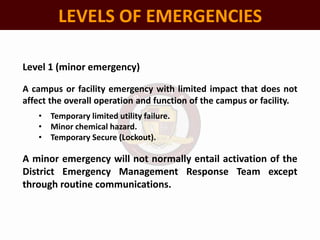
LEVELS OF EMERGENCIES
Level 1 (minor emergency)
A campus or facility emergency with limited impact that does not
affect the overall operation and function of the campus or facility.
• Temporary limited utility failure.
• Minor chemical hazard.
• Temporary Secure (Lockout).
A minor emergency will not normally entail activation of the
District Emergency Management Response Team except
through routine communications.
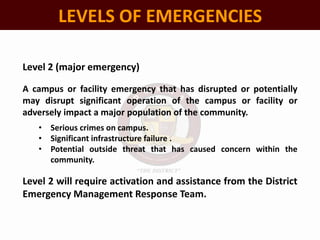
LEVELS OF EMERGENCIES
Level 2 (major emergency)
A campus or facility emergency that has disrupted or potentially
may disrupt significant operation of the campus or facility or
adversely impact a major population of the community.
• Serious crimes on campus.
• Significant infrastructure failure .
• Potential outside threat that has caused concern within the
community.
Level 2 will require activation and assistance from the District
Emergency Management Response Team.
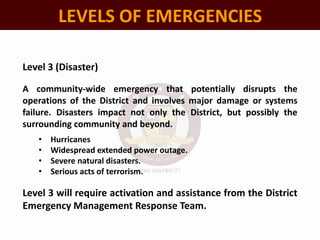
LEVELS OF EMERGENCIES
Level 3 (Disaster)
A community-wide emergency that potentially disrupts the
operations of the District and involves major damage or systems
failure. Disasters impact not only the District, but possibly the
surrounding community and beyond.
• Hurricanes
• Widespread extended power outage.
• Severe natural disasters.
• Serious acts of terrorism.
Level 3 will require activation and assistance from the District
Emergency Management Response Team.
LEVELS OF EMERGENCIES
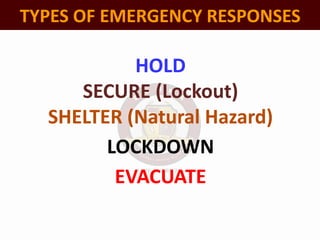
HOLD
SECURE (Lockout)
SHELTER (Natural Hazard)
LOCKDOWN
EVACUATE
TYPES OF EMERGENCY RESPONSES
Purpose:
To clear the hallways for situations deemed necessary by an
administrator.
• Medical issues.
• Altercations or other situations that require clearing of
hallways.
Alert/Announcement:
“Hold in your room or area. Clear the halls.
Hold in your room or area. Clear the halls”
HOLD
Procedure/Response:
• Students and teachers are to remain in their classroom or area, even if
there is a scheduled class change, until the “all clear” is announced.
• Students and staff in common areas, like a cafeteria or a gym, may be
asked to remain in those areas or move to adjoining areas like a locker
room.
• Students and staff outside of the building should remain outside unless
administration directs otherwise.
• Prior to locking the classroom door, teachers should rapidly sweep the
hallway for nearby students. Additionally, teachers should take
attendance, note the time, and conduct business as usual.
HOLD
OUTSIDE HUMAN THREAT
Purpose:
To rapidly increase the level of security in the facility.
Exterior doors and main interior doors are locked and secure to
make it difficult for a potential intruder or outside threat to
gain access to staff and students.
• Reported law enforcement chase near the area.
• Pursuit of individual by law enforcement.
• Gun shots heard nearby.
• Violence or criminal activity in the immediate neighborhood.
• Dangerous animal in the playground or campus perimeter.
Alert/Announcement:
“Secure! Get Inside, Lock outside doors. Secure!
Get Inside. Lock outside doors.”
SECURE (LOCKOUT)
OUTSIDE HUMAN THREAT
Procedure/Response:
• Immediately move students and staff from outside into the building.
• Lock all outside access points.
• If you’re located in an area with a lockable door, gather the students in
the vicinity into the room and close your locked door.
• Account for students.
• Continue with normal activities as much as possible.
• If students or staff must move about in the building, obtain permission
from the administrator or designee.
• Be prepared to rapidly implement an Evacuation or Lockdown if
directed to do so.
SECURE (LOCKOUT)
NATURAL HAZARD
Purpose:
To provide safety for students, staff and visitor when there has
been a chemical, biological or natural incident outside of, but in
proximity to the facility.
• Weather advisory.
• Chemical spill.
• Nearby fire.
Alert/Announcement:
“Shelter! For a hazard. Using safety strategy.
Shelter! For a hazard. Using safety strategy.”
SHELTER IN PLACE
NATURAL HAZARD
Procedure/Response:
• Immediately move students and staff from outside into the building.
• Close all windows and doors leading to hallways.
• Account for students.
• Continue with normal activities as much as possible.
• Be prepared to rapidly implement an Evacuation if directed to do so.
SHELTER IN PLACE
Purpose:
To rapidly increase the level of security in the facility when
there is a threat or hazard inside the building and danger is
imminent.
Lockdown requires that all staff and students seek as much
physical safety as possible by using barriers.
• Physical threat inside building.
• Individual with a gun or other weapon.
• Violent/unruly individual inside the campus.
Alert/Announcement:
“Lockdown! Locks, Lights, Out of Sight!
Lockdown! Locks, Lights, Out of Sight! ”
LOCKDOWN
Procedure/Response:
• If you witness a weapons incident, call for a lockdown and call 911, the
Donna ISD Police Department and notify an administrator as rapidly as
it is safely possible.
• If a report of weapons is reported to you and there is not visible
imminent danger to you or others, notify administrator immediately.
• If you know the location of the attacker/shooter and it is safe to do so,
evacuate the building immediately.
• If the exact location of the attacker/shooter is unknown, lockdown by
barricading.
• Spread out throughout the room, take cover and grab objects you can
use to distract the attacker/shooter.
LOCKDOWN
• Keep all persons away from doors and windows.
• Pull window shades when safe to do so.
• Ignore bells and alarms.
• Remain quiet.
• Silent all cell phones and turn off their wifi and data.
• If safe to do so, let students send sms messages every 5 minutes to
their parents or guardian.
• When safe to do so, account for students and relay information as
instructed.
• Be prepared to rapidly implement an Evacuation if directed to do so.
• DO NOT open the door for anyone.
• When safe to do so, a police officer or an administrator will unlock the
door.
LOCKDOWN
Purpose:
To provide safety whenever it is determined that it is safer
outside the building rather than inside or to move students from
one location to another.
• Fire Alarm.
• Inside Hazard.
The public address for Evacuate is: “Evacuate! to a location”
and is repeated twice each time the public address is performed.
For instance. “Evacuate! To the flagpole.”
Alert/Announcement:
“Evacuate! To a location. Evacuate! To a location.”
EVACUATE
Procedure/Response:
• Keep order and students in line.
• Immediately begin to exit the building according to established
evacuation route to a location at least 300ft from building.
• Close doors and turn of the lights.
• Ensure that individuals with special needs are provided assistance.
• Remain alert to any potential hazards in the area.
• If you encounter fire or hazard use an alternate evacuation route.
• Upon reaching designated area, account for students.
• Do not let students back in the building for any reason.
• Remain alert to potential hazards and properly supervise students.
• Wait for announcement of All Clear before returning to building.
EVACUATE
EVACUATE
WHAT IS A
REVERSE
EVACUATION?
Reverse Evacuation:
A reverse evacuation protocol is used to
rapidly and safely move students and staff
inside a facility when it would be dangerous to
remain outside.
REVERSE EVACUATE
Standard Response Protocols provide unique procedures,
roles, and responsibilities that apply to a specific threat or
hazard.
They include provisions and applications for warning the
public and disseminating information, but do not repeat
information presented in the basic plan.
STANDARD RESPONSE PROTOCOLS
THE END

EMERGENCY OPERATION Presentation Plan ERA

  • 1.
    Donna ISD Emergency OperationsPlan Emergency Response Actions
  • 2.
    MANDATED DRILLS Each campusmust conduct the minimum following drills: • One Fire drill each month that has 10 or more instructional days. • Two Secure (Lockout) drills per year. • Two Lockdown drills per year. The Donna ISD Police Department and the Safety and Risk Management Department should be notified of your drills, prior to them being conducted.
  • 3.
    The Donna ISDEmergency Operations Plan is designed to provide guidelines for responding to a variety of incidents and emergencies that affect the District. Not all emergencies require the same degree of response, and each incident will be evaluated on a case by case basis. LEVELS OF EMERGENCIES
  • 4.
    Level 1 (minoremergency) A campus or facility emergency with limited impact that does not affect the overall operation and function of the campus or facility. • Temporary limited utility failure. • Minor chemical hazard. • Temporary Secure (Lockout). A minor emergency will not normally entail activation of the District Emergency Management Response Team except through routine communications. LEVELS OF EMERGENCIES
  • 5.
    Level 2 (majoremergency) A campus or facility emergency that has disrupted or potentially may disrupt significant operation of the campus or facility or adversely impact a major population of the community. • Serious crimes on campus. • Significant infrastructure failure . • Potential outside threat that has caused concern within the community. Level 2 will require activation and assistance from the District Emergency Management Response Team. LEVELS OF EMERGENCIES
  • 6.
    Level 3 (Disaster) Acommunity-wide emergency that potentially disrupts the operations of the District and involves major damage or systems failure. Disasters impact not only the District, but possibly the surrounding community and beyond. • Hurricanes • Widespread extended power outage. • Severe natural disasters. • Serious acts of terrorism. Level 3 will require activation and assistance from the District Emergency Management Response Team. LEVELS OF EMERGENCIES
  • 7.
    HOLD SECURE (Lockout) SHELTER (NaturalHazard) LOCKDOWN EVACUATE TYPES OF EMERGENCY RESPONSES
  • 8.
    Purpose: To clear thehallways for situations deemed necessary by an administrator. • Medical issues. • Altercations or other situations that require clearing of hallways. Alert/Announcement: “Hold in your room or area. Clear the halls. Hold in your room or area. Clear the halls” HOLD
  • 9.
    Procedure/Response: • Students andteachers are to remain in their classroom or area, even if there is a scheduled class change, until the “all clear” is announced. • Students and staff in common areas, like a cafeteria or a gym, may be asked to remain in those areas or move to adjoining areas like a locker room. • Students and staff outside of the building should remain outside unless administration directs otherwise. • Prior to locking the classroom door, teachers should rapidly sweep the hallway for nearby students. Additionally, teachers should take attendance, note the time, and conduct business as usual. HOLD
  • 10.
    OUTSIDE HUMAN THREAT Purpose: Torapidly increase the level of security in the facility. Exterior doors and main interior doors are locked and secure to make it difficult for a potential intruder or outside threat to gain access to staff and students. • Reported law enforcement chase near the area. • Pursuit of individual by law enforcement. • Gun shots heard nearby. • Violence or criminal activity in the immediate neighborhood. • Dangerous animal in the playground or campus perimeter. Alert/Announcement: “Secure! Get Inside, Lock outside doors. Secure! Get Inside. Lock outside doors.” SECURE (LOCKOUT)
  • 11.
    OUTSIDE HUMAN THREAT Procedure/Response: •Immediately move students and staff from outside into the building. • Lock all outside access points. • If you’re located in an area with a lockable door, gather the students in the vicinity into the room and close your locked door. • Account for students. • Continue with normal activities as much as possible. • If students or staff must move about in the building, obtain permission from the administrator or designee. • Be prepared to rapidly implement an Evacuation or Lockdown if directed to do so. SECURE (LOCKOUT)
  • 12.
    NATURAL HAZARD Purpose: To providesafety for students, staff and visitor when there has been a chemical, biological or natural incident outside of, but in proximity to the facility. • Weather advisory. • Chemical spill. • Nearby fire. Alert/Announcement: “Shelter! For a hazard. Using safety strategy. Shelter! For a hazard. Using safety strategy.” SHELTER IN PLACE
  • 13.
    NATURAL HAZARD Procedure/Response: • Immediatelymove students and staff from outside into the building. • Close all windows and doors leading to hallways. • Account for students. • Continue with normal activities as much as possible. • Be prepared to rapidly implement an Evacuation if directed to do so. SHELTER IN PLACE
  • 14.
    Purpose: To rapidly increasethe level of security in the facility when there is a threat or hazard inside the building and danger is imminent. Lockdown requires that all staff and students seek as much physical safety as possible by using barriers. • Physical threat inside building. • Individual with a gun or other weapon. • Violent/unruly individual inside the campus. Alert/Announcement: “Lockdown! Locks, Lights, Out of Sight! Lockdown! Locks, Lights, Out of Sight! ” LOCKDOWN
  • 15.
    Procedure/Response: • If youwitness a weapons incident, call for a lockdown and call 911, the Donna ISD Police Department and notify an administrator as rapidly as it is safely possible. • If a report of weapons is reported to you and there is not visible imminent danger to you or others, notify administrator immediately. • If you know the location of the attacker/shooter and it is safe to do so, evacuate the building immediately. • If the exact location of the attacker/shooter is unknown, lockdown by barricading. • Spread out throughout the room, take cover and grab objects you can use to distract the attacker/shooter. LOCKDOWN
  • 16.
    • Keep allpersons away from doors and windows. • Pull window shades when safe to do so. • Ignore bells and alarms. • Remain quiet. • Silent all cell phones and turn off their wifi and data. • If safe to do so, let students send sms messages every 5 minutes to their parents or guardian. • When safe to do so, account for students and relay information as instructed. • Be prepared to rapidly implement an Evacuation if directed to do so. • DO NOT open the door for anyone. • When safe to do so, a police officer or an administrator will unlock the door. LOCKDOWN
  • 17.
    Purpose: To provide safetywhenever it is determined that it is safer outside the building rather than inside or to move students from one location to another. • Fire Alarm. • Inside Hazard. The public address for Evacuate is: “Evacuate! to a location” and is repeated twice each time the public address is performed. For instance. “Evacuate! To the flagpole.” Alert/Announcement: “Evacuate! To a location. Evacuate! To a location.” EVACUATE
  • 18.
    Procedure/Response: • Keep orderand students in line. • Immediately begin to exit the building according to established evacuation route to a location at least 300ft from building. • Close doors and turn of the lights. • Ensure that individuals with special needs are provided assistance. • Remain alert to any potential hazards in the area. • If you encounter fire or hazard use an alternate evacuation route. • Upon reaching designated area, account for students. • Do not let students back in the building for any reason. • Remain alert to potential hazards and properly supervise students. • Wait for announcement of All Clear before returning to building. EVACUATE
  • 19.
  • 20.
    Reverse Evacuation: A reverseevacuation protocol is used to rapidly and safely move students and staff inside a facility when it would be dangerous to remain outside. REVERSE EVACUATE
  • 21.
    Standard Response Protocolsprovide unique procedures, roles, and responsibilities that apply to a specific threat or hazard. They include provisions and applications for warning the public and disseminating information, but do not repeat information presented in the basic plan. STANDARD RESPONSE PROTOCOLS
  • 22.