Introduction
In India the scope of trading power is huge even with its current power shortage scenario.
The power sector has come a long way from being a bilateral contract driven long-term
market to one which is also driven by short-term trades.
There has been a steady growth in the number of short-term power trades, with the number
of participating utilities in short-term open access (STOA) increasing steadily.
The most distinguishing feature of electricity as a commodity is that it has no storage value.
At a time when a large number of captive and merchant power plants are expected to be
added in the coming future, there is a need to encourage the peaking power plants and bring
the surplus captive generation in the grid.
Short-term transactions of electricity refers to the contracts of less than one year period
through Inter-State Trading Licensees and directly by the Distribution Licensees, Power
Exchanges (Indian Energy Exchange Ltd (IEX) and Power Exchange India Ltd (PXIL)), and
Unscheduled Interchange (UI).
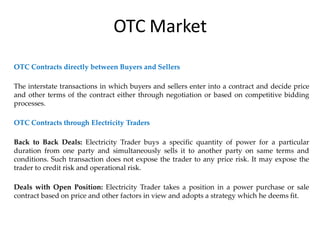
OTC Contracts directly between Buyers and Sellers
The interstate transactions in which buyers and sellers enter into a contract and decide price
and other terms of the contract either through negotiation or based on competitive bidding
processes.
OTC Contracts through Electricity Traders
Back to Back Deals: Electricity Trader buys a specific quantity of power for a particular
duration from one party and simultaneously sells it to another party on same terms and
conditions. Such transaction does not expose the trader to any price risk. It may expose the
trader to credit risk and operational risk.
Deals with Open Position: Electricity Trader takes a position in a power purchase or sale
contract based on price and other factors in view and adopts a strategy which he deems fit.
OTC Market
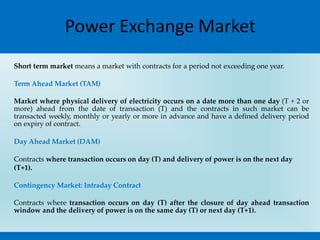
Power Exchange Market
Short term market means a market with contracts for a period not exceeding one year.
Term Ahead Market (TAM)
Market where physical delivery of electricity occurs on a date more than one day (T + 2 or
more) ahead from the date of transaction (T) and the contracts in such market can be
transacted weekly, monthly or yearly or more in advance and have a defined delivery period
on expiry of contract.
Day Ahead Market (DAM)
Contracts where transaction occurs on day (T) and delivery of power is on the next day
(T+1).
Contingency Market: Intraday Contract
Contracts where transaction occurs on day (T) after the closure of day ahead transaction
window and the delivery of power is on the same day (T) or next day (T+1).
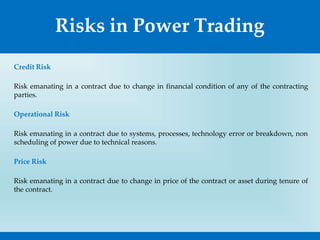
Risks in Power Trading
Credit Risk
Risk emanating in a contract due to change in financial condition of any of the contracting
parties.
Operational Risk
Risk emanating in a contract due to systems, processes, technology error or breakdown, non
scheduling of power due to technical reasons.
Price Risk
Risk emanating in a contract due to change in price of the contract or asset during tenure of
the contract.
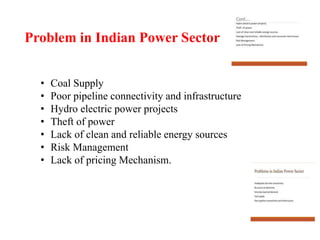
Problem in Indian Power Sector
• Coal Supply
• Poor pipeline connectivity and infrastructure
• Hydro electric power projects
• Theft of power
• Lack of clean and reliable energy sources
• Risk Management
• Lack of pricing Mechanism.
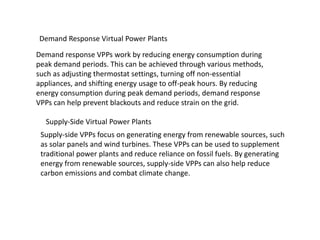
Demand response VPPs work by reducing energy consumption during
peak demand periods. This can be achieved through various methods,
such as adjusting thermostat settings, turning off non-essential
appliances, and shifting energy usage to off-peak hours. By reducing
energy consumption during peak demand periods, demand response
VPPs can help prevent blackouts and reduce strain on the grid.
Demand Response Virtual Power Plants
Supply-side VPPs focus on generating energy from renewable sources, such
as solar panels and wind turbines. These VPPs can be used to supplement
traditional power plants and reduce reliance on fossil fuels. By generating
energy from renewable sources, supply-side VPPs can also help reduce
carbon emissions and combat climate change.
Supply-Side Virtual Power Plants
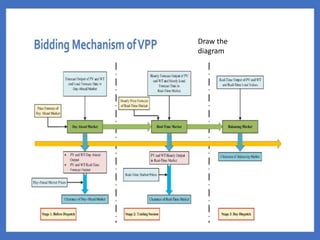
Draw the
diagram
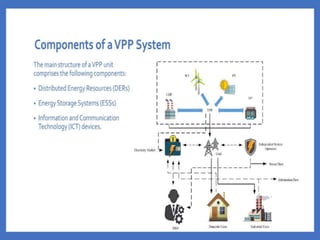
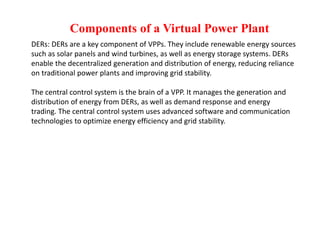
DERs: DERs are a key component of VPPs. They include renewable energy sources
such as solar panels and wind turbines, as well as energy storage systems. DERs
enable the decentralized generation and distribution of energy, reducing reliance
on traditional power plants and improving grid stability.
The central control system is the brain of a VPP. It manages the generation and
distribution of energy from DERs, as well as demand response and energy
trading. The central control system uses advanced software and communication
technologies to optimize energy efficiency and grid stability.
Components of a Virtual Power Plant
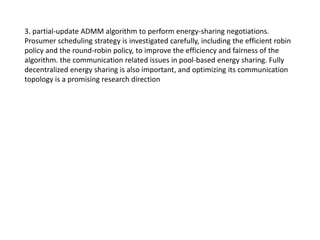
3. partial-update ADMM algorithm to perform energy-sharing negotiations.
Prosumer scheduling strategy is investigated carefully, including the efficient robin
policy and the round-robin policy, to improve the efficiency and fairness of the
algorithm. the communication related issues in pool-based energy sharing. Fully
decentralized energy sharing is also important, and optimizing its communication
topology is a promising research direction
Findings:
1. Real-time market participation is expected to help improve Protability for VPP
operators and enhance the operational stability of the system operator.
2. Switching round number, Fully decentralized energy sharing, and optimizing its
communication topology.
Value assessment of aggregated energy flexibility when traded on multiple
markets: Realistic view of impact on costs of generating imbalances when high
volumes of aggregators are participating in active market trading.
4. aggregation and de-aggregation of VPP constrained by the network of distribution
system.

EMconcept.pptx

  • 1.
    Introduction In India thescope of trading power is huge even with its current power shortage scenario. The power sector has come a long way from being a bilateral contract driven long-term market to one which is also driven by short-term trades. There has been a steady growth in the number of short-term power trades, with the number of participating utilities in short-term open access (STOA) increasing steadily. The most distinguishing feature of electricity as a commodity is that it has no storage value. At a time when a large number of captive and merchant power plants are expected to be added in the coming future, there is a need to encourage the peaking power plants and bring the surplus captive generation in the grid. Short-term transactions of electricity refers to the contracts of less than one year period through Inter-State Trading Licensees and directly by the Distribution Licensees, Power Exchanges (Indian Energy Exchange Ltd (IEX) and Power Exchange India Ltd (PXIL)), and Unscheduled Interchange (UI).
  • 2.
    OTC Contracts directlybetween Buyers and Sellers The interstate transactions in which buyers and sellers enter into a contract and decide price and other terms of the contract either through negotiation or based on competitive bidding processes. OTC Contracts through Electricity Traders Back to Back Deals: Electricity Trader buys a specific quantity of power for a particular duration from one party and simultaneously sells it to another party on same terms and conditions. Such transaction does not expose the trader to any price risk. It may expose the trader to credit risk and operational risk. Deals with Open Position: Electricity Trader takes a position in a power purchase or sale contract based on price and other factors in view and adopts a strategy which he deems fit. OTC Market
  • 3.
    Power Exchange Market Shortterm market means a market with contracts for a period not exceeding one year. Term Ahead Market (TAM) Market where physical delivery of electricity occurs on a date more than one day (T + 2 or more) ahead from the date of transaction (T) and the contracts in such market can be transacted weekly, monthly or yearly or more in advance and have a defined delivery period on expiry of contract. Day Ahead Market (DAM) Contracts where transaction occurs on day (T) and delivery of power is on the next day (T+1). Contingency Market: Intraday Contract Contracts where transaction occurs on day (T) after the closure of day ahead transaction window and the delivery of power is on the same day (T) or next day (T+1).
  • 4.
    Risks in PowerTrading Credit Risk Risk emanating in a contract due to change in financial condition of any of the contracting parties. Operational Risk Risk emanating in a contract due to systems, processes, technology error or breakdown, non scheduling of power due to technical reasons. Price Risk Risk emanating in a contract due to change in price of the contract or asset during tenure of the contract.
  • 5.
    Problem in IndianPower Sector • Coal Supply • Poor pipeline connectivity and infrastructure • Hydro electric power projects • Theft of power • Lack of clean and reliable energy sources • Risk Management • Lack of pricing Mechanism.
  • 9.
    Demand response VPPswork by reducing energy consumption during peak demand periods. This can be achieved through various methods, such as adjusting thermostat settings, turning off non-essential appliances, and shifting energy usage to off-peak hours. By reducing energy consumption during peak demand periods, demand response VPPs can help prevent blackouts and reduce strain on the grid. Demand Response Virtual Power Plants Supply-side VPPs focus on generating energy from renewable sources, such as solar panels and wind turbines. These VPPs can be used to supplement traditional power plants and reduce reliance on fossil fuels. By generating energy from renewable sources, supply-side VPPs can also help reduce carbon emissions and combat climate change. Supply-Side Virtual Power Plants
  • 11.
  • 15.
    DERs: DERs area key component of VPPs. They include renewable energy sources such as solar panels and wind turbines, as well as energy storage systems. DERs enable the decentralized generation and distribution of energy, reducing reliance on traditional power plants and improving grid stability. The central control system is the brain of a VPP. It manages the generation and distribution of energy from DERs, as well as demand response and energy trading. The central control system uses advanced software and communication technologies to optimize energy efficiency and grid stability. Components of a Virtual Power Plant
  • 20.
    3. partial-update ADMMalgorithm to perform energy-sharing negotiations. Prosumer scheduling strategy is investigated carefully, including the efficient robin policy and the round-robin policy, to improve the efficiency and fairness of the algorithm. the communication related issues in pool-based energy sharing. Fully decentralized energy sharing is also important, and optimizing its communication topology is a promising research direction
  • 21.
    Findings: 1. Real-time marketparticipation is expected to help improve Protability for VPP operators and enhance the operational stability of the system operator. 2. Switching round number, Fully decentralized energy sharing, and optimizing its communication topology. Value assessment of aggregated energy flexibility when traded on multiple markets: Realistic view of impact on costs of generating imbalances when high volumes of aggregators are participating in active market trading. 4. aggregation and de-aggregation of VPP constrained by the network of distribution system.