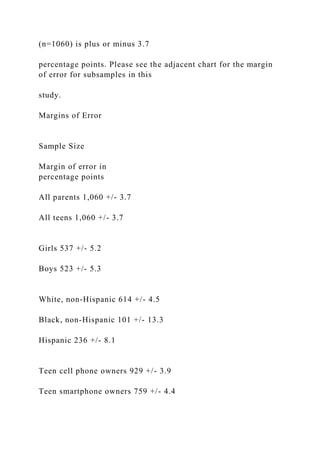
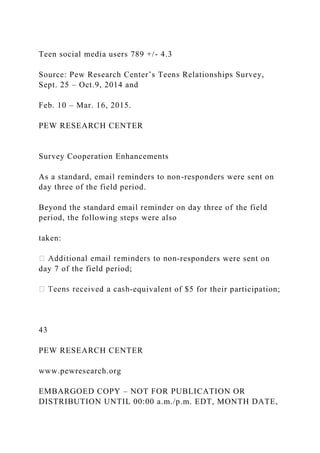
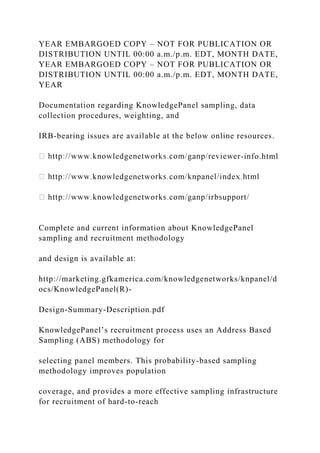
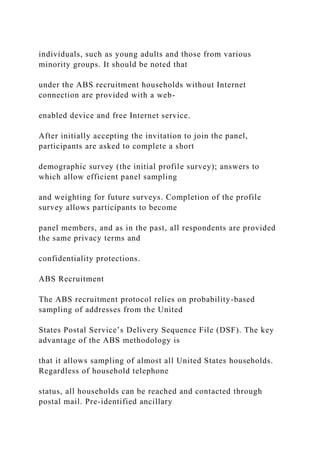
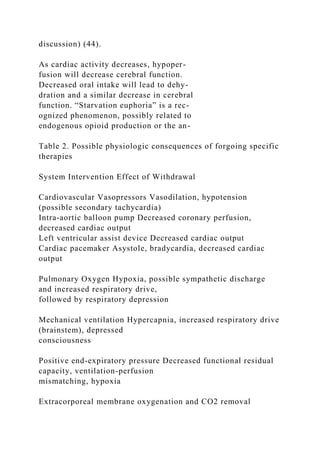
EMBARGOED COPY – NOT FOR PUBLICATION OR
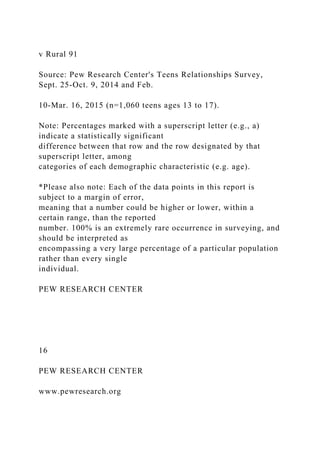
DISTRIBUTION UNTIL 00:00 a.m./p.m. EDT, MONTH DATE,
YEAR
FOR RELEASE APRIL 9, 2015
FOR FURTHER INFORMATION
ON THIS REPORT:
Amanda Lenhart, Associate Director, Research
Dana Page, Communications Manager
202.419.4372
www.pewresearch.org
RECOMMENDED CITATION: Lenhart, Amanda, Pew Research
Center, April 2015, “Teen, Social Media and Technology
Overview 2015”
NUMBERS, FACTS AND TRENDS SHAPING THE WORLD
1
PEW RESEARCH CENTER
www.pewresearch.org
EMBARGOED COPY – NOT FOR PUBLICATION OR
DISTRIBUTION UNTIL 00:00 a.m./p.m. EDT, MONTH DATE,
YEAR EMBARGOED COPY – NOT FOR PUBLICATION OR
DISTRIBUTION UNTIL 00:00 a.m./p.m. EDT, MONTH DATE,
YEAR EMBARGOED COPY – NOT FOR PUBLICATION OR
DISTRIBUTION UNTIL 00:00 a.m./p.m. EDT, MONTH DATE,
YEAR
About This Report
This report is the first in a series of reports examining
teenagers’ use of technology. Forthcoming
reports will focus on how American adolescents use social
media and mobile phones to create,
maintain and end their friendships and romantic relationships.
This report is a collaborative effort
based on the input and analysis of the following individuals.
Find a digital version of this report at
http://www.pewinternet.org/2015/04/09/teens-social-media-
technology-2015.
Amanda Lenhart, Associate Director, Research
Maeve Duggan, Research Analyst
Andrew Perrin , Research Assistant
Renee Stepler, Research Assistant
Lee Rainie, Director Internet, Science, and Technology
Research
Kim Parker, Director Social and Demographic Trends Research
About Pew Research Center
Pew Research Center is a nonpartisan fact tank that informs the
public about the issues, attitudes
and trends shaping America and the world. It does not take
policy positions. It conducts public
opinion polling, demographic research, media content analysis
and other empirical social science
research. The center studies U.S. politics and policy views;
media and journalism; internet and
technology; religion and public life; Hispanic trends; global
attitudes and U.S. social and demo-
graphic trends. All of the center’s reports are available at
www.pewresearch.org. Pew Research
Center is a subsidiary of The Pew Charitable Trusts.
© Pew Research Center 2015
http://www.pewinternet.org/2015/04/09/teens-social-media-
technology-2015
http://www.pewresearch.org/
2
PEW RESEARCH CENTER
www.pewresearch.org
Summary of Findings
24% of teens go online “almost constantly,” facilitated by the
widespread availability of
smartphones
Aided by the convenience and constant access provided by
mobile devices, especially smartphones,
92% of teens report going online daily — including 24% who
say they go online “almost
constantly,” according to a new study from Pew Research
Center. More than half (56%) of teens —
defined in this report as those ages 13 to 17 — go online several
times a day, and 12% report once-
a-day use. Just 6% of teens report going online weekly, and 2%
go online less often.
Much of this frenzy of access is facilitated by mobile devices.
Nearly three-quarters of teens have
or have access1 to a smartphone and 30% have a basic phone,
while just 12% of teens 13 to 17 say
they have no cell phone of any type. African-American teens are
the most likely of any group of
teens to have a smartphone, with 85% having access to one,
compared with 71% of both white and
Hispanic teens. These phones and other mobile devices have
become a primary driver of teen
internet use: Fully 91% of teens go online from mobile devices
at least occasionally. Among these
“mobile teens,” 94% go online daily or more often. By
comparison, teens who don’t access the
internet via mobile devices tend to go online less
frequently. Some 68% go online at least daily.
African-American and Hispanic youth report
more frequent internet use than white teens.
Among African-American teens, 34% report
going online “almost constantly” as do 32% of
Hispanic teens, while 19% of white teens go
online that often.
Facebook is the most popular and frequently
used social media platform among teens;
half of teens use Instagram, and nearly as
many use Snapchat
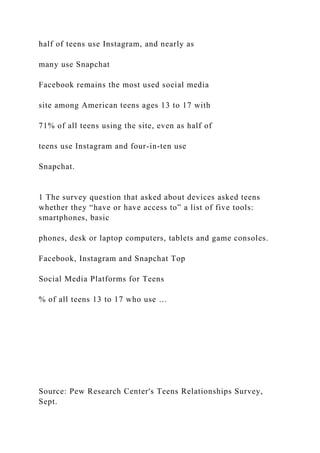
Facebook remains the most used social media
site among American teens ages 13 to 17 with
71% of all teens using the site, even as half of
teens use Instagram and four-in-ten use
Snapchat.
1 The survey question that asked about devices asked teens
whether they “have or have access to” a list of five tools:
smartphones, basic
phones, desk or laptop computers, tablets and game consoles.
Facebook, Instagram and Snapchat Top
Social Media Platforms for Teens
% of all teens 13 to 17 who use …
Source: Pew Research Center's Teens Relationships Survey,
Sept.
25-Oct. 9, 2014 and Feb. 10-Mar. 16, 2015. (n=1,060 teens ages
13 to 17).
PEW RESEARCH CENTER
3
PEW RESEARCH CENTER
www.pewresearch.org
EMBARGOED COPY – NOT FOR PUBLICATION OR
DISTRIBUTION UNTIL 00:00 a.m./p.m. EDT, MONTH DATE,
YEAR EMBARGOED COPY – NOT FOR PUBLICATION OR
DISTRIBUTION UNTIL 00:00 a.m./p.m. EDT, MONTH DATE,
YEAR EMBARGOED COPY – NOT FOR PUBLICATION OR
DISTRIBUTION UNTIL 00:00 a.m./p.m. EDT, MONTH DATE,
YEAR
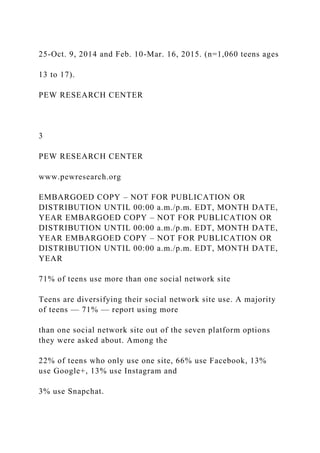
71% of teens use more than one social network site
Teens are diversifying their social network site use. A majority
of teens — 71% — report using more
than one social network site out of the seven platform options
they were asked about. Among the
22% of teens who only use one site, 66% use Facebook, 13%
use Google+, 13% use Instagram and
3% use Snapchat.
This study uses a somewhat different method than Pew Research
Center’s previous reports on
teens. While both are probability-based, nationally
representative samples of American teens, the
current survey was administered online, while our previous
work involved surveying teens by
phone. A great deal of previous research has found that the
mode of interview — telephone vs.
online self-administration — can affect the results. The
magnitude and direction of these effects
are difficult to predict, though for most kinds of questions, the
fundamental conclusions one would
draw from the data will be similar regardless of mode.
Accordingly, we will not compare specific
percentages from previous research with results from the
current survey. But we believe that the
broad contours and patterns evident in this
web-based survey are comparable to those seen
in previous telephone surveys.
Facebook remains a dominant force in teens’
social media ecosystems, even as Instagram and
Snapchat have risen into a prominent role in
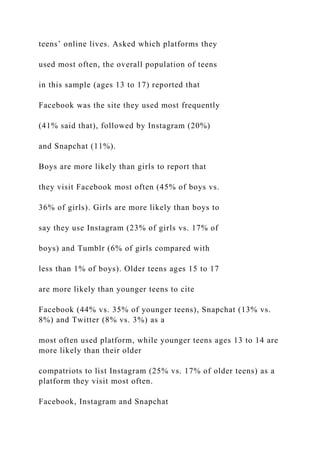
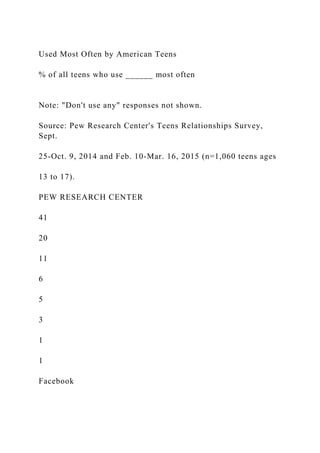
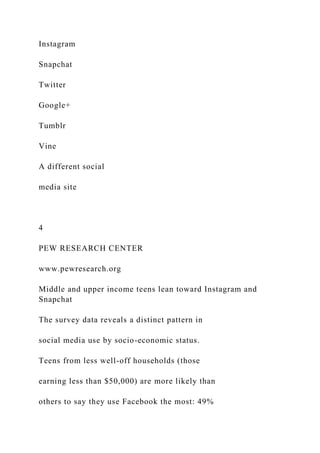
teens’ online lives. Asked which platforms they
used most often, the overall population of teens
in this sample (ages 13 to 17) reported that
Facebook was the site they used most frequently
(41% said that), followed by Instagram (20%)
and Snapchat (11%).
Boys are more likely than girls to report that
they visit Facebook most often (45% of boys vs.
36% of girls). Girls are more likely than boys to
say they use Instagram (23% of girls vs. 17% of
boys) and Tumblr (6% of girls compared with
less than 1% of boys). Older teens ages 15 to 17
are more likely than younger teens to cite
Facebook (44% vs. 35% of younger teens), Snapchat (13% vs.
8%) and Twitter (8% vs. 3%) as a
most often used platform, while younger teens ages 13 to 14 are
more likely than their older
compatriots to list Instagram (25% vs. 17% of older teens) as a
platform they visit most often.
Facebook, Instagram and Snapchat
Used Most Often by American Teens
% of all teens who use ______ most often
Note: "Don't use any" responses not shown.
Source: Pew Research Center's Teens Relationships Survey,
Sept.
25-Oct. 9, 2014 and Feb. 10-Mar. 16, 2015 (n=1,060 teens ages
13 to 17).
PEW RESEARCH CENTER
41
20
11
6
5
3
1
1
Facebook
Instagram
Snapchat
Twitter
Google+
Tumblr
Vine
A different social
media site
4
PEW RESEARCH CENTER
www.pewresearch.org
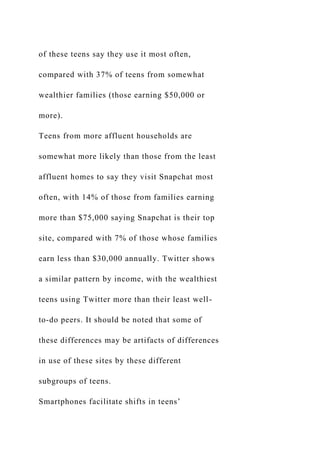
Middle and upper income teens lean toward Instagram and
Snapchat
The survey data reveals a distinct pattern in
social media use by socio-economic status.
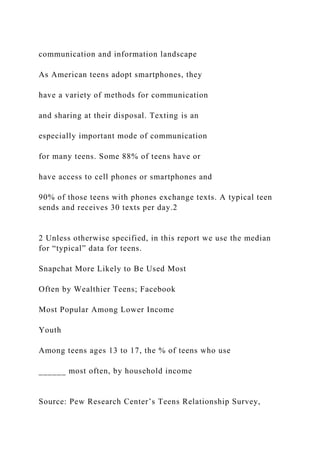
Teens from less well-off households (those
earning less than $50,000) are more likely than
others to say they use Facebook the most: 49%
of these teens say they use it most often,
compared with 37% of teens from somewhat
wealthier families (those earning $50,000 or
more).
Teens from more affluent households are
somewhat more likely than those from the least
affluent homes to say they visit Snapchat most
often, with 14% of those from families earning
more than $75,000 saying Snapchat is their top
site, compared with 7% of those whose families
earn less than $30,000 annually. Twitter shows
a similar pattern by income, with the wealthiest
teens using Twitter more than their least well-
to-do peers. It should be noted that some of
these differences may be artifacts of differences
in use of these sites by these different
subgroups of teens.
Smartphones facilitate shifts in teens’
communication and information landscape
As American teens adopt smartphones, they
have a variety of methods for communication
and sharing at their disposal. Texting is an
especially important mode of communication
for many teens. Some 88% of teens have or
have access to cell phones or smartphones and
90% of those teens with phones exchange texts. A typical teen
sends and receives 30 texts per day.2
2 Unless otherwise specified, in this report we use the median
for “typical” data for teens.
Snapchat More Likely to Be Used Most
Often by Wealthier Teens; Facebook
Most Popular Among Lower Income
Youth
Among teens ages 13 to 17, the % of teens who use
______ most often, by household income
Source: Pew Research Center’s Teens Relationship Survey,
September 25-October 9, 2014 and February 10-March 16, 2015
(n=1,016 teens ages 13 to 17).
PEW RESEARCH CENTER
5
PEW RESEARCH CENTER
www.pewresearch.org
EMBARGOED COPY – NOT FOR PUBLICATION OR
DISTRIBUTION UNTIL 00:00 a.m./p.m. EDT, MONTH DATE,
YEAR EMBARGOED COPY – NOT FOR PUBLICATION OR
DISTRIBUTION UNTIL 00:00 a.m./p.m. EDT, MONTH DATE,
YEAR EMBARGOED COPY – NOT FOR PUBLICATION OR
DISTRIBUTION UNTIL 00:00 a.m./p.m. EDT, MONTH DATE,
YEAR
And teens are not simply sending messages through the texting
system that telephone companies
offer. Some 73% of teens have access to smartphones and
among them messaging apps like Kik or
WhatsApp have caught on. Fully 33% of teens with phones have
such apps. And Hispanic and
African-American youth with phones are substantially more
likely to use messaging apps, with
46% of Hispanic and 47% of African-American teens using a
messaging app compared with 24% of
white teens.
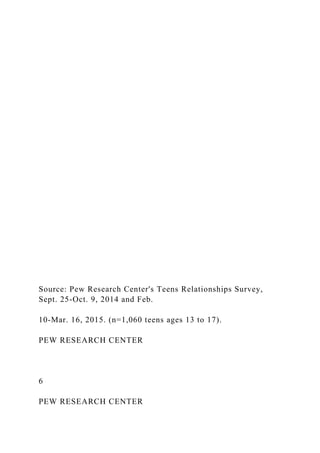
Girls dominate social media;
boys are more likely to play
video games
Teenage girls use social media
sites and platforms —
particularly visually-oriented
ones — for sharing more than
their male counterparts do. For
their part, boys are more likely
than girls to own gaming
consoles and play video games.
Data for this report was
collected for Pew Research
Center. The survey was
administered online by the GfK
Group using its
KnowledgePanel, in English
and Spanish, to a nationally
representative sample of over
1,060 teens ages 13 to 17 and a
parent or guardian from
September 25 to October 9,
2014 and February 10 to March
16, 2015. In the fall, 1016
parent-teen pairs were
interviewed. The survey was re-
opened in the spring and 44
pairs were added to the sample. For more on the methods for
this study, please visit the Methods
section at the back of this report.
Girls Dominate Visually-Oriented Social Media
Platforms
Percent of girls and boys who use …
Source: Pew Research Center's Teens Relationships Survey,
Sept. 25-Oct. 9, 2014 and Feb.
10-Mar. 16, 2015. (n=1,060 teens ages 13 to 17).
PEW RESEARCH CENTER
6
PEW RESEARCH CENTER
www.pewresearch.org
Introduction
Much has changed in recent years when it comes to teenagers
and their use of technology. When
the Center last surveyed teens, Snapchat did not exist, and
Instagram, Tumblr, Vine and a host of
other platforms were barely out of their infancy.
As the technology environment has changed, we have also
modified our basic methods for
surveying teens ages 13 to 17. While both our current and
previous methods are probability-based,
nationally representative samples of American teens, the current
survey was administered online,
while our previous work involved surveying teens by phone. A
great deal of previous research has
found that the mode of interview — telephone vs. online self-
administration— can affect the
results. The magnitude and direction of these effects are
difficult to predict, though for most kinds
of questions, the fundamental conclusions one would draw from
the data will be similar regardless
of mode. This means we will not compare specific percentages
from previous research with results
from the current survey and we will therefore not include trend
data in this report. But we believe
that the broad contours and patterns evident in this web-based
survey are comparable to those
seen in previous telephone surveys.
This report covers the current landscape of teens’ technology
use. The survey shows gaps in access
to technology which fall along socio-economic, racial and
ethnic lines — especially access to
desktop and laptop computers, and smartphones. The survey
also reveals that a large number of
teens are using sites and apps like Instagram and Snapchat.
However, adolescents continue to use
Facebook, and it is the site that the largest share of teens say
they use most often. Facebook is
more likely to be cited as the most used site by lower income
youth than by higher income teens,
while Snapchat is more likely to be a frequently used site for
more well-to-do teens.
The survey finds a significant gender gap among teens in online
and gaming behaviors. Girls are
outpacing boys in their use of text messaging, and in their use
of visual social media platforms like
Instagram, Snapchat, online pinboards (like Pinterest and
Polyvore), as well as Tumblr and Vine,
while boys dominate in the console access and video game
playing sphere.
Among Hispanic and African-American youth, there is
somewhat less access to desktops,
compared with white teens. At the same time, African-American
youth have greater access to
smartphones than their Hispanic or white counterparts. Minority
youth are much more likely to
adopt text messaging apps on their phones than their white
counterparts. And while Hispanic
youth are equally as likely as white teens to use most of the
social media platforms that were
queried in the survey, Hispanic teens are more likely to report
using Google+ than white youth.
7
PEW RESEARCH CENTER
www.pewresearch.org
EMBARGOED COPY – NOT FOR PUBLICATION OR
DISTRIBUTION UNTIL 00:00 a.m./p.m. EDT, MONTH DATE,
YEAR EMBARGOED COPY – NOT FOR PUBLICATION OR
DISTRIBUTION UNTIL 00:00 a.m./p.m. EDT, MONTH DATE,
YEAR EMBARGOED COPY – NOT FOR PUBLICATION OR
DISTRIBUTION UNTIL 00:00 a.m./p.m. EDT, MONTH DATE,
YEAR
African-American teens are also substantially more likely than
white or Hispanic youth to report
playing video games.
Data for this report was collected for Pew Research Center. The
survey was administered online by
the GfK Group using its KnowledgePanel, in English and
Spanish, to a nationally representative
sample of 1060 teens ages 13 to 17 and a parent or guardian
from September 25 to October 9, 2014
and February 10 to March 16, 2015. In the fall data collection,
1016 parent-teen pairs were
interviewed. The survey was re-opened in the spring and 44
pairs were added to the sample. For
more on the methods for this study, please visit the Methods
section at the back of this report.
8
PEW RESEARCH CENTER
www.pewresearch.org
87
81
73
58
30
A desktop / laptop
computer
A gaming console
A smartphone
A tablet computer
A basic cell phone
A Majority of American Teens Report Access to a Computer,
Game Console, Smartphone and a Tablet
In our exploration of teens’ digital technology
ownership, we wanted to capture both what
teens “owned” — sometimes a tricky concept
within families where devices are often shared
— and what technology tools teens can access.
The survey question that asked about devices
asked teens whether they “have or have access
to” a list of five tools: smartphones, basic cell
phones, desktop or laptop computers, tablets
and game consoles. Below is a discussion of
teens’ ownership, access to and use of these
devices.
Mobile phones
Fully 88% of American teens ages 13 to 17 have
or have access to a mobile phone of some kind,
and a majority of teens (73%) have smartphones. Smartphone
users skew more toward older teens
with 76% of 15- to 17-year-olds having a smartphone, compared
with 68% of 13- to 14-year-olds.
About a third of teens (30%) have a “basic” cell phone that is
not a smartphone. About 15% of
teens have both types of phones. Of teens with a smartphone,
21% also have a basic cell phone. On
the flipside, half of teens with a basic phone also have or have
access to a smartphone.
African-American teens are the most likely of any racial or
ethnic group to have or have access to a
smartphone; 85% of African-American teens report smartphone
ownership, compared with 71% of
white and 71% of Hispanic youth.
Teens from higher income families and households where
parents have higher levels of
educational attainment are among the most likely to own a
smartphone. While 77% of teens whose
families earn more than $50,000 a year have a smartphone, two-
thirds (64%) of teens from
families earning less than that own one. Those teens with lower
incomes are the most likely to
have a basic cell phone — with 39% of teens from households
earning less than $30,000 annually
reporting basic cell ownership compared with 28% of teens
from households earning more.
Teens’ Phone, Computer & Console
Access
% of all teens who have or have access to the following:
Source: Pew Research Center's Teens Relationships Survey,
Sept.
25-Oct. 9, 2014 and Feb. 10-Mar. 16, 2015 (n=1,060 teens ages
13 to 17).
PEW RESEARCH CENTER
9
PEW RESEARCH CENTER
www.pewresearch.org
EMBARGOED COPY – NOT FOR PUBLICATION OR
DISTRIBUTION UNTIL 00:00 a.m./p.m. EDT, MONTH DATE,
YEAR EMBARGOED COPY – NOT FOR PUBLICATION OR
DISTRIBUTION UNTIL 00:00 a.m./p.m. EDT, MONTH DATE,
YEAR EMBARGOED COPY – NOT FOR PUBLICATION OR
DISTRIBUTION UNTIL 00:00 a.m./p.m. EDT, MONTH DATE,
YEAR
73% of Teens Have Access to a Smartphone; 15% Have Only a
Basic Phone
% of all teens who have or have access to the following types of
cell phones
Smartphone Basic phone only No cell phone
All teens 73% 15% 12%
Sex
a Boys 71 16 13
b Girls 74 14 12
Race / ethnicity
c White, non-Hispanic 71 17d 12
d Black, non-Hispanic 85ce 7 8
e Hispanic 71 15 14
Age
f 13-14 68 14 18f
g 15-17 76f 16 8
Sex by age
h Boys 13-14 64 16 19ik
i Boys 15-17 75h 16 8
j Girls 13-14 72 11 17ik
k Girls 15-17 76h 16 8
Household income
l <$30K 61 22no 17o
m $30K-$49,999 67 16 18o
n $50K-$74,999 76l 12 12
o $75K+ 78lm 13 9
Parent educational attainment
p Less than high school 60 21 19s
q High school 72 15 13
r Some college 76p 12 12
s College+ 75p 16 9
Urbanity
t Urban 73 16 11
u Suburban 74 14 12
v Rural 68 16 15
Source: Pew Research Center’s Teens Relationships Survey,
Sept. 25–Oct.9, 2014 and Feb. 10–Mar. 16, 2015 (N=1,060 teens
ages 13 to
17).
Note: Percentages marked with a superscript letter (e.g., a)
indicate a statistically significant difference between that row
and the row
designated by that superscript letter, among categories of each
demographic characteristic (e.g. age).
PEW RESEARCH CENTER
10
PEW RESEARCH CENTER
www.pewresearch.org
Desktops, laptops and tablets
Fully 87% of American teens ages 13 to 17 have or have access
to a desktop or laptop computer,
and 58% of teens have or have access to a tablet computer.
White teens are more likely to report having a desktop or laptop
computer — with 91% of white
teens owning a desktop or laptop compared with 82% of
Hispanic youth and 79% of African-
American youth. Household income and parents’ educational
level are also factors in teens’ access
to desktops or laptops. Teens whose families earn less than
$50,000 a year are less likely to have
access to a desktop or laptop, though even among these groups,
eight out of ten teens (80%) have
these machines. And among more well-to-do teens, 91% own or
have access to desktops or laptops.
As with larger desktop and laptop computers, family income
plays a role in whether teens have
access to tablets. Fully (46%) of teens from households earning
less than $50,000 a year have
access to a tablet, while closer to two-thirds (63%) of wealthier
teens have them.
There are also modest gender differences in tablet access, with
62% of girls reporting access to a
tablet compared with 54% of boys. There are no differences by
race or ethnicity in tablet access.
11
PEW RESEARCH CENTER
www.pewresearch.org
EMBARGOED COPY – NOT FOR PUBLICATION OR
DISTRIBUTION UNTIL 00:00 a.m./p.m. EDT, MONTH DATE,
YEAR EMBARGOED COPY – NOT FOR PUBLICATION OR
DISTRIBUTION UNTIL 00:00 a.m./p.m. EDT, MONTH DATE,
YEAR EMBARGOED COPY – NOT FOR PUBLICATION OR
DISTRIBUTION UNTIL 00:00 a.m./p.m. EDT, MONTH DATE,
YEAR
More than Half of Teens Have Access to a Tablet; 87%
Have a Desktop or Laptop
% of all teens who have or have access to a desktop, laptop or
tablet
computer
Desktop or Laptop Access Tablet Access
All teens 87% 58%
Sex
a Boys 87 54
b Girls 88 62a
Race / ethnicity
c White, non-Hispanic 91de 57
d Black, non-Hispanic 79 54
e Hispanic 82 62
Age
f 13-14 84 61
g 15-17 90f 56
Sex by age
h Boys 13-14 83 55
i Boys 15-17 89 53
j Girls 13-14 85 67hi
k Girls 15-17 90 58
Household income
l <$30K 78 48
m $30K-$49,999 83 45
n $50K-$74,999 88l 59lm
o $75K+ 92lm 65lm
Parent educational attainment
p Less than high school 73 51
q High school 88p 51
r Some college 89p 65pq
s College+ 92p 59
Urbanity
t Urban 83 56
u Suburban 89t 59
v Rural 89 55
Source: Pew Research Center's Teens Relationships Survey,
Sept. 25-Oct. 9, 2014 and
Feb. 10-Mar. 16, 2015. (n=1,060 teens ages 13 to 17).
Note: Percentages marked with a superscript letter (e.g., a)
indicate a statistically significant
difference between that row and the row designated by that
superscript letter, among
categories of each demographic characteristic (e.g. age).
PEW RESEARCH CENTER
12
PEW RESEARCH CENTER
www.pewresearch.org
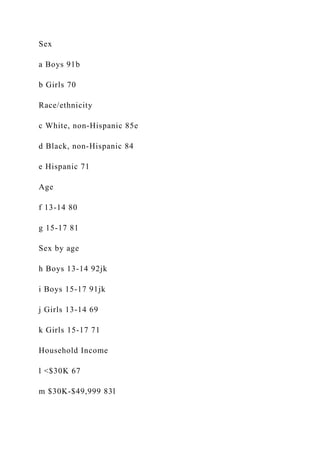
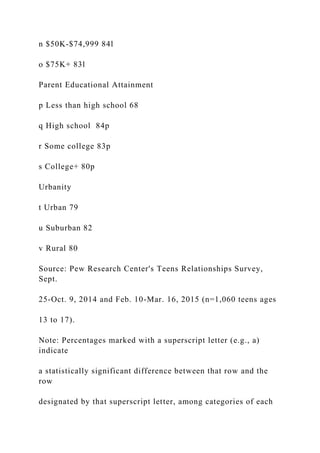
Game consoles
Some 81% of teens 13 to 17 have or have access to a game
console such as a Playstation, Xbox or
Wii. Fully 91% of teen boys own game consoles, while 70% of
girls say they have or have access to a
console. White teens are a bit more likely than Hispanic teens to
have a game console with 85% of
whites and 84% of African-Americans3 owing consoles
compared with 71% of Hispanic youth.
Teens in households earning less than $30,000 annually are less
likely to have a console, though
about two-thirds (67%) of these families have them. By
contrast, 83% of families earning more
own console game systems.
Overall, teens have relatively robust levels of access to tech
devices. The majority of youth have
access to three or four of the five items asked about on the
survey — desktop or laptop computer,
smartphone, basic phone, tablet and game console. Fully seven-
in-ten teens have or have access to
three or four of those items; about 1% of teens own no devices
and just 4% say they only have or
have access to one.
3 While white and African-American teens have or have access
to game consoles at similar rates, the difference between
African-Americans
and Hispanics is not statistically significant due to small sample
size. The difference in console ownership and access rates
between whites
and Hispanics is statistically significant.
13
PEW RESEARCH CENTER
www.pewresearch.org
EMBARGOED COPY – NOT FOR PUBLICATION OR
DISTRIBUTION UNTIL 00:00 a.m./p.m. EDT, MONTH DATE,
YEAR EMBARGOED COPY – NOT FOR PUBLICATION OR
DISTRIBUTION UNTIL 00:00 a.m./p.m. EDT, MONTH DATE,
YEAR EMBARGOED COPY – NOT FOR PUBLICATION OR
DISTRIBUTION UNTIL 00:00 a.m./p.m. EDT, MONTH DATE,
YEAR
81% of Teens Have Access to Gaming
Consoles
% of all teens who have or have access to a gaming
console
All Teens 81%
Sex
a Boys 91b
b Girls 70
Race/ethnicity
c White, non-Hispanic 85e
d Black, non-Hispanic 84
e Hispanic 71
Age
f 13-14 80
g 15-17 81
Sex by age
h Boys 13-14 92jk
i Boys 15-17 91jk
j Girls 13-14 69
k Girls 15-17 71
Household Income
l <$30K 67
m $30K-$49,999 83l
n $50K-$74,999 84l
o $75K+ 83l
Parent Educational Attainment
p Less than high school 68
q High school 84p
r Some college 83p
s College+ 80p
Urbanity
t Urban 79
u Suburban 82
v Rural 80
Source: Pew Research Center's Teens Relationships Survey,
Sept.
25-Oct. 9, 2014 and Feb. 10-Mar. 16, 2015 (n=1,060 teens ages
13 to 17).
Note: Percentages marked with a superscript letter (e.g., a)
indicate
a statistically significant difference between that row and the
row
designated by that superscript letter, among categories of each
demographic characteristic (e.g. age).
PEW RESEARCH CENTER
14
PEW RESEARCH CENTER
www.pewresearch.org
Mobile Access Shifts Social Media Use and Other Online
Activities
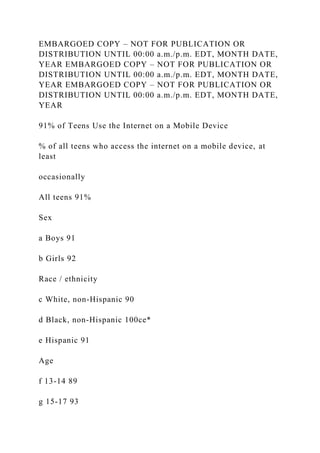
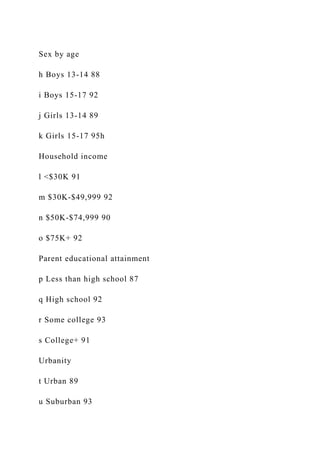
Accessing the internet on mobile devices
The survey shows that 91% of teens go online from a mobile
device, at least occasionally.4 African-
American teens are significantly more likely than whites or
Hispanics to use mobile devices to go
online — with nearly all African-American youth in the study
reporting mobile internet access at
least occasionally, while 90% of white and 91% of Hispanic
teens go online on-the-go.
4 In our previous reports our data collection methods allowed us
to report a figure for percent of American teens who use the
Internet. This
report marks a switch to a new data collection method. Our new
survey methodology is conducted online. Even as the population
surveyed
contains members who do not initially have a computer and/or
internet access (these households are given a computer and
internet
connectivity to allow them to take the surveys), it is
representative of the American population. However, this
administration method does not
allow us to estimate the percentage of youth who go online.
15
PEW RESEARCH CENTER
www.pewresearch.org
EMBARGOED COPY – NOT FOR PUBLICATION OR
DISTRIBUTION UNTIL 00:00 a.m./p.m. EDT, MONTH DATE,
YEAR EMBARGOED COPY – NOT FOR PUBLICATION OR
DISTRIBUTION UNTIL 00:00 a.m./p.m. EDT, MONTH DATE,
YEAR EMBARGOED COPY – NOT FOR PUBLICATION OR
DISTRIBUTION UNTIL 00:00 a.m./p.m. EDT, MONTH DATE,
YEAR
91% of Teens Use the Internet on a Mobile Device
% of all teens who access the internet on a mobile device, at
least
occasionally
All teens 91%
Sex
a Boys 91
b Girls 92
Race / ethnicity
c White, non-Hispanic 90
d Black, non-Hispanic 100ce*
e Hispanic 91
Age
f 13-14 89
g 15-17 93
Sex by age
h Boys 13-14 88
i Boys 15-17 92
j Girls 13-14 89
k Girls 15-17 95h
Household income
l <$30K 91
m $30K-$49,999 92
n $50K-$74,999 90
o $75K+ 92
Parent educational attainment
p Less than high school 87
q High school 92
r Some college 93
s College+ 91
Urbanity
t Urban 89
u Suburban 93
v Rural 91
Source: Pew Research Center's Teens Relationships Survey,
Sept. 25-Oct. 9, 2014 and Feb.
10-Mar. 16, 2015 (n=1,060 teens ages 13 to 17).
Note: Percentages marked with a superscript letter (e.g., a)
indicate a statistically significant
difference between that row and the row designated by that
superscript letter, among
categories of each demographic characteristic (e.g. age).
*Please also note: Each of the data points in this report is
subject to a margin of error,
meaning that a number could be higher or lower, within a
certain range, than the reported
number. 100% is an extremely rare occurrence in surveying, and
should be interpreted as
encompassing a very large percentage of a particular population
rather than every single
individual.
PEW RESEARCH CENTER
16
PEW RESEARCH CENTER
www.pewresearch.org
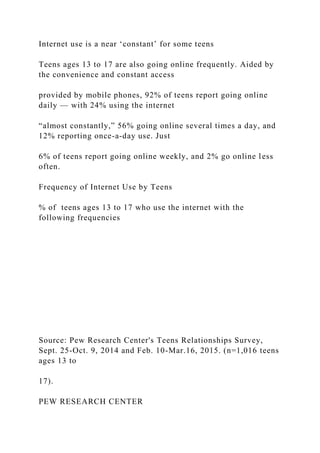
Internet use is a near ‘constant’ for some teens
Teens ages 13 to 17 are also going online frequently. Aided by
the convenience and constant access
provided by mobile phones, 92% of teens report going online
daily — with 24% using the internet
“almost constantly,” 56% going online several times a day, and
12% reporting once-a-day use. Just
6% of teens report going online weekly, and 2% go online less
often.
Frequency of Internet Use by Teens
% of teens ages 13 to 17 who use the internet with the
following frequencies
Source: Pew Research Center's Teens Relationships Survey,
Sept. 25-Oct. 9, 2014 and Feb. 10-Mar.16, 2015. (n=1,016 teens
ages 13 to
17).
PEW RESEARCH CENTER
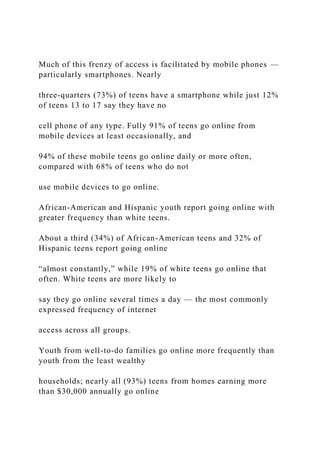
Much of this frenzy of access is facilitated by mobile phones —
particularly smartphones. Nearly
three-quarters (73%) of teens have a smartphone while just 12%
of teens 13 to 17 say they have no
cell phone of any type. Fully 91% of teens go online from
mobile devices at least occasionally, and
94% of these mobile teens go online daily or more often,
compared with 68% of teens who do not
use mobile devices to go online.
African-American and Hispanic youth report going online with
greater frequency than white teens.
About a third (34%) of African-American teens and 32% of
Hispanic teens report going online
“almost constantly,” while 19% of white teens go online that
often. White teens are more likely to
say they go online several times a day — the most commonly
expressed frequency of internet
access across all groups.
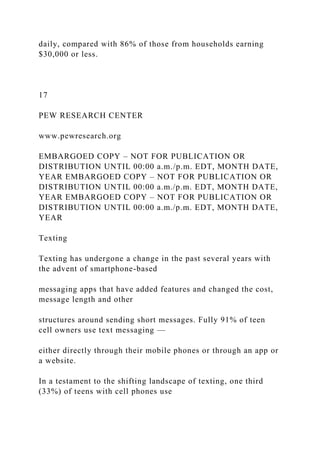
Youth from well-to-do families go online more frequently than
youth from the least wealthy
households; nearly all (93%) teens from homes earning more
than $30,000 annually go online
daily, compared with 86% of those from households earning
$30,000 or less.
17
PEW RESEARCH CENTER
www.pewresearch.org
EMBARGOED COPY – NOT FOR PUBLICATION OR
DISTRIBUTION UNTIL 00:00 a.m./p.m. EDT, MONTH DATE,
YEAR EMBARGOED COPY – NOT FOR PUBLICATION OR
DISTRIBUTION UNTIL 00:00 a.m./p.m. EDT, MONTH DATE,
YEAR EMBARGOED COPY – NOT FOR PUBLICATION OR
DISTRIBUTION UNTIL 00:00 a.m./p.m. EDT, MONTH DATE,
YEAR
Texting
Texting has undergone a change in the past several years with
the advent of smartphone-based
messaging apps that have added features and changed the cost,
message length and other
structures around sending short messages. Fully 91% of teen
cell owners use text messaging —
either directly through their mobile phones or through an app or
a website.
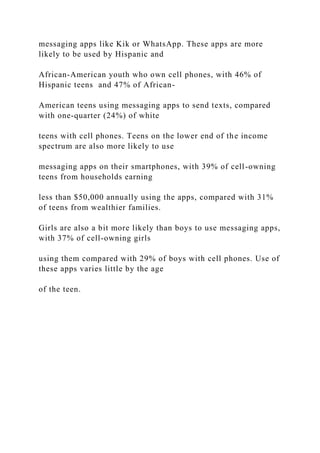
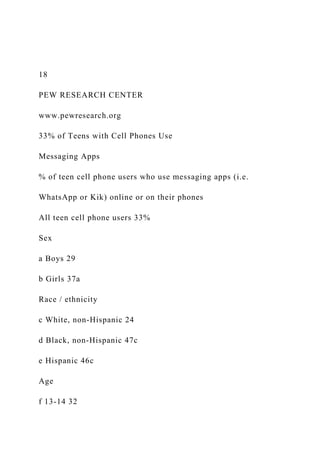
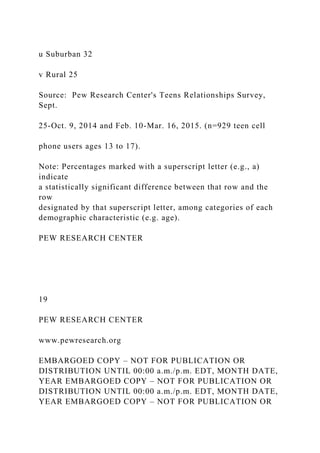
In a testament to the shifting landscape of texting, one third
(33%) of teens with cell phones use
messaging apps like Kik or WhatsApp. These apps are more
likely to be used by Hispanic and
African-American youth who own cell phones, with 46% of
Hispanic teens and 47% of African-
American teens using messaging apps to send texts, compared
with one-quarter (24%) of white
teens with cell phones. Teens on the lower end of the income
spectrum are also more likely to use
messaging apps on their smartphones, with 39% of cell-owning
teens from households earning
less than $50,000 annually using the apps, compared with 31%
of teens from wealthier families.
Girls are also a bit more likely than boys to use messaging apps,
with 37% of cell-owning girls
using them compared with 29% of boys with cell phones. Use of
these apps varies little by the age
of the teen.
18
PEW RESEARCH CENTER
www.pewresearch.org
33% of Teens with Cell Phones Use
Messaging Apps
% of teen cell phone users who use messaging apps (i.e.
WhatsApp or Kik) online or on their phones
All teen cell phone users 33%
Sex
a Boys 29
b Girls 37a
Race / ethnicity
c White, non-Hispanic 24
d Black, non-Hispanic 47c
e Hispanic 46c
Age
f 13-14 32
g 15-17 34
Sex by age
h Boys 13-14 23
i Boys 15-17 42h
j Girls 13-14 33h
k Girls 15-17 34h
Household income
l <$30K 40
m $30K-$49,999 38
n $50K-$74,999 29
o $75K+ 31
Parent educational attainment
p Less than high school 36
q High school 31
r Some college 30
s College+ 37
Urbanity
t Urban 39v
u Suburban 32
v Rural 25
Source: Pew Research Center's Teens Relationships Survey,
Sept.
25-Oct. 9, 2014 and Feb. 10-Mar. 16, 2015. (n=929 teen cell
phone users ages 13 to 17).
Note: Percentages marked with a superscript letter (e.g., a)
indicate
a statistically significant difference between that row and the
row
designated by that superscript letter, among categories of each
demographic characteristic (e.g. age).
PEW RESEARCH CENTER
19
PEW RESEARCH CENTER
www.pewresearch.org
EMBARGOED COPY – NOT FOR PUBLICATION OR
DISTRIBUTION UNTIL 00:00 a.m./p.m. EDT, MONTH DATE,
YEAR EMBARGOED COPY – NOT FOR PUBLICATION OR
DISTRIBUTION UNTIL 00:00 a.m./p.m. EDT, MONTH DATE,
YEAR EMBARGOED COPY – NOT FOR PUBLICATION OR
DISTRIBUTION UNTIL 00:00 a.m./p.m. EDT, MONTH DATE,
YEAR
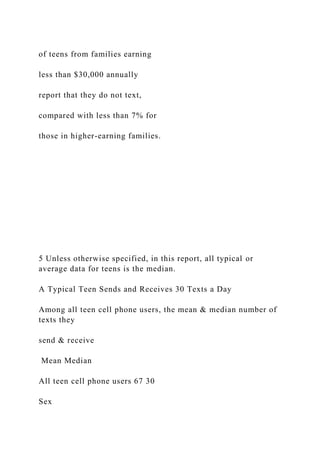
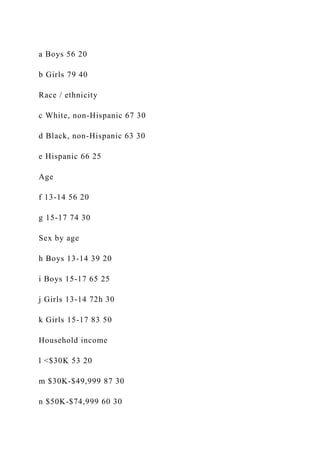
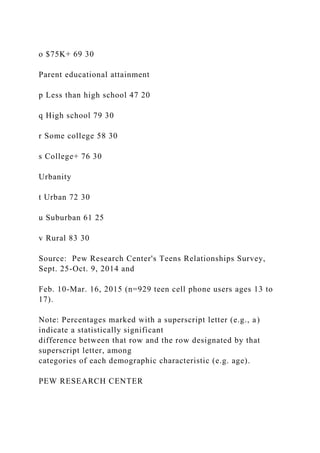
The number of text messages
sent or received by cell phone
owning teens ages 13 to 17
(directly through phone or on
apps on the phone) on a typical
day is 30.5 The number of
messages exchanged for girls is
higher, typically sending and
receiving 40 messages a day.
And for the oldest girls (15 to
17), this rises to a median of 50
messages exchanged daily.
Among teens with cell phones,
those from less well-off families
are more likely than others to
report that they simply don’t
send text messages. Some 18%
of teens from families earning
less than $30,000 annually
report that they do not text,
compared with less than 7% for
those in higher-earning families.
5 Unless otherwise specified, in this report, all typical or
average data for teens is the median.
A Typical Teen Sends and Receives 30 Texts a Day
Among all teen cell phone users, the mean & median number of
texts they
send & receive
Mean Median
All teen cell phone users 67 30
Sex
a Boys 56 20
b Girls 79 40
Race / ethnicity
c White, non-Hispanic 67 30
d Black, non-Hispanic 63 30
e Hispanic 66 25
Age
f 13-14 56 20
g 15-17 74 30
Sex by age
h Boys 13-14 39 20
i Boys 15-17 65 25
j Girls 13-14 72h 30
k Girls 15-17 83 50
Household income
l <$30K 53 20
m $30K-$49,999 87 30
n $50K-$74,999 60 30
o $75K+ 69 30
Parent educational attainment
p Less than high school 47 20
q High school 79 30
r Some college 58 30
s College+ 76 30
Urbanity
t Urban 72 30
u Suburban 61 25
v Rural 83 30
Source: Pew Research Center's Teens Relationships Survey,
Sept. 25-Oct. 9, 2014 and
Feb. 10-Mar. 16, 2015 (n=929 teen cell phone users ages 13 to
17).
Note: Percentages marked with a superscript letter (e.g., a)
indicate a statistically significant
difference between that row and the row designated by that
superscript letter, among
categories of each demographic characteristic (e.g. age).
PEW RESEARCH CENTER
20
PEW RESEARCH CENTER
www.pewresearch.org
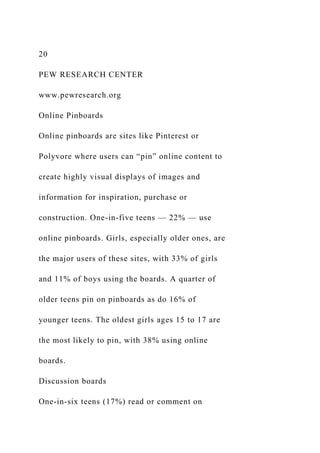
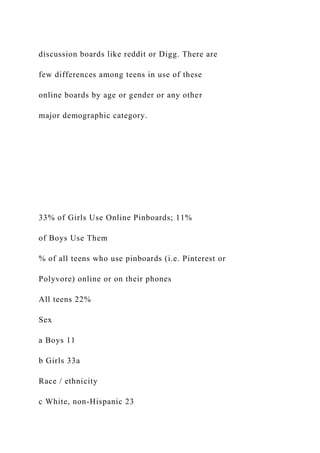
Online Pinboards
Online pinboards are sites like Pinterest or
Polyvore where users can “pin” online content to
create highly visual displays of images and
information for inspiration, purchase or
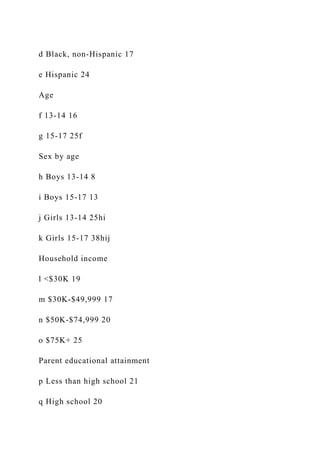
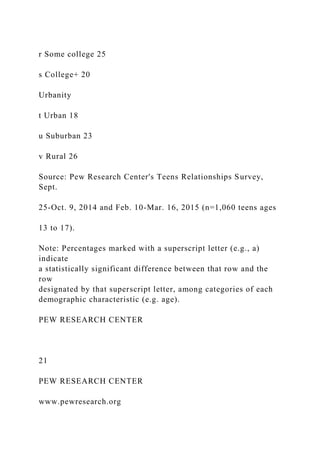
construction. One-in-five teens — 22% — use
online pinboards. Girls, especially older ones, are
the major users of these sites, with 33% of girls
and 11% of boys using the boards. A quarter of
older teens pin on pinboards as do 16% of
younger teens. The oldest girls ages 15 to 17 are
the most likely to pin, with 38% using online
boards.
Discussion boards
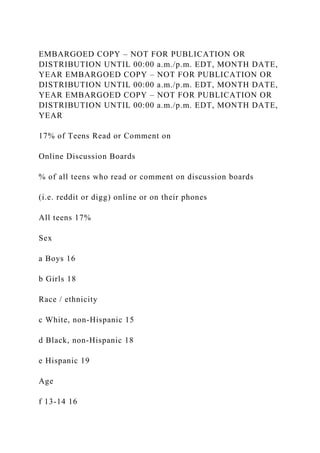
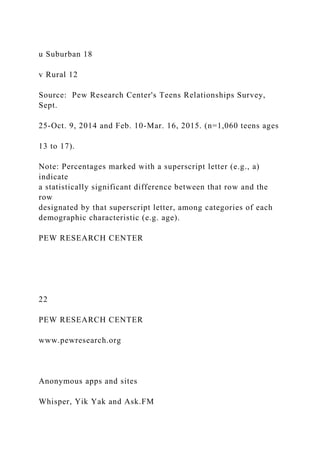
One-in-six teens (17%) read or comment on
discussion boards like reddit or Digg. There are
few differences among teens in use of these
online boards by age or gender or any other
major demographic category.
33% of Girls Use Online Pinboards; 11%
of Boys Use Them
% of all teens who use pinboards (i.e. Pinterest or
Polyvore) online or on their phones
All teens 22%
Sex
a Boys 11
b Girls 33a
Race / ethnicity
c White, non-Hispanic 23
d Black, non-Hispanic 17
e Hispanic 24
Age
f 13-14 16
g 15-17 25f
Sex by age
h Boys 13-14 8
i Boys 15-17 13
j Girls 13-14 25hi
k Girls 15-17 38hij
Household income
l <$30K 19
m $30K-$49,999 17
n $50K-$74,999 20
o $75K+ 25
Parent educational attainment
p Less than high school 21
q High school 20
r Some college 25
s College+ 20
Urbanity
t Urban 18
u Suburban 23
v Rural 26
Source: Pew Research Center's Teens Relationships Survey,
Sept.
25-Oct. 9, 2014 and Feb. 10-Mar. 16, 2015 (n=1,060 teens ages
13 to 17).
Note: Percentages marked with a superscript letter (e.g., a)
indicate
a statistically significant difference between that row and the
row
designated by that superscript letter, among categories of each
demographic characteristic (e.g. age).
PEW RESEARCH CENTER
21
PEW RESEARCH CENTER
www.pewresearch.org
EMBARGOED COPY – NOT FOR PUBLICATION OR
DISTRIBUTION UNTIL 00:00 a.m./p.m. EDT, MONTH DATE,
YEAR EMBARGOED COPY – NOT FOR PUBLICATION OR
DISTRIBUTION UNTIL 00:00 a.m./p.m. EDT, MONTH DATE,
YEAR EMBARGOED COPY – NOT FOR PUBLICATION OR
DISTRIBUTION UNTIL 00:00 a.m./p.m. EDT, MONTH DATE,
YEAR
17% of Teens Read or Comment on
Online Discussion Boards
% of all teens who read or comment on discussion boards
(i.e. reddit or digg) online or on their phones
All teens 17%
Sex
a Boys 16
b Girls 18
Race / ethnicity
c White, non-Hispanic 15
d Black, non-Hispanic 18
e Hispanic 19
Age
f 13-14 16
g 15-17 18
Sex by age
h Boys 13-14 15
i Boys 15-17 17
j Girls 13-14 17
k Girls 15-17 19
Household income
l <$30K 16
m $30K-$49,999 16
n $50K-$74,999 13
o $75K+ 19
Parent educational attainment
p Less than high school 17
q High school 17
r Some college 18
s College+ 16
Urbanity
t Urban 18
u Suburban 18
v Rural 12
Source: Pew Research Center's Teens Relationships Survey,
Sept.
25-Oct. 9, 2014 and Feb. 10-Mar. 16, 2015. (n=1,060 teens ages
13 to 17).
Note: Percentages marked with a superscript letter (e.g., a)
indicate
a statistically significant difference between that row and the
row
designated by that superscript letter, among categories of each
demographic characteristic (e.g. age).
PEW RESEARCH CENTER
22
PEW RESEARCH CENTER
www.pewresearch.org
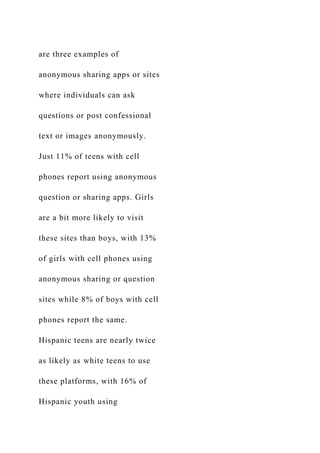
Anonymous apps and sites
Whisper, Yik Yak and Ask.FM
are three examples of
anonymous sharing apps or sites
where individuals can ask
questions or post confessional
text or images anonymously.
Just 11% of teens with cell
phones report using anonymous
question or sharing apps. Girls
are a bit more likely to visit
these sites than boys, with 13%
of girls with cell phones using
anonymous sharing or question
sites while 8% of boys with cell
phones report the same.
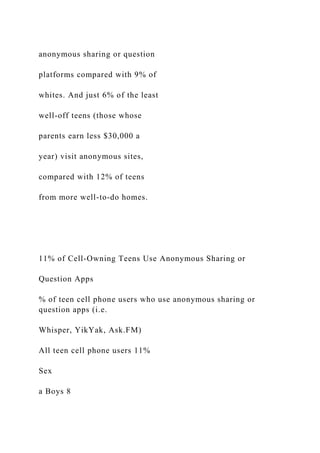
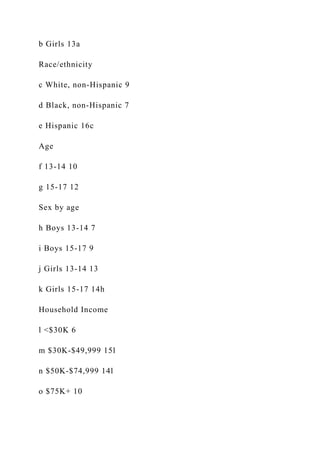
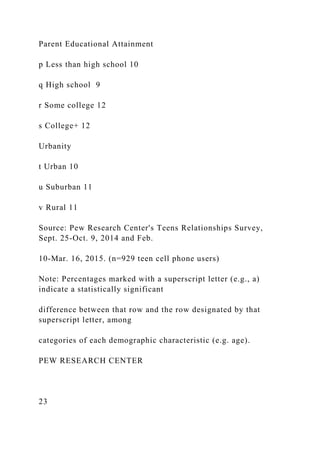
Hispanic teens are nearly twice
as likely as white teens to use
these platforms, with 16% of
Hispanic youth using
anonymous sharing or question
platforms compared with 9% of
whites. And just 6% of the least
well-off teens (those whose
parents earn less $30,000 a
year) visit anonymous sites,
compared with 12% of teens
from more well-to-do homes.
11% of Cell-Owning Teens Use Anonymous Sharing or
Question Apps
% of teen cell phone users who use anonymous sharing or
question apps (i.e.
Whisper, YikYak, Ask.FM)
All teen cell phone users 11%
Sex
a Boys 8
b Girls 13a
Race/ethnicity
c White, non-Hispanic 9
d Black, non-Hispanic 7
e Hispanic 16c
Age
f 13-14 10
g 15-17 12
Sex by age
h Boys 13-14 7
i Boys 15-17 9
j Girls 13-14 13
k Girls 15-17 14h
Household Income
l <$30K 6
m $30K-$49,999 15l
n $50K-$74,999 14l
o $75K+ 10
Parent Educational Attainment
p Less than high school 10
q High school 9
r Some college 12
s College+ 12
Urbanity
t Urban 10
u Suburban 11
v Rural 11
Source: Pew Research Center's Teens Relationships Survey,
Sept. 25-Oct. 9, 2014 and Feb.
10-Mar. 16, 2015. (n=929 teen cell phone users)
Note: Percentages marked with a superscript letter (e.g., a)
indicate a statistically significant
difference between that row and the row designated by that
superscript letter, among
categories of each demographic characteristic (e.g. age).
PEW RESEARCH CENTER
23
PEW RESEARCH CENTER
www.pewresearch.org
EMBARGOED COPY – NOT FOR PUBLICATION OR
DISTRIBUTION UNTIL 00:00 a.m./p.m. EDT, MONTH DATE,
YEAR EMBARGOED COPY – NOT FOR PUBLICATION OR
DISTRIBUTION UNTIL 00:00 a.m./p.m. EDT, MONTH DATE,
YEAR EMBARGOED COPY – NOT FOR PUBLICATION OR
DISTRIBUTION UNTIL 00:00 a.m./p.m. EDT, MONTH DATE,
YEAR
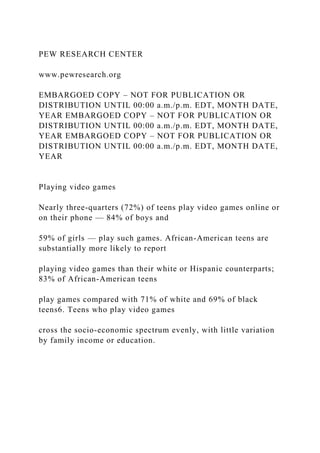
Playing video games
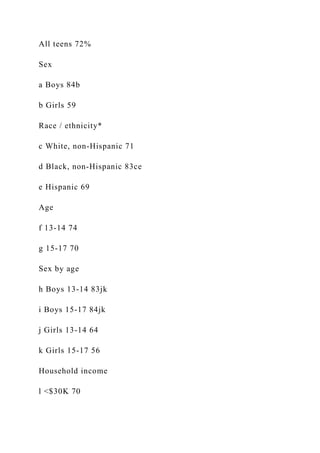
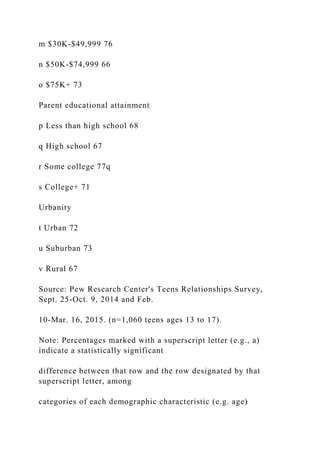
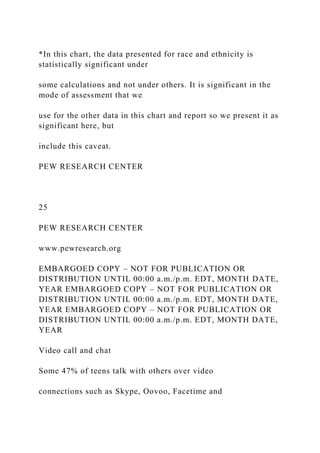
Nearly three-quarters (72%) of teens play video games online or
on their phone — 84% of boys and
59% of girls — play such games. African-American teens are
substantially more likely to report
playing video games than their white or Hispanic counterparts;
83% of African-American teens
play games compared with 71% of white and 69% of black
teens6. Teens who play video games
cross the socio-economic spectrum evenly, with little variation
by family income or education.
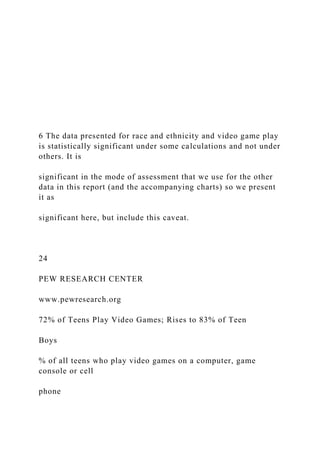
6 The data presented for race and ethnicity and video game play
is statistically significant under some calculations and not under
others. It is
significant in the mode of assessment that we use for the other
data in this report (and the accompanying charts) so we present
it as
significant here, but include this caveat.
24
PEW RESEARCH CENTER
www.pewresearch.org
72% of Teens Play Video Games; Rises to 83% of Teen
Boys
% of all teens who play video games on a computer, game
console or cell
phone
All teens 72%
Sex
a Boys 84b
b Girls 59
Race / ethnicity*
c White, non-Hispanic 71
d Black, non-Hispanic 83ce
e Hispanic 69
Age
f 13-14 74
g 15-17 70
Sex by age
h Boys 13-14 83jk
i Boys 15-17 84jk
j Girls 13-14 64
k Girls 15-17 56
Household income
l <$30K 70
m $30K-$49,999 76
n $50K-$74,999 66
o $75K+ 73
Parent educational attainment
p Less than high school 68
q High school 67
r Some college 77q
s College+ 71
Urbanity
t Urban 72
u Suburban 73
v Rural 67
Source: Pew Research Center's Teens Relationships Survey,
Sept. 25-Oct. 9, 2014 and Feb.
10-Mar. 16, 2015. (n=1,060 teens ages 13 to 17).
Note: Percentages marked with a superscript letter (e.g., a)
indicate a statistically significant
difference between that row and the row designated by that
superscript letter, among
categories of each demographic characteristic (e.g. age)
*In this chart, the data presented for race and ethnicity is
statistically significant under
some calculations and not under others. It is significant in the
mode of assessment that we
use for the other data in this chart and report so we present it as
significant here, but
include this caveat.
PEW RESEARCH CENTER
25
PEW RESEARCH CENTER
www.pewresearch.org
EMBARGOED COPY – NOT FOR PUBLICATION OR
DISTRIBUTION UNTIL 00:00 a.m./p.m. EDT, MONTH DATE,
YEAR EMBARGOED COPY – NOT FOR PUBLICATION OR
DISTRIBUTION UNTIL 00:00 a.m./p.m. EDT, MONTH DATE,
YEAR EMBARGOED COPY – NOT FOR PUBLICATION OR
DISTRIBUTION UNTIL 00:00 a.m./p.m. EDT, MONTH DATE,
YEAR
Video call and chat
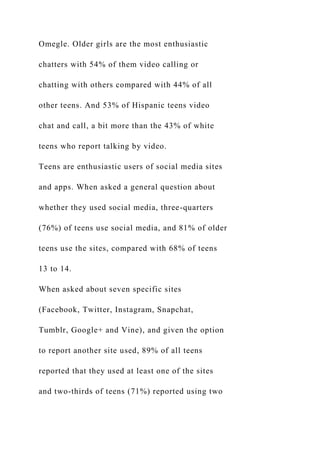
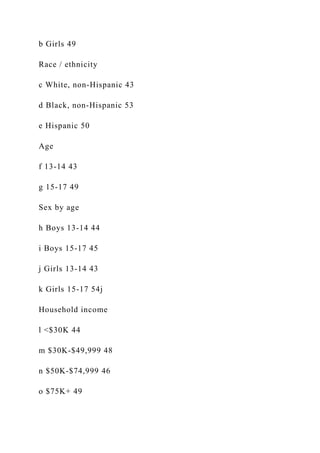
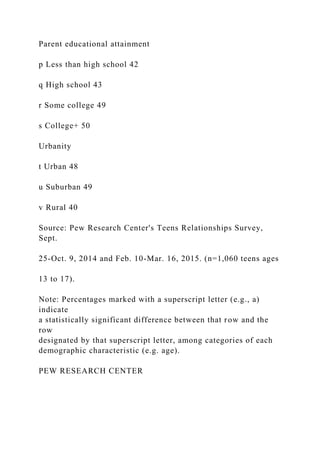
Some 47% of teens talk with others over video
connections such as Skype, Oovoo, Facetime and
Omegle. Older girls are the most enthusiastic
chatters with 54% of them video calling or
chatting with others compared with 44% of all
other teens. And 53% of Hispanic teens video
chat and call, a bit more than the 43% of white
teens who report talking by video.
Teens are enthusiastic users of social media sites
and apps. When asked a general question about
whether they used social media, three-quarters
(76%) of teens use social media, and 81% of older
teens use the sites, compared with 68% of teens
13 to 14.
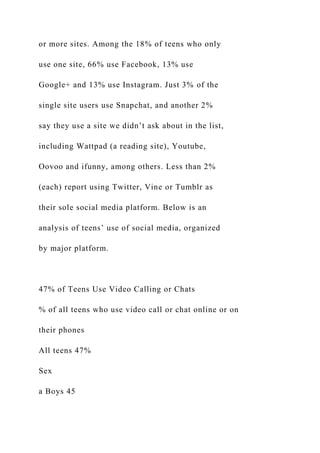
When asked about seven specific sites
(Facebook, Twitter, Instagram, Snapchat,
Tumblr, Google+ and Vine), and given the option
to report another site used, 89% of all teens
reported that they used at least one of the sites
and two-thirds of teens (71%) reported using two
or more sites. Among the 18% of teens who only
use one site, 66% use Facebook, 13% use
Google+ and 13% use Instagram. Just 3% of the
single site users use Snapchat, and another 2%
say they use a site we didn’t ask about in the list,
including Wattpad (a reading site), Youtube,
Oovoo and ifunny, among others. Less than 2%
(each) report using Twitter, Vine or Tumblr as
their sole social media platform. Below is an
analysis of teens’ use of social media, organized
by major platform.
47% of Teens Use Video Calling or Chats
% of all teens who use video call or chat online or on
their phones
All teens 47%
Sex
a Boys 45
b Girls 49
Race / ethnicity
c White, non-Hispanic 43
d Black, non-Hispanic 53
e Hispanic 50
Age
f 13-14 43
g 15-17 49
Sex by age
h Boys 13-14 44
i Boys 15-17 45
j Girls 13-14 43
k Girls 15-17 54j
Household income
l <$30K 44
m $30K-$49,999 48
n $50K-$74,999 46
o $75K+ 49
Parent educational attainment
p Less than high school 42
q High school 43
r Some college 49
s College+ 50
Urbanity
t Urban 48
u Suburban 49
v Rural 40
Source: Pew Research Center's Teens Relationships Survey,
Sept.
25-Oct. 9, 2014 and Feb. 10-Mar. 16, 2015. (n=1,060 teens ages
13 to 17).
Note: Percentages marked with a superscript letter (e.g., a)
indicate
a statistically significant difference between that row and the
row
designated by that superscript letter, among categories of each
demographic characteristic (e.g. age).
PEW RESEARCH CENTER
26
PEW RESEARCH CENTER
www.pewresearch.org
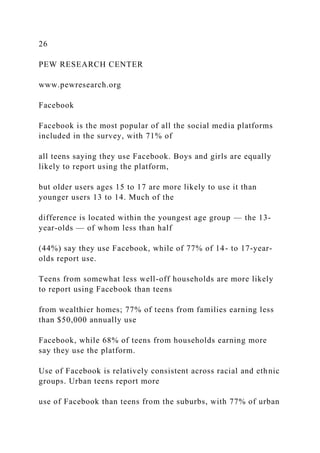
Facebook
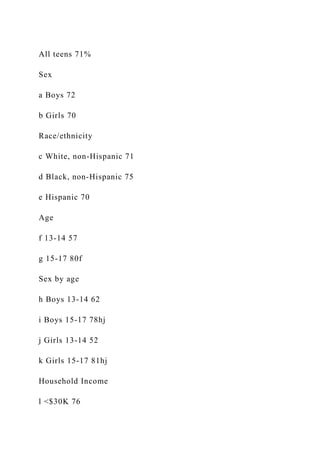
Facebook is the most popular of all the social media platforms
included in the survey, with 71% of
all teens saying they use Facebook. Boys and girls are equally
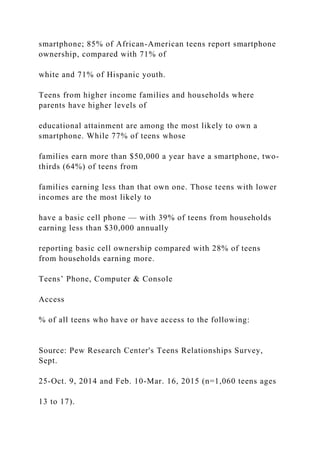
likely to report using the platform,
but older users ages 15 to 17 are more likely to use it than
younger users 13 to 14. Much of the
difference is located within the youngest age group — the 13-
year-olds — of whom less than half
(44%) say they use Facebook, while of 77% of 14- to 17-year-
olds report use.
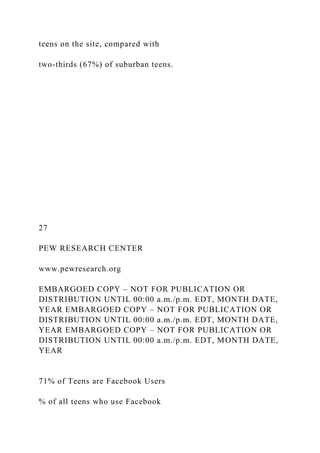
Teens from somewhat less well-off households are more likely
to report using Facebook than teens
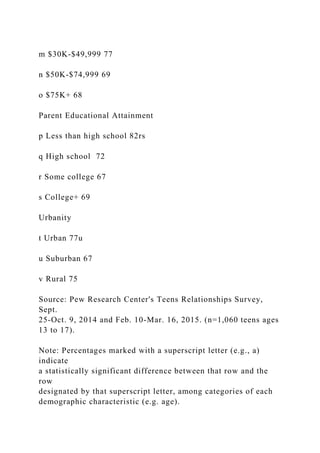
from wealthier homes; 77% of teens from families earning less
than $50,000 annually use
Facebook, while 68% of teens from households earning more
say they use the platform.
Use of Facebook is relatively consistent across racial and ethnic
groups. Urban teens report more
use of Facebook than teens from the suburbs, with 77% of urban
teens on the site, compared with
two-thirds (67%) of suburban teens.
27
PEW RESEARCH CENTER
www.pewresearch.org
EMBARGOED COPY – NOT FOR PUBLICATION OR
DISTRIBUTION UNTIL 00:00 a.m./p.m. EDT, MONTH DATE,
YEAR EMBARGOED COPY – NOT FOR PUBLICATION OR
DISTRIBUTION UNTIL 00:00 a.m./p.m. EDT, MONTH DATE,
YEAR EMBARGOED COPY – NOT FOR PUBLICATION OR
DISTRIBUTION UNTIL 00:00 a.m./p.m. EDT, MONTH DATE,
YEAR
71% of Teens are Facebook Users
% of all teens who use Facebook
All teens 71%
Sex
a Boys 72
b Girls 70
Race/ethnicity
c White, non-Hispanic 71
d Black, non-Hispanic 75
e Hispanic 70
Age
f 13-14 57
g 15-17 80f
Sex by age
h Boys 13-14 62
i Boys 15-17 78hj
j Girls 13-14 52
k Girls 15-17 81hj
Household Income
l <$30K 76
m $30K-$49,999 77
n $50K-$74,999 69
o $75K+ 68
Parent Educational Attainment
p Less than high school 82rs
q High school 72
r Some college 67
s College+ 69
Urbanity
t Urban 77u
u Suburban 67
v Rural 75
Source: Pew Research Center's Teens Relationships Survey,
Sept.
25-Oct. 9, 2014 and Feb. 10-Mar. 16, 2015. (n=1,060 teens ages
13 to 17).
Note: Percentages marked with a superscript letter (e.g., a)
indicate
a statistically significant difference between that row and the
row
designated by that superscript letter, among categories of each
demographic characteristic (e.g. age).
PEW RESEARCH CENTER
28
PEW RESEARCH CENTER
www.pewresearch.org
Adult use of Facebook has plateaued in recent years, with 71%
of online adults using the site.
However, Facebook’s user base remains quite active, with 70%
of Facebook users engaging with
the site daily. For more details on adult use of Facebook, please
read Social Media Update 2014.
Facebook users typically have 145 friends
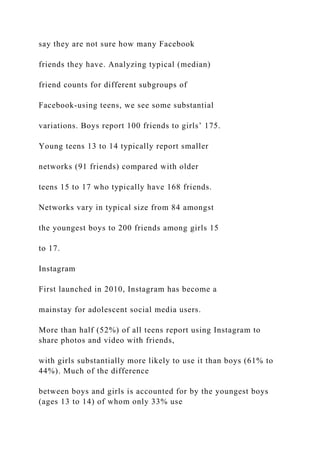
Among Facebook-using teens, the typical teen has 145
Facebook friends.7 Breaking it down, the
largest group of teens — 30% — say they have Facebook
networks of 0 to 100 friends. Another 12%
report networks of 101-200 friends and 9% say
201 to 300 friends. And 15% say they have more
than 300 friends. Tellingly, one-third of teens
say they are not sure how many Facebook
friends they have. Analyzing typical (median)
friend counts for different subgroups of
Facebook-using teens, we see some substantial
variations. Boys report 100 friends to girls’ 175.
Young teens 13 to 14 typically report smaller
networks (91 friends) compared with older
teens 15 to 17 who typically have 168 friends.
Networks vary in typical size from 84 amongst
the youngest boys to 200 friends among girls 15
to 17.
Instagram
First launched in 2010, Instagram has become a
mainstay for adolescent social media users.
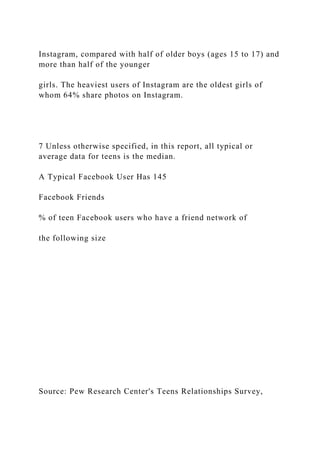
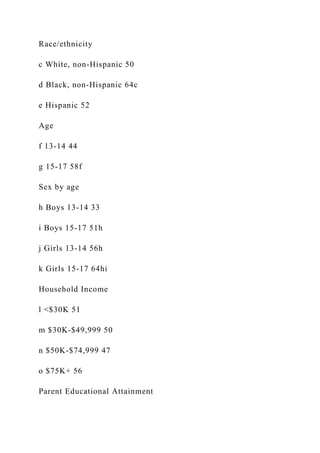
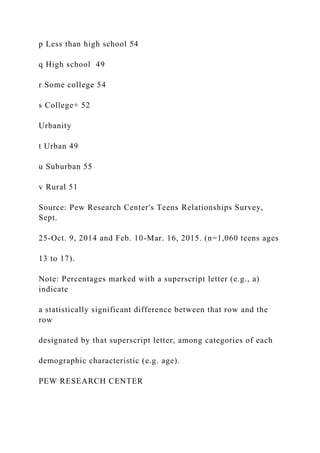
More than half (52%) of all teens report using Instagram to
share photos and video with friends,
with girls substantially more likely to use it than boys (61% to
44%). Much of the difference
between boys and girls is accounted for by the youngest boys
(ages 13 to 14) of whom only 33% use
Instagram, compared with half of older boys (ages 15 to 17) and
more than half of the younger
girls. The heaviest users of Instagram are the oldest girls of
whom 64% share photos on Instagram.
7 Unless otherwise specified, in this report, all typical or
average data for teens is the median.
A Typical Facebook User Has 145
Facebook Friends
% of teen Facebook users who have a friend network of
the following size
Source: Pew Research Center's Teens Relationships Survey,
September 25-October 9, 2014 and February 10-March 16, 2015.
(n=737 teens ages 13 to 17).
PEW RESEARCH CENTER
http://www.pewinternet.org/2015/01/09/social-media-update-
2014/
29
PEW RESEARCH CENTER
www.pewresearch.org
EMBARGOED COPY – NOT FOR PUBLICATION OR
DISTRIBUTION UNTIL 00:00 a.m./p.m. EDT, MONTH DATE,
YEAR EMBARGOED COPY – NOT FOR PUBLICATION OR
DISTRIBUTION UNTIL 00:00 a.m./p.m. EDT, MONTH DATE,
YEAR EMBARGOED COPY – NOT FOR PUBLICATION OR
DISTRIBUTION UNTIL 00:00 a.m./p.m. EDT, MONTH DATE,
YEAR
Half of American Teens Use Instagram
% of all teens who use Instagram
All teens 52%
Sex
a Boys 44
b Girls 61a
Race/ethnicity
c White, non-Hispanic 50
d Black, non-Hispanic 64c
e Hispanic 52
Age
f 13-14 44
g 15-17 58f
Sex by age
h Boys 13-14 33
i Boys 15-17 51h
j Girls 13-14 56h
k Girls 15-17 64hi
Household Income
l <$30K 51
m $30K-$49,999 50
n $50K-$74,999 47
o $75K+ 56
Parent Educational Attainment
p Less than high school 54
q High school 49
r Some college 54
s College+ 52
Urbanity
t Urban 49
u Suburban 55
v Rural 51
Source: Pew Research Center's Teens Relationships Survey,
Sept.
25-Oct. 9, 2014 and Feb. 10-Mar. 16, 2015. (n=1,060 teens ages
13 to 17).
Note: Percentages marked with a superscript letter (e.g., a)
indicate
a statistically significant difference between that row and the
row
designated by that superscript letter, among categories of each
demographic characteristic (e.g. age).
PEW RESEARCH CENTER
30
PEW RESEARCH CENTER
www.pewresearch.org
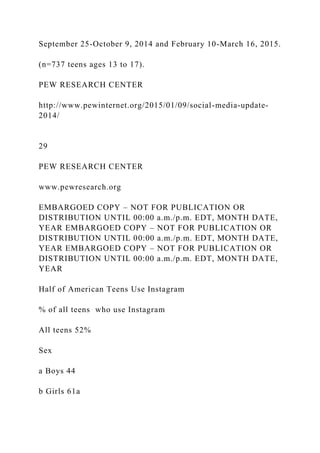
The typical teen’s Instagram network has 150 followers.
The typical American teen who uses Instagram
has 150 followers in their network. Girls outpace
boys in their typical number of followers, with
girls reporting a median of 200 followers on
Instagram compared with 100 followers for boys.
There is little variation in the number of followers
between younger and older cohorts of teens. And
fully 39% of Instagramming teens are not sure
how many followers they have.
Use of Instagram is not just confined to teens;
21% of American adults use the photo and video
sharing platform. As with Twitter, young adults
ages 18 to 29 are the most likely to use Instagram.
The service is also popular with adult women,
Hispanics, African-Americans, and urban and
suburban dwellers. For more data on adult use of Instagram,
please visit our Social Media Update
2014.
Snapchat
Snapchat is another relatively new photo and video focused
sharing app that teens have embraced
in the last two and half years. Two-in-five American teens
(41%) use Snapchat to share images and
videos that are then automatically deleted within a
predetermined amount of time — usually a few
seconds. (At least that is the way the firm describes how the
service works. In practice, there are
many workarounds that allow viewers to capture images.) By a
wide margin, girls and older teens
are the most likely to send snaps — with half of girls using the
service, compared with 31% of boys.
Similarly, 47% of older teens 15 to 17 send snaps, while 31% of
younger teens do so. Older girls are
the most likely of any teen group to use to service, with 56%
using Snapchat. Teens from the lowest
income households earning less than $30,000 per year are the
least likely to use the service, with
30% of them sending snaps, while 43% of wealthier teens send
them.
A Typical Instagram-Using Teen Has
150 Followers
% of teen Instagram users who have a network of
followers of this size
Source: Pew Research Center's Teens Relationships Survey,
Sept. 25-Oct. 9, 2014 and February 10-March 16, 2015. (n=534
teens ages 13 to 17).
PEW RESEARCH CENTER
http://www.pewinternet.org/2015/01/09/social-media-update-
2014/
http://www.pewinternet.org/2015/01/09/social-media-update-
2014/
31
PEW RESEARCH CENTER
www.pewresearch.org
EMBARGOED COPY – NOT FOR PUBLICATION OR
DISTRIBUTION UNTIL 00:00 a.m./p.m. EDT, MONTH DATE,
YEAR EMBARGOED COPY – NOT FOR PUBLICATION OR
DISTRIBUTION UNTIL 00:00 a.m./p.m. EDT, MONTH DATE,
YEAR EMBARGOED COPY – NOT FOR PUBLICATION OR
DISTRIBUTION UNTIL 00:00 a.m./p.m. EDT, MONTH DATE,
YEAR
41% of Teens are Snapchat Users
% of all teens who use Snapchat
All teens 41%
Sex
a Boys 31
b Girls 51a
Race/ethnicity
c White, non-Hispanic 42
d Black, non-Hispanic 40
e Hispanic 41
Age
f 13-14 31
g 15-17 47f
Sex by age
h Boys 13-14 19
i Boys 15-17 39h
j Girls 13-14 43h
k Girls 15-17 56hij
Household Income
l <$30K 30
m $30K-$49,999 40
n $50K-$74,999 39
o $75K+ 46l
Parent Educational Attainment
p Less than high school 35
q High school 42
r Some college 41
s College+ 44
Urbanity
t Urban 38
u Suburban 41
v Rural 49
Source: Pew Research Center's Teens Relationships Survey,
Sept.
25-Oct. 9, 2014 and Feb. 10-Mar. 16, 2015. (n=1,060 teens ages
13 to 17).
Note: Percentages marked with a superscript letter (e.g., a)
indicate
a statistically significant difference between that row and the
row
designated by that superscript letter, among categories of each
demographic characteristic (e.g. age).
PEW RESEARCH CENTER
32
PEW RESEARCH CENTER
www.pewresearch.org
Twitter
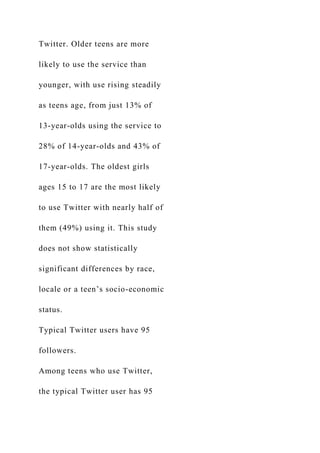
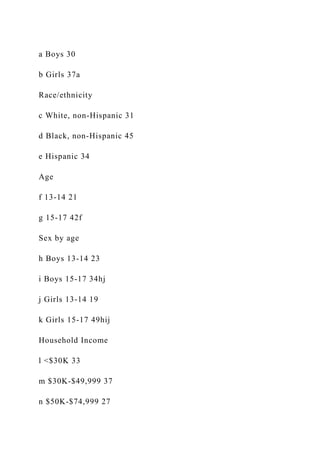
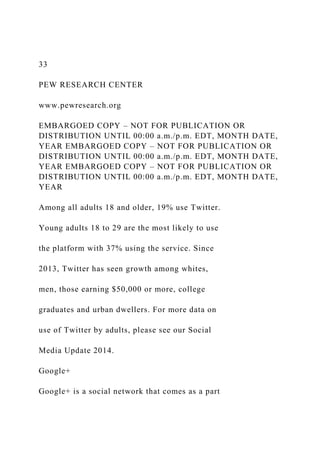
A third (33%) of all teens use
Twitter. Older teens are more
likely to use the service than
younger, with use rising steadily
as teens age, from just 13% of
13-year-olds using the service to
28% of 14-year-olds and 43% of
17-year-olds. The oldest girls
ages 15 to 17 are the most likely
to use Twitter with nearly half of
them (49%) using it. This study
does not show statistically
significant differences by race,
locale or a teen’s socio-economic
status.
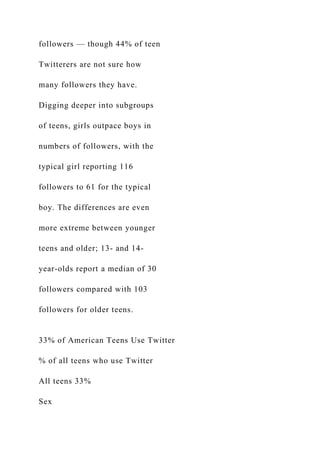
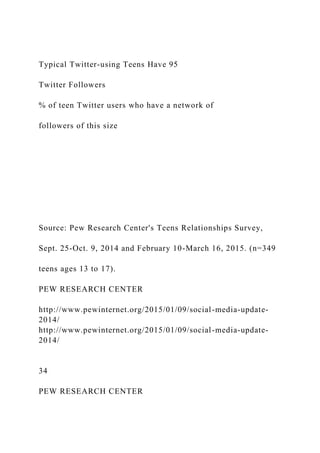
Typical Twitter users have 95
followers.
Among teens who use Twitter,
the typical Twitter user has 95
followers — though 44% of teen
Twitterers are not sure how
many followers they have.
Digging deeper into subgroups
of teens, girls outpace boys in
numbers of followers, with the
typical girl reporting 116
followers to 61 for the typical
boy. The differences are even
more extreme between younger
teens and older; 13- and 14-
year-olds report a median of 30
followers compared with 103
followers for older teens.
33% of American Teens Use Twitter
% of all teens who use Twitter
All teens 33%
Sex
a Boys 30
b Girls 37a
Race/ethnicity
c White, non-Hispanic 31
d Black, non-Hispanic 45
e Hispanic 34
Age
f 13-14 21
g 15-17 42f
Sex by age
h Boys 13-14 23
i Boys 15-17 34hj
j Girls 13-14 19
k Girls 15-17 49hij
Household Income
l <$30K 33
m $30K-$49,999 37
n $50K-$74,999 27
o $75K+ 35
Parent Educational Attainment
p Less than high school 31
q High school 35
r Some college 31
s College+ 35
Urbanity
t Urban 36
u Suburban 32
v Rural 34
Source: Pew Research Center's Teens Relationships Survey,
Sept. 25-Oct. 9, 2014 and Feb.
10-Mar. 16, 2015. (n=1,060 teens ages 13 to 17).
Note: Percentages marked with a superscript letter (e.g., a)
indicate a statistically significant
difference between that row and the row designated by that
superscript letter, among
categories of each demographic characteristic (e.g. age).
PEW RESEARCH CENTER
33
PEW RESEARCH CENTER
www.pewresearch.org
EMBARGOED COPY – NOT FOR PUBLICATION OR
DISTRIBUTION UNTIL 00:00 a.m./p.m. EDT, MONTH DATE,
YEAR EMBARGOED COPY – NOT FOR PUBLICATION OR
DISTRIBUTION UNTIL 00:00 a.m./p.m. EDT, MONTH DATE,
YEAR EMBARGOED COPY – NOT FOR PUBLICATION OR
DISTRIBUTION UNTIL 00:00 a.m./p.m. EDT, MONTH DATE,
YEAR
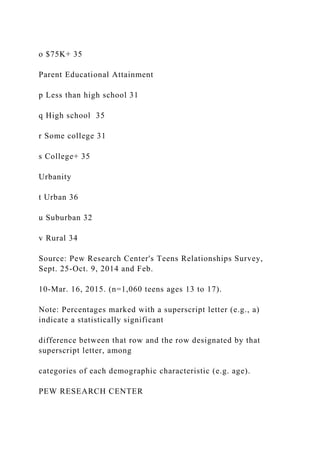
Among all adults 18 and older, 19% use Twitter.
Young adults 18 to 29 are the most likely to use
the platform with 37% using the service. Since
2013, Twitter has seen growth among whites,
men, those earning $50,000 or more, college
graduates and urban dwellers. For more data on
use of Twitter by adults, please see our Social
Media Update 2014.
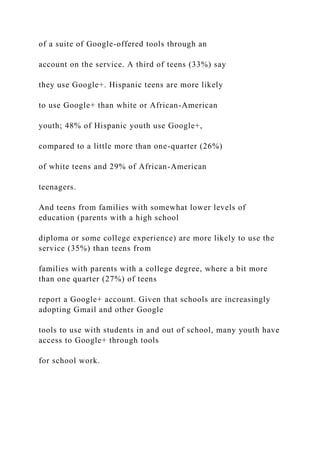
Google+
Google+ is a social network that comes as a part
of a suite of Google-offered tools through an
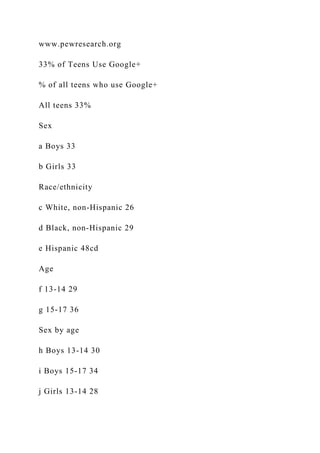
account on the service. A third of teens (33%) say
they use Google+. Hispanic teens are more likely
to use Google+ than white or African-American
youth; 48% of Hispanic youth use Google+,
compared to a little more than one-quarter (26%)
of white teens and 29% of African-American
teenagers.
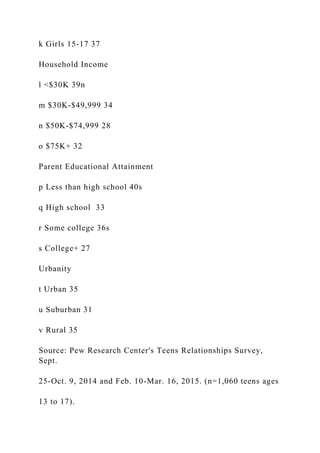
And teens from families with somewhat lower levels of
education (parents with a high school
diploma or some college experience) are more likely to use the
service (35%) than teens from
families with parents with a college degree, where a bit more
than one quarter (27%) of teens
report a Google+ account. Given that schools are increasingly
adopting Gmail and other Google
tools to use with students in and out of school, many youth have
access to Google+ through tools
for school work.
Typical Twitter-using Teens Have 95
Twitter Followers
% of teen Twitter users who have a network of
followers of this size
Source: Pew Research Center's Teens Relationships Survey,
Sept. 25-Oct. 9, 2014 and February 10-March 16, 2015. (n=349
teens ages 13 to 17).
PEW RESEARCH CENTER
http://www.pewinternet.org/2015/01/09/social-media-update-
2014/
http://www.pewinternet.org/2015/01/09/social-media-update-
2014/
34
PEW RESEARCH CENTER
www.pewresearch.org
33% of Teens Use Google+
% of all teens who use Google+
All teens 33%
Sex
a Boys 33
b Girls 33
Race/ethnicity
c White, non-Hispanic 26
d Black, non-Hispanic 29
e Hispanic 48cd
Age
f 13-14 29
g 15-17 36
Sex by age
h Boys 13-14 30
i Boys 15-17 34
j Girls 13-14 28
k Girls 15-17 37
Household Income
l <$30K 39n
m $30K-$49,999 34
n $50K-$74,999 28
o $75K+ 32
Parent Educational Attainment
p Less than high school 40s
q High school 33
r Some college 36s
s College+ 27
Urbanity
t Urban 35
u Suburban 31
v Rural 35
Source: Pew Research Center's Teens Relationships Survey,
Sept.
25-Oct. 9, 2014 and Feb. 10-Mar. 16, 2015. (n=1,060 teens ages
13 to 17).
Note: Percentages marked with a superscript letter (e.g., a)
indicate
a statistically significant difference between that row and the
row
designated by that superscript letter, among categories of each
demographic characteristic (e.g. age).
PEW RESEARCH CENTER
35
PEW RESEARCH CENTER
www.pewresearch.org
EMBARGOED COPY – NOT FOR PUBLICATION OR
DISTRIBUTION UNTIL 00:00 a.m./p.m. EDT, MONTH DATE,
YEAR EMBARGOED COPY – NOT FOR PUBLICATION OR
DISTRIBUTION UNTIL 00:00 a.m./p.m. EDT, MONTH DATE,
YEAR EMBARGOED COPY – NOT FOR PUBLICATION OR
DISTRIBUTION UNTIL 00:00 a.m./p.m. EDT, MONTH DATE,
YEAR
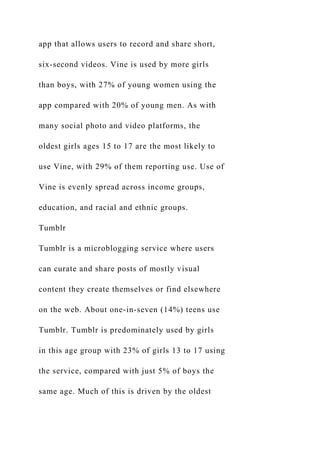
Vine
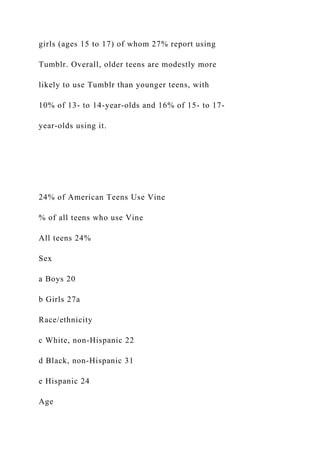
Roughly one quarter of teens (24%) use Vine, an
app that allows users to record and share short,
six-second videos. Vine is used by more girls
than boys, with 27% of young women using the
app compared with 20% of young men. As with
many social photo and video platforms, the
oldest girls ages 15 to 17 are the most likely to
use Vine, with 29% of them reporting use. Use of
Vine is evenly spread across income groups,
education, and racial and ethnic groups.
Tumblr
Tumblr is a microblogging service where users
can curate and share posts of mostly visual
content they create themselves or find elsewhere
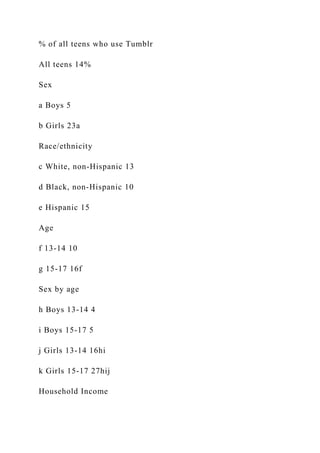
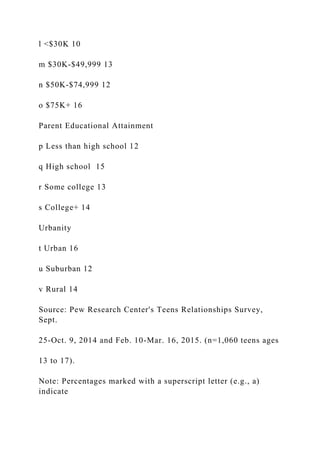
on the web. About one-in-seven (14%) teens use
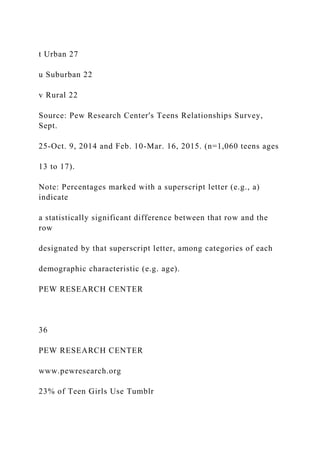
Tumblr. Tumblr is predominately used by girls
in this age group with 23% of girls 13 to 17 using
the service, compared with just 5% of boys the
same age. Much of this is driven by the oldest
girls (ages 15 to 17) of whom 27% report using
Tumblr. Overall, older teens are modestly more
likely to use Tumblr than younger teens, with
10% of 13- to 14-year-olds and 16% of 15- to 17-
year-olds using it.
24% of American Teens Use Vine
% of all teens who use Vine
All teens 24%
Sex
a Boys 20
b Girls 27a
Race/ethnicity
c White, non-Hispanic 22
d Black, non-Hispanic 31
e Hispanic 24
Age
f 13-14 21
g 15-17 25
Sex by age
h Boys 13-14 16
i Boys 15-17 22
j Girls 13-14 26h
k Girls 15-17 29h
Household Income
l <$30K 20
m $30K-$49,999 25
n $50K-$74,999 20
o $75K+ 26
Parent Educational Attainment
p Less than high school 25
q High school 21
r Some college 23
s College+ 26
Urbanity
t Urban 27
u Suburban 22
v Rural 22
Source: Pew Research Center's Teens Relationships Survey,
Sept.
25-Oct. 9, 2014 and Feb. 10-Mar. 16, 2015. (n=1,060 teens ages
13 to 17).
Note: Percentages marked with a superscript letter (e.g., a)
indicate
a statistically significant difference between that row and the
row
designated by that superscript letter, among categories of each
demographic characteristic (e.g. age).
PEW RESEARCH CENTER
36
PEW RESEARCH CENTER
www.pewresearch.org
23% of Teen Girls Use Tumblr
% of all teens who use Tumblr
All teens 14%
Sex
a Boys 5
b Girls 23a
Race/ethnicity
c White, non-Hispanic 13
d Black, non-Hispanic 10
e Hispanic 15
Age
f 13-14 10
g 15-17 16f
Sex by age
h Boys 13-14 4
i Boys 15-17 5
j Girls 13-14 16hi
k Girls 15-17 27hij
Household Income
l <$30K 10
m $30K-$49,999 13
n $50K-$74,999 12
o $75K+ 16
Parent Educational Attainment
p Less than high school 12
q High school 15
r Some college 13
s College+ 14
Urbanity
t Urban 16
u Suburban 12
v Rural 14
Source: Pew Research Center's Teens Relationships Survey,
Sept.
25-Oct. 9, 2014 and Feb. 10-Mar. 16, 2015. (n=1,060 teens ages
13 to 17).
Note: Percentages marked with a superscript letter (e.g., a)
indicate
a statistically significant difference between that row and the
row
designated by that superscript letter, among categories of each
demographic characteristic (e.g. age).
PEW RESEARCH CENTER
37
PEW RESEARCH CENTER
www.pewresearch.org
EMBARGOED COPY – NOT FOR PUBLICATION OR
DISTRIBUTION UNTIL 00:00 a.m./p.m. EDT, MONTH DATE,
YEAR EMBARGOED COPY – NOT FOR PUBLICATION OR
DISTRIBUTION UNTIL 00:00 a.m./p.m. EDT, MONTH DATE,
YEAR EMBARGOED COPY – NOT FOR PUBLICATION OR
DISTRIBUTION UNTIL 00:00 a.m./p.m. EDT, MONTH DATE,
YEAR
Facebook is used most often by the bulk of teens, but access
varies, based on family
income
When asked to rank social media sites by their
frequency of use, Facebook is the platform that
teens report that they use most often, with 41%
of youth saying they use it most. Instagram is
the next most often used social media platform,
with 20% of teens saying they use it most often.
Fully 11% of teens say Snapchat is the social site
they use most, and another 6% say Twitter.
The data shows a split in social media use by
socio-economic status. Less well-off teens from
families earning less than $30,000 annually
remain more connected to Facebook, with 51%
saying they use it most, compared with 38% of
teens from wealthier families. More well-to-do
teens instead are significantly more likely than
the least well-off teens to say they visit
Snapchat most, with 14% of those from families
earning more than $75,000 saying Snapchat is
their top social media platform, compared with
7% of teens whose families earn less than $30,000 annually.
There is a similar pattern by income
around Twitter, with the wealthiest teens shifting to Twitter
more than their least well-to-do peers.
Facebook, Instagram and Snapchat
Used Most Often by American Teens
% of all teens who use _____ most often
Note: "Don't use any" responses not shown.
Source: Pew Research Center's Teens Relationships Survey,
Sept.
25-Oct. 9, 2014 and Feb. 10-Mar. 16, 2015. (n=1,060 teens ages
13 to 17).
PEW RESEARCH CENTER
41
20
11
6
5
3
1
1
Facebook
Instagram
Snapchat
Twitter
Google+
Tumblr
Vine
A different social
media site
38
PEW RESEARCH CENTER
www.pewresearch.org
The youngest teens — the 13-year-olds — divide their loyalties
between Facebook and Instagram,
with a bit more than a quarter of teens this age reporting they
use each of these platforms most
often. Teens 14 and older are more likely to have Facebook as
their most often visited site. Indeed
the youngest girls (ages 13 and 14) are the most likely to report
using Instagram most often of any
age/gender group, with 31% reporting Instagram as their most
often visited platform.
Boys are more likely than girls to give Facebook as their most
visited site, with 45% of boys
reporting that, compared with 36% of teen girls. Girls are more
likely than boys to report
Split in Social Media Used Most Often
by Household Income
Among teens ages 13 to 17, the % of teens who use
______ most often, by household income
Source: Pew Research Center’s Teens Relationship Survey,
Sept.
25-Oct. 9, 2014 and Feb. 10-March 16, 2015.(n=1,060 teens
ages
13 to 17).
PEW RESEARCH CENTER
39
PEW RESEARCH CENTER
www.pewresearch.org
EMBARGOED COPY – NOT FOR PUBLICATION OR
DISTRIBUTION UNTIL 00:00 a.m./p.m. EDT, MONTH DATE,
YEAR EMBARGOED COPY – NOT FOR PUBLICATION OR
DISTRIBUTION UNTIL 00:00 a.m./p.m. EDT, MONTH DATE,
YEAR EMBARGOED COPY – NOT FOR PUBLICATION OR
DISTRIBUTION UNTIL 00:00 a.m./p.m. EDT, MONTH DATE,
YEAR
Instagram as their most often visited site, with 23% of girls and
17% of boys saying it is their most
visited platform. Older teens are more likely than younger teens
to list Facebook, Snapchat and
Twitter as their most often visited platforms, though for
Snapchat this is driven by great use
among 15- to 17-year-old girls. Urban teens are most likely to
say they visit Facebook most often,
while suburban teens report visiting Instagram more than their
urban peers.
Many teens who use multiple online social network sites report
“some” overlap in their
online personal social networks
When asked to think about how
much overlap they have with
various friends on the different
social networks they use, the
largest group of teens who use
multiple social media platforms
report that there is “some”
overlap in their friends on the
different sites. More than half
(57%) of teens describe their
networks as having some
overlap across sites. Another
three-in-ten teens (29%) have
tight networks — reporting that
their networks are composed of
the same people on every social
site they visit. And 9% say there
is “not a lot” of overlap in their
friends across social media
sites. Another 4% of teens are
compartmentalizers, who
report no overlap of friends across the social sites they visit.
Teens who use more than one social media platform and come
from households earning less than
$75,000 per year are more likely to say they have the same
friends across all of their networks,
with 35% of teens in these income brackets reporting the same
friends, compared with 23% of
teens from the wealthiest homes. Teens from higher income
households (earning $50,000 and
above) are substantially more likely to report that they have
some overlap among friends across
their different social networks, with 61% reporting some
overlap, compared with 48% of those
Lower Income Teens More Likely to Have the Same
Friends Across Multiple Social Media Platforms
Among all teens who use multiple social media platforms, the %
by household
income who say they have the following amount of overlap in
friends across
social media sites.
Source: Pew Research Center's Teens Relationships Survey,
September 25-October. 9, 2014
and February 10-March 16, 2015. (n=1,060 teens ages 13 to 17).
PEW RESEARCH CENTER
40
PEW RESEARCH CENTER
www.pewresearch.org
earning less. Teens from households that earn less than $50,ooo
a year are more likely than
wealthier teens to report that they have completely
compartmentalized their social network
platforms, with no overlap of friends across the different sites
they use. Fully 7% of households
earning less than $50,000 say they have no overlap in friends,
compared with 2% of teens from
families that earn more.
41
PEW RESEARCH CENTER
www.pewresearch.org
EMBARGOED COPY – NOT FOR PUBLICATION OR
DISTRIBUTION UNTIL 00:00 a.m./p.m. EDT, MONTH DATE,
YEAR EMBARGOED COPY – NOT FOR PUBLICATION OR
DISTRIBUTION UNTIL 00:00 a.m./p.m. EDT, MONTH DATE,
YEAR EMBARGOED COPY – NOT FOR PUBLICATION OR
DISTRIBUTION UNTIL 00:00 a.m./p.m. EDT, MONTH DATE,
YEAR
Methods
Introduction
The Pew Research Center’s Teen Relationship Study was
funded, designed and analyzed by Center
staff. Fieldwork was conducted by the GfK Group (GfK,
formerly Knowledge Networks.)
Specifically, the survey examined the attitudes of teenagers age
13 to 17 years old, as well as those
of their parents, toward technology. The survey examined
friendships and romantic relationships
within the context of technology use. The survey was
conducted using sample from
KnowledgePanel®.
Sample Definition
The target population consists of the following: parents of
teens age 13 to 17 and teens 13 to 17
years old residing in the United States. To sample the
population, GfK sampled households from
its KnowledgePanel, a probability-based web panel designed to
be representative of the United
States. The survey consisted of three stages: initial screening
for the parents of teens age 13 to 17,
the parent survey, and the teen survey.
The main data collection field periods were from September 25,
2014 through October 9, 2014 and
from February 10, 2015 to March 16, 2015. In the fall, 1016
parent-teen pairs were interviewed.
The survey was re-opened in the spring and 44 pairs were added
to the sample. The second data
collection was targeted toward African-American parents and
teenagers, with the intent of
increasing the number of African-American teens in the sample
to reportable levels. Parents
completed the parent section of the survey in 6 minutes
(median). Teens completed the teen
section of the survey in 16 minutes (median). The survey was
conducted in English and Spanish.
Parents and teens could select different languages for the
survey.
Survey Completion and Sample Sizes
The number of respondents sampled and participating in the
survey, the survey completion rates
for the screener and main interview, and the
incidence/eligibility rate are presented below.
Key Survey Response Statistics: In-Field Screening
N Complete Screener: 1637
42
PEW RESEARCH CENTER
www.pewresearch.org
While 1084 parents completed the parent section of the main
survey, 1060 teens completed the
teen section of the main survey; the 24 unpaired parents were
not included in the final counts. The
margin of error for the full sample of teens (n=1060) or parents
(n=1060) is plus or minus 3.7
percentage points. Please see the adjacent chart for the margin
of error for subsamples in this
study.
Margins of Error
Sample Size
Margin of error in
percentage points
All parents 1,060 +/- 3.7
All teens 1,060 +/- 3.7
Girls 537 +/- 5.2
Boys 523 +/- 5.3
White, non-Hispanic 614 +/- 4.5
Black, non-Hispanic 101 +/- 13.3
Hispanic 236 +/- 8.1
Teen cell phone owners 929 +/- 3.9
Teen smartphone owners 759 +/- 4.4
Teen social media users 789 +/- 4.3
Source: Pew Research Center’s Teens Relationships Survey,
Sept. 25 – Oct.9, 2014 and
Feb. 10 – Mar. 16, 2015.
PEW RESEARCH CENTER
Survey Cooperation Enhancements
As a standard, email reminders to non-responders were sent on
day three of the field period.
Beyond the standard email reminder on day three of the field
period, the following steps were also
taken:
-responders were sent on
day 7 of the field period;
-equivalent of $5 for their participation;
43
PEW RESEARCH CENTER
www.pewresearch.org
EMBARGOED COPY – NOT FOR PUBLICATION OR
DISTRIBUTION UNTIL 00:00 a.m./p.m. EDT, MONTH DATE,
YEAR EMBARGOED COPY – NOT FOR PUBLICATION OR
DISTRIBUTION UNTIL 00:00 a.m./p.m. EDT, MONTH DATE,
YEAR EMBARGOED COPY – NOT FOR PUBLICATION OR
DISTRIBUTION UNTIL 00:00 a.m./p.m. EDT, MONTH DATE,
YEAR
Documentation regarding KnowledgePanel sampling, data
collection procedures, weighting, and
IRB-bearing issues are available at the below online resources.
r-info.html
Complete and current information about KnowledgePanel
sampling and recruitment methodology
and design is available at:
http://marketing.gfkamerica.com/knowledgenetworks/knpanel/d
ocs/KnowledgePanel(R)-
Design-Summary-Description.pdf
KnowledgePanel’s recruitment process uses an Address Based
Sampling (ABS) methodology for
selecting panel members. This probability-based sampling
methodology improves population
coverage, and provides a more effective sampling infrastructure
for recruitment of hard-to-reach
individuals, such as young adults and those from various
minority groups. It should be noted that
under the ABS recruitment households without Internet
connection are provided with a web-
enabled device and free Internet service.
After initially accepting the invitation to join the panel,
participants are asked to complete a short
demographic survey (the initial profile survey); answers to
which allow efficient panel sampling
and weighting for future surveys. Completion of the profile
survey allows participants to become
panel members, and as in the past, all respondents are provided
the same privacy terms and
confidentiality protections.
ABS Recruitment
The ABS recruitment protocol relies on probability-based
sampling of addresses from the United
States Postal Service’s Delivery Sequence File (DSF). The key
advantage of the ABS methodology is
that it allows sampling of almost all United States households.
Regardless of household telephone
status, all households can be reached and contacted through
postal mail. Pre-identified ancillary
information about addresses was used to construct and target
households in the following four
sampling strata:
-29
-Hispanic ages 18-29
http://www.knowledgenetworks.com/ganp/reviewer-info.html
http://www.knowledgenetworks.com/knpanel/index.html
http://www.knowledgenetworks.com/ganp/irbsupport/
http://marketing.gfkamerica.com/knowledgenetworks/knpanel/d
ocs/KnowledgePanel(R)-Design-Summary-Description.pdf
http://marketing.gfkamerica.com/knowledgenetworks/knpanel/d
ocs/KnowledgePanel(R)-Design-Summary-Description.pdf
44
PEW RESEARCH CENTER
www.pewresearch.org
-Hispanic ages 30+
As detailed below, specific adjustments are applied to
compensate for any oversampling that is
carried out to improve the demographic composition of the
panel.
Randomly sampled addresses from the DSF are invited to join
KnowledgePanel through a series of
mailings, including an initial invitation letter, a reminder
postcard, and a subsequent follow-up
letter. Given that approximately 45% of the physical addresses
can be matched to a corresponding
landline telephone number, about 5 weeks after the initial
mailing, telephone refusal-conversion
calls are made to households for whom a telephone number was
matched to the sampled address.
Invited households can join the panel by:
-paid
envelope
-free hotline phone number maintained by GfK
recruitment form at the website
Household Member Recruitment.
For all recruitment efforts, during the initial recruitment survey,
all household members are
enumerated. Following enumeration, attempts are made to
recruit every household member who
is at least 13 years old to participate in KnowledgePanel
surveys. For household members aged 13
to 17, consent is collected from the parents or the legal guardian
during the initial recruitment
interview. If no consent is given, no further direct
communication with the teenagers is attempted.
Survey Sampling from KnowledgePanel
For this survey, a nationally representative sample of U.S.
parents of teens age 13 to 17 was
selected. The general sampling rule is to assign no more than
one survey per week to individual
members. Allowing for rare exceptions during some weeks, this
limits a member’s total
assignments per month to four or six surveys.
Survey Administration
Once assigned to a survey, members receive a notification email
letting them know there is a new
survey available for them to take. This email notification
contains a link that sends them to the
survey questionnaire.
After three days, automatic email reminders are sent to all non-
responding panel members in the
sample. If email reminders do not generate a sufficient
response, an automated telephone
45
PEW RESEARCH CENTER
www.pewresearch.org
EMBARGOED COPY – NOT FOR PUBLICATION OR
DISTRIBUTION UNTIL 00:00 a.m./p.m. EDT, MONTH DATE,
YEAR EMBARGOED COPY – NOT FOR PUBLICATION OR
DISTRIBUTION UNTIL 00:00 a.m./p.m. EDT, MONTH DATE,
YEAR EMBARGOED COPY – NOT FOR PUBLICATION OR
DISTRIBUTION UNTIL 00:00 a.m./p.m. EDT, MONTH DATE,
YEAR
reminder call can be initiated. The usual protocol is to wait at
least three to four days after the
email reminder before calling. To assist panel members with
their survey taking, each individual
has a personalized “home page” that lists all the surveys that
were assigned to that member and
have yet to be completed.
GfK also operates an ongoing modest incentive program to
encourage participation and create
member loyalty. Members can enter special raffles or can be
entered into special sweepstakes with
both cash rewards and other prizes to be won.
The typical survey commitment for panel members is one
survey per week or four per month with
duration of 10 to 15 minutes per survey. In the case of longer
surveys, an additional incentive is
typically provided.
Sample Weighting
For selection of general population samples from the
Knowledge Panel (KP), however, a patented
methodology has been developed that ensures the resulting
samples behave as EPSEM (Equal
Probability of Selection Method) samples. Briefly, this
methodology starts by weighting the entire
KP to the benchmarks secured from the latest March supplement
of the Current Population Survey
(CPS) along several dimensions. This way, the weighted
distribution of the Knowledge Panel
matches that of the US adults – even with respect to the few
dimensions where minor
misalignments may result from differential attrition rates.
Study-Specific Post-Stratification Weights
Once the study sample has been selected and fielded, and all the
survey data are edited and made
final, design weights are adjusted for any survey nonresponse as
well as any under- or over-
coverage imposed by the study-specific sample design.
Depending on the specific target population
for a given study, geo-demographic distributions for the
corresponding population are obtained
from the CPS, the American Community Survey (ACS) or in
certain instances from the weighted
KP profile data. For this purpose an iterative proportional
fitting (raking) procedure is used to
produce final weights that will be aligned with respect to all
study benchmark distributions
simultaneously. In the final step, calculated weights are
examined to identify and, if necessary,
trim outliers at the extreme upper and lower tails of the weight
distribution. The resulting weights
are then scaled to the sum of the total sample size of all eligible
respondents.
For this study, the following benchmark distributions of parents
with teens age 13 to 17 from the
2010-2012 American Community Survey (ACS) were used for
the raking adjustment of weights for
parents (par_weight):
46
PEW RESEARCH CENTER
www.pewresearch.org
–39, 40–49, and 50+)
-Hispanic, Black/Non-
Hispanic, Other/Non-Hispanic, 2+
Races/Non-Hispanic, Hispanic)
Midwest, South, West)
College, Bachelor and beyond)
<$75k, $75K to <$100k, $100K+)
-dominant, Bilingual, Spanish-
dominant, Non-Hispanic)
–39, 40–49, and 50+) by Race/Hispanic ethnicity
(White/Non-Hispanic, Black/Non-
Hispanic, Other/Non-Hispanic, 2+ Races/Non-Hispanic,
Hispanic)
(White/Non-Hispanic, Black/Non-
Hispanic, Other/Non-Hispanic, 2+ Races/Non-Hispanic,
Hispanic) (collapsed metro status
together for Others/2+ Races because of not enough cases))
Race/Hispanic ethnicity (White/Non-
Hispanic, Black/Non-Hispanic, Other/Non-Hispanic, 2+
Races/Non-Hispanic, Hispanic)
College, Bachelor and beyond) by
Race/Hispanic ethnicity (White/Non-Hispanic, Black/Non-
Hispanic, Other/Non-Hispanic, 2+
Races/Non-Hispanic, Hispanic) (collapsed HS/LHS for AA and
HS/LHS for Others/2+ Races)
<$75k, $75K to <$100k, $100K+) by
Race/Hispanic ethnicity (White/Non-Hispanic, Black/Non-
Hispanic, Other/Non-Hispanic, 2+
Races/Non-Hispanic, Hispanic) (collapsed income into two
categories for Others/2+ Races ---
(under $50K, $50K+))
(White/Non-Hispanic, Black/Non-
Hispanic, Other/Non-Hispanic, 2+ Races/Non-Hispanic,
Hispanic) (collapsed metro status
together for Others/2+ Races because of not enough cases)
The following benchmark distributions of children age 13 to 17
from the 2014 March Supplement
of the Current Population Survey (CPS) were used for the
raking adjustment of weights for teens
(teen_weight):
-Hispanic,
Black/Non-Hispanic, Other/Non-
Hispanic, 2+ Races/Non-Hispanic, Hispanic)
rea (Yes, No) by Census Region (Northeast,
Midwest, South, West)
(White/Non-Hispanic, Black/Non-
Hispanic, Other/Non-Hispanic, 2+ Races/Non-Hispanic,
Hispanic)
ace/Hispanic ethnicity
(White/Non-Hispanic, Black/Non-
Hispanic, Other/Non-Hispanic, 2+ Races/Non-Hispanic,
Hispanic)
47
PEW RESEARCH CENTER
www.pewresearch.org
EMBARGOED COPY – NOT FOR PUBLICATION OR
DISTRIBUTION UNTIL 00:00 a.m./p.m. EDT, MONTH DATE,
YEAR EMBARGOED COPY – NOT FOR PUBLICATION OR
DISTRIBUTION UNTIL 00:00 a.m./p.m. EDT, MONTH DATE,
YEAR EMBARGOED COPY – NOT FOR PUBLICATION OR
DISTRIBUTION UNTIL 00:00 a.m./p.m. EDT, MONTH DATE,
YEAR
st) by Teen
Race/Hispanic ethnicity
(White/Non-Hispanic, Black/Non-Hispanic, Other/Non-
Hispanic, 2+ Races/Non-Hispanic,
Hispanic)
(White/Non-Hispanic,
Black/Non-Hispanic, Other/Non-Hispanic, 2+ Races/Non-
Hispanic, Hispanic)
Some College, Bachelor and beyond)
by Parental Race/Hispanic ethnicity (White/Non-Hispanic,
Black/Non-Hispanic, Other/Non-
Hispanic, 2+ Races/Non-Hispanic, Hispanic) (collapsed HS/LHS
for AA and HS/LHS for
Others/2+ Races)
The starting weight for the teen’s is the final parent weight
multiplied by the number of children
age 13 to 17 years old in the household (1, 2+).
Detailed information on the demographic distributions of the
benchmarks is available upon
request. Please contact Amanda Lenhart at [email protected] for
more information about
the study methodology.
Pew Research Center is a nonprofit, tax-exempt 501(c)3
organization and a subsidiary of The Pew
Charitable Trusts, its primary funder.
mailto:[email protected]
Recommendations for end-of-life care in the intensive care unit:
The Ethics Committee of the Society of Critical Care Medicine
Robert D. Truog, MD; Alexandra F. M. Cist, MD; Sharon E.
Brackett, RN, BSN; Jeffrey P. Burns, MD;
Martha A. Q. Curley, RN, PhD, CCNS, FAAN; Marion Danis,
MD; Michael A. DeVita, MD;
Stanley H. Rosenbaum, MD; David M. Rothenberg, MD;
Charles L. Sprung, MD; Sally A. Webb, MD;
Ginger S. Wlody, RN, EdD, FCCM; William E. Hurford, MD
KEY WORDS: palliative care; intensive care; end-of-life care
T hese recommendations are in-tended to provide
informationand advice for clinicians whodeliver end-of-life care
in in-
tensive care units (ICUs). The number of
deaths that occur in the ICU after the
withdrawal of life support is increasing,
with one recent survey finding that 90%
of patients who die in ICUs now do so
after a decision to limit therapy (1). Al-
though there is significant variability in
the frequency of withdrawal of life sup-
port both within countries (2) and among
cultures (3), the general trend is interna-
tional in scope (4). Nevertheless, most
evidence indicates that patients and fam-
ilies remain dissatisfied with the care
they receive once a decision has been
made to withdraw life support (5). Al-
though intensive care clinicians tradi-
tionally have seen their goals as curing
disease and restoring health and func-
tion, these goals must now expand when
necessary to also include assuring pa-
tients of a “good death.” Just as develop-
ments in knowledge and technology have
dramatically enhanced our ability to re-
store patients to health, similar develop-
ments now make it possible for almost all
patients to have a death that is dignified
and free from pain.
The management of patients at the
end of life can be divided into two phases.
The first concerns the process of shared
decision-making that leads from the pur-
suit of cure or recovery to the pursuit of
comfort and freedom from pain. The sec-
ond concerns the actions that are taken
once this shift in goals has been made
and focuses on both the humanistic and
technical skills that must be enlisted to
ensure that the needs of the patient and
family are met. Although both of these
issues are critically important in end-of-
life care, the decision-making process is
not unique to the ICU environment and
has been addressed by others (6 –11).
These recommendations, therefore, do
not deal primarily with the process that
leads to the decision to forego life-
prolonging treatments but rather focus
on the implementation of that decision,
with particular emphasis on the ICU en-
vironment.
This division of the process into two
phases is necessarily somewhat artificial.
Patients and families do not suddenly
switch from the hope for survival and
cure to the acceptance of death and pur-
suit of comfort. This process happens
gradually over varying periods of time
ranging from hours to weeks. Similarly,
the forgoing of life-sustaining treatments
rarely happens all at once and is likewise
a stepwise process that parallels the shift
in goals. Although acknowledging the re-
lationship between the process of deci-
sion-making and the corresponding ac-
tions, these guidelines will focus on the
latter.
These recommendations are written
from the emerging perspective that pal-
liative care and intensive care are not
mutually exclusive options but rather
should be coexistent (12–14). All inten-
sive care patients are at an increased risk
of mortality and can benefit from inclu-
sion of the principles of palliative care in
their management. The degree to which
treatments are focused on cure vs. palli-
ation depends on the clinical situation,
but in principle both are always present
to some degree. Figure 1 illustrates a
useful paradigm for the integration of
palliative care and curative care over the
course of a patient’s illness.
Although many patients are best
served by transfer to other environments
(e.g., home, hospice, or ward) that may
be more conducive to palliative care,
some patients are so dependent on ICU
technology at the end of life that transfer
is not possible. For those who are ex-
pected to survive for only a short time
after the removal of life-sustaining tech-
nology, transfer of the patient to a new
environment with new caregivers is awk-
ward and may disrupt the patient’s med-
ical care. For these reasons, among oth-
ers, intensive care clinicians must
become as skilled and knowledgeable at
forgoing life-sustaining treatments as
they are at delivering care aimed at sur-
vival and cure.
Preparation of the Patient, the
Family, and the Clinical Team
As the decision to forego further use of
life-sustaining treatments is being made,
From the Ethics Committee, American College of
Critical Care Medicine.
The American College of Critical Care Medicine
(ACCM), which honors individuals for their achieve-
ments and contributions to multidisciplinary critical
care medicine, is the consultative body of the Society
of Critical Care Medicine (SCCM) that possesses rec-
ognized expertise in the practice of critical care. The
ACCM has developed administrative guidelines and
clinical practice parameters for the critical care prac-
titioner. New guidelines and practice parameters are
continually developed, and current ones are system-
atically reviewed and revised.
Supported, in part, by grants from the Argosy
Foundation and the Harvard Risk Management Foun-
dation.
Address requests for reprints to: Robert D. Truog,
MD, Professor of Anaesthesia & Medical Ethics, Har-
vard Medical School, Director, MICU, FA-108, Chil-
dren’s Hospital, Boston, MA 02115.
Copyright © 2001 by Lippincott Williams & Wilkins
2332 Crit Care Med 2001 Vol. 29, No. 12
the family and clinical team must be pre-
pared for what is to follow. As familiar as
many clinicians may be with the process
of withdrawing life support, it is a singu-
lar event in the life of the patient and
often is unprecedented for family mem-
bers. Therefore, they may suffer great
anxiety during the experience. Clear and
explicit explanations on the part of the
clinician may alleviate anxiety and refo-
cus familial expectations.
Needs of the Patient. The healthcare
team has an obligation to provide care
that relieves suffering arising from phys-
ical, emotional, social, and spiritual
sources (7, 15–17). The patients in the
study by Singer et al. (18) identified five
domains of good end-of-life care: receiv-
ing adequate pain and symptom manage-
ment, avoiding inappropriate prolonga-
tion of dying, achieving a sense of
control, relieving burden, and strength-
ening relationships with loved ones.
Most patients have already lost con-
sciousness by the time life-sustaining
treatments are removed (4, 19). Some,
however, such as those with cervical
quadriplegia or amyotrophic lateral scle-
rosis, may be fully conscious. Whenever
possible, patients should be prepared for
the planned sequence of events and reas-
sured about what they may experience.
Experience of hospice workers shows
that the majority of dying patients fear
pain and dyspnea (20). First and fore-
most, patients should be assured that
management of their pain and distress
will be the highest priority of their care-
givers. Depending on personal prefer-
ences and spiritual considerations, some
patients will want to be more sedated
than others. Patients should understand,
however, that the clinicians will take
their cues from the patient and will try to
tailor the administration of sedation and
analgesia to the individual needs and de-
sires of the patient.
Closely related is the need to assure
patients that they will be treated with
respect and dignity, both during and after
the dying process. A policy that explicitly
allows and encourages the continuous
presence of family and friends at the bed-
side is one means of expressing this com-
mitment. For patients who maintain re-
lational capacity, the opportunity to say
good-bye may be of paramount impor-
tance.
Patients should know that their cul-
tural beliefs are understood and that cul-
tural expectations will be met (13). Clini-
cians must plan ahead in this regard and
be sure that they fully understand the
relevant cultural expectations regarding
the process of dying, the handling of the
body after death, views about autopsy and
organ donation, and cultural norms of
grieving. Prior consultation with local
representatives of cultural groups may be
invaluable. Patients should be given every
opportunity to experience spiritual mean-
ing and fulfillment. Involvement of clergy
will often be desirable, and performance
of religious services and rites at the bed-
side should be encouraged (21). For chil-
dren, cultural and spiritual observances
should be oriented toward providing an
age-appropriate understanding of dying,
as well as providing the parents and fam-
ily with meaningful rituals for coping
with the death of a child.
Needs of the Family. Although the
needs of the patient must be the primary
focus of caregivers, there is growing con-
sensus that a family-centered approach is
particularly important in end-of-life care
(22). Families of the dying need to be
kept informed about what to expect and
about what is happening during the dying
process. Communication between clini-
cians and grieving families may be diffi-
cult in the absence of a prior relationship,
as is frequently the case in the ICU. Pri-
mary care providers and other more fa-
miliar clinicians may be able to provide a
helpful interface with the ICU team.
After conducting interviews, Hampe
(23) identified eight needs of spouses of
dying patients in the hospital setting: to
be with the dying person; to be helpful; to
be assured of the comfort of the dying
person; to be informed of the person’s
condition; to be informed of impending
death; to ventilate emotions; to be com-
forted and supported by family members;
and to be accepted, supported, and com-
forted by health professionals. Parents of
children in pediatric intensive care units
have identified their own needs, which
Meyer et al. (24) arranged in a useful
hierarchy: physical needs such as hunger
and sleep; safety of their child; ready ac-
cess to their child; access to optimal
health care, accurate information from
the healthcare team; participation in
their child’s care; fulfillment of their pa-
rental role; social support; and emotional
consolidation and acceptance. Family
members may neglect their own physical
and emotional needs, to the detriment of
their ability to participate in decision-
making and care.
The needs of families have been as-
sessed by a survey tool known as the
Critical Care Family Needs Inventory
(25). A meta-analysis of several studies
that have used this tool identified the
most important family needs, many of
which focused on the desire to have on-
going communication with the health-
care team (26). Combining information
from a number of studies leads to a sum-
mary of the needs of families, as seen in
Table 1 (23–25, 27, 28).
Figure 1. Palliative care within the experience of illness,
bereavement, and risk. From Frank D. Ferris,
MD, Medical Director, Palliative Care Standards/Outcomes, San
Diego Hospice, 4311 Third Avenue,
San Diego, CA, USA 92103–1407.
2333Crit Care Med 2001 Vol. 29, No. 12
Families need the opportunity to be
with the dying person. Although not al-
ways possible, a private room is the envi-
ronment most conducive to emotional
and physical intimacy and should be
identified as a goal for excellent care of
the dying (as well as a legitimate factor in
justifying this cost to third-party payers).
Usual restrictions on visitation should be
relaxed as much as possible, especially
with regard to restrictions on children (in
some hospitals, even pets have been al-
lowed for short visits) (29). This also may
mean accepting and tolerating large
groups of family and friends at the bed-
side, which may be disconcerting to some
clinicians. Whenever possible and within
reason, withdrawal of life support should
be timed to allow for the arrival of family
members who must travel long distances.
Not all families, however, want to be at
the bedside at the time of the patient’s
death. Notifying the family that death is
imminent should not be linked with an
expectation that the family will be
present. Families need to be reassured
that it is also acceptable for them to re-
main at home.
Attention to detail can make an enor-
mous difference. For example, providing
the family with an electronic pager or
cellular phone can allow them to break
away for awhile without feeling out of
contact. Clinicians can remind family
members that they may want to contact
clergy, friends, or others and can assist in
making the calls if possible. Simple
amenities like the presence of tissues,
chairs, blankets, coffee, water, and a
phone and general attention to the aes-
thetics of the room can contribute sub-
stantially to the family’s sense of well-
being and peacefulness. After the death of
the patient, attention to detail may be
greatly appreciated, as in freshly shaving
the face of a man or clothing a child in
her own pajamas (23).
Families vary in their tolerance for
uncertainty and ambiguity, but clini-
cians, from the primary intensivist to the
subspecialists to the nursing staff, should
strive to deliver a consistent message.
This may be facilitated by having all com-
munication occur through the same per-
son.
Families should clearly know the iden-
tity of the attending physician, under-
stand that this person is ultimately re-
sponsible for the patient’s care, and be
assured of his or her involvement. Clini-
cians should avoid making firm predic-
tions about the patient’s clinical course,
because these are notoriously difficult to
make, are often inaccurate, and may re-
sult in a substantial loss of credibility
when they are in error. Although clini-
cians should be sensitive and compas-
sionate in their communication, it is im-
portant that they explain the physiologic
process of dying and describe in concrete
terms how the patient will die and what it
will look like. At times it will be necessary
for the clinicians to anticipate, ask, and
answer questions that the family appears
to be afraid or unable to verbalize. Fam-
ilies may benefit from reassurance that
the clinicians are focused on the patient’s
comfort. Clinicians should earn the pa-
tient’s and family’s confidence by contin-
ually assessing the patient’s suffering and
demonstrating that pain-relieving medi-
cations and treatments are constantly
available. Families should know that the
caregivers are committed to having a
presence at the bedside, even when the
family members themselves are not able
to be there. Finally, families often need to
be reassured about the decisions they
have already reached, emphasizing that
the responsibility for these decisions is
shared between the family and care team.
This can help to dispel lingering doubts
and potential feelings of guilt.
Families should have the opportunity
to be helpful. They may be invited to
participate in activities to relieve discom-
fort, such as mouth care, bathing, and
repositioning. They should be encour-
aged to participate in assessment of the
patient’s pain and suffering. This is espe-
cially important in pediatrics and pro-
vides parents with an opportunity to ex-
press their nurturing role (16). Families
also should be encouraged to bring in
meaningful personal articles and be al-
lowed to keep these articles at the pa-
tient’s bedside.
Families should be encouraged to ex-
press their emotions. Both before and
after the death of the patient, they should
be given the opportunity to reflect on the
patient’s life and to recall shared memo-
ries. For neonates or young children, it
may be necessary to create special mem-
ories through spiritual rituals or cultural
tradition.
During the withdrawal of life support,
all distractions should be eliminated so
that the family’s attention can be devoted
entirely to the patient. In most cases,
monitors should be turned off and the
leads and cables should be removed from
the patient. In some cases, catheters such
as nasogastric tubes, urinary catheters,
and arterial catheters also may be re-
moved. In other situations, however, do-
ing so may be more disruptive than ben-
eficial. Even if there is the possibility that
an autopsy may be required by the med-
ical examiner, removal of catheters and
tubes before death is not prohibited when
this is done for the benefit of the patient
and family (medical examiners may dis-
courage or prohibit removal of lines and
tubes after death, however). Bedrails can
be lowered and restraints removed to al-
low family members more intimate con-
tact with the patient. Although some
family members may not desire to be at
the bedside through the process of with-
drawal, they should be given the oppor-
tunity to be present and possibly even to
participate in the withdrawal of treat-
ment. Finally, families should have pri-
vate time to be with the patient after
death and before removal of the body
from the ICU.
Needs of the Clinical Team. Although
all members of the clinical team should
have active roles in providing end-of-life
care, key aspects of this care should be
performed and modeled by respected cli-
nicians with leadership roles in the insti-
tution. These individuals are in a unique
position to reinforce the message that
excellent care at the end of life is an
institutional priority. Attendings should
affirm their leadership by personally su-
pervising critical aspects of this care. For
example, only 64% of Society of Critical
Care Medicine (SCCM) physician mem-
bers who perform extubation at the end
of life remove the endotracheal tube
themselves; the remainder presumably
leave this task to nurses and respiratory
therapists (30). Although removal of an
endotracheal tube is clearly not a techni-
cally challenging procedure, personal in-
volvement of the attending during this
transitional event can send a powerful
Table 1. Ten most important needs of families of
critically ill dying patients
To be with the person
To be helpful to the dying person
To be informed of the dying person’s changing
condition
To understand what is being done to the
patient and why
To be assured of the patient’s comfort
To be comforted
To ventilate emotions
To be assured that their decisions were right
To find meaning in the dying of their loved one
To be fed, hydrated, and rested
2334 Crit Care Med 2001 Vol. 29, No. 12
message about the importance of end-of-
life care.
The clinical team needs to be multi-
disciplinary and committed to coopera-
tion and clear communication. A recent
survey by Asch (31) pointed to difficulties
in this area, with critical care nurses re-
portedly needing to engage in many co-
vert practices that were in conflict with
the physician’s orders. These included ad-
ministering more opioid than ordered
and concealing the action by falsifying
the amount “wasted,” increasing doses of
opioids when patients were already coma-
tose, or only pretending to administer
life-sustaining treatments that were or-
dered, such as by substituting saline for a
vasopressor infusion (31). The methodol-
ogy of this study has been harshly criti-
cized, and many doubt that it represents
an accurate picture of current critical
care practices (32, 33). Nevertheless, it
does suggest that nurses are concerned
about the overuse of life-sustaining tech-
nology and the unresponsiveness of phy-
sicians to address this concern as well as
the patients’ pain and suffering. These
concerns emphasize the need to develop a
better consensus between physicians and
nurses regarding the goals and strategies
for providing end-of-life care in the ICU.
The Asch survey also pointed to the
need for better education about end-of-
life care and an institutional commit-
ment to maintaining clinical compe-
tence. This is aided by providing
clinicians with opportunities to gain
knowledge concerning intensive pallia-
tive care. This education should focus on
how to support and counsel families
through the withdrawal process, ensure
respect for various religious and cultural
beliefs, and emphasize general communi-
cation and teamwork skills. Educational
efforts need to be ongoing so that new
staff are continually oriented to these
competencies (13).
Clinical teams need administrative
support. This begins by affirming the
value of intensive palliative care at the
highest levels of the institution and con-
tinues with protecting nursing staff from
increased workloads when they are in-
volved in delivering time-intensive pallia-
tive care. Administrators also can support
intensive palliative care by allowing clini-
cians to minimize transfers of dying pa-
tients from the ICU to unfamiliar staff
and locations, unless this is in the best
interests of the patient and family.
Clinical teams need to have opportu-
nities for bereavement and debriefing.
One option is to have regularly scheduled
meetings where staff can share their
thoughts and experiences as well as cri-
tique the quality of the care they pro-
vided. This can be an opportunity to as-
sess whether the patient experienced a
“good death” and to discuss what went
well and what could have gone better.
These meetings also can be a forum for
organizing a structured bereavement
program that may include sympathy
cards, follow-up phone calls, or distribu-
tion of educational materials to help
guide families through the grieving pro-
cess.
Ensuring the Comfort of the
Patient
Intensive care medicine is so thor-
oughly grounded in the curative model of
care that clinicians may have a difficult
time “switching gears” and adopting a
model focused primarily on symptom-
atology. An important difference between
these models is the criteria used to deter-
mine whether a particular monitor, diag-
nostic test, or therapeutic intervention is
indicated. In the curative model, the cri-
teria are related to the degree to which
the procedure will contribute to the pa-
tient’s recovery from illness. In the pal-
liative model, the criteria are related to
whether the intervention will improve
symptom relief, improve functional sta-
tus, or ameliorate emotional, psycholog-
ical, or spiritual concerns (13, 34). Only
interventions that are favorable in this
analysis should be used.
The transition from the curative to the
palliative model often occurs in a piece-
meal fashion. Sometimes the patient may
receive an inconsistent combination of
therapies, some aimed at comfort and
some aimed at cure. One practical solu-
tion for dealing with this problem is to
completely rewrite the patient’s orders
and care plan, just as if the patient were
being newly admitted to the ICU. Each
monitor, test, or intervention should be
evaluated in terms of the degree to which
it furthers the patient’s goals before it is
entered onto the order sheet. Some rou-
tine procedures that usually are consid-
ered an intrinsic part of ICU care, such as
measuring vital signs, performing rou-
tine laboratory tests and chest radio-
grams, and endotracheal suctioning, may
not contribute positively to the patient’s
comfort and should be excluded. On the
other hand, some therapeutic proce-
dures, such as the intravenous infusion of
vasopressors or inotropes, may cause very
little discomfort (requiring only the
maintenance of intravenous access) but
may substantially benefit the patient by
maintaining perfusion of vital organs,
thereby improving level of consciousness,
renal and liver function, and gastrointes-
tinal absorption. In some circumstances,
such therapy might be reasonable, even
in a terminally ill patient who is not re-
ceiving other life-prolonging therapies
(35).
One caveat to this approach is that
clinicians must interpret the goals of
treatment from the perspective of the pa-
tient. For example, one study found that
many cystic fibrosis patients were still
taking vitamins on their last day of life,
well after the point at which it was clear
that they were very near death (36). Cer-
tainly the vitamins were not providing
any “medical” benefit at this point, yet
the authors surmised that the vitamins
may have been part of a routine of care
that the patient found comforting, and
that altering this pattern or ritual of care
as the patient approached death would
have caused more distress than comfort.
In this sense, then, some treatments may
be indicated because of the psychological
benefits (rather than strictly medical ben-
efits) that they confer on the patient.
In most cases, however, rewriting the
orders at the time that the goals of care
are revised should reduce the use of mon-
itors, tests, and procedures. Campbell
and Frank (37) estimated that implemen-
tation of a comprehensive palliative care
plan reduces the use of acute care inter-
ventions by approximately 50%.
Assessment of Pain. Many patients die
with treatable pain, even in intensive care
units (5). One probable reason for this is
the strong bias in medicine toward the
treatment of diseases rather than symp-
toms (e.g., the treatment for the acute
abdominal pain of appendicitis is surgery,
not morphine). Palliative care reverses
these priorities and places symptom man-
agement ahead of diagnosis and definitive
treatment. Another reason why pain is
inadequately recognized and treated is
because it is inherently subjective (e.g.,
“pain is whatever the patient says it is”)
and difficult to measure. Palliative care
gives pain relief a high priority. The con-
cept of pain as the “fifth vital sign” is one
way of emphasizing the importance of
treating pain assessment as a core ele-
ment of patient care. The increased use of
pain scales has provided for better quan-
tification of the patient’s experience. Un-
2335Crit Care Med 2001 Vol. 29, No. 12
fortunately, pain scales may be better
suited to postoperative and other forms of
acute pain than they are to the chronic
pain frequently experienced by dying pa-
tients.
Assessment of pain in dying patients
often relies primarily on evaluation of
level of consciousness and awareness,
breathing pattern, and hemodynamics.
Consciousness can be assessed by the pa-
tient’s response to stimuli, by the pa-
tient’s agitation or motor activity, and by
facial expression. Bispectral analysis,
which uses a processed electroencephalo-
graphic signal to assess a patient’s level of
consciousness, has been used as an ad-
junctive monitor for assessing patient
comfort during the withdrawal of life
support. Although this approach to pain
assessment is at odds with the goal of
reducing intrusive technology and mon-
itoring at the end of life, in very rare
circumstances it may have a role when
assessment of distress is particularly dif-
ficult, such as in patients who are receiv-
ing neuromuscular blocking agents (see
subsequent discussion) (19, 38).
Assessment of breathing patterns can
be complicated in dying patients. Irregu-
lar breathing patterns are a natural part
of dying and may not be uncomfortable
for the patient. Unfortunately, the irreg-
ular pattern that accompanies dying is
often referred to as “agonal,” which may
imply to the family and other clinicians
that the patient is in “agony.” Gasping is
a medullary reflex and can occur in the
absence of consciousness. Similarly,
noisy respirations from airway secretions
(the “death rattle”) are more likely to be
distressing to the family and other ob-
servers than they are to the patient. The
question of whether clinicians should
ever treat the patient primarily to relieve
the distress of the family is considered
subsequently.
The hemodynamic status of the pa-
tient (e.g., heart rate and blood pressure)
is an unreliable indicator of pain, because
tachycardia and hypertension can occur
even in the absence of consciousness.
Such hemodynamic signs may be more
indicative of distress when they occur as
part of a constellation of autonomic signs
such as diaphoresis or lacrimation or
when they occur in association with nox-
ious stimuli.
The assessment of pain in neonates
and small infants deserves special com-
ment. Until recently, many clinicians be-
lieved that these patients had diminished
capacity to experience pain and suffering
and that they were more prone to serious
side effects from the use of potent anal-
gesic and anesthetic medications. Recent
studies suggest, however, that pain path-
ways are functional from late gestation
onward, and advances in anesthesiology
and pediatrics have resulted in the devel-
opment of safe anesthetic regimens and
pain treatment protocols for patients of
all ages (39 – 41). These insights extend
the same emphasis on relief of pain and
suffering that has become mandatory for
adults to the clinical management of dy-
ing newborns and children (42).
Assessment of Suffering. “Pain” and
“suffering” are not synonymous, but nei-
ther are they inherently distinct. In addi-
tion to its neurobiologic dimensions,
pain also has powerful psychological and
cultural components. Suffering is a more
global term and includes consideration of
the existential pain that is an essential
part of the human condition. Some have
argued that clinicians tend to be biased
toward reductionistic interpretations of
pain and suffering and often fail to attend
to the broader and more difficult issues
that may be of much greater importance
to patients and families (43). The fact that
there are not yet validated “suffering
scales” does not diminish the importance
of this dimension of the dying process.
Suffering may have profound mean-
ings for patients that are unrelated to
physical symptoms. Some patients, for
example, may find redemptive meaning
in their suffering and therefore may not
want to avoid it entirely. By seeking to
understand and appreciate these mean-
ings, clinicians can individualize their
care in ways that are responsive to these
varying perspectives.
Nonpharmacologic Approaches to
Pain and Suffering. “Dying in one’s
sleep” has always been viewed as a natural
way to depart from this life. There are
many physiologic reasons to support this
view. Respiratory depression during dy-
ing may produce hypercarbia and hyp-
oxia. Studies of alveolar anoxia suggest
that the most rapid descent into uncon-
sciousness with the least agitation occurs
when hypoxia is allowed to progress in
the face of normocarbia, a finding that
could have relevance for approaches to
ventilator withdrawal (see subsequent
discussion) (44).
As cardiac activity decreases, hypoper-
fusion will decrease cerebral function.
Decreased oral intake will lead to dehy-
dration and a similar decrease in cerebral
function. “Starvation euphoria” is a rec-
ognized phenomenon, possibly related to
endogenous opioid production or the an-
Table 2. Possible physiologic consequences of forgoing specific
therapies
System Intervention Effect of Withdrawal
Cardiovascular Vasopressors Vasodilation, hypotension
(possible secondary tachycardia)
Intra-aortic balloon pump Decreased coronary perfusion,
decreased cardiac output
Left ventricular assist device Decreased cardiac output
Cardiac pacemaker Asystole, bradycardia, decreased cardiac
output
Pulmonary Oxygen Hypoxia, possible sympathetic discharge
and increased respiratory drive,
followed by respiratory depression
Mechanical ventilation Hypercapnia, increased respiratory drive
(brainstem), depressed
consciousness
Positive end-expiratory pressure Decreased functional residual
capacity, ventilation-perfusion
mismatching, hypoxia
Extracorporeal membrane oxygenation and CO2 removal
Hypoxia, hypercapnia, tachypnea, decreased cardiac output,
tachycardia,
bradycardia, asystole
Nitric oxide Pulmonary hypertension, hypoxia, decreased
cardiac output
Renal Dialysis Acidosis, uremia, fluid overload, hyperkalemia,
lethargy, delirium
Neurologic Cerebrospinal fluid drainage Increased intracranial
pressure, leading to mechanical compression and
hypoperfusion of cerebral structures
Nutritional Nutrition and hydration Lipolysis, ketosis,
dehydration
2336 Crit Care Med 2001 Vol. 29, No. 12
algesic effects of ketosis (34). Table 2
summarizes the physiologic effects that
accompany the foregoing of specific ther-
apies and illustrates some of the ways
that the withdrawal of treatments may
actually contribute positively to the pa-
tient’s comfort. Although these physio-
logic effects probably contribute to the
comfort of dying patients, they are not
uniformly effective. Some may make the
patient more uncomfortable before the
patient’s consciousness diminishes. Ac-
cordingly, these physiologic effects
should be attenuated by other measures.
Environmental factors can play an im-
portant role in promoting the patient’s
comfort. As noted previously, there are
pros and cons to having dying patients
remain in the ICU. The advantages in-
clude continuity of care and the greater
availability of nurses and physicians. The
benefits of leaving the ICU may include
return to a more familiar (and possibly
more private) setting, as well as less tech-
nology and cost. In either location, much
can be done to enhance the patient’s
comfort, such as providing privacy and a
comfortable bed, reducing lighting and
noise, removing restraints, eliminating
unnecessary monitors and machines, and
providing the space and opportunity for
interaction with the patient’s family and
loved ones (45– 48). Beyond these simple
measures, there may be cultural or spir-
itual factors, such as the opportunity for
ritual, prayer, or music, that can increase
the patient’s comfort (49 –51).
Opioids. Opioids have been a mainstay
for the treatment of pain and suffering in
dying patients (Table 3). Opiates are �-re-
ceptor agonists, and central �-receptors
invoke analgesia, sedation, respiratory
depression, constipation, urinary reten-
tion, nausea, and euphoria. Vasodilation
may produce hypotension but also can
have a therapeutic effect by decreasing
venous return to the right heart, thereby
decreasing filling pressures and relieving
cardiogenic pulmonary edema. Practice
parameters from the SCCM cite mor-
phine as the preferred analgesic agent in
the ICU, with hydromorphone and fenta-
nyl as alternative agents (52).
Morphine is the most frequently used
opioid analgesic in the United States,
mainly because of its low cost, potency,
analgesic efficacy, and euphoric effect. It
has a half-life of 1.5–2 hrs in normal
subjects after intravenous administra-
tion, but the elimination half-life may be
prolonged in patients with hepatic or re-
nal dysfunction. Although allergic reac-
tions to morphine have been reported, it
is much more common for allergic symp-
toms to be related to histamine release,
especially when the medication is admin-
istered rapidly (52).
Fentanyl is a synthetic opiate with 80 –
100 times the potency of morphine. Fen-
tanyl does not cause histamine release,
which may explain the reduced incidence
of hypotension compared with morphine.
It has less sedative and euphoric effects
compared with morphine. It has a half-
life of 30 – 60 mins because of rapid redis-
tribution, but with prolonged administra-
tion the elimination half-life increases to
9 –16 hrs, as the peripheral sites of redis-
tribution become saturated. Because
both fentanyl and morphine reach 90% of
their peak effect within 5 mins of intra-
venous administration, these medica-
tions can be safely redosed at 5-min in-
tervals (53, 54). Hydromorphone is a
semisynthetic morphine derivative, simi-
lar to morphine but with more potent
analgesic and sedative properties and sig-
nificantly less euphoria (52).
SCCM practice parameters recom-
mend against the routine use of meperi-
dine. Normeperidine is an active metab-
olite of meperidine that produces signs of
central nervous system excitation such as
apprehension, tremors, and/or seizures,
especially in patients with renal insuffi-
ciency (52). The Agency for Health Care
Policy and Research has recommended
that meperidine should not be used ex-
cept for a brief course of treatment in
otherwise healthy patients who have
demonstrated an unusual reaction or al-
lergic response to morphine (meperidine
does not cross-react in morphine allergy)
(55, 56).
When intravenous access is either not
possible or not desired, alternative routes
of administration should be considered,
including oral, rectal, subcutaneous, and
transdermal. Long-acting formulations of
several opioids are also available. Because
most patients dying in intensive care
units have intravenous access, and be-
cause these alternatives are extensively
discussed in the palliative care literature,
these other options for treatment are not
reviewed here (57, 58).
Benzodiazepines. Benzodiazepines re-
duce anxiety and cause amnesia, impor-
tant in preventing recall or breakthrough
suffering. In addition to having a desir-
able synergistic sedative effect with opi-
oids, benzodiazepines are anticonvul-
Table 3. Opioid analgesics
Medication
Equianalgesic
Dosing, IV
Typical
Starting Dose,
Adult, IV
Typical
Starting Dose,
Pediatric, IV
Duration,
hrs
Typical Starting
Infusion Rate Comments
Morphine 1 2–10 mg 0.1 mg/kg 3–4 0.05–0.1 mg�kg�1�hr�1
Histamine release (caution in
asthma), vasodilation,
hypotension
Hydromorphone 0.15 0.3–1.5 mg 3–4 Less pruritus, nausea,
sedation, and
euphoria than morphine
Fentanyl 0.01 50–100 �g 1–5 �g/kg 0.5–2.0 1–10
�g�kg�1�hr�1 Minimal hemodynamic effects,
duration of action short when
given by intermittent bolus, half-
life prolonged when administered
chronically
Meperidine 10 25–100 mg 1 mg/kg 2–4 Not recommended for
chronic use;
catastrophic interaction with MAO
inhibitors; tachycardia; seizures
IV, intravenous; MAO, monoamine oxidase.
From Refs. 52, 55, 56, 59, 60, 67, 127.
2337Crit Care Med 2001 Vol. 29, No. 12
sants and may help prevent the
development of premorbid seizures.
Lorazepam is an intermediate-acting
benzodiazepine that has a peak effect ap-
proximately 30 mins after intravenous
administration. In adults, elimination is
not altered by renal or hepatic dysfunc-
tion. The recommended starting dose is
about 0.05 mg/kg every 2– 4 hrs when
administered by intermittent bolus (52).
Midazolam is a short-acting benzodi-
azepine. Because it is water soluble, it is
not painful on peripheral injection. After
intravenous administration, it undergoes
a structural change to a lipophilic com-
pound that rapidly penetrates the central
nervous system and gives it an onset of
action comparable to diazepam. It has a
brief duration of action attributable to
rapid redistribution, however, and ad-
ministration by continuous infusion of-
ten is required for the medication to have
a sustained effect. Starting doses for
adults are 1 mg intravenously or 1–5
mg/hr by continuous infusion. Starting
doses for children are 0.1 mg/kg intrave-
nously or 0.05– 0.10 mg·kg�1·hr�1 (52,
59 – 61).
Neuroleptics. Neuroleptics may be ef-
fective when the patient is manifesting
signs and symptoms of delirium. Delir-
ium is an acute confusional state that can
be difficult to differentiate from anxiety,
yet the distinction is important, because
the administration of opioids or benzodi-
azepines as initial treatment for delirium
can worsen the symptoms (52). Haloper-
idol has proven efficacy in the manage-
ment of delirium. Although the drug does
not possess a significant sedative effect,
patients whose delirium is ameliorated by
haloperidol often require less sedation
with other agents (52). In addition, in one
study this agent was used at least occa-
sionally as an adjunct to the discontinu-
ation of life-sustaining measures by 24%
of physicians (30).
Starting doses of haloperidol in adults
range from 0.5 to 20 mg, depending on
the severity of the patient’s delirium. Ad-
ditional doses should be titrated at 30-
min intervals until the patient’s symp-
toms are controlled (62). Doses up to 50
or 60 mg may be required. Once delirium
is controlled, patients often can be main-
tained on 50% to 100% of this amount in
divided doses over 24 hrs (52). Haloperi-
dol also has been administered success-
fully by continuous infusion, at doses
ranging from 3 to 25 mg/hr (63).
Disadvantages of haloperidol include
extrapyramidal symptoms, which are less
common when the drug is given intrave-
nously as opposed to enterally. Extrapy-
ramidal symptoms are more common in
children, reducing the usefulness of this
medication in the pediatric population
(64).
Propofol. Propofol is a sedative and
anesthetic agent that is attractive primar-
ily because of its short half-life. In most
studies of ICU sedation, it has had a com-
parable effect to a continuous infusion of
midazolam (52, 65). Low doses can be
titrated to achieve varying planes of seda-
tion or unconsciousness. A typical start-
ing dose of propofol for both adults and
children is 1 mg/kg, but some patients
may become hypotensive with even this
much, emphasizing the need to titrate to
effect. When administered by infusion, a
typical starting dose is 0.5 mg·kg�1·hr�1,
with most patients requiring between 0.5
and 3.0 mg·kg�1·hr�1. The potential for
drug incompatibility is a problem with
propofol, because it requires that propo-
fol be administered through a dedicated
intravenous catheter. In addition, be-
cause of the potential for contamination
and infection, the manufacturer recom-
mends that propofol infusion bottles and
tubing be changed every 12 hrs and that
solutions transferred from the original
container be discarded every 6 hrs. Like
diazepam, propofol is painful when ad-
ministered via a peripheral vein (52).
Barbiturates. Barbiturates have both
advantages and disadvantages when used
at the end of life. Their disadvantages
include an absence of analgesic effect,
necessitating the concurrent administra-
tion of analgesics (e.g., opioids) whenever
the patient’s symptoms include pain. Bar-
biturates also have been strongly linked
to the practice of euthanasia, having been
used for that purpose in the Netherlands
and for the execution of prisoners by le-
thal injection in the United States. Even
when appropriately administered within
existing guidelines, therefore, their use
could be misinterpreted as the practice of
euthanasia. Advantages of barbiturates
include their ability to reliably and rap-
idly cause unconsciousness, which may
be necessary for the rare patient whose
pain does not respond to any other ap-
proach (66). In addition, because their
mechanism of action differs from the opi-
oids and benzodiazepines, they may be
useful in patients who have developed
extreme levels of tolerance to these other
medications. On balance, although barbi-
turates are very helpful in limited cir-
cumstances, they are not in the first line
of medications that should be used in
treating the terminally ill. Propofol offers
many of the same advantages as the bar-
biturates without the complicating fea-
tures. A typical starting dose for pento-
barbital, a barbiturate with a medium
duration of action, is 150 mg intrave-
nously for adults and 2– 6 mg/kg intrave-
nously for children. For prolonged effect,
the medication may be continued in
doses of 3–5 mg·kg�1·hr�1. Because tol-
erance develops rapidly, progressive esca-
lation of the dose is often necessary (66,
67). These adjunctive agents are summa-
rized in Table 4.
Principles for Dosing and Titration.
Although starting doses for sedation and
analgesia were discussed previously and
included in the tables, in many cases
these doses will be irrelevant, because
most patients will have already received
these agents and will have already devel-
oped some tolerance to their effects at the
time of withdrawal of life support. These
agents should be titrated to effect, and
the dose should not be limited solely on
the basis of “recommended” or “suggest-
ed” maximal doses. In most cases, pa-
tients who do not respond to a given dose
of an opioid or benzodiazepine will re-
spond if the dose is increased—there is
no theoretical or practical maximal dose.
In rare cases, this generalization does not
hold; in these patients, alternative classes
of agents (like barbiturates or propofol)
should be considered.
Current ethical and legal guidelines
place importance on the intentions of cli-
nicians in administering analgesics and
sedatives at the end of life. Specifically,
clinicians should administer doses that
are intended to relieve pain and suffering
but not intended to directly cause death.
Because intentions are essentially subjec-
tive and private, the only ways to infer the
nature of an individual’s intentions are by
self-report and by an analysis of his or her
actions. Accordingly, documentation of
one’s intentions in the patient’s chart is
an important part of providing end-of-life
care. When “p.r.n.” orders are written for
analgesics and sedatives, the indication
for administration should be stated
clearly (e.g., pain, anxiety, shortness of
breath). This reduces the likelihood of
misinterpretation or abuse. With regard
to actions, when a clinician titrates mor-
phine in doses of 1, 5, or 10 mg every 10
or 20 mins, it is plausible to conclude
that the clinician intends to make the
patient comfortable and not to directly
cause the patient’s death. On the other
2338 Crit Care Med 2001 Vol. 29, No. 12
hand, when a clinician administers 2 g of
morphine acutely to a patient who is not
profoundly tolerant, it is difficult not to
conclude that the clinician did intend the
death of the patient.
The concept of “anticipatory dosing”
(as opposed to reactive dosing) also
should guide clinicians in the use of se-
dation and analgesia at the end of life.
The rapid withdrawal of mechanical ven-
tilation is an example of the need for
anticipatory dosing. At the time of venti-
lator withdrawal, the clinician can antic-
ipate that there will be a sudden increase
in dyspnea. It is not sufficient simply to
respond to this distress with titrated
doses of an opioid (reactive dosing).
Rather, clinicians should anticipate this
sudden event and provide adequate med-
ication beforehand (anticipatory dosing).
As a general rule, the doses of medication
that the patient has been receiving hourly
should be increased by two- or three-fold
and administered acutely before with-
drawing mechanical ventilation.
There are some data on the use of
sedatives and opioids during the with-
drawal of life support. In one study, non-
comatose adult patients received analge-
sia and sedation during withdrawal of life
support, with an increase in benzodiaz-
epine from a dose equivalent to 2.2 mg/hr
of diazepam to 9.8 mg/hr and an increase
in opioid from a dose equivalent to 3.3
mg/hr of morphine to 11.2 mg/hr at the
time that life support was withdrawn
(68). A retrospective study of three adult
ICUs found that large doses of morphine
(mean, 21 � 33 mg/hr) and benzodiaz-
epines (equivalent to a mean diazepam
dose of 8.6 � 11 mg/hr) were given dur-
ing the withdrawal of life support (69). A
similar study performed in pediatric ICUs
found an increase in diazepam equiva-
lents from 0.26 to 0.68 mg·kg�1·hr�1 and
an increase in morphine equivalents from
0.54 to 1.80 mg·kg�1·hr�1 during the
withdrawal of ventilator support (70). In
addition, a review of 121 neonatal deaths
reported that most patients (84%) re-
ceived analgesia as their life support was
withdrawn, and that most of these pa-
tients (64%) could be managed with
doses of morphine in the usual pharma-
cologic range (0.1– 0.2 mg/kg intrave-
nously). Infants who were tolerant to
morphine required larger doses, up to 1
mg/kg intravenously. Of particular note,
there was no relationship between the
dose of morphine used and the time until
death after ventilator withdrawal (42).
Alleviation of Specific Symptoms.
Campbell (29) called attention to many of
the specific symptoms that may be expe-
rienced by terminally ill patients. Dys-
pnea is a form of suffering and is probably
the most important symptom that must
be relieved for patients dying in the ICU.
The incidence of this problem is not well
described, but data suggest that it is
present in up to half of dying persons
(29). Although dyspnea in patients dying
of respiratory failure is almost always at-
tributable to progression of their under-
lying disease, clinicians should remem-
ber that the differential diagnosis for
dyspnea is extensive and includes many
potentially treatable conditions such as
reactive airway disease, infection, pneu-
mothorax, congestive heart failure, and
anxiety. The response to this sensation is
both physiologic (e.g., tachycardia, tachy-
pnea) and psychological (e.g., panic, anx-
iety, fear). Assessment should include an
investigation for potentially treatable
causes before focusing on symptom man-
agement. Symptom severity scales, such
as the modified Borg dyspnea scale and
the Bizek agitation scale, can be used to
assess symptoms associated with breath-
lessness (29, 71–73).
Treatment of dyspnea may include
pharmacologic and nonpharmacologic
strategies. Simple positioning may be ef-
fective. Patients with chronic obstructive
pulmonary disease may be most comfort-
able sitting up or leaning over a bedside
table. Patients with unilateral lung dis-
ease (e.g., pneumonia) may prefer lying
on one side more than the other.
Pharmacologic approaches to dyspnea
are varied. Oxygen may enhance patient
comfort by relieving hypoxemia (74).
However, one study of advanced cancer
patients reported that oxygen was no bet-
ter than air in relieving dyspnea (75).
Sometimes patients experience symp-
tomatic relief by having air from a fan
blowing gently on their face and may
have increased dyspnea from a feeling of
claustrophobia associated with the ad-
ministration of oxygen by a facemask.
Opioids relieve dyspnea by depressing re-
spiratory drive, producing sedation and
euphoria, and causing vasodilation,
which can reduce pulmonary vascular
congestion. Patients also may benefit
from the judicious use of bronchodilators
and diuretics to relieve small airway ob-
struction and pulmonary vascular con-
gestion.
Nausea and vomiting are frequently
reported at the end of life. As with dys-
Table 4. Adjunctive agents
Medication
Typical
Starting Dose,
Adult, IV
Typical
Starting Dose,
Pediatric, IV
Duration,
hrs
Typical Starting Infusion
Rate, Adult
Typical Starting Infusion
Rate, Pediatric Comments
Lorazepam 1–3 mg 0.05 mg/kg 2–4 0.025–0.05
mg�kg�1�hr�1 0.05–0.1 mg�kg�1�hr�1 Longer acting,
ideal for long-
term administration
Midazolam 1 mg 0.1 mg/kg 1.5–2 1–5 mg/hr 0.05–0.1
mg�kg�1�hr�1 Well tolerated but fairly
expensive
Haloperidol 0.5–20 mg 2–4 3–5 mg/hr IV Not often used in
pediatrics
because extrapyramidal
effects more frequent
Propofol 1 mg/kg 1 mg/kg 10–15min 0.5–3.0 mg�kg�1�hr�1
0.5–3.0 mg�kg�1�hr�1 Hypotension, lipid base lead to
hyperlipidemia, painful on
injection
Pentobarbital 150 mg 2–6 mg/kg 2–4 3–5 mg�kg�1�hr�1 3–5
mg�kg�1�hr�1 Propofol should replace
pentobarbital in most end-
of-life situations
IV, intravenous.
From Refs. 52, 59 – 65, 71.
2339Crit Care Med 2001 Vol. 29, No. 12
pnea, potentially treatable causes should
be investigated before resorting to symp-
tomatic management. Most nausea and
vomiting can be controlled with anti-
emetic agents. Although nasogastric
drainage is sometimes effective for relief
from profound ileus or small bowel ob-
struction, it may be more uncomfortable
for the patient than occasional emesis.
Hunger and thirst are problematic
concerns at the end of life. Some believe
that the dying should always be given
food and fluids and that this is a basic
expression of our humanity and capacity
for compassion (see “minority opinion”
in Ref. 11). On this view, some caregivers
believe that hunger and thirst should al-
ways be treated and encourage placement
of nasogastric or gastrostomy tubes in
terminally ill patients to administer nu-
trition when patients are no longer capa-
ble of oral sustenance. Current palliative
care practices, however, recognize that
loss of hunger and thirst are normal
physiologic responses to the dying pro-
cess, and that forced nutrition and hydra-
tion in this setting not only prolong the
dying process but do not contribute to
the patient’s comfort (76 –78). In addi-
tion, the metabolic abnormalities associ-
ated with dehydration tend to contribute
to sedation and diminished conscious-
ness rather than cause distress (76, 79).
Although the symbolism associated with
providing food and fluid should not be
dismissed lightly, the majority view in
the United States now holds that food and
fluid should be provided if they are de-
sired by the patient and contribute to the
patient’s comfort; otherwise, they may be
foregone (78, 80).
Skin ulceration may be caused by local
tissue conditions, infection, or ischemia
from hypoperfusion and localized pres-
sure or edema. Even the best skin care
regimens are unlikely to promote healing
under these conditions. The frequent
turning and dressing changes that are
required can cause more pain and dis-
comfort than benefit. Attention to keep-
ing the patient clean, dry, and free from
odor may be the best goal under some
circumstances.
Fevers and infections frequently occur
in critically ill and dying patients. Be-
cause fever can be quite uncomfortable,
antipyretics generally should be used. Ex-
ternal cooling with ice packs, cooling
blankets, or alcohol baths may create
greater distress for the patient than the
fever itself. Antibiotics may offer more
benefit than burden for painful infec-
tions, such as otitis media, oral candidi-
asis, or herpetic infections.
Anxiety and delirium often occur at
the end of life. The use of physical re-
straints should be avoided whenever pos-
sible. Pharmacologic management
should be gauged more toward the pa-
tient’s comfort and peacefulness rather
than toward resolution of the delirium.
Withdrawal of Life-Sustaining
Treatments
The indications for any proposed in-
tervention in a dying patient should be
assessed in terms of the goals of the pa-
tient. Any intervention that does not ad-
vance the patient’s goals should be elim-
inated. This simple advice is persuasive in
concept yet difficult to follow. In reality,
physicians have many biases and prefer-
ences regarding the withdrawal of life-
sustaining therapies that do not seem to
be related to the needs or values of the
patient. For example, a 1992 survey of
SCCM physicians found that 15% almost
never withdraw mechanical ventilation
and that internists and pediatricians were
more likely to withdraw mechanical ven-
tilation than surgeons or anesthesiolo-
gists (30). Unless these differences were
attributable to underlying systematic dif-
ferences in the patient populations they
cared for, the origins of these variations
in practice must rest primarily with the
preferences of the physicians themselves
(81).
Some of these preferences are related
to culture and religious beliefs. Some
Jewish clinicians, for example, have reli-
gious reasons for believing that the with-
drawal of life-sustaining treatments is
“killing” and therefore is prohibited (4).
In addition to these differences based on
culture or religion, Christakis and Asch
(82) reported that physicians prefer to
withdraw therapy supporting organs that
failed for natural vs. iatrogenic reasons,
to withdraw recently instituted vs. long-
standing interventions, to withdraw ther-
apies leading to immediate death rather
than delayed death, but to withdraw ther-
apies leading to delayed death when faced
with diagnostic uncertainty (82). There
were also patterns in the preferences of
physicians for the order in which treat-
ments were withdrawn: first being blood
products, followed by hemodialysis, vaso-
pressors, mechanical ventilation, total
parenteral nutrition, antibiotics, intrave-
nous fluids, and finally tube feedings.
There was an underlying trend toward
earlier withdrawal of treatments per-
ceived as more artificial, scarce, or expen-
sive (82– 84). Specialists have also been
reported to prefer to withdraw the ther-
apy with which they are most familiar; for
example, pulmonologists withdraw me-
chanical ventilation, nephrologists with-
draw dialysis, and so forth (85). Decisions
in pediatrics are also stereotyped, with
deaths in most series almost always fol-
lowing the withholding or withdrawal of
either mechanical ventilation or extra-
corporeal membrane oxygenation (86,
87).
In light of these (perhaps uncon-
scious) biases, it is useful to review the
wide range of life-sustaining treatments
that are used in critical care medicine
and to work toward an approach that is
less centered on physician preferences
and more focused on the unique situation
and needs of the patient. Table 5 catalogs
the types of life-sustaining treatments
that may be withdrawn and illustrates the
range of therapies that may be foregone,
from measuring and recording vital signs
to extracorporeal membrane oxygen-
ation.
Terminal Extubation vs.
Terminal Wean
Grenvik (88) was the first to describe a
systematic approach to ventilator with-
drawal at the end of life and advocated a
gradual reduction in the ventilator set-
tings over several hours. Since then,
there has been an ongoing debate regard-
ing the best method of withdrawing me-
chanical ventilation. Although the early
literature recommended blood gas mon-
itoring during the withdrawal of ventila-
tion, virtually all now agree that neither
this nor noninvasive forms of respiratory
monitoring are consistent with the pal-
liative goals of promoting the patient’s
comfort and reducing technology when-
ever possible.
One recommended approach, com-
monly referred to as “terminal extuba-
tion,” involves removal of the endotra-
cheal tube, usually after the
administration of boluses of sedatives
and/or analgesics. The second technique,
known as a “terminal wean,” is performed
by gradually reducing the FIO2 and/or the
mandatory ventilator rate, leading to the
progressive development of hypoxemia
and hypercarbia. In the latter technique
there is considerably variability in the
pace of the process, with some complet-
ing the wean over several minutes (19,
2340 Crit Care Med 2001 Vol. 29, No. 12
89 –91) and others stretching it over sev-
eral days (92).
The preferred approach varies widely.
A 1992 survey of SCCM physicians found
that 33% preferred terminal weaning,
13% preferred extubation, and the re-
mainder used both. These preferences
were correlated with specialty: Surgeons
and anesthesiologists were more likely to
use terminal weaning, whereas internists
and pediatricians were more likely to use
extubation (p � .0001) (30).
The principle advantage of the termi-
nal wean is that patients do not develop
any signs of upper airway obstruction
during the withdrawal of ventilation.
They therefore do not develop distress
from either stridor or oral secretions, and
if the wean is performed slowly with the
administration of sedatives and analge-
sics, they do not develop symptoms of
acute air hunger. These advantages not
only promote the comfort of the patient
but reduce the anxiety of family and care-
givers (93).
Another cited advantage of terminal
weans is that they are perceived to dimin-
ish the moral burden of the family and
caregivers, presumably because the ter-
minal wean is perceived as being less
“active” than terminal extubation (30).
Whether this is an advantage or disadvan-
tage remains controversial. There is a
risk that terminal weans may be per-
ceived by families as bona fide attempts
to have the patient successfully survive
separation from the ventilator, even
when this is not the expectation or intent
of the clinicians—particularly when the
wean is prolonged over several days. Ter-
minal weans therefore should not be
adopted as a means of avoiding difficult
conversations with families about the pa-
tient’s condition and prognosis.
In contrast to terminal weans, termi-
nal extubations have the principal advan-
tages that they do not prolong the dying
process and that they allow the patient to
be free from an “unnatural” endotracheal
tube (94). The process of terminal extu-
bation also is morally transparent; the
intentions of the clinicians are clear, and
the process cannot be confused with a
therapeutic wean (30).
Although these two concepts have be-
come fairly well entrenched into the lex-
icon of critical care medicine, we believe
that the terminology of terminal weans
and terminal extubations is confusing
and should be replaced by more specific
descriptions of the process. The use of the
word terminal suggests that withdrawal
will directly result in death of the patient.
Occasionally, however, patients who are
separated from the ventilator with the
expectation of failure survive to be dis-
charged from the intensive care unit or
the hospital (95). Weaning generally re-
fers to a therapeutic procedure that oc-
curs when patients are improving and
expected to survive. It may be unclear
whether the process includes removal of
the artificial airway, supplemental oxy-
gen, or positive pressure ventilation. We
believe it is preferable to use specific
terms and to consider each of these ther-
apies separately. An artificial airway may
be removed (extubation), the patient may
have supplemental oxygen discontinued,
and/or positive pressure ventilation may
be reduced or eliminated. These ap-
proaches are not mutually exclusive. For
example, withdrawal of the artificial air-
way may occur simultaneously with the
withdrawal of oxygenation and ventila-
tion (terminal extubation). Ventilation
and oxygenation also may be withdrawn
rapidly (by transitioning to a T-piece) or
slowly (by gradually reducing the FIO2
and/or ventilator rate). Then, as the pa-
tient’s pharmacologic sedation is supple-
mented by the effects of hypoventilation
and hypoxia, the artificial airway may be
withdrawn. It is conceivable that each
therapy (artificial airway, supplemental
oxygenation, and mechanical ventilation)
may be continued or eliminated, depend-
ing on the specific circumstances of the
patient. In this way, decisions can be
made more specifically and deliberately
Table 5. Treatments that can be withheld or withdrawn
Therapeutic Goal Therapy
Circulatory homeostasis Cardiopulmonary resuscitation
Vasopressors and inotropic medication
Antihypertensive medication
External ventricular assist/replacement device
Implantable ventricular assist/replacement device
Pacemaker
Implantable cardiac defibrillator
Intra-aortic balloon counterpulsation
Transfusion of blood products, albumin
Intravenous crystalloid administration
Invasive pressure monitoring
Respiratory homeostasis Mechanical ventilation
Supplemental oxygen
Artificial airway (endotracheal tube, tracheostomy tube, oral-
pharyngeal airway)
Extra-corporeal membrane oxygenation or CO2 elimination
Diaphragmatic pacing
Renal homeostasis Hemodialysis (continuous or intermittent)
Hemofiltration
Peritoneal dialysis
Neurologic homeostasis Cerebrospinal fluid drainage (may be
palliative)
Intracranial pressure monitoring
Steroids, mannitol, hyperventilation
Anticonvulsants (probably would continue for palliative
reasons)
Endocrinologic homeostasis Steroids (may be palliative)
Hormone supplementation or suppression (may be palliative)
Treatment of infection,
inflammation, or
neoplasm
Antibiotic, antifungal, antiparasitic, antiviral medications (may
be palliative)
Anti-inflammatory medications (may be palliative)
Immune “booster” medications
Cytotoxic medication (may be palliative)
Radiation therapy (may be palliative)
Nutritional homeostasis Total parenteral nutrition
Enteral feeding via gastric or jejunal tube
Intravenous dextrose
“Routine” measures Frequent phlebotomy for laboratory tests
Frequent vital sign measurements
Radiologic examinations
Aggressive chest physiotherapy and endotracheal suctioning
Placement of intravenous and intra-arterial lines
Debridement of wounds
2341Crit Care Med 2001 Vol. 29, No. 12
than when the choices are only between
terminal wean and terminal extubation.
Finally, the method of withdrawal has
important implications for the adminis-
tration of sedation and analgesia. Abrupt
changes in the patient’s level of distress
require the administration of anticipatory
doses of analgesics and sedatives. If the
decision is made to rapidly withdraw the
artificial airway (extubation) or mechan-
ical ventilation (transition to T-piece), for
example, the patient generally should re-
ceive medication before the withdrawal in
anticipation of distress, with subsequent
doses titrated to the patient’s level of
comfort.
Withdrawal Prototypes
No two instances of the withdrawal of
life support are ever identical, yet certain
prototypes have a number of features in
common. They depend on the clinical
characteristics of the patient and the type
of life support that is being withdrawn.
These were discussed in more detail by
Campbell (29).
Ventilator Withdrawal from Patients
Declared Brain Dead. Patients who have
been declared brain dead are dead. Re-
moval of the ventilator is not the with-
drawal of life support, because the venti-
lator is not supporting life. The most
straightforward approach to withdrawal
of the ventilator in these circumstances is
rapid removal of the artificial airway, ox-
ygenation, and ventilation.
Clinicians should be aware, however,
that brain dead patients may rarely ex-
hibit dramatic movements, caused by the
firing of spinal motor neurons, that are
known as the Lazarus sign (96, 97). Such
movements generally occur either during
the apnea test or after the withdrawal of
mechanical ventilation and are thought
to be related to acute effects of hypoxia or
ischemia on spinal motor neurons. The
movements can be as extensive and com-
plex as the patient sitting up in bed. Be-
cause current brain death criteria do not
require the loss of all spinal activity,
these movements do not exclude the di-
agnosis of brain death. If the patient’s
family is to be at the bedside during ei-
ther the apnea test or the withdrawal of
mechanical ventilation, it is imperative
that the clinicians prepare them for what
they might see, so as not to alarm them
with the fear that the diagnosis of brain
death might have been in error.
Ventilator Withdrawal from Uncon-
scious Patients Unlikely to Experience
Distress. This prototype includes patients
who are comatose but who are not brain
dead. Although patients who are truly
comatose are not capable of experiencing
anything, in some cases there may be
doubt about whether the patient has any
rudimentary capacity for experiencing
pain or suffering. In these cases, clini-
cians should err on the side of caution
and provide an appropriate level of anal-
gesia and sedation.
Withdrawal of life support usually can
proceed rapidly in such cases, either by
withdrawal of the artificial airway or by
removing the mechanical ventilator. In
either case, the patient may require an-
ticipatory dosing with analgesics and/or
sedatives and may require additional
medication administered as necessary, ti-
trated to the observed level of the pa-
tient’s distress. Because some uncon-
scious patients will not require the
administration of any additional sedatives
or analgesics, however, these should be
given on an individualized basis accord-
ing to need rather than dosed according
to protocol (19).
Ventilator Withdrawal from the Con-
scious or Semiconscious Patient Likely
to Experience Distress. This prototype in-
cludes patients who are definitely able to
experience suffering, and the method of
withdrawal needs to be tailored to mini-
mize distress. In most cases, this will
involve a more gradual withdrawal of
both ventilator rate and supplemental ox-
ygen. Although there is indirect evidence
that patients may be more comfortable
when supplemental oxygen is removed
before ventilator rate (44), there are no
clinical studies to support this approach.
In any case, the gradual withdrawal of
ventilator support allows clinicians the
opportunity to carefully titrate sedatives
and analgesics to the patient’s level of
comfort, thereby ensuring that the pa-
tient does not experience any treatable
pain or suffering. Once the patient has
lost consciousness from the combined ef-
fect of the medications and hypoxia, then
the artificial airway can be removed.
In some cases, such as those involving
patients with cervical quadriplegia or
those undergoing advanced life support,
the patient may prefer the rapid with-
drawal of ventilation while sedated to a
sufficient depth to eliminate any possibil-
ity of dyspnea or air hunger. This ap-
proach is also acceptable but requires
very close attention to the adequacy of
the anticipatory dosing to make sure that
the patient does not experience acute suf-
fering at the time of ventilator with-
drawal. One technique for ensuring this
is to use rapidly acting medications such
as thiopental or propofol in sufficient
doses to relieve the patient’s suffering
(66).
Special Issues in
Communicating with Families
Near the Time of Death
Notification of Death. Breaking bad
news is one of the most difficult tasks
that physicians face but is a common
necessity in the practice of critical care
medicine. Little empirical research on
this topic exists to ground recommenda-
tions, however, and most suggestions are
therefore based primarily on common
sense, experience, and intuition. These
deficiencies may explain in part why few
clinicians have received formal training
in how to deliver bad news. Even so,
certain principles can be recommended
(98 –102). Bad news should be delivered
in person, whenever possible. The ideal
location is in a private room that has
seating available for everyone. Clinicians
should be attentive to their appearance,
especially if they appear disheveled from
performing a resuscitation or other work
in the ICU. They should learn how to
demonstrate compassion and empathy,
by beginning with words of condolence,
maintaining eye contact, and extending a
comforting touch when appropriate. Al-
though well-intended, clichés like “He’s
at peace now,” or “At least she lived a
long and happy life” should be avoided,
because these are often not well received
and can be seen as offensive.
Clinicians often inadvertently use un-
familiar jargon when talking with pa-
tients and families. Words such as code,
CPR, and vent should be avoided in favor
of more clearly understood terms such as
heart stopped, tried to start the heart,
and breathing machine. In particular, cli-
nicians should not be afraid to use the
words died and death; saying only that
resuscitation was unsuccessful or that
the patient expired will often risk misun-
derstanding (29). Development of these
“bilingual” skills should be a priority for
critical care clinicians.
The family frequently must be con-
tacted by telephone if they are not
present at the time of death. A Gallup poll
of a sample of the U.S. adult population
reported that when death of a family
member was unexpected, most (64%)
preferred to be told that the patient was
2342 Crit Care Med 2001 Vol. 29, No. 12
critically ill and to come to the hospital
immediately (103). Only 26% preferred to
be told over the telephone that the pa-
tient had died. These findings were mir-
rored in a companion survey of physician
practices, which found that 72% of the
physicians preferred to defer informing
the family of the patient’s death until the
family arrived at the hospital, whereas
only 25% would relay the information
immediately over the telephone. These
preferences changed dramatically, how-
ever, when the death of the patient was
perceived as “expected.” In these circum-
stances, only 13% of physicians would
delay notification until the family’s ar-
rival, with 83% informing the family di-
rectly.
When the patient has been declared
dead by neurologic criteria (“brain
dead”), clinicians must be particularly
careful with their words so as not to con-
fuse the family. One of the most common
mistakes is to say something like, “We
have diagnosed your son as brain dead.
He will die very quickly after he is re-
moved from the ventilator.” Patients are
declared dead at the time that the re-
quirements for brain death are met. This
is the time that should appear on the
death certificate as the time of death.
Removal of the ventilator at a later time
should be seen as the removal of unnec-
essary machines from a corpse. Although
clinicians should be compassionate in the
language that they use, they must take
care to deliver an accurate and consistent
message to the family and emphasize that
bodily functions dependent on the brain
are being artificially supported and will
cease as soon as the machines are
stopped. For example, a family could be
told, “We tested your son and unfortu-
nately we found that none of his brain is
working. That means he is dead. He
passed away at 6 o’clock.”
Permission for Autopsy. Physicians
may sometimes have the opportunity to
discuss the option of an autopsy with the
patient or family before death, particu-
larly in situations where death is expected
and the patient or family has had an op-
portunity to reflect on their wishes be-
forehand. In most cases, however, discus-
sions about autopsy occur within a short
time after the patient’s death. Because
this may coincide with the height of the
family’s grief, many families may be un-
able to cope with the complicated factors
that must be considered in making this
decision. This problem is compounded by
the fact that education about the autopsy
procedure is perceived as inadequate in
many residency programs (104), creating
the risk of misinforming the family about
the nature of the autopsy and possible
alternatives. One frequent misconception
is that the organs (or most of the organs)
are customarily returned to the body af-
ter they are examined. Another is that a
limited autopsy (percutaneous biopsies or
examination of a single organ, for exam-
ple) is generally an acceptable substitute
for a complete autopsy. Even although
modern imaging and diagnostic tools
have increased the accuracy of premor-
tem diagnosis, complete autopsies con-
tinue to provide answers to unresolved
clinical questions and frequently reveal
major unexpected factors that contrib-
uted to the patient’s death (105).
Clinicians must be aware of local reg-
ulations that require notification of the
medical examiner after death. When re-
quired, the medical examiner has author-
ity to perform an autopsy without per-
mission from the family. Clinicians
should strive to maintain a supportive
relationship with the family by emphasiz-
ing the importance and necessity of med-
icolegal examinations and that the clini-
cal team typically has no influence over
the medical examiner’s decision. Medical
examiners may take religious reasons for
opposing an autopsy into account in
reaching their decision, but in most ju-
risdictions they are under no obligation
to do so. The medical examiner may not
reach a decision concerning an autopsy
until several hours after a patient’s death.
Families should be informed that an eval-
uation by the medical examiner’s office is
pending so that they will not be surprised
if the medical examiner chooses to per-
form the autopsy. This is especially im-
portant if the family would otherwise
decide against having an autopsy per-
formed, because they could feel betrayed
if they believed that their wishes were
being arbitrarily disregarded. A clinician
might say, for example, “We will do ev-
erything possible to respect your wishes
regarding an autopsy, but you should
know that the medical examiner is autho-
rized by law to perform an autopsy, if he
or she believes it is important for legal
purposes.”
Organ Donation. Current federal reg-
ulations require all institutions receiving
Medicare or Medicaid funds to have the
appropriate individual ask the family of
every deceased patient for permission to
procure tissues and organs (106). This
discussion should occur separately from
notification of the patient’s death, and
Health Care Financing Administration
regulations now require that the request
be made by someone specially trained in
asking for organ and tissue donation.
Critical care practitioners who are inter-
ested in making these requests should
therefore receive special training. Re-
cently these federal regulations have been
revised so that institutions are now re-
quired to contact the local organ pro-
curement organization concerning any
death or impending death. When appro-
priate, the organ procurement organiza-
tion then sends a representative to the
hospital to ensure that the family will be
approached at the appropriate time by a
professional skilled in presenting the op-
tion of organ donation and in accurately
answering the family’s questions and ad-
dressing their concerns. Studies have
documented that this approach enhances
the likelihood that families will be asked
to donate and might increase the chance
that they choose to donate (107).
Although families of patients who
have been declared brain dead commonly
are asked to grant permission for organ
donation, patients declared dead by car-
diopulmonary criteria (so-called non-
heart-beating organ donors) can also
sometimes be suitable donors. Non-
heart-beating cadavers have always been
possible donors of skin, bone, corneas,
and heart valves, but recent protocols
have expanded the opportunities for some
of these patients to donate kidneys, livers,
and rarely even lungs and hearts. These
solid organ procurements are performed
under protocols that call for life-sustain-
ing treatments to be withdrawn (usually
mechanical ventilation) under controlled
conditions (usually in the operating
room), with death declared by cardiac
criteria following 2–5 mins of pulseless-
ness. Alternatively, non-heart-beating or-
gan donation can proceed after a failed
attempt at resuscitation. The solid organs
then are either removed immediately or
preserved in situ by infusing cold organ
preservation solution through vascular
cannulae before removal. This approach
requires strict adherence to many ethical
and technical details, and the procedure
should never be performed on an ad hoc
basis without a prospectively developed
institutional protocol (108, 109).
Attending Funerals. Opinions about
whether clinicians should attend funerals
vary widely. Although it would be quite
impractical for an intensive care clinician
to attend funerals of patients regularly,
2343Crit Care Med 2001 Vol. 29, No. 12
attendance may be welcome and appro-
priate when there has been a long-
standing relationship between the clini-
cian and the patient or family. Even when
there has only been a brief opportunity
for the clinicians to become acquainted
with the patient or family, family mem-
bers may feel a profound attachment to
the ICU clinicians, perhaps because of the
intensity of the ICU experience. Atten-
dance at the funeral in these circum-
stances may be highly valued by the fam-
ily and could permit the clinician to
release some of the grief and loss that is a
part of working with critically ill and dy-
ing patients. Striking a balance between
the need to maintain a healthy emotional
distance from patients and families and
yet avoiding a destructive emotional de-
tachment is a difficult yet important chal-
lenge for ICU clinicians.
Bereavement Programs. The responsi-
bilities of intensive care do not end when
the patient is taken to the morgue. In
addition to the issues about autopsy and
organ donation outlined previously, fam-
ilies may need assistance with choosing a
funeral home and with making prelimi-
nary arrangements for the disposition of
the body. If a family has consented to an
autopsy, the ICU should ensure that a
physician (e.g., an intensivist, a subspe-
cialist, or a primary physician) will notify
the family and offer to meet with them as
soon as results are available. By explicitly
delegating this task to a specific clinician,
the chances are reduced that this impor-
tant follow-up will be overlooked. Spe-
cific processes should be in place to en-
sure rapid response to spiritual and
psychological needs, as required by the
Joint Commission on Accreditation of
Healthcare Organizations. Bereavement
programs can be structured to provide
follow-up cards or notes to the family at
set intervals (usually including the first
anniversary) and can include sympathetic
comments from nurses and doctors who
were involved in the patient’s care. Sup-
plemental information such as booklets
or bibliographies to provide guidance and
contact with support groups also can be
provided (110, 111).
Special Ethical Issues
Terminal Sedation. Terminal sedation
is a term that has been used to describe
the practice of sedating patients to the
point of unconsciousness, as a last resort
and when all other methods of control-
ling their suffering have failed. Typically,
either benzodiazepines or barbiturates
are used as sedatives, although propofol
could also be useful for this purpose
(112). Once unconscious, patients typi-
cally die of dehydration, starvation, or a
complication of the treatment, with
death usually occurring within several
days (66, 113, 114).
This approach rarely is needed in the
ICU environment, where patients sedated
to the point of unconsciousness are gen-
erally dependent on mechanical ventila-
tion, with death following the withdrawal
of that life-sustaining therapy. Occasion-
ally, however, ICU patients who are not
receiving mechanical ventilation will re-
quire escalation of analgesics and seda-
tives to the point of unconsciousness.
Some have argued that terminal seda-
tion is merely a covert form of euthana-
sia. Once the patient is unconscious, gen-
erally no attempt is made to restore the
patient to consciousness, and medical
nutrition and hydration are terminated.
Others have defended terminal sedation
under the rule of double effect (115). In
addition, the U.S. Supreme Court implic-
itly endorsed the practice in two recent
decisions concerning physician-assisted
suicide, citing the technique as an alter-
native to physician-assisted suicide that
could ensure, at least theoretically, that
no patient should die with “untreatable”
pain. At least in part because of this legal
endorsement, terminal sedation has be-
come more widely practiced, although it
remains controversial (116 –120).
Treating the Patient vs. Treating the
Family. A standard principle in bioethics
is that physicians should consider only
the patient’s best interests and defend
those interests against the potentially
competing demands of third parties. This
view may be a bit naïve. The interests of
patients almost always are interwoven
with those of family members and other
loved ones, and physicians are often in
the position of choosing which interests
should prevail. This should not be sur-
prising when one considers that family
members make sacrifices for one another
daily in everyday life; why should it be
any different when it comes to making
medical decisions? This tendency is espe-
cially prominent in pediatrics, where pe-
diatricians commonly see their role as
“treating the family,” placing the best in-
terests of the child within the context of
the family’s resources and needs.
Attitudes about the proper role of the
family’s interests vary widely. Some view
the family’s wishes primarily as a conflict
of interest that needs to be blocked. Oth-
ers allow the families’ wishes to enter
into decision-making only with the ex-
plicit permission of the patient, whereas
others see the patients’ interests as being
interdependent with those of the family
and at times legitimately overridden by
the needs of these others.
These issues take on a special signifi-
cance at the end of life. Because the in-
terests of the patient may be perceived as
greatly diminished at this time, clinicians
may be more likely to consider the needs
of the family as more important. Con-
sider, for example, the question of
whether to perform a tracheostomy and
initiate chronic ventilation for a severely
demented elderly man who is primarily
cared for by his daughter. Perhaps in this
circumstance the needs and wishes of the
daughter and her family should be con-
sidered along with the best interests of
the patient.
Similar issues arise in the use of sed-
atives and analgesics at the end of life.
Consider a patient who is near death and
having “agonal” respirations. The family
finds these very distressing, despite reas-
surances from the clinicians that the pa-
tient is unconscious and not experiencing
any pain or suffering. Should the physi-
cian administer additional opioid to the
patient, with the intention of making the
patient appear more peaceful for the ben-
efit of the family? Both of these examples
present relatively common dilemmas that
are not well addressed by the standard
principles and paradigms that currently
exist in bioethics.
The Pharmacologically Paralyzed Pa-
tient. Neuromuscular blocking agents
(NMBAs) are required occasionally for the
management of critically ill patients, pri-
marily to facilitate the use of nonphysi-
ologic ventilatory modes such as inverse-
ratio ventilation and high-frequency
oscillation. When a decision is made to
withdraw ventilator support from a pa-
tient who is paralyzed by these agents,
there is a question as to whether the
effects of the medication need to be re-
versed or allowed to wear off before the
ventilator is withdrawn.
This dilemma is not infrequent. For
example, three of 33 patients (9%) in one
study continued to receive NMBAs during
the withdrawal of life support (68). One
survey of physician members of SCCM
reported that 6% have used NMBAs at the
end of life at least occasionally (30),
whereas another survey of pediatric in-
tensive care specialists in the United
2344 Crit Care Med 2001 Vol. 29, No. 12
Kingdom reported that 12% would con-
tinue NMBAs during ventilator with-
drawal (121).
NMBAs possess no sedative or analge-
sic activity and can provide no comfort to
the patient when they are administered at
the time of withdrawal of life support.
Clinicians cannot plausibly maintain that
their intention in administering these
agents in these circumstances is to ben-
efit the patient. Indeed, unless the patient
is also treated with adequate sedation and
analgesia, the NMBAs may mask the signs
of acute air hunger associated with ven-
tilator withdrawal, leaving the patient to
endure the agony of suffocation in silence
and isolation. Although it is true that
families may be distressed while observ-
ing a dying family member, the best way
to relieve their suffering is by reassuring
them of the patient’s comfort through
the use of adequate sedation and analge-
sia.
The same considerations apply to
most patients who are receiving NMBAs
at the time that the decision to withdraw
life support is made. In most cases, the
effect of these agents can be reversed or
allowed to wear off within a short period
of time, allowing for the withdrawal of
mechanical ventilation in the absence of
the confounding effects of paralysis. As a
general rule, therefore, pharmacologic
paralysis should be avoided at the end of
life.
Patients who have been receiving
NMBAs chronically for management of
their ventilatory failure occasionally can
present a more difficult ethical dilemma.
In some situations, restoration of neuro-
muscular function may not be possible
for several days or even weeks, because of
relative overdosage of the drug or the
accumulation of active metabolites (122).
When faced with this problem, the clini-
cian must choose between withdrawal of
the ventilator while the patient is para-
lyzed vs. continuation of life support well
beyond the point at which the patient and
family have determined that the burdens
of such treatments outweigh the probable
benefits. In this circumstance, it may be
preferable to proceed with withdrawal of
life support despite the continued pres-
ence of neuromuscular blockade. This
recommendation is in accord with others
who have commented on this issue (34,
123–125).
Before proceeding with the with-
drawal of life support from a patient who
is pharmacologically paralyzed, several
issues must be carefully considered. First,
the clinicians must be quite certain that
the patient is truly dependent on ventila-
tor support for survival. This is not al-
ways easy to do— 8% of “terminally
weaned” patients from one study survived
to hospital discharge (93). If there is a
small but significant chance that the pa-
tient could survive separation from the
ventilator in the absence of the neuro-
muscular blockade, then the effects of the
blockade must be eliminated before ven-
tilator withdrawal.
Second, clinicians must be aware that
neuromuscular blockade will signifi-
cantly impair their ability to assess the
patient’s comfort. Paralyzed patients are
unable to communicate any evidence of
discomfort or distress during the process
of withdrawal of life support. Autonomic
signs such as hypertension and tachycar-
dia are highly unreliable. The onus is on
the clinicians to use medications in dos-
ages sufficient to ensure the patient’s
comfort despite the absence of the usual
behavioral clues to the patient’s level of
distress. This is certainly possible (it is
done routinely by anesthesiologists car-
ing for pharmacologically paralyzed pa-
tients during anesthesia and surgery),
but it does require sufficient knowledge,
skill, and experience on the part of the
ICU clinicians.
Third, clinicians must balance the
costs of waiting until the NMBAs can be
reversed or wear off against the potential
benefits. In addition to removing uncer-
tainty about the prognosis and ensuring
the availability of behavioral clues about
the patient’s comfort, waiting until neu-
romuscular function can be restored has
the theoretical benefit of allowing the pa-
tient to interact with family members and
other loved ones both before and during
the process of withdrawing life support.
In summary, in certain cases of pro-
longed paralysis, it may be reasonable to
proceed with removal of the ventilator
provided the clinicians a) are highly cer-
tain that the patient could not survive
separation from the ventilator; b) proceed
with careful regard for the patient’s com-
fort; and c) have concluded that the ben-
efits of waiting for the return of neuro-
muscular function are not sufficient to
outweigh the burdens.
Conclusions
The early years of critical care medi-
cine were defined by remarkable discov-
eries and innovations that dramatically
reduced the morbidity and mortality of
disease. In recent years, critical care prac-
titioners increasingly have recognized
that our obligations to patients extend
beyond our attempts to treat disease and
include a commitment to providing pa-
tients with a dignified and tolerable
death.
Meeting these obligations will require
that intensive care clinicians learn how to
operate within a new paradigm or model
of care. In the curative model, the “med-
ical indications” for diagnostic and ther-
apeutic procedures are judged relevant to
the contribution they make toward cur-
ing the patient. In the palliative model,
however, these indications are judged
relative to symptom relief, improved
functional status, or the amelioration of
emotional, psychological, or spiritual
concerns. The former focuses on the
treatment of diseases, the latter on the
treatment of symptoms.
In this context, treatment of the pa-
tient’s pain often becomes the highest
priority. The notion of pain as the fifth
vital sign is one way of signifying this
importance. Critical care clinicians are in
a unique position to affect this symptom.
Not only are we expert in delivering med-
ications to relieve suffering, but we also
can provide leadership that will enhance
our ability to provide palliative care in
ways that go beyond medications. We
should work toward developing a culture
and physical environment in the ICU that
enhance communication and facilitate
the comfort of our patients.
Practical aspects of end-of-life care are
inseparably wed to many intensely con-
troversial ethical issues. Recommenda-
tions such as these can only attempt to
articulate practices that are based on
sound ethical reasoning and that are con-
sonant with current cultural and legal
R ecommendationssuch as these canonly attempt to
articulate practices that are
based on sound ethical rea-
soning and that are conso-
nant with current cultural
and legal norms.
2345Crit Care Med 2001 Vol. 29, No. 12
norms. These norms are not static and
undoubtedly will change over the years.
What is unlikely to change, however, is a
basic commitment to the comfort and
well-being of the patient, regardless of
whether the hopes for cure are high or
nonexistent. As Albert Schweitzer noted
several decades ago, “We all must die. But
that I can save him from days of torture
that is what I feel as my great and ever
new privilege. Pain is a more terrible lord
of mankind than even death itself” (126).
REFERENCES
1. Prendergast TJ, Luce JM: Increasing inci-
dences of withholding and withdrawal of life
support from the critically ill. Am J Respir
Crit Care Med 1997; 155:15–20
2. McLean RF, Tarshis J, Mazer CD, et al:
Death in two Canadian intensive care units:
Institutional difference and changes over
time. Crit Care Med 2000; 28:100 –103
3. Eidelman LA, Jakobson DJ, Pizov R, et al:
Forgoing life-sustaining treatment in an Is-
raeli ICU. Intensive Care Med 1998; 24:
162–166
4. Sprung CL, Eidelman LA: Worldwide simi-
larities and differences in the forgoing of
life-sustaining treatments. Intensive Care
Med 1996; 22:1003–1005
5. SUPPORT Principal Investigators: A con-
trolled trial to improve care for seriously ill
hospitalized patients. The study to under-
stand prognoses and preferences for out-
comes and risks of treatments (SUPPORT).
The SUPPORT Principal Investigators.
JAMA 1995; 274:1591–1598
6. American Thoracic Society: Withholding
and withdrawing life-sustaining therapy.
Ann Intern Med 1991; 115:478 – 485
7. The Hastings Center: Guidelines on the
Termination of Life-Sustaining Treatment
and the Care of the Dying. Bloomington,
Indiana University Press, 1987
8. American Academy of Pediatrics: Commit-
tee on Bioethics: Guidelines on forgoing
life-sustaining medical treatment. Pediat-
rics 1994; 93:532–536
9. President’s Commission for the Study of
Ethical Problems in Medicine and Biomed-
ical and Behavioral Research: Deciding to
Forego Life-Sustaining Treatment: Ethical,
Medical, and Legal Issues in Treatment De-
cisions. Washington, DC, U.S. Government
Printing Office, 1983
10. ACCP/SCCM Consensus Panel: Ethical and
moral guidelines for the initiation, contin-
uation, and withdrawal of intensive care.
Chest 1990; 97:949 –961
11. Society of Critical Care Medicine Ethics
Committee: Consensus report on the ethics
of foregoing life-sustaining treatments in
the critically ill. Crit Care Med 1990; 18:
1435–1439
12. Danis M: Improving end-of-life care in the
intensive care unit: What’s to be learned
from outcomes research? New Horizons
1998; 6:110 –118
13. Danis M, Federman D, Fins JJ, et al: Incor-
porating palliative care into critical care
education: Principles, challenges, and op-
portunities. Crit Care Med 1999; 27:
2005–2013
14. Institute of Medicine: Committee on Care at
the End of Life: Approaching Death: Im-
proving Care at the End of Life. Washing-
ton, DC, National Academy Press, 1997
15. Copp G: A review of current theories of
death and dying. J Adv Nurs 1998; 28:
382–390
16. Fleischman AR, Nolan K, Dubler NN, et al:
Caring for gravely ill children. Pediatrics
1994; 94:433– 439
17. Emanuel EJ, Emanuel LL: The promise of a
good death. Lancet 1998; 351(Suppl 2):
SII21–SII29
18. Singer PA, Martin DK, Kelner M: Quality
end-of-life care: Patient’s perspectives.
JAMA 1999; 281:163–168
19. Campbell ML, Bizek KS, Thill M: Patient
responses during rapid terminal weaning
from mechanical ventilation: A prospective
study. Crit Care Med 1999; 27:73–77
20. Council on Scientific Affairs American Med-
ical Association: Good care of the dying
patient. JAMA 1996; 275:474 – 478
21. Irion PE: The agnostic and the religious:
Their coping with death. In: Death and Min-
istry: Pastoral Care of the Dying and Be-
reaved. Bane JD, Kutsher AH, Neale RE, et
al (Eds). New York, Seabury Press, 1975
22. Curley MAQ, Meyer EC: The impact of the
critical care experience on the family. In:
Critical Care Nursing of Infants and Chil-
dren. Curley MAQ, Smith JB, Moloney-
Harmon PA (Eds). Philadelphia, WB Saun-
ders, 1999, pp 47– 67
23. Hampe SO: Needs of the grieving spouse in
a hospital setting. Nurs Res 1975; 24:
113–120
24. Meyer EC, Snelling LK, Myren-Manbeck
LK: Pediatric intensive care: The parents’
experience. AACN Clin Issues 1998; 9:64 –74
25. Leske JS: Needs of relatives of critically ill
patients: A follow-up. Heart Lung 1986; 15:
189 –193
26. Hickey M: What are the needs of families of
critically ill patients? A review of the liter-
ature since 1976. Heart Lung 1990; 19:
401– 415
27. Coolican MB: Families: Facing the sudden
death of a loved one. Crit Care Nurs Clin
North Am 1994; 6:607– 612
28. Furukawa MM: Meeting the needs of the
dying patient’s family. Crit Care Nurse
1996; 16:51–57
29. Campbell ML: Forgoing Life-Sustaining
Therapy. Aliso Viejo, CA, American Associ-
ation of Critical Care Nurses, 1998
30. Faber-Langendoen K: The clinical manage-
ment of dying patients receiving mechani-
cal ventilation: A survey of physician prac-
tice. Chest 1994; 106:880 – 888
31. Asch DA: The role of critical care nurses in
euthanasia and assisted suicide. N Engl
J Med 1996; 334:1374 –1379
32. Hoyt JW, Harvey MA, Wlody GS: The role of
critical care nurses in euthanasia and as-
sisted suicide. N Engl J Med 1996; 335:
973–974
33. Scanlon C: Euthanasia and nursing prac-
tice—Right question, wrong answer.
N Engl J Med 1996; 334:1401–1402
34. Brody H, Campbell ML, Faber-Langendoen
K, et al: Withdrawing intensive life-sustain-
ing treatment—Recommendations for
compassionate clinical management.
N Engl J Med 1997; 336:652– 657
35. Faber-Langendoen K, Bartels DM: Process
of forgoing life-sustaining treatment in a
university hospital. Crit Care Med 1992; 20:
570 –577
36. Robinson WM, Ravilly S, Berde C, et al:
End-of-life care in cystic fibrosis. Pediatrics
1997; 100:205–209
37. Campbell ML, Frank RR: Experience with
an end-of-life practice at a university hos-
pital. Crit Care Med 1997; 25:197–202
38. Campbell ML, Bizek KS, Stewart R: Inte-
grating technology with compassionate
care: Withdrawal of ventilation in a con-
scious patient with apnea. Am J Crit Care
1998; 7:85– 89
39. Anand KJS, Hickey PR: Pain and its effects
in the human neonate and fetus. N Engl
J Med 1987; 317:1321–1329
40. Walco GA, Cassidy RC, Schechter NL: Pain,
hurt, and harm: The ethics of pain control
in infants and children. N Engl J Med 1994;
331:541–544
41. Schechter NL: The undertreatment of pain
in children: An overview. Pediatr Clin North
Am 1989; 36:781–794
42. Partridge JC, Wall SN: Analgesia for dying
infants whose life support is withdrawn or
withheld. Pediatrics 1997; 99:76 –79
43. Cassell EJ: The nature of suffering and the
goals of medicine. N Engl J Med 1982; 306:
639 – 645
44. Crippen D: Terminally weaning awake pa-
tients from life-sustaining mechanical ven-
tilation: The critical care physician’s role in
comfort measures during the dying process.
Clin Intensive Care 1992; 3:206 –212
45. Fontaine DK: Nonpharmacologic manage-
ment of patient distress during mechanical
ventilation. Crit Care Clin 1994; 10:
695–708
46. Jastremski CA, Harvey M: Making changes
to improve the intensive care unit experi-
ence for patients and their families. New
Horiz 1998; 6:99 –109
47. Meyer TJ, Eveloff SE, Bauer MS, et al: Ad-
verse environmental conditions in the re-
spiratory and medical ICU settings. Chest
1994; 105:1211–1216
48. Krachman SL, D’Alonzo GE, Criner GJ:
Sleep in the intensive care unit. Chest 1995;
107:1713–1720
49. Chlan L: Effectiveness of a music therapy
intervention on relaxation and anxiety for
2346 Crit Care Med 2001 Vol. 29, No. 12
patients receiving ventilatory assistance.
Heart Lung 1998; 27:169 –176
50. Sulmasy DP: Is medicine a spiritual prac-
tice? Acad Med 1999; 74:1002–1005
51. Waldfogel S: Spirituality in medicine. Prim
Care 1997; 24:963–976
52. Shapiro BA, Warren J, Egol AB, et al: Prac-
tice parameters for intravenous analgesia
and sedation for adult patients in the inten-
sive care unit: An executive summary. Crit
Care Med 1995; 23:1596 –1600
53. Reisine T, Pasternak G: Opioid analgesics
and antagonists. In: Goodman & Gilman’s
The Pharmacologic Basis of Therapeutics.
Hardman JG, Limbard LE (Eds). New York,
McGraw Hill, 1996, pp 521–555
54. Harper MH, Hickey RF, Cromwell TH, et al:
The magnitude and duration of respiratory
depression produced by fentanyl and fenta-
nyl plus droperidol in man. J Pharmacol
Exp Ther 1976; 199:464 – 468
55. Agency for Health Care Policy and Re-
search: Acute pain management: Operative
or medical procedures and trauma, Part 1.
Clin Pharm 1992; 11:309 –331
56. Agency for Health Care Policy and Re-
search: Acute pain management: Operative
or medical procedures and trauma, Part 2.
Clin Pharm 1992; 11:391– 414
57. Carney MT, Meier DE: Geriatric anesthesia:
Palliative care and end-of-life issues.
Anesthesiol Clin North Am 2000; 18:
183–209
58. American Society of Anesthesiologists Task
Force on Pain Management, Cancer Pain
Section: Practice guidelines for cancer pain
management. Anesthesiology 1996; 84:
1243–1257
59. Yaster M, Bean JD, Schulman SR, et al:
Pain, sedation, and postoperative anesthetic
management in the pediatric intensive care
unit. In: Textbook of Pediatric Intensive
Care. Rogers MC (Ed). Baltimore, Williams
& Wilkins, 1996, pp 1547–1593
60. Hollman GA: Analgesia and sedation in pe-
diatric critical care. In: Pediatric Critical
Care. Fuhrman BP, Zimmerman JJ (Eds).
St. Louis, Mosby, 1998, pp 1363–1379
61. Litt B, Krauss GL: Pharmacologic approach
to acute seizures and antiepileptic drugs.
In: The Pharmacologic Approach to the
Critically Ill Patient. Chernow B (Ed). Bal-
timore, Williams & Wilkins, 1994, pp
484 –506
62. Cassem EH, Lake CR, Boyer WF: Psychop-
harmacology in the ICU. In: The Pharma-
cologic Approach to the Critically Ill Pa-
tient. Chernow B (Ed). Baltimore, Williams
& Wilkins, 1994, pp 651– 665
63. Riker RR, Fraser GL, Cox PM: Continuous
infusion of haloperidol controls agitation in
critically ill patients. Crit Care Med 1994;
22:433– 440
64. Notterman DA: Pediatric pharmacotherapy.
In: The Pharmacologic Approach to the
Critically Ill Patient. Chernow B (Ed). Bal-
timore, Williams & Wilkins, 1994, pp
139 –155.
65. Ostermann ME, Keenan SP, Seiferling RA,
et al: Sedation in the intensive care unit: A
systematic review. JAMA 2000; 283:
1451–1459
66. Truog RD, Berde CB, Mitchell C, et al: Bar-
biturates in the care of the terminally ill.
N Engl J Med 1992; 327:1678 –1682
67. Analgesia and sedation: In: The Harriet
Lane Handbook. Barone MA (Ed). Balti-
more, Mosby, 1996
68. Wilson WC, Smedira NG, Fink C, et al:
Ordering and administration of sedatives
and analgesics during the withholding and
withdrawal of life support from critically ill
patients. JAMA 1992; 267:949 –953
69. Keenan SP, Busche KD, Chen LM, et al: A
retrospective review of a large cohort of
patients undergoing the process of with-
holding or withdrawal of life support. Crit
Care Med 1997; 25:1324 –1331
70. Burns JP, Mitchell C, Outwater KM, et al:
End-of-life care in the pediatric intensive
care unit following the forgoing of mechan-
ical ventilation. Crit Care Med, In Press
71. Bizek KS: Optimizing sedation in critically
ill, mechanically ventilated patients. Crit
Care Nurs Clin North Am 1995; 7:315–325
72. Mancini I, Body JJ: Assessment of dyspnea
in advanced cancer patients. Support Care
Cancer 1999; 7:229 –232
73. Wilson RC, Jones PW: A comparison of the
visual analogue scale and modified Borg
scale for the measurement of dyspnoea dur-
ing exercise. Clin Sci 1989; 76:277–282
74. Bruera E, de Stoutz N, Velasco-Leiva A, et
al: Effects of oxygen on dyspnoea in hy-
poxaemic terminal-cancer patients. Lancet
1993; 342:13–14
75. Booth S, Kelly MJ, Cox NP, et al: Does
oxygen help dyspnea in patients with can-
cer? Am J Respir Crit Care Med 1996; 153:
1515–1518
76. McCann RM, Hall WJ, Groth-Juncker A:
Comfort care for terminally ill patients: The
appropriate use of nutrition and hydration.
JAMA 1994; 272:1263–1266
77. Printz LA: Terminal dehydration, a compas-
sionate treatment. Arch Intern Med 1992;
152:697–700
78. Gillick MR: Rethinking the role of tube
feeding in patients with advanced dementia.
N Engl J Med 2000; 342:206 –210
79. Viola RA, Wells GA, Peterson J: The effects
of fluid status and fluid therapy on the dy-
ing: A systematic review. J Palliat Care
1997; 13:41–52
80. Steinbrook R, Lo B: Artificial feeding—
Solid ground, not a slippery slope. N Engl
J Med 1988; 318:286 –290
81. Cook DJ, Guyatt GH, Jaeschke R, et al:
Determinants in Canadian health care
workers of the decision to withdraw life
support from the critically ill. Canadian
Critical Care Trials Group. JAMA 1995; 273:
703–708
82. Christakis NA, Asch DA: Biases in how phy-
sicians choose to withdraw life support.
Lancet 1993; 342:642– 646
83. Asch DA, Christakis NA: Why do physicians
prefer to withdraw some forms of life sup-
port over others? Intrinsic attributes of life-
sustaining treatments are associated with
physicians’ preferences. Med Care 1996; 34:
103–111
84. Asch DA, Faber-Langendoen K, Shea JA, et
al: The sequence of withdrawing life-
sustaining treatment from patients. Am J
Med 1999; 107:153–156
85. Christakis NA, Asch DA: Medical specialists
prefer to withdraw familiar technologies
when discontinuing life-support. J Gen
Intern Med 1995; 10:491– 494
86. Wall SN, Partridge JC: Death in the inten-
sive care nursery: Physician practice of
withdrawing and withholding life support.
Pediatrics 1997; 99:64 –70
87. Collins JJ, Grier HE, Kinney HC, et al: Con-
trol of severe pain in children with terminal
malignancy. J Pediatr 1995; 126:653– 657
88. Grenvik A: “Terminal weaning”: Discon-
tinuance of life-support therapy in the ter-
minally ill patient. Crit Care Med 1983; 11:
394 –395
89. Gilligan T, Raffin TA: Withdrawing life sup-
port: Extubation and prolonged terminal
weans are inappropriate. Crit Care Med
1996; 24:352–353
90. Gilligan T, Raffin TA: Rapid withdrawal of
support. Chest 1995; 108:1407–1408
91. Krishna G, Raffin TA: Terminal weaning
from mechanical ventilation. Crit Care Med
1999; 27:9 –10
92. Gianakos D: Terminal weaning. Chest 1995;
108:1405–1406
93. Campbell ML, Carlson RW: Terminal wean-
ing from mechanical ventilation: Ethical
and practical considerations in patient
management. Am J Crit Care 1992; 1:52–56
94. Levetown M: Palliative care in the intensive
care unit. New Horizons 1998; 6:383–397
95. Smedira NG, Evans BH, Grais LS, et al:
Withholding and withdrawal of life support
from the critically ill. N Engl J Med 1990;
322:309 –315
96. Heytens L, Verlooy J, Gheuens J, et al: Laza-
rus sign and extensor posturing in a brain-
dead patient. Case report. J Neurosurg
1989; 71:449 – 451
97. Ropper AH: Unusual spontaneous move-
ments in brain-dead patients. Neurology
1984; 34:1089 –1092
98. Campbell ML: Breaking bad news to pa-
tients. JAMA 1994; 271:1052
99. Krahn GL, Hallum A, Kime C: Are there
good ways to give “bad news”? Pediatrics
1993; 91:578 –582
100. Ptacek JT, Eberhardt TL: Breaking bad
news. JAMA 1996; 276:496 –502
101. Quill TE, Townsend P: Bad news: Delivery,
dialogue, and dilemmas. Arch Intern Med
1991; 151:463– 468
102. Sharp MC, Strauss RP, Lorch SC: Commu-
nicating medical bad news: Parents’ experi-
ences and preferences. J Pediatr 1992; 121:
539 –546
103. Viswanathan R, Clark JJ, Viswanathan K:
2347Crit Care Med 2001 Vol. 29, No. 12
Physician’s and the public’s attitudes on
communication about death. Arch Intern
Med 1986; 146:2029 –2033
104. Rosenbaum GE, Burns J, Johnson J, et al:
Autopsy consent practice at US teaching
hospitals—Results of a national survey.
Arch Intern Med 2000; 160:374 –380
105. Zarbo RJ, Baker PB, Howanitz PJ: The au-
topsy as a performance measurement
tool—Diagnostic discrepancies and unre-
solved clinical questions: A College of
American Pathologists Q-Probes study of
2479 autopsies from 248 institutions. Arch
Pathol Lab Med 1999; 123:191–198
106. Federal Register Final Rule: Hospital Con-
ditions for Participation for Organ Donation
(42 CFR Part 482), 2000
107. Gortmaker SL, Beasley CL, Sheehy E, et al:
Improving the request process to increase
family consent for organ donation.
J Transpl Coord 1998; 8:210 –217
108. Institute of Medicine: Non-Heart-Beating
Organ Donation: Medical and Ethical Issues
in Procurement. Washington, DC, National
Academy Press, 1997
109. DeVita MA, Snyder JV: Development of the
University of Pittsburgh Medical Center
Policy for the care of terminally ill patients
who may become organ donors after death
following the removal of life support.
Kennedy Inst Ethics J 1993; 3:131–143
110. Anderson AH, Bateman LH, Ingallinera KL,
et al: Our caring continues: A bereavement
follow-up program. Focus Crit Care 1991;
18:523–526
111. McClelland ML: Our unit has a bereavement
program. Am J Nurs 1993; 93:62– 68
112. Tobias JD: Propofol sedation for terminal
care in a pediatric patient. Clin Pediatr
1997; 36:291–293
113. Quill TE, Lo B, Brock DW: Palliative options
of last resort—A comparison of voluntarily
stopping eating and drinking, terminal se-
dation, physician-assisted suicide, and vol-
untary active euthanasia. JAMA 1997; 278:
2099 –2104
114. Quill TE, Brody RV: “You promised me I
wouldn’t die like this!” A bad death as a
medical emergency. Arch Intern Med 1995;
155:1250 –1254
115. Sulmasy DP, Pellegrino ED: The rule of
double effect: Clearing up the double talk.
Arch Intern Med 1999; 159:545–550
116. Enck RE: Drug-induced terminal sedation
for symptom control. Am J Hosp Palliat
Care 1991; 8:3–5
117. Fainsinger R, Miller MJ, Bruera E, et al:
Symptom control during the last week of
life on a palliative care unit. J Palliat Care
1991; 7:5–11
118. Ventafridda V, Ripamonti C, De Conno F, et
al: Symptom prevalence and control during
cancer patients’ last days of life. J Palliat
Care 1990; 6:7–11
119. Mount B: A final crescendo of pain? J Palliat
Care 1990; 6:5– 6
120. Roy DJ: Need they sleep before they die?
J Palliat Care 1990; 6:3– 4
121. Hatherill M, Tibby SM, Sykes K, et al:
Dilemmas exist in withdrawing ventila-
tion from dying children. BMJ 1998;
317:80
122. Hoyt JW: Persistent paralysis in critically
ill patients after the use of neuromuscular
blocking agents. New Horiz 1994;
2:48 –55
123. Rushton C, Terry PB: Neuromuscular
blockade and ventilator withdrawal: Ethical
controversies. Am J Crit Care 1995;
4:112–115
124. Truog RD, Burns JP: To breathe or not to
breathe. J Clin Ethics 1994; 5:39 – 41
125. Truog RD, Burns JP, Mitchell C, et al: Phar-
macologic paralysis and withdrawal of me-
chanical ventilation at the end of life.
N Engl J Med 2000; 342:508 –511
126. Schweitzer AS: On the Edge of the Primeval
Forest. New York, Macmillan, 1931
127. Balestrieri F, Fisher S: Analgesics. In: The
Pharmacologic Approach to the Critically Ill
Patient. Chernow B (Ed). Baltimore, Wil-
liams & Wilkins, 1994, pp 640 – 650
2348 Crit Care Med 2001 Vol. 29, No. 12

EMBARGOED COPY – NOT FOR PUBLICATION OR DISTRIBUTION UNTIL 0.docx

  • 1.
    EMBARGOED COPY –NOT FOR PUBLICATION OR DISTRIBUTION UNTIL 00:00 a.m./p.m. EDT, MONTH DATE, YEAR FOR RELEASE APRIL 9, 2015 FOR FURTHER INFORMATION ON THIS REPORT: Amanda Lenhart, Associate Director, Research Dana Page, Communications Manager 202.419.4372 www.pewresearch.org RECOMMENDED CITATION: Lenhart, Amanda, Pew Research Center, April 2015, “Teen, Social Media and Technology Overview 2015” NUMBERS, FACTS AND TRENDS SHAPING THE WORLD
  • 2.
    1 PEW RESEARCH CENTER www.pewresearch.org EMBARGOEDCOPY – NOT FOR PUBLICATION OR DISTRIBUTION UNTIL 00:00 a.m./p.m. EDT, MONTH DATE, YEAR EMBARGOED COPY – NOT FOR PUBLICATION OR DISTRIBUTION UNTIL 00:00 a.m./p.m. EDT, MONTH DATE, YEAR EMBARGOED COPY – NOT FOR PUBLICATION OR DISTRIBUTION UNTIL 00:00 a.m./p.m. EDT, MONTH DATE, YEAR About This Report This report is the first in a series of reports examining teenagers’ use of technology. Forthcoming reports will focus on how American adolescents use social media and mobile phones to create, maintain and end their friendships and romantic relationships. This report is a collaborative effort based on the input and analysis of the following individuals. Find a digital version of this report at http://www.pewinternet.org/2015/04/09/teens-social-media- technology-2015. Amanda Lenhart, Associate Director, Research Maeve Duggan, Research Analyst
  • 3.
    Andrew Perrin ,Research Assistant Renee Stepler, Research Assistant Lee Rainie, Director Internet, Science, and Technology Research Kim Parker, Director Social and Demographic Trends Research About Pew Research Center Pew Research Center is a nonpartisan fact tank that informs the public about the issues, attitudes and trends shaping America and the world. It does not take policy positions. It conducts public opinion polling, demographic research, media content analysis and other empirical social science research. The center studies U.S. politics and policy views; media and journalism; internet and technology; religion and public life; Hispanic trends; global attitudes and U.S. social and demo- graphic trends. All of the center’s reports are available at www.pewresearch.org. Pew Research Center is a subsidiary of The Pew Charitable Trusts. © Pew Research Center 2015 http://www.pewinternet.org/2015/04/09/teens-social-media- technology-2015
  • 4.
    http://www.pewresearch.org/ 2 PEW RESEARCH CENTER www.pewresearch.org Summaryof Findings 24% of teens go online “almost constantly,” facilitated by the widespread availability of smartphones Aided by the convenience and constant access provided by mobile devices, especially smartphones, 92% of teens report going online daily — including 24% who say they go online “almost constantly,” according to a new study from Pew Research Center. More than half (56%) of teens — defined in this report as those ages 13 to 17 — go online several times a day, and 12% report once- a-day use. Just 6% of teens report going online weekly, and 2% go online less often. Much of this frenzy of access is facilitated by mobile devices. Nearly three-quarters of teens have or have access1 to a smartphone and 30% have a basic phone, while just 12% of teens 13 to 17 say
  • 5.
    they have nocell phone of any type. African-American teens are the most likely of any group of teens to have a smartphone, with 85% having access to one, compared with 71% of both white and Hispanic teens. These phones and other mobile devices have become a primary driver of teen internet use: Fully 91% of teens go online from mobile devices at least occasionally. Among these “mobile teens,” 94% go online daily or more often. By comparison, teens who don’t access the internet via mobile devices tend to go online less frequently. Some 68% go online at least daily. African-American and Hispanic youth report more frequent internet use than white teens. Among African-American teens, 34% report going online “almost constantly” as do 32% of Hispanic teens, while 19% of white teens go online that often. Facebook is the most popular and frequently used social media platform among teens;
  • 6.
    half of teensuse Instagram, and nearly as many use Snapchat Facebook remains the most used social media site among American teens ages 13 to 17 with 71% of all teens using the site, even as half of teens use Instagram and four-in-ten use Snapchat. 1 The survey question that asked about devices asked teens whether they “have or have access to” a list of five tools: smartphones, basic phones, desk or laptop computers, tablets and game consoles. Facebook, Instagram and Snapchat Top Social Media Platforms for Teens % of all teens 13 to 17 who use … Source: Pew Research Center's Teens Relationships Survey, Sept.
  • 7.
    25-Oct. 9, 2014and Feb. 10-Mar. 16, 2015. (n=1,060 teens ages 13 to 17). PEW RESEARCH CENTER 3 PEW RESEARCH CENTER www.pewresearch.org EMBARGOED COPY – NOT FOR PUBLICATION OR DISTRIBUTION UNTIL 00:00 a.m./p.m. EDT, MONTH DATE, YEAR EMBARGOED COPY – NOT FOR PUBLICATION OR DISTRIBUTION UNTIL 00:00 a.m./p.m. EDT, MONTH DATE, YEAR EMBARGOED COPY – NOT FOR PUBLICATION OR DISTRIBUTION UNTIL 00:00 a.m./p.m. EDT, MONTH DATE, YEAR 71% of teens use more than one social network site Teens are diversifying their social network site use. A majority of teens — 71% — report using more than one social network site out of the seven platform options they were asked about. Among the 22% of teens who only use one site, 66% use Facebook, 13% use Google+, 13% use Instagram and 3% use Snapchat.
  • 8.
    This study usesa somewhat different method than Pew Research Center’s previous reports on teens. While both are probability-based, nationally representative samples of American teens, the current survey was administered online, while our previous work involved surveying teens by phone. A great deal of previous research has found that the mode of interview — telephone vs. online self-administration — can affect the results. The magnitude and direction of these effects are difficult to predict, though for most kinds of questions, the fundamental conclusions one would draw from the data will be similar regardless of mode. Accordingly, we will not compare specific percentages from previous research with results from the current survey. But we believe that the broad contours and patterns evident in this web-based survey are comparable to those seen in previous telephone surveys. Facebook remains a dominant force in teens’ social media ecosystems, even as Instagram and Snapchat have risen into a prominent role in
  • 9.
    teens’ online lives.Asked which platforms they used most often, the overall population of teens in this sample (ages 13 to 17) reported that Facebook was the site they used most frequently (41% said that), followed by Instagram (20%) and Snapchat (11%). Boys are more likely than girls to report that they visit Facebook most often (45% of boys vs. 36% of girls). Girls are more likely than boys to say they use Instagram (23% of girls vs. 17% of boys) and Tumblr (6% of girls compared with less than 1% of boys). Older teens ages 15 to 17 are more likely than younger teens to cite Facebook (44% vs. 35% of younger teens), Snapchat (13% vs. 8%) and Twitter (8% vs. 3%) as a most often used platform, while younger teens ages 13 to 14 are more likely than their older compatriots to list Instagram (25% vs. 17% of older teens) as a platform they visit most often. Facebook, Instagram and Snapchat
  • 10.
    Used Most Oftenby American Teens % of all teens who use ______ most often Note: "Don't use any" responses not shown. Source: Pew Research Center's Teens Relationships Survey, Sept. 25-Oct. 9, 2014 and Feb. 10-Mar. 16, 2015 (n=1,060 teens ages 13 to 17). PEW RESEARCH CENTER 41 20 11 6 5 3 1 1 Facebook
  • 11.
    Instagram Snapchat Twitter Google+ Tumblr Vine A different social mediasite 4 PEW RESEARCH CENTER www.pewresearch.org Middle and upper income teens lean toward Instagram and Snapchat The survey data reveals a distinct pattern in social media use by socio-economic status. Teens from less well-off households (those earning less than $50,000) are more likely than others to say they use Facebook the most: 49%
  • 12.
    of these teenssay they use it most often, compared with 37% of teens from somewhat wealthier families (those earning $50,000 or more). Teens from more affluent households are somewhat more likely than those from the least affluent homes to say they visit Snapchat most often, with 14% of those from families earning more than $75,000 saying Snapchat is their top site, compared with 7% of those whose families earn less than $30,000 annually. Twitter shows a similar pattern by income, with the wealthiest teens using Twitter more than their least well- to-do peers. It should be noted that some of these differences may be artifacts of differences in use of these sites by these different subgroups of teens. Smartphones facilitate shifts in teens’
  • 13.
    communication and informationlandscape As American teens adopt smartphones, they have a variety of methods for communication and sharing at their disposal. Texting is an especially important mode of communication for many teens. Some 88% of teens have or have access to cell phones or smartphones and 90% of those teens with phones exchange texts. A typical teen sends and receives 30 texts per day.2 2 Unless otherwise specified, in this report we use the median for “typical” data for teens. Snapchat More Likely to Be Used Most Often by Wealthier Teens; Facebook Most Popular Among Lower Income Youth Among teens ages 13 to 17, the % of teens who use ______ most often, by household income Source: Pew Research Center’s Teens Relationship Survey,
  • 14.
    September 25-October 9,2014 and February 10-March 16, 2015 (n=1,016 teens ages 13 to 17). PEW RESEARCH CENTER 5 PEW RESEARCH CENTER www.pewresearch.org EMBARGOED COPY – NOT FOR PUBLICATION OR DISTRIBUTION UNTIL 00:00 a.m./p.m. EDT, MONTH DATE, YEAR EMBARGOED COPY – NOT FOR PUBLICATION OR DISTRIBUTION UNTIL 00:00 a.m./p.m. EDT, MONTH DATE, YEAR EMBARGOED COPY – NOT FOR PUBLICATION OR DISTRIBUTION UNTIL 00:00 a.m./p.m. EDT, MONTH DATE, YEAR And teens are not simply sending messages through the texting system that telephone companies offer. Some 73% of teens have access to smartphones and among them messaging apps like Kik or WhatsApp have caught on. Fully 33% of teens with phones have such apps. And Hispanic and African-American youth with phones are substantially more likely to use messaging apps, with 46% of Hispanic and 47% of African-American teens using a
  • 15.
    messaging app comparedwith 24% of white teens. Girls dominate social media; boys are more likely to play video games Teenage girls use social media sites and platforms — particularly visually-oriented ones — for sharing more than their male counterparts do. For their part, boys are more likely than girls to own gaming consoles and play video games. Data for this report was collected for Pew Research Center. The survey was administered online by the GfK Group using its
  • 16.
    KnowledgePanel, in English andSpanish, to a nationally representative sample of over 1,060 teens ages 13 to 17 and a parent or guardian from September 25 to October 9, 2014 and February 10 to March 16, 2015. In the fall, 1016 parent-teen pairs were interviewed. The survey was re- opened in the spring and 44 pairs were added to the sample. For more on the methods for this study, please visit the Methods section at the back of this report. Girls Dominate Visually-Oriented Social Media Platforms Percent of girls and boys who use …
  • 17.
    Source: Pew ResearchCenter's Teens Relationships Survey, Sept. 25-Oct. 9, 2014 and Feb. 10-Mar. 16, 2015. (n=1,060 teens ages 13 to 17). PEW RESEARCH CENTER 6 PEW RESEARCH CENTER
  • 18.
    www.pewresearch.org Introduction Much has changedin recent years when it comes to teenagers and their use of technology. When the Center last surveyed teens, Snapchat did not exist, and Instagram, Tumblr, Vine and a host of other platforms were barely out of their infancy. As the technology environment has changed, we have also modified our basic methods for surveying teens ages 13 to 17. While both our current and previous methods are probability-based, nationally representative samples of American teens, the current survey was administered online, while our previous work involved surveying teens by phone. A great deal of previous research has found that the mode of interview — telephone vs. online self- administration— can affect the results. The magnitude and direction of these effects are difficult to predict, though for most kinds of questions, the fundamental conclusions one would draw from the data will be similar regardless of mode. This means we will not compare specific percentages from previous research with results
  • 19.
    from the currentsurvey and we will therefore not include trend data in this report. But we believe that the broad contours and patterns evident in this web-based survey are comparable to those seen in previous telephone surveys. This report covers the current landscape of teens’ technology use. The survey shows gaps in access to technology which fall along socio-economic, racial and ethnic lines — especially access to desktop and laptop computers, and smartphones. The survey also reveals that a large number of teens are using sites and apps like Instagram and Snapchat. However, adolescents continue to use Facebook, and it is the site that the largest share of teens say they use most often. Facebook is more likely to be cited as the most used site by lower income youth than by higher income teens, while Snapchat is more likely to be a frequently used site for more well-to-do teens. The survey finds a significant gender gap among teens in online and gaming behaviors. Girls are outpacing boys in their use of text messaging, and in their use of visual social media platforms like
  • 20.
    Instagram, Snapchat, onlinepinboards (like Pinterest and Polyvore), as well as Tumblr and Vine, while boys dominate in the console access and video game playing sphere. Among Hispanic and African-American youth, there is somewhat less access to desktops, compared with white teens. At the same time, African-American youth have greater access to smartphones than their Hispanic or white counterparts. Minority youth are much more likely to adopt text messaging apps on their phones than their white counterparts. And while Hispanic youth are equally as likely as white teens to use most of the social media platforms that were queried in the survey, Hispanic teens are more likely to report using Google+ than white youth. 7 PEW RESEARCH CENTER www.pewresearch.org EMBARGOED COPY – NOT FOR PUBLICATION OR DISTRIBUTION UNTIL 00:00 a.m./p.m. EDT, MONTH DATE, YEAR EMBARGOED COPY – NOT FOR PUBLICATION OR DISTRIBUTION UNTIL 00:00 a.m./p.m. EDT, MONTH DATE,
  • 21.
    YEAR EMBARGOED COPY– NOT FOR PUBLICATION OR DISTRIBUTION UNTIL 00:00 a.m./p.m. EDT, MONTH DATE, YEAR African-American teens are also substantially more likely than white or Hispanic youth to report playing video games. Data for this report was collected for Pew Research Center. The survey was administered online by the GfK Group using its KnowledgePanel, in English and Spanish, to a nationally representative sample of 1060 teens ages 13 to 17 and a parent or guardian from September 25 to October 9, 2014 and February 10 to March 16, 2015. In the fall data collection, 1016 parent-teen pairs were interviewed. The survey was re-opened in the spring and 44 pairs were added to the sample. For more on the methods for this study, please visit the Methods section at the back of this report. 8 PEW RESEARCH CENTER www.pewresearch.org 87
  • 22.
    81 73 58 30 A desktop /laptop computer A gaming console A smartphone A tablet computer A basic cell phone A Majority of American Teens Report Access to a Computer, Game Console, Smartphone and a Tablet In our exploration of teens’ digital technology ownership, we wanted to capture both what teens “owned” — sometimes a tricky concept within families where devices are often shared — and what technology tools teens can access. The survey question that asked about devices
  • 23.
    asked teens whetherthey “have or have access to” a list of five tools: smartphones, basic cell phones, desktop or laptop computers, tablets and game consoles. Below is a discussion of teens’ ownership, access to and use of these devices. Mobile phones Fully 88% of American teens ages 13 to 17 have or have access to a mobile phone of some kind, and a majority of teens (73%) have smartphones. Smartphone users skew more toward older teens with 76% of 15- to 17-year-olds having a smartphone, compared with 68% of 13- to 14-year-olds. About a third of teens (30%) have a “basic” cell phone that is not a smartphone. About 15% of teens have both types of phones. Of teens with a smartphone, 21% also have a basic cell phone. On the flipside, half of teens with a basic phone also have or have access to a smartphone. African-American teens are the most likely of any racial or ethnic group to have or have access to a
  • 24.
    smartphone; 85% ofAfrican-American teens report smartphone ownership, compared with 71% of white and 71% of Hispanic youth. Teens from higher income families and households where parents have higher levels of educational attainment are among the most likely to own a smartphone. While 77% of teens whose families earn more than $50,000 a year have a smartphone, two- thirds (64%) of teens from families earning less than that own one. Those teens with lower incomes are the most likely to have a basic cell phone — with 39% of teens from households earning less than $30,000 annually reporting basic cell ownership compared with 28% of teens from households earning more. Teens’ Phone, Computer & Console Access % of all teens who have or have access to the following: Source: Pew Research Center's Teens Relationships Survey, Sept. 25-Oct. 9, 2014 and Feb. 10-Mar. 16, 2015 (n=1,060 teens ages 13 to 17).
  • 25.
    PEW RESEARCH CENTER 9 PEWRESEARCH CENTER www.pewresearch.org EMBARGOED COPY – NOT FOR PUBLICATION OR DISTRIBUTION UNTIL 00:00 a.m./p.m. EDT, MONTH DATE, YEAR EMBARGOED COPY – NOT FOR PUBLICATION OR DISTRIBUTION UNTIL 00:00 a.m./p.m. EDT, MONTH DATE, YEAR EMBARGOED COPY – NOT FOR PUBLICATION OR DISTRIBUTION UNTIL 00:00 a.m./p.m. EDT, MONTH DATE, YEAR 73% of Teens Have Access to a Smartphone; 15% Have Only a Basic Phone % of all teens who have or have access to the following types of cell phones Smartphone Basic phone only No cell phone All teens 73% 15% 12% Sex a Boys 71 16 13 b Girls 74 14 12 Race / ethnicity
  • 26.
    c White, non-Hispanic71 17d 12 d Black, non-Hispanic 85ce 7 8 e Hispanic 71 15 14 Age f 13-14 68 14 18f g 15-17 76f 16 8 Sex by age h Boys 13-14 64 16 19ik i Boys 15-17 75h 16 8 j Girls 13-14 72 11 17ik k Girls 15-17 76h 16 8 Household income l <$30K 61 22no 17o m $30K-$49,999 67 16 18o n $50K-$74,999 76l 12 12 o $75K+ 78lm 13 9 Parent educational attainment p Less than high school 60 21 19s
  • 27.
    q High school72 15 13 r Some college 76p 12 12 s College+ 75p 16 9 Urbanity t Urban 73 16 11 u Suburban 74 14 12 v Rural 68 16 15 Source: Pew Research Center’s Teens Relationships Survey, Sept. 25–Oct.9, 2014 and Feb. 10–Mar. 16, 2015 (N=1,060 teens ages 13 to 17). Note: Percentages marked with a superscript letter (e.g., a) indicate a statistically significant difference between that row and the row designated by that superscript letter, among categories of each demographic characteristic (e.g. age). PEW RESEARCH CENTER
  • 28.
    10 PEW RESEARCH CENTER www.pewresearch.org Desktops,laptops and tablets Fully 87% of American teens ages 13 to 17 have or have access to a desktop or laptop computer, and 58% of teens have or have access to a tablet computer. White teens are more likely to report having a desktop or laptop computer — with 91% of white teens owning a desktop or laptop compared with 82% of Hispanic youth and 79% of African- American youth. Household income and parents’ educational level are also factors in teens’ access to desktops or laptops. Teens whose families earn less than $50,000 a year are less likely to have access to a desktop or laptop, though even among these groups, eight out of ten teens (80%) have these machines. And among more well-to-do teens, 91% own or have access to desktops or laptops. As with larger desktop and laptop computers, family income plays a role in whether teens have access to tablets. Fully (46%) of teens from households earning less than $50,000 a year have
  • 29.
    access to atablet, while closer to two-thirds (63%) of wealthier teens have them. There are also modest gender differences in tablet access, with 62% of girls reporting access to a tablet compared with 54% of boys. There are no differences by race or ethnicity in tablet access. 11 PEW RESEARCH CENTER www.pewresearch.org EMBARGOED COPY – NOT FOR PUBLICATION OR DISTRIBUTION UNTIL 00:00 a.m./p.m. EDT, MONTH DATE, YEAR EMBARGOED COPY – NOT FOR PUBLICATION OR DISTRIBUTION UNTIL 00:00 a.m./p.m. EDT, MONTH DATE, YEAR EMBARGOED COPY – NOT FOR PUBLICATION OR DISTRIBUTION UNTIL 00:00 a.m./p.m. EDT, MONTH DATE, YEAR
  • 30.
    More than Halfof Teens Have Access to a Tablet; 87% Have a Desktop or Laptop % of all teens who have or have access to a desktop, laptop or tablet computer Desktop or Laptop Access Tablet Access All teens 87% 58% Sex a Boys 87 54 b Girls 88 62a Race / ethnicity c White, non-Hispanic 91de 57 d Black, non-Hispanic 79 54 e Hispanic 82 62 Age f 13-14 84 61 g 15-17 90f 56 Sex by age
  • 31.
    h Boys 13-1483 55 i Boys 15-17 89 53 j Girls 13-14 85 67hi k Girls 15-17 90 58 Household income l <$30K 78 48 m $30K-$49,999 83 45 n $50K-$74,999 88l 59lm o $75K+ 92lm 65lm Parent educational attainment p Less than high school 73 51 q High school 88p 51 r Some college 89p 65pq s College+ 92p 59 Urbanity t Urban 83 56 u Suburban 89t 59 v Rural 89 55
  • 32.
    Source: Pew ResearchCenter's Teens Relationships Survey, Sept. 25-Oct. 9, 2014 and Feb. 10-Mar. 16, 2015. (n=1,060 teens ages 13 to 17). Note: Percentages marked with a superscript letter (e.g., a) indicate a statistically significant difference between that row and the row designated by that superscript letter, among categories of each demographic characteristic (e.g. age). PEW RESEARCH CENTER 12 PEW RESEARCH CENTER www.pewresearch.org Game consoles Some 81% of teens 13 to 17 have or have access to a game console such as a Playstation, Xbox or Wii. Fully 91% of teen boys own game consoles, while 70% of girls say they have or have access to a console. White teens are a bit more likely than Hispanic teens to have a game console with 85% of
  • 33.
    whites and 84%of African-Americans3 owing consoles compared with 71% of Hispanic youth. Teens in households earning less than $30,000 annually are less likely to have a console, though about two-thirds (67%) of these families have them. By contrast, 83% of families earning more own console game systems. Overall, teens have relatively robust levels of access to tech devices. The majority of youth have access to three or four of the five items asked about on the survey — desktop or laptop computer, smartphone, basic phone, tablet and game console. Fully seven- in-ten teens have or have access to three or four of those items; about 1% of teens own no devices and just 4% say they only have or have access to one.
  • 34.
    3 While whiteand African-American teens have or have access to game consoles at similar rates, the difference between African-Americans and Hispanics is not statistically significant due to small sample size. The difference in console ownership and access rates between whites and Hispanics is statistically significant. 13 PEW RESEARCH CENTER www.pewresearch.org EMBARGOED COPY – NOT FOR PUBLICATION OR DISTRIBUTION UNTIL 00:00 a.m./p.m. EDT, MONTH DATE, YEAR EMBARGOED COPY – NOT FOR PUBLICATION OR DISTRIBUTION UNTIL 00:00 a.m./p.m. EDT, MONTH DATE, YEAR EMBARGOED COPY – NOT FOR PUBLICATION OR DISTRIBUTION UNTIL 00:00 a.m./p.m. EDT, MONTH DATE, YEAR 81% of Teens Have Access to Gaming Consoles % of all teens who have or have access to a gaming console All Teens 81%
  • 35.
    Sex a Boys 91b bGirls 70 Race/ethnicity c White, non-Hispanic 85e d Black, non-Hispanic 84 e Hispanic 71 Age f 13-14 80 g 15-17 81 Sex by age h Boys 13-14 92jk i Boys 15-17 91jk j Girls 13-14 69 k Girls 15-17 71 Household Income l <$30K 67 m $30K-$49,999 83l
  • 36.
    n $50K-$74,999 84l o$75K+ 83l Parent Educational Attainment p Less than high school 68 q High school 84p r Some college 83p s College+ 80p Urbanity t Urban 79 u Suburban 82 v Rural 80 Source: Pew Research Center's Teens Relationships Survey, Sept. 25-Oct. 9, 2014 and Feb. 10-Mar. 16, 2015 (n=1,060 teens ages 13 to 17). Note: Percentages marked with a superscript letter (e.g., a) indicate a statistically significant difference between that row and the row designated by that superscript letter, among categories of each
  • 37.
    demographic characteristic (e.g.age). PEW RESEARCH CENTER 14 PEW RESEARCH CENTER www.pewresearch.org Mobile Access Shifts Social Media Use and Other Online Activities Accessing the internet on mobile devices The survey shows that 91% of teens go online from a mobile device, at least occasionally.4 African- American teens are significantly more likely than whites or Hispanics to use mobile devices to go online — with nearly all African-American youth in the study reporting mobile internet access at least occasionally, while 90% of white and 91% of Hispanic teens go online on-the-go.
  • 38.
    4 In ourprevious reports our data collection methods allowed us to report a figure for percent of American teens who use the Internet. This report marks a switch to a new data collection method. Our new survey methodology is conducted online. Even as the population surveyed contains members who do not initially have a computer and/or internet access (these households are given a computer and internet connectivity to allow them to take the surveys), it is representative of the American population. However, this administration method does not allow us to estimate the percentage of youth who go online. 15 PEW RESEARCH CENTER www.pewresearch.org
  • 39.
    EMBARGOED COPY –NOT FOR PUBLICATION OR DISTRIBUTION UNTIL 00:00 a.m./p.m. EDT, MONTH DATE, YEAR EMBARGOED COPY – NOT FOR PUBLICATION OR DISTRIBUTION UNTIL 00:00 a.m./p.m. EDT, MONTH DATE, YEAR EMBARGOED COPY – NOT FOR PUBLICATION OR DISTRIBUTION UNTIL 00:00 a.m./p.m. EDT, MONTH DATE, YEAR 91% of Teens Use the Internet on a Mobile Device % of all teens who access the internet on a mobile device, at least occasionally All teens 91% Sex a Boys 91 b Girls 92 Race / ethnicity c White, non-Hispanic 90 d Black, non-Hispanic 100ce* e Hispanic 91 Age f 13-14 89 g 15-17 93
  • 40.
    Sex by age hBoys 13-14 88 i Boys 15-17 92 j Girls 13-14 89 k Girls 15-17 95h Household income l <$30K 91 m $30K-$49,999 92 n $50K-$74,999 90 o $75K+ 92 Parent educational attainment p Less than high school 87 q High school 92 r Some college 93 s College+ 91 Urbanity t Urban 89 u Suburban 93
  • 41.
    v Rural 91 Source:Pew Research Center's Teens Relationships Survey, Sept. 25-Oct. 9, 2014 and Feb. 10-Mar. 16, 2015 (n=1,060 teens ages 13 to 17). Note: Percentages marked with a superscript letter (e.g., a) indicate a statistically significant difference between that row and the row designated by that superscript letter, among categories of each demographic characteristic (e.g. age). *Please also note: Each of the data points in this report is subject to a margin of error, meaning that a number could be higher or lower, within a certain range, than the reported number. 100% is an extremely rare occurrence in surveying, and should be interpreted as encompassing a very large percentage of a particular population rather than every single individual. PEW RESEARCH CENTER 16 PEW RESEARCH CENTER www.pewresearch.org
  • 42.
    Internet use isa near ‘constant’ for some teens Teens ages 13 to 17 are also going online frequently. Aided by the convenience and constant access provided by mobile phones, 92% of teens report going online daily — with 24% using the internet “almost constantly,” 56% going online several times a day, and 12% reporting once-a-day use. Just 6% of teens report going online weekly, and 2% go online less often. Frequency of Internet Use by Teens % of teens ages 13 to 17 who use the internet with the following frequencies Source: Pew Research Center's Teens Relationships Survey, Sept. 25-Oct. 9, 2014 and Feb. 10-Mar.16, 2015. (n=1,016 teens ages 13 to 17). PEW RESEARCH CENTER
  • 43.
    Much of thisfrenzy of access is facilitated by mobile phones — particularly smartphones. Nearly three-quarters (73%) of teens have a smartphone while just 12% of teens 13 to 17 say they have no cell phone of any type. Fully 91% of teens go online from mobile devices at least occasionally, and 94% of these mobile teens go online daily or more often, compared with 68% of teens who do not use mobile devices to go online. African-American and Hispanic youth report going online with greater frequency than white teens. About a third (34%) of African-American teens and 32% of Hispanic teens report going online “almost constantly,” while 19% of white teens go online that often. White teens are more likely to say they go online several times a day — the most commonly expressed frequency of internet access across all groups. Youth from well-to-do families go online more frequently than youth from the least wealthy households; nearly all (93%) teens from homes earning more than $30,000 annually go online
  • 44.
    daily, compared with86% of those from households earning $30,000 or less. 17 PEW RESEARCH CENTER www.pewresearch.org EMBARGOED COPY – NOT FOR PUBLICATION OR DISTRIBUTION UNTIL 00:00 a.m./p.m. EDT, MONTH DATE, YEAR EMBARGOED COPY – NOT FOR PUBLICATION OR DISTRIBUTION UNTIL 00:00 a.m./p.m. EDT, MONTH DATE, YEAR EMBARGOED COPY – NOT FOR PUBLICATION OR DISTRIBUTION UNTIL 00:00 a.m./p.m. EDT, MONTH DATE, YEAR Texting Texting has undergone a change in the past several years with the advent of smartphone-based messaging apps that have added features and changed the cost, message length and other structures around sending short messages. Fully 91% of teen cell owners use text messaging — either directly through their mobile phones or through an app or a website. In a testament to the shifting landscape of texting, one third (33%) of teens with cell phones use
  • 45.
    messaging apps likeKik or WhatsApp. These apps are more likely to be used by Hispanic and African-American youth who own cell phones, with 46% of Hispanic teens and 47% of African- American teens using messaging apps to send texts, compared with one-quarter (24%) of white teens with cell phones. Teens on the lower end of the income spectrum are also more likely to use messaging apps on their smartphones, with 39% of cell-owning teens from households earning less than $50,000 annually using the apps, compared with 31% of teens from wealthier families. Girls are also a bit more likely than boys to use messaging apps, with 37% of cell-owning girls using them compared with 29% of boys with cell phones. Use of these apps varies little by the age of the teen.
  • 46.
    18 PEW RESEARCH CENTER www.pewresearch.org 33%of Teens with Cell Phones Use Messaging Apps % of teen cell phone users who use messaging apps (i.e. WhatsApp or Kik) online or on their phones All teen cell phone users 33% Sex a Boys 29 b Girls 37a Race / ethnicity c White, non-Hispanic 24 d Black, non-Hispanic 47c e Hispanic 46c Age f 13-14 32
  • 47.
    g 15-17 34 Sexby age h Boys 13-14 23 i Boys 15-17 42h j Girls 13-14 33h k Girls 15-17 34h Household income l <$30K 40 m $30K-$49,999 38 n $50K-$74,999 29 o $75K+ 31 Parent educational attainment p Less than high school 36 q High school 31 r Some college 30 s College+ 37 Urbanity t Urban 39v
  • 48.
    u Suburban 32 vRural 25 Source: Pew Research Center's Teens Relationships Survey, Sept. 25-Oct. 9, 2014 and Feb. 10-Mar. 16, 2015. (n=929 teen cell phone users ages 13 to 17). Note: Percentages marked with a superscript letter (e.g., a) indicate a statistically significant difference between that row and the row designated by that superscript letter, among categories of each demographic characteristic (e.g. age). PEW RESEARCH CENTER 19 PEW RESEARCH CENTER www.pewresearch.org EMBARGOED COPY – NOT FOR PUBLICATION OR DISTRIBUTION UNTIL 00:00 a.m./p.m. EDT, MONTH DATE, YEAR EMBARGOED COPY – NOT FOR PUBLICATION OR DISTRIBUTION UNTIL 00:00 a.m./p.m. EDT, MONTH DATE, YEAR EMBARGOED COPY – NOT FOR PUBLICATION OR
  • 49.
    DISTRIBUTION UNTIL 00:00a.m./p.m. EDT, MONTH DATE, YEAR The number of text messages sent or received by cell phone owning teens ages 13 to 17 (directly through phone or on apps on the phone) on a typical day is 30.5 The number of messages exchanged for girls is higher, typically sending and receiving 40 messages a day. And for the oldest girls (15 to 17), this rises to a median of 50 messages exchanged daily. Among teens with cell phones, those from less well-off families are more likely than others to report that they simply don’t send text messages. Some 18%
  • 50.
    of teens fromfamilies earning less than $30,000 annually report that they do not text, compared with less than 7% for those in higher-earning families. 5 Unless otherwise specified, in this report, all typical or average data for teens is the median. A Typical Teen Sends and Receives 30 Texts a Day Among all teen cell phone users, the mean & median number of texts they send & receive Mean Median All teen cell phone users 67 30 Sex
  • 51.
    a Boys 5620 b Girls 79 40 Race / ethnicity c White, non-Hispanic 67 30 d Black, non-Hispanic 63 30 e Hispanic 66 25 Age f 13-14 56 20 g 15-17 74 30 Sex by age h Boys 13-14 39 20 i Boys 15-17 65 25 j Girls 13-14 72h 30 k Girls 15-17 83 50 Household income l <$30K 53 20 m $30K-$49,999 87 30 n $50K-$74,999 60 30
  • 52.
    o $75K+ 6930 Parent educational attainment p Less than high school 47 20 q High school 79 30 r Some college 58 30 s College+ 76 30 Urbanity t Urban 72 30 u Suburban 61 25 v Rural 83 30 Source: Pew Research Center's Teens Relationships Survey, Sept. 25-Oct. 9, 2014 and Feb. 10-Mar. 16, 2015 (n=929 teen cell phone users ages 13 to 17). Note: Percentages marked with a superscript letter (e.g., a) indicate a statistically significant difference between that row and the row designated by that superscript letter, among categories of each demographic characteristic (e.g. age). PEW RESEARCH CENTER
  • 53.
    20 PEW RESEARCH CENTER www.pewresearch.org OnlinePinboards Online pinboards are sites like Pinterest or Polyvore where users can “pin” online content to create highly visual displays of images and information for inspiration, purchase or construction. One-in-five teens — 22% — use online pinboards. Girls, especially older ones, are the major users of these sites, with 33% of girls and 11% of boys using the boards. A quarter of older teens pin on pinboards as do 16% of younger teens. The oldest girls ages 15 to 17 are the most likely to pin, with 38% using online boards. Discussion boards One-in-six teens (17%) read or comment on
  • 54.
    discussion boards likereddit or Digg. There are few differences among teens in use of these online boards by age or gender or any other major demographic category. 33% of Girls Use Online Pinboards; 11% of Boys Use Them % of all teens who use pinboards (i.e. Pinterest or Polyvore) online or on their phones All teens 22% Sex a Boys 11 b Girls 33a Race / ethnicity c White, non-Hispanic 23
  • 55.
    d Black, non-Hispanic17 e Hispanic 24 Age f 13-14 16 g 15-17 25f Sex by age h Boys 13-14 8 i Boys 15-17 13 j Girls 13-14 25hi k Girls 15-17 38hij Household income l <$30K 19 m $30K-$49,999 17 n $50K-$74,999 20 o $75K+ 25 Parent educational attainment p Less than high school 21 q High school 20
  • 56.
    r Some college25 s College+ 20 Urbanity t Urban 18 u Suburban 23 v Rural 26 Source: Pew Research Center's Teens Relationships Survey, Sept. 25-Oct. 9, 2014 and Feb. 10-Mar. 16, 2015 (n=1,060 teens ages 13 to 17). Note: Percentages marked with a superscript letter (e.g., a) indicate a statistically significant difference between that row and the row designated by that superscript letter, among categories of each demographic characteristic (e.g. age). PEW RESEARCH CENTER 21 PEW RESEARCH CENTER www.pewresearch.org
  • 57.
    EMBARGOED COPY –NOT FOR PUBLICATION OR DISTRIBUTION UNTIL 00:00 a.m./p.m. EDT, MONTH DATE, YEAR EMBARGOED COPY – NOT FOR PUBLICATION OR DISTRIBUTION UNTIL 00:00 a.m./p.m. EDT, MONTH DATE, YEAR EMBARGOED COPY – NOT FOR PUBLICATION OR DISTRIBUTION UNTIL 00:00 a.m./p.m. EDT, MONTH DATE, YEAR 17% of Teens Read or Comment on Online Discussion Boards % of all teens who read or comment on discussion boards (i.e. reddit or digg) online or on their phones All teens 17% Sex a Boys 16 b Girls 18 Race / ethnicity c White, non-Hispanic 15 d Black, non-Hispanic 18 e Hispanic 19 Age f 13-14 16
  • 58.
    g 15-17 18 Sexby age h Boys 13-14 15 i Boys 15-17 17 j Girls 13-14 17 k Girls 15-17 19 Household income l <$30K 16 m $30K-$49,999 16 n $50K-$74,999 13 o $75K+ 19 Parent educational attainment p Less than high school 17 q High school 17 r Some college 18 s College+ 16 Urbanity t Urban 18
  • 59.
    u Suburban 18 vRural 12 Source: Pew Research Center's Teens Relationships Survey, Sept. 25-Oct. 9, 2014 and Feb. 10-Mar. 16, 2015. (n=1,060 teens ages 13 to 17). Note: Percentages marked with a superscript letter (e.g., a) indicate a statistically significant difference between that row and the row designated by that superscript letter, among categories of each demographic characteristic (e.g. age). PEW RESEARCH CENTER 22 PEW RESEARCH CENTER www.pewresearch.org Anonymous apps and sites Whisper, Yik Yak and Ask.FM
  • 60.
    are three examplesof anonymous sharing apps or sites where individuals can ask questions or post confessional text or images anonymously. Just 11% of teens with cell phones report using anonymous question or sharing apps. Girls are a bit more likely to visit these sites than boys, with 13% of girls with cell phones using anonymous sharing or question sites while 8% of boys with cell phones report the same. Hispanic teens are nearly twice as likely as white teens to use these platforms, with 16% of Hispanic youth using
  • 61.
    anonymous sharing orquestion platforms compared with 9% of whites. And just 6% of the least well-off teens (those whose parents earn less $30,000 a year) visit anonymous sites, compared with 12% of teens from more well-to-do homes. 11% of Cell-Owning Teens Use Anonymous Sharing or Question Apps % of teen cell phone users who use anonymous sharing or question apps (i.e. Whisper, YikYak, Ask.FM) All teen cell phone users 11% Sex a Boys 8
  • 62.
    b Girls 13a Race/ethnicity cWhite, non-Hispanic 9 d Black, non-Hispanic 7 e Hispanic 16c Age f 13-14 10 g 15-17 12 Sex by age h Boys 13-14 7 i Boys 15-17 9 j Girls 13-14 13 k Girls 15-17 14h Household Income l <$30K 6 m $30K-$49,999 15l n $50K-$74,999 14l o $75K+ 10
  • 63.
    Parent Educational Attainment pLess than high school 10 q High school 9 r Some college 12 s College+ 12 Urbanity t Urban 10 u Suburban 11 v Rural 11 Source: Pew Research Center's Teens Relationships Survey, Sept. 25-Oct. 9, 2014 and Feb. 10-Mar. 16, 2015. (n=929 teen cell phone users) Note: Percentages marked with a superscript letter (e.g., a) indicate a statistically significant difference between that row and the row designated by that superscript letter, among categories of each demographic characteristic (e.g. age). PEW RESEARCH CENTER 23
  • 64.
    PEW RESEARCH CENTER www.pewresearch.org EMBARGOEDCOPY – NOT FOR PUBLICATION OR DISTRIBUTION UNTIL 00:00 a.m./p.m. EDT, MONTH DATE, YEAR EMBARGOED COPY – NOT FOR PUBLICATION OR DISTRIBUTION UNTIL 00:00 a.m./p.m. EDT, MONTH DATE, YEAR EMBARGOED COPY – NOT FOR PUBLICATION OR DISTRIBUTION UNTIL 00:00 a.m./p.m. EDT, MONTH DATE, YEAR Playing video games Nearly three-quarters (72%) of teens play video games online or on their phone — 84% of boys and 59% of girls — play such games. African-American teens are substantially more likely to report playing video games than their white or Hispanic counterparts; 83% of African-American teens play games compared with 71% of white and 69% of black teens6. Teens who play video games cross the socio-economic spectrum evenly, with little variation by family income or education.
  • 65.
    6 The datapresented for race and ethnicity and video game play is statistically significant under some calculations and not under others. It is significant in the mode of assessment that we use for the other data in this report (and the accompanying charts) so we present it as significant here, but include this caveat. 24 PEW RESEARCH CENTER www.pewresearch.org 72% of Teens Play Video Games; Rises to 83% of Teen Boys % of all teens who play video games on a computer, game console or cell phone
  • 66.
    All teens 72% Sex aBoys 84b b Girls 59 Race / ethnicity* c White, non-Hispanic 71 d Black, non-Hispanic 83ce e Hispanic 69 Age f 13-14 74 g 15-17 70 Sex by age h Boys 13-14 83jk i Boys 15-17 84jk j Girls 13-14 64 k Girls 15-17 56 Household income l <$30K 70
  • 67.
    m $30K-$49,999 76 n$50K-$74,999 66 o $75K+ 73 Parent educational attainment p Less than high school 68 q High school 67 r Some college 77q s College+ 71 Urbanity t Urban 72 u Suburban 73 v Rural 67 Source: Pew Research Center's Teens Relationships Survey, Sept. 25-Oct. 9, 2014 and Feb. 10-Mar. 16, 2015. (n=1,060 teens ages 13 to 17). Note: Percentages marked with a superscript letter (e.g., a) indicate a statistically significant difference between that row and the row designated by that superscript letter, among categories of each demographic characteristic (e.g. age)
  • 68.
    *In this chart,the data presented for race and ethnicity is statistically significant under some calculations and not under others. It is significant in the mode of assessment that we use for the other data in this chart and report so we present it as significant here, but include this caveat. PEW RESEARCH CENTER 25 PEW RESEARCH CENTER www.pewresearch.org EMBARGOED COPY – NOT FOR PUBLICATION OR DISTRIBUTION UNTIL 00:00 a.m./p.m. EDT, MONTH DATE, YEAR EMBARGOED COPY – NOT FOR PUBLICATION OR DISTRIBUTION UNTIL 00:00 a.m./p.m. EDT, MONTH DATE, YEAR EMBARGOED COPY – NOT FOR PUBLICATION OR DISTRIBUTION UNTIL 00:00 a.m./p.m. EDT, MONTH DATE, YEAR Video call and chat Some 47% of teens talk with others over video connections such as Skype, Oovoo, Facetime and
  • 69.
    Omegle. Older girlsare the most enthusiastic chatters with 54% of them video calling or chatting with others compared with 44% of all other teens. And 53% of Hispanic teens video chat and call, a bit more than the 43% of white teens who report talking by video. Teens are enthusiastic users of social media sites and apps. When asked a general question about whether they used social media, three-quarters (76%) of teens use social media, and 81% of older teens use the sites, compared with 68% of teens 13 to 14. When asked about seven specific sites (Facebook, Twitter, Instagram, Snapchat, Tumblr, Google+ and Vine), and given the option to report another site used, 89% of all teens reported that they used at least one of the sites and two-thirds of teens (71%) reported using two
  • 70.
    or more sites.Among the 18% of teens who only use one site, 66% use Facebook, 13% use Google+ and 13% use Instagram. Just 3% of the single site users use Snapchat, and another 2% say they use a site we didn’t ask about in the list, including Wattpad (a reading site), Youtube, Oovoo and ifunny, among others. Less than 2% (each) report using Twitter, Vine or Tumblr as their sole social media platform. Below is an analysis of teens’ use of social media, organized by major platform. 47% of Teens Use Video Calling or Chats % of all teens who use video call or chat online or on their phones All teens 47% Sex a Boys 45
  • 71.
    b Girls 49 Race/ ethnicity c White, non-Hispanic 43 d Black, non-Hispanic 53 e Hispanic 50 Age f 13-14 43 g 15-17 49 Sex by age h Boys 13-14 44 i Boys 15-17 45 j Girls 13-14 43 k Girls 15-17 54j Household income l <$30K 44 m $30K-$49,999 48 n $50K-$74,999 46 o $75K+ 49
  • 72.
    Parent educational attainment pLess than high school 42 q High school 43 r Some college 49 s College+ 50 Urbanity t Urban 48 u Suburban 49 v Rural 40 Source: Pew Research Center's Teens Relationships Survey, Sept. 25-Oct. 9, 2014 and Feb. 10-Mar. 16, 2015. (n=1,060 teens ages 13 to 17). Note: Percentages marked with a superscript letter (e.g., a) indicate a statistically significant difference between that row and the row designated by that superscript letter, among categories of each demographic characteristic (e.g. age). PEW RESEARCH CENTER
  • 73.
    26 PEW RESEARCH CENTER www.pewresearch.org Facebook Facebookis the most popular of all the social media platforms included in the survey, with 71% of all teens saying they use Facebook. Boys and girls are equally likely to report using the platform, but older users ages 15 to 17 are more likely to use it than younger users 13 to 14. Much of the difference is located within the youngest age group — the 13- year-olds — of whom less than half (44%) say they use Facebook, while of 77% of 14- to 17-year- olds report use. Teens from somewhat less well-off households are more likely to report using Facebook than teens from wealthier homes; 77% of teens from families earning less than $50,000 annually use Facebook, while 68% of teens from households earning more say they use the platform. Use of Facebook is relatively consistent across racial and ethnic groups. Urban teens report more use of Facebook than teens from the suburbs, with 77% of urban
  • 74.
    teens on thesite, compared with two-thirds (67%) of suburban teens. 27 PEW RESEARCH CENTER www.pewresearch.org EMBARGOED COPY – NOT FOR PUBLICATION OR DISTRIBUTION UNTIL 00:00 a.m./p.m. EDT, MONTH DATE, YEAR EMBARGOED COPY – NOT FOR PUBLICATION OR DISTRIBUTION UNTIL 00:00 a.m./p.m. EDT, MONTH DATE, YEAR EMBARGOED COPY – NOT FOR PUBLICATION OR DISTRIBUTION UNTIL 00:00 a.m./p.m. EDT, MONTH DATE, YEAR 71% of Teens are Facebook Users % of all teens who use Facebook
  • 75.
    All teens 71% Sex aBoys 72 b Girls 70 Race/ethnicity c White, non-Hispanic 71 d Black, non-Hispanic 75 e Hispanic 70 Age f 13-14 57 g 15-17 80f Sex by age h Boys 13-14 62 i Boys 15-17 78hj j Girls 13-14 52 k Girls 15-17 81hj Household Income l <$30K 76
  • 76.
    m $30K-$49,999 77 n$50K-$74,999 69 o $75K+ 68 Parent Educational Attainment p Less than high school 82rs q High school 72 r Some college 67 s College+ 69 Urbanity t Urban 77u u Suburban 67 v Rural 75 Source: Pew Research Center's Teens Relationships Survey, Sept. 25-Oct. 9, 2014 and Feb. 10-Mar. 16, 2015. (n=1,060 teens ages 13 to 17). Note: Percentages marked with a superscript letter (e.g., a) indicate a statistically significant difference between that row and the row designated by that superscript letter, among categories of each demographic characteristic (e.g. age).
  • 77.
    PEW RESEARCH CENTER 28 PEWRESEARCH CENTER www.pewresearch.org Adult use of Facebook has plateaued in recent years, with 71% of online adults using the site. However, Facebook’s user base remains quite active, with 70% of Facebook users engaging with the site daily. For more details on adult use of Facebook, please read Social Media Update 2014. Facebook users typically have 145 friends Among Facebook-using teens, the typical teen has 145 Facebook friends.7 Breaking it down, the largest group of teens — 30% — say they have Facebook networks of 0 to 100 friends. Another 12% report networks of 101-200 friends and 9% say 201 to 300 friends. And 15% say they have more than 300 friends. Tellingly, one-third of teens
  • 78.
    say they arenot sure how many Facebook friends they have. Analyzing typical (median) friend counts for different subgroups of Facebook-using teens, we see some substantial variations. Boys report 100 friends to girls’ 175. Young teens 13 to 14 typically report smaller networks (91 friends) compared with older teens 15 to 17 who typically have 168 friends. Networks vary in typical size from 84 amongst the youngest boys to 200 friends among girls 15 to 17. Instagram First launched in 2010, Instagram has become a mainstay for adolescent social media users. More than half (52%) of all teens report using Instagram to share photos and video with friends, with girls substantially more likely to use it than boys (61% to 44%). Much of the difference between boys and girls is accounted for by the youngest boys (ages 13 to 14) of whom only 33% use
  • 79.
    Instagram, compared withhalf of older boys (ages 15 to 17) and more than half of the younger girls. The heaviest users of Instagram are the oldest girls of whom 64% share photos on Instagram. 7 Unless otherwise specified, in this report, all typical or average data for teens is the median. A Typical Facebook User Has 145 Facebook Friends % of teen Facebook users who have a friend network of the following size Source: Pew Research Center's Teens Relationships Survey,
  • 80.
    September 25-October 9,2014 and February 10-March 16, 2015. (n=737 teens ages 13 to 17). PEW RESEARCH CENTER http://www.pewinternet.org/2015/01/09/social-media-update- 2014/ 29 PEW RESEARCH CENTER www.pewresearch.org EMBARGOED COPY – NOT FOR PUBLICATION OR DISTRIBUTION UNTIL 00:00 a.m./p.m. EDT, MONTH DATE, YEAR EMBARGOED COPY – NOT FOR PUBLICATION OR DISTRIBUTION UNTIL 00:00 a.m./p.m. EDT, MONTH DATE, YEAR EMBARGOED COPY – NOT FOR PUBLICATION OR DISTRIBUTION UNTIL 00:00 a.m./p.m. EDT, MONTH DATE, YEAR Half of American Teens Use Instagram % of all teens who use Instagram All teens 52% Sex a Boys 44 b Girls 61a
  • 81.
    Race/ethnicity c White, non-Hispanic50 d Black, non-Hispanic 64c e Hispanic 52 Age f 13-14 44 g 15-17 58f Sex by age h Boys 13-14 33 i Boys 15-17 51h j Girls 13-14 56h k Girls 15-17 64hi Household Income l <$30K 51 m $30K-$49,999 50 n $50K-$74,999 47 o $75K+ 56 Parent Educational Attainment
  • 82.
    p Less thanhigh school 54 q High school 49 r Some college 54 s College+ 52 Urbanity t Urban 49 u Suburban 55 v Rural 51 Source: Pew Research Center's Teens Relationships Survey, Sept. 25-Oct. 9, 2014 and Feb. 10-Mar. 16, 2015. (n=1,060 teens ages 13 to 17). Note: Percentages marked with a superscript letter (e.g., a) indicate a statistically significant difference between that row and the row designated by that superscript letter, among categories of each demographic characteristic (e.g. age). PEW RESEARCH CENTER
  • 83.
    30 PEW RESEARCH CENTER www.pewresearch.org Thetypical teen’s Instagram network has 150 followers. The typical American teen who uses Instagram has 150 followers in their network. Girls outpace boys in their typical number of followers, with girls reporting a median of 200 followers on Instagram compared with 100 followers for boys. There is little variation in the number of followers between younger and older cohorts of teens. And fully 39% of Instagramming teens are not sure how many followers they have. Use of Instagram is not just confined to teens; 21% of American adults use the photo and video sharing platform. As with Twitter, young adults
  • 84.
    ages 18 to29 are the most likely to use Instagram. The service is also popular with adult women, Hispanics, African-Americans, and urban and suburban dwellers. For more data on adult use of Instagram, please visit our Social Media Update 2014. Snapchat Snapchat is another relatively new photo and video focused sharing app that teens have embraced in the last two and half years. Two-in-five American teens (41%) use Snapchat to share images and videos that are then automatically deleted within a predetermined amount of time — usually a few seconds. (At least that is the way the firm describes how the service works. In practice, there are many workarounds that allow viewers to capture images.) By a wide margin, girls and older teens are the most likely to send snaps — with half of girls using the service, compared with 31% of boys. Similarly, 47% of older teens 15 to 17 send snaps, while 31% of younger teens do so. Older girls are the most likely of any teen group to use to service, with 56% using Snapchat. Teens from the lowest
  • 85.
    income households earningless than $30,000 per year are the least likely to use the service, with 30% of them sending snaps, while 43% of wealthier teens send them. A Typical Instagram-Using Teen Has 150 Followers % of teen Instagram users who have a network of followers of this size Source: Pew Research Center's Teens Relationships Survey, Sept. 25-Oct. 9, 2014 and February 10-March 16, 2015. (n=534 teens ages 13 to 17). PEW RESEARCH CENTER http://www.pewinternet.org/2015/01/09/social-media-update- 2014/ http://www.pewinternet.org/2015/01/09/social-media-update- 2014/ 31 PEW RESEARCH CENTER
  • 86.
    www.pewresearch.org EMBARGOED COPY –NOT FOR PUBLICATION OR DISTRIBUTION UNTIL 00:00 a.m./p.m. EDT, MONTH DATE, YEAR EMBARGOED COPY – NOT FOR PUBLICATION OR DISTRIBUTION UNTIL 00:00 a.m./p.m. EDT, MONTH DATE, YEAR EMBARGOED COPY – NOT FOR PUBLICATION OR DISTRIBUTION UNTIL 00:00 a.m./p.m. EDT, MONTH DATE, YEAR 41% of Teens are Snapchat Users % of all teens who use Snapchat All teens 41% Sex a Boys 31 b Girls 51a Race/ethnicity c White, non-Hispanic 42 d Black, non-Hispanic 40 e Hispanic 41 Age f 13-14 31 g 15-17 47f
  • 87.
    Sex by age hBoys 13-14 19 i Boys 15-17 39h j Girls 13-14 43h k Girls 15-17 56hij Household Income l <$30K 30 m $30K-$49,999 40 n $50K-$74,999 39 o $75K+ 46l Parent Educational Attainment p Less than high school 35 q High school 42 r Some college 41 s College+ 44 Urbanity t Urban 38 u Suburban 41
  • 88.
    v Rural 49 Source:Pew Research Center's Teens Relationships Survey, Sept. 25-Oct. 9, 2014 and Feb. 10-Mar. 16, 2015. (n=1,060 teens ages 13 to 17). Note: Percentages marked with a superscript letter (e.g., a) indicate a statistically significant difference between that row and the row designated by that superscript letter, among categories of each demographic characteristic (e.g. age). PEW RESEARCH CENTER 32 PEW RESEARCH CENTER www.pewresearch.org Twitter A third (33%) of all teens use
  • 89.
    Twitter. Older teensare more likely to use the service than younger, with use rising steadily as teens age, from just 13% of 13-year-olds using the service to 28% of 14-year-olds and 43% of 17-year-olds. The oldest girls ages 15 to 17 are the most likely to use Twitter with nearly half of them (49%) using it. This study does not show statistically significant differences by race, locale or a teen’s socio-economic status. Typical Twitter users have 95 followers. Among teens who use Twitter, the typical Twitter user has 95
  • 90.
    followers — though44% of teen Twitterers are not sure how many followers they have. Digging deeper into subgroups of teens, girls outpace boys in numbers of followers, with the typical girl reporting 116 followers to 61 for the typical boy. The differences are even more extreme between younger teens and older; 13- and 14- year-olds report a median of 30 followers compared with 103 followers for older teens. 33% of American Teens Use Twitter % of all teens who use Twitter All teens 33% Sex
  • 91.
    a Boys 30 bGirls 37a Race/ethnicity c White, non-Hispanic 31 d Black, non-Hispanic 45 e Hispanic 34 Age f 13-14 21 g 15-17 42f Sex by age h Boys 13-14 23 i Boys 15-17 34hj j Girls 13-14 19 k Girls 15-17 49hij Household Income l <$30K 33 m $30K-$49,999 37 n $50K-$74,999 27
  • 92.
    o $75K+ 35 ParentEducational Attainment p Less than high school 31 q High school 35 r Some college 31 s College+ 35 Urbanity t Urban 36 u Suburban 32 v Rural 34 Source: Pew Research Center's Teens Relationships Survey, Sept. 25-Oct. 9, 2014 and Feb. 10-Mar. 16, 2015. (n=1,060 teens ages 13 to 17). Note: Percentages marked with a superscript letter (e.g., a) indicate a statistically significant difference between that row and the row designated by that superscript letter, among categories of each demographic characteristic (e.g. age). PEW RESEARCH CENTER
  • 93.
    33 PEW RESEARCH CENTER www.pewresearch.org EMBARGOEDCOPY – NOT FOR PUBLICATION OR DISTRIBUTION UNTIL 00:00 a.m./p.m. EDT, MONTH DATE, YEAR EMBARGOED COPY – NOT FOR PUBLICATION OR DISTRIBUTION UNTIL 00:00 a.m./p.m. EDT, MONTH DATE, YEAR EMBARGOED COPY – NOT FOR PUBLICATION OR DISTRIBUTION UNTIL 00:00 a.m./p.m. EDT, MONTH DATE, YEAR Among all adults 18 and older, 19% use Twitter. Young adults 18 to 29 are the most likely to use the platform with 37% using the service. Since 2013, Twitter has seen growth among whites, men, those earning $50,000 or more, college graduates and urban dwellers. For more data on use of Twitter by adults, please see our Social Media Update 2014. Google+ Google+ is a social network that comes as a part
  • 94.
    of a suiteof Google-offered tools through an account on the service. A third of teens (33%) say they use Google+. Hispanic teens are more likely to use Google+ than white or African-American youth; 48% of Hispanic youth use Google+, compared to a little more than one-quarter (26%) of white teens and 29% of African-American teenagers. And teens from families with somewhat lower levels of education (parents with a high school diploma or some college experience) are more likely to use the service (35%) than teens from families with parents with a college degree, where a bit more than one quarter (27%) of teens report a Google+ account. Given that schools are increasingly adopting Gmail and other Google tools to use with students in and out of school, many youth have access to Google+ through tools for school work.
  • 95.
    Typical Twitter-using TeensHave 95 Twitter Followers % of teen Twitter users who have a network of followers of this size Source: Pew Research Center's Teens Relationships Survey, Sept. 25-Oct. 9, 2014 and February 10-March 16, 2015. (n=349 teens ages 13 to 17). PEW RESEARCH CENTER http://www.pewinternet.org/2015/01/09/social-media-update- 2014/ http://www.pewinternet.org/2015/01/09/social-media-update- 2014/ 34 PEW RESEARCH CENTER
  • 96.
    www.pewresearch.org 33% of TeensUse Google+ % of all teens who use Google+ All teens 33% Sex a Boys 33 b Girls 33 Race/ethnicity c White, non-Hispanic 26 d Black, non-Hispanic 29 e Hispanic 48cd Age f 13-14 29 g 15-17 36 Sex by age h Boys 13-14 30 i Boys 15-17 34 j Girls 13-14 28
  • 97.
    k Girls 15-1737 Household Income l <$30K 39n m $30K-$49,999 34 n $50K-$74,999 28 o $75K+ 32 Parent Educational Attainment p Less than high school 40s q High school 33 r Some college 36s s College+ 27 Urbanity t Urban 35 u Suburban 31 v Rural 35 Source: Pew Research Center's Teens Relationships Survey, Sept. 25-Oct. 9, 2014 and Feb. 10-Mar. 16, 2015. (n=1,060 teens ages 13 to 17).
  • 98.
    Note: Percentages markedwith a superscript letter (e.g., a) indicate a statistically significant difference between that row and the row designated by that superscript letter, among categories of each demographic characteristic (e.g. age). PEW RESEARCH CENTER 35 PEW RESEARCH CENTER www.pewresearch.org EMBARGOED COPY – NOT FOR PUBLICATION OR DISTRIBUTION UNTIL 00:00 a.m./p.m. EDT, MONTH DATE, YEAR EMBARGOED COPY – NOT FOR PUBLICATION OR DISTRIBUTION UNTIL 00:00 a.m./p.m. EDT, MONTH DATE, YEAR EMBARGOED COPY – NOT FOR PUBLICATION OR DISTRIBUTION UNTIL 00:00 a.m./p.m. EDT, MONTH DATE, YEAR Vine Roughly one quarter of teens (24%) use Vine, an
  • 99.
    app that allowsusers to record and share short, six-second videos. Vine is used by more girls than boys, with 27% of young women using the app compared with 20% of young men. As with many social photo and video platforms, the oldest girls ages 15 to 17 are the most likely to use Vine, with 29% of them reporting use. Use of Vine is evenly spread across income groups, education, and racial and ethnic groups. Tumblr Tumblr is a microblogging service where users can curate and share posts of mostly visual content they create themselves or find elsewhere on the web. About one-in-seven (14%) teens use Tumblr. Tumblr is predominately used by girls in this age group with 23% of girls 13 to 17 using the service, compared with just 5% of boys the same age. Much of this is driven by the oldest
  • 100.
    girls (ages 15to 17) of whom 27% report using Tumblr. Overall, older teens are modestly more likely to use Tumblr than younger teens, with 10% of 13- to 14-year-olds and 16% of 15- to 17- year-olds using it. 24% of American Teens Use Vine % of all teens who use Vine All teens 24% Sex a Boys 20 b Girls 27a Race/ethnicity c White, non-Hispanic 22 d Black, non-Hispanic 31 e Hispanic 24 Age
  • 101.
    f 13-14 21 g15-17 25 Sex by age h Boys 13-14 16 i Boys 15-17 22 j Girls 13-14 26h k Girls 15-17 29h Household Income l <$30K 20 m $30K-$49,999 25 n $50K-$74,999 20 o $75K+ 26 Parent Educational Attainment p Less than high school 25 q High school 21 r Some college 23 s College+ 26 Urbanity
  • 102.
    t Urban 27 uSuburban 22 v Rural 22 Source: Pew Research Center's Teens Relationships Survey, Sept. 25-Oct. 9, 2014 and Feb. 10-Mar. 16, 2015. (n=1,060 teens ages 13 to 17). Note: Percentages marked with a superscript letter (e.g., a) indicate a statistically significant difference between that row and the row designated by that superscript letter, among categories of each demographic characteristic (e.g. age). PEW RESEARCH CENTER 36 PEW RESEARCH CENTER www.pewresearch.org 23% of Teen Girls Use Tumblr
  • 103.
    % of allteens who use Tumblr All teens 14% Sex a Boys 5 b Girls 23a Race/ethnicity c White, non-Hispanic 13 d Black, non-Hispanic 10 e Hispanic 15 Age f 13-14 10 g 15-17 16f Sex by age h Boys 13-14 4 i Boys 15-17 5 j Girls 13-14 16hi k Girls 15-17 27hij Household Income
  • 104.
    l <$30K 10 m$30K-$49,999 13 n $50K-$74,999 12 o $75K+ 16 Parent Educational Attainment p Less than high school 12 q High school 15 r Some college 13 s College+ 14 Urbanity t Urban 16 u Suburban 12 v Rural 14 Source: Pew Research Center's Teens Relationships Survey, Sept. 25-Oct. 9, 2014 and Feb. 10-Mar. 16, 2015. (n=1,060 teens ages 13 to 17). Note: Percentages marked with a superscript letter (e.g., a) indicate
  • 105.
    a statistically significantdifference between that row and the row designated by that superscript letter, among categories of each demographic characteristic (e.g. age). PEW RESEARCH CENTER 37 PEW RESEARCH CENTER www.pewresearch.org EMBARGOED COPY – NOT FOR PUBLICATION OR DISTRIBUTION UNTIL 00:00 a.m./p.m. EDT, MONTH DATE, YEAR EMBARGOED COPY – NOT FOR PUBLICATION OR DISTRIBUTION UNTIL 00:00 a.m./p.m. EDT, MONTH DATE, YEAR EMBARGOED COPY – NOT FOR PUBLICATION OR DISTRIBUTION UNTIL 00:00 a.m./p.m. EDT, MONTH DATE, YEAR Facebook is used most often by the bulk of teens, but access varies, based on family income When asked to rank social media sites by their frequency of use, Facebook is the platform that
  • 106.
    teens report thatthey use most often, with 41% of youth saying they use it most. Instagram is the next most often used social media platform, with 20% of teens saying they use it most often. Fully 11% of teens say Snapchat is the social site they use most, and another 6% say Twitter. The data shows a split in social media use by socio-economic status. Less well-off teens from families earning less than $30,000 annually remain more connected to Facebook, with 51% saying they use it most, compared with 38% of teens from wealthier families. More well-to-do teens instead are significantly more likely than the least well-off teens to say they visit Snapchat most, with 14% of those from families earning more than $75,000 saying Snapchat is their top social media platform, compared with 7% of teens whose families earn less than $30,000 annually.
  • 107.
    There is asimilar pattern by income around Twitter, with the wealthiest teens shifting to Twitter more than their least well-to-do peers. Facebook, Instagram and Snapchat Used Most Often by American Teens % of all teens who use _____ most often Note: "Don't use any" responses not shown. Source: Pew Research Center's Teens Relationships Survey, Sept. 25-Oct. 9, 2014 and Feb. 10-Mar. 16, 2015. (n=1,060 teens ages 13 to 17). PEW RESEARCH CENTER 41 20 11 6
  • 108.
  • 109.
    The youngest teens— the 13-year-olds — divide their loyalties between Facebook and Instagram, with a bit more than a quarter of teens this age reporting they use each of these platforms most often. Teens 14 and older are more likely to have Facebook as their most often visited site. Indeed the youngest girls (ages 13 and 14) are the most likely to report using Instagram most often of any age/gender group, with 31% reporting Instagram as their most often visited platform. Boys are more likely than girls to give Facebook as their most visited site, with 45% of boys reporting that, compared with 36% of teen girls. Girls are more likely than boys to report Split in Social Media Used Most Often by Household Income Among teens ages 13 to 17, the % of teens who use ______ most often, by household income
  • 110.
    Source: Pew ResearchCenter’s Teens Relationship Survey, Sept. 25-Oct. 9, 2014 and Feb. 10-March 16, 2015.(n=1,060 teens ages 13 to 17). PEW RESEARCH CENTER 39 PEW RESEARCH CENTER www.pewresearch.org EMBARGOED COPY – NOT FOR PUBLICATION OR DISTRIBUTION UNTIL 00:00 a.m./p.m. EDT, MONTH DATE, YEAR EMBARGOED COPY – NOT FOR PUBLICATION OR DISTRIBUTION UNTIL 00:00 a.m./p.m. EDT, MONTH DATE, YEAR EMBARGOED COPY – NOT FOR PUBLICATION OR DISTRIBUTION UNTIL 00:00 a.m./p.m. EDT, MONTH DATE, YEAR Instagram as their most often visited site, with 23% of girls and 17% of boys saying it is their most visited platform. Older teens are more likely than younger teens
  • 111.
    to list Facebook,Snapchat and Twitter as their most often visited platforms, though for Snapchat this is driven by great use among 15- to 17-year-old girls. Urban teens are most likely to say they visit Facebook most often, while suburban teens report visiting Instagram more than their urban peers. Many teens who use multiple online social network sites report “some” overlap in their online personal social networks When asked to think about how much overlap they have with various friends on the different social networks they use, the largest group of teens who use multiple social media platforms report that there is “some” overlap in their friends on the different sites. More than half (57%) of teens describe their
  • 112.
    networks as havingsome overlap across sites. Another three-in-ten teens (29%) have tight networks — reporting that their networks are composed of the same people on every social site they visit. And 9% say there is “not a lot” of overlap in their friends across social media sites. Another 4% of teens are compartmentalizers, who report no overlap of friends across the social sites they visit. Teens who use more than one social media platform and come from households earning less than $75,000 per year are more likely to say they have the same friends across all of their networks, with 35% of teens in these income brackets reporting the same friends, compared with 23% of teens from the wealthiest homes. Teens from higher income households (earning $50,000 and
  • 113.
    above) are substantiallymore likely to report that they have some overlap among friends across their different social networks, with 61% reporting some overlap, compared with 48% of those Lower Income Teens More Likely to Have the Same Friends Across Multiple Social Media Platforms Among all teens who use multiple social media platforms, the % by household income who say they have the following amount of overlap in friends across social media sites. Source: Pew Research Center's Teens Relationships Survey, September 25-October. 9, 2014 and February 10-March 16, 2015. (n=1,060 teens ages 13 to 17). PEW RESEARCH CENTER
  • 114.
    40 PEW RESEARCH CENTER www.pewresearch.org earningless. Teens from households that earn less than $50,ooo a year are more likely than wealthier teens to report that they have completely compartmentalized their social network platforms, with no overlap of friends across the different sites they use. Fully 7% of households earning less than $50,000 say they have no overlap in friends, compared with 2% of teens from families that earn more. 41
  • 115.
    PEW RESEARCH CENTER www.pewresearch.org EMBARGOEDCOPY – NOT FOR PUBLICATION OR DISTRIBUTION UNTIL 00:00 a.m./p.m. EDT, MONTH DATE, YEAR EMBARGOED COPY – NOT FOR PUBLICATION OR DISTRIBUTION UNTIL 00:00 a.m./p.m. EDT, MONTH DATE, YEAR EMBARGOED COPY – NOT FOR PUBLICATION OR DISTRIBUTION UNTIL 00:00 a.m./p.m. EDT, MONTH DATE, YEAR Methods Introduction The Pew Research Center’s Teen Relationship Study was funded, designed and analyzed by Center staff. Fieldwork was conducted by the GfK Group (GfK, formerly Knowledge Networks.) Specifically, the survey examined the attitudes of teenagers age 13 to 17 years old, as well as those of their parents, toward technology. The survey examined friendships and romantic relationships within the context of technology use. The survey was conducted using sample from KnowledgePanel®. Sample Definition The target population consists of the following: parents of
  • 116.
    teens age 13to 17 and teens 13 to 17 years old residing in the United States. To sample the population, GfK sampled households from its KnowledgePanel, a probability-based web panel designed to be representative of the United States. The survey consisted of three stages: initial screening for the parents of teens age 13 to 17, the parent survey, and the teen survey. The main data collection field periods were from September 25, 2014 through October 9, 2014 and from February 10, 2015 to March 16, 2015. In the fall, 1016 parent-teen pairs were interviewed. The survey was re-opened in the spring and 44 pairs were added to the sample. The second data collection was targeted toward African-American parents and teenagers, with the intent of increasing the number of African-American teens in the sample to reportable levels. Parents completed the parent section of the survey in 6 minutes (median). Teens completed the teen section of the survey in 16 minutes (median). The survey was conducted in English and Spanish. Parents and teens could select different languages for the survey.
  • 117.
    Survey Completion andSample Sizes The number of respondents sampled and participating in the survey, the survey completion rates for the screener and main interview, and the incidence/eligibility rate are presented below. Key Survey Response Statistics: In-Field Screening N Complete Screener: 1637 42 PEW RESEARCH CENTER www.pewresearch.org While 1084 parents completed the parent section of the main survey, 1060 teens completed the teen section of the main survey; the 24 unpaired parents were not included in the final counts. The margin of error for the full sample of teens (n=1060) or parents
  • 118.
    (n=1060) is plusor minus 3.7 percentage points. Please see the adjacent chart for the margin of error for subsamples in this study. Margins of Error Sample Size Margin of error in percentage points All parents 1,060 +/- 3.7 All teens 1,060 +/- 3.7 Girls 537 +/- 5.2 Boys 523 +/- 5.3 White, non-Hispanic 614 +/- 4.5 Black, non-Hispanic 101 +/- 13.3 Hispanic 236 +/- 8.1 Teen cell phone owners 929 +/- 3.9 Teen smartphone owners 759 +/- 4.4
  • 119.
    Teen social mediausers 789 +/- 4.3 Source: Pew Research Center’s Teens Relationships Survey, Sept. 25 – Oct.9, 2014 and Feb. 10 – Mar. 16, 2015. PEW RESEARCH CENTER Survey Cooperation Enhancements As a standard, email reminders to non-responders were sent on day three of the field period. Beyond the standard email reminder on day three of the field period, the following steps were also taken: -responders were sent on day 7 of the field period; -equivalent of $5 for their participation; 43 PEW RESEARCH CENTER www.pewresearch.org EMBARGOED COPY – NOT FOR PUBLICATION OR DISTRIBUTION UNTIL 00:00 a.m./p.m. EDT, MONTH DATE,
  • 120.
    YEAR EMBARGOED COPY– NOT FOR PUBLICATION OR DISTRIBUTION UNTIL 00:00 a.m./p.m. EDT, MONTH DATE, YEAR EMBARGOED COPY – NOT FOR PUBLICATION OR DISTRIBUTION UNTIL 00:00 a.m./p.m. EDT, MONTH DATE, YEAR Documentation regarding KnowledgePanel sampling, data collection procedures, weighting, and IRB-bearing issues are available at the below online resources. r-info.html Complete and current information about KnowledgePanel sampling and recruitment methodology and design is available at: http://marketing.gfkamerica.com/knowledgenetworks/knpanel/d ocs/KnowledgePanel(R)- Design-Summary-Description.pdf KnowledgePanel’s recruitment process uses an Address Based Sampling (ABS) methodology for selecting panel members. This probability-based sampling methodology improves population coverage, and provides a more effective sampling infrastructure for recruitment of hard-to-reach
  • 121.
    individuals, such asyoung adults and those from various minority groups. It should be noted that under the ABS recruitment households without Internet connection are provided with a web- enabled device and free Internet service. After initially accepting the invitation to join the panel, participants are asked to complete a short demographic survey (the initial profile survey); answers to which allow efficient panel sampling and weighting for future surveys. Completion of the profile survey allows participants to become panel members, and as in the past, all respondents are provided the same privacy terms and confidentiality protections. ABS Recruitment The ABS recruitment protocol relies on probability-based sampling of addresses from the United States Postal Service’s Delivery Sequence File (DSF). The key advantage of the ABS methodology is that it allows sampling of almost all United States households. Regardless of household telephone status, all households can be reached and contacted through postal mail. Pre-identified ancillary
  • 122.
    information about addresseswas used to construct and target households in the following four sampling strata: -29 -Hispanic ages 18-29 http://www.knowledgenetworks.com/ganp/reviewer-info.html http://www.knowledgenetworks.com/knpanel/index.html http://www.knowledgenetworks.com/ganp/irbsupport/ http://marketing.gfkamerica.com/knowledgenetworks/knpanel/d ocs/KnowledgePanel(R)-Design-Summary-Description.pdf http://marketing.gfkamerica.com/knowledgenetworks/knpanel/d ocs/KnowledgePanel(R)-Design-Summary-Description.pdf 44 PEW RESEARCH CENTER www.pewresearch.org -Hispanic ages 30+ As detailed below, specific adjustments are applied to compensate for any oversampling that is carried out to improve the demographic composition of the panel. Randomly sampled addresses from the DSF are invited to join
  • 123.
    KnowledgePanel through aseries of mailings, including an initial invitation letter, a reminder postcard, and a subsequent follow-up letter. Given that approximately 45% of the physical addresses can be matched to a corresponding landline telephone number, about 5 weeks after the initial mailing, telephone refusal-conversion calls are made to households for whom a telephone number was matched to the sampled address. Invited households can join the panel by: -paid envelope -free hotline phone number maintained by GfK recruitment form at the website Household Member Recruitment. For all recruitment efforts, during the initial recruitment survey, all household members are enumerated. Following enumeration, attempts are made to recruit every household member who is at least 13 years old to participate in KnowledgePanel surveys. For household members aged 13 to 17, consent is collected from the parents or the legal guardian
  • 124.
    during the initialrecruitment interview. If no consent is given, no further direct communication with the teenagers is attempted. Survey Sampling from KnowledgePanel For this survey, a nationally representative sample of U.S. parents of teens age 13 to 17 was selected. The general sampling rule is to assign no more than one survey per week to individual members. Allowing for rare exceptions during some weeks, this limits a member’s total assignments per month to four or six surveys. Survey Administration Once assigned to a survey, members receive a notification email letting them know there is a new survey available for them to take. This email notification contains a link that sends them to the survey questionnaire. After three days, automatic email reminders are sent to all non- responding panel members in the sample. If email reminders do not generate a sufficient response, an automated telephone
  • 125.
    45 PEW RESEARCH CENTER www.pewresearch.org EMBARGOEDCOPY – NOT FOR PUBLICATION OR DISTRIBUTION UNTIL 00:00 a.m./p.m. EDT, MONTH DATE, YEAR EMBARGOED COPY – NOT FOR PUBLICATION OR DISTRIBUTION UNTIL 00:00 a.m./p.m. EDT, MONTH DATE, YEAR EMBARGOED COPY – NOT FOR PUBLICATION OR DISTRIBUTION UNTIL 00:00 a.m./p.m. EDT, MONTH DATE, YEAR reminder call can be initiated. The usual protocol is to wait at least three to four days after the email reminder before calling. To assist panel members with their survey taking, each individual has a personalized “home page” that lists all the surveys that were assigned to that member and have yet to be completed. GfK also operates an ongoing modest incentive program to encourage participation and create member loyalty. Members can enter special raffles or can be entered into special sweepstakes with both cash rewards and other prizes to be won. The typical survey commitment for panel members is one survey per week or four per month with
  • 126.
    duration of 10to 15 minutes per survey. In the case of longer surveys, an additional incentive is typically provided. Sample Weighting For selection of general population samples from the Knowledge Panel (KP), however, a patented methodology has been developed that ensures the resulting samples behave as EPSEM (Equal Probability of Selection Method) samples. Briefly, this methodology starts by weighting the entire KP to the benchmarks secured from the latest March supplement of the Current Population Survey (CPS) along several dimensions. This way, the weighted distribution of the Knowledge Panel matches that of the US adults – even with respect to the few dimensions where minor misalignments may result from differential attrition rates. Study-Specific Post-Stratification Weights Once the study sample has been selected and fielded, and all the survey data are edited and made final, design weights are adjusted for any survey nonresponse as well as any under- or over- coverage imposed by the study-specific sample design.
  • 127.
    Depending on thespecific target population for a given study, geo-demographic distributions for the corresponding population are obtained from the CPS, the American Community Survey (ACS) or in certain instances from the weighted KP profile data. For this purpose an iterative proportional fitting (raking) procedure is used to produce final weights that will be aligned with respect to all study benchmark distributions simultaneously. In the final step, calculated weights are examined to identify and, if necessary, trim outliers at the extreme upper and lower tails of the weight distribution. The resulting weights are then scaled to the sum of the total sample size of all eligible respondents. For this study, the following benchmark distributions of parents with teens age 13 to 17 from the 2010-2012 American Community Survey (ACS) were used for the raking adjustment of weights for parents (par_weight): 46 PEW RESEARCH CENTER
  • 128.
    www.pewresearch.org –39, 40–49, and50+) -Hispanic, Black/Non- Hispanic, Other/Non-Hispanic, 2+ Races/Non-Hispanic, Hispanic) Midwest, South, West) College, Bachelor and beyond) <$75k, $75K to <$100k, $100K+) -dominant, Bilingual, Spanish- dominant, Non-Hispanic) –39, 40–49, and 50+) by Race/Hispanic ethnicity (White/Non-Hispanic, Black/Non- Hispanic, Other/Non-Hispanic, 2+ Races/Non-Hispanic, Hispanic) (White/Non-Hispanic, Black/Non- Hispanic, Other/Non-Hispanic, 2+ Races/Non-Hispanic, Hispanic) (collapsed metro status together for Others/2+ Races because of not enough cases))
  • 129.
    Race/Hispanic ethnicity (White/Non- Hispanic,Black/Non-Hispanic, Other/Non-Hispanic, 2+ Races/Non-Hispanic, Hispanic) College, Bachelor and beyond) by Race/Hispanic ethnicity (White/Non-Hispanic, Black/Non- Hispanic, Other/Non-Hispanic, 2+ Races/Non-Hispanic, Hispanic) (collapsed HS/LHS for AA and HS/LHS for Others/2+ Races) <$75k, $75K to <$100k, $100K+) by Race/Hispanic ethnicity (White/Non-Hispanic, Black/Non- Hispanic, Other/Non-Hispanic, 2+ Races/Non-Hispanic, Hispanic) (collapsed income into two categories for Others/2+ Races --- (under $50K, $50K+)) (White/Non-Hispanic, Black/Non- Hispanic, Other/Non-Hispanic, 2+ Races/Non-Hispanic, Hispanic) (collapsed metro status together for Others/2+ Races because of not enough cases) The following benchmark distributions of children age 13 to 17 from the 2014 March Supplement
  • 130.
    of the CurrentPopulation Survey (CPS) were used for the raking adjustment of weights for teens (teen_weight): -Hispanic, Black/Non-Hispanic, Other/Non- Hispanic, 2+ Races/Non-Hispanic, Hispanic) rea (Yes, No) by Census Region (Northeast, Midwest, South, West) (White/Non-Hispanic, Black/Non- Hispanic, Other/Non-Hispanic, 2+ Races/Non-Hispanic, Hispanic) ace/Hispanic ethnicity (White/Non-Hispanic, Black/Non- Hispanic, Other/Non-Hispanic, 2+ Races/Non-Hispanic, Hispanic) 47 PEW RESEARCH CENTER www.pewresearch.org
  • 131.
    EMBARGOED COPY –NOT FOR PUBLICATION OR DISTRIBUTION UNTIL 00:00 a.m./p.m. EDT, MONTH DATE, YEAR EMBARGOED COPY – NOT FOR PUBLICATION OR DISTRIBUTION UNTIL 00:00 a.m./p.m. EDT, MONTH DATE, YEAR EMBARGOED COPY – NOT FOR PUBLICATION OR DISTRIBUTION UNTIL 00:00 a.m./p.m. EDT, MONTH DATE, YEAR st) by Teen Race/Hispanic ethnicity (White/Non-Hispanic, Black/Non-Hispanic, Other/Non- Hispanic, 2+ Races/Non-Hispanic, Hispanic) (White/Non-Hispanic, Black/Non-Hispanic, Other/Non-Hispanic, 2+ Races/Non- Hispanic, Hispanic) Some College, Bachelor and beyond) by Parental Race/Hispanic ethnicity (White/Non-Hispanic, Black/Non-Hispanic, Other/Non- Hispanic, 2+ Races/Non-Hispanic, Hispanic) (collapsed HS/LHS for AA and HS/LHS for Others/2+ Races) The starting weight for the teen’s is the final parent weight multiplied by the number of children
  • 132.
    age 13 to17 years old in the household (1, 2+). Detailed information on the demographic distributions of the benchmarks is available upon request. Please contact Amanda Lenhart at [email protected] for more information about the study methodology. Pew Research Center is a nonprofit, tax-exempt 501(c)3 organization and a subsidiary of The Pew Charitable Trusts, its primary funder. mailto:[email protected] Recommendations for end-of-life care in the intensive care unit: The Ethics Committee of the Society of Critical Care Medicine Robert D. Truog, MD; Alexandra F. M. Cist, MD; Sharon E. Brackett, RN, BSN; Jeffrey P. Burns, MD; Martha A. Q. Curley, RN, PhD, CCNS, FAAN; Marion Danis, MD; Michael A. DeVita, MD; Stanley H. Rosenbaum, MD; David M. Rothenberg, MD; Charles L. Sprung, MD; Sally A. Webb, MD; Ginger S. Wlody, RN, EdD, FCCM; William E. Hurford, MD KEY WORDS: palliative care; intensive care; end-of-life care T hese recommendations are in-tended to provide informationand advice for clinicians whodeliver end-of-life care
  • 133.
    in in- tensive careunits (ICUs). The number of deaths that occur in the ICU after the withdrawal of life support is increasing, with one recent survey finding that 90% of patients who die in ICUs now do so after a decision to limit therapy (1). Al- though there is significant variability in the frequency of withdrawal of life sup- port both within countries (2) and among cultures (3), the general trend is interna- tional in scope (4). Nevertheless, most evidence indicates that patients and fam- ilies remain dissatisfied with the care they receive once a decision has been made to withdraw life support (5). Al- though intensive care clinicians tradi- tionally have seen their goals as curing disease and restoring health and func- tion, these goals must now expand when necessary to also include assuring pa- tients of a “good death.” Just as develop- ments in knowledge and technology have dramatically enhanced our ability to re- store patients to health, similar develop- ments now make it possible for almost all patients to have a death that is dignified and free from pain. The management of patients at the end of life can be divided into two phases. The first concerns the process of shared decision-making that leads from the pur- suit of cure or recovery to the pursuit of comfort and freedom from pain. The sec-
  • 134.
    ond concerns theactions that are taken once this shift in goals has been made and focuses on both the humanistic and technical skills that must be enlisted to ensure that the needs of the patient and family are met. Although both of these issues are critically important in end-of- life care, the decision-making process is not unique to the ICU environment and has been addressed by others (6 –11). These recommendations, therefore, do not deal primarily with the process that leads to the decision to forego life- prolonging treatments but rather focus on the implementation of that decision, with particular emphasis on the ICU en- vironment. This division of the process into two phases is necessarily somewhat artificial. Patients and families do not suddenly switch from the hope for survival and cure to the acceptance of death and pur- suit of comfort. This process happens gradually over varying periods of time ranging from hours to weeks. Similarly, the forgoing of life-sustaining treatments rarely happens all at once and is likewise a stepwise process that parallels the shift in goals. Although acknowledging the re- lationship between the process of deci- sion-making and the corresponding ac- tions, these guidelines will focus on the latter.
  • 135.
    These recommendations arewritten from the emerging perspective that pal- liative care and intensive care are not mutually exclusive options but rather should be coexistent (12–14). All inten- sive care patients are at an increased risk of mortality and can benefit from inclu- sion of the principles of palliative care in their management. The degree to which treatments are focused on cure vs. palli- ation depends on the clinical situation, but in principle both are always present to some degree. Figure 1 illustrates a useful paradigm for the integration of palliative care and curative care over the course of a patient’s illness. Although many patients are best served by transfer to other environments (e.g., home, hospice, or ward) that may be more conducive to palliative care, some patients are so dependent on ICU technology at the end of life that transfer is not possible. For those who are ex- pected to survive for only a short time after the removal of life-sustaining tech- nology, transfer of the patient to a new environment with new caregivers is awk- ward and may disrupt the patient’s med- ical care. For these reasons, among oth- ers, intensive care clinicians must become as skilled and knowledgeable at forgoing life-sustaining treatments as they are at delivering care aimed at sur- vival and cure.
  • 136.
    Preparation of thePatient, the Family, and the Clinical Team As the decision to forego further use of life-sustaining treatments is being made, From the Ethics Committee, American College of Critical Care Medicine. The American College of Critical Care Medicine (ACCM), which honors individuals for their achieve- ments and contributions to multidisciplinary critical care medicine, is the consultative body of the Society of Critical Care Medicine (SCCM) that possesses rec- ognized expertise in the practice of critical care. The ACCM has developed administrative guidelines and clinical practice parameters for the critical care prac- titioner. New guidelines and practice parameters are continually developed, and current ones are system- atically reviewed and revised. Supported, in part, by grants from the Argosy Foundation and the Harvard Risk Management Foun- dation. Address requests for reprints to: Robert D. Truog, MD, Professor of Anaesthesia & Medical Ethics, Har- vard Medical School, Director, MICU, FA-108, Chil- dren’s Hospital, Boston, MA 02115. Copyright © 2001 by Lippincott Williams & Wilkins 2332 Crit Care Med 2001 Vol. 29, No. 12
  • 137.
    the family andclinical team must be pre- pared for what is to follow. As familiar as many clinicians may be with the process of withdrawing life support, it is a singu- lar event in the life of the patient and often is unprecedented for family mem- bers. Therefore, they may suffer great anxiety during the experience. Clear and explicit explanations on the part of the clinician may alleviate anxiety and refo- cus familial expectations. Needs of the Patient. The healthcare team has an obligation to provide care that relieves suffering arising from phys- ical, emotional, social, and spiritual sources (7, 15–17). The patients in the study by Singer et al. (18) identified five domains of good end-of-life care: receiv- ing adequate pain and symptom manage- ment, avoiding inappropriate prolonga- tion of dying, achieving a sense of control, relieving burden, and strength- ening relationships with loved ones. Most patients have already lost con- sciousness by the time life-sustaining treatments are removed (4, 19). Some, however, such as those with cervical quadriplegia or amyotrophic lateral scle- rosis, may be fully conscious. Whenever possible, patients should be prepared for the planned sequence of events and reas- sured about what they may experience. Experience of hospice workers shows
  • 138.
    that the majorityof dying patients fear pain and dyspnea (20). First and fore- most, patients should be assured that management of their pain and distress will be the highest priority of their care- givers. Depending on personal prefer- ences and spiritual considerations, some patients will want to be more sedated than others. Patients should understand, however, that the clinicians will take their cues from the patient and will try to tailor the administration of sedation and analgesia to the individual needs and de- sires of the patient. Closely related is the need to assure patients that they will be treated with respect and dignity, both during and after the dying process. A policy that explicitly allows and encourages the continuous presence of family and friends at the bed- side is one means of expressing this com- mitment. For patients who maintain re- lational capacity, the opportunity to say good-bye may be of paramount impor- tance. Patients should know that their cul- tural beliefs are understood and that cul- tural expectations will be met (13). Clini- cians must plan ahead in this regard and be sure that they fully understand the relevant cultural expectations regarding the process of dying, the handling of the body after death, views about autopsy and
  • 139.
    organ donation, andcultural norms of grieving. Prior consultation with local representatives of cultural groups may be invaluable. Patients should be given every opportunity to experience spiritual mean- ing and fulfillment. Involvement of clergy will often be desirable, and performance of religious services and rites at the bed- side should be encouraged (21). For chil- dren, cultural and spiritual observances should be oriented toward providing an age-appropriate understanding of dying, as well as providing the parents and fam- ily with meaningful rituals for coping with the death of a child. Needs of the Family. Although the needs of the patient must be the primary focus of caregivers, there is growing con- sensus that a family-centered approach is particularly important in end-of-life care (22). Families of the dying need to be kept informed about what to expect and about what is happening during the dying process. Communication between clini- cians and grieving families may be diffi- cult in the absence of a prior relationship, as is frequently the case in the ICU. Pri- mary care providers and other more fa- miliar clinicians may be able to provide a helpful interface with the ICU team. After conducting interviews, Hampe (23) identified eight needs of spouses of dying patients in the hospital setting: to
  • 140.
    be with thedying person; to be helpful; to be assured of the comfort of the dying person; to be informed of the person’s condition; to be informed of impending death; to ventilate emotions; to be com- forted and supported by family members; and to be accepted, supported, and com- forted by health professionals. Parents of children in pediatric intensive care units have identified their own needs, which Meyer et al. (24) arranged in a useful hierarchy: physical needs such as hunger and sleep; safety of their child; ready ac- cess to their child; access to optimal health care, accurate information from the healthcare team; participation in their child’s care; fulfillment of their pa- rental role; social support; and emotional consolidation and acceptance. Family members may neglect their own physical and emotional needs, to the detriment of their ability to participate in decision- making and care. The needs of families have been as- sessed by a survey tool known as the Critical Care Family Needs Inventory (25). A meta-analysis of several studies that have used this tool identified the most important family needs, many of which focused on the desire to have on- going communication with the health- care team (26). Combining information from a number of studies leads to a sum- mary of the needs of families, as seen in Table 1 (23–25, 27, 28).
  • 141.
    Figure 1. Palliativecare within the experience of illness, bereavement, and risk. From Frank D. Ferris, MD, Medical Director, Palliative Care Standards/Outcomes, San Diego Hospice, 4311 Third Avenue, San Diego, CA, USA 92103–1407. 2333Crit Care Med 2001 Vol. 29, No. 12 Families need the opportunity to be with the dying person. Although not al- ways possible, a private room is the envi- ronment most conducive to emotional and physical intimacy and should be identified as a goal for excellent care of the dying (as well as a legitimate factor in justifying this cost to third-party payers). Usual restrictions on visitation should be relaxed as much as possible, especially with regard to restrictions on children (in some hospitals, even pets have been al- lowed for short visits) (29). This also may mean accepting and tolerating large groups of family and friends at the bed- side, which may be disconcerting to some clinicians. Whenever possible and within reason, withdrawal of life support should be timed to allow for the arrival of family members who must travel long distances. Not all families, however, want to be at the bedside at the time of the patient’s death. Notifying the family that death is imminent should not be linked with an expectation that the family will be
  • 142.
    present. Families needto be reassured that it is also acceptable for them to re- main at home. Attention to detail can make an enor- mous difference. For example, providing the family with an electronic pager or cellular phone can allow them to break away for awhile without feeling out of contact. Clinicians can remind family members that they may want to contact clergy, friends, or others and can assist in making the calls if possible. Simple amenities like the presence of tissues, chairs, blankets, coffee, water, and a phone and general attention to the aes- thetics of the room can contribute sub- stantially to the family’s sense of well- being and peacefulness. After the death of the patient, attention to detail may be greatly appreciated, as in freshly shaving the face of a man or clothing a child in her own pajamas (23). Families vary in their tolerance for uncertainty and ambiguity, but clini- cians, from the primary intensivist to the subspecialists to the nursing staff, should strive to deliver a consistent message. This may be facilitated by having all com- munication occur through the same per- son. Families should clearly know the iden- tity of the attending physician, under- stand that this person is ultimately re-
  • 143.
    sponsible for thepatient’s care, and be assured of his or her involvement. Clini- cians should avoid making firm predic- tions about the patient’s clinical course, because these are notoriously difficult to make, are often inaccurate, and may re- sult in a substantial loss of credibility when they are in error. Although clini- cians should be sensitive and compas- sionate in their communication, it is im- portant that they explain the physiologic process of dying and describe in concrete terms how the patient will die and what it will look like. At times it will be necessary for the clinicians to anticipate, ask, and answer questions that the family appears to be afraid or unable to verbalize. Fam- ilies may benefit from reassurance that the clinicians are focused on the patient’s comfort. Clinicians should earn the pa- tient’s and family’s confidence by contin- ually assessing the patient’s suffering and demonstrating that pain-relieving medi- cations and treatments are constantly available. Families should know that the caregivers are committed to having a presence at the bedside, even when the family members themselves are not able to be there. Finally, families often need to be reassured about the decisions they have already reached, emphasizing that the responsibility for these decisions is shared between the family and care team. This can help to dispel lingering doubts and potential feelings of guilt.
  • 144.
    Families should havethe opportunity to be helpful. They may be invited to participate in activities to relieve discom- fort, such as mouth care, bathing, and repositioning. They should be encour- aged to participate in assessment of the patient’s pain and suffering. This is espe- cially important in pediatrics and pro- vides parents with an opportunity to ex- press their nurturing role (16). Families also should be encouraged to bring in meaningful personal articles and be al- lowed to keep these articles at the pa- tient’s bedside. Families should be encouraged to ex- press their emotions. Both before and after the death of the patient, they should be given the opportunity to reflect on the patient’s life and to recall shared memo- ries. For neonates or young children, it may be necessary to create special mem- ories through spiritual rituals or cultural tradition. During the withdrawal of life support, all distractions should be eliminated so that the family’s attention can be devoted entirely to the patient. In most cases, monitors should be turned off and the leads and cables should be removed from the patient. In some cases, catheters such as nasogastric tubes, urinary catheters, and arterial catheters also may be re- moved. In other situations, however, do-
  • 145.
    ing so maybe more disruptive than ben- eficial. Even if there is the possibility that an autopsy may be required by the med- ical examiner, removal of catheters and tubes before death is not prohibited when this is done for the benefit of the patient and family (medical examiners may dis- courage or prohibit removal of lines and tubes after death, however). Bedrails can be lowered and restraints removed to al- low family members more intimate con- tact with the patient. Although some family members may not desire to be at the bedside through the process of with- drawal, they should be given the oppor- tunity to be present and possibly even to participate in the withdrawal of treat- ment. Finally, families should have pri- vate time to be with the patient after death and before removal of the body from the ICU. Needs of the Clinical Team. Although all members of the clinical team should have active roles in providing end-of-life care, key aspects of this care should be performed and modeled by respected cli- nicians with leadership roles in the insti- tution. These individuals are in a unique position to reinforce the message that excellent care at the end of life is an institutional priority. Attendings should affirm their leadership by personally su- pervising critical aspects of this care. For example, only 64% of Society of Critical Care Medicine (SCCM) physician mem-
  • 146.
    bers who performextubation at the end of life remove the endotracheal tube themselves; the remainder presumably leave this task to nurses and respiratory therapists (30). Although removal of an endotracheal tube is clearly not a techni- cally challenging procedure, personal in- volvement of the attending during this transitional event can send a powerful Table 1. Ten most important needs of families of critically ill dying patients To be with the person To be helpful to the dying person To be informed of the dying person’s changing condition To understand what is being done to the patient and why To be assured of the patient’s comfort To be comforted To ventilate emotions To be assured that their decisions were right To find meaning in the dying of their loved one To be fed, hydrated, and rested 2334 Crit Care Med 2001 Vol. 29, No. 12 message about the importance of end-of- life care. The clinical team needs to be multi-
  • 147.
    disciplinary and committedto coopera- tion and clear communication. A recent survey by Asch (31) pointed to difficulties in this area, with critical care nurses re- portedly needing to engage in many co- vert practices that were in conflict with the physician’s orders. These included ad- ministering more opioid than ordered and concealing the action by falsifying the amount “wasted,” increasing doses of opioids when patients were already coma- tose, or only pretending to administer life-sustaining treatments that were or- dered, such as by substituting saline for a vasopressor infusion (31). The methodol- ogy of this study has been harshly criti- cized, and many doubt that it represents an accurate picture of current critical care practices (32, 33). Nevertheless, it does suggest that nurses are concerned about the overuse of life-sustaining tech- nology and the unresponsiveness of phy- sicians to address this concern as well as the patients’ pain and suffering. These concerns emphasize the need to develop a better consensus between physicians and nurses regarding the goals and strategies for providing end-of-life care in the ICU. The Asch survey also pointed to the need for better education about end-of- life care and an institutional commit- ment to maintaining clinical compe- tence. This is aided by providing clinicians with opportunities to gain knowledge concerning intensive pallia-
  • 148.
    tive care. Thiseducation should focus on how to support and counsel families through the withdrawal process, ensure respect for various religious and cultural beliefs, and emphasize general communi- cation and teamwork skills. Educational efforts need to be ongoing so that new staff are continually oriented to these competencies (13). Clinical teams need administrative support. This begins by affirming the value of intensive palliative care at the highest levels of the institution and con- tinues with protecting nursing staff from increased workloads when they are in- volved in delivering time-intensive pallia- tive care. Administrators also can support intensive palliative care by allowing clini- cians to minimize transfers of dying pa- tients from the ICU to unfamiliar staff and locations, unless this is in the best interests of the patient and family. Clinical teams need to have opportu- nities for bereavement and debriefing. One option is to have regularly scheduled meetings where staff can share their thoughts and experiences as well as cri- tique the quality of the care they pro- vided. This can be an opportunity to as- sess whether the patient experienced a “good death” and to discuss what went well and what could have gone better. These meetings also can be a forum for
  • 149.
    organizing a structuredbereavement program that may include sympathy cards, follow-up phone calls, or distribu- tion of educational materials to help guide families through the grieving pro- cess. Ensuring the Comfort of the Patient Intensive care medicine is so thor- oughly grounded in the curative model of care that clinicians may have a difficult time “switching gears” and adopting a model focused primarily on symptom- atology. An important difference between these models is the criteria used to deter- mine whether a particular monitor, diag- nostic test, or therapeutic intervention is indicated. In the curative model, the cri- teria are related to the degree to which the procedure will contribute to the pa- tient’s recovery from illness. In the pal- liative model, the criteria are related to whether the intervention will improve symptom relief, improve functional sta- tus, or ameliorate emotional, psycholog- ical, or spiritual concerns (13, 34). Only interventions that are favorable in this analysis should be used. The transition from the curative to the palliative model often occurs in a piece- meal fashion. Sometimes the patient may receive an inconsistent combination of therapies, some aimed at comfort and
  • 150.
    some aimed atcure. One practical solu- tion for dealing with this problem is to completely rewrite the patient’s orders and care plan, just as if the patient were being newly admitted to the ICU. Each monitor, test, or intervention should be evaluated in terms of the degree to which it furthers the patient’s goals before it is entered onto the order sheet. Some rou- tine procedures that usually are consid- ered an intrinsic part of ICU care, such as measuring vital signs, performing rou- tine laboratory tests and chest radio- grams, and endotracheal suctioning, may not contribute positively to the patient’s comfort and should be excluded. On the other hand, some therapeutic proce- dures, such as the intravenous infusion of vasopressors or inotropes, may cause very little discomfort (requiring only the maintenance of intravenous access) but may substantially benefit the patient by maintaining perfusion of vital organs, thereby improving level of consciousness, renal and liver function, and gastrointes- tinal absorption. In some circumstances, such therapy might be reasonable, even in a terminally ill patient who is not re- ceiving other life-prolonging therapies (35). One caveat to this approach is that clinicians must interpret the goals of treatment from the perspective of the pa- tient. For example, one study found that
  • 151.
    many cystic fibrosispatients were still taking vitamins on their last day of life, well after the point at which it was clear that they were very near death (36). Cer- tainly the vitamins were not providing any “medical” benefit at this point, yet the authors surmised that the vitamins may have been part of a routine of care that the patient found comforting, and that altering this pattern or ritual of care as the patient approached death would have caused more distress than comfort. In this sense, then, some treatments may be indicated because of the psychological benefits (rather than strictly medical ben- efits) that they confer on the patient. In most cases, however, rewriting the orders at the time that the goals of care are revised should reduce the use of mon- itors, tests, and procedures. Campbell and Frank (37) estimated that implemen- tation of a comprehensive palliative care plan reduces the use of acute care inter- ventions by approximately 50%. Assessment of Pain. Many patients die with treatable pain, even in intensive care units (5). One probable reason for this is the strong bias in medicine toward the treatment of diseases rather than symp- toms (e.g., the treatment for the acute abdominal pain of appendicitis is surgery, not morphine). Palliative care reverses these priorities and places symptom man- agement ahead of diagnosis and definitive
  • 152.
    treatment. Another reasonwhy pain is inadequately recognized and treated is because it is inherently subjective (e.g., “pain is whatever the patient says it is”) and difficult to measure. Palliative care gives pain relief a high priority. The con- cept of pain as the “fifth vital sign” is one way of emphasizing the importance of treating pain assessment as a core ele- ment of patient care. The increased use of pain scales has provided for better quan- tification of the patient’s experience. Un- 2335Crit Care Med 2001 Vol. 29, No. 12 fortunately, pain scales may be better suited to postoperative and other forms of acute pain than they are to the chronic pain frequently experienced by dying pa- tients. Assessment of pain in dying patients often relies primarily on evaluation of level of consciousness and awareness, breathing pattern, and hemodynamics. Consciousness can be assessed by the pa- tient’s response to stimuli, by the pa- tient’s agitation or motor activity, and by facial expression. Bispectral analysis, which uses a processed electroencephalo- graphic signal to assess a patient’s level of consciousness, has been used as an ad- junctive monitor for assessing patient comfort during the withdrawal of life
  • 153.
    support. Although thisapproach to pain assessment is at odds with the goal of reducing intrusive technology and mon- itoring at the end of life, in very rare circumstances it may have a role when assessment of distress is particularly dif- ficult, such as in patients who are receiv- ing neuromuscular blocking agents (see subsequent discussion) (19, 38). Assessment of breathing patterns can be complicated in dying patients. Irregu- lar breathing patterns are a natural part of dying and may not be uncomfortable for the patient. Unfortunately, the irreg- ular pattern that accompanies dying is often referred to as “agonal,” which may imply to the family and other clinicians that the patient is in “agony.” Gasping is a medullary reflex and can occur in the absence of consciousness. Similarly, noisy respirations from airway secretions (the “death rattle”) are more likely to be distressing to the family and other ob- servers than they are to the patient. The question of whether clinicians should ever treat the patient primarily to relieve the distress of the family is considered subsequently. The hemodynamic status of the pa- tient (e.g., heart rate and blood pressure) is an unreliable indicator of pain, because tachycardia and hypertension can occur even in the absence of consciousness.
  • 154.
    Such hemodynamic signsmay be more indicative of distress when they occur as part of a constellation of autonomic signs such as diaphoresis or lacrimation or when they occur in association with nox- ious stimuli. The assessment of pain in neonates and small infants deserves special com- ment. Until recently, many clinicians be- lieved that these patients had diminished capacity to experience pain and suffering and that they were more prone to serious side effects from the use of potent anal- gesic and anesthetic medications. Recent studies suggest, however, that pain path- ways are functional from late gestation onward, and advances in anesthesiology and pediatrics have resulted in the devel- opment of safe anesthetic regimens and pain treatment protocols for patients of all ages (39 – 41). These insights extend the same emphasis on relief of pain and suffering that has become mandatory for adults to the clinical management of dy- ing newborns and children (42). Assessment of Suffering. “Pain” and “suffering” are not synonymous, but nei- ther are they inherently distinct. In addi- tion to its neurobiologic dimensions, pain also has powerful psychological and cultural components. Suffering is a more global term and includes consideration of the existential pain that is an essential
  • 155.
    part of thehuman condition. Some have argued that clinicians tend to be biased toward reductionistic interpretations of pain and suffering and often fail to attend to the broader and more difficult issues that may be of much greater importance to patients and families (43). The fact that there are not yet validated “suffering scales” does not diminish the importance of this dimension of the dying process. Suffering may have profound mean- ings for patients that are unrelated to physical symptoms. Some patients, for example, may find redemptive meaning in their suffering and therefore may not want to avoid it entirely. By seeking to understand and appreciate these mean- ings, clinicians can individualize their care in ways that are responsive to these varying perspectives. Nonpharmacologic Approaches to Pain and Suffering. “Dying in one’s sleep” has always been viewed as a natural way to depart from this life. There are many physiologic reasons to support this view. Respiratory depression during dy- ing may produce hypercarbia and hyp- oxia. Studies of alveolar anoxia suggest that the most rapid descent into uncon- sciousness with the least agitation occurs when hypoxia is allowed to progress in the face of normocarbia, a finding that could have relevance for approaches to ventilator withdrawal (see subsequent
  • 156.
    discussion) (44). As cardiacactivity decreases, hypoper- fusion will decrease cerebral function. Decreased oral intake will lead to dehy- dration and a similar decrease in cerebral function. “Starvation euphoria” is a rec- ognized phenomenon, possibly related to endogenous opioid production or the an- Table 2. Possible physiologic consequences of forgoing specific therapies System Intervention Effect of Withdrawal Cardiovascular Vasopressors Vasodilation, hypotension (possible secondary tachycardia) Intra-aortic balloon pump Decreased coronary perfusion, decreased cardiac output Left ventricular assist device Decreased cardiac output Cardiac pacemaker Asystole, bradycardia, decreased cardiac output Pulmonary Oxygen Hypoxia, possible sympathetic discharge and increased respiratory drive, followed by respiratory depression Mechanical ventilation Hypercapnia, increased respiratory drive (brainstem), depressed consciousness Positive end-expiratory pressure Decreased functional residual capacity, ventilation-perfusion mismatching, hypoxia Extracorporeal membrane oxygenation and CO2 removal
  • 157.
    Hypoxia, hypercapnia, tachypnea,decreased cardiac output, tachycardia, bradycardia, asystole Nitric oxide Pulmonary hypertension, hypoxia, decreased cardiac output Renal Dialysis Acidosis, uremia, fluid overload, hyperkalemia, lethargy, delirium Neurologic Cerebrospinal fluid drainage Increased intracranial pressure, leading to mechanical compression and hypoperfusion of cerebral structures Nutritional Nutrition and hydration Lipolysis, ketosis, dehydration 2336 Crit Care Med 2001 Vol. 29, No. 12 algesic effects of ketosis (34). Table 2 summarizes the physiologic effects that accompany the foregoing of specific ther- apies and illustrates some of the ways that the withdrawal of treatments may actually contribute positively to the pa- tient’s comfort. Although these physio- logic effects probably contribute to the comfort of dying patients, they are not uniformly effective. Some may make the patient more uncomfortable before the patient’s consciousness diminishes. Ac- cordingly, these physiologic effects should be attenuated by other measures. Environmental factors can play an im- portant role in promoting the patient’s
  • 158.
    comfort. As notedpreviously, there are pros and cons to having dying patients remain in the ICU. The advantages in- clude continuity of care and the greater availability of nurses and physicians. The benefits of leaving the ICU may include return to a more familiar (and possibly more private) setting, as well as less tech- nology and cost. In either location, much can be done to enhance the patient’s comfort, such as providing privacy and a comfortable bed, reducing lighting and noise, removing restraints, eliminating unnecessary monitors and machines, and providing the space and opportunity for interaction with the patient’s family and loved ones (45– 48). Beyond these simple measures, there may be cultural or spir- itual factors, such as the opportunity for ritual, prayer, or music, that can increase the patient’s comfort (49 –51). Opioids. Opioids have been a mainstay for the treatment of pain and suffering in dying patients (Table 3). Opiates are �-re- ceptor agonists, and central �-receptors invoke analgesia, sedation, respiratory depression, constipation, urinary reten- tion, nausea, and euphoria. Vasodilation may produce hypotension but also can have a therapeutic effect by decreasing venous return to the right heart, thereby decreasing filling pressures and relieving cardiogenic pulmonary edema. Practice parameters from the SCCM cite mor-
  • 159.
    phine as thepreferred analgesic agent in the ICU, with hydromorphone and fenta- nyl as alternative agents (52). Morphine is the most frequently used opioid analgesic in the United States, mainly because of its low cost, potency, analgesic efficacy, and euphoric effect. It has a half-life of 1.5–2 hrs in normal subjects after intravenous administra- tion, but the elimination half-life may be prolonged in patients with hepatic or re- nal dysfunction. Although allergic reac- tions to morphine have been reported, it is much more common for allergic symp- toms to be related to histamine release, especially when the medication is admin- istered rapidly (52). Fentanyl is a synthetic opiate with 80 – 100 times the potency of morphine. Fen- tanyl does not cause histamine release, which may explain the reduced incidence of hypotension compared with morphine. It has less sedative and euphoric effects compared with morphine. It has a half- life of 30 – 60 mins because of rapid redis- tribution, but with prolonged administra- tion the elimination half-life increases to 9 –16 hrs, as the peripheral sites of redis- tribution become saturated. Because both fentanyl and morphine reach 90% of their peak effect within 5 mins of intra- venous administration, these medica- tions can be safely redosed at 5-min in-
  • 160.
    tervals (53, 54).Hydromorphone is a semisynthetic morphine derivative, simi- lar to morphine but with more potent analgesic and sedative properties and sig- nificantly less euphoria (52). SCCM practice parameters recom- mend against the routine use of meperi- dine. Normeperidine is an active metab- olite of meperidine that produces signs of central nervous system excitation such as apprehension, tremors, and/or seizures, especially in patients with renal insuffi- ciency (52). The Agency for Health Care Policy and Research has recommended that meperidine should not be used ex- cept for a brief course of treatment in otherwise healthy patients who have demonstrated an unusual reaction or al- lergic response to morphine (meperidine does not cross-react in morphine allergy) (55, 56). When intravenous access is either not possible or not desired, alternative routes of administration should be considered, including oral, rectal, subcutaneous, and transdermal. Long-acting formulations of several opioids are also available. Because most patients dying in intensive care units have intravenous access, and be- cause these alternatives are extensively discussed in the palliative care literature, these other options for treatment are not reviewed here (57, 58).
  • 161.
    Benzodiazepines. Benzodiazepines re- duceanxiety and cause amnesia, impor- tant in preventing recall or breakthrough suffering. In addition to having a desir- able synergistic sedative effect with opi- oids, benzodiazepines are anticonvul- Table 3. Opioid analgesics Medication Equianalgesic Dosing, IV Typical Starting Dose, Adult, IV Typical Starting Dose, Pediatric, IV Duration, hrs Typical Starting Infusion Rate Comments Morphine 1 2–10 mg 0.1 mg/kg 3–4 0.05–0.1 mg�kg�1�hr�1 Histamine release (caution in asthma), vasodilation, hypotension Hydromorphone 0.15 0.3–1.5 mg 3–4 Less pruritus, nausea, sedation, and
  • 162.
    euphoria than morphine Fentanyl0.01 50–100 �g 1–5 �g/kg 0.5–2.0 1–10 �g�kg�1�hr�1 Minimal hemodynamic effects, duration of action short when given by intermittent bolus, half- life prolonged when administered chronically Meperidine 10 25–100 mg 1 mg/kg 2–4 Not recommended for chronic use; catastrophic interaction with MAO inhibitors; tachycardia; seizures IV, intravenous; MAO, monoamine oxidase. From Refs. 52, 55, 56, 59, 60, 67, 127. 2337Crit Care Med 2001 Vol. 29, No. 12 sants and may help prevent the development of premorbid seizures. Lorazepam is an intermediate-acting benzodiazepine that has a peak effect ap- proximately 30 mins after intravenous administration. In adults, elimination is not altered by renal or hepatic dysfunc- tion. The recommended starting dose is about 0.05 mg/kg every 2– 4 hrs when administered by intermittent bolus (52). Midazolam is a short-acting benzodi- azepine. Because it is water soluble, it is not painful on peripheral injection. After
  • 163.
    intravenous administration, itundergoes a structural change to a lipophilic com- pound that rapidly penetrates the central nervous system and gives it an onset of action comparable to diazepam. It has a brief duration of action attributable to rapid redistribution, however, and ad- ministration by continuous infusion of- ten is required for the medication to have a sustained effect. Starting doses for adults are 1 mg intravenously or 1–5 mg/hr by continuous infusion. Starting doses for children are 0.1 mg/kg intrave- nously or 0.05– 0.10 mg·kg�1·hr�1 (52, 59 – 61). Neuroleptics. Neuroleptics may be ef- fective when the patient is manifesting signs and symptoms of delirium. Delir- ium is an acute confusional state that can be difficult to differentiate from anxiety, yet the distinction is important, because the administration of opioids or benzodi- azepines as initial treatment for delirium can worsen the symptoms (52). Haloper- idol has proven efficacy in the manage- ment of delirium. Although the drug does not possess a significant sedative effect, patients whose delirium is ameliorated by haloperidol often require less sedation with other agents (52). In addition, in one study this agent was used at least occa- sionally as an adjunct to the discontinu- ation of life-sustaining measures by 24% of physicians (30).
  • 164.
    Starting doses ofhaloperidol in adults range from 0.5 to 20 mg, depending on the severity of the patient’s delirium. Ad- ditional doses should be titrated at 30- min intervals until the patient’s symp- toms are controlled (62). Doses up to 50 or 60 mg may be required. Once delirium is controlled, patients often can be main- tained on 50% to 100% of this amount in divided doses over 24 hrs (52). Haloperi- dol also has been administered success- fully by continuous infusion, at doses ranging from 3 to 25 mg/hr (63). Disadvantages of haloperidol include extrapyramidal symptoms, which are less common when the drug is given intrave- nously as opposed to enterally. Extrapy- ramidal symptoms are more common in children, reducing the usefulness of this medication in the pediatric population (64). Propofol. Propofol is a sedative and anesthetic agent that is attractive primar- ily because of its short half-life. In most studies of ICU sedation, it has had a com- parable effect to a continuous infusion of midazolam (52, 65). Low doses can be titrated to achieve varying planes of seda- tion or unconsciousness. A typical start- ing dose of propofol for both adults and children is 1 mg/kg, but some patients may become hypotensive with even this much, emphasizing the need to titrate to
  • 165.
    effect. When administeredby infusion, a typical starting dose is 0.5 mg·kg�1·hr�1, with most patients requiring between 0.5 and 3.0 mg·kg�1·hr�1. The potential for drug incompatibility is a problem with propofol, because it requires that propo- fol be administered through a dedicated intravenous catheter. In addition, be- cause of the potential for contamination and infection, the manufacturer recom- mends that propofol infusion bottles and tubing be changed every 12 hrs and that solutions transferred from the original container be discarded every 6 hrs. Like diazepam, propofol is painful when ad- ministered via a peripheral vein (52). Barbiturates. Barbiturates have both advantages and disadvantages when used at the end of life. Their disadvantages include an absence of analgesic effect, necessitating the concurrent administra- tion of analgesics (e.g., opioids) whenever the patient’s symptoms include pain. Bar- biturates also have been strongly linked to the practice of euthanasia, having been used for that purpose in the Netherlands and for the execution of prisoners by le- thal injection in the United States. Even when appropriately administered within existing guidelines, therefore, their use could be misinterpreted as the practice of euthanasia. Advantages of barbiturates include their ability to reliably and rap- idly cause unconsciousness, which may be necessary for the rare patient whose
  • 166.
    pain does notrespond to any other ap- proach (66). In addition, because their mechanism of action differs from the opi- oids and benzodiazepines, they may be useful in patients who have developed extreme levels of tolerance to these other medications. On balance, although barbi- turates are very helpful in limited cir- cumstances, they are not in the first line of medications that should be used in treating the terminally ill. Propofol offers many of the same advantages as the bar- biturates without the complicating fea- tures. A typical starting dose for pento- barbital, a barbiturate with a medium duration of action, is 150 mg intrave- nously for adults and 2– 6 mg/kg intrave- nously for children. For prolonged effect, the medication may be continued in doses of 3–5 mg·kg�1·hr�1. Because tol- erance develops rapidly, progressive esca- lation of the dose is often necessary (66, 67). These adjunctive agents are summa- rized in Table 4. Principles for Dosing and Titration. Although starting doses for sedation and analgesia were discussed previously and included in the tables, in many cases these doses will be irrelevant, because most patients will have already received these agents and will have already devel- oped some tolerance to their effects at the time of withdrawal of life support. These agents should be titrated to effect, and
  • 167.
    the dose shouldnot be limited solely on the basis of “recommended” or “suggest- ed” maximal doses. In most cases, pa- tients who do not respond to a given dose of an opioid or benzodiazepine will re- spond if the dose is increased—there is no theoretical or practical maximal dose. In rare cases, this generalization does not hold; in these patients, alternative classes of agents (like barbiturates or propofol) should be considered. Current ethical and legal guidelines place importance on the intentions of cli- nicians in administering analgesics and sedatives at the end of life. Specifically, clinicians should administer doses that are intended to relieve pain and suffering but not intended to directly cause death. Because intentions are essentially subjec- tive and private, the only ways to infer the nature of an individual’s intentions are by self-report and by an analysis of his or her actions. Accordingly, documentation of one’s intentions in the patient’s chart is an important part of providing end-of-life care. When “p.r.n.” orders are written for analgesics and sedatives, the indication for administration should be stated clearly (e.g., pain, anxiety, shortness of breath). This reduces the likelihood of misinterpretation or abuse. With regard to actions, when a clinician titrates mor- phine in doses of 1, 5, or 10 mg every 10 or 20 mins, it is plausible to conclude that the clinician intends to make the
  • 168.
    patient comfortable andnot to directly cause the patient’s death. On the other 2338 Crit Care Med 2001 Vol. 29, No. 12 hand, when a clinician administers 2 g of morphine acutely to a patient who is not profoundly tolerant, it is difficult not to conclude that the clinician did intend the death of the patient. The concept of “anticipatory dosing” (as opposed to reactive dosing) also should guide clinicians in the use of se- dation and analgesia at the end of life. The rapid withdrawal of mechanical ven- tilation is an example of the need for anticipatory dosing. At the time of venti- lator withdrawal, the clinician can antic- ipate that there will be a sudden increase in dyspnea. It is not sufficient simply to respond to this distress with titrated doses of an opioid (reactive dosing). Rather, clinicians should anticipate this sudden event and provide adequate med- ication beforehand (anticipatory dosing). As a general rule, the doses of medication that the patient has been receiving hourly should be increased by two- or three-fold and administered acutely before with- drawing mechanical ventilation. There are some data on the use of sedatives and opioids during the with-
  • 169.
    drawal of lifesupport. In one study, non- comatose adult patients received analge- sia and sedation during withdrawal of life support, with an increase in benzodiaz- epine from a dose equivalent to 2.2 mg/hr of diazepam to 9.8 mg/hr and an increase in opioid from a dose equivalent to 3.3 mg/hr of morphine to 11.2 mg/hr at the time that life support was withdrawn (68). A retrospective study of three adult ICUs found that large doses of morphine (mean, 21 � 33 mg/hr) and benzodiaz- epines (equivalent to a mean diazepam dose of 8.6 � 11 mg/hr) were given dur- ing the withdrawal of life support (69). A similar study performed in pediatric ICUs found an increase in diazepam equiva- lents from 0.26 to 0.68 mg·kg�1·hr�1 and an increase in morphine equivalents from 0.54 to 1.80 mg·kg�1·hr�1 during the withdrawal of ventilator support (70). In addition, a review of 121 neonatal deaths reported that most patients (84%) re- ceived analgesia as their life support was withdrawn, and that most of these pa- tients (64%) could be managed with doses of morphine in the usual pharma- cologic range (0.1– 0.2 mg/kg intrave- nously). Infants who were tolerant to morphine required larger doses, up to 1 mg/kg intravenously. Of particular note, there was no relationship between the dose of morphine used and the time until death after ventilator withdrawal (42).
  • 170.
    Alleviation of SpecificSymptoms. Campbell (29) called attention to many of the specific symptoms that may be expe- rienced by terminally ill patients. Dys- pnea is a form of suffering and is probably the most important symptom that must be relieved for patients dying in the ICU. The incidence of this problem is not well described, but data suggest that it is present in up to half of dying persons (29). Although dyspnea in patients dying of respiratory failure is almost always at- tributable to progression of their under- lying disease, clinicians should remem- ber that the differential diagnosis for dyspnea is extensive and includes many potentially treatable conditions such as reactive airway disease, infection, pneu- mothorax, congestive heart failure, and anxiety. The response to this sensation is both physiologic (e.g., tachycardia, tachy- pnea) and psychological (e.g., panic, anx- iety, fear). Assessment should include an investigation for potentially treatable causes before focusing on symptom man- agement. Symptom severity scales, such as the modified Borg dyspnea scale and the Bizek agitation scale, can be used to assess symptoms associated with breath- lessness (29, 71–73). Treatment of dyspnea may include pharmacologic and nonpharmacologic strategies. Simple positioning may be ef- fective. Patients with chronic obstructive
  • 171.
    pulmonary disease maybe most comfort- able sitting up or leaning over a bedside table. Patients with unilateral lung dis- ease (e.g., pneumonia) may prefer lying on one side more than the other. Pharmacologic approaches to dyspnea are varied. Oxygen may enhance patient comfort by relieving hypoxemia (74). However, one study of advanced cancer patients reported that oxygen was no bet- ter than air in relieving dyspnea (75). Sometimes patients experience symp- tomatic relief by having air from a fan blowing gently on their face and may have increased dyspnea from a feeling of claustrophobia associated with the ad- ministration of oxygen by a facemask. Opioids relieve dyspnea by depressing re- spiratory drive, producing sedation and euphoria, and causing vasodilation, which can reduce pulmonary vascular congestion. Patients also may benefit from the judicious use of bronchodilators and diuretics to relieve small airway ob- struction and pulmonary vascular con- gestion. Nausea and vomiting are frequently reported at the end of life. As with dys- Table 4. Adjunctive agents Medication Typical
  • 172.
    Starting Dose, Adult, IV Typical StartingDose, Pediatric, IV Duration, hrs Typical Starting Infusion Rate, Adult Typical Starting Infusion Rate, Pediatric Comments Lorazepam 1–3 mg 0.05 mg/kg 2–4 0.025–0.05 mg�kg�1�hr�1 0.05–0.1 mg�kg�1�hr�1 Longer acting, ideal for long- term administration Midazolam 1 mg 0.1 mg/kg 1.5–2 1–5 mg/hr 0.05–0.1 mg�kg�1�hr�1 Well tolerated but fairly expensive Haloperidol 0.5–20 mg 2–4 3–5 mg/hr IV Not often used in pediatrics because extrapyramidal effects more frequent Propofol 1 mg/kg 1 mg/kg 10–15min 0.5–3.0 mg�kg�1�hr�1 0.5–3.0 mg�kg�1�hr�1 Hypotension, lipid base lead to hyperlipidemia, painful on injection
  • 173.
    Pentobarbital 150 mg2–6 mg/kg 2–4 3–5 mg�kg�1�hr�1 3–5 mg�kg�1�hr�1 Propofol should replace pentobarbital in most end- of-life situations IV, intravenous. From Refs. 52, 59 – 65, 71. 2339Crit Care Med 2001 Vol. 29, No. 12 pnea, potentially treatable causes should be investigated before resorting to symp- tomatic management. Most nausea and vomiting can be controlled with anti- emetic agents. Although nasogastric drainage is sometimes effective for relief from profound ileus or small bowel ob- struction, it may be more uncomfortable for the patient than occasional emesis. Hunger and thirst are problematic concerns at the end of life. Some believe that the dying should always be given food and fluids and that this is a basic expression of our humanity and capacity for compassion (see “minority opinion” in Ref. 11). On this view, some caregivers believe that hunger and thirst should al- ways be treated and encourage placement of nasogastric or gastrostomy tubes in terminally ill patients to administer nu- trition when patients are no longer capa- ble of oral sustenance. Current palliative care practices, however, recognize that
  • 174.
    loss of hungerand thirst are normal physiologic responses to the dying pro- cess, and that forced nutrition and hydra- tion in this setting not only prolong the dying process but do not contribute to the patient’s comfort (76 –78). In addi- tion, the metabolic abnormalities associ- ated with dehydration tend to contribute to sedation and diminished conscious- ness rather than cause distress (76, 79). Although the symbolism associated with providing food and fluid should not be dismissed lightly, the majority view in the United States now holds that food and fluid should be provided if they are de- sired by the patient and contribute to the patient’s comfort; otherwise, they may be foregone (78, 80). Skin ulceration may be caused by local tissue conditions, infection, or ischemia from hypoperfusion and localized pres- sure or edema. Even the best skin care regimens are unlikely to promote healing under these conditions. The frequent turning and dressing changes that are required can cause more pain and dis- comfort than benefit. Attention to keep- ing the patient clean, dry, and free from odor may be the best goal under some circumstances. Fevers and infections frequently occur in critically ill and dying patients. Be- cause fever can be quite uncomfortable, antipyretics generally should be used. Ex-
  • 175.
    ternal cooling withice packs, cooling blankets, or alcohol baths may create greater distress for the patient than the fever itself. Antibiotics may offer more benefit than burden for painful infec- tions, such as otitis media, oral candidi- asis, or herpetic infections. Anxiety and delirium often occur at the end of life. The use of physical re- straints should be avoided whenever pos- sible. Pharmacologic management should be gauged more toward the pa- tient’s comfort and peacefulness rather than toward resolution of the delirium. Withdrawal of Life-Sustaining Treatments The indications for any proposed in- tervention in a dying patient should be assessed in terms of the goals of the pa- tient. Any intervention that does not ad- vance the patient’s goals should be elim- inated. This simple advice is persuasive in concept yet difficult to follow. In reality, physicians have many biases and prefer- ences regarding the withdrawal of life- sustaining therapies that do not seem to be related to the needs or values of the patient. For example, a 1992 survey of SCCM physicians found that 15% almost never withdraw mechanical ventilation and that internists and pediatricians were more likely to withdraw mechanical ven-
  • 176.
    tilation than surgeonsor anesthesiolo- gists (30). Unless these differences were attributable to underlying systematic dif- ferences in the patient populations they cared for, the origins of these variations in practice must rest primarily with the preferences of the physicians themselves (81). Some of these preferences are related to culture and religious beliefs. Some Jewish clinicians, for example, have reli- gious reasons for believing that the with- drawal of life-sustaining treatments is “killing” and therefore is prohibited (4). In addition to these differences based on culture or religion, Christakis and Asch (82) reported that physicians prefer to withdraw therapy supporting organs that failed for natural vs. iatrogenic reasons, to withdraw recently instituted vs. long- standing interventions, to withdraw ther- apies leading to immediate death rather than delayed death, but to withdraw ther- apies leading to delayed death when faced with diagnostic uncertainty (82). There were also patterns in the preferences of physicians for the order in which treat- ments were withdrawn: first being blood products, followed by hemodialysis, vaso- pressors, mechanical ventilation, total parenteral nutrition, antibiotics, intrave- nous fluids, and finally tube feedings. There was an underlying trend toward earlier withdrawal of treatments per-
  • 177.
    ceived as moreartificial, scarce, or expen- sive (82– 84). Specialists have also been reported to prefer to withdraw the ther- apy with which they are most familiar; for example, pulmonologists withdraw me- chanical ventilation, nephrologists with- draw dialysis, and so forth (85). Decisions in pediatrics are also stereotyped, with deaths in most series almost always fol- lowing the withholding or withdrawal of either mechanical ventilation or extra- corporeal membrane oxygenation (86, 87). In light of these (perhaps uncon- scious) biases, it is useful to review the wide range of life-sustaining treatments that are used in critical care medicine and to work toward an approach that is less centered on physician preferences and more focused on the unique situation and needs of the patient. Table 5 catalogs the types of life-sustaining treatments that may be withdrawn and illustrates the range of therapies that may be foregone, from measuring and recording vital signs to extracorporeal membrane oxygen- ation. Terminal Extubation vs. Terminal Wean Grenvik (88) was the first to describe a systematic approach to ventilator with- drawal at the end of life and advocated a gradual reduction in the ventilator set-
  • 178.
    tings over severalhours. Since then, there has been an ongoing debate regard- ing the best method of withdrawing me- chanical ventilation. Although the early literature recommended blood gas mon- itoring during the withdrawal of ventila- tion, virtually all now agree that neither this nor noninvasive forms of respiratory monitoring are consistent with the pal- liative goals of promoting the patient’s comfort and reducing technology when- ever possible. One recommended approach, com- monly referred to as “terminal extuba- tion,” involves removal of the endotra- cheal tube, usually after the administration of boluses of sedatives and/or analgesics. The second technique, known as a “terminal wean,” is performed by gradually reducing the FIO2 and/or the mandatory ventilator rate, leading to the progressive development of hypoxemia and hypercarbia. In the latter technique there is considerably variability in the pace of the process, with some complet- ing the wean over several minutes (19, 2340 Crit Care Med 2001 Vol. 29, No. 12 89 –91) and others stretching it over sev- eral days (92). The preferred approach varies widely.
  • 179.
    A 1992 surveyof SCCM physicians found that 33% preferred terminal weaning, 13% preferred extubation, and the re- mainder used both. These preferences were correlated with specialty: Surgeons and anesthesiologists were more likely to use terminal weaning, whereas internists and pediatricians were more likely to use extubation (p � .0001) (30). The principle advantage of the termi- nal wean is that patients do not develop any signs of upper airway obstruction during the withdrawal of ventilation. They therefore do not develop distress from either stridor or oral secretions, and if the wean is performed slowly with the administration of sedatives and analge- sics, they do not develop symptoms of acute air hunger. These advantages not only promote the comfort of the patient but reduce the anxiety of family and care- givers (93). Another cited advantage of terminal weans is that they are perceived to dimin- ish the moral burden of the family and caregivers, presumably because the ter- minal wean is perceived as being less “active” than terminal extubation (30). Whether this is an advantage or disadvan- tage remains controversial. There is a risk that terminal weans may be per- ceived by families as bona fide attempts to have the patient successfully survive
  • 180.
    separation from theventilator, even when this is not the expectation or intent of the clinicians—particularly when the wean is prolonged over several days. Ter- minal weans therefore should not be adopted as a means of avoiding difficult conversations with families about the pa- tient’s condition and prognosis. In contrast to terminal weans, termi- nal extubations have the principal advan- tages that they do not prolong the dying process and that they allow the patient to be free from an “unnatural” endotracheal tube (94). The process of terminal extu- bation also is morally transparent; the intentions of the clinicians are clear, and the process cannot be confused with a therapeutic wean (30). Although these two concepts have be- come fairly well entrenched into the lex- icon of critical care medicine, we believe that the terminology of terminal weans and terminal extubations is confusing and should be replaced by more specific descriptions of the process. The use of the word terminal suggests that withdrawal will directly result in death of the patient. Occasionally, however, patients who are separated from the ventilator with the expectation of failure survive to be dis- charged from the intensive care unit or the hospital (95). Weaning generally re- fers to a therapeutic procedure that oc-
  • 181.
    curs when patientsare improving and expected to survive. It may be unclear whether the process includes removal of the artificial airway, supplemental oxy- gen, or positive pressure ventilation. We believe it is preferable to use specific terms and to consider each of these ther- apies separately. An artificial airway may be removed (extubation), the patient may have supplemental oxygen discontinued, and/or positive pressure ventilation may be reduced or eliminated. These ap- proaches are not mutually exclusive. For example, withdrawal of the artificial air- way may occur simultaneously with the withdrawal of oxygenation and ventila- tion (terminal extubation). Ventilation and oxygenation also may be withdrawn rapidly (by transitioning to a T-piece) or slowly (by gradually reducing the FIO2 and/or ventilator rate). Then, as the pa- tient’s pharmacologic sedation is supple- mented by the effects of hypoventilation and hypoxia, the artificial airway may be withdrawn. It is conceivable that each therapy (artificial airway, supplemental oxygenation, and mechanical ventilation) may be continued or eliminated, depend- ing on the specific circumstances of the patient. In this way, decisions can be made more specifically and deliberately Table 5. Treatments that can be withheld or withdrawn Therapeutic Goal Therapy
  • 182.
    Circulatory homeostasis Cardiopulmonaryresuscitation Vasopressors and inotropic medication Antihypertensive medication External ventricular assist/replacement device Implantable ventricular assist/replacement device Pacemaker Implantable cardiac defibrillator Intra-aortic balloon counterpulsation Transfusion of blood products, albumin Intravenous crystalloid administration Invasive pressure monitoring Respiratory homeostasis Mechanical ventilation Supplemental oxygen Artificial airway (endotracheal tube, tracheostomy tube, oral- pharyngeal airway) Extra-corporeal membrane oxygenation or CO2 elimination Diaphragmatic pacing Renal homeostasis Hemodialysis (continuous or intermittent) Hemofiltration Peritoneal dialysis Neurologic homeostasis Cerebrospinal fluid drainage (may be palliative) Intracranial pressure monitoring Steroids, mannitol, hyperventilation Anticonvulsants (probably would continue for palliative reasons) Endocrinologic homeostasis Steroids (may be palliative) Hormone supplementation or suppression (may be palliative) Treatment of infection, inflammation, or
  • 183.
    neoplasm Antibiotic, antifungal, antiparasitic,antiviral medications (may be palliative) Anti-inflammatory medications (may be palliative) Immune “booster” medications Cytotoxic medication (may be palliative) Radiation therapy (may be palliative) Nutritional homeostasis Total parenteral nutrition Enteral feeding via gastric or jejunal tube Intravenous dextrose “Routine” measures Frequent phlebotomy for laboratory tests Frequent vital sign measurements Radiologic examinations Aggressive chest physiotherapy and endotracheal suctioning Placement of intravenous and intra-arterial lines Debridement of wounds 2341Crit Care Med 2001 Vol. 29, No. 12 than when the choices are only between terminal wean and terminal extubation. Finally, the method of withdrawal has important implications for the adminis- tration of sedation and analgesia. Abrupt changes in the patient’s level of distress require the administration of anticipatory doses of analgesics and sedatives. If the decision is made to rapidly withdraw the artificial airway (extubation) or mechan-
  • 184.
    ical ventilation (transitionto T-piece), for example, the patient generally should re- ceive medication before the withdrawal in anticipation of distress, with subsequent doses titrated to the patient’s level of comfort. Withdrawal Prototypes No two instances of the withdrawal of life support are ever identical, yet certain prototypes have a number of features in common. They depend on the clinical characteristics of the patient and the type of life support that is being withdrawn. These were discussed in more detail by Campbell (29). Ventilator Withdrawal from Patients Declared Brain Dead. Patients who have been declared brain dead are dead. Re- moval of the ventilator is not the with- drawal of life support, because the venti- lator is not supporting life. The most straightforward approach to withdrawal of the ventilator in these circumstances is rapid removal of the artificial airway, ox- ygenation, and ventilation. Clinicians should be aware, however, that brain dead patients may rarely ex- hibit dramatic movements, caused by the firing of spinal motor neurons, that are known as the Lazarus sign (96, 97). Such movements generally occur either during the apnea test or after the withdrawal of
  • 185.
    mechanical ventilation andare thought to be related to acute effects of hypoxia or ischemia on spinal motor neurons. The movements can be as extensive and com- plex as the patient sitting up in bed. Be- cause current brain death criteria do not require the loss of all spinal activity, these movements do not exclude the di- agnosis of brain death. If the patient’s family is to be at the bedside during ei- ther the apnea test or the withdrawal of mechanical ventilation, it is imperative that the clinicians prepare them for what they might see, so as not to alarm them with the fear that the diagnosis of brain death might have been in error. Ventilator Withdrawal from Uncon- scious Patients Unlikely to Experience Distress. This prototype includes patients who are comatose but who are not brain dead. Although patients who are truly comatose are not capable of experiencing anything, in some cases there may be doubt about whether the patient has any rudimentary capacity for experiencing pain or suffering. In these cases, clini- cians should err on the side of caution and provide an appropriate level of anal- gesia and sedation. Withdrawal of life support usually can proceed rapidly in such cases, either by withdrawal of the artificial airway or by removing the mechanical ventilator. In
  • 186.
    either case, thepatient may require an- ticipatory dosing with analgesics and/or sedatives and may require additional medication administered as necessary, ti- trated to the observed level of the pa- tient’s distress. Because some uncon- scious patients will not require the administration of any additional sedatives or analgesics, however, these should be given on an individualized basis accord- ing to need rather than dosed according to protocol (19). Ventilator Withdrawal from the Con- scious or Semiconscious Patient Likely to Experience Distress. This prototype in- cludes patients who are definitely able to experience suffering, and the method of withdrawal needs to be tailored to mini- mize distress. In most cases, this will involve a more gradual withdrawal of both ventilator rate and supplemental ox- ygen. Although there is indirect evidence that patients may be more comfortable when supplemental oxygen is removed before ventilator rate (44), there are no clinical studies to support this approach. In any case, the gradual withdrawal of ventilator support allows clinicians the opportunity to carefully titrate sedatives and analgesics to the patient’s level of comfort, thereby ensuring that the pa- tient does not experience any treatable pain or suffering. Once the patient has lost consciousness from the combined ef- fect of the medications and hypoxia, then
  • 187.
    the artificial airwaycan be removed. In some cases, such as those involving patients with cervical quadriplegia or those undergoing advanced life support, the patient may prefer the rapid with- drawal of ventilation while sedated to a sufficient depth to eliminate any possibil- ity of dyspnea or air hunger. This ap- proach is also acceptable but requires very close attention to the adequacy of the anticipatory dosing to make sure that the patient does not experience acute suf- fering at the time of ventilator with- drawal. One technique for ensuring this is to use rapidly acting medications such as thiopental or propofol in sufficient doses to relieve the patient’s suffering (66). Special Issues in Communicating with Families Near the Time of Death Notification of Death. Breaking bad news is one of the most difficult tasks that physicians face but is a common necessity in the practice of critical care medicine. Little empirical research on this topic exists to ground recommenda- tions, however, and most suggestions are therefore based primarily on common sense, experience, and intuition. These deficiencies may explain in part why few clinicians have received formal training
  • 188.
    in how todeliver bad news. Even so, certain principles can be recommended (98 –102). Bad news should be delivered in person, whenever possible. The ideal location is in a private room that has seating available for everyone. Clinicians should be attentive to their appearance, especially if they appear disheveled from performing a resuscitation or other work in the ICU. They should learn how to demonstrate compassion and empathy, by beginning with words of condolence, maintaining eye contact, and extending a comforting touch when appropriate. Al- though well-intended, clichés like “He’s at peace now,” or “At least she lived a long and happy life” should be avoided, because these are often not well received and can be seen as offensive. Clinicians often inadvertently use un- familiar jargon when talking with pa- tients and families. Words such as code, CPR, and vent should be avoided in favor of more clearly understood terms such as heart stopped, tried to start the heart, and breathing machine. In particular, cli- nicians should not be afraid to use the words died and death; saying only that resuscitation was unsuccessful or that the patient expired will often risk misun- derstanding (29). Development of these “bilingual” skills should be a priority for critical care clinicians. The family frequently must be con-
  • 189.
    tacted by telephoneif they are not present at the time of death. A Gallup poll of a sample of the U.S. adult population reported that when death of a family member was unexpected, most (64%) preferred to be told that the patient was 2342 Crit Care Med 2001 Vol. 29, No. 12 critically ill and to come to the hospital immediately (103). Only 26% preferred to be told over the telephone that the pa- tient had died. These findings were mir- rored in a companion survey of physician practices, which found that 72% of the physicians preferred to defer informing the family of the patient’s death until the family arrived at the hospital, whereas only 25% would relay the information immediately over the telephone. These preferences changed dramatically, how- ever, when the death of the patient was perceived as “expected.” In these circum- stances, only 13% of physicians would delay notification until the family’s ar- rival, with 83% informing the family di- rectly. When the patient has been declared dead by neurologic criteria (“brain dead”), clinicians must be particularly careful with their words so as not to con- fuse the family. One of the most common mistakes is to say something like, “We
  • 190.
    have diagnosed yourson as brain dead. He will die very quickly after he is re- moved from the ventilator.” Patients are declared dead at the time that the re- quirements for brain death are met. This is the time that should appear on the death certificate as the time of death. Removal of the ventilator at a later time should be seen as the removal of unnec- essary machines from a corpse. Although clinicians should be compassionate in the language that they use, they must take care to deliver an accurate and consistent message to the family and emphasize that bodily functions dependent on the brain are being artificially supported and will cease as soon as the machines are stopped. For example, a family could be told, “We tested your son and unfortu- nately we found that none of his brain is working. That means he is dead. He passed away at 6 o’clock.” Permission for Autopsy. Physicians may sometimes have the opportunity to discuss the option of an autopsy with the patient or family before death, particu- larly in situations where death is expected and the patient or family has had an op- portunity to reflect on their wishes be- forehand. In most cases, however, discus- sions about autopsy occur within a short time after the patient’s death. Because this may coincide with the height of the family’s grief, many families may be un- able to cope with the complicated factors
  • 191.
    that must beconsidered in making this decision. This problem is compounded by the fact that education about the autopsy procedure is perceived as inadequate in many residency programs (104), creating the risk of misinforming the family about the nature of the autopsy and possible alternatives. One frequent misconception is that the organs (or most of the organs) are customarily returned to the body af- ter they are examined. Another is that a limited autopsy (percutaneous biopsies or examination of a single organ, for exam- ple) is generally an acceptable substitute for a complete autopsy. Even although modern imaging and diagnostic tools have increased the accuracy of premor- tem diagnosis, complete autopsies con- tinue to provide answers to unresolved clinical questions and frequently reveal major unexpected factors that contrib- uted to the patient’s death (105). Clinicians must be aware of local reg- ulations that require notification of the medical examiner after death. When re- quired, the medical examiner has author- ity to perform an autopsy without per- mission from the family. Clinicians should strive to maintain a supportive relationship with the family by emphasiz- ing the importance and necessity of med- icolegal examinations and that the clini- cal team typically has no influence over the medical examiner’s decision. Medical
  • 192.
    examiners may takereligious reasons for opposing an autopsy into account in reaching their decision, but in most ju- risdictions they are under no obligation to do so. The medical examiner may not reach a decision concerning an autopsy until several hours after a patient’s death. Families should be informed that an eval- uation by the medical examiner’s office is pending so that they will not be surprised if the medical examiner chooses to per- form the autopsy. This is especially im- portant if the family would otherwise decide against having an autopsy per- formed, because they could feel betrayed if they believed that their wishes were being arbitrarily disregarded. A clinician might say, for example, “We will do ev- erything possible to respect your wishes regarding an autopsy, but you should know that the medical examiner is autho- rized by law to perform an autopsy, if he or she believes it is important for legal purposes.” Organ Donation. Current federal reg- ulations require all institutions receiving Medicare or Medicaid funds to have the appropriate individual ask the family of every deceased patient for permission to procure tissues and organs (106). This discussion should occur separately from notification of the patient’s death, and Health Care Financing Administration regulations now require that the request
  • 193.
    be made bysomeone specially trained in asking for organ and tissue donation. Critical care practitioners who are inter- ested in making these requests should therefore receive special training. Re- cently these federal regulations have been revised so that institutions are now re- quired to contact the local organ pro- curement organization concerning any death or impending death. When appro- priate, the organ procurement organiza- tion then sends a representative to the hospital to ensure that the family will be approached at the appropriate time by a professional skilled in presenting the op- tion of organ donation and in accurately answering the family’s questions and ad- dressing their concerns. Studies have documented that this approach enhances the likelihood that families will be asked to donate and might increase the chance that they choose to donate (107). Although families of patients who have been declared brain dead commonly are asked to grant permission for organ donation, patients declared dead by car- diopulmonary criteria (so-called non- heart-beating organ donors) can also sometimes be suitable donors. Non- heart-beating cadavers have always been possible donors of skin, bone, corneas, and heart valves, but recent protocols have expanded the opportunities for some of these patients to donate kidneys, livers, and rarely even lungs and hearts. These
  • 194.
    solid organ procurementsare performed under protocols that call for life-sustain- ing treatments to be withdrawn (usually mechanical ventilation) under controlled conditions (usually in the operating room), with death declared by cardiac criteria following 2–5 mins of pulseless- ness. Alternatively, non-heart-beating or- gan donation can proceed after a failed attempt at resuscitation. The solid organs then are either removed immediately or preserved in situ by infusing cold organ preservation solution through vascular cannulae before removal. This approach requires strict adherence to many ethical and technical details, and the procedure should never be performed on an ad hoc basis without a prospectively developed institutional protocol (108, 109). Attending Funerals. Opinions about whether clinicians should attend funerals vary widely. Although it would be quite impractical for an intensive care clinician to attend funerals of patients regularly, 2343Crit Care Med 2001 Vol. 29, No. 12 attendance may be welcome and appro- priate when there has been a long- standing relationship between the clini- cian and the patient or family. Even when there has only been a brief opportunity for the clinicians to become acquainted
  • 195.
    with the patientor family, family mem- bers may feel a profound attachment to the ICU clinicians, perhaps because of the intensity of the ICU experience. Atten- dance at the funeral in these circum- stances may be highly valued by the fam- ily and could permit the clinician to release some of the grief and loss that is a part of working with critically ill and dy- ing patients. Striking a balance between the need to maintain a healthy emotional distance from patients and families and yet avoiding a destructive emotional de- tachment is a difficult yet important chal- lenge for ICU clinicians. Bereavement Programs. The responsi- bilities of intensive care do not end when the patient is taken to the morgue. In addition to the issues about autopsy and organ donation outlined previously, fam- ilies may need assistance with choosing a funeral home and with making prelimi- nary arrangements for the disposition of the body. If a family has consented to an autopsy, the ICU should ensure that a physician (e.g., an intensivist, a subspe- cialist, or a primary physician) will notify the family and offer to meet with them as soon as results are available. By explicitly delegating this task to a specific clinician, the chances are reduced that this impor- tant follow-up will be overlooked. Spe- cific processes should be in place to en- sure rapid response to spiritual and psychological needs, as required by the
  • 196.
    Joint Commission onAccreditation of Healthcare Organizations. Bereavement programs can be structured to provide follow-up cards or notes to the family at set intervals (usually including the first anniversary) and can include sympathetic comments from nurses and doctors who were involved in the patient’s care. Sup- plemental information such as booklets or bibliographies to provide guidance and contact with support groups also can be provided (110, 111). Special Ethical Issues Terminal Sedation. Terminal sedation is a term that has been used to describe the practice of sedating patients to the point of unconsciousness, as a last resort and when all other methods of control- ling their suffering have failed. Typically, either benzodiazepines or barbiturates are used as sedatives, although propofol could also be useful for this purpose (112). Once unconscious, patients typi- cally die of dehydration, starvation, or a complication of the treatment, with death usually occurring within several days (66, 113, 114). This approach rarely is needed in the ICU environment, where patients sedated to the point of unconsciousness are gen- erally dependent on mechanical ventila- tion, with death following the withdrawal
  • 197.
    of that life-sustainingtherapy. Occasion- ally, however, ICU patients who are not receiving mechanical ventilation will re- quire escalation of analgesics and seda- tives to the point of unconsciousness. Some have argued that terminal seda- tion is merely a covert form of euthana- sia. Once the patient is unconscious, gen- erally no attempt is made to restore the patient to consciousness, and medical nutrition and hydration are terminated. Others have defended terminal sedation under the rule of double effect (115). In addition, the U.S. Supreme Court implic- itly endorsed the practice in two recent decisions concerning physician-assisted suicide, citing the technique as an alter- native to physician-assisted suicide that could ensure, at least theoretically, that no patient should die with “untreatable” pain. At least in part because of this legal endorsement, terminal sedation has be- come more widely practiced, although it remains controversial (116 –120). Treating the Patient vs. Treating the Family. A standard principle in bioethics is that physicians should consider only the patient’s best interests and defend those interests against the potentially competing demands of third parties. This view may be a bit naïve. The interests of patients almost always are interwoven with those of family members and other loved ones, and physicians are often in
  • 198.
    the position ofchoosing which interests should prevail. This should not be sur- prising when one considers that family members make sacrifices for one another daily in everyday life; why should it be any different when it comes to making medical decisions? This tendency is espe- cially prominent in pediatrics, where pe- diatricians commonly see their role as “treating the family,” placing the best in- terests of the child within the context of the family’s resources and needs. Attitudes about the proper role of the family’s interests vary widely. Some view the family’s wishes primarily as a conflict of interest that needs to be blocked. Oth- ers allow the families’ wishes to enter into decision-making only with the ex- plicit permission of the patient, whereas others see the patients’ interests as being interdependent with those of the family and at times legitimately overridden by the needs of these others. These issues take on a special signifi- cance at the end of life. Because the in- terests of the patient may be perceived as greatly diminished at this time, clinicians may be more likely to consider the needs of the family as more important. Con- sider, for example, the question of whether to perform a tracheostomy and initiate chronic ventilation for a severely demented elderly man who is primarily
  • 199.
    cared for byhis daughter. Perhaps in this circumstance the needs and wishes of the daughter and her family should be con- sidered along with the best interests of the patient. Similar issues arise in the use of sed- atives and analgesics at the end of life. Consider a patient who is near death and having “agonal” respirations. The family finds these very distressing, despite reas- surances from the clinicians that the pa- tient is unconscious and not experiencing any pain or suffering. Should the physi- cian administer additional opioid to the patient, with the intention of making the patient appear more peaceful for the ben- efit of the family? Both of these examples present relatively common dilemmas that are not well addressed by the standard principles and paradigms that currently exist in bioethics. The Pharmacologically Paralyzed Pa- tient. Neuromuscular blocking agents (NMBAs) are required occasionally for the management of critically ill patients, pri- marily to facilitate the use of nonphysi- ologic ventilatory modes such as inverse- ratio ventilation and high-frequency oscillation. When a decision is made to withdraw ventilator support from a pa- tient who is paralyzed by these agents, there is a question as to whether the effects of the medication need to be re- versed or allowed to wear off before the
  • 200.
    ventilator is withdrawn. Thisdilemma is not infrequent. For example, three of 33 patients (9%) in one study continued to receive NMBAs during the withdrawal of life support (68). One survey of physician members of SCCM reported that 6% have used NMBAs at the end of life at least occasionally (30), whereas another survey of pediatric in- tensive care specialists in the United 2344 Crit Care Med 2001 Vol. 29, No. 12 Kingdom reported that 12% would con- tinue NMBAs during ventilator with- drawal (121). NMBAs possess no sedative or analge- sic activity and can provide no comfort to the patient when they are administered at the time of withdrawal of life support. Clinicians cannot plausibly maintain that their intention in administering these agents in these circumstances is to ben- efit the patient. Indeed, unless the patient is also treated with adequate sedation and analgesia, the NMBAs may mask the signs of acute air hunger associated with ven- tilator withdrawal, leaving the patient to endure the agony of suffocation in silence and isolation. Although it is true that families may be distressed while observ- ing a dying family member, the best way
  • 201.
    to relieve theirsuffering is by reassuring them of the patient’s comfort through the use of adequate sedation and analge- sia. The same considerations apply to most patients who are receiving NMBAs at the time that the decision to withdraw life support is made. In most cases, the effect of these agents can be reversed or allowed to wear off within a short period of time, allowing for the withdrawal of mechanical ventilation in the absence of the confounding effects of paralysis. As a general rule, therefore, pharmacologic paralysis should be avoided at the end of life. Patients who have been receiving NMBAs chronically for management of their ventilatory failure occasionally can present a more difficult ethical dilemma. In some situations, restoration of neuro- muscular function may not be possible for several days or even weeks, because of relative overdosage of the drug or the accumulation of active metabolites (122). When faced with this problem, the clini- cian must choose between withdrawal of the ventilator while the patient is para- lyzed vs. continuation of life support well beyond the point at which the patient and family have determined that the burdens of such treatments outweigh the probable benefits. In this circumstance, it may be preferable to proceed with withdrawal of
  • 202.
    life support despitethe continued pres- ence of neuromuscular blockade. This recommendation is in accord with others who have commented on this issue (34, 123–125). Before proceeding with the with- drawal of life support from a patient who is pharmacologically paralyzed, several issues must be carefully considered. First, the clinicians must be quite certain that the patient is truly dependent on ventila- tor support for survival. This is not al- ways easy to do— 8% of “terminally weaned” patients from one study survived to hospital discharge (93). If there is a small but significant chance that the pa- tient could survive separation from the ventilator in the absence of the neuro- muscular blockade, then the effects of the blockade must be eliminated before ven- tilator withdrawal. Second, clinicians must be aware that neuromuscular blockade will signifi- cantly impair their ability to assess the patient’s comfort. Paralyzed patients are unable to communicate any evidence of discomfort or distress during the process of withdrawal of life support. Autonomic signs such as hypertension and tachycar- dia are highly unreliable. The onus is on the clinicians to use medications in dos- ages sufficient to ensure the patient’s comfort despite the absence of the usual
  • 203.
    behavioral clues tothe patient’s level of distress. This is certainly possible (it is done routinely by anesthesiologists car- ing for pharmacologically paralyzed pa- tients during anesthesia and surgery), but it does require sufficient knowledge, skill, and experience on the part of the ICU clinicians. Third, clinicians must balance the costs of waiting until the NMBAs can be reversed or wear off against the potential benefits. In addition to removing uncer- tainty about the prognosis and ensuring the availability of behavioral clues about the patient’s comfort, waiting until neu- romuscular function can be restored has the theoretical benefit of allowing the pa- tient to interact with family members and other loved ones both before and during the process of withdrawing life support. In summary, in certain cases of pro- longed paralysis, it may be reasonable to proceed with removal of the ventilator provided the clinicians a) are highly cer- tain that the patient could not survive separation from the ventilator; b) proceed with careful regard for the patient’s com- fort; and c) have concluded that the ben- efits of waiting for the return of neuro- muscular function are not sufficient to outweigh the burdens. Conclusions
  • 204.
    The early yearsof critical care medi- cine were defined by remarkable discov- eries and innovations that dramatically reduced the morbidity and mortality of disease. In recent years, critical care prac- titioners increasingly have recognized that our obligations to patients extend beyond our attempts to treat disease and include a commitment to providing pa- tients with a dignified and tolerable death. Meeting these obligations will require that intensive care clinicians learn how to operate within a new paradigm or model of care. In the curative model, the “med- ical indications” for diagnostic and ther- apeutic procedures are judged relevant to the contribution they make toward cur- ing the patient. In the palliative model, however, these indications are judged relative to symptom relief, improved functional status, or the amelioration of emotional, psychological, or spiritual concerns. The former focuses on the treatment of diseases, the latter on the treatment of symptoms. In this context, treatment of the pa- tient’s pain often becomes the highest priority. The notion of pain as the fifth vital sign is one way of signifying this importance. Critical care clinicians are in a unique position to affect this symptom. Not only are we expert in delivering med-
  • 205.
    ications to relievesuffering, but we also can provide leadership that will enhance our ability to provide palliative care in ways that go beyond medications. We should work toward developing a culture and physical environment in the ICU that enhance communication and facilitate the comfort of our patients. Practical aspects of end-of-life care are inseparably wed to many intensely con- troversial ethical issues. Recommenda- tions such as these can only attempt to articulate practices that are based on sound ethical reasoning and that are con- sonant with current cultural and legal R ecommendationssuch as these canonly attempt to articulate practices that are based on sound ethical rea- soning and that are conso- nant with current cultural and legal norms. 2345Crit Care Med 2001 Vol. 29, No. 12 norms. These norms are not static and undoubtedly will change over the years. What is unlikely to change, however, is a basic commitment to the comfort and
  • 206.
    well-being of thepatient, regardless of whether the hopes for cure are high or nonexistent. As Albert Schweitzer noted several decades ago, “We all must die. But that I can save him from days of torture that is what I feel as my great and ever new privilege. Pain is a more terrible lord of mankind than even death itself” (126). REFERENCES 1. Prendergast TJ, Luce JM: Increasing inci- dences of withholding and withdrawal of life support from the critically ill. Am J Respir Crit Care Med 1997; 155:15–20 2. McLean RF, Tarshis J, Mazer CD, et al: Death in two Canadian intensive care units: Institutional difference and changes over time. Crit Care Med 2000; 28:100 –103 3. Eidelman LA, Jakobson DJ, Pizov R, et al: Forgoing life-sustaining treatment in an Is- raeli ICU. Intensive Care Med 1998; 24: 162–166 4. Sprung CL, Eidelman LA: Worldwide simi- larities and differences in the forgoing of life-sustaining treatments. Intensive Care Med 1996; 22:1003–1005 5. SUPPORT Principal Investigators: A con- trolled trial to improve care for seriously ill hospitalized patients. The study to under- stand prognoses and preferences for out- comes and risks of treatments (SUPPORT).
  • 207.
    The SUPPORT PrincipalInvestigators. JAMA 1995; 274:1591–1598 6. American Thoracic Society: Withholding and withdrawing life-sustaining therapy. Ann Intern Med 1991; 115:478 – 485 7. The Hastings Center: Guidelines on the Termination of Life-Sustaining Treatment and the Care of the Dying. Bloomington, Indiana University Press, 1987 8. American Academy of Pediatrics: Commit- tee on Bioethics: Guidelines on forgoing life-sustaining medical treatment. Pediat- rics 1994; 93:532–536 9. President’s Commission for the Study of Ethical Problems in Medicine and Biomed- ical and Behavioral Research: Deciding to Forego Life-Sustaining Treatment: Ethical, Medical, and Legal Issues in Treatment De- cisions. Washington, DC, U.S. Government Printing Office, 1983 10. ACCP/SCCM Consensus Panel: Ethical and moral guidelines for the initiation, contin- uation, and withdrawal of intensive care. Chest 1990; 97:949 –961 11. Society of Critical Care Medicine Ethics Committee: Consensus report on the ethics of foregoing life-sustaining treatments in the critically ill. Crit Care Med 1990; 18: 1435–1439
  • 208.
    12. Danis M:Improving end-of-life care in the intensive care unit: What’s to be learned from outcomes research? New Horizons 1998; 6:110 –118 13. Danis M, Federman D, Fins JJ, et al: Incor- porating palliative care into critical care education: Principles, challenges, and op- portunities. Crit Care Med 1999; 27: 2005–2013 14. Institute of Medicine: Committee on Care at the End of Life: Approaching Death: Im- proving Care at the End of Life. Washing- ton, DC, National Academy Press, 1997 15. Copp G: A review of current theories of death and dying. J Adv Nurs 1998; 28: 382–390 16. Fleischman AR, Nolan K, Dubler NN, et al: Caring for gravely ill children. Pediatrics 1994; 94:433– 439 17. Emanuel EJ, Emanuel LL: The promise of a good death. Lancet 1998; 351(Suppl 2): SII21–SII29 18. Singer PA, Martin DK, Kelner M: Quality end-of-life care: Patient’s perspectives. JAMA 1999; 281:163–168 19. Campbell ML, Bizek KS, Thill M: Patient responses during rapid terminal weaning from mechanical ventilation: A prospective
  • 209.
    study. Crit CareMed 1999; 27:73–77 20. Council on Scientific Affairs American Med- ical Association: Good care of the dying patient. JAMA 1996; 275:474 – 478 21. Irion PE: The agnostic and the religious: Their coping with death. In: Death and Min- istry: Pastoral Care of the Dying and Be- reaved. Bane JD, Kutsher AH, Neale RE, et al (Eds). New York, Seabury Press, 1975 22. Curley MAQ, Meyer EC: The impact of the critical care experience on the family. In: Critical Care Nursing of Infants and Chil- dren. Curley MAQ, Smith JB, Moloney- Harmon PA (Eds). Philadelphia, WB Saun- ders, 1999, pp 47– 67 23. Hampe SO: Needs of the grieving spouse in a hospital setting. Nurs Res 1975; 24: 113–120 24. Meyer EC, Snelling LK, Myren-Manbeck LK: Pediatric intensive care: The parents’ experience. AACN Clin Issues 1998; 9:64 –74 25. Leske JS: Needs of relatives of critically ill patients: A follow-up. Heart Lung 1986; 15: 189 –193 26. Hickey M: What are the needs of families of critically ill patients? A review of the liter- ature since 1976. Heart Lung 1990; 19: 401– 415
  • 210.
    27. Coolican MB:Families: Facing the sudden death of a loved one. Crit Care Nurs Clin North Am 1994; 6:607– 612 28. Furukawa MM: Meeting the needs of the dying patient’s family. Crit Care Nurse 1996; 16:51–57 29. Campbell ML: Forgoing Life-Sustaining Therapy. Aliso Viejo, CA, American Associ- ation of Critical Care Nurses, 1998 30. Faber-Langendoen K: The clinical manage- ment of dying patients receiving mechani- cal ventilation: A survey of physician prac- tice. Chest 1994; 106:880 – 888 31. Asch DA: The role of critical care nurses in euthanasia and assisted suicide. N Engl J Med 1996; 334:1374 –1379 32. Hoyt JW, Harvey MA, Wlody GS: The role of critical care nurses in euthanasia and as- sisted suicide. N Engl J Med 1996; 335: 973–974 33. Scanlon C: Euthanasia and nursing prac- tice—Right question, wrong answer. N Engl J Med 1996; 334:1401–1402 34. Brody H, Campbell ML, Faber-Langendoen K, et al: Withdrawing intensive life-sustain- ing treatment—Recommendations for compassionate clinical management. N Engl J Med 1997; 336:652– 657
  • 211.
    35. Faber-Langendoen K,Bartels DM: Process of forgoing life-sustaining treatment in a university hospital. Crit Care Med 1992; 20: 570 –577 36. Robinson WM, Ravilly S, Berde C, et al: End-of-life care in cystic fibrosis. Pediatrics 1997; 100:205–209 37. Campbell ML, Frank RR: Experience with an end-of-life practice at a university hos- pital. Crit Care Med 1997; 25:197–202 38. Campbell ML, Bizek KS, Stewart R: Inte- grating technology with compassionate care: Withdrawal of ventilation in a con- scious patient with apnea. Am J Crit Care 1998; 7:85– 89 39. Anand KJS, Hickey PR: Pain and its effects in the human neonate and fetus. N Engl J Med 1987; 317:1321–1329 40. Walco GA, Cassidy RC, Schechter NL: Pain, hurt, and harm: The ethics of pain control in infants and children. N Engl J Med 1994; 331:541–544 41. Schechter NL: The undertreatment of pain in children: An overview. Pediatr Clin North Am 1989; 36:781–794 42. Partridge JC, Wall SN: Analgesia for dying infants whose life support is withdrawn or withheld. Pediatrics 1997; 99:76 –79
  • 212.
    43. Cassell EJ:The nature of suffering and the goals of medicine. N Engl J Med 1982; 306: 639 – 645 44. Crippen D: Terminally weaning awake pa- tients from life-sustaining mechanical ven- tilation: The critical care physician’s role in comfort measures during the dying process. Clin Intensive Care 1992; 3:206 –212 45. Fontaine DK: Nonpharmacologic manage- ment of patient distress during mechanical ventilation. Crit Care Clin 1994; 10: 695–708 46. Jastremski CA, Harvey M: Making changes to improve the intensive care unit experi- ence for patients and their families. New Horiz 1998; 6:99 –109 47. Meyer TJ, Eveloff SE, Bauer MS, et al: Ad- verse environmental conditions in the re- spiratory and medical ICU settings. Chest 1994; 105:1211–1216 48. Krachman SL, D’Alonzo GE, Criner GJ: Sleep in the intensive care unit. Chest 1995; 107:1713–1720 49. Chlan L: Effectiveness of a music therapy intervention on relaxation and anxiety for 2346 Crit Care Med 2001 Vol. 29, No. 12
  • 213.
    patients receiving ventilatoryassistance. Heart Lung 1998; 27:169 –176 50. Sulmasy DP: Is medicine a spiritual prac- tice? Acad Med 1999; 74:1002–1005 51. Waldfogel S: Spirituality in medicine. Prim Care 1997; 24:963–976 52. Shapiro BA, Warren J, Egol AB, et al: Prac- tice parameters for intravenous analgesia and sedation for adult patients in the inten- sive care unit: An executive summary. Crit Care Med 1995; 23:1596 –1600 53. Reisine T, Pasternak G: Opioid analgesics and antagonists. In: Goodman & Gilman’s The Pharmacologic Basis of Therapeutics. Hardman JG, Limbard LE (Eds). New York, McGraw Hill, 1996, pp 521–555 54. Harper MH, Hickey RF, Cromwell TH, et al: The magnitude and duration of respiratory depression produced by fentanyl and fenta- nyl plus droperidol in man. J Pharmacol Exp Ther 1976; 199:464 – 468 55. Agency for Health Care Policy and Re- search: Acute pain management: Operative or medical procedures and trauma, Part 1. Clin Pharm 1992; 11:309 –331 56. Agency for Health Care Policy and Re- search: Acute pain management: Operative or medical procedures and trauma, Part 2.
  • 214.
    Clin Pharm 1992;11:391– 414 57. Carney MT, Meier DE: Geriatric anesthesia: Palliative care and end-of-life issues. Anesthesiol Clin North Am 2000; 18: 183–209 58. American Society of Anesthesiologists Task Force on Pain Management, Cancer Pain Section: Practice guidelines for cancer pain management. Anesthesiology 1996; 84: 1243–1257 59. Yaster M, Bean JD, Schulman SR, et al: Pain, sedation, and postoperative anesthetic management in the pediatric intensive care unit. In: Textbook of Pediatric Intensive Care. Rogers MC (Ed). Baltimore, Williams & Wilkins, 1996, pp 1547–1593 60. Hollman GA: Analgesia and sedation in pe- diatric critical care. In: Pediatric Critical Care. Fuhrman BP, Zimmerman JJ (Eds). St. Louis, Mosby, 1998, pp 1363–1379 61. Litt B, Krauss GL: Pharmacologic approach to acute seizures and antiepileptic drugs. In: The Pharmacologic Approach to the Critically Ill Patient. Chernow B (Ed). Bal- timore, Williams & Wilkins, 1994, pp 484 –506 62. Cassem EH, Lake CR, Boyer WF: Psychop- harmacology in the ICU. In: The Pharma- cologic Approach to the Critically Ill Pa- tient. Chernow B (Ed). Baltimore, Williams
  • 215.
    & Wilkins, 1994,pp 651– 665 63. Riker RR, Fraser GL, Cox PM: Continuous infusion of haloperidol controls agitation in critically ill patients. Crit Care Med 1994; 22:433– 440 64. Notterman DA: Pediatric pharmacotherapy. In: The Pharmacologic Approach to the Critically Ill Patient. Chernow B (Ed). Bal- timore, Williams & Wilkins, 1994, pp 139 –155. 65. Ostermann ME, Keenan SP, Seiferling RA, et al: Sedation in the intensive care unit: A systematic review. JAMA 2000; 283: 1451–1459 66. Truog RD, Berde CB, Mitchell C, et al: Bar- biturates in the care of the terminally ill. N Engl J Med 1992; 327:1678 –1682 67. Analgesia and sedation: In: The Harriet Lane Handbook. Barone MA (Ed). Balti- more, Mosby, 1996 68. Wilson WC, Smedira NG, Fink C, et al: Ordering and administration of sedatives and analgesics during the withholding and withdrawal of life support from critically ill patients. JAMA 1992; 267:949 –953 69. Keenan SP, Busche KD, Chen LM, et al: A retrospective review of a large cohort of patients undergoing the process of with- holding or withdrawal of life support. Crit
  • 216.
    Care Med 1997;25:1324 –1331 70. Burns JP, Mitchell C, Outwater KM, et al: End-of-life care in the pediatric intensive care unit following the forgoing of mechan- ical ventilation. Crit Care Med, In Press 71. Bizek KS: Optimizing sedation in critically ill, mechanically ventilated patients. Crit Care Nurs Clin North Am 1995; 7:315–325 72. Mancini I, Body JJ: Assessment of dyspnea in advanced cancer patients. Support Care Cancer 1999; 7:229 –232 73. Wilson RC, Jones PW: A comparison of the visual analogue scale and modified Borg scale for the measurement of dyspnoea dur- ing exercise. Clin Sci 1989; 76:277–282 74. Bruera E, de Stoutz N, Velasco-Leiva A, et al: Effects of oxygen on dyspnoea in hy- poxaemic terminal-cancer patients. Lancet 1993; 342:13–14 75. Booth S, Kelly MJ, Cox NP, et al: Does oxygen help dyspnea in patients with can- cer? Am J Respir Crit Care Med 1996; 153: 1515–1518 76. McCann RM, Hall WJ, Groth-Juncker A: Comfort care for terminally ill patients: The appropriate use of nutrition and hydration. JAMA 1994; 272:1263–1266 77. Printz LA: Terminal dehydration, a compas-
  • 217.
    sionate treatment. ArchIntern Med 1992; 152:697–700 78. Gillick MR: Rethinking the role of tube feeding in patients with advanced dementia. N Engl J Med 2000; 342:206 –210 79. Viola RA, Wells GA, Peterson J: The effects of fluid status and fluid therapy on the dy- ing: A systematic review. J Palliat Care 1997; 13:41–52 80. Steinbrook R, Lo B: Artificial feeding— Solid ground, not a slippery slope. N Engl J Med 1988; 318:286 –290 81. Cook DJ, Guyatt GH, Jaeschke R, et al: Determinants in Canadian health care workers of the decision to withdraw life support from the critically ill. Canadian Critical Care Trials Group. JAMA 1995; 273: 703–708 82. Christakis NA, Asch DA: Biases in how phy- sicians choose to withdraw life support. Lancet 1993; 342:642– 646 83. Asch DA, Christakis NA: Why do physicians prefer to withdraw some forms of life sup- port over others? Intrinsic attributes of life- sustaining treatments are associated with physicians’ preferences. Med Care 1996; 34: 103–111 84. Asch DA, Faber-Langendoen K, Shea JA, et al: The sequence of withdrawing life-
  • 218.
    sustaining treatment frompatients. Am J Med 1999; 107:153–156 85. Christakis NA, Asch DA: Medical specialists prefer to withdraw familiar technologies when discontinuing life-support. J Gen Intern Med 1995; 10:491– 494 86. Wall SN, Partridge JC: Death in the inten- sive care nursery: Physician practice of withdrawing and withholding life support. Pediatrics 1997; 99:64 –70 87. Collins JJ, Grier HE, Kinney HC, et al: Con- trol of severe pain in children with terminal malignancy. J Pediatr 1995; 126:653– 657 88. Grenvik A: “Terminal weaning”: Discon- tinuance of life-support therapy in the ter- minally ill patient. Crit Care Med 1983; 11: 394 –395 89. Gilligan T, Raffin TA: Withdrawing life sup- port: Extubation and prolonged terminal weans are inappropriate. Crit Care Med 1996; 24:352–353 90. Gilligan T, Raffin TA: Rapid withdrawal of support. Chest 1995; 108:1407–1408 91. Krishna G, Raffin TA: Terminal weaning from mechanical ventilation. Crit Care Med 1999; 27:9 –10 92. Gianakos D: Terminal weaning. Chest 1995; 108:1405–1406
  • 219.
    93. Campbell ML,Carlson RW: Terminal wean- ing from mechanical ventilation: Ethical and practical considerations in patient management. Am J Crit Care 1992; 1:52–56 94. Levetown M: Palliative care in the intensive care unit. New Horizons 1998; 6:383–397 95. Smedira NG, Evans BH, Grais LS, et al: Withholding and withdrawal of life support from the critically ill. N Engl J Med 1990; 322:309 –315 96. Heytens L, Verlooy J, Gheuens J, et al: Laza- rus sign and extensor posturing in a brain- dead patient. Case report. J Neurosurg 1989; 71:449 – 451 97. Ropper AH: Unusual spontaneous move- ments in brain-dead patients. Neurology 1984; 34:1089 –1092 98. Campbell ML: Breaking bad news to pa- tients. JAMA 1994; 271:1052 99. Krahn GL, Hallum A, Kime C: Are there good ways to give “bad news”? Pediatrics 1993; 91:578 –582 100. Ptacek JT, Eberhardt TL: Breaking bad news. JAMA 1996; 276:496 –502 101. Quill TE, Townsend P: Bad news: Delivery, dialogue, and dilemmas. Arch Intern Med 1991; 151:463– 468
  • 220.
    102. Sharp MC,Strauss RP, Lorch SC: Commu- nicating medical bad news: Parents’ experi- ences and preferences. J Pediatr 1992; 121: 539 –546 103. Viswanathan R, Clark JJ, Viswanathan K: 2347Crit Care Med 2001 Vol. 29, No. 12 Physician’s and the public’s attitudes on communication about death. Arch Intern Med 1986; 146:2029 –2033 104. Rosenbaum GE, Burns J, Johnson J, et al: Autopsy consent practice at US teaching hospitals—Results of a national survey. Arch Intern Med 2000; 160:374 –380 105. Zarbo RJ, Baker PB, Howanitz PJ: The au- topsy as a performance measurement tool—Diagnostic discrepancies and unre- solved clinical questions: A College of American Pathologists Q-Probes study of 2479 autopsies from 248 institutions. Arch Pathol Lab Med 1999; 123:191–198 106. Federal Register Final Rule: Hospital Con- ditions for Participation for Organ Donation (42 CFR Part 482), 2000 107. Gortmaker SL, Beasley CL, Sheehy E, et al: Improving the request process to increase family consent for organ donation.
  • 221.
    J Transpl Coord1998; 8:210 –217 108. Institute of Medicine: Non-Heart-Beating Organ Donation: Medical and Ethical Issues in Procurement. Washington, DC, National Academy Press, 1997 109. DeVita MA, Snyder JV: Development of the University of Pittsburgh Medical Center Policy for the care of terminally ill patients who may become organ donors after death following the removal of life support. Kennedy Inst Ethics J 1993; 3:131–143 110. Anderson AH, Bateman LH, Ingallinera KL, et al: Our caring continues: A bereavement follow-up program. Focus Crit Care 1991; 18:523–526 111. McClelland ML: Our unit has a bereavement program. Am J Nurs 1993; 93:62– 68 112. Tobias JD: Propofol sedation for terminal care in a pediatric patient. Clin Pediatr 1997; 36:291–293 113. Quill TE, Lo B, Brock DW: Palliative options of last resort—A comparison of voluntarily stopping eating and drinking, terminal se- dation, physician-assisted suicide, and vol- untary active euthanasia. JAMA 1997; 278: 2099 –2104 114. Quill TE, Brody RV: “You promised me I wouldn’t die like this!” A bad death as a medical emergency. Arch Intern Med 1995;
  • 222.
    155:1250 –1254 115. SulmasyDP, Pellegrino ED: The rule of double effect: Clearing up the double talk. Arch Intern Med 1999; 159:545–550 116. Enck RE: Drug-induced terminal sedation for symptom control. Am J Hosp Palliat Care 1991; 8:3–5 117. Fainsinger R, Miller MJ, Bruera E, et al: Symptom control during the last week of life on a palliative care unit. J Palliat Care 1991; 7:5–11 118. Ventafridda V, Ripamonti C, De Conno F, et al: Symptom prevalence and control during cancer patients’ last days of life. J Palliat Care 1990; 6:7–11 119. Mount B: A final crescendo of pain? J Palliat Care 1990; 6:5– 6 120. Roy DJ: Need they sleep before they die? J Palliat Care 1990; 6:3– 4 121. Hatherill M, Tibby SM, Sykes K, et al: Dilemmas exist in withdrawing ventila- tion from dying children. BMJ 1998; 317:80 122. Hoyt JW: Persistent paralysis in critically ill patients after the use of neuromuscular blocking agents. New Horiz 1994; 2:48 –55
  • 223.
    123. Rushton C,Terry PB: Neuromuscular blockade and ventilator withdrawal: Ethical controversies. Am J Crit Care 1995; 4:112–115 124. Truog RD, Burns JP: To breathe or not to breathe. J Clin Ethics 1994; 5:39 – 41 125. Truog RD, Burns JP, Mitchell C, et al: Phar- macologic paralysis and withdrawal of me- chanical ventilation at the end of life. N Engl J Med 2000; 342:508 –511 126. Schweitzer AS: On the Edge of the Primeval Forest. New York, Macmillan, 1931 127. Balestrieri F, Fisher S: Analgesics. In: The Pharmacologic Approach to the Critically Ill Patient. Chernow B (Ed). Baltimore, Wil- liams & Wilkins, 1994, pp 640 – 650 2348 Crit Care Med 2001 Vol. 29, No. 12