ELIXIR AND PHOENIX FOR RUBYSISTS
BROOKLYN ZELENKA
TABLE OF CONTENTS
WHAT WE’RE GOING TO COVER
▸ Background
▸ Syntax
▸ Compare with Ruby
▸ Extra features
▸ Functional Programming Basics
▸ Tooling (Mix, Hex, Dialyzer, and ExUnit)
▸ A tiny bit of OTP
▸ Project layout
▸ Compare with Rails
▸ Similarities
▸ Differences
▸ Extra features
▸ Live code a simple app
ELIXIR (LANGUAGE) PHOENIX (WEB FRAMEWORK)
ELIXIR
PART ONE
ELIXIR: BACKGROUND
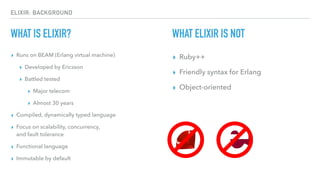
WHAT IS ELIXIR?
▸ Runs on BEAM (Erlang virtual machine)
▸ Developed by Ericsson
▸ Battled tested
▸ Major telecom
▸ Almost 30 years
▸ Compiled, dynamically typed language
▸ Focus on scalability, concurrency,

and fault tolerance
▸ Functional language
▸ Immutable by default
WHAT ELIXIR IS NOT
▸ Ruby++
▸ Friendly syntax for Erlang
▸ Object-oriented
I WOULDN’T CLASSIFY ELIXIR AS A BETTER
RUBY. SURE, RUBY WAS MY MAIN LANGUAGE
BEFORE ELIXIR, BUT PART OF MY WORK/
RESEARCH ON CREATING ELIXIR WAS
EXACTLY TO BROADEN THIS EXPERIENCE AS
MUCH AS POSSIBLE AND GET SOME MILEAGE
ON OTHER ECOSYSTEMS SO I DIDN’T BRING

A BIASED VIEW TO ELIXIR. IT IS NOT

(A BETTER) RUBY, IT IS NOT (A BETTER)
ERLANG, IT IS ITS OWN LANGUAGE.
José Valim, Elixir’s BDFL
FP + RUBY
BUT I WANT A FAST, FUNCTIONAL RUBY!
▸ You should check out Clojure
▸ Once you get over the parentheses, the semantics are much closer
▸ Legend has it that Matz originally started Ruby as a Lisp
▸ Great community, tons of libs, Java & JS interop, and so on…
ANYWAY…
FUNCTIONAL PROGRAMMING
FUNCTIONAL PROGRAMMING: 101
▸ Data-first
▸ Explicit state rather than data hiding
▸ Limit and isolate side effects
▸ Referential transparency
▸ Composition over inheritance
▸ Expressions rather than objects & messages
▸ Everything is an expression
▸ Not mutually exclusive with OO (see Scala, Swift, and Rust)
FUNCTIONAL PROGRAMMING
WHY CARE ABOUT FUNCTIONAL PROGRAMMING?
▸ The free lunch is over
▸ Clean, maintainable systems
▸ Abstractions
▸ Even higher level code
▸ Focused on meaning and intent, rather than machine instructions
▸ Highly reusable
TYPES, TYPES, TYPES
ELIXIR IS “WEAKLY TYPED”
▸ “Weak” is technical, not derogatory
▸ Does its own type conversion as needed
▸ Nice for integers vs floats
▸ No built-in ADTs
▸ Shameless self-plug: ADTs coming soon in a lib!
▸ Type annotations
▸ @spec add(integer, integer) :: integer
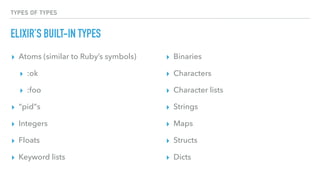
TYPES OF TYPES
ELIXIR’S BUILT-IN TYPES
▸ Atoms (similar to Ruby’s symbols)
▸ :ok
▸ :foo
▸ “pid”s
▸ Integers
▸ Floats
▸ Keyword lists
▸ Binaries
▸ Characters
▸ Character lists
▸ Strings
▸ Maps
▸ Structs
▸ Dicts
TRUTHINESS
ELIXIR’S TRUTHINESS TABLE
TRUTHY FALSEY
TRUE ✓
FALSE ✓
nil ✓
“” ✓
[] ✓
anything else ✓
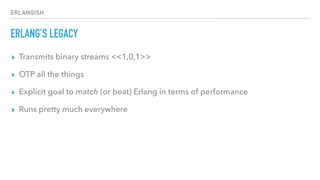
ERLANGISH
ERLANG’S LEGACY
▸ Transmits binary streams <<1,0,1>>
▸ OTP all the things
▸ Explicit goal to match (or beat) Erlang in terms of performance
▸ Runs pretty much everywhere
SYNTAX
RUBY
# Cool stuff ahead

module Foo
def hello(name = nil, *names)
case name
when nil
“Hello, world!”
when names.empty?
“Hello, #{ name }”
else
hello(name) + hello(names)
end
end
# Cool stuff ahead

defmodule Foo do
def hello, do: “Hello, world!”
def hello([head|tail]) do
hello(head) <> hello(tail)
end
def hello(name), do: “Hi, #{ name }”
end
ELIXIR
hello/0
hello/1 on lists
hello/1 on anything
pattern
matching
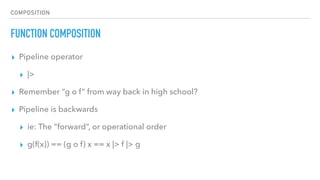
COMPOSITION
FUNCTION COMPOSITION
▸ Pipeline operator
▸ |>
▸ Remember “g o f” from way back in high school?
▸ Pipeline is backwards
▸ ie: The “forward”, or operational order
▸ g(f(x)) == (g o f) x == x |> f |> g
PIPELINING
THE PIPELINE OPERATOR |>
Ruby: message chaining
[1,2,3].sum.divide(5).floor
[1,2,3].sum = 6
6.divide(5) = 1.2
1.2.floor = 1
Elixir: pipe, or (forward) composition
[1,2,3] |> Enum.sum |> divide(5) |> floor
Enum.sum([1,2,3]) = 6
divide(6, 5) = 1.2
Float.floor(1.2) = 1
First argument
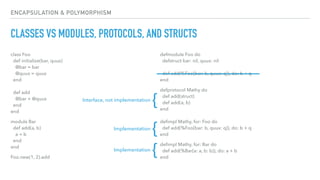
ENCAPSULATION & POLYMORPHISM
CLASSES VS MODULES, PROTOCOLS, AND STRUCTS
class Foo

def initialize(bar, quux)

@bar = bar

@quux = quux

end


def add

@bar + @quux

end

end
module Bar

def add(a, b)

a + b

end

end
Foo.new(1, 2).add
defmodule Foo do

defstruct bar: nil, quux: nil


def add(%Foo{bar: b, quux: q}), do: b + q

end
defprotocol Mathy do

def add(struct)

def add(a, b)

end


defimpl Mathy, for: Foo do

def add(%Foo{bar: b, quux: q}), do: b + q

end
defimpl Mathy, for: Bar do

def add(%Bar{a: a, b: b}), do: a + b

end
Interface, not implementation
{
Implementation
{
Implementation
{
METAPROGRAMMING
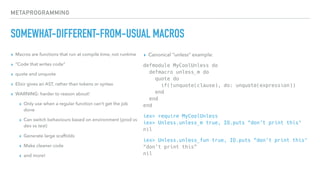
SOMEWHAT-DIFFERENT-FROM-USUAL MACROS
▸ Macros are functions that run at compile time, not runtime
▸ “Code that writes code”
▸ quote and unquote
▸ Elixir gives an AST, rather than tokens or syntax
▸ WARNING: harder to reason about!
▸ Only use when a regular function can’t get the job
done
▸ Can switch behaviours based on environment (prod vs
dev vs test)
▸ Generate large scaffolds
▸ Make cleaner code
▸ and more!
▸ Canonical “unless” example:
defmodule MyCoolUnless do

defmacro unless_m do

quote do

if(!unquote(clause), do: unquote(expression))

end

end

end
iex> require MyCoolUnless

iex> Unless.unless_m true, IO.puts “don’t print this"

nil
iex> Unless.unless_fun true, IO.puts “don’t print this"

“don’t print this”

nil
TOOLING
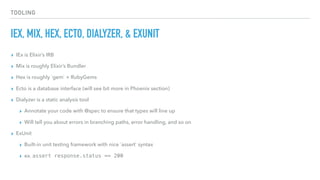
IEX, MIX, HEX, ECTO, DIALYZER, & EXUNIT
▸ IEx is Elixir’s IRB
▸ Mix is roughly Elixir’s Bundler
▸ Hex is roughly `gem` + RubyGems
▸ Ecto is a database interface (will see bit more in Phoenix section)
▸ Dialyzer is a static analysis tool
▸ Annotate your code with @spec to ensure that types will line up
▸ Will tell you about errors in branching paths, error handling, and so on
▸ ExUnit
▸ Built-in unit testing framework with nice `assert` syntax
▸ ex. assert response.status == 200
KILLER FEATURE: CONCURRENCY
PART TWO
CONCURRENCY
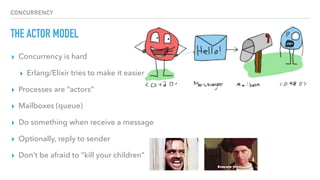
THE ACTOR MODEL
▸ Concurrency is hard
▸ Erlang/Elixir tries to make it easier
▸ Processes are “actors”
▸ Mailboxes (queue)
▸ Do something when receive a message
▸ Optionally, reply to sender
▸ Don’t be afraid to “kill your children”
CONCURRENCY
SENDING MESSAGES IS SIMPLE!
iex> a = spawn(Foo, :bar, []) <~Module, function, args

iex> a |> send({self, {3, 2, 1}})

iex> flush
12 3

:ok
CONCURRENCY + TELECOMMUNICATION = ♥
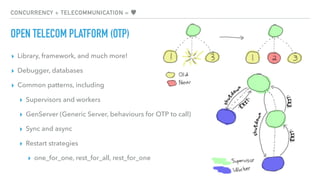
OPEN TELECOM PLATFORM (OTP)
▸ Library, framework, and much more!
▸ Debugger, databases
▸ Common patterns, including
▸ Supervisors and workers
▸ GenServer (Generic Server, behaviours for OTP to call)
▸ Sync and async
▸ Restart strategies
▸ one_for_one, rest_for_all, rest_for_one
SHORT INTERMISSION
PART THREE
PHOENIX
PART FOUR
BACKGROUND
WHAT IS PHOENIX?
▸ Server-side web framework
▸ Soft-realtime features
▸ Channels
▸ Distributed
▸ Attention to serving web APIs
▸ Well separated concerns
▸ Just hit 1.0
RAILS
SIMILAR TO RAILS
▸ MVC (and then some)
▸ Plugins
▸ Migrations
▸ EEx is similar to ERB
▸ <%= some stuff %>
▸ Path helpers
▸ Router
▸ Schema
▸ Generators
RAILS
MAJOR DIFFERENCES FROM RAILS
▸ No ActiveRecord
▸ Closer to Data Mapper
▸ Request cycle is clearer
▸ Soft real time
▸ Sockets, etc
▸ View models
▸ Schemas are kept in each model
RAILS
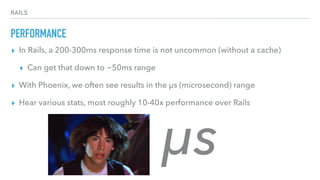
PERFORMANCE
▸ In Rails, a 200-300ms response time is not uncommon (without a cache)
▸ Can get that down to ~50ms range
▸ With Phoenix, we often see results in the μs (microsecond) range
▸ Hear various stats, most roughly 10-40x performance over Rails
μs
DIRECTORY STRUCTURE
mix phoenix.new awesome
awesome/

README.md

mix.exs

package.json

brunch-config.js

_build/

config/

deps/

lib/

awesome.ex

awesome/

endpoint.ex

repo.ex

node_modules/

priv/

test/

web/

router.ex

web.ex

channels/

controllers/

models/

static/

templates/

views/
rails new awesome
awesome/

README.rdoc

Gemfile

Rakefile

config.ru

app/

assets/

controllers/

helpers/

mailers/

models/

views/

bin/

config/

db/

lib/

log/

public/

test/

tmp/

vendor/
PHOENIX CONCURRENCY
CHANNELS VS PROCESSES
▸ Channels are layers
▸ PubSub on steroids
▸ Senders and receivers can switch roles on the topic at any time
▸ Don’t even have to be Elixir/Erlang processes
▸ Could be a Rails server, JS client, Android app, mix & match, and so on
▸ Have their own routing system
▸ Fallback
▸ Ex. sockets will fall back to polling
LIVE CODING
PART FIVE
“WHAT COULD POSSIBLY GO WRONG?”

Elixir and Phoenix for Rubyists

  • 1.
    ELIXIR AND PHOENIXFOR RUBYSISTS BROOKLYN ZELENKA
  • 2.
    TABLE OF CONTENTS WHATWE’RE GOING TO COVER ▸ Background ▸ Syntax ▸ Compare with Ruby ▸ Extra features ▸ Functional Programming Basics ▸ Tooling (Mix, Hex, Dialyzer, and ExUnit) ▸ A tiny bit of OTP ▸ Project layout ▸ Compare with Rails ▸ Similarities ▸ Differences ▸ Extra features ▸ Live code a simple app ELIXIR (LANGUAGE) PHOENIX (WEB FRAMEWORK)
  • 3.
  • 4.
    ELIXIR: BACKGROUND WHAT ISELIXIR? ▸ Runs on BEAM (Erlang virtual machine) ▸ Developed by Ericsson ▸ Battled tested ▸ Major telecom ▸ Almost 30 years ▸ Compiled, dynamically typed language ▸ Focus on scalability, concurrency,
 and fault tolerance ▸ Functional language ▸ Immutable by default WHAT ELIXIR IS NOT ▸ Ruby++ ▸ Friendly syntax for Erlang ▸ Object-oriented
  • 5.
    I WOULDN’T CLASSIFYELIXIR AS A BETTER RUBY. SURE, RUBY WAS MY MAIN LANGUAGE BEFORE ELIXIR, BUT PART OF MY WORK/ RESEARCH ON CREATING ELIXIR WAS EXACTLY TO BROADEN THIS EXPERIENCE AS MUCH AS POSSIBLE AND GET SOME MILEAGE ON OTHER ECOSYSTEMS SO I DIDN’T BRING
 A BIASED VIEW TO ELIXIR. IT IS NOT
 (A BETTER) RUBY, IT IS NOT (A BETTER) ERLANG, IT IS ITS OWN LANGUAGE. José Valim, Elixir’s BDFL
  • 6.
    FP + RUBY BUTI WANT A FAST, FUNCTIONAL RUBY! ▸ You should check out Clojure ▸ Once you get over the parentheses, the semantics are much closer ▸ Legend has it that Matz originally started Ruby as a Lisp ▸ Great community, tons of libs, Java & JS interop, and so on… ANYWAY…
  • 7.
    FUNCTIONAL PROGRAMMING FUNCTIONAL PROGRAMMING:101 ▸ Data-first ▸ Explicit state rather than data hiding ▸ Limit and isolate side effects ▸ Referential transparency ▸ Composition over inheritance ▸ Expressions rather than objects & messages ▸ Everything is an expression ▸ Not mutually exclusive with OO (see Scala, Swift, and Rust)
  • 8.
    FUNCTIONAL PROGRAMMING WHY CAREABOUT FUNCTIONAL PROGRAMMING? ▸ The free lunch is over ▸ Clean, maintainable systems ▸ Abstractions ▸ Even higher level code ▸ Focused on meaning and intent, rather than machine instructions ▸ Highly reusable
  • 9.
    TYPES, TYPES, TYPES ELIXIRIS “WEAKLY TYPED” ▸ “Weak” is technical, not derogatory ▸ Does its own type conversion as needed ▸ Nice for integers vs floats ▸ No built-in ADTs ▸ Shameless self-plug: ADTs coming soon in a lib! ▸ Type annotations ▸ @spec add(integer, integer) :: integer
  • 10.
    TYPES OF TYPES ELIXIR’SBUILT-IN TYPES ▸ Atoms (similar to Ruby’s symbols) ▸ :ok ▸ :foo ▸ “pid”s ▸ Integers ▸ Floats ▸ Keyword lists ▸ Binaries ▸ Characters ▸ Character lists ▸ Strings ▸ Maps ▸ Structs ▸ Dicts
  • 11.
    TRUTHINESS ELIXIR’S TRUTHINESS TABLE TRUTHYFALSEY TRUE ✓ FALSE ✓ nil ✓ “” ✓ [] ✓ anything else ✓
  • 12.
    ERLANGISH ERLANG’S LEGACY ▸ Transmitsbinary streams <<1,0,1>> ▸ OTP all the things ▸ Explicit goal to match (or beat) Erlang in terms of performance ▸ Runs pretty much everywhere
  • 13.
    SYNTAX RUBY # Cool stuffahead
 module Foo def hello(name = nil, *names) case name when nil “Hello, world!” when names.empty? “Hello, #{ name }” else hello(name) + hello(names) end end # Cool stuff ahead
 defmodule Foo do def hello, do: “Hello, world!” def hello([head|tail]) do hello(head) <> hello(tail) end def hello(name), do: “Hi, #{ name }” end ELIXIR hello/0 hello/1 on lists hello/1 on anything pattern matching
  • 14.
    COMPOSITION FUNCTION COMPOSITION ▸ Pipelineoperator ▸ |> ▸ Remember “g o f” from way back in high school? ▸ Pipeline is backwards ▸ ie: The “forward”, or operational order ▸ g(f(x)) == (g o f) x == x |> f |> g
  • 15.
    PIPELINING THE PIPELINE OPERATOR|> Ruby: message chaining [1,2,3].sum.divide(5).floor [1,2,3].sum = 6 6.divide(5) = 1.2 1.2.floor = 1 Elixir: pipe, or (forward) composition [1,2,3] |> Enum.sum |> divide(5) |> floor Enum.sum([1,2,3]) = 6 divide(6, 5) = 1.2 Float.floor(1.2) = 1 First argument
  • 16.
    ENCAPSULATION & POLYMORPHISM CLASSESVS MODULES, PROTOCOLS, AND STRUCTS class Foo
 def initialize(bar, quux)
 @bar = bar
 @quux = quux
 end
 
 def add
 @bar + @quux
 end
 end module Bar
 def add(a, b)
 a + b
 end
 end Foo.new(1, 2).add defmodule Foo do
 defstruct bar: nil, quux: nil
 
 def add(%Foo{bar: b, quux: q}), do: b + q
 end defprotocol Mathy do
 def add(struct)
 def add(a, b)
 end
 
 defimpl Mathy, for: Foo do
 def add(%Foo{bar: b, quux: q}), do: b + q
 end defimpl Mathy, for: Bar do
 def add(%Bar{a: a, b: b}), do: a + b
 end Interface, not implementation { Implementation { Implementation {
  • 17.
    METAPROGRAMMING SOMEWHAT-DIFFERENT-FROM-USUAL MACROS ▸ Macrosare functions that run at compile time, not runtime ▸ “Code that writes code” ▸ quote and unquote ▸ Elixir gives an AST, rather than tokens or syntax ▸ WARNING: harder to reason about! ▸ Only use when a regular function can’t get the job done ▸ Can switch behaviours based on environment (prod vs dev vs test) ▸ Generate large scaffolds ▸ Make cleaner code ▸ and more! ▸ Canonical “unless” example: defmodule MyCoolUnless do
 defmacro unless_m do
 quote do
 if(!unquote(clause), do: unquote(expression))
 end
 end
 end iex> require MyCoolUnless
 iex> Unless.unless_m true, IO.puts “don’t print this"
 nil iex> Unless.unless_fun true, IO.puts “don’t print this"
 “don’t print this”
 nil
  • 18.
    TOOLING IEX, MIX, HEX,ECTO, DIALYZER, & EXUNIT ▸ IEx is Elixir’s IRB ▸ Mix is roughly Elixir’s Bundler ▸ Hex is roughly `gem` + RubyGems ▸ Ecto is a database interface (will see bit more in Phoenix section) ▸ Dialyzer is a static analysis tool ▸ Annotate your code with @spec to ensure that types will line up ▸ Will tell you about errors in branching paths, error handling, and so on ▸ ExUnit ▸ Built-in unit testing framework with nice `assert` syntax ▸ ex. assert response.status == 200
  • 19.
  • 20.
    CONCURRENCY THE ACTOR MODEL ▸Concurrency is hard ▸ Erlang/Elixir tries to make it easier ▸ Processes are “actors” ▸ Mailboxes (queue) ▸ Do something when receive a message ▸ Optionally, reply to sender ▸ Don’t be afraid to “kill your children”
  • 21.
    CONCURRENCY SENDING MESSAGES ISSIMPLE! iex> a = spawn(Foo, :bar, []) <~Module, function, args
 iex> a |> send({self, {3, 2, 1}})
 iex> flush 12 3
 :ok
  • 22.
    CONCURRENCY + TELECOMMUNICATION= ♥ OPEN TELECOM PLATFORM (OTP) ▸ Library, framework, and much more! ▸ Debugger, databases ▸ Common patterns, including ▸ Supervisors and workers ▸ GenServer (Generic Server, behaviours for OTP to call) ▸ Sync and async ▸ Restart strategies ▸ one_for_one, rest_for_all, rest_for_one
  • 23.
  • 24.
  • 25.
    BACKGROUND WHAT IS PHOENIX? ▸Server-side web framework ▸ Soft-realtime features ▸ Channels ▸ Distributed ▸ Attention to serving web APIs ▸ Well separated concerns ▸ Just hit 1.0
  • 26.
    RAILS SIMILAR TO RAILS ▸MVC (and then some) ▸ Plugins ▸ Migrations ▸ EEx is similar to ERB ▸ <%= some stuff %> ▸ Path helpers ▸ Router ▸ Schema ▸ Generators
  • 27.
    RAILS MAJOR DIFFERENCES FROMRAILS ▸ No ActiveRecord ▸ Closer to Data Mapper ▸ Request cycle is clearer ▸ Soft real time ▸ Sockets, etc ▸ View models ▸ Schemas are kept in each model
  • 28.
    RAILS PERFORMANCE ▸ In Rails,a 200-300ms response time is not uncommon (without a cache) ▸ Can get that down to ~50ms range ▸ With Phoenix, we often see results in the μs (microsecond) range ▸ Hear various stats, most roughly 10-40x performance over Rails μs
  • 29.
    DIRECTORY STRUCTURE mix phoenix.newawesome awesome/
 README.md
 mix.exs
 package.json
 brunch-config.js
 _build/
 config/
 deps/
 lib/
 awesome.ex
 awesome/
 endpoint.ex
 repo.ex
 node_modules/
 priv/
 test/
 web/
 router.ex
 web.ex
 channels/
 controllers/
 models/
 static/
 templates/
 views/ rails new awesome awesome/
 README.rdoc
 Gemfile
 Rakefile
 config.ru
 app/
 assets/
 controllers/
 helpers/
 mailers/
 models/
 views/
 bin/
 config/
 db/
 lib/
 log/
 public/
 test/
 tmp/
 vendor/
  • 30.
    PHOENIX CONCURRENCY CHANNELS VSPROCESSES ▸ Channels are layers ▸ PubSub on steroids ▸ Senders and receivers can switch roles on the topic at any time ▸ Don’t even have to be Elixir/Erlang processes ▸ Could be a Rails server, JS client, Android app, mix & match, and so on ▸ Have their own routing system ▸ Fallback ▸ Ex. sockets will fall back to polling
  • 31.
    LIVE CODING PART FIVE “WHATCOULD POSSIBLY GO WRONG?”