Outline
1. Introduction toElectronics Engineering
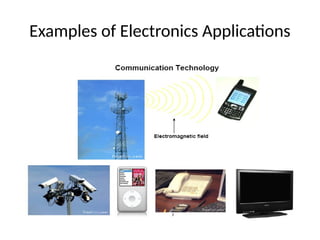
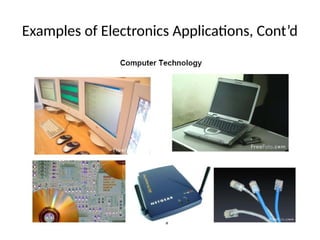
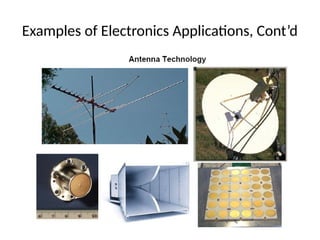
2. Application of Electronics Engineering
3. Future Scope of Electronics Engineering
4. Brief History of Electronics Engg
5. Semiconductor Materials
6. Diode
7. Assignment
3.
Why Study ElectronicsEngineering?
Electronics is Everywhere
Objective:
Introduce the basic principle and working of Electronics Circuits, devices
and instruments.
Outcome:
• Students are well equipped:
1. To handle important practical problems in Electronics, Electrical and
Computer Engineering.
2. To gain physical intuition about electronics around themselves .
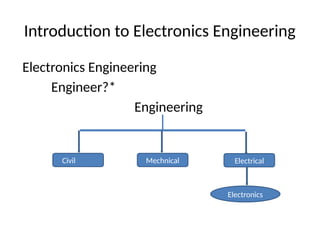
Introduction to ElectronicsEngineering
“Electronics is a branch of Engineering which
deals with study, design and utilization of
Electronics devices in which current flow
through vacuum, semiconductor or Gas”.
• This definition is given by IRE (Institution of
Radio Engineers)
• Nowadays IRE is known as IEEE.
History of Electronics
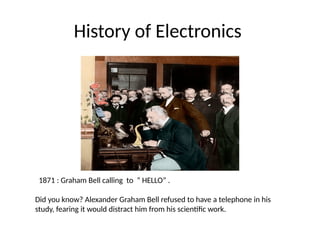
1871: Graham Bell calling to “ HELLO” .
Did you know? Alexander Graham Bell refused to have a telephone in his
study, fearing it would distract him from his scientific work.
16.
History of Electronics
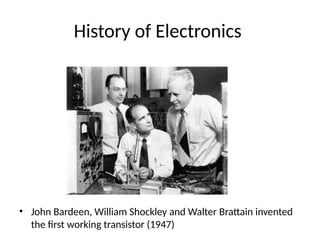
•John Bardeen, William Shockley and Walter Brattain invented
the first working transistor (1947)
What are P-typeand N-type ?
• Semiconductors are classified in to P-type and
N-type semiconductor
• P-type: A P-type material is one in which
holes are majority carriers (++++)
• N-type: A N-type material is one in which
electrons are majority charge carriers (-----)
21.
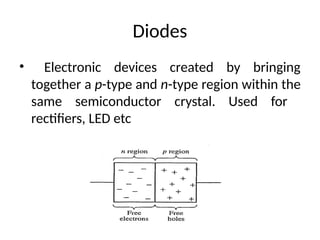
Diodes
• Electronic devicescreated by bringing
together a p-type and n-type region within the
same semiconductor crystal. Used for
rectifiers, LED etc
22.
Diodes
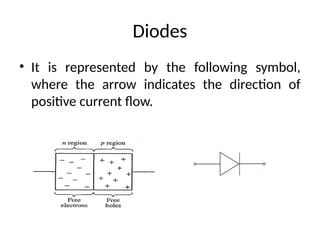
• It isrepresented by the following symbol,
where the arrow indicates the direction of
positive current flow.
23.
Forward Bias andReverse Bias
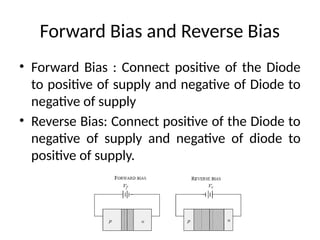
• Forward Bias : Connect positive of the Diode
to positive of supply and negative of Diode to
negative of supply
• Reverse Bias: Connect positive of the Diode to
negative of supply and negative of diode to
positive of supply.
24.
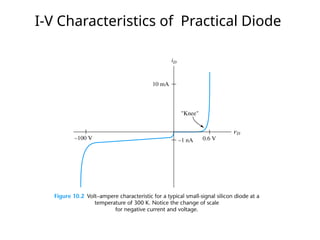
Characteristics of Diode
•Diode always conducts in one direction.
• Diodes always conduct current when “Forward
Biased” ( Zero resistance)
• Diodes do not conduct when Reverse Biased
(Infinite resistance)
Assignment- 0
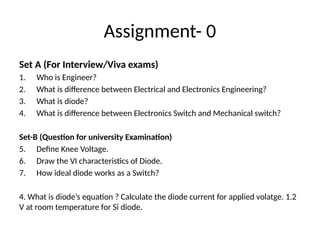
Set A(For Interview/Viva exams)
1. Who is Engineer?
2. What is difference between Electrical and Electronics Engineering?
3. What is diode?
4. What is difference between Electronics Switch and Mechanical switch?
Set-B (Question for university Examination)
5. Define Knee Voltage.
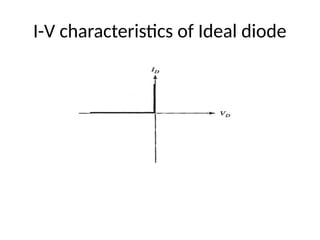
6. Draw the VI characteristics of Diode.
7. How ideal diode works as a Switch?
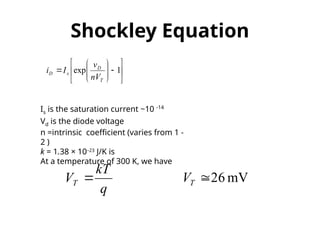
4. What is diode’s equation ? Calculate the diode current for applied volatge. 1.2
V at room temperature for Si diode.
29.
Agenda for NextLecture
• Discuss of Assignment solution
• Overview of Complete Syllabus
• Diode properties





![Week01 diode revision [revision]](https://cdn.slidesharecdn.com/ss_thumbnails/week01dioderevisionrevision-150705232129-lva1-app6891-thumbnail.jpg?width=640&height=640&fit=bounds)


