ElectronicPortfolio: 2010Saint Gianna Catholic Health AcademyThao Hoang
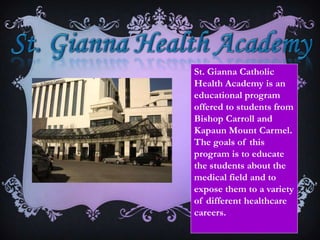
St. Gianna Health AcademySt. Gianna Catholic Health Academy is an educational program offered to students from Bishop Carroll and Kapaun Mount Carmel. The goals of this program is to educate the students about the medical field and to expose them to a variety  of different healthcare careers.
Orientation Week Campus Tours at St. Francis and St. Joseph Hospitals
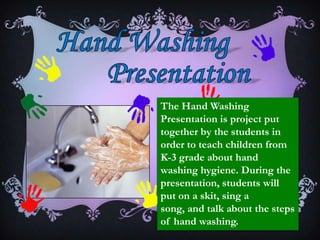
Mrs. Hang gave us a talk over the Hand Washing Presentation project
Security came and talk to us about  parking and how we should act while we’re in the hospital
We went to Newman University  for orientation over our Medical Terminology class
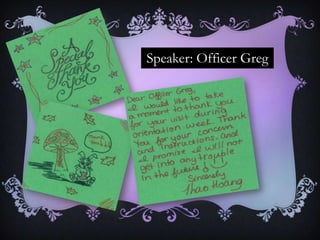
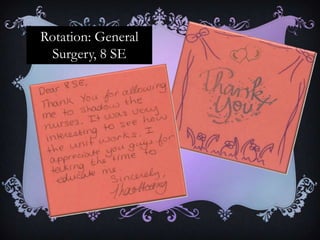
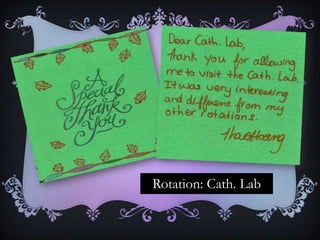
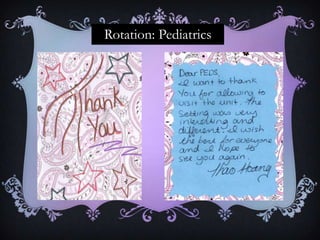
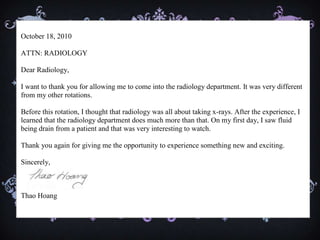
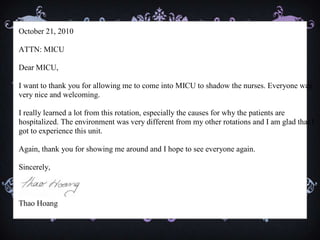
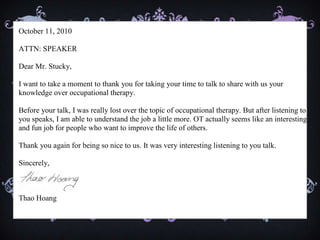
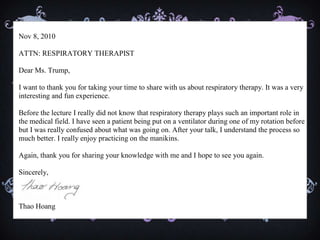
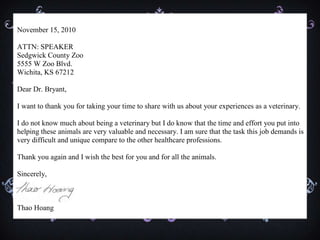
Everyone was required to obtain a badge and to wear at all time in the hospitalThank You!The success of the program was made possible through the help of many healthcare professionals. So to thank those who took their time to teach the class, the students make personal thank you cards and professional thank you letters to show their appreciation.
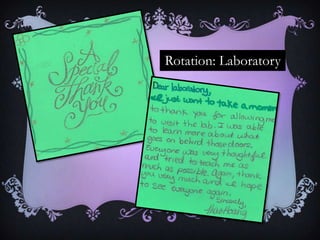
Rotation: Laboratory
Speaker: Officer Greg
Rotation: General Surgery, 8 SE
Rotation: Cath. Lab
Rotation: Pediatrics
Hand Washing PresentationThe Hand Washing Presentation is project put together by the students in order to teach children from K-3 grade about hand washing hygiene. During the presentation, students will put on a skit, sing a song, and talk about the steps of hand washing.
Blogs Over RotationsBlogging is a big part of Health Academy because it allows the students to share their experiences. Sometime students will talk about their rotation in front of the whole class, but for most of the time, students will blog about their rotation on Black Board, which is easier because then other students can leave their comments right under the blog.
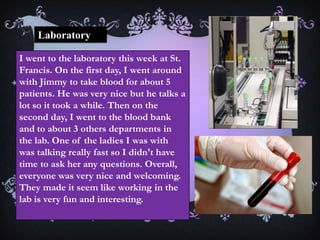
LaboratoryI went to the laboratory this week at St. Francis. On the first day, I went around with Jimmy to take blood for about 5 patients. He was very nice but he talks a lot so it took a while. Then on the second day, I went to the blood bank and to about 3 others departments in the lab. One of the ladies I was with was talking really fast so I didn't have time to ask her any questions. Overall, everyone was very nice and welcoming. They made it seem like working in the lab is very fun and interesting.
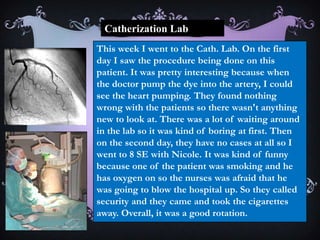
Catherization LabThis week I went to the Cath. Lab. On the first day I saw the procedure being done on this patient. It was pretty interesting because when the doctor pump the dye into the artery, I could see the heart pumping. They found nothing wrong with the patients so there wasn't anything new to look at. There was a lot of waiting around in the lab so it was kind of boring at first. Then on the second day, they have no cases at all so I went to 8 SE with Nicole. It was kind of funny because one of the patient was smoking and he has oxygen on so the nurses was afraid that he was going to blow the hospital up. So they called security and they came and took the cigarettes away. Overall, it was a good rotation.
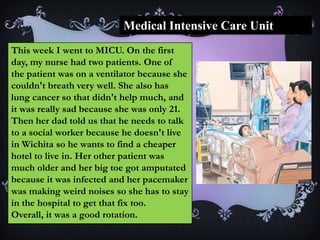
Medical Intensive Care UnitThis week I went to MICU. On the first day, my nurse had two patients. One of the patient was on a ventilator because she couldn't breath very well. She also has lung cancer so that didn't help much, and it was really sad because she was only 21. Then her dad told us that he needs to talk to a social worker because he doesn't live in Wichita so he wants to find a cheaper hotel to live in. Her other patient was much older and her big toe got amputated because it was infected and her pacemaker was making weird noises so she has to stay in the hospital to get that fix too. Overall, it was a good rotation.
Emergency RoomI went to the ER this week and it was pretty interesting. Instead of following a nurse, I went with a Med Technician for both days and what they do is really different. Most of the cases that came in were stroke and the Tech. I followed told me that there has been a lot of stroke cases during the last month. On the second day, a patient was admitted because he has a seizure. I thought it was really scary because he said he couldn't see anything. But then the AP came in and when we ask her she said he might be faking.
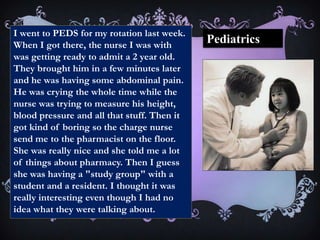
I went to PEDS for my rotation last week. When I got there, the nurse I was with was getting ready to admit a 2 year old. They brought him in a few minutes later and he was having some abdominal pain. He was crying the whole time while the nurse was trying to measure his height, blood pressure and all that stuff. Then it got kind of boring so the charge nurse send me to the pharmacist on the floor. She was really nice and she told me a lot of things about pharmacy. Then I guess she was having a "study group" with a student and a resident. I thought it was really interesting even though I had no idea what they were talking about.Pediatrics
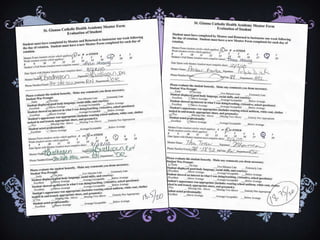
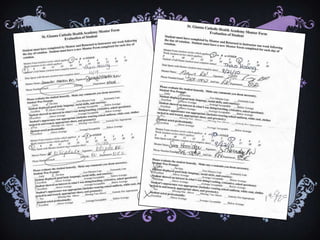
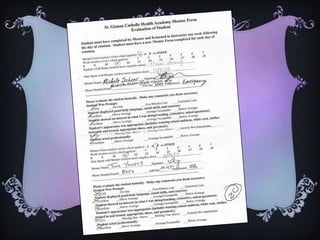
Mentor FormsDuring rotation, students are responsible for acting professionally and taking an interest  in what the person they’re shadowing are doing. Since each student goes on a different unit for their rotation, mentor forms are filled out by the professional in that unit so the teacher can see how the students are doing.
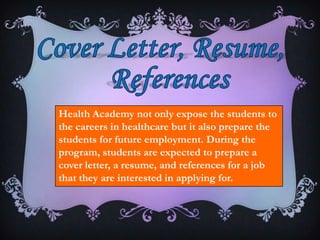
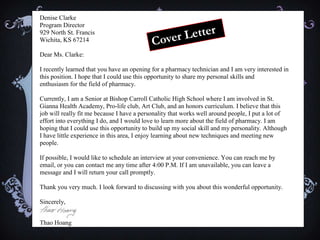
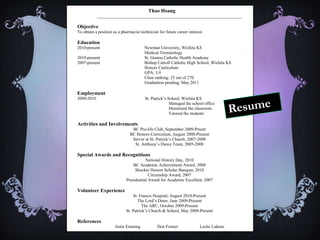
Cover Letter, Resume,ReferencesHealth Academy not only expose the students to the careers in healthcare but it also prepare the students for future employment. During the program, students are expected to prepare a cover letter, a resume, and references for a job that they are interested in applying for.
Cover Letter
Resume
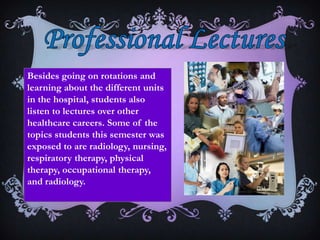
Professional LecturesBesides going on rotations and learning about the different units in the hospital, students also listen to lectures over other healthcare careers. Some of the topics students this semester was exposed to are radiology, nursing, respiratory therapy, physical therapy, occupational therapy, and radiology.
Radiology:Radiology is a career that focuses mainly on obtaining images and interpreting them. The radiology department offers many different levels of careers, depending on a person’s interest and education. One could start out as a radiology technologist, then a radiologist assistant, and he or she could go on to become a radiologist. The education to become a radiologist is almost the same as becoming a physician. One must graduate from an accredited medical school and receive an MD degree.Nursing:Like many other careers in the healthcare field, nursing plays a vital part in providing care for patients. It does not matter where nurses work, whether it is in the hospital or a clinic, the job of nurses is always to treat patients, educate patients, and provide advice and emotional support. Taking care of someone may seem like a very easy going job; however, not everyone can get along. So besides providing care for patients, nurses must also be able to deal with personal problems and patients’ family members.
Psychology Therapy:Even though there are many different healthcare careers, something all the professionals have in common is the special connection between themselves and the patients. When the guest speaker came and talked to us about the healthcare career in psychology, I learned that people who are interested in psychology is much more interested in improving the lives of others than the high salary. The speaker told us about the different kinds of careers in psychology: clinical psychology and community psychology, and developmental psychology.Respiratory TherapyRespiratory therapy is a very young career compare to nursing and it is very different from other healthcare professions. People who work as respiratory therapists play a vital role in caring for patients and they must have a very profound knowledge about the respiratory system. They work closely with physicians and they assist in the evaluation, treatment, and care of patients with lung and heart disorder. Respiratory therapists must be quick in dealing with problems because nothing stays the same with patients who have respiratory disorder.
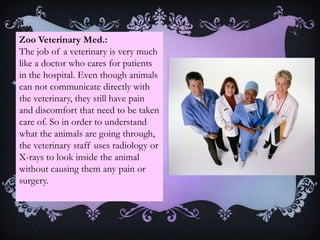
Zoo Veterinary Med.:The job of a veterinary is very much like a doctor who cares for patients in the hospital. Even though animals can not communicate directly with the veterinary, they still have pain and discomfort that need to be taken care of. So in order to understand what the animals are going through, the veterinary staff uses radiology or X-rays to look inside the animal without causing them any pain or surgery.
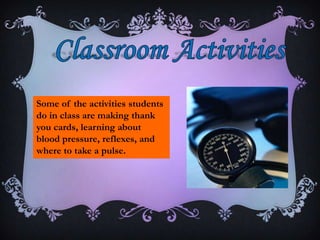
Classroom ActivitiesSome of the activities students do in class are making thank you cards, learning about blood pressure, reflexes, and where to take a pulse.
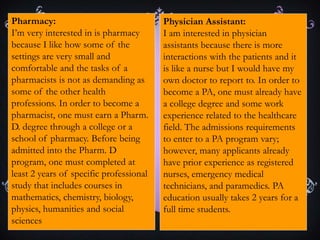
Career InterestsAt the very beginning of this course, students are expected to do research over six healthcare careers they are interested in. My six careers that I researched over are pharmacy, physician assistant, radiology, pharmacy technicians, cardiovascular technologists, and medical assistants. The career that I’m very interested in right now is pharmacy.
Pharmacy:I’m very interested in is pharmacy because I like how some of the settings are very small and comfortable and the tasks of a pharmacists is not as demanding as some of the other health professions. In order to become a pharmacist, one must earn a Pharm. D. degree through a college or a school of pharmacy. Before being admitted into the Pharm. D program, one must completed at least 2 years of specific professional study that includes courses in mathematics, chemistry, biology, physics, humanities and social sciencesPhysician Assistant:I am interested in physician assistants because there is more interactions with the patients and it is like a nurse but I would have my own doctor to report to. In order to become a PA, one must already have a college degree and some work experience related to the healthcare field. The admissions requirements to enter to a PA program vary; however, many applicants already have prior experience as registered nurses, emergency medical technicians, and paramedics. PA education usually takes 2 years for a full time students.

Thao Hoang's Portfolio

  • 1.
    ElectronicPortfolio: 2010Saint GiannaCatholic Health AcademyThao Hoang
  • 2.
    St. Gianna HealthAcademySt. Gianna Catholic Health Academy is an educational program offered to students from Bishop Carroll and Kapaun Mount Carmel. The goals of this program is to educate the students about the medical field and to expose them to a variety of different healthcare careers.
  • 3.
    Orientation Week CampusTours at St. Francis and St. Joseph Hospitals
  • 4.
    Mrs. Hang gaveus a talk over the Hand Washing Presentation project
  • 5.
    Security came andtalk to us about parking and how we should act while we’re in the hospital
  • 6.
    We went toNewman University for orientation over our Medical Terminology class
  • 7.
    Everyone was requiredto obtain a badge and to wear at all time in the hospitalThank You!The success of the program was made possible through the help of many healthcare professionals. So to thank those who took their time to teach the class, the students make personal thank you cards and professional thank you letters to show their appreciation.
  • 8.
  • 9.
  • 10.
  • 11.
  • 12.
  • 18.
    Hand Washing PresentationTheHand Washing Presentation is project put together by the students in order to teach children from K-3 grade about hand washing hygiene. During the presentation, students will put on a skit, sing a song, and talk about the steps of hand washing.
  • 19.
    Blogs Over RotationsBloggingis a big part of Health Academy because it allows the students to share their experiences. Sometime students will talk about their rotation in front of the whole class, but for most of the time, students will blog about their rotation on Black Board, which is easier because then other students can leave their comments right under the blog.
  • 20.
    LaboratoryI went tothe laboratory this week at St. Francis. On the first day, I went around with Jimmy to take blood for about 5 patients. He was very nice but he talks a lot so it took a while. Then on the second day, I went to the blood bank and to about 3 others departments in the lab. One of the ladies I was with was talking really fast so I didn't have time to ask her any questions. Overall, everyone was very nice and welcoming. They made it seem like working in the lab is very fun and interesting.
  • 21.
    Catherization LabThis weekI went to the Cath. Lab. On the first day I saw the procedure being done on this patient. It was pretty interesting because when the doctor pump the dye into the artery, I could see the heart pumping. They found nothing wrong with the patients so there wasn't anything new to look at. There was a lot of waiting around in the lab so it was kind of boring at first. Then on the second day, they have no cases at all so I went to 8 SE with Nicole. It was kind of funny because one of the patient was smoking and he has oxygen on so the nurses was afraid that he was going to blow the hospital up. So they called security and they came and took the cigarettes away. Overall, it was a good rotation.
  • 22.
    Medical Intensive CareUnitThis week I went to MICU. On the first day, my nurse had two patients. One of the patient was on a ventilator because she couldn't breath very well. She also has lung cancer so that didn't help much, and it was really sad because she was only 21. Then her dad told us that he needs to talk to a social worker because he doesn't live in Wichita so he wants to find a cheaper hotel to live in. Her other patient was much older and her big toe got amputated because it was infected and her pacemaker was making weird noises so she has to stay in the hospital to get that fix too. Overall, it was a good rotation.
  • 23.
    Emergency RoomI wentto the ER this week and it was pretty interesting. Instead of following a nurse, I went with a Med Technician for both days and what they do is really different. Most of the cases that came in were stroke and the Tech. I followed told me that there has been a lot of stroke cases during the last month. On the second day, a patient was admitted because he has a seizure. I thought it was really scary because he said he couldn't see anything. But then the AP came in and when we ask her she said he might be faking.
  • 24.
    I went toPEDS for my rotation last week. When I got there, the nurse I was with was getting ready to admit a 2 year old. They brought him in a few minutes later and he was having some abdominal pain. He was crying the whole time while the nurse was trying to measure his height, blood pressure and all that stuff. Then it got kind of boring so the charge nurse send me to the pharmacist on the floor. She was really nice and she told me a lot of things about pharmacy. Then I guess she was having a "study group" with a student and a resident. I thought it was really interesting even though I had no idea what they were talking about.Pediatrics
  • 25.
    Mentor FormsDuring rotation,students are responsible for acting professionally and taking an interest in what the person they’re shadowing are doing. Since each student goes on a different unit for their rotation, mentor forms are filled out by the professional in that unit so the teacher can see how the students are doing.
  • 29.
    Cover Letter, Resume,ReferencesHealthAcademy not only expose the students to the careers in healthcare but it also prepare the students for future employment. During the program, students are expected to prepare a cover letter, a resume, and references for a job that they are interested in applying for.
  • 30.
  • 31.
  • 32.
    Professional LecturesBesides goingon rotations and learning about the different units in the hospital, students also listen to lectures over other healthcare careers. Some of the topics students this semester was exposed to are radiology, nursing, respiratory therapy, physical therapy, occupational therapy, and radiology.
  • 33.
    Radiology:Radiology is acareer that focuses mainly on obtaining images and interpreting them. The radiology department offers many different levels of careers, depending on a person’s interest and education. One could start out as a radiology technologist, then a radiologist assistant, and he or she could go on to become a radiologist. The education to become a radiologist is almost the same as becoming a physician. One must graduate from an accredited medical school and receive an MD degree.Nursing:Like many other careers in the healthcare field, nursing plays a vital part in providing care for patients. It does not matter where nurses work, whether it is in the hospital or a clinic, the job of nurses is always to treat patients, educate patients, and provide advice and emotional support. Taking care of someone may seem like a very easy going job; however, not everyone can get along. So besides providing care for patients, nurses must also be able to deal with personal problems and patients’ family members.
  • 34.
    Psychology Therapy:Even thoughthere are many different healthcare careers, something all the professionals have in common is the special connection between themselves and the patients. When the guest speaker came and talked to us about the healthcare career in psychology, I learned that people who are interested in psychology is much more interested in improving the lives of others than the high salary. The speaker told us about the different kinds of careers in psychology: clinical psychology and community psychology, and developmental psychology.Respiratory TherapyRespiratory therapy is a very young career compare to nursing and it is very different from other healthcare professions. People who work as respiratory therapists play a vital role in caring for patients and they must have a very profound knowledge about the respiratory system. They work closely with physicians and they assist in the evaluation, treatment, and care of patients with lung and heart disorder. Respiratory therapists must be quick in dealing with problems because nothing stays the same with patients who have respiratory disorder.
  • 35.
    Zoo Veterinary Med.:Thejob of a veterinary is very much like a doctor who cares for patients in the hospital. Even though animals can not communicate directly with the veterinary, they still have pain and discomfort that need to be taken care of. So in order to understand what the animals are going through, the veterinary staff uses radiology or X-rays to look inside the animal without causing them any pain or surgery.
  • 36.
    Classroom ActivitiesSome ofthe activities students do in class are making thank you cards, learning about blood pressure, reflexes, and where to take a pulse.
  • 37.
    Career InterestsAt thevery beginning of this course, students are expected to do research over six healthcare careers they are interested in. My six careers that I researched over are pharmacy, physician assistant, radiology, pharmacy technicians, cardiovascular technologists, and medical assistants. The career that I’m very interested in right now is pharmacy.
  • 38.
    Pharmacy:I’m very interestedin is pharmacy because I like how some of the settings are very small and comfortable and the tasks of a pharmacists is not as demanding as some of the other health professions. In order to become a pharmacist, one must earn a Pharm. D. degree through a college or a school of pharmacy. Before being admitted into the Pharm. D program, one must completed at least 2 years of specific professional study that includes courses in mathematics, chemistry, biology, physics, humanities and social sciencesPhysician Assistant:I am interested in physician assistants because there is more interactions with the patients and it is like a nurse but I would have my own doctor to report to. In order to become a PA, one must already have a college degree and some work experience related to the healthcare field. The admissions requirements to enter to a PA program vary; however, many applicants already have prior experience as registered nurses, emergency medical technicians, and paramedics. PA education usually takes 2 years for a full time students.