© The Ensign-Bickford Company, 1997,1998, 1999, 2000
DIGIDET
®
Electronic Delay Detonator
Product Description
Summary Description
The Ensign-Bickford Company (EBCo) DIGIDET®
electronic delay detonator is a new
generation product designed to provide a “practical and ‘user friendly’ approach to
precision blasting challenges”. Unlike wired electric/electronic detonators, the
DIGIDET
®
electronic delay detonator utilizes a standard shock tube lead as the “input”
signal. As with all other shock tube detonators manufactured by EBCo, the tube is
seated in an internal antistatic cup (molded from semi-conductive plastic) to protect the
unit from static discharges or other spurious electrical energy. The shock tube signal is
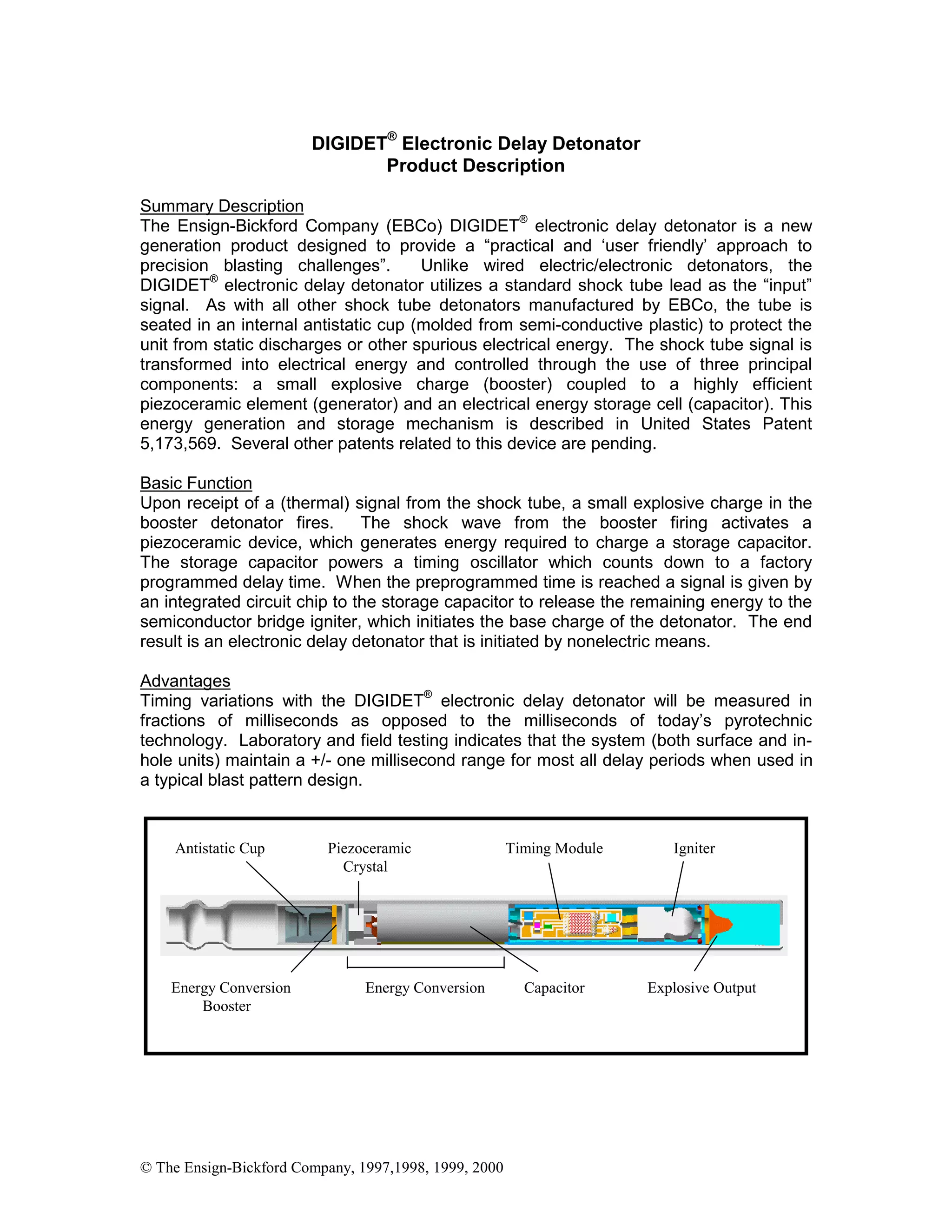
transformed into electrical energy and controlled through the use of three principal
components: a small explosive charge (booster) coupled to a highly efficient
piezoceramic element (generator) and an electrical energy storage cell (capacitor). This
energy generation and storage mechanism is described in United States Patent
5,173,569. Several other patents related to this device are pending.
Basic Function
Upon receipt of a (thermal) signal from the shock tube, a small explosive charge in the
booster detonator fires. The shock wave from the booster firing activates a
piezoceramic device, which generates energy required to charge a storage capacitor.
The storage capacitor powers a timing oscillator which counts down to a factory
programmed delay time. When the preprogrammed time is reached a signal is given by
an integrated circuit chip to the storage capacitor to release the remaining energy to the
semiconductor bridge igniter, which initiates the base charge of the detonator. The end
result is an electronic delay detonator that is initiated by nonelectric means.
Advantages
Timing variations with the DIGIDET®
electronic delay detonator will be measured in
fractions of milliseconds as opposed to the milliseconds of today’s pyrotechnic
technology. Laboratory and field testing indicates that the system (both surface and in-
hole units) maintain a +/- one millisecond range for most all delay periods when used in
a typical blast pattern design.
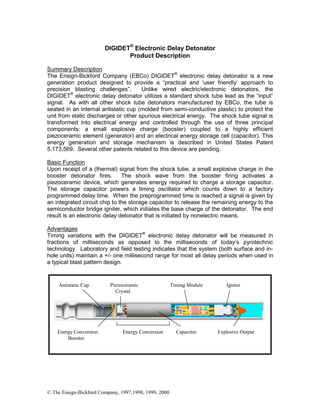
Antistatic Cup Piezoceramic Timing Module Igniter
Crystal
Energy Conversion Energy Conversion Capacitor Explosive Output
Booster
© The Ensign-Bickford Company, 1997,1998, 1999, 2000
The internal electronics are rendered immune from radio frequency and other electric
field energy sources by the metallic cap shell. The shell completely surrounds the
electronic elements, creating a Faraday cage, which keeps the field strength at zero
within the shell. This effect has been confirmed through testing to MIL-STD 461-D,
which has demonstrated the unit’s non-susceptibility to initiation from high electric field
density environments.
DIGIDET
®
electronic delay detonators require no electronic testing or blasting circuit
protocol, other than the hookup and inspection procedures currently used for standard
nonelectric blast initiation systems. There are no blasting machines, programming
interfaces, data input or electrical connections of any type. Training is limited to that
which is needed for conventional nonelectric initiation systems. Unlike other electronic
systems, DIGIDET
®
electronic delay detonators can be used in combination with existing
shock tube or detonating cord products as required. The result is complete flexibility in
delay selection for blast designs and the elimination of concern over cap scatter as a
design consideration.
Conclusion
Reliability and “User Friendly Precision” are two primary design specifications that were
incorporated in this "next step" in blast initiation efficiency. The proven reliability of
shock tube detonators and their growth in popularity around the world over the last two
decades, make the DIGIDET
®
electronic delay detonator a natural choice for “the future
detonator technology”. Virtually all blasting practices, patterns, and methodologies can
leverage the precision of electronics without adding complexity to field use.
Preliminary Product Specification
DIGIDET
®
is a registered trademark of The Ensign-Bickford Company.
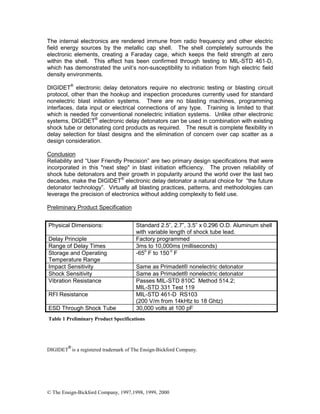
Physical Dimensions: Standard 2.5”, 2.7”, 3.5” x 0.296 O.D. Aluminum shell
with variable length of shock tube lead.
Delay Principle Factory programmed
Range of Delay Times 3ms to 10,000ms (milliseconds)
Storage and Operating
Temperature Range
-65o
F to 150 o
F
Impact Sensitivity Same as Primadet® nonelectric detonator
Shock Sensitivity Same as Primadet® nonelectric detonator
Vibration Resistance Passes MIL-STD 810C Method 514.2;
MIL-STD 331 Test 119
RFI Resistance MIL-STD 461-D RS103
(200 V/m from 14kHtz to 18 Ghtz)
ESD Through Shock Tube 30,000 volts at 100 pF
Table 1 Preliminary Product Specifications

Electronic delay detonator

  • 1.
    © The Ensign-BickfordCompany, 1997,1998, 1999, 2000 DIGIDET ® Electronic Delay Detonator Product Description Summary Description The Ensign-Bickford Company (EBCo) DIGIDET® electronic delay detonator is a new generation product designed to provide a “practical and ‘user friendly’ approach to precision blasting challenges”. Unlike wired electric/electronic detonators, the DIGIDET ® electronic delay detonator utilizes a standard shock tube lead as the “input” signal. As with all other shock tube detonators manufactured by EBCo, the tube is seated in an internal antistatic cup (molded from semi-conductive plastic) to protect the unit from static discharges or other spurious electrical energy. The shock tube signal is transformed into electrical energy and controlled through the use of three principal components: a small explosive charge (booster) coupled to a highly efficient piezoceramic element (generator) and an electrical energy storage cell (capacitor). This energy generation and storage mechanism is described in United States Patent 5,173,569. Several other patents related to this device are pending. Basic Function Upon receipt of a (thermal) signal from the shock tube, a small explosive charge in the booster detonator fires. The shock wave from the booster firing activates a piezoceramic device, which generates energy required to charge a storage capacitor. The storage capacitor powers a timing oscillator which counts down to a factory programmed delay time. When the preprogrammed time is reached a signal is given by an integrated circuit chip to the storage capacitor to release the remaining energy to the semiconductor bridge igniter, which initiates the base charge of the detonator. The end result is an electronic delay detonator that is initiated by nonelectric means. Advantages Timing variations with the DIGIDET® electronic delay detonator will be measured in fractions of milliseconds as opposed to the milliseconds of today’s pyrotechnic technology. Laboratory and field testing indicates that the system (both surface and in- hole units) maintain a +/- one millisecond range for most all delay periods when used in a typical blast pattern design. Antistatic Cup Piezoceramic Timing Module Igniter Crystal Energy Conversion Energy Conversion Capacitor Explosive Output Booster
  • 2.
    © The Ensign-BickfordCompany, 1997,1998, 1999, 2000 The internal electronics are rendered immune from radio frequency and other electric field energy sources by the metallic cap shell. The shell completely surrounds the electronic elements, creating a Faraday cage, which keeps the field strength at zero within the shell. This effect has been confirmed through testing to MIL-STD 461-D, which has demonstrated the unit’s non-susceptibility to initiation from high electric field density environments. DIGIDET ® electronic delay detonators require no electronic testing or blasting circuit protocol, other than the hookup and inspection procedures currently used for standard nonelectric blast initiation systems. There are no blasting machines, programming interfaces, data input or electrical connections of any type. Training is limited to that which is needed for conventional nonelectric initiation systems. Unlike other electronic systems, DIGIDET ® electronic delay detonators can be used in combination with existing shock tube or detonating cord products as required. The result is complete flexibility in delay selection for blast designs and the elimination of concern over cap scatter as a design consideration. Conclusion Reliability and “User Friendly Precision” are two primary design specifications that were incorporated in this "next step" in blast initiation efficiency. The proven reliability of shock tube detonators and their growth in popularity around the world over the last two decades, make the DIGIDET ® electronic delay detonator a natural choice for “the future detonator technology”. Virtually all blasting practices, patterns, and methodologies can leverage the precision of electronics without adding complexity to field use. Preliminary Product Specification DIGIDET ® is a registered trademark of The Ensign-Bickford Company. Physical Dimensions: Standard 2.5”, 2.7”, 3.5” x 0.296 O.D. Aluminum shell with variable length of shock tube lead. Delay Principle Factory programmed Range of Delay Times 3ms to 10,000ms (milliseconds) Storage and Operating Temperature Range -65o F to 150 o F Impact Sensitivity Same as Primadet® nonelectric detonator Shock Sensitivity Same as Primadet® nonelectric detonator Vibration Resistance Passes MIL-STD 810C Method 514.2; MIL-STD 331 Test 119 RFI Resistance MIL-STD 461-D RS103 (200 V/m from 14kHtz to 18 Ghtz) ESD Through Shock Tube 30,000 volts at 100 pF Table 1 Preliminary Product Specifications