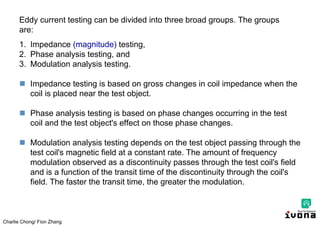
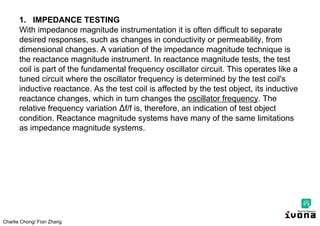
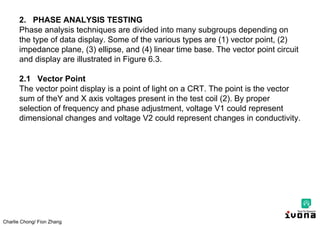
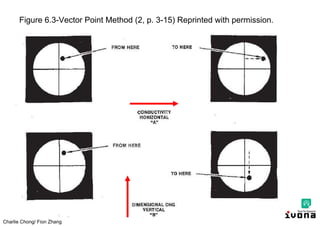
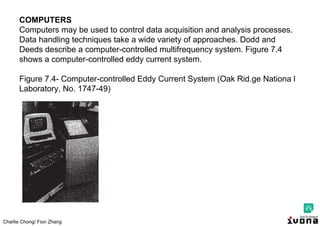
Electromagnetic Testing
Study Guide Eddy Current Testing Revisited
My ASNT Level III
Pre-Exam Preparatory
Self Study Notes
26th April 2015
Charlie Chong/ Fion Zhang
Aerospace Applications
https://www.youtube.com/embed/WlEt0bCeTy8
Charlie Chong/ Fion Zhang
E&P Applications
https://www.youtube.com/embed/_Iiwd-_uCLQ
Charlie Chong/ Fion Zhang
Aerospace Applications
https://www.youtube.com/embed/_Iiwd-_uCLQ
Charlie Chong/ Fion Zhang
Aerospace Applications
https://www.youtube.com/embed/_Iiwd-_uCLQ
Charlie Chong/ Fion Zhang
Aerospace & Defence Applications
https://www.youtube.com/embed/_Iiwd-_uCLQ
Charlie Chong/ Fion Zhang
Power & Nuclear Applications
https://www.youtube.com/embed/_Iiwd-_uCLQ
Charlie Chong/ Fion Zhang
Oil & Gas Applications
https://www.youtube.com/embed/_Iiwd-_uCLQ
Charlie Chong/ Fion Zhang
Heavy Industry & Mining Applications
https://www.youtube.com/embed/_Iiwd-_uCLQ
Charlie Chong/ Fion Zhang
http://independent.academia.edu/CharlieChong1
http://www.yumpu.com/zh/browse/user/charliechong
http://issuu.com/charlieccchong
Charlie Chong/ Fion Zhang
Fion Zhang at Shanghai
26th April 2015
http://meilishouxihu.blog.163.com/
Charlie Chong/ Fion Zhang
Charlie Chong/ Fion Zhang http://greekhouseoffonts.com/
Charlie Chong/ Fion Zhang http://www.naturalreaders.com
Charlie Chong/ Fion Zhang http://www.naturalreaders.cn/
Charlie Chong/ Fion Zhang
IVONA TTS Capable.
http://www.naturalreaders.com/
Charlie Chong/ Fion Zhang
CHAPTER 1
PRINCIPLES OF EDDY CURRENT TESTING
Charlie Chong/ Fion Zhang
HISTORICAL BACKGROUND
Belore discussing the principles of eddy current testing, it seems appropriate
to discuss brielly facets of magnetism and electromagnetism that serve as the
foundation of our study of eddy current testing. In the period from 1775 to
1900, scientific experimenters Coulomb, A Ampere, Faraday, Oersted, Arago,
Maxwell, and Kelvin investigated and cataloged most of what is known about
magnetism and electromagnetism
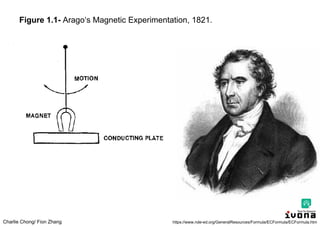
Arago discovered that the oscillation of a magnet was rapidly damped when a
nonmagnetic conducting disk was placed near the magnet (Figure 1.1).
He also observed that by rotating the disk, the magnet was attracted to the
disk. In effect, Arago had introduced a varying magnetic field to the disk
causing eddy currents to allow in the disk producing a magnetic field by the
disk that attracted the magnet. Arago's simple model is a basis lor many
automobile speedometers used today.
Charlie Chong/ Fion Zhang
Figure 1.1- Arago‘s Magnetic Experimentation, 1821.
https://www.nde-ed.org/GeneralResources/Formula/ECFormula/ECFormula.htm
Charlie Chong/ Fion Zhang
Oersted discovered the presence of a magnetic field around a current-
carrying conductor, and he observed a magnetic field developed in a
perpendicular plane to the direction of current flow in a wire. Ampere
observed that equal and opposite currents Ilowing in adjacent conductors
cancelled this magnetic effect. Ampere's observation is used in differential
coil applications and to manufacture noninductive, precision resistors.
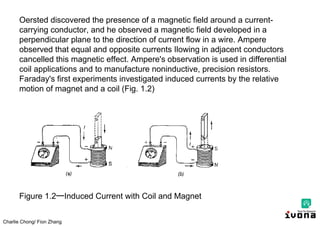
Faraday's first experiments investigated induced currents by the relative
motion of magnet and a coil (Fig. 1.2)
Figure 1.2一Induced Current with Coil and Magnet
Charlie Chong/ Fion Zhang
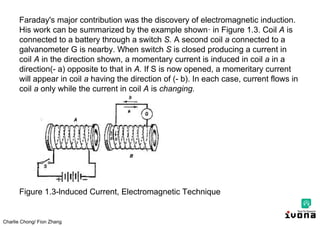
Faraday's major contribution was the discovery of electromagnetic induction.
His work can be summarized by the example shown· in Figure 1.3. Coil A is
connected to a battery through a switch S. A second coil a connected to a
galvanometer G is nearby. When switch S is closed producing a current in
coil A in the direction shown, a momentary current is induced in coil a in a
direction(- a) opposite to that in A. If S is now opened, a momeritary current
will appear in coil a having the direction of (- b). In each case, current flows in
coil a only while the current in coil A is changing.
Figure 1.3-lnduced Current, Electromagnetic Technique
Charlie Chong/ Fion Zhang
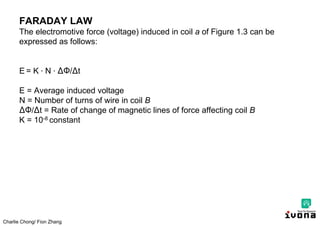
FARADAY LAW
The electromotive force (voltage) induced in coil a of Figure 1.3 can be
expressed as follows:
E = K ∙ N ∙ ∆Ф/∆t
E = Average induced voltage
N = Number of turns of wire in coil B
∆Ф/∆t = Rate of change of magnetic lines of force affecting coil B
K = 10-8 constant
Charlie Chong/ Fion Zhang
Maxwell produced a two-volume work "A Treatise on Electricity and
Magnetism" first published in 1873, Maxwell not only chronicled most of the
work done in electricity and magnetism at that time, but he also developed
and published a group of relations known as Maxwell's equations for the elec
tromagnetic field. These equations form the base that mathematically
describes most of what is known about electromagnetism today. In 1849 Lord
Kelvin applied Bessel.'s equation to solve the elements of an electromagnetic
field. The principles of eddy current testing depend on the process of
electromagnetic induction. This process includes a test coil through which a
varying or alternating current is passed. A varying current flowing in a test coil
produces a varying electromagnetic field about the coil. This field is known as
the primary field.
Charlie Chong/ Fion Zhang
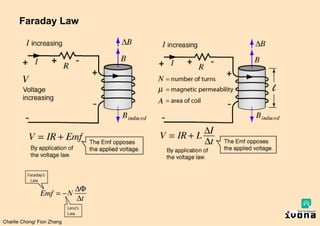
Faraday Law
Increasing current in a coil of wire will generate a counter emf which opposes the current.
Applying the voltage law allows us to see the effect of this emf on the circuit equation. The fact
that the emf always opposes the change in current is an example of Lenz's law. The relation of
this counter emf to the current is the origin of the concept of inductance. The inductance of a coil
follows from Faraday's law.
Since the magnetic field of a solenoid is:
B = μNI ∙ (l -1)
Thus:
E = - NA ∙∆B/ ∆t, becomes;
E = - N A ∙∆ [μNI (l -1)] / ∆t
E = - NAμN ∙(l -1) ∙ ∆I/∆t
for L = N2Aμ (l -1)
E = -L ∆I/∆t #
E ∝ ∆ Ф/ ∆t (Faraday Law)
E = - N ∆Ф/ ∆t
Ф = BA
B = flux density
A = Area under the influence of B
For a fixed area and changing
current, Faraday's law becomes:
E = - N ∆Ф/ ∆t = -N ∆BA/ ∆t
for Ф = BA
http://hyperphysics.phy-astr.gsu.edu/hbase/magnetic/indcur.html
Charlie Chong/ Fion Zhang
Faraday Law
Charlie Chong/ Fion Zhang
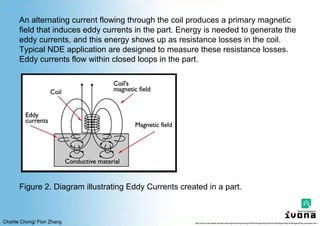
GENERATION OF EDDY CURRENTS
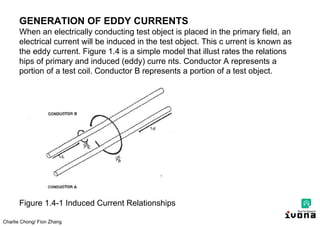
When an electrically conducting test object is placed in the primary field, an
electrical current will be induced in the test object. This c urrent is known as
the eddy current. Figure 1.4 is a simple model that illust rates the relations
hips of primary and induced (eddy) curre nts. Conductor A represents a
portion of a test coil. Conductor B represents a portion of a test object.
Figure 1.4-1 Induced Current Relationships
Charlie Chong/ Fion Zhang
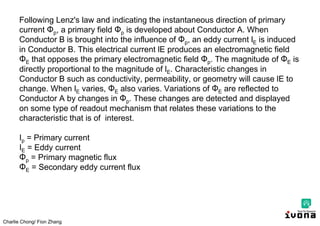
Following Lenz's law and indicating the instantaneous direction of primary
current Фp, a primary field Фp is developed about Conductor A. When
Conductor B is brought into the influence of Фp, an eddy current lE is induced
in Conductor B. This electrical current lE produces an electromagnetic field
ФE that opposes the primary electromagnetic field Фp. The magnitude of ФE is
directly proportional to the magnitude of lE. Characteristic changes in
Conductor B such as conductivity, permeability, or geometry will cause lE to
change. When lE varies, ФE also varies. Variations of ФE are reflected to
Conductor A by changes in Фp. These changes are detected and displayed
on some type of readout mechanism that relates these variations to the
characteristic that is of interest.
Ip = Primary current
IE = Eddy current
Фp = Primary magnetic flux
ФE = Secondary eddy current flux
Charlie Chong/ Fion Zhang
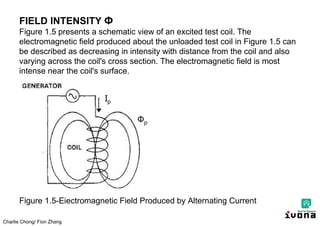
FIELD INTENSITY Ф
Figure 1.5 presents a schematic view of an excited test coil. The
electromagnetic field produced about the unloaded test coil in Figure 1.5 can
be described as decreasing in intensity with distance from the coil and also
varying across the coil's cross section. The electromagnetic field is most
intense near the coil's surface.
Figure 1.5-Eiectromagnetic Field Produced by Alternating Current
Фp
Ip
Charlie Chong/ Fion Zhang
The field produced about this coil is directly proportional to the magnitude of applied
current, rate of change of current or frequency, and the coil parameters. Coil
parameters include inductance, diameter, length, thickness, number of turns of wire,
and core material. To better understand the principles under discussion, we must
again look at the instantaneous relationships of current and magnetic flux. The
exciting current is supplied to the coil by an alternating current generator or oscillator.
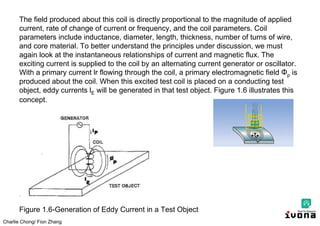
With a primary current lr flowing through the coil, a primary electromagnetic field Фp is
produced about the coil. When this excited test coil is placed on a conducting test
object, eddy currents lE will be generated in that test object. Figure 1.6 illustrates this
concept.
Figure 1.6-Generation of Eddy Current in a Test Object
Charlie Chong/ Fion Zhang
Note the direction of lp, Фp, and the resultant eddy current lE. Although Figure
1.6 shows lE by directional arrows on the surface of the test object, lE extends
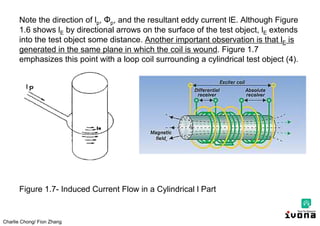
into the test object some distance. Another important observation is that lE is
generated in the same plane in which the coil is wound. Figure 1.7
emphasizes this point with a loop coil surrounding a cylindrical test object (4).
Figure 1.7- Induced Current Flow in a Cylindrical l Part
Charlie Chong/ Fion Zhang
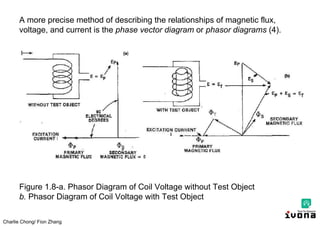
A more precise method of describing the relationships of magnetic flux,
voltage, and current is the phase vector diagram or phasor diagrams (4).
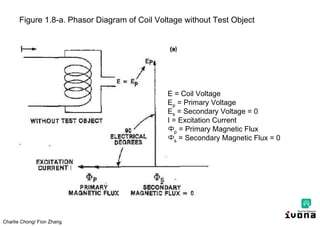
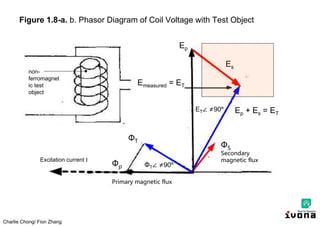
Figure 1.8-a. Phasor Diagram of Coil Voltage without Test Object
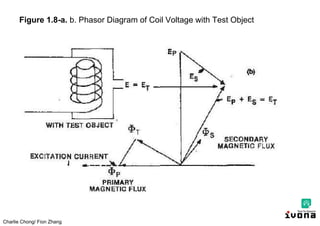
b. Phasor Diagram of Coil Voltage with Test Object
Charlie Chong/ Fion Zhang
Figure 1.8-a. Phasor Diagram of Coil Voltage without Test Object
E = Coil Voltage
Ep = Primary Voltage
Es = Secondary Voltage = 0
I = Excitation Current
Фp = Primary Magnetic Flux
Фs = Secondary Magnetic Flux = 0
Charlie Chong/ Fion Zhang
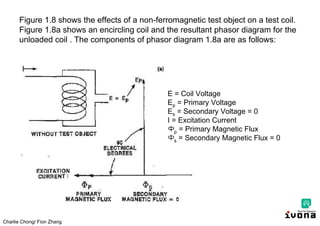
Figure 1.8 shows the effects of a non-ferromagnetic test object on a test coil.
Figure 1.8a shows an encircling coil and the resultant phasor diagram for the
unloaded coil . The components of phasor diagram 1.8a are as follows:
E = Coil Voltage
Ep = Primary Voltage
Es = Secondary Voltage = 0
I = Excitation Current
Фp = Primary Magnetic Flux
Фs = Secondary Magnetic Flux = 0
Charlie Chong/ Fion Zhang
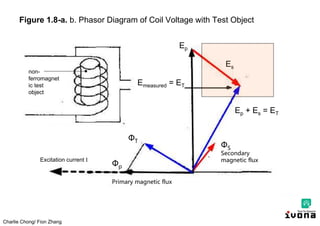
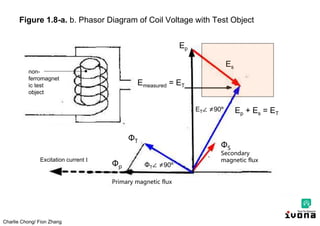
Figure 1.8-a. b. Phasor Diagram of Coil Voltage with Test Object
Charlie Chong/ Fion Zhang
The current (I) and primary magnetic flux (ФP) are plotted in phase, and the
primary voltage (EP) is shown separated by 90 electrical degrees. Secondary
magnetic flux Фs is plotted at zero because without a test object no
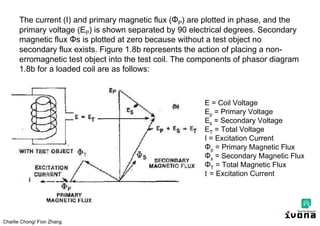
secondary flux exists. Figure 1.8b represents the action of placing a non-
erromagnetic test object into the test coil. The components of phasor diagram
1.8b for a loaded coil are as follows:
E = Coil Voltage
Ep = Primary Voltage
Es = Secondary Voltage
ET = Total Voltage
I = Excitation Current
Фp = Primary Magnetic Flux
Фs = Secondary Magnetic Flux
ФT = Total Magnetic Flux
I = Excitation Current
Charlie Chong/ Fion Zhang
Figure 1.8-a. b. Phasor Diagram of Coil Voltage with Test Object
Ep + Es = ET
Ep
Es
Emeasured = ET
ФS
Secondary
magnetic flux
ФT
Фp
Primary magnetic flux
non-
ferromagnet
ic test
object
Excitation current I
ФT∠ ≠90º
ET∠ ≠90º
Charlie Chong/ Fion Zhang
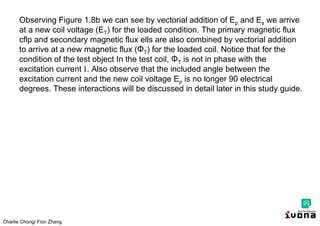
Observing Figure 1.8b we can see by vectorial addition of Ep and Es we arrive
at a new coil voltage (ET) for the loaded condition. The primary magnetic flux
cflp and secondary magnetic flux ells are also combined by vectorial addition
to arrive at a new magnetic flux (ФT) for the loaded coil. Notice that for the
condition of the test object In the test coil, ФT is not in phase with the
excitation current I. Also observe that the included angle between the
excitation current and the new coil voltage Ep is no longer 90 electrical
degrees. These interactions will be discussed in detail later in this study guide.
Charlie Chong/ Fion Zhang
Figure 1.8-a. b. Phasor Diagram of Coil Voltage with Test Object
Ep + Es = ET
Ep
Es
Emeasured = ET
ФS
Secondary
magnetic flux
ФT
Фp
Primary magnetic flux
non-
ferromagnet
ic test
object
Excitation current I
Charlie Chong/ Fion Zhang
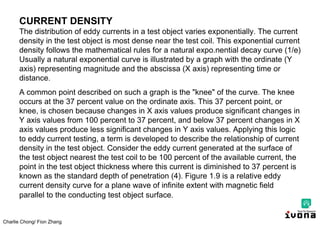
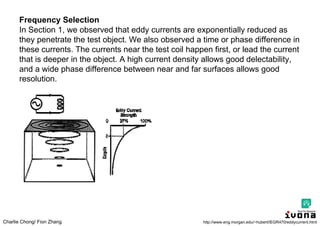
CURRENT DENSITY
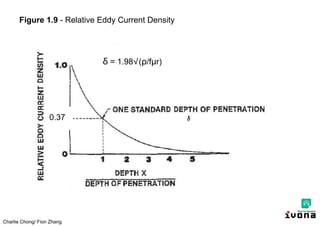
The distribution of eddy currents in a test object varies exponentially. The current
density in the test object is most dense near the test coil. This exponential current
density follows the mathematical rules for a natural expo.nential decay curve (1/e)
Usually a natural exponential curve is illustrated by a graph with the ordinate (Y
axis) representing magnitude and the abscissa (X axis) representing time or
distance.
A common point described on such a graph is the "knee" of the curve. The knee
occurs at the 37 percent value on the ordinate axis. This 37 percent point, or
knee, is chosen because changes in X axis values produce significant changes in
Y axis values from 100 percent to 37 percent, and below 37 percent changes in X
axis values produce less significant changes in Y axis values. Applying this logic
to eddy current testing, a term is developed to describe the relationship of current
density in the test object. Consider the eddy current generated at the surface of
the test object nearest the test coil to be 100 percent of the available current, the
point in the test object thickness where this current is diminished to 37 percent is
known as the standard depth of penetration (4). Figure 1.9 is a relative eddy
current density curve for a plane wave of infinite extent with magnetic field
parallel to the conducting test object surface.
Charlie Chong/ Fion Zhang
Figure 1.9 - Relative Eddy Current Density
0.37
δ = 1.98√( /fμr)
Charlie Chong/ Fion Zhang
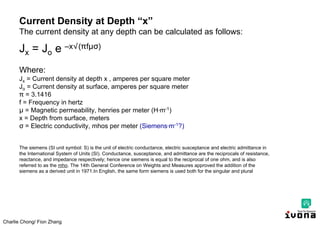
Current Density at Depth “x”
The current density at any depth can be calculated as follows:
Jx = Jo e –x√( fμσ)
Where:
Jx = Current density at depth x , amperes per square meter
Jo = Current density at surface, amperes per square meter
= 3.1416
f = Frequency in hertz
μ = Magnetic permeability, henries per meter (H∙m-1)
x = Depth from surface, meters
σ = Electric conductivity, mhos per meter (Siemens∙m-1?)
The siemens (SI unit symbol: S) is the unit of electric conductance, electric susceptance and electric admittance in
the International System of Units (SI). Conductance, susceptance, and admittance are the reciprocals of resistance,
reactance, and impedance respectively; hence one siemens is equal to the reciprocal of one ohm, and is also
referred to as the mho. The 14th General Conference on Weights and Measures approved the addition of the
siemens as a derived unit in 1971.In English, the same form siemens is used both for the singular and plural
Charlie Chong/ Fion Zhang
MAGNETIC PERMEABILITY
Magnetic permeability μ is a combination of terms.
For nonmagnetic materials:
μ= μo = 4 ∙ 10-7 H/m
For magnetic materials:
μ = μr∙μo
Where:
μr = Relative permeability, henries per meter (H∙m-1)
μo = Magnetic permeability of air or nonmagnetic material, (H∙m-1)
Charlie Chong/ Fion Zhang
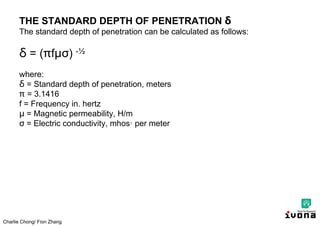
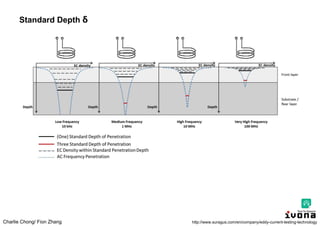
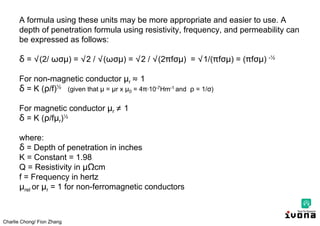
THE STANDARD DEPTH OF PENETRATION δ
The standard depth of penetration can be calculated as follows:
δ = ( fμσ) -½
where:
δ = Standard depth of penetration, meters
= 3.1416
f = Frequency in. hertz
μ = Magnetic permeability, H/m
σ = Electric conductivity, mhos· per meter
Charlie Chong/ Fion Zhang
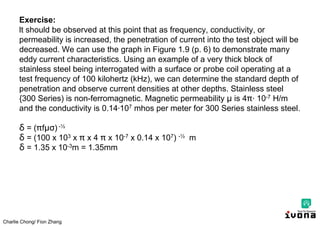
Exercise:
lt should be observed at this point that as frequency, conductivity, or
permeability is increased, the penetration of current into the test object will be
decreased. We can use the graph in Figure 1.9 (p. 6) to demonstrate many
eddy current characteristics. Using an example of a very thick block of
stainless steel being interrogated with a surface or probe coil operating at a
test frequency of 100 kilohertz (kHz), we can determine the standard depth of
penetration and observe current densities at other depths. Stainless steel
{300 Series) is non-ferromagnetic. Magnetic permeability μ is 4 ∙ 10-7 H/m
and the conductivity is 0.14∙107 mhos per meter for 300 Series stainless steel.
δ = ( fμσ) -½
δ = (100 x 103 x x 4 x 10-7 x 0.14 x 107) -½ m
δ = 1.35 x 10⁻³m = 1.35mm
Charlie Chong/ Fion Zhang
Exercise:
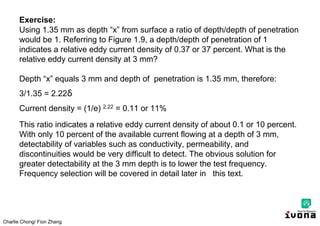
Using 1.35 mm as depth “x” from surface a ratio of depth/depth of penetration
would be 1. Referring to Figure 1.9, a depth/depth of penetration of 1
indicates a relative eddy current density of 0.37 or 37 percent. What is the
relative eddy current density at 3 mm?
Depth “x” equals 3 mm and depth of penetration is 1.35 mm, therefore:
3/1.35 = 2.22δ
Current density = (1/e) 2.22 = 0.11 or 11%
This ratio indicates a relative eddy current density of about 0.1 or 10 percent.
With only 10 percent of the available current flowing at a depth of 3 mm,
detectability of variables such as conductivity, permeability, and
discontinuities would be very difficult to detect. The obvious solution for
greater detectability at the 3 mm depth is to lower the test frequency.
Frequency selection will be covered in detail later in this text.
Charlie Chong/ Fion Zhang
PHASE/AMPLITUDE AND CURRENT/TIME RELATIONSHIPS
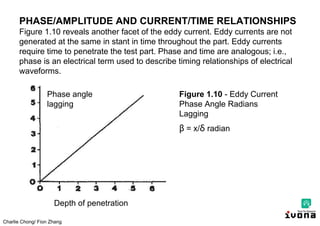
Figure 1.10 reveals another facet of the eddy current. Eddy currents are not
generated at the same in stant in time throughout the part. Eddy currents
require time to penetrate the test part. Phase and time are analogous; i.e.,
phase is an electrical term used to describe timing relationships of electrical
waveforms.
Phase angle
lagging
Depth of penetration
Figure 1.10 - Eddy Current
Phase Angle Radians
Lagging
β = x/δ radian
Charlie Chong/ Fion Zhang
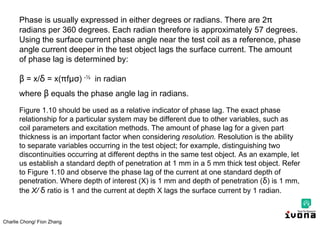
Phase is usually expressed in either degrees or radians. There are 2
radians per 360 degrees. Each radian therefore is approximately 57 degrees.
Using the surface current phase angle near the test coil as a reference, phase
angle current deeper in the test object lags the surface current. The amount
of phase lag is determined by:
β = x/δ = x( fμσ) -½ in radian
where β equals the phase angle lag in radians.
Figure 1.10 should be used as a relative indicator of phase lag. The exact phase
relationship for a particular system may be different due to other variables, such as
coil parameters and excitation methods. The amount of phase lag for a given part
thickness is an important factor when considering resolution. Resolution is the ability
to separate variables occurring in the test object; for example, distinguishing two
discontinuities occurring at different depths in the same test object. As an example, let
us establish a standard depth of penetration at 1 mm in a 5 mm thick test object. Refer
to Figure 1.10 and observe the phase lag of the current at one standard depth of
penetration. Where depth of interest (X) is 1 mm and depth of penetration (δ) is 1 mm,
the X/ δ ratio is 1 and the current at depth X lags the surface current by 1 radian.
Charlie Chong/ Fion Zhang
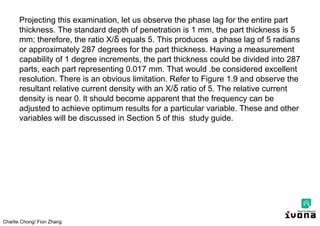
Projecting this examination, let us observe the phase lag for the entire part
thickness. The standard depth of penetration is 1 mm, the part thickness is 5
mm; therefore, the ratio X/δ equals 5. This produces a phase lag of 5 radians
or approximately 287 degrees for the part thickness. Having a measurement
capability of 1 degree increments, the part thickness could be divided into 287
parts, each part representing 0.017 mm. That would .be considered excellent
resolution. There is an obvious limitation. Refer to Figure 1.9 and observe the
resultant relative current density with an X/δ ratio of 5. The relative current
density is near 0. lt should become apparent that the frequency can be
adjusted to achieve optimum results for a particular variable. These and other
variables will be discussed in Section 5 of this study guide.
Charlie Chong/ Fion Zhang
CHAPTER 1
REVIEW QUESTIONS
Charlie Chong/ Fion Zhang
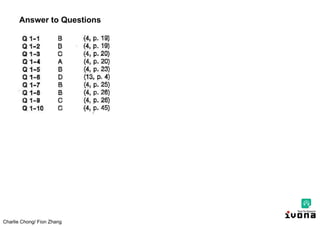
Answer to Questions
Charlie Chong/ Fion Zhang
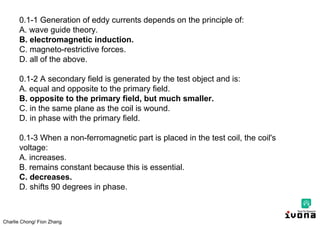
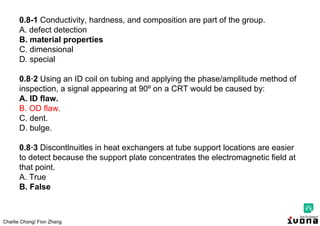
0.1-1 Generation of eddy currents depends on the principle of:
A. wave guide theory.
B. electromagnetic induction.
C. magneto-restrictive forces.
D. all of the above.
0.1-2 A secondary field is generated by the test object and is:
A. equal and opposite to the primary field.
B. opposite to the primary field, but much smaller.
C. in the same plane as the coil is wound.
D. in phase with the primary field.
0.1-3 When a non-ferromagnetic part is placed in the test coil, the coil's
voltage:
A. increases.
B. remains constant because this is essential.
C. decreases.
D. shifts 90 degrees in phase.
Charlie Chong/ Fion Zhang
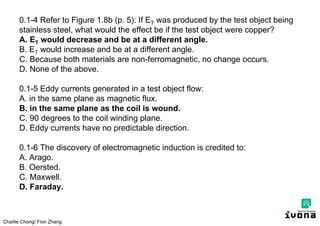
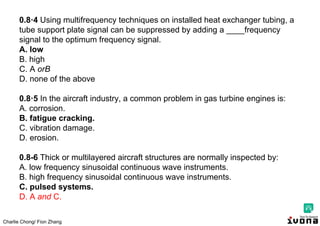
0.1-4 Refer to Figure 1.8b (p. 5): If ET was produced by the test object being
stainless steel, what would the effect be if the test object were copper?
A. ET would decrease and be at a different angle.
B. ET would increase and be at a different angle.
C. Because both materials are non-ferromagnetic, no change occurs.
D. None of the above.
0.1-5 Eddy currents generated in a test object flow:
A. in the same plane as magnetic flux.
B. in the same plane as the coil is wound.
C. 90 degrees to the coil winding plane.
D. Eddy currents have no predictable direction.
0.1-6 The discovery of electromagnetic induction is credited to:
A. Arago.
B. Oersted.
C. Maxwell.
D. Faraday.
Charlie Chong/ Fion Zhang
Figure 1.8-a. b. Phasor Diagram of Coil Voltage with Test Object
Ep + Es = ET
Ep
Es
Emeasured = ET
ФS
Secondary
magnetic flux
ФT
Фp
Primary magnetic flux
non-
ferromagnet
ic test
object
Excitation current I
ФT∠ ≠90º
ET∠ ≠90º
Charlie Chong/ Fion Zhang
Discussion
Subject: Reason out on the following:
0.1-4 Refer to Figure 1.8b (p. 5): If ET was produced by the test object being
stainless steel, what would the effect be if the test object were copper?
A. ET would decrease and be at a different angle.
B. ET would increase and be at a different angle.
C. Because both materials are non-ferromagnetic, no change occurs.
D. None of the above.
Charlie Chong/ Fion Zhang
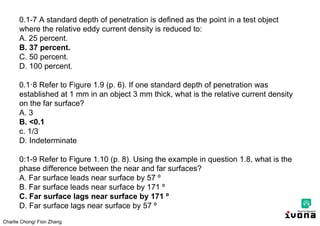
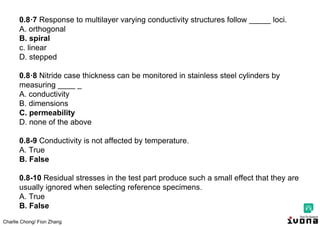
0.1-7 A standard depth of penetration is defined as the point in a test object
where the relative eddy current density is reduced to:
A. 25 percent.
B. 37 percent.
C. 50 percent.
D. 100 percent.
0.1·8 Refer to Figure 1.9 (p. 6). If one standard depth of penetration was
established at 1 mm in an object 3 mm thick, what is the relative current density
on the far surface?
A. 3
B. <0.1
c. 1/3
D. Indeterminate
0:1-9 Refer to Figure 1.10 (p. 8). Using the example in question 1.8, what is the
phase difference between the near and far surfaces?
A. Far surface leads near surface by 57 º
B. Far surface leads near surface by 171 º
C. Far surface lags near surface by 171 º
D. Far surface lags near surface by 57 º
Charlie Chong/ Fion Zhang
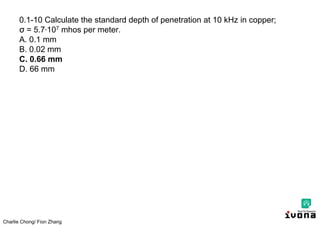
0.1-10 Calculate the standard depth of penetration at 10 kHz in copper;
σ = 5.7∙107 mhos per meter.
A. 0.1 mm
B. 0.02 mm
C. 0.66 mm
D. 66 mm
Charlie Chong/ Fion Zhang
CHAPTER 2
TEST COIL ARRANGEMENTS
Charlie Chong/ Fion Zhang
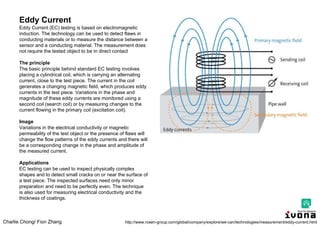
Eddy Current
Eddy Current (EC) testing is based on electromagnetic
induction. The technology can be used to detect flaws in
conducting materials or to measure the distance between a
sensor and a conducting material. The measurement does
not require the tested object to be in direct contact
The principle
The basic principle behind standard EC testing involves
placing a cylindrical coil, which is carrying an alternating
current, close to the test piece. The current in the coil
generates a changing magnetic field, which produces eddy
currents in the test piece. Variations in the phase and
magnitude of these eddy currents are monitored using a
second coil (search coil) or by measuring changes to the
current flowing in the primary coil (excitation coil).
Image
Variations in the electrical conductivity or magnetic
permeability of the test object or the presence of flaws will
change the flow patterns of the eddy currents and there will
be a corresponding change in the phase and amplitude of
the measured current.
Applications
EC testing can be used to inspect physically complex
shapes and to detect small cracks on or near the surface of
a test piece. The inspected surfaces need only minor
preparation and need to be perfectly even. The technique
is also used for measuring electrical conductivity and the
thickness of coatings.
http://www.rosen-group.com/global/company/explore/we-can/technologies/measurement/eddy-current.html
Charlie Chong/ Fion Zhang
TEST COIL ARRANGEMENTS
Test coils can be categorized into three main mechanical groups: probe coils,
bobbin coils, and encircling coils.
PROBE COILS
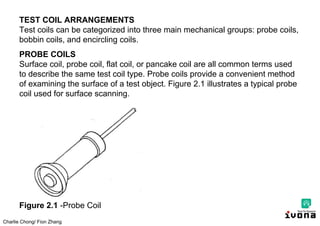
Surface coil, probe coil, flat coil, or pancake coil are all common terms used
to describe the same test coil type. Probe coils provide a convenient method
of examining the surface of a test object. Figure 2.1 illustrates a typical probe
coil used for surface scanning.
Figure 2.1 -Probe Coil
Charlie Chong/ Fion Zhang
Probe coils and probe coil forms can be shaped to fit particular geometries to
solve complex inspection problems. As an example, probe coils fabricated in
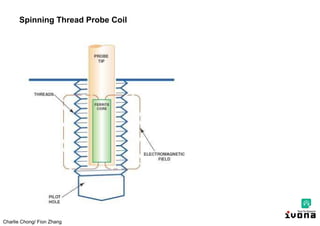
a pencil shape (pencil probe) are used to inspect threaded areas of mounting
studs and nuts or serrated areas of turbine wheels and turbine blade
assemblies. Probe coils may be used where high resolution is required by
adding coil shielding. When using a high-resolution probe coil, the test object
surface must be carefully scanned to assure complete inspection coverage.
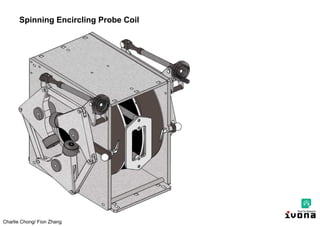
This careful scanning is very time consuming. For this reason, probe coil
inspections of large test objects are usually limited to critical areas. Probe
coils are used extensively in aircraft inspection for crack detection near
fasteners and fastener holes. In the case of fastener holes (bolt holes, rivet
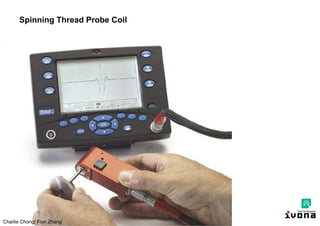
holes), the probe coil is spinning while being withdrawn at a uniform rate. This
provides a helical scan of the hole using a "spinning probe" technique.
Charlie Chong/ Fion Zhang
Spinning Encircling Probe Coil
Charlie Chong/ Fion Zhang
Spinning Thread Probe Coil
Charlie Chong/ Fion Zhang
Spinning Thread Probe Coil
Charlie Chong/ Fion Zhang
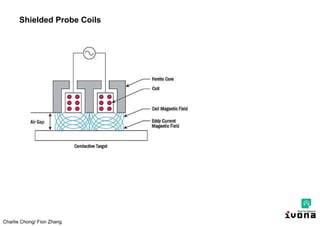
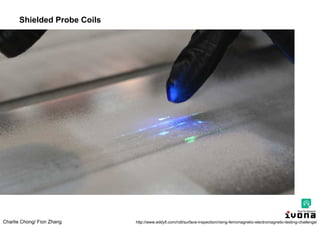
Shielded Probe Coils
Charlie Chong/ Fion Zhang
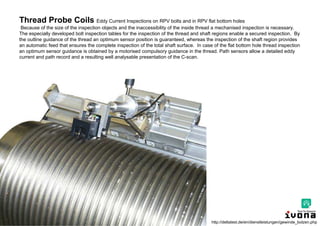
Thread Probe Coils Eddy Current Inspections on RPV bolts and in RPV flat bottom holes
Because of the size of the inspection objects and the inaccessibility of the inside thread a mechanised inspection is necessary.
The especially developed bolt inspection tables for the inspection of the thread and shaft regions enable a secured inspection. By
the outline guidance of the thread an optimum sensor position is guaranteed, whereas the inspection of the shaft region provides
an automatic feed that ensures the complete inspection of the total shaft surface. In case of the flat bottom hole thread inspection
an optimum sensor guidance is obtained by a motorised compulsory guidance in the thread. Path sensors allow a detailed eddy
current and path record and a resulting well analysable presentation of the C-scan.
http://deltatest.de/en/dienstleistungen/gewinde_bolzen.php
Charlie Chong/ Fion Zhang
Shielded Probe Coils
http://www.eddyfi.com/ndt/surface-inspection/rising-ferromagnetic-electromagnetic-testing-challenge/
Charlie Chong/ Fion Zhang
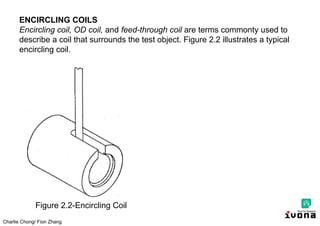
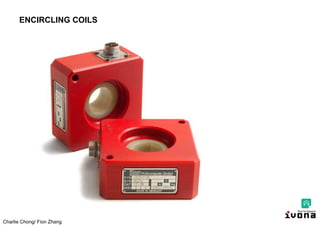
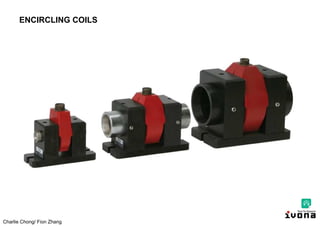
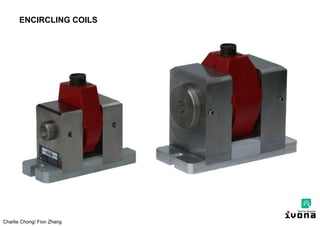
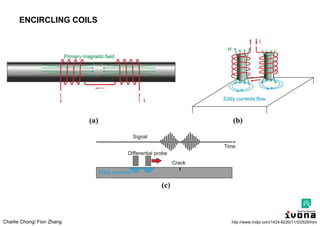
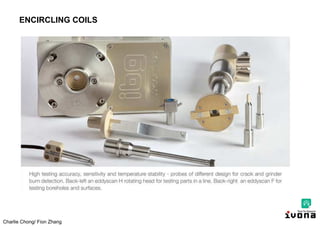
ENCIRCLING COILS
Encircling coil, OD coil, and feed-through coil are terms commonty used to
describe a coil that surrounds the test object. Figure 2.2 illustrates a typical
encircling coil.
Figure 2.2-Encircling Coil
Charlie Chong/ Fion Zhang
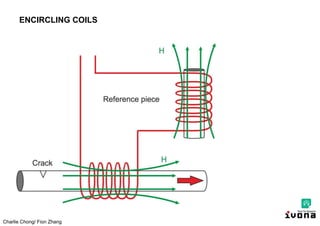
Encircling coils are primarily used to inspect tubular and bar-shaped products.
The tube or bar is fed through the coil (feed-through) at relatively high speed.
The cross section of the test object within the test coil is simultaneously
interrogated. For this reason, circumferential orientation of discontinuities
cannot be determined with an encircling coil. The volume of material
examined at one time is greater using an encircling coil than a probe coil;
therefore, the relative sensitivity is lower for an encircling coil. When using an
encircling coil, it is important to keep the test object centered in the coil. If the
test object is not centered, a uniform continuity response is difficult to
obtained. It is common practice to run the calibration standard several times,
each time indexing the artificial discontinuities to a new circumferential
location in the coil. This procedure is used to insure proper response and
proper centering.
Charlie Chong/ Fion Zhang
ENCIRCLING COILS
Charlie Chong/ Fion Zhang
ENCIRCLING COILS
Charlie Chong/ Fion Zhang
ENCIRCLING COILS
Charlie Chong/ Fion Zhang
ENCIRCLING COILS
Charlie Chong/ Fion Zhang
ENCIRCLING COILS
http://www.mdpi.com/1424-8220/11/3/2525/htm
Charlie Chong/ Fion Zhang
ENCIRCLING COILS
Charlie Chong/ Fion Zhang
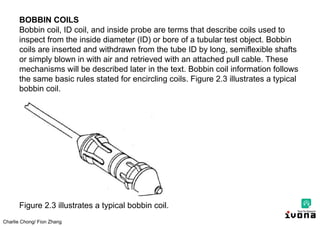
BOBBIN COILS
Bobbin coil, ID coil, and inside probe are terms that describe coils used to
inspect from the inside diameter (ID) or bore of a tubular test object. Bobbin
coils are inserted and withdrawn from the tube ID by long, semiflexible shafts
or simply blown in with air and retrieved with an attached pull cable. These
mechanisms will be described later in the text. Bobbin coil information follows
the same basic rules stated for encircling coils. Figure 2.3 illustrates a typical
bobbin coil.
Figure 2.3 illustrates a typical bobbin coil.
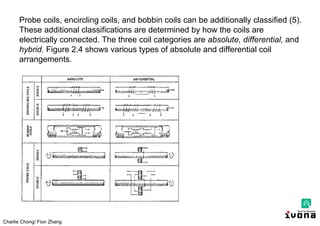
Charlie Chong/ Fion Zhang
Probe coils, encircling coils, and bobbin coils can be additionally classified (5).
These additional classifications are determined by how the coils are
electrically connected. The three coil categories are absolute, differential, and
hybrid. Figure 2.4 shows various types of absolute and differential coil
arrangements.
Charlie Chong/ Fion Zhang
ABSOLUTE COILS
An absolute coil makes its measurement without direct reference or comparison to a
standard as the measurement is being made (6). Some applications for absolute coil
systems would be measurements of conductivity, permeability, dimensions, and
hardness.
DIFFERENTIAL COILS
Differential coils consist of two or more coils electrically connected to oppose each
other. Differential coils can be categorized into two types. One is the self-comparison
differential, and the other is external reference differential. The self-comparison
differential coil compares one area of a test object to another area on the same test
object. A common. use is two coils, connected opposing, so that if both coils are
affected by identical test object conditions, the net output is "0“ or no signal. The self-
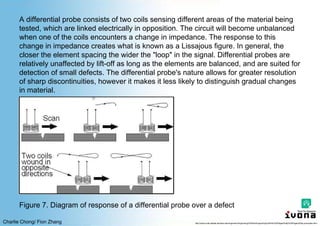
comparison arrangement is insensitive to test object variables that occur gradually.
Variables such as slowly changing wall thickness, diameter, or conductivity are
effectively discriminated against with the self-comparison differential coil. Only when a
different condition affects one or the other test coils will an output signal be generated.
The coils usually being mechanically and electrically similar allows the arrangement to
be very stable during temperature changes. Short discontinuities such as cracks, pits,
or other localized discontinuities with abrupt boundaries can be detected readily
using the self-comparison differential coil.
Charlie Chong/ Fion Zhang
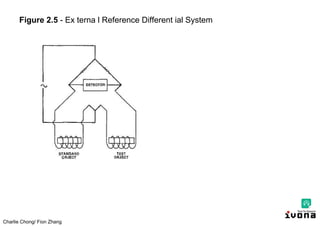
The external reference differential coil, as the name implies, is when an
external reference is used to affect one coil while the other coil is affected by
the test object. Figure 2.5 illustrates this concept. This system is used to
detect differences between a standard object and test objects. lt is particularly
useful for comparative conductivity, permeability, and dimensional
measurements. Obviously in Figure 2.5 it is imperative to normalize the
system with one coil affected by the standard object and the other coil
affected by an acceptable test object. The external reference differential coil
system is sensitive to all measurable differences between the standard object
and test object. For this reason it is often necessary to provide additional
discrimination to separate and define variables present in the test object.
Charlie Chong/ Fion Zhang
Figure 2.5 - Ex terna l Reference Different ial System
Charlie Chong/ Fion Zhang
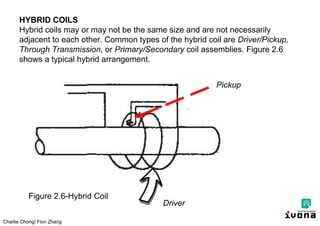
HYBRID COILS
Hybrid coils may or may not be the same size and are not necessarily
adjacent to each other. Common types of the hybrid coil are Driver/Pickup,
Through Transmission, or Primary/Secondary coil assemblies. Figure 2.6
shows a typical hybrid arrangement.
Figure 2.6-Hybrid Coil
Pickup
Driver
Charlie Chong/ Fion Zhang
A simple hybrid coil consists of an excitation coil and a sensing coil. In the
through transmission coil, the excitation coil is on one side of the test object
and the sensing coil is on the other. The voltage developed in the sensing coil
is a function of the current magnitude and frequency applied to the excitation
coil, coil parameters of the exciting and sensing coils, and test object
characteristics. In Figure 2.6 an encircling coil induces circumferential
currents in a cylindrical test object, and the disturbances of these currents
are detected by a small probe coil.
ADDITIONAL COIL CHARACTERISTICS
Coil configuration is but one of many factors to consider when setting up test
conditions. Other coil characteristics of importance are mechanical, thermal,
and electrical stability; sensitivity; resolution; and dimensions. The geometry
of the coil is usually dictated by the geometry of the test object, and often
sensitivity and resolution are compromised. The relative importance of test
coil characteristics depends upon the nature of the test. A blend of theory and
experience usually succeeds in selection of proper coil parameters. Coil
design and interactions with test objects will be discussed later in this study
guide.
Charlie Chong/ Fion Zhang
More Reading – Phase Array Technology
Charlie Chong/ Fion Zhang
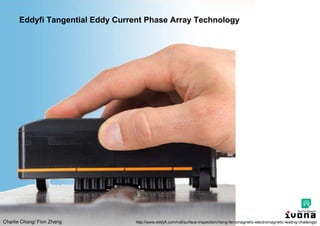
Eddyfi Tangential Eddy Current Phase Array Technology
http://www.eddyfi.com/ndt/surface-inspection/rising-ferromagnetic-electromagnetic-testing-challenge/
Charlie Chong/ Fion Zhang
Detecting Corrosion in Aluminum with Eddy Current Array Technology
Corrosion is everywhere and aluminum is no exception. Whether used in the
petrochemical, the power generation, or the aerospace industry, aluminum is
subject to degradation. Without a doubt, there is a real need for a reliable and
high-precision non-destructive testing (NDT) method.
In many situations, one must detect and assess the extent of corrosion
damage without having direct access to the region of interest. Indeed,
assessing wall loss and pitting on the far side of an aluminum layer is key in a
number of situations.
The present document highlights the capabilities of eddy current array (ECA)
technology using a particularly interesting application: corrosion detection in
the storage tanks of nuclear power plants. The following describes how the
technology is used to examine this important asset, which plays a critical role
in the safe operation of nuclear plants.
http://www.ndt.net/search/docs.php3?id=14617&content=1
Charlie Chong/ Fion Zhang
The Challenge
Storage tanks vary in size, shape and material. In the current situation, an
aluminum tank with a slightly concave floor (approximately 5.2 m (17 ft) in
diameter) was in need of inspection. As in most cases during in-service
inspections, the far side of the aluminum plate was not accessible. This called
for a solution capable of scanning through the floor plates in an effort to
detect and characterize corrosion-related defects such as pitting and thinning.
An enhanced technique was needed in place of conventional NDT methods
such as ultrasonic testing (UT) or single-channel eddy current testing (ECT).
In the application herein, the examination was originally performed with UT,
which required couplant, a crew of four to five technicians and a significant
amount of time because of the small active surface of the transducer
(6.35 mm or 0.25 in.).
Furthermore, a wide ECA probe would need to:
 Adapt to the tank floor’s curvature and other geometric features
 Offer sufficient penetration to scan through thick aluminum (6.35–7.94 mm or
0.250–0.313 in.)
 Be robust enough to withstand extensive use
http://www.ndt.net/search/docs.php3?id=14617&content=1
Charlie Chong/ Fion Zhang
The Solution
ECA technology uses several individual coils, grouped together in one probe. The
coils are excited in sequence to eliminate interference from mutual inductance
(something referred to as multiplexing). So doing, the coils work together to scan a
wider inspection area than conventional ECT probes, which drastically cuts down on
the time required to inspect an entire tank floor.
The absence of couplant, inherent to eddy current testing, is also a natural advantage
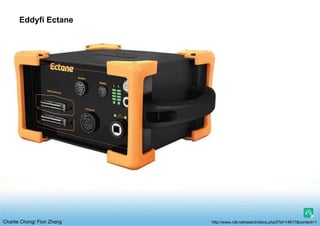
of the solution over UT. Ectane front The solution developed to answer this challenge
consists of three elements — Eddyfi’s EctaneTM, a compact, rugged, battery-operated
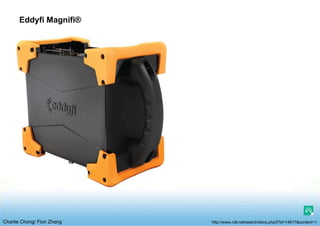
ECA data acquisition unit; Magnifi®, acquisition and analysis software for graphical
display (C-scan), record keeping, and reporting; and, finally, because of the non-linear
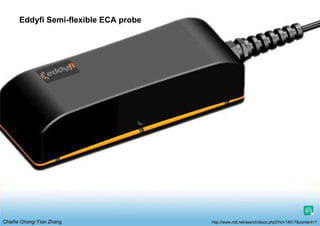
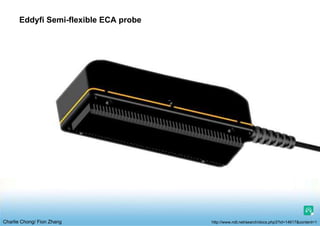
geometry found in this application, a semi-flexible probe whose active surface could
match the tank floor’s geometry.
The ECA probe developed for the application has a flexible active surface 128 mm
(5.04 in.) wide adapting to slightly convex or concave geometries. The array features
33 coils, distributed in two rows, and uses multiplexing for enhanced performance.
The coils, 6 mm (0.236 in.) in diameter, are perfectly matched to cover a low-frequency
range of 0.6-20 kHz with a central frequency of 5 kHz. This design ensures excellent
penetration, reaching the far side of the aluminum tank floor.
http://www.ndt.net/search/docs.php3?id=14617&content=1
Charlie Chong/ Fion Zhang
Eddyfi Ectane
http://www.ndt.net/search/docs.php3?id=14617&content=1
Charlie Chong/ Fion Zhang
Eddyfi Magnifi®
http://www.ndt.net/search/docs.php3?id=14617&content=1
Charlie Chong/ Fion Zhang
Eddyfi Semi-flexible ECA probe
http://www.ndt.net/search/docs.php3?id=14617&content=1
Charlie Chong/ Fion Zhang
Eddyfi Semi-flexible ECA probe
http://www.ndt.net/search/docs.php3?id=14617&content=1
Charlie Chong/ Fion Zhang
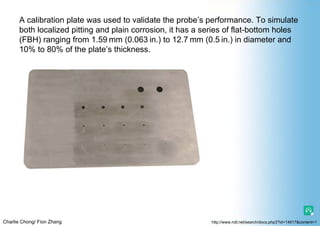
A calibration plate was used to validate the probe’s performance. To simulate
both localized pitting and plain corrosion, it has a series of flat-bottom holes
(FBH) ranging from 1.59 mm (0.063 in.) to 12.7 mm (0.5 in.) in diameter and
10% to 80% of the plate’s thickness.
http://www.ndt.net/search/docs.php3?id=14617&content=1
Charlie Chong/ Fion Zhang
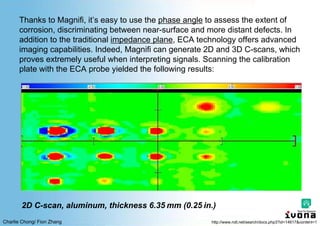
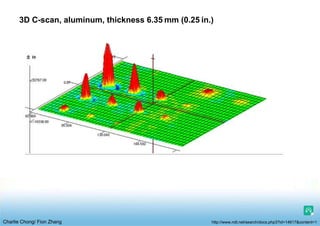
Thanks to Magnifi, it’s easy to use the phase angle to assess the extent of
corrosion, discriminating between near-surface and more distant defects. In
addition to the traditional impedance plane, ECA technology offers advanced
imaging capabilities. Indeed, Magnifi can generate 2D and 3D C-scans, which
proves extremely useful when interpreting signals. Scanning the calibration
plate with the ECA probe yielded the following results:
http://www.ndt.net/search/docs.php3?id=14617&content=1
2D C-scan, aluminum, thickness 6.35 mm (0.25 in.)
Charlie Chong/ Fion Zhang
3D C-scan, aluminum, thickness 6.35 mm (0.25 in.)
http://www.ndt.net/search/docs.php3?id=14617&content=1
Charlie Chong/ Fion Zhang
The ECA probe can clearly detect pitting-like indications (down to the
1.59 mm (0.063 in.) FBH at 40% thickness) or thinning-like indications (down
to the 12.7 mm (0.5 in.) FBH at 10% thickness). These results proved to be
superior to those of the previous examination method.
The solution was deployed on-site and led to the discovery of very degraded
tank floor plates. The entire ECA inspection of a typical tank floor was
performed in about a tenth of the time taken with the original UT inspection
procedure, and was carried out by a single technician.
http://www.ndt.net/search/docs.php3?id=14617&content=1
Charlie Chong/ Fion Zhang
The Benefits
The solution developed by Eddyfi to meet the challenge of corrosion detection
in nuclear power plant storage tanks has several benefits, useful to other
industries and applications as well:
 Rapid scanning of large regions of interest
 Improved versatility, adapting to curved or irregular surfaces
 High-precision assessment of localized indications (e.g. pitting) and
general degradation (e.g. thinning)
 Easier interpretation with C-scan imaging
 Full data recording and archiving capabilities
Eddyfi develops a variety of products, of which the ones presented here are
only a few. We have the expertise and flexibility to engineer solutions for the
most challenging applications.
http://www.ndt.net/search/docs.php3?id=14617&content=1
Charlie Chong/ Fion Zhang
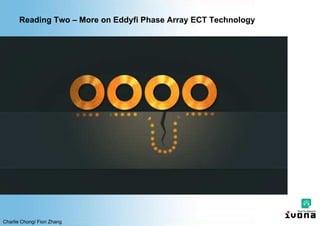
Reading Two – More on Eddyfi Phase Array ECT Technology
Charlie Chong/ Fion Zhang
Rising to the Ferromagnetic Electromagnetic Testing Challenge
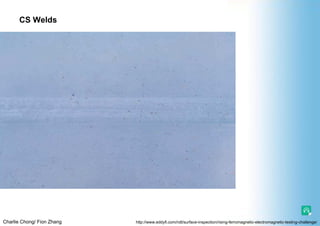
We all rely on carbon steel (CS) welds in our daily lives, whether they are on
the structures we use to commute, on the pipelines that carry the fuel we use
in our cars, or on the wind turbines that generate the electricity we use to
prepare meals. I think we can agree that we like our CS welds strong and
secure. Hence the need to inspect them for defects thoroughly and effectively.
Carbon Steel Welds are Everywhere
Why is that? CS is easy to weld, doesn’t cost too much, and it’s extremely
reliable. But. There’s always a but. CS welds are prone to cracking and are
sometimes well hidden under layers of paint and coatings used in an effort to
preserve assets. The crack defects in CS welds often break their surface and
are usually too small for the naked eye to see.
Furthermore, carbon steel is ferromagnetic. This means a high magnetic
permeability and little to no penetration of eddy current. We’ve never shied
away from a challenge
http://www.eddyfi.com/ndt/surface-inspection/rising-ferromagnetic-electromagnetic-testing-challenge/
Charlie Chong/ Fion Zhang
CS Welds
http://www.eddyfi.com/ndt/surface-inspection/rising-ferromagnetic-electromagnetic-testing-challenge/
Charlie Chong/ Fion Zhang
The Problems with Existing CS Weld Inspection Methods
Conventional methods used to detect cracks in industries relying heavily on carbon
steel welds include:
• Penetrant testing (PT)
• Magnetic particle testing (MT)
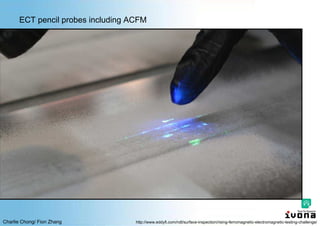
• ECT pencil probes including ACFM
These methods require extensive and time consuming surface preparation, the
remains of which often end up released in the environment. Which adds to their high
dependence on operator skills, somewhat unreliable results, inability to archive
inspection data, and inherently low inspection speeds.
Another method enjoying a degree of success - electromagnetic, this time - is
alternating current field measurement ACFM . This method relies on mathematical
models to assess cracks and estimate their depth. However, while it can do what the
other techniques can’t, it’s also a slow one that needs, like ECT pencil probes, several
scans to cover the entire geometry of the weld while only offering partial data.
http://www.eddyfi.com/ndt/surface-inspection/rising-ferromagnetic-electromagnetic-testing-challenge/
Charlie Chong/ Fion Zhang
ECT pencil probes including ACFM
http://www.eddyfi.com/ndt/surface-inspection/rising-ferromagnetic-electromagnetic-testing-challenge/
Charlie Chong/ Fion Zhang
Pushing the Limits of Electromagnetic Inspection Technologies
Being so widespread, but not supported properly, CS weld inspection
deserved a better inspection method. To come up with it, we were faced with
very interesting technological challenges: How do we scan the entire
geometry of the weld in a single pass to speed up the inspection process?
How do we do so without surface preparation? How do we achieve that with
reliable positioning and depth information about crack defects? A typical eddy
current array (ECA) solution would seem, at first glance, ideally suited to this
type of application. It isn’t, however. That’s because typical ECA pancake coil
configurations yield signals from which it is difficult to extract depth
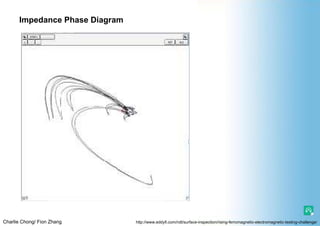
information. Furthermore, the presence of liftoff introduces a “drift” of the
operation point along this hook, which produces significant phase changes,
making depth sizing impossible from a practical standpoint.
http://www.eddyfi.com/ndt/surface-inspection/rising-ferromagnetic-electromagnetic-testing-challenge/
Charlie Chong/ Fion Zhang
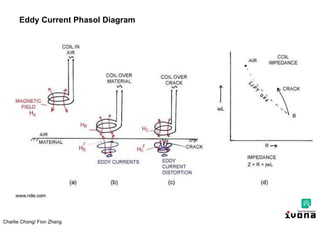
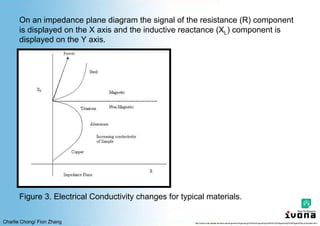
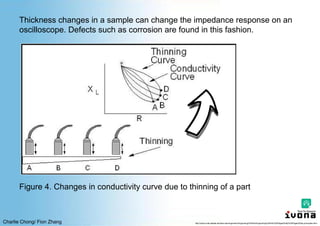
Impedance Phase Diagram
http://www.eddyfi.com/ndt/surface-inspection/rising-ferromagnetic-electromagnetic-testing-challenge/
Charlie Chong/ Fion Zhang
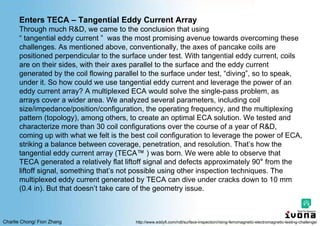
Enters TECA – Tangential Eddy Current Array
Through much R&D, we came to the conclusion that using
“ tangential eddy current ” was the most promising avenue towards overcoming these
challenges. As mentioned above, conventionally, the axes of pancake coils are
positioned perpendicular to the surface under test. With tangential eddy current, coils
are on their sides, with their axes parallel to the surface and the eddy current
generated by the coil flowing parallel to the surface under test, “diving”, so to speak,
under it. So how could we use tangential eddy current and leverage the power of an
eddy current array? A multiplexed ECA would solve the single-pass problem, as
arrays cover a wider area. We analyzed several parameters, including coil
size/impedance/position/configuration, the operating frequency, and the multiplexing
pattern (topology), among others, to create an optimal ECA solution. We tested and
characterize more than 30 coil configurations over the course of a year of R&D,
coming up with what we felt is the best coil configuration to leverage the power of ECA,
striking a balance between coverage, penetration, and resolution. That’s how the
tangential eddy current array (TECA™ ) was born. We were able to observe that
TECA generated a relatively flat liftoff signal and defects approximately 90° from the
liftoff signal, something that’s not possible using other inspection techniques. The
multiplexed eddy current generated by TECA can dive under cracks down to 10 mm
(0.4 in). But that doesn’t take care of the geometry issue.
http://www.eddyfi.com/ndt/surface-inspection/rising-ferromagnetic-electromagnetic-testing-challenge/
Charlie Chong/ Fion Zhang
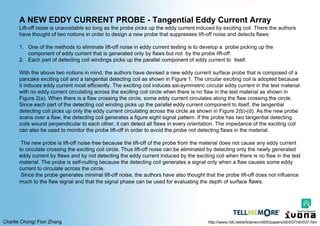
A NEW EDDY CURRENT PROBE - Tangential Eddy Current Array
Lift-off noise is unavoidable so long as the probe picks up the eddy current induced by exciting coil. There the authors
have thought of two notions in order to design a new probe that suppresses lift-off noise and detects flaws:
1. One of the methods to eliminate lift-off noise in eddy current testing is to develop a probe picking up the
component of eddy current that is generated only by flaws but not by the probe lift-off.
2. Each part of detecting coil windings picks up the parallel component of eddy current to itself.
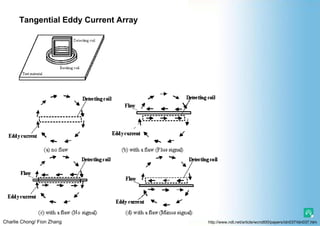
With the above two notions in mind, the authors have devised a new eddy current surface probe that is composed of a
pancake exciting coil and a tangential detecting coil as shown in Figure 1. The circular exciting coil is adopted because
it induces eddy current most efficiently. The exciting coil induces axi-symmetric circular eddy current in the test material
with no eddy current circulating across the exciting coil circle when there is no flaw in the test material as shown in
Figure 2(a). When there is a flaw crossing the circle, some eddy current circulates along the flaw crossing the circle.
Since each part of the detecting coil winding picks up the parallel eddy current component to itself, the tangential
detecting coil picks up only the eddy current circulating across the circle as shown in Figure 2(b)-(d). As the new probe
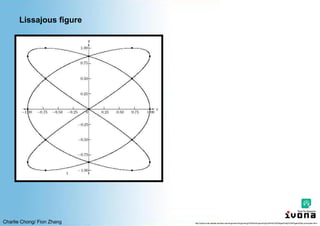
scans over a flaw, the detecting coil generates a figure eight signal pattern. If the probe has two tangential detecting
coils wound perpendicular to each other, it can detect all flaws in every orientation. The impedance of the exciting coil
can also be used to monitor the probe lift-off in order to avoid the probe not detecting flaws in the material.
The new probe is lift-off noise free because the lift-off of the probe from the material does not cause any eddy current
to circulate crossing the exciting coil circle. Thus lift-off noise can be eliminated by detecting only the newly generated
eddy current by flaws and by not detecting the eddy current induced by the exciting coil when there is no flaw in the test
material. The probe is self-nulling because the detecting coil generates a signal only when a flaw causes some eddy
current to circulate across the circle.
Since the probe generates minimal lift-off noise, the authors have also thought that the probe lift-off does not influence
much to the flaw signal and that the signal phase can be used for evaluating the depth of surface flaws.
http://www.ndt.net/article/wcndt00/papers/idn037/idn037.htm
Charlie Chong/ Fion Zhang
Tangential Eddy Current Array
http://www.ndt.net/article/wcndt00/papers/idn037/idn037.htm
Charlie Chong/ Fion Zhang
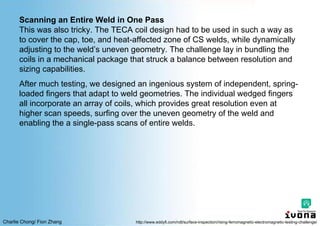
Scanning an Entire Weld in One Pass
This was also tricky. The TECA coil design had to be used in such a way as
to cover the cap, toe, and heat-affected zone of CS welds, while dynamically
adjusting to the weld’s uneven geometry. The challenge lay in bundling the
coils in a mechanical package that struck a balance between resolution and
sizing capabilities.
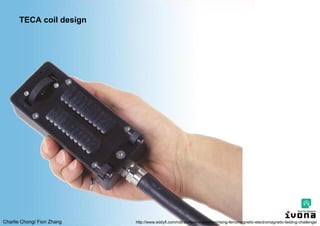
After much testing, we designed an ingenious system of independent, spring-
loaded fingers that adapt to weld geometries. The individual wedged fingers
all incorporate an array of coils, which provides great resolution even at
higher scan speeds, surfing over the uneven geometry of the weld and
enabling the a single-pass scans of entire welds.
http://www.eddyfi.com/ndt/surface-inspection/rising-ferromagnetic-electromagnetic-testing-challenge/
Charlie Chong/ Fion Zhang
TECA coil design
http://www.eddyfi.com/ndt/surface-inspection/rising-ferromagnetic-electromagnetic-testing-challenge/
Charlie Chong/ Fion Zhang
What About Liftoff?
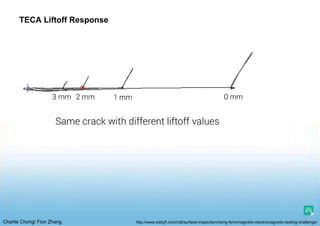
And you would be right to ask. As I mentioned above, TECA generates a
virtually flat liftoff signal, with crack-like indications approximately 90° relative
to this liftoff signal and all the indications featuring the same phase shift.
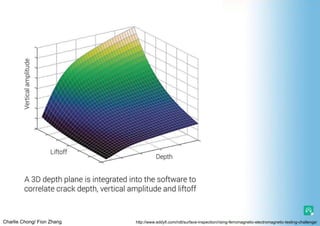
The software processing Sharck probe data incorporates the equivalent of a
three-dimensional depth-to-liftoff-to-vertical-amplitude depth plane that allows
compensating for liftoff.
http://www.eddyfi.com/ndt/surface-inspection/rising-ferromagnetic-electromagnetic-testing-challenge/
Charlie Chong/ Fion Zhang
TECA Liftoff Response
http://www.eddyfi.com/ndt/surface-inspection/rising-ferromagnetic-electromagnetic-testing-challenge/
Charlie Chong/ Fion Zhang http://www.eddyfi.com/ndt/surface-inspection/rising-ferromagnetic-electromagnetic-testing-challenge/
Charlie Chong/ Fion Zhang
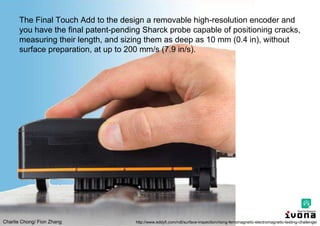
The Final Touch Add to the design a removable high-resolution encoder and
you have the final patent-pending Sharck probe capable of positioning cracks,
measuring their length, and sizing them as deep as 10 mm (0.4 in), without
surface preparation, at up to 200 mm/s (7.9 in/s).
http://www.eddyfi.com/ndt/surface-inspection/rising-ferromagnetic-electromagnetic-testing-challenge/
Charlie Chong/ Fion Zhang
Chapter 2
REVIEW QUESTIONS
Charlie Chong/ Fion Zhang
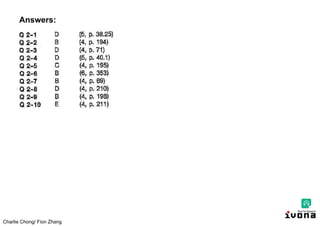
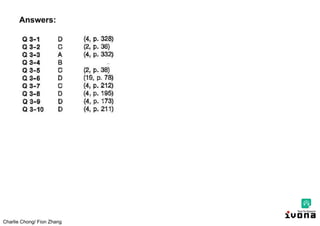
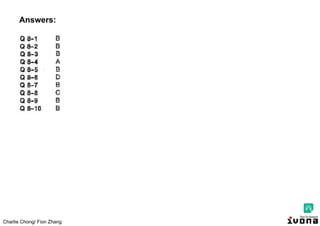
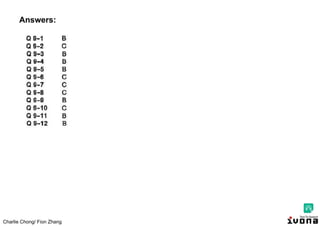
Answers:
Charlie Chong/ Fion Zhang
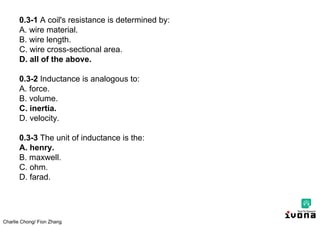
0.2-1 Differential coils are usually used in:
A. bobbin coils.
B. probe coils.
C. OD coils.
D. any of the above.
0.2·2 When using a probe coil to scan a test object, ____ _
A. the object must be dry and polished.
B. the object must be scanned carefully to insure inspection coverage.
C. the object must be scanned in circular motions at constant speeds.
D. the probe must be moving at all times to get a reading.
0.2·3 A "spinning probe" would most likely be a (an):
A. bobbin coil.
B. ID coil.
C. OD coil.
D. probe coi I.
Charlie Chong/ Fion Zhang
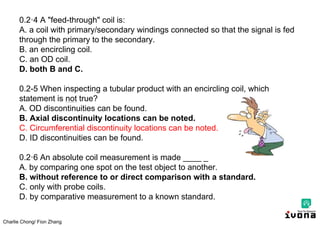
0.2·4 A "feed-through" coil is:
A. a coil with primary/secondary windings connected so that the signal is fed
through the primary to the secondary.
B. an encircling coil.
C. an OD coil.
D. both B and C.
0.2-5 When inspecting a tubular product with an encircling coil, which
statement is not true?
A. OD discontinuities can be found.
B. Axial discontinuity locations can be noted.
C. Circumferential discontinuity locations can be noted.
D. ID discontinuities can be found.
0.2·6 An absolute coil measurement is made ____ _
A. by comparing one spot on the test object to another.
B. without reference to or direct comparison with a standard.
C. only with probe coils.
D. by comparative measurement to a known standard.
Charlie Chong/ Fion Zhang
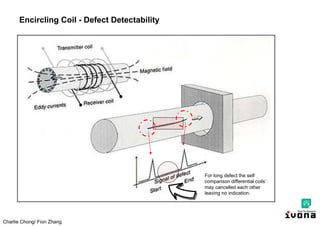
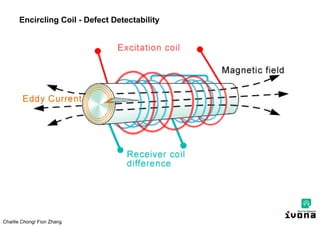
Encircling Coil - Defect Detectability
For long defect the self
comparison differential coils’
may cancelled each other
leaving no indication.
Charlie Chong/ Fion Zhang
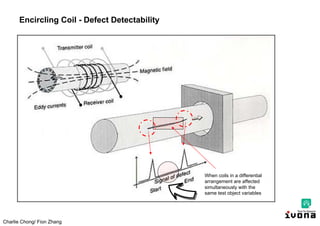
Encircling Coil - Defect Detectability
Charlie Chong/ Fion Zhang
0.2·7 When coils in a differential arrangement are affected simultaneously
with the same test object variables, the output signal ____ _
A. is directly proportional to the number of variables.
B. is "0" or near-"0."
C. is indirectly proportional to the number of variables.
D. is primarily a function of the exciting current.
0.2·8 Which coil type inherently has better thermal stability?
A. Bobbin
B. Absolute
C. OD
D. Differential
Charlie Chong/ Fion Zhang
Encircling Coil - Defect Detectability
When coils in a differential
arrangement are affected
simultaneously with the
same test object variables
Charlie Chong/ Fion Zhang
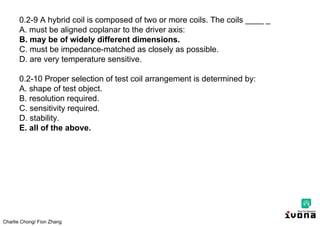
0.2-9 A hybrid coil is composed of two or more coils. The coils ____ _
A. must be aligned coplanar to the driver axis:
B. may be of widely different dimensions.
C. must be impedance-matched as closely as possible.
D. are very temperature sensitive.
0.2-10 Proper selection of test coil arrangement is determined by:
A. shape of test object.
B. resolution required.
C. sensitivity required.
D. stability.
E. all of the above.
Charlie Chong/ Fion Zhang
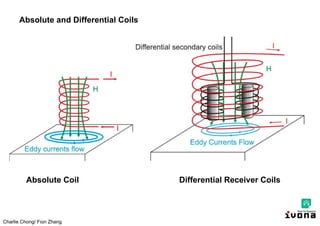
Absolute and Differential Coils
Absolute Coil Differential Receiver Coils
Charlie Chong/ Fion Zhang
3. TEST COIL DESIGN
As discussed earlier, test coil design and selection is a blend of theory and
experience. Many factors must be considered. These important factors are
determined by the inspection requirement for resolution, sensitivity,
impedance, size, stability, and environmental considerations. In order to
better understand coil properties and electrical relationships, a short refresher
in alternating current theory is necessary. First, we must examine electrical
units-for example, current and its representative symbol I. Current not only
suggests electron flow but also the amount. The amount of electrons flowing
past a point in a circuit in one second is expressed in amperes; 2 ∙1018
electrons passing a point in one second is called 1 ampere.
RESISTANCE
Resistance is an opposition to the flow of electrons and is measured in ohms.
Ohm's Jaw is stated by the equation: I = E/R
Where:
I = Current in amperes
R = Resistance in ohms
E = Electrical potential difference in volts
Charlie Chong/ Fion Zhang
R = X l / A
Resistance = Ohms
Specific Resistance = Ohm / circular mill foot
Area = Circular mill
Length = foot
Thus, the resistance of a 10-foot length of 40 gauge copper wire with a
specific resistance of 10.4 circular-mil-foot at 20ºC would be found as follows:
R = 10.4 x 10/ 9.88 = 10.53Ω
In an alternating current circuit containing only resistance, the current and
voltage are in phase. In phase means the current and voltage reach their
minimum and maximum values, respectively, at the same time. The power
dissipated in a resistive circuit appears in the form of heat. For example,
electric toasters are equipped with resistance wires that become hot when
current flows through them, providing a heat source for toasting bread.
Charlie Chong/ Fion Zhang
R = X l / A
Charlie Chong/ Fion Zhang
Inductance
Heat generation is an undesirable trait for an eddy current coil. If the 10-foot
length of wire used in the previous example was wound into the shape of a
coil, it would exhibit characteristics of alternating current other than resistance.
By forming the wire into the shape of a coil, the coil also would have the
property of inductance. The role of inductance is analogous to inertia in
mechanics, because inertia is the property of matter that causes a body to
oppose any change in its velocity. The unit of inductance is the Henry (H). A
coil is said to have the property of inductance when a change in current
through the coil produces a voltage in the coil. More precisely, a circuit in
which an electromotive force of one volt is induced when the current is
changing at a rate of one ampere per second will have an inductance of one
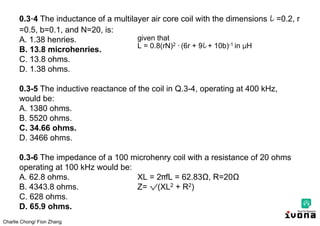
Henry. The inductance of a multilayer air core coil can be expressed by its
physical properties, or coil parameters. Coil parameters such as length,
diameter, thickness, and number of turns of wire affect the coil's inductance.
Charlie Chong/ Fion Zhang
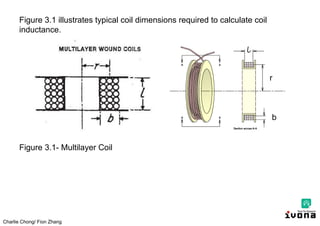
Figure 3.1 illustrates typical coil dimensions required to calculate coil
inductance.
Figure 3.1- Multilayer Coil
r
l
b
Charlie Chong/ Fion Zhang
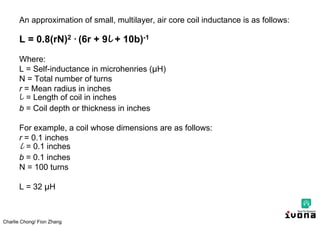
An approximation of small, multilayer, air core coil inductance is as follows:
L = 0.8(rN)2 ∙ (6r + 9l + 10b)-1
Where:
L = Self-inductance in microhenries (μH)
N = Total number of turns
r = Mean radius in inches
l = Length of coil in inches
b = Coil depth or thickness in inches
For example, a coil whose dimensions are as follows:
r = 0.1 inches
l = 0.1 inches
b = 0.1 inches
N = 100 turns
L = 32 μH
Charlie Chong/ Fion Zhang
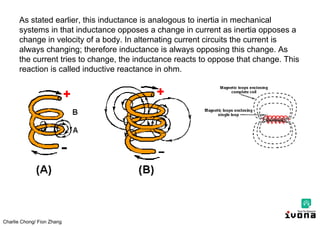
As stated earlier, this inductance is analogous to inertia in mechanical
systems in that inductance opposes a change in current as inertia opposes a
change in velocity of a body. In alternating current circuits the current is
always changing; therefore inductance is always opposing this change. As
the current tries to change, the inductance reacts to oppose that change. This
reaction is called inductive reactance in ohm.
Charlie Chong/ Fion Zhang
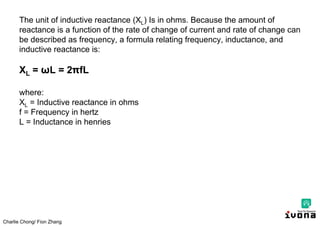
The unit of inductive reactance (XL) Is in ohms. Because the amount of
reactance is a function of the rate of change of current and rate of change can
be described as frequency, a formula relating frequency, inductance, and
inductive reactance is:
XL = ωL = 2 fL
where:
XL = Inductive reactance in ohms
f = Frequency in hertz
L = Inductance in henries
Charlie Chong/ Fion Zhang
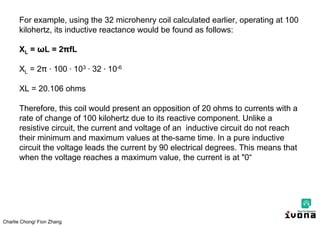
For example, using the 32 microhenry coil calculated earlier, operating at 100
kilohertz, its inductive reactance would be found as follows:
XL = ωL = 2 fL
XL = 2 ∙ 100 ∙ 103 ∙ 32 ∙ 10-6
XL = 20.106 ohms
Therefore, this coil would present an opposition of 20 ohms to currents with a
rate of change of 100 kilohertz due to its reactive component. Unlike a
resistive circuit, the current and voltage of an inductive circuit do not reach
their minimum and maximum values at the-same time. In a pure inductive
circuit the voltage leads the current by 90 electrical degrees. This means that
when the voltage reaches a maximum value, the current is at "0“
Charlie Chong/ Fion Zhang
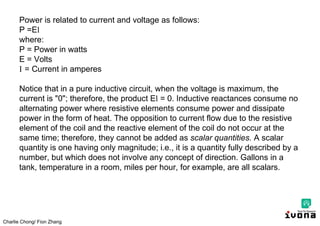
Power is related to current and voltage as follows:
P =El
where:
P = Power in watts
E = Volts
I = Current in amperes
Notice that in a pure inductive circuit, when the voltage is maximum, the
current is "0"; therefore, the product El = 0. Inductive reactances consume no
alternating power where resistive elements consume power and dissipate
power in the form of heat. The opposition to current flow due to the resistive
element of the coil and the reactive element of the coil do not occur at the
same time; therefore, they cannot be added as scalar quantities. A scalar
quantity is one having only magnitude; i.e., it is a quantity fully described by a
number, but which does not involve any concept of direction. Gallons in a
tank, temperature in a room, miles per hour, for example, are all scalars.
Charlie Chong/ Fion Zhang
IMPEDANCE
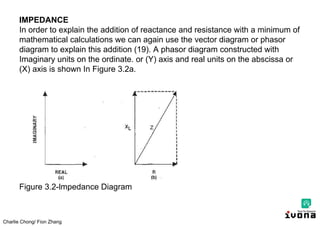
In order to explain the addition of reactance and resistance with a minimum of
mathematical calculations we can again use the vector diagram or phasor
diagram to explain this addition (19). A phasor diagram constructed with
Imaginary units on the ordinate. or (Y) axis and real units on the abscissa or
(X) axis is shown In Figure 3.2a.
Figure 3.2-lmpedance Diagram
Charlie Chong/ Fion Zhang
Substituting Inductive reactance (XL) and resistance (R) we can find the
resultant of the vector addition of XL and R. This resultant vector Z is known
as impedance. Impedance is the total opposition to current flow. Further
observation of Figure 3.2b reveals XL, R, and Z appear to form the sides of a
right triangle. The mathematical solution of right triangles states the square of
the hypotenuse is equal to the sum of the squares of the other two sldes, or
c2 = a2 + b2 , substituting the Z, R & XL, the equation becomes
Z2 = R2 + XL
2
Z = √(R2 + XL
2)
Let's try an example. What is the impedance of a coil having an inductance of
100 microhenries and a resistance of 5 ohms and being operated at 200
kilohertz? First we must convert inductance to inductive reactance and then,
by vector addition, combine inductive reactance and resistance to obtain the
impedance.
Z = [ 52 + (2 ∙200 ∙103 ∙100 ∙10-6)2]0.5
Z = 125.76 Ohm
Charlie Chong/ Fion Zhang
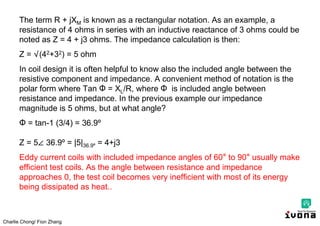
The term R + jXM is known as a rectangular notation. As an example, a
resistance of 4 ohms in series with an inductive reactance of 3 ohms could be
noted as Z = 4 + j3 ohms. The impedance calculation is then:
Z = √(42+32) = 5 ohm
In coil design it is often helpful to know also the included angle between the
resistive component and impedance. A convenient method of notation is the
polar form where Tan Ф = XL/R, where Ф is included angle between
resistance and impedance. In the previous example our impedance
magnitude is 5 ohms, but at what angle?
Ф = tan-1 (3/4) = 36.9º
Z = 5∠ 36.9º = |5|36.9º = 4+j3
Eddy current coils with included impedance angles of 60° to 90° usually make
efficient test coils. As the angle between resistance and impedance
approaches 0, the test coil becomes very inefficient with most of its energy
being dissipated as heat..
Charlie Chong/ Fion Zhang
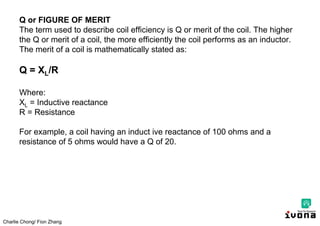
Q or FIGURE OF MERIT
The term used to describe coil efficiency is Q or merit of the coil. The higher
the Q or merit of a coil, the more efficiently the coil performs as an inductor.
The merit of a coil is mathematically stated as:
Q = XL/R
Where:
XL = Inductive reactance
R = Resistance
For example, a coil having an induct ive reactance of 100 ohms and a
resistance of 5 ohms would have a Q of 20.
Charlie Chong/ Fion Zhang
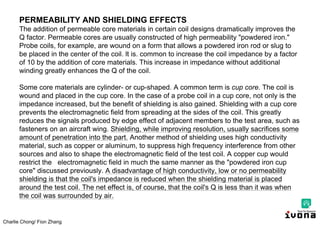
PERMEABILITY AND SHIELDING EFFECTS
The addition of permeable core materials in certain coil designs dramatically improves the
Q factor. Permeable cores are usually constructed of high permeability "powdered iron."
Probe coils, for example, are wound on a form that allows a powdered iron rod or slug to
be placed in the center of the coil. lt is. common to increase the coil impedance by a factor
of 10 by the addition of core materials. This increase in impedance without additional
winding greatly enhances the Q of the coil.
Some core materials are cylinder- or cup-shaped. A common term is cup core. The coil is
wound and placed in the cup core. In the case of a probe coil in a cup core, not only is the
impedance increased, but the benefit of shielding is also gained. Shielding with a cup core
prevents the electromagnetic field from spreading at the sides of the coil. This greatly
reduces the signals produced by edge effect of adjacent members to the test area, such as
fasteners on an aircraft wing. Shielding, while improving resolution, usually sacrifices some
amount of penetration into the part. Another method of shielding uses high conductivity
material, such as copper or aluminum, to suppress high frequency interference from other
sources and also to shape the electromagnetic field of the test coil. A copper cup would
restrict the electromagnetic field in much the same manner as the "powdered iron cup
core" discussed previously. A disadvantage of high conductivity, low or no permeability
shielding is that the coil's impedance is reduced when the shielding material is placed
around the test coil. The net effect is, of course, that the coil's Q is less than it was when
the coil was surrounded by air.
Charlie Chong/ Fion Zhang
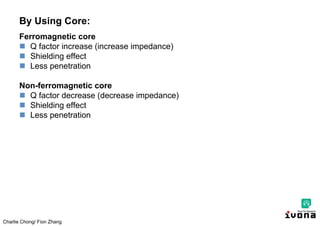
By Using Core:
Ferromagnetic core
 Q factor increase (increase impedance)
 Shielding effect
 Less penetration
Non-ferromagnetic core
 Q factor decrease (decrease impedance)
 Shielding effect
 Less penetration
Charlie Chong/ Fion Zhang
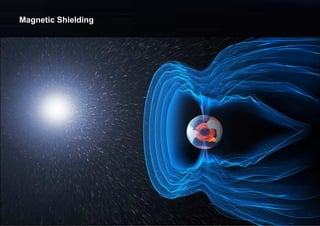
Magnetic Shielding
Charlie Chong/ Fion Zhang
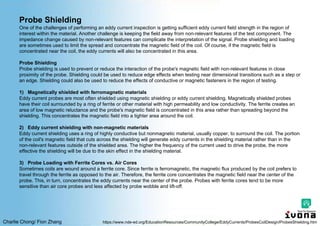
Probe Shielding
One of the challenges of performing an eddy current inspection is getting sufficient eddy current field strength in the region of
interest within the material. Another challenge is keeping the field away from non-relevant features of the test component. The
impedance change caused by non-relevant features can complicate the interpretation of the signal. Probe shielding and loading
are sometimes used to limit the spread and concentrate the magnetic field of the coil. Of course, if the magnetic field is
concentrated near the coil, the eddy currents will also be concentrated in this area.
Probe Shielding
Probe shielding is used to prevent or reduce the interaction of the probe's magnetic field with non-relevant features in close
proximity of the probe. Shielding could be used to reduce edge effects when testing near dimensional transitions such as a step or
an edge. Shielding could also be used to reduce the effects of conductive or magnetic fasteners in the region of testing.
1) Magnetically shielded with ferromagnetic materials
Eddy current probes are most often shielded using magnetic shielding or eddy current shielding. Magnetically shielded probes
have their coil surrounded by a ring of ferrite or other material with high permeability and low conductivity. The ferrite creates an
area of low magnetic reluctance and the probe's magnetic field is concentrated in this area rather than spreading beyond the
shielding. This concentrates the magnetic field into a tighter area around the coil.
2) Eddy current shielding with non-magnetic materials
Eddy current shielding uses a ring of highly conductive but nonmagnetic material, usually copper, to surround the coil. The portion
of the coil's magnetic field that cuts across the shielding will generate eddy currents in the shielding material rather than in the
non-relevant features outside of the shielded area. The higher the frequency of the current used to drive the probe, the more
effective the shielding will be due to the skin effect in the shielding material.
3) Probe Loading with Ferrite Cores vs. Air Cores
Sometimes coils are wound around a ferrite core. Since ferrite is ferromagnetic, the magnetic flux produced by the coil prefers to
travel through the ferrite as opposed to the air. Therefore, the ferrite core concentrates the magnetic field near the center of the
probe. This, in turn, concentrates the eddy currents near the center of the probe. Probes with ferrite cores tend to be more
sensitive than air core probes and less affected by probe wobble and lift-off.
https://www.nde-ed.org/EducationResources/CommunityCollege/EddyCurrents/ProbesCoilDesign/ProbesShielding.htm
Charlie Chong/ Fion Zhang
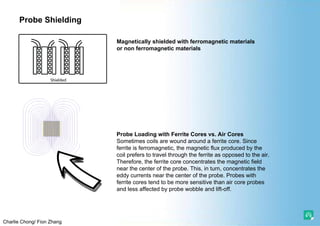
Probe Shielding
Probe Loading with Ferrite Cores vs. Air Cores
Sometimes coils are wound around a ferrite core. Since
ferrite is ferromagnetic, the magnetic flux produced by the
coil prefers to travel through the ferrite as opposed to the air.
Therefore, the ferrite core concentrates the magnetic field
near the center of the probe. This, in turn, concentrates the
eddy currents near the center of the probe. Probes with
ferrite cores tend to be more sensitive than air core probes
and less affected by probe wobble and lift-off.
Magnetically shielded with ferromagnetic materials
or non ferromagnetic materials
Charlie Chong/ Fion Zhang
Another coil design used for inspection of ferromagnetic materials uses a
saturation approach. A predominant variable that prevents eddy current
penetration in ferromagnetic material is called permeability. Permeability
effects exhibited by the test object can be reduced by means of magnetic
saturation. Saturation coils for steels are usually very large and surround the
test object and test coil. A steady state current is applied to the saturation coil.
When the steel test object is magnetically saturated it may be inspected in the
same manner as a non-ferromagnetic material. In the case of mild steel many
thousands of gauss are required to produce saturation. In such other
materials as nickel alloys (monel and inconel), the saturation required is much
less and can usually be accomplished by incorporating permanent magnets
adjacent to the test coil.
Charlie Chong/ Fion Zhang
More Reading on Shielded and Unshielded Probes
Probes are normally available in both shielded and unshielded versions; however, there is an
increasing demand for the shielded variety. Shielding restricts the magnetic field produced by the
coils to the physical size of the probe. A shield can be made of various materials, but the most
common are: ferrite (like a ceramic made of iron oxides), Mumetal, and mild steel. Ferrite make
the best shielding because they provide an easy path for the magnetic field but has poor
conductivity. This means that there is little eddy current loss in the shield itself (?) . Mild steel has
more losses but is widely used for spot probes and ring probes due to its ease of machining
when ferrite is not available in certain sizes or shapes. Mumetal is sometimes for pencil probes
as it is available in thin sheet; however, it is less effective than ferrite.
Shielding has several advantages: first, it allows the probe to be used near geometry changes,
such as edges, without giving false indications; next, it allows the probe to touch ferrous fastener
heads with minimal interference; last, it allows the detection of smaller defects due to the
stronger magnetic field concentrated in a smaller area.
On the other hand, unshielded probes allow somewhat deeper penetration due to the larger
magnetic field. They are also slightly more tolerant to lift-off. Unshielded probes are
recommended for the inspection of ferrous materials (steel) for surface cracks, and in particular
with meter instruments. The reason for this is that the meter response is too slow to allow the
signal from a shielded probe to be displayed at normal scanning speeds due to the smaller
sensitive area.
http://www.olympus-ims.com/en/ec-probes/selection/
Charlie Chong/ Fion Zhang
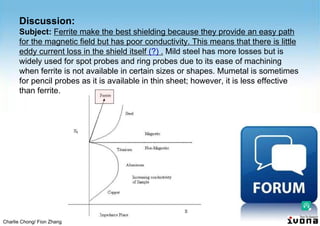
Discussion:
Subject: Ferrite make the best shielding because they provide an easy path
for the magnetic field but has poor conductivity. This means that there is little
eddy current loss in the shield itself (?) . Mild steel has more losses but is
widely used for spot probes and ring probes due to its ease of machining
when ferrite is not available in certain sizes or shapes. Mumetal is sometimes
for pencil probes as it is available in thin sheet; however, it is less effective
than ferrite.
Charlie Chong/ Fion Zhang
COIL FIXTURES
Coil fixtures or holders may be as varied as the imagination of the designers
and users. After the size, shape, and style have been decided upon, the next
consideration should be the test environment. Characteristics of wear,
temperature, atmosphere, mechanical stress, and stability must be
considered. Normally wear can be reduced by selection of wear-resistant
plastic compounds, or where severe wear is expected, artificial or genuine
jewels may be used. Less expensive and very effective wear materials,.such
as aluminum oxide or ceramics, are more commonly used. Temperature
stability may be accomplished by using coil holder material with poor heat
transfer characteristics. Metals have high heat transfer characteristics, and
often coils made with metal holders are sensitive to temperature variations
caused by human touch. For high temperature applications, materials must
be chosen carefully. Most common commercial copper coil wire may be used
up to 150 ~ 200°C. For temperatures above 200°C, silver or aluminum wire
with ceramic or high temperature silicone insulation must be used.
Charlie Chong/ Fion Zhang
The Jewels
Charlie Chong/ Fion Zhang
Materials must be chemically compatible with the test object. As extreme
examples, a polystyrene coil form would not be used to inspect an acetone
cooler, or a lead or graphite housing allowed to come in contact with an
inconel jet engine tail cone producing service-related stress cracks.
Mechanical and electrical stability of the test coil can be enhanced by an
application of epoxy resin between each layer of coil winding. This
accomplishes many objectives: (1) it seals the coil to exclude moisture; (2) it
provides additional electrical insulation; and (3) it provides mechanical
stability. Characteristics listed are not in order of importance. The importance
of each characteristic is determined by specific test requirements.
Charlie Chong/ Fion Zhang
Eddy Current Phasol Diagram
Charlie Chong/ Fion Zhang
Chapter 3
REVIEW QUESTIONS
Charlie Chong/ Fion Zhang
Answers:
Charlie Chong/ Fion Zhang
0.3-1 A coil's resistance is determined by:
A. wire material.
B. wire length.
C. wire cross-sectional area.
D. all of the above.
0.3-2 Inductance is analogous to:
A. force.
B. volume.
C. inertia.
D. velocity.
0.3-3 The unit of inductance is the:
A. henry.
B. maxwell.
C. ohm.
D. farad.
Charlie Chong/ Fion Zhang
0.3·4 The inductance of a multilayer air core coil with the dimensions l =0.2, r
=0.5, b=0.1, and N=20, is:
A. 1.38 henries.
B. 13.8 microhenries.
C. 13.8 ohms.
D. 1.38 ohms.
0.3-5 The inductive reactance of the coil in Q.3-4, operating at 400 kHz,
would be:
A. 1380 ohms.
B. 5520 ohms.
C. 34.66 ohms.
D. 3466 ohms.
0.3-6 The impedance of a 100 microhenry coil with a resistance of 20 ohms
operating at 100 kHz would be:
A. 62.8 ohms. XL = 2πfL = 62.83Ω, R=20Ω
B. 4343.8 ohms. Z= √(XL2 + R2)
C. 628 ohms.
D. 65.9 ohms.
given that
L = 0.8(rN)2 ∙ (6r + 9l + 10b)-1 in μH
Charlie Chong/ Fion Zhang
0.3-7 The Q or merit of a coil is the ratio of:
A. Z/XL
B. XL/Z
C. XL/R
D. R/XL
0 .3-8 The incorporation of magnetic shielding:
A. improves resolution.
B. decreases field extension.
C. increases impedance.(?)
D. does all of the above. (for ferromagnetic material shield materials only)
0.3-9 The purpose of a steady-state 稳态的 winding incorporated in a test coil
is to:
A. reduce permeability effects.
B. provide magnetic saturation.
C. provide a balance source for the sensing coil.
D. both A and B.
Charlie Chong/ Fion Zhang
0.3·10 The most important consideration when selecting a test coil is:
A. sensitivity.
B. resolution.
C. stability.
D. test requirement and compatibility.
Charlie Chong/ Fion Zhang
4. EFFECTS OF TEST OBJECT ON TEST COIL
As we have seen, the eddy current technique depends on the generation of
induced currents within the test object. Perturbations or disturbances in these
small induced currents affect the test coil. The result is variance of test coil
impedance due to test object variables. These are called operating variables
(19). Some of the operating variables are coil impedance, electrical
conductivity, magnetic permeability, skin effect, lift-off, fill factor, end effect,
edge effect, and signal-to-noise ratio. Coil impedance was discussed at
length in the previous Section. In this Section coil impedance changes will be
represented graphically to more effectively explain the interaction of other
operating variables.
Charlie Chong/ Fion Zhang
ELECTRICAL CONDUCTIVITY
In electron theory the atom consists of a positive nucleus surrounded by orbiting
negative electrons. Materials that allow these electrons to be easily moved out of
orbit around the nucleus are classified as conductors. In conductors electrons
are moved by applying an outside electrical force. The ease with which the
electrons are made to move through the conductor is called conductafce.
A unit of conductance is the mho: The mho is the reciprocal of the ohm, or
conductance G = 1/R, where G is conductance in mhos and R is resistance in
ohms. In eddy current testing, instead of describing conductance in absolute
terms, an arbitrary unit has been assigned. Since the relative conductivity of
metals and alloys varies over a wide range, the need for a conductivity
benchmark is of prime importance. The international electrochemical Commission
established in 1913 aconvenient method of comparing of material to another.
The commission established that a specified grade of high purity copper and
uniform section of 1 mm2 measuring 0.017241 ohms at 20°C would be arbitrarily
considered 100 percent conductive. The symbol for conductivity is Ω (sigma) and
the unit is % IACS or percent of the International Annealed Conductivity Standard.
Charlie Chong/ Fion Zhang
Table 4.1 lists materials by conductivity and resistivity. A statement can be
made about a conductor in terms of conductance or resistance. Note that a
good conductor is a poor resistor. Conductance and resistance are direct
reciprocals as stated earlier. Conductivity and resistivity, however, have
different origins and units; therefore, the conversion is not so direct. As
previously discussed, conductivity is expressed on an arbitrary scale in %
IACS. Resistivity is expressed in absolute terms of micro ohm-centimeter. To
convert to either unit, simply follow the equation:
Conductivity %IACS =
172.41 / in micro-ohm-cm
Charlie Chong/ Fion Zhang
As the test coil is influenced by different conductivities, its impedance varies
inversely to conductivity. A higher conductivity causes the test coil to have a
lower impedance value. Figure 4.1 illustrates this concept.
The coil's inductive reactance is represented
by the Y axis and coil resistance appears on
the X axis.
The 0 percent conductivity point, or air point,
is when the coil's empty reactance (XLo) is
maximum.
Figure 4.1 represents a measured
conductivity locus (4). Conductivity is
influenced by many factors.
Table 4.1 lists conductivities of materials with
different chemical compositions.
Figure 4.1 - Measured Conductivity Locus
Charlie Chong/ Fion Zhang
Table 4.1- Eiectrical Resistivity and Conductivity of Several Common Metals and Alloys (ASM
Committee on Eddy Current Inspection, "Eddy-Current Inspection," Metals Handbook, Vol. 11,
8th Ed.
Charlie Chong/ Fion Zhang
Some other factors affecting conductivity are temperature, heat treatment,
grain size, hardness, and residual stresses. A change in the temperature of
the test object will change the electrical conductivity of that object. In metals,
as the temperature is increased, the conductivity is decreased. Carbons and
carbon compounds have negative temperature coefficients; therefore, their
conductivity increases as temperature is increased.
Heat treatment also affects electrical conductivity by redistributing elements in
the material. Dependent upon materials and degree of heat treatment,
conductivity can either increase or decrease as a result of heat treatment.
Stresses in a material due to cold working produces lattice distortion or
dislocation. This mechanical process changes the grain structure and
hardness of the material, changing its electrical conductivity.
Hardness in "age hardenable" aluminum alloys changes the electrical
conductivity of the alloy. The electrical conductivity decreases as hardness
increases. As an example, a Brinell hardness of 60 is represented by a
conductivity of 23, and a Brinell hardness of 100 of the same alloy would
have a conductivity of 19.
Charlie Chong/ Fion Zhang
Impedance Plane Response for Conductivity
As the test coil is influenced by
different conductivities, its
impedance varies inversely to
conductivity. A higher conductivity
causes the test coil to have a
lower impedance value.
Charlie Chong/ Fion Zhang
Impedance Plane Response for Conductivity
http://www.cnde.iastate.edu/faa-casr/engineers/Supporting%20Info/Supporting%20Info%20Pages/Eddy%20Pages/Eddy-principles.html
Charlie Chong/ Fion Zhang
More Reading on the Impedance Plane
Eddy current testing is used to find surface and near surface defects in
conductive materials. It is used by the aviation industry for detection of
defects such as cracks, corrosion damage, thickness verification, and for
materials characterization such as metal sorting and heat treatment
verification. Applications range from fuselage and structural inspection,
engines, landing gear, and wheels. Eddy current inspection involves initial
setup and calibration procedures with known reference standards of the same
material as the part. Probes of appropriate design and frequency must be
used.
Eddy current inspection is based on the principle of electromagnetic induction.
An electric coil in which an alternating current is flowing is placed adjacent to
the part. Since the method is based on induction of electromagnetic fields,
electrical contact is not required.
http://www.cnde.iastate.edu/faa-casr/engineers/Supporting%20Info/Supporting%20Info%20Pages/Eddy%20Pages/Eddy-principles.html
Charlie Chong/ Fion Zhang
Figure 1. Schematic of Eddy Current absolute probe
http://www.cnde.iastate.edu/faa-casr/engineers/Supporting%20Info/Supporting%20Info%20Pages/Eddy%20Pages/Eddy-principles.html
Charlie Chong/ Fion Zhang
An alternating current flowing through the coil produces a primary magnetic
field that induces eddy currents in the part. Energy is needed to generate the
eddy currents, and this energy shows up as resistance losses in the coil.
Typical NDE application are designed to measure these resistance losses.
Eddy currents flow within closed loops in the part.
Figure 2. Diagram illustrating Eddy Currents created in a part.
http://www.cnde.iastate.edu/faa-casr/engineers/Supporting%20Info/Supporting%20Info%20Pages/Eddy%20Pages/Eddy-principles.html
Charlie Chong/ Fion Zhang
As a result of eddy currents, a second magnetic field is generated in the
material. The magnetic fields of the core interact with those in the part and
changes in the material being inspected affect the interaction of the magnetic
fields.
The interaction, in turn, affects the electrical characteristics of the coil.
Resistance and inductive reactance add up to the total impedance of the coil.
Changes in the electrical impedance of the coil are measured by commercial
eddy current instruments.
So, what does all of this have to do with nondestructive testing? The main
method used in eddy current inspection is one in which the response of the
sensor depends on conductivity and permeability of the test material and the
frequency selected.
http://www.cnde.iastate.edu/faa-casr/engineers/Supporting%20Info/Supporting%20Info%20Pages/Eddy%20Pages/Eddy-principles.html
Charlie Chong/ Fion Zhang
How eddy currents are created and sensed:
 An alternating current creates a magnetic field (Oersted's Law).
 The magnetic field causes a resulting eddy current in a part, which creates
an induced magnetic field (Faraday's Law).
 The magnetic field from the coil is opposed to the induced magnetic field
from the eddy current.
 A defect (surface or near surface) modifies the eddy current and therefore
the magnetic field as well.
 This change in the magnetic field is detected by a sensor and is indicative
of a flaw.
http://www.cnde.iastate.edu/faa-casr/engineers/Supporting%20Info/Supporting%20Info%20Pages/Eddy%20Pages/Eddy-principles.html
Charlie Chong/ Fion Zhang
How far do the eddy currents penetrate into a test piece?
The strength of the response from a flaw is greatest at the surface of the material being tested,
and decreases with depth into the material. The "Standard depth of penetration" is
mathematically defined as the point when the eddy current is 1/e or 37% of its surface value. The
"effective depth of penetration" is defined as three times the standard depth of penetration,
where the eddy current has fallen to about 3% of its surface value. At this depth there is no
effective impact on the eddy current and a valid inspection is not feasible.
Penetration depth will:
- Decrease with an increase in conductivity
- Decrease with an increase in permeability
- Decrease with an increase in frequency
Conductivity is sensitive to cracks and material in-homogeneities
- Cracks
- Defects
- Voids
- Scattering of electrons
Magnetic permeability is much more sensitive to structural changes in magnetic materials
- Dislocations
- Residual stress
- Second phases
- Precipitates
http://www.cnde.iastate.edu/faa-casr/engineers/Supporting%20Info/Supporting%20Info%20Pages/Eddy%20Pages/Eddy-principles.html
Charlie Chong/ Fion Zhang
Frequency selection will greatly affect eddy current response. Selection of the proper frequency
is the essential test factor under the control of the test operator. The frequency selected affects
not only the strength of the response from flaws and the effective depth of penetration, but also
the phase relationship.
How do we measure eddy current response?
Eddy current response is viewed on an oscilloscope display, showing the impedance response (Z)
from the test material, which is affected by factors depending on the specimen and experimental
conditions.
Specimen conditions affecting response:
- Electrical conductivity
- Magnetic permeability (unmagnetized ferromagnetic materials can become magnetized,
resulting in large changes in impedance)
- Specimen thickness - thickness should be limited to less then three times the standard depth of
penetration
Experimental conditions affecting response
- AC frequency
- Electromagnetic coupling between the coil and the specimen (a small liftoff has a pronounced
effect)
- Inspection coil size
- Number of turns within the coil itself
- Coil type
http://www.cnde.iastate.edu/faa-casr/engineers/Supporting%20Info/Supporting%20Info%20Pages/Eddy%20Pages/Eddy-principles.html
Charlie Chong/ Fion Zhang
On an impedance plane diagram the signal of the resistance (R) component
is displayed on the X axis and the inductive reactance (XL) component is
displayed on the Y axis.
Figure 3. Electrical Conductivity changes for typical materials.
http://www.cnde.iastate.edu/faa-casr/engineers/Supporting%20Info/Supporting%20Info%20Pages/Eddy%20Pages/Eddy-principles.html
Charlie Chong/ Fion Zhang
Thickness changes in a sample can change the impedance response on an
oscilloscope. Defects such as corrosion are found in this fashion.
Figure 4. Changes in conductivity curve due to thinning of a part
http://www.cnde.iastate.edu/faa-casr/engineers/Supporting%20Info/Supporting%20Info%20Pages/Eddy%20Pages/Eddy-principles.html
Charlie Chong/ Fion Zhang
Figure 5. Changes in conductivity curve due to corrosion damage
http://www.cnde.iastate.edu/faa-casr/engineers/Supporting%20Info/Supporting%20Info%20Pages/Eddy%20Pages/Eddy-principles.html
Charlie Chong/ Fion Zhang
There are two basic types of coil probes used in eddy current inspection; the
absolute probe and the differential probe.
An absolute probe consists of a single pickup coil which can be fashioned in
a variety of shapes. Absolute probes are very good for sorting metals and
detection of cracks in many situations. Absolute coils can detect both sharp
changes in impedance and gradual changes. They are however, sensitive to
material variations, temperature changes, etc.
Figure 6. Typical response for samples of different conductivity
http://www.cnde.iastate.edu/faa-casr/engineers/Supporting%20Info/Supporting%20Info%20Pages/Eddy%20Pages/Eddy-principles.html
Charlie Chong/ Fion Zhang
A differential probe consists of two coils sensing different areas of the material being
tested, which are linked electrically in opposition. The circuit will become unbalanced
when one of the coils encounters a change in impedance. The response to this
change in impedance creates what is known as a Lissajous figure. In general, the
closer the element spacing the wider the "loop" in the signal. Differential probes are
relatively unaffected by lift-off as long as the elements are balanced, and are suited for
detection of small defects. The differential probe's nature allows for greater resolution
of sharp discontinuities, however it makes it less likely to distinguish gradual changes
in material.
Figure 7. Diagram of response of a differential probe over a defect
http://www.cnde.iastate.edu/faa-casr/engineers/Supporting%20Info/Supporting%20Info%20Pages/Eddy%20Pages/Eddy-principles.html
Charlie Chong/ Fion Zhang
Lissajous figure
http://www.cnde.iastate.edu/faa-casr/engineers/Supporting%20Info/Supporting%20Info%20Pages/Eddy%20Pages/Eddy-principles.html
Charlie Chong/ Fion Zhang
Lift Off
Lift-off from paint, coatings, etc. can cause variations that may mask the
defects of interest. Lift-off may also be useful in determining the thickness of
nonconductive coatings on a conductive component
Figure 8. Response of a probe due to lift off
http://www.cnde.iastate.edu/faa-casr/engineers/Supporting%20Info/Supporting%20Info%20Pages/Eddy%20Pages/Eddy-principles.html
Charlie Chong/ Fion Zhang
PERMEABILITY
Permeability of any material is a measure of the ease with which its atoms
can be aligned, or the ease with which it can establish lines of force. Materials
are rated on a comparative basis. Air is assigned a permeability of 1. A basic
determination of permeability, μ (pronounced "mu"), is:
μr = Number of Lines Produced with material as a core
Number of Lines Produced with air as a core
Ferromagnetic metals and alloys including nickel, iron, and cobalt tend to concentrate magnetic flux li-
nes. Ferromagnetic material or sintered ionic compounds are also useful in concentrating magnetic flux.
Magnetic permeability is not constant tor a given material. The permeability depends more upon the
magnetic field acting upon it. As an example, consider a magnetic steel bar placed in an encircling coil.
As the coil current is increased, the magnetic field of the coil will increase. The magnetic flux within the
steel will increase rapidly at first, and then will tend to level off as the steel approaches magnetic
saturation. This phenomenon is called the Barkhausen effect (?). When increases in the magnetizing
force produce little or no change on the flux within the steel bar, the bar is magnetically saturated.
When ferromagnetic materials are saturated, permeability becomes constant. With magnetic
permeability constant, ferromagnetic materials may be inspected using the eddy current method.
Without magnetic saturation, ferromagnetic materials exhibit such a wide range of permeability variation
that signals produced by discontinuities or conductivity variations are masked by the permeability signal.
Permeability effects are most predominant at lower frequencies. Other magnetic effects include
diamagnetic and paramagnetic.
Charlie Chong/ Fion Zhang
SKIN EFFECT
Electromagnetic tests in many applications are most sensitive to test object
variables nearest the test coil due to skin effect. Skin effect is a result of
mutual interaction of eddy currents, operating frequency, test object
conductivity, and permeability. The skin effect, the concentration of eddy
currents in the test object nearest the test coil, becomes more evident as test
frequency, test object conductivity, and permeability are increased (4). For
current density or eddy current distribution inthe test object, refer to Figure 1.9
in Section 1.
Charlie Chong/ Fion Zhang
EDGE EFFECT
The electromagnetic field produced by an excited test coil extends in all
directions from the coil. As test object geometrical boundaries are
approached by the test coil, they are sensed by the coil prior to the coil's
arrival at the boundary. The coil's field precedes the coil by some distance (2)
determined by coil parameters, operating frequency, and test object
characteristics. As the coil approaches the edge of a test object, eddy
currents become distorted by the edge signal. This is known as edge effect.
Response to the edges of test objects can be reduced by the incorporation of
magnetic shields around the test coil or by reducing the test coil diameter.
Edge effect is a term most applicable to the inspection of sheets or plates with
a probe coil.
END EFFECT
End effect follows the same logic as edge effect. End effect is the signal
observed when the end of a product approaches the test coil. Response to
end effect can be reduced by coil shielding or reducing coil length in OD
encircling or ID bobbin coils. End effect is a term most applicable to the
inspection of bar or tubular products.
Charlie Chong/ Fion Zhang
LIFT-OFF
Electromagnetic coupling between test coil and test object is of prime
importance when conducting an eddy current examination. The coupling
between test coil and test object varies with spacing between the test coil and
test object. This spacing is called lift-off. The effect on the coil impedance is
called I ift-off effect.
NOTE:
Absolute coil – more sensitive to lift off.
Differential coil – lift off is compensated, thus less sensitive to lift off.
Differential external reference – sensitive to lift off as it is not
compensated.
http://www.ndt.net/apcndt2001/papers/224/224.htm
Charlie Chong/ Fion Zhang
Figure 4.2 - Lift-off Conductivity Relationship
Charlie Chong/ Fion Zhang
Figure 4.2 shows the relationship between air, conductive materials, and lift-
off. The electromagnetic field, as previously discussed, is strongest near the
coil and dissipates with distance from the coil. This fact causes a pronounced
lift-off effect for small variations in coil-to-object spacing. As an example, a
spacing change from contact to 0.001 in. will produce a lift-off effect many
times greater than a spacing change of 0.010 in. to 0.011 in.. Lift-off effect is
generally an undesired effect causing increased noise and reduced coupling
resulting in poor measuring ability. In some instances, equipment having
phase discrimination capability can readily separate lift-off from conductivity
or other variables. Lift-off can be used to advantage when measuring
nonconductive coatings on conductive bases. A nonconductive coating such
as paint or plastic causes a space between the coil and conducting base,
allowing lift-off to represent the coating thickness. Lift-oft is also useful in
profilometry and proximity applications. Lift-oft is a term most applicable to
testing objects with a surface or probe coil.
Charlie Chong/ Fion Zhang
Discussion
Topic: Figure 4.2 shows the relationship between air, conductive materials,
and lift-off. The electromagnetic field, as previously discussed, is strongest
near the coil and dissipates with distance from the coil. This fact causes a
pronounced lift-off effect for small variations in coil-to-object spacing. As an
example, a spacing change from contact to 0.001 in. will produce a lift-off
effect many times greater than a spacing change of 0.010 in. to 0.011 in..
Charlie Chong/ Fion Zhang
Fill factor
Fill factor is a term used to describe how well a test object will be
electromagnetically coupled to a test coil that surrounds or is inserted into the
test object. Fill factor then pertains to inspections using bobbin or encircling
coils. Like lift-off, electromagnetic coupling between test coil and test object is
most efficient when the coil is nearest the surface of the part. Fill factor canbe
described as the ratio of test object diameter to coil diameter squared. The
diameters squared is a simplified equation resulting in the division of effective
coil and part areas. The area of a circle (A) is determined using the equation:
A1 = d2/4, A2= D2/4
where A1, A2 are the sample’s and coil’s area.
/4 appears in both numerator and denominator of the fractional equation;
therefore; /4 cancels, leaving the ratio of diameters squared d2/D2 = η (eta)
= fill factor
Charlie Chong/ Fion Zhang
Fil I factor will always be a number less than 1, and efficient fill factors
approach 1. A fill factor of 0.99 is more desirable than a fill factor of 0.75. The
effect of fill factor on the test system is that poor fill factors do not allow the
coil to be sufficiently loaded by the test object. This is analogous to the effect
of drawing a bow only slightly and releasing an arrow. The result is, with
thebow slightly drawn and released, little effect is produced to propel the
arrow. In electrical terms, we say the coil is loaded by the test object. How
much the coil is loaded by thetest object due to fill factor can be calculated in
relative terms. A test system with constant current capabilities being affected
by a conductive nonmagnetic bar placed into an encircling coil can be used to
demonstrate this effect.
Charlie Chong/ Fion Zhang
Discussion
Topic: Comments on the illustration. η>1?
Charlie Chong/ Fion Zhang
Electromagnetic Testing with Bobbin Coil
Expert at Works
http://www.concosystems.com/sites/default/files/userfiles/files/techical-papers/energy-tech-magazine-ndt-testing-article-jk.pdf
Charlie Chong/ Fion Zhang
For this example, the system parameters are as follows:
(a) Unloaded coil voltage equals 10 volts,
(b) Test object effective permeability (5) equals 0.3.
(c) Test coil inside diameter equals 1 inch.
(d) Test object outside diameter equals 0.9 inches.
Fill Factor η = 0.81
An equation demonstrating coil loading is given by:
E = E0(1- η + ημeff)
When the nonmagnetic test object is inserted into the test coil with μeff=0.3, the coil's voltage will decrease.
E = 10 (1-0.81 + 0.81 • 0.3)
E = 10 (0.19 + 0.243)
E = 1 0 (0.433)
E = 4.3 volts
where:
E0 = Coil voltage with coil affected by air
E = Coil voltage with coil affected by test object
η = Fill factor
μeff = Effective permeability
This allows 10 - 4.3 or 5.7 volts available to respond to test object changes caused by discontinuities or
decreases in effective conductivity of the test object. it is suggested that the reader calculate the resultant
loaded voltage developed by a 0.5 inch bar of the same material and observe the relativesensitivity difference.
Charlie Chong/ Fion Zhang
DISCONTINUITIES
Any discontinuity that appreciably changes the normal eddy current flow can be detected.
Discontinuities, such as cracks, pits, gouges, vibrational damage, and corrosion, generally
cause the effective conductivity of the test object to be reduced. Discontinuities open to the
surface are more easily detected than subsurface discontinuities. Discontinuities open to
the surface can be detected with a wide range of frequencies; subsurface investigations
require a more careful frequency selection. Discontinuity detection at depths greater than
0.5 inch in stainless steel is very difficult. This is in part due to the sparse distribution of
magnetic flux lines at the low frequency required for such deep.penetrations. Figure 1.9 (p.
6) is again useful to illustrate discontinuity response due to current distribution.
As an example, consider testing a non-ferromagnetic tube at a frequency that establishes a
standard depth of penetration at the midpoint of the tube wall. This condition would allow a
relative current density of approximately 20 percent on the far surface of the tube. With this
condition, identical near and far surface discontinuities would have greatly different
responses. Due to current magnitude alone, the near surface discontinuity response would
be nearly 5 times that of the far surface discontinuity. Discontinuity orientation has a
dramatic effect on response. As seen earlier, discontinuity response is maximum when
eddy currents and discontinuities are at 90º, or perpendicular. Discontinuities parallel to the
eddy current flow produce little or no response. The easiest method to insure detectability
of discontinuitles is to use a reference standard or model that provides a consistent means
of adjusting instrumentation.
Charlie Chong/ Fion Zhang
SIGNAL-TO-NOISE RATIO
Signal-to-noise ratio Is the ratio of signals of interest to unwanted signals.
Common noise sources are test object variations of surface roughness,
geometry, and homogeneity. Other electrical noises can be due to such
external sources as welding machines, electric motors and generators.
Mechanical vibrations can increase test system noise by physical movement
of test coil or test object. In other words, anything that interferes with a test
system's ability to define a measurement is considered noise. Signal-to-noise
ratios can be improved by several methods. If a part is dirty or scaly; signal-
o-noise ratio can be lmproverl tly cleaning the part. Electrical interference can
be shielded or isolated. Phase discrimination and filtering can improve signal-
to-noise ratio. lt is common practice in nondestructive testing to require a
minimum signal-to-noise ratio of 3: to 1. This means a signal of interest must
have a response at least three times that of the noise at that point.
Charlie Chong/ Fion Zhang
Chapter 4
REVIEW QUESTIONS
Charlie Chong/ Fion Zhang
Answers:
Charlie Chong/ Fion Zhang
Q.4·1 Materials that hold their electrons loosely are classified as:
A. resistors.
B. conductors.
C. semiconductors.
D. insulators.
Q.4·2 100% IACS is based on a specified copper bar having a resistance of:
A. 0.01 ohms.
B. 100 ohms.
C. 0.017241 ohms.
D. 172.41 ohms.
Q.4·3 A resistivity of 13 micro ohm-cm is equivalent to a conductivity in %
lACS of
A. 11.032
B. 0.0625
C. 16.52
D. 13.26
Charlie Chong/ Fion Zhang
Q.4·4 A prime factor affecting conductivity is:
A. temperature.
B. hardness.
C. heat treatment.
D. all of the above.
Q.4·5 Materials that tend to concentrate magnetic flux lines are ____ _
A. conductive
B. permeable
C. resistive
D. inductive
Q.4·6 Diamagnetic materials have ____ _
A. a permeability greater than air
B. a permeability less than air
C. a permeability greater than ferromagnetic materials
D. no permeability
Charlie Chong/ Fion Zhang
0.4·7 When an increase in field intensity produces little or no additional flux in
a magnetic test object, the object is considered:
A. stabilized.
B. balanced.
C. saturated.
D. at magnetic threshold.
0.4·8 Edge effect can be reduced by:
A. shielding.
B. selecting a lower frequency.
C. using a smaller coil.
D. both A and C.
0.4·9 Lift-off signals produced by a 0-10 mil spacing change are
approximately _____ times greater than a 80-90 mil spacing change.
A. 10
B. 2
C. 5
D. 100
Charlie Chong/ Fion Zhang
0.4-10 Calculate the effect of fill factor when a conducting bar 0.5 inches in
diameter with an effective permeability of 0.4 is placed into a 1-inch diameter
coil with an unloaded voltage of 10 volts. The loaded voltage is ____ _
A. 2 volts
B. 4.6 volts
C. 8.5 volts
D. 3.2 volts
0.4·11 Laminations are easily detected with the eddy current (probe coil)
method.
A. True
B. False
0.4-12 Temperature changes, vibration, and environmental effects are test
coil inputs that generate:
A. unwanted signals.
B. magnetic fields.
C. eddy currents.
D. drift.
E = E0(1- η + ημeff)
η = 0.25
E = 10(1-.25+.25x0.4) = 8.5V
Charlie Chong/ Fion Zhang
5. SELECTION OF TEST PARAMETERS
As NDT engineers and technicians, it is our responsibility to industry to
provide and perform nondestructive examinations that in some way assure
the quality or usefulness of industry products. In order to apply a
nondestructive test, it is essential that we understand the parameters
affecting the test. Usually, industry establishes a product or component and
then seeks a method to inspect it.This practice establishes test object
geometry, conductivity, and permeability prior to the application of the eddy
current examination. Instrumentation, test coil, and test frequency selection
become the tools used to solve the problem of inspection. Test coils were
discussed previously, and instrumentation will be discussed later in this text.
Test frequencies and their selection will be examined in detail in this Section.
Charlie Chong/ Fion Zhang
Frequency Selection
In Section 1, we observed that eddy currents are exponentially reduced as
they penetrate the test object. We also observed a time or phase difference in
these currents. The currents near the test coil happen first, or lead the current
that is deeper in the object. A high current density allows good delectability,
and a wide phase difference between near and far surfaces allows good
resolution.
http://www.eng.morgan.edu/~hubert/IEGR470/eddycurrent.html
Charlie Chong/ Fion Zhang
Standard Depth δ
http://www.suragus.com/en/company/eddy-current-testing-technology
Charlie Chong/ Fion Zhang
Single Frequency System
unfortunately, if a low frequency is selected to provide good penetration and
detectability, the phase difference between near and far surface is reduced. Selection
of frequency often becomes a compromise.
lt is common practice in in-service inspection of thin wall, non-ferromagnetic tubing to
establish a standard depth of penetration δ just past the mid-point of the tube wall.
This permits about 25 percent of the available eddy current to flow at the outside
surface of the tube wall. In addition, this establishes a phase difference of
approximately 150 to 170 degrees between the inside and outside surface of the tube
wall. The combination of 25 percent outside, or surface current, and 170 degrees
included phase angle provides good detectability and resolution for thin wall tube
inspection.
The depth of penetration formula discussed in Section 1, although correct, has rather
cumbersome units. Conductivity is usually expressed in percent of the "International
Annealed Copper Standard“ (% IACS). Resistivity is usually expressed in terms of
micro-ohm-centimeter (μΩcm). Depths of penetration are normally much less than 0.5
inch.
Charlie Chong/ Fion Zhang
A formula using these units may be more appropriate and easier to use. A
depth of penetration formula using resistivity, frequency, and permeability can
be expressed as follows:
δ = √(2/ ωσμ) = √2 / √(ωσμ) = √2 / √(2 fσμ) = √1/( fσμ) = ( fσμ) -½
For non-magnetic conductor μr ≈ 1
δ = K ( /f)½ (given that μ = μr x μ0 = 4 ∙10-7Hm-1 and = 1/σ)
For magnetic conductor μr ≠ 1
δ = K ( /fμr)½
where:
δ = Depth of penetration in inches
K = Constant = 1.98
Q = Resistivity in μΩcm
f = Frequency in hertz
μrel or μr = 1 for non-ferromagnetic conductors
Charlie Chong/ Fion Zhang
As technicians and engineers, our prime variable is frequency. By adjusting
frequency we can be selectively responsive to test object variables. Solving
the non-ferromagnetic depth of penetration formula for frequency requires a
simple algebraic manipulation as follows:
δ = K ( /f)½
δ2/K2 = ( /f), f = K2 / δ2
Charlie Chong/ Fion Zhang
for English system
f =1.982 / δ2
f in Hertz. for a given standard penetration δ
in micro-ohm-cm.
δ in inches.
As an example of how this may be used consider inspecting an aluminum
plate 0.3 inch thick, fastened to a steel plate at the far surface. Effects of the
steel part are undesirable and require discrimination or elimination. The
aluminum plate has a resistivity of 5 micro-ohm-cm. By establishing a depth
of penetration at 0.1 inch, the far surface current will be less than 10 percent
of the available current, thus reducing response to the steel part. The
frequency required for this can be calculated by applying: f = 1960Hz.
Charlie Chong/ Fion Zhang
If detection of the presence of the steel part was required, the depth of
penetration could be reestablished at 0.3 inch in the aluminum plate, and a
new frequency could be calculated: f = 218Hz
δ= 0.3 in.
steel part
aluminum plate
Area of interest
Charlie Chong/ Fion Zhang
Another approach to frequency selection uses argument "A" of the Bessel
function where argument "A" is equal to unity or 1.
A = fσμrd2/ 5066
f = Frequency in hertz
σ = Conductivity meter/ohm-mm2
d = Diameter of test object, cm
μr = Relative permeability
A frequency can always be selected to establish factor "A" equal to 1. This
frequency is known as the limit frequency and is noted by the term fg By
substituting 1 for factor "A" and fg for f, the equation becomes:
fg = 5066/σμrd2
Limit frequency (fg) is then established In terms of conductivity, permeability
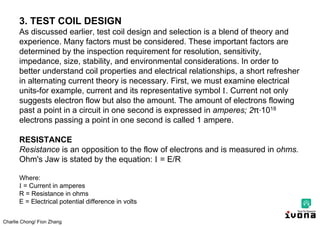
dimension, and a constant “5066”. · Since limit frequency is based on these
parameters, a method of frequency determination using a test frequency to
limit frequency ratio f/fg can be accomplished. High f/fg ratios are used for
near surface tests, and lower f/fg ratios are used for subsurface tests.
Charlie Chong/ Fion Zhang
Often results of such tests are represented graphically by diagrams. These
diagrams are called impedance diagrams. Impedance illustrated by vector
diagrams in Section 3 shows inductive reactance represented on the ordinate
axis and resistance on the axis of abscissa. The vector sum of the reactive
and resistive components is impedance. This impedance is a quantity with
magnitude and direction that is directly proportional to frequency. In order to
construct a universal Impedance diagram valid for all frequencies, the
jmpedance must be normalized. Figure 5.1 illustrates a normalization process.
Charlie Chong/ Fion Zhang
Figure 5.1-Effect of Frequency Change: (a) Primary Impedance Without
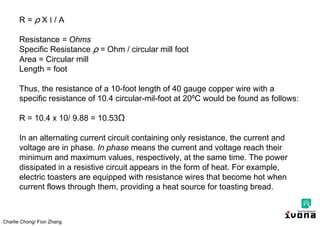
Secondary Circuit; (b) Primary lmpedance with Secondary Circuit
R1
Charlie Chong/ Fion Zhang
Figure 5.1 a shows the effect on primary impedance Zp with changes in
frequency (ω = 2πf). Figure 5.1 a represents primary impedance without a
secondary circuit or test object.
Figure 5.1b Illustrates the effect of frequency on primary impedance with a
secondary circuit or test object present. The primary resistance R1 in Figure
5.1 a has been subtracted in Figure 5.1 b since resistance is not affected by
frequency. The term ωLsG in Figure 5.1 b represents a reference quantity for
the secondary impedance. The units are secondary conductance G and ωLs
secondary reactance.
Further normalization is accomplished by dividing the reactive and resistive
components by the term ωLo or the primary inductive reactance without a
secondary circuit present. Figure 5.2 shows a typical normalized impedance
diagram.
The terms ωL/ωLo and R/ωLo represent the relative impedance of the test
coil as affected by the test object.
Charlie Chong/ Fion Zhang
Fig. 16 Normalized impedance
diagram for a long coil encircling a
solid cylindrical nonferromagnetic bar
showing also the locus for a thin-wall
tube. k, electromagnetic wave
propagation constant for a conducting
material, or √(ωμσ) ; r, radius of
conducting cylinder, meters; ω , 2 f;f,
frequency; √(ωLoG) , equivalent of
√(ωμσ) for simplified electric circuits;
μ, magnetic permeability of bar, or =
4 × 10⁻⁷ H/m if bar is nonmagnetic;
σ, electrical conductivity of bar, mho/m;
1.0, coil fill factor.
Charlie Chong/ Fion Zhang
Signals generated by changes in ωL or R caused by test object conditions
such as surface and subsurface discontinuities may be noted by ∆ωL or ∆R.
The ∆ωLo and ∆R notation indicates a change in the impedance.
Figure 5.3 shows the impedance variation in a non-ferromagnetic cylinder
caused by surface and subsurface discontinuities.
Figure 5.3 also illustrates a sensitivity ratio for surface and subsurface
discontinuities. Notice with an f/fg ratio of 50, a relatively high frequency, the
response to subsurface discontinuities is not very pronounced.
Charlie Chong/ Fion Zhang
Figure 5.3-lmpedance Variations caused by surface and subsurface cracks in
non-ferromagnetic cylinders, at a frequency ratio f/f 9 = 50.
Charlie Chong/ Fion Zhang
Figure 5.4 shows responses to the same discontinuities with an f/fg ratio of 15.
This lower frequency allows better detection of subsurface discontinuities as
shown in Figure 5.4.
Charlie Chong/ Fion Zhang
Figure 5.4-lmpedance Variations caused by surface and subsurface cracks in
non-ferromagnetic cylinders, at a frequency ratio f/fg = 15
Charlie Chong/ Fion Zhang
Multifrequency Systems
lt becomes obvious that the technician must have a good working knowledge
of current density and phase relationships in order .to make intelligent
frequency choices. The frequency choice discussed to date deals with coil
systems driven by only one frequency. Test systems driven by more than one
frequency are called multifrequency or multiparameter systems. lt is common
for a test coil to be driven with three or more frequencies. Although several
frequencies may be applied simultaneously or sequentially to a test coil, each
of the individual frequencies follows rules established by single frequency
methods. Signals generated at the various frequencies are often combined or
mixed in electronic circuits that algebraically add or subtract signals to obtain
a desired result.
One multifrequency approach is to apply a broadband signal, with many
frequency components, to the test coil. The information transmitted by this
signal is proportional to its bandwidth, and the logarithm of 1 plus the signal-
to-noise power ratio. This relationship is stated by the equation:
Charlie Chong/ Fion Zhang
C = W Log2 (1 + S/N)
C = Rate of information transmitted in bits per second
W = Bandwidth of the signal
S/N = Signal-to-noise power ratio
This is known as the Shannon-Hartley Jaw.
Another approach to multi parameter methods is to use a multiplexing
process. The multiplexing process places one frequency at a time on the test
coil. This results in zero cross-talk between frequencies and eliminates the
need for band pass filters. The major advantages of a multiplex system are (1)
lower cost, (2) greater flexibility in frequency selection, and (3) no cross-talk
between frequency channels. If the multiplex switching rate is sufficiently high,
both broadband and multiplex systems have essentially the same results. The
characterization of eddy current signals by their phase angle and amplitude is
a common practice and provides a basis for signal mixing to suppress
unwanted signals from test data. Two frequencies are required to remove
each unwanted variable.
Charlie Chong/ Fion Zhang
Keywords:
 Multiple frequency testing- Multifrequency systems
 Multiple frequency testing- Multiparameter systems
 Broad band technique for multiple frequency testing.
 Multiplexing technique for multiple frequency testing.
 Phase angle and amplitude for characterization of eddy current signals.
 Two frequencies are required to remove each unwanted variable (prime &
subtractor frequencies).
Charlie Chong/ Fion Zhang
Practical multiparameter frequency selection
can be demonstrated by the following example:
Problem: Eddy current inspection of installed thin-wall non-ferromagnetic heat
exchanger tubing. Tubing is structurally supported by ferromagnetic tube supports at
several locations. lt is desired to remove the tube support response signal from tube
wall data.
Solution: Apply a multiparameter technique to suppress tube support signal response.
First, a frequency is selected to give optimum phase and amplitude information about the
tube wall. We shall call this the prime frequency. At the prime frequency, the response to
the tube support and a calibrating through- all hole are equal in amplitude response. A
second frequency called the subtractor frequency is selected on the basis of tube support
response. Since the tube support surrounds the OD of the tube, a low frequency is
selected. At the subtractor frequency the tube support signal response is approximately 10
times greater than the calibrating through-wall hole. If the mixing unit amplitude
adjustments are set so that both prime and subtractor tube support signal amplitudes are
equal and phased in a manner to cause signal subtraction, the tube support signals cancel,
leaving only slightly attenuated prime data information. For suppressions of inside or near
surface signals, a higher subtractor frequency would be chosen. A combination of prime,
low, and high subtractor frequencies is often used to suppress both near and far surface
signals, leaving only data pertaining to the part thickness and its condition. Optimization of
frequency then depends on the desired measurement or parameter of interest
Charlie Chong/ Fion Zhang
Typical Heat Exchanger
Since the tube support surrounds the OD of the tube, a low frequency is selected. At the
subtractor frequency the tube support signal response is approximately 10 times greater than the
calibrating through-wall hole.
Charlie Chong/ Fion Zhang
Typical Heat Exchanger
Since the tube support surrounds the OD of the tube, a low frequency is selected. At the
subtractor frequency the tube support signal response is approximately 10 times greater than the
calibrating through-wall hole.
Charlie Chong/ Fion Zhang
Chapter 5
REVIEW QUESTIONS
Charlie Chong/ Fion Zhang
Answers:
Charlie Chong/ Fion Zhang
Table of information
Charlie Chong/ Fion Zhang
0.5·1 What frequency is required to establish one standard depth of
penetration of 0.1 inch in Zirconium?
A. 19.6 kHz
B. 196 Hz
C. 3.4 kHz
D. 340Hz
0.5-2 In order to reduce effects of far surface indications, the test frequency
____ _
A. must be mixed
B. must be raised
C. must be lowered
D. has no effect
0.5-3 The frequency required to establish the Bessel function Argument "A"
equal to 1 is called
A. optimum frequency
B. resonant frequency
C. limit frequency
D. penetration frequency
δ = ( fμσ) -½
f = 1.982 /δ2 = 1.982 x 50 / (0.1)2
Charlie Chong/ Fion Zhang
0.5·4 Calculate the limit frequency for a copper bar (σ = 50.6 meter/ohm-mm2)
1 cm in diameter. The correct limit frequency is ____ _
A. 50kHz
B. 50.6 Hz
C. 100Hz
D. 100kHz
0.5-5 Using the example in Question 5.4, what is the f/fg ratio if the test
frequency is 60 kHz?
A. 1.2
B. 120
C. 60
D. 600
0.5-6 In Figure 5.1b the value ωLsG equaling 1.4 would be indicative of ____
A. a high resistivity material
B. a high conductivity material
C. a low conductivity material
D. a nonconductor
fg = 5066/σμrd2
fg = 5066 /(50.6 x 1 x12) = 100Hz
Charlie Chong/ Fion Zhang
Figure 5.1- Effect of Frequency Change: (a) Primary Impedance Without
Secondary Circuit; (b) Primary lmpedance with Secondary Circuit
R1
Charlie Chong/ Fion Zhang
0.5·7 Primary resistance is subtracted from Figure 5.1 b because ____ _
A. resistance is always constant
B. resistance is not frequency dependent
C. resistance does not add to the impedance
D. none of the above .
0.5-8 The reference quantity is different for solid cylinder and thin-wall tube in
Figure 5.2 because
A, the frequency is different
B. the conductivity is different
C. the skin effect is no longer negligible
D. the thin-wall tube has not been normalized
0.5-9 A 25 percent deep crack open to the near surface gives a response ___
times greater than the same crack 3.3 percent of diameter under the surface
(ref. Figure 5.4).
A. 10
B. 2.4
C. 1.25
D. 5
Charlie Chong/ Fion Zhang
ratio = 5
Charlie Chong/ Fion Zhang
ration = 3
Charlie Chong/ Fion Zhang
0.5-10 When using multifrequency systems, low subtractor frequencies are
used to suppress
A. conductivity changes
B. far surface signals
C. near surface signals
D. permeability changes
Charlie Chong/ Fion Zhang
6. INSTRUMENT SYSTEMS
Most eddy current instrumentation is categorized by its final output or display
mode. There are basic requirements common to all types of eddy current
instrumentation. Five different elements are usually required to produce a
viable eddy current instrument. These functions are:
■ excitation,
■ modulation,
■ signal preparation,
■ Demodulation, signal analysis, and
■ signal display.
An optional sixth component would be test object handling equipment. Figure
6.1 illustrates how these components interrelate.
Charlie Chong/ Fion Zhang
Figure 6.1- internal Functions of the Electromagnetic Nondestructive Test
Charlie Chong/ Fion Zhang
1. The generator provides excitation signals to the test coil.
2. The signal modulation occurs in the electromagnetic field of the test coil
assembly.
3. Next, the signal preparation section, usually a balancing network, prepares the
signal for demodulation and analysis. In the signal preparation stage, balance
networks are used to "null" out steady-value alternating current signals. Amplifiers
and filters are also part of this section to improve signal-to-noise ratio and raise
signal levels for the subsequent demodulation and analysis stage.
4. The demodulation and analysis section is made up of detectors, analyzers,
discriminators, filters, and sampling circuits. Detectors can be a simple amplitude
type or a more sophisticated phase/ amplitude or coherent type.
5. The signal display section is the key link between the test equipment and its
intended purpose. The signal can be displayed many different ways. Common
displays include cathode ray tube (CRT) oscilloscopes, meters, recorders, visual or
audible alarms, computer terminals, and automatic signaling or reject equipment.
Charlie Chong/ Fion Zhang
series of simple eddy current instruments is shown in Figure 6.2 a, b, c, and d
(19).
Figure 6.2-Four Types of Simple Eddy Current Instruments
In Figure 6.2a, the voltage across the inspection coil is monitored by an ac voltmeter. This type of
instrument could be used to measure large lift-off variations where accuracy was not critical.
Figure 6.2b shows an impedance bridge circuit. This instrument consists of an ac exciting source,
dropping resistors, and a balancing impedance. Figure 6.2c is similar to Figure 6.2b. In Figure
6.2c a balance coil similar to the inspection coil is used to provide a balanced bridge. Figure 6.2d
illustrates a balancing coil affected by a reference sample. This is commonly used in external
reference differential coil tests. In all cases, since only the voltage change or magnitude is
monitored, these systems can all be grouped as impedance magnitude types (5).
Charlie Chong/ Fion Zhang
Eddy current testing can be divided into three broad groups. The groups
are:
1. Impedance (magnitude) testing,
2. Phase analysis testing, and
3. Modulation analysis testing.
 Impedance testing is based on gross changes in coil impedance when the
coil is placed near the test object.
 Phase analysis testing is based on phase changes occurring in the test
coil and the test object's effect on those phase changes.
 Modulation analysis testing depends on the test object passing through the
test coil's magnetic field at a constant rate. The amount of frequency
modulation observed as a discontinuity passes through the test coil's field
and is a function of the transit time of the discontinuity through the coil's
field. The faster the transit time, the greater the modulation.
Charlie Chong/ Fion Zhang
1. IMPEDANCE TESTING
With impedance magnitude instrumentation it is often difficult to separate
desired responses, such as changes in conductivity or permeability, from
dimensional changes. A variation of the impedance magnitude technique is
the reactance magnitude instrument. In reactance magnitude tests, the test
coil is part of the fundamental frequency oscillator circuit. This operates like a
tuned circuit where the oscillator frequency is determined by the test coil's
inductive reactance. As the test coil is affected by the test object, its inductive
reactance changes, which in turn changes the oscillator frequency. The
relative frequency variation ∆f/f is, therefore, an indication of test object
condition. Reactance magnitude systems have many of the same limitations
as impedance magnitude systems.
Charlie Chong/ Fion Zhang
2. PHASE ANALYSIS TESTING
Phase analysis techniques are divided into many subgroups depending on
the type of data display. Some of the various types are (1) vector point, (2)
impedance plane, (3) ellipse, and (4) linear time base. The vector point circuit
and display are illustrated in Figure 6.3.
2.1 Vector Point
The vector point display is a point of light on a CRT. The point is the vector
sum of theY and X axis voltages present in the test coil (2). By proper
selection of frequency and phase adjustment, voltage V1 could represent
dimensional changes and voltage V2 could represent changes in conductivity.
Charlie Chong/ Fion Zhang
Figure 6.3-Vector Point Method (2, p. 3-15) Reprinted with permission.
Charlie Chong/ Fion Zhang
Figure 6.3-Vector Point Method (2, p. 3-15) Reprinted with permission.
(continued)
Charlie Chong/ Fion Zhang
2.2 Ellipse
The ellipse method is shown in Figure 6.4. As with the vector point method,
the test object and reference standard are used to provide a balanced output.
A normal balanced output is a straight horizontal line. Figure 6.5 shows
typical ellipse responses. With the ellipse method the vertical deflection plates
of a CRT are energized by an amplified voltage from the secondary test coils.
The horizontal deflection plates are energized by a voltage that corresponds
to the primary magnetizing current. With this arrangement, an ellipse opening
occurs when a discontinuity signal is perpendicular to a dimensional variation
in the impedance plane. The ellipse method can be used to examine many
test object variables such as conductivity, permeability, hardness, dimensions,
and discontinuities. When testing ferromagnetic parts with the ellipse and
vector point methods, the relative permeability of the part will vary due to the
nonlinear magnetization of the magnetizing field. This nonlinear
magnetization creates odd harmonic frequencies to appear in the output data.
Charlie Chong/ Fion Zhang
Figure 6.4-EIIipse Method (2, p. 3-16) Reprinted with permission.
Charlie Chong/ Fion Zhang
Figure 6.5-CRT Displays for Dimension and Conductivity (2, p. 3-17)
Reprinted with permission.
Charlie Chong/ Fion Zhang
2.3 Linear Time Base
A test instrument system that is well suited to determine harmonic distortions
present in the fundamental frequency uses the linear time base method of
analysis. The linear time base unit applies a sawtooth shaped voltage to the
horizontal deflection plates of a CRT. This provides a linear trace of the CRT
beam from left to right across the CRT screen. The linear trace is timed so
that it is equal to one cycle of the magnetizing current. This allows one cycle
of the magnetizing sine wave voltage to appear on the CRT. Figure 6.7
illustrates a linear time base display.
Charlie Chong/ Fion Zhang
Figure 6.6-Linear Time Base Instrument Diagram (5, p. 40-29)
Charlie Chong/ Fion Zhang
Figure 6.7- Screen Image of a Linear Time Base Instrument with Sinusoidal
Signals (5, p. 40·31)
Charlie Chong/ Fion Zhang
A slit or narrow vertical scale is provided to measure the amplitude of signals
present in the slit. The base voltage is normally adjusted to cross the slit at
"0" volts, the 180°point on the sine wave. The slit value "M" is used to analyze
results. The slit value "M" is described by the equation:
M = A sine ϴ
where:
M = Slit value
A = Amplitude of the measurement in the slit
ϴ = Angle between base signal and measurement effect
In Figure 6.7, the angle difference A to B is approximately 90 degrees.
Charlie Chong/ Fion Zhang
MODULATION ANALYSIS TESTING
Test instruments may also be classified by mode of operation. The mode of
operation is determined by two functional areas within the instrument type.
The first consideration is the method of test coil excitation. The second area is
the degree of compensation, or nulling, and the type of detector used. The
types of excitation include single frequency or multifrequency sinusoidal,
single or repetitive pulse, and swept frequency. Compensation and detection
can be accomplished by three modes. The three main input-detector modes
are:
1. null balance with amplitude detector,
2. null balance with amplitude-phase detectors, and
3. selected off-null balance with amplitude detector.
Charlie Chong/ Fion Zhang
Mode 1 responds to any signal irrespective of phase angle.
Mode 2, using amplitude-phase detectors, can discriminate against signals
having a particular phase angle. With this system, the total demodulated
signal can be displayed on an X-Y oscilloscope to show amplitude and phase
relationships. Figure 6.8a shows a commercial null balance instrument with
amplitude phase detectors.
Charlie Chong/ Fion Zhang
Figure 6.8a-Null Balance Instrument with Amplitude-Phase Detectors (Zetec,
Inc.)
Charlie Chong/ Fion Zhang
Figure 6.8b-Typical Response to a Thin Wall Non-ferromagnetic Tube
Calibration Standard (Zetec, Inc.)
Charlie Chong/ Fion Zhang
Mode 3 is a phase-sensitive system although it has only amplitude detectors.
lt achieves phase sensitivity by operating at a selected off-balance condition.
This off-null signal is very large compared with test object variations. Under
this condition, the amplitude detector output varies in accordance with the test
object signal variation on the large off-null signal. Two off-null systems are
required to present both components of the test coil output signal.
Figure 6.9 shows a block diagram of a stepped single frequency phase-
amplitude instrument.
Charlie Chong/ Fion Zhang
Figure 6.9-lnstrument Providing Any One of Four Operating Frequencies
Charlie Chong/ Fion Zhang
The circuit in Figure 6.9 is capable of operating at any of the four frequencies.
If the four frequencies are over a wide range, several different test coils may
be required to use the instrument over the entire range. Most modern single
frequency instruments use this principle; however, the four individual
generators are usually replaced by one variable frequency generator with a
wide operating range. A typical frequency range for such an instrument is 100
Hz to several megahertz. Figure 6.10 shows a block diagram for a
multifrequency instrument operating at three frequencies simultaneously.
Charlie Chong/ Fion Zhang
Figure 6.10-Multifrequency Instrument Operating at Three Frequencies
Simultaneously
Charlie Chong/ Fion Zhang
In Figure 6.10, excitation currents at each frequency are impressed on the
coil at the same time. Multiple circuits are used throughout the instrument.
The test coil output carrier frequencies are separated by filters. Multiple dual
phase amplitude detectors are used and their outputs summed to provide
separation of several test object parameters. A system similar to this is
described in "In-Service Inspection of Steam Generator Tubing UsingMultiple
Frequency Eddy Current Techniques“. another approach to the
multifrequency technique uses a sequential coil drive called multiplexing. The
frequencies are changed by a step-by-step sequence with such rapidity that
the test parameters remain unchanged. The multiplex technique has the
advantages of lower cost, continuously variable frequencies, and little or no
cross-talk between channels.
Charlie Chong/ Fion Zhang
Figure 6.11 illustrates a commercial multifrequency instrument capable of
operating at four different frequencies sequentially. Each of the frequency
modules may be adjusted over a wide range of frequencies. In addition, two
mixing modules are used to combine output signals of the various channels
for suppression of unwanted variables. Results of such suppression are
described in "Multi-Frequency Eddy Current Method and the Separation of
Test Specimen Variables" .
Charlie Chong/ Fion Zhang
Figure 6.11-Commercial Multifrequency Instrument (Zetec, Inc.)
Charlie Chong/ Fion Zhang
Instruments are being developed that are programmable, computer or
microprocessor based. With microprocessor controlled instruments, test
setups can be stored in a programmable memory system. This allows
complicated, preprogrammed test setups to be recalled and used by
semiskilled personnel. Systems are designed with preprograms having
supervisory code interlocks that prevent reprogramming by other than
authorized personnel. Microprocessor-based instruments can interface with
larger computer systems for control and signal analysis purposes. Figure 6.12
shows a single frequency portable microprocessor-based instrument. The
CRT display applies the phase analysis technique for signal interpretation.
Charlie Chong/ Fion Zhang
Figure 6.12- Commercial Microprocessor-Based Instrument (Nortec
Corporation)
Charlie Chong/ Fion Zhang
Other instruments being developed will be microprocessor based with the
ability to excite several coils .at several frequencies. This would allow
automatic supp-ression of unwanted variables and a direct link to larger
computers for computer enhancement of test signal information. A test
system using pulsed·excitation is shown in Figure 6.13. A pulse is applied to
the test coil, compensating networks, and analyzers simultaneously. Systems
having analyzers with one or two sampling points perform similar to a single
frequency tester using sinusoidal excitation. Pulsed eddy current systems
having multiple sampling points perform more like the multifrequency tester
shown in Figure 6.10.
Charlie Chong/ Fion Zhang
Figure 6.13-Pulsed Waveform Excitation
Charlie Chong/ Fion Zhang
TEST OBJECT HANDLING EQUIPMENT
Test object handling equipment is often a necessary component of a test
system. Bars and tubes can be fed through encircling coils by means of roller
fed assemblies. The stock being fed through the coil is usually transported at
a constant speed. The transport speed is selected with instrument response
and reject system response being of prime importance to the test. Pen
marking and automatic sorting devices are common in automated systems.
Spinning probes are used where the probe is rotated and the tube or bar is
translated. Probe rotational speeds must be compatible with instrument
response and translation speeds in order to obtain the desired inspection
coverage and results. Small parts are often gravity fed through coil
assemblies.
Charlie Chong/ Fion Zhang
A major problem with small parts is loading, inspecting, and unloading. A
speed effect occurs when a conducting object is passed through a coil. As the
object moves through the coil's magnetic field, an additional induced voltage
within the object occurs. This additional induced voltage has the same
frequency as the exciting current, and it causes a current flow and associated
magnetic fields that produce signals proportional to the speed of the object
through the coil. For larger or stationary structures, test probes are scanned
over the part surface by manual or remotely operated systems. Scanning
considerations are the same as tor tube and bar stock instrument response,
marking or reject system response, and desired coverage. In the case of
large heat exchangers, a probe positioning device is used to position the test
probe over each tube opening to be inspected.
Charlie Chong/ Fion Zhang
Keywords: Speed Effect
A major problem with small parts is loading, inspecting, and unloading. A
speed effect occurs when a conducting object is passed through a coil. As the
object moves through the coil's magnetic field, an additional induced voltage
within the object occurs. This additional induced voltage has the same
frequency as the exciting current, and it causes a current flow and associated
magnetic fields that produce signals proportional to the speed of the object
through the coil.
Charlie Chong/ Fion Zhang
Tubes to be inspected are identified by manual templates, or their coordinates
are pro· grammed into computer memory. Positive feedback is supplied to
computer positioning systems by encoder devices. In manual template
systems the tube end is viewed by a video camera. Tube identification and
control feedback are supplied to the operator via a video display system. In
each system, as the probe guide is positioned correctly, the probe is inserted
and withdrawn from the heat exchanger tube bore, and res ults of the scan
are recorded on chart paper and magnetic tape.
Charlie Chong/ Fion Zhang
Chapter 6
REVIEW QUESTIONS
Charlie Chong/ Fion Zhang
Answers:
Charlie Chong/ Fion Zhang
0.6·1 Signal preparation is usually accomplished by:
A. detectors.
B. samplers.
C. balance networks.
D. discriminators.
0.6·2 Most eddy current instruments have _____ coil excitation.
A. square wave
B. triangular wave
C. sine wave
D. sawtooth wave
0.6·3 When only coil voltage is monitored, the system is considered a(an)
_____ type system.
A. impedance magnitude
B. phase analysis
C. reactance magnitude
D. resistance magnitude
Charlie Chong/ Fion Zhang
0.6·4 lt is easy to distinguish dimensional variations from discontinuities in a
reactance magnitude system.
A. True
B. False
0.6·5 Eddy current systems can be grouped by:
A. output characteristics.
B. excitation mode.
C. phase analysis extent.
D. both A and B.
0.6·6 In modulation testing the test object must be ____ _
A. stationary
B. moving
C. polarized
D. saturated
Charlie Chong/ Fion Zhang
0.6·7 Using the vector point method, undesired responses appear _____ on
the CRT.
A. vertical
B. horizontal
C. at 45º to horizontal
D. random and cannot be set
0.6·8 When ellipse testing a rod, the f/fg ratio is lowered from 50 to 5 percent.
The response from a 5 percent surface flaw:
A. will appear more elliptical.
B. will appear less elliptical.
C. is unchanged.
D. rotates 90 D clockwise.
0.6·9 Using the linear time base, harmonics appear:
A. as phase shifts of the fundamental waveform.
B. as distortions of the fundamental waveform.
C. to have no effect on the fundamental waveform.
D. as modified sawtooth signals.
Charlie Chong/ Fion Zhang
0.6·10 Calculate the slit value "M" for a signal phase shift of 45 degrees at 10
divisions vertical amplitude.
A. 14
B. 7
C. 0.7
D. 1.4
0.6·11 A multifrequency instrument that excites the test coil with several
frequencies simultaneously uses the concept.
A. multiplex
B. time share
C. broadband
D. synthesized
0.6·12 A multifrequency instrument that excites the test coil with several
frequencies sequentially usesthe concept.
A. multiplex
B. time base
C. broadband
D. Cartesian
Charlie Chong/ Fion Zhang
0.6·13 In a pulsed eddy current system using a short duration and a long
duration pulse, the short duration pulse is used to reduce ____
A. edge effect
B. skin effect
C. lift-off effect
D. conductivity variations
0.6·14 When selecting feed rates for automatic inspection of tube and bar
stock, consideration is given to:
A. instrument response.
B. automatic sorting response.
C. speed effect.
D. all of the above.
Charlie Chong/ Fion Zhang
7. READOUT MECHANISMS
Eddy current test data may be displayed or indicated in a variety of ways. The
type of display or readout depends on the test requirements. Test records
may require archive storage on large inservice components so that corrosion
or discontinuity rates of change can bemonitored and projected. In some
production tests, a simple GO/NO-GO indicator circuit is all that is required.
Some common readout mechanisms are indicator tights, audio alarms,
meters, digital displays, cathode ray tubes, recorders, and computer printout
or displays.
INDICATOR LIGHTS
A simple use of the indicator light is to monitor the eddy current signal
amplitude with an amplitude gate circuit. When the signal reaches a preset
amplitude limit, the amplitude gate switches a relay that applies power to an
indicator light or automatic sorting device. With the amplitude gate circuit,
high-low limits could be preset to give GO/NO-GO indications.
Charlie Chong/ Fion Zhang
AUDIO ALARMS
Audio alarms can be used in much the same manner. Usually the audio alarm
indicates only the abnormal condition. Alarm lights and audio alarms are commonly
incorporated in eddy current test equipment. The indicator light and audio alarm give
only qualitative information about the item, whether a condition is present or not. The
degree of condition cannot normally be determined with these devices. Indicator lights
and audio alarms are relatively inexpensive and can be interpreted by semi skilled
personnel.
METERS
Meters can present quantitative information about a test object. Meters operate on the
D'Arsonval galvanometer principle. The principle is based on the action between two
magnetic fields. A common meter uses a strong permanent magnet to produce one
magnetic field; the other magnetic field is produced by a movable coil wound on a core.
The coil and core are suspended on jewelled bearings and attached to a pointer or
"needle." The instrument output current is passed through the coil and produces a
magnetic field about the coil that reacts to the permanent magnetic field surrounding
the assembly. The measuring coil is deflected, moving the meter pointer. The degree
of pointer movement can be related to test object variables as presented by the tester
output signals.
Charlie Chong/ Fion Zhang
DIGITAL DISPLAYS
Numerical digital displays or indicators provide the same type of information
as analog meter systems. Many eddy current instruments have analog output
circuits. Data handling of analog information in digital form requires analog
information to be processed through analog-to-digital (A-D) converters. The
A-D converter transforms analog voltages to numerical values tor display.
Charlie Chong/ Fion Zhang
CRTs
Cathode ray tubes (CATs) play an important role in the display of eddy current
information. Most CRTs are the "electrostatic" type. Three main elements comprise a
cathode ray tube: (1) electron gun, (2) deflection plates, and (3) a fluorescent screen.
The electron gun generates, focuses, and directs the electron beam toward the face or
screen of the CAT. The deflection plates are situated between the electron gun and
the screen. They are arranged in two pairs, usually called horizontal and vertical, or X
and Y. The plane of one pair is perpendicular to the other pair and therefore
considered X and Y.
The screen is the imaging portion of the CAT. The screen consists of a coating or
coatings that produce photochemical reactions when struck by the electron beam. The
photochemical action appears in two stages. Fluorescence occurs as the electron
beam strikes the screen. Phosphorescence enables the screen to continue to give off
light after the electron- beam has been removed or has passed over a section of the
screen. All screen materials possess both fluorescence and phosphorescence. Screen
materials are referred to as phosphors. The color of fluorescence and
phosphorescence may differ as the case for zinc sulfide: the fluorescence is blue-
green, and the phosphorescence is yellow-green.
Charlie Chong/ Fion Zhang
Fluorescence may appear blue, white, red, yellow, green, orange, or a
combination of colors, depending on the chemical makeup of the screen. The
amount of light output from the fluorescent screen depends on the electron
beam accelerating potential, screen chemical composition, thickness of
screen material, and writing speed of the electron beam. The duration of the
photochemical effect is called persistence.
Persistence is grouped as to low, medium, or high persistence. To display
repetitive signals, a low or medium persistence CAT may be used. To display
non recurrent or single events, a high persistence CAT should be used. Many
modern CRTs have the capability of both low or medium and high-
persistence. Storage or memory CRTs have the ability to display non
recurrent signals. The image from a single event may remain visible on the
CRT for many hours, if desired.
Charlie Chong/ Fion Zhang
Figure 7.1 illustrates a typical eddy current signal response on a storage CAT.
The amplitude of the signal in Figure 7.1 is an indicator of the volume of the
discontinuity. The phase angle with respect to the X axis represents
discontinuity depth and origin, origin indicating whether the discontinuity
originated on the inside or outside surface of the tube.
Charlie Chong/ Fion Zhang
RECORDERS
Recorders are also used to display data and to provide a convenient method of
data storage. Recording is accomplished on paper strip charts, facsimile paper,
facsimile photosensitive, magnetic tape (AM, FM, or video), or digital memory
disks. Strip chart recordings are common in testing tubing or nuclear fuel rods
where the discontinuity's location down the length of rod or tube is critical. The
strip chart length is indexed to time or distance and pen response indicates
normal or abnormal conditions.
Fascimile recording is a technique of displaying data signals as a raster of lines
which have varying levels of blackness which correspond to data-signal voltage
changes. Facsimile recording is commonly referred to as C-scan recording. If no
data is transmitted to the facsimile recorder, a uniform light or dark (depending on
preference) line or series of lines (raster) would be recorded. In the case of light
rasters, the incoming data signal would produce areas of different darkness. The
darkness would be dependent on the incoming data signal. Facsimile recorders
are used in conjunction with scanning mechanisms and scan rates, and locations
are synchronized with the facsimile recorder to present an image of the object
variances. Figure 7.3 illustrates a typical facsimile recording.
Charlie Chong/ Fion Zhang
Figure 7.2-Commercial Strip Chart Recorder (Gould Instruments)
Charlie Chong/ Fion Zhang
Figure 7.3-Facsimile Recording of Saw-cut Specimen (Copyright, American
Society for Testing and Materials, 1916 Race Street, Philadelphia, PA. 19103.
Reprinted, with permission.)
Charlie Chong/ Fion Zhang
Another common type recorder is the X·Y recorder. X-Yrecorders are usually
used to present scanning type data. In X-Y systems, only data signals are
printed; no raster is produced in a conventional X-Y recorder system.
Magnetic tape recorders, usually frequency-modulated multichannel types,
are used to provide a permanent record of test results. In the case of eddy
current equipment with X·Y outputs, quadrature information is recorded and
played back into analyzers for post inspection analysis.
Charlie Chong/ Fion Zhang
COMPUTERS
Computers may be used to control data acquisition and analysis processes.
Data handling techniques take a wide variety of approaches. Dodd and
Deeds describe a computer-controlled multifrequency system. Figure 7.4
shows a computer-controlled eddy current system.
Figure 7.4- Computer-controlled Eddy Current System (Oak Rid.ge Nationa l
Laboratory, No. 1747-49)
Charlie Chong/ Fion Zhang
Chapter 7
REVIEW QUESTIONS
Charlie Chong/ Fion Zhang
Answers:
Charlie Chong/ Fion Zhang
0.7-1 Display requirements are based on:
A. test applications.
B. records requirement.
C. need for automatic control.
D. all of the above.
Q.7-2 Amplitude gates provide a method of controlling:
A. reject or acceptance limits.
B. instrument response.
C. display amplitude.
D. all of the above.
Q.7-3 Alarms and lights offer only:
A. qualitative information.
B. quantitative information.
C. reject information.
D. accept information.
Charlie Chong/ Fion Zhang
Q.7-4 The galvanometer principle is the basis for ____
A. corrosion rates
B. metallographic deterioration
C. a voltmeter
D. light source illumination
Q.7-5 In order for analog information to be presented to a digital computer, it
must be processed through _______ _
A. an A-D converter
B. a microprocessor
C. a phase detector
D. an amplitude detector
0.7-6 In a cathode ray tube, the electron gun:
A. directs the beam.
B. focuses the beam.
C. generates the beam.
D. all of the above.
Charlie Chong/ Fion Zhang
0.7·7 Photochemical reactions produced by electrons striking a CAT screen
cause:
A. photosynthesis.
B. phosphorescence.
C. fluorescence.
D. both B and C.
0.7·8 High persistance CRT screens are normally used for repetitive signal
display.
A. True
B. False
0.7-9 Length of a strip chart can indicate:
A. flaw severity.
B. distance or time.
C. orthogonality.
D. all of the above.
Charlie Chong/ Fion Zhang
0.7-10 A series of lines produced in facsimile recording is/are called:
A. grid lines.
B. raster.
C. crosshatch.
D. sweep display.
Charlie Chong/ Fion Zhang
8. APPLICATIONS
Electromagnetic induction and the eddy current principle can be affected in
many different ways. These effects may be grouped by discontinuity detection,
measurement of material properties, dimensional measurements, and other
special applications. With discontinuity, or the flaw detection group, we are
concerned with locating cracks, corrosion, erosion, and mechanical damage.
The material properties group includes measurements of conductivity,
permeability, hardness, alloy sorting or chemical composition, and degree of
heat treatment. Dimensional measurements commonly made are thickness,
profilometry, spacing or location, and coating or cladding thickness. Special
applications include measurements of temperature, flow metering of liquid
metals, sonic vibrations, and anisotropic conditions.
Charlie Chong/ Fion Zhang
FLAW DETECTION
The theoretical response to discontinuities has been discussed in previous
Sections of this guide. In this Section, some actual practice examples are
given to enhance the understanding of applied theory. A problem common to
the chemical and electric power industries is the corrosion of heat exchanger
tubing. This tubing is installed in large vessels in a high density array. It is not
uncommon for a 4 foot diameter heat exchanger to contain 3000 tubes· This
high density and limited access to the inspection areas often preclude the use
of other NDE methods. Heat exchanger inspection systems and results are
described. In most of these cases, the severity of the discontinuity is
determined by analyzing the eddy current signal phase and amplitude.
■ The signal amplitude is an indicator of the discontinuity volume.
■ The phase angle determines the depth of the discontinuity and also the
originating surface (ID or OD) of that discontinuity. (See Figure 6.8, above)
Charlie Chong/ Fion Zhang
Phase angle and amplitude relationships are usually established by using a
reference standard with artificial discontinuities of known and documented
values.
The geometry of real discontinuities may differ from reference standard
discontinuities. This difference produces interpretation errors as discussed by
Sagar. Placement of real discontinuities near tube support members causing
a complex coil impedance change is also a source of error. This, of course, is
dependent upon the size of the discontinuity and its resultant eddy current
signal in relation to the tube support signal. This follows the basic principle of
signal-to-noise ratio. The signal-to-noise ratio can be improved at tube to tube
support intersections by the use of multi-frequency techniques.
Charlie Chong/ Fion Zhang
In multifrequency applications, an optimum frequency is chosen for response
to the tube wall and a lower than optimum frequency is chosen for response
to the tube support. The two signals are processed through comparator
circuits called mixers where the tube support response is subtracted from the
tube wall response signal, leaving only the response to the tube wall
discontinuity. Another industry that uses eddy current testing extensively is
the aircraft industry. Many eddy current examinations are conducted on gas
turbine engines and airframe structures. A common problem with gas turbines
is fatigue cracking of the compressor or exhaust turbine blade roots.
Charlie Chong/ Fion Zhang
Usually these inspections are performed with portable instruments with meter
response capability. The meter response is compared to the response of
known discontinuities in a reference specimen. A determination is then made
of the part's acceptance. The reference specimen and its associated
discontinuities are very critical to the success of the test. Often models are
constructed with artificial discontinuities that are exact duplicates of the item
being inspected. The low frequency eddy current inspection of aircraft
structures is explained by D.J. Hagemaier. The low frequency (100 - 1000 Hz)
technique is used to locate cracks in thick or multiple layer, bolted or riveted
aircraft structures. Again, models are constructed with artificial cracks, and
their responses are compared to responses in the actual test object. Pulsed
eddy current systems also are used for crack detection in thick structures.
Charlie Chong/ Fion Zhang
DIMENSIONAL MEASUREMENTS
Dimensional measurements, such as thickness, shape, and position, or
proximity of one item to another, are important uses of the eddy current
technique. Often materials are clad with other materials to present a
resistance to chemical attack or to provide wear resistance. Cladding or
plating thickness then becomes an important variable to the serviceability of
the unit. For nonconductive coatings on conductive bases, the "probe-to-
specimen spacing", or lift-off technique can be applied. The case of
conductive plating or cladding on conductive bases requires more refinement.
The thickness loci respond in a complex manner on the impedance plane.
The loci for multilayered objects with each layer consisting of a material with a
different conductivity follow a spiral pattern. In certain cases, two frequency or
multifrequency systems are used to stabilize results or minimize lift-off
variations on the thickness measurement
Charlie Chong/ Fion Zhang
The depth of case hardening can be determined by measuring the nitride
case thickness in stainless steel. The nitride case thickness produces
magnetic permeability variations. The thicker the nitride, the greater the
permeability. The coil's inductive reactance increases with a permeability
increase. This variable is carefully monitored and correlated to actual
metallographic results. Eddy current profilometry is another common way to
measure dimensions; for example, the measurement of inside diameters of
tubes using a lift-off technique. For this measurement, several small probe
coils are mounted radially in a coil form. The coil form is inserted into the tube
and each coil's proximity to the tube wall is monitored. The resultant output of
each coil can provide information about the concentricity of the tube. An
obvious problem encountered with this method is cantering of the coil holder
assembly. The center of the coil holder must be near the center of the tube.
When inspecting for localized dimensional changes, a long coil holder is
effective in maintaining proper centering. Another function of the long coil
form is to keep the coils from becoming "cocked" or tilted in the tube.
Charlie Chong/ Fion Zhang
CONDUCTIVITY MEASUREMENTS
Conductivity is an important measured variable. In the aircraft industry,
aluminum is used extensively. Aluminum conductivity varies not only with
alloy but also with hardness and tensile strength. Eddy current instruments
scaled in % IACS are normally used to inspect for conductivity variations.
Secondary conductivity standards are commonly used to check instrument
calibration. Common secondary conductivity standards range from 8% IACS
to approximately 100% IACS. The secondary standards are usually certified
accurate within ± 0.35 percent or ± 1 percent of value, whichever is less.
Temperature is an important variable when making conductivity
measurements. Most instruments and standards are certified at 20°C.
Primary conductivity standards are maintained at a constant temperature by
oil bath systems. Primary standards are measured by precision Maxwell
bridge type instruments. This circuit increases measurement accuracy and
minimizes frequncy dependence of the measurement
Charlie Chong/ Fion Zhang
HARDNESS MEASUREMENTS
Hardness of steel parts is often measured with low frequency comparator
bridge instruments. The reference and test coil are balanced with sample
parts of known hardness. As parts of unknown hardness affect the test coil,
the instrument output varies. The amount of output variation depends upon
the degree of imbalance created by the unknown test object hardness. Signal
output is then correlated to test object hardness by comparing to known
hardness samples of the same geometry. For example, if a cathode ray tube
were used to display hardness information, the "balance" hardness could be
adjusted to center screen, lower hardness values could appear below center,
and higher hardness values could appear above center on the CRT.
Charlie Chong/ Fion Zhang
ALLOY SORTING
Alloy sorting can be accomplished in the same comparator bridge manner as
hardness. A major consideration in both cases is the selection of correct and
accurate reference specimens. Since most eddy current instruments respond
to a wide range of variables, the reference specimen parameters must be
controlled carefully. Test object and reference specimens must be the same
or very similar in the following characteristics:
1. geometry,
2. heat treatment,
3. surface finish,
4. residual stresses, and
5. metallurgical structure.
Charlie Chong/ Fion Zhang
In addition, it is advisable to have more than one reference specimen for
backup in case of loss or damage. In the case of steel parts, they should be
completely demagnetized to remove the effects of residual magnetism on
instrument readings. As in most comparative tests, temperature of specimen
and test object should be the same or compensated. Many other
measurements can be made using eddy current techniques. The
electromagnetic technique produces so much information about a material, its
application is only limited by our ability to decipher this information.
Charlie Chong/ Fion Zhang
Chapter 8
REVIEW QUESTIONS
Charlie Chong/ Fion Zhang
Answers:
Charlie Chong/ Fion Zhang
0.8-1 Conductivity, hardness, and composition are part of the group.
A. defect detection
B. material properties
C. dimensional
D. special
0.8·2 Using an ID coil on tubing and applying the phase/amplitude method of
inspection, a signal appearing at 90º on a CRT would be caused by:
A. ID flaw.
B. OD flaw.
C. dent.
D. bulge.
0.8·3 Discontlnuitles in heat exchangers at tube support locations are easier
to detect because the support plate concentrates the electromagnetic field at
that point.
A. True
B. False
Charlie Chong/ Fion Zhang
0.8·4 Using multifrequency techniques on installed heat exchanger tubing, a
tube support plate signal can be suppressed by adding a ____frequency
signal to the optimum frequency signal.
A. low
B. high
C. A orB
D. none of the above
0.8·5 In the aircraft industry, a common problem in gas turbine engines is:
A. corrosion.
B. fatigue cracking.
C. vibration damage.
D. erosion.
0.8-6 Thick or multilayered aircraft structures are normally inspected by:
A. low frequency sinusoidal continuous wave instruments.
B. high frequency sinusoidal continuous wave instruments.
C. pulsed systems.
D. A and C.
Charlie Chong/ Fion Zhang
0.8·7 Response to multilayer varying conductivity structures follow _____ loci.
A. orthogonal
B. spiral
c. linear
D. stepped
0.8·8 Nitride case thickness can be monitored in stainless steel cylinders by
measuring ____ _
A. conductivity
B. dimensions
C. permeability
D. none of the above
0.8-9 Conductivity is not affected by temperature.
A. True
B. False
0.8-10 Residual stresses in the test part produce such a small effect that they are
usually ignored when selecting reference specimens.
A. True
B. False
Charlie Chong/ Fion Zhang
Chapter 9
REVIEW QUESTIONS
Charlie Chong/ Fion Zhang
Answers:
Charlie Chong/ Fion Zhang
0.9·1 A precise statement of a set of requirements to be satisfied by a
material, product, system, or service is a----'---
A. standard
B. specification
C. procedure
D. practice
0.9·2 A statement that comprises one or more terms with explanation is a
____ _
A. practice
B. classification
C. definition
D. proposal
0.9-3 A general statement of applicability and intent is usually presented in
the _____ of a standard?
A. summary
B. scope
C. significance
D. procedure
Charlie Chong/ Fion Zhang
0.9·4 Military Standards are designated by "MIL-C-(number}."
A. True
B. False
0.9·5 In the structure of ASME the subcommittee reports to the subgroup.
A. True
B. False
0.9·6 In example QA 3, personnel Interpreting results must be:
A. Level I or higher.
B. Level 11 or higher.
C. Level IIA or higher.
D. Level Ill.
MIL-STD-1537A
Charlie Chong/ Fion Zhang
0.9-7 The prime artificial discontinuity used to calibrate the system described
in QA 3 is:
A. 20% ID
B. 50% OD
C. 100%
D. 50% ID
0.9-8 In QA 3, equipment calibration must be verified at least ____ _
A. every hour
B. each day
C. every 4 hours
D. every 8 hours
0.9·9 QA 3 specifies a maximum probe traverse rate of _______ _
A. 12"/sec
B. 14"/sec
C. 6"/sec
D. not specified
Charlie Chong/ Fion Zhang
0.9·10 The system in QA 3 is calibrated with an approved standard that is
traceable to ___ _
A. NBS
B. ASME
C. a master standard
D. ASTM
Q.9·11 In accordance with QA 3, tubes whose data are incomplete or
uninterpretable must be
A. reinspected
B. reported
C. reevaluated
D. removed from service
0.9·12 Referring to QA 3, QA 4.1 is a ____ _
A. calibration form
B. data interpretation table
C. data report form
D. certification form
Charlie Chong/ Fion Zhang
Good Luck
Charlie Chong/ Fion Zhang
■ωσμ∙Ω ∆º≠δ≤>η φФ |β≠Ɛ∠
Charlie Chong/ Fion Zhang
More Reading
http://www.ndt.net/article/ecndt02/322/322.htm
http://www.proprofs.com/quiz-school/story.php?title=eddy-current-practise
Charlie Chong/ Fion Zhang
Further Reading
Charlie Chong/ Fion Zhang
Good Luck
Charlie Chong/ Fion Zhang
https://www.yumpu.com/en/browse/user/charliechong

Electromagnetic_Testing_ASNT_Level_III_S.pdf

  • 1.
    Electromagnetic Testing Study GuideEddy Current Testing Revisited My ASNT Level III Pre-Exam Preparatory Self Study Notes 26th April 2015 Charlie Chong/ Fion Zhang
  • 2.
    Charlie Chong/ FionZhang Aerospace Applications https://www.youtube.com/embed/WlEt0bCeTy8
  • 3.
    Charlie Chong/ FionZhang E&P Applications https://www.youtube.com/embed/_Iiwd-_uCLQ
  • 4.
    Charlie Chong/ FionZhang Aerospace Applications https://www.youtube.com/embed/_Iiwd-_uCLQ
  • 5.
    Charlie Chong/ FionZhang Aerospace Applications https://www.youtube.com/embed/_Iiwd-_uCLQ
  • 6.
    Charlie Chong/ FionZhang Aerospace & Defence Applications https://www.youtube.com/embed/_Iiwd-_uCLQ
  • 7.
    Charlie Chong/ FionZhang Power & Nuclear Applications https://www.youtube.com/embed/_Iiwd-_uCLQ
  • 8.
    Charlie Chong/ FionZhang Oil & Gas Applications https://www.youtube.com/embed/_Iiwd-_uCLQ
  • 9.
    Charlie Chong/ FionZhang Heavy Industry & Mining Applications https://www.youtube.com/embed/_Iiwd-_uCLQ
  • 10.
    Charlie Chong/ FionZhang http://independent.academia.edu/CharlieChong1 http://www.yumpu.com/zh/browse/user/charliechong http://issuu.com/charlieccchong
  • 11.
  • 12.
    Fion Zhang atShanghai 26th April 2015 http://meilishouxihu.blog.163.com/ Charlie Chong/ Fion Zhang
  • 13.
  • 14.
    Charlie Chong/ FionZhang http://greekhouseoffonts.com/
  • 15.
    Charlie Chong/ FionZhang http://www.naturalreaders.com
  • 16.
    Charlie Chong/ FionZhang http://www.naturalreaders.cn/
  • 17.
    Charlie Chong/ FionZhang IVONA TTS Capable. http://www.naturalreaders.com/
  • 18.
    Charlie Chong/ FionZhang CHAPTER 1 PRINCIPLES OF EDDY CURRENT TESTING
  • 19.
    Charlie Chong/ FionZhang HISTORICAL BACKGROUND Belore discussing the principles of eddy current testing, it seems appropriate to discuss brielly facets of magnetism and electromagnetism that serve as the foundation of our study of eddy current testing. In the period from 1775 to 1900, scientific experimenters Coulomb, A Ampere, Faraday, Oersted, Arago, Maxwell, and Kelvin investigated and cataloged most of what is known about magnetism and electromagnetism Arago discovered that the oscillation of a magnet was rapidly damped when a nonmagnetic conducting disk was placed near the magnet (Figure 1.1). He also observed that by rotating the disk, the magnet was attracted to the disk. In effect, Arago had introduced a varying magnetic field to the disk causing eddy currents to allow in the disk producing a magnetic field by the disk that attracted the magnet. Arago's simple model is a basis lor many automobile speedometers used today.
  • 20.
    Charlie Chong/ FionZhang Figure 1.1- Arago‘s Magnetic Experimentation, 1821. https://www.nde-ed.org/GeneralResources/Formula/ECFormula/ECFormula.htm
  • 21.
    Charlie Chong/ FionZhang Oersted discovered the presence of a magnetic field around a current- carrying conductor, and he observed a magnetic field developed in a perpendicular plane to the direction of current flow in a wire. Ampere observed that equal and opposite currents Ilowing in adjacent conductors cancelled this magnetic effect. Ampere's observation is used in differential coil applications and to manufacture noninductive, precision resistors. Faraday's first experiments investigated induced currents by the relative motion of magnet and a coil (Fig. 1.2) Figure 1.2一Induced Current with Coil and Magnet
  • 22.
    Charlie Chong/ FionZhang Faraday's major contribution was the discovery of electromagnetic induction. His work can be summarized by the example shown· in Figure 1.3. Coil A is connected to a battery through a switch S. A second coil a connected to a galvanometer G is nearby. When switch S is closed producing a current in coil A in the direction shown, a momentary current is induced in coil a in a direction(- a) opposite to that in A. If S is now opened, a momeritary current will appear in coil a having the direction of (- b). In each case, current flows in coil a only while the current in coil A is changing. Figure 1.3-lnduced Current, Electromagnetic Technique
  • 23.
    Charlie Chong/ FionZhang FARADAY LAW The electromotive force (voltage) induced in coil a of Figure 1.3 can be expressed as follows: E = K ∙ N ∙ ∆Ф/∆t E = Average induced voltage N = Number of turns of wire in coil B ∆Ф/∆t = Rate of change of magnetic lines of force affecting coil B K = 10-8 constant
  • 24.
    Charlie Chong/ FionZhang Maxwell produced a two-volume work "A Treatise on Electricity and Magnetism" first published in 1873, Maxwell not only chronicled most of the work done in electricity and magnetism at that time, but he also developed and published a group of relations known as Maxwell's equations for the elec tromagnetic field. These equations form the base that mathematically describes most of what is known about electromagnetism today. In 1849 Lord Kelvin applied Bessel.'s equation to solve the elements of an electromagnetic field. The principles of eddy current testing depend on the process of electromagnetic induction. This process includes a test coil through which a varying or alternating current is passed. A varying current flowing in a test coil produces a varying electromagnetic field about the coil. This field is known as the primary field.
  • 25.
    Charlie Chong/ FionZhang Faraday Law Increasing current in a coil of wire will generate a counter emf which opposes the current. Applying the voltage law allows us to see the effect of this emf on the circuit equation. The fact that the emf always opposes the change in current is an example of Lenz's law. The relation of this counter emf to the current is the origin of the concept of inductance. The inductance of a coil follows from Faraday's law. Since the magnetic field of a solenoid is: B = μNI ∙ (l -1) Thus: E = - NA ∙∆B/ ∆t, becomes; E = - N A ∙∆ [μNI (l -1)] / ∆t E = - NAμN ∙(l -1) ∙ ∆I/∆t for L = N2Aμ (l -1) E = -L ∆I/∆t # E ∝ ∆ Ф/ ∆t (Faraday Law) E = - N ∆Ф/ ∆t Ф = BA B = flux density A = Area under the influence of B For a fixed area and changing current, Faraday's law becomes: E = - N ∆Ф/ ∆t = -N ∆BA/ ∆t for Ф = BA http://hyperphysics.phy-astr.gsu.edu/hbase/magnetic/indcur.html
  • 26.
    Charlie Chong/ FionZhang Faraday Law
  • 27.
    Charlie Chong/ FionZhang GENERATION OF EDDY CURRENTS When an electrically conducting test object is placed in the primary field, an electrical current will be induced in the test object. This c urrent is known as the eddy current. Figure 1.4 is a simple model that illust rates the relations hips of primary and induced (eddy) curre nts. Conductor A represents a portion of a test coil. Conductor B represents a portion of a test object. Figure 1.4-1 Induced Current Relationships
  • 28.
    Charlie Chong/ FionZhang Following Lenz's law and indicating the instantaneous direction of primary current Фp, a primary field Фp is developed about Conductor A. When Conductor B is brought into the influence of Фp, an eddy current lE is induced in Conductor B. This electrical current lE produces an electromagnetic field ФE that opposes the primary electromagnetic field Фp. The magnitude of ФE is directly proportional to the magnitude of lE. Characteristic changes in Conductor B such as conductivity, permeability, or geometry will cause lE to change. When lE varies, ФE also varies. Variations of ФE are reflected to Conductor A by changes in Фp. These changes are detected and displayed on some type of readout mechanism that relates these variations to the characteristic that is of interest. Ip = Primary current IE = Eddy current Фp = Primary magnetic flux ФE = Secondary eddy current flux
  • 29.
    Charlie Chong/ FionZhang FIELD INTENSITY Ф Figure 1.5 presents a schematic view of an excited test coil. The electromagnetic field produced about the unloaded test coil in Figure 1.5 can be described as decreasing in intensity with distance from the coil and also varying across the coil's cross section. The electromagnetic field is most intense near the coil's surface. Figure 1.5-Eiectromagnetic Field Produced by Alternating Current Фp Ip
  • 30.
    Charlie Chong/ FionZhang The field produced about this coil is directly proportional to the magnitude of applied current, rate of change of current or frequency, and the coil parameters. Coil parameters include inductance, diameter, length, thickness, number of turns of wire, and core material. To better understand the principles under discussion, we must again look at the instantaneous relationships of current and magnetic flux. The exciting current is supplied to the coil by an alternating current generator or oscillator. With a primary current lr flowing through the coil, a primary electromagnetic field Фp is produced about the coil. When this excited test coil is placed on a conducting test object, eddy currents lE will be generated in that test object. Figure 1.6 illustrates this concept. Figure 1.6-Generation of Eddy Current in a Test Object
  • 31.
    Charlie Chong/ FionZhang Note the direction of lp, Фp, and the resultant eddy current lE. Although Figure 1.6 shows lE by directional arrows on the surface of the test object, lE extends into the test object some distance. Another important observation is that lE is generated in the same plane in which the coil is wound. Figure 1.7 emphasizes this point with a loop coil surrounding a cylindrical test object (4). Figure 1.7- Induced Current Flow in a Cylindrical l Part
  • 32.
    Charlie Chong/ FionZhang A more precise method of describing the relationships of magnetic flux, voltage, and current is the phase vector diagram or phasor diagrams (4). Figure 1.8-a. Phasor Diagram of Coil Voltage without Test Object b. Phasor Diagram of Coil Voltage with Test Object
  • 33.
    Charlie Chong/ FionZhang Figure 1.8-a. Phasor Diagram of Coil Voltage without Test Object E = Coil Voltage Ep = Primary Voltage Es = Secondary Voltage = 0 I = Excitation Current Фp = Primary Magnetic Flux Фs = Secondary Magnetic Flux = 0
  • 34.
    Charlie Chong/ FionZhang Figure 1.8 shows the effects of a non-ferromagnetic test object on a test coil. Figure 1.8a shows an encircling coil and the resultant phasor diagram for the unloaded coil . The components of phasor diagram 1.8a are as follows: E = Coil Voltage Ep = Primary Voltage Es = Secondary Voltage = 0 I = Excitation Current Фp = Primary Magnetic Flux Фs = Secondary Magnetic Flux = 0
  • 35.
    Charlie Chong/ FionZhang Figure 1.8-a. b. Phasor Diagram of Coil Voltage with Test Object
  • 36.
    Charlie Chong/ FionZhang The current (I) and primary magnetic flux (ФP) are plotted in phase, and the primary voltage (EP) is shown separated by 90 electrical degrees. Secondary magnetic flux Фs is plotted at zero because without a test object no secondary flux exists. Figure 1.8b represents the action of placing a non- erromagnetic test object into the test coil. The components of phasor diagram 1.8b for a loaded coil are as follows: E = Coil Voltage Ep = Primary Voltage Es = Secondary Voltage ET = Total Voltage I = Excitation Current Фp = Primary Magnetic Flux Фs = Secondary Magnetic Flux ФT = Total Magnetic Flux I = Excitation Current
  • 37.
    Charlie Chong/ FionZhang Figure 1.8-a. b. Phasor Diagram of Coil Voltage with Test Object Ep + Es = ET Ep Es Emeasured = ET ФS Secondary magnetic flux ФT Фp Primary magnetic flux non- ferromagnet ic test object Excitation current I ФT∠ ≠90º ET∠ ≠90º
  • 38.
    Charlie Chong/ FionZhang Observing Figure 1.8b we can see by vectorial addition of Ep and Es we arrive at a new coil voltage (ET) for the loaded condition. The primary magnetic flux cflp and secondary magnetic flux ells are also combined by vectorial addition to arrive at a new magnetic flux (ФT) for the loaded coil. Notice that for the condition of the test object In the test coil, ФT is not in phase with the excitation current I. Also observe that the included angle between the excitation current and the new coil voltage Ep is no longer 90 electrical degrees. These interactions will be discussed in detail later in this study guide.
  • 39.
    Charlie Chong/ FionZhang Figure 1.8-a. b. Phasor Diagram of Coil Voltage with Test Object Ep + Es = ET Ep Es Emeasured = ET ФS Secondary magnetic flux ФT Фp Primary magnetic flux non- ferromagnet ic test object Excitation current I
  • 40.
    Charlie Chong/ FionZhang CURRENT DENSITY The distribution of eddy currents in a test object varies exponentially. The current density in the test object is most dense near the test coil. This exponential current density follows the mathematical rules for a natural expo.nential decay curve (1/e) Usually a natural exponential curve is illustrated by a graph with the ordinate (Y axis) representing magnitude and the abscissa (X axis) representing time or distance. A common point described on such a graph is the "knee" of the curve. The knee occurs at the 37 percent value on the ordinate axis. This 37 percent point, or knee, is chosen because changes in X axis values produce significant changes in Y axis values from 100 percent to 37 percent, and below 37 percent changes in X axis values produce less significant changes in Y axis values. Applying this logic to eddy current testing, a term is developed to describe the relationship of current density in the test object. Consider the eddy current generated at the surface of the test object nearest the test coil to be 100 percent of the available current, the point in the test object thickness where this current is diminished to 37 percent is known as the standard depth of penetration (4). Figure 1.9 is a relative eddy current density curve for a plane wave of infinite extent with magnetic field parallel to the conducting test object surface.
  • 41.
    Charlie Chong/ FionZhang Figure 1.9 - Relative Eddy Current Density 0.37 δ = 1.98√( /fμr)
  • 42.
    Charlie Chong/ FionZhang Current Density at Depth “x” The current density at any depth can be calculated as follows: Jx = Jo e –x√( fμσ) Where: Jx = Current density at depth x , amperes per square meter Jo = Current density at surface, amperes per square meter = 3.1416 f = Frequency in hertz μ = Magnetic permeability, henries per meter (H∙m-1) x = Depth from surface, meters σ = Electric conductivity, mhos per meter (Siemens∙m-1?) The siemens (SI unit symbol: S) is the unit of electric conductance, electric susceptance and electric admittance in the International System of Units (SI). Conductance, susceptance, and admittance are the reciprocals of resistance, reactance, and impedance respectively; hence one siemens is equal to the reciprocal of one ohm, and is also referred to as the mho. The 14th General Conference on Weights and Measures approved the addition of the siemens as a derived unit in 1971.In English, the same form siemens is used both for the singular and plural
  • 43.
    Charlie Chong/ FionZhang MAGNETIC PERMEABILITY Magnetic permeability μ is a combination of terms. For nonmagnetic materials: μ= μo = 4 ∙ 10-7 H/m For magnetic materials: μ = μr∙μo Where: μr = Relative permeability, henries per meter (H∙m-1) μo = Magnetic permeability of air or nonmagnetic material, (H∙m-1)
  • 44.
    Charlie Chong/ FionZhang THE STANDARD DEPTH OF PENETRATION δ The standard depth of penetration can be calculated as follows: δ = ( fμσ) -½ where: δ = Standard depth of penetration, meters = 3.1416 f = Frequency in. hertz μ = Magnetic permeability, H/m σ = Electric conductivity, mhos· per meter
  • 45.
    Charlie Chong/ FionZhang Exercise: lt should be observed at this point that as frequency, conductivity, or permeability is increased, the penetration of current into the test object will be decreased. We can use the graph in Figure 1.9 (p. 6) to demonstrate many eddy current characteristics. Using an example of a very thick block of stainless steel being interrogated with a surface or probe coil operating at a test frequency of 100 kilohertz (kHz), we can determine the standard depth of penetration and observe current densities at other depths. Stainless steel {300 Series) is non-ferromagnetic. Magnetic permeability μ is 4 ∙ 10-7 H/m and the conductivity is 0.14∙107 mhos per meter for 300 Series stainless steel. δ = ( fμσ) -½ δ = (100 x 103 x x 4 x 10-7 x 0.14 x 107) -½ m δ = 1.35 x 10⁻³m = 1.35mm
  • 46.
    Charlie Chong/ FionZhang Exercise: Using 1.35 mm as depth “x” from surface a ratio of depth/depth of penetration would be 1. Referring to Figure 1.9, a depth/depth of penetration of 1 indicates a relative eddy current density of 0.37 or 37 percent. What is the relative eddy current density at 3 mm? Depth “x” equals 3 mm and depth of penetration is 1.35 mm, therefore: 3/1.35 = 2.22δ Current density = (1/e) 2.22 = 0.11 or 11% This ratio indicates a relative eddy current density of about 0.1 or 10 percent. With only 10 percent of the available current flowing at a depth of 3 mm, detectability of variables such as conductivity, permeability, and discontinuities would be very difficult to detect. The obvious solution for greater detectability at the 3 mm depth is to lower the test frequency. Frequency selection will be covered in detail later in this text.
  • 47.
    Charlie Chong/ FionZhang PHASE/AMPLITUDE AND CURRENT/TIME RELATIONSHIPS Figure 1.10 reveals another facet of the eddy current. Eddy currents are not generated at the same in stant in time throughout the part. Eddy currents require time to penetrate the test part. Phase and time are analogous; i.e., phase is an electrical term used to describe timing relationships of electrical waveforms. Phase angle lagging Depth of penetration Figure 1.10 - Eddy Current Phase Angle Radians Lagging β = x/δ radian
  • 48.
    Charlie Chong/ FionZhang Phase is usually expressed in either degrees or radians. There are 2 radians per 360 degrees. Each radian therefore is approximately 57 degrees. Using the surface current phase angle near the test coil as a reference, phase angle current deeper in the test object lags the surface current. The amount of phase lag is determined by: β = x/δ = x( fμσ) -½ in radian where β equals the phase angle lag in radians. Figure 1.10 should be used as a relative indicator of phase lag. The exact phase relationship for a particular system may be different due to other variables, such as coil parameters and excitation methods. The amount of phase lag for a given part thickness is an important factor when considering resolution. Resolution is the ability to separate variables occurring in the test object; for example, distinguishing two discontinuities occurring at different depths in the same test object. As an example, let us establish a standard depth of penetration at 1 mm in a 5 mm thick test object. Refer to Figure 1.10 and observe the phase lag of the current at one standard depth of penetration. Where depth of interest (X) is 1 mm and depth of penetration (δ) is 1 mm, the X/ δ ratio is 1 and the current at depth X lags the surface current by 1 radian.
  • 49.
    Charlie Chong/ FionZhang Projecting this examination, let us observe the phase lag for the entire part thickness. The standard depth of penetration is 1 mm, the part thickness is 5 mm; therefore, the ratio X/δ equals 5. This produces a phase lag of 5 radians or approximately 287 degrees for the part thickness. Having a measurement capability of 1 degree increments, the part thickness could be divided into 287 parts, each part representing 0.017 mm. That would .be considered excellent resolution. There is an obvious limitation. Refer to Figure 1.9 and observe the resultant relative current density with an X/δ ratio of 5. The relative current density is near 0. lt should become apparent that the frequency can be adjusted to achieve optimum results for a particular variable. These and other variables will be discussed in Section 5 of this study guide.
  • 50.
    Charlie Chong/ FionZhang CHAPTER 1 REVIEW QUESTIONS
  • 51.
    Charlie Chong/ FionZhang Answer to Questions
  • 52.
    Charlie Chong/ FionZhang 0.1-1 Generation of eddy currents depends on the principle of: A. wave guide theory. B. electromagnetic induction. C. magneto-restrictive forces. D. all of the above. 0.1-2 A secondary field is generated by the test object and is: A. equal and opposite to the primary field. B. opposite to the primary field, but much smaller. C. in the same plane as the coil is wound. D. in phase with the primary field. 0.1-3 When a non-ferromagnetic part is placed in the test coil, the coil's voltage: A. increases. B. remains constant because this is essential. C. decreases. D. shifts 90 degrees in phase.
  • 53.
    Charlie Chong/ FionZhang 0.1-4 Refer to Figure 1.8b (p. 5): If ET was produced by the test object being stainless steel, what would the effect be if the test object were copper? A. ET would decrease and be at a different angle. B. ET would increase and be at a different angle. C. Because both materials are non-ferromagnetic, no change occurs. D. None of the above. 0.1-5 Eddy currents generated in a test object flow: A. in the same plane as magnetic flux. B. in the same plane as the coil is wound. C. 90 degrees to the coil winding plane. D. Eddy currents have no predictable direction. 0.1-6 The discovery of electromagnetic induction is credited to: A. Arago. B. Oersted. C. Maxwell. D. Faraday.
  • 54.
    Charlie Chong/ FionZhang Figure 1.8-a. b. Phasor Diagram of Coil Voltage with Test Object Ep + Es = ET Ep Es Emeasured = ET ФS Secondary magnetic flux ФT Фp Primary magnetic flux non- ferromagnet ic test object Excitation current I ФT∠ ≠90º ET∠ ≠90º
  • 55.
    Charlie Chong/ FionZhang Discussion Subject: Reason out on the following: 0.1-4 Refer to Figure 1.8b (p. 5): If ET was produced by the test object being stainless steel, what would the effect be if the test object were copper? A. ET would decrease and be at a different angle. B. ET would increase and be at a different angle. C. Because both materials are non-ferromagnetic, no change occurs. D. None of the above.
  • 56.
    Charlie Chong/ FionZhang 0.1-7 A standard depth of penetration is defined as the point in a test object where the relative eddy current density is reduced to: A. 25 percent. B. 37 percent. C. 50 percent. D. 100 percent. 0.1·8 Refer to Figure 1.9 (p. 6). If one standard depth of penetration was established at 1 mm in an object 3 mm thick, what is the relative current density on the far surface? A. 3 B. <0.1 c. 1/3 D. Indeterminate 0:1-9 Refer to Figure 1.10 (p. 8). Using the example in question 1.8, what is the phase difference between the near and far surfaces? A. Far surface leads near surface by 57 º B. Far surface leads near surface by 171 º C. Far surface lags near surface by 171 º D. Far surface lags near surface by 57 º
  • 57.
    Charlie Chong/ FionZhang 0.1-10 Calculate the standard depth of penetration at 10 kHz in copper; σ = 5.7∙107 mhos per meter. A. 0.1 mm B. 0.02 mm C. 0.66 mm D. 66 mm
  • 58.
    Charlie Chong/ FionZhang CHAPTER 2 TEST COIL ARRANGEMENTS
  • 59.
    Charlie Chong/ FionZhang Eddy Current Eddy Current (EC) testing is based on electromagnetic induction. The technology can be used to detect flaws in conducting materials or to measure the distance between a sensor and a conducting material. The measurement does not require the tested object to be in direct contact The principle The basic principle behind standard EC testing involves placing a cylindrical coil, which is carrying an alternating current, close to the test piece. The current in the coil generates a changing magnetic field, which produces eddy currents in the test piece. Variations in the phase and magnitude of these eddy currents are monitored using a second coil (search coil) or by measuring changes to the current flowing in the primary coil (excitation coil). Image Variations in the electrical conductivity or magnetic permeability of the test object or the presence of flaws will change the flow patterns of the eddy currents and there will be a corresponding change in the phase and amplitude of the measured current. Applications EC testing can be used to inspect physically complex shapes and to detect small cracks on or near the surface of a test piece. The inspected surfaces need only minor preparation and need to be perfectly even. The technique is also used for measuring electrical conductivity and the thickness of coatings. http://www.rosen-group.com/global/company/explore/we-can/technologies/measurement/eddy-current.html
  • 60.
    Charlie Chong/ FionZhang TEST COIL ARRANGEMENTS Test coils can be categorized into three main mechanical groups: probe coils, bobbin coils, and encircling coils. PROBE COILS Surface coil, probe coil, flat coil, or pancake coil are all common terms used to describe the same test coil type. Probe coils provide a convenient method of examining the surface of a test object. Figure 2.1 illustrates a typical probe coil used for surface scanning. Figure 2.1 -Probe Coil
  • 61.
    Charlie Chong/ FionZhang Probe coils and probe coil forms can be shaped to fit particular geometries to solve complex inspection problems. As an example, probe coils fabricated in a pencil shape (pencil probe) are used to inspect threaded areas of mounting studs and nuts or serrated areas of turbine wheels and turbine blade assemblies. Probe coils may be used where high resolution is required by adding coil shielding. When using a high-resolution probe coil, the test object surface must be carefully scanned to assure complete inspection coverage. This careful scanning is very time consuming. For this reason, probe coil inspections of large test objects are usually limited to critical areas. Probe coils are used extensively in aircraft inspection for crack detection near fasteners and fastener holes. In the case of fastener holes (bolt holes, rivet holes), the probe coil is spinning while being withdrawn at a uniform rate. This provides a helical scan of the hole using a "spinning probe" technique.
  • 62.
    Charlie Chong/ FionZhang Spinning Encircling Probe Coil
  • 63.
    Charlie Chong/ FionZhang Spinning Thread Probe Coil
  • 64.
    Charlie Chong/ FionZhang Spinning Thread Probe Coil
  • 65.
    Charlie Chong/ FionZhang Shielded Probe Coils
  • 66.
    Charlie Chong/ FionZhang Thread Probe Coils Eddy Current Inspections on RPV bolts and in RPV flat bottom holes Because of the size of the inspection objects and the inaccessibility of the inside thread a mechanised inspection is necessary. The especially developed bolt inspection tables for the inspection of the thread and shaft regions enable a secured inspection. By the outline guidance of the thread an optimum sensor position is guaranteed, whereas the inspection of the shaft region provides an automatic feed that ensures the complete inspection of the total shaft surface. In case of the flat bottom hole thread inspection an optimum sensor guidance is obtained by a motorised compulsory guidance in the thread. Path sensors allow a detailed eddy current and path record and a resulting well analysable presentation of the C-scan. http://deltatest.de/en/dienstleistungen/gewinde_bolzen.php
  • 67.
    Charlie Chong/ FionZhang Shielded Probe Coils http://www.eddyfi.com/ndt/surface-inspection/rising-ferromagnetic-electromagnetic-testing-challenge/
  • 68.
    Charlie Chong/ FionZhang ENCIRCLING COILS Encircling coil, OD coil, and feed-through coil are terms commonty used to describe a coil that surrounds the test object. Figure 2.2 illustrates a typical encircling coil. Figure 2.2-Encircling Coil
  • 69.
    Charlie Chong/ FionZhang Encircling coils are primarily used to inspect tubular and bar-shaped products. The tube or bar is fed through the coil (feed-through) at relatively high speed. The cross section of the test object within the test coil is simultaneously interrogated. For this reason, circumferential orientation of discontinuities cannot be determined with an encircling coil. The volume of material examined at one time is greater using an encircling coil than a probe coil; therefore, the relative sensitivity is lower for an encircling coil. When using an encircling coil, it is important to keep the test object centered in the coil. If the test object is not centered, a uniform continuity response is difficult to obtained. It is common practice to run the calibration standard several times, each time indexing the artificial discontinuities to a new circumferential location in the coil. This procedure is used to insure proper response and proper centering.
  • 70.
    Charlie Chong/ FionZhang ENCIRCLING COILS
  • 71.
    Charlie Chong/ FionZhang ENCIRCLING COILS
  • 72.
    Charlie Chong/ FionZhang ENCIRCLING COILS
  • 73.
    Charlie Chong/ FionZhang ENCIRCLING COILS
  • 74.
    Charlie Chong/ FionZhang ENCIRCLING COILS http://www.mdpi.com/1424-8220/11/3/2525/htm
  • 75.
    Charlie Chong/ FionZhang ENCIRCLING COILS
  • 76.
    Charlie Chong/ FionZhang BOBBIN COILS Bobbin coil, ID coil, and inside probe are terms that describe coils used to inspect from the inside diameter (ID) or bore of a tubular test object. Bobbin coils are inserted and withdrawn from the tube ID by long, semiflexible shafts or simply blown in with air and retrieved with an attached pull cable. These mechanisms will be described later in the text. Bobbin coil information follows the same basic rules stated for encircling coils. Figure 2.3 illustrates a typical bobbin coil. Figure 2.3 illustrates a typical bobbin coil.
  • 77.
    Charlie Chong/ FionZhang Probe coils, encircling coils, and bobbin coils can be additionally classified (5). These additional classifications are determined by how the coils are electrically connected. The three coil categories are absolute, differential, and hybrid. Figure 2.4 shows various types of absolute and differential coil arrangements.
  • 78.
    Charlie Chong/ FionZhang ABSOLUTE COILS An absolute coil makes its measurement without direct reference or comparison to a standard as the measurement is being made (6). Some applications for absolute coil systems would be measurements of conductivity, permeability, dimensions, and hardness. DIFFERENTIAL COILS Differential coils consist of two or more coils electrically connected to oppose each other. Differential coils can be categorized into two types. One is the self-comparison differential, and the other is external reference differential. The self-comparison differential coil compares one area of a test object to another area on the same test object. A common. use is two coils, connected opposing, so that if both coils are affected by identical test object conditions, the net output is "0“ or no signal. The self- comparison arrangement is insensitive to test object variables that occur gradually. Variables such as slowly changing wall thickness, diameter, or conductivity are effectively discriminated against with the self-comparison differential coil. Only when a different condition affects one or the other test coils will an output signal be generated. The coils usually being mechanically and electrically similar allows the arrangement to be very stable during temperature changes. Short discontinuities such as cracks, pits, or other localized discontinuities with abrupt boundaries can be detected readily using the self-comparison differential coil.
  • 79.
    Charlie Chong/ FionZhang The external reference differential coil, as the name implies, is when an external reference is used to affect one coil while the other coil is affected by the test object. Figure 2.5 illustrates this concept. This system is used to detect differences between a standard object and test objects. lt is particularly useful for comparative conductivity, permeability, and dimensional measurements. Obviously in Figure 2.5 it is imperative to normalize the system with one coil affected by the standard object and the other coil affected by an acceptable test object. The external reference differential coil system is sensitive to all measurable differences between the standard object and test object. For this reason it is often necessary to provide additional discrimination to separate and define variables present in the test object.
  • 80.
    Charlie Chong/ FionZhang Figure 2.5 - Ex terna l Reference Different ial System
  • 81.
    Charlie Chong/ FionZhang HYBRID COILS Hybrid coils may or may not be the same size and are not necessarily adjacent to each other. Common types of the hybrid coil are Driver/Pickup, Through Transmission, or Primary/Secondary coil assemblies. Figure 2.6 shows a typical hybrid arrangement. Figure 2.6-Hybrid Coil Pickup Driver
  • 82.
    Charlie Chong/ FionZhang A simple hybrid coil consists of an excitation coil and a sensing coil. In the through transmission coil, the excitation coil is on one side of the test object and the sensing coil is on the other. The voltage developed in the sensing coil is a function of the current magnitude and frequency applied to the excitation coil, coil parameters of the exciting and sensing coils, and test object characteristics. In Figure 2.6 an encircling coil induces circumferential currents in a cylindrical test object, and the disturbances of these currents are detected by a small probe coil. ADDITIONAL COIL CHARACTERISTICS Coil configuration is but one of many factors to consider when setting up test conditions. Other coil characteristics of importance are mechanical, thermal, and electrical stability; sensitivity; resolution; and dimensions. The geometry of the coil is usually dictated by the geometry of the test object, and often sensitivity and resolution are compromised. The relative importance of test coil characteristics depends upon the nature of the test. A blend of theory and experience usually succeeds in selection of proper coil parameters. Coil design and interactions with test objects will be discussed later in this study guide.
  • 83.
    Charlie Chong/ FionZhang More Reading – Phase Array Technology
  • 84.
    Charlie Chong/ FionZhang Eddyfi Tangential Eddy Current Phase Array Technology http://www.eddyfi.com/ndt/surface-inspection/rising-ferromagnetic-electromagnetic-testing-challenge/
  • 85.
    Charlie Chong/ FionZhang Detecting Corrosion in Aluminum with Eddy Current Array Technology Corrosion is everywhere and aluminum is no exception. Whether used in the petrochemical, the power generation, or the aerospace industry, aluminum is subject to degradation. Without a doubt, there is a real need for a reliable and high-precision non-destructive testing (NDT) method. In many situations, one must detect and assess the extent of corrosion damage without having direct access to the region of interest. Indeed, assessing wall loss and pitting on the far side of an aluminum layer is key in a number of situations. The present document highlights the capabilities of eddy current array (ECA) technology using a particularly interesting application: corrosion detection in the storage tanks of nuclear power plants. The following describes how the technology is used to examine this important asset, which plays a critical role in the safe operation of nuclear plants. http://www.ndt.net/search/docs.php3?id=14617&content=1
  • 86.
    Charlie Chong/ FionZhang The Challenge Storage tanks vary in size, shape and material. In the current situation, an aluminum tank with a slightly concave floor (approximately 5.2 m (17 ft) in diameter) was in need of inspection. As in most cases during in-service inspections, the far side of the aluminum plate was not accessible. This called for a solution capable of scanning through the floor plates in an effort to detect and characterize corrosion-related defects such as pitting and thinning. An enhanced technique was needed in place of conventional NDT methods such as ultrasonic testing (UT) or single-channel eddy current testing (ECT). In the application herein, the examination was originally performed with UT, which required couplant, a crew of four to five technicians and a significant amount of time because of the small active surface of the transducer (6.35 mm or 0.25 in.). Furthermore, a wide ECA probe would need to:  Adapt to the tank floor’s curvature and other geometric features  Offer sufficient penetration to scan through thick aluminum (6.35–7.94 mm or 0.250–0.313 in.)  Be robust enough to withstand extensive use http://www.ndt.net/search/docs.php3?id=14617&content=1
  • 87.
    Charlie Chong/ FionZhang The Solution ECA technology uses several individual coils, grouped together in one probe. The coils are excited in sequence to eliminate interference from mutual inductance (something referred to as multiplexing). So doing, the coils work together to scan a wider inspection area than conventional ECT probes, which drastically cuts down on the time required to inspect an entire tank floor. The absence of couplant, inherent to eddy current testing, is also a natural advantage of the solution over UT. Ectane front The solution developed to answer this challenge consists of three elements — Eddyfi’s EctaneTM, a compact, rugged, battery-operated ECA data acquisition unit; Magnifi®, acquisition and analysis software for graphical display (C-scan), record keeping, and reporting; and, finally, because of the non-linear geometry found in this application, a semi-flexible probe whose active surface could match the tank floor’s geometry. The ECA probe developed for the application has a flexible active surface 128 mm (5.04 in.) wide adapting to slightly convex or concave geometries. The array features 33 coils, distributed in two rows, and uses multiplexing for enhanced performance. The coils, 6 mm (0.236 in.) in diameter, are perfectly matched to cover a low-frequency range of 0.6-20 kHz with a central frequency of 5 kHz. This design ensures excellent penetration, reaching the far side of the aluminum tank floor. http://www.ndt.net/search/docs.php3?id=14617&content=1
  • 88.
    Charlie Chong/ FionZhang Eddyfi Ectane http://www.ndt.net/search/docs.php3?id=14617&content=1
  • 89.
    Charlie Chong/ FionZhang Eddyfi Magnifi® http://www.ndt.net/search/docs.php3?id=14617&content=1
  • 90.
    Charlie Chong/ FionZhang Eddyfi Semi-flexible ECA probe http://www.ndt.net/search/docs.php3?id=14617&content=1
  • 91.
    Charlie Chong/ FionZhang Eddyfi Semi-flexible ECA probe http://www.ndt.net/search/docs.php3?id=14617&content=1
  • 92.
    Charlie Chong/ FionZhang A calibration plate was used to validate the probe’s performance. To simulate both localized pitting and plain corrosion, it has a series of flat-bottom holes (FBH) ranging from 1.59 mm (0.063 in.) to 12.7 mm (0.5 in.) in diameter and 10% to 80% of the plate’s thickness. http://www.ndt.net/search/docs.php3?id=14617&content=1
  • 93.
    Charlie Chong/ FionZhang Thanks to Magnifi, it’s easy to use the phase angle to assess the extent of corrosion, discriminating between near-surface and more distant defects. In addition to the traditional impedance plane, ECA technology offers advanced imaging capabilities. Indeed, Magnifi can generate 2D and 3D C-scans, which proves extremely useful when interpreting signals. Scanning the calibration plate with the ECA probe yielded the following results: http://www.ndt.net/search/docs.php3?id=14617&content=1 2D C-scan, aluminum, thickness 6.35 mm (0.25 in.)
  • 94.
    Charlie Chong/ FionZhang 3D C-scan, aluminum, thickness 6.35 mm (0.25 in.) http://www.ndt.net/search/docs.php3?id=14617&content=1
  • 95.
    Charlie Chong/ FionZhang The ECA probe can clearly detect pitting-like indications (down to the 1.59 mm (0.063 in.) FBH at 40% thickness) or thinning-like indications (down to the 12.7 mm (0.5 in.) FBH at 10% thickness). These results proved to be superior to those of the previous examination method. The solution was deployed on-site and led to the discovery of very degraded tank floor plates. The entire ECA inspection of a typical tank floor was performed in about a tenth of the time taken with the original UT inspection procedure, and was carried out by a single technician. http://www.ndt.net/search/docs.php3?id=14617&content=1
  • 96.
    Charlie Chong/ FionZhang The Benefits The solution developed by Eddyfi to meet the challenge of corrosion detection in nuclear power plant storage tanks has several benefits, useful to other industries and applications as well:  Rapid scanning of large regions of interest  Improved versatility, adapting to curved or irregular surfaces  High-precision assessment of localized indications (e.g. pitting) and general degradation (e.g. thinning)  Easier interpretation with C-scan imaging  Full data recording and archiving capabilities Eddyfi develops a variety of products, of which the ones presented here are only a few. We have the expertise and flexibility to engineer solutions for the most challenging applications. http://www.ndt.net/search/docs.php3?id=14617&content=1
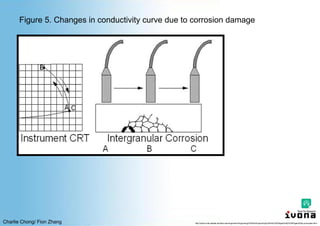
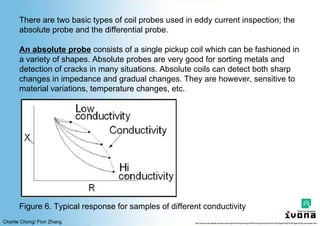
  • 97.
    Charlie Chong/ FionZhang Reading Two – More on Eddyfi Phase Array ECT Technology
  • 98.
    Charlie Chong/ FionZhang Rising to the Ferromagnetic Electromagnetic Testing Challenge We all rely on carbon steel (CS) welds in our daily lives, whether they are on the structures we use to commute, on the pipelines that carry the fuel we use in our cars, or on the wind turbines that generate the electricity we use to prepare meals. I think we can agree that we like our CS welds strong and secure. Hence the need to inspect them for defects thoroughly and effectively. Carbon Steel Welds are Everywhere Why is that? CS is easy to weld, doesn’t cost too much, and it’s extremely reliable. But. There’s always a but. CS welds are prone to cracking and are sometimes well hidden under layers of paint and coatings used in an effort to preserve assets. The crack defects in CS welds often break their surface and are usually too small for the naked eye to see. Furthermore, carbon steel is ferromagnetic. This means a high magnetic permeability and little to no penetration of eddy current. We’ve never shied away from a challenge http://www.eddyfi.com/ndt/surface-inspection/rising-ferromagnetic-electromagnetic-testing-challenge/
  • 99.
    Charlie Chong/ FionZhang CS Welds http://www.eddyfi.com/ndt/surface-inspection/rising-ferromagnetic-electromagnetic-testing-challenge/
  • 100.
    Charlie Chong/ FionZhang The Problems with Existing CS Weld Inspection Methods Conventional methods used to detect cracks in industries relying heavily on carbon steel welds include: • Penetrant testing (PT) • Magnetic particle testing (MT) • ECT pencil probes including ACFM These methods require extensive and time consuming surface preparation, the remains of which often end up released in the environment. Which adds to their high dependence on operator skills, somewhat unreliable results, inability to archive inspection data, and inherently low inspection speeds. Another method enjoying a degree of success - electromagnetic, this time - is alternating current field measurement ACFM . This method relies on mathematical models to assess cracks and estimate their depth. However, while it can do what the other techniques can’t, it’s also a slow one that needs, like ECT pencil probes, several scans to cover the entire geometry of the weld while only offering partial data. http://www.eddyfi.com/ndt/surface-inspection/rising-ferromagnetic-electromagnetic-testing-challenge/
  • 101.
    Charlie Chong/ FionZhang ECT pencil probes including ACFM http://www.eddyfi.com/ndt/surface-inspection/rising-ferromagnetic-electromagnetic-testing-challenge/
  • 102.
    Charlie Chong/ FionZhang Pushing the Limits of Electromagnetic Inspection Technologies Being so widespread, but not supported properly, CS weld inspection deserved a better inspection method. To come up with it, we were faced with very interesting technological challenges: How do we scan the entire geometry of the weld in a single pass to speed up the inspection process? How do we do so without surface preparation? How do we achieve that with reliable positioning and depth information about crack defects? A typical eddy current array (ECA) solution would seem, at first glance, ideally suited to this type of application. It isn’t, however. That’s because typical ECA pancake coil configurations yield signals from which it is difficult to extract depth information. Furthermore, the presence of liftoff introduces a “drift” of the operation point along this hook, which produces significant phase changes, making depth sizing impossible from a practical standpoint. http://www.eddyfi.com/ndt/surface-inspection/rising-ferromagnetic-electromagnetic-testing-challenge/
  • 103.
    Charlie Chong/ FionZhang Impedance Phase Diagram http://www.eddyfi.com/ndt/surface-inspection/rising-ferromagnetic-electromagnetic-testing-challenge/
  • 104.
    Charlie Chong/ FionZhang Enters TECA – Tangential Eddy Current Array Through much R&D, we came to the conclusion that using “ tangential eddy current ” was the most promising avenue towards overcoming these challenges. As mentioned above, conventionally, the axes of pancake coils are positioned perpendicular to the surface under test. With tangential eddy current, coils are on their sides, with their axes parallel to the surface and the eddy current generated by the coil flowing parallel to the surface under test, “diving”, so to speak, under it. So how could we use tangential eddy current and leverage the power of an eddy current array? A multiplexed ECA would solve the single-pass problem, as arrays cover a wider area. We analyzed several parameters, including coil size/impedance/position/configuration, the operating frequency, and the multiplexing pattern (topology), among others, to create an optimal ECA solution. We tested and characterize more than 30 coil configurations over the course of a year of R&D, coming up with what we felt is the best coil configuration to leverage the power of ECA, striking a balance between coverage, penetration, and resolution. That’s how the tangential eddy current array (TECA™ ) was born. We were able to observe that TECA generated a relatively flat liftoff signal and defects approximately 90° from the liftoff signal, something that’s not possible using other inspection techniques. The multiplexed eddy current generated by TECA can dive under cracks down to 10 mm (0.4 in). But that doesn’t take care of the geometry issue. http://www.eddyfi.com/ndt/surface-inspection/rising-ferromagnetic-electromagnetic-testing-challenge/
  • 105.
    Charlie Chong/ FionZhang A NEW EDDY CURRENT PROBE - Tangential Eddy Current Array Lift-off noise is unavoidable so long as the probe picks up the eddy current induced by exciting coil. There the authors have thought of two notions in order to design a new probe that suppresses lift-off noise and detects flaws: 1. One of the methods to eliminate lift-off noise in eddy current testing is to develop a probe picking up the component of eddy current that is generated only by flaws but not by the probe lift-off. 2. Each part of detecting coil windings picks up the parallel component of eddy current to itself. With the above two notions in mind, the authors have devised a new eddy current surface probe that is composed of a pancake exciting coil and a tangential detecting coil as shown in Figure 1. The circular exciting coil is adopted because it induces eddy current most efficiently. The exciting coil induces axi-symmetric circular eddy current in the test material with no eddy current circulating across the exciting coil circle when there is no flaw in the test material as shown in Figure 2(a). When there is a flaw crossing the circle, some eddy current circulates along the flaw crossing the circle. Since each part of the detecting coil winding picks up the parallel eddy current component to itself, the tangential detecting coil picks up only the eddy current circulating across the circle as shown in Figure 2(b)-(d). As the new probe scans over a flaw, the detecting coil generates a figure eight signal pattern. If the probe has two tangential detecting coils wound perpendicular to each other, it can detect all flaws in every orientation. The impedance of the exciting coil can also be used to monitor the probe lift-off in order to avoid the probe not detecting flaws in the material. The new probe is lift-off noise free because the lift-off of the probe from the material does not cause any eddy current to circulate crossing the exciting coil circle. Thus lift-off noise can be eliminated by detecting only the newly generated eddy current by flaws and by not detecting the eddy current induced by the exciting coil when there is no flaw in the test material. The probe is self-nulling because the detecting coil generates a signal only when a flaw causes some eddy current to circulate across the circle. Since the probe generates minimal lift-off noise, the authors have also thought that the probe lift-off does not influence much to the flaw signal and that the signal phase can be used for evaluating the depth of surface flaws. http://www.ndt.net/article/wcndt00/papers/idn037/idn037.htm
  • 106.
    Charlie Chong/ FionZhang Tangential Eddy Current Array http://www.ndt.net/article/wcndt00/papers/idn037/idn037.htm
  • 107.
    Charlie Chong/ FionZhang Scanning an Entire Weld in One Pass This was also tricky. The TECA coil design had to be used in such a way as to cover the cap, toe, and heat-affected zone of CS welds, while dynamically adjusting to the weld’s uneven geometry. The challenge lay in bundling the coils in a mechanical package that struck a balance between resolution and sizing capabilities. After much testing, we designed an ingenious system of independent, spring- loaded fingers that adapt to weld geometries. The individual wedged fingers all incorporate an array of coils, which provides great resolution even at higher scan speeds, surfing over the uneven geometry of the weld and enabling the a single-pass scans of entire welds. http://www.eddyfi.com/ndt/surface-inspection/rising-ferromagnetic-electromagnetic-testing-challenge/
  • 108.
    Charlie Chong/ FionZhang TECA coil design http://www.eddyfi.com/ndt/surface-inspection/rising-ferromagnetic-electromagnetic-testing-challenge/
  • 109.
    Charlie Chong/ FionZhang What About Liftoff? And you would be right to ask. As I mentioned above, TECA generates a virtually flat liftoff signal, with crack-like indications approximately 90° relative to this liftoff signal and all the indications featuring the same phase shift. The software processing Sharck probe data incorporates the equivalent of a three-dimensional depth-to-liftoff-to-vertical-amplitude depth plane that allows compensating for liftoff. http://www.eddyfi.com/ndt/surface-inspection/rising-ferromagnetic-electromagnetic-testing-challenge/
  • 110.
    Charlie Chong/ FionZhang TECA Liftoff Response http://www.eddyfi.com/ndt/surface-inspection/rising-ferromagnetic-electromagnetic-testing-challenge/
  • 111.
    Charlie Chong/ FionZhang http://www.eddyfi.com/ndt/surface-inspection/rising-ferromagnetic-electromagnetic-testing-challenge/
  • 112.
    Charlie Chong/ FionZhang The Final Touch Add to the design a removable high-resolution encoder and you have the final patent-pending Sharck probe capable of positioning cracks, measuring their length, and sizing them as deep as 10 mm (0.4 in), without surface preparation, at up to 200 mm/s (7.9 in/s). http://www.eddyfi.com/ndt/surface-inspection/rising-ferromagnetic-electromagnetic-testing-challenge/
  • 113.
    Charlie Chong/ FionZhang Chapter 2 REVIEW QUESTIONS
  • 114.
    Charlie Chong/ FionZhang Answers:
  • 115.
    Charlie Chong/ FionZhang 0.2-1 Differential coils are usually used in: A. bobbin coils. B. probe coils. C. OD coils. D. any of the above. 0.2·2 When using a probe coil to scan a test object, ____ _ A. the object must be dry and polished. B. the object must be scanned carefully to insure inspection coverage. C. the object must be scanned in circular motions at constant speeds. D. the probe must be moving at all times to get a reading. 0.2·3 A "spinning probe" would most likely be a (an): A. bobbin coil. B. ID coil. C. OD coil. D. probe coi I.
  • 116.
    Charlie Chong/ FionZhang 0.2·4 A "feed-through" coil is: A. a coil with primary/secondary windings connected so that the signal is fed through the primary to the secondary. B. an encircling coil. C. an OD coil. D. both B and C. 0.2-5 When inspecting a tubular product with an encircling coil, which statement is not true? A. OD discontinuities can be found. B. Axial discontinuity locations can be noted. C. Circumferential discontinuity locations can be noted. D. ID discontinuities can be found. 0.2·6 An absolute coil measurement is made ____ _ A. by comparing one spot on the test object to another. B. without reference to or direct comparison with a standard. C. only with probe coils. D. by comparative measurement to a known standard.
  • 117.
    Charlie Chong/ FionZhang Encircling Coil - Defect Detectability For long defect the self comparison differential coils’ may cancelled each other leaving no indication.
  • 118.
    Charlie Chong/ FionZhang Encircling Coil - Defect Detectability
  • 119.
    Charlie Chong/ FionZhang 0.2·7 When coils in a differential arrangement are affected simultaneously with the same test object variables, the output signal ____ _ A. is directly proportional to the number of variables. B. is "0" or near-"0." C. is indirectly proportional to the number of variables. D. is primarily a function of the exciting current. 0.2·8 Which coil type inherently has better thermal stability? A. Bobbin B. Absolute C. OD D. Differential
  • 120.
    Charlie Chong/ FionZhang Encircling Coil - Defect Detectability When coils in a differential arrangement are affected simultaneously with the same test object variables
  • 121.
    Charlie Chong/ FionZhang 0.2-9 A hybrid coil is composed of two or more coils. The coils ____ _ A. must be aligned coplanar to the driver axis: B. may be of widely different dimensions. C. must be impedance-matched as closely as possible. D. are very temperature sensitive. 0.2-10 Proper selection of test coil arrangement is determined by: A. shape of test object. B. resolution required. C. sensitivity required. D. stability. E. all of the above.
  • 122.
    Charlie Chong/ FionZhang Absolute and Differential Coils Absolute Coil Differential Receiver Coils
  • 123.
    Charlie Chong/ FionZhang 3. TEST COIL DESIGN As discussed earlier, test coil design and selection is a blend of theory and experience. Many factors must be considered. These important factors are determined by the inspection requirement for resolution, sensitivity, impedance, size, stability, and environmental considerations. In order to better understand coil properties and electrical relationships, a short refresher in alternating current theory is necessary. First, we must examine electrical units-for example, current and its representative symbol I. Current not only suggests electron flow but also the amount. The amount of electrons flowing past a point in a circuit in one second is expressed in amperes; 2 ∙1018 electrons passing a point in one second is called 1 ampere. RESISTANCE Resistance is an opposition to the flow of electrons and is measured in ohms. Ohm's Jaw is stated by the equation: I = E/R Where: I = Current in amperes R = Resistance in ohms E = Electrical potential difference in volts
  • 124.
    Charlie Chong/ FionZhang R = X l / A Resistance = Ohms Specific Resistance = Ohm / circular mill foot Area = Circular mill Length = foot Thus, the resistance of a 10-foot length of 40 gauge copper wire with a specific resistance of 10.4 circular-mil-foot at 20ºC would be found as follows: R = 10.4 x 10/ 9.88 = 10.53Ω In an alternating current circuit containing only resistance, the current and voltage are in phase. In phase means the current and voltage reach their minimum and maximum values, respectively, at the same time. The power dissipated in a resistive circuit appears in the form of heat. For example, electric toasters are equipped with resistance wires that become hot when current flows through them, providing a heat source for toasting bread.
  • 125.
    Charlie Chong/ FionZhang R = X l / A
  • 126.
    Charlie Chong/ FionZhang Inductance Heat generation is an undesirable trait for an eddy current coil. If the 10-foot length of wire used in the previous example was wound into the shape of a coil, it would exhibit characteristics of alternating current other than resistance. By forming the wire into the shape of a coil, the coil also would have the property of inductance. The role of inductance is analogous to inertia in mechanics, because inertia is the property of matter that causes a body to oppose any change in its velocity. The unit of inductance is the Henry (H). A coil is said to have the property of inductance when a change in current through the coil produces a voltage in the coil. More precisely, a circuit in which an electromotive force of one volt is induced when the current is changing at a rate of one ampere per second will have an inductance of one Henry. The inductance of a multilayer air core coil can be expressed by its physical properties, or coil parameters. Coil parameters such as length, diameter, thickness, and number of turns of wire affect the coil's inductance.
  • 127.
    Charlie Chong/ FionZhang Figure 3.1 illustrates typical coil dimensions required to calculate coil inductance. Figure 3.1- Multilayer Coil r l b
  • 128.
    Charlie Chong/ FionZhang An approximation of small, multilayer, air core coil inductance is as follows: L = 0.8(rN)2 ∙ (6r + 9l + 10b)-1 Where: L = Self-inductance in microhenries (μH) N = Total number of turns r = Mean radius in inches l = Length of coil in inches b = Coil depth or thickness in inches For example, a coil whose dimensions are as follows: r = 0.1 inches l = 0.1 inches b = 0.1 inches N = 100 turns L = 32 μH
  • 129.
    Charlie Chong/ FionZhang As stated earlier, this inductance is analogous to inertia in mechanical systems in that inductance opposes a change in current as inertia opposes a change in velocity of a body. In alternating current circuits the current is always changing; therefore inductance is always opposing this change. As the current tries to change, the inductance reacts to oppose that change. This reaction is called inductive reactance in ohm.
  • 130.
    Charlie Chong/ FionZhang The unit of inductive reactance (XL) Is in ohms. Because the amount of reactance is a function of the rate of change of current and rate of change can be described as frequency, a formula relating frequency, inductance, and inductive reactance is: XL = ωL = 2 fL where: XL = Inductive reactance in ohms f = Frequency in hertz L = Inductance in henries
  • 131.
    Charlie Chong/ FionZhang For example, using the 32 microhenry coil calculated earlier, operating at 100 kilohertz, its inductive reactance would be found as follows: XL = ωL = 2 fL XL = 2 ∙ 100 ∙ 103 ∙ 32 ∙ 10-6 XL = 20.106 ohms Therefore, this coil would present an opposition of 20 ohms to currents with a rate of change of 100 kilohertz due to its reactive component. Unlike a resistive circuit, the current and voltage of an inductive circuit do not reach their minimum and maximum values at the-same time. In a pure inductive circuit the voltage leads the current by 90 electrical degrees. This means that when the voltage reaches a maximum value, the current is at "0“
  • 132.
    Charlie Chong/ FionZhang Power is related to current and voltage as follows: P =El where: P = Power in watts E = Volts I = Current in amperes Notice that in a pure inductive circuit, when the voltage is maximum, the current is "0"; therefore, the product El = 0. Inductive reactances consume no alternating power where resistive elements consume power and dissipate power in the form of heat. The opposition to current flow due to the resistive element of the coil and the reactive element of the coil do not occur at the same time; therefore, they cannot be added as scalar quantities. A scalar quantity is one having only magnitude; i.e., it is a quantity fully described by a number, but which does not involve any concept of direction. Gallons in a tank, temperature in a room, miles per hour, for example, are all scalars.
  • 133.
    Charlie Chong/ FionZhang IMPEDANCE In order to explain the addition of reactance and resistance with a minimum of mathematical calculations we can again use the vector diagram or phasor diagram to explain this addition (19). A phasor diagram constructed with Imaginary units on the ordinate. or (Y) axis and real units on the abscissa or (X) axis is shown In Figure 3.2a. Figure 3.2-lmpedance Diagram
  • 134.
    Charlie Chong/ FionZhang Substituting Inductive reactance (XL) and resistance (R) we can find the resultant of the vector addition of XL and R. This resultant vector Z is known as impedance. Impedance is the total opposition to current flow. Further observation of Figure 3.2b reveals XL, R, and Z appear to form the sides of a right triangle. The mathematical solution of right triangles states the square of the hypotenuse is equal to the sum of the squares of the other two sldes, or c2 = a2 + b2 , substituting the Z, R & XL, the equation becomes Z2 = R2 + XL 2 Z = √(R2 + XL 2) Let's try an example. What is the impedance of a coil having an inductance of 100 microhenries and a resistance of 5 ohms and being operated at 200 kilohertz? First we must convert inductance to inductive reactance and then, by vector addition, combine inductive reactance and resistance to obtain the impedance. Z = [ 52 + (2 ∙200 ∙103 ∙100 ∙10-6)2]0.5 Z = 125.76 Ohm
  • 135.
    Charlie Chong/ FionZhang The term R + jXM is known as a rectangular notation. As an example, a resistance of 4 ohms in series with an inductive reactance of 3 ohms could be noted as Z = 4 + j3 ohms. The impedance calculation is then: Z = √(42+32) = 5 ohm In coil design it is often helpful to know also the included angle between the resistive component and impedance. A convenient method of notation is the polar form where Tan Ф = XL/R, where Ф is included angle between resistance and impedance. In the previous example our impedance magnitude is 5 ohms, but at what angle? Ф = tan-1 (3/4) = 36.9º Z = 5∠ 36.9º = |5|36.9º = 4+j3 Eddy current coils with included impedance angles of 60° to 90° usually make efficient test coils. As the angle between resistance and impedance approaches 0, the test coil becomes very inefficient with most of its energy being dissipated as heat..
  • 136.
    Charlie Chong/ FionZhang Q or FIGURE OF MERIT The term used to describe coil efficiency is Q or merit of the coil. The higher the Q or merit of a coil, the more efficiently the coil performs as an inductor. The merit of a coil is mathematically stated as: Q = XL/R Where: XL = Inductive reactance R = Resistance For example, a coil having an induct ive reactance of 100 ohms and a resistance of 5 ohms would have a Q of 20.
  • 137.
    Charlie Chong/ FionZhang PERMEABILITY AND SHIELDING EFFECTS The addition of permeable core materials in certain coil designs dramatically improves the Q factor. Permeable cores are usually constructed of high permeability "powdered iron." Probe coils, for example, are wound on a form that allows a powdered iron rod or slug to be placed in the center of the coil. lt is. common to increase the coil impedance by a factor of 10 by the addition of core materials. This increase in impedance without additional winding greatly enhances the Q of the coil. Some core materials are cylinder- or cup-shaped. A common term is cup core. The coil is wound and placed in the cup core. In the case of a probe coil in a cup core, not only is the impedance increased, but the benefit of shielding is also gained. Shielding with a cup core prevents the electromagnetic field from spreading at the sides of the coil. This greatly reduces the signals produced by edge effect of adjacent members to the test area, such as fasteners on an aircraft wing. Shielding, while improving resolution, usually sacrifices some amount of penetration into the part. Another method of shielding uses high conductivity material, such as copper or aluminum, to suppress high frequency interference from other sources and also to shape the electromagnetic field of the test coil. A copper cup would restrict the electromagnetic field in much the same manner as the "powdered iron cup core" discussed previously. A disadvantage of high conductivity, low or no permeability shielding is that the coil's impedance is reduced when the shielding material is placed around the test coil. The net effect is, of course, that the coil's Q is less than it was when the coil was surrounded by air.
  • 138.
    Charlie Chong/ FionZhang By Using Core: Ferromagnetic core  Q factor increase (increase impedance)  Shielding effect  Less penetration Non-ferromagnetic core  Q factor decrease (decrease impedance)  Shielding effect  Less penetration
  • 139.
    Charlie Chong/ FionZhang Magnetic Shielding
  • 140.
    Charlie Chong/ FionZhang Probe Shielding One of the challenges of performing an eddy current inspection is getting sufficient eddy current field strength in the region of interest within the material. Another challenge is keeping the field away from non-relevant features of the test component. The impedance change caused by non-relevant features can complicate the interpretation of the signal. Probe shielding and loading are sometimes used to limit the spread and concentrate the magnetic field of the coil. Of course, if the magnetic field is concentrated near the coil, the eddy currents will also be concentrated in this area. Probe Shielding Probe shielding is used to prevent or reduce the interaction of the probe's magnetic field with non-relevant features in close proximity of the probe. Shielding could be used to reduce edge effects when testing near dimensional transitions such as a step or an edge. Shielding could also be used to reduce the effects of conductive or magnetic fasteners in the region of testing. 1) Magnetically shielded with ferromagnetic materials Eddy current probes are most often shielded using magnetic shielding or eddy current shielding. Magnetically shielded probes have their coil surrounded by a ring of ferrite or other material with high permeability and low conductivity. The ferrite creates an area of low magnetic reluctance and the probe's magnetic field is concentrated in this area rather than spreading beyond the shielding. This concentrates the magnetic field into a tighter area around the coil. 2) Eddy current shielding with non-magnetic materials Eddy current shielding uses a ring of highly conductive but nonmagnetic material, usually copper, to surround the coil. The portion of the coil's magnetic field that cuts across the shielding will generate eddy currents in the shielding material rather than in the non-relevant features outside of the shielded area. The higher the frequency of the current used to drive the probe, the more effective the shielding will be due to the skin effect in the shielding material. 3) Probe Loading with Ferrite Cores vs. Air Cores Sometimes coils are wound around a ferrite core. Since ferrite is ferromagnetic, the magnetic flux produced by the coil prefers to travel through the ferrite as opposed to the air. Therefore, the ferrite core concentrates the magnetic field near the center of the probe. This, in turn, concentrates the eddy currents near the center of the probe. Probes with ferrite cores tend to be more sensitive than air core probes and less affected by probe wobble and lift-off. https://www.nde-ed.org/EducationResources/CommunityCollege/EddyCurrents/ProbesCoilDesign/ProbesShielding.htm
  • 141.
    Charlie Chong/ FionZhang Probe Shielding Probe Loading with Ferrite Cores vs. Air Cores Sometimes coils are wound around a ferrite core. Since ferrite is ferromagnetic, the magnetic flux produced by the coil prefers to travel through the ferrite as opposed to the air. Therefore, the ferrite core concentrates the magnetic field near the center of the probe. This, in turn, concentrates the eddy currents near the center of the probe. Probes with ferrite cores tend to be more sensitive than air core probes and less affected by probe wobble and lift-off. Magnetically shielded with ferromagnetic materials or non ferromagnetic materials
  • 142.
    Charlie Chong/ FionZhang Another coil design used for inspection of ferromagnetic materials uses a saturation approach. A predominant variable that prevents eddy current penetration in ferromagnetic material is called permeability. Permeability effects exhibited by the test object can be reduced by means of magnetic saturation. Saturation coils for steels are usually very large and surround the test object and test coil. A steady state current is applied to the saturation coil. When the steel test object is magnetically saturated it may be inspected in the same manner as a non-ferromagnetic material. In the case of mild steel many thousands of gauss are required to produce saturation. In such other materials as nickel alloys (monel and inconel), the saturation required is much less and can usually be accomplished by incorporating permanent magnets adjacent to the test coil.
  • 143.
    Charlie Chong/ FionZhang More Reading on Shielded and Unshielded Probes Probes are normally available in both shielded and unshielded versions; however, there is an increasing demand for the shielded variety. Shielding restricts the magnetic field produced by the coils to the physical size of the probe. A shield can be made of various materials, but the most common are: ferrite (like a ceramic made of iron oxides), Mumetal, and mild steel. Ferrite make the best shielding because they provide an easy path for the magnetic field but has poor conductivity. This means that there is little eddy current loss in the shield itself (?) . Mild steel has more losses but is widely used for spot probes and ring probes due to its ease of machining when ferrite is not available in certain sizes or shapes. Mumetal is sometimes for pencil probes as it is available in thin sheet; however, it is less effective than ferrite. Shielding has several advantages: first, it allows the probe to be used near geometry changes, such as edges, without giving false indications; next, it allows the probe to touch ferrous fastener heads with minimal interference; last, it allows the detection of smaller defects due to the stronger magnetic field concentrated in a smaller area. On the other hand, unshielded probes allow somewhat deeper penetration due to the larger magnetic field. They are also slightly more tolerant to lift-off. Unshielded probes are recommended for the inspection of ferrous materials (steel) for surface cracks, and in particular with meter instruments. The reason for this is that the meter response is too slow to allow the signal from a shielded probe to be displayed at normal scanning speeds due to the smaller sensitive area. http://www.olympus-ims.com/en/ec-probes/selection/
  • 144.
    Charlie Chong/ FionZhang Discussion: Subject: Ferrite make the best shielding because they provide an easy path for the magnetic field but has poor conductivity. This means that there is little eddy current loss in the shield itself (?) . Mild steel has more losses but is widely used for spot probes and ring probes due to its ease of machining when ferrite is not available in certain sizes or shapes. Mumetal is sometimes for pencil probes as it is available in thin sheet; however, it is less effective than ferrite.
  • 145.
    Charlie Chong/ FionZhang COIL FIXTURES Coil fixtures or holders may be as varied as the imagination of the designers and users. After the size, shape, and style have been decided upon, the next consideration should be the test environment. Characteristics of wear, temperature, atmosphere, mechanical stress, and stability must be considered. Normally wear can be reduced by selection of wear-resistant plastic compounds, or where severe wear is expected, artificial or genuine jewels may be used. Less expensive and very effective wear materials,.such as aluminum oxide or ceramics, are more commonly used. Temperature stability may be accomplished by using coil holder material with poor heat transfer characteristics. Metals have high heat transfer characteristics, and often coils made with metal holders are sensitive to temperature variations caused by human touch. For high temperature applications, materials must be chosen carefully. Most common commercial copper coil wire may be used up to 150 ~ 200°C. For temperatures above 200°C, silver or aluminum wire with ceramic or high temperature silicone insulation must be used.
  • 146.
    Charlie Chong/ FionZhang The Jewels
  • 147.
    Charlie Chong/ FionZhang Materials must be chemically compatible with the test object. As extreme examples, a polystyrene coil form would not be used to inspect an acetone cooler, or a lead or graphite housing allowed to come in contact with an inconel jet engine tail cone producing service-related stress cracks. Mechanical and electrical stability of the test coil can be enhanced by an application of epoxy resin between each layer of coil winding. This accomplishes many objectives: (1) it seals the coil to exclude moisture; (2) it provides additional electrical insulation; and (3) it provides mechanical stability. Characteristics listed are not in order of importance. The importance of each characteristic is determined by specific test requirements.
  • 148.
    Charlie Chong/ FionZhang Eddy Current Phasol Diagram
  • 149.
    Charlie Chong/ FionZhang Chapter 3 REVIEW QUESTIONS
  • 150.
    Charlie Chong/ FionZhang Answers:
  • 151.
    Charlie Chong/ FionZhang 0.3-1 A coil's resistance is determined by: A. wire material. B. wire length. C. wire cross-sectional area. D. all of the above. 0.3-2 Inductance is analogous to: A. force. B. volume. C. inertia. D. velocity. 0.3-3 The unit of inductance is the: A. henry. B. maxwell. C. ohm. D. farad.
  • 152.
    Charlie Chong/ FionZhang 0.3·4 The inductance of a multilayer air core coil with the dimensions l =0.2, r =0.5, b=0.1, and N=20, is: A. 1.38 henries. B. 13.8 microhenries. C. 13.8 ohms. D. 1.38 ohms. 0.3-5 The inductive reactance of the coil in Q.3-4, operating at 400 kHz, would be: A. 1380 ohms. B. 5520 ohms. C. 34.66 ohms. D. 3466 ohms. 0.3-6 The impedance of a 100 microhenry coil with a resistance of 20 ohms operating at 100 kHz would be: A. 62.8 ohms. XL = 2πfL = 62.83Ω, R=20Ω B. 4343.8 ohms. Z= √(XL2 + R2) C. 628 ohms. D. 65.9 ohms. given that L = 0.8(rN)2 ∙ (6r + 9l + 10b)-1 in μH
  • 153.
    Charlie Chong/ FionZhang 0.3-7 The Q or merit of a coil is the ratio of: A. Z/XL B. XL/Z C. XL/R D. R/XL 0 .3-8 The incorporation of magnetic shielding: A. improves resolution. B. decreases field extension. C. increases impedance.(?) D. does all of the above. (for ferromagnetic material shield materials only) 0.3-9 The purpose of a steady-state 稳态的 winding incorporated in a test coil is to: A. reduce permeability effects. B. provide magnetic saturation. C. provide a balance source for the sensing coil. D. both A and B.
  • 154.
    Charlie Chong/ FionZhang 0.3·10 The most important consideration when selecting a test coil is: A. sensitivity. B. resolution. C. stability. D. test requirement and compatibility.
  • 155.
    Charlie Chong/ FionZhang 4. EFFECTS OF TEST OBJECT ON TEST COIL As we have seen, the eddy current technique depends on the generation of induced currents within the test object. Perturbations or disturbances in these small induced currents affect the test coil. The result is variance of test coil impedance due to test object variables. These are called operating variables (19). Some of the operating variables are coil impedance, electrical conductivity, magnetic permeability, skin effect, lift-off, fill factor, end effect, edge effect, and signal-to-noise ratio. Coil impedance was discussed at length in the previous Section. In this Section coil impedance changes will be represented graphically to more effectively explain the interaction of other operating variables.
  • 156.
    Charlie Chong/ FionZhang ELECTRICAL CONDUCTIVITY In electron theory the atom consists of a positive nucleus surrounded by orbiting negative electrons. Materials that allow these electrons to be easily moved out of orbit around the nucleus are classified as conductors. In conductors electrons are moved by applying an outside electrical force. The ease with which the electrons are made to move through the conductor is called conductafce. A unit of conductance is the mho: The mho is the reciprocal of the ohm, or conductance G = 1/R, where G is conductance in mhos and R is resistance in ohms. In eddy current testing, instead of describing conductance in absolute terms, an arbitrary unit has been assigned. Since the relative conductivity of metals and alloys varies over a wide range, the need for a conductivity benchmark is of prime importance. The international electrochemical Commission established in 1913 aconvenient method of comparing of material to another. The commission established that a specified grade of high purity copper and uniform section of 1 mm2 measuring 0.017241 ohms at 20°C would be arbitrarily considered 100 percent conductive. The symbol for conductivity is Ω (sigma) and the unit is % IACS or percent of the International Annealed Conductivity Standard.
  • 157.
    Charlie Chong/ FionZhang Table 4.1 lists materials by conductivity and resistivity. A statement can be made about a conductor in terms of conductance or resistance. Note that a good conductor is a poor resistor. Conductance and resistance are direct reciprocals as stated earlier. Conductivity and resistivity, however, have different origins and units; therefore, the conversion is not so direct. As previously discussed, conductivity is expressed on an arbitrary scale in % IACS. Resistivity is expressed in absolute terms of micro ohm-centimeter. To convert to either unit, simply follow the equation: Conductivity %IACS = 172.41 / in micro-ohm-cm
  • 158.
    Charlie Chong/ FionZhang As the test coil is influenced by different conductivities, its impedance varies inversely to conductivity. A higher conductivity causes the test coil to have a lower impedance value. Figure 4.1 illustrates this concept. The coil's inductive reactance is represented by the Y axis and coil resistance appears on the X axis. The 0 percent conductivity point, or air point, is when the coil's empty reactance (XLo) is maximum. Figure 4.1 represents a measured conductivity locus (4). Conductivity is influenced by many factors. Table 4.1 lists conductivities of materials with different chemical compositions. Figure 4.1 - Measured Conductivity Locus
  • 159.
    Charlie Chong/ FionZhang Table 4.1- Eiectrical Resistivity and Conductivity of Several Common Metals and Alloys (ASM Committee on Eddy Current Inspection, "Eddy-Current Inspection," Metals Handbook, Vol. 11, 8th Ed.
  • 160.
    Charlie Chong/ FionZhang Some other factors affecting conductivity are temperature, heat treatment, grain size, hardness, and residual stresses. A change in the temperature of the test object will change the electrical conductivity of that object. In metals, as the temperature is increased, the conductivity is decreased. Carbons and carbon compounds have negative temperature coefficients; therefore, their conductivity increases as temperature is increased. Heat treatment also affects electrical conductivity by redistributing elements in the material. Dependent upon materials and degree of heat treatment, conductivity can either increase or decrease as a result of heat treatment. Stresses in a material due to cold working produces lattice distortion or dislocation. This mechanical process changes the grain structure and hardness of the material, changing its electrical conductivity. Hardness in "age hardenable" aluminum alloys changes the electrical conductivity of the alloy. The electrical conductivity decreases as hardness increases. As an example, a Brinell hardness of 60 is represented by a conductivity of 23, and a Brinell hardness of 100 of the same alloy would have a conductivity of 19.
  • 161.
    Charlie Chong/ FionZhang Impedance Plane Response for Conductivity As the test coil is influenced by different conductivities, its impedance varies inversely to conductivity. A higher conductivity causes the test coil to have a lower impedance value.
  • 162.
    Charlie Chong/ FionZhang Impedance Plane Response for Conductivity http://www.cnde.iastate.edu/faa-casr/engineers/Supporting%20Info/Supporting%20Info%20Pages/Eddy%20Pages/Eddy-principles.html
  • 163.
    Charlie Chong/ FionZhang More Reading on the Impedance Plane Eddy current testing is used to find surface and near surface defects in conductive materials. It is used by the aviation industry for detection of defects such as cracks, corrosion damage, thickness verification, and for materials characterization such as metal sorting and heat treatment verification. Applications range from fuselage and structural inspection, engines, landing gear, and wheels. Eddy current inspection involves initial setup and calibration procedures with known reference standards of the same material as the part. Probes of appropriate design and frequency must be used. Eddy current inspection is based on the principle of electromagnetic induction. An electric coil in which an alternating current is flowing is placed adjacent to the part. Since the method is based on induction of electromagnetic fields, electrical contact is not required. http://www.cnde.iastate.edu/faa-casr/engineers/Supporting%20Info/Supporting%20Info%20Pages/Eddy%20Pages/Eddy-principles.html
  • 164.
    Charlie Chong/ FionZhang Figure 1. Schematic of Eddy Current absolute probe http://www.cnde.iastate.edu/faa-casr/engineers/Supporting%20Info/Supporting%20Info%20Pages/Eddy%20Pages/Eddy-principles.html
  • 165.
    Charlie Chong/ FionZhang An alternating current flowing through the coil produces a primary magnetic field that induces eddy currents in the part. Energy is needed to generate the eddy currents, and this energy shows up as resistance losses in the coil. Typical NDE application are designed to measure these resistance losses. Eddy currents flow within closed loops in the part. Figure 2. Diagram illustrating Eddy Currents created in a part. http://www.cnde.iastate.edu/faa-casr/engineers/Supporting%20Info/Supporting%20Info%20Pages/Eddy%20Pages/Eddy-principles.html
  • 166.
    Charlie Chong/ FionZhang As a result of eddy currents, a second magnetic field is generated in the material. The magnetic fields of the core interact with those in the part and changes in the material being inspected affect the interaction of the magnetic fields. The interaction, in turn, affects the electrical characteristics of the coil. Resistance and inductive reactance add up to the total impedance of the coil. Changes in the electrical impedance of the coil are measured by commercial eddy current instruments. So, what does all of this have to do with nondestructive testing? The main method used in eddy current inspection is one in which the response of the sensor depends on conductivity and permeability of the test material and the frequency selected. http://www.cnde.iastate.edu/faa-casr/engineers/Supporting%20Info/Supporting%20Info%20Pages/Eddy%20Pages/Eddy-principles.html
  • 167.
    Charlie Chong/ FionZhang How eddy currents are created and sensed:  An alternating current creates a magnetic field (Oersted's Law).  The magnetic field causes a resulting eddy current in a part, which creates an induced magnetic field (Faraday's Law).  The magnetic field from the coil is opposed to the induced magnetic field from the eddy current.  A defect (surface or near surface) modifies the eddy current and therefore the magnetic field as well.  This change in the magnetic field is detected by a sensor and is indicative of a flaw. http://www.cnde.iastate.edu/faa-casr/engineers/Supporting%20Info/Supporting%20Info%20Pages/Eddy%20Pages/Eddy-principles.html
  • 168.
    Charlie Chong/ FionZhang How far do the eddy currents penetrate into a test piece? The strength of the response from a flaw is greatest at the surface of the material being tested, and decreases with depth into the material. The "Standard depth of penetration" is mathematically defined as the point when the eddy current is 1/e or 37% of its surface value. The "effective depth of penetration" is defined as three times the standard depth of penetration, where the eddy current has fallen to about 3% of its surface value. At this depth there is no effective impact on the eddy current and a valid inspection is not feasible. Penetration depth will: - Decrease with an increase in conductivity - Decrease with an increase in permeability - Decrease with an increase in frequency Conductivity is sensitive to cracks and material in-homogeneities - Cracks - Defects - Voids - Scattering of electrons Magnetic permeability is much more sensitive to structural changes in magnetic materials - Dislocations - Residual stress - Second phases - Precipitates http://www.cnde.iastate.edu/faa-casr/engineers/Supporting%20Info/Supporting%20Info%20Pages/Eddy%20Pages/Eddy-principles.html
  • 169.
    Charlie Chong/ FionZhang Frequency selection will greatly affect eddy current response. Selection of the proper frequency is the essential test factor under the control of the test operator. The frequency selected affects not only the strength of the response from flaws and the effective depth of penetration, but also the phase relationship. How do we measure eddy current response? Eddy current response is viewed on an oscilloscope display, showing the impedance response (Z) from the test material, which is affected by factors depending on the specimen and experimental conditions. Specimen conditions affecting response: - Electrical conductivity - Magnetic permeability (unmagnetized ferromagnetic materials can become magnetized, resulting in large changes in impedance) - Specimen thickness - thickness should be limited to less then three times the standard depth of penetration Experimental conditions affecting response - AC frequency - Electromagnetic coupling between the coil and the specimen (a small liftoff has a pronounced effect) - Inspection coil size - Number of turns within the coil itself - Coil type http://www.cnde.iastate.edu/faa-casr/engineers/Supporting%20Info/Supporting%20Info%20Pages/Eddy%20Pages/Eddy-principles.html
  • 170.
    Charlie Chong/ FionZhang On an impedance plane diagram the signal of the resistance (R) component is displayed on the X axis and the inductive reactance (XL) component is displayed on the Y axis. Figure 3. Electrical Conductivity changes for typical materials. http://www.cnde.iastate.edu/faa-casr/engineers/Supporting%20Info/Supporting%20Info%20Pages/Eddy%20Pages/Eddy-principles.html
  • 171.
    Charlie Chong/ FionZhang Thickness changes in a sample can change the impedance response on an oscilloscope. Defects such as corrosion are found in this fashion. Figure 4. Changes in conductivity curve due to thinning of a part http://www.cnde.iastate.edu/faa-casr/engineers/Supporting%20Info/Supporting%20Info%20Pages/Eddy%20Pages/Eddy-principles.html
  • 172.
    Charlie Chong/ FionZhang Figure 5. Changes in conductivity curve due to corrosion damage http://www.cnde.iastate.edu/faa-casr/engineers/Supporting%20Info/Supporting%20Info%20Pages/Eddy%20Pages/Eddy-principles.html
  • 173.
    Charlie Chong/ FionZhang There are two basic types of coil probes used in eddy current inspection; the absolute probe and the differential probe. An absolute probe consists of a single pickup coil which can be fashioned in a variety of shapes. Absolute probes are very good for sorting metals and detection of cracks in many situations. Absolute coils can detect both sharp changes in impedance and gradual changes. They are however, sensitive to material variations, temperature changes, etc. Figure 6. Typical response for samples of different conductivity http://www.cnde.iastate.edu/faa-casr/engineers/Supporting%20Info/Supporting%20Info%20Pages/Eddy%20Pages/Eddy-principles.html
  • 174.
    Charlie Chong/ FionZhang A differential probe consists of two coils sensing different areas of the material being tested, which are linked electrically in opposition. The circuit will become unbalanced when one of the coils encounters a change in impedance. The response to this change in impedance creates what is known as a Lissajous figure. In general, the closer the element spacing the wider the "loop" in the signal. Differential probes are relatively unaffected by lift-off as long as the elements are balanced, and are suited for detection of small defects. The differential probe's nature allows for greater resolution of sharp discontinuities, however it makes it less likely to distinguish gradual changes in material. Figure 7. Diagram of response of a differential probe over a defect http://www.cnde.iastate.edu/faa-casr/engineers/Supporting%20Info/Supporting%20Info%20Pages/Eddy%20Pages/Eddy-principles.html
  • 175.
    Charlie Chong/ FionZhang Lissajous figure http://www.cnde.iastate.edu/faa-casr/engineers/Supporting%20Info/Supporting%20Info%20Pages/Eddy%20Pages/Eddy-principles.html
  • 176.
    Charlie Chong/ FionZhang Lift Off Lift-off from paint, coatings, etc. can cause variations that may mask the defects of interest. Lift-off may also be useful in determining the thickness of nonconductive coatings on a conductive component Figure 8. Response of a probe due to lift off http://www.cnde.iastate.edu/faa-casr/engineers/Supporting%20Info/Supporting%20Info%20Pages/Eddy%20Pages/Eddy-principles.html
  • 177.
    Charlie Chong/ FionZhang PERMEABILITY Permeability of any material is a measure of the ease with which its atoms can be aligned, or the ease with which it can establish lines of force. Materials are rated on a comparative basis. Air is assigned a permeability of 1. A basic determination of permeability, μ (pronounced "mu"), is: μr = Number of Lines Produced with material as a core Number of Lines Produced with air as a core Ferromagnetic metals and alloys including nickel, iron, and cobalt tend to concentrate magnetic flux li- nes. Ferromagnetic material or sintered ionic compounds are also useful in concentrating magnetic flux. Magnetic permeability is not constant tor a given material. The permeability depends more upon the magnetic field acting upon it. As an example, consider a magnetic steel bar placed in an encircling coil. As the coil current is increased, the magnetic field of the coil will increase. The magnetic flux within the steel will increase rapidly at first, and then will tend to level off as the steel approaches magnetic saturation. This phenomenon is called the Barkhausen effect (?). When increases in the magnetizing force produce little or no change on the flux within the steel bar, the bar is magnetically saturated. When ferromagnetic materials are saturated, permeability becomes constant. With magnetic permeability constant, ferromagnetic materials may be inspected using the eddy current method. Without magnetic saturation, ferromagnetic materials exhibit such a wide range of permeability variation that signals produced by discontinuities or conductivity variations are masked by the permeability signal. Permeability effects are most predominant at lower frequencies. Other magnetic effects include diamagnetic and paramagnetic.
  • 178.
    Charlie Chong/ FionZhang SKIN EFFECT Electromagnetic tests in many applications are most sensitive to test object variables nearest the test coil due to skin effect. Skin effect is a result of mutual interaction of eddy currents, operating frequency, test object conductivity, and permeability. The skin effect, the concentration of eddy currents in the test object nearest the test coil, becomes more evident as test frequency, test object conductivity, and permeability are increased (4). For current density or eddy current distribution inthe test object, refer to Figure 1.9 in Section 1.
  • 179.
    Charlie Chong/ FionZhang EDGE EFFECT The electromagnetic field produced by an excited test coil extends in all directions from the coil. As test object geometrical boundaries are approached by the test coil, they are sensed by the coil prior to the coil's arrival at the boundary. The coil's field precedes the coil by some distance (2) determined by coil parameters, operating frequency, and test object characteristics. As the coil approaches the edge of a test object, eddy currents become distorted by the edge signal. This is known as edge effect. Response to the edges of test objects can be reduced by the incorporation of magnetic shields around the test coil or by reducing the test coil diameter. Edge effect is a term most applicable to the inspection of sheets or plates with a probe coil. END EFFECT End effect follows the same logic as edge effect. End effect is the signal observed when the end of a product approaches the test coil. Response to end effect can be reduced by coil shielding or reducing coil length in OD encircling or ID bobbin coils. End effect is a term most applicable to the inspection of bar or tubular products.
  • 180.
    Charlie Chong/ FionZhang LIFT-OFF Electromagnetic coupling between test coil and test object is of prime importance when conducting an eddy current examination. The coupling between test coil and test object varies with spacing between the test coil and test object. This spacing is called lift-off. The effect on the coil impedance is called I ift-off effect. NOTE: Absolute coil – more sensitive to lift off. Differential coil – lift off is compensated, thus less sensitive to lift off. Differential external reference – sensitive to lift off as it is not compensated. http://www.ndt.net/apcndt2001/papers/224/224.htm
  • 181.
    Charlie Chong/ FionZhang Figure 4.2 - Lift-off Conductivity Relationship
  • 182.
    Charlie Chong/ FionZhang Figure 4.2 shows the relationship between air, conductive materials, and lift- off. The electromagnetic field, as previously discussed, is strongest near the coil and dissipates with distance from the coil. This fact causes a pronounced lift-off effect for small variations in coil-to-object spacing. As an example, a spacing change from contact to 0.001 in. will produce a lift-off effect many times greater than a spacing change of 0.010 in. to 0.011 in.. Lift-off effect is generally an undesired effect causing increased noise and reduced coupling resulting in poor measuring ability. In some instances, equipment having phase discrimination capability can readily separate lift-off from conductivity or other variables. Lift-off can be used to advantage when measuring nonconductive coatings on conductive bases. A nonconductive coating such as paint or plastic causes a space between the coil and conducting base, allowing lift-off to represent the coating thickness. Lift-oft is also useful in profilometry and proximity applications. Lift-oft is a term most applicable to testing objects with a surface or probe coil.
  • 183.
    Charlie Chong/ FionZhang Discussion Topic: Figure 4.2 shows the relationship between air, conductive materials, and lift-off. The electromagnetic field, as previously discussed, is strongest near the coil and dissipates with distance from the coil. This fact causes a pronounced lift-off effect for small variations in coil-to-object spacing. As an example, a spacing change from contact to 0.001 in. will produce a lift-off effect many times greater than a spacing change of 0.010 in. to 0.011 in..
  • 184.
    Charlie Chong/ FionZhang Fill factor Fill factor is a term used to describe how well a test object will be electromagnetically coupled to a test coil that surrounds or is inserted into the test object. Fill factor then pertains to inspections using bobbin or encircling coils. Like lift-off, electromagnetic coupling between test coil and test object is most efficient when the coil is nearest the surface of the part. Fill factor canbe described as the ratio of test object diameter to coil diameter squared. The diameters squared is a simplified equation resulting in the division of effective coil and part areas. The area of a circle (A) is determined using the equation: A1 = d2/4, A2= D2/4 where A1, A2 are the sample’s and coil’s area. /4 appears in both numerator and denominator of the fractional equation; therefore; /4 cancels, leaving the ratio of diameters squared d2/D2 = η (eta) = fill factor
  • 185.
    Charlie Chong/ FionZhang Fil I factor will always be a number less than 1, and efficient fill factors approach 1. A fill factor of 0.99 is more desirable than a fill factor of 0.75. The effect of fill factor on the test system is that poor fill factors do not allow the coil to be sufficiently loaded by the test object. This is analogous to the effect of drawing a bow only slightly and releasing an arrow. The result is, with thebow slightly drawn and released, little effect is produced to propel the arrow. In electrical terms, we say the coil is loaded by the test object. How much the coil is loaded by thetest object due to fill factor can be calculated in relative terms. A test system with constant current capabilities being affected by a conductive nonmagnetic bar placed into an encircling coil can be used to demonstrate this effect.
  • 186.
    Charlie Chong/ FionZhang Discussion Topic: Comments on the illustration. η>1?
  • 187.
    Charlie Chong/ FionZhang Electromagnetic Testing with Bobbin Coil Expert at Works http://www.concosystems.com/sites/default/files/userfiles/files/techical-papers/energy-tech-magazine-ndt-testing-article-jk.pdf
  • 188.
    Charlie Chong/ FionZhang For this example, the system parameters are as follows: (a) Unloaded coil voltage equals 10 volts, (b) Test object effective permeability (5) equals 0.3. (c) Test coil inside diameter equals 1 inch. (d) Test object outside diameter equals 0.9 inches. Fill Factor η = 0.81 An equation demonstrating coil loading is given by: E = E0(1- η + ημeff) When the nonmagnetic test object is inserted into the test coil with μeff=0.3, the coil's voltage will decrease. E = 10 (1-0.81 + 0.81 • 0.3) E = 10 (0.19 + 0.243) E = 1 0 (0.433) E = 4.3 volts where: E0 = Coil voltage with coil affected by air E = Coil voltage with coil affected by test object η = Fill factor μeff = Effective permeability This allows 10 - 4.3 or 5.7 volts available to respond to test object changes caused by discontinuities or decreases in effective conductivity of the test object. it is suggested that the reader calculate the resultant loaded voltage developed by a 0.5 inch bar of the same material and observe the relativesensitivity difference.
  • 189.
    Charlie Chong/ FionZhang DISCONTINUITIES Any discontinuity that appreciably changes the normal eddy current flow can be detected. Discontinuities, such as cracks, pits, gouges, vibrational damage, and corrosion, generally cause the effective conductivity of the test object to be reduced. Discontinuities open to the surface are more easily detected than subsurface discontinuities. Discontinuities open to the surface can be detected with a wide range of frequencies; subsurface investigations require a more careful frequency selection. Discontinuity detection at depths greater than 0.5 inch in stainless steel is very difficult. This is in part due to the sparse distribution of magnetic flux lines at the low frequency required for such deep.penetrations. Figure 1.9 (p. 6) is again useful to illustrate discontinuity response due to current distribution. As an example, consider testing a non-ferromagnetic tube at a frequency that establishes a standard depth of penetration at the midpoint of the tube wall. This condition would allow a relative current density of approximately 20 percent on the far surface of the tube. With this condition, identical near and far surface discontinuities would have greatly different responses. Due to current magnitude alone, the near surface discontinuity response would be nearly 5 times that of the far surface discontinuity. Discontinuity orientation has a dramatic effect on response. As seen earlier, discontinuity response is maximum when eddy currents and discontinuities are at 90º, or perpendicular. Discontinuities parallel to the eddy current flow produce little or no response. The easiest method to insure detectability of discontinuitles is to use a reference standard or model that provides a consistent means of adjusting instrumentation.
  • 190.
    Charlie Chong/ FionZhang SIGNAL-TO-NOISE RATIO Signal-to-noise ratio Is the ratio of signals of interest to unwanted signals. Common noise sources are test object variations of surface roughness, geometry, and homogeneity. Other electrical noises can be due to such external sources as welding machines, electric motors and generators. Mechanical vibrations can increase test system noise by physical movement of test coil or test object. In other words, anything that interferes with a test system's ability to define a measurement is considered noise. Signal-to-noise ratios can be improved by several methods. If a part is dirty or scaly; signal- o-noise ratio can be lmproverl tly cleaning the part. Electrical interference can be shielded or isolated. Phase discrimination and filtering can improve signal- to-noise ratio. lt is common practice in nondestructive testing to require a minimum signal-to-noise ratio of 3: to 1. This means a signal of interest must have a response at least three times that of the noise at that point.
  • 191.
    Charlie Chong/ FionZhang Chapter 4 REVIEW QUESTIONS
  • 192.
    Charlie Chong/ FionZhang Answers:
  • 193.
    Charlie Chong/ FionZhang Q.4·1 Materials that hold their electrons loosely are classified as: A. resistors. B. conductors. C. semiconductors. D. insulators. Q.4·2 100% IACS is based on a specified copper bar having a resistance of: A. 0.01 ohms. B. 100 ohms. C. 0.017241 ohms. D. 172.41 ohms. Q.4·3 A resistivity of 13 micro ohm-cm is equivalent to a conductivity in % lACS of A. 11.032 B. 0.0625 C. 16.52 D. 13.26
  • 194.
    Charlie Chong/ FionZhang Q.4·4 A prime factor affecting conductivity is: A. temperature. B. hardness. C. heat treatment. D. all of the above. Q.4·5 Materials that tend to concentrate magnetic flux lines are ____ _ A. conductive B. permeable C. resistive D. inductive Q.4·6 Diamagnetic materials have ____ _ A. a permeability greater than air B. a permeability less than air C. a permeability greater than ferromagnetic materials D. no permeability
  • 195.
    Charlie Chong/ FionZhang 0.4·7 When an increase in field intensity produces little or no additional flux in a magnetic test object, the object is considered: A. stabilized. B. balanced. C. saturated. D. at magnetic threshold. 0.4·8 Edge effect can be reduced by: A. shielding. B. selecting a lower frequency. C. using a smaller coil. D. both A and C. 0.4·9 Lift-off signals produced by a 0-10 mil spacing change are approximately _____ times greater than a 80-90 mil spacing change. A. 10 B. 2 C. 5 D. 100
  • 196.
    Charlie Chong/ FionZhang 0.4-10 Calculate the effect of fill factor when a conducting bar 0.5 inches in diameter with an effective permeability of 0.4 is placed into a 1-inch diameter coil with an unloaded voltage of 10 volts. The loaded voltage is ____ _ A. 2 volts B. 4.6 volts C. 8.5 volts D. 3.2 volts 0.4·11 Laminations are easily detected with the eddy current (probe coil) method. A. True B. False 0.4-12 Temperature changes, vibration, and environmental effects are test coil inputs that generate: A. unwanted signals. B. magnetic fields. C. eddy currents. D. drift. E = E0(1- η + ημeff) η = 0.25 E = 10(1-.25+.25x0.4) = 8.5V
  • 197.
    Charlie Chong/ FionZhang 5. SELECTION OF TEST PARAMETERS As NDT engineers and technicians, it is our responsibility to industry to provide and perform nondestructive examinations that in some way assure the quality or usefulness of industry products. In order to apply a nondestructive test, it is essential that we understand the parameters affecting the test. Usually, industry establishes a product or component and then seeks a method to inspect it.This practice establishes test object geometry, conductivity, and permeability prior to the application of the eddy current examination. Instrumentation, test coil, and test frequency selection become the tools used to solve the problem of inspection. Test coils were discussed previously, and instrumentation will be discussed later in this text. Test frequencies and their selection will be examined in detail in this Section.
  • 198.
    Charlie Chong/ FionZhang Frequency Selection In Section 1, we observed that eddy currents are exponentially reduced as they penetrate the test object. We also observed a time or phase difference in these currents. The currents near the test coil happen first, or lead the current that is deeper in the object. A high current density allows good delectability, and a wide phase difference between near and far surfaces allows good resolution. http://www.eng.morgan.edu/~hubert/IEGR470/eddycurrent.html
  • 199.
    Charlie Chong/ FionZhang Standard Depth δ http://www.suragus.com/en/company/eddy-current-testing-technology
  • 200.
    Charlie Chong/ FionZhang Single Frequency System unfortunately, if a low frequency is selected to provide good penetration and detectability, the phase difference between near and far surface is reduced. Selection of frequency often becomes a compromise. lt is common practice in in-service inspection of thin wall, non-ferromagnetic tubing to establish a standard depth of penetration δ just past the mid-point of the tube wall. This permits about 25 percent of the available eddy current to flow at the outside surface of the tube wall. In addition, this establishes a phase difference of approximately 150 to 170 degrees between the inside and outside surface of the tube wall. The combination of 25 percent outside, or surface current, and 170 degrees included phase angle provides good detectability and resolution for thin wall tube inspection. The depth of penetration formula discussed in Section 1, although correct, has rather cumbersome units. Conductivity is usually expressed in percent of the "International Annealed Copper Standard“ (% IACS). Resistivity is usually expressed in terms of micro-ohm-centimeter (μΩcm). Depths of penetration are normally much less than 0.5 inch.
  • 201.
    Charlie Chong/ FionZhang A formula using these units may be more appropriate and easier to use. A depth of penetration formula using resistivity, frequency, and permeability can be expressed as follows: δ = √(2/ ωσμ) = √2 / √(ωσμ) = √2 / √(2 fσμ) = √1/( fσμ) = ( fσμ) -½ For non-magnetic conductor μr ≈ 1 δ = K ( /f)½ (given that μ = μr x μ0 = 4 ∙10-7Hm-1 and = 1/σ) For magnetic conductor μr ≠ 1 δ = K ( /fμr)½ where: δ = Depth of penetration in inches K = Constant = 1.98 Q = Resistivity in μΩcm f = Frequency in hertz μrel or μr = 1 for non-ferromagnetic conductors
  • 202.
    Charlie Chong/ FionZhang As technicians and engineers, our prime variable is frequency. By adjusting frequency we can be selectively responsive to test object variables. Solving the non-ferromagnetic depth of penetration formula for frequency requires a simple algebraic manipulation as follows: δ = K ( /f)½ δ2/K2 = ( /f), f = K2 / δ2
  • 203.
    Charlie Chong/ FionZhang for English system f =1.982 / δ2 f in Hertz. for a given standard penetration δ in micro-ohm-cm. δ in inches. As an example of how this may be used consider inspecting an aluminum plate 0.3 inch thick, fastened to a steel plate at the far surface. Effects of the steel part are undesirable and require discrimination or elimination. The aluminum plate has a resistivity of 5 micro-ohm-cm. By establishing a depth of penetration at 0.1 inch, the far surface current will be less than 10 percent of the available current, thus reducing response to the steel part. The frequency required for this can be calculated by applying: f = 1960Hz.
  • 204.
    Charlie Chong/ FionZhang If detection of the presence of the steel part was required, the depth of penetration could be reestablished at 0.3 inch in the aluminum plate, and a new frequency could be calculated: f = 218Hz δ= 0.3 in. steel part aluminum plate Area of interest
  • 205.
    Charlie Chong/ FionZhang Another approach to frequency selection uses argument "A" of the Bessel function where argument "A" is equal to unity or 1. A = fσμrd2/ 5066 f = Frequency in hertz σ = Conductivity meter/ohm-mm2 d = Diameter of test object, cm μr = Relative permeability A frequency can always be selected to establish factor "A" equal to 1. This frequency is known as the limit frequency and is noted by the term fg By substituting 1 for factor "A" and fg for f, the equation becomes: fg = 5066/σμrd2 Limit frequency (fg) is then established In terms of conductivity, permeability dimension, and a constant “5066”. · Since limit frequency is based on these parameters, a method of frequency determination using a test frequency to limit frequency ratio f/fg can be accomplished. High f/fg ratios are used for near surface tests, and lower f/fg ratios are used for subsurface tests.
  • 206.
    Charlie Chong/ FionZhang Often results of such tests are represented graphically by diagrams. These diagrams are called impedance diagrams. Impedance illustrated by vector diagrams in Section 3 shows inductive reactance represented on the ordinate axis and resistance on the axis of abscissa. The vector sum of the reactive and resistive components is impedance. This impedance is a quantity with magnitude and direction that is directly proportional to frequency. In order to construct a universal Impedance diagram valid for all frequencies, the jmpedance must be normalized. Figure 5.1 illustrates a normalization process.
  • 207.
    Charlie Chong/ FionZhang Figure 5.1-Effect of Frequency Change: (a) Primary Impedance Without Secondary Circuit; (b) Primary lmpedance with Secondary Circuit R1
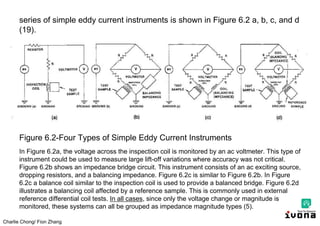
  • 208.
    Charlie Chong/ FionZhang Figure 5.1 a shows the effect on primary impedance Zp with changes in frequency (ω = 2πf). Figure 5.1 a represents primary impedance without a secondary circuit or test object. Figure 5.1b Illustrates the effect of frequency on primary impedance with a secondary circuit or test object present. The primary resistance R1 in Figure 5.1 a has been subtracted in Figure 5.1 b since resistance is not affected by frequency. The term ωLsG in Figure 5.1 b represents a reference quantity for the secondary impedance. The units are secondary conductance G and ωLs secondary reactance. Further normalization is accomplished by dividing the reactive and resistive components by the term ωLo or the primary inductive reactance without a secondary circuit present. Figure 5.2 shows a typical normalized impedance diagram. The terms ωL/ωLo and R/ωLo represent the relative impedance of the test coil as affected by the test object.
  • 209.
    Charlie Chong/ FionZhang Fig. 16 Normalized impedance diagram for a long coil encircling a solid cylindrical nonferromagnetic bar showing also the locus for a thin-wall tube. k, electromagnetic wave propagation constant for a conducting material, or √(ωμσ) ; r, radius of conducting cylinder, meters; ω , 2 f;f, frequency; √(ωLoG) , equivalent of √(ωμσ) for simplified electric circuits; μ, magnetic permeability of bar, or = 4 × 10⁻⁷ H/m if bar is nonmagnetic; σ, electrical conductivity of bar, mho/m; 1.0, coil fill factor.
  • 210.
    Charlie Chong/ FionZhang Signals generated by changes in ωL or R caused by test object conditions such as surface and subsurface discontinuities may be noted by ∆ωL or ∆R. The ∆ωLo and ∆R notation indicates a change in the impedance. Figure 5.3 shows the impedance variation in a non-ferromagnetic cylinder caused by surface and subsurface discontinuities. Figure 5.3 also illustrates a sensitivity ratio for surface and subsurface discontinuities. Notice with an f/fg ratio of 50, a relatively high frequency, the response to subsurface discontinuities is not very pronounced.
  • 211.
    Charlie Chong/ FionZhang Figure 5.3-lmpedance Variations caused by surface and subsurface cracks in non-ferromagnetic cylinders, at a frequency ratio f/f 9 = 50.
  • 212.
    Charlie Chong/ FionZhang Figure 5.4 shows responses to the same discontinuities with an f/fg ratio of 15. This lower frequency allows better detection of subsurface discontinuities as shown in Figure 5.4.
  • 213.
    Charlie Chong/ FionZhang Figure 5.4-lmpedance Variations caused by surface and subsurface cracks in non-ferromagnetic cylinders, at a frequency ratio f/fg = 15
  • 214.
    Charlie Chong/ FionZhang Multifrequency Systems lt becomes obvious that the technician must have a good working knowledge of current density and phase relationships in order .to make intelligent frequency choices. The frequency choice discussed to date deals with coil systems driven by only one frequency. Test systems driven by more than one frequency are called multifrequency or multiparameter systems. lt is common for a test coil to be driven with three or more frequencies. Although several frequencies may be applied simultaneously or sequentially to a test coil, each of the individual frequencies follows rules established by single frequency methods. Signals generated at the various frequencies are often combined or mixed in electronic circuits that algebraically add or subtract signals to obtain a desired result. One multifrequency approach is to apply a broadband signal, with many frequency components, to the test coil. The information transmitted by this signal is proportional to its bandwidth, and the logarithm of 1 plus the signal- to-noise power ratio. This relationship is stated by the equation:
  • 215.
    Charlie Chong/ FionZhang C = W Log2 (1 + S/N) C = Rate of information transmitted in bits per second W = Bandwidth of the signal S/N = Signal-to-noise power ratio This is known as the Shannon-Hartley Jaw. Another approach to multi parameter methods is to use a multiplexing process. The multiplexing process places one frequency at a time on the test coil. This results in zero cross-talk between frequencies and eliminates the need for band pass filters. The major advantages of a multiplex system are (1) lower cost, (2) greater flexibility in frequency selection, and (3) no cross-talk between frequency channels. If the multiplex switching rate is sufficiently high, both broadband and multiplex systems have essentially the same results. The characterization of eddy current signals by their phase angle and amplitude is a common practice and provides a basis for signal mixing to suppress unwanted signals from test data. Two frequencies are required to remove each unwanted variable.
  • 216.
    Charlie Chong/ FionZhang Keywords:  Multiple frequency testing- Multifrequency systems  Multiple frequency testing- Multiparameter systems  Broad band technique for multiple frequency testing.  Multiplexing technique for multiple frequency testing.  Phase angle and amplitude for characterization of eddy current signals.  Two frequencies are required to remove each unwanted variable (prime & subtractor frequencies).
  • 217.
    Charlie Chong/ FionZhang Practical multiparameter frequency selection can be demonstrated by the following example: Problem: Eddy current inspection of installed thin-wall non-ferromagnetic heat exchanger tubing. Tubing is structurally supported by ferromagnetic tube supports at several locations. lt is desired to remove the tube support response signal from tube wall data. Solution: Apply a multiparameter technique to suppress tube support signal response. First, a frequency is selected to give optimum phase and amplitude information about the tube wall. We shall call this the prime frequency. At the prime frequency, the response to the tube support and a calibrating through- all hole are equal in amplitude response. A second frequency called the subtractor frequency is selected on the basis of tube support response. Since the tube support surrounds the OD of the tube, a low frequency is selected. At the subtractor frequency the tube support signal response is approximately 10 times greater than the calibrating through-wall hole. If the mixing unit amplitude adjustments are set so that both prime and subtractor tube support signal amplitudes are equal and phased in a manner to cause signal subtraction, the tube support signals cancel, leaving only slightly attenuated prime data information. For suppressions of inside or near surface signals, a higher subtractor frequency would be chosen. A combination of prime, low, and high subtractor frequencies is often used to suppress both near and far surface signals, leaving only data pertaining to the part thickness and its condition. Optimization of frequency then depends on the desired measurement or parameter of interest
  • 218.
    Charlie Chong/ FionZhang Typical Heat Exchanger Since the tube support surrounds the OD of the tube, a low frequency is selected. At the subtractor frequency the tube support signal response is approximately 10 times greater than the calibrating through-wall hole.
  • 219.
    Charlie Chong/ FionZhang Typical Heat Exchanger Since the tube support surrounds the OD of the tube, a low frequency is selected. At the subtractor frequency the tube support signal response is approximately 10 times greater than the calibrating through-wall hole.
  • 220.
    Charlie Chong/ FionZhang Chapter 5 REVIEW QUESTIONS
  • 221.
    Charlie Chong/ FionZhang Answers:
  • 222.
    Charlie Chong/ FionZhang Table of information
  • 223.
    Charlie Chong/ FionZhang 0.5·1 What frequency is required to establish one standard depth of penetration of 0.1 inch in Zirconium? A. 19.6 kHz B. 196 Hz C. 3.4 kHz D. 340Hz 0.5-2 In order to reduce effects of far surface indications, the test frequency ____ _ A. must be mixed B. must be raised C. must be lowered D. has no effect 0.5-3 The frequency required to establish the Bessel function Argument "A" equal to 1 is called A. optimum frequency B. resonant frequency C. limit frequency D. penetration frequency δ = ( fμσ) -½ f = 1.982 /δ2 = 1.982 x 50 / (0.1)2
  • 224.
    Charlie Chong/ FionZhang 0.5·4 Calculate the limit frequency for a copper bar (σ = 50.6 meter/ohm-mm2) 1 cm in diameter. The correct limit frequency is ____ _ A. 50kHz B. 50.6 Hz C. 100Hz D. 100kHz 0.5-5 Using the example in Question 5.4, what is the f/fg ratio if the test frequency is 60 kHz? A. 1.2 B. 120 C. 60 D. 600 0.5-6 In Figure 5.1b the value ωLsG equaling 1.4 would be indicative of ____ A. a high resistivity material B. a high conductivity material C. a low conductivity material D. a nonconductor fg = 5066/σμrd2 fg = 5066 /(50.6 x 1 x12) = 100Hz
  • 225.
    Charlie Chong/ FionZhang Figure 5.1- Effect of Frequency Change: (a) Primary Impedance Without Secondary Circuit; (b) Primary lmpedance with Secondary Circuit R1
  • 226.
    Charlie Chong/ FionZhang 0.5·7 Primary resistance is subtracted from Figure 5.1 b because ____ _ A. resistance is always constant B. resistance is not frequency dependent C. resistance does not add to the impedance D. none of the above . 0.5-8 The reference quantity is different for solid cylinder and thin-wall tube in Figure 5.2 because A, the frequency is different B. the conductivity is different C. the skin effect is no longer negligible D. the thin-wall tube has not been normalized 0.5-9 A 25 percent deep crack open to the near surface gives a response ___ times greater than the same crack 3.3 percent of diameter under the surface (ref. Figure 5.4). A. 10 B. 2.4 C. 1.25 D. 5
  • 227.
    Charlie Chong/ FionZhang ratio = 5
  • 228.
    Charlie Chong/ FionZhang ration = 3
  • 229.
    Charlie Chong/ FionZhang 0.5-10 When using multifrequency systems, low subtractor frequencies are used to suppress A. conductivity changes B. far surface signals C. near surface signals D. permeability changes
  • 230.
    Charlie Chong/ FionZhang 6. INSTRUMENT SYSTEMS Most eddy current instrumentation is categorized by its final output or display mode. There are basic requirements common to all types of eddy current instrumentation. Five different elements are usually required to produce a viable eddy current instrument. These functions are: ■ excitation, ■ modulation, ■ signal preparation, ■ Demodulation, signal analysis, and ■ signal display. An optional sixth component would be test object handling equipment. Figure 6.1 illustrates how these components interrelate.
  • 231.
    Charlie Chong/ FionZhang Figure 6.1- internal Functions of the Electromagnetic Nondestructive Test
  • 232.
    Charlie Chong/ FionZhang 1. The generator provides excitation signals to the test coil. 2. The signal modulation occurs in the electromagnetic field of the test coil assembly. 3. Next, the signal preparation section, usually a balancing network, prepares the signal for demodulation and analysis. In the signal preparation stage, balance networks are used to "null" out steady-value alternating current signals. Amplifiers and filters are also part of this section to improve signal-to-noise ratio and raise signal levels for the subsequent demodulation and analysis stage. 4. The demodulation and analysis section is made up of detectors, analyzers, discriminators, filters, and sampling circuits. Detectors can be a simple amplitude type or a more sophisticated phase/ amplitude or coherent type. 5. The signal display section is the key link between the test equipment and its intended purpose. The signal can be displayed many different ways. Common displays include cathode ray tube (CRT) oscilloscopes, meters, recorders, visual or audible alarms, computer terminals, and automatic signaling or reject equipment.
  • 233.
    Charlie Chong/ FionZhang series of simple eddy current instruments is shown in Figure 6.2 a, b, c, and d (19). Figure 6.2-Four Types of Simple Eddy Current Instruments In Figure 6.2a, the voltage across the inspection coil is monitored by an ac voltmeter. This type of instrument could be used to measure large lift-off variations where accuracy was not critical. Figure 6.2b shows an impedance bridge circuit. This instrument consists of an ac exciting source, dropping resistors, and a balancing impedance. Figure 6.2c is similar to Figure 6.2b. In Figure 6.2c a balance coil similar to the inspection coil is used to provide a balanced bridge. Figure 6.2d illustrates a balancing coil affected by a reference sample. This is commonly used in external reference differential coil tests. In all cases, since only the voltage change or magnitude is monitored, these systems can all be grouped as impedance magnitude types (5).
  • 234.
    Charlie Chong/ FionZhang Eddy current testing can be divided into three broad groups. The groups are: 1. Impedance (magnitude) testing, 2. Phase analysis testing, and 3. Modulation analysis testing.  Impedance testing is based on gross changes in coil impedance when the coil is placed near the test object.  Phase analysis testing is based on phase changes occurring in the test coil and the test object's effect on those phase changes.  Modulation analysis testing depends on the test object passing through the test coil's magnetic field at a constant rate. The amount of frequency modulation observed as a discontinuity passes through the test coil's field and is a function of the transit time of the discontinuity through the coil's field. The faster the transit time, the greater the modulation.
  • 235.
    Charlie Chong/ FionZhang 1. IMPEDANCE TESTING With impedance magnitude instrumentation it is often difficult to separate desired responses, such as changes in conductivity or permeability, from dimensional changes. A variation of the impedance magnitude technique is the reactance magnitude instrument. In reactance magnitude tests, the test coil is part of the fundamental frequency oscillator circuit. This operates like a tuned circuit where the oscillator frequency is determined by the test coil's inductive reactance. As the test coil is affected by the test object, its inductive reactance changes, which in turn changes the oscillator frequency. The relative frequency variation ∆f/f is, therefore, an indication of test object condition. Reactance magnitude systems have many of the same limitations as impedance magnitude systems.
  • 236.
    Charlie Chong/ FionZhang 2. PHASE ANALYSIS TESTING Phase analysis techniques are divided into many subgroups depending on the type of data display. Some of the various types are (1) vector point, (2) impedance plane, (3) ellipse, and (4) linear time base. The vector point circuit and display are illustrated in Figure 6.3. 2.1 Vector Point The vector point display is a point of light on a CRT. The point is the vector sum of theY and X axis voltages present in the test coil (2). By proper selection of frequency and phase adjustment, voltage V1 could represent dimensional changes and voltage V2 could represent changes in conductivity.
  • 237.
    Charlie Chong/ FionZhang Figure 6.3-Vector Point Method (2, p. 3-15) Reprinted with permission.
  • 238.
    Charlie Chong/ FionZhang Figure 6.3-Vector Point Method (2, p. 3-15) Reprinted with permission. (continued)
  • 239.
    Charlie Chong/ FionZhang 2.2 Ellipse The ellipse method is shown in Figure 6.4. As with the vector point method, the test object and reference standard are used to provide a balanced output. A normal balanced output is a straight horizontal line. Figure 6.5 shows typical ellipse responses. With the ellipse method the vertical deflection plates of a CRT are energized by an amplified voltage from the secondary test coils. The horizontal deflection plates are energized by a voltage that corresponds to the primary magnetizing current. With this arrangement, an ellipse opening occurs when a discontinuity signal is perpendicular to a dimensional variation in the impedance plane. The ellipse method can be used to examine many test object variables such as conductivity, permeability, hardness, dimensions, and discontinuities. When testing ferromagnetic parts with the ellipse and vector point methods, the relative permeability of the part will vary due to the nonlinear magnetization of the magnetizing field. This nonlinear magnetization creates odd harmonic frequencies to appear in the output data.
  • 240.
    Charlie Chong/ FionZhang Figure 6.4-EIIipse Method (2, p. 3-16) Reprinted with permission.
  • 241.
    Charlie Chong/ FionZhang Figure 6.5-CRT Displays for Dimension and Conductivity (2, p. 3-17) Reprinted with permission.
  • 242.
    Charlie Chong/ FionZhang 2.3 Linear Time Base A test instrument system that is well suited to determine harmonic distortions present in the fundamental frequency uses the linear time base method of analysis. The linear time base unit applies a sawtooth shaped voltage to the horizontal deflection plates of a CRT. This provides a linear trace of the CRT beam from left to right across the CRT screen. The linear trace is timed so that it is equal to one cycle of the magnetizing current. This allows one cycle of the magnetizing sine wave voltage to appear on the CRT. Figure 6.7 illustrates a linear time base display.
  • 243.
    Charlie Chong/ FionZhang Figure 6.6-Linear Time Base Instrument Diagram (5, p. 40-29)
  • 244.
    Charlie Chong/ FionZhang Figure 6.7- Screen Image of a Linear Time Base Instrument with Sinusoidal Signals (5, p. 40·31)
  • 245.
    Charlie Chong/ FionZhang A slit or narrow vertical scale is provided to measure the amplitude of signals present in the slit. The base voltage is normally adjusted to cross the slit at "0" volts, the 180°point on the sine wave. The slit value "M" is used to analyze results. The slit value "M" is described by the equation: M = A sine ϴ where: M = Slit value A = Amplitude of the measurement in the slit ϴ = Angle between base signal and measurement effect In Figure 6.7, the angle difference A to B is approximately 90 degrees.
  • 246.
    Charlie Chong/ FionZhang MODULATION ANALYSIS TESTING Test instruments may also be classified by mode of operation. The mode of operation is determined by two functional areas within the instrument type. The first consideration is the method of test coil excitation. The second area is the degree of compensation, or nulling, and the type of detector used. The types of excitation include single frequency or multifrequency sinusoidal, single or repetitive pulse, and swept frequency. Compensation and detection can be accomplished by three modes. The three main input-detector modes are: 1. null balance with amplitude detector, 2. null balance with amplitude-phase detectors, and 3. selected off-null balance with amplitude detector.
  • 247.
    Charlie Chong/ FionZhang Mode 1 responds to any signal irrespective of phase angle. Mode 2, using amplitude-phase detectors, can discriminate against signals having a particular phase angle. With this system, the total demodulated signal can be displayed on an X-Y oscilloscope to show amplitude and phase relationships. Figure 6.8a shows a commercial null balance instrument with amplitude phase detectors.
  • 248.
    Charlie Chong/ FionZhang Figure 6.8a-Null Balance Instrument with Amplitude-Phase Detectors (Zetec, Inc.)
  • 249.
    Charlie Chong/ FionZhang Figure 6.8b-Typical Response to a Thin Wall Non-ferromagnetic Tube Calibration Standard (Zetec, Inc.)
  • 250.
    Charlie Chong/ FionZhang Mode 3 is a phase-sensitive system although it has only amplitude detectors. lt achieves phase sensitivity by operating at a selected off-balance condition. This off-null signal is very large compared with test object variations. Under this condition, the amplitude detector output varies in accordance with the test object signal variation on the large off-null signal. Two off-null systems are required to present both components of the test coil output signal. Figure 6.9 shows a block diagram of a stepped single frequency phase- amplitude instrument.
  • 251.
    Charlie Chong/ FionZhang Figure 6.9-lnstrument Providing Any One of Four Operating Frequencies
  • 252.
    Charlie Chong/ FionZhang The circuit in Figure 6.9 is capable of operating at any of the four frequencies. If the four frequencies are over a wide range, several different test coils may be required to use the instrument over the entire range. Most modern single frequency instruments use this principle; however, the four individual generators are usually replaced by one variable frequency generator with a wide operating range. A typical frequency range for such an instrument is 100 Hz to several megahertz. Figure 6.10 shows a block diagram for a multifrequency instrument operating at three frequencies simultaneously.
  • 253.
    Charlie Chong/ FionZhang Figure 6.10-Multifrequency Instrument Operating at Three Frequencies Simultaneously
  • 254.
    Charlie Chong/ FionZhang In Figure 6.10, excitation currents at each frequency are impressed on the coil at the same time. Multiple circuits are used throughout the instrument. The test coil output carrier frequencies are separated by filters. Multiple dual phase amplitude detectors are used and their outputs summed to provide separation of several test object parameters. A system similar to this is described in "In-Service Inspection of Steam Generator Tubing UsingMultiple Frequency Eddy Current Techniques“. another approach to the multifrequency technique uses a sequential coil drive called multiplexing. The frequencies are changed by a step-by-step sequence with such rapidity that the test parameters remain unchanged. The multiplex technique has the advantages of lower cost, continuously variable frequencies, and little or no cross-talk between channels.
  • 255.
    Charlie Chong/ FionZhang Figure 6.11 illustrates a commercial multifrequency instrument capable of operating at four different frequencies sequentially. Each of the frequency modules may be adjusted over a wide range of frequencies. In addition, two mixing modules are used to combine output signals of the various channels for suppression of unwanted variables. Results of such suppression are described in "Multi-Frequency Eddy Current Method and the Separation of Test Specimen Variables" .
  • 256.
    Charlie Chong/ FionZhang Figure 6.11-Commercial Multifrequency Instrument (Zetec, Inc.)
  • 257.
    Charlie Chong/ FionZhang Instruments are being developed that are programmable, computer or microprocessor based. With microprocessor controlled instruments, test setups can be stored in a programmable memory system. This allows complicated, preprogrammed test setups to be recalled and used by semiskilled personnel. Systems are designed with preprograms having supervisory code interlocks that prevent reprogramming by other than authorized personnel. Microprocessor-based instruments can interface with larger computer systems for control and signal analysis purposes. Figure 6.12 shows a single frequency portable microprocessor-based instrument. The CRT display applies the phase analysis technique for signal interpretation.
  • 258.
    Charlie Chong/ FionZhang Figure 6.12- Commercial Microprocessor-Based Instrument (Nortec Corporation)
  • 259.
    Charlie Chong/ FionZhang Other instruments being developed will be microprocessor based with the ability to excite several coils .at several frequencies. This would allow automatic supp-ression of unwanted variables and a direct link to larger computers for computer enhancement of test signal information. A test system using pulsed·excitation is shown in Figure 6.13. A pulse is applied to the test coil, compensating networks, and analyzers simultaneously. Systems having analyzers with one or two sampling points perform similar to a single frequency tester using sinusoidal excitation. Pulsed eddy current systems having multiple sampling points perform more like the multifrequency tester shown in Figure 6.10.
  • 260.
    Charlie Chong/ FionZhang Figure 6.13-Pulsed Waveform Excitation
  • 261.
    Charlie Chong/ FionZhang TEST OBJECT HANDLING EQUIPMENT Test object handling equipment is often a necessary component of a test system. Bars and tubes can be fed through encircling coils by means of roller fed assemblies. The stock being fed through the coil is usually transported at a constant speed. The transport speed is selected with instrument response and reject system response being of prime importance to the test. Pen marking and automatic sorting devices are common in automated systems. Spinning probes are used where the probe is rotated and the tube or bar is translated. Probe rotational speeds must be compatible with instrument response and translation speeds in order to obtain the desired inspection coverage and results. Small parts are often gravity fed through coil assemblies.
  • 262.
    Charlie Chong/ FionZhang A major problem with small parts is loading, inspecting, and unloading. A speed effect occurs when a conducting object is passed through a coil. As the object moves through the coil's magnetic field, an additional induced voltage within the object occurs. This additional induced voltage has the same frequency as the exciting current, and it causes a current flow and associated magnetic fields that produce signals proportional to the speed of the object through the coil. For larger or stationary structures, test probes are scanned over the part surface by manual or remotely operated systems. Scanning considerations are the same as tor tube and bar stock instrument response, marking or reject system response, and desired coverage. In the case of large heat exchangers, a probe positioning device is used to position the test probe over each tube opening to be inspected.
  • 263.
    Charlie Chong/ FionZhang Keywords: Speed Effect A major problem with small parts is loading, inspecting, and unloading. A speed effect occurs when a conducting object is passed through a coil. As the object moves through the coil's magnetic field, an additional induced voltage within the object occurs. This additional induced voltage has the same frequency as the exciting current, and it causes a current flow and associated magnetic fields that produce signals proportional to the speed of the object through the coil.
  • 264.
    Charlie Chong/ FionZhang Tubes to be inspected are identified by manual templates, or their coordinates are pro· grammed into computer memory. Positive feedback is supplied to computer positioning systems by encoder devices. In manual template systems the tube end is viewed by a video camera. Tube identification and control feedback are supplied to the operator via a video display system. In each system, as the probe guide is positioned correctly, the probe is inserted and withdrawn from the heat exchanger tube bore, and res ults of the scan are recorded on chart paper and magnetic tape.
  • 265.
    Charlie Chong/ FionZhang Chapter 6 REVIEW QUESTIONS
  • 266.
    Charlie Chong/ FionZhang Answers:
  • 267.
    Charlie Chong/ FionZhang 0.6·1 Signal preparation is usually accomplished by: A. detectors. B. samplers. C. balance networks. D. discriminators. 0.6·2 Most eddy current instruments have _____ coil excitation. A. square wave B. triangular wave C. sine wave D. sawtooth wave 0.6·3 When only coil voltage is monitored, the system is considered a(an) _____ type system. A. impedance magnitude B. phase analysis C. reactance magnitude D. resistance magnitude
  • 268.
    Charlie Chong/ FionZhang 0.6·4 lt is easy to distinguish dimensional variations from discontinuities in a reactance magnitude system. A. True B. False 0.6·5 Eddy current systems can be grouped by: A. output characteristics. B. excitation mode. C. phase analysis extent. D. both A and B. 0.6·6 In modulation testing the test object must be ____ _ A. stationary B. moving C. polarized D. saturated
  • 269.
    Charlie Chong/ FionZhang 0.6·7 Using the vector point method, undesired responses appear _____ on the CRT. A. vertical B. horizontal C. at 45º to horizontal D. random and cannot be set 0.6·8 When ellipse testing a rod, the f/fg ratio is lowered from 50 to 5 percent. The response from a 5 percent surface flaw: A. will appear more elliptical. B. will appear less elliptical. C. is unchanged. D. rotates 90 D clockwise. 0.6·9 Using the linear time base, harmonics appear: A. as phase shifts of the fundamental waveform. B. as distortions of the fundamental waveform. C. to have no effect on the fundamental waveform. D. as modified sawtooth signals.
  • 270.
    Charlie Chong/ FionZhang 0.6·10 Calculate the slit value "M" for a signal phase shift of 45 degrees at 10 divisions vertical amplitude. A. 14 B. 7 C. 0.7 D. 1.4 0.6·11 A multifrequency instrument that excites the test coil with several frequencies simultaneously uses the concept. A. multiplex B. time share C. broadband D. synthesized 0.6·12 A multifrequency instrument that excites the test coil with several frequencies sequentially usesthe concept. A. multiplex B. time base C. broadband D. Cartesian
  • 271.
    Charlie Chong/ FionZhang 0.6·13 In a pulsed eddy current system using a short duration and a long duration pulse, the short duration pulse is used to reduce ____ A. edge effect B. skin effect C. lift-off effect D. conductivity variations 0.6·14 When selecting feed rates for automatic inspection of tube and bar stock, consideration is given to: A. instrument response. B. automatic sorting response. C. speed effect. D. all of the above.
  • 272.
    Charlie Chong/ FionZhang 7. READOUT MECHANISMS Eddy current test data may be displayed or indicated in a variety of ways. The type of display or readout depends on the test requirements. Test records may require archive storage on large inservice components so that corrosion or discontinuity rates of change can bemonitored and projected. In some production tests, a simple GO/NO-GO indicator circuit is all that is required. Some common readout mechanisms are indicator tights, audio alarms, meters, digital displays, cathode ray tubes, recorders, and computer printout or displays. INDICATOR LIGHTS A simple use of the indicator light is to monitor the eddy current signal amplitude with an amplitude gate circuit. When the signal reaches a preset amplitude limit, the amplitude gate switches a relay that applies power to an indicator light or automatic sorting device. With the amplitude gate circuit, high-low limits could be preset to give GO/NO-GO indications.
  • 273.
    Charlie Chong/ FionZhang AUDIO ALARMS Audio alarms can be used in much the same manner. Usually the audio alarm indicates only the abnormal condition. Alarm lights and audio alarms are commonly incorporated in eddy current test equipment. The indicator light and audio alarm give only qualitative information about the item, whether a condition is present or not. The degree of condition cannot normally be determined with these devices. Indicator lights and audio alarms are relatively inexpensive and can be interpreted by semi skilled personnel. METERS Meters can present quantitative information about a test object. Meters operate on the D'Arsonval galvanometer principle. The principle is based on the action between two magnetic fields. A common meter uses a strong permanent magnet to produce one magnetic field; the other magnetic field is produced by a movable coil wound on a core. The coil and core are suspended on jewelled bearings and attached to a pointer or "needle." The instrument output current is passed through the coil and produces a magnetic field about the coil that reacts to the permanent magnetic field surrounding the assembly. The measuring coil is deflected, moving the meter pointer. The degree of pointer movement can be related to test object variables as presented by the tester output signals.
  • 274.
    Charlie Chong/ FionZhang DIGITAL DISPLAYS Numerical digital displays or indicators provide the same type of information as analog meter systems. Many eddy current instruments have analog output circuits. Data handling of analog information in digital form requires analog information to be processed through analog-to-digital (A-D) converters. The A-D converter transforms analog voltages to numerical values tor display.
  • 275.
    Charlie Chong/ FionZhang CRTs Cathode ray tubes (CATs) play an important role in the display of eddy current information. Most CRTs are the "electrostatic" type. Three main elements comprise a cathode ray tube: (1) electron gun, (2) deflection plates, and (3) a fluorescent screen. The electron gun generates, focuses, and directs the electron beam toward the face or screen of the CAT. The deflection plates are situated between the electron gun and the screen. They are arranged in two pairs, usually called horizontal and vertical, or X and Y. The plane of one pair is perpendicular to the other pair and therefore considered X and Y. The screen is the imaging portion of the CAT. The screen consists of a coating or coatings that produce photochemical reactions when struck by the electron beam. The photochemical action appears in two stages. Fluorescence occurs as the electron beam strikes the screen. Phosphorescence enables the screen to continue to give off light after the electron- beam has been removed or has passed over a section of the screen. All screen materials possess both fluorescence and phosphorescence. Screen materials are referred to as phosphors. The color of fluorescence and phosphorescence may differ as the case for zinc sulfide: the fluorescence is blue- green, and the phosphorescence is yellow-green.
  • 276.
    Charlie Chong/ FionZhang Fluorescence may appear blue, white, red, yellow, green, orange, or a combination of colors, depending on the chemical makeup of the screen. The amount of light output from the fluorescent screen depends on the electron beam accelerating potential, screen chemical composition, thickness of screen material, and writing speed of the electron beam. The duration of the photochemical effect is called persistence. Persistence is grouped as to low, medium, or high persistence. To display repetitive signals, a low or medium persistence CAT may be used. To display non recurrent or single events, a high persistence CAT should be used. Many modern CRTs have the capability of both low or medium and high- persistence. Storage or memory CRTs have the ability to display non recurrent signals. The image from a single event may remain visible on the CRT for many hours, if desired.
  • 277.
    Charlie Chong/ FionZhang Figure 7.1 illustrates a typical eddy current signal response on a storage CAT. The amplitude of the signal in Figure 7.1 is an indicator of the volume of the discontinuity. The phase angle with respect to the X axis represents discontinuity depth and origin, origin indicating whether the discontinuity originated on the inside or outside surface of the tube.
  • 278.
    Charlie Chong/ FionZhang RECORDERS Recorders are also used to display data and to provide a convenient method of data storage. Recording is accomplished on paper strip charts, facsimile paper, facsimile photosensitive, magnetic tape (AM, FM, or video), or digital memory disks. Strip chart recordings are common in testing tubing or nuclear fuel rods where the discontinuity's location down the length of rod or tube is critical. The strip chart length is indexed to time or distance and pen response indicates normal or abnormal conditions. Fascimile recording is a technique of displaying data signals as a raster of lines which have varying levels of blackness which correspond to data-signal voltage changes. Facsimile recording is commonly referred to as C-scan recording. If no data is transmitted to the facsimile recorder, a uniform light or dark (depending on preference) line or series of lines (raster) would be recorded. In the case of light rasters, the incoming data signal would produce areas of different darkness. The darkness would be dependent on the incoming data signal. Facsimile recorders are used in conjunction with scanning mechanisms and scan rates, and locations are synchronized with the facsimile recorder to present an image of the object variances. Figure 7.3 illustrates a typical facsimile recording.
  • 279.
    Charlie Chong/ FionZhang Figure 7.2-Commercial Strip Chart Recorder (Gould Instruments)
  • 280.
    Charlie Chong/ FionZhang Figure 7.3-Facsimile Recording of Saw-cut Specimen (Copyright, American Society for Testing and Materials, 1916 Race Street, Philadelphia, PA. 19103. Reprinted, with permission.)
  • 281.
    Charlie Chong/ FionZhang Another common type recorder is the X·Y recorder. X-Yrecorders are usually used to present scanning type data. In X-Y systems, only data signals are printed; no raster is produced in a conventional X-Y recorder system. Magnetic tape recorders, usually frequency-modulated multichannel types, are used to provide a permanent record of test results. In the case of eddy current equipment with X·Y outputs, quadrature information is recorded and played back into analyzers for post inspection analysis.
  • 282.
    Charlie Chong/ FionZhang COMPUTERS Computers may be used to control data acquisition and analysis processes. Data handling techniques take a wide variety of approaches. Dodd and Deeds describe a computer-controlled multifrequency system. Figure 7.4 shows a computer-controlled eddy current system. Figure 7.4- Computer-controlled Eddy Current System (Oak Rid.ge Nationa l Laboratory, No. 1747-49)
  • 283.
    Charlie Chong/ FionZhang Chapter 7 REVIEW QUESTIONS
  • 284.
    Charlie Chong/ FionZhang Answers:
  • 285.
    Charlie Chong/ FionZhang 0.7-1 Display requirements are based on: A. test applications. B. records requirement. C. need for automatic control. D. all of the above. Q.7-2 Amplitude gates provide a method of controlling: A. reject or acceptance limits. B. instrument response. C. display amplitude. D. all of the above. Q.7-3 Alarms and lights offer only: A. qualitative information. B. quantitative information. C. reject information. D. accept information.
  • 286.
    Charlie Chong/ FionZhang Q.7-4 The galvanometer principle is the basis for ____ A. corrosion rates B. metallographic deterioration C. a voltmeter D. light source illumination Q.7-5 In order for analog information to be presented to a digital computer, it must be processed through _______ _ A. an A-D converter B. a microprocessor C. a phase detector D. an amplitude detector 0.7-6 In a cathode ray tube, the electron gun: A. directs the beam. B. focuses the beam. C. generates the beam. D. all of the above.
  • 287.
    Charlie Chong/ FionZhang 0.7·7 Photochemical reactions produced by electrons striking a CAT screen cause: A. photosynthesis. B. phosphorescence. C. fluorescence. D. both B and C. 0.7·8 High persistance CRT screens are normally used for repetitive signal display. A. True B. False 0.7-9 Length of a strip chart can indicate: A. flaw severity. B. distance or time. C. orthogonality. D. all of the above.
  • 288.
    Charlie Chong/ FionZhang 0.7-10 A series of lines produced in facsimile recording is/are called: A. grid lines. B. raster. C. crosshatch. D. sweep display.
  • 289.
    Charlie Chong/ FionZhang 8. APPLICATIONS Electromagnetic induction and the eddy current principle can be affected in many different ways. These effects may be grouped by discontinuity detection, measurement of material properties, dimensional measurements, and other special applications. With discontinuity, or the flaw detection group, we are concerned with locating cracks, corrosion, erosion, and mechanical damage. The material properties group includes measurements of conductivity, permeability, hardness, alloy sorting or chemical composition, and degree of heat treatment. Dimensional measurements commonly made are thickness, profilometry, spacing or location, and coating or cladding thickness. Special applications include measurements of temperature, flow metering of liquid metals, sonic vibrations, and anisotropic conditions.
  • 290.
    Charlie Chong/ FionZhang FLAW DETECTION The theoretical response to discontinuities has been discussed in previous Sections of this guide. In this Section, some actual practice examples are given to enhance the understanding of applied theory. A problem common to the chemical and electric power industries is the corrosion of heat exchanger tubing. This tubing is installed in large vessels in a high density array. It is not uncommon for a 4 foot diameter heat exchanger to contain 3000 tubes· This high density and limited access to the inspection areas often preclude the use of other NDE methods. Heat exchanger inspection systems and results are described. In most of these cases, the severity of the discontinuity is determined by analyzing the eddy current signal phase and amplitude. ■ The signal amplitude is an indicator of the discontinuity volume. ■ The phase angle determines the depth of the discontinuity and also the originating surface (ID or OD) of that discontinuity. (See Figure 6.8, above)
  • 291.
    Charlie Chong/ FionZhang Phase angle and amplitude relationships are usually established by using a reference standard with artificial discontinuities of known and documented values. The geometry of real discontinuities may differ from reference standard discontinuities. This difference produces interpretation errors as discussed by Sagar. Placement of real discontinuities near tube support members causing a complex coil impedance change is also a source of error. This, of course, is dependent upon the size of the discontinuity and its resultant eddy current signal in relation to the tube support signal. This follows the basic principle of signal-to-noise ratio. The signal-to-noise ratio can be improved at tube to tube support intersections by the use of multi-frequency techniques.
  • 292.
    Charlie Chong/ FionZhang In multifrequency applications, an optimum frequency is chosen for response to the tube wall and a lower than optimum frequency is chosen for response to the tube support. The two signals are processed through comparator circuits called mixers where the tube support response is subtracted from the tube wall response signal, leaving only the response to the tube wall discontinuity. Another industry that uses eddy current testing extensively is the aircraft industry. Many eddy current examinations are conducted on gas turbine engines and airframe structures. A common problem with gas turbines is fatigue cracking of the compressor or exhaust turbine blade roots.
  • 293.
    Charlie Chong/ FionZhang Usually these inspections are performed with portable instruments with meter response capability. The meter response is compared to the response of known discontinuities in a reference specimen. A determination is then made of the part's acceptance. The reference specimen and its associated discontinuities are very critical to the success of the test. Often models are constructed with artificial discontinuities that are exact duplicates of the item being inspected. The low frequency eddy current inspection of aircraft structures is explained by D.J. Hagemaier. The low frequency (100 - 1000 Hz) technique is used to locate cracks in thick or multiple layer, bolted or riveted aircraft structures. Again, models are constructed with artificial cracks, and their responses are compared to responses in the actual test object. Pulsed eddy current systems also are used for crack detection in thick structures.
  • 294.
    Charlie Chong/ FionZhang DIMENSIONAL MEASUREMENTS Dimensional measurements, such as thickness, shape, and position, or proximity of one item to another, are important uses of the eddy current technique. Often materials are clad with other materials to present a resistance to chemical attack or to provide wear resistance. Cladding or plating thickness then becomes an important variable to the serviceability of the unit. For nonconductive coatings on conductive bases, the "probe-to- specimen spacing", or lift-off technique can be applied. The case of conductive plating or cladding on conductive bases requires more refinement. The thickness loci respond in a complex manner on the impedance plane. The loci for multilayered objects with each layer consisting of a material with a different conductivity follow a spiral pattern. In certain cases, two frequency or multifrequency systems are used to stabilize results or minimize lift-off variations on the thickness measurement
  • 295.
    Charlie Chong/ FionZhang The depth of case hardening can be determined by measuring the nitride case thickness in stainless steel. The nitride case thickness produces magnetic permeability variations. The thicker the nitride, the greater the permeability. The coil's inductive reactance increases with a permeability increase. This variable is carefully monitored and correlated to actual metallographic results. Eddy current profilometry is another common way to measure dimensions; for example, the measurement of inside diameters of tubes using a lift-off technique. For this measurement, several small probe coils are mounted radially in a coil form. The coil form is inserted into the tube and each coil's proximity to the tube wall is monitored. The resultant output of each coil can provide information about the concentricity of the tube. An obvious problem encountered with this method is cantering of the coil holder assembly. The center of the coil holder must be near the center of the tube. When inspecting for localized dimensional changes, a long coil holder is effective in maintaining proper centering. Another function of the long coil form is to keep the coils from becoming "cocked" or tilted in the tube.
  • 296.
    Charlie Chong/ FionZhang CONDUCTIVITY MEASUREMENTS Conductivity is an important measured variable. In the aircraft industry, aluminum is used extensively. Aluminum conductivity varies not only with alloy but also with hardness and tensile strength. Eddy current instruments scaled in % IACS are normally used to inspect for conductivity variations. Secondary conductivity standards are commonly used to check instrument calibration. Common secondary conductivity standards range from 8% IACS to approximately 100% IACS. The secondary standards are usually certified accurate within ± 0.35 percent or ± 1 percent of value, whichever is less. Temperature is an important variable when making conductivity measurements. Most instruments and standards are certified at 20°C. Primary conductivity standards are maintained at a constant temperature by oil bath systems. Primary standards are measured by precision Maxwell bridge type instruments. This circuit increases measurement accuracy and minimizes frequncy dependence of the measurement
  • 297.
    Charlie Chong/ FionZhang HARDNESS MEASUREMENTS Hardness of steel parts is often measured with low frequency comparator bridge instruments. The reference and test coil are balanced with sample parts of known hardness. As parts of unknown hardness affect the test coil, the instrument output varies. The amount of output variation depends upon the degree of imbalance created by the unknown test object hardness. Signal output is then correlated to test object hardness by comparing to known hardness samples of the same geometry. For example, if a cathode ray tube were used to display hardness information, the "balance" hardness could be adjusted to center screen, lower hardness values could appear below center, and higher hardness values could appear above center on the CRT.
  • 298.
    Charlie Chong/ FionZhang ALLOY SORTING Alloy sorting can be accomplished in the same comparator bridge manner as hardness. A major consideration in both cases is the selection of correct and accurate reference specimens. Since most eddy current instruments respond to a wide range of variables, the reference specimen parameters must be controlled carefully. Test object and reference specimens must be the same or very similar in the following characteristics: 1. geometry, 2. heat treatment, 3. surface finish, 4. residual stresses, and 5. metallurgical structure.
  • 299.
    Charlie Chong/ FionZhang In addition, it is advisable to have more than one reference specimen for backup in case of loss or damage. In the case of steel parts, they should be completely demagnetized to remove the effects of residual magnetism on instrument readings. As in most comparative tests, temperature of specimen and test object should be the same or compensated. Many other measurements can be made using eddy current techniques. The electromagnetic technique produces so much information about a material, its application is only limited by our ability to decipher this information.
  • 300.
    Charlie Chong/ FionZhang Chapter 8 REVIEW QUESTIONS
  • 301.
    Charlie Chong/ FionZhang Answers:
  • 302.
    Charlie Chong/ FionZhang 0.8-1 Conductivity, hardness, and composition are part of the group. A. defect detection B. material properties C. dimensional D. special 0.8·2 Using an ID coil on tubing and applying the phase/amplitude method of inspection, a signal appearing at 90º on a CRT would be caused by: A. ID flaw. B. OD flaw. C. dent. D. bulge. 0.8·3 Discontlnuitles in heat exchangers at tube support locations are easier to detect because the support plate concentrates the electromagnetic field at that point. A. True B. False
  • 303.
    Charlie Chong/ FionZhang 0.8·4 Using multifrequency techniques on installed heat exchanger tubing, a tube support plate signal can be suppressed by adding a ____frequency signal to the optimum frequency signal. A. low B. high C. A orB D. none of the above 0.8·5 In the aircraft industry, a common problem in gas turbine engines is: A. corrosion. B. fatigue cracking. C. vibration damage. D. erosion. 0.8-6 Thick or multilayered aircraft structures are normally inspected by: A. low frequency sinusoidal continuous wave instruments. B. high frequency sinusoidal continuous wave instruments. C. pulsed systems. D. A and C.
  • 304.
    Charlie Chong/ FionZhang 0.8·7 Response to multilayer varying conductivity structures follow _____ loci. A. orthogonal B. spiral c. linear D. stepped 0.8·8 Nitride case thickness can be monitored in stainless steel cylinders by measuring ____ _ A. conductivity B. dimensions C. permeability D. none of the above 0.8-9 Conductivity is not affected by temperature. A. True B. False 0.8-10 Residual stresses in the test part produce such a small effect that they are usually ignored when selecting reference specimens. A. True B. False
  • 305.
    Charlie Chong/ FionZhang Chapter 9 REVIEW QUESTIONS
  • 306.
    Charlie Chong/ FionZhang Answers:
  • 307.
    Charlie Chong/ FionZhang 0.9·1 A precise statement of a set of requirements to be satisfied by a material, product, system, or service is a----'--- A. standard B. specification C. procedure D. practice 0.9·2 A statement that comprises one or more terms with explanation is a ____ _ A. practice B. classification C. definition D. proposal 0.9-3 A general statement of applicability and intent is usually presented in the _____ of a standard? A. summary B. scope C. significance D. procedure
  • 308.
    Charlie Chong/ FionZhang 0.9·4 Military Standards are designated by "MIL-C-(number}." A. True B. False 0.9·5 In the structure of ASME the subcommittee reports to the subgroup. A. True B. False 0.9·6 In example QA 3, personnel Interpreting results must be: A. Level I or higher. B. Level 11 or higher. C. Level IIA or higher. D. Level Ill. MIL-STD-1537A
  • 309.
    Charlie Chong/ FionZhang 0.9-7 The prime artificial discontinuity used to calibrate the system described in QA 3 is: A. 20% ID B. 50% OD C. 100% D. 50% ID 0.9-8 In QA 3, equipment calibration must be verified at least ____ _ A. every hour B. each day C. every 4 hours D. every 8 hours 0.9·9 QA 3 specifies a maximum probe traverse rate of _______ _ A. 12"/sec B. 14"/sec C. 6"/sec D. not specified
  • 310.
    Charlie Chong/ FionZhang 0.9·10 The system in QA 3 is calibrated with an approved standard that is traceable to ___ _ A. NBS B. ASME C. a master standard D. ASTM Q.9·11 In accordance with QA 3, tubes whose data are incomplete or uninterpretable must be A. reinspected B. reported C. reevaluated D. removed from service 0.9·12 Referring to QA 3, QA 4.1 is a ____ _ A. calibration form B. data interpretation table C. data report form D. certification form
  • 311.
    Charlie Chong/ FionZhang Good Luck
  • 312.
    Charlie Chong/ FionZhang ■ωσμ∙Ω ∆º≠δ≤>η φФ |β≠Ɛ∠
  • 313.
    Charlie Chong/ FionZhang More Reading http://www.ndt.net/article/ecndt02/322/322.htm http://www.proprofs.com/quiz-school/story.php?title=eddy-current-practise
  • 314.
    Charlie Chong/ FionZhang Further Reading
  • 315.
    Charlie Chong/ FionZhang Good Luck
  • 316.
    Charlie Chong/ FionZhang https://www.yumpu.com/en/browse/user/charliechong