Electromagnetic
spectrum
The big picture
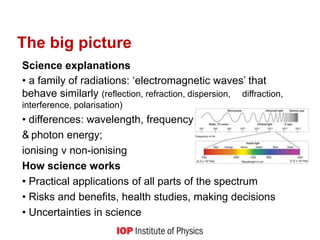
Science explanations
• a family of radiations: ‘electromagnetic waves’ that
behave similarly (reflection, refraction, dispersion, diffraction,
interference, polarisation)
• differences: wavelength, frequency
& photon energy;
ionising v non-ionising
How science works
• Practical applications of all parts of the spectrum
• Risks and benefits, health studies, making decisions
• Uncertainties in science
Main teaching challenges
The electromagnetic spectrum is
• mostly invisible
• an abstract idea
Students understand more when
• it is introduced carefully, by stages. Start with visible
light then extend through both UV & infrared.
• it is made perceptible (concrete)
• connects with students’ lives and interests
Prior learning
• sound (vibrations and waves)
• light
• source-journey-detector model of radiation
TASK:
How does the model apply to (1) sound? (2) light?
Source–journey–detector
A useful model: makes the invisible more concrete.
Task: Name at least 1 source and 1 detector for each
part of the full spectrum.
• gamma rays
• X-rays
• ultraviolet
• visible light
• infrared
• microwaves
• radio waves
Use sources & detectors, either as demonstration
experiments, or as a circus of class experiments.
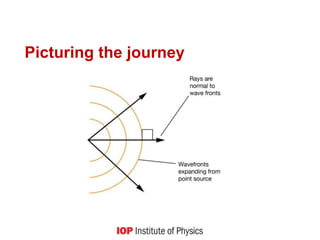
Picturing the journey
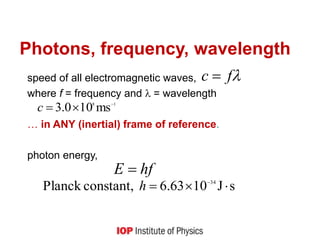
Photons, frequency, wavelength
speed of all electromagnetic waves,
where f = frequency and = wavelength
… in ANY (inertial) frame of reference.
photon energy,

f
c 
hf
E 
s
J
10
63
.
6
constant,
Planck 34


 
h
1
8
ms
10
0
.
3 


c
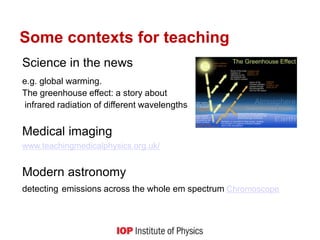
Some contexts for teaching
Science in the news
e.g. global warming.
The greenhouse effect: a story about
infrared radiation of different wavelengths
Medical imaging
www.teachingmedicalphysics.org.uk/
Modern astronomy
detecting emissions across the whole em spectrum Chromoscope
The visible spectrum
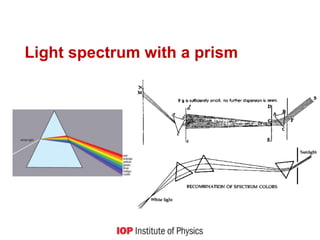
Light spectrum with a prism
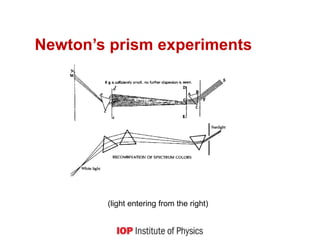
Newton’s prism experiments
(light entering from the right)
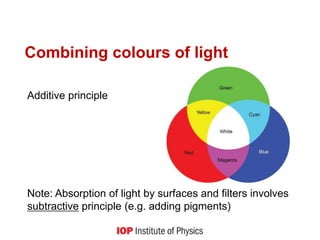
Combining colours of light
Additive principle
Note: Absorption of light by surfaces and filters involves
subtractive principle (e.g. adding pigments)
Combining colours of light
SEP Activity 2
with light emitting diodes (LEDs) as light sources
Power source: 3V lithium batteries (disc-shaped)
Signalling with optical fibres
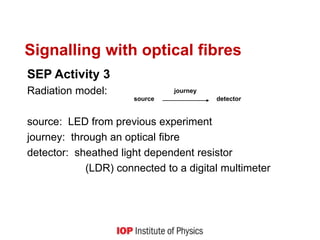
SEP Activity 3
Radiation model:
source: LED from previous experiment
journey: through an optical fibre
detector: sheathed light dependent resistor
(LDR) connected to a digital multimeter
journey
source detector
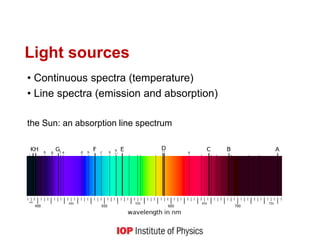
Light sources
• Continuous spectra (temperature)
• Line spectra (emission and absorption)
the Sun: an absorption line spectrum
Light sources
SEP Activity 1
Make a spectroscope.
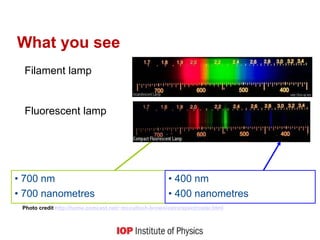
Use your spectroscope to compare light sources.
Photo credit http://home.comcast.net/~mcculloch-brown/astro/spectrostar.html
What you see
Filament lamp
• 700 nm
• 700 nanometres
• 400 nm
• 400 nanometres
Fluorescent lamp
Beyond the visible
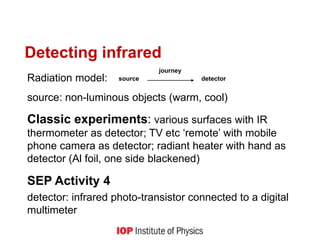
Detecting infrared
Radiation model:
source: non-luminous objects (warm, cool)
Classic experiments: various surfaces with IR
thermometer as detector; TV etc ‘remote’ with mobile
phone camera as detector; radiant heater with hand as
detector (Al foil, one side blackened)
SEP Activity 4
detector: infrared photo-transistor connected to a digital
multimeter
journey
source detector
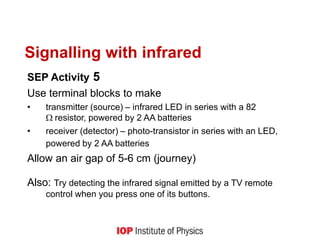
Signalling with infrared
SEP Activity 5
Use terminal blocks to make
• transmitter (source) – infrared LED in series with a 82
resistor, powered by 2 AA batteries
• receiver (detector) – photo-transistor in series with an LED,
powered by 2 AA batteries
Allow an air gap of 5-6 cm (journey)
Also: Try detecting the infrared signal emitted by a TV remote
control when you press one of its buttons.
Radiation model:
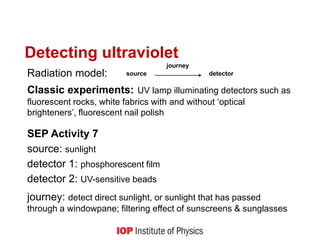
Classic experiments: UV lamp illuminating detectors such as
fluorescent rocks, white fabrics with and without ‘optical
brighteners’, fluorescent nail polish
SEP Activity 7
source: sunlight
detector 1: phosphorescent film
detector 2: UV-sensitive beads
journey: detect direct sunlight, or sunlight that has passed
through a windowpane; filtering effect of sunscreens & sunglasses
Detecting ultraviolet
journey
source detector
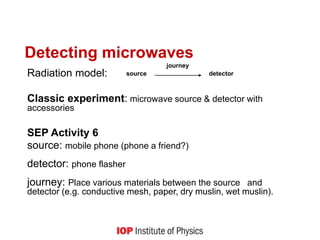
Detecting microwaves
Radiation model:
Classic experiment: microwave source & detector with
accessories
SEP Activity 6
source: mobile phone (phone a friend?)
detector: phone flasher
journey: Place various materials between the source and
detector (e.g. conductive mesh, paper, dry muslin, wet muslin).
journey
source detector
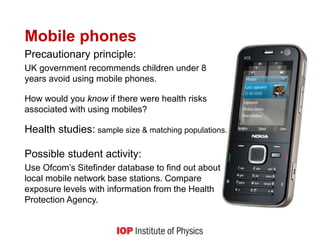
Mobile phones
Precautionary principle:
UK government recommends children under 8
years avoid using mobile phones.
How would you know if there were health risks
associated with using mobiles?
Health studies: sample size & matching populations.
Possible student activity:
Use Ofcom’s Sitefinder database to find out about
local mobile network base stations. Compare
exposure levels with information from the Health
Protection Agency.
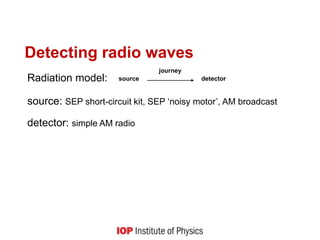
Detecting radio waves
Radiation model:
source: SEP short-circuit kit, SEP ‘noisy motor’, AM broadcast
detector: simple AM radio
journey
source detector
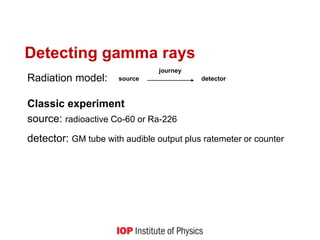
Detecting gamma rays
Radiation model:
Classic experiment
source: radioactive Co-60 or Ra-226
detector: GM tube with audible output plus ratemeter or counter
journey
source detector
Properties of em waves
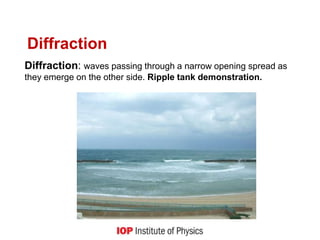
Diffraction
Diffraction: waves passing through a narrow opening spread as
they emerge on the other side. Ripple tank demonstration.
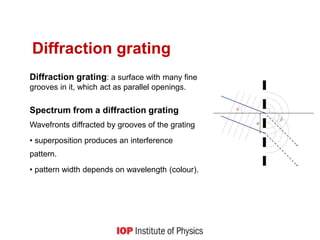
Diffraction grating
Diffraction grating: a surface with many fine
grooves in it, which act as parallel openings.
Spectrum from a diffraction grating
Wavefronts diffracted by grooves of the grating
• superposition produces an interference
pattern.
• pattern width depends on wavelength (colour).
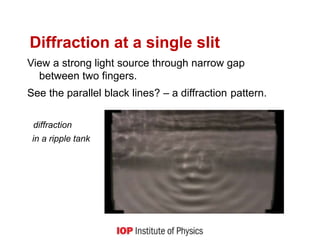
Diffraction at a single slit
View a strong light source through narrow gap
between two fingers.
See the parallel black lines? – a diffraction pattern.
diffraction
in a ripple tank
SEP diffraction grids
SEP Activity 8
Holding the grid close to your eye, view a point source of visible
light with grid of
• horizontal lines
• zigzag lines
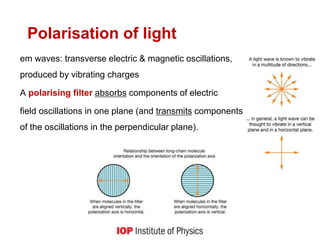
Polarisation of light
em waves: transverse electric & magnetic oscillations,
produced by vibrating charges
A polarising filter absorbs components of electric
field oscillations in one plane (and transmits components-
of the oscillations in the perpendicular plane).
Support, references
talkphysics.org
SPT 11-14 Light & sound
Gatsby SEP booklets … free @ National STEM Centre e.library
Radiation and communication
Seeing beyond the visible
Light and matter
Practical resources available from Mindsets
David Sang (ed, 2011) Teaching secondary physics ASE / Hodder

Electromagnetic spectrum short ppt for students

  • 1.
  • 2.
    The big picture Scienceexplanations • a family of radiations: ‘electromagnetic waves’ that behave similarly (reflection, refraction, dispersion, diffraction, interference, polarisation) • differences: wavelength, frequency & photon energy; ionising v non-ionising How science works • Practical applications of all parts of the spectrum • Risks and benefits, health studies, making decisions • Uncertainties in science
  • 3.
    Main teaching challenges Theelectromagnetic spectrum is • mostly invisible • an abstract idea Students understand more when • it is introduced carefully, by stages. Start with visible light then extend through both UV & infrared. • it is made perceptible (concrete) • connects with students’ lives and interests
  • 4.
    Prior learning • sound(vibrations and waves) • light • source-journey-detector model of radiation TASK: How does the model apply to (1) sound? (2) light?
  • 5.
    Source–journey–detector A useful model:makes the invisible more concrete. Task: Name at least 1 source and 1 detector for each part of the full spectrum. • gamma rays • X-rays • ultraviolet • visible light • infrared • microwaves • radio waves Use sources & detectors, either as demonstration experiments, or as a circus of class experiments.
  • 6.
  • 7.
    Photons, frequency, wavelength speedof all electromagnetic waves, where f = frequency and = wavelength … in ANY (inertial) frame of reference. photon energy,  f c  hf E  s J 10 63 . 6 constant, Planck 34     h 1 8 ms 10 0 . 3    c
  • 8.
    Some contexts forteaching Science in the news e.g. global warming. The greenhouse effect: a story about infrared radiation of different wavelengths Medical imaging www.teachingmedicalphysics.org.uk/ Modern astronomy detecting emissions across the whole em spectrum Chromoscope
  • 9.
  • 10.
  • 11.
    Newton’s prism experiments (lightentering from the right)
  • 12.
    Combining colours oflight Additive principle Note: Absorption of light by surfaces and filters involves subtractive principle (e.g. adding pigments)
  • 13.
    Combining colours oflight SEP Activity 2 with light emitting diodes (LEDs) as light sources Power source: 3V lithium batteries (disc-shaped)
  • 14.
    Signalling with opticalfibres SEP Activity 3 Radiation model: source: LED from previous experiment journey: through an optical fibre detector: sheathed light dependent resistor (LDR) connected to a digital multimeter journey source detector
  • 15.
    Light sources • Continuousspectra (temperature) • Line spectra (emission and absorption) the Sun: an absorption line spectrum
  • 16.
    Light sources SEP Activity1 Make a spectroscope. Use your spectroscope to compare light sources.
  • 17.
    Photo credit http://home.comcast.net/~mcculloch-brown/astro/spectrostar.html Whatyou see Filament lamp • 700 nm • 700 nanometres • 400 nm • 400 nanometres Fluorescent lamp
  • 18.
  • 19.
    Detecting infrared Radiation model: source:non-luminous objects (warm, cool) Classic experiments: various surfaces with IR thermometer as detector; TV etc ‘remote’ with mobile phone camera as detector; radiant heater with hand as detector (Al foil, one side blackened) SEP Activity 4 detector: infrared photo-transistor connected to a digital multimeter journey source detector
  • 20.
    Signalling with infrared SEPActivity 5 Use terminal blocks to make • transmitter (source) – infrared LED in series with a 82 resistor, powered by 2 AA batteries • receiver (detector) – photo-transistor in series with an LED, powered by 2 AA batteries Allow an air gap of 5-6 cm (journey) Also: Try detecting the infrared signal emitted by a TV remote control when you press one of its buttons.
  • 21.
    Radiation model: Classic experiments:UV lamp illuminating detectors such as fluorescent rocks, white fabrics with and without ‘optical brighteners’, fluorescent nail polish SEP Activity 7 source: sunlight detector 1: phosphorescent film detector 2: UV-sensitive beads journey: detect direct sunlight, or sunlight that has passed through a windowpane; filtering effect of sunscreens & sunglasses Detecting ultraviolet journey source detector
  • 22.
    Detecting microwaves Radiation model: Classicexperiment: microwave source & detector with accessories SEP Activity 6 source: mobile phone (phone a friend?) detector: phone flasher journey: Place various materials between the source and detector (e.g. conductive mesh, paper, dry muslin, wet muslin). journey source detector
  • 23.
    Mobile phones Precautionary principle: UKgovernment recommends children under 8 years avoid using mobile phones. How would you know if there were health risks associated with using mobiles? Health studies: sample size & matching populations. Possible student activity: Use Ofcom’s Sitefinder database to find out about local mobile network base stations. Compare exposure levels with information from the Health Protection Agency.
  • 24.
    Detecting radio waves Radiationmodel: source: SEP short-circuit kit, SEP ‘noisy motor’, AM broadcast detector: simple AM radio journey source detector
  • 25.
    Detecting gamma rays Radiationmodel: Classic experiment source: radioactive Co-60 or Ra-226 detector: GM tube with audible output plus ratemeter or counter journey source detector
  • 26.
  • 27.
    Diffraction Diffraction: waves passingthrough a narrow opening spread as they emerge on the other side. Ripple tank demonstration.
  • 28.
    Diffraction grating Diffraction grating:a surface with many fine grooves in it, which act as parallel openings. Spectrum from a diffraction grating Wavefronts diffracted by grooves of the grating • superposition produces an interference pattern. • pattern width depends on wavelength (colour).
  • 29.
    Diffraction at asingle slit View a strong light source through narrow gap between two fingers. See the parallel black lines? – a diffraction pattern. diffraction in a ripple tank
  • 30.
    SEP diffraction grids SEPActivity 8 Holding the grid close to your eye, view a point source of visible light with grid of • horizontal lines • zigzag lines
  • 31.
    Polarisation of light emwaves: transverse electric & magnetic oscillations, produced by vibrating charges A polarising filter absorbs components of electric field oscillations in one plane (and transmits components- of the oscillations in the perpendicular plane).
  • 32.
    Support, references talkphysics.org SPT 11-14Light & sound Gatsby SEP booklets … free @ National STEM Centre e.library Radiation and communication Seeing beyond the visible Light and matter Practical resources available from Mindsets David Sang (ed, 2011) Teaching secondary physics ASE / Hodder