Management of
Electrical Injury
(Electrocution)
Dr. Choudhury Md. Anwar Sadat
ATLS protocol
1. Immediately life-threatening conditions are identified and
emergency management begun.
2. A. Airway maintenance with cervical spine control
3. B. Breathing and ventilation
4. C. Circulation with haemorrhage control
5. D. Disability - neurological status
6. E. Exposure + environmental control.
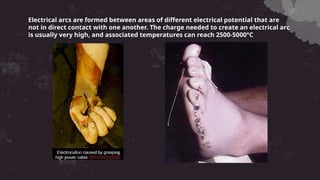
Electrical arcs are formed between areas of different electrical potential that are
not in direct contact with one another. The charge needed to create an electrical arc
is usually very high, and associated temperatures can reach 2500-5000°C
TABLE OF CONTENTS
ATLS Protocol Resuscitation
01 02
Electrocardiograp
hic monitoring
Wound Care
03 04
Resuscitation
Burn resuscitation formulas based on body
surface area burned inaccurate
In absence of gross myo/hemoglobinuria, goal
of resuscitation is to maintain normal vital
signs and a urine output of 30–50 mL/h with
Ringer’s lactate (rate adjusted on an hourly
basis)
Myoglobinuria
Presence of pigmented (darker than light pink) urine
Myoglobin and hemoglobin pigments
Rapid, osmotic diuresis with initial alkalinization to minimize
pigment precipitation in renal tubules
Loop diuretics are not as efficient as mannitol.
Required U/O very high for several hours following injury,
followed by significant reduction (venous return from the injured
part to the central circulation is thrombosed)
Electrocardiographic
monitoring
Indications for cardiac monitoring
Cardiac arrhythmia on
transport
Documented cardiac arrest
Abnormal EKG in ER (other than
sinus brady- or tachycardia)
Burn size or patient age
would require monitoring
Electrocardiographic
monitoring
● Most common abnormalities seen on
an electrocardiogram (ECG) are sinus
tachycardia, nonspecific ST- and T-wave
changes, heart blocks, and
prolongation of the QT interval
● Creatine kinase (CK) and MB creatine
kinase (CK-MB) levels are poor
indicators of myocardial injury in the
absence of ECG finding of myocardial
damage
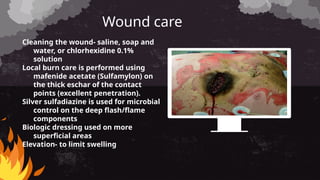
Wound care
Cleaning the wound- saline, soap and
water, or chlorhexidine 0.1%
solution
Local burn care is performed using
mafenide acetate (Sulfamylon) on
the thick eschar of the contact
points (excellent penetration).
Silver sulfadiazine is used for microbial
control on the deep flash/flame
components
Biologic dressing used on more
superficial areas
Elevation- to limit swelling
● Surgical excision begun 2–3 days postburn
● Obviously necrotic tissue removed, while
tissues of questionable viability are retained
and re-evaluated every 2–3 days until wound
closure
● Conservative course of tissue removal and
wound closure with a combination of skin
grafts and/or flaps
● Ongoing program of physical therapy and
functional splinting
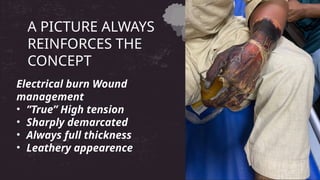
Electrical burn Wound
management
• ”True” High tension
• Sharply demarcated
• Always full thickness
• Leathery appearence
A PICTURE ALWAYS
REINFORCES THE
CONCEPT
Accurate predictors of tissue damage
Radionuclide scanning with xenon-133
Technetium pyrophosphate.
Gadolinium-enhanced MR imaging
MPLES
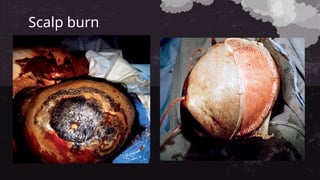
Scalp burn
Scalp burn
Sparing galea:-
-Excision and skin grafting directly onto the galea
Penetrate outer table of skull or deeper:-
-Removing dead bone with an osteotome or a dental type
burr.
-Drilling multiple holes in a close set pattern, deep enough to
cause bleeding from viable cancellous bone
(patient’s advanced age or large burn size precludes more
aggressive approaches to wound closure)
Scalp burn
-Rotation scalp flap(s) over the burned area. Split-
thickness skin grafts over donor defect.
-This provides rapid closure and is associated with minimal
morbidity
-Skin expansion of the hair-bearing area can be performed
12–18 months
-Larger scalp defects are closed with free flaps
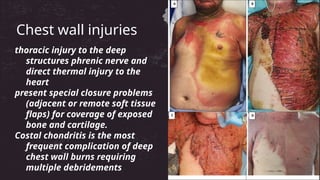
thoracic injury to the deep
structures phrenic nerve and
direct thermal injury to the
heart
present special closure problems
(adjacent or remote soft tissue
flaps) for coverage of exposed
bone and cartilage.
Costal chondritis is the most
frequent complication of deep
chest wall burns requiring
multiple debridements
Chest wall injuries
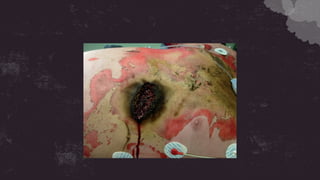
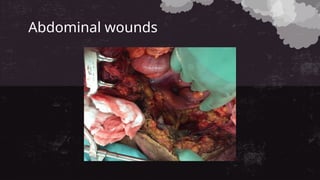
Abdominal wounds
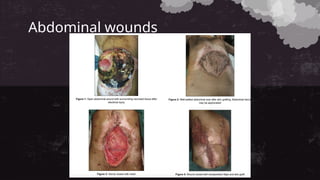
Abdominal wounds
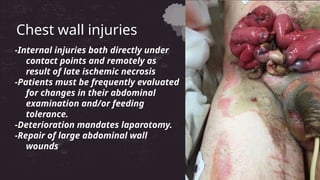
-Internal injuries both directly under
contact points and remotely as
result of late ischemic necrosis
-Patients must be frequently evaluated
for changes in their abdominal
examination and/or feeding
tolerance.
-Deterioration mandates laparotomy.
-Repair of large abdominal wall
wounds
Chest wall injuries
Younger children
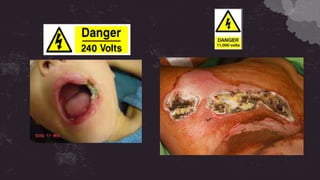
only the oral commissure are initially
treated very conservatively
most serious complication is bleeding
from the labial artery (10–14 days
after injury)
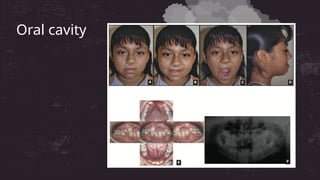
Oral cavity
Gentle stretching and the use of oral splints give good
cosmetic and functional results in most patients
Severe mircostomia is corrected by mucosal advancement
flaps.
Burns of the mid-portions of mouth heal very poorly and
require a much more aggressive surgical approach with
carefully planned reconstruction
Oral cavity
Oral cavity
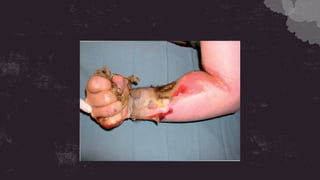
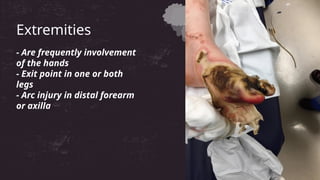
Extremities
- Are frequently involvement
of the hands
- Exit point in one or both
legs
- Arc injury in distal forearm
or axilla
Extremities
Serial debridement every 24–72 hours
Delay closure until demarcation completes
Skin grafts/flaps used for deep or exposed
structures
Compartment syndrome
First 48 hours post injury in high voltage injury
Damaged muscle, swelling within the investing fascia of the
extremity
Loss of pulses is one of the last signs
Serial examinations of the affected extremities or repeated
measurements of compartment pressures
Compartment syndrome
Indications for fasciotomies
clinical signs of compartment syndrome,
Progressive nerve dysfunction
failure of resuscitation with other patients undergoing
exploration
aggressive debridement on the third to fifth postburn day
Surgical Indications
Fasciotomy for compartment syndrome
Escharotomy for full-thickness circumferential
burns
Early exploration & debridement of necrotic tissue
Amputation when limb is non-viable
Stay healthy,
Use electrical
extension cord
wisely
Thank you

Electrocution and lightning management Final.pptx

  • 1.
  • 2.
    ATLS protocol 1. Immediatelylife-threatening conditions are identified and emergency management begun. 2. A. Airway maintenance with cervical spine control 3. B. Breathing and ventilation 4. C. Circulation with haemorrhage control 5. D. Disability - neurological status 6. E. Exposure + environmental control.
  • 4.
    Electrical arcs areformed between areas of different electrical potential that are not in direct contact with one another. The charge needed to create an electrical arc is usually very high, and associated temperatures can reach 2500-5000°C
  • 9.
    TABLE OF CONTENTS ATLSProtocol Resuscitation 01 02 Electrocardiograp hic monitoring Wound Care 03 04
  • 10.
    Resuscitation Burn resuscitation formulasbased on body surface area burned inaccurate In absence of gross myo/hemoglobinuria, goal of resuscitation is to maintain normal vital signs and a urine output of 30–50 mL/h with Ringer’s lactate (rate adjusted on an hourly basis)
  • 11.
  • 12.
    Presence of pigmented(darker than light pink) urine Myoglobin and hemoglobin pigments Rapid, osmotic diuresis with initial alkalinization to minimize pigment precipitation in renal tubules Loop diuretics are not as efficient as mannitol. Required U/O very high for several hours following injury, followed by significant reduction (venous return from the injured part to the central circulation is thrombosed)
  • 13.
  • 14.
    Indications for cardiacmonitoring Cardiac arrhythmia on transport Documented cardiac arrest Abnormal EKG in ER (other than sinus brady- or tachycardia) Burn size or patient age would require monitoring
  • 15.
    Electrocardiographic monitoring ● Most commonabnormalities seen on an electrocardiogram (ECG) are sinus tachycardia, nonspecific ST- and T-wave changes, heart blocks, and prolongation of the QT interval ● Creatine kinase (CK) and MB creatine kinase (CK-MB) levels are poor indicators of myocardial injury in the absence of ECG finding of myocardial damage
  • 16.
    Wound care Cleaning thewound- saline, soap and water, or chlorhexidine 0.1% solution Local burn care is performed using mafenide acetate (Sulfamylon) on the thick eschar of the contact points (excellent penetration). Silver sulfadiazine is used for microbial control on the deep flash/flame components Biologic dressing used on more superficial areas Elevation- to limit swelling
  • 17.
    ● Surgical excisionbegun 2–3 days postburn ● Obviously necrotic tissue removed, while tissues of questionable viability are retained and re-evaluated every 2–3 days until wound closure ● Conservative course of tissue removal and wound closure with a combination of skin grafts and/or flaps ● Ongoing program of physical therapy and functional splinting
  • 18.
    Electrical burn Wound management •”True” High tension • Sharply demarcated • Always full thickness • Leathery appearence A PICTURE ALWAYS REINFORCES THE CONCEPT
  • 19.
    Accurate predictors oftissue damage Radionuclide scanning with xenon-133 Technetium pyrophosphate. Gadolinium-enhanced MR imaging MPLES
  • 20.
  • 21.
    Scalp burn Sparing galea:- -Excisionand skin grafting directly onto the galea Penetrate outer table of skull or deeper:- -Removing dead bone with an osteotome or a dental type burr. -Drilling multiple holes in a close set pattern, deep enough to cause bleeding from viable cancellous bone (patient’s advanced age or large burn size precludes more aggressive approaches to wound closure)
  • 22.
    Scalp burn -Rotation scalpflap(s) over the burned area. Split- thickness skin grafts over donor defect. -This provides rapid closure and is associated with minimal morbidity -Skin expansion of the hair-bearing area can be performed 12–18 months -Larger scalp defects are closed with free flaps
  • 23.
    thoracic injury tothe deep structures phrenic nerve and direct thermal injury to the heart present special closure problems (adjacent or remote soft tissue flaps) for coverage of exposed bone and cartilage. Costal chondritis is the most frequent complication of deep chest wall burns requiring multiple debridements Chest wall injuries
  • 24.
  • 25.
  • 26.
    -Internal injuries bothdirectly under contact points and remotely as result of late ischemic necrosis -Patients must be frequently evaluated for changes in their abdominal examination and/or feeding tolerance. -Deterioration mandates laparotomy. -Repair of large abdominal wall wounds Chest wall injuries
  • 27.
    Younger children only theoral commissure are initially treated very conservatively most serious complication is bleeding from the labial artery (10–14 days after injury) Oral cavity
  • 28.
    Gentle stretching andthe use of oral splints give good cosmetic and functional results in most patients Severe mircostomia is corrected by mucosal advancement flaps. Burns of the mid-portions of mouth heal very poorly and require a much more aggressive surgical approach with carefully planned reconstruction Oral cavity
  • 29.
  • 30.
    Extremities - Are frequentlyinvolvement of the hands - Exit point in one or both legs - Arc injury in distal forearm or axilla
  • 31.
    Extremities Serial debridement every24–72 hours Delay closure until demarcation completes Skin grafts/flaps used for deep or exposed structures
  • 32.
    Compartment syndrome First 48hours post injury in high voltage injury Damaged muscle, swelling within the investing fascia of the extremity Loss of pulses is one of the last signs Serial examinations of the affected extremities or repeated measurements of compartment pressures
  • 33.
    Compartment syndrome Indications forfasciotomies clinical signs of compartment syndrome, Progressive nerve dysfunction failure of resuscitation with other patients undergoing exploration aggressive debridement on the third to fifth postburn day
  • 34.
    Surgical Indications Fasciotomy forcompartment syndrome Escharotomy for full-thickness circumferential burns Early exploration & debridement of necrotic tissue Amputation when limb is non-viable
  • 35.
  • 36.