Electrical Safety
You will learn about…
 Hazards of Electricity
 Isolating Circuits
 Testing Circuits
 Work on Energized Equipment
 Portable Electrical Tools
 Electrical PPE
 Work Area Safety
 Electrical Systems
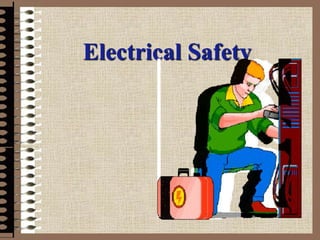
Electrical Safety
Special Training is required for work on
electrical equipment
Only Authorized Employees may conduct
electrical work
Hazards
Electrical Hazards Include
 Electrical Shock
 Electrical Explosions
 Electrical Burns
These can result in severe injury or death
Safe Work Practices
Before starting work…
 De-energize, Lock, Tag and Test all circuits of 50
volts or less
 Deenergize all Power Sources
 Disconnect from all electric energy sources
Control circuit devices such as…
– push buttons
– selector switches
– interlocks
…may not be used as the sole means for
de-energizing circuits or equipment.
Lock & Tag…
Lock & Tag all Sources
 Place Lock & Tag on each disconnecting
means used to de-energize circuits
 Attach Lock so as to prevent operating the
disconnecting means
 Place Tag with Each Lock
If a Lock cannot be applied…
A tag used without a lock must be supplemented by
at least one additional safety measure that
provides a level of safety equal to that of a lock.
Examples:
 Removal of an isolating circuit element such
as a fuse
 Blocking of a controlling switch
 Opening of an extra disconnecting device.
Release Stored Energy…
Stored electric energy must be released
before starting work.
 Discharge all Capacitors &
 Short-Circuit & Ground all high capacitance
elements
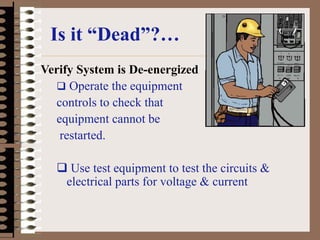
Is it “Dead”?…
Verify System is De-energized
 Operate the equipment
controls to check that
equipment cannot be
restarted.
 Use test equipment to test the circuits &
electrical parts for voltage & current
Check your tester…
Check test equipment (Volt-Ohlm Meter) on a
known live source of same rating to ensure it
works before and after checking the circuit on
which you will be working
Re-energizing Equipment…
 Conduct tests and visual inspections to ensure
all tools, electrical jumpers, shorts, grounds,
and other such devices have been removed
 Warn others to stay clear of circuits and
equipment.
 Each lock and tag must be removed by the
person who applied it
 Visually check that all employees are clear of
the circuits and equipment.
Energized….
Working with Energized Parts
Persons working on energized equipment must
be familiar with the proper use of special
precautionary techniques, personal protective
equipment, insulating and shielding materials,
and insulated tools.
Working on energized circuits
When working on energized circuits
 Isolate the area from all traffic
 Post signs & barricades
 Use an attendant if necessary
 Use insulated tool, mats and sheeting
 Use electrical rubber sheeting to cover nearby
exposed circuits
Conductive Materials
Conductive materials and equipment must be
handled so as to prevent them from
contacting exposed energized conductors
or circuit parts
Conductive Apparel
Remove all conductive articles of jewelry
and clothing, such a watch bands,
bracelets, rings, key chains, necklaces,
metalized aprons, cloth with conductive
thread, or metal headgear.
Portable Electric Tools
Handling
Portable equipment shall be handled in a manner
which will not cause damage. Flexible electric
cords connected to equipment may not be used
for raising or lowering the equipment. Flexible
cords may not be fastened with staples or
otherwise hung in such a fashion as could
damage the outer jacket or insulation.
Visually Inspect…
Portable cord and plug connected equipment
and flexible cord sets (extension cords)
shall be visually inspected before use on
any shift for external defects:
Loose parts
 Deformed or missing pins
 Damage to outer jacket or insulation
 Evidence of possible internal damage
Remove from Service…
If there is a defect or evidence of damage to
any electrical tools or equipment…
Immediately notify your supervisor
Remove the item from service
 Tell your co-workers
Attachment Plugs…
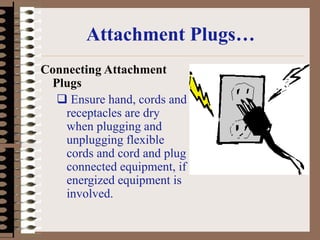
Connecting Attachment
Plugs
 Ensure hand, cords and
receptacles are dry
when plugging and
unplugging flexible
cords and cord and plug
connected equipment, if
energized equipment is
involved.
Ladders….
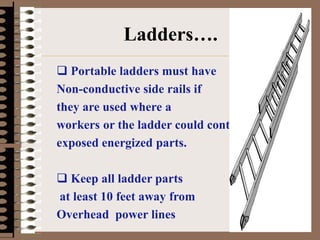
 Portable ladders must have
Non-conductive side rails if
they are used where a
workers or the ladder could contact
exposed energized parts.
 Keep all ladder parts
at least 10 feet away from
Overhead power lines
Test Instruments..
 Test instruments, equipment & test
leads, cables, power cords, probes, and
connectors must be visually inspected
for external defects and damage before
the equipment is used.
 Remove any defective items from
service
Personal Protective
Equipment…
Employees working in areas where there are
potential electrical hazards must use
electrical protective equipment that is
appropriate for the work to be performed.
More on PPE..
• Use, store & maintain your Electrical PPE in a
safe, reliable condition
• Wear nonconductive head protection wherever
there is a danger of head injury from electric
shock or burns due to contact with exposed
energized parts.
• Wear protective equipment for the eyes or face
wherever there is danger of injury to the eyes or
face from electric arcs or flashes or from flying
objects resulting from electrical explosion.
PPE Inspection…
Electrical PPE with any of the following defects
may not be used
 A hole, tear, puncture, or cut
Any other defect that damages the
insulating properties
Tools & Equipment
 Use insulated tools or handling equipment
when working near exposed energized
conductors or circuit parts.
 Use fuse handling equipment to remove or
install fuses when the fuse terminals are
energized.
 Ropes and handlines used near exposed
energized parts must be nonconductive.
Work Area Safety…
You must be able to see what you are doing
when working on energized equipment
 Do not work on energized electrical parts
• without adequate illumination
• if there is an obstruction that prevents seeing
your work area
• if you must reach blindly into areas which may
contain energized parts
Alerting others…
Use safety signs, safety symbols, or accident
prevention tags to warn others about electrical
hazards which may endanger them.
Use barricades to prevent or limit access to work
areas with un-insulated energized conductors or
circuit parts
If signs and barricades do not provide sufficient
warning and protection from electrical hazards,
an attendant shall be stationed to warn and
protect employees
Conductive Work Locations…
Portable electric equipment & flexible cords
used in highly conductive work locations
where employees are likely to contact
water or conductive liquids, must be rated
for the wet environment
Electrical Systems…
Interlocks
Only a qualified person may defeat an
electrical safety interlock, and then only
temporarily while he or she is working on
the equipment. The interlock system shall
be returned to its operable condition when
this work is completed.
Electrical Systems…
Re-closing circuits after protective device
operation
After a circuit is de-energized by a circuit protective
device, the circuit protective device, the circuit
may not be manually reenergized until it has been
determined that the equipment and circuit can be
safely energized. The repetitive manual re-
closing of circuit breakers or reenergizing circuits
through replaced fuses is prohibited.
Over-Currnet Protection…
Overcurrent Protection Modification
Overcurrent protection of circuits and
conductors may not be modified, even
on a temporary basis
System Markings..
Electrical equipment may not be used unless
the manufacturer's name, trademark, or
other descriptive marking is placed on the
equipment.
Other markings shall be provided giving
voltage, current, wattage, or other ratings
as necessary.
Circuit ID…
Identification of disconnecting means and
circuits
 Each disconnecting means for motors and
appliances shall be legibly marked to
indicate its purpose.
 Each service, feeder, and branch circuit, at
its disconnecting means or overcurrent
device, must be legibly marked to indicate
its purpose

electrical-safetyrev1.ppt

  • 1.
  • 2.
    You will learnabout…  Hazards of Electricity  Isolating Circuits  Testing Circuits  Work on Energized Equipment  Portable Electrical Tools  Electrical PPE  Work Area Safety  Electrical Systems
  • 3.
    Electrical Safety Special Trainingis required for work on electrical equipment Only Authorized Employees may conduct electrical work
  • 4.
    Hazards Electrical Hazards Include Electrical Shock  Electrical Explosions  Electrical Burns These can result in severe injury or death
  • 5.
    Safe Work Practices Beforestarting work…  De-energize, Lock, Tag and Test all circuits of 50 volts or less  Deenergize all Power Sources  Disconnect from all electric energy sources Control circuit devices such as… – push buttons – selector switches – interlocks …may not be used as the sole means for de-energizing circuits or equipment.
  • 6.
    Lock & Tag… Lock& Tag all Sources  Place Lock & Tag on each disconnecting means used to de-energize circuits  Attach Lock so as to prevent operating the disconnecting means  Place Tag with Each Lock
  • 7.
    If a Lockcannot be applied… A tag used without a lock must be supplemented by at least one additional safety measure that provides a level of safety equal to that of a lock. Examples:  Removal of an isolating circuit element such as a fuse  Blocking of a controlling switch  Opening of an extra disconnecting device.
  • 8.
    Release Stored Energy… Storedelectric energy must be released before starting work.  Discharge all Capacitors &  Short-Circuit & Ground all high capacitance elements
  • 9.
    Is it “Dead”?… VerifySystem is De-energized  Operate the equipment controls to check that equipment cannot be restarted.  Use test equipment to test the circuits & electrical parts for voltage & current
  • 10.
    Check your tester… Checktest equipment (Volt-Ohlm Meter) on a known live source of same rating to ensure it works before and after checking the circuit on which you will be working
  • 11.
    Re-energizing Equipment…  Conducttests and visual inspections to ensure all tools, electrical jumpers, shorts, grounds, and other such devices have been removed  Warn others to stay clear of circuits and equipment.  Each lock and tag must be removed by the person who applied it  Visually check that all employees are clear of the circuits and equipment.
  • 12.
    Energized…. Working with EnergizedParts Persons working on energized equipment must be familiar with the proper use of special precautionary techniques, personal protective equipment, insulating and shielding materials, and insulated tools.
  • 13.
    Working on energizedcircuits When working on energized circuits  Isolate the area from all traffic  Post signs & barricades  Use an attendant if necessary  Use insulated tool, mats and sheeting  Use electrical rubber sheeting to cover nearby exposed circuits
  • 14.
    Conductive Materials Conductive materialsand equipment must be handled so as to prevent them from contacting exposed energized conductors or circuit parts
  • 15.
    Conductive Apparel Remove allconductive articles of jewelry and clothing, such a watch bands, bracelets, rings, key chains, necklaces, metalized aprons, cloth with conductive thread, or metal headgear.
  • 16.
    Portable Electric Tools Handling Portableequipment shall be handled in a manner which will not cause damage. Flexible electric cords connected to equipment may not be used for raising or lowering the equipment. Flexible cords may not be fastened with staples or otherwise hung in such a fashion as could damage the outer jacket or insulation.
  • 17.
    Visually Inspect… Portable cordand plug connected equipment and flexible cord sets (extension cords) shall be visually inspected before use on any shift for external defects: Loose parts  Deformed or missing pins  Damage to outer jacket or insulation  Evidence of possible internal damage
  • 18.
    Remove from Service… Ifthere is a defect or evidence of damage to any electrical tools or equipment… Immediately notify your supervisor Remove the item from service  Tell your co-workers
  • 19.
    Attachment Plugs… Connecting Attachment Plugs Ensure hand, cords and receptacles are dry when plugging and unplugging flexible cords and cord and plug connected equipment, if energized equipment is involved.
  • 20.
    Ladders….  Portable laddersmust have Non-conductive side rails if they are used where a workers or the ladder could contact exposed energized parts.  Keep all ladder parts at least 10 feet away from Overhead power lines
  • 21.
    Test Instruments..  Testinstruments, equipment & test leads, cables, power cords, probes, and connectors must be visually inspected for external defects and damage before the equipment is used.  Remove any defective items from service
  • 22.
    Personal Protective Equipment… Employees workingin areas where there are potential electrical hazards must use electrical protective equipment that is appropriate for the work to be performed.
  • 23.
    More on PPE.. •Use, store & maintain your Electrical PPE in a safe, reliable condition • Wear nonconductive head protection wherever there is a danger of head injury from electric shock or burns due to contact with exposed energized parts. • Wear protective equipment for the eyes or face wherever there is danger of injury to the eyes or face from electric arcs or flashes or from flying objects resulting from electrical explosion.
  • 24.
    PPE Inspection… Electrical PPEwith any of the following defects may not be used  A hole, tear, puncture, or cut Any other defect that damages the insulating properties
  • 25.
    Tools & Equipment Use insulated tools or handling equipment when working near exposed energized conductors or circuit parts.  Use fuse handling equipment to remove or install fuses when the fuse terminals are energized.  Ropes and handlines used near exposed energized parts must be nonconductive.
  • 26.
    Work Area Safety… Youmust be able to see what you are doing when working on energized equipment  Do not work on energized electrical parts • without adequate illumination • if there is an obstruction that prevents seeing your work area • if you must reach blindly into areas which may contain energized parts
  • 27.
    Alerting others… Use safetysigns, safety symbols, or accident prevention tags to warn others about electrical hazards which may endanger them. Use barricades to prevent or limit access to work areas with un-insulated energized conductors or circuit parts If signs and barricades do not provide sufficient warning and protection from electrical hazards, an attendant shall be stationed to warn and protect employees
  • 28.
    Conductive Work Locations… Portableelectric equipment & flexible cords used in highly conductive work locations where employees are likely to contact water or conductive liquids, must be rated for the wet environment
  • 29.
    Electrical Systems… Interlocks Only aqualified person may defeat an electrical safety interlock, and then only temporarily while he or she is working on the equipment. The interlock system shall be returned to its operable condition when this work is completed.
  • 30.
    Electrical Systems… Re-closing circuitsafter protective device operation After a circuit is de-energized by a circuit protective device, the circuit protective device, the circuit may not be manually reenergized until it has been determined that the equipment and circuit can be safely energized. The repetitive manual re- closing of circuit breakers or reenergizing circuits through replaced fuses is prohibited.
  • 31.
    Over-Currnet Protection… Overcurrent ProtectionModification Overcurrent protection of circuits and conductors may not be modified, even on a temporary basis
  • 32.
    System Markings.. Electrical equipmentmay not be used unless the manufacturer's name, trademark, or other descriptive marking is placed on the equipment. Other markings shall be provided giving voltage, current, wattage, or other ratings as necessary.
  • 33.
    Circuit ID… Identification ofdisconnecting means and circuits  Each disconnecting means for motors and appliances shall be legibly marked to indicate its purpose.  Each service, feeder, and branch circuit, at its disconnecting means or overcurrent device, must be legibly marked to indicate its purpose