Measuring Resistance
The resistance of a
component can be
found by measuring
the current through,
and voltage across,
the component.
Circuit used for measuring the
resistance of an indicator lamp
Question 1
Calculate the resistance of a lamp if a
voltage of 12V causes a current of 3A to
flow through the lamp.
resistance = voltage
current
= 12V / 3A
resistance = 4 ohms (4Ω)
Question 2
Calculate the resistance of a heater if a voltage of
230V causes a current of 200mA to flow through
the heater.
resistance = voltage
current
= 230V / 200mA
= 230V / 0.200A
resistance = 1150 Ω
Question 3
Calculate the voltage across a resistance of
40Ω when a current of 5A is flowing.
V = I x R
= 5A x 40Ω
voltage = 200V
Question 4
Calculate the current flowing through a wire
of resistance of 8Ω when a voltage of 12V is
connected to the wire.
current = voltage
resistance
= 12V / 8Ω
current = 1.5A
Answers
V I R
20 V 4 A
5 A 40 Ω
300 V 0.20 50 Ω
8 V 500 mA
3 kV 150 Ω
4 mA 30 kΩ
5 Ω
200 V
6 A
16 Ω
20 A
120 V
Complete:
Current-voltage graphs
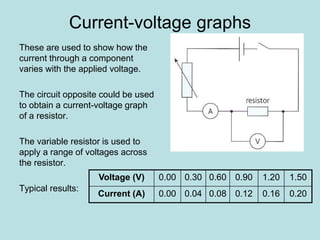
These are used to show how the
current through a component
varies with the applied voltage.
The circuit opposite could be used
to obtain a current-voltage graph
of a resistor.
The variable resistor is used to
apply a range of voltages across
the resistor.
Typical results:
Voltage (V) 0.00 0.30 0.60 0.90 1.20 1.50
Current (A) 0.00 0.04 0.08 0.12 0.16 0.20
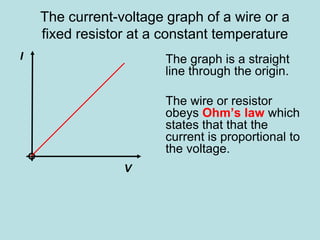
The current-voltage graph of a wire or a
fixed resistor at a constant temperature
The graph is a straight
line through the origin.
The wire or resistor
obeys Ohm’s law which
states that that the
current is proportional to
the voltage.
I
V
Choose appropriate words to fill in the gaps below:
An electric ________ will only flow around a circuit if there
are no ______ in the circuit.
All components have __________. The greater the resistance
the ________ is the current for the same applied voltage.
Resistance is measured in ______.
A current – voltage graph for a ________ is a straight line
through the _______. This shows that the current through
the resistor is ___________ to the applied voltage.
resistance current
resistor ohms
gaps origin
smaller
WORD SELECTION:
proportional
resistance
current
resistor
ohms
gaps
origin
smaller
proportional
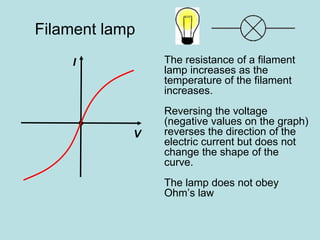
Filament lamp
The resistance of a filament
lamp increases as the
temperature of the filament
increases.
Reversing the voltage
(negative values on the graph)
reverses the direction of the
electric current but does not
change the shape of the
curve.
The lamp does not obey
Ohm’s law
I
V
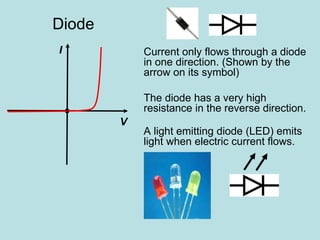
Diode
Current only flows through a diode
in one direction. (Shown by the
arrow on its symbol)
The diode has a very high
resistance in the reverse direction.
A light emitting diode (LED) emits
light when electric current flows.
I
V
Thermistor
The resistance of a
thermistor decreases as
the temperature
increases.
The higher temperature
line therefore has a
greater slope than the
lower temperature case.
I
V
HOT
COLD
Light dependent
resistor (LDR)
The resistance of a
light-dependant resistor
decreases as light
intensity increases.
The bright light line
therefore has a greater
slope than the dim light
case.
I
V
BRIGHT
DIM
Choose appropriate words to fill in the gaps below:
The resistance of a filament lamp _________ when the lamp
comes on and the filament rises in ___________.
A ______ only allows electric current to flow one way. The
allowed direction is shown by the _______ on its circuit
symbol.
The ________ of a thermistor decreases if its temperature is
increased. The resistance of a LDR _________ if the
_______level is increased.
resistance
decreases
arrow diode light
increases
WORD SELECTION:
temperature
resistance
decreases
arrow
diode
light
increases
temperature
Electrical Resistance
Notes questions from pages 82 to 88
1. Give the equation for resistance and state the units used. (see
page 83)
2. Describe how the resistance of a thermistor and LDR can be
varies. (see page 84)
3. With the aid of a circuit diagram describe an experiment to find out
how the current through a wire varies with the voltage across it.
(see pages 85 and 86)
4. Sketch graphs showing how current varies with voltage with a (a)
fixed resistor; (b) lamp; (c) diode. (see pages 86 and 87)
5. What is Ohm’s law? (b) How does a graph show whether or not
Ohm’s law is being obeyed? (see page 85)
6. Answer the questions on page 88.
7. Verify that you can do all of the items listed in the end of chapter
checklist on page 88.

ElectricalResistance.ppt

  • 1.
    Measuring Resistance The resistanceof a component can be found by measuring the current through, and voltage across, the component. Circuit used for measuring the resistance of an indicator lamp
  • 2.
    Question 1 Calculate theresistance of a lamp if a voltage of 12V causes a current of 3A to flow through the lamp. resistance = voltage current = 12V / 3A resistance = 4 ohms (4Ω)
  • 3.
    Question 2 Calculate theresistance of a heater if a voltage of 230V causes a current of 200mA to flow through the heater. resistance = voltage current = 230V / 200mA = 230V / 0.200A resistance = 1150 Ω
  • 4.
    Question 3 Calculate thevoltage across a resistance of 40Ω when a current of 5A is flowing. V = I x R = 5A x 40Ω voltage = 200V
  • 5.
    Question 4 Calculate thecurrent flowing through a wire of resistance of 8Ω when a voltage of 12V is connected to the wire. current = voltage resistance = 12V / 8Ω current = 1.5A
  • 6.
    Answers V I R 20V 4 A 5 A 40 Ω 300 V 0.20 50 Ω 8 V 500 mA 3 kV 150 Ω 4 mA 30 kΩ 5 Ω 200 V 6 A 16 Ω 20 A 120 V Complete:
  • 7.
    Current-voltage graphs These areused to show how the current through a component varies with the applied voltage. The circuit opposite could be used to obtain a current-voltage graph of a resistor. The variable resistor is used to apply a range of voltages across the resistor. Typical results: Voltage (V) 0.00 0.30 0.60 0.90 1.20 1.50 Current (A) 0.00 0.04 0.08 0.12 0.16 0.20
  • 8.
    The current-voltage graphof a wire or a fixed resistor at a constant temperature The graph is a straight line through the origin. The wire or resistor obeys Ohm’s law which states that that the current is proportional to the voltage. I V
  • 9.
    Choose appropriate wordsto fill in the gaps below: An electric ________ will only flow around a circuit if there are no ______ in the circuit. All components have __________. The greater the resistance the ________ is the current for the same applied voltage. Resistance is measured in ______. A current – voltage graph for a ________ is a straight line through the _______. This shows that the current through the resistor is ___________ to the applied voltage. resistance current resistor ohms gaps origin smaller WORD SELECTION: proportional resistance current resistor ohms gaps origin smaller proportional
  • 10.
    Filament lamp The resistanceof a filament lamp increases as the temperature of the filament increases. Reversing the voltage (negative values on the graph) reverses the direction of the electric current but does not change the shape of the curve. The lamp does not obey Ohm’s law I V
  • 11.
    Diode Current only flowsthrough a diode in one direction. (Shown by the arrow on its symbol) The diode has a very high resistance in the reverse direction. A light emitting diode (LED) emits light when electric current flows. I V
  • 12.
    Thermistor The resistance ofa thermistor decreases as the temperature increases. The higher temperature line therefore has a greater slope than the lower temperature case. I V HOT COLD
  • 13.
    Light dependent resistor (LDR) Theresistance of a light-dependant resistor decreases as light intensity increases. The bright light line therefore has a greater slope than the dim light case. I V BRIGHT DIM
  • 14.
    Choose appropriate wordsto fill in the gaps below: The resistance of a filament lamp _________ when the lamp comes on and the filament rises in ___________. A ______ only allows electric current to flow one way. The allowed direction is shown by the _______ on its circuit symbol. The ________ of a thermistor decreases if its temperature is increased. The resistance of a LDR _________ if the _______level is increased. resistance decreases arrow diode light increases WORD SELECTION: temperature resistance decreases arrow diode light increases temperature
  • 15.
    Electrical Resistance Notes questionsfrom pages 82 to 88 1. Give the equation for resistance and state the units used. (see page 83) 2. Describe how the resistance of a thermistor and LDR can be varies. (see page 84) 3. With the aid of a circuit diagram describe an experiment to find out how the current through a wire varies with the voltage across it. (see pages 85 and 86) 4. Sketch graphs showing how current varies with voltage with a (a) fixed resistor; (b) lamp; (c) diode. (see pages 86 and 87) 5. What is Ohm’s law? (b) How does a graph show whether or not Ohm’s law is being obeyed? (see page 85) 6. Answer the questions on page 88. 7. Verify that you can do all of the items listed in the end of chapter checklist on page 88.