ELECTRICAL
SAFETY
GREENPAK
PRIVATE
LIMITED
JHAMPIR,
SINDH,
PAKISTAN.
Engineer Tameer
Hussain Langah
QEHS Engineer
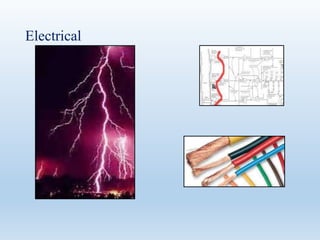
Electrical
Introduction
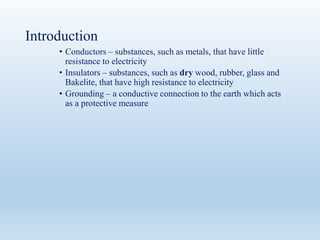
Lesson objectives:
1. Identify major electrical hazards
2. Describe types of electrical hazards
3. Describe electrical protection methods
4. Recognize employer requirements to protect workers from
electrical hazards
Introduction
Definitions:
•Electricity – movement
of the free electrons between
atoms;
• Related terms:
• Current – the movement of
electrical charge
• Resistance – opposition to current flow
• Voltage – a measurement of electrical force
Introduction
• Conductors – substances, such as metals, that have little
resistance to electricity
• Insulators – substances, such as dry wood, rubber, glass and
Bakelite, that have high resistance to electricity
• Grounding – a conductive connection to the earth which acts
as a protective measure
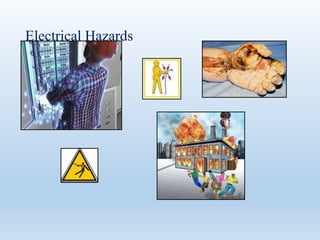
Electrical Hazards
Electrical Hazards
BE SAFE:
•Burns
•Electrocution
•Shock
•Arc flash/arc blast
•Fire
•Explosions
Electrical Hazards
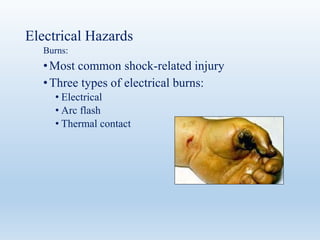
Burns:
•Most common shock-related injury
•Three types of electrical burns:
• Electrical
• Arc flash
• Thermal contact
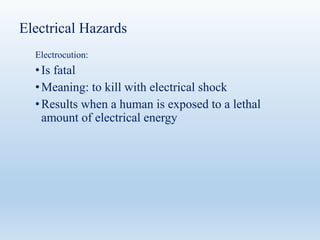
Electrical Hazards
Electrocution:
•Is fatal
•Meaning: to kill with electrical shock
•Results when a human is exposed to a lethal
amount of electrical energy
Electrical Hazards
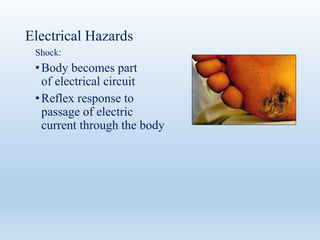
Shock:
•Body becomes part
of electrical circuit
•Reflex response to
passage of electric
current through the body
Electrical Hazards
Arc Flash/Arc Blast
•Arc flash
• Sudden release of electrical energy through air when
a high-voltage gap exists and there is a breakdown
between conductors
• Gives off thermal radiation (heat) and bright, intense
light that can cause burns
• Temperatures as high as 35,000°F
Electrical Hazards
•Arc blast – high-voltage arcs can also
produce considerable pressure waves by
rapidly heating the air and creating a blast
Electrical Hazards
Fire:
•Most result from problems with "fixed wiring”
•Problems with cords, plugs, receptacles, and
switches also cause electrical fires
Electrical Hazards
Explosions:
•Occur when electricity ignites explosive mixture
of material in the air
•Note:
• Electricity is source of these hazards
• All hazards are of equal importance
• Lesson focuses on eliminating electrical hazards
Electrical Hazards
Examples of fatal accidents:
•Case #1: Worker electrocuted when the ladder came
in contact with overhead power lines
•Case #2: Worker electrocuted when mast came in
contact with high voltage overhead lines
Electrical Hazards
•Case #3: Worker changing energized ballast on
light fixture was electrocuted and fell to the
concrete floor while working from an 8' fiberglass
stepladder.
Electrical Hazards
U.S. Bureau of Labor Statistics:
•156 electrocutions for 2014
•Up from 141 in 2013
Types of Electrical Hazards
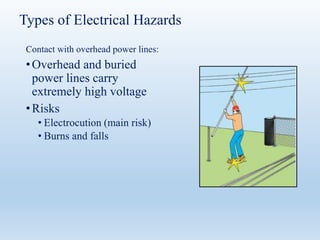
Contact with overhead power lines:
•Overhead and buried
power lines carry
extremely high voltage
•Risks
• Electrocution (main risk)
• Burns and falls
Types of Electrical Hazards
•Cranes are not the only equipment
that can reach overhead power
lines.
•Use of ladders or suspension in a
man-basket under or near power
lines are risks.
Types of Electrical Hazards
•Important: the covering on an overhead power
line is primarily for weather protection;
therefore, workers need to know that if they
touch a power line, covered or bare, death is
probable.
Types of Electrical Hazards
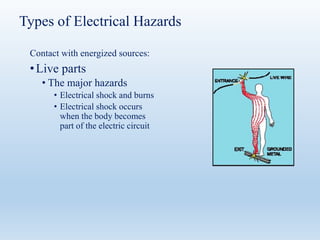
Contact with energized sources:
•Live parts
• The major hazards
• Electrical shock and burns
• Electrical shock occurs
when the body becomes
part of the electric circuit
Types of Electrical Hazards
• Severity and effects of an electrical shock depend on
a number of factors
• Pathway through the body
• Amount of current
• Length of time of the exposure
• Whether skin is wet or dry
• Water
• Great conductor
• Allows current to flow more easily in wet conditions and
through wet skin
Types of Electrical Hazards
•Damaged or bare wires
• Fault current may travel through a body, causing
electrical burns or death, if
• Power supply is not grounded
• Path has been broken
• There are live parts or bare wires
• Extreme conditions and rough treatment can change
electrical equipment from safe to hazardous
Types of Electrical Hazards
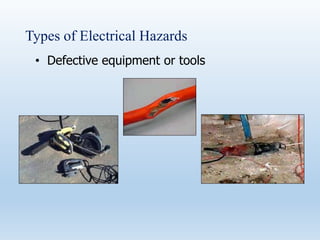
• Defective equipment or tools
Types of Electrical Hazards
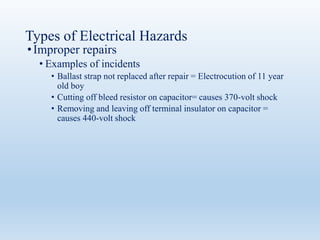
•Improper repairs
• Examples of incidents
• Ballast strap not replaced after repair = Electrocution of 11 year
old boy
• Cutting off bleed resistor on capacitor= causes 370-volt shock
• Removing and leaving off terminal insulator on capacitor =
causes 440-volt shock
Types of Electrical Hazards
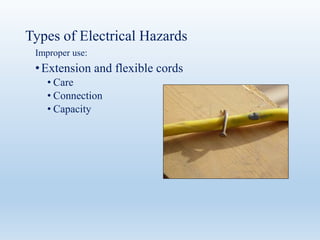
Improper use:
•Extension and flexible cords
• Care
• Connection
• Capacity
Types of Electrical Hazards
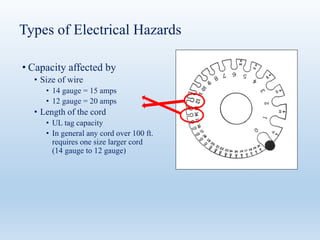
• Capacity affected by
• Size of wire
• 14 gauge = 15 amps
• 12 gauge = 20 amps
• Length of the cord
• UL tag capacity
• In general any cord over 100 ft.
requires one size larger cord
(14 gauge to 12 gauge)
Types of Electrical Hazards
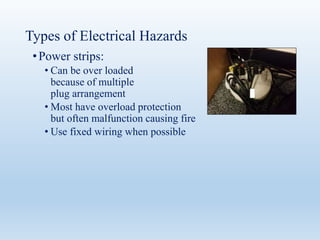
•Power strips:
• Can be over loaded
because of multiple
plug arrangement
• Most have overload protection
but often malfunction causing fire
• Use fixed wiring when possible
Types of Electrical Hazards
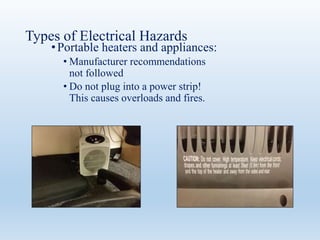
•Portable heaters and appliances:
• Manufacturer recommendations
not followed
• Do not plug into a power strip!
This causes overloads and fires.
Electrical Protection Methods
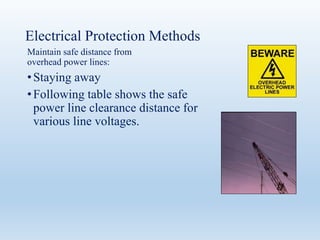
Maintain safe distance from
overhead power lines:
•Staying away
•Following table shows the safe
power line clearance distance for
various line voltages.
Electrical Protection Methods
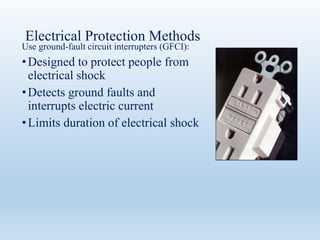
Use ground-fault circuit interrupters (GFCI):
•Designed to protect people from
electrical shock
•Detects ground faults and
interrupts electric current
•Limits duration of electrical shock
Electrical Protection Methods
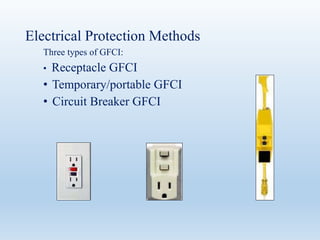
Three types of GFCI:
• Receptacle GFCI
• Temporary/portable GFCI
• Circuit Breaker GFCI
Electrical Protection Methods
Inspect portable tools and extension cords:
•Workers need to inspect extension cords prior to
their use for any cuts or abrasion.
•Electric hand tools that are old, damaged, or misused
may have damaged insulation inside.
Electrical Protection Methods
Use power tools and equipment as designed:
•Follow tool safety tips to avoid misusing
equipment
•Follow manufacturer’s instructions
Electrical Protection Methods
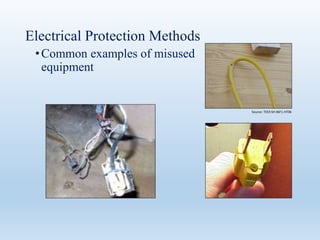
•Common examples of misused
equipment
Source: TEEX SH 46F1-HT06
Electrical Protection Methods
Tool safety tips
•Never carry a tool by the cord.
•Never yank the cord to disconnect it.
•Keep cords away from heat, oil, and sharp
edges.
•Disconnect when not in use and when
changing accessories such as blades and bits.
Electrical Protection Methods
•Avoid accidental starting. Do not hold fingers
on the switch button while carrying a plugged-
in tool.
•Use gloves and appropriate footwear.
•Store in dry a place when not using.
Electrical Protection Methods
•Don’t use in wet/damp environments.
•Keep working areas well lit.
•Ensure that cords do not cause a tripping hazard.
•Remove damaged tools from use.
•Use double-insulated tools.
Electrical Protection Methods
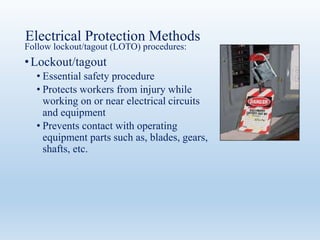
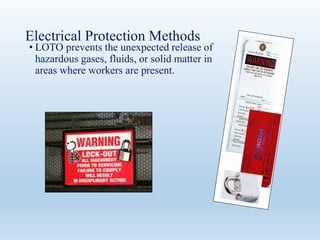
Follow lockout/tagout (LOTO) procedures:
•Lockout/tagout
• Essential safety procedure
• Protects workers from injury while
working on or near electrical circuits
and equipment
• Prevents contact with operating
equipment parts such as, blades, gears,
shafts, etc.
Electrical Protection Methods
• LOTO prevents the unexpected release of
hazardous gases, fluids, or solid matter in
areas where workers are present.
Electrical Protection Methods
Power source identification:
•Mark all breakers accordingly for the circuits they
protect
•Mark all disconnect means accordingly for the
equipment they service
•Identify all voltages with proper labeling
Employer Requirements
Employer requirements to protect workers:
•Ensure overhead power line safety
•Isolate electrical parts
•Supply ground-fault circuit interrupters (GFCI)
protection
•Establish and implement an AEGCP
•Ensure power tools are maintained in a safe condition
Employer Requirements
•Ensure proper guarding
•Provide training
•Enforce LOTO safety related work practices
•Ensure proper use of flexible cords and power
strips
•Ensure proper identification of power sources
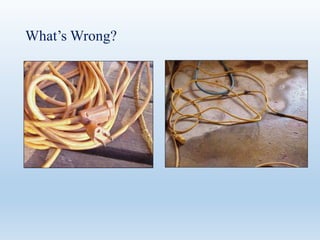
What’s Wrong?
What’s Wrong?
Knowledge Check
1. What is electricity?
a. The movement of atoms within an object
b. The movement of free electrons between atoms
c. Solid mass
d. Movement within the nucleus of an atom
Answer: b. The movement of free
electrons between atoms
Knowledge Check
2. “Electrocution” means ___.
a. received a mild electrical shock
b. killed by electrical shock
c. exposed to electrical current
d. any accident involving electricity
Answer: b. killed by
electrical shock R.I.P.
Knowledge Check
3. New worker needs to ___.
a. Go to work directly due to work load
b. Go to CCR for safety induction
c. Police station for police verification
d. Start working without supervision
Answer: b. Go to CCR
for Safety Induction
Knowledge Check
4. All trained persons can go to perform the job at site, it is not
necessary to inform the management and require PTW?
a. True
b. False
Answer: b. False – PTW/LOTO
must be ensured
Knowledge Check
5. Which gauge of wire will carry the most current?
a. 14 gauge
b. 12 gauge
c. 10 gauge
d. 00 gauge
Answer: d. 00 gauge – the lower the
wire gauge number, the
more current it can carry
Knowledge Check
6. What does GFCI stand for?
a. Ground Flexible Conduit Insulator
b. Ground Flow Current Interceptor
c. Ground Fault Circuit Interrupter
d. Ground Floor Connection Intersector
Answer: c. Ground Fault Circuit
Interrupter
Knowledge Check
7. Which of the following is a safe practice?
a. Trained people go site without informing at CCR and perform job.
b. Untrained people go at work with no supervision
c. After risk assessment, after proper induction, TBT and with proper
PTW/LOTO compliance
d. Don’t listen to anyone and perform your job on your own.
Answer: c. After proper induction, TBT
and with proper PTW/LOTO compliance
Knowledge Check
8. Who is responsible for ensuring that during work the site is de-
energized?
a. Client/UEP
b. Supervisor
c. OM team
d. HSE Manager
Answer: b. Supervisor
Electrical Safety training.pptx

Electrical Safety training.pptx

  • 1.
  • 2.
  • 3.
    Introduction Lesson objectives: 1. Identifymajor electrical hazards 2. Describe types of electrical hazards 3. Describe electrical protection methods 4. Recognize employer requirements to protect workers from electrical hazards
  • 4.
    Introduction Definitions: •Electricity – movement ofthe free electrons between atoms; • Related terms: • Current – the movement of electrical charge • Resistance – opposition to current flow • Voltage – a measurement of electrical force
  • 5.
    Introduction • Conductors –substances, such as metals, that have little resistance to electricity • Insulators – substances, such as dry wood, rubber, glass and Bakelite, that have high resistance to electricity • Grounding – a conductive connection to the earth which acts as a protective measure
  • 6.
  • 7.
  • 8.
    Electrical Hazards Burns: •Most commonshock-related injury •Three types of electrical burns: • Electrical • Arc flash • Thermal contact
  • 9.
    Electrical Hazards Electrocution: •Is fatal •Meaning:to kill with electrical shock •Results when a human is exposed to a lethal amount of electrical energy
  • 10.
    Electrical Hazards Shock: •Body becomespart of electrical circuit •Reflex response to passage of electric current through the body
  • 11.
    Electrical Hazards Arc Flash/ArcBlast •Arc flash • Sudden release of electrical energy through air when a high-voltage gap exists and there is a breakdown between conductors • Gives off thermal radiation (heat) and bright, intense light that can cause burns • Temperatures as high as 35,000°F
  • 12.
    Electrical Hazards •Arc blast– high-voltage arcs can also produce considerable pressure waves by rapidly heating the air and creating a blast
  • 13.
    Electrical Hazards Fire: •Most resultfrom problems with "fixed wiring” •Problems with cords, plugs, receptacles, and switches also cause electrical fires
  • 14.
    Electrical Hazards Explosions: •Occur whenelectricity ignites explosive mixture of material in the air •Note: • Electricity is source of these hazards • All hazards are of equal importance • Lesson focuses on eliminating electrical hazards
  • 15.
    Electrical Hazards Examples offatal accidents: •Case #1: Worker electrocuted when the ladder came in contact with overhead power lines •Case #2: Worker electrocuted when mast came in contact with high voltage overhead lines
  • 16.
    Electrical Hazards •Case #3:Worker changing energized ballast on light fixture was electrocuted and fell to the concrete floor while working from an 8' fiberglass stepladder.
  • 17.
    Electrical Hazards U.S. Bureauof Labor Statistics: •156 electrocutions for 2014 •Up from 141 in 2013
  • 18.
    Types of ElectricalHazards Contact with overhead power lines: •Overhead and buried power lines carry extremely high voltage •Risks • Electrocution (main risk) • Burns and falls
  • 19.
    Types of ElectricalHazards •Cranes are not the only equipment that can reach overhead power lines. •Use of ladders or suspension in a man-basket under or near power lines are risks.
  • 20.
    Types of ElectricalHazards •Important: the covering on an overhead power line is primarily for weather protection; therefore, workers need to know that if they touch a power line, covered or bare, death is probable.
  • 21.
    Types of ElectricalHazards Contact with energized sources: •Live parts • The major hazards • Electrical shock and burns • Electrical shock occurs when the body becomes part of the electric circuit
  • 22.
    Types of ElectricalHazards • Severity and effects of an electrical shock depend on a number of factors • Pathway through the body • Amount of current • Length of time of the exposure • Whether skin is wet or dry • Water • Great conductor • Allows current to flow more easily in wet conditions and through wet skin
  • 23.
    Types of ElectricalHazards •Damaged or bare wires • Fault current may travel through a body, causing electrical burns or death, if • Power supply is not grounded • Path has been broken • There are live parts or bare wires • Extreme conditions and rough treatment can change electrical equipment from safe to hazardous
  • 24.
    Types of ElectricalHazards • Defective equipment or tools
  • 25.
    Types of ElectricalHazards •Improper repairs • Examples of incidents • Ballast strap not replaced after repair = Electrocution of 11 year old boy • Cutting off bleed resistor on capacitor= causes 370-volt shock • Removing and leaving off terminal insulator on capacitor = causes 440-volt shock
  • 26.
    Types of ElectricalHazards Improper use: •Extension and flexible cords • Care • Connection • Capacity
  • 27.
    Types of ElectricalHazards • Capacity affected by • Size of wire • 14 gauge = 15 amps • 12 gauge = 20 amps • Length of the cord • UL tag capacity • In general any cord over 100 ft. requires one size larger cord (14 gauge to 12 gauge)
  • 28.
    Types of ElectricalHazards •Power strips: • Can be over loaded because of multiple plug arrangement • Most have overload protection but often malfunction causing fire • Use fixed wiring when possible
  • 29.
    Types of ElectricalHazards •Portable heaters and appliances: • Manufacturer recommendations not followed • Do not plug into a power strip! This causes overloads and fires.
  • 30.
    Electrical Protection Methods Maintainsafe distance from overhead power lines: •Staying away •Following table shows the safe power line clearance distance for various line voltages.
  • 31.
    Electrical Protection Methods Useground-fault circuit interrupters (GFCI): •Designed to protect people from electrical shock •Detects ground faults and interrupts electric current •Limits duration of electrical shock
  • 32.
    Electrical Protection Methods Threetypes of GFCI: • Receptacle GFCI • Temporary/portable GFCI • Circuit Breaker GFCI
  • 33.
    Electrical Protection Methods Inspectportable tools and extension cords: •Workers need to inspect extension cords prior to their use for any cuts or abrasion. •Electric hand tools that are old, damaged, or misused may have damaged insulation inside.
  • 34.
    Electrical Protection Methods Usepower tools and equipment as designed: •Follow tool safety tips to avoid misusing equipment •Follow manufacturer’s instructions
  • 35.
    Electrical Protection Methods •Commonexamples of misused equipment Source: TEEX SH 46F1-HT06
  • 36.
    Electrical Protection Methods Toolsafety tips •Never carry a tool by the cord. •Never yank the cord to disconnect it. •Keep cords away from heat, oil, and sharp edges. •Disconnect when not in use and when changing accessories such as blades and bits.
  • 37.
    Electrical Protection Methods •Avoidaccidental starting. Do not hold fingers on the switch button while carrying a plugged- in tool. •Use gloves and appropriate footwear. •Store in dry a place when not using.
  • 38.
    Electrical Protection Methods •Don’tuse in wet/damp environments. •Keep working areas well lit. •Ensure that cords do not cause a tripping hazard. •Remove damaged tools from use. •Use double-insulated tools.
  • 39.
    Electrical Protection Methods Followlockout/tagout (LOTO) procedures: •Lockout/tagout • Essential safety procedure • Protects workers from injury while working on or near electrical circuits and equipment • Prevents contact with operating equipment parts such as, blades, gears, shafts, etc.
  • 40.
    Electrical Protection Methods •LOTO prevents the unexpected release of hazardous gases, fluids, or solid matter in areas where workers are present.
  • 41.
    Electrical Protection Methods Powersource identification: •Mark all breakers accordingly for the circuits they protect •Mark all disconnect means accordingly for the equipment they service •Identify all voltages with proper labeling
  • 42.
    Employer Requirements Employer requirementsto protect workers: •Ensure overhead power line safety •Isolate electrical parts •Supply ground-fault circuit interrupters (GFCI) protection •Establish and implement an AEGCP •Ensure power tools are maintained in a safe condition
  • 43.
    Employer Requirements •Ensure properguarding •Provide training •Enforce LOTO safety related work practices •Ensure proper use of flexible cords and power strips •Ensure proper identification of power sources
  • 44.
  • 45.
  • 46.
    Knowledge Check 1. Whatis electricity? a. The movement of atoms within an object b. The movement of free electrons between atoms c. Solid mass d. Movement within the nucleus of an atom Answer: b. The movement of free electrons between atoms
  • 47.
    Knowledge Check 2. “Electrocution”means ___. a. received a mild electrical shock b. killed by electrical shock c. exposed to electrical current d. any accident involving electricity Answer: b. killed by electrical shock R.I.P.
  • 48.
    Knowledge Check 3. Newworker needs to ___. a. Go to work directly due to work load b. Go to CCR for safety induction c. Police station for police verification d. Start working without supervision Answer: b. Go to CCR for Safety Induction
  • 49.
    Knowledge Check 4. Alltrained persons can go to perform the job at site, it is not necessary to inform the management and require PTW? a. True b. False Answer: b. False – PTW/LOTO must be ensured
  • 50.
    Knowledge Check 5. Whichgauge of wire will carry the most current? a. 14 gauge b. 12 gauge c. 10 gauge d. 00 gauge Answer: d. 00 gauge – the lower the wire gauge number, the more current it can carry
  • 51.
    Knowledge Check 6. Whatdoes GFCI stand for? a. Ground Flexible Conduit Insulator b. Ground Flow Current Interceptor c. Ground Fault Circuit Interrupter d. Ground Floor Connection Intersector Answer: c. Ground Fault Circuit Interrupter
  • 52.
    Knowledge Check 7. Whichof the following is a safe practice? a. Trained people go site without informing at CCR and perform job. b. Untrained people go at work with no supervision c. After risk assessment, after proper induction, TBT and with proper PTW/LOTO compliance d. Don’t listen to anyone and perform your job on your own. Answer: c. After proper induction, TBT and with proper PTW/LOTO compliance
  • 53.
    Knowledge Check 8. Whois responsible for ensuring that during work the site is de- energized? a. Client/UEP b. Supervisor c. OM team d. HSE Manager Answer: b. Supervisor

Editor's Notes

  • #4 Enabling Objectives: Identify major electrical hazards. Describe types of electrical hazards. Describe electrical protection methods. Recognize employer requirements to protect workers from electrical hazards.
  • #7 Source: https://www.osha.gov/Publications/osha3075.pdf “Most electrical accidents result from one of the following three factors: • unsafe equipment or installation, • unsafe environment, or • unsafe work practices.”
  • #8 BE SAFE by recognizing, avoiding and protecting against all of these electrical hazards.
  • #9 Electrical burns are the most common shock-related injury. The three types of burns from electricity are: - Electrical burns result from heat generated by the flow of electric current through the body. - Arc/Flash burns are high temperature burns caused by an electric arc or explosion. -Thermal contact burns occur when skin comes in contact with overheated electric equipment.
  • #10 Electrocution is fatal; it means to kill with electrical shock. Electrocution results when a human is exposed to a lethal amount of electrical energy.
  • #11 Shock results when the body becomes part of the electrical circuit; current enters the body at one point and leaves at another. Electrical shock is defined as a reflex response to the passage of electric current through the body.
  • #12 An arc flash is the sudden release of electrical energy through the air when a high-voltage gap exists and there is a breakdown between conductors. An arc flash gives off thermal radiation (heat) and bright, intense light that can cause burns. Temperatures have been recorded as high as 35,000°F.
  • #13 High-voltage arcs can also produce considerable pressure waves by rapidly heating the air and creating a blast An arc flash can be spontaneous or result from inadvertently bridging electrical contacts with a conducting object. Other causes may include dropped tools or the buildup of conductive dust or corrosion. For more information on arc flash/blast, including best practices in electrical safety, refer to NFPA 70E: Standard for Electrical Safety in the Workplace available online at: http://www.nfpa.org/codes-and-standards/all-codes-and-standards/list-of-codes-and-standards?mode=code&code=70E
  • #14 Fire Most electrical distribution fires result from problems with "fixed wiring" such as faulty electrical outlets and old wiring. Problems with cords (such as extension and appliance cords), plugs, receptacles, and switches also cause electrical fires.
  • #15 Explosions An explosion can occur when electricity ignites an explosive mixture of material in the air. Note that although electricity is the source of these hazards, and all of these hazards are of equal importance, this lesson focuses on eliminating electrical hazards.
  • #16 Case #1: Two workers were moving an aluminum ladder. One of them was electrocuted when the ladder came in contact with overhead power lines. Case #2: Worker was raising a mast on a water well drilling truck when the mast came in contact with high voltage overhead lines, electrocuting the worker. Provide examples of accidents related to the type of work your audience does. Locate accident summaries on OSHA’s website. Go to: http://www.osha.gov/pls/imis/accidentsearch.html. Within the keyword field, enter a keyword to be searched against. For example, to obtain accident investigations involving electrocutions, enter the key word electrocuted. To view a list of key words, use the keyword list at the bottom of the Accident Investigation Search page.
  • #17 Case #3: Worker was fatally injured when he was electrocuted and fell to the concrete floor while working from an 8' fiberglass stepladder. Worker was changing an energized ballast on a two-bulb florescent light fixture, located approximately 11.5 ft. off the ground.
  • #18 NOTES: For the most current statistical data, or for more detail, see: http://www.bls.gov/iif/
  • #19 Contact with overhead power lines Overhead and buried power lines are especially hazardous because they carry extremely high voltage. Fatalities are possible as electrocution is the main risk; however, burns and falls from elevations are also hazards that workers are exposed to while working in the vicinity of high voltage power lines.
  • #20 Workers may not realize that cranes are not the only equipment that reaches overhead power lines. Working on a ladder or in a man-basket suspended under or near power lines also poses a risk of electrocution.
  • #21 Important to note: The covering on an overhead power line is primarily for weather protection; therefore, workers need to know that if they touch a power line, covered or bare, death is probable. Voltages of overhead lines range from 120 to 750,000 volts. The most reliable way to know the voltage is to ask the utility company that owns the line. Video: Electrocution: Work Safely with Ladders Near Power Lines (Runtime: 00:05:39)
  • #22 The major hazards regarding contact with energized sources are electrical shock and burns. Electrical shock occurs when the body becomes part of the electric circuit, either when an individual comes in contact with both wires of an electrical circuit, one wire of an energized circuit and the ground, or a metallic part that has become energized by contact with an electrical conductor.
  • #23 The severity and effects of an electrical shock depend on a number of factors, such as the pathway through the body, the amount of current, the length of time of the exposure, and whether the skin is wet or dry. Water is a great conductor of electricity, allowing current to flow more easily in wet conditions and through wet skin.
  • #24 If power supply to electrical equipment is not grounded or the path has been broken, or if there are live parts or bare wires, a fault current may travel through a worker's body, causing electrical burns or death. Even when the power system is properly grounded, electrical equipment can instantly change from safe to hazardous because of extreme conditions and rough treatment.
  • #26 Mercury vapor light fixture on the wood pole was repaired and the ballast strap was not replaced causing the ballast to short from movement the secondary wiring energizing the connecting electrical conduit. Bleed resistors are used to bleed off potential electrical stored energy from capacitors. Rubber insulators are required over capacitor terminals in locations of contact.
  • #27 Because they are exposed, flexible, and unsecured, extension and flexible cords are more susceptible to damage than fixed wiring. Hazards are created when cords, cord connectors, receptacles, and cord- and plug connected equipment are improperly used and maintained. To reduce hazards, flexible cords must connect to devices and to fittings in ways that prevent tension at joints and terminal screws. A flexible cord may be damaged by door or window edges, staples and fastenings, abrasion from adjacent materials, or simply by aging. If the electrical conductors become exposed, there is a danger of shocks, burns, or fire. Overloading extension cords can cause them to overheat. Capacity of the extension cord should be labeled on the UL tag.
  • #28 The higher the wire gauge number of the wire in the cord the less current it can carry. Length of the cord also effects its capacity. The UL tag capacity is related to it length. In general any cord over 100 ft. requires one size larger cord. (14 gauge to 12 gauge)
  • #29 Power strips capability to be over loaded because of the multiple plug arrangement. Most have overload protection but often malfunction causing fire. Use fixed wiring when possible.
  • #30 Portable heaters and appliances are often not used as the manufacturer recommends. Do not plug into a power strip! This causes overloads and fires.
  • #31 Maintain safe distance from overhead power lines Staying away from power lines is the best option. The following table shows the safe power line clearance distance for various line voltages.
  • #32 A "GFCI" is a ground fault circuit interrupter that is designed to protect people from severe and sometimes fatal electrical shock. A GFCI detects ground faults and interrupts the flow of electric current, and is designed to protect the worker by limiting the duration of an electrical shock. NOTE: If the light or tool [other product] remains “ON” when the “Test” button is pushed, the GFCI is not working properly or has been incorrectly installed (miswired). If this is the case, a qualified electrician (equivalent to qualified electrician is a ‘licensed’, ‘certified’, and/or ‘registered’ electrician) needs to be contacted to properly wire or replace the GFCI device.
  • #33 1. Receptacle GFCI: Often found on construction work sites, outdoor areas and other locations where damp conditions do or could exist. 2. Temporary/portable GFCI: AP portable GFCI is an extension cord combined with a GFCI. It adds flexibility in using receptacles that are not protected by GFCls. Extension cords with GFCI protection incorporated should be used when permanent protection is unavailable. 3. Circuit Breaker GFCI: The GFCI circuit breaker controls an entire circuit, and is installed as a replacement for a circuit breaker on the main circuit board. Rather than install multiple GFCI outlets, one GFCI circuit breaker can protect the entire circuit. At sites equipped with circuit breakers, this type of GFCI might be installed in a panel box to give protection to selected circuits. Circuit breaker GFCIs should be tested monthly. Keep in mind that the test will disconnect power to everything on the circuit.
  • #34 Extension cords may have damaged insulation. Sometimes the insulation inside an electrical tool or appliance is damaged. When the insulation is damaged, exposed metal parts may become energized if a live wire inside touches the metal parts
  • #35 OSHA standards: - Use only equipment that is approved [29 CFR 1926.403(a)] - Use all equipment according to the manufacturer's instructions [29 CFR 1926.403(b)(2)]
  • #36 Common examples of misused equipment • Using multi-receptacle boxes designed to be mounted by fitting them with a power cord and placing them on the floor. • Fabricating extension cords with ROMEX wire. • Using equipment outdoors that is labeled for use only in dry, indoor locations. • Attaching ungrounded, two-prong adapter plugs to three-prong cords and tools. • Using circuit breakers or fuses with the wrong rating for over-current protection, e.g., using a 30-amp breaker in a system with 15 or 20 amp receptacles. Protection is lost because it will not trip when the system’s load has been exceeded. • Using modified cords or tools, i.e., ground prongs removed, face plates, insulation, etc. • Using cords or tools with worn insulation or exposed wires.
  • #40 Source: NIOSH Electrical Safety Manual [2009-113]: http://www.cdc.gov/niosh/docs/2009-113 Lockout/tagout is an essential safety procedure that protects workers from injury while working on or near electrical circuits and equipment. In addition, lockout/tagout prevents contact with operating equipment parts such as, blades, gears, shafts, etc.
  • #41 To protect against being electrocuted, workers need to follow lockout/tagout procedures. When performing lockout/tagout on circuits and equipment, the following checklist can be used: • Identify all sources of electrical energy for the equipment or circuits in question • Disable backup energy sources such as generators and batteries • Identify all shut-offs for each energy source • Notify all personnel that equipment and circuitry must be shut off, locked out, and tagged out (Simply turning a switch off is not enough) • Shut off energy sources and lock switch gear in the OFF position. Each worker should apply his/her individual lock and keys kept with the worker • Test equipment and circuitry to ensure they are de-energized. This must be done by a qualified person • Deplete stored energy (for example, in capacitors) by bleeding, blocking, grounding, etc. • Apply a lock or tag to alert other workers that an energy source or piece of equipment has been locked or tagged out • Make sure all workers are safe and accounted for before equipment and circuits are unlocked and turned back on. Only a qualified person may determine when it is safe to re-energize circuits.
  • #42 Power source identification Make sure that all breakers are marked accordingly for the circuits they protect. Make sure that all disconnect means are marked accordingly for the equipment they service. Make sure that all voltages are identified with proper labeling.
  • #43 (AEGCP) assured equipment grounding control program.
  • #45 Photo on left: ground missing Photo on right: cord in water; cord taped to repair Source: TEEX Susan Harwood Grant # 46F1-HT06
  • #46 Photo on left: open electrical panel in motor control room; wet mop stored at electrical disconnect. Photo on right: breakers in panel not identified Source: https://www.osha.gov/SLTC/etools/poultry/general_hazards/elec_hazards.html