Presentation Overview
• Inthis presentation, I shall be covering:
• • About the Polytechnic
• • Vision, Mission & Objectives
• • Organizational Structure
• • Academic Programs & Faculty
• • Infrastructure & Facilities
• • Student Strength & Performance
• • Training, Placement & Industry Interface
• • MoU with Tata for Diploma in Mechatronics
3.
About University Polytechnic
•• Established in [Year]
• • Approved by AICTE and affiliated to
[University Name]
• • Diploma programs: Civil, Mechanical,
Electrical, Computer, Mechatronics
• • Total intake: [Number]
• • Total current strength: [Number]
• • Objective: Providing quality technical
education with industry alignment.
4.
Vision, Mission &Objectives
• Vision: To emerge as a center of excellence in
technical education producing industry-ready
professionals.
• Mission:
• • To impart quality technical education with
practical orientation.
• • To promote innovation, research, and skill
development.
• • To strengthen industry-institute linkages.
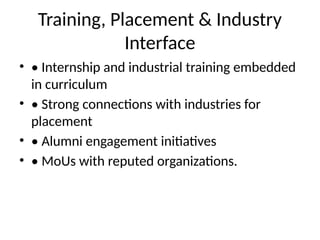
Training, Placement &Industry
Interface
• • Internship and industrial training embedded
in curriculum
• • Strong connections with industries for
placement
• • Alumni engagement initiatives
• • MoUs with reputed organizations.
11.
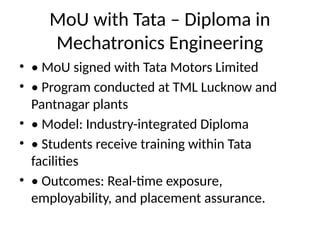
MoU with Tata– Diploma in
Mechatronics Engineering
• • MoU signed with Tata Motors Limited
• • Program conducted at TML Lucknow and
Pantnagar plants
• • Model: Industry-integrated Diploma
• • Students receive training within Tata
facilities
• • Outcomes: Real-time exposure,
employability, and placement assurance.
Strengths, Challenges &
Opportunities
•Strengths:
• • Qualified and dedicated faculty
• • Good discipline and attendance
• • Strong industry linkage (Tata)
• Challenges:
• • Limited space and technical manpower
• • Need for modern lab upgrades
16.
Future Plans &Vision 2025–2030
• • Strengthen Tata collaborations and new
industry MoUs
• • Introduce AI, EV, and Smart Manufacturing
Labs
• • NBA/NAAC accreditation process
• • Faculty upskilling and digital expansion
• • Achieve 100% placement target.
17.
Support Required fromUniversity
• • Faculty recruitment and training support
• • Budget and infrastructure development
• • Policy facilitation for MoU implementation
• • Digital resource enhancement.
18.
Conclusion & ThankYou
• “Together Towards Excellence in Technical
Education.”
• Thank you for your continued support and
guidance.
• Contact: [Your Name]
• Director, University Polytechnic
• Email: [Your Email] | Phone: [Your Number]
Editor's Notes
#1 Welcome the University Head and briefly introduce yourself and the institution.
#2 Briefly tell the audience that these are the key areas that will be covered to give a complete understanding of the Polytechnic.
#3 Explain when and why the Polytechnic was established, and highlight growth and relevance in today’s context.
#4 Read the Vision confidently. Highlight alignment with University and AICTE goals.
#5 Briefly describe how responsibilities and decision-making are distributed.
#6 Explain your approach to maintaining academic quality and compliance with AICTE standards.
#7 Mention faculty strengths and focus on continuous professional development.
#8 Show photos here if possible. Emphasize student-centered infrastructure.
#9 Explain improvement trend and your measures for academic support and monitoring.
#10 Emphasize industry relevance and student exposure.
#11 Explain how this MoU is a milestone connecting academics with real-world industrial learning.
#12 Describe how students benefit through hands-on industrial experience.
#13 Show visuals here if available. Mention student enthusiasm and achievement culture.
#14 Highlight unique practices that make your Polytechnic stand out.
#15 Use this slide to be transparent yet optimistic about future growth.
#16 Focus on your roadmap and align with university’s broader vision.
#17 Politely highlight where the University’s support can make the most impact.
#18 Conclude with gratitude and invite suggestions or discussion.
![University Polytechnic Overview
Presentation
Presented by: Director, University
Polytechnic
Date: [Insert Date]
Venue: [Insert Venue]](https://image.slidesharecdn.com/universitypolytechnicpresentation1-251227061556-15ab56a9/85/electrical-engineering-basic-concept-on-electrical-safety-basic-of-electricity-measuring-instrument-1-320.jpg)
![About University Polytechnic
• • Established in [Year]
• • Approved by AICTE and affiliated to
[University Name]
• • Diploma programs: Civil, Mechanical,
Electrical, Computer, Mechatronics
• • Total intake: [Number]
• • Total current strength: [Number]
• • Objective: Providing quality technical
education with industry alignment.](https://image.slidesharecdn.com/universitypolytechnicpresentation1-251227061556-15ab56a9/85/electrical-engineering-basic-concept-on-electrical-safety-basic-of-electricity-measuring-instrument-3-320.jpg)
![Organizational Structure
• • Director → HODs → Faculty → Supporting
Staff
• • Key Committees: Academic, Examination,
Training & Placement, Discipline, Anti-Ragging,
etc.
• • Faculty and Staff Summary: [Insert Data]](https://image.slidesharecdn.com/universitypolytechnicpresentation1-251227061556-15ab56a9/85/electrical-engineering-basic-concept-on-electrical-safety-basic-of-electricity-measuring-instrument-5-320.jpg)
![Faculty Profile
• • Total Faculty: [Number]
• • Qualifications: Ph.D./M.Tech/B.Tech
• • Regular, Contractual, Guest breakdown
• • FDPs and trainings attended
• • Achievements or recognitions.](https://image.slidesharecdn.com/universitypolytechnicpresentation1-251227061556-15ab56a9/85/electrical-engineering-basic-concept-on-electrical-safety-basic-of-electricity-measuring-instrument-7-320.jpg)
![Student Strength & Performance
• • Total Enrollment: [Insert Number]
• • Attendance: Average 80–85%
• • Academic Performance:
• - 2021–22: 76% pass
• - 2022–23: 82% pass
• - 2023–24: 88% pass
• • Branch-wise results: CE–86%, ME–82%, EE–
80%, CS–90%
• • Initiatives: Mentoring, remedials, parent](https://image.slidesharecdn.com/universitypolytechnicpresentation1-251227061556-15ab56a9/85/electrical-engineering-basic-concept-on-electrical-safety-basic-of-electricity-measuring-instrument-9-320.jpg)
![Conclusion & Thank You
• “Together Towards Excellence in Technical
Education.”
• Thank you for your continued support and
guidance.
• Contact: [Your Name]
• Director, University Polytechnic
• Email: [Your Email] | Phone: [Your Number]](https://image.slidesharecdn.com/universitypolytechnicpresentation1-251227061556-15ab56a9/85/electrical-engineering-basic-concept-on-electrical-safety-basic-of-electricity-measuring-instrument-18-320.jpg)


