Electric Ratemaking
in Texas
November 2020
Legislative advertising paid for by: Association of Electric Companies of Texas
1005 Congress, Suite 1000, Austin, TX 78701 • 512-474-6725 • www.aect.net
512-474-6725
www.aect.net
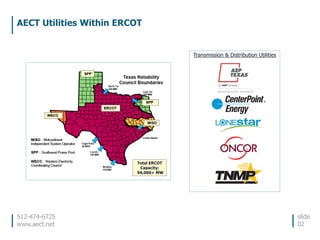
AECT Utilities Within ERCOT
slide
02
Transmission & Distribution Utilities
Total ERCOT
Capacity:
94,000+ MW
512-474-6725
www.aect.net
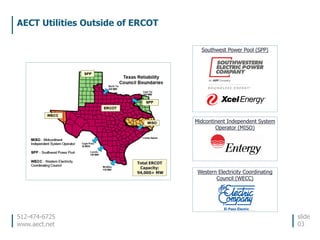
AECT Utilities Outside of ERCOT
slide
03
Western Electricity Coordinating
Council (WECC)
Midcontinent Independent System
Operator (MISO)
Southwest Power Pool (SPP)
Total ERCOT
Capacity:
94,000+ MW
512-474-6725
www.aect.net
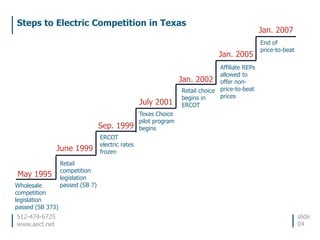
Steps to Electric Competition in Texas
slide
04
Jan. 2007
Jan. 2005
Jan. 2002
July 2001
Sep. 1999
June 1999
May 1995
Wholesale
competition
legislation
passed (SB 373)
Retail
competition
legislation
passed (SB 7)
ERCOT
electric rates
frozen
Texas Choice
pilot program
begins
Retail choice
begins in
ERCOT
Affiliate REPs
allowed to
offer non-
price-to-beat
prices
End of
price-to-beat
512-474-6725
www.aect.net
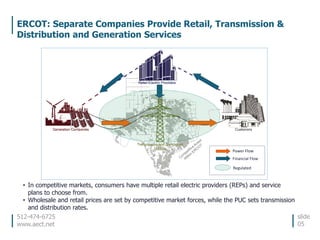
ERCOT: Separate Companies Provide Retail, Transmission &
Distribution and Generation Services
slide
05
• In competitive markets, consumers have multiple retail electric providers (REPs) and service
plans to choose from.
• Wholesale and retail prices are set by competitive market forces, while the PUC sets transmission
and distribution rates.
Power Flow
Financial Flow
Regulated
512-474-6725
www.aect.net
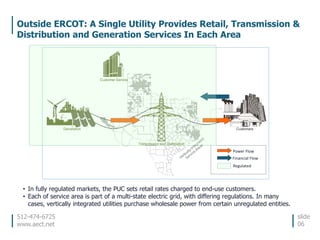
Outside ERCOT: A Single Utility Provides Retail, Transmission &
Distribution and Generation Services In Each Area
slide
06
• In fully regulated markets, the PUC sets retail rates charged to end-use customers.
• Each of service area is part of a multi-state electric grid, with differing regulations. In many
cases, vertically integrated utilities purchase wholesale power from certain unregulated entities.
Power Flow
Financial Flow
Regulated
512-474-6725
www.aect.net
The Regulatory Compact
slide
07
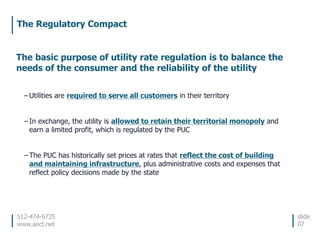
The basic purpose of utility rate regulation is to balance the
needs of the consumer and the reliability of the utility
– Utilities are required to serve all customers in their territory
– In exchange, the utility is allowed to retain their territorial monopoly and
earn a limited profit, which is regulated by the PUC
– The PUC has historically set prices at rates that reflect the cost of building
and maintaining infrastructure, plus administrative costs and expenses that
reflect policy decisions made by the state
512-474-6725
www.aect.net
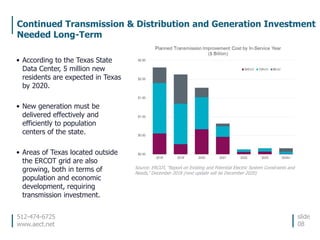
Continued Transmission & Distribution and Generation Investment
Needed Long-Term
slide
08
• According to the Texas State
Data Center, 5 million new
residents are expected in Texas
by 2020.
• New generation must be
delivered effectively and
efficiently to population
centers of the state.
• Areas of Texas located outside
the ERCOT grid are also
growing, both in terms of
population and economic
development, requiring
transmission investment.
Source: ERCOT, “Report on Existing and Potential Electric System Constraints and
Needs,” December 2018 (next update will be December 2020)
512-474-6725
www.aect.net
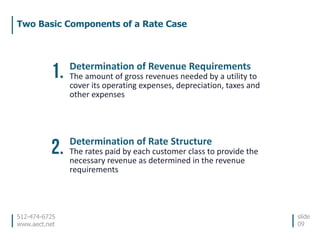
Two Basic Components of a Rate Case
slide
09
Determination of Revenue Requirements
The amount of gross revenues needed by a utility to
cover its operating expenses, depreciation, taxes and
other expenses
Determination of Rate Structure
The rates paid by each customer class to provide the
necessary revenue as determined in the revenue
requirements
1.
2.
512-474-6725
www.aect.net
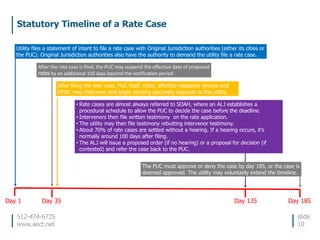
Statutory Timeline of a Rate Case
slide
10
Day 1 Day 185Day 35 Day 135
Utility files a statement of intent to file a rate case with Original Jurisdiction authorities (either its cities or
the PUC). Original Jurisdiction authorities also have the authority to demand the utility file a rate case.
After the rate case is filed, the PUC may suspend the effective date of proposed
rates by an additional 150 days beyond the notification period
After filing the rate case, PUC Staff, cities, affected ratepayer groups and
OPUC may intervene and begin sending discovery requests to the utility.
• Rate cases are almost always referred to SOAH, where an ALJ establishes a
procedural schedule to allow the PUC to decide the case before the deadline.
• Intervenors then file written testimony on the rate application.
• The utility may then file testimony rebutting intervenor testimony.
• About 70% of rate cases are settled without a hearing. If a hearing occurs, it’s
normally around 100 days after filing.
• The ALJ will issue a proposed order (if no hearing) or a proposal for decision (if
contested) and refer the case back to the PUC.
The PUC must approve or deny the case by day 185, or the case is
deemed approved. The utility may voluntarily extend the timeline.
512-474-6725
www.aect.net
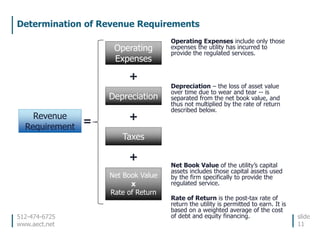
Determination of Revenue Requirements
slide
11
Operating Expenses include only those
expenses the utility has incurred to
provide the regulated services.
Depreciation – the loss of asset value
over time due to wear and tear -- is
separated from the net book value, and
thus not multiplied by the rate of return
described below.
Net Book Value of the utility’s capital
assets includes those capital assets used
by the firm specifically to provide the
regulated service.
Rate of Return is the post-tax rate of
return the utility is permitted to earn. It is
based on a weighted average of the cost
of debt and equity financing.
Revenue
Requirement
Operating
Expenses
+
+
+
=
Depreciation
Taxes
Net Book Value
x
Rate of Return
512-474-6725
www.aect.net
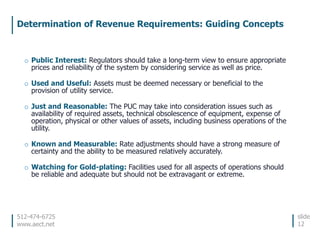
Determination of Revenue Requirements: Guiding Concepts
slide
12
o Public Interest: Regulators should take a long-term view to ensure appropriate
prices and reliability of the system by considering service as well as price.
o Used and Useful: Assets must be deemed necessary or beneficial to the
provision of utility service.
o Just and Reasonable: The PUC may take into consideration issues such as
availability of required assets, technical obsolescence of equipment, expense of
operation, physical or other values of assets, including business operations of the
utility.
o Known and Measurable: Rate adjustments should have a strong measure of
certainty and the ability to be measured relatively accurately.
o Watching for Gold-plating: Facilities used for all aspects of operations should
be reliable and adequate but should not be extravagant or extreme.
512-474-6725
www.aect.net
Determination of Revenue Requirements: Additional Guiding
Concepts
slide
13
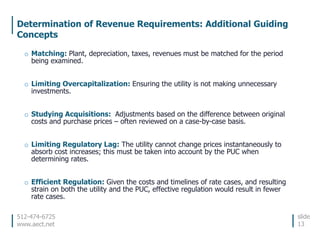
o Matching: Plant, depreciation, taxes, revenues must be matched for the period
being examined.
o Limiting Overcapitalization: Ensuring the utility is not making unnecessary
investments.
o Studying Acquisitions: Adjustments based on the difference between original
costs and purchase prices – often reviewed on a case-by-case basis.
o Limiting Regulatory Lag: The utility cannot change prices instantaneously to
absorb cost increases; this must be taken into account by the PUC when
determining rates.
o Efficient Regulation: Given the costs and timelines of rate cases, and resulting
strain on both the utility and the PUC, effective regulation would result in fewer
rate cases.
512-474-6725
www.aect.net
Determination of Rate Structure: Customer Classes
slide
14
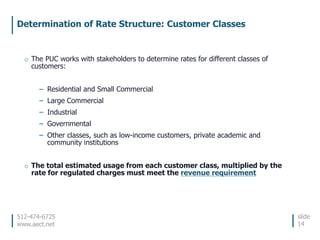
o The PUC works with stakeholders to determine rates for different classes of
customers:
– Residential and Small Commercial
– Large Commercial
– Industrial
– Governmental
– Other classes, such as low-income customers, private academic and
community institutions
o The total estimated usage from each customer class, multiplied by the
rate for regulated charges must meet the revenue requirement
512-474-6725
www.aect.net
Charges Included in Utility Rates
slide
15
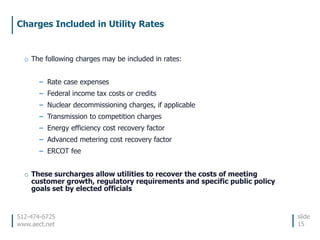
o The following charges may be included in rates:
– Rate case expenses
– Federal income tax costs or credits
– Nuclear decommissioning charges, if applicable
– Transmission to competition charges
– Energy efficiency cost recovery factor
– Advanced metering cost recovery factor
– ERCOT fee
o These surcharges allow utilities to recover the costs of meeting
customer growth, regulatory requirements and specific public policy
goals set by elected officials
512-474-6725
www.aect.net
Newest Mechanisms in Utility Ratemaking in Texas
slide
16
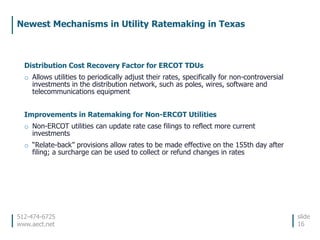
Distribution Cost Recovery Factor for ERCOT TDUs
o Allows utilities to periodically adjust their rates, specifically for non-controversial
investments in the distribution network, such as poles, wires, software and
telecommunications equipment
Improvements in Ratemaking for Non-ERCOT Utilities
o Non-ERCOT utilities can update rate case filings to reflect more current
investments
o “Relate-back” provisions allow rates to be made effective on the 155th day after
filing; a surcharge can be used to collect or refund changes in rates
512-474-6725
www.aect.net
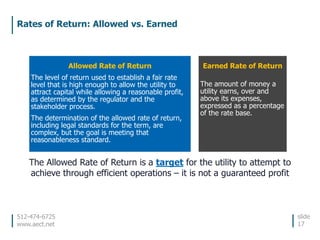
Rates of Return: Allowed vs. Earned
slide
17
Allowed Rate of Return
The level of return used to establish a fair rate
level that is high enough to allow the utility to
attract capital while allowing a reasonable profit,
as determined by the regulator and the
stakeholder process.
The determination of the allowed rate of return,
including legal standards for the term, are
complex, but the goal is meeting that
reasonableness standard.
Earned Rate of Return
The amount of money a
utility earns, over and
above its expenses,
expressed as a percentage
of the rate base.
The Allowed Rate of Return is a target for the utility to attempt to
achieve through efficient operations – it is not a guaranteed profit
512-474-6725
www.aect.net
How to Reach Us
slide
18
AECT.net
@aectnet
AECT Advocacy
The AECT App

Electric Ratemaking in Texas

  • 1.
    Electric Ratemaking in Texas November2020 Legislative advertising paid for by: Association of Electric Companies of Texas 1005 Congress, Suite 1000, Austin, TX 78701 • 512-474-6725 • www.aect.net
  • 2.
    512-474-6725 www.aect.net AECT Utilities WithinERCOT slide 02 Transmission & Distribution Utilities Total ERCOT Capacity: 94,000+ MW
  • 3.
    512-474-6725 www.aect.net AECT Utilities Outsideof ERCOT slide 03 Western Electricity Coordinating Council (WECC) Midcontinent Independent System Operator (MISO) Southwest Power Pool (SPP) Total ERCOT Capacity: 94,000+ MW
  • 4.
    512-474-6725 www.aect.net Steps to ElectricCompetition in Texas slide 04 Jan. 2007 Jan. 2005 Jan. 2002 July 2001 Sep. 1999 June 1999 May 1995 Wholesale competition legislation passed (SB 373) Retail competition legislation passed (SB 7) ERCOT electric rates frozen Texas Choice pilot program begins Retail choice begins in ERCOT Affiliate REPs allowed to offer non- price-to-beat prices End of price-to-beat
  • 5.
    512-474-6725 www.aect.net ERCOT: Separate CompaniesProvide Retail, Transmission & Distribution and Generation Services slide 05 • In competitive markets, consumers have multiple retail electric providers (REPs) and service plans to choose from. • Wholesale and retail prices are set by competitive market forces, while the PUC sets transmission and distribution rates. Power Flow Financial Flow Regulated
  • 6.
    512-474-6725 www.aect.net Outside ERCOT: ASingle Utility Provides Retail, Transmission & Distribution and Generation Services In Each Area slide 06 • In fully regulated markets, the PUC sets retail rates charged to end-use customers. • Each of service area is part of a multi-state electric grid, with differing regulations. In many cases, vertically integrated utilities purchase wholesale power from certain unregulated entities. Power Flow Financial Flow Regulated
  • 7.
    512-474-6725 www.aect.net The Regulatory Compact slide 07 Thebasic purpose of utility rate regulation is to balance the needs of the consumer and the reliability of the utility – Utilities are required to serve all customers in their territory – In exchange, the utility is allowed to retain their territorial monopoly and earn a limited profit, which is regulated by the PUC – The PUC has historically set prices at rates that reflect the cost of building and maintaining infrastructure, plus administrative costs and expenses that reflect policy decisions made by the state
  • 8.
    512-474-6725 www.aect.net Continued Transmission &Distribution and Generation Investment Needed Long-Term slide 08 • According to the Texas State Data Center, 5 million new residents are expected in Texas by 2020. • New generation must be delivered effectively and efficiently to population centers of the state. • Areas of Texas located outside the ERCOT grid are also growing, both in terms of population and economic development, requiring transmission investment. Source: ERCOT, “Report on Existing and Potential Electric System Constraints and Needs,” December 2018 (next update will be December 2020)
  • 9.
    512-474-6725 www.aect.net Two Basic Componentsof a Rate Case slide 09 Determination of Revenue Requirements The amount of gross revenues needed by a utility to cover its operating expenses, depreciation, taxes and other expenses Determination of Rate Structure The rates paid by each customer class to provide the necessary revenue as determined in the revenue requirements 1. 2.
  • 10.
    512-474-6725 www.aect.net Statutory Timeline ofa Rate Case slide 10 Day 1 Day 185Day 35 Day 135 Utility files a statement of intent to file a rate case with Original Jurisdiction authorities (either its cities or the PUC). Original Jurisdiction authorities also have the authority to demand the utility file a rate case. After the rate case is filed, the PUC may suspend the effective date of proposed rates by an additional 150 days beyond the notification period After filing the rate case, PUC Staff, cities, affected ratepayer groups and OPUC may intervene and begin sending discovery requests to the utility. • Rate cases are almost always referred to SOAH, where an ALJ establishes a procedural schedule to allow the PUC to decide the case before the deadline. • Intervenors then file written testimony on the rate application. • The utility may then file testimony rebutting intervenor testimony. • About 70% of rate cases are settled without a hearing. If a hearing occurs, it’s normally around 100 days after filing. • The ALJ will issue a proposed order (if no hearing) or a proposal for decision (if contested) and refer the case back to the PUC. The PUC must approve or deny the case by day 185, or the case is deemed approved. The utility may voluntarily extend the timeline.
  • 11.
    512-474-6725 www.aect.net Determination of RevenueRequirements slide 11 Operating Expenses include only those expenses the utility has incurred to provide the regulated services. Depreciation – the loss of asset value over time due to wear and tear -- is separated from the net book value, and thus not multiplied by the rate of return described below. Net Book Value of the utility’s capital assets includes those capital assets used by the firm specifically to provide the regulated service. Rate of Return is the post-tax rate of return the utility is permitted to earn. It is based on a weighted average of the cost of debt and equity financing. Revenue Requirement Operating Expenses + + + = Depreciation Taxes Net Book Value x Rate of Return
  • 12.
    512-474-6725 www.aect.net Determination of RevenueRequirements: Guiding Concepts slide 12 o Public Interest: Regulators should take a long-term view to ensure appropriate prices and reliability of the system by considering service as well as price. o Used and Useful: Assets must be deemed necessary or beneficial to the provision of utility service. o Just and Reasonable: The PUC may take into consideration issues such as availability of required assets, technical obsolescence of equipment, expense of operation, physical or other values of assets, including business operations of the utility. o Known and Measurable: Rate adjustments should have a strong measure of certainty and the ability to be measured relatively accurately. o Watching for Gold-plating: Facilities used for all aspects of operations should be reliable and adequate but should not be extravagant or extreme.
  • 13.
    512-474-6725 www.aect.net Determination of RevenueRequirements: Additional Guiding Concepts slide 13 o Matching: Plant, depreciation, taxes, revenues must be matched for the period being examined. o Limiting Overcapitalization: Ensuring the utility is not making unnecessary investments. o Studying Acquisitions: Adjustments based on the difference between original costs and purchase prices – often reviewed on a case-by-case basis. o Limiting Regulatory Lag: The utility cannot change prices instantaneously to absorb cost increases; this must be taken into account by the PUC when determining rates. o Efficient Regulation: Given the costs and timelines of rate cases, and resulting strain on both the utility and the PUC, effective regulation would result in fewer rate cases.
  • 14.
    512-474-6725 www.aect.net Determination of RateStructure: Customer Classes slide 14 o The PUC works with stakeholders to determine rates for different classes of customers: – Residential and Small Commercial – Large Commercial – Industrial – Governmental – Other classes, such as low-income customers, private academic and community institutions o The total estimated usage from each customer class, multiplied by the rate for regulated charges must meet the revenue requirement
  • 15.
    512-474-6725 www.aect.net Charges Included inUtility Rates slide 15 o The following charges may be included in rates: – Rate case expenses – Federal income tax costs or credits – Nuclear decommissioning charges, if applicable – Transmission to competition charges – Energy efficiency cost recovery factor – Advanced metering cost recovery factor – ERCOT fee o These surcharges allow utilities to recover the costs of meeting customer growth, regulatory requirements and specific public policy goals set by elected officials
  • 16.
    512-474-6725 www.aect.net Newest Mechanisms inUtility Ratemaking in Texas slide 16 Distribution Cost Recovery Factor for ERCOT TDUs o Allows utilities to periodically adjust their rates, specifically for non-controversial investments in the distribution network, such as poles, wires, software and telecommunications equipment Improvements in Ratemaking for Non-ERCOT Utilities o Non-ERCOT utilities can update rate case filings to reflect more current investments o “Relate-back” provisions allow rates to be made effective on the 155th day after filing; a surcharge can be used to collect or refund changes in rates
  • 17.
    512-474-6725 www.aect.net Rates of Return:Allowed vs. Earned slide 17 Allowed Rate of Return The level of return used to establish a fair rate level that is high enough to allow the utility to attract capital while allowing a reasonable profit, as determined by the regulator and the stakeholder process. The determination of the allowed rate of return, including legal standards for the term, are complex, but the goal is meeting that reasonableness standard. Earned Rate of Return The amount of money a utility earns, over and above its expenses, expressed as a percentage of the rate base. The Allowed Rate of Return is a target for the utility to attempt to achieve through efficient operations – it is not a guaranteed profit
  • 18.
    512-474-6725 www.aect.net How to ReachUs slide 18 AECT.net @aectnet AECT Advocacy The AECT App