U.S. History – Chapter 15 / #15

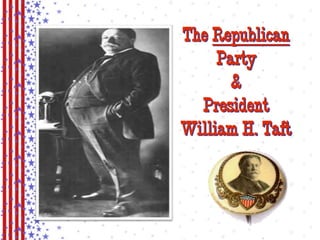
The Republican 
Party 
& 
President 
William H. Taft
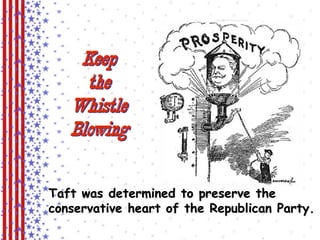
Keep 
the 
Whistle 
Blowing 
Taft was determined to preserve the 
conservative heart of the Republican Party.
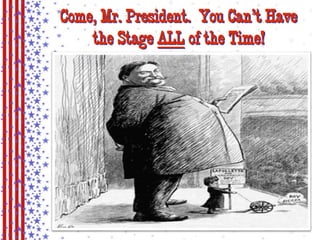
Come, Mr. President. You Can’t Have 
the Stage ALL of the Time!
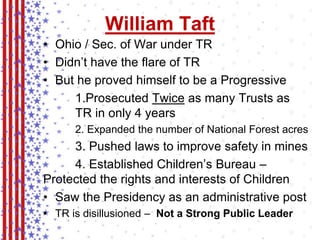
William Taft 
• Ohio / Sec. of War under TR 
• Didn’t have the flare of TR 
• But he proved himself to be a Progressive 
1.Prosecuted Twice as many Trusts as 
TR in only 4 years 
2. Expanded the number of National Forest acres 
3. Pushed laws to improve safety in mines 
4. Established Children’s Bureau – 
Protected the rights and interests of Children 
• Saw the Presidency as an administrative post 
• TR is disillusioned – Not a Strong Public Leader
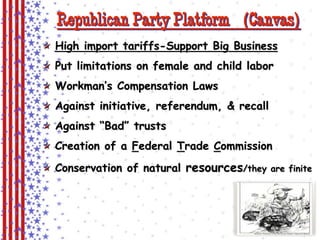
Republican Party Platform (Canvas) 
High import tariffs-Support Big Business 
Put limitations on female and child labor 
Workman’s Compensation Laws 
Against initiative, referendum, & recall 
Against “Bad” trusts 
Creation of a Federal Trade Commission 
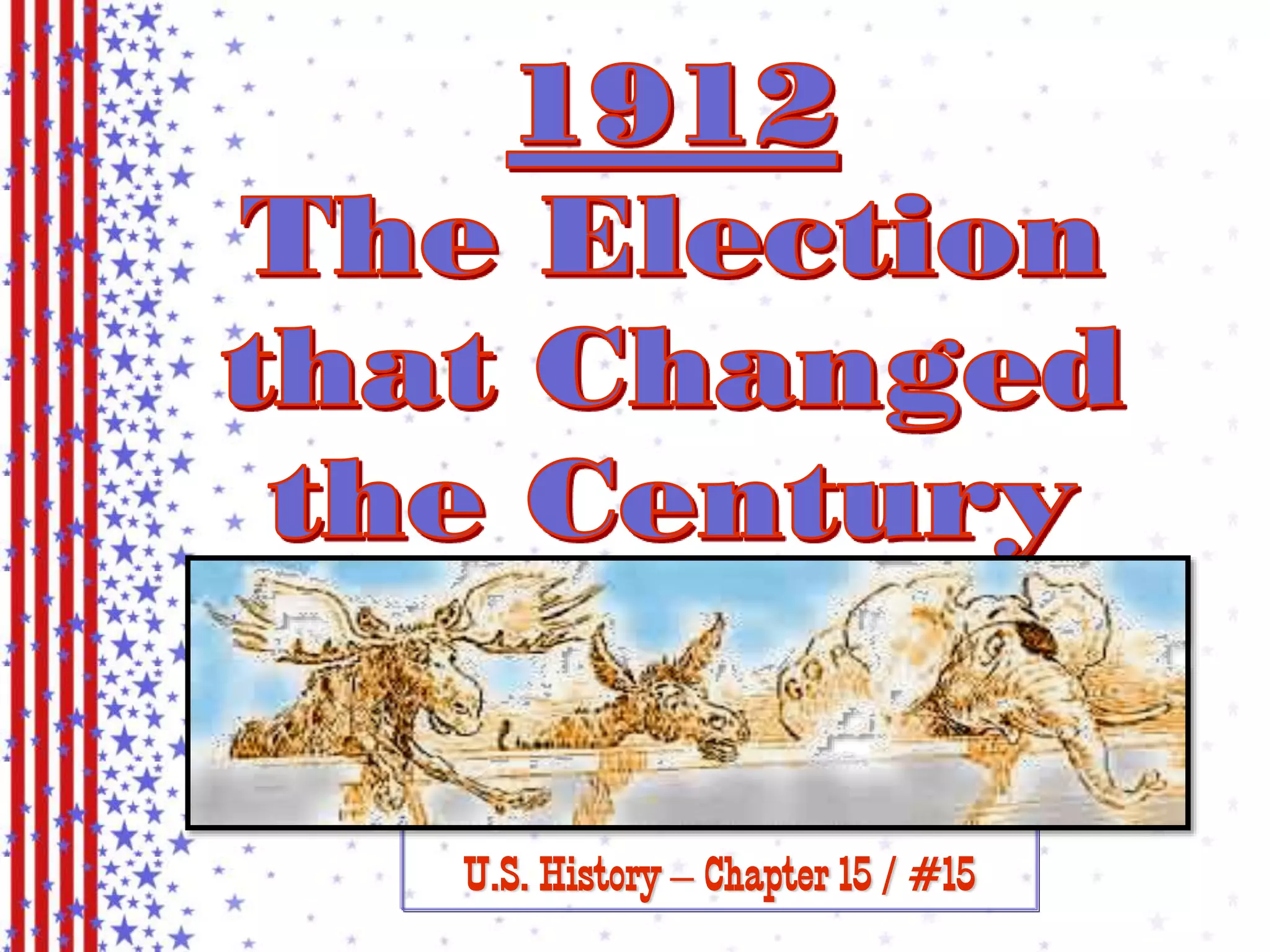
Conservation of natural resources/they are finite
Republican Convention of 1912 
TR & Taft both arrive expecting the 
nomination of the party 
Who Deserves the Nomination? 
Taft or TR 
The Party Chooses Taft 
TR bolts from the party
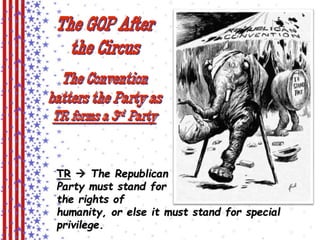
The GOP After 
the Circus 
The Convention 
batters the Party as 
TR forms a 3rd Party 
TR  The Republican 
Party must stand for 
the rights of 
humanity, or else it must stand for special 
privilege.
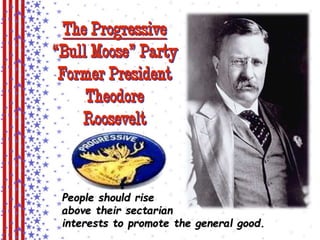
The Progressive 
“Bull Moose” Party 
Former President 
Theodore 
Roosevelt 
People should rise 
above their sectarian 
interests to promote the general good.
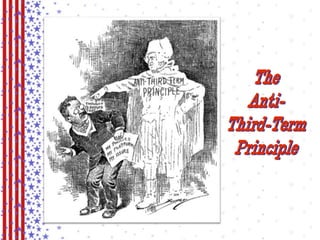
The 
Anti- 
Third-Term 
Principle
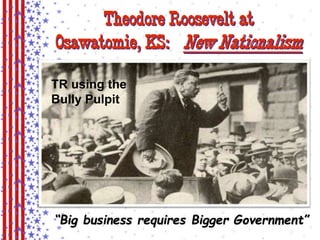
Theodore Roosevelt at 
Osawatomie, KS: New Nationalism 
TR using the 
Bully Pulpit 
“Big business requires Bigger Government”
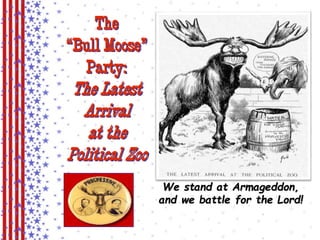
The 
“Bull Moose” 
Party: 
The Latest 
Arrival 
at the 
Political Zoo 
We stand at Armageddon, 
and we battle for the Lord!
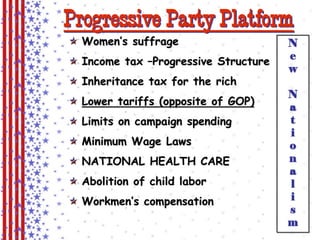
Progressive Party Platform 
Women’s suffrage 
Income tax –Progressive Structure 
Inheritance tax for the rich 
Lower tariffs (opposite of GOP) 
Limits on campaign spending 
Minimum Wage Laws 
NATIONAL HEALTH CARE 
Abolition of child labor 
Workmen’s compensation 
New 
National 
ism
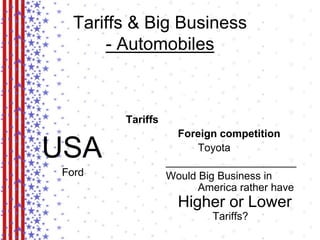
Tariffs & Big Business 
- Automobiles 
Tariffs 
USA 
Ford 
Foreign competition 
Toyota 
______________________ 
Would Big Business in 
America rather have 
Higher or Lower 
Tariffs?
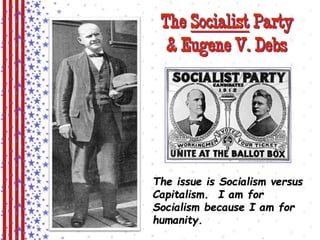
The Socialist Party 
& Eugene V. Debs 
The issue is Socialism versus 
Capitalism. I am for 
Socialism because I am for 
humanity.
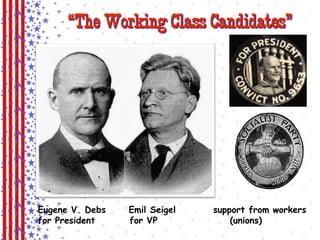
“The Working Class Candidates” 
Eugene V. Debs Emil Seigel support from workers 
for President for VP (unions)
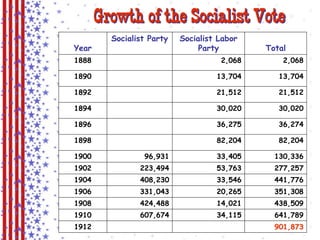
Growth of the Socialist Vote 
Year 
Socialist Party Socialist Labor 
Party Total 
1888 2,068 2,068 
1890 13,704 13,704 
1892 21,512 21,512 
1894 30,020 30,020 
1896 36,275 36,274 
1898 82,204 82,204 
1900 96,931 33,405 130,336 
1902 223,494 53,763 277,257 
1904 408,230 33,546 441,776 
1906 331,043 20,265 351,308 
1908 424,488 14,021 438,509 
1910 607,674 34,115 641,789 
1912 901,873
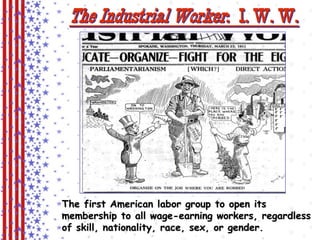
The Industrial Worker : I. W. W. 
The first American labor group to open its 
membership to all wage-earning workers, regardless 
of skill, nationality, race, sex, or gender.
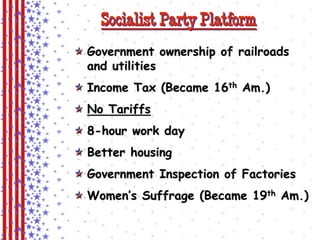
Socialist Party Platform 
Government ownership of railroads 
and utilities 
Income Tax (Became 16th Am.) 
No Tariffs 
8-hour work day 
Better housing 
Government Inspection of Factories 
Women’s Suffrage (Became 19th Am.)
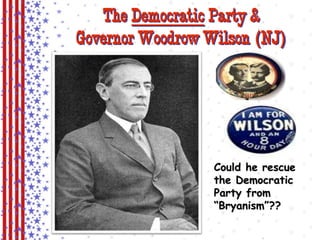
The Democratic Party & 
Governor Woodrow Wilson (NJ) 
Could he rescue 
the Democratic 
Party from 
“Bryanism”??
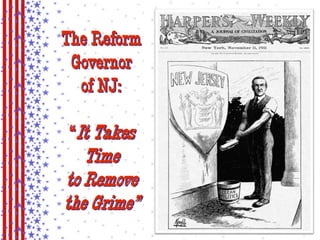
The Reform 
Governor 
of NJ: 
“It Takes 
Time 
to Remove 
the Grime”
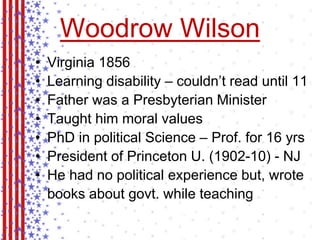
Woodrow Wilson 
• Virginia 1856 
• Learning disability – couldn’t read until 11 
• Father was a Presbyterian Minister 
• Taught him moral values 
• PhD in political Science – Prof. for 16 yrs 
• President of Princeton U. (1902-10) - NJ 
• He had no political experience but, wrote 
books about govt. while teaching
Wilson becomes a Politician 
• Books seemed to show he believed the 
Republican reforms were too extreme 
• Nominated by James Smith (NJ Party Boss) 
- to run for Governor in 1910 as Dem. 
(Electable/Novice/Non Threatening Appearance) 
• Elected Gov. in 1910 - NJ 
• Declared independence from the machine 
• Supported many progressive reforms in NJ
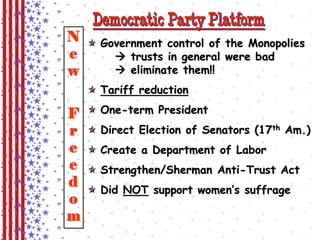
Democratic Party Platform 
Government control of the Monopolies 
 trusts in general were bad 
 eliminate them!! 
Tariff reduction 
One-term President 
Direct Election of Senators (17th Am.) 
Create a Department of Labor 
Strengthen/Sherman Anti-Trust Act 
Did NOT support women’s suffrage 
New 
Freedom
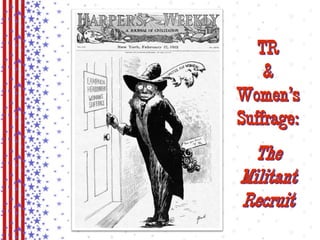
TR 
& 
Women’s 
Suffrage: 
The 
Militant 
Recruit
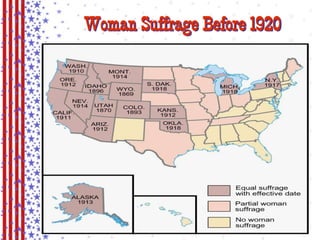
Woman Suffrage Before 1920
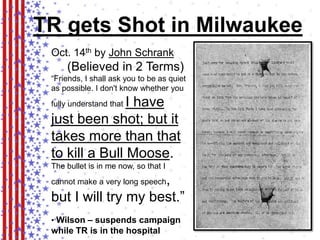
TR gets Shot in Milwaukee 
Oct. 14th by John Schrank 
(Believed in 2 Terms) 
“Friends, I shall ask you to be as quiet 
as possible. I don't know whether you 
fully understand that I have 
just been shot; but it 
takes more than that 
to kill a Bull Moose. 
The bullet is in me now, so that I 
cannot make a very long speech, 
but I will try my best.” 
• Wilson – suspends campaign 
while TR is in the hospital
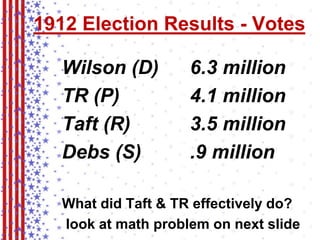
1912 Election Results - Votes 
Wilson (D) 6.3 million 
TR (P) 4.1 million 
Taft (R) 3.5 million 
Debs (S) .9 million 
What did Taft & TR effectively do? 
look at math problem on next slide
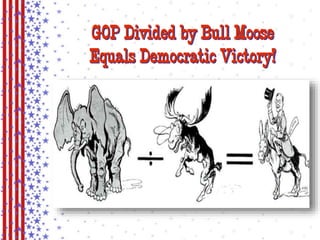
GOP Divided by Bull Moose 
Equals Democratic Victory!
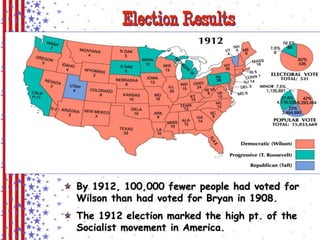
Election Results 
By 1912, 100,000 fewer people had voted for 
Wilson than had voted for Bryan in 1908. 
The 1912 election marked the high pt. of the 
Socialist movement in America.
Ch 15.3 p. 537-540 ebook 
• Wilson’s New Freedoms Program 
consisted of Four main Categories 
1) Tariffs 
2) Banks 
3) Trusts 
4) Reforms for Workers 
Explain each Category: 
• What was the issue? 
• What was created to carry out his plan ? 
• Did he succeed? Did he Compromise?
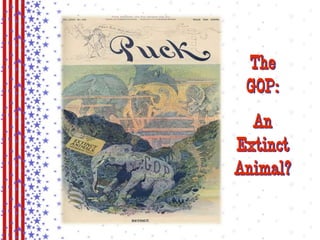
The 
GOP: 
An 
Extinct 
Animal?
Answers 
1.Tariffs 
– Underwood Tariff 
- reduced rate to about 30% of 
the value of the goods or 1/2 of what 
is was in the 1890’s 
Underwood Tariff also had a 
provision for the collection of a direct 
income tax(1%) – 16th Am in 1913
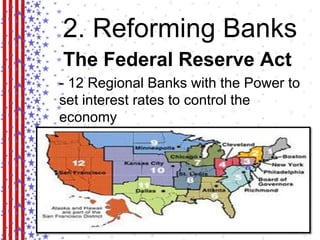
2. Reforming Banks 
The Federal Reserve Act 
- 12 Regional Banks with the Power to 
set interest rates to control the 
economy
3. Trusts 
Creation of the FTC 
– Federal Trade Commission 
To monitor Am. Business so they would 
stop unfair trade practices(slow) 
Clayton Antitrust Act 
outlawed practices that restricted 
competition – stronger than the Sherman
4. Reforms for Workers 
Keating-Owen Child Labor Law 
- prohibited the employment of kids 
U14 in factories producing goods for 
interstate commerce 
1918 – declared unconstitutional 
(child labor is not interstate commerce so 
only the state could enforce) 
Adamson Act – 8 hr workday for RR workers 
Federal Farm Loan Act – low interest loans
Election of1912 5

Election of1912 5

  • 1.
    U.S. History –Chapter 15 / #15
  • 3.
    The Republican Party & President William H. Taft
  • 4.
    Keep the Whistle Blowing Taft was determined to preserve the conservative heart of the Republican Party.
  • 5.
    Come, Mr. President.You Can’t Have the Stage ALL of the Time!
  • 6.
    William Taft •Ohio / Sec. of War under TR • Didn’t have the flare of TR • But he proved himself to be a Progressive 1.Prosecuted Twice as many Trusts as TR in only 4 years 2. Expanded the number of National Forest acres 3. Pushed laws to improve safety in mines 4. Established Children’s Bureau – Protected the rights and interests of Children • Saw the Presidency as an administrative post • TR is disillusioned – Not a Strong Public Leader
  • 7.
    Republican Party Platform(Canvas) High import tariffs-Support Big Business Put limitations on female and child labor Workman’s Compensation Laws Against initiative, referendum, & recall Against “Bad” trusts Creation of a Federal Trade Commission Conservation of natural resources/they are finite
  • 8.
    Republican Convention of1912 TR & Taft both arrive expecting the nomination of the party Who Deserves the Nomination? Taft or TR The Party Chooses Taft TR bolts from the party
  • 9.
    The GOP After the Circus The Convention batters the Party as TR forms a 3rd Party TR  The Republican Party must stand for the rights of humanity, or else it must stand for special privilege.
  • 10.
    The Progressive “BullMoose” Party Former President Theodore Roosevelt People should rise above their sectarian interests to promote the general good.
  • 11.
  • 12.
    Theodore Roosevelt at Osawatomie, KS: New Nationalism TR using the Bully Pulpit “Big business requires Bigger Government”
  • 13.
    The “Bull Moose” Party: The Latest Arrival at the Political Zoo We stand at Armageddon, and we battle for the Lord!
  • 14.
    Progressive Party Platform Women’s suffrage Income tax –Progressive Structure Inheritance tax for the rich Lower tariffs (opposite of GOP) Limits on campaign spending Minimum Wage Laws NATIONAL HEALTH CARE Abolition of child labor Workmen’s compensation New National ism
  • 15.
    Tariffs & BigBusiness - Automobiles Tariffs USA Ford Foreign competition Toyota ______________________ Would Big Business in America rather have Higher or Lower Tariffs?
  • 16.
    The Socialist Party & Eugene V. Debs The issue is Socialism versus Capitalism. I am for Socialism because I am for humanity.
  • 17.
    “The Working ClassCandidates” Eugene V. Debs Emil Seigel support from workers for President for VP (unions)
  • 18.
    Growth of theSocialist Vote Year Socialist Party Socialist Labor Party Total 1888 2,068 2,068 1890 13,704 13,704 1892 21,512 21,512 1894 30,020 30,020 1896 36,275 36,274 1898 82,204 82,204 1900 96,931 33,405 130,336 1902 223,494 53,763 277,257 1904 408,230 33,546 441,776 1906 331,043 20,265 351,308 1908 424,488 14,021 438,509 1910 607,674 34,115 641,789 1912 901,873
  • 19.
    The Industrial Worker: I. W. W. The first American labor group to open its membership to all wage-earning workers, regardless of skill, nationality, race, sex, or gender.
  • 20.
    Socialist Party Platform Government ownership of railroads and utilities Income Tax (Became 16th Am.) No Tariffs 8-hour work day Better housing Government Inspection of Factories Women’s Suffrage (Became 19th Am.)
  • 21.
    The Democratic Party& Governor Woodrow Wilson (NJ) Could he rescue the Democratic Party from “Bryanism”??
  • 22.
    The Reform Governor of NJ: “It Takes Time to Remove the Grime”
  • 23.
    Woodrow Wilson •Virginia 1856 • Learning disability – couldn’t read until 11 • Father was a Presbyterian Minister • Taught him moral values • PhD in political Science – Prof. for 16 yrs • President of Princeton U. (1902-10) - NJ • He had no political experience but, wrote books about govt. while teaching
  • 24.
    Wilson becomes aPolitician • Books seemed to show he believed the Republican reforms were too extreme • Nominated by James Smith (NJ Party Boss) - to run for Governor in 1910 as Dem. (Electable/Novice/Non Threatening Appearance) • Elected Gov. in 1910 - NJ • Declared independence from the machine • Supported many progressive reforms in NJ
  • 25.
    Democratic Party Platform Government control of the Monopolies  trusts in general were bad  eliminate them!! Tariff reduction One-term President Direct Election of Senators (17th Am.) Create a Department of Labor Strengthen/Sherman Anti-Trust Act Did NOT support women’s suffrage New Freedom
  • 26.
    TR & Women’s Suffrage: The Militant Recruit
  • 27.
  • 28.
    TR gets Shotin Milwaukee Oct. 14th by John Schrank (Believed in 2 Terms) “Friends, I shall ask you to be as quiet as possible. I don't know whether you fully understand that I have just been shot; but it takes more than that to kill a Bull Moose. The bullet is in me now, so that I cannot make a very long speech, but I will try my best.” • Wilson – suspends campaign while TR is in the hospital
  • 29.
    1912 Election Results- Votes Wilson (D) 6.3 million TR (P) 4.1 million Taft (R) 3.5 million Debs (S) .9 million What did Taft & TR effectively do? look at math problem on next slide
  • 30.
    GOP Divided byBull Moose Equals Democratic Victory!
  • 31.
    Election Results By1912, 100,000 fewer people had voted for Wilson than had voted for Bryan in 1908. The 1912 election marked the high pt. of the Socialist movement in America.
  • 32.
    Ch 15.3 p.537-540 ebook • Wilson’s New Freedoms Program consisted of Four main Categories 1) Tariffs 2) Banks 3) Trusts 4) Reforms for Workers Explain each Category: • What was the issue? • What was created to carry out his plan ? • Did he succeed? Did he Compromise?
  • 33.
    The GOP: An Extinct Animal?
  • 34.
    Answers 1.Tariffs –Underwood Tariff - reduced rate to about 30% of the value of the goods or 1/2 of what is was in the 1890’s Underwood Tariff also had a provision for the collection of a direct income tax(1%) – 16th Am in 1913
  • 35.
    2. Reforming Banks The Federal Reserve Act - 12 Regional Banks with the Power to set interest rates to control the economy
  • 36.
    3. Trusts Creationof the FTC – Federal Trade Commission To monitor Am. Business so they would stop unfair trade practices(slow) Clayton Antitrust Act outlawed practices that restricted competition – stronger than the Sherman
  • 37.
    4. Reforms forWorkers Keating-Owen Child Labor Law - prohibited the employment of kids U14 in factories producing goods for interstate commerce 1918 – declared unconstitutional (child labor is not interstate commerce so only the state could enforce) Adamson Act – 8 hr workday for RR workers Federal Farm Loan Act – low interest loans