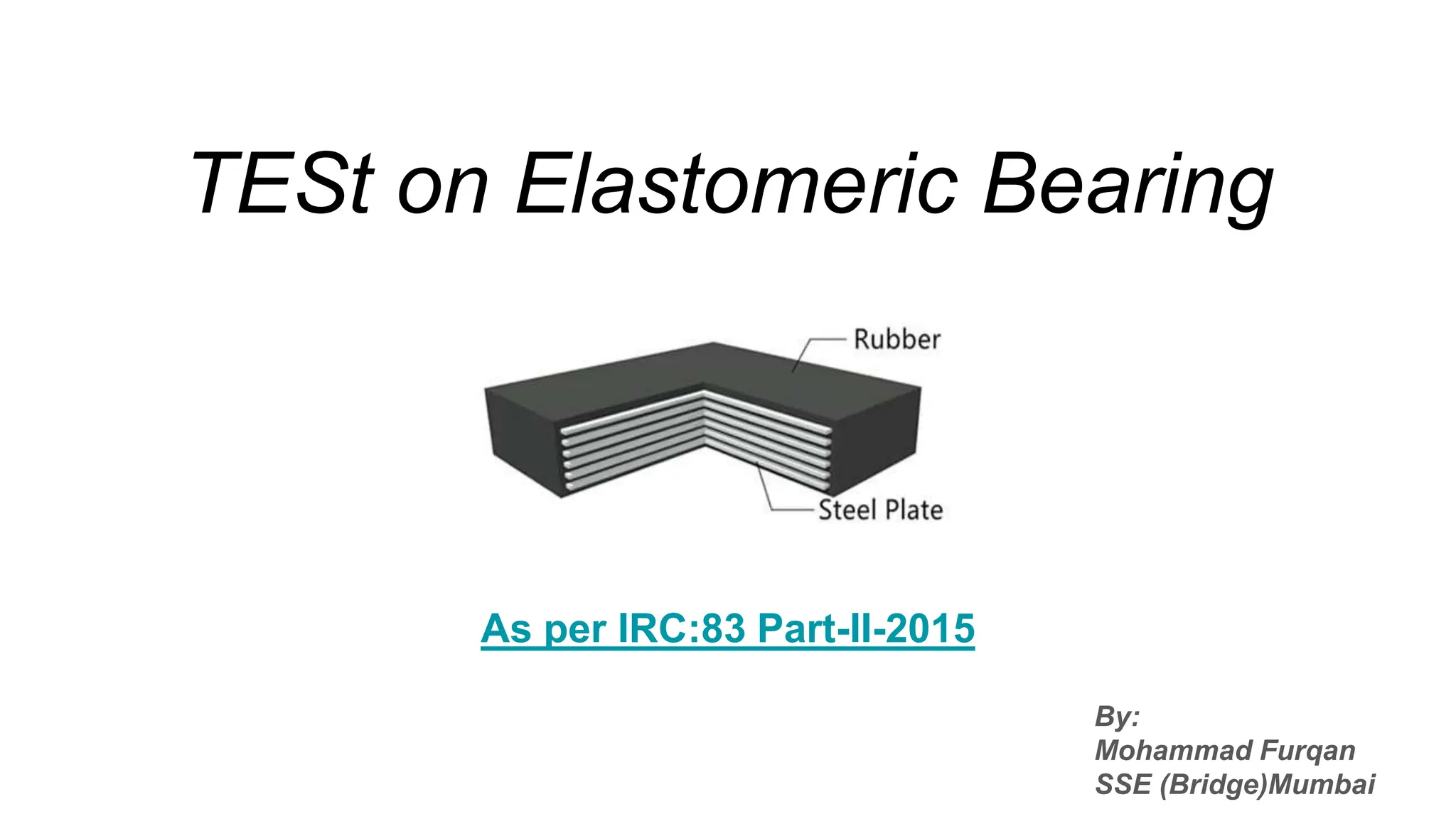
TESt on Elastomeric Bearing
As per IRC:83 Part-II-2015
By:
Mohammad Furqan
SSE (Bridge)Mumbai
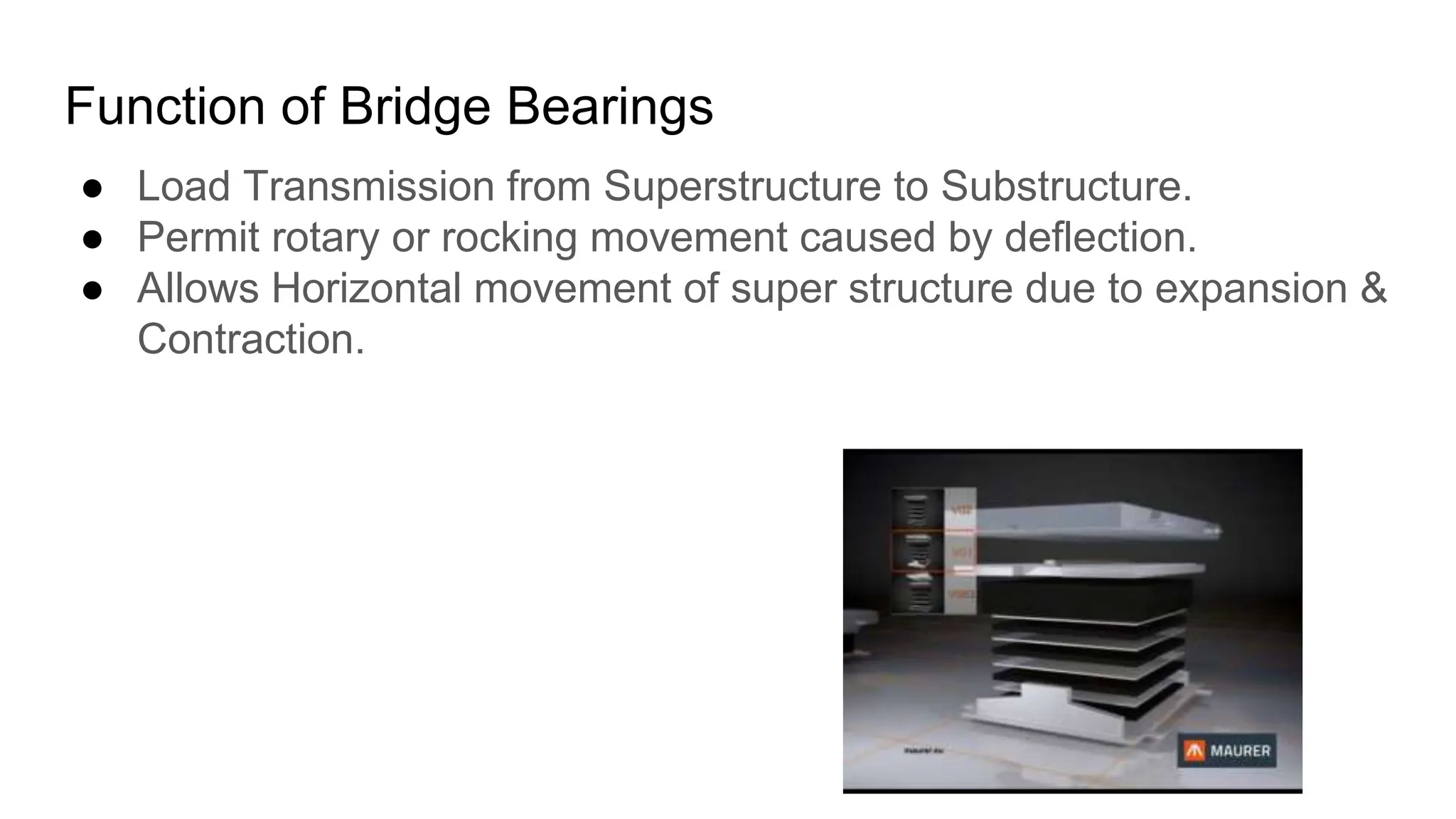
Function of Bridge Bearings
● Load Transmission from Superstructure to Substructure.
● Permit rotary or rocking movement caused by deflection.
● Allows Horizontal movement of super structure due to expansion &
Contraction.
Manufacture Test Check of Elastomeric Pad
As maintenance cost of Elastomeric Pad is very low, but the
replacement of Bridge Bearing requires huge investment.
If Elastomeric Pad is not as per standard Specification laid
down in IRC 83 Part-II,it may result in early deterioration of
Bearing Pads which may lead to replacement of Bearing.To
avoid such a situation Manufacturing Test check of
Elastomeric Pad is required before launching.
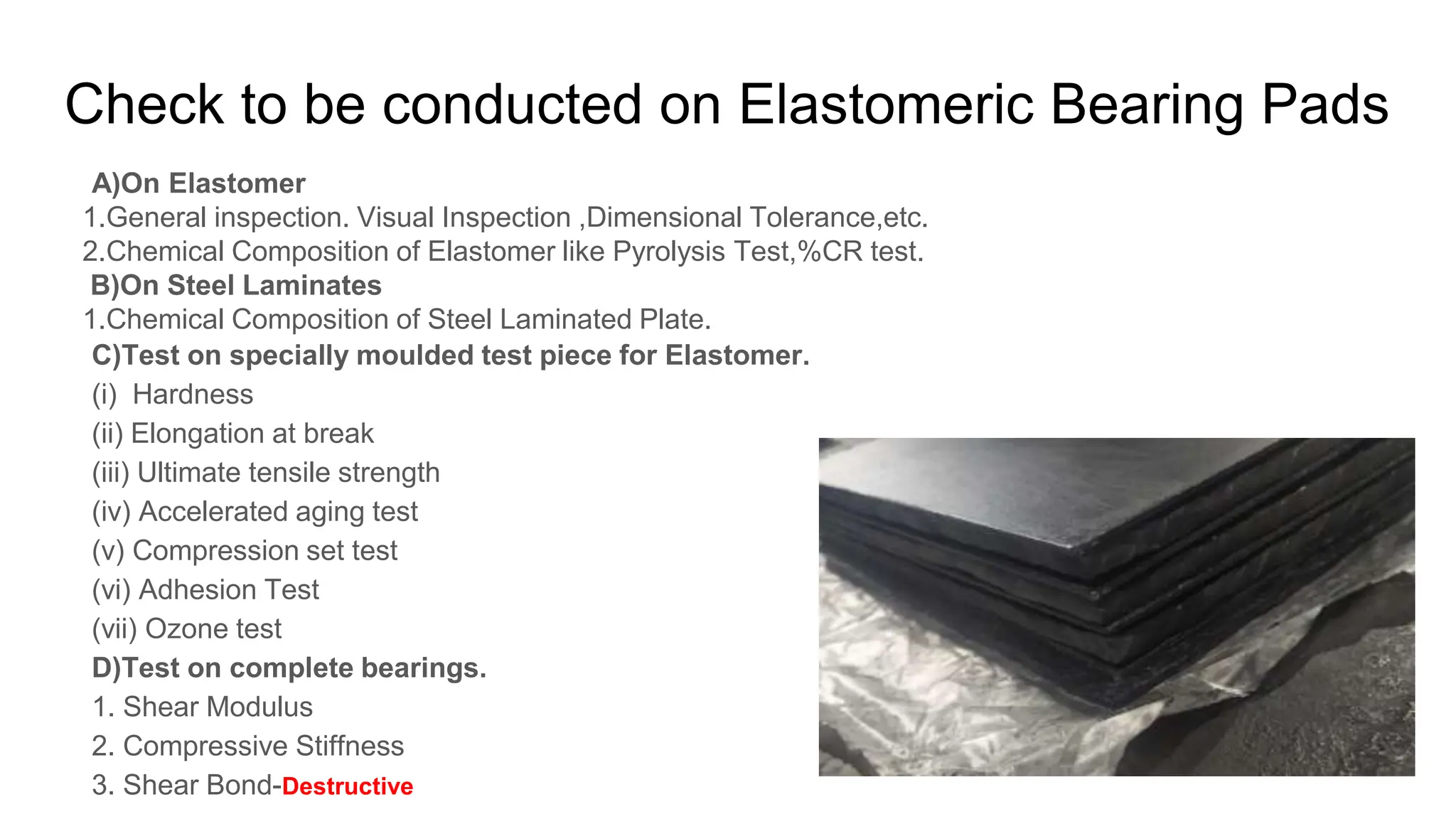
Check to be conducted on Elastomeric Bearing Pads
A)On Elastomer
1.General inspection. Visual Inspection ,Dimensional Tolerance,etc.
2.Chemical Composition of Elastomer like Pyrolysis Test,%CR test.
B)On Steel Laminates
1.Chemical Composition of Steel Laminated Plate.
C)Test on specially moulded test piece for Elastomer.
(i) Hardness
(ii) Elongation at break
(iii) Ultimate tensile strength
(iv) Accelerated aging test
(v) Compression set test
(vi) Adhesion Test
(vii) Ozone test
D)Test on complete bearings.
1. Shear Modulus
2. Compressive Stiffness
3. Shear Bond-Destructive
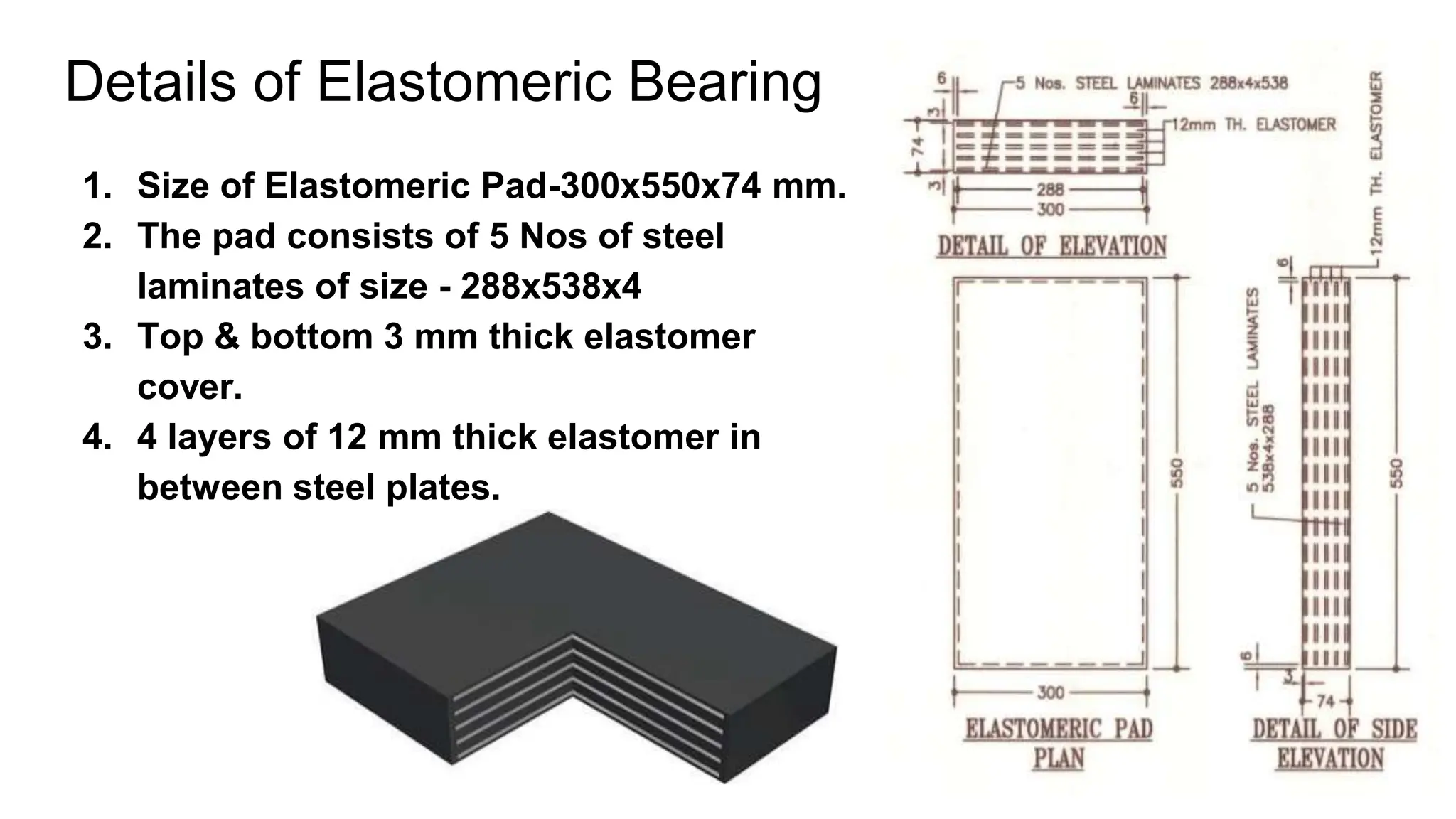
Details of Elastomeric Bearing
1. Size of Elastomeric Pad-300x550x74 mm.
2. The pad consists of 5 Nos of steel
laminates of size - 288x538x4
3. Top & bottom 3 mm thick elastomer
cover.
4. 4 layers of 12 mm thick elastomer in
between steel plates.
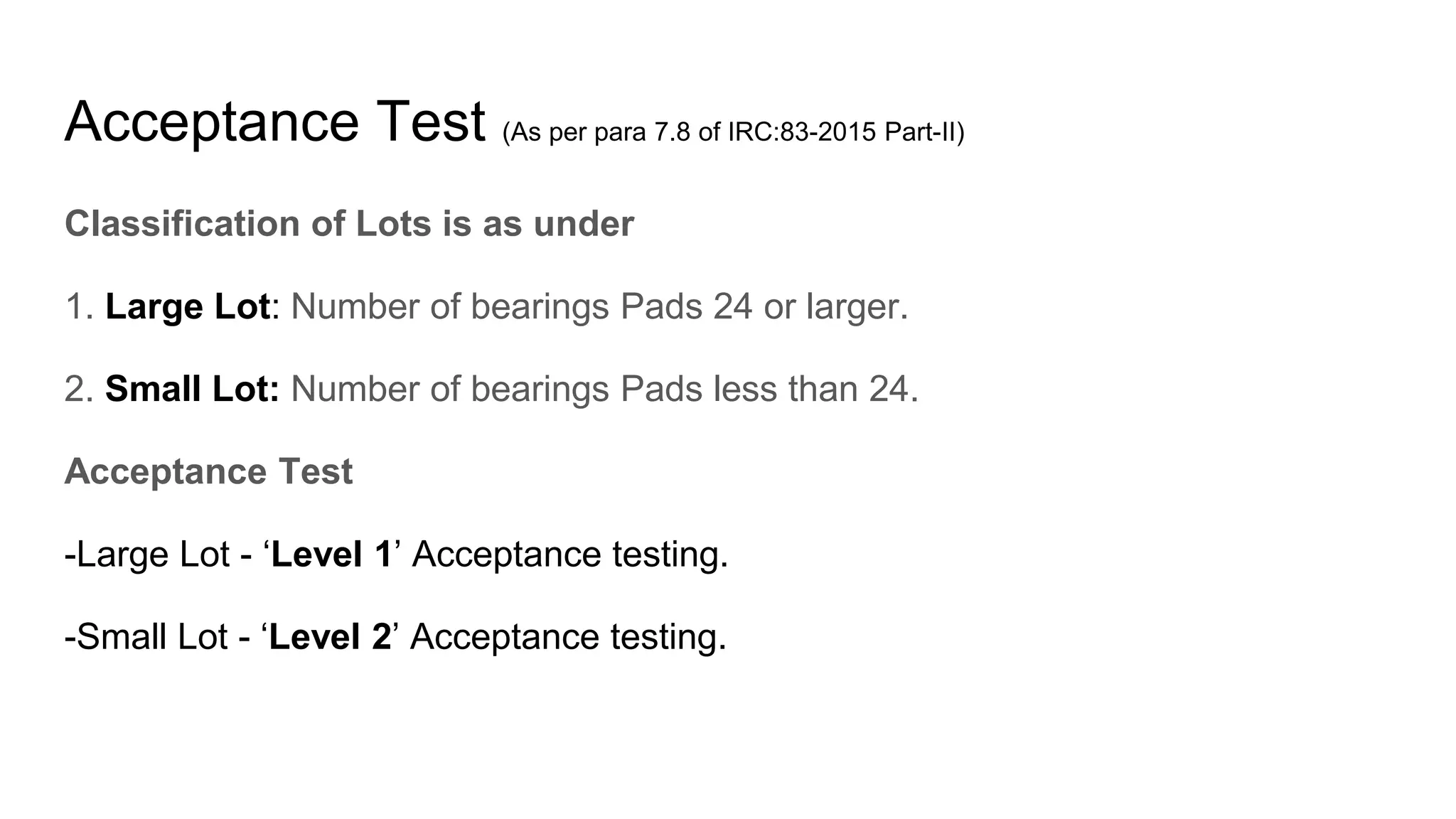
Acceptance Test (As per para 7.8 of IRC:83-2015 Part-II)
Classification of Lots is as under
1. Large Lot: Number of bearings Pads 24 or larger.
2. Small Lot: Number of bearings Pads less than 24.
Acceptance Test
-Large Lot - ‘Level 1’ Acceptance testing.
-Small Lot - ‘Level 2’ Acceptance testing.
‘Level 1’ Acceptance testing.
This will include the following tests:
A. General inspection.
B. Test on specially moulded test piece of Elastomer.
C. Test on complete bearings.
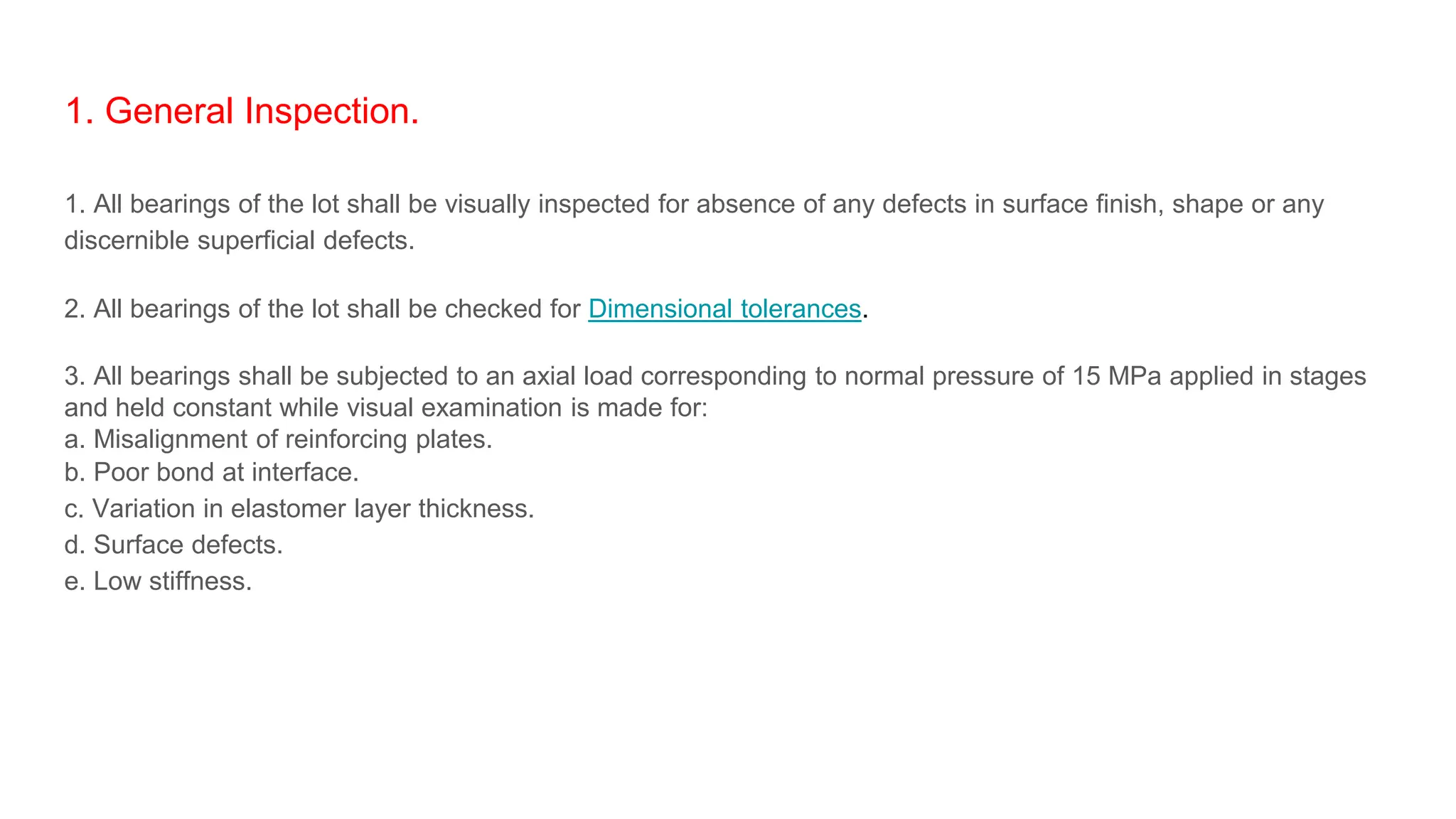
1. General Inspection.
1. All bearings of the lot shall be visually inspected for absence of any defects in surface finish, shape or any
discernible superficial defects.
2. All bearings of the lot shall be checked for Dimensional tolerances.
3. All bearings shall be subjected to an axial load corresponding to normal pressure of 15 MPa applied in stages
and held constant while visual examination is made for:
a. Misalignment of reinforcing plates.
b. Poor bond at interface.
c. Variation in elastomer layer thickness.
d. Surface defects.
e. Low stiffness.
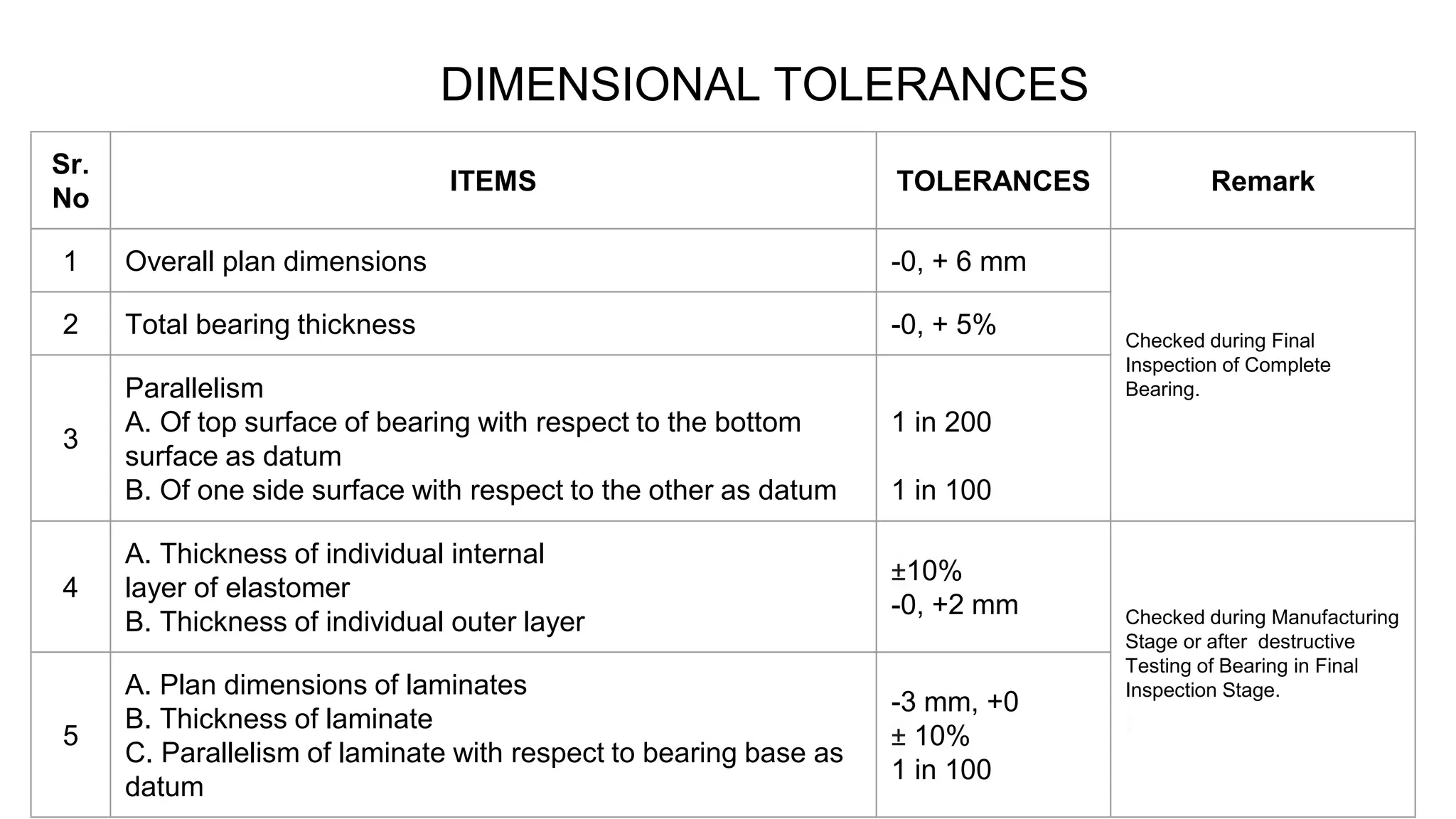
DIMENSIONAL TOLERANCES
Sr.
No
ITEMS TOLERANCES Remark
1 Overall plan dimensions -0, + 6 mm
Checked during Final
Inspection of Complete
Bearing.
2 Total bearing thickness -0, + 5%
3
Parallelism
A. Of top surface of bearing with respect to the bottom
surface as datum
B. Of one side surface with respect to the other as datum
1 in 200
1 in 100
4
A. Thickness of individual internal
layer of elastomer
B. Thickness of individual outer layer
±10%
-0, +2 mm Checked during Manufacturing
Stage or after destructive
Testing of Bearing in Final
Inspection Stage.
5
A. Plan dimensions of laminates
B. Thickness of laminate
C. Parallelism of laminate with respect to bearing base as
datum
-3 mm, +0
± 10%
1 in 100
B. Test on specially moulded Elastomer test piece.
Test piece shall be moulded by the manufacturer with identical compound and under identical
vulcanizing conditions as used in manufacture of the bearings.
A.Test for chemical properties
(i)Polymer Identification
(ii)Specific gravity
(iii)Ash content
B.Test for physical properties of Elastomer such as
(i) Hardness
(ii) Elongation at break
(iii) Ultimate tensile strength
(iv) Accelerated aging test
(v) Compression set test
(vi) Ozone test
Pyrolysis Test: If a Red colour develops during the procedure mentioned
as below then it confirms Polychloroprene rubber.
0.5 Gram of Sample of elastomer + Heat → Vapours + Solution II* → Red Colour.
*Solution II: Dissolve 2.0 g of Sodium citrate crystals, 200 mg of citric acid &
30 mg each of indicators bromocresol green and metanil yellow in 500 cubic centimeter of water.
→
→
Accepted
1.Polymer Identification(As per IS:3400 Part-22 or ASTM D297)
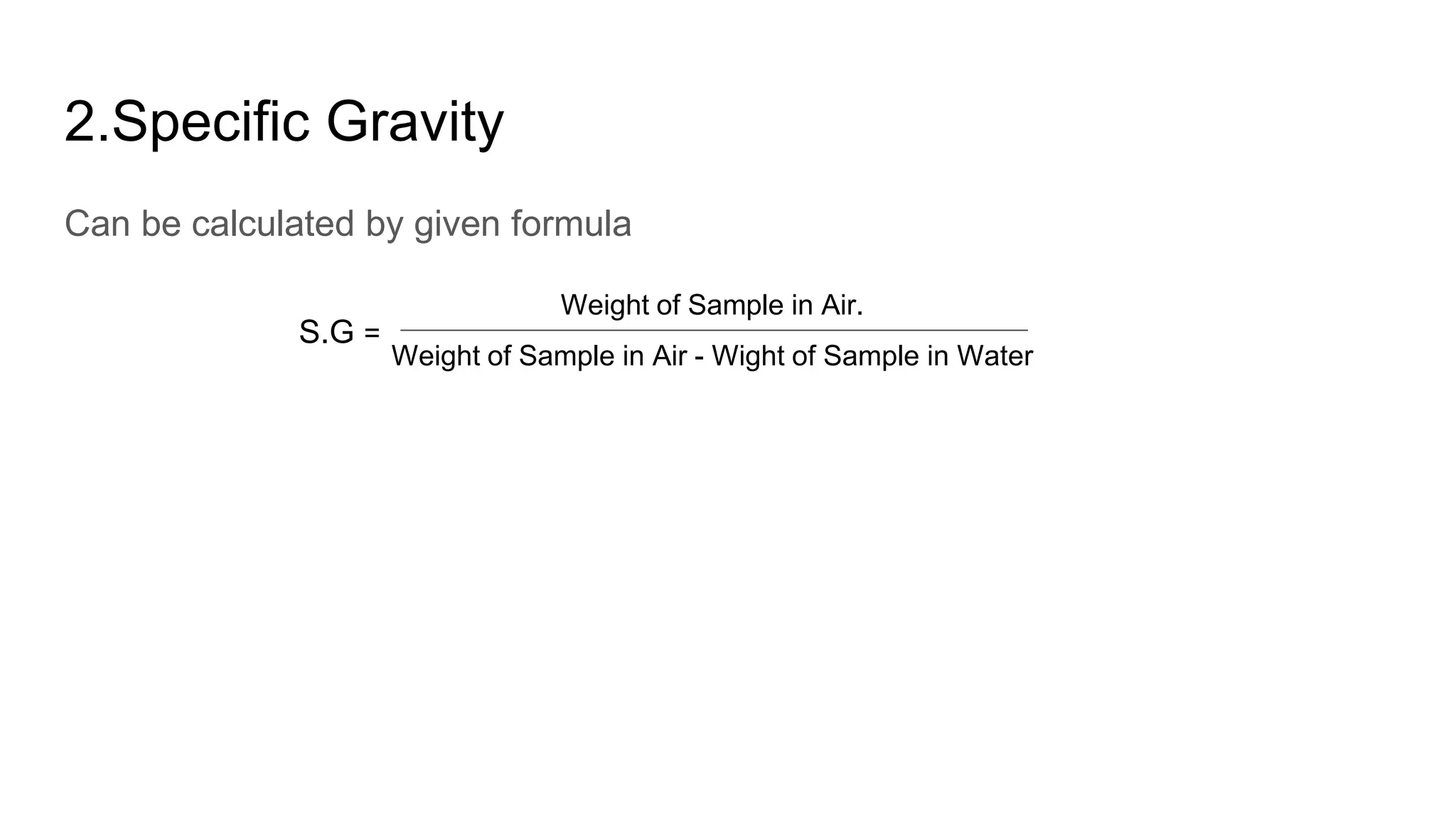
Can be calculated by given formula
2.Specific Gravity
Weight of Sample in Air.
Weight of Sample in Air - Wight of Sample in Water
S.G =
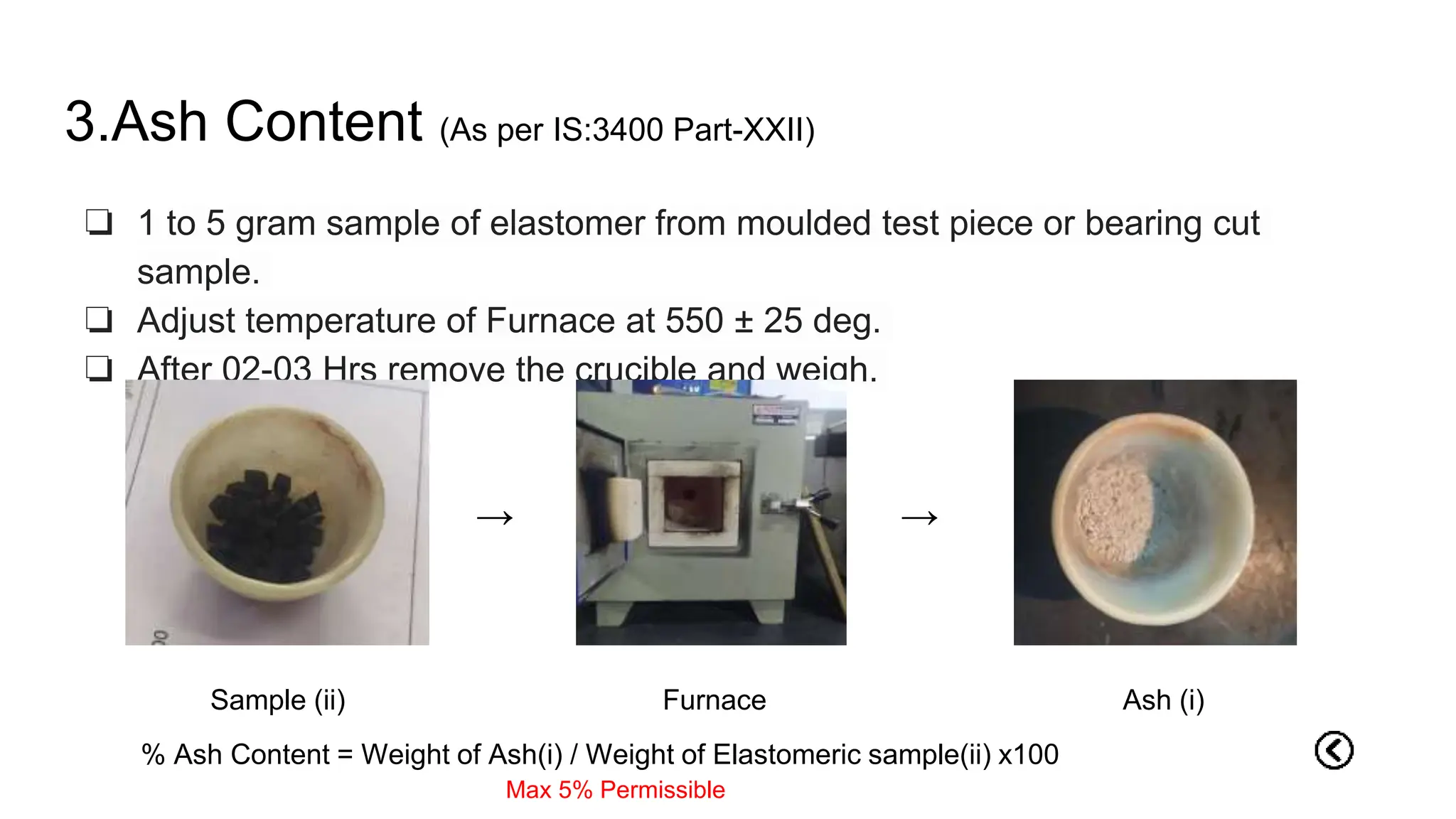
3.Ash Content (As per IS:3400 Part-XXII)
❏ 1 to 5 gram sample of elastomer from moulded test piece or bearing cut
sample.
❏ Adjust temperature of Furnace at 550 ± 25 deg.
❏ After 02-03 Hrs remove the crucible and weigh.
→ →
Sample (ii) Furnace Ash (i)
% Ash Content = Weight of Ash(i) / Weight of Elastomeric sample(ii) x100
Max 5% Permissible
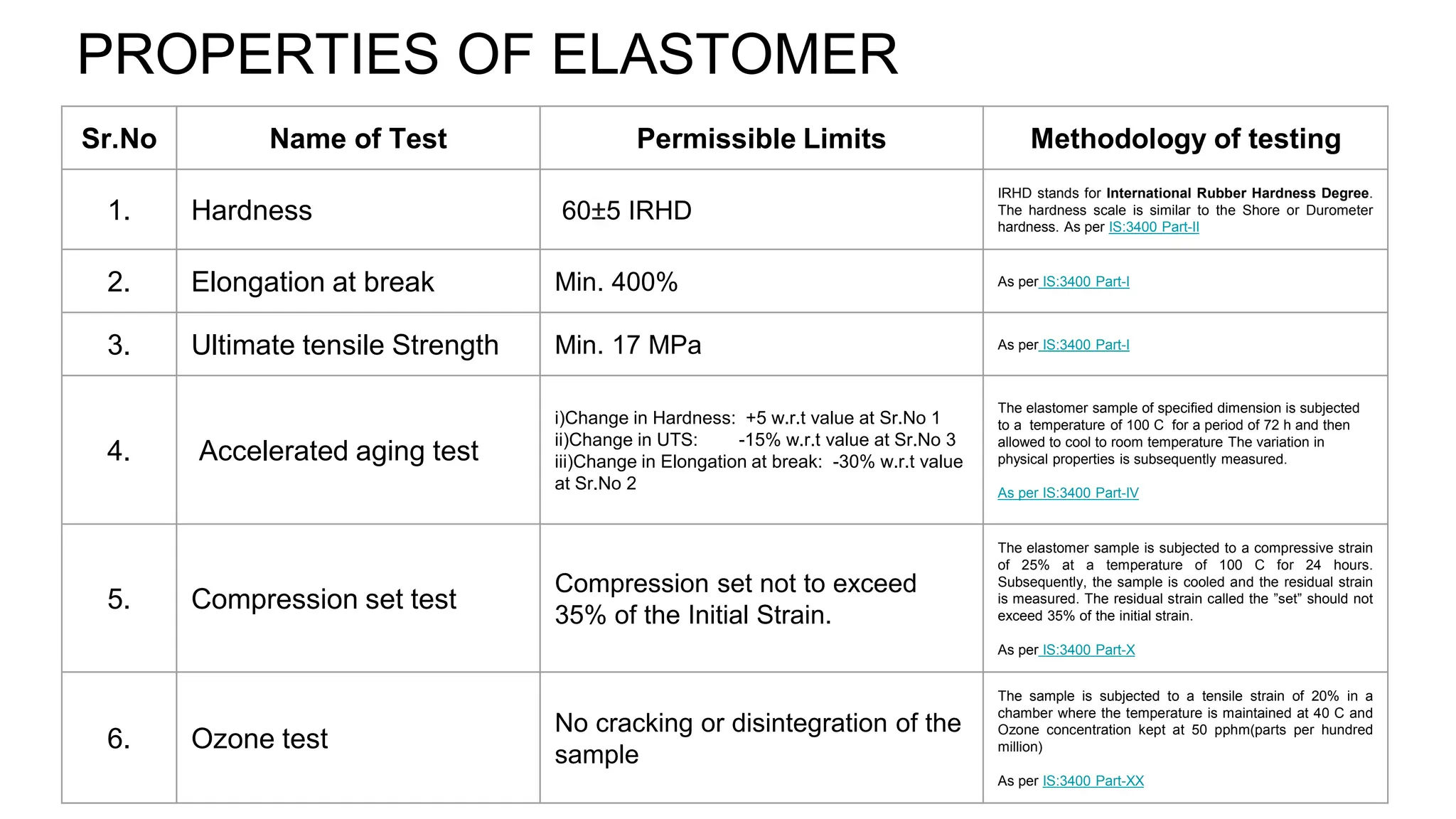
Sr.No Name of Test Permissible Limits Methodology of testing
1. Hardness 60±5 IRHD
IRHD stands for International Rubber Hardness Degree.
The hardness scale is similar to the Shore or Durometer
hardness. As per IS:3400 Part-II
2. Elongation at break Min. 400% As per IS:3400 Part-I
3. Ultimate tensile Strength Min. 17 MPa As per IS:3400 Part-I
4. Accelerated aging test
i)Change in Hardness: +5 w.r.t value at Sr.No 1
ii)Change in UTS: -15% w.r.t value at Sr.No 3
iii)Change in Elongation at break: -30% w.r.t value
at Sr.No 2
The elastomer sample of specified dimension is subjected
to a temperature of 100 C for a period of 72 h and then
allowed to cool to room temperature The variation in
physical properties is subsequently measured.
As per IS:3400 Part-IV
5. Compression set test
Compression set not to exceed
35% of the Initial Strain.
The elastomer sample is subjected to a compressive strain
of 25% at a temperature of 100 C for 24 hours.
Subsequently, the sample is cooled and the residual strain
is measured. The residual strain called the ”set” should not
exceed 35% of the initial strain.
As per IS:3400 Part-X
6. Ozone test
No cracking or disintegration of the
sample
The sample is subjected to a tensile strain of 20% in a
chamber where the temperature is maintained at 40 C and
Ozone concentration kept at 50 pphm(parts per hundred
million)
As per IS:3400 Part-XX
PROPERTIES OF ELASTOMER
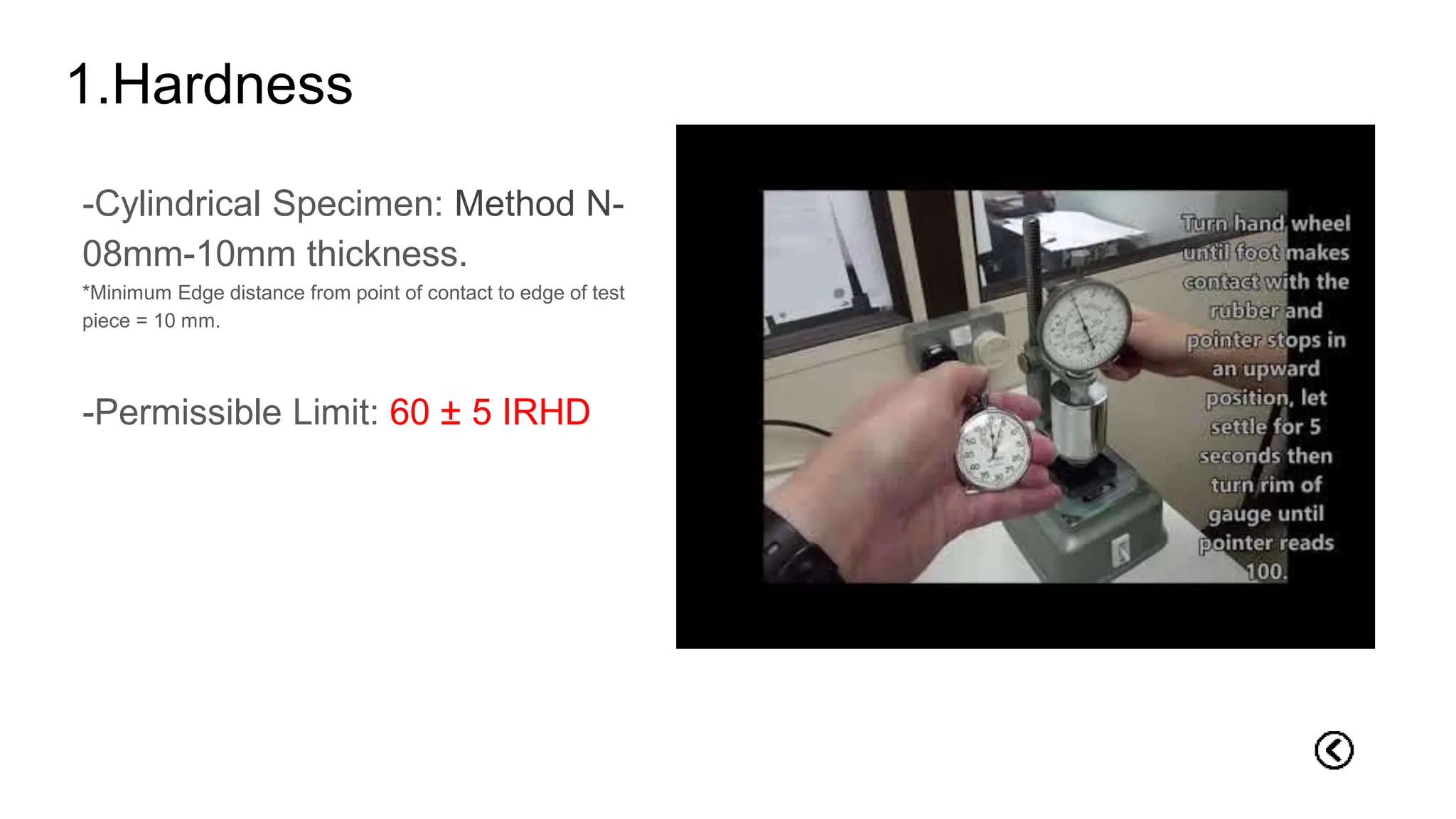
1.Hardness
-Cylindrical Specimen: Method N-
08mm-10mm thickness.
*Minimum Edge distance from point of contact to edge of test
piece = 10 mm.
-Permissible Limit: 60 ± 5 IRHD
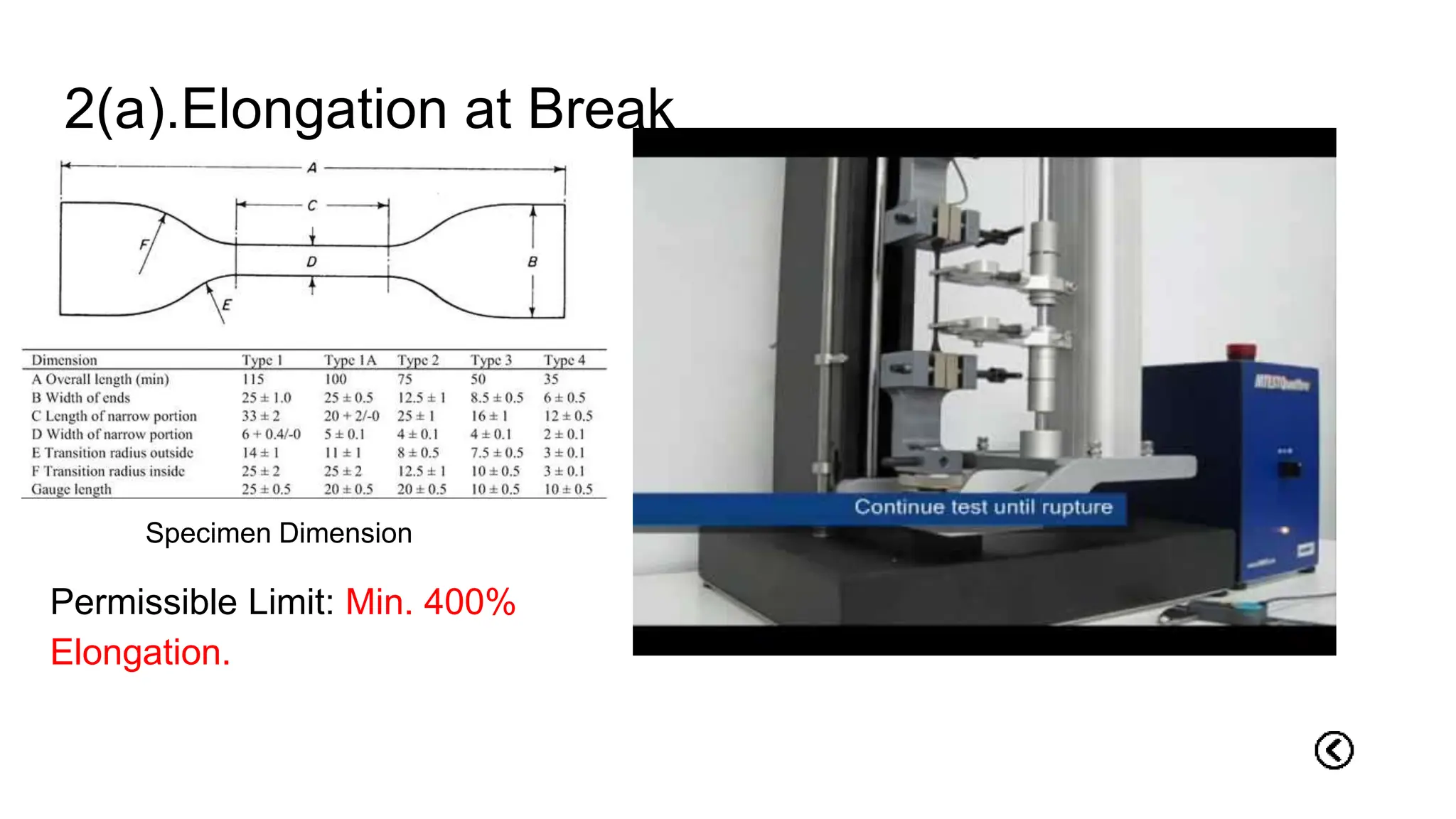
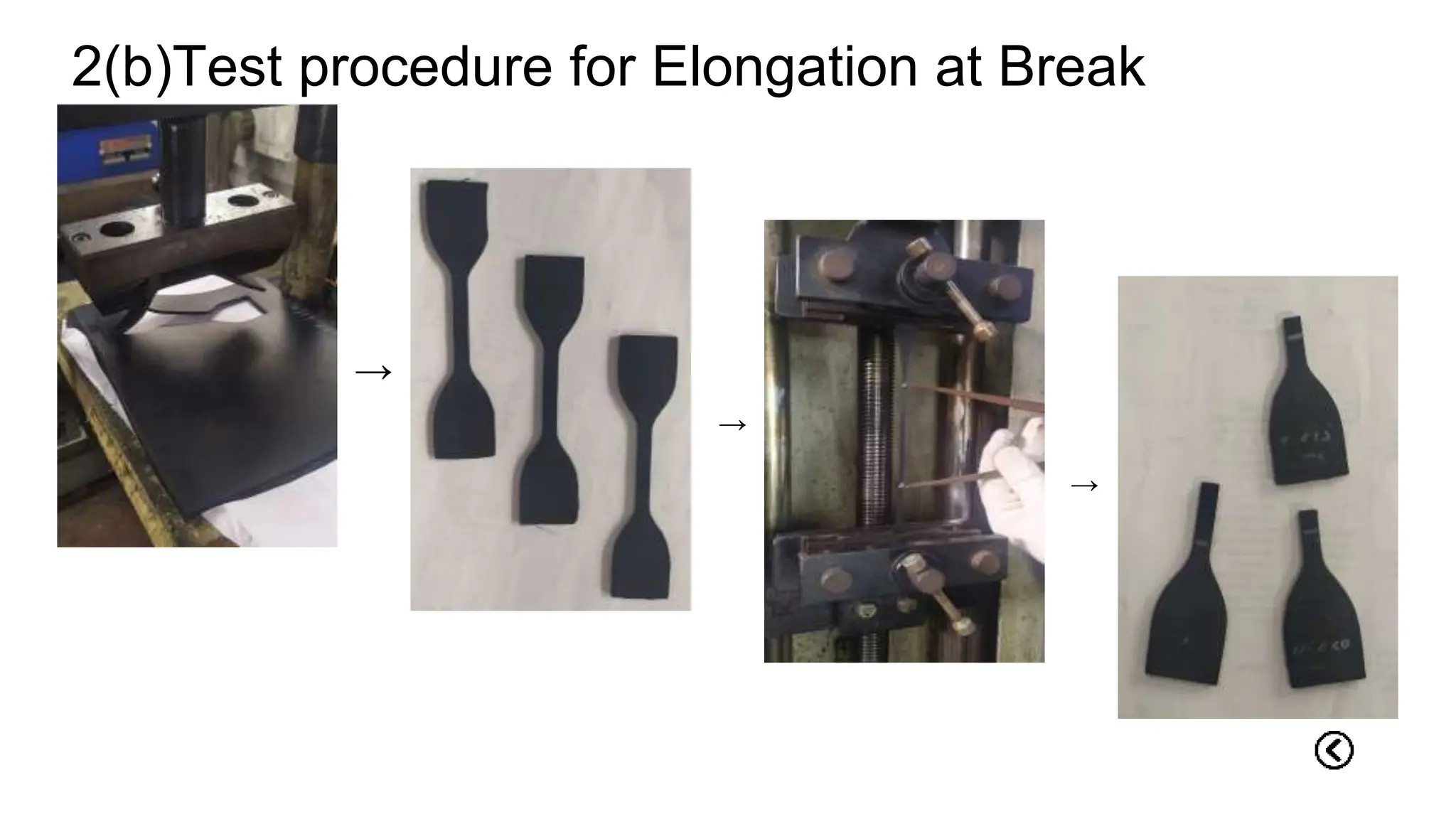
2(a).Elongation at Break
Permissible Limit: Min. 400%
Elongation.
Specimen Dimension
→
→
→
2(b)Test procedure for Elongation at Break
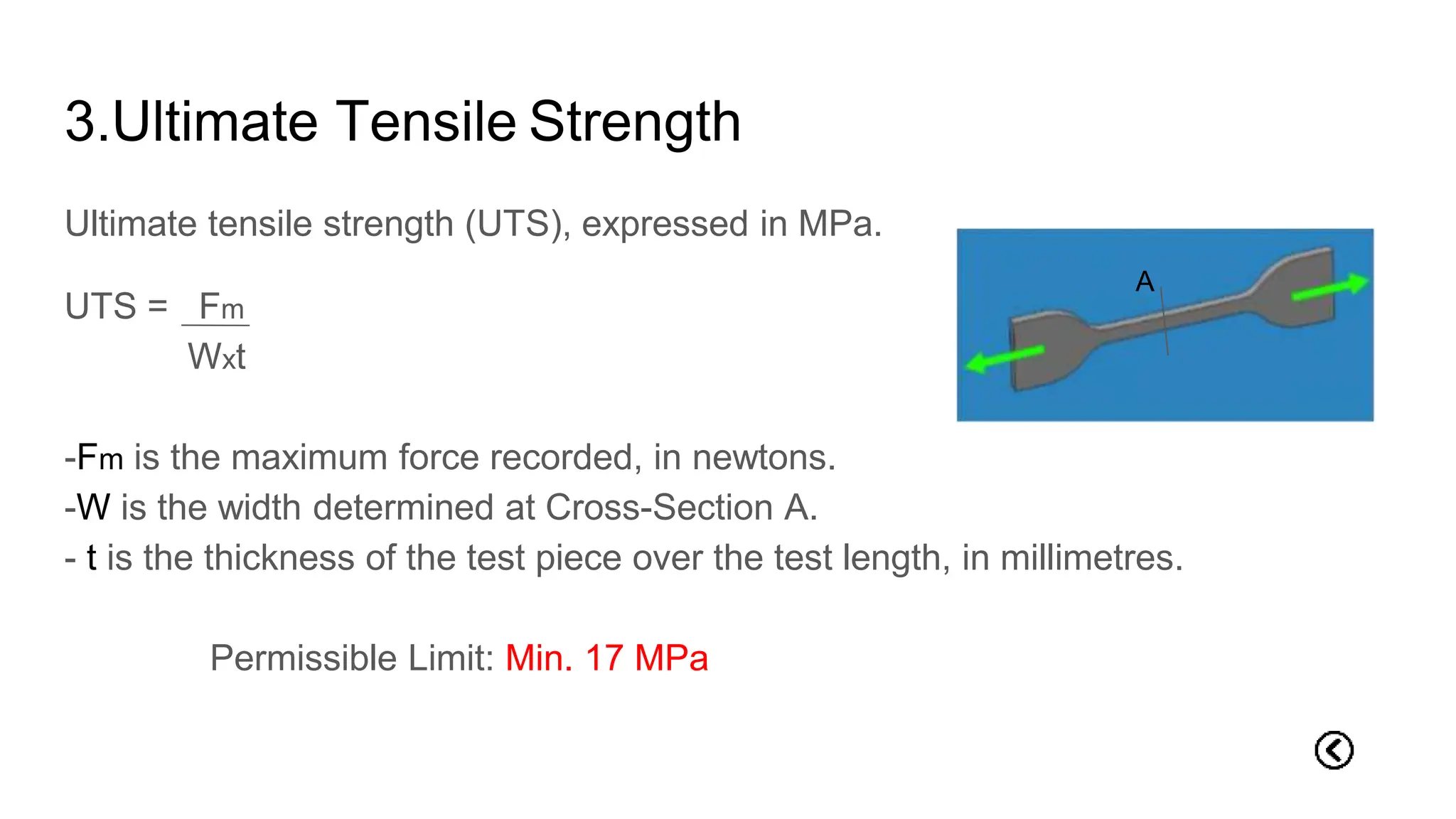
3.Ultimate Tensile Strength
Ultimate tensile strength (UTS), expressed in MPa.
UTS = Fm
Wxt
-Fm is the maximum force recorded, in newtons.
-W is the width determined at Cross-Section A.
- t is the thickness of the test piece over the test length, in millimetres.
Permissible Limit: Min. 17 MPa
A
4.Accelerated Aging Test
● Accelerated ageing and heat resistance tests are designed to estimate the
relative resistance of rubber to deterioration with the passage of time.
● The elastomer sample is subjected to a temperature of 100 C for a period of
72 h and then allowed to cool to room temperature.
● The variation in physical properties is subsequently measured.
i) Hardness: + 5 IRHD
ii) UTS : - 15%
iii) Elongation at break: - 30%.
5.Compression Set Test
Cylindrical Disk of Dia 29.0 ± 0.5 mm &
Thickness 12.5 ± 0.5 mm.
Permissible Limit: Not to Exceed 35% of
Initial Strain.
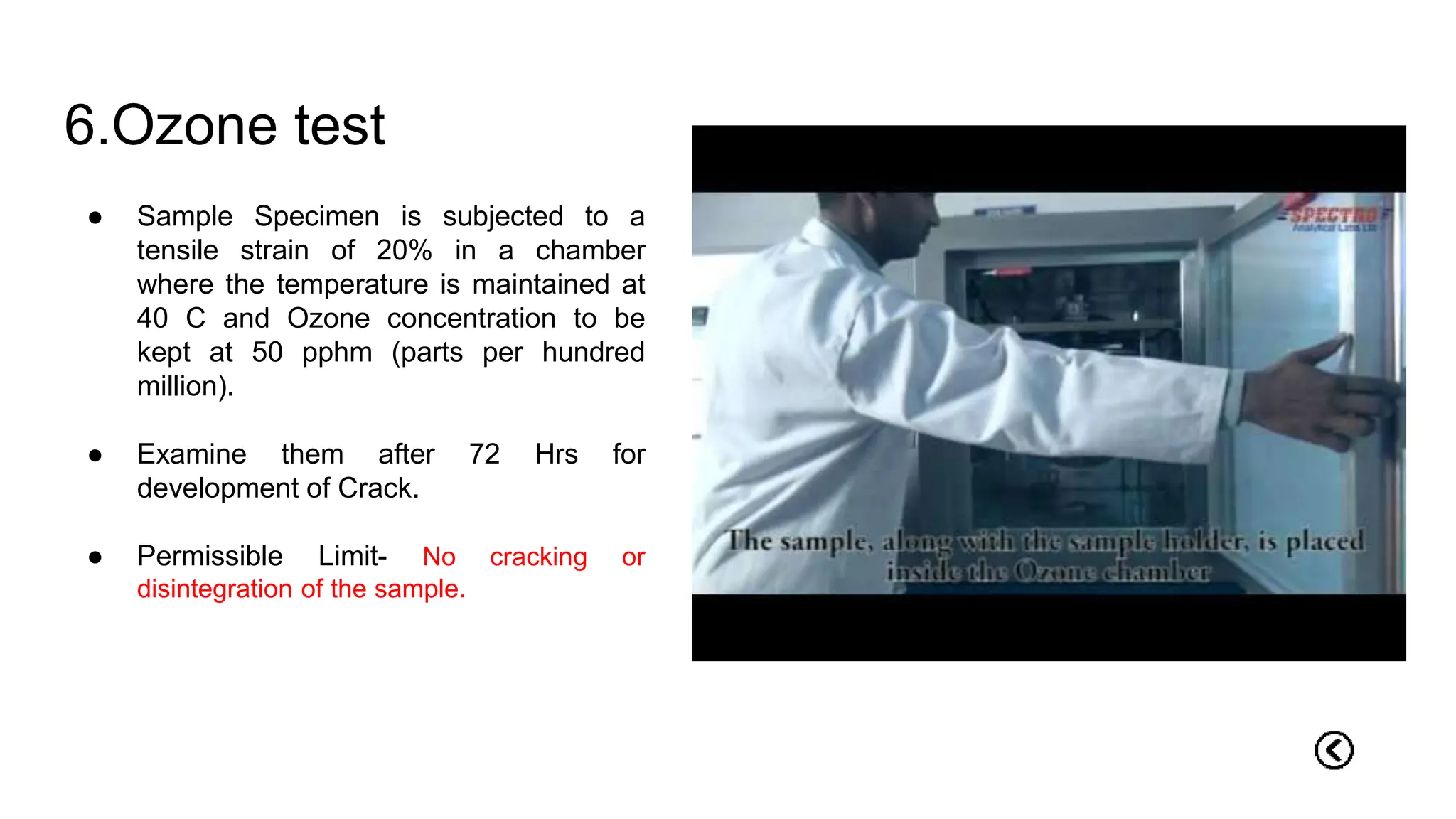
6.Ozone test
● Sample Specimen is subjected to a
tensile strain of 20% in a chamber
where the temperature is maintained at
40 C and Ozone concentration to be
kept at 50 pphm (parts per hundred
million).
● Examine them after 72 Hrs for
development of Crack.
● Permissible Limit- No cracking or
disintegration of the sample.
C. Test on Complete Bearings.
Two bearings should be selected at random from the ‘lot’.
1. Shear Modulus
2. Compressive Stiffness
3. Shear Bond
(Bearings should be excluded from the accepted lot as ‘Shear bond test’ is Destructive tests.)
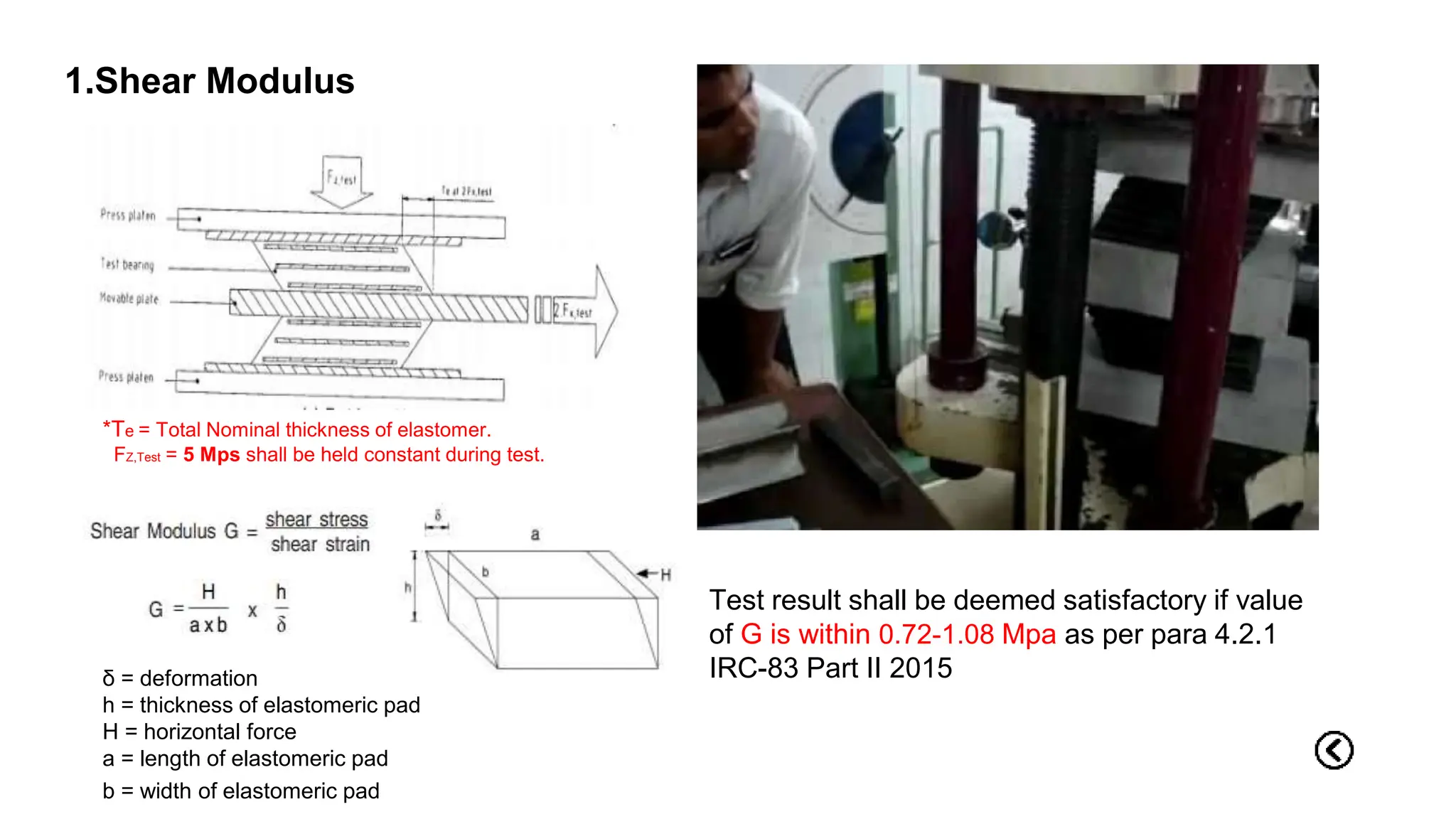
1.Shear Modulus
δ = deformation
h = thickness of elastomeric pad
H = horizontal force
a = length of elastomeric pad
b = width of elastomeric pad
Test result shall be deemed satisfactory if value
of G is within 0.72-1.08 Mpa as per para 4.2.1
IRC-83 Part II 2015
*Te = Total Nominal thickness of elastomer.
FZ,Test = 5 Mps shall be held constant during test.
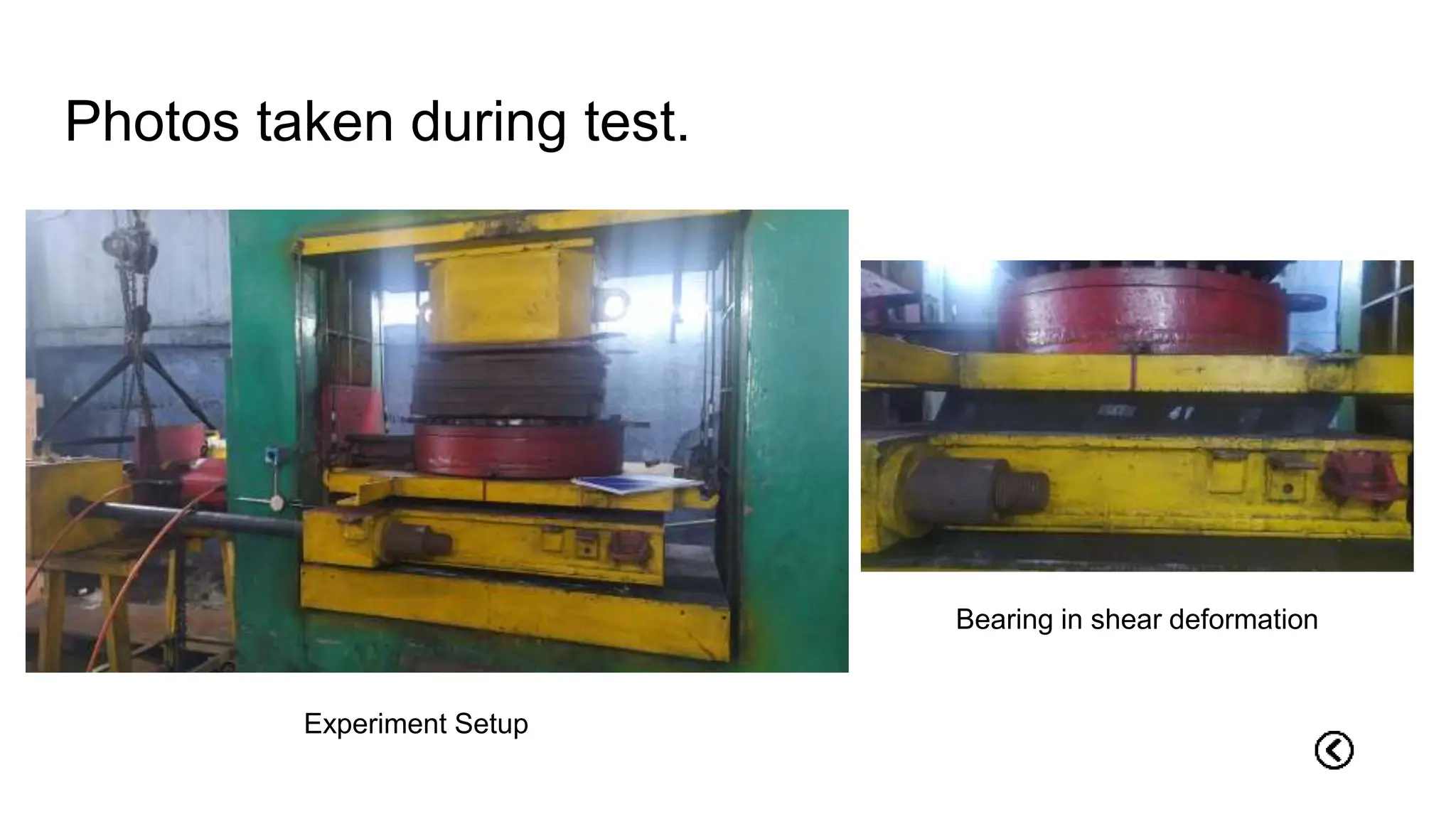
Photos taken during test.
Experiment Setup
Bearing in shear deformation
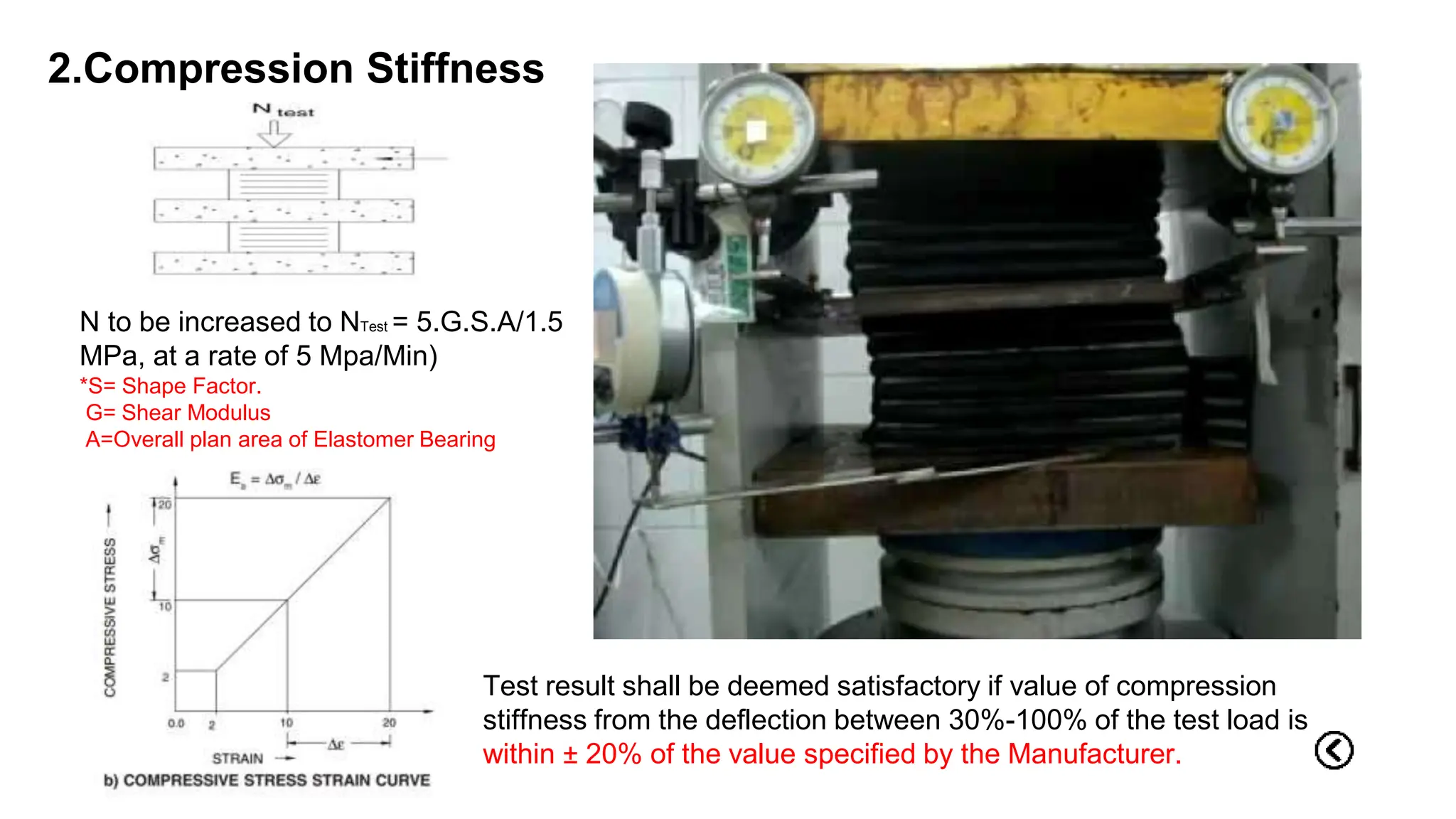
2.Compression Stiffness
Test result shall be deemed satisfactory if value of compression
stiffness from the deflection between 30%-100% of the test load is
within ± 20% of the value specified by the Manufacturer.
N to be increased to NTest = 5.G.S.A/1.5
MPa, at a rate of 5 Mpa/Min)
*S= Shape Factor.
G= Shear Modulus
A=Overall plan area of Elastomer Bearing
Shape Factor (As per IRC 83-2015(Part-II) Para 5.2.3.1)
The compressive stiffness of the bearing depends upon the ratio of
effective plan area to its force-free surface area.
For Laminated Bearing shape factor given by:
S = Plan area common to Elastomer & Steel Plate
Perimeter of laminated plate x Te
* Te=Ti if thickness of outer layer is less than 03 mm.
Te=1.4Ti if thickness of outer layer is more than or equal to 03 mm.
Where Te & Ti are the effective layer of Elastomer & individual inner layer of elastomer.
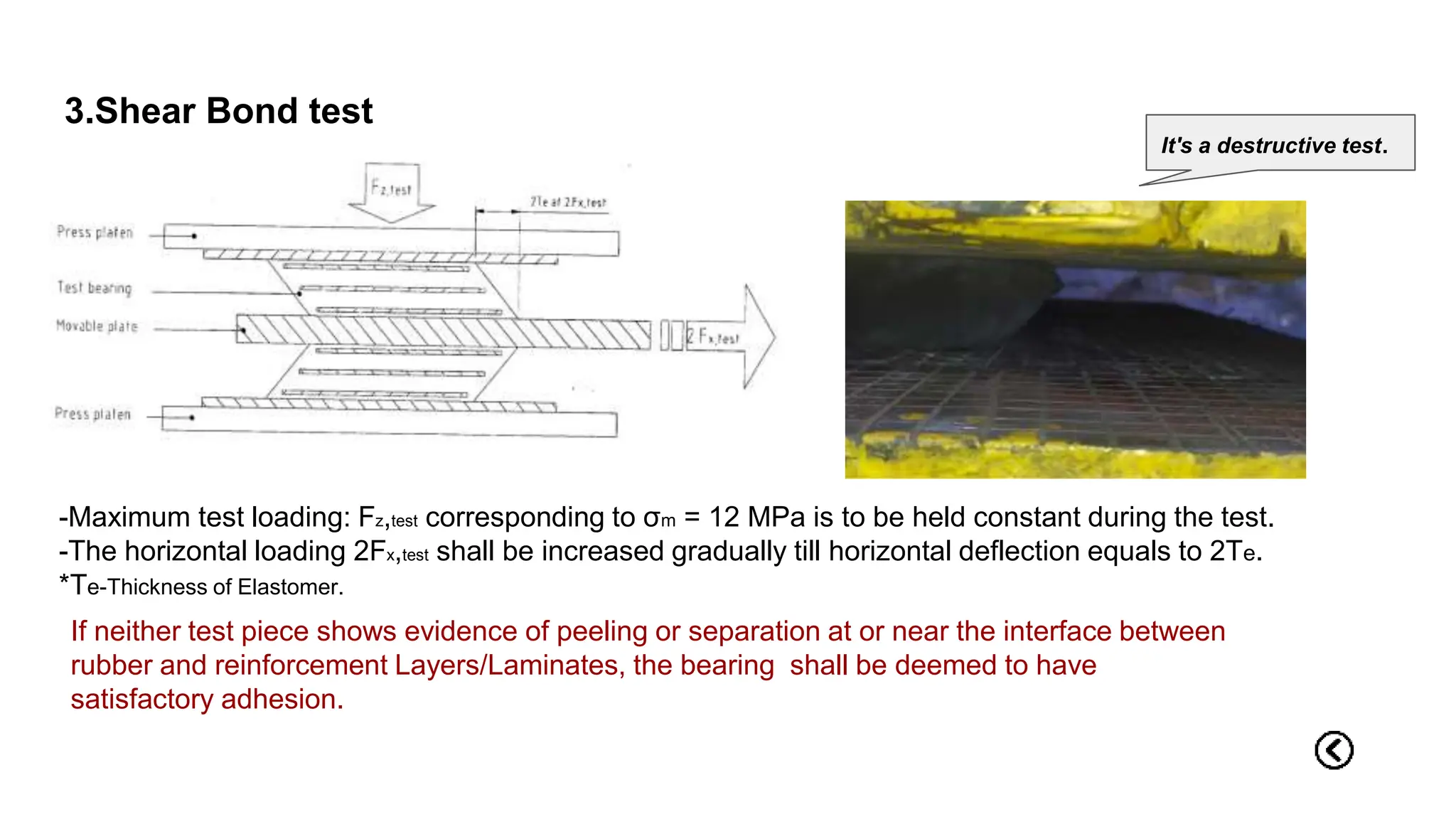
3.Shear Bond test
-Maximum test loading: Fz,test corresponding to σm = 12 MPa is to be held constant during the test.
-The horizontal loading 2Fx,test shall be increased gradually till horizontal deflection equals to 2Te.
*Te-Thickness of Elastomer.
If neither test piece shows evidence of peeling or separation at or near the interface between
rubber and reinforcement Layers/Laminates, the bearing shall be deemed to have
satisfactory adhesion.
It's a destructive test.
‘Level 2’ Acceptance testing.
This will also include the same tests as in Level 1
A. General inspection.
B. Test on specially moulded test piece.
C. Test on complete bearings.
But here, the test ‘C’ is little different as only two test i.e. ‘Test for shear
modulus’ & ‘Compression Stiffness’ are conducted.
(Since these are not the destructive test, the test bearings can be used in the bridge and these shall become the part of the
accepted ‘lot’.)
Inspection and Quality Control Certificate :
A ‘lot’ under inspection should be accepted by the inspector when no defect is
found in the acceptance level tests and so certified.
In case of any defect in the bearing, the whole ‘lot’ shall be rejected by the
inspector and certified accordingly.
Acceptance: Manufacture shall furnish the following to Engineer for the
acceptance judgement.
i)Quality Control Certificate.
ii)Inspection Certificate.
Certification & Marking
● Bearing shall be transported to site after final acceptance by Engineer.
● Each bearing shall be uniquely & individually numbered for identification on its
external surface.
● A label should be provided on Top & Bottom of Bearing with detailing
-Manufacturer's Name.
-Unique Identification number and manufactures symbol or name on one of its Edge.
-marking shall be resistant to water & Normal wear & Tear.
● Additional Information may be marked on bearing or supplied separately.
-Date of Manufacture -Bearing Dimension -Production Batch
Number
-Acceptance Lot Number -Specific Bridge Location -Explanation of Marking used on
Bearing.
What 2 Check during Inspection after installation.
● Shear Deformation not more than 50% of height of elastomeric pad.
● Rotation leading to off-loading of Edge.
● Compression not more than 5% of height of the Pad.
Malfunctioning of Elastomeric pad would result in distress either in girder or in
bed block.
Reference(Click to download)
➢ IRC:83-2015 (Part-II)
➢ Quality Assurance Plan ,QAP for Elastomeric Bearing
➢ Bridge Bearings by IRICEN,Pune
➢ Relevant IS:3400 Code.
○ IS:3400 Part-II for Hardness Test
○ IS:3400 Part-I for Ultimate Tensile Strength & Elongation at Break Test
○ IS:3400 Part-IV for Accelerated Aging Test
○ IS:3400 Part-X for Compression Set Test
○ IS:3400 Part-XX for Ozone Test
Elastomeric Bearing as per IRC_83-2015 (Part-II).pptx

Elastomeric Bearing as per IRC_83-2015 (Part-II).pptx

  • 1.
    TESt on ElastomericBearing As per IRC:83 Part-II-2015 By: Mohammad Furqan SSE (Bridge)Mumbai
  • 2.
    Function of BridgeBearings ● Load Transmission from Superstructure to Substructure. ● Permit rotary or rocking movement caused by deflection. ● Allows Horizontal movement of super structure due to expansion & Contraction.
  • 3.
    Manufacture Test Checkof Elastomeric Pad As maintenance cost of Elastomeric Pad is very low, but the replacement of Bridge Bearing requires huge investment. If Elastomeric Pad is not as per standard Specification laid down in IRC 83 Part-II,it may result in early deterioration of Bearing Pads which may lead to replacement of Bearing.To avoid such a situation Manufacturing Test check of Elastomeric Pad is required before launching.
  • 4.
    Check to beconducted on Elastomeric Bearing Pads A)On Elastomer 1.General inspection. Visual Inspection ,Dimensional Tolerance,etc. 2.Chemical Composition of Elastomer like Pyrolysis Test,%CR test. B)On Steel Laminates 1.Chemical Composition of Steel Laminated Plate. C)Test on specially moulded test piece for Elastomer. (i) Hardness (ii) Elongation at break (iii) Ultimate tensile strength (iv) Accelerated aging test (v) Compression set test (vi) Adhesion Test (vii) Ozone test D)Test on complete bearings. 1. Shear Modulus 2. Compressive Stiffness 3. Shear Bond-Destructive
  • 5.
    Details of ElastomericBearing 1. Size of Elastomeric Pad-300x550x74 mm. 2. The pad consists of 5 Nos of steel laminates of size - 288x538x4 3. Top & bottom 3 mm thick elastomer cover. 4. 4 layers of 12 mm thick elastomer in between steel plates.
  • 6.
    Acceptance Test (Asper para 7.8 of IRC:83-2015 Part-II) Classification of Lots is as under 1. Large Lot: Number of bearings Pads 24 or larger. 2. Small Lot: Number of bearings Pads less than 24. Acceptance Test -Large Lot - ‘Level 1’ Acceptance testing. -Small Lot - ‘Level 2’ Acceptance testing.
  • 7.
    ‘Level 1’ Acceptancetesting. This will include the following tests: A. General inspection. B. Test on specially moulded test piece of Elastomer. C. Test on complete bearings.
  • 8.
    1. General Inspection. 1.All bearings of the lot shall be visually inspected for absence of any defects in surface finish, shape or any discernible superficial defects. 2. All bearings of the lot shall be checked for Dimensional tolerances. 3. All bearings shall be subjected to an axial load corresponding to normal pressure of 15 MPa applied in stages and held constant while visual examination is made for: a. Misalignment of reinforcing plates. b. Poor bond at interface. c. Variation in elastomer layer thickness. d. Surface defects. e. Low stiffness.
  • 9.
    DIMENSIONAL TOLERANCES Sr. No ITEMS TOLERANCESRemark 1 Overall plan dimensions -0, + 6 mm Checked during Final Inspection of Complete Bearing. 2 Total bearing thickness -0, + 5% 3 Parallelism A. Of top surface of bearing with respect to the bottom surface as datum B. Of one side surface with respect to the other as datum 1 in 200 1 in 100 4 A. Thickness of individual internal layer of elastomer B. Thickness of individual outer layer ±10% -0, +2 mm Checked during Manufacturing Stage or after destructive Testing of Bearing in Final Inspection Stage. 5 A. Plan dimensions of laminates B. Thickness of laminate C. Parallelism of laminate with respect to bearing base as datum -3 mm, +0 ± 10% 1 in 100
  • 10.
    B. Test onspecially moulded Elastomer test piece. Test piece shall be moulded by the manufacturer with identical compound and under identical vulcanizing conditions as used in manufacture of the bearings. A.Test for chemical properties (i)Polymer Identification (ii)Specific gravity (iii)Ash content B.Test for physical properties of Elastomer such as (i) Hardness (ii) Elongation at break (iii) Ultimate tensile strength (iv) Accelerated aging test (v) Compression set test (vi) Ozone test
  • 11.
    Pyrolysis Test: Ifa Red colour develops during the procedure mentioned as below then it confirms Polychloroprene rubber. 0.5 Gram of Sample of elastomer + Heat → Vapours + Solution II* → Red Colour. *Solution II: Dissolve 2.0 g of Sodium citrate crystals, 200 mg of citric acid & 30 mg each of indicators bromocresol green and metanil yellow in 500 cubic centimeter of water. → → Accepted 1.Polymer Identification(As per IS:3400 Part-22 or ASTM D297)
  • 12.
    Can be calculatedby given formula 2.Specific Gravity Weight of Sample in Air. Weight of Sample in Air - Wight of Sample in Water S.G =
  • 13.
    3.Ash Content (Asper IS:3400 Part-XXII) ❏ 1 to 5 gram sample of elastomer from moulded test piece or bearing cut sample. ❏ Adjust temperature of Furnace at 550 ± 25 deg. ❏ After 02-03 Hrs remove the crucible and weigh. → → Sample (ii) Furnace Ash (i) % Ash Content = Weight of Ash(i) / Weight of Elastomeric sample(ii) x100 Max 5% Permissible
  • 14.
    Sr.No Name ofTest Permissible Limits Methodology of testing 1. Hardness 60±5 IRHD IRHD stands for International Rubber Hardness Degree. The hardness scale is similar to the Shore or Durometer hardness. As per IS:3400 Part-II 2. Elongation at break Min. 400% As per IS:3400 Part-I 3. Ultimate tensile Strength Min. 17 MPa As per IS:3400 Part-I 4. Accelerated aging test i)Change in Hardness: +5 w.r.t value at Sr.No 1 ii)Change in UTS: -15% w.r.t value at Sr.No 3 iii)Change in Elongation at break: -30% w.r.t value at Sr.No 2 The elastomer sample of specified dimension is subjected to a temperature of 100 C for a period of 72 h and then allowed to cool to room temperature The variation in physical properties is subsequently measured. As per IS:3400 Part-IV 5. Compression set test Compression set not to exceed 35% of the Initial Strain. The elastomer sample is subjected to a compressive strain of 25% at a temperature of 100 C for 24 hours. Subsequently, the sample is cooled and the residual strain is measured. The residual strain called the ”set” should not exceed 35% of the initial strain. As per IS:3400 Part-X 6. Ozone test No cracking or disintegration of the sample The sample is subjected to a tensile strain of 20% in a chamber where the temperature is maintained at 40 C and Ozone concentration kept at 50 pphm(parts per hundred million) As per IS:3400 Part-XX PROPERTIES OF ELASTOMER
  • 15.
    1.Hardness -Cylindrical Specimen: MethodN- 08mm-10mm thickness. *Minimum Edge distance from point of contact to edge of test piece = 10 mm. -Permissible Limit: 60 ± 5 IRHD
  • 16.
    2(a).Elongation at Break PermissibleLimit: Min. 400% Elongation. Specimen Dimension
  • 17.
  • 18.
    3.Ultimate Tensile Strength Ultimatetensile strength (UTS), expressed in MPa. UTS = Fm Wxt -Fm is the maximum force recorded, in newtons. -W is the width determined at Cross-Section A. - t is the thickness of the test piece over the test length, in millimetres. Permissible Limit: Min. 17 MPa A
  • 19.
    4.Accelerated Aging Test ●Accelerated ageing and heat resistance tests are designed to estimate the relative resistance of rubber to deterioration with the passage of time. ● The elastomer sample is subjected to a temperature of 100 C for a period of 72 h and then allowed to cool to room temperature. ● The variation in physical properties is subsequently measured. i) Hardness: + 5 IRHD ii) UTS : - 15% iii) Elongation at break: - 30%.
  • 20.
    5.Compression Set Test CylindricalDisk of Dia 29.0 ± 0.5 mm & Thickness 12.5 ± 0.5 mm. Permissible Limit: Not to Exceed 35% of Initial Strain.
  • 21.
    6.Ozone test ● SampleSpecimen is subjected to a tensile strain of 20% in a chamber where the temperature is maintained at 40 C and Ozone concentration to be kept at 50 pphm (parts per hundred million). ● Examine them after 72 Hrs for development of Crack. ● Permissible Limit- No cracking or disintegration of the sample.
  • 22.
    C. Test onComplete Bearings. Two bearings should be selected at random from the ‘lot’. 1. Shear Modulus 2. Compressive Stiffness 3. Shear Bond (Bearings should be excluded from the accepted lot as ‘Shear bond test’ is Destructive tests.)
  • 23.
    1.Shear Modulus δ =deformation h = thickness of elastomeric pad H = horizontal force a = length of elastomeric pad b = width of elastomeric pad Test result shall be deemed satisfactory if value of G is within 0.72-1.08 Mpa as per para 4.2.1 IRC-83 Part II 2015 *Te = Total Nominal thickness of elastomer. FZ,Test = 5 Mps shall be held constant during test.
  • 24.
    Photos taken duringtest. Experiment Setup Bearing in shear deformation
  • 25.
    2.Compression Stiffness Test resultshall be deemed satisfactory if value of compression stiffness from the deflection between 30%-100% of the test load is within ± 20% of the value specified by the Manufacturer. N to be increased to NTest = 5.G.S.A/1.5 MPa, at a rate of 5 Mpa/Min) *S= Shape Factor. G= Shear Modulus A=Overall plan area of Elastomer Bearing
  • 26.
    Shape Factor (Asper IRC 83-2015(Part-II) Para 5.2.3.1) The compressive stiffness of the bearing depends upon the ratio of effective plan area to its force-free surface area. For Laminated Bearing shape factor given by: S = Plan area common to Elastomer & Steel Plate Perimeter of laminated plate x Te * Te=Ti if thickness of outer layer is less than 03 mm. Te=1.4Ti if thickness of outer layer is more than or equal to 03 mm. Where Te & Ti are the effective layer of Elastomer & individual inner layer of elastomer.
  • 27.
    3.Shear Bond test -Maximumtest loading: Fz,test corresponding to σm = 12 MPa is to be held constant during the test. -The horizontal loading 2Fx,test shall be increased gradually till horizontal deflection equals to 2Te. *Te-Thickness of Elastomer. If neither test piece shows evidence of peeling or separation at or near the interface between rubber and reinforcement Layers/Laminates, the bearing shall be deemed to have satisfactory adhesion. It's a destructive test.
  • 28.
    ‘Level 2’ Acceptancetesting. This will also include the same tests as in Level 1 A. General inspection. B. Test on specially moulded test piece. C. Test on complete bearings. But here, the test ‘C’ is little different as only two test i.e. ‘Test for shear modulus’ & ‘Compression Stiffness’ are conducted. (Since these are not the destructive test, the test bearings can be used in the bridge and these shall become the part of the accepted ‘lot’.)
  • 29.
    Inspection and QualityControl Certificate : A ‘lot’ under inspection should be accepted by the inspector when no defect is found in the acceptance level tests and so certified. In case of any defect in the bearing, the whole ‘lot’ shall be rejected by the inspector and certified accordingly. Acceptance: Manufacture shall furnish the following to Engineer for the acceptance judgement. i)Quality Control Certificate. ii)Inspection Certificate.
  • 30.
    Certification & Marking ●Bearing shall be transported to site after final acceptance by Engineer. ● Each bearing shall be uniquely & individually numbered for identification on its external surface. ● A label should be provided on Top & Bottom of Bearing with detailing -Manufacturer's Name. -Unique Identification number and manufactures symbol or name on one of its Edge. -marking shall be resistant to water & Normal wear & Tear. ● Additional Information may be marked on bearing or supplied separately. -Date of Manufacture -Bearing Dimension -Production Batch Number -Acceptance Lot Number -Specific Bridge Location -Explanation of Marking used on Bearing.
  • 31.
    What 2 Checkduring Inspection after installation. ● Shear Deformation not more than 50% of height of elastomeric pad. ● Rotation leading to off-loading of Edge. ● Compression not more than 5% of height of the Pad. Malfunctioning of Elastomeric pad would result in distress either in girder or in bed block.
  • 32.
    Reference(Click to download) ➢IRC:83-2015 (Part-II) ➢ Quality Assurance Plan ,QAP for Elastomeric Bearing ➢ Bridge Bearings by IRICEN,Pune ➢ Relevant IS:3400 Code. ○ IS:3400 Part-II for Hardness Test ○ IS:3400 Part-I for Ultimate Tensile Strength & Elongation at Break Test ○ IS:3400 Part-IV for Accelerated Aging Test ○ IS:3400 Part-X for Compression Set Test ○ IS:3400 Part-XX for Ozone Test