A Practical Guide To
Sustainability in Meetings


November 2012 EIBTM
Tamara Kennedy-Hill, CMP
GMIC Executive Director
Key Elements of a Sustainable Event:

• Leadership and Vision

• Identify and Define Measureable Objectives

• Engagement of Stakeholders

• Integration into Operational Procedures

• Measurement and Performance

• Transparency and Reporting/3rd Party Certification

              Courtesy of CSMP and MCI


                                                       www.gmicglobal.org
The Sustainability Paradigm
                                                Innovation
                                             Risk Management
                                            Margin Improvement
                                            Growth Enhancement


         Job Creation                            Economic                          Resource Efficiency
       Skills Enhancement                        Growth
                                                                                   Product Stewardship
       Social Investments
                                                                                  Life-Cycle Management
        Business Ethics
                                                                                     Products to Service
              Security                Socio-                Eco-Efficiency
                                      Economic


                                                 Socio-
                                 Social          Environmental    Environmental
                                 Progress                         Stewardship        Clean Air, Water & Land
         Diversity                                                                     Emissions Reductions
        Human Rights                                                               Zero Waste, Releases & Spills
     Community Outreach
       Labor Relations
                                            Safety & Health
                                       Environmental Regulations
                                        Global Climate Change
                                          Crisis Management

Source: Brundtland Commission Report, 1987                                                       www.gmicglobal.org
Slide courtesy of Paul Salinger, Oracle
What this means to me?


                         www.gmicglobal.org
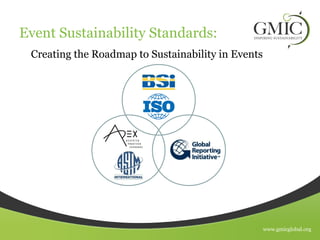
Event Sustainability Standards:
 Creating the Roadmap to Sustainability in Events


                                                    www.gmicglobal.org
What is a Roadmap?


A tool to help you
  navigate from point
  A to point B


                        www.gmicglobal.org
How the Standards Work Together


                                  www.gmicglobal.org
                                                 7
How They Relate


                  www.gmicglobal.org
Scope and Examples
• Focus on 3-5 key areas that you can control, are
  related to key issues of impact and are scalable

• Create specific indicators and targets to measure
  performance


                                             www.gmicglobal.org
KPI Examples
• Economic indicators: Estimate any cost savings/additions
  associated with efforts:
   –   Shuttle reductions
   –   Signage reductions
   –   Food procurement– water bottles, local
   –   Print reductions


                                                  www.gmicglobal.org
KPI Examples
• Environmental Indicators:
   –   Shuttle fuel use
   –   Facility energy use
   –   Facility water use
   –   Venue waste
   –   Food miles
   –   Paper use
   –   Miles traveled


                              www.gmicglobal.org
KPI Examples
• Procurement: Environmental specifications and amounts
  for
   – Food & beverage procurement – amounts of local, organic, etc.
   – Trade show procurement – carpet, signage, freight, materials
     reuse, etc.
   – Signage – reuse, recycled, donated.
   – Printed materials – reductions, recycled content.
   – Airline partnership program use.


                                                         www.gmicglobal.org
Event Case Example


                     www.gmicglobal.org
Strategic Objectives                  Actions                                 KPIs                                                         Assigned To

1. Demonstrate latest industry        Integrate elements of APEX/ASTM,        Conduct a Gap analysis against APEX/ASTM Level 1
standards, measurement tools and      ISO 20121 into the event planning       criteria.
innovative approaches to test and     cycle.                                  Create a case study sharing process and performance to
model sustainable event management                                            objectives of the 2013 event
theory in a practical way.


2. Create A Social Responsibility     Engage local host committee to          A minimum of 25% of registered attendees participate
Project and activate participation    research and create a list of viable    A minimum of $2000 US raised for NGO
from registered attendees             project option to bring needed          2 media articles in local and/or industry press
                                      support to an NGO whose mission
                                      aligns with GMIC values


                                      Create a pre-and post event survey of   Achieve minimum of 75% approval rating based on
                                      event delegates                         returned survey response to delegate perception of social
                                                                              responsibility project
                                                                              Publish survey results as part of case study


4. Actively engage conference         For program committee, create a 40-     -measurement of content education components (what
attendees through conference design   40-20 rule: 40 designed, 40 open for    are the % at each level that we want to address)
and the content delivery of           innovative delivery and 20 open for     -Post Survey X% of respondents felt that they had gained
sustainability education.             new opportunity                         knowledge or tools that would enable them to actively go
                                      Assess level of sustainability          home and implement change.
                                      knowledge pre and post event            -25% of the audience participates in a challenge to do one
                                                                              act of change post event. 5 -10 Video testimonials


                                                                                                                                                     14
                                                                                                                                     www.gmicglobal.org
So How Do You Start?


                       www.gmicglobal.org
Creation Process
 • Review strategies and
   actions completed to date
   – corporate and event
   organization
 • Determine and assess
   strategic objectives
 • Develop plan to get there
 • Identify holes
 • Map out key activities
 • Gain buy-in


                               www.gmicglobal.org
Pre-planning


• Integrate the standards
  – Request for Proposal (RFP) Phase


                                       www.gmicglobal.org
RFP – Planner Perspective

                   – Use your existing RFP
                   – Add the desired level
                     specifications
                   – Include a rating system


                                      www.gmicglobal.org
RFP – Supplier Response
                     – Use your existing
                       bid materials
                     – Illustrate your
                       current level of
                       implementation
                     – Describe what will
                       be in place or a
                       willingness to
                       comply


                                    www.gmicglobal.org
Onsite

• 3 ways to verify:
  – Documentation
  – Third-party verification
  – Observation


                               www.gmicglobal.org
Post Event


Report/Measure
  – Collect data
  – Report outcomes
  – Share experiences


                        www.gmicglobal.org
Tools and Resources
• ISO 20121 Training & Education:
  – Training: Positive Impact, Sustainable Event Alliance,
    GMIC Global Community
  – Tools: SEMS, Sustainable Event Management System
• Measurement and Performance (APEX and
  others)
  – GMIC APEX/ASTM training courses and programs
  – Tools: SEMT Tool, MeetGreen Tool
• Reporting
  – GRI EOSS


                                                                22
                                                    www.gmicglobal.org
Some Resources

http://www.gmicglobal.org/
http://www.meetgreen.com/resources/casestudies
 http://www.naturalstep.org/
http://www.conventionindustry.org/StandardsPractices/APEXASTM.aspx
https://www.globalreporting.org/Pages/default.aspx
http://www.sustainableeventsdenmark.org/csmp/business-case-for-
sustainable-meetings
http://www.positiveimpact.uk


                                                            www.gmicglobal.org
Questions?
Questions?
        Tamara Kennedy-Hill, CMP
            Executive Director
      Green Meeting Industry Council
           503-332-5739 direct
       1-888-450-2098 main office
         tamara@gmicglobal.org
           www.gmicglobal.org


                                       www.gmicglobal.org

A Practical Guide to Sustainability in Meetings

  • 1.
    A Practical GuideTo Sustainability in Meetings November 2012 EIBTM Tamara Kennedy-Hill, CMP GMIC Executive Director
  • 2.
    Key Elements ofa Sustainable Event: • Leadership and Vision • Identify and Define Measureable Objectives • Engagement of Stakeholders • Integration into Operational Procedures • Measurement and Performance • Transparency and Reporting/3rd Party Certification Courtesy of CSMP and MCI www.gmicglobal.org
  • 3.
    The Sustainability Paradigm Innovation Risk Management Margin Improvement Growth Enhancement Job Creation Economic Resource Efficiency Skills Enhancement Growth Product Stewardship Social Investments Life-Cycle Management Business Ethics Products to Service Security Socio- Eco-Efficiency Economic Socio- Social Environmental Environmental Progress Stewardship Clean Air, Water & Land Diversity Emissions Reductions Human Rights Zero Waste, Releases & Spills Community Outreach Labor Relations Safety & Health Environmental Regulations Global Climate Change Crisis Management Source: Brundtland Commission Report, 1987 www.gmicglobal.org Slide courtesy of Paul Salinger, Oracle
  • 4.
    What this meansto me? www.gmicglobal.org
  • 5.
    Event Sustainability Standards: Creating the Roadmap to Sustainability in Events www.gmicglobal.org
  • 6.
    What is aRoadmap? A tool to help you navigate from point A to point B www.gmicglobal.org
  • 7.
    How the StandardsWork Together www.gmicglobal.org 7
  • 8.
    How They Relate www.gmicglobal.org
  • 9.
    Scope and Examples •Focus on 3-5 key areas that you can control, are related to key issues of impact and are scalable • Create specific indicators and targets to measure performance www.gmicglobal.org
  • 10.
    KPI Examples • Economicindicators: Estimate any cost savings/additions associated with efforts: – Shuttle reductions – Signage reductions – Food procurement– water bottles, local – Print reductions www.gmicglobal.org
  • 11.
    KPI Examples • EnvironmentalIndicators: – Shuttle fuel use – Facility energy use – Facility water use – Venue waste – Food miles – Paper use – Miles traveled www.gmicglobal.org
  • 12.
    KPI Examples • Procurement:Environmental specifications and amounts for – Food & beverage procurement – amounts of local, organic, etc. – Trade show procurement – carpet, signage, freight, materials reuse, etc. – Signage – reuse, recycled, donated. – Printed materials – reductions, recycled content. – Airline partnership program use. www.gmicglobal.org
  • 13.
    Event Case Example www.gmicglobal.org
  • 14.
    Strategic Objectives Actions KPIs Assigned To 1. Demonstrate latest industry Integrate elements of APEX/ASTM, Conduct a Gap analysis against APEX/ASTM Level 1 standards, measurement tools and ISO 20121 into the event planning criteria. innovative approaches to test and cycle. Create a case study sharing process and performance to model sustainable event management objectives of the 2013 event theory in a practical way. 2. Create A Social Responsibility Engage local host committee to A minimum of 25% of registered attendees participate Project and activate participation research and create a list of viable A minimum of $2000 US raised for NGO from registered attendees project option to bring needed 2 media articles in local and/or industry press support to an NGO whose mission aligns with GMIC values Create a pre-and post event survey of Achieve minimum of 75% approval rating based on event delegates returned survey response to delegate perception of social responsibility project Publish survey results as part of case study 4. Actively engage conference For program committee, create a 40- -measurement of content education components (what attendees through conference design 40-20 rule: 40 designed, 40 open for are the % at each level that we want to address) and the content delivery of innovative delivery and 20 open for -Post Survey X% of respondents felt that they had gained sustainability education. new opportunity knowledge or tools that would enable them to actively go Assess level of sustainability home and implement change. knowledge pre and post event -25% of the audience participates in a challenge to do one act of change post event. 5 -10 Video testimonials 14 www.gmicglobal.org
  • 15.
    So How DoYou Start? www.gmicglobal.org
  • 16.
    Creation Process •Review strategies and actions completed to date – corporate and event organization • Determine and assess strategic objectives • Develop plan to get there • Identify holes • Map out key activities • Gain buy-in www.gmicglobal.org
  • 17.
    Pre-planning • Integrate thestandards – Request for Proposal (RFP) Phase www.gmicglobal.org
  • 18.
    RFP – PlannerPerspective – Use your existing RFP – Add the desired level specifications – Include a rating system www.gmicglobal.org
  • 19.
    RFP – SupplierResponse – Use your existing bid materials – Illustrate your current level of implementation – Describe what will be in place or a willingness to comply www.gmicglobal.org
  • 20.
    Onsite • 3 waysto verify: – Documentation – Third-party verification – Observation www.gmicglobal.org
  • 21.
    Post Event Report/Measure – Collect data – Report outcomes – Share experiences www.gmicglobal.org
  • 22.
    Tools and Resources •ISO 20121 Training & Education: – Training: Positive Impact, Sustainable Event Alliance, GMIC Global Community – Tools: SEMS, Sustainable Event Management System • Measurement and Performance (APEX and others) – GMIC APEX/ASTM training courses and programs – Tools: SEMT Tool, MeetGreen Tool • Reporting – GRI EOSS 22 www.gmicglobal.org
  • 23.
  • 24.
    Questions? Questions? Tamara Kennedy-Hill, CMP Executive Director Green Meeting Industry Council 503-332-5739 direct 1-888-450-2098 main office tamara@gmicglobal.org www.gmicglobal.org www.gmicglobal.org

Editor's Notes

  • #3 All are found in standards, what does this mean?
  • #4 This paradigm is like a three legged stool – each leg is important and supports the others. We are focusing on the environmental area, including the intersection of business and the environment (eco-efficiencies, product lifecycle design) and the intersection of society and the environment, incl. its impact on business (regulation and compliance). We are not saying that the social side of sustainability is not important but the environmental area seems to be first area of focus for our customers and overall is more measurable thus lending itself better to the application of software. Software is not the sole aspect or technology that is important in companies becoming ‘ greener ’ but it is one of the tools that can be used to support companies to manage, execute, and measure their environmental sustainability initiatives.
  • #5 Script: So what does all this mean to you? To be able to understand these standards and apply them to your events will provide you with an expanded level of expertise. By following the standards and aspiring to be performing at the next level of the standard will afford you and your organization a concrete pathway to planning and producing credible, environmentally sustainable meetings. Furthermore, (next slide)
  • #6 Andrew
  • #8 AW-I modified colors to match previous slides, plus tweaked text Andrew ISO 20121, based on BS 8901: This is not a “green meetings” standard. It focuses on sustainable management of economic, social and environmental aspects of events including process , design , execution , documentation and process improvement APEX: Being developed by APEX in conjunction with the US Environmental Protection Agency and ASTM Int. Areas: Destinations, Accommodations, Venues , Transportation, Food and Beverage, Exhibitions, AV & Production, Communications, On-site Office GRI: Developing a reporting template for the events sector. Has previously created sector supplements for industries such as the financial sector.
  • #9 Script: They are all important steps/components of an environmentally sustainable meeting. You do not have to do all of these. For the purposes of APEX/ASTM you are only required to meet APEX/ASTM standard. APEX/ASTM Environmentally Sustainable Event Standard is a prescriptive, measurable standard. BS 8901/ISO 20121 is great for developing a methodology, process for decision making. GRI is a reporting process. Three bodies of work are expected to be completed and launched by the end of 2011. Instructor note: (Will need to modify this when APEX/ASTM standards are completed.)
  • #10 Activity: Take one or two of top 5 issues, write an objective, define a strategy and metric and identify action plan next steps. From the SWOT we identified that since this was the first time we had incorporated green meeting standards into our conference, we would maximize our strengths, keep it simple and we focused on three key areas: Destination – this was something within our control, we were looking for the least amount of air travel for our North America wide audience, and the least amount of ground transportation, i.e. all events were held within walking distance, and we encouraged delegates to spend their spare time in the LA Live region Venue – the new LA Convention Center is LEED gold certified (the previous year we were in another LEED certified facility, the new Vancouver Convention Center. Transportation – we encouraged delegates to purchase carbon offsets and helped facilitate carpooling for those from San Diego and Las Vegas Both of the SMART objectives were up to the attendees to fulfill, so we needed to have a communications strategy that Inspired them to action Made it easy for them to purchase the offsets Provided thorough information about the venue so that they would make their “offsite” plans at venues within walking distance.
  • #11 Nancy Before we get into the results of our verification, here are some of the highlights from 2007 by the numbers.
  • #12 Nancy Before we get into the results of our verification, here are some of the highlights from 2007 by the numbers.
  • #13 Nancy Before we get into the results of our verification, here are some of the highlights from 2007 by the numbers.
  • #14 Process Plans for identification Issues Goals and targets Stakeholder engagement Policy (use of planning process from APEX and determine indicators you want to report with GRI)
  • #16 Identify Resources to Support Your Efforts Communicate Commitment Celebrate Success It’s not the easy button but it’s a start.
  • #18 Instructor notes: Introduce the RFP sample. Script: We have a sample RFP we ’ll work through to give you a better idea how this might work. We’ll start with the planner perspective in creating the RFP. This RFP is a modification of the APEXs ’ Request for Proposal format. We took Level 1 specifications for meeting venue and food and beverage and included them in the sample RFP. Instructor notes: The majority of the standard components within the RFP start on page 5 of the RFP. The intent is for a planner to see how they might integrate the desired level of the standard within their current RFPs. For the supplier, it ’s to get a feel for what an RFP from a planner could look like. You may ask the suppliers in the room if this makes sense to them. Script: We ’re going to go through the RFP process from both the planner and supplier perspective.
  • #19 Script: The RFP shows how to take what you ’re already doing and simply add your desire level of the standard specifications to it. Once you do this once, you won’t need to change it unless you alter the level of the standard your requesting. (Hand out RFP – one facilitator distribute while other speaks) The standard components of the RFP start on page 5. You can see that you are not only asking what they are currently doing but also giving them an opportunity to include anything they may be implementing by your event date or are willing to implement by then. What you may want to do when you integrate this in your own RFPs is to have a spreadsheet that shows the suppliers name and their responses to the 3 columns. For those of you who have suppliers you use all the time and no long send out RFPs you will want to send them the level standard your now expecting them to achieve using those same 3 columns. There is a sample scoring worksheet in your manual.
  • #20 Instructor notes: Introduce the supplier response to the RFP in their handout materials. Script: Now for the supplier who respond to the RFP. The DoubleTree Hotel in Portland was gracious enough to fill out a response to the sample RFP reflecting how they would potentially respond to the bid. If you are already performing at the certain level of the standard, it would be great to point that out in the beginning. If you ’re not meeting the current requested level of standard, you have the opportunity to describe what you intend to have in place by the time of the event, or are willing to do for the event. You can see that in some of the responses from the DoubleTree they are exceeding Level 1 specifications. If you know you are performing at a higher level than requested, it would be in your best interest to highlight that fact. For example, if you traditionally operate at Level 2 for meeting venue, then reflect that in your response to the RFP. If you ’re not sure what level currently meet, it would prudent to do a self assessment. Also, using the standards in your bid response offers you a consistent way of responding to the variety of planner requests. One of the complaints we hear from suppliers is that planners are asking for sustainable practices but rarely are they consistent. We hope the standards will minimize the inconsistencies.
  • #21 EXAMPLES of each are Key - Script: There are 3 ways to verify: Documentation - An example of documentation would be written information provided such as a copy of their sustainability policy (both supplier and planner must provide this). Or a link could be posted on the company ’s website. This is something you’d ask for in the pre-planning phase. We’ll give more examples in a moment from the planner perspective and then from the supplier perspective. In other words documentation is a written proof of compliance. Third-party verification A third party verification is a process or product that has been audited by a third party. Certifications like Green Seal or LEED are examples of third party verification. Getting a copy of their seals or seeing their certificates would be done in the pre-planning phase. Observation refers to the visual verification through observation. For example, any practices observed by you or your staff or attendees. You will verify with observation predominately during the onsite phase, though some will occur in the pre-planning phase.
  • #22 Script: The final phase is a critical, but rarely practiced, step which is the post event reporting. By post event reporting we mean beyond the financial reports or minimal post event demographics. We ’re referring to reporting on performance, sustainability practices and lessons learned. Public reports of that nature are scarce in our industry. Post event performance reporting will be an essential part of integrating the standards. Currently, it is up to the individual organization to be assessing, measuring and reporting on their compliance with the standard. It may be a while before credible certification is ready, so you may find it helpful to use a third party consulting group to assist with this process if you ’re doing it for the first time. Often we get caught up in the next project and don ’t often take the time to complete this process. Think of it as part of your existing post reporting, like verifying bills and running final financial reporting. Again once, you have integrated a system to include this in your current process, it will be more automatic. In the post reporting phase you ’ll need to collect data, like the waste diversion numbers. You’ll want to record what worked, what didn’t. If you met the standard, did your counterpart also meet the standard? How might you share your experiences. Let ’s talk about each of these in a bit more detail.