
THE QUALITY ASSURANCE
AND ACCREDITATION
HANDBOOK
FOR HIGHER EDUCATION
IN EGYPT
Ministr
y
of Higher Ed
ucation
Ë“«¸…«∞∑FKOøøør«∞FøøøøøøøU∞w
THE QUALITY ASSURANCE
AND ACCREDITATION
HANDBOOK
FOR HIGHER EDUCATION
IN EGYPT
Arab Republic of Egypt (ARE)
Ministry of Higher Education (MOHE)
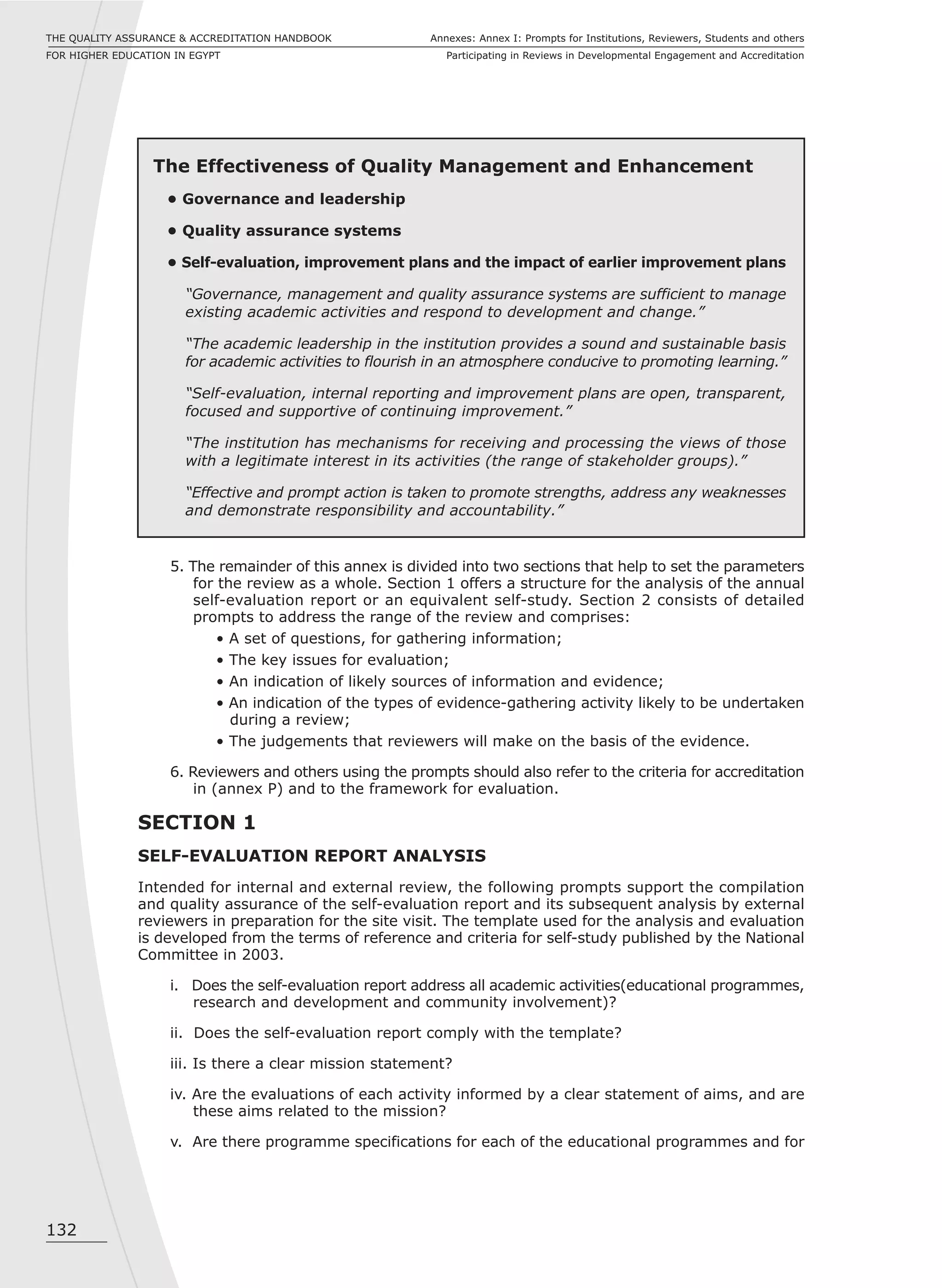
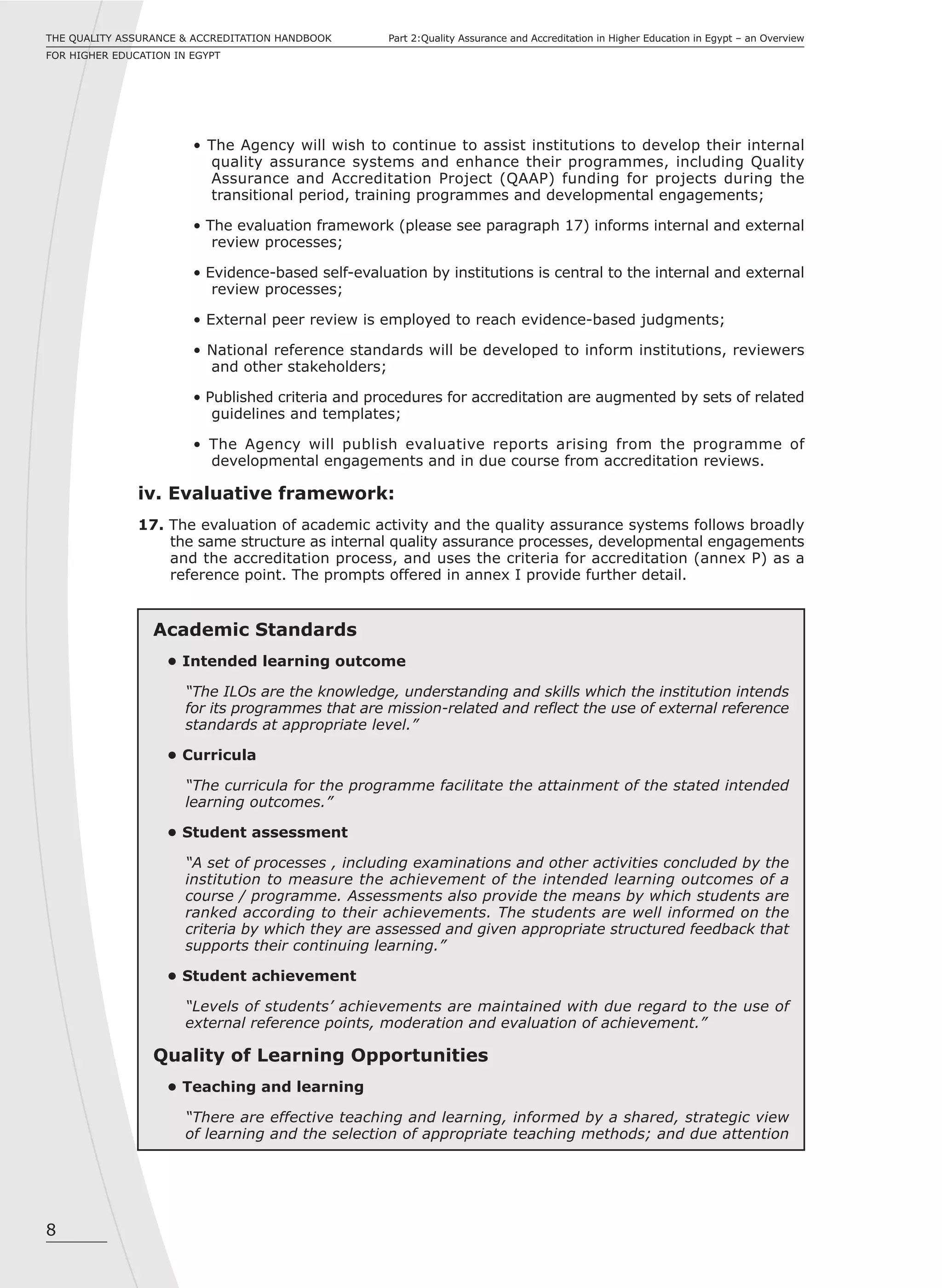
Projects Management Unit (PMU)
Higher Education Enhancement Project (HEEP)
Quality Assurance & Accreditation Project (QAAP)
Prepared by
The National Quality Assurance and Accreditation
Committee in Collaboration with British Consultants
in Higher Education
2004
2005/3054 I.S.B.N. 977-17-2173-9
The National Quality Assurance and Accreditation Committee may be contacted at:
96 Ahmed Oraby Street, Mohandessein, Giza, Egypt
Tel.: 3458610
Fax: 3458611
www.qaap.net
First edition : 2004
copyright © : This Handbook or parts of it, is produced for the benefit of all higher
education in Egypt and the range of stakeholder groups.
Designed & Printed in Egypt by: Print Right Adv.
Foreward
Dr.Amr Ezzat Salama
Minister of Higher Education and State for Scientific Research
In a speech at the joint session of the People's assembly and Shoura Council, President
Hosni Mubarak stressed the importance of quality assurance and accreditation in education.
President Mubarak highlighted the need to establish a national agency to overlook issues
related to quality assurance and accreditation in the Egyptian educational system. He
reiterated in most of his successive speeches the importance of such an agency, being one
of the key pillars of the national strategy for the education reform in Egypt.
The Ministry of Higher Education, being responsible for the overall education system in Egypt
as stipulated in the constitution, took the initiative to develop an overall strategic plan for
quality assurance and accreditation to assist Egyptian Higher Education Institutions to
improve the quality of their academic programs and that of their graduates. This handbook
developed by the National Quality Assurance and Accreditation Committee (NQAAC) contains
detailed information on the guidelines and procedures required for quality assurance and
accreditation to take place in all Egyptian higher education institutions. It is a reference
manual for all those who are concerned with the quality of higher education, mainly, the
academic community, the public and private higher education institutions and the community
at large.
It is with great pleasure that I witness the continuous and ongoing efforts made by the
NQAAC that culminated in the development of the first version of this handbook. The
institutional and academic reference standards currently under development will complete
the development of the evaluation system leading to the accreditation mechanism we are
seeking to implement in the Egyptian higher education institutions. It is of paramount
importance to ensure that students, parents, academic community and all other stakeholders
witness the presence of quality standards in education that conform with international
standards.
In order to promote awareness and spread the culture of quality assurance and accreditation,
the information presented in this handbook needs to be widely disseminated among all
academic professionals. On the regional and international levels, the manual will be available
for countries and higher education institutions interested to benefit from the Egyptian
experience.
I congratulate all those who worked so diligently to produce this handbook in a collaborative
effort, particularly, the professional and administrative staff from the Ministry of Higher
Education and State for Scientific Research, the Projects Management Unit, the Quality
Assurance and Accreditation Project, as well as the local and international consultants and
organizations that helped make this work come true.
v
THE QUALITY ASSURANCE & ACCREDITATION HANDBOOK
FOR HIGHER EDUCATION IN EGYPT
List of contents
Acknowledgment.................................................................................. vii
Preface ................................................................................................ viii
Part 1: Introduction ............................................................................... 3
i. Purposes of Handbook and how to use it ............................................... 3
ii. Definitions of quality assurance and accreditation processes ................... 3
iii. Statement of principles that underpin the quality assurance and
accreditation processes ..................................................................... 4
Part 2: Quality Assurance and Accreditation in Higher Education
in Egypt – an Overview ............................................................... 7
i. The role of the Agency, its mission and strategic aims ..............................7
ii. Transitional period ............................................................................ 7
iii. Main features of the quality assurance and accreditation processes ......... 7
iv. Evaluative framework........................................................................ 8
v. Peer review......................................................................................10
vi. The development of guidelines and national reference standards ...........10
vii. Developmental engagements............................................................10
viii. Accreditation .................................................................................10
Part 3: The Development of Internal Quality Assurance Systems
in Higher Education Institutions ............................................... 13
i. Context........................................................................................... 13
ii. Summary of the features of internal quality assurance systems ............. 13
iii. Towards a development plan for internal quality assurance systems and
processes ...................................................................................... 14
Part 4: Developmental Engagements.................................................... 19
i. Purposes and outcomes of developmental engagements ........................ 19
ii. Evaluative framework....................................................................... 19
iii. Guidelines on the conduct of developmental engagements.................... 21
iv. Guidelines on the reporting of outcome.............................................. 23
v. Provisional timetable for transitional period ......................................... 25
Part 5: Accreditation ............................................................................ 29
i. Scope ............................................................................................. 29
ii. Key elements of the process.............................................................. 29
iii. Criteria for accreditation ................................................................. 29
iv. Key reference points........................................................................ 29
v. Mechanisms available to institutions ................................................... 30
vi. Guidelines on the conduct of accreditation reviews .............................. 30
List of Contents
vi
List of contentsTHE QUALITY ASSURANCE & ACCREDITATION HANDBOOK
FOR HIGHER EDUCATION IN EGYPT
vii. Framework for evaluation................................................................ 30
viii. Planning for the site-visit ............................................................... 32
ix. Preliminary visit.............................................................................. 33
x. Organisation of the accreditation site-visit .......................................... 33
xi. Judgements ................................................................................... 35
xii. The Accreditation Report ................................................................ 36
xiii. Arrangements for further improvements .......................................... 37
xiv. The Agency’s decision process on accreditation ................................. 37
xv. Arrangements for re-accreditation ................................................... 37
xvi. Publication of summary results and identified good practice .............. 37
xvii. Monitoring and evaluation of the accreditation process ..................... 37
Annexes ............................................................................................... 41
A. Specification for peer reviewers and criteria for their appointment and
deployment, and criteria for team composition .....................................41
B. Code of conduct for peer reviewers ................................................... 45
C. Roles of institutional representatives/facilitator in internal reporting,
DEs and accreditation ...................................................................... 47
D. Guidelines and templates for course specifications and annual course
reports with appendix D1 (template for course specifications) and
appendix D2 (template for annual course reports) ............................... 50
E. Guidelines and templates for programme specifications and
programme reports together with appendix E1 (template for programme
specifications) and appendix E2 (template for annual programme reports) ....67
F. Guidelines and template for the annual faculty self-evaluation report
together with appendix F1 (template) ................................................88
G. Guidelines and template for the periodic (five-yearly) strategic review
(self-study) together with appendix G1 (template)..............................106
H. Outline typical site visit schedule ......................................................126
I. Prompts for institutions, reviewers, students and others participating in the
process (analysis of self-study, evaluation of the educational programmes)..130
J. Protocol for feedback on outcomes to institutions ...............................141
K. Protocol and prompts for meetings between reviewers and staff ...........144
L. Protocol and prompts for meetings between reviewers and students .....147
M. Prompts for reviewing assessed student work ...................................150
N. Protocol for class observation ..........................................................152
O. Criteria for a successful review and evaluation of the process ..............156
P. Criteria for accreditation..................................................................158
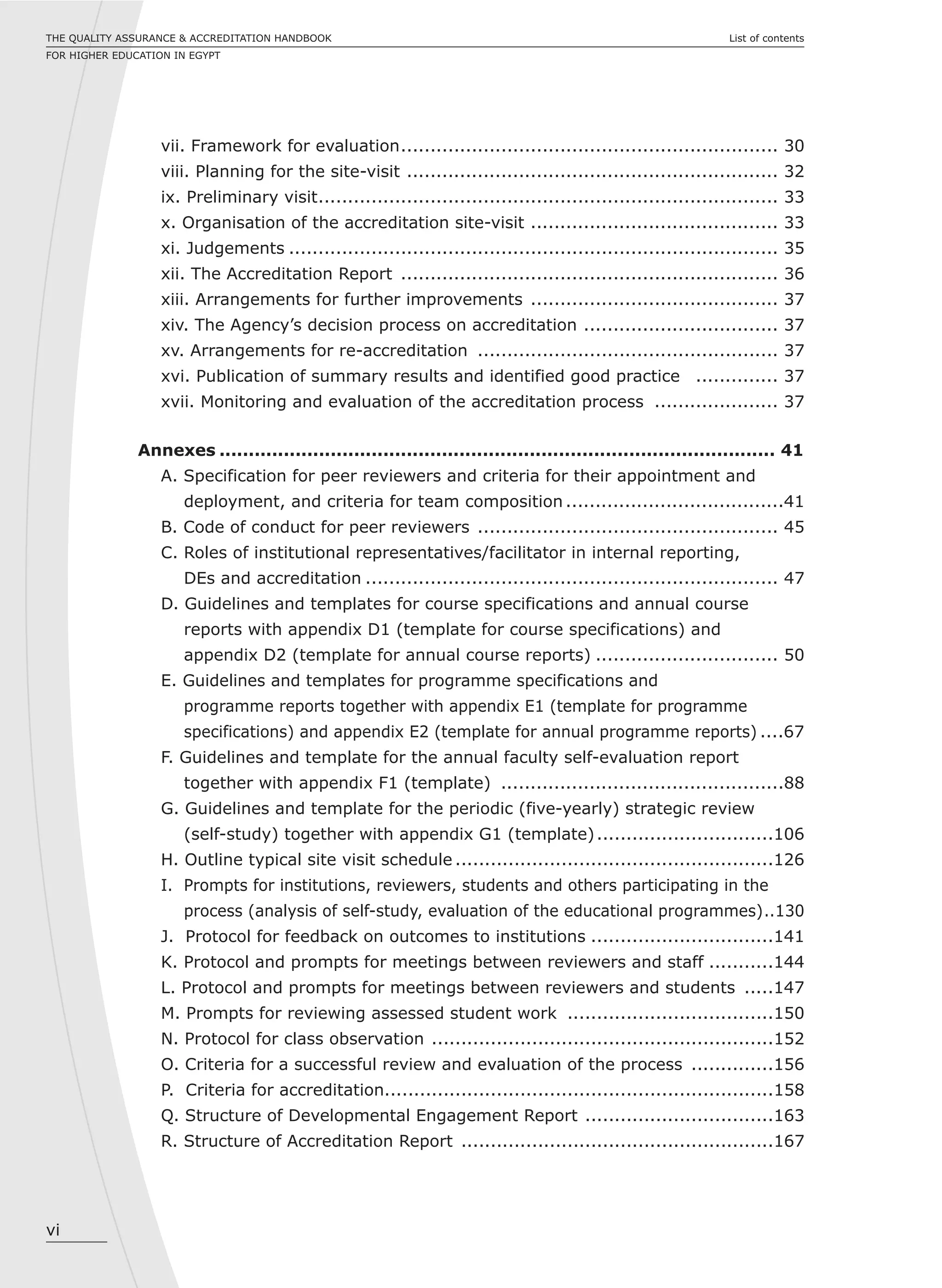
Q. Structure of Developmental Engagement Report ................................163
R. Structure of Accreditation Report .....................................................167
vii
THE QUALITY ASSURANCE & ACCREDITATION HANDBOOK
FOR HIGHER EDUCATION IN EGYPT
Acknowledgement
Acknowledgement
The Quality Assurance and Accreditation Committee (NQAAC) is proud to present to all the
Higher Education institutions, and to the Egyptian community at large, the first version of
“The Quality Assurance and Accreditation Handbook for Higher Education in Egypt” (QAAHHEE).
This handbook is the outcome of several years of relentless efforts, shared experience and
feedback from many stakeholders, individuals and/or institutions/organizations that made
it possible to complete this work.
It would be very difficult to acknowledge in person all those who have contributed and given
support towards the development of this work. However, special thanks and appreciation
are due to the Ford Foundation for granting funds to develop the initial phases of this work.
The continual support of the British Council, not only in this endeavor but also in Egypt’s
overall reform program, is highly acknowledged and appreciated. Special credit goes to Mr.
Arthur Brown and Dr. Bob Schofield, Consultants of Quality Assurance and Accreditation in
Higher Education affiliated to the Quality Assurance Agency (QAA) in the U.K., for their
valuable contribution and primary role in developing this handbook.
Special credit is also due to the following members of the NQAAC for their continuous efforts
working hand-in-hand with the British Consultants to finalize and issue the first version of
this Handbook:
Dr. Mohsen Elmahdy Said Cairo University (Engineering)
Chairman of the Board of PMU
Former NQAAC and QAAP Director
Dr. Nadia Badrawi Cairo University (Medicine)
Chairperson of NQAAC and QAAP
Dr. Salwa El Magoli Cairo University (Agriculture)
Dr. Ibrahim Shafei Assiut University (Engineering)
Dr. Zeinab Selim Cairo University
(Economics & Political Science)
Dr. Nabil Makled Assiut University (Agriculture)
Dr. Thabet Edrees Menoufia University (Commerce)
Dr. Kamal Emam Kamel Ain-Shams University (Science)
Dr. Ashraf Barkawi Cairo University (Agriculture)
Dr. Amal Garas Cairo University (Nursing)
Dr. Mahmoud Hefny Assuit University (Science)
Dr. Ibrahim Ismail Assuit University (Engineering)
Dr. Lamis Ragab Cairo University (Medicine)
It is envisaged by NQAAC that the Egyptian National Quality Assurance and
Accreditation Agency (NQAAA), when established, will build on this effort and will
continue to adopt and develop the same QAA methodology.
viii
PrefaceTHE QUALITY ASSURANCE & ACCREDITATION HANDBOOK
FOR HIGHER EDUCATION IN EGYPT
Preface by the National Quality Assurance and Accreditation Committee (NQAAC)
We are pleased to present this Handbook for use in Egypt as part of the national policy to
improve the level of confidence in the quality and academic standards of the range of
academic activities undertaken in higher education institutions. The Handbook marks the
beginning of an important period of transition in the quality and standards of higher education
in Egypt. It is the product of a number of years of consultation and development by the
NQAAC. We are grateful for the considerable support and enthusiasm in the higher education
community and the wider community for the initiatives to put in place new, rigorous processes
to assure the quality of higher education.
We are also using the period of transition in higher education to develop rigorous accreditation
processes that will assist in the goal of raising the level of confidence in higher education
and its graduates. We commend the Handbook to the higher education institutions and the
range of stakeholders who have a legitimate interest in the quality of higher education, and
the standing that its graduates and community projects held in Egypt, regionally and
internationally.
We are committed to quality assurance and continuing improvement in higher education
and, in publishing this Handbook to processes that are open, transparent, fair and consistent.
The implementation of the method as presented here will ultimately be the responsibility
of the proposed National Quality Assurance and Accreditation Agency (NQAAA) together
with all the users of the Handbook, including peer reviewers, institutions and the wider
community.
Dr. Nadia Badrawi
Chairperson of
National Quality Assurance
& Accreditation Committee
Preface
PART 1
INTRODUCTION
3
Part 1:Introduction THE QUALITY ASSURANCE & ACCREDITATION HANDBOOK
FOR HIGHER EDUCATION IN EGYPT
Part 1
Introduction
Purposes of the Handbook and how to use it:
1. This Handbook offers a comprehensive description of the processes and methods in
quality assurance and accreditation in higher education in Egypt together with guidelines
and templates to inform all those directly and indirectly concerned with the conduct of
the activities and to support continuing improvements in higher education. The Handbook
draws upon good practice in Egypt and other countries worldwide. It represents the
policy of openness, transparency and equity that are essential principles in the wider
education reform initiative.
2. The Handbook focuses upon the part that rigorous and systematic processes of quality
assurance can play a role in giving confidence to all those with a legitimate interest in
higher education and its quality assurance systems. These stakeholders include higher
education institutions, the students and prospective students, graduates and alumni,
sponsors and funding organisations, employers of graduates and those involved in
community services, and the wider community. It is intended to be the standard text
on the methods employed and a point of reference for all those engaged in the processes
and methods. It is also the starting point for the National Quality Assurance and
Accreditation Agency (NQAAA), hereafter referred to as the Agency, to develop in detail
its set of standards and operating procedures.
3. This introduction is followed by Part 2, which provides an overview of the quality
assurance and accreditation processes in Egypt. Part 3 together with its supporting
annexes provide information and guidance on the development of internal quality
assurance systems in institutions. Part 4 sets out the arrangements for the developmental
engagements during the transitional period. Part 5 describes the arrangements for
accreditation. Further information and guidance is given in the annexes.
4. Higher Education institutions should not only find parts 3, 4 and 5 of direct interest,
but also draw on the guidelines, templates and protocols contained in the annexes.
Academic staff in institutions engaging in developments within their institution and
conducting internal reviews, and peer reviewers engaged by the Agency, should find
the methods described in parts 2 – 5 and all the annexes essential guides to their review
work. Few will wish to read the text from cover to cover. The parts and the annexes
are written to be self-standing and easily accessible when needed to inform users on
the methods and emerging good practice across the range of activities in quality
assurance and accreditation in higher education. This means inevitably that there is
some duplication of information within the single Handbook.
Definitions of quality assurance and accreditation process:
5. Ultimately, the responsibility for the academic standards and quality of its academic
activities rests with the university as a degree-awarding body and the institutions that
run the programmes. The range of processes described in this Handbook encompass
not only the institutions but also the role of the Agency and its reviewers in conducting
external reviews and supporting the institutions’ plans for improving the quality of their
programmes and in considering applications from institutions for accreditation.
6. For the purposes of this initiative in Egypt, quality assurance is defined as:
“The means of ensuring that, informed by its mission, academic standards are defined
and achieved in line with equivalent standards nationally and internationally, and that
the quality of learning opportunities, research and community involvement are appropriate
and fulfill the expectations of the range of stakeholders.”
7. Accreditation is an affirmation and empowerment for higher education institutions to
obtain a distinguished character and identity and a seal of approval that actions taken
to improve quality are successful. In this context it is defined as:
4
THE QUALITY ASSURANCE & ACCREDITATION HANDBOOK
FOR HIGHER EDUCATION IN EGYPT
Part 1:Introduction
“The recognition accorded by the Agency to an institution which can demonstrate that
its programmes meet acceptable standards and that it has in place effective systems
to ensure the quality and continuing improvement of its academic activities, according
to the criteria published by the Agency.“
Statement of principles that underpin the quality assurance and accreditation
process:
8. The following nine principles, drawn from current good practice in quality assurance,
are applied to the quality assurance and accreditation processes and to the Agency’s
operations.
i. Focus on the customer (addressing the prime needs of the student, society and
the labour market)
ii. Leadership (uniting visions, aims and strategies in the educational community)
iii. People involvement (confirming the effective and equitable participation of all who
are engaged in education without discrimination and allowing the full use of their
abilities for the benefit of education and the wider community)
iv. Focus on tools (addressing processes and means as well as product or outcomes)
v. Adopting decisions on the basis of fact (encouraging and requiring judgements to
be evidence-based and reasonable)
vi. Continuous improvement (recognising the commitment to respond to changing
needs)
vii. Autonomy (respecting the responsibility of an institution for its academic activities)
viii. Mutual benefits (taking an approach to the range of participants – reviewers,
institutions, students and the wider community – that optimises the development
and transfer of knowledge and skills)
ix. Next steps (ensuring that the Agency and institutions, being in a dynamic and
open-ended process of continuing improvement, are committed to identifying
actions and issues to be addressed).
9. The Agency will wish to conduct its affairs informed by the principles of good governance,
notably openness, transparency, fairness, equity and accountability. It will wish to
continue to develop its organisation and systems in accordance with the above principles.
10. The Agency will wish to develop appropriate procedures for processing legitimate
complaints about the conduct of its operations and for processing appeals from institutions
against the outcomes of its accreditation process. These procedures will reflect best
international practice and respect the two fundament laws of natural justice: the
accreditation process will be conducted essentially in line with its published procedures
and protocols, and the judgments derived from the process will be fair and evidence-
based without perversity.
11. The Agency will wish continually to evaluate and develop its processes and systems in
line with national and international needs and trends. The developmental engagements
and accreditation reviews will routinely be evaluated using the criteria for successful
reviews (annex O) as the basis of questionnaires sent to all those directly participating
in the reviews (the peer reviewers, the review chairs, the institutional representatives
(facilitators) and the institution).
PART 2
QUALITY ASSURANCE
AND ACCREDITATION
IN HIGHER EDUCATION
IN EGYPT
AN OVERVIEW
7
THE QUALITY ASSURANCE & ACCREDITATION HANDBOOK
FOR HIGHER EDUCATION IN EGYPT
Part 2:Quality Assurance and Accreditation in Higher Education in Egypt – an Overview
i. The role of the Agency, its mission and strategic aims:
12. The roles of the Agency are: to promote quality assurance in higher education, including
the contributions of research and community service; encourage the improvement in
academic standards and the quality of the learning opportunities; facilitate the development
and application of national reference standards taking account of international standards,
and support institutions in the development of their internal quality assurance systems.
The Agency will also establish a system for accreditating and reviewing institutions with
the intention of accrediting institutions that satisfy published criteria.
13. The mission of the Agency is: “To ensure quality, continuous development and
efficient performance of Egyptian higher education institutions, of their systems
and of their programmes, in accordance with their mission statements and
declared goals; and to gain the confidence of the community in their graduates,
depending on distinguished and competent human resources, and based on
internationally recognized evaluation mechanisms through an independent,
neutral and transparent framework.”
14. The strategic goals of the Agency in respect of its higher education remit are to:
• Raise the level of confidence of the community in the outcomes of higher education;
• Support the quality assurance and accreditation process in accordance with internal
requirements of universities and higher education institutes;
• Review the higher education institutions through developmental engagements and
encourage them to establish their internal quality assurance systems;
• Enhance capacity building in quality assurance;
• Facilitate the development and application of national reference standards for
academic programmes;
• Integrate a sustainable process combining the institutions’ systems for quality
assurance with external processes for review and accreditation;
• Support continuing quality improvement;
• Co-operate regionally and internationally with similar agencies.
ii. Transitional period:
15. There will be a transitional period in which institutions will be supported in the development
of quality assurance systems and the improvement of academic standards and the
quality of learning opportunities. At the same time, this period will see the establishment
and development of the Agency.
iii. Main features of the quality assurance and accreditation process:
16. The system and process are developed especially to support the education reforms in
Egypt. The main features are as follows:
• The institution providing higher education programmes is responsible for the
academic standards and the quality of its programmes that comply with the
national standards
• Internal systems for quality assurance when developed should provide sufficient
information for any external scrutiny including the processing of applications for
Agency accreditation;
• The Agency will wish to continue to develop, in partnership with the higher education
community and other stakeholders, a framework for evaluation and reporting that
supports enhancement and provides evidence-based qualitative information;
Part 2
Quality Assurance and Accreditation
in Higher Education in Egypt – an Overview
8
Part 2:Quality Assurance and Accreditation in Higher Education in Egypt – an OverviewTHE QUALITY ASSURANCE & ACCREDITATION HANDBOOK
FOR HIGHER EDUCATION IN EGYPT
• The Agency will wish to continue to assist institutions to develop their internal
quality assurance systems and enhance their programmes, including Quality
Assurance and Accreditation Project (QAAP) funding for projects during the
transitional period, training programmes and developmental engagements;
• The evaluation framework (please see paragraph 17) informs internal and external
review processes;
• Evidence-based self-evaluation by institutions is central to the internal and external
review processes;
• External peer review is employed to reach evidence-based judgments;
• National reference standards will be developed to inform institutions, reviewers
and other stakeholders;
• Published criteria and procedures for accreditation are augmented by sets of related
guidelines and templates;
• The Agency will publish evaluative reports arising from the programme of
developmental engagements and in due course from accreditation reviews.
iv. Evaluative framework:
17. The evaluation of academic activity and the quality assurance systems follows broadly
the same structure as internal quality assurance processes, developmental engagements
and the accreditation process, and uses the criteria for accreditation (annex P) as a
reference point. The prompts offered in annex I provide further detail.
Academic Standards
• Intended learning outcome
“The ILOs are the knowledge, understanding and skills which the institution intends
for its programmes that are mission-related and reflect the use of external reference
standards at appropriate level.”
• Curricula
“The curricula for the programme facilitate the attainment of the stated intended
learning outcomes.”
• Student assessment
“A set of processes , including examinations and other activities concluded by the
institution to measure the achievement of the intended learning outcomes of a
course / programme. Assessments also provide the means by which students are
ranked according to their achievements. The students are well informed on the
criteria by which they are assessed and given appropriate structured feedback that
supports their continuing learning.”
• Student achievement
“Levels of students’ achievements are maintained with due regard to the use of
external reference points, moderation and evaluation of achievement.”
Quality of Learning Opportunities
• Teaching and learning
“There are effective teaching and learning, informed by a shared, strategic view
of learning and the selection of appropriate teaching methods; and due attention
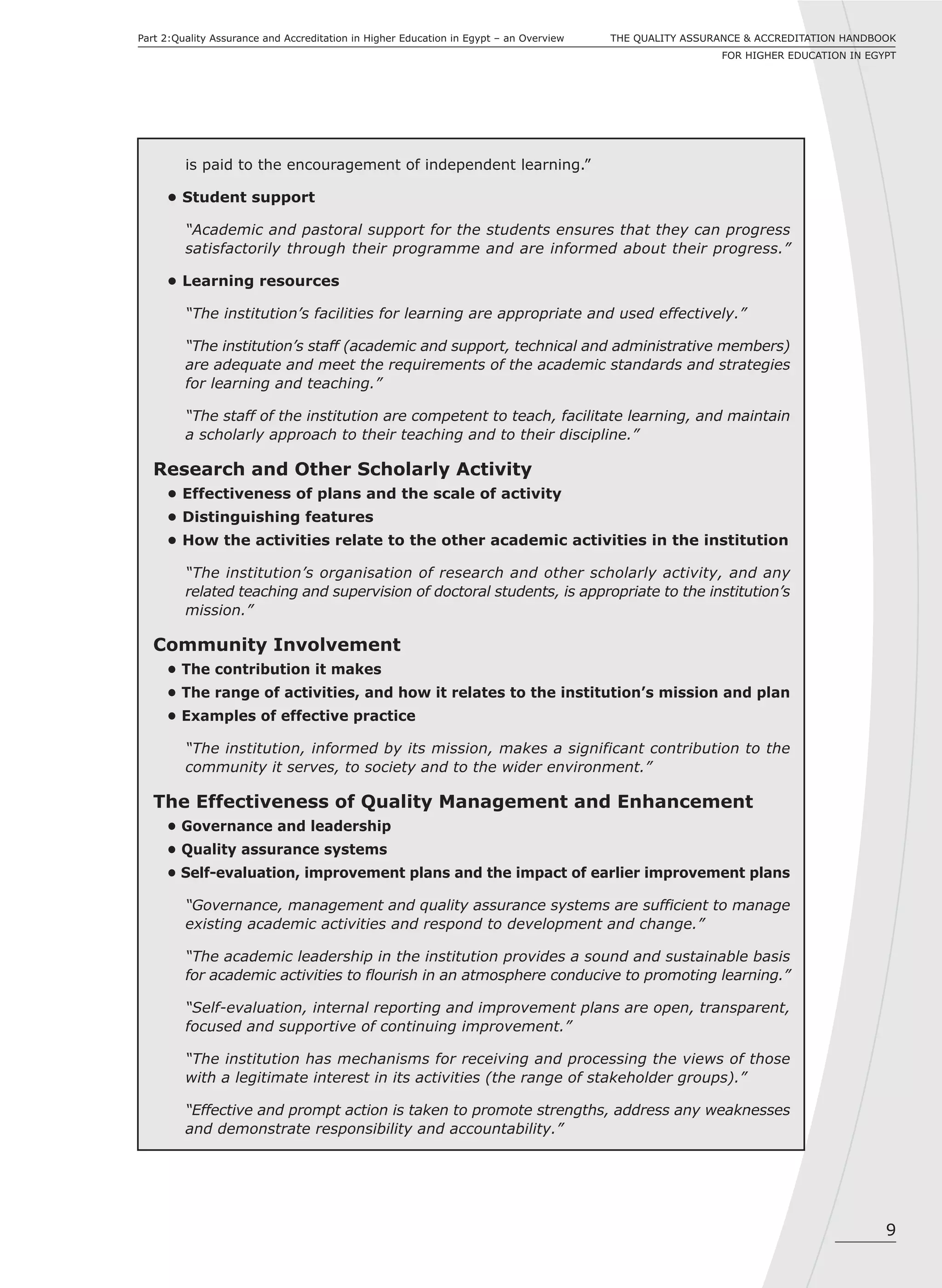
9
THE QUALITY ASSURANCE & ACCREDITATION HANDBOOK
FOR HIGHER EDUCATION IN EGYPT
Part 2:Quality Assurance and Accreditation in Higher Education in Egypt – an Overview
is paid to the encouragement of independent learning.”
• Student support
“Academic and pastoral support for the students ensures that they can progress
satisfactorily through their programme and are informed about their progress.”
• Learning resources
“The institution’s facilities for learning are appropriate and used effectively.”
“The institution’s staff (academic and support, technical and administrative members)
are adequate and meet the requirements of the academic standards and strategies
for learning and teaching.”
“The staff of the institution are competent to teach, facilitate learning, and maintain
a scholarly approach to their teaching and to their discipline.”
Research and Other Scholarly Activity
• Effectiveness of plans and the scale of activity
• Distinguishing features
• How the activities relate to the other academic activities in the institution
“The institution’s organisation of research and other scholarly activity, and any
related teaching and supervision of doctoral students, is appropriate to the institution’s
mission.”
Community Involvement
• The contribution it makes
• The range of activities, and how it relates to the institution’s mission and plan
• Examples of effective practice
“The institution, informed by its mission, makes a significant contribution to the
community it serves, to society and to the wider environment.”
The Effectiveness of Quality Management and Enhancement
• Governance and leadership
• Quality assurance systems
• Self-evaluation, improvement plans and the impact of earlier improvement plans
“Governance, management and quality assurance systems are sufficient to manage
existing academic activities and respond to development and change.”
“The academic leadership in the institution provides a sound and sustainable basis
for academic activities to flourish in an atmosphere conducive to promoting learning.”
“Self-evaluation, internal reporting and improvement plans are open, transparent,
focused and supportive of continuing improvement.”
“The institution has mechanisms for receiving and processing the views of those
with a legitimate interest in its activities (the range of stakeholder groups).”
“Effective and prompt action is taken to promote strengths, address any weaknesses
and demonstrate responsibility and accountability.”
10
Part 2:Quality Assurance and Accreditation in Higher Education in Egypt – an OverviewTHE QUALITY ASSURANCE & ACCREDITATION HANDBOOK
FOR HIGHER EDUCATION IN EGYPT
v. Peer review
18. The Agency wishes to appoint peer reviewers for external reviews, using the specification
and criteria presented in annex A. They will not be assigned to their own university or
college and they should not have any potential conflict of interest. The peer reviewers
undertake the prime evaluating role, bringing current or recent relevant experience in
higher education and relevant experience in the teaching or application in professional
or industrial practice. They themselves must be credible and respected as peers by
academic staff in institutions. The institutions’ internal self-evaluation processes as part
of institutional quality assurance systems are therefore not defined as being peer review,
though there are clear benefits to the institution if it draws upon peer review skills and
insights when implementing its institutional quality systems. The conduct of peer
reviewers is informed by the protocol contained in annex B.
vi. The development of guidelines and national reference standards
19. Higher education institutions are expected to define their mission and strategic aims and
develop a five yearly strategic review report (Annex G). The institutions will also need
to develop their internal quality assurance systems. Annual reporting will concentrate on
the performance in terms of the institution’s intended learning outcomes manifest in its
course and programme specifications and prepare an annual self-evaluation report based
on evaluative data carried forward from course and programme reports (Annex F)
20. Institutions will be encouraged to compare their academic standards with equivalent
standards nationally and internationally. To assist in this important process, the Agency
will work with the sectors of the Supreme Council of Universities in Egypt, higher
education institutions and academic and professional societies, to develop national
academic reference standards and measure instruments that correspond to international
standards.
vii. Developmental engagements:
21. Developmental engagements will be conducted during the transitional period, until the
full function of the Agency and the first cycle of accreditation is in place. The developmental
engagement provides an opportunity for institutions to develop and test in co-operation
with the Agency, the effectiveness of their quality system and the robustness of the
evidence and reporting used in that system. Developmental engagements will not lead
to accreditation. The outcome will not be used directly to determine accreditation at a
later stage. However, the conclusion reached will include a judgment by the reviewers
on the extent to which, if accreditation were to be under consideration, the institution
would have met the criteria, and what further improvement is needed. The report produced
(annex Q) will make recommendations for improvement, in order to provide the institution
with information to assist it to prepare for accreditation. The report will not be published.
22. Guidelines for the peer reviewers, the review chair, the facilitators nominated by the
institution and the site visit, will be available (please refer to annexes A, B and C). All
reviewers, chairs, and facilitators will receive training and briefing on the method, the
role and the assignment, including the structure of the report. The Agency will also arrange
for briefing and training of academic and support staff in the quality assurance process.
These steps will contribute to the fair and consistent application of the published methods
and protocols.
viii. Accreditation:
23. Accreditation is a gateway towards total quality, and it is also considered to be a motivation
for institutions to promote comprehensive educational processes and quality systems to
raise the level of confidence in the institution and its graduates. The Agency will seek to
accredit all institutions that can demonstrate that they have met the published criteria
(annex P). In brief, the criteria require the institution to have effective quality assurance
systems that underpin the appropriate academic standards of its programmes and the
high quality of learning opportunities. The Agency will wish to accredit institutions that
have significantly improved their standards and are committed to continuing improvement.
The accredited institution will have demonstrated a high level of the management of its
academic standards, the quality of its programmes and a capacity to maintain and
continually improve them. The Accreditation Review Report (annex R) will be the prime
evidence base for the decision by the Agency to accredit the institution. It will be published.
PART 3
THE DEVELOPMENT
OF INTERNAL QUALITY
ASSURANCE SYSTEMS
IN HIGHER EDUCATION
INSTITUTIONS
13
Part 3:The Development of Internal Quality Assurance Systems
in Higher Education Institutions
THE QUALITY ASSURANCE & ACCREDITATION HANDBOOK
FOR HIGHER EDUCATION IN EGYPT
Part 3
The Development of Internal Quality Assurance Systems
in Higher Education Institutions
Introduction
24. This part of the Handbook outlines the context within which institutions are encouraged
to develop their internal systems of quality assurance, defines the systems, introduces
the detailed guidelines and templates provided in the annexes to the Handbook, and
offers an approach to developing these systems that institutions, newly embarking on
this development, may wish to apply in the transitional period. The annexes directly
addressed in this part are:
Annex D: Guidelines on course specifications and annual course reports together
with templates in appendices D1 and D2
Annex E: Guidelines on programme specifications and annual programme reports
together with templates in appendices E1 and E2
Annex F: Guidelines on annual faculty reports together with a template in appendix F1.
Annex G: Guidelines on periodic strategic reviews together with a template in
appendix G1.
In addition, institutions may wish to refer to the evaluation framework set out in part 2 of
the Handbook and to parts 4 and 5 that address developmental engagements and the
accreditation process.
i. Context
25. The processes of quality assurance and accreditation for higher education being developed
in Egypt place upon institutions, and (where appropriate) upon their awarding university,
the responsibility for maintaining and continually improving the academic standards of
their programmes that comply with the national standards and the quality of the learning
opportunities provided. The transitional period provides all institutions with the opportunity
to develop their internal systems of quality assurance to the point where they ensure
high quality and promote a justifiably high level of confidence in their graduates. One
of the key criteria for accreditation is the demonstrable effectiveness of the institution’s
internal systems for quality assurance. In working with institutions towards successful
accreditation, the Agency will wish to continue to support institutions in their development
of effective systems of quality assurance.
26. Institutions have available a range of approaches and models of quality management,
including Total Quality Management and International Standards Organization (ISO)
requirements. Whatever their chosen model of quality management, institutions will
be expected to be able to demonstrate to its range of stakeholders that it conducts its
academic activities in line with good governance, including the principles of openness,
transparency and accountability.
27. The guidelines and the templates contained in annexes D, E, F and G are the product
of extensive consultations with higher education institutions and draw upon good practice
worldwide. Institutions are invited to adopt and adapt them to their own circumstances.
ii. Summary of the features of internal quality assurance systems
28. The management of academic standards and quality of higher education and the process
of continuing improvement require of the institution a systematic approach. The prime
purpose of such a system is to maintain and improve the level of the educational
programmes and other elements affecting them. Such a system involves specifying the
quality and the intended outcomes of educational programmes, designing, implementing
and reviewing the instruments of quality assurance such as templates and procedures
and developing appropriate data bases together with the means of gathering and
processing information effectively.
14
THE QUALITY ASSURANCE & ACCREDITATION HANDBOOK
FOR HIGHER EDUCATION IN EGYPT
Part 3:The Development of Internal Quality Assurance Systems
in Higher Education Institutions
29. The students (potential and current) and recent graduates of an institution’s educational
programs and related academic activities should benefit from this systematic approach
with a clarity of intended outcomes, routine reporting of performance, performance
follow-up, precise identification of good practice that can be disseminated, as well as
the identification of learning deficiencies and obstacles, and suggestions for development
and enhancement. The institution will be more effective for being able to make evidence-
based decisions to develop its policies, to modify its priorities for improvement based
on needs and risk assessment and to follow up the identification and implementation
of development policies. It will also be in a position to demonstrate the robustness of
its internal systems to its stakeholders.
30. The purpose of the guidelines is to inform the development of inter-related systems at
course, programme and institutional levels. Annexes D, E and F provide guidelines and
recommended templates for specifications and reports at each level. When fully
implemented, these instruments of quality assurance will routinely provide up to date,
evaluative information that serves both internal and external interests. In addition, a
framework for a periodic strategic review by the institution, set out in annex G, offers
the institution the means of taking a broad, strategic view of its direction and impact
every five years. This self-study will be more comprehensive and analytical than the
routine annual updating of performance and will take a medium and long term planning
perspective. Taken together, these guidelines and templates are not intended to be
prescriptive. The Agency, in implementing its procedures for accreditation, will not seek
rigid compliance by all institutions with the guidelines and templates. An institution
applying for accreditation may choose to adopt alternative templates but will be expected
to demonstrate the effectiveness of its systems and procedures.
iii. Towards a development plan for quality assurance systems and
processes in institutions:
31. Many institutions are already developing their systems for quality assurance. Institutions
embarking on development for the first time may wish to consider adopting a development
plan based on the recommendations from the National Quality Assurance and Accreditation
committee (NQAAC). The following stepped approach, based on the ISO quality
management approach is suggested:
1. Identify the goals. What is the prime purpose (e.g. “improving the academic
standing of the graduates”)?
2. Identify what others (the range of stakeholders) expect of you. These are the
expectations of interested parties (stakeholders) such as:
• Students, graduates and other end users
• Academic staff
• Employers of graduates
• Funding organisations
• Suppliers (e.g. IT equipment and software)
• Society
3. Obtain information about current good practice in quality management, study the
guidelines in the annexes and relevant university regulations, and consider the
implications for the institution of the criteria for accreditation.
4. Adopt in principle the guidelines offered in the management system of your
institution. Decide if you are seeking certification for your quality management
such as ISO 9001:2000 or other recognition from, for example, a professional
organisation, and the timescale for applying for the Agency’s accreditation.
15
Part 3:The Development of Internal Quality Assurance Systems
in Higher Education Institutions
THE QUALITY ASSURANCE & ACCREDITATION HANDBOOK
FOR HIGHER EDUCATION IN EGYPT
5. Obtain guidance on specific topics within the quality management system, using
workshops, projects funded by QAAP and other relevant programmes that support
systems development and professional development (including staff training).
6. Establish your current status, determine the gaps between your quality
management system and the requirements of the Agency accreditation and any
other selected certification. You may wish to use the evaluation framework
provided in this Handbook and a self-evaluation to help you. Developmental
engagements (addressed in Part 4 of this Handbook) and the appointment of
an external evaluator should also provide valuable external commentary. You
should seek to involve all members of the institution in the process and address
the range of stakeholders as indicated in step 2 above.
7. Use the guidelines and templates in the annexes to determine the processes
that are needed, which apply and which need to be adapted, in order to develop
appropriate systems and procedures. You will also wish to consider developing
devices for controlling, measuring and monitoring the development plan.
8. Develop a plan to close the gaps in step 6 and to develop the processes in step
7. Identify actions needed to close the gaps, allocate resources to perform these
actions, assign responsibilities and establish a schedule to complete the needed
actions.
9. Carry out your plan. Proceed to implement the identified actions and track
progress in your schedule.
10. Maintain a record of key activities and the measurement of impact, which can
be included in self-evaluation reports and presented as part of the application
for accreditation.
PART 4
DEVELOPMENTAL
ENGAGEMENTS
19
Part 4:Developmental Engagements THE QUALITY ASSURANCE & ACCREDITATION HANDBOOK
FOR HIGHER EDUCATION IN EGYPT
i. Purposes and outcomes of developmental engagements:
32. Developmental engagements will take place during the transitional period. Institutions
may wish to use the opportunity to evaluate their quality assurance systems and their
programmes with a view to identify strengths and areas for further improvement. This
part of the Handbook provides guidelines for the engagements and a provisional
timetable.
33. In addition to internal projects, some of which may be funded by the QAAP, the Agency
will wish to arrange external peer reviews. Institutions are invited to participate in these
peer review engagements by submitting to the Agency their annual self-evaluation
report and discussing with the Agency the appropriate timing of a site-visit.
34. These developmental engagements provide an opportunity for institutions to develop
and test, in co-operation with the Agency, the effectiveness of the institution’s quality
assurance systems, the robustness of the evidence base and the reports that they
generate in those systems. The Agency will agree on a suitable schedule, compose a
peer review team (annex A), appoint a review chair and invite the institution to nominate
a facilitator (annex C).
35. The benefits to an institution of participating in a developmental engagement include,
in addition to the opportunities to test, develop and refine internal review processes:
the dialogue with peers; receiving external structured comment; and the written review
report, which should offer an agenda for further improvement. All of these may assist
further with the institution’s arrangements to identify strengths and weaknesses, enhance
the programmes and disseminate good practice.
36. The developmental engagements and the outcomes will not lead to accreditation.
However, the conclusions reached will include a judgment on: the extent to which the
quality assurance systems in place are effective; and the quality and academic standards
of the programmes.
37. The outcome of each developmental engagement is a set of conclusions agreed by the
visiting review team, conveyed in an oral feedback at the end of the site visit (annex
J) and supported by a detailed review report (annex Q). The report will remain confidential.
ii. Evaluative framework:
38. The evaluation of the academic activity and the quality assurance systems follows
broadly the same structure as the templates for annual self-evaluation reports and
accreditation and uses the criteria for accreditation (annex P). The framework for
evaluation and the report given below is designed to be sufficiently flexible to serve all
institutions that have developmental engagements. However, the framework, with its
standard structure and key criteria, also ensures that the developmental engagement
method is applied consistently and fairly in all cases.
Part 4
Developmental Engagements
Academic Standards
• Intended learning outcomes:
“The ILOs are the knowledge, understanding and skills which the institution intends
for its programmes that are mission-related and reflect the use of external reference
standards at appropriate level.”
• Curricula
“The curricula for the programme facilitate the attainment of the stated intended
learning outcomes.”
20
THE QUALITY ASSURANCE & ACCREDITATION HANDBOOK
FOR HIGHER EDUCATION IN EGYPT
Part 4:Developmental Engagements
• Student assessment
“A set of processes , including examinations and other activities concluded by the
institution to measure the achievement of the intended learning outcomes of a
course / programme. Assessments also provide the means by which students are
ranked according to their achievements. The students are well informed on the
criteria by which they are assessed and given appropriate structured feedback that
supports their continuing learning.”
• Student achievement
“Levels of students’ achievements are maintained with due regard to the use of
external reference points, moderation and evaluation of achievement.”
Quality of Learning Opportunities
• Teaching and learning
“There are effective teaching and learning, informed by a shared, strategic view
of learning and the selection of appropriate teaching methods; and due attention
is paid to the encouragement of independent learning.”
• Student support
“Academic and pastoral support for the students ensures that they can progress
satisfactorily through their programme and are informed about their progress.”
• Learning resources
“The institution’s facilities for learning are appropriate and used effectively.”
“The institution’s staff (academic and support, technical and administrative members)
are adequate and meet the requirements of the academic standards and strategies
for learning and teaching.”
“The staff of the institution are competent to teach, facilitate learning, and maintain
a scholarly approach to their teaching and to their discipline.”
Research and Other Scholarly Activity
• Effectiveness of plans and the scale of activity
• Distinguishing features
• How the activities relate to the other academic activities in the institution
“The institution’s organisation of research and other scholarly activity, and any
related teaching and supervision of doctoral students, is appropriate to the
institution’s mission.”
Community Involvement
• The contribution it makes
• The range of activities, and how it relates to the institution’s mission and plan
• Examples of effective practice
“The institution, informed by its mission, makes a significant contribution to the
community it serves, to society and to the wider environment.”
21
Part 4:Developmental Engagements THE QUALITY ASSURANCE & ACCREDITATION HANDBOOK
FOR HIGHER EDUCATION IN EGYPT
The Effectiveness of Quality Management and Enhancement
• Governance and leadership
• Quality assurance systems
• Self-evaluation, improvement plans and the impact of earlier improvement plans
“Governance, management and quality assurance systems are sufficient to manage
existing academic activities and respond to development and change.”
“The academic leadership in the institution provides a sound and sustainable basis
for academic activities to flourish in an atmosphere conducive to promoting
learning.”
“Self-evaluation, internal reporting and improvement plans are open, transparent,
focused and supportive of continuing improvement.”
“The institution has mechanisms for receiving and processing the views of those
with a legitimate interest in its activities (the range of stakeholder groups).”
“Effective and prompt action is taken to promote strengths, address any weaknesses
and demonstrate responsibility and accountability.”
iii. Guidelines on the conduct of developmental engagements:
Planning for the site-visit
39. Initial planning commences in the institution, with its preparation of the internal annual
course, programme and faculty annual reports. Some institutions may also wish to
prepare their first periodic strategic self-evaluation review report (annex G) before
asking for a developmental engagement. The institution may if it wishes also write an
additional brief self-evaluation report in preparation for the peer review, which may
highlight key developments since the annual faculty self-evaluation report was produced.
40. The institution and the Agency will wish to consider the timing of a site visit and the
size and composition of the peer review team needed. The institution will be invited to
nominate a senior member of the institution, or from another institution within the
university, to facilitate the process of developmental engagement and peer review. The
role of the facilitator is set out in annex C.
41. The Agency will compose a provisional review team and send the information to the
institution inviting it to comment on suitability. The reviewers will offer appropriate
expertise, but the review chair need not necessarily bring subject expertise. The team
size and the selection of expertise will be informed by the specification and criteria set
out in annex A, together with information supplied to the Agency by the institution on
the profile of the programmes.
42. When considering the provisional team, the institution has no veto on the team members,
nor can it nominate reviewers; however, the institution will be invited to confirm that
the expertise in the team is appropriate and that it is not aware of any potential conflict
of interest (annex A). When the Agency has confirmed the review team, it will send the
names and addresses to the institution, which will send the copies of the advance
documentation directly to the reviewers not later than six weeks before the scheduled
visit. At the same time, the institution will send two hard copies for the Agency and an
electronic version of the most recent self-evaluation reports by e-mail or floppy disk
to the Agency.
43. The review chair is responsible for contacting the review team members and the
representative of the institution who is leading the developmental engagement, at least
22
THE QUALITY ASSURANCE & ACCREDITATION HANDBOOK
FOR HIGHER EDUCATION IN EGYPT
Part 4:Developmental Engagements
four weeks before the scheduled site-visit. The peer reviewers are required to read the
course programme and faculty reports as well as any strategic review report and prepare
an initial commentary in line with the guidance offered by the review chair. The initial
commentaries should be sent to other team members including the review chair not
later than one week before the first day of the site-visit. The facilitator is also entitled
to see these initial commentaries.
Preliminary visit
44. The review chair will arrange with the institution a suitable date for him or her to attend
a preliminary visit to the institution. The purposes of this visit are:
• To confirm the arrangements for the developmental engagement.
• To provide initial feedback on the adequacy of the evaluative information contained
in the advance documentation and request any additional information.
• To confirm the supporting documentation to be available for the site visit, including
the sample of students’ assessed work.
• To agree on the timetable for the site-visit based on the typical timetable (see
annex H) and taking account of local circumstances.
• To agree on the logistics including a base room for the visiting reviewers.
• To ensure that the facilitator understands the method and to brief him on his role.
Site visit
45. The site-visit will normally be arranged, using the typical outline visit schedule (annex
H), over three days. These days will normally be consecutive but can be split over a
period of up to two weeks into 2 +1 or 1+2 days.
46. The site-visit invariably includes time for meetings (annexes J, K and L). The meetings
with students and with staff are essential elements of the developmental engagements.
Some meetings are best pre-arranged and some may be arranged at short notice. The
reviewers will also wish to devote sometime to reading the documentation provided and
making notes. The sample of students’ assessed work forms a vital part of this supporting
documentation. Reviewers will wish to scrutinise the sample together with the question
sheets, marking schemes and any written comments and feedback to students (annex M).
47. The reviewers, after considering their preliminary reading of the documentation and
their initial written commentaries, may decide to include observation of a small sample
of classes in the schedule. The purpose of observing classes is to collect evidence by
direct observation of the quality of the teaching and learning and to draw reasonable
inferences on, for example, the appropriateness of the teaching methods and the
classroom facilities. The purpose is not to appraise the performance of academic staff.
Any evaluations made will not be personalised nor over-generalised. The full protocol
for class observation is given in annex N.
48. The institution will be expected to provide a suitable room for the visiting reviewers that
is sufficient for the size of the team and the range of supporting documentation. The
room should offer worktables, coffee machine, water and light refreshments. It would
also be helpful to include a PC and printer and, if appropriate, a web terminal. The
visiting team will also need access to photocopying. The base room should also be
secure to protect the documentation. In addition, the institution will need to arrange
access to suitable meeting rooms during the site-visit in line with the schedule of
meetings.
49. The institution will wish to ensure that all documents are readily available to the
reviewers.
23
Part 4:Developmental Engagements THE QUALITY ASSURANCE & ACCREDITATION HANDBOOK
FOR HIGHER EDUCATION IN EGYPT
These will normally consist of:
• Programme approval (validation) documents
• Programme handbooks
• Student handbooks
• Learner support material (a sample may be sufficient)
• Records of staff-student liaison committee or the equivalent for the last year
• Assessment criteria together with guidance and rules of marking or equivalent
• Samples of students’ assessed work representing all levels and a sample of programmes
• Examination board minutes for at least three years
• External evaluators’ reports for the last three years if applicable
• Student feedback summaries
• Outcomes of consultations, surveys and other engagements with students
• Recruitment and progression data including employment
• Staff CVs including summary lists of research, conference papers and publications
• Examples of the output from recent community service activity
• Staff development programme and reports
• Professional, statutory and regulatory body reports if relevant
50. The reviewers will meet regularly as a team and at least once a day will hold a formal
meeting to assess its progress, review the evidence base and the priorities for further
enquiries. The facilitator is entitled to attend these meetings. The final team meeting
on the last day will review the evidence, satisfy itself that the enquiries address the
criteria and prompts provided in annex I that are appropriate to the self-evaluation,
agree a generic comment on the quality of the self-evaluation and its supporting
evidence, and make judgements that include a set of conclusions. The facilitator is not
present at this judgement meeting.
51. Each peer reviewer, for the specific areas of responsibility assigned and under the
guidance of the review chair, will compile a record of the evidence base and will draft
a section or sections of the review report during the site-visit. The review chair is
responsible for co-ordinating the reviewers’ writing, ensuring that the information is
shared in the team and preparing the first draft review report in line with the published
structure (annex Q).
iv. Guidelines on the reporting of outcomes
Judgements
52. Using the criteria for accreditation (annex P) together with other guidelines and templates
provided in the annexes to this Handbook, the reviewers will work closely with the
institution to evaluate whether, were this to be a review for accreditation, the institution
would have met the criteria and if not what further improvements are required. The
reviewers will evaluate the academic standards, the quality of the learning opportunities,
the research and other scholarly activity, the community involvement and the effectiveness
of quality management and enhancement, including a comment on the progress made
in developing quality assurance systems.
53. The judgements under each heading will be presented in the review report using the
programme specification(s), the annual self-evaluation report(s), the evaluation framework
and the criteria
24
THE QUALITY ASSURANCE & ACCREDITATION HANDBOOK
FOR HIGHER EDUCATION IN EGYPT
Part 4:Developmental Engagements
For each heading (component) under Academic Standards in the framework, reviewers
will give a positive or negative outcome. If the reviewers give a positive outcome on
all four components, the outcome for Academic Standards as a whole will be positive.
If any one component in this aspect has a negative outcome, the outcome for Academic
Standards as a whole will be negative.
For each component under Quality of Learning Opportunities in the framework, reviewers
will give a positive or negative outcome.
If the reviewers give a positive outcome on all components, the outcome for the Quality
of Learning Opportunities as a whole will be positive. If any one component in this
aspect has a negative outcome, the outcome for Quality of Learning Opportunities as
a whole will be negative.
For Research and Other Scholarly Activity, reviewers will give one generic outcome,
positive or negative.
For Community Involvement, reviewers will give one generic outcome, positive or
negative.
For each component under The Effectiveness of Quality Management and Enhancement
in the evaluation framework, reviewers will give a positive or negative outcome. If the
reviewers give a positive outcome on all components, the outcome as a whole will be
positive. If any one component in this aspect has a negative outcome, the outcome
for The Effectiveness of Quality Management and Enhancement as a whole will be
negative.
Sample of text reporting conclusions
Conclusions
The developmental engagement at [institution] included a site visit by reviewers in
[month/year]. The reviewers, on the basis of the self-evaluation report and supporting
documentation and the additional evidence derived from the site-visit, conclude that
the [institution] [is ready to receive an accreditation visit] OR [is not yet ready to
receive an accreditation visit.
The strengths include:
[List key points]
Matters that deserve to be addressed before an accreditation visit are:
[List key points in a way that the institution has a clear indication of the matters
that it should address]”
Oral feedback on outcomes
54. The site visit ends with a feedback meeting chaired by the review chair and attended
by the Dean or equivalent head of the institution, the President or their representative
and such other members of the institution as are invited by the President or the Dean.
All reviewers attend the meeting, but the presentation of the findings is made on their
behalf by the review chair in line with the protocol (annex J).
After the site-visit
55. The team will produce a review report using the structure in annex Q. The report will
take a narrative form and focus on evaluation (including key strengths and any weaknesses
or issues to be addressed) rather than description. It will be evidence-based and where
appropriate will offer examples of good practice. The report should be factually correct,
25
Part 4:Developmental Engagements THE QUALITY ASSURANCE & ACCREDITATION HANDBOOK
FOR HIGHER EDUCATION IN EGYPT
clear, concise, fair and balanced. The conclusions should match the reasoning in the
main text. The review report will be produced in both Arabic and English. As an indication
of length, it is envisaged that the English version of the report will normally convey the
necessary evaluative information in around 5,000 words.
56. The report is addressed to the institution, copied to the Agency and, where relevant,
the institution’s university. The review chair will prepare draft 1 shortly after (that is,
normally within two weeks) the site-visit and send it to the review team for comments.
The team is expected to respond constructively and promptly (that is, within two weeks)
to this draft, supplying, if required, additional clarification, information or examples.
The review chair will use the responses to prepare draft 2, which he will send to an
independent editor (normally another experienced review chair) to read and comment
on the draft. This includes checking that its structure complies with annex Q that the
judgements are clear and supported by evidence, that the conclusions are in line with
the main text of the report and that the evaluations are fair and balanced. The review
chair will consider points raised and modify the draft report accordingly. This stage will
not normally take more than two weeks. The review chair then sends the draft 3 reports
to the institution with a covering letter, inviting comments on factual accuracy,
approximately eight weeks following the end of the site-visit. The institution is expected
to respond within two weeks and send a considered response to the review chair. The
editing of the report, taking due account of the institution’s response, will be undertaken
by the review chair. This editing process will normally enable the review chair to send
the draft 4 versions to the Agency within 12 weeks of the site-visit.
57. The Agency at this stage will take responsibility for the ultimate quality of the report
and will wish to satisfy itself that the report is competent. The Agency may wish to
engage a professional editor at this stage. However, the conclusions reached by the
peer reviewers in a competent report will not be changed. If the Agency requires further
editing such as the inclusion of additional evidence, the review chair will be asked to
assist. It is envisaged that the review report production will be complete approximately
20 weeks following the site-visit. The report will not be published but the Agency will
send printed copies with a covering letter to the institution.
58. The Agency will invite all participants in each review to contribute to the evaluation of
the engagement using a questionnaire based on the criteria for successful reviews
(annex O).
59. The institution will be responsible for preparing its action plan for further development,
informed by its mission, its self-evaluation report(s), the review report and the Agency's
published criteria for accreditation. This may include if it wishes any application for
funding by the QAAP to assist the successful outcome of its plan. The action plan should
include intended outcomes, any measures of success and an estimate of the time
needed. A copy of this plan should be sent to the Agency within eight weeks of receiving
the review report.
60. The Agency will arrange with the institution for any necessary further review activity
in the light of the review report and the action plan it receives from the institution.
v. Developmental engagements during the transitional period:
The transitional period provides the opportunity for institutions to undertake projects to
enhance the systems and processes that support its arrangements for quality assurance.
Developmental engagements will be arranged by the Agency to support these projects. The
process and outcomes will provide further qualitative information and valuable experience
in the processes for the institution preparing its application for accreditation. The Agency
will invite institutions to discuss with it the timing of theses developmental engagements.
PART 5
ACCREDITATION
29
Part 5:Accreditation THE QUALITY ASSURANCE & ACCREDITATION HANDBOOK
FOR HIGHER EDUCATION IN EGYPT
Introduction
61. Accreditation is one of the principal interests of the Agency. It wishes to encourage
institutions to apply for and achieve accredited status as soon after the transitional
period as possible. The Agency intends to commence accreditations in January 2007.
This part of the Handbook presents, together with references to annex P, the criteria
for accreditation, gives guidelines for the accreditation reviews, sets out the procedures
for the accreditation and re-accreditation processes and outlines the arrangements for
the continuing evaluation and improvement of the published methods. The arrangements
for institutions to prepare for accreditation during the transitional period are set out
in parts 3 and 4 of the Handbook, and the criteria for accreditation, together with the
criteria for eligibility to apply for accreditation, are given in annex P of the Handbook.
62. Accreditation is the recognition accorded by the Agency to an institution, which can
demonstrate that its programmes meet acceptable standards and that it has in place
effective systems to ensure the quality and continuing improvement of its academic
activities, according to the criteria published by the Agency.
i. Scope
63. The three main academic activities of all institutions will be included in the accreditation
process: educational programmes, research and other scholarly activity and community
involvement.
ii. Key elements of the process:
64. The Agency’s quality assurance and accreditation process places on institutions the
responsibility for developing its quality assurance systems and improving quality and
standards. The Agency is confident that by the end of the transitional period, institutions
will have improved their academic standards, the quality of their programmes and the
effectiveness of their management of quality.
65. The accreditation process provides for institutions, and the range of stakeholders in
higher education, with published criteria, guidelines for institutions on the development
of quality assurance systems, and a peer review method that includes a site-visit and
leads to an accreditation report. The accreditation report will make judgements and
recommendations to the Agency on the extent to which the applicant institution has
satisfied the criteria. The accreditation report is the prime evidence when the Agency
considers whether to accredit an institution.
iii. Criteria for accreditation:
66. The criteria for accreditation developed by the Agency are given in annex P. They are
drawn from best practice internationally and reflect the range and standards of academic
activities associated with higher education institutions nationally, regionally and
internationally. The criteria are intended to offer institutions a reasonable and significant
goal in their endeavour to improve standards. They are presented in a way that permits
institutions considerable flexibility in their chosen mission, academic standards and in
the design and delivery of their programmes. The Agency will accredit an institution
that demonstrates to the satisfaction of the peer reviewers that it meets all the criteria.
iv. Key reference points:
67. Institutions developing their quality assurance systems and seeking to improve the
Part 5
Accreditation
30
THE QUALITY ASSURANCE & ACCREDITATION HANDBOOK
FOR HIGHER EDUCATION IN EGYPT
Part 5:Accreditation
academic standards of their educational programmes will be expected to have the means
of comparing their academic standards with other equivalent programmes, regionally
and internationally and ensuring that their standards are at least as high as comparable
higher education. The responsibility for undertaking this process (sometimes referred
to as “benchmarking”) rests with the institutions.
68. Some institutions in Egypt already benchmark their standards against equivalent
international standards. However, it is recognised that the process of locating national
standards is difficult for most institutions. The Agency is therefore working with the
Supreme Council of Universities in Egypt to develop national reference standards for
19 sectors covering all higher education. These reference standards will be informed
by an analysis of high standards worldwide. They will offer institutions an external
reference point for their benchmarking alongside a number of other sources, including
where appropriate professional organisations. The national reference standards are not
intended as a central control on the academic standards in institutions. Until the national
reference standards are available, institutions should undertake to find appropriate
equivalent standards.
v. Mechanisms available to institutions:
69. Part 3 of the Handbook, together with annexes D, E, F and G, contains guidelines for
institutions on developing internal quality assurance systems. The mechanisms available
to institutions throughout the transitional period include programme specifications,
annual self-evaluation reports and a five-yearly strategic review report together with
a supporting evidence base.
vi. Guidelines on the conduct of accreditation reviews:
70. The institution is invited to apply for accreditation when it is eligible and when it believes
that it is able to demonstrate that it meets the criteria for accreditation published by
the Agency (annex P).
71. The outcome of each accreditation review visit is a set of conclusions agreed by the
visiting review team, conveyed in an oral feedback at the end of the site visit and
supported by a detailed accreditation report. The report will be published. The accreditation
review and the report follow a common framework for evaluation.
vii. Framework for evaluation:
72. The evaluation of the academic activity and the quality assurance systems follows
broadly the same structure as the templates for annual self-evaluation reports and
developmental engagements and uses the criteria for accreditation (annex P). The
framework for evaluation and the report given below is designed to be sufficiently flexible
to serve all institutions. However, the framework, with its standard structure and key
criteria, also ensures that the accreditation review method is applied consistently and
fairly in all cases.
Academic Standards
• Intended learning outcomes:
“The ILOs are the knowledge, understanding and skills which the institution intends
for its programmes that are mission-related; reflect the use of external reference
standards at appropriate level.”
31
Part 5:Accreditation THE QUALITY ASSURANCE & ACCREDITATION HANDBOOK
FOR HIGHER EDUCATION IN EGYPT
• Curricula
“The curricula for the programme facilitate the attainment of the stated intended
learning outcomes.”
• Student assessment
“A set of processes , including examinations and other activities concluded by the
institution to measure the achievement of the intended learning outcomes of a
course / programme. Assessments also provide the means by which students are
ranked according to their achievements. The students are well informed on the
criteria by which they are assessed and given appropriate structured feedback
that supports their continuing learning.”
• Student achievement
“Levels of students’ achievements are maintained with due regard to the use of
external reference points, moderation and evaluation of achievement.”
Quality of Learning Opportunities
• Teaching and learning
“There are effective teaching and learning, informed by a shared, strategic view
of learning and the selection of appropriate teaching methods; and due attention
is paid to the encouragement of independent learning.”
• Student support
“Academic and pastoral support for the students ensures that they can progress
satisfactorily through their programme and are informed about their progress.”
• Learning resources
“The institution’s facilities for learning are appropriate and used effectively.”
“The institution’s staff (academic and support, technical and administrative
members) are adequate and meet the requirements of the academic standards
and strategies for learning and teaching.”
“The staff of the institution are competent to teach, facilitate learning, and maintain
a scholarly approach to their teaching and to their discipline.”
Research and Other Scholarly Activity
• Effectiveness of plans and the scale of activity
• Distinguishing features
• How the activities relate to the other academic activities in the institution
“The institution’s organisation of research and other scholarly activity, and any
related teaching and supervision of doctoral students, is appropriate to the
institution’s mission.”
Community Involvement
• The contribution it makes
• The range of activities, and how it relates to the institution’s mission and plan
• Examples of effective practice
32
THE QUALITY ASSURANCE & ACCREDITATION HANDBOOK
FOR HIGHER EDUCATION IN EGYPT
Part 5:Accreditation
“The institution, informed by its mission, makes a significant contribution to the
community it serves, to society and to the wider environment.”
The Effectiveness of Quality Management and Enhancement
• Governance and leadership
• Quality assurance systems
• Self-evaluation, improvement plans and the impact of earlier improvement plans
“Governance, management and quality assurance systems are sufficient to manage
existing academic activities and respond to development and change.”
“The academic leadership in the institution provides a sound and sustainable basis
for academic activities to flourish in an atmosphere conducive to promoting
learning.”
“Self-evaluation, internal reporting and improvement plans are open, transparent,
focused and supportive of continuing improvement.”
“The institution has mechanisms for receiving and processing the views of those
with a legitimate interest in its activities (the range of stakeholder groups).”
“Effective and prompt action is taken to promote strengths, address any weaknesses
and demonstrate responsibility and accountability.”
viii. Planning for the site-visit:
73. Initial planning commences in the institution, with its preparation of the internal annual
faculty self-evaluation report and the five-yearly strategic review report. The institution
may if it wishes also write an additional brief self-evaluation report in preparation for
the peer review, which may highlight key developments since the annual faculty self-
evaluation report and the strategic review report were produced. However, the Agency
wishes to keep to the minimum the burden on institutions of preparing documentation
for a peer review site visit.
74. The institution and the Agency will consider the timing of a site visit and the size and
composition of the peer review team needed. The institution is invited to nominate a
senior member of the institution, or from another institution within the university, to
facilitate the process of peer review, and accreditation the role for the facilitator is set
out in annex C.
75. The Agency will compose a provisional review team and send the information to the
institution, inviting it to comment on suitability. The reviewers will offer appropriate
expertise, but the review chair need not necessarily bring relevant subject expertise.
The team size and the selection of expertise will be informed by the specification and
criteria set out in annex A, together with information supplied to the Agency by the
institution on the profile of the programmes.
76. When considering the provisional team, the institution has no veto on the team members,
nor can it nominate reviewers; however, the institution will be invited to confirm that
the expertise in the team is appropriate and that it is not aware of any potential conflict
of interest (annex A). When the Agency has confirmed the review team it will send the
names and addresses to the institution, which will send the copies of the advance
documentation directly to the reviewers not later than six weeks before the scheduled
visit. At the same time, the institution will send two hard copies for the Agency and an
electronic version of the self evaluation reports by e-mail or floppy disk to the Agency.
33
Part 5:Accreditation THE QUALITY ASSURANCE & ACCREDITATION HANDBOOK
FOR HIGHER EDUCATION IN EGYPT
77. The review chair is responsible for contacting the review team members and the
representative of the institution who is leading the accreditation review, at least four
weeks before the scheduled site-visit. The peer reviewers are required to read the self-
evaluation reports, and the strategic review report, and prepare an initial commentary
in line with the guidance offered by the review chair. Annex I contains guidance and
an analytical framework for this task. The initial commentaries should be sent to other
team members including the review chair not later than one week before the first day
of the site-visit. The facilitator is also entitled to see these initial commentaries.
ix. Preliminary visit:
78. The review chair will arrange with the institution a suitable date for him or her to attend
a preliminary visit to the institution. The purposes of this visit are:
• To confirm the arrangements for the accreditation review
• To provide initial feedback on the adequacy of the evaluative information contained
in the advance documentation and request any additional information
• To confirm the supporting documentation to be available for the site visit, including
the sample of students’ assessed work
• To agree the timetable (annex H) for the site-visit based on the typical timetable
and taking account of local circumstances
• To agree the logistics including a base room for the visiting reviewers
• To ensure that the facilitator understands the method and to brief him on his role
x. Organization of the accreditation site visit:
79. The site-visit will normally be arranged, using the typical outline visit schedule (annex
H), over three days. These days will normally be consecutive but can be split over a
period of up to two weeks into 2 +1 or 1+2 days.
80. The site-visit invariably includes time for meetings. The meetings with students and
with staff (annexes K and L) are essential elements of the accreditation review visits.
Some meetings are best pre-arranged and some may be arranged at short notice. The
reviewers will also wish to devote sometime to reading the documentation provided and
making notes.
81. The sample of students’ assessed work is a vital part of this supporting documentation.
The reviewers will wish to scrutinise the sample, the questions or assignments set, the
marking scheme, the marks awarded and any written comments including feedback to
students and any moderation of marks. The institution is invited to apply the template
to be used by reviewers (annex M) for their own internal review of the sample of
students’ assessed work, thus contributing to the rigour of internal systems and also
facilitating the accreditation review. The reviewers’ prime interests are firstly to establish
that the academic standards demonstrated are in line with the ILOs, and secondly that
the institution demonstrates appropriate processes for assuring itself and others of the
academic standards. A standard form is provided to record the reviewers’ scrutiny and
their judgements (annex M).
82. The reviewers, after considering their preliminary reading of the documentation and
their initial written commentaries, may decide to include observation of a small sample
of classes in the schedule. The purpose of observing classes is to collect evidence by
direct observation of the quality of the teaching and learning and to draw reasonable
inferences on, for example, the appropriateness of the teaching methods and the
classroom facilities. The purpose is not to appraise the performance of academic staff.
34
THE QUALITY ASSURANCE & ACCREDITATION HANDBOOK
FOR HIGHER EDUCATION IN EGYPT
Part 5:Accreditation
Any evaluations made will not be personalised nor over-generalised. The full protocol
for class observation is given in annex N. Every class observation made by a reviewer
should be recorded using the standard form provided in annex N.
83. The institution will be expected to provide a suitable room for the visiting reviewers that
is sufficient for the size of the team and the range of supporting documentation. The
room should offer worktables, coffee machine, water and light refreshments. It would
also be helpful to include a PC and printer, and, if appropriate, a web terminal. The
team will also need access to photocopying. The base room should also be secure to
protect the documentation. In addition, the institution will need to arrange access to
suitable meeting rooms during the site-visit in line with the schedule of meetings.
84. The institution will wish to ensure that all documents are readily available to the
reviewers.
These will normally consist of:
• Programme approval (validation) documents
• Programme handbooks
• Student handbooks
• Learner support material (a sample may be sufficient)
• Records of staff-student liaison committee or the equivalent for the last year
• Assessment criteria together with guidance and rules of marking or equivalent
• Samples of students’ assessed work representing all levels and a sample of
programmes
• Internal reviews of assessed work if available (template at annex M)
• Examination board minutes for at least three years
• External evaluators’ reports for the last three years if applicable
• Student feedback summaries
• Outcomes of consultations, surveys and other engagements with students
• Recruitment and progression data including into employment
• Staff CVs including summary lists of research, conference papers and publications
• Examples of the output from recent community service activity
• Staff development programme and reports
• Professional, statutory and regulatory body reports if relevant.
85. The reviewers will meet regularly as a team and at least once a day will hold a formal
meeting to assess progress, review the evidence base and determine the priorities for
further enquiries. The facilitator is entitled to attend these meetings. The final team
meeting on the last day will review the evidence, satisfy itself that the enquiries address
the criteria (annex P) and the prompts provided in annex I that are appropriate to the
self-evaluation, agree a generic comment on the quality of the self-evaluation and its
supporting evidence, and make judgements that include a set of conclusions. The
facilitator is not present at this judgement meeting.
86. Each peer reviewer, for the specific areas of responsibility assigned and under the
guidance of the review chair, will compile a record of the evidence base and will draft
a section or sections of the accreditation report during the site-visit. The review chair
is responsible for co-ordinating the writing, ensuring that the information is shared in
the team and preparing the first draft review report.
87. The site visit ends with a feedback meeting chaired by the review chair and attended
by the Dean or equivalent head of the institution, the President or their representative
and such other members of the institution as are invited by the Dean. All reviewers
attend the meeting, but the presentation of the findings is made on their behalf by the
review chair in line with the protocol (annex J).
35
Part 5:Accreditation THE QUALITY ASSURANCE & ACCREDITATION HANDBOOK
FOR HIGHER EDUCATION IN EGYPT
xi. Judgements:
88. Using the criteria for accreditation (annex P) together with other guidelines and templates
provided in the annexes to this Handbook, the reviewers will judge the extent to which
the institution has met the criteria and if not what further improvements are required.
The reviewers will evaluate the academic standards, the quality of the learning
opportunities, the research and other scholarly activity, the community involvement
and the effectiveness of quality management and enhancement, including a comment
on the effectiveness of the internal quality assurance systems.
89. The judgements under each heading will be presented in the accreditation report using
the evaluation framework and the criteria either to confirm that the institution has met
the criteria or, alternatively, to report that further improvement is required to meet the
criteria.
For each heading (component) under Academic Standards in the evaluation
framework, reviewers will give a positive or negative outcome. If the reviewers
give a positive outcome on all four components, the outcome for Academic
Standards as a whole will be positive. If any one component in this aspect has a
negative outcome, the outcome for Academic Standards as a whole will be negative.
For each component under Quality of Learning Opportunities in the evaluation
framework, reviewers will give a positive or negative outcome. If the reviewers
give a positive outcome on all components, the outcome for the Quality of Learning
Opportunities as a whole will be positive. If any one component in this aspect has
a negative outcome, the outcome for Quality of Learning Opportunities as a whole
will be negative.
For Research and Other Scholarly Activity, reviewers will give one generic outcome,
positive or negative.
For Community Involvement, reviewers will give one generic outcome, positive
or negative.
For each component under The Effectiveness of Quality Management and
Enhancement in the evaluation framework, reviewers will give a positive or negative
outcome. If the reviewers give a positive outcome on all components, the outcome
as a whole will be positive. If any one component in this aspect has a negative
outcome, the outcome for The Effectiveness of Quality Management and Enhancement
as a whole will be negative.
Sample of text reporting conclusions
Conclusions
The accreditation review at [institution] included a site visit by reviewers in
[month/year]. The reviewers, on the basis of the self-evaluation report, the
strategic review report and supporting documentation, and the additional evidence
derived from the site-visit, recommend to the Agency that the [institution] [is
accredited] OR [is accredited on condition that it satisfies the Agency in certain
respects (to be listed, and to be relatively minor] OR [needs to make further
improvements in order to meet the criteria (accompanied by a clear set of
recommendations to the institution on what it needs to address in order to
demonstrate in the future that it meets the criteria).]
The strengths include:
[List key points]
36
THE QUALITY ASSURANCE & ACCREDITATION HANDBOOK
FOR HIGHER EDUCATION IN EGYPT
Part 5:Accreditation
[In the case of an institution recommended for a conditional accreditation with
relatively minor matters to address] The institution is advised to address the
following matters within [n months] and satisfy the Agency that it has addressed
them satisfactorily:
[The points will be listed in a way that gives the institution clear information on
what is expected]
[In the case of an overall judgement that the institution needs to make further
improvements] The institution needs to make further Improvements before it can
demonstrate that it meets the criteria. The matters that deserve to be addressed
are:
[Key points should be listed in a way that gives the institution a clear indication
of the matters that it should address]
xii. The accreditation report:
90. The team will produce an accreditation report using the structure in annex R. The report
will take a narrative form and focus on evaluation (including key strengths and any
weaknesses or issues to be addressed) rather than description. It will be evidence-
based and where appropriate will offer examples of good practice. The report should
be factually correct, clear, concise, fair and balanced. The accreditation report will be
produced in both Arabic and English. As an indication of length, it is envisaged that the
English version of the report will normally convey the necessary evaluative information
in around 5,000 words.
91. The report is addressed to the Agency, copied to the institution and, where relevant,
the institution’s university. The review chair will prepare draft 1 shortly after (that is,
within two weeks) the site-visit and send it to the review team for comments. The team
is expected to respond constructively and promptly (that is, within two weeks) to this
draft, supplying if required additional clarification, information or examples. The review
chair will use the responses to prepare draft 2, which he will send to an independent
editor (normally another experienced review chair) to read and comment on the draft.
This includes checking that its structure complies with annex R, that the judgements
are clear and supported by evidence, that the conclusions are in line with the main text
of the report and that the evaluations are fair and balanced. The review chair will
consider points raised and modify the draft report accordingly. This stage will not
normally take more than two weeks.
92. The review chair then sends the draft 3 of the report to the institution with a covering
letter, inviting comments on factual accuracy, approximately eight weeks following the
end of the site-visit. The institution is expected to respond within two weeks and send
a considered response to the review chair. The editing of the report, taking due account
of the institution’s response, will be undertaken by the review chair. This editing process
will normally enable the review chair to send the draft four versions to the Agency within
12 weeks of the site-visit.
93. The Agency at this stage will take responsibility for the ultimate quality of the report
and will wish to satisfy itself that the report is competent. The Agency may wish to
engage a professional editor at this stage. However, the conclusions reached by the
peer reviewers in a competent report will not be changed. If the Agency requires further
editing such as including additional evidence, the review chair will be asked to assist.
It is envisaged that the accreditation report production will be complete approximately
20 weeks following the site-visit. The report will be published and shortly before
publication the Agency will send printed copies with a covering letter to the institution.
37
Part 5:Accreditation THE QUALITY ASSURANCE & ACCREDITATION HANDBOOK
FOR HIGHER EDUCATION IN EGYPT
xiii. Arrangements for further improvements:
94. Even an accredited institution, by the terms of the criteria, is expected to continue
to improve. An institution that needs further improvement before it is accredited will
wish to give priority to its improvement or action plan. The institution will be responsible
for preparing its action plan for further development, informed by its mission, the
accreditation report and the Agency’s published criteria for accreditation. This may
include, if it wishes, any application for funding to support further improvements. The
action plan should include intended outcomes, any measures of success and an
estimate of the time needed. A copy of this plan should be sent to the Agency within
eight weeks of receiving the review report.
95. The Agency will arrange with an institution that is not accredited any necessary further
review activity in the light of the accreditation report and the action plan it receives
from the institution.
xiv. The Agency’s decision process on accreditation:
96. Accredited institutions will have demonstrated a high level of management of academic
standards, the quality of their programmes and a capacity to maintain and continually
improve them in line with the published criteria.
97. Details of the criteria for accreditation are contained in annex P. In all cases the Agency
will consider and process applications from institutions on their individual merits and
make decisions based on facts with due regard to the published quality assurance and
accreditation process and its own standard operating procedures. The prime evidence
base used to decide whether to accredit an institution would be the peer review report.
The Agency will make the final decision to accredit an institution based primarily on
the peer review report.
98. The expectation is that the applicant institutions, partly as a consequence of improvements
made during the transitional period, will succeed in demonstrating that they meet the
specific criteria. However, it is possible that an institution does not fully meet them.
In such cases, the institution will be given an opportunity to prepare and implement
an improvement plan to satisfy the requirements in full at a later date.
99. From applying to accrediting (or alternatively the decision to defer accreditation) the
period for the processing of the application and the consideration of granting accreditation
should normally take one year and should not exceed two years.
100. The Agency will arrange for accredited institutions to be listed in a published register
of accredited institutions for a period not exceeding five years. The register will be
regularly revised.
xv. Arrangements for re-accreditation:
101. The Agency will invite accredited institutions to prepare for re-accreditation at an
interval normally of five years.
xvi. Publication of summary results and identified good practice
102. The Agency will wish to optimise the value to higher education institutions and all
stakeholders of the evaluative information accumulating in the accreditation review
process. It will arrange for the analysis of published accreditation reports and
commission overview summaries of patterns and trends, including examples of good
practice.
xvii. Monitoring and evaluation of the accreditation process
103. The Agency will wish to monitor carefully the conduct and impact of the accreditation
process. It will invite all participants in each review to contribute to the evaluation
of the engagement, using annex 0 as a basis. The arrangements for accreditation will
be reviewed towards the end of the transitional period and the Agency will make any
adjustments that are necessary in the light of experiences in the transitional period.
ANNEXES
ANNEX A
SPECIFICATION
FOR PEER REVIEWERS
AND CRITERIA
FOR THEIR APPOINTMENT
AND DEPLOYMENT,
AND CRITERIA FOR TEAM
COMPOSITION
41
THE QUALITY ASSURANCE & ACCREDITATION HANDBOOK
FOR HIGHER EDUCATION IN EGYPT
Annexes: Annex A:Specification for Peer Reviewers and Criteria for their
Appointment and Deployment, and Criteria for Team Composition
Annexes
1. Peer review is an essential part of the quality assurance and accreditation process in
Egypt. This annex sets out the criteria for the appointment of reviewers, the person
specification for reviewers and review chairs and criteria for the composition of review
teams.
Introduction
2. Review by peers means that the institution has a reasonable expectation that the visiting
reviewers should hold, or have recently held, equivalent professional positions to those
with whom they conduct their enquiries in the institution. They should have the
confidence of the institution and, when offering professional opinion on their area of
expertise, they are credible in the eyes of the institution. Peer review also offers safety
in numbers for the process, in that the team as a whole provides a degree of protection
for the institution and the Agency from one person’s eccentric views.
3. The effective contribution of peer reviewers is underpinned by the application of criteria
for their appointment, equal opportunities for all reviewers, experience of the same
training and support in the quality assurance and accreditation process. In addition, the
specification for the composition of review teams offers transparency to the process of
arranging reviews.
Recruitment, training and visit allocation
4. Reviewers are recruited and trained in line with standard operating procedures and
published criteria to ensure that they make an effective contribution to the process.
The criteria for appointment are:
• All reviewers actively engaged in the schedule of engagements should meet the
specification (see below)
• All reviewers allocated to a review have successfully completed the training
• Reviewers are provided with the Quality Assurance and Accreditation Handbook
together with supporting materials and guidelines
• Reviewers will be allocated to reviews that are within their competence
• Reviewers will make themselves available with the agreement of their organisation
for not less than three reviews during an academic year
• Reviewers will make themselves available for the whole of the scheduled review
• Reviewers will not be assigned to a review where either they, or the institution,
believe there to be a potential conflict of interest (see below, Composition of a
team))
• Reviewers take a professional interest in the process and the advancement of
academic affairs.
Personal specification
5. Reviewers need to have sufficient status and reputation for their views to be respected
in the academic community. They also need to bring to the process a high order of skills
in communication and evaluation. All candidates for the role of reviewer will be invited
Annex A
Specification for Peer Reviewers and Criteria for their
Appointment and Deployment, and Criteria for Team Composition
42
Annexes: Annex A:Specification for Peer Reviewers and Criteria for their
Appointment and Deployment, and Criteria for Team Composition
THE QUALITY ASSURANCE & ACCREDITATION HANDBOOK
FOR HIGHER EDUCATION IN EGYPT
to submit a CV and write a letter in English that sets out how they meet the specification
and the contribution they feel they can make to the process as a reviewer. The Agency
will acknowledge all submissions and subsequently notify candidates of the outcome.
6. The following points represent a core specification:
Essential
• Academic expertise in one or more discipline that appears in the schedule for
review within the Agency’s medium term plans
• Current or recent academic experience including successful teaching practice and
at least five years teaching and/or research and/or community projects within
the last ten years.
• Those in professional practice in a relevant discipline who have recent, direct
experience of academic activity may also be considered
• Current or recent experience in quality management and improvement projects
or systems which have made an impact
• Proven abilities in communications in Arabic and English including: listening;
joining group discussion; respecting the views of others; leading (chairing) group
discussion; rapid reading with understanding; and concise clear writing to tight
deadlines
• Competence in the use of and interpretation of number including: the accurate
analysis of data sets; verification and reconciliation techniques; presentation of
valid data in support of a judgement
• Proven ability in evaluation including: appraisal of the context; identifying logical
and irrational argument; making sound judgements based on facts; adjusting
judgements in the light of additional information or well-argued alternative views
in a professional context; and a willingness to justify judgements
• A favourable disposition to the national initiatives to improve the quality and
academic standards of higher education
Desirable
• IT skills, including the use of laptops or notebooks, internet and intranet, preferably
in MS word
• Current or recent experience in moderation of marking, external examining and/or
formal validation of graduate attainment
• Effective practice in curricula developments, including the writing of outcome-
related curricula documents, action plans for programme/course improvements
or strategies for learning, teaching and assessment
• Acknowledged track record in research and other scholarly activities
• Recognised contributions to society or the community within the normal range of
academic activities (e.g. projects, consultancy, teaching, coaching or mentoring)
• Advisory or interventionist functions as internal or external consultant or change
agent in higher education or related professional fields.
43
THE QUALITY ASSURANCE & ACCREDITATION HANDBOOK
FOR HIGHER EDUCATION IN EGYPT
Annexes: Annex A:Specification for Peer Reviewers and Criteria for their
Appointment and Deployment, and Criteria for Team Composition
Review chairs
7. Review chairs will meet all the above requirements, except relevant academic activity
in the discipline under review, and in addition will need to demonstrate:
• Recent experience in internal and/or external review methods
• Proven qualities of leadership and the management of people and information
in task groups or projects
• Abilities to implement procedures and protocols consistently yet fairly to
accommodate local circumstances
• Effective chairing of reviews and meetings including thorough planning, collaboration
with other key participants and time management
• Ability to assess the evidence available and the validity of emerging judgements
• Ability to write cogently to deadlines and edit the writing of reviewers to meet
the specification for the review report
• Ability to evaluate the review and make constructive suggestions for the continuing
improvement of the method
• On request, additional contributions to the process through, for example,
conferences, editing the review reports generated by others, trawling reports in
order to draft overview or summary reports, and the preparation of materials for
briefing reviewers and institutions.
Composition of a review team
8. The Agency will create review teams for each review in line with its standard operating
procedures. The Agency will work with the institution to ensure the composition of an
appropriate team and inform the institution of the proposed team prior to its confirmation.
However, the final allocation of reviewers is made by the Agency to ensure the
independence of the review process.
9. The key criteria for the composition of the team are as follows:
• Teams are composed of reviewers who meet the above requirements
• The minimum number of reviewers will be three plus a review chair. The size of
the team will vary according to the scale and complexity of the institution’s
academic activity
• The team will be led by a review chair who may or may not have relevant expertise
in the discipline
• The profile of the team reflects the profile of the main academic activities of the
institution
• The team cannot cover every specialist teaching and research interest in the
institution, but the Agency, guided by the institution, will seek to provide a balance
of interests in the principal academic activities
• Where appropriate, a team may include a reviewer from professional practice
• Where appropriate, a team may include a reviewer who offers relevant regional
and international perspectives
• Potential conflicts of interest in the team will be avoided, and the Agency will seek
the cooperation of reviewers and the institution to this end.
ANNEX B
CODE OF CONDUCT
FOR PEER REVIEWERS
45
THE QUALITY ASSURANCE & ACCREDITATION HANDBOOK
FOR HIGHER EDUCATION IN EGYPT
Annexes: Annex B:Code of Conduct for Peer Reviewers
Introduction
1. The Agency wishes to ensure that the peer review process makes a full contribution
to its quality assurance and accreditation process. The role of the peer reviewer is
complex and demanding. The contribution the reviewer can make in assisting institutions
to continue to develop their quality assurance systems and improve their standards is
considerable.
2. This note offers guidance to the reviewers and other participants in the peer review
process on the standards of conduct expected.
3. The Agency will monitor and evaluate the effectiveness of the review process. It will
train and support the reviewers it appoints to the role, and the code of conduct will
feature in this training.
Code of conduct
4. The reviewer is expected to:
• Take all reasonable steps to know and understand the published quality assurance
and accreditation process and in particular the methods of developmental
engagements and accreditation.
• Ensure that they remain up to date with any developments in the published
method, including attending conferences and workshops arranged for peer
reviewers by the Agency.
• Conduct their roles and activities in reviews in a way that fully respects the
published method and protocols, including reaching justifiable evidence-based
judgements.
• Undertake their part in a review in a way that respects the mission of the institution
they are visiting and avoids bringing to the process any prejudices.
• Show courtesy to all colleagues with whom they work in the review team and in
the institution, including respect for their views and opinions.
• Complete the assignment on time and to a high professional standard, drawing
upon the Handbook and the guidance provided in the review.
• Respect the confidences shared in the course of the review, so that they do not
divulge any information on the self-evaluation, the findings of the review team
or the conduct of the review to any other institution, any member of the public
or the media.
• Contribute, as requested by the Agency, to the evaluation of the process by
offering constructive comment on their experiences as a reviewer.
Annex B
Code of Conduct for Peer Reviewers
ANNEX C
ROLES OF INSTITUTIONAL
REPRESENTATIVES/
FACILITATORS
IN INTERNAL REPORTING,
DEVELOPMENTAL
ENGAGEMENTS
AND ACCREDITATION
47
THE QUALITY ASSURANCE & ACCREDITATION HANDBOOK
FOR HIGHER EDUCATION IN EGYPT
Annexes: Annex C:Roles of Institutional Representatives/Facilitator
in Internal Reporting, Developmental Engagements and Accreditation
Introduction
1. The Agency wishes to invite the institutions to nominate a suitable senior member of
academic staff to represent the institution and facilitate the peer review process when
developmental engagement and accreditation visits take place. The facilitator must be
briefed on the role by the Agency. The Agency will make suitable arrangements for this
briefing to take place before the site-visit. This annex provides information on the roles,
activities and the person specification for the facilitator.
Roles and activities
2. The facilitators will work both with the team in the institution responsible for preparing
for the peer review process, and with the review chair and reviewers. They take no part
in the decision-making processes of the review team in reaching judgements. They will
take a professional approach in facilitating the process. They should not be directly
involved in the day-to-day operations of the institution’s academic activities and, if the
institution is part of a university, they may be from another faculty or college within
the university. Their “loyalty” is to the integrity and effectiveness of the peer review
process.
3. The role is demanding of time and the facilitator should ensure that they are available
without distractions for the preliminary visit and throughout the site-visit. The facilitator
is expected:
• To ensure factual accuracy in the documentation produced internally for the
developmental engagement and accreditation visit.
• To ensure that appropriate supporting evidence is available to the visiting review
team and is accessed by the review team.
• To support the preparations for the site-visit in partnership with both the visiting
review chair and the person assigned by the institution to lead the institution’s
part in the review, and to verify for the institution and the review chair that the
proposed timetable for the site-visit is suitable.
• To attend the preliminary meeting arranged by the review chair.
• To attend the daily meetings of the review team and any of the meetings arranged
during the site-visit between reviewers and academic staff. By attending these
meetings, they will gain understanding of the lines of enquiries and the development
of the review team’s approach to making judgements. Such insights may be
shared with colleagues in the institution to facilitate the sharing of useful information
that supports the peer review process. However, the facilitator should avoid
speculating on the possible outcomes of the review. They should remain passive
on the range of evaluations that the peer reviewers compile in the course of the
visit and should not divulge them to members of the institution during or after
the review.
• To clarify, during the site-visit, any matters concerning the context in which the
institution conducts its academic activities and to assist the review team in
determining how they can seek further clarification in the institution on matters
addressed in or omitted from the annual self-evaluation report or the periodic
strategic review report.
Annex C
Roles of Institutional Representatives/Facilitators in Internal
Reporting, Developmental Engagements and Accreditation
48
Annexes: Annex C:Roles of Institutional Representatives/Facilitator
in Internal Reporting, Developmental Engagements and Accreditation
THE QUALITY ASSURANCE & ACCREDITATION HANDBOOK
FOR HIGHER EDUCATION IN EGYPT
• To attend the final oral feedback meeting.
• Following each review visit, to provide a debrief for the institution, to ensure that
the benefits of the review process are captured in the institution’s arrangements
for further development and continuing improvement. To be responsible for the
preparation of the institution’s evaluation of the peer review, following the site-visit.
4. It should be noted that the facilitator will not attend the meeting(s) between peer
reviewers and students or other stakeholders. He will not attend the final meeting of
the review team on the last day when it makes the judgements and agrees to the
conclusions.
Person specification
5. The institution may nominate one person per engagement or accreditation and will
inform the Agency. The facilitator should be a senior, experienced member of academic
staff, and should not be currently engaged in the teaching, assessment or management
of the academic activities in scope.
6. In nominating the facilitator, the institution should be satisfied that the person:
• Has knowledge and experience of quality assurance initiatives within an institution
• Has sufficient knowledge of the mission, any recent engagement in developments
and the methods of working in the institution
• Has the skill to intervene constructively in sensitive situations.
Briefing and support
7. The Agency will produce further guidance and arrange for the facilitator to be briefed
on the published method and the role.
8. After briefing, the facilitator should also:
• Have knowledge and comprehension of the published method and the part to be
played by the quality assurance and accreditation process in education reform
• Understand the role and contribution of the facilitator.
9. The Agency believes that institutions will wish to ensure that the facilitators engaged
in the conduct of the peer review process are also able to make a positive contribution
to the development of quality assurance systems in the institution.
ANNEX D
GUIDELINES
AND TEMPLATES
FOR COURSE
SPECIFICATIONS
AND ANNUAL
COURSE REPORTS
50
Annexes: Annex D:Guidelines and Templates for
Course Specifications and Annual Course Reports
THE QUALITY ASSURANCE & ACCREDITATION HANDBOOK
FOR HIGHER EDUCATION IN EGYPT
Preface
1. The objective of these guidelines is to assist higher education institutions in compiling
course specifications and the associated annual course reports in accordance with
international standards for assuring their quality. It is one of the sets of guidelines
produced by the Quality Assurance and Accreditation Project (QAAP).
2. The forms for course specifications and reports have been prepared with the cooperation
of consultants from the United Kingdom. The guidelines and templates were developed
in association with representation of institutions in January and June 2004.
3. Each section of the guidelines has been divided into two parts. The first part contains
the general rules presenting the basic requirements which educational institutions will
have to meet and the practices, which they will have to follow in order to assure the
quality of their provision. The second part is a collection of basic elements, which are
suggested for each section. The general rules as well as the titles of the basic elements
are shadowed in grey to distinguish them.
4. In order to prevent any misunderstanding, each item of these guidelines is accompanied
by an explanation of the meaning of the item and its connection with the basic
requirements and practices, which have to be put into place to assure the quality of
their provision.
5. The course specification template contains eight main items. These are: basic information;
the overall aims of the course; its intended learning outcomes (ILOs); the course
content; teaching and learning methods; student assessment methods; a list of books
and references and the facilities required for teaching and learning.
6. The course report template contains eleven main items. These are: basic information;
statistical information; topics taught; methods of teaching and learning; student
assessment methods; constitution of examination committees, including the role of the
external evaluator; administration constraints; student evaluation; comments of external
evaluators; enhancement proposals; and finally, a formal action plan.
7. The course specification has to be provided when the faculty academic by-laws document
is authorized. The course report should be provided within two weeks after the publication
of students’ results.
8. The course specification template is given in annex (1).
9. The course report template is given in annex (2).
10. The published documents of the Quality Assurance Agency for Higher Education in the
UK and the accrediting agency for mid and west USA universities were used for guidance
when these guidelines were prepared.
Introduction
11. Recent developments in science and in other fields, have resulted in the enhancement
of education standards and quality becoming one of the most important challenges
facing all nations. Such enhancement enables nations to cope with the consequences
of globalization policies. Thus, education has become a matter of national strategic
concern for both developing and developed nations. The need is to fulfill the main aim
of education, which is to provide society with graduates capable of meeting its professional
and research needs and of effectively participating in drawing-up and implementing the
intended policies and plans of investment.
Annex D
Guidelines and Templates for Course
Specifications and Annual Course Reports
51
THE QUALITY ASSURANCE & ACCREDITATION HANDBOOK
FOR HIGHER EDUCATION IN EGYPT
Annexes: Annex D:Guidelines and Templates for
Course Specifications and Annual Course Reports
12. Egyptian higher education quality reform policies have been developed to assure the
production of graduates conforming to internationally recognized standards. Implementation
of these policies will increase the skills of graduates and enhance their competitive
capacity in the national and regional labour market. For these reasons, the Quality
Assurance and Accreditation Project (QAAP) was included in the 25 projects agreed
upon by the National Higher Education Conference in 2000. The (QAAP) has also been
chosen as one of the six higher education (HE) development projects implemented by
the end of the year 2002. The academic programmes are considered to be the core of
the educational system. It is therefore essential that all programmes are specified
according to international standards and on the basis of intended learning outcomes
(ILOs). It is also essential to demonstrate, by means of an annual report, that the
operation of the programmes has resulted in the specified quality and standards being
achieved. This must be done with reference to the standards and benchmarks that are
carefully chosen by the HE institution in accordance with its mission. These guidelines
have been prepared through the (QAAP) aiming at satisfying certain performance
standards. They also aim at standardising the concepts among faculty members when
compiling the course specifications and reports covered by these guidelines.
Glossary
Some of the terms appearing in these guidelines and / or used in writing course specification
and course report in the higher education institutions may have more than one meaning
according to its context. This might cause confusion in understanding, and consequently
affect the compilation of specifications and reports. It is very important for the reader of
these guidelines to be aware of the meaning, in this context, of the terms used. Therefore,
this section defines the terms used in the compilation of course specifications and reports.
Academic standards:
Specific standards decided by the institution, and informed by external references
and including the minimum knowledge and skills to be gained by the graduates from
the programme and fulfilling the stated mission of the institution.
Accreditation:
The recognition accorded by the Agency to an institution which can demonstrate that
its programmes meet acceptable standards and that it has in place effective systems
to ensure the quality and continuing improvement of its academic activities, according
to the criteria published by the Agency.
The impact of accreditation at course and programme level will be to require an
assurance of the existence of a specific quality level in accordance with the institution’s
mission, the objectives of the programme(s) and the expectations of similar academic
institutions, the students and the labour market.
Benchmarks:
Reference points with which to compare the standards and quality of a programme.
Therefore, benchmark statements represent general expectations about the standards
of achievement and general attributes to be expected of a graduate in a given subject
area.
Course aims:
A collection of the course-specific goals that are derived from the overall objectives
of the education programme. They are written in a general manner concentrating on
the knowledge, skills and attitudes that the course intends to develop in the students.
External evaluator:
An external experienced person in the field of specialization who is invited to review
the structure and content of a programme, its relevance to the ILOs, the standards
52
Annexes: Annex D:Guidelines and Templates for
Course Specifications and Annual Course Reports
THE QUALITY ASSURANCE & ACCREDITATION HANDBOOK
FOR HIGHER EDUCATION IN EGYPT
and appropriateness of student assessments and attainment against the specification,
and also evaluating the existing learning resources and whether or not they satisfy
the programme requirements. The institution is responsible for specifying the evaluators’
role and appointing them.
Institution:
A faculty or higher institute providing HE programmes leading to a first university
degree (B.Sc. or B.A.) or a higher degree.
Intended Learning Outcomes (ILOs):
The ILOs are the knowledge, understanding and skills which the institution intends
for its programmes that are mission-related; reflect the use of external reference
standards at appropriate level.
Internal system for quality management:
The system adopted by the institution to improve the level of the educational
programmes and other elements affecting them. Such an outcomes-related system
involves precise specifications for quality, the identification of good practice as well
as of learning deficiencies and obstacles, performance follow-up, suggestions for
development and enhancement, and the systematic review and development of
processes for establishing effective policies, strategies and priorities to support
continuing improvement.
Peer reviewer:
A person who is professionally equal in calibre and subject specialism to those delivering
the provision but not from the same institution, without any conflict of interest, who
can contribute to the review of an educational programme either for internal quality
assurance (QA) or for accreditation purposes.
Programme evaluation:
The methods used to obtain the opinions of the stakeholders of the programme,
including students, faculty members, the graduates, and the governing council, etc
with the aim of improving and developing the programme to cope with the advances
in subject matter and the needs of society and the environment.
Strategic objectives:
A collection of institution-specific objectives that are derived from its mission. They
are written in a general manner concentrating on the knowledge and skills that the
institution intends to develop in its students.
Student assessment:
A set of processes , including examinations and other activities concluded by the
institution to measure the achievement of the intended learning outcomes of a course
/ programme. Assessments also provide the means by which students are ranked
according to their achievements. The students are well informed on the criteria by
which they are assessed and given appropriate structured feedback that supports
their continuing learning.
Teaching and learning methods:
The methods, which are used by teachers to help students to achieve the ILOs for
the course. Examples would be: a case study to teach students how to analyse
information and reach a decision; writing a review paper for the students to gain the
skills of self-learning and presentation; practical sessions for the students to gain
practical skills and executing experiments to train the students to analyse the results
and reach specific conclusions.
53
THE QUALITY ASSURANCE & ACCREDITATION HANDBOOK
FOR HIGHER EDUCATION IN EGYPT
Annexes: Annex D:Guidelines and Templates for
Course Specifications and Annual Course Reports
GUIDLINES FOR COMPILING
A COURSE SPECIFICATION
General precepts
1. The institution should have a file for each course “Course File” containing the course
specification, samples of previous examination sheets, results of student evaluation of
the course as well as the percentages of students dropping out, passing and failing the
course. The file should include any other relevant information.
2. The institution should ensure the existence of two copies of the course file, one for the
course lecturer and the other for the head of the department or program coordinator.
This will help in performance follow-up.
3. The institution should provide a system for course evaluation.
4. The Department Council should approve the course specification when
preparing/reforming/developing an educational programme and before authorization
of the programme by higher authority or, in case of reviewing a course to cope with
novel topics or to add/delete some of programme academic standards.
A-Basic Information:
1- Programme title:
Write the title of the programme(s) which contain the course, and identify if major/minor
elements, where relevant
2- Department offering the programme(s):
Write the name of the department responsible for the programme(s).
3- Department responsible for the course:
Write the name of the department responsible for teaching the course.
4- Course code:
Write the code (the letter(s) and the number that identify the course in the faculty by-laws).
If there is no code, leave the space blank.
5- Year/Level:
Write the year of the programme for the students in the case of a daily scheduling system
or the level in a credit-hour system.
6- No. of hours/units:
Referring to the faculty by-laws, write the number of weekly contact hours of the course
for the daily scheduling system and credit hour units for credit hour system divided into
lectures, exercises and lab.
7-Authorization date of course specification:
Write the year in which the course specification has been authorized.
B- Professional Information
1- Course aims:
Overall course aims should be expressed as the outcomes to be achieved by students
completing the course as significant, and assessable qualities.
54
Annexes: Annex D:Guidelines and Templates for
Course Specifications and Annual Course Reports
THE QUALITY ASSURANCE & ACCREDITATION HANDBOOK
FOR HIGHER EDUCATION IN EGYPT
2- Intended Learning Outcomes from the course:
Express the ILOs of the course in terms of:
a- Knowledge and understanding
The main information to be gained and the concepts that should be understood from
the course.
b- Intellectual skills
Explain the intellectual skills, which the course will assist in developing in the
students such as: analysis, capability for creative thinking, problem identification
and solving, …….etc
c- Professional skills
These skills are demonstrated by the ability of the student, after completing the course,
to apply and adopt the topics into professional applications.
d- General and transferable skills
Skills of a general nature, which can be applied in any subject area, including: written
and oral communication, the use of new technological tools, ICT, group working, problem
solving, management,. …etc.
3- Course content:
Write in the main course topics, the number of semester hours allocated for teaching each
topic for lectures as well as for seminars, tutorials, exercises, laboratory work, etc. The
topics should comply with the content written in the faculty by-laws.
4- Teaching and learning methods:
- Identify the methods used in delivering the course such as lectures, discussion sessions,
information collection from different sources, practical, research assignment, field
visits, case studies. …etc.
5- Student assessment:
- Write down the assessment methods used, such as written examinations (mid-term,
regular, at the end of term), class activities (reports, discussions, practicals…etc).
Match the methods used with the course ILOs (item No. 3).
- Time schedule: specify the date for each assessment in the semester/year span.
- Weighting system: identify the percentage of marks allocated to each assessment tool
mentioned above
- Formative only assessments are those, which do not contribute to the overall grading
system, but are important in the learning process.
6- List of text books and references:
a- Lectures notes: When notes are available, specify whether they are prepared in the
form of a book authorized by the department or are handed out to the students part
by part.
b- Essential books (Text books): When the lecturer uses one book that covers most of
course contents, specify the book.
When the lecturer uses more than one book, which contains parts of the course,
specify the books and the topics covered by each.
c- General references, journals, periodicals, newspapers, web sites, which enrich the
learning process should also be listed.
The references that should be identified in the above items should be written in a
standard way (publisher, edition, year, author(s)…etc). Refer also to locations for
reading or buying the specified references.
55
THE QUALITY ASSURANCE & ACCREDITATION HANDBOOK
FOR HIGHER EDUCATION IN EGYPT
Annexes: Annex D:Guidelines and Templates for
Course Specifications and Annual Course Reports
7- Facilities required for teaching and learning:
The facilities include: appropriate teaching accommodation, including teaching aids,
laboratories, laboratory equipment, computers etc., facilities for field work, site visits etc.,
which are necessary for teaching the course.
GUIDELINES FOR WRITING COURSE REPORTS
General precepts
1. The academic institution should have a file for each authorised programme containing
the specification of its courses. Two copies should be available, one with the academic
coordinator and the other with the vice dean for education and student affairs.
2. The institution should provide the necessary mechanisms to ensure continuous
reviewing and updating of the programmes including readjustments of the structure,
adding/deleting specific skills from the courses, ILOs…etc.
3. The institution should have clear academic standards and benchmarks for each
education programme.
4. At the end of the semester/year, the lecturer/coordinator of a course should submit
a course report to the head of the department.
A-Basic Information:
1- Course title and code:
Write the title and the code (the letter(s) and the number that identifies the course in the
faculty by-laws). If there is no code, leave the space blank.
2- Programme:
Write the title of the programme(s) to which the course contributes.
3- Year /Level:
Write the programme year(s) of the students attending the course in the case of a daily
scheduling system or the level in credit-hour systems.
4- No. of hours/ units:
Referring to the faculty by-laws, write the number of weekly contact hours of the course
for the daily scheduling system and credit hour units for credit hour system divided to
lectures, exercises and lab.
5- Teaching staff:
Write the name(s) of lecturer(s) teaching the course.
B- Statistical Information
6- No. of students starting the course:
Write the number of students starting the course at the beginning of the semester.
7- Results of students’ assessment:
Write the number and percentage of pass students as well as fail students.
8- Distribution of passed students according to:
Fill in the allocated space, the number as well as the percentage of students for each grade.
56
Annexes: Annex D:Guidelines and Templates for
Course Specifications and Annual Course Reports
THE QUALITY ASSURANCE & ACCREDITATION HANDBOOK
FOR HIGHER EDUCATION IN EGYPT
C- Professional Information
1- Course topics taught:
In the first column of the table, write the topics actually covered in the semester/year.
In the second column of the table, write the actual hours spent in covering each topic.
In the third column, write the name of the lecturer covering each topic.
Write in the space provided the percentage of the specified topics actually covered. State
the reasons for the failure to cover any of the specified topics. If topics, not included in the
course specification, were taught, justify this action.
2- Teaching and learning methods:
Tick in the appropriate rectangle, the method used. Write any comments.
Lectures …………………………………………………
Practical training/lab ………………………………
Discussion sessions…………………………………
Class activities………………………………………
Case studies ……………………………………………
Other assignments……………………………………
3- Student assessment:
a- Methods of assessment
Tick in the appropriate place the method(s) used.
b- State the rules applied for the selection of the examination committee.
State the names of the members of the examination committee.
c- State the involvement of the external evaluator in:
- The match between the examination and the topics taught.
- The existence of grading criteria in examination sheets
- The allocation and distribution of marks and weighting
- Effectiveness of the overall assessments in measuring the achievement of the
intended learning outcomes (ILOs).
4- Facilities and teaching materials:
Tick the boxes provided to indicate whether or not the facilities for learning and teaching
materials are adequate. If there are any inadequacies, identify them, together with any
problems in the delivery of the course or achieving the ILOs, which resulted.
5- Administration constraints:
State any administrative constraints related to teaching and learning (lack of: some facilities
or funds, teaching aids, site visits, qualified personnel for laboratory and administration).
Also mention any management problems or regulations, which impeded the delivery of the
course and the achievement of the ILOs.
6- Results of course evaluation by students:
State the main points resulting from the analysis of students’ evaluation of the course, and
the response to any criticisms by the faculty members delivering the course, together with
their proposals for dealing with those issues.
7- External evaluator’s comments:
State the issues raised by the external evaluator and the responses from the faculty members
delivering the course, together with their proposals for dealing with those issues.
57
THE QUALITY ASSURANCE & ACCREDITATION HANDBOOK
FOR HIGHER EDUCATION IN EGYPT
Annexes: Annex D:Guidelines and Templates for
Course Specifications and Annual Course Reports
8- Course enhancement:
a- List the issues identified in the action plan from the previous year and whether or
not they have been dealt with effectively. When issues have not been effectively
dealt with, give reasons and include in the current year’s action plan.
Write the issues not handled from those raised in the previous report and the
reasons for overlooking such issues.
b- Action plan for programme enhancement over the next academic year.
List:
1- Issues and actions required
2- Time schedule
3- Person(s) responsible for the successful achievement of the specified action.
The action plan is fundamental to the success of the quality system.
It appears at the end of the report, because it is the result of all of
prior analysis. Enhancement can only take place if issues are identified
and then acted upon and resolved. The action plan identifies the
issues, prioritizes them and dictates the necessary action to be
taken. It is also clearly places the responsibility for the
implementation of the action and the resolution of the associated
issues, in a given time scale on named individuals.
APPENDIX D1
TEMPLATES FOR COURSE
SPECIFICATIONS
59
THE QUALITY ASSURANCE & ACCREDITATION HANDBOOK
FOR HIGHER EDUCATION IN EGYPT
Annexes: Appendix D1:Templates for Course Specifications
University… Faculty ...
Course specifications
Programme(s) on which the course is given
Major or minor element of programmes
Department offering the programme
Department offering the course
Academic year / Level
Date of specification approval
A- Basic Information
Title: Code:
Credit Hours: Lecture:
Tutorial: Practical: Total:
B- Professional Information
1 – Overall aims of course
…………….
………………
………………
2 – Intended learning outcomes of course (ILOs)
a- Knowledge and understanding:
a1- ….…………………………………………….…..
a2- ……………………………………………………
a3- ……………………………………………………
b- Intellectual skills
b1-…..……
b2-………..
b3-………..
c- Professional and practical skills
c1-………..
c2-…….….
c3-……..…
d- General and transferable skills
d1-………..
d2-…….….
Appendix D1
Templates for Course Specifications
60
Annexes: Appendix D1:Templates for Course SpecificationsTHE QUALITY ASSURANCE & ACCREDITATION HANDBOOK
FOR HIGHER EDUCATION IN EGYPT
3- Contents
Topic No. of Hours Lecture Tutorial/Practical
4– Teaching and learning methods
4.1-……………………………
4.2-……………………………
4.3-……………………………
4.4-……………………………
5- Student assessment methods
5.1………………………. to assess ………………….
5.2………………………. to assess ………………….
5.3………………………. to assess …………………..
5.4………………………. to assess ………….……….
Assessment schedule
Assessment 1…………………. Week …………….
Assessment 2 ………………… week …………….
Assessment 3…………………. Week …………….
Assessment 4…………………. Week …………….
Weighting of assessments
Mid-term examination %
Final-term examination %
Oral examination. %
Practical examination %
Semester work %
Other types of assessment %
Total 100%
Any formative only assessments
6- List of references
6.1- Course notes
……………………………………………………..
6.2- Essential books (text books)
……………………………………………………..
……………………………………………………..
61
THE QUALITY ASSURANCE & ACCREDITATION HANDBOOK
FOR HIGHER EDUCATION IN EGYPT
Annexes: Appendix D1:Templates for Course Specifications
6.3- Recommended books
……………………………………………………..
……………………………………………………..
6.4- Periodicals, Web sites, … etc
…………………………………………………….
…………………………………………………….
…………………………………………………….
7- Facilities required for teaching and learning
……………………………………………………..
Course coordinator:
Head of Department:
Date: / /
APPENDIX D2
TEMPLATES FOR
ANNUAL COURSE REPORTS
63
THE QUALITY ASSURANCE & ACCREDITATION HANDBOOK
FOR HIGHER EDUCATION IN EGYPT
Annexes: Appendix D2:Templates for Annual Course Reports
University………..… Faculty…………… Department…..………
Course Report
A- Basic Information
1. Title and code:
2. Programme(s) on which this course is given:
3. Year/ Level of programmes
4. Units/Credit hours:
Lectures Tutorial/Practical Total
5. Names of lecturers contributing to the delivery of the course
i ……………………………………………….
ii ……………………………………………….
iii ……………………………………………….
Course co-ordinator ……………………………
External evaluator ……………………………
B- Statistical Information
No. of students attending the course: No. %
No. of students completing the course: No. %
Results:
Passed: No. % Failed: No. %
Grading of successful students:
Excellent: No. % Very Good: No. %
Good : No. % Pass: No. %
C- Professional Information
1 – Course teaching
Topics actually taught No. of hours Lecturer
Appendix D2
Templates for Annual Course Reports
64
Annexes: Appendix D2:Templates for Annual Course ReportsTHE QUALITY ASSURANCE & ACCREDITATION HANDBOOK
FOR HIGHER EDUCATION IN EGYPT
Topics taught as a percentage of the content specified:
>90 % 70-90 % <70%
Reasons in detail for not teaching any topic
……………………………………….
……………………………………….
……………………………………….
If any topics were taught which are not specified, give reasons in detail
………………………………………………
………………………………………………
………………………………………………
………………………………………………
2- Teaching and learning methods:
Lectures:
Practical training/ laboratory:
Seminar/Workshop:
Class activity:
Case Study:
Other assignments/homework:
If teaching and learning methods were used other than those specified, list
and give reasons:
……………………………………………………………
……………………………………………………………
3- Student assessment:
Method of assessment Percentage of total
Written examination
Oral examination
Practical/laboratory work
Other assignments/class work
Total 100 %
Members of examination committee
………………………………………
………………………………………
………………………………………
Role of external evaluator
………………………………………
………………………………………
……………………………………....
65
THE QUALITY ASSURANCE & ACCREDITATION HANDBOOK
FOR HIGHER EDUCATION IN EGYPT
Annexes: Appendix D2:Templates for Annual Course Reports
4- Facilities and teaching materials:
Totally adequate
Adequate to some extent
Inadequate
List any inadequacies
……………………………………………
……………………………………………
5- Administrative constraints
List any difficulties encountered
………………………………..
………………………………..
………………………………..
6- Student evaluation of the course: Response of course team
List any criticisms
……………………………………………… ……………………………………………
……………………………………………… ……………………………………………
……………………………………………… ……………………………………………
……………………………………………… ……………………………………………
7- Comments from external evaluator(s): Response of course team
……………………………………………… ……………………………………………
……………………………………………… ……………………………………………
……………………………………………… ……………………………………………
……………………………………………… ……………………………………………
……………………………………………… ……………………………………………
8- Course enhancement:
Progress on actions identified in the previous year’s action plan:
Action State whether or not
completed and give reasons
for any non-completion
……………………………. …………………………….
……………………………. …………………………….
……………………………. …………………………….
9- Action plan for academic year 200X – 200Y
Actions required Completion date Person responsible
……………………… ……………………… ………………………
……………………… ……………………… ………………………
……………………… ……………………… ………………………
……………………… ……………………… ………………………
……………………… ……………………… ………………………
Course coordinator:
Signature:
Date: / /
ANNEX E
GUIDELINES
AND TEMPLATES
FOR PROGRAMME
SPECIFICATIONS AND
PROGRAMME REPORTS
67
THE QUALITY ASSURANCE & ACCREDITATION HANDBOOK
FOR HIGHER EDUCATION IN EGYPT
Annexes: Annex E:Guidelines and Templates for
Programme Specifications and Programme Reports
Annex E
Guidelines and Templates for Programme
Specifications and Programme Reports
Introduction
1. The purpose of these guidelines is to assist higher education institutions to prepare a
specification for each academic programme in their institution and to write a report on
the operation of the programme according to international standards for assuring its
quality. It is one of the guidelines produced by the Quality Assurance and Accreditation
Project (QAAP) following consultations in higher education and should be used together
with the guidelines on course specifications and reports (Handbook annex D) and annual
faculty self-evaluation reports (Handbook annex F).
2. The published documents of the Quality Assurance Agency for Higher Education in the
UK (QAA) and the accrediting agency for mid and west USA universities were used as
guidance material for the preparation of these guidelines. The templates for programme
specifications (E1) and reports (E2) contained in the appendices have been prepared
with the cooperation of consultants from the (QAA) and following consultations with
representatives of higher education institutions in Egypt.distinguish them.
3. Each section of the guidelines is in two parts. The first part contains the general rules
presenting the basic considerations and practices that the educational institution should
provide to assure the quality of its performance. The second part is a collection of basic
elements that are suggested for each section.
4. Each item of these guidelines is accompanied by an explanation of the meaning of the
item and its connection with the basic considerations and practices which the institution
should provide to assure the quality of its performance. This should prevent any
misunderstanding of the concepts and also to help in writing programme specifications
and reports.
5. The programme specification form contains the following main items: basic information;
aims; intended learning outcomes (ILOs); curriculum structure and contents; courses
in the programme; contents of courses; regulations for progression and completion of
the programme; student assessment; academic standards; benchmarks; programme
evaluation; and the action plan.
6. The programme report template contains the following main items: basic information;
statistics; professional information including academic standards; learning quality
management for programme development; and the action plan.
7. The academic programme specification has to be provided for the faculty academic
bylaws document to be authorized. The annual programme report should be provided
at the end of the academic year no later than mid July, to permit time for the preparation
of the annual faculty academic report and for the compilation of the action plan for the
next academic year.
8. The Programme Specification template is given in appendix E1. The Program Report
template is given in appendix E2.
Context
9. The enhancement of educational standards is one of the most important challenges
facing all countries worldwide. Such enhancement enables nations to be capable of
implementing economic reforms driven by globalization. Egypt’s Education Reform
Programme has recognized the priority for the economy and society of assisting
institutions to make all their academic programmes in higher education of comparable
68
Annexes: Annex E:Guidelines and Templates for
Programme Specifications and Programme Reports
THE QUALITY ASSURANCE & ACCREDITATION HANDBOOK
FOR HIGHER EDUCATION IN EGYPT
standard to the best in the world. Such enhancement will help to fulfill the main
educational aim, which is to provide society with graduates capable of achieving its
professional and research needs and of effectively participating in developing and
implementing the intended national policies and plans of investment.
10. In order to assure the production of graduates according to internationally recognized
standards, all institutions need to develop appropriate internal systems to specify the
quality of their academic programmes, specify the intended outcomes in terms of the
attributes of their graduates, to review and report routinely on their performance against
the specification and to take steps to identify matters that need to be addressed as part
of a process of continuing improvement. Such action will increase the skills of graduates
and enhance their competitive capacity in the national and regional labour market. This
is the reason for including the Quality Assurance and Accreditation Project (QAAP) as
one of the 25 projects agreed upon by the National Higher Education Conference in
2000. The (QAAP) has also been chosen as one of the six higher education (HE)
development projects to be implemented by the end of the year 2002. Academic
educational programmes are considered to be the core of the educational system.
11. Hence, it is important to specify any programme according to international standards
and on the basis of its intended learning outcomes (ILOs). It is also important to prepare
an annual report on the performance of the programme during its implementation. This
must be done with reference to the standards and benchmarks that are to be carefully
chosen by the HE institution in accordance with its mission. These guidelines have been
prepared due to the aim of the QAAP to satisfy performance standards. They are also
aimed at unifying the concepts among the faculty members when compiling programme
specifications and reports.
Glossary
12. Some of the terms appearing in these guidelines and/or used in writing programme
specifications and programme reports in the HE institution may have more than one
meaning according to its context. This might cause confusion in understanding and
consequently affect the compilation of specifications and reports. It is very important
for the reader of these guidelines to be aware of the meaning, in this context, of the
terms used. Therefore, this section defines the terms used in the compilation of course
specifications and reports.
Academic Standards
Specific standards decided by the institution, informed by external references and
including the minimum knowledge and skills to be gained by the graduates from the
academic programme and fulfilling the stated mission of the institution.
Accreditation:
The recognition accorded by the Agency to an institution which can demonstrate that
its programmes meet acceptable standards and that it has in place effective systems
to ensure the quality and continuing improvement of its academic activities, according
to the criteria published by the Agency.
The impact of accreditation at course and programme level will be to require an
assurance of the existence of a specific quality level in accordance with the institution’s
mission, the objectives of the programme(s) and the expectations of similar academic
institutions, the students and the labour market.
69
THE QUALITY ASSURANCE & ACCREDITATION HANDBOOK
FOR HIGHER EDUCATION IN EGYPT
Annexes: Annex E:Guidelines and Templates for
Programme Specifications and Programme Reports
Benchmarks:
Reference points with which to compare the standards and quality of a programme. Therefore,
benchmark statements represent general expectations about the standards of achievement
and general attributes to be expected of a graduate in a given subject area.
Aims
A collection of the goals that are derived from the mission statement and which in turn
inform the detailed intended learning outcomes objectives ILOs of the educational
programme and specific course objectives. They are written in a general manner,
expressing the broad purposes and intent. In educational programmes and courses,
they catalogue the knowledge, skills and attitudes to be developed in the students.
External evaluator
An external experienced person in the field of specialization who is invited to review
the structure and content of a programme, its relevance to the ILOs, the standards and
appropriateness of student assessments and attainment against the specification, and
also evaluating the existing learning resources and whether or not they satisfy the
programme requirements. The institution is responsible for specifying the evaluators’
role and appointing them.
Institution
A faculty or higher institute providing HE programmes leading to a first university degree
(B.Sc. or B.A.) or a higher degree.
Intended learning outcomes (ILOs )
The knowledge, understanding and skills which the institution intends to have been
gained by the students completing the programme. For the purposes of quality assurance
systems, these should be expressed as outcomes rather than as a traditionally written
syllabus.
Internal system for quality management
The system adopted by the institution to improve the level of the educational programmes
and other elements affecting them. Such an outcomes-related system involves precise
specifications for quality, the identification of good practice as well as of learning
deficiencies and obstacles, performance follow-up, suggestions for development and
enhancement, and the systematic review and development of processes for establishing
effective policies, strategies and priorities to support continuing improvement.
Peer reviewer
A person who is professionally equal in calibre and subject specialism to those delivering
the provision but not from the same institution, without any conflict of interest, who
can contribute to the review of an educational programme either for internal quality
assurance (QA) or for accreditation purposes.
Programme evaluation
The methods used to obtain the opinions of the stakeholders of the programme, including
students, faculty members, the graduates, and the governing council, etc with the aim
of improving and developing the programme to cope with the advances in subject matter
and the needs of society and the environment. Self-evaluation is central to internal
quality assurance systems. External reviews, for example in connection with an application
by an institution for accreditation, will use the self-evaluation reports as a starting point
and lead to an evaluation report.
70
Annexes: Annex E:Guidelines and Templates for
Programme Specifications and Programme Reports
THE QUALITY ASSURANCE & ACCREDITATION HANDBOOK
FOR HIGHER EDUCATION IN EGYPT
Strategic objectives
A collection of institution-specific aims and objectives that are derived from its mission.
Objectives are written in a general manner focusing on the portfolio of academic
programmes and the medium and long term aims of the institution.
Student assessment:
The different types of assessment including examinations or semester activities that
the teacher sets to ensure that the students have achieved the ILOs.
Teaching and learning methods:
The methods which are used by teacher to help students to achieve the ILOs for the
course. Examples would be: a case study to teach students how to analyse information
and reach a decision based on available evidence; writing a review paper for the students
to gain the skills of self-learning and presentation; practical sessions for the students
to gain practical skills; and executing laboratory or field-work experiments to train the
students to gather information, analyse the results and reach specific conclusions.
GUIDELINES FOR WRITING A PROGRAMME
SPECIFICATION
General precepts
The institution should ensure that all its departments have internal mechanisms for periodic
review and reporting of the educational programmes provided by the institution.
The institution should make sure that there is a system to ensure continuous improvement,
in accordance with the current national and international conditions.
The institution should define and apply the academic standards for its programmes in line
with its mission, using appropriate external reference points, and ensure that the students
gain the minimum knowledge and skills that fulfill the programme aims and the intended
learning outcomes.
The institution should specify the external reference points (benchmarks) used to define
and compare its academic standards.
A- Basic Information
1. Programme title:
Write programme title
2. Programme type:
Write whether the programme is single (has the specialty of one department), joint (has
two specialties) or multidisciplinary (has more than two specialties). Specialties may be
in different departments in one faculty or more than one faculty.
71
THE QUALITY ASSURANCE & ACCREDITATION HANDBOOK
FOR HIGHER EDUCATION IN EGYPT
Annexes: Annex E:Guidelines and Templates for
Programme Specifications and Programme Reports
3. Faculty
Write the name of the faculty responsible for the programme. In the case of joint or
multi-disciplinary programme, write the name of the faculty which has the main responsibility
for the programme.
4. Department
Write the name(s) of the department(s) providing the programme
5. Assistant co-ordinator
Write the name
6. Co-ordinator
Write the name
7. External evaluator(s)
Write the name(s) of the external evaluator(s)
8. Last date of programme approval:
Write down the year in which the programme was last authorised.
B- Professional Information:
1. Programme aims:
Write down the programme aims in a general way specifying the most important knowledge
skills and attitudes which the students should gain after completing the programme
2. Intended learning outcomes (ILOs):
When completing this item, the complete ILOs for the programme should be given so
that the courses comprising the programme can be justified by the programme ILOs
which they satisfy. Also, each ILO should be given a code or number so that it can be
easily referred to. The (ILOs) include, without limitation, the following:
a. Knowledge and understanding:
Meaning the basic information and understanding the graduate should have gained
upon completing the programme.
b. Intellectual capabilities:
Meaning the intellectual capabilities gained by the graduate after completing the
programme such as: the ability to select from different choices – concluding and
discussing – innovation, specifying problems and finding solutions - etc.
c. Professional and practical skills :
Meaning the capability to use academic material in professional applications, which
should be gained by the student upon completing the programme. Examples of such
capabilities include: use of remote sensing maps – laser applications – ability to
diagnose an illness – writing a treatment prescription – managing water resources –
performing an engineering design – designing a computer program - etc.
72
Annexes: Annex E:Guidelines and Templates for
Programme Specifications and Programme Reports
THE QUALITY ASSURANCE & ACCREDITATION HANDBOOK
FOR HIGHER EDUCATION IN EGYPT
d. General and transferable skills:
Meaning the different general or transferable skills that should be gained by the student
upon completing the programme. These are non-subject-specific skills such as:
Computing skills
Communication skills
Management skills
Working in a group
Problem solving.
3. Academic standards:
Write a specification of the academic standards for the programme which indicate what
the graduate should have achieved on completion of the programme. Reference should
be made to external references such as benchmark statements.
4. External references for standards (Benchmarks):
Meaning the collection of measures applied by the academic community to ensure that
the graduates have fulfilled the academic standards and the academic quality level
specified in the institution mission.
5. Curriculum structure and contents:
a- Programme duration:
Write the minimum number of years required to complete the programme and obtain
the degree.
b- Programme structure:
The following points have to be covered:
(i) Number of hours required to complete the programme (including lectures,
exercises, lab. and others).
(ii) Distribution of the hours given in (i) as compulsory, elective, and optional.
(iii), (iv), (v), (vi) and (vii) number of hours and the percentages of the total
number of programme hours classified respectively as:
- basic sciences courses
- social sciences and humanities courses
- specialized courses
- other courses and
- practical/field training
(viii) Programme levels (for the credit hours system):
If the programme has different levels, state the levels and the requirement for
transfer from the lower, level to the higher, level.
Also state whether or not certificates are awarded for completion of each level.
6. Programme courses:
6.1 First Year / Semester
for the first column of the table:
write the code number of the course and its title
for the second column of the table.
write the course title
73
THE QUALITY ASSURANCE & ACCREDITATION HANDBOOK
FOR HIGHER EDUCATION IN EGYPT
Annexes: Annex E:Guidelines and Templates for
Programme Specifications and Programme Reports
for the third column of the table
write the number of units in the course
for the fourth, fifth and sixth columns of the table
write in the number of hours/week for each of the given activities
for the final column
write in the programme ILOs (by number) which are achieved by the course in
question
For semester systems, write no. of hours/week and for credit hours system, write
no. of units (as distributed into lectures, labs and exercises)
Note: Use separate tables for each of:
1. Compulsory courses
2. Elective courses
3.Optional courses
AND
Construct similar tables for each year / level / semester
Note: There will be a need to amend the table to specify any pre-requisites.
7. Programme admission requirements:
Write the general criteria and rules for the admission of students to the programme,
and from which level the programme starts.
8. Regulation for progression and programme completion
Identify the rules and bylaws for moving from one year/level to the next year/level in
semester/credit hours system. Also, identify the rules for withdrawal or transfer from
another programme or another faculty.
9. Programme evaluation:
Write the way by which the programme is regularly evaluated. List also the concerned
stakeholders of the programme doing the evaluation, and mention the methods used
for evaluation, including the function of an external evaluator.
All course specifications should be included as appendices.
GUIDELINES FOR WRITING PROGRAMME REPORTS
General precepts
The institution should make sure that there are mechanisms which guarantee the submission
of the programme report by a specified date.
The institution should make sure that there are policies and mechanisms which guarantee
a real response to requirements for programme development.
The institution should make sure that the policies and mechanisms used for programmes
evaluation are transparent and true.
The programme report must take account of all of the information provided in all of the
course reports. This information should be integrated to form the programme report.
74
Annexes: Annex E:Guidelines and Templates for
Programme Specifications and Programme Reports
THE QUALITY ASSURANCE & ACCREDITATION HANDBOOK
FOR HIGHER EDUCATION IN EGYPT
The programme report(s) in turn form the basis of the annual faculty self-evaluation report.
A- Basic Information
• Programme Title:
Write the programme title and specialty.
• Tick the type of programme
• Department responsible
• Enter name of programme co-ordinator
• Enter name(s) of external evaluator(s)
• Specify the year of operation
B- Statistics
1- No. of admitted students: Identify the number of the students who joined the programme
from those admitted to the institution. Thus for programmes where students start in
their first university year, enter the numbers for that year. Where the programme is a
specialization starting in the third year, enter the number of students enrolled in that
year.
2- This can be calculated from the number of students admitted to the programme current
year as a percentage of the number of students admitted in the previous year.
3- For each year/level/semester of the programme, enter the number of students passing
and express also as a percentage of those starting.
4- Enter the number of students, who completed the whole programme and express as a
percentage of the number who started.
5- Enter the number and percentage in each grade.
C- Professional Information
Academic standards:
Define the academic standards that have been achieved compared with those that were
identified by the institution upon planning and endorsing the programme. Also, in order
to show to what extent the programme design, structure and organization are in accordance
with the academic standards and programme aims, the coordinator should cover the
following points:
- How well matched to the ILOs are the programme and its courses? – identifying any
courses that appear to be especially effective or ineffective.
- What are the trends in academic standards worldwide, and are the external reference
points used for the specification still valid?
- The strengths and weaknesses in the relevance of the subject matter, for example
in drawing on recent and current research activity.
75
THE QUALITY ASSURANCE & ACCREDITATION HANDBOOK
FOR HIGHER EDUCATION IN EGYPT
Annexes: Annex E:Guidelines and Templates for
Programme Specifications and Programme Reports
1- Intended learning outcomes by graduation:
In order to evaluate the programme, design a table similar to that for ILOs in programme
specifications. This table should include the learning methods and the ILOs that have
been achieved by each of the mentioned methods. The ILOs are referred to by their code
number in the programme specification.
Also, the coordinator must include the comments of external reviewers (if any) about
learning methods of different courses.
2. Achievement of programme aims
Evaluate the extent by which the achievement of the programme ILOs has facilitated the
achievement of the programme aims.
3- Assessment methods
Report on the assessment methods used as defined in the course reports. State whether
or not overall the assessment methods effectively demonstrate that the students achieved
the range of the ILOs specified for the programme. Discuss any need for modification
of assessment methods.
Comment on whether or not the assessments have measured that programme aims have
been achieved and propose any remedial action necessary if they have not.
4- Student achievement
Comment on the statistics quoted in Section B. Consider the performance of students at
all levels. Indicate whether the achievement percentages are acceptable, and, if this is not
the case, propose any measures to be taken. Comment also on whether the grades achieved
were appropriate in the light of the academic standards of the assessments. Comment
also on the first destinations of students after graduating as defined in Section B 6.
Quality of Learning Opportunities
5- Teaching and learning
Evaluate the quality of the teaching and learning process which has been carried out. Quote
evaluations by stakeholders, including students from all levels.
6. Student support
Comment on the quality of both academic and pastoral/personal support provided to
students. Consider the effectiveness of any personal and group tutorial systems. Was
adequate support provided for outstanding students and those with disabilities? Was there
special provision to support students who were at risk dropping out as well as those whose
performance was outstanding and who could benefit from a greater challenge?
7- Learning resources
a. Faculty members:
Number of faculty members and their assistants, and the ratio of the numbers of faculty
members and the number of students for each year/level of the programme.
b. The specialisms of the faculty members who taught the different courses and how they
fit with the programme requirements. State any deficiencies in specialisms.
c. Is there a programme handbook and does it contain all of the information, which students
might need. Availability and students awareness of its contents.
Comment on:
Sufficiency of details in handbook about programme rules (admission, progression,
completion, …etc)
Any other details considered by the programme coordinator
d. Libraries:
76
Annexes: Annex E:Guidelines and Templates for
Programme Specifications and Programme Reports
THE QUALITY ASSURANCE & ACCREDITATION HANDBOOK
FOR HIGHER EDUCATION IN EGYPT
Comment on:
The availability of the required textbooks, periodicals, video aids, etc in a number
sufficient for all students. Comment also on their currency and suitability for the
programme requirements;
the working areas, working hours, number & efficiency of staff;
the flexibility and appropriateness of the rules for facilitating borrowing.
e- Laboratories:
Comment on:
Sufficiency, efficiency and currency of equipment, instruments, materials and the number
of students per experiment;
matching between the experimental work performance to that given in course specifications;
number and qualifications of laboratory technicians;
the extent of availability of laboratories to students for self learning.
f- Computer laboratories:
Comment on:
number of laboratories, number of machines, currency, availability of suitable software,
access to the internet, suitability of facilities to assignments required by students and
faculty members;
hours of availability of computing facilities, technician support, help desks etc;
g- Fieldwork/Training:
Comment on:
Matching of achieved field training to that stated in programme specification;
evaluation of the training in regard to period, timing, place, suitability to intended skills
outcomes, number and percentage of students who completed training;
obstacles and constraints (if any) for field training noted by training supervisors or
directors of training sites;
h- Other programme needs.
Identify any other programme needs and comment on their availability and quality in
a similar way to the above.
8- Quality Management:
Comment on:
a- Existence of periodical internal quality evaluation of the programme.
b- The effectiveness of the system management and administrative obstacles impeding
achievement of program intended learning outcomes. Steps taken by the
faculty/university administration after receiving preceding programme report (to
overcome deficiencies).
77
THE QUALITY ASSURANCE & ACCREDITATION HANDBOOK
FOR HIGHER EDUCATION IN EGYPT
Annexes: Annex E:Guidelines and Templates for
Programme Specifications and Programme Reports
The coordinator’s evaluation on the efficiency of the institution arrangements to identify
good practice and to eliminate or minimise identified deficiencies.
Reaction of administration to suggestions proposed in the preceding year’s report for
developing the programme.
c- The extent of activating faculty bylaws and university regulations by administrators
including those concerned with students attendance and commitment of staff members
to complete course reports, etc.
d- External evaluator(s) for external evaluators, comment on:
- Choice criteria
- Their specialty and experience
- Commitment toward reporting on different issues of the programme.
- Their accounting for tools and outcomes of evaluation by the
stakeholders (employees, senior students, alumni, professional
syndicates, etc.)
e- Summary of stakeholders’ evaluations.
f- Response of faculty/institution administration to preceding year’s external evaluators
reports and stakeholders evaluations.
9- Proposals for programme development:
- State the proposals for programme development based on course and programme
specifications, academic standards and benchmarks and stakeholders’ evaluations.
- Proposals should include:
a- Programme structure b- Courses c- Staff development
10- Progress of previous year’s action plan
Include a copy of the previous year’s action plan, and comment on the completion or
non-completion of the specified actions, with reasons for any non-completion. Re-
consider actions not completed and decide whether to include in the current year’s
action plan either in a similar form or modified in the light of the experience of the
current year.
11- Action plan
List all actions brought forward from previous year, together with all actions arising
from the analysis of the current year’s operation of the programme.
Specify action, individual responsible and completion date.
All course reports should be attached as appendices.
APPENDIX E1
TEMPLATE
FOR PROGRAMME
SPECIFICATION
University…………………………….. Faculty(s)……………………
Programme Specification
A- Basic Information
1- Programme title:……………………………………………………………………………………
2- Programme type: Single Double Multiple
3- Department (s ):……………………………………………………………………………………
4- Coordinator:……………………………………………………………………………………………
5- External evaluator(s)……………………………………………………………………………
6- Last date of programme specifications approval:…………………………………
B- Professional Information
1- Programme aims
……………………………………………………………………………………………………………………
……………………………………………………………………………………………………………………
……………………………………………………………………………………………………………………
……………………………………………………………………………………………………………………
……………………………………………………………………………………………………………………
2- Intended learning outcomes (ILOs)
a- Knowledge and understanding:
a1- ……………………………………………………………………………………
a2- ……………………………………………………………………………………
a3-…………………………………………………………………………………….
Etc.
b- Intellectual skills
b1- ……………………………………………………………………………………
b2- ……………………………………………………………………………………
b3-…………………………………………………………………………………….
Etc.
79
THE QUALITY ASSURANCE & ACCREDITATION HANDBOOK
FOR HIGHER EDUCATION IN EGYPT
Annexes: Appendix E1:Template for Programme Specification
Appendix E1
Template For Programme Specification
80
Annexes: Appendix E1:Template for Programme SpecificationTHE QUALITY ASSURANCE & ACCREDITATION HANDBOOK
FOR HIGHER EDUCATION IN EGYPT
c- Professional and practical skills
c1- ……………………………………………………………………………………
c2- ……………………………………………………………………………………
c3-…………………………………………………………………………………….
Etc.
d- General and transferable skills
d1- ……………………………………………………………………………………
d2- ……………………………………………………………………………………
d3-…………………………………………………………………………………….
Etc.
3- Academic standards
3a External references for standards (Benchmarks)
………………………………………………………….………………………………
………………………………………………………….………………………………
………………………………………………………….………………………………
………………………………………………………….………………………………
3b Comparison of provision to external references
………………………………………………………….………………………………
………………………………………………………….………………………………
………………………………………………………….………………………………
………………………………………………………….………………………………
4- Curriculum Structure and Contents
4.a- Programme duration…………………………………………………
4.b- Programme structure
4.b.i- No. of hours per week: Lectures Lab./Exercise total
4.b.ii- No. of credit hours: Compulsory Elective Optional
4.b.iii-No. of credit hours of basic sciences courses: No. %
4.b.iv- No. of credit hours of courses of social No. %
sciences and humanities
4.b.v- No. of credit hours of specialized courses: No. %
4.b.vi- No. of credit hours of other courses: N0. %
4.b.vii- Practical/Field Training:
………………………………………………………………………………
4.b.viii-Programme Levels (in credit-hours system):
5- Programme courses
5.1- Level/Year of Programme…1……. Semester…1…..
a. Compulsory
Code
No.
Course Title
No. of
Units
No. of hours /week
Programme
ILOs
Covered
(By No.)Lect. Lab. Exer.
81
THE QUALITY ASSURANCE & ACCREDITATION HANDBOOK
FOR HIGHER EDUCATION IN EGYPT
Annexes: Annex E1:Template for Programme Specification
b- Elective – number required
c- Optional – number required
5.2 Repeat for all higher years/semesters /levels
6- Programme admission requirements
………………………………………………………………………………..……
……………………………………………………………………………………..
7- Regulations for progression and programme completion
First Year/Level/Semester
………………………………………………………………………………..……
……………………………………………………………………………………..
Second Year/Level/Semester
………………………………………………………………………………..……
……………………………………………………………………………………..
Etc.
8- Evaluation of programme intended learning outcomes
Evaluator Tool Sample
1- Senior students
2- Alumni
3- Stakeholders ( Employers)
4-External Evaluator(s) (External Examiner(s))
5- Other
Annex 1
Attach course specifications
Code
No.
Course Title
No. of
Units
No. of hours /week
Programme
ILOs
Covered
(By No.)Lect. Lab. Exer.
Code
No.
Course Title
No. of
Units
No. of hours /week
Programme
ILOs
Covered
(By No.)Lect. Lab. Exer.
APPENDIX E2
TEMPLATE FOR
PROGRAMME REPORT
83
THE QUALITY ASSURANCE & ACCREDITATION HANDBOOK
FOR HIGHER EDUCATION IN EGYPT
Annexes: Appendix E2:Template for Programme Report
Appendix E2
Template for Programme Report
Programme Report
A- Basic Information
1- Programme title:
2- Programme type: Single Double Multiple
3-Department(s):
4-Co-ordinator:
5- External evaluator:
6- Year of operation
B- Statistic
1-No. of students starting the programme.
2-Ratio of students attending the programme this year to those of last year
3-No. and percentage of students passing in each year/level/semester
4-No. of students completing the programme and as a percentage of those who started
5-Grading: No. and percentage in each grade
6-First destinations of graduates
Give percentages of the graduating cohort who have
i. Proceeded to appropriate employment
ii Proceeded to other employment
iii Undertaken postgraduate study
iv. Engaged in other types of activity
v. Unknown first destination
Academic Standards
1- Achievement of programme intended learning outcomes
Course
Programme ILOs ( By No. )
K, U * IS ** P.S *** G.T.S ****
* Knowledge and Understanding
** Intellectual Skills
*** Professional and Practical Skills
**** General and Transferable Skills
Commentary (quoting evaluations from external evaluator and other stakeholders)
……………………………………………………………………………………….
……………………………………………………………………………………….
……………………………………………………………………………………….
……………………………………………………………………………………….
84
Annexes: Appendix E2:Template for Programme ReportTHE QUALITY ASSURANCE & ACCREDITATION HANDBOOK
FOR HIGHER EDUCATION IN EGYPT
2. Achievement of programme aims
Commentary(quoting evaluations from external evaluator and other stakeholders)
……………………………………………………………………………………….
……………………………………………………………………………………….
……………………………………………………………………………………….
……………………………………………………………………………………….
3. Assessment methods
Commentary(quoting evaluations from external evaluator and other stakeholders)
……………………………………………………………………………………….
……………………………………………………………………………………….
……………………………………………………………………………………….
……………………………………………………………………………………….
4. Student achievement
Commentary(quoting statistics from Section B and evaluations from external evaluator
and other stakeholders)
……………………………………………………………………………………….
……………………………………………………………………………………….
……………………………………………………………………………………….
……………………………………………………………………………………….
Quality of Learning Opportunities
5. Quality of teaching and learning
Commentary on the quality of teaching and learning (quoting evaluations by stakeholders
including students)
……………………………………………………………………………………….
……………………………………………………………………………………….
……………………………………………………………………………………….
……………………………………………………………………………………….
6. Effectiveness of student support systems
Commentary on both academic and pastoral/personal support for all students
……………………………………………………………………………………….
……………………………………………………………………………………….
……………………………………………………………………………………….
7. Learning resources
a. No. and ratio of faculty members and their assistants to students
……………………………………………………………………………………….
……………………………………………………………………………………….
b. Matching of faculty members’ specialization to programme needs.
……………………………………………………………………………………….
……………………………………………………………………………………….
c. Availability and adequacy of programme handbook
……………………………………………………………………………………….
……………………………………………………………………………………….
85
THE QUALITY ASSURANCE & ACCREDITATION HANDBOOK
FOR HIGHER EDUCATION IN EGYPT
Annexes: Appendix E2:Template for Programme Report
d. Adequacy of library facilities.
……………………………………………………………………………………….
……………………………………………………………………………………….
e. Adequacy of laboratories
……………………………………………………………………………
……………………………………………………………………………
f. Adequacy of computer facilities
……………………………………………………………………………
……………………………………………………………………………
g. Adequacy of field/practical training resources
……………………………………………………………………………
……………………………………………………………………………
h. Adequacy of any other programme needs
……………………………………………………………………………
8. Quality management
a. Availability of regular evaluation and revision system for the programme
……………………………………………………………………………
……………………………………………………………………………
b. Effectiveness of the system
……………………………………………………………………………
……………………………………………………………………………
c. Effectiveness of Faculty and University laws and regulations for progression
and completion
……………………………………………………………………………
……………………………………………………………………………
d. Effectiveness of programme external evaluation system:
i- External evaluators
………………………………………………………………………..
ii- Students
………………………………………………………………………..
iii- Other stakeholders
………………………………………………………………………..
e. Faculty response to student and external evaluations
……………………………………………………………………………
……………………………………………………………………………
86
Annexes: Appendix E2:Template for Programme ReportTHE QUALITY ASSURANCE & ACCREDITATION HANDBOOK
FOR HIGHER EDUCATION IN EGYPT
9. Proposals for programme development
a. Programme structure (units/credit-hours)
……………………………………………………………………………………………
……………………………………………………………………………………………
……………………………………………………………………………………………
b. Courses, deletions and additions and modifications
……………………………………………………………………………………………
……………………………………………………………………………………………
……………………………………………………………………………………………
c. Staff development requirements
……………………………………………………………………………………………
……………………………………………………………………………………………
……………………………………………………………………………………………
10. Progress of previous year’s action plan
Action Identified Person Responsible Progress of action, state if
completed and any reasons
for non-completion
………………… …………………… …………………
………………… …………………… …………………
………………… …………………… …………………
………………… …………………… …………………
………………… …………………… …………………
11. Action plan
Action required Person Responsible Completion Date
………………… …………………… …………………
………………… …………………… …………………
………………… …………………… …………………
………………… …………………… …………………
………………… …………………… …………………
Annex
Attach all course reports as annexes
ANNEX F
GUIDELINES AND
TEMPLATES FOR
ANNUAL FACULTY SELF
EVALUATION REPORTS
88
Annexes: Annex F:Guidelines and Templates for the Annual Faculty Self Evaluation ReportsTHE QUALITY ASSURANCE & ACCREDITATION HANDBOOK
FOR HIGHER EDUCATION IN EGYPT
A. Preface
1- This document is one of a series published by the Quality Assurance and Accreditation
Project (QAAP).
2- The objective of this document is to guide higher education institutions in the preparation
of their annual report for internal auditing, and external review as an element of a
process to assure quality of educational programs.
3- The template outlines ten major considerations:
i. The Institution Mission
ii. Governance and Administration
iii. Human Resources (staffing)
iv. Educational Programmes
v. Academic Standards
vi. Quality of Learning Opportunities
vii. Quality Management
viii. Research and Other Scholarly Activities
ix. Community Services
x. Action Plan.
4- Each section of this document is structured into a series of precepts, identifying the
policies and procedures which an academic institution is expected to have in order
to assure the quality in its performance. Accompanying the precepts, outline guidance
is provided to assist in the writing of the report; the precepts are contained in gray
shaded boxes in order to be easily recognized.
5- The guidance accompanying the precepts offers the institution a framework for writing
the report. The institution has the choice of discussing any of the guidance briefly or
extensively according to their views of how best to achieve the objectives of the
report.
6- Appendix F1: Contains the template for the report.
7- In writing this document, reference was made to similar publications of the QAA and
USA West and Middle State Accreditation Board.
B- Introduction
New advancements in science and other academic areas have made the upgrading of
the quality of education one of the most important challenges facing all countries of the
world in order to cope with changes made necessary through the onset of globalization.
Accordingly, education is a main priority in both developed and developing countries, as
a strategic issue at the national level. This is because the main goal of education is to
provide societies with graduates qualified to meet their professional and research needs.
Those graduates are also expected to contribute effectively in drawing-up and implementing
development policies and plans.
Within this framework, state policies are reformulated in order to upgrade the quality
level of higher education. This is to ensure that higher education graduates meet
internationally accepted standards, and that their knowledge and skills enable them to
compete in local and regional job markets. Furthermore, one of the corner stones of the
"National Conference for Education Reform 2000” was the establishment of the National
Quality Assurance and Accreditation Project, which was later selected as one of six
developmental projects to be implemented nationwide.
The project has adopted a policy for internal auditing and quality management and
assurance of educational programmes in higher education institutions. This is carried out
through annual reports based on programme and course reports drafted by educational
Annex F
Guidelines and Template for
the Annual Faculty Self Evaluation Reports
89
THE QUALITY ASSURANCE & ACCREDITATION HANDBOOK
FOR HIGHER EDUCATION IN EGYPT
Annexes: Annex F:Guidelines and Templates for the Annual Faculty Self Evaluation Reports
institutions with the purpose of identifying any shortcomings, and proposing development
plans to overcome them, and also providing monitoring mechanisms for their implementation.
These guidelines were prepared by the Quality Assurance and Accreditation Project
(QAAP) to assist higher education institutions in the preparation of their Annual Report
in such a way as to monitor the achievement of its aims and objectives and those of the
programmes for which it is responsible. Familiarity with the guidelines will also help
internal auditors, at the institutional level, to perform the auditing and quality enhancement
process in an effective way.
C- Definitions of terms used in the guidelines
Some of the terms used in these guidelines and/or used in writing the annual report may
have different meanings according to the context in which they are used. Therefore,
because of possible ambiguities that may reflect on the content of the report and the
understanding of its user, it was felt necessary to provide the reader with the intended
meaning of these terms. In the following, we provide definitions of the terms found in
this guideline.
Accreditation
The recognition accorded by the Agency to an institution which can demonstrate that
its programmes meet acceptable standards and that it has in place effective systems
to ensure the quality and continuing improvement of its academic activities, according
to the criteria published by the Agency.
The impact of accreditation at course and programme level will be to require an
assurance of the existence of a specific quality level in accordance with the institution’s
mission, the objectives of the programme(s) and the expectations of similar academic
institutions, the students and the labour market.
Academic standards
Specific standards decided by the institution, and informed by external references
and including the minimum knowledge and skills to be gained by the graduates from
the programme and fulfilling the stated mission of the institution.
Benchmark
Reference points with which to compare the standards and quality of a programme.
Therefore, benchmark statements represent general expectations about the standards
of achievement and general attributes to be expected of a graduate in a given subject
area.
Course/ programme aims
Overall course aims should be expressed as the outcomes to be achieved by students
completing the course as significant, and assessable qualities.
General precepts
Principles / regulations, related to the components of the annual report, which the
educational institution must have as part of the policies covering its operations.
Institution
A faculty or higher institute providing HE programmes leading to a first university
degree (B.Sc. or B.A.) or a higher degree.
Intended learning outcomes (ILOs)
The ILOs are the knowledge, understanding and skills which the institution intends for
its programmes that are mission-related; reflect the use of external reference standards
at appropriate level.
Internal system for quality management
The system adopted by the institution to improve the level of the educational
programmes and other elements affecting them. Such an outcomes-related system
90
Annexes: Annex F:Guidelines and Templates for the Annual Faculty Self Evaluation ReportsTHE QUALITY ASSURANCE & ACCREDITATION HANDBOOK
FOR HIGHER EDUCATION IN EGYPT
involves precise specifications for quality, the identification of good practice as well
as of learning deficiencies and obstacles, performance follow-up, suggestions for
development and enhancement, and the systematic review and development of
processes for establishing effective policies, strategies and priorities to support
continuing improvement.
Job market
The availability of professional, research oriented or other fields of employment, a
graduate is qualified to join upon graduation.
Mission
A brief statement clearly identifying the educational institution’s duty and its role in the
development of the surrounding society and the nation, all in light of its strategic goals.
Peer reviewer
A person who is professionally equal in calibre and subject specialism to those delivering
the provision but not from the same institution, without any conflict of interest, who
can contribute to the review of an educational programme either for internal quality
assurance (QA) or for accreditation purposes.
Report
The annual report of the faculty prepared on the basis of reports of its educational
programme
Stakeholder
Those groups which have a legitimate interest in the educational activities of the
institution both in respect of the quality and standards of the education and also in
respect of the effectiveness of the systems and processes for assuring the quality.
An effective strategic review process will include the key stakeholder groups. The
precise range of stakeholder groups and their differentiated interests depend upon
the mission, the range of educational activities in the institution and local circumstances.
The range is usually defined by a scoping study. Examples of groups with a legitimate
interest include current students, alumni, intending students, staff in the institution,
the employing community, the sponsors and other funding organisations and, where
appropriate, professional organisations.
Strategic objectives
A collection of institution-specific objectives that are derived from its mission. They
are written in a general manner concentrating on the knowledge and skills that the
institution intends to develop in its students.
Students’ assessment
A set of processes, including examinations and other activities conducted by the
institution to measure the achievement of the intended learning outcomes of a course
/ programme. Assessments also provide the means by which students are ranked
according to their achievement.
Teaching and learning methods
The methods, which are used by teachers to help students to achieve the ILOs for
the course. Examples would be: a case study to teach students how to analyse
information and reach a decision; writing a review paper for the students to gain the
skills of self-learning and presentation; practical sessions for the students to gain
practical skills and executing experiments to train the students to analyse the results
and reach specific conclusions.
I. Mission
General precepts
1- Every institution must have a written and well-publicized mission, stemming from the
university mission. All types of activities of the institution are carried out with reference
to its mission.
2- The mission statement must be clear and inclusive. It is with reference to the mission
that the selection of the educational programmes which the institution decides to
provide will be justified. The mission statement should also define the role of the
institution in research and in its contribution to the community. The mission should
also determine the intended geographical sector served by the institution.
91
THE QUALITY ASSURANCE & ACCREDITATION HANDBOOK
FOR HIGHER EDUCATION IN EGYPT
Annexes: Annex F:Guidelines and Templates for the Annual Faculty Self Evaluation Reports
1- Existence of a mission for the institution
• Does the institution have a mission?
• If a mission statement exists, is it inclusive, publicized, and known to stakeholders?
• If the institution is preparing its mission statement now, when is it expected to be
completed and published? What methods are proposed to publicize it?
2- The mission statement
• If a mission statement exists, it is necessary to present the exact statement since
programme aims and intended learning outcomes are measured with reference to
the mission
3- Reviewing / updating the institution mission
• Is the mission reviewed periodically?
• If the mission is reviewed regularly, what was the date (month / year) of the last
review?
4-Strategic objectives
• Strategic objectives of the institution, which are approved by the relevant institutional
council, should be given. Give also the number and date of the council meeting at
which approval of the strategic objectives was granted.
II. Governance and Administration
General precepts
1. The institution should ensure that an effective relationship between top management
and faculty staff members exists.
2. The institution should ensure that its policies and procedures assure the clarity and
transparency in the decision making process.
3. The institution should ensure that the organizational structure has a degree of flexibility
allowing for the changing of priorities and the reviewing of polices according to the
institution's requirements
4. The institution should have procedures to deal with students complaints and resolve
them effectively.
5. The institution should have procedures allowing students to submit, individually or
collectively their complaints without fear of harm or disadvantage and with the
assurance that privacy and confidentiality will be respected.
6. The institution should ensure that the office(s) responsible for dealing with students'
complaints is (are) fair with respect to applying the bylaws, and treat students equally.
7. The institution should ensure that the office responsible for resolving students'
complaints addresses the issues and offers solutions in a timely manner.
1- Organizational structure
• Description of the organizational structure
• Defining academic duties and responsibility
2- Selection of academic leadership
• What is the method of appointment of senior management (Dean, Vice-Dean, Heads
of Department)?
• What is the method of appointment of academic leaders (programme – coordinators)?
• What are the criteria for appointment and the period of appointment?
• What are the duties and responsibilities? Are they approved by the institution
council?
3- Effectiveness of policies, systems and practices
• Adequacy of policies for improvement and enhancement
• Adequacy of practices to achieve improvement plans
• Efficiency of the administrative system to achieve the intended goals
• Efficiency of the administrative system to deal with students problems
92
Annexes: Annex F:Guidelines and Templates for the Annual Faculty Self Evaluation ReportsTHE QUALITY ASSURANCE & ACCREDITATION HANDBOOK
FOR HIGHER EDUCATION IN EGYPT
4- Responsiveness to changing priorities and emerging needs
• Response of the top management to changes
• Availability of a priority system to respond to change and review policies
• Mechanisms used to cope with changes
• Managing resistance to change
• Methods used to disseminate the vision for development
5- Contribution of recent improvement / enhancement activities to the
strategic objectives and plans
• Types of recent quality improvement / enhancement activities
• Contribution of recent improvement / enhancement activities to the strategic
objectives and plans.
6- Review of the impact of previous improvement plans
• Availability of an internal auditing system for the results of the previous improvement
plans
• Mechanisms used in the internal auditing system
• Procedures for updating the improvement plans, and the extent of their effectiveness.
• Willingness and support of the top management in updating the previous improvement
plans
III. Faculty Staff Members
General precepts
1- The institution must have a vision for its requirements of staff members and teaching
assistants
2- The institution must have policies and mechanisms for the professional development
of the faculty staff and the teaching assistants in line with the future plans for the
operation of the institution.
1- Statistics
• Number of staff members and teaching assistants distributed according to their
academic degrees.
2- Adequacy of members and profiles of staff members to achieve the
institution mission and strategic objectives in each of the following
• Educational programmes
• Research
• Community services
• Percentage of shortage / surplus of staff members in each discipline
• If a shortage / surplus exists, what are the institution’s policies for meeting the
shortage or dealing with the surplus?
93
THE QUALITY ASSURANCE & ACCREDITATION HANDBOOK
FOR HIGHER EDUCATION IN EGYPT
Annexes: Annex F:Guidelines and Templates for the Annual Faculty Self Evaluation Reports
3- Staff development to meet the needs of the mission and strategic
objectives
• Is there a strategy for staff development?
• What are the policies and how available are training programmes for developing
the capabilities of faculty staff members?
• What are the policies and how available are training programmes for developing
the capabilities of other staff (technical, administrative etc.)?
• What other methods are adopted by the institution to develop the capabilities of
all staff members. and how effective are these methods?
4- Review of the policies implemented to develop capabilities of staff
members
• What actions have actually been implemented as a result of the improvement
policies suggested in previous years?
• Which of the improvement policies suggested in the previous year have not been
implemented? What are the obstacles that caused the non-implementation of those
policies?
IV: Educational Programmes
General precepts
1- Academic institutions should ensure that their responsibilities for the standards and
quality of their educational programmes are discharged effectively through their
procedures which include:
-The design of programmes
- Accreditation of programmes
- Monitoring / reviewing of programme development
2- Academic institutions should clearly define (and provide justification for) the academic
standards and the quality of the learning opportunities of its educational programmes
3- Academic institutions should ensure that the roles and responsibilities of the different
bodies involved in designing and reviewing their programmes (departments, department
councils, educational development committee, faculty, university and sectoral committee)
are clearly defined.
4- Academic institutions should have monitoring procedures:
- To ensure that programmes remain current in the light of developing knowledge
in the discipline and practice in its application.
- To evaluate the extent to which the intended learning outcomes are being attained
by students in accordance with the programme academic standards referenced
to the mission.
5- To make available the necessary publications, presenting clearly, the regulations
governing the educational programmes and procedures for admission and withdrawal.
Note: The discussion under this section should take account of all of the programme
reports for the academic year. The findings from these reports should be integrated into
each of the sub-headings, below. It is not necessary to provide the detailed information
contained in these reports, but they should all be attached to the faculty annual report
as an annex.
94
Annexes: Annex F:Guidelines and Templates for the Annual Faculty Self Evaluation ReportsTHE QUALITY ASSURANCE & ACCREDITATION HANDBOOK
FOR HIGHER EDUCATION IN EGYPT
1- Statistics
In this section, provide overall statistics for the institution. The statistical
details for individual programmes will be contained in the programme reports
• Number of graduates for the current academic year (of each programme and
of the institution)
1- Percentage of graduates in each grade
• Number of available educational programmes
• Number of students registering in each programme
• Indicators for admission in the different programmes.
Comment on these overall statistics, identify any poorer than expected
performances, suggest reasons and propose remedies.
Identify also any better than expected performances and identify areas of
good practice which might contribute to this performance and are capable
of being replicated in other programmes.
2- Educational programmes framework
• Number of credit hours or courses per programmes
• Percentages of courses forming the different components of the academic
structure of the programme:
- Basic sciences
- Social sciences and humanities
- Specialization
- Computer sciences
- Practical training
- Others
• Does the institution offer a programme (or additional courses) for outstanding
students leading to an Honours Degree? If such a programme exists, what are
the requirements for admission, the programme contents, and the level of
demand to join it?
Again comment on any general findings from this information. Individual
programme findings should be dealt with in the programme reports.
V: Academic Standards
In the following sections, using the information provided in the programme reports, comment
on the overall achievement of academic standards.
Identify any examples of high programme achievement, together with examples of good
practice which could be replicated in other programmes. Also identify any examples of
programmes falling short of the reference standards, give reasons and proposed remedies
1. Academic standards compared with reference standards
• General standards and their relationship to the reference standards
• To what extent is the programme current to recent academic developments?
• Have the aims of the programmes been achieved, if not why not?
95
THE QUALITY ASSURANCE & ACCREDITATION HANDBOOK
FOR HIGHER EDUCATION IN EGYPT
Annexes: Annex F:Guidelines and Templates for the Annual Faculty Self Evaluation Reports
• Have the programme intended learning outcomes been achieved, if not why not?
• How appropriate are the design and structure of the curricula in achieving reference
standards? Are there any recommendations for improvement?
2- Student assessment
• Are different types of assessment used in order to assess students performance
effectively in respect of the achievement of the intended learning outcomes for
programmes, if not, why not?
• Does the language used in assessments coincide with that of teaching, if not why
not?
• Are students provided with grading criteria for assessments, so that they are aware
of what is required of them, if not why not ?
• Was the examination grading system appropriate, if not why not?
• Are students given effective feedback from their assessments so that they can learn
from them, if not why not?
• Does the institution have policies and procedures for the constitution of examiners
boards?
• Were there external evaluators, if not why not?
• If so, what were their comments in respect of the appropriateness of the assessment
methods used with reference to the intended learning outcomes, the academic level
of the assessments with reference to the external references, the appropriateness
of the gradings awarded and the fairness and efficiency of the assessment methods
and procedures?
• Did any difficulties arise as a result of the examination scheduling system?
• Are there effective procedures for reviewing examination results in the event of
students’ complaints?
• Are the systems and timing of the notification of results of assessments appropriate?
3- Student retention and progression
From the statistics produced in the programme reports, comment on the retention
and progression rates for all levels. Identify programmes where retention and
progression rates are high and identify the reasons and any elements of good practice,
which could be replicated in other programmes. Similarly, identify programmes where
retention and progression are disappointing. Indicate reasons and make proposals
for improvement.
4. Student achievement, including employment opportunities and take-up
From the statistics produced in the programme reports, comment on the achievement
of students, in respect of the number and percentages of final grades. Identify
programmes where achievement is high and identify the reasons and any elements
of good practice, which could be replicated in other programmes. Similarly, identify
programmes where achievement is disappointing. Indicate reasons and make proposals
for improvement.
What is the vision of the academic institution with respect to the employment
opportunities for the graduates in relation to:
• The availability of appropriate employment opportunities
• Appropriateness of the opportunities to the academic qualification
96
Annexes: Annex F:Guidelines and Template for the Annual Faculty Self Evaluation ReportsTHE QUALITY ASSURANCE & ACCREDITATION HANDBOOK
FOR HIGHER EDUCATION IN EGYPT
• Which new specialisms are required by the job market, which are not currently
included in the educational programmes of the institution. Is the institution producing
graduates in specialisms, in excess of the job market requirements?
• Propose any remedial measures which might be required.
5. External evaluation of the performance of students and the academic
standards achieved
- Opinions of external evaluators
- Opinions of other stakeholders, employers, industrial representative
VI: Quality of Learning Opportunities
General precepts
1- Institutions should ensure that their facilities and resources are adequate to achieve
the intended learning outcomes.
2- Institutions should have policies that assure students that they have equal rights in
the allocation of resources.
3- Institutions should have policies to enable students to participate in all aspects of the
academic social life of the institution.
4- Institutions should provide services to help students to interact with their colleagues
and the academic environment.
5- Institutions should have policies to ensure the quality of learning opportunities to
disabled students and to high achievers.
6- Institutions should provide services to support disabled students and help them to
be committed to and participate in the academic life.
1- Teaching and learning
• What are the strategies for teaching and learning in the different programmes?
• Which methods are used to help students to achieve the intended learning
outcomes?
• What are the students’ opinions of the quality of teaching and learning?
• What means exist for helping students’ independent learning and self evaluation?
2- Student support, academic and pastoral
• What are the systems for academic support?
- What is the tutorial system, for groups and for individual students?
- Do individual students have a member of faculty as a personal tutor?
- Are faculty members available for timetabled tutorial sessions?
- What facilities exist to identify, at an early stage, students, who are at risk
of failure? What measures are taken to support them?
- What facilities exist to support outstanding students to enhance further their
academic achievement?
- Are there individual programme handbooks?
• What are the systems for pastoral support?
• Does the tutorial system provide adequate pastoral support?
• Is there a student handbook (guide) to show the educational schedules, regulations
97
THE QUALITY ASSURANCE & ACCREDITATION HANDBOOK
FOR HIGHER EDUCATION IN EGYPT
Annexes: Annex F:Guidelines and Templates for the Annual Faculty Self Evaluation Reports
and instructions of the different departments, participation in students activities,
and available services? .
- Facilities and services for students with disabilities to help them to participate
in academic social life.
- Facilities services for outstanding students.
- Students activities and accommodation and health services.
• Are there any means of financial support for students?
3- Learning resources
• Adequacy of the faculty, technical and administrative staff (numbers – qualifications).
• The Library
- Accommodation (study space, ventilation, lighting)
- Working hours
- Adequacy of textbooks and periodicals (availability, number,)
- Adequacy of services (searching internet, electronic library).
• Computing facilities (number, software, internet,etc.).
• Laboratories and equipment.
- Adequacy of equipments to the needs of the practical sessions and research
work.
- Adequacy of laboratories (spacing, lighting, and ventilation).
• Teaching halls.
- Adequacy of halls (number of seats, space, lighting, and ventilation).
- Adequacy of audiovisual aids (number and capacity).
4- Student feedback on courses
• Is there a system for course evaluation on the part of the student?
• What is the response of the faculty staff to the evaluation system?
• To what extent does the institution comply with the system of evaluation?
• To what extent does the system of evaluation participate in the development of
the academic programmes?
VII: Quality Management and Enhancement
General precepts
Institutions should have policies for quality management and enhancement. These should
ensure precise identification of teaching and learning obstacles, suggestions for enhancement,
modification of policies and setting of priorities according to the real needs of the institution
and the students, following the implementation of enhancement policies
1- The institution's vision for enhancement.
• What is the institution's strategy for enhancement?
• What are the mechanisms of the enhancement strategy?
• What are the enhancement procedures concerned with?
98
Annexes: Annex F:Guidelines and Template for the Annual Faculty Self Evaluation ReportsTHE QUALITY ASSURANCE & ACCREDITATION HANDBOOK
FOR HIGHER EDUCATION IN EGYPT
- Mechanisms for monitoring the effectiveness of teaching and learning in the
institution
- Committee structures for monitoring the effectiveness of teaching and learning
- Mechanisms for disseminating and implementing policies
2- The extent of implementing the university's policies and regulations
3- The extent of the engagement with the stakeholders to gain the
community's trust in the academic programmes
• What are the policies, plans and mechanisms in this respect?
• Which are the collaborative bodies?
• What is the extent of the response to the stakeholder’s views in the enhancement
of the academic programmes?
4- The extent of the effectiveness of the internal review system for quality
assurance.
• The quality of the annual programme reports
• The extent to which the academic departments adhere to the enhancement plans
• The responsiveness of the academic faculty staff to the enhancement plans
• The contribution of the performance appraisal system in achieving the enhancement
goals.
5- The issues from any external review report
• Does the institution have any policies and / or procedures for the assessment of
overall student performance? If so, does this occur by:
- Peer reviewers report
- External evaluators comments
- Stakeholders, including students, feedback
- Others (specify)?
• What are the concerns and comments of the external reviewers (if any)?
• What are the issues for which agreed actions are taken?
• What are the issues for which no actions are taken? and why?
6- Review of the last enhancement plans for improving the quality of
education.
• What are the enhancement policies that are being implemented?
• What are the enhancement policies that have not been implemented?
• What are the obstacles to implementation?
7- Action Plan for the coming year
• Is there such a plan?
• Does it provide for clearly specified actions?
• Are individual responsibilities for the completion of the actions clearly specified?
• Are there target dates for the completion and are they adhered to?
99
THE QUALITY ASSURANCE & ACCREDITATION HANDBOOK
FOR HIGHER EDUCATION IN EGYPT
snnexes: Annex F:Guidelines and Templates for the Annual Faculty Self Evaluation Reports
VIII: Research and Other Scholastic Activities
General precepts
1- Institutions should adopt defined policies that ensure freedom for research and creativity
for the faculty staff.
2- Institutions should have a committee for research administration, planning ,
implementation and enhancement.
3- Institutions should have policies for the development of research skills of the faculty
members.
4- Institutions should have a database of conducted and published research.
1- Research plans
• Do academic departments have an endorsed and documented research plan?
• To what extent are the academic departments integrated and coherent in setting
the research plans?
• What are the mechanisms used for the assessment and acceptance of research?
• Are the research plans reviewed regularly? And what is the timing of any review?
• To what extent do the topics of the research plans conform with recent subject
area developments?
• Are there available policies and procedures for the construction of research plans?
2- Participation of faculty members in research activity
• Number and proportion of research-active faculty members
• Number and proportion of participating faculty members with other academic
departments, colleges, universities.
• To what extent are the interests and specialisms of the faculty members matched
to the implementation of the research plans?
• What are the policies for encouraging the faculty staff to conduct collaborative
research?
• Are there available policies and plans for the enhancement of the research skills
of the faculty staff?
3- Awards offered by the institution
• Diplomas /Masters /Doctorates
4- Awards given by the institution in the current academic year.
• Number of Diploma/Masters/Doctorates awarded
• Are there any departments/sections, which are relatively inactive in this area?
Give reasons and propose remedies
5- Sources and amount of research funds.
• Total budget allocated for research activity from the university/private sector/public
sector /NGOs / other sectors.
• What are the regulations for the distribution of the research budget?
100
Annexes: Annex F:Guidelines and Templates for the Annual Faculty Self Evaluation ReportsTHE QUALITY ASSURANCE & ACCREDITATION HANDBOOK
FOR HIGHER EDUCATION IN EGYPT
• To what extent does the research budget facilitate the implementation of the
research plan?
• Number of collaboration research protocols with different sectors.
6- Published research in conferences and periodicals.
• Number of publications in research conferences (national/ international).
• Number of publications in research periodicals (national/ international).
7- Contribution of faculty members in seminars and conferences
• Number of contributions by faculty members in research conferences (national/
international)
• Number of contributions by faculty members in seminars and workshops.
8- Reviewing of the last recommendations for research enhancement
• Which are the enhancement policies that are being implemented?
• Which are the enhancement policies that have not been implemented?
• What are the reasons or obstacles preventing implementation?
9- Propose an action plan for the coming year, with clearly stated
responsibilities and timescales.
IX: Community Involvement
General precepts
Institutions should have:
- Clear policies for community services
- Mechanism(s) to measure the real needs of the community
1-Contribution of the institution in community, society and environmental
affairs.
• Number of community service units within the institute
• Community services at national level
- Training programmes
- Workshops and seminars
- Conferences
- Technical services
- Others
• Community services at international level
• Technical consultations
• What is the evaluation mechanism of the institution for the impact of community
services?
• What are the mechanism(s) that the institution uses to assess the real community
needs?
101
THE QUALITY ASSURANCE & ACCREDITATION HANDBOOK
FOR HIGHER EDUCATION IN EGYPT
Annexes: Annex F:Guidelines and Template for the Annual Faculty Self Evaluation Reports
2- Evaluation of end users for community services quality.
• What are the mechanisms applied to measure the opinion of end users on the
impact of institutional community services?
• What are the opinions of end users in the quality of institutional community
services?
3- Review of the last recommendations for community services enhancement.
• What are the enhancement policies that are being implemented?
• What are the enhancement policies which have not been implemented? What are
the obstacles to implementation?
4- Propose an action plan for the coming year, with clearly stated
responsibilities and timescales.
X: Consolidated Developmental Plans
Consider all of the proposals for action and development arising from all sections of
the report. These should be carefully prioritised, taking into account the time and
resources required for each action/development. The suggested plan for development
of each criterion should be stated according to its priority, with clearly defined outcomes,
responsibilities and timescales.
XI: Proposals for the Improvement of the Process of Review
and Reporting.
Make any proposals or suggestions for the improvement of the process of self-
evaluation and annual reporting, together with constructive comments on the templates
and guidelines that support reviews at course, programme, and faculty level, following
early experiences.
APPENDIX F1
TEMPLATE FOR
ANNUAL FACULTY SELF-
EVALUATION REPORTS
103
THE QUALITY ASSURANCE & ACCREDITATION HANDBOOK
FOR HIGHER EDUCATION IN EGYPT
Annexes: Appendix F1:Template for Annual Faculty Self-Evaluation Reports
Appendix F1
Template for Annual Faculty
Self-Evaluation Reports
Preambles
This template lists the main and sub-headings for the production of the report. The
report requires an analysis of the year’s activities of the institution in the three areas
covered by the institution’s mission, educational programmes, research and other
scholarly activity and community involvement. In each of the three areas, the analysis
should review the activities in the previous academic year against the actions planned
for that year to conform with the Mission Statement. A set of action plans should then
be drawn up to guide the activities for the coming academic year.
I. Mission
1- Existence of a mission for the institution
2- The mission statement
3- Reviewing / updating the institution mission
4- Strategic objectives
II. Governance and Administration
1- Organizational structure
2- Selection of academic leadership
3- Effectiveness of policies, systems and practices
4- Responsiveness to changing priorities and emerging needs
5- Contribution of recent improvement / enhancement activities to the strategic
objectives and plans
6- Review of the impact of the previous improvement plan
III. Faculty Staff Members
1- Statistics
2-Adequacy of members and profiles of staff members to achieve the institution
mission and strategic objectives
3-Staff development to meet the needs of the mission and strategic objectives
4-Review of the policies implemented to develop capabilities of staff members
IV: Educational Programmes
1- Statistics
2- Educational programme framework
V: Academic Standards
1- Academic standards compared with reference standards
2- Student assessment
3- Student retention and progression
4- Student achievement, including employment opportunities and take-up
5-External evaluation of the quality of performance and academic
standards achieved by students/graduates
104
Annexes: Appendix F1:Template for Annual Faculty Self-Evaluation ReportsTHE QUALITY ASSURANCE & ACCREDITATION HANDBOOK
FOR HIGHER EDUCATION IN EGYPT
VI:Quality of Learning Opportunities
1- Teaching and learning
2- Students support
3- Learning resources
4- Student feedback on courses
VII: Quality Management
1- The institution's vision for enhancement.
2- The extent of implementing the university's policies/ regulations.
3- The extent of the engagement with the stakeholders to gain the community's trust
in the academic programmes.
4- The extent of the effectiveness of the internal review system for quality assurance.
5- The issues arising from any external review report.
6- Review of the last enhancement/action plan for improving the quality of education.
7- Action plan for the coming academic year.
VIII: Research and other scholastic activities
1- Research plans.
2- Participation of faculty members in research activity.
3- Awards offered by the institution.
4- Current awards offered by the institution.
5- Sources and level of research funds.
6- Published research in conferences and periodicals.
7- Contribution of faculty members in seminars and conferences.
8- Review of the last recommendations for research enhancement.
IX: Community Involvement
1- Contribution of the institution in community, society and environmental affairs.
2- Evaluation of end users for community services quality.
3- Reviewing of the last recommendations for community services enhancement.
4- Action plan for the coming academic year.
X: Consolidated Developmental Plans
XI: Proposals for the improvement of the process of internal
annual review and reporting including the effectiveness of the
templates and the accompanying guidelines at course,
programme and faculty levels.
ANNEX G
GUIDELINES FOR
THE PERIODIC STRATEGIC
REVIEW OF EDUCATIONAL
ACTIVITIES AND FOR
COMPILING THE PERIODIC
STRATEGIC REVIEW REPORT
106
Annexes: Annex G: Guidelines for the Periodic Strategic Review of Educational
Activities and for Compiling the Periodic Strategic Review Report
THE QUALITY ASSURANCE & ACCREDITATION HANDBOOK
FOR HIGHER EDUCATION IN EGYPT
Preface
1. The purposes of these guidelines are firstly to assist higher education institutions
in developing a systematic approach to the periodic strategic review of their activities
and in addition to provide guidance on the organisation and compilation of the
periodic review report. It is one of the sets of guidelines produced by the Quality
Assurance and Accreditation Project (QAAP).
2. These guidelines and the associated templates are offered to institutions as a
proven means of undertaking effective periodic reviews. They are not intended to
be prescriptive and institutions are invited to adapt them to their own local
circumstances. However, institutions are reminded that the criteria for accreditation
contained in the Quality Assurance and Accreditation Handbook for Higher Education
in Egypt (Handbook) include the effectiveness of quality management and
enhancement systems and processes, and these include the arrangements for
review, reporting and action planning.
3. These guidelines draw upon good practice in quality assurance processes in higher
education worldwide. The pilot scheme in Egypt in 2003 when, guided by published
criteria, six institutions prepared self-studies, produced some excellent practice
and has informed the development of these guidelines. Other sources of information
include best audit principles and practice and the guiding principles used by the
International Standards Organisation (ISO). In addition, the guidelines are designed
to complement the other key components of the quality assurance and accreditation
process as set out in the Handbook.
4. Although these guidelines adopt a format that makes them self-sufficient, it is
important that institutions and others making use of the guidelines consult the
Handbook, with particular references to parts 1, 2, 3 and 5 together with Annexes
E and F.
5. In order to prevent any misunderstanding, these guidelines incorporate an explanation
of the meaning of the main terms and their relationship with the internal quality
assurance systems and accreditation and the external review processes being
implemented to assure and enhance the quality of educational activities in higher
education in Egypt.
Introduction
6. Education has become a matter of national strategic concern for both developing
and developed nations. The need is to fulfill the main aim of education, which is
to provide society with graduates capable of meeting its professional and research
needs and of effectively participating in drawing-up and implementing the intended
economic policies and plans of investment. To this end, Egyptian higher education
quality upgrading policies have been developed to assure the production of graduates
conforming to internationally recognized standards. Implementation of these policies
will increase the skills of graduates and enhance their competitive capacity in the
national and regional labour market. In the meantime, education and the occupations
of its graduates are continually changing. With such a dynamic and competitive
environment which require to provide and to prove high quality and relevant
educational activities, institutions need to demonstrate that they are taking a
strategic view of their activities.
7. The quality assurance and accreditation process as set out in Parts 1, 2 and 3 of
the Handbook firmly places responsibility for the quality of the educational activities
Annex G
Guidelines for the Periodic Strategic Review of Educational
Activities and for Compiling the Periodic Strategic Review Report
107
THE QUALITY ASSURANCE & ACCREDITATION HANDBOOK
FOR HIGHER EDUCATION IN EGYPT
Annexes: Annex G: Guidelines for the Periodic Strategic Review of Educational
Activities and for Compiling the Periodic Strategic Review Report
and the academic standards of educational programmes with the institution
responsible for those activities, together with (where appropriate) the university
that awards the degrees. This responsibility spans the design and delivery of
educational programmes and other activities, organisation and structure of the
institution and the full range of resources and facilities that support the activities.
Annual reviews and reports at course and programme levels, informing faculty
annual reviews and reports, when undertaken effectively, secure the confidence
in the maintenance and development of these activities within pre-determined aims
and an infrastructure that is fit for purpose. The most effective incremental reporting,
however, will not ensure that its strategic aims and its structures are appropriate
and that its annual improvement plans are making the impact necessary. Well-
managed institutions will complement the systems for annual reporting by periodically
reviewing the strategic operation of the institution.
8. The prime function of a periodic strategic review is, taking a medium and longer
term view of the effectiveness of the faculty, to ensure that it has in place appropriate
measures for continuing improvement. The medium term is defined broadly for
these purposes as between five and seven years. The strategic approach offers the
institution, and those with whom the institution works, an opportunity to:
• assess changing needs and priorities, the patterns and trends of performance
as recorded in annual reviews and reports
• identify emerging priorities and options for change
• articulate the strategic aims
• secure the means of achieving them
• commit the faculty and associated organisations (for example, its university)
to a realistic plan.
9. An effective strategic review and reporting process provides:
• an overview of effectiveness
• a level of confidence within the institution and with its stakeholder groups
• an occasion to adjust core values, aims and supporting structures to reflect
changing needs.
10. The purpose of the strategic review process is not to maintain the current position.
Rather, it should be approached in the institution as an opportunity to ensure that
the institution at the very least responds to changing circumstances and therefore
supports change. Strategic reviews in excellent organisations go further, by assessing
their competitors’ performances and identifying new opportunities for future
development that may redefine the institution’s optimal strategic position and thus
challenge the way it currently meets its mission.
11. These guidelines have been prepared by the National Quality Assurance and
Accreditation Committee (NQAAC). The intention is to provide institutions and all
stakeholder groups with an interest in education and the graduates of educational
programmes with a framework for a strategic view of the contribution the institution
is making and can continue to make, with due regard to its mission.
Glossary
12. Some of the terms appearing in these guidelines and/or used in the strategic
review, and the report derived from it, may have more than one meaning according
to their context. This might cause confusion in understanding and consequently
affect the process and the impact of the strategic review and the strategic review
report. It is very important for the reader of these guidelines to be aware of the
meaning, in this context, of the terms used. Therefore, this section defines the
terms used in the strategic review process and in the compilation of the strategic
review report
108
Annexes: Annex G: Guidelines for the Periodic Strategic Review of Educational
Activities and for Compiling the Periodic Strategic Review Report
THE QUALITY ASSURANCE & ACCREDITATION HANDBOOK
FOR HIGHER EDUCATION IN EGYPT
Academic standards:
Specific standards decided by the institution, informed by external references and
including the minimum knowledge and skills to be gained by the graduates from
the programmes and fulfilling the stated mission of the institution.
Accreditation:
The recognition accorded by the Agency to an institution which can demonstrate
that its programmes meet acceptable standards and that it has in place effective
systems to ensure the quality and continuing improvement of its academic activities,
according to the criteria published by the Agency.
The impact of accreditation at course and programme level will be to require an
assurance of the existence of a specific quality level in accordance with the
institution’s mission, the objectives of the programme(s) and the expectations of
similar academic institutions, the students and the labour market.
Aims
A collection of the goals that are derived from the mission statement and which
in turn inform the detailed intended learning outcomes objectives ILOs of the
educational programme and specific course objectives. They are written in a general
manner, expressing the broad purposes and intent. In educational programmes
and courses, they catalogue the knowledge, skills and attitudes to be developed
in the students.
Benchmarks:
Reference points with which to compare the standards and quality of a programme.
Therefore, benchmark statements represent general expectations about the
standards of achievement and general attributes to be expected of a graduate in
a given subject area.
External evaluator:
An external experienced person in the field of specialization who is invited to review the
structure and content of a programme, its relevance to the ILOs, the standards and
appropriateness of student assessments and attainment against the specification, and also
evaluating the existing learning resources and whether or not they satisfy the programme
requirements. The institution is responsible for specifying the evaluators’ role and appointing
them.
Faculty Review and Faculty Review Report
The annual process within the faculty of analysing and interpreting the annual
course reports and programme reports with a view to providing a summative
overview of performance and adjusting the faculty’s action planning to respond
to emerging needs and new priorities.
Institution:
A faculty or higher institute providing HE programmes leading to a first university
degree (B.Sc. or B.A.) or a higher degree.
Intended Learning Outcomes (ILOs):
The demonstrable knowledge, understanding and skills which the institution intends
to have been gained by the students completing the course.
Internal system for quality management:
The system adopted by the institution to improve the level of the educational
programmes and other elements affecting them. Such a system involves performance
follow-up, precise identification of learning deficiencies and obstacles as well as
strengths, suggestions for development and enhancement, policies, modifications
and needs-oriented priorities, re-ordering and following-up the identification and
implementation of development policies.
Peer reviewer:
A person who is professionally equal in calibre and subject specialism to those delivering
the provision but not from the same institution, without any conflict of interest, who
can contribute to the review of an educational programme either for internal quality
assurance (QA) or for accreditation purposes.
109
THE QUALITY ASSURANCE & ACCREDITATION HANDBOOK
FOR HIGHER EDUCATION IN EGYPT
Annexes: Annex G: Guidelines for the Periodic Strategic Review of Educational
Activities and for Compiling the Periodic Strategic Review Report
Programme evaluation:
The methods used to obtain the opinions of the stakeholders of the programme,
including students, faculty members, the graduates, and the governing council,
etc with the aim of improving and developing the programme to cope with the
advances in subject matter and the needs of society and the environment.
Quality Assurance:
For the purposes of this process, quality assurance is defined as
the systems and processes applied by a responsible organisation to ensure that,
informed by its mission, academic standards are defined and achieved in line
with equivalent standards nationally and internationally, and that the quality of
learning opportunities, research and community involvement are appropriate
and fulfill the expectations of the range of stakeholders.
Stakeholders:
Those groups which have a legitimate interest in the educational activities of the
institution both in respect of the quality and standards of the education and also
in respect of the effectiveness of the systems and processes for assuring the
quality. An effective strategic review process will include the key stakeholder
groups. The precise range of stakeholder groups and their differentiated interests
depend upon the mission, the range of educational activities in the institution
and local circumstances. The range is usually defined by a scoping study. Examples
of groups with a legitimate interest include current students, alumni, intending
students, staff in the institution, the employing community, the sponsors and
other funding organisations and, where appropriate, professional organisations.
Strategic aims:
A collection of institution-specific aims that are derived from its mission. They
are written in a general manner concentrating on the broad and medium-term
view of the strategic direction which the institution wishes to take in order to
optimise the impact of the range of educational activities for its students, the
community and wider society.
Strategic Review:
A process that captures key developments reported in recent annual review
reports assesses changing needs and priorities and sets out medium and long
term plans to continual improvement, together with the means of achieving it.
Strategic Review Report:
A periodic report (once every five years) that presents the findings of the strategic
review and incorporates (or refers to) supporting data and an adopted action
plan. The report is included as one of the key documents to be presented by the
institution as part of the Agency’s accreditation process (please see paragraphs
30, 73 and 77 of the main text of the Handbook).
Student Assessment:
The different types of assessment including examinations or semester activities
that the teacher sets to ensure that the students have achieved the ILOs.
SWOT analysis:
The analytical tool widely used in strategic management to highlight key strengths,
weaknesses, opportunities and threats.
110
Annexes: Annex G: Guidelines for the Periodic Strategic Review of Educational
Activities and for Compiling the Periodic Strategic Review Report
THE QUALITY ASSURANCE & ACCREDITATION HANDBOOK
FOR HIGHER EDUCATION IN EGYPT
Evaluative Framework
13. The evaluation of the academic activity and the quality assurance systems follows
broadly the same structure as for internal quality assurance processes, developmental
engagements and the accreditation process, and uses the criteria for accreditation
(Annex P) as a reference point. The prompts offered in Annex G1 provide further
detail. Employed routinely by the institution as part of its annual review process, the
evaluative framework also provides a reference point for the strategic review process
and a basis for the structure of the strategic review report (please see below in sections
6 and 7 (G1)).
Academic Standards
• Intended learning outcomes:
“The institution has intended learning outcomes for its programmes that are mission-
related, reflect the use of relevant external reference standards, and are at an
appropriate level.”
• Curricula
“The curricula for the programme facilitate the attainment of the stated intended
learning outcomes.”
• Student assessment
“There is an appropriate range of assessment methods that enables the students
to demonstrate the attainment of intended learning outcomes.”
“The students are well-informed on the criteria by which they are assessed and
given appropriate, structured feedback that supports their continuing learning.”
• Student achievement
“Levels of students’ achievements are maintained with due regard to the use of
external reference points, moderation and evaluation of achievement.”
Quality of Learning Opportunities
• Teaching and learning
“There are effective teaching and learning, informed by a shared, strategic view
of learning and the selection of appropriate teaching methods; and due attention
is paid to the encouragement of independent learning.”
• Student support
“Academic and pastoral support for the students ensure that they can progress
satisfactorily through their programme and are informed about their progress.”
• Learning resources
“The institution’s facilities for learning are appropriate and used effectively.”
“The institution’s staff (academic and support, technical and administrative members)
are adequate and meet the requirements of the academic standards and strategies
for learning and teaching.”
“The staff of the institution are competent to teach, facilitate learning, and maintain
a scholarly approach to their teaching and to their discipline.”
111
THE QUALITY ASSURANCE & ACCREDITATION HANDBOOK
FOR HIGHER EDUCATION IN EGYPT
Annexes: Annex G: Guidelines for the Periodic Strategic Review of Educational
Activities and for Compiling the Periodic Strategic Review Report
Research and Other Scholarly Activity
• Effectiveness of plans and the scale of activity
• Distinguishing features
• How the activities relate to the other academic activities in the institution
“The institution’s organisation of research and other scholarly activity, and any
related teaching and supervision of doctoral students, is appropriate to the institution’s
mission.”
Community Involvement
• The contribution it makes
• The range of activities, and how it relates to the institution’s mission and plan
• Examples of effective practice
“The institution, informed by its mission, makes a significant contribution to the
community it serves, to society and to the wider environment.”
The Effectiveness of Quality Management and Enhancement
• Governance and leadership
• Quality assurance systems
• Self-evaluation, improvement plans and the impact of earlier improvement plans
“Governance, management and quality assurance systems are sufficient to manage
existing academic activities and respond to development and change.”
“The academic leadership in the institution provides a sound and sustainable basis
for academic activities to flourish in an atmosphere conducive to promoting learning.”
“Self-evaluation, internal reporting and improvement plans are open, transparent,
focused and supportive of continuing improvement.”
“The institution has mechanisms for receiving and processing the views of those
with a legitimate interest in its activities (the range of stakeholder groups).”
“Effective and prompt action is taken to promote strengths, address any weaknesses
and demonstrate responsibility and accountability.”
Guidelines for the periodic strategic review
14. These guidelines address the process of periodic strategic review and are organised
in sequence to cover preparation, the sources of evidence, the processes available
and outputs (leading to the compilation of the strategic review report, for which
there is also guidance in the next section).
Guiding principles
15. The following principles are offered as guidance on the good conduct of strategic
reviews in institutions. They are drawn from good practice in a range of contexts,
including auditing, ISO standards and the AA1000 series of the Institute for Social
and Ethical Accounting). Institutions are also invited to visit the statement of
principles set out in Part 1 (paragraph 8) of the main text of the Handbook.
112
Annexes: Annex G: Guidelines for the Periodic Strategic Review of Educational
Activities and for Compiling the Periodic Strategic Review Report
THE QUALITY ASSURANCE & ACCREDITATION HANDBOOK
FOR HIGHER EDUCATION IN EGYPT
The process should:
1. Be “Inclusive” – involve at all stages of the review and reporting process over
time the aspirations and needs of all stakeholder groups. It requires the consideration
of “voiceless” stakeholders including future generations (e.g. intending students
and sponsors) and the environment.
2. Be Complete – the review process should include without bias, over time, all
appropriate areas of activity relating to the organisation’s performance.
3. Contain or cite all material information – the inclusion of significant information
that is likely to affect one or more stakeholder groups and their assessment of
the organisation’s performance. Determining the significance of information
requires an inclusive process of analysis of needs and engagement with the
stakeholders.
4. Be Regular (periodic) and timely – the need for regular, systematic and timely
action of the process to support the decision making of the organisation and its
stakeholders and to provide information for accreditation.
5. Be Quality assured – concerns the audit of an organisation’s process by an
verifier, auditor or other independent party, building credibility in the process with
all stakeholder groups, considering the accuracy/validity of the organisation’s
reporting. (This function is performed in part by the Agency as part of its
accreditation process.)
6. Be Accessible – concerns appropriate and effective communication to the
organisation’s stakeholders (including the University and the Agency) of its process
and performance.
7. Offer Comparability – the extent to which it is possible to compare an organisation’s
performance with that of previous periods, performance targets or external
benchmarks drawn from the experience of other organisations, statutory regulations
or non-statutory norms.
8. Promote reliability – the characteristic that allows the organisation and its
stakeholders to depend on the information provided to be free from significant
omission, error or bias.
9. Be Relevant – the usefulness of information as a means of building knowledge
and forming opinions, and as assistance to decision making. Engagement with
stakeholders is an essential part of identifying the relevance of information.
10. Be Understandable – the comprehensibility of information to the organisation
and its stakeholders, including issues of language, style and format.
In addition, there are two principles relating to the management of the process:
11. Embeddedness – the appropriate incorporation of quality assurance and
accounting processes, consultation and review findings within the strategic,
managerial practice and policy, and operational levels of the organisation.
Embeddedness may be considered as an indicator of the capacity of the institution
to manage self-knowledge and learn as well as look forward.
12. Continuous Improvement – the institution takes recognised and verified steps
to improve performance in response to the results of earlier reviews, together
with the means of securing continuous improvement in the strategic review
process and annual review processes within the institution.
113
THE QUALITY ASSURANCE & ACCREDITATION HANDBOOK
FOR HIGHER EDUCATION IN EGYPT
Annexes: Annex G: Guidelines for the Periodic Strategic Review of Educational
Activities and for Compiling the Periodic Strategic Review Report
Preparation
16. Designation of the responsible person: the institution will need to nominate a
senior member of staff to take responsibility for the review and the eventual
production of the review report. The Dean or equivalent head of institution will
normally take this position. They should take an active part in leading and
coordinating the review process and not merely hold a titular position. They may,
however, wish to appoint a small core team of colleagues to steer the process.
They should report directly to the Dean or the equivalent head of the institution
with regular progress reports. The person leading the strategic review should
have relevant skills and knowledge, including a working knowledge of the principles
and practices of quality assurance, recent experience of leading equivalent reviews
and the authority to coordinate the evidence base and the activities of colleague
staff.
17. Timetable: Although defined as a periodic review once every five years, the review
is in practice a process and requires a timetable. This is likely to begin a year
ahead of the due date for the completion of the strategic review report, although
the timing will depend on the range, scale and complexity of the institution’s
activities and the extent to which new evidence (such as survey questionnaire
responses) is to be generated to supplement annual recurring data. The timetable
should contain clear indications of the components required, milestones and
appropriate measures of progress.
18. Defining the scope: Effective strategic reviews must be comprehensive yet also
realistic about the volume and level of information that can reasonably be managed.
The guidance offered later in this annex on the structure of the strategic review
(section 6) provides the agenda in broad terms. However, decisions need to be
taken early in the process to determine the adequacy of the existing evidence
base (starting with the accumulated annual reports), the range of enquiries, the
level of detail and the focus. For example, all educational activities should be
included, but there may be early indications (perhaps from a recent faculty review
report) that a long-established educational programme needs substantial reform
of its educational aims and the curriculum with implication for the level of resources;
in this case, the strategic review may wish to devote more attention to that
programme, either to support the reforms or to identify more precisely the
strategies required to implement the changes successfully. In another instance,
the institution may wish to undertake a systematic analysis of the strengths,
weaknesses, opportunities and threats (SWOT) identified as factors in strategic
decision-making.
19. Self-study: The strategic review is essentially a self-study conducted within the
faculty. However, the institution may wish to consider engaging the services of
a facilitator or external evaluator to support the process. This may be of particular
value on the first occasion or when in preparation for the review it is clear that
far-reaching reforms are required and the capacity for undertaking them needs
to be enlarged.
20. Creating the capacity: A strategic review undertaken on top of existing responsibilities
is a major undertaking that requires managing. When the review is accompanied
by far-reaching changes or the detailed planning of such changes, the institution
may need to create capacity to address the review. Examples of capacity building
that can be used include the use of improvement funding, sponsorship of training
for staff, the development of a new data base, new initiatives to improve
communications between staff, between staff and students, and between the
faculty and other organisations such as the employing community. Some of these,
if introduced for the first time for the first strategic review, may be regarded as
114
Annexes: Annex G: Guidelines for the Periodic Strategic Review of Educational
Activities and for Compiling the Periodic Strategic Review Report
THE QUALITY ASSURANCE & ACCREDITATION HANDBOOK
FOR HIGHER EDUCATION IN EGYPT
valuable elements of a robust quality assurance process that can be placed on a
systematic basis. Other elements may be used for the review process and then
phased down until the next periodic strategic review is due.
21. Carrying people along: An effective strategic review process involves all those
with a legitimate interest and engages them in the process. All those individuals
and groups should feel included and feel confident that their views are sought
and listened to. The institution embarking on its first strategic review may wish
to consider undertaking a preliminary scoping study to clarify the range of
stakeholder interests and the most efficient and effective ways of including them
in the process. These groups will also have a reasonable expectation that they
will receive feedback and have an opportunity to comment on interim findings
and this process needs to be built into the timetable.
22. Recording key steps and outcomes: Without inviting an over-bureaucratic approach,
the strategic review will require a methodical record of the preparation, the key
steps in the process, the decisions made and the outcomes. The peer reviewers
attending the institution as part of the institution’s accreditation application may
wish to see this record to clarify and substantiate the value to the institution of
the strategic review and the derived strategic review report. However, care should
be taken to quote only the conclusions from cited references, rather than any
detail.
Sources of Evidence
23. Effective strategic reviews are evidence-based. The due application of the institution’s
internal systems of quality assurance (please refer to Part 3 of the main text of
the Handbook) will routinely generate valuable qualitative and quantitative
information on the programmes and the supporting infrastructure in the faculty.
The strategic review should not attempt to duplicate this information, but harness
it to take a strategic view of the performance, the effectiveness of the systems
and processes in place and the direction the institution needs to take in the
foreseeable future. The institution may wish to gather and collate additional
information of strategic significance.
24. The evidence base for a strategic review should be obtained from: existing
evidence accumulated incrementally from internal sources such as annual review
reports and regular student satisfaction surveys; as well as periodic or occasional
evidence such as trends analyses and additional information gathered for the
strategic review or for other purposes, that are not always captured in annual
reports. This should be complemented by evidence from relevant external sources.
The following guidance (see paragraphs 25 to 28) on sources of evidence is not
exhaustive, but gives an indication of the range of evidence that is likely to be
relevant and may assist institutions to consider the organisation of the evidence
base that supports the strategic review and the derived strategic review report.
Some examples are drawn from the pilot self-studies in 2003 and the outcomes
of the workshops held in 2004 with representatives of higher education institutions.
25. A full critical account of the activities of an institution during each academic year
should be encapsulated in the Faculty Annual Reports (please see Annex F in the
Handbook). These will therefore provide the main source of internal evidence for
the strategic review. They should represent the situation of the institution each
year, and consequently record its incremental development. In compiling the
strategic review, much of the information required can be obtained from these
reports (see template, Annex G1). These reports should be analysed, interpreted
and quoted as references but not duplicated. In their annexes they should contain
115
THE QUALITY ASSURANCE & ACCREDITATION HANDBOOK
FOR HIGHER EDUCATION IN EGYPT
Annexes: Annex G: Guidelines for the Periodic Strategic Review of Educational
Activities and for Compiling the Periodic Strategic Review Report
all of the detail relative to the various sections. Other factors affecting the strategic
position of an institution will be external pressures, resulting from changes in
government policy, economic, social and political changes as well as international
pressures and events.
26. One of the most successful features of the pilot self-studies in 2003 was the use
of well-constructed questionnaires and other forms of surveys including meetings
with representative groups. These addressed key strategic issues and filled gaps
in information that confirmed levels of satisfaction and suggested next steps for
development.
27. Another valuable source of evidence for an institution is benchmarks from
comparable institutions, professional organisations, national and international
organisations that publish standards and procedures which represent good practice.
A strategic review should scan worldwide for relevant benchmarks and cite instances
of innovation and improvement that are relevant to the institution. Such evidence
may then form the basis for discussion in the course of the strategic review of
the desired improvements to the institution’s aims, the range of programme
specifications in place and the range of research and other scholarly activity. A
strategic review report that can demonstrate currency and relevance in these
ways strengthens the strategic position of the institution in its portfolio of
programmes, research and community involvement.
28. Engagements with key stakeholder groups may take place at any time. The
strategic review may provide a good opportunity to increase the rate of exchange
of information and views with some stakeholder groups. Annual reports may not
always capture the full range of these engagements and draw out strategic
implications. The strategic review provides such an opportunity.
Guidelines for writing the periodic strategic report
29. The template in Annex GI provides a structure for organising the strategic report.
This intentionally avoids detailed prompts and check lists at the level of detail
addressed in the annual course and programme review reports and in the annual
faculty report.
30. The function of the strategic review report should be clear to the writers and to
the intended audiences from the outset: it is a report of the main findings of the
process of strategic review and an instrument to guide medium and longer term
plans.
31. The strategic review report should draw upon evidence in its discussion of key
features and issues, but avoid the technical detail contained in the annual reviews
other than citing examples as part of its evidence-based analysis. Some of the
pilot self studies contained detailed blocks of information including lists of faculty
staff, library stocks, lists of physical resources raw data from surveys etc. All of
this information is valuable, but its use in the body of a self-study tends to make
the document unwieldy. This type of information needs to be continually up-dated
and used where required as evidence, which can be referenced in the report.
32. The strategic report needs to be analytical, concise and transparent. It should go
beyond analysis by demonstrating vision and leadership with a focus on key issues
and preferred strategic developments.
33. Institutions with experience of writing strategic reviews, and equally those
colleagues who are embarking on the process for the first time, will recognize
that it is a complex and demanding task. Four of the most common difficulties
that should be avoided with good planning and economical writing are:
• Getting confused with too much information at a level of detail that is
redundant: therefore use annexes, cite references, focus on conclusions
reached
• Dealing with each part of the portfolio in turn and missing the overview:
116
Annexes: Annex G: Guidelines for the Periodic Strategic Review of Educational
Activities and for Compiling the Periodic Strategic Review Report
THE QUALITY ASSURANCE & ACCREDITATION HANDBOOK
FOR HIGHER EDUCATION IN EGYPT
therefore produce a generalised statement, qualified and differentiated only
when necessary
• Over-emphasising either the strengths or the weaknesses: therefore endeavour
to strike the right balance with a realistic assessment that is evidence-based,
and perhaps moderated by an external evaluator or facilitator
• Doing a sound job of analysis but not taking a future view of emerging needs
and new priorities: therefore rehearse “what if” scenarios as part of the
process of review in team discussions and early draft position papers, that
can be polished into chosen action plans in the strategic review report.
34. Most institutions in the pilot scheme adopted a team approach to writing the self-
study report. However many are involved in the writing, it is important that one
person takes responsibility for the final editing, for version control and for the
production and circulation of the report. Institutions may wish to consider from
the outset appointing a “critical friend” as a final reader of the draft report to
assist the institution in producing a sound report free of errors and contradictions.
35. The range of matters to be addressed, implied by the headings presented and
questions posed in the template, will normally apply to all institutions but in
exceptional circumstances, the structure of the report may need to be adapted.
The questions should be addressed and the answers analysed to produce prioritised
action plans under each heading, culminating in an overall prioritised action plan
to establish the strategy of the institution for the future period.
APPENDIX G1
TEMPLATE FOR THE PERIODIC
STRATEGIC REVIEW REPORT
118
Annexes: Appendix G1: Template for the Periodic Strategic Review ReportTHE QUALITY ASSURANCE & ACCREDITATION HANDBOOK
FOR HIGHER EDUCATION IN EGYPT
The report should normally be addressed to the President of the University or the equivalent
most senior academic member of the organization. The report should be presented electronically
as a MS word document and available in hard copy. The document should be paginated and
paragraphs numbered in the main text. The institution may wish to consider accessibility
on either its website and/or intranet facility.
Title page
Name of University (if applicable)
Title of institution (faculty)
“Strategic Review Report”
“Date”
“Senior person or team responsible”
Contents
Executive Summary
Not exceeding one page, setting out the purpose of the report, the nature of the process
of strategic review that it represents and the key findings
List of contents including annexes
…………………………………………………………………………..
…………………………………………………………………………..
Introduction
• Brief outline of portfolio, indicating range of activities of the institution, scale and how
long established
• Purpose of this strategic review
• Context for the review (any key factors such as timing)
• Any brief comments or explanation concerning the review process such as who has
been included
• Any brief explanation for the structure used or special features in the report
Main text
The following should report on the outcomes of all internal processes as well as an analysis
of the wider environment for higher education. (For example, presenting position papers
derived from SWOT analyses of any of the aspects identified below) in respect of:
• Institution Mission
• Undergraduate programmes
• Postgraduate programmes
• Research
• Community involvement
• The impact of quality assurance processes and systems
• Governance and leadership
Appendix G1
Template for the Periodic Strategic ReviewReport
119
THE QUALITY ASSURANCE & ACCREDITATION HANDBOOK
FOR HIGHER EDUCATION IN EGYPT
Annexes: Appendix G1: Template for the Periodic Strategic Review Report
Institution Mission
Consider the appropriateness of the existing institution mission statement in respect of:
• Government policy for higher education and any recent initiatives, such as admission
policy
• Trends and developments in the industrial and professional sectors relevant to graduates
and collaborative activities such as joint research projects
• Trends and innovations detected nationally, regionally and internationally in higher
education that are significant , such as developments in teaching and learning strategies
(e.g. e-learning ) or significant subject-specific developments
• Cross-reference the above with key messages from recent annual review reports
Key questions:
• How well has the mission served detectable trends nationally, regionally, internationally,
in industrial and professional sectors and the context of government policy?
• Was the mission modified to take account of any short coming in this respect?
• If so, what was the modification?
• If not, why not?
• How should the mission now be modified to relate fully to government policy and
other trends in respect of the four main educational activities?
• Are there any activities other than those presently in place which should or could be
undertaken?
• If so, what are they and what is the justification?
• How well does the existing strategic aims serve?
• How effective have any previous action plan (s) been at faculty level and what is their
impact?
• Are any revisions to strategic aims or objectives desirable to serve the medium or
longer term?
• If so, what is recommended?
Review any previous action plans and their impact at the strategic levels, as reported in recent
faculty annual review report
Action plan
…………………………………………………………………………………
…………………………………………………………………………………
Priorities (in order)
………………………………………………………………………………….
………………………………………………………………………………….
Undergraduate and postgraduate academic programmes
(i) Do the educational programmes establish, clearly articulate, and deliver,
appropriate academic standards and acceptable quality of learning opportunities?
Are all programme specifications appropriate to the selected benchmarks, and current to
comparable programmes; are they responsive to detectable trends and developments in
the institution and in the external environment (region, industrial sector etc)?
• Are they fully understood and applied by colleagues, students and other partners such
as organizations involved in internship?
• Is the balance of vocational skills and transferable skills and higher educational skills
correct?
• Do the programmes deliver appropriate subject specific and transferable skills?
120
Annexes: Appendix G1: Template for the Periodic Strategic Review ReportTHE QUALITY ASSURANCE & ACCREDITATION HANDBOOK
FOR HIGHER EDUCATION IN EGYPT
• Are the overall levels of student’s achievement appropriate?
• Are the first destinations of students appropriate?
• Are the programmes producing graduates with the subject specific and general skills
and knowledge required by the government / nation/ community in sufficient numbers?
• Do graduates and postgraduates experience any difficulties in finding appropriate
employment or other career opportunities?
• Is the institution sufficiently pro-active in identifying /seeking new programmes (and
courses, topics, learning and teaching strategies within programmes) and able to
respond to detected trends, feedback and suggestions from colleagues?
(ii) Are the programmes fully supported by appropriate resources, staff and support
services for staff and students (including libraries, IT facilities, academic and
support/ administrative staff, student tutorial and counselling services)?
(iii) Is there an effective strategic approach to ensure that changes to programmes
and other activities are matched by appropriate developments in the resources
and other components of the infrastructure?
Review of any previous action plans and their impact at programme level, as reported in
recent programme review reports
Action plan
…………………………………………………………………………………
…………………………………………………………………………………
Priorities (in order)
…………………………………………………………………………………
…………………………………………………………………………………
Research Activities
Do the academic research activities make a full contribution to the achievement
of the mission?
• What is the quantity and quality of research activities?
• Summary of papers published in period of review in journals and conferences
international/national/regional and any significant themes of patterns
• Conference attended ( international/national/regional)
• Research commissioned and the strategic significance of partnerships, collaborative
arrangements and networking for the institution and for the other educational activities
(educational programmes and community involvement)
• Finance attracted, government/ private
• Five –year trends in the registration and completion of PhDs
• Number of staff involved, absolute and as a percentage
• Is this record satisfactory?
• How does it compare with the remainder of the university, all Egyptian universities,
other centres of research, internationally?
• Is the institution pro-active in identifying/seeking research topics /activity/ finding?
121
THE QUALITY ASSURANCE & ACCREDITATION HANDBOOK
FOR HIGHER EDUCATION IN EGYPT
Annexes: Appendix G1: Template for the Periodic Strategic Review Report
Action plan
…………………………………………………………………………………
…………………………………………………………………………………
Priorities (in order)
…………………………………………………………………………………
…………………………………………………………………………………
Community Involvement
Do community involvement activities make a full contribution to the achievement
of the mission?
• What is the extent of community involvement and are there opportunities for additional
activity?
• Is the extent of community involvement satisfactory in the light of Government policy
and competitors’ performance?
• Is the institution pro-active in seeking/identifying community involvement?
• Is the institution optimizing mutual exchange and knowledge transfer with the other
educational activities?
• What are the relationships with stakeholders / employers locally / nationally /
internationally?
Review of any previous action plan and its impact, as reported in recent faculty review
reports
Action plan
…………………………………………………………………………………
…………………………………………………………………………………
Priorities (in order)
…………………………………………………………………………………
…………………………………………………………………………………
The Impact of Quality Assurance Processes and Systems
This section addresses at strategic level the impact of the current arrangements and identifies
examples of emerging good practices as well as any perceived obstacles. It is primarily
derived from an analysis of the internal review reports but could also be informed by
questionnaires and discussion groups commissioned for the strategic review. Please refer
to the relevant criteria in the evaluative frameworks, with particular reference to:
“... … management and quality assurance systems are sufficient to manage existing
academic activities and respond to development and charge “
“Self- evaluation, internal reporting and improvement plans are open, transparent,
focused and supportive of continuing improvement.”
“The institution has mechanisms of receiving and processing the views of those with
a legitimate interest in the activities ( the range of stakeholder groups).”
“Effective and prompt action is taken to promote strengths, address any weaknesses
and demonstrate responsibility and accountability”.
122
Annexes: Appendix G1: Template for the Periodic Strategic Review ReportTHE QUALITY ASSURANCE & ACCREDITATION HANDBOOK
FOR HIGHER EDUCATION IN EGYPT
(i) Are effective systems and processes in place to ensure quality and to support
continuing improvement?
• Is there a structured process, supported by clear procedures, for quality and to support
continuing improvement?
• Is there a structured process, supported by clear procedures, for quality assurance
and enhancement?
• If no, why not?
• If yes, is it adhered to?
• To what extent is it adhered to?
• Are there any significant gaps in information on effectiveness of the educational
activities?
• If so, what additional information is needed and how?
• Are there formal course and programme specifications and reports?
• If so, are they fulfilling their purpose/function?
• If not, why not?
• Are there action plans at course and programme level?
• To what extent are they fulfilled?
• If fulfilment is not complete, why not?
• If they are fulfilled are there examples of good practice that can be disseminated
more widely?
(ii) Do the current arrangements promote confidence in the quality and standards
of the range of activities and in the capacity to develop?
• Are there obstacles to the enhancement of quality?
• Are elements of government policy and University regulations such obstacles or are
they particularly supportive in any way?
• Are administrative requirements and the current structure and organization of the
institution such obstacles or are they particularly supportive in any way?
• Do any lack of resources and the way in which they are managed constitute such
obstacles or are they particularly supportive in any way?
• How could all of these obstacles be overcome?
How can examples of effective processes at work be exploited/capitalized on?
Review of any previous action plans and its impact
Action plan
…………………………………………………………………………………
…………………………………………………………………………………
Priorities (in order)
…………………………………………………………………………………
…………………………………………………………………………………
123
THE QUALITY ASSURANCE & ACCREDITATION HANDBOOK
FOR HIGHER EDUCATION IN EGYPT
Annexes: Appendix G1: Template for the Periodic Strategic Review Report
Governance and Leadership
This section is concerned with the overall impact on the institution’s performance
and plans for: the structures; the culture of scholarship, learning and placing the
students and other clients first; and the quest for continuing improvement. It is
not an occasion to critically appraise the individual qualities of the person in senior
posts.
Please refer to the criteria in the evaluative framework with particular reference to:
“Governance, management and quality assurance system are sufficient to manage
existing academic activities and respond to development and change.”
“the academic leadership in the institution provides a sound and sustainable basis for
academic activities to flourish in an atmosphere conducive to promoting learning.”
For example, address:
• The integrity of the institution and its performance.
• The relationship of the institution with the University
• Comparable performance by other faculties in the University and comparable faculty
in other Universities, national and international and other competitors
• The balance between the main areas of activity: undergraduate and postgraduate
programmes; research; and community involvement.
• Is the culture of institution fully supportive of the fulfilment of the mission?
• Is the culture appropriate for the commitment to quality and for the development of
effective processes for quality assurance?
• Is there a clear vision of both the institution’s legacy and its future role and how it
can develop?
• In operational terms, do the structures, systems and academic leadership encourage
proactive approaches together with the engagement of the range of stakeholders?
• In operational terms, are the structures, systems and academic leadership conducive
to the full achievement of the mission?
• Are there any aspects that can be improved to optimise the strategic position of the
institution, such as the processes by which the institution, is accountable, is able to
identify priorities based on sound interpretation of facts, make plans happen and have
reliable information of success?
Review any previous action plan and its impact
Action plan
…………………………………………………………………………………
…………………………………………………………………………………
Priorities (in order)
…………………………………………………………………………………
…………………………………………………………………………………
124
Annexes: Appendix G1: Template for the Periodic Strategic Review ReportTHE QUALITY ASSURANCE & ACCREDITATION HANDBOOK
FOR HIGHER EDUCATION IN EGYPT
Conclusions
• Summary of key strengths
• Issues that need to be addressed
• External factors that need to be taken into account
Overall Action Plan
Incorporating priorities at each level expressed in realistic terms of timing, resources required,
management to ensure progress and successful completion
Annexes
These should include: summaries of annual reports, results of surveys, an index
of citation/references, other significant internal or external sources of evidence
etc.
ANNEX H
OUTLINE OF A TYPICAL
SITE VISIT SCHEDULE
126
Annexes: Annex H: Outline of a Typical Site Visit ScheduleTHE QUALITY ASSURANCE & ACCREDITATION HANDBOOK
FOR HIGHER EDUCATION IN EGYPT
This suggested timetable is offered as a starting point for discussions within the institution
and with the review chair and facilitator to establish the most efficient use of the time
available during a site-visit. There is considerable flexibility within the three-day time frame
for the review chair and the institution to adapt the typical outline to the particular
circumstances. For example, it is possible to have three days consecutively, or to arrange
for two days plus one up to two weeks later, or one plus two days. It should be noted that
it is not necessary for all reviewers to attend all meetings, however there should always
be at least two reviewers at all meetings
Day 1
Arrive
08:30 Welcome and brief introductions by the institution’s senior representative (Dean)
to the visiting reviewers. Guided introduction to the base room and its documentation.
09:30-10:00 Meeting of reviewers with University President or nominee and other senior
staff including the Dean.
This will be a working meeting that should result in the review team being able to place the
institution provision within the university context and relate it to the university’s mission
and the sector as a whole. It should clearly establish the overall structure of higher education
within the institution and identify any particular features relating to lines of responsibility
and reporting within the quality assurance systems between the institution and the university.
The meeting should also establish the institution’s strategy to provide and improve the range
of academic activities and the current stage of development of quality assurance systems
that may have recently been introduced.
10:30-11:30 Meeting of reviewers with the faculty members or representatives of the
institution: Educational Programmes
This meeting will seek to establish how the institution defines its academic standards, its
Intended Learning Outcomes and the design and content of the curricula. The institution
will be invited by the reviewers to clarify the overall shape of the programmes. The reviewers
will wish to explore the uses made of external reference points with particular reference to
the national reference standards and any other external recognition.
11:30-12:30 In parallel: (a) meeting between reviewers and selected staff on research
and other scholarly activity and (b) meeting between reviewers and selected staff on
community involvement
12:30-13:30 Meeting of all reviewers with current students
The students should be a representative group across the educational programmes that are at
various stages of their programme. The protocol and agenda are in the Handbook (annex J).
14:00 – 15:00 Learning Resources tour
This should include the library and all facilities used by the students, including a representative
sample of study areas and IT. Individual reviewers may wish to return to these individually
to explore detailed provision in specialist fields.
15:00 – 16:00 Individual reviewers to make notes on the meetings and to read the base
room documentation including an initial scan of the sample of student work. If there is to
be any classroom observations one or more of these may also be in the afternoon.
16:00 – 17:00 Review team meeting: review of day 1 and progress check ahead of meeting
Annex H
Outline of a Typical Site Visit Schedule
127
THE QUALITY ASSURANCE & ACCREDITATION HANDBOOK
FOR HIGHER EDUCATION IN EGYPT
Annexes: Annex H: Outline of a Typical Site Visit Schedule
at 0830 day 2 on the evidence base and schedule of meetings.
17:00 – 18:00 Meeting with a group of recent graduates and representatives of the
community and some employers of graduates
Institutions will be invited to arrange meetings at convenient times with both graduates and
employers. The visiting team will have to be flexible with regard to the timing of such
meetings.
Day 2
08:30-09:00 Meeting with Dean or nominee to consider the evidence base and progress
of the review, and to check the day's programme.
09:00-10:30 Meeting with appropriate (all) faculty members - educational programmes:
Curriculum and academic progression
This meeting builds on the first meeting in day 1 and explores the curriculum in detail. It
should establish clearly how the various core and optional units seek to achieve the overall
objectives and how the individual learning objectives are delivered. The meeting should also
consider in particular the project and electives. Finally, it should establish how academic
progression for the individual student is achieved.
11:30-12:30 Meeting with appropriate faculty members: Programme specifications,
assessment and achievement (If there are many programmes, it may be better to have
parallel meetings addressing each or groups of programmes)
This meeting is to seek to clarify the specification for the programmes, the assessment
strategy, and the range of methods and how assessment relates to ILOs. It will also explore
marking, verification and moderation of assessments and how feedback is given to students.
Achievement in terms of ILOs, moderation of assessment and the quality assurance of
standards will also be explored.
12:30-13:30 Meeting with current students undertaking projects (6 students)
This provides an opportunity to talk to individual students in depth about their projects and
the level of support.
15:00-16:00 Meeting of reviewers with appropriate faculty members: quality of learning
opportunities, teaching, learning, use of available resources (e.g. reading and internet) and
academic support
This meeting should seek to establish the overall approach to learning opportunities and
also the strategy for learning and teaching. What range of methods do students experience,
what is the nature of teaching/practical/internships etc.. What teaching materials are available
and how are they used? How does the institution support the students in their studies? How
is the quality and consistency of teaching and students’ academic and personal support
assured?
16:00 – 17:00 Individual reviewers to read the base room documentation and look at
student work. Any classroom observations may be allocated in this time.
17:00 – 18:00 Review team meeting: Review evidence base and day 3 schedule, and adjust
the planned tasks and priorities. Agree points to rise at the 08:30 meeting in day 3.
Day 3
08:30-09:00 Meeting with Dean or nominee to consider evidence base, any gaps to pursue
and check or fine tune the day's programme.
09:00 – 10:30 Time for reviewers to explore lines of enquiry, make notes for circulation in
the team and complete their examination of samples of students’ assessed work and their
128
Annexes: Annex H: Outline of aTypical Site Visit ScheduleTHE QUALITY ASSURANCE & ACCREDITATION HANDBOOK
FOR HIGHER EDUCATION IN EGYPT
standards of achievement.
10:30 – 12:00 Meeting of reviewers with senior members of the university and the Dean
and other staff in the institution: Effectiveness of quality management and enhancement
This meeting will explore the effectiveness of the arrangements in place, the impact of any
recent developments to the system and procedures, and the features addressed (or not)
in the self-evaluation report. Feedback on the quality of the internal review, reporting and
documentation may also be discussed, where it has a direct bearing on emerging issues.
12:30 – 13:00 Individual reviewers to write their sections of the draft report and prepare
for the final team meeting
14:00 – 15:30 Team meeting: Conclusions
This meeting will review the evidence base, check the records of meetings and other activities,
and review the key headings to reach their conclusions.
1600-1630 Oral feedback meeting 16:30 Departure
ANNEX I
PROMPTS FOR
INSTITUTIONS, REVIEWERS,
STUDENTS AND OTHERS
PARTICIPATING
IN THE PROCESS
ANALYSIS OF SELF-STUDY
AND EVALUATION OF THE
EDUCATIONAL PROGRAMMES
130
Annexes: Annex I: Prompts for Institutions, Reviewers, Students and others
Participating in Reviews in Developmental Engagement and Accreditation
THE QUALITY ASSURANCE & ACCREDITATION HANDBOOK
FOR HIGHER EDUCATION IN EGYPT
Introduction
1. Institutions, reviewers, students and other directly involved in the quality assurance
processes may find the following set of prompts useful reference points for development
of quality assurance processes and the conduct of reviews. They are based on the
template for annual self-evaluation reports (annex F) and the criteria for accreditation
(annex P). They may use it for the preparation and analysis of the annual self-
evaluation report prior to developmental engagements and the accreditation reviews;
collection of evidence during the reviews; meetings between reviewers and staff and
students in the institution, discussions with others who have an interest in the
academic standards and quality of the programmes and other activities provided by
the institution, and for the preparation and compilation of the report of the review.
2. The prompts are neither prescriptive nor exhaustive. The range of activities in the
institution, the self-study and annual reports, the nature of the educational programmes
together with the statement of aims and the intended outcomes of programmes may
all raise issues specific to the provision under scrutiny.
3. The prompts for reviewers are set out under a series of headings. They follow the
three principal activities in institutions and also address the development of quality
assurance systems and processes:
• Educational programmes leading to an award
• Research and other scholarly activity
• Community involvement
4. The largest of these activities, educational programmes, is also the most complex
and the majority of the prompts support the evaluation of these. The prompts are
organised to reflect the processes of self-evaluation, internal reporting, developmental
engagements and accreditation. The external review at the stages of developmental
engagements and accreditation focuses on the setting of academic standards by the
subject provider, their achievement by students, the quality of the learning opportunities
offered, the contributions made by research and other scholarly activity and community
involvement, and the effectiveness of the institution’s quality management and
enhancement, including progress in the development of quality assurance systems.
These essential elements are inter-related and cannot be viewed in isolation.
Nevertheless the prompts offer a flexible yet consistent structure for conducting
internal and external reviews. The framework for evaluation provides a summary
together with the criteria for accreditation:
Framework for evaluation
Annex I
Prompts for Institutions, Reviewers, Students and others Participating
in Reviews in Developmental Engagement and Accreditation
Academic Standards
• Intended learning outcomes:
“The institution has intended learning outcomes for its programmes that are mission-
related, reflect the use of relevant external reference standards, and are at an
appropriate level.”
• Curricula
“The curricula for the programme facilitate the attainment of the stated intended
learning outcomes.”
131
THE QUALITY ASSURANCE & ACCREDITATION HANDBOOK
FOR HIGHER EDUCATION IN EGYPT
Annexes: Annex I: Prompts for Institutions, Reviewers, Students and others
Participating in Reviews in Developmental Engagement and Accreditation
• Student assessment
“There is an appropriate range of assessment methods that enables the students
to demonstrate the attainment of intended learning outcomes.”
“The students are well-informed on the criteria by which they are assessed and
given appropriate, structured feedback that supports their continuing learning.”
• Student achievement
“Levels of students’ achievements are maintained with due regard to the use of
external reference points, moderation and evaluation of achievement.”
Quality of Learning Opportunities
• Teaching and learning
“There are effective teaching and learning, informed by a shared, strategic view
of learning and the selection of appropriate teaching methods; and due attention
is paid to the encouragement of independent learning.”
• Student support
“Academic and pastoral support for the students ensure that they can progress
satisfactorily through their programme and are informed about their progress.”
• Learning resources
“The institution’s facilities for learning are appropriate and used effectively.”
“The institution’s staff (academic and support, technical and administrative members)
are adequate and meet the requirements of the academic standards and strategies
for learning and teaching.”
“The staff of the institution are competent to teach, facilitate learning, and maintain
a scholarly approach to their teaching and to their discipline.”
Research and Other Scholarly Activity
• Effectiveness of plans and the scale of activity
• Distinguishing features
• How the activities relate to the other academic activities in the institution
“The institution’s organisation of research and other scholarly activity, and any
related teaching and supervision of doctoral students, is appropriate to the institution’s
mission.”
Community Involvement
• The contribution it makes
• The range of activities, and how it relates to the institution’s mission and plan
• Examples of effective practice
“The institution, informed by its mission, makes a significant contribution to the
community it serves, to society and to the wider environment.”
132
Annexes: Annex I: Prompts for Institutions, Reviewers, Students and others
Participating in Reviews in Developmental Engagement and Accreditation
THE QUALITY ASSURANCE & ACCREDITATION HANDBOOK
FOR HIGHER EDUCATION IN EGYPT
The Effectiveness of Quality Management and Enhancement
• Governance and leadership
• Quality assurance systems
• Self-evaluation, improvement plans and the impact of earlier improvement plans
“Governance, management and quality assurance systems are sufficient to manage
existing academic activities and respond to development and change.”
“The academic leadership in the institution provides a sound and sustainable basis
for academic activities to flourish in an atmosphere conducive to promoting learning.”
“Self-evaluation, internal reporting and improvement plans are open, transparent,
focused and supportive of continuing improvement.”
“The institution has mechanisms for receiving and processing the views of those
with a legitimate interest in its activities (the range of stakeholder groups).”
“Effective and prompt action is taken to promote strengths, address any weaknesses
and demonstrate responsibility and accountability.”
5. The remainder of this annex is divided into two sections that help to set the parameters
for the review as a whole. Section 1 offers a structure for the analysis of the annual
self-evaluation report or an equivalent self-study. Section 2 consists of detailed
prompts to address the range of the review and comprises:
• A set of questions, for gathering information;
• The key issues for evaluation;
• An indication of likely sources of information and evidence;
• An indication of the types of evidence-gathering activity likely to be undertaken
during a review;
• The judgements that reviewers will make on the basis of the evidence.
6. Reviewers and others using the prompts should also refer to the criteria for accreditation
in (annex P) and to the framework for evaluation.
SECTION 1
SELF-EVALUATION REPORT ANALYSIS
Intended for internal and external review, the following prompts support the compilation
and quality assurance of the self-evaluation report and its subsequent analysis by external
reviewers in preparation for the site visit. The template used for the analysis and evaluation
is developed from the terms of reference and criteria for self-study published by the National
Committee in 2003.
i. Does the self-evaluation report address all academic activities(educational programmes,
research and development and community involvement)?
ii. Does the self-evaluation report comply with the template?
iii. Is there a clear mission statement?
iv. Are the evaluations of each activity informed by a clear statement of aims, and are
these aims related to the mission?
v. Are there programme specifications for each of the educational programmes and for
133
THE QUALITY ASSURANCE & ACCREDITATION HANDBOOK
FOR HIGHER EDUCATION IN EGYPT
Annexes: Annex I: Prompts for Institutions, Reviewers, Students and others
Participating in Reviews in Developmental Engagement and Accreditation
the named programmes within the community involvement activity?
vi. Is the evaluation supported by evidence and clear references to a supporting evidence
base?
vii. Are data sets in use and are they comprehensive and dependable?
viii. Do quality enhancement and the review of the impact of earlier improvement plans
feature?
ix. Does the self-evaluation demonstrate a commitment to accountability, and reflect
engagements with the range of stakeholder groups?
x. In terms of the quality and effectiveness of the educational programmes, does the
self-evaluation report:
• Suggest that it arises from established and/or developing internal review processes?
• Address any collaborative arrangements?
• Draw upon the course reports and any previous annual or periodic reports?
• Demonstrate outcomes-related and strategic approaches to quality assurance?
• Address academic standards?
• Focus on the students’ learning opportunities and achievements?
• Adopt an analytical, evidence-based and evaluative approach?
• Set a realistic agenda for action/improvement?
xi. Is there evidence that good practice and needs for development are identified,
addressed and followed up?
xii. Under each main heading in the self-evaluation, what are the main strengths,
weaknesses and issues that deserve further attention? (This freehand list can be
used to inform the discussions that take place during the site visit).
SECTION 2
A: ACADEMIC STANDARDS of EDUCATIONAL PROGRAMMES
Intended learning outcomes
Evaluation of the intended learning outcomes in relation to the broad aims of the provision
and to any applicable external reference points.
Reviewers should ask:
What are the intended learning outcomes for a programme?
How do they relate to the overall aims of the provision as stated by the institution?
Are they appropriate to the aims?
How do they relate to external reference points including, where applicable, relevant reference
standards and any requirements by professional organisations?
Potential sources of information and evidence will include the self-study, programme
specifications, the most recent annual reports, curricular documents, subject benchmark
statements, and details of requirements of professional organisations.
Review activities may also include analysis of programme content and discussions with
134
Annexes: Annex I: Prompts for Institutions, Reviewers, Students and others
Participating in Reviews in Developmental Engagement and Accreditation
THE QUALITY ASSURANCE & ACCREDITATION HANDBOOK
FOR HIGHER EDUCATION IN EGYPT
members of the teaching staff. They should then evaluate the intended learning outcomes
against the aims of the provision as described in the self-evaluation and against relevant
external reference points. As a result of these activities reviewers should be able to judge:
• whether the intended learning outcomes are clearly stated;
• whether they reflect appropriately the overall aims of the provision and relevant
benchmark statements or other external references.
Evaluation of the effectiveness of the means by which the subject provider designs curricula
that support the attainment of the intended learning outcomes.
Reviewers should ask:
How does the institution ensure that curriculum content enables students to achieve the
intended learning outcomes?
How does the institution ensure that the design and organisation of the curriculum is effective
in promoting student learning and achievement of the intended learning outcomes?
Sources of information and evidence will include institutional curricular documents and
curricular review and validation reports. Reviewers should seek information about levels and
modes of study, breadth and depth of study, inter- and multi-disciplinarity, coherence,
flexibility and student choice, as well as the role of professional and/or statutory bodies
where relevant.
Review activities, may also include discussions with members of the teaching teams, support
staff and administrative staff, and discussions with students. They should then evaluate the
effectiveness of the way in which the institution plans, designs and approves the curricula.
As a result of these activities reviewers should be able to assess the adequacy of procedures
for ensuring that programmes are designed to enable students to achieve the intended
learning outcomes.
Evaluation of the means by which the intended learning outcomes are communicated to
students, staff and others with a direct interest, such as potential employers.
Reviewers should ask:
How are the intended learning outcomes of a programme and its constituent parts
communicated to staff, students and external examiners?
Do the students know what is expected of them?
Sources of information and evidence will include course or programme, validation or
accreditation documents, and professional and/or statutory body accreditation reports .
Review activities may also include discussions with teaching teams and students. They
should then evaluate the way in which subject providers convey their expectations to staff
and students. As a result of these activities, reviewers should be able to judge the adequacy
of arrangements within the subject for communicating intended learning outcomes.
Curricula
Evaluation of the means by which the institution creates the conditions for the attainment
of the intended learning outcomes.
Reviewers should ask:
Do the design and content of the curricula support the attainment of the intended learning
outcomes in terms of knowledge, cognitive skills (including practical/professional skills),
transferable skills, progression to employment and/or further study, and personal development?
Sources of information and evidence will include subject or programme handbooks and
curricular documents, such as module or unit guides, practical or placement handbooks,
135
THE QUALITY ASSURANCE & ACCREDITATION HANDBOOK
FOR HIGHER EDUCATION IN EGYPT
Annexes: Annex I: Prompts for Institutions, Reviewers, Students and others
Participating in Reviews in Developmental Engagement and Accreditation
and further study and employment statistics.
Review activities will also include evaluation of curricular documents and discussions with
staff and students. They should then evaluate the design and content of the curriculum for
each programme in relation to its potential for enabling students to achieve the intended
learning outcomes. As a result of these activities reviewers should be able to judge whether
the intended learning outcomes are adequately supported by the curricula.
Evaluation of the breadth, depth and currency of the curricula.
Reviewers should ask:
Is the curriculum content appropriate, in breadth and depth, to each stage of the programme,
and to the level of the award and does it secure academic and intellectual progression by
imposing increasing demands on the learner, over time, in terms of the acquisition of
knowledge and skills, the capacity for conceptualisation, and increasing autonomy in learning?
And also:
Is there evidence that curricular content and design is informed by current research and
other scholarly activity, by any changes in relevant occupational or professional requirements
and by recent developments in approaches to teaching and learning in the discipline?
Sources of information and evidence will include course or programme specifications,
validation or accreditation documents, and professional and/or statutory body accreditation
reports.
Review activities may also include discussions with staff, discussions with professional and/or
statutory bodies, and discussions with employers (where relevant and possible). They should
then evaluate whether the curriculum is appropriate in these respects and whether it is
adequately informed by the wider range of academic activities and recent developments in
teaching and learning approaches. As a result of these activities, reviewers should be able
to assess the breadth, depth and currency of the curricula.
Assessment
Evaluation of the assessment process and the standards it demonstrates.
Reviewers should ask:
Does the assessment process enable learners to demonstrate achievement of the intended
learning outcomes?
Are there criteria that enable internal and external examiners to distinguish between different
categories of achievement?
Can there be full confidence in the objectivity, fairness and transparency of assessment
procedures?
Does the assessment strategy have an adequate formative function in promoting student
learning, and how (e.g. feedback, further reading tasks)?
Sources of information and evidence will include assessment criteria and guidance to markers,
external evaluators reports and procedures for monitoring and recording achievement.
Review activities may also include discussions with teaching teams, students and external
evaluators and the analysis of the methods for recording progress and achievement. They
should then evaluate whether the overall assessment process and the particular assessment
methods chosen are appropriate and effective. As a result of these activities, reviewers
should be able to judge whether assessment processes can adequately measure achievement
of the intended programme outcomes.
136
Annexes: Annex I: Prompts for Institutions, Reviewers, Students and others
Participating in Reviews in Developmental Engagement and Accreditation
THE QUALITY ASSURANCE & ACCREDITATION HANDBOOK
FOR HIGHER EDUCATION IN EGYPT
Student achievement
Evaluation of student achievement of appropriate standards.
Reviewers should ask:
What evidence is there that the standards achieved by students / graduates meet the
minimum expectations for the award, as measured against the intended learning outcomes,
relevant reference standards and any other applicable requirements?
Sources of information and evidence will include the programme specification, external
evaluators' reports, examination board minutes, records of pass rates, and samples of
student work. Relevant reference standards will be an important point of comparison.
Review activities may also include discussions with teaching teams and the programme
leader/group and the examiners. They should then evaluate whether student achievement
meets or exceeds the minimum expectations. As a result of these activities, reviewers should
be able to judge whether appropriate standards are being achieved.
B. Quality of Learning Opportunities
Teaching and learning
Evaluation of the quality of the teaching delivered by staff and how it leads to learning by
students.
Reviewers should ask:
How effective is teaching in relation to curriculum content and programme aims?
How effectively do staff draw upon their research, scholarship or professional activity to
inform their teaching?
How good are the materials, including e-learning, provided to support learning?
Is there effective engagement with and participation by students?
Is the quality of teaching maintained and enhanced through effective staff development,
peer review of teaching, integration of part-time and visiting staff, effective team teaching
and induction and mentoring of new staff?
How effectively is learning facilitated in terms of student workloads?
Sources of information and evidence will include student questionnaires, internal review
documents, staff development documents, subject or programme handbooks, and academic
staff appointment documents.
Review activities may also include direct observation of teaching and practical workshop
sessions, discussions with staff, and discussions with students. As a result of these activities
reviewers should be able to make an overall judgement about the quality of teaching and
learning opportunities and the extent to which teaching and learning contribute to the
achievement of the intended learning outcomes. They should then evaluate the overall
effectiveness of the teaching and learning activities, including:
• the breadth, depth, pace and challenge of teaching;
• whether there is suitable variety of appropriate teaching methods;
• whether there are suitable opportunities for guided and independent learning by students;
• the effectiveness of the teaching and learning of subject knowledge; and
• the effectiveness of the learning of subject-specific, transferable and practical skills.
137
THE QUALITY ASSURANCE & ACCREDITATION HANDBOOK
FOR HIGHER EDUCATION IN EGYPT
Annexes: Annex I: Prompts for Institutions, Reviewers, Students and others
Participating in Reviews in Developmental Engagement and Accreditation
Student support
Evaluation of the quality of student progression and academic support.
Reviewers should ask:
Is there an appropriate overall strategy for academic support, including written guidance,
which is consistent with the student profile and the overall aims of the provision?
Are there effective arrangements for admission and induction, which are generally understood
by staff and applicants?
Are arrangements made to identify and support students with special learning needs,
including distinguished students?
If the language of teaching is not Arabic, do students have an adequate level of skills in the
language? Do students receive adequate foreign language support to support their learning
(for example, to enable them to access up-to-date textbooks, technical literature, the
Internet)?
How effectively is learning facilitated by academic guidance, feedback and supervisory
arrangements?
Are the arrangements for academic tutorial support clear, effective and generally understood
by staff and students?
Are students involved in the social activities of the institution?
Are students who are studying off-site or on internships receiving academic support?
Sources of information and evidence will include subject or programme handbooks, student
questionnaires, internal review documents, recruitment data, and progression data.
Review activities may also include discussions with admissions staff, discussions with teaching
staff, and discussions with students. They should then evaluate whether the arrangements
in place are effective in facilitating student progression towards successful completion of
their programmes. As a result of these activities, reviewers should be able to judge the
effectiveness of the recruitment arrangements, the strategy for student support and the
progression of students.
Learning resources
Evaluation of the quality of learning resources and their deployment.
Reviewers should ask:
Is the staff resource level and its deployment appropriate?
Is the collective expertise of the academic staff suitable and available for effective delivery
of the curricula, for the overall teaching, learning and assessment strategy, and for the
achievement of the intended learning outcomes?
Are appropriate staff development opportunities available?
Is appropriate technical and administrative support available?
Sources of information and evidence will include staff CVs, internal review documents,
external evaluators' reports, and staff development documents.
Review activities may also include direct observation of teaching, discussions with teaching
teams, and discussions with students. As a result of these activities reviewers should be
able to judge whether there are appropriately qualified staff that are contributing effectively
to achievement of the intended outcomes. They should then evaluate the effectiveness of
138
Annexes: Annex I: Prompts for Institutions, Reviewers, Students and others
Participating in Reviews in Developmental Engagement and Accreditation
THE QUALITY ASSURANCE & ACCREDITATION HANDBOOK
FOR HIGHER EDUCATION IN EGYPT
the deployment of academic and support staff in support of the intended learning outcomes.
Reviewers should ask:
Is there an overall strategy for the deployment of learning resources?
How effectively is learning facilitated in terms of the provision of physical resources?
Is suitable teaching and learning accommodation available?
Are the subject book and periodical stocks appropriate and accessible?
Are suitable equipment and appropriate IT facilities available to learners, including internet
and intranet access?
Sources of information and evidence will include equipment lists, library stocks, and internal
review documents including the annual reports.
Review activities may also include direct observation of accommodation and equipment,
discussions with staff, and discussions with students. Reviewers should then evaluate the
appropriateness of the physical learning resources available, and the effectiveness of their
deployment.
As a result of these activities, reviewers should be able to judge how effectively the physical
learning resources are deployed in support of the intended outcomes.
C: Research and other Scholarly Activity
Reviewers should ask:
How effective is the Research plan for department?
Does it reflect the institution’s mission and the available resources?
Does the programme of activity match the plan?
Are there examples of the impact of earlier plans?
What is the scale of output in terms of publications, conference papers, new
courses/programmes, and community involvement?
Are there any distinguishing features such as strategic alliances with sponsors and other
organisations, or themed activities?
How do the research and other scholarly programmes relate to the educational programmes
and community involvement – are there reciprocal influences and benefits?
Sources of information and evidence will start with the self-study, and extend to the range,
or in the case of a large programme, a sample of the range, of output.
Review activities may include a discussion with academic staff who are principally concerned
with research and development activity.
D: Community Involvement
Reviewers should ask:
What is the contribution of faculty to the community, society and the environment at local,
regional, and national levels?
Is the range of activities, including consultancy, in line with the mission and the institution’s
strategic plan and is it realistic in terms of the available resources?
Are there examples of mutual exchange and benefit between community involvement and
139
THE QUALITY ASSURANCE & ACCREDITATION HANDBOOK
FOR HIGHER EDUCATION IN EGYPT
Annexes: Annex I: Prompts for Institutions, Reviewers, Students and others
Participating in Reviews in Developmental Engagement and Accreditation
other academic activities?
Does the institution engage with, and take account of the views of clients and the range
of stakeholders?
Are there examples of effective practice in the impact and updating of the previous
improvement plan?
Sources of information and evidence will include the self-study, the most recent annual
report, examples of recent projects together with any recent reports of engagements with
client groups and the range of stakeholder interests.
Review activities will include scrutiny of the evidence base provided and note-making of key
features and any good practice. Reviewers may wish to meet a small representative group
of clients or stakeholders to confirm the value of the process and verify the conclusions
reached by the institution in its self-study.
E: The Effectiveness of Quality Management and Enhancement
Evaluation of the institution's mechanisms and procedures for setting goals, developing
quality assurance systems including improvement planning, and monitoring, reviewing and
improving the academic standards achieved and the quality of learning opportunities in
programmes.
Reviewers should ask:
Are the arrangements for governance, leadership and management effective?
What examples are there of leadership?
How does the institution review and seek to maintain and enhance standards?
How effective are the current arrangements for internal review and reporting?
Is the data set as presented in the annual self-evaluation report adequate in measuring the
contribution and the effectiveness of the programmes?
To what extent is the institution successful in developing its quality assurance systems?
Are the arrangements for improvement (or action) planning effective?
Does the quality of the self-evaluation and supporting internal reports (e.g. course reports)
reflect the institution’s commitment to quality assurance?
How widely has the institution invited and captured the views of the range of stakeholder
interests?
What is the impact of earlier improvement plans?
Sources of information and evidence will include the annual self-evaluation, other internal
and external evaluator's documents, records and analysis of statistical data, arrangements
for representation of students, use made of qualitative feedback from students and staff,
summary reports of recent surveys, external evaluators' reports, professional and/or statutory
body accreditation reports, examination board and other committee minutes.
Review activities will include an evaluation of the adequacy of the mechanisms and procedures
used and the effectiveness of their implementation by the institution. Reviewers may also
include analyses of information, practices and procedures, discussions with teaching teams
and discussions with a representative group of graduates, employers and others with an
interest.
As a result of these activities reviewers should be able to assess the capacity of the institution
to set goals, review and calibrate their standards, ensure quality and promote enhancement.
ANNEX J
PROTOCOL FOR FEEDBACK ON
OUTCOMES TO INSTITUTIONS
141
THE QUALITY ASSURANCE & ACCREDITATION HANDBOOK
FOR HIGHER EDUCATION IN EGYPT
Annexes: Annex J:Protocol for Feedback on Outcomes to Institutions
Annex J
Protocol for Feedback on Outcomes to Institutions
The site visit will conclude with a meeting at which the visiting reviewers will provide an
oral report of the main activities and findings. The institution is invited to choose who attends.
The meeting is likely to require between one and two hours, depending on the personnel
attending. The review chair will chair the meeting and deliver the oral report. The agenda
for the meeting should include:
1. Thanks to the institution and the subject staff – courteously, with any helpful, fair and
balanced comments from the reviewers on the availability and organisation of information,
the quality of the self-evaluation report, quality of dialogue in the course of the review
and level of co-operation of staff.
2. Reminder of the method
• Centrality of institution’s responsibility for quality assurance and the
development of systems that include quality specifications and systematic
reviews and reports. Intended Learning Outcomes; peer review; based on the
Handbook, with consistent agenda of questions to be addressed – judgements are
not based on personal preferences of review team; all judgements are agreed team
judgements, not judgements by individuals; the use of the published criteria for
accreditation. Brief report on the scope (including any collaborative provision), the
range of evidence and activities during the site-visit.
• Academic standards in educational programmes consists of four closely
interdependent elements:
• Intended learning outcomes
• Curriculum
• Assessment
• Student achievement
• Quality of learning opportunities includes three relatively discrete areas:
• Teaching and learning
• Students support (including academic support)
• Learning resources
• Research and other scholarly activity
• Community involvement
• The effectiveness of quality management and enhancement
• The effectiveness of the mechanisms at subject and university level which ensure
that standards and quality are maintained and enhanced, and progress on the
development of effective quality assurance systems.
3. Judgements to be made, the recognition of strengths, the identification of
weaknesses, omissions, any issues identified in the course of the review
142
Annexes: Annex J:Protocol for Feedback on Outcomes to InstitutionsTHE QUALITY ASSURANCE & ACCREDITATION HANDBOOK
FOR HIGHER EDUCATION IN EGYPT
Announcement of the judgements made under each heading:
o Academic standards
o Quality of learning opportunities
o Research and other scholarly activity
o Community involvement
o Effectiveness of quality management and enhancement
Summary of the main strengths and issues under each heading; in particular, for academic
standards, clarification of overall judgement in terms of the four elements. For developmental
engagements, recommendations for the institution to address any omissions or issues to
meet accreditation criteria and the proposed recommendation to the Agency. For accreditation,
overall outcomes with recommendation to be made to the Agency.
4. Any clarification of the main issues reported. (But no discussion on judgements).
5. Timetable for written report (to be sent to Head of University and Head of institution).
Close
ANNEX K
PROTOCOL AND PROMPTS
FOR MEETINGS BETWEEN
REVIEWERS AND STAFF
144
Annexes: Annex K: Protocol and Prompts for Meetings between Reviewers
and Staff during Developmental Engagements and Accreditation Reviews
THE QUALITY ASSURANCE & ACCREDITATION HANDBOOK
FOR HIGHER EDUCATION IN EGYPT
Purposes and conduct of meetings
1. Meetings between staff and visiting reviewers are frequent during a site visit. The
schedule of formal meetings should be agreed before the site visit begins. It may,
however, be desirable to arrange an ad hoc meeting during the review to address
an emerging issue. The time and place of the meeting, its focus, who is expected
to attend and if necessary any special agenda, should be discussed and agreed by
the review chair and the institution’s point of contact. The institutional facilitator is
invited to attend all meetings involving staff.
2. Meetings are a desirable means of conducting open dialogue and can be the most
efficient way of augmenting or clarifying information already provided. They should,
however, be kept to the minimum to complete the assignment. The review chair may
chair the meeting or assign one of the reviewers to lead it. One of the reviewers will
take notes of the matters addressed, the key contributions and any responses.
Shortly after a meeting the reviewers will reflect on the discussion, aggregate the
information derived from it with other information, and consider the completeness
of the evidence base and any need for further discussions.
3. The focus of the meeting will derive from the framework for evaluation, the self-
evaluation report(s), the analysis of the self-evaluation report by the external
reviewers guided by annex I, the template for the annual self-evaluation report in
annex F and the prompts in annex I. In all meetings, the review chair or a nominated
reviewer will lead the discussion but staff attending must feel able to raise any points
they believe to be important and relevant.
The most significant meetings
4. The following meetings will normally be essential parts of the review site visits.
Introductions on day 1:
Personal introductions followed by the review chair reminding those present of the purpose
of the review, the main activities and the arrangements for reaching and communicating
the reviewers’ conclusions.
Academic standards in educational programmes:
Addressing the five inter-related components as set out in the template for the annual self-
evaluation report and the prompts, starting with the self-study and exploring supporting
information and any gaps or opportunities to enlarge and clarify.
Quality of learning opportunities:
Either one or separate discussions on approaches to learning and teaching, student support
and learning resources. Specialist staff such as the librarian in the discipline or head of
student support services may wish to join relevant discussions, though it is important for
all participants to keep the focus of the meetings on the institution’s programmes and not
be drawn into auditing university-wide matters. The exchange on learning resources will
also be supplemented by direct observation and sampling of the range of facilities.
Research and other scholarly activity:
At least one meeting will address the contribution and the output of this activity. In addition,
the reviewers may wish to meet a small group of clients or strategic partners to explore
further the evaluations made in the annual self-evaluation report.
Annex K
Protocol and Prompts for Meetings between Reviewers and Staff
during Developmental Engagements and Accreditation Reviews
145
THE QUALITY ASSURANCE & ACCREDITATION HANDBOOK
FOR HIGHER EDUCATION IN EGYPT
Annexes: Annex K: Protocol and Prompts for Meetings between Reviewers
and Staff during Developmental Engagements and Accreditation Reviews
Community involvement:
A meeting with the leader of this academic activity will be arranged to explore the self-
evaluation and the items listed in the template and prompts. In addition, the review chair
may request a meeting or telephone discussion with one or more clients or client groups
who can testify to the contribution the activity makes to the community, society and the
environment.
Effectiveness of quality management and enhancement:
At least one meeting will address the robustness of the systems, the development of improved
processes and the impact of recent changes. The opportunities for all staff to make a quality
contribution to the preparation of programme specifications, self-evaluation reports and
action planning should also feature. The university’s contribution in regulating the institution
and overseeing the application and development of systems in the institution will feature
and therefore a member of the most senior university staff may wish to attend this discussion.
Daily meetings between the review team and a small core
team of staff:
These ensure the timely exchange of information on the progress of the review, an opportunity
to clarify, adjust and confirm arrangements on a daily basis, and prompt attention to any
emerging questions or issues concerning either the conduct of the review or the quality of
information available to the visiting reviewers. They are not intended to rehearse or anticipate
the findings of the review team, though the reviewers may on occasions wish to explore
and test an interim evaluation or hypothesis, or to advise the staff of a pattern of conclusions
emerging in a particular aspect of the review, thus giving the staff an opportunity to gather
further information to clarify the position or satisfy the reviewers.
Feedback meeting:
Please refer to (annex J) for the protocol and agenda for the final meeting between the
visiting review team and the institution.
ANNEX L
PROTOCOL AND PROMPTS
FOR MEETINGS BETWEEN
REVIEWERS AND STUDENTS
147
THE QUALITY ASSURANCE & ACCREDITATION HANDBOOK
FOR HIGHER EDUCATION IN EGYPT
Annexes: Annex L:Protocol and Prompts for Meeting between Reviewers and
Students during Reviews for Developmental Engagement and Accreditation
Annex L
Protocol and Prompts for Meeting between Reviewers and Students
during Reviews for Developmental Engagement and Accreditation
Purposes and conduct of meetings
1. The views of students represent an important part of the evidence collected by the
review process. The reviewers will be seeking to focus on key points emerging from
their reading of the self-evaluation report and supporting information. They will wish
to reflect on the expressed views following the meeting and consider the full range
of information when making their judgements.
2. The list of prompts below should be used to plan the meeting beforehand and the
lines of enquiry should be selective, based on the self-evaluation report and information
emerging earlier in the review site-visit. The meeting should not normally take longer
than 60 minutes. One of the review team will take notes of the areas addressed and
the responses. In the notes, comments will be generalised, recognising alternative
views, and not ascribed to individuals.
3. The meeting should be pre-arranged to include a representative group of students
across all levels with a range of modules within the educational programme(s). It
may include members of students’ councils, but should not be “packed” with politically
active students. The review chair normally chairs the meeting. The ideal numbers
are approximately 15 – 20. The institutional facilitator and members of staff of the
faculty should not attend.
4. Dialogue should be constructive and should avoid personalising criticism of staff.
Questions from reviewers should be open and unbiased. One apparently extreme
opinion may be checked out around the whole group for a consensus or dissention.
The review team may decide to break a large group into smaller groups after the
introduction, with one reviewer leading each.
Structure of meeting
Introduction
The review chair will introduce the visiting reviewers and provide a brief summary of the
purposes of the visit and the review method. Ideally they should have already seen a copy
of this agenda. Students should be invited to introduce themselves by name, programme,
year/level and reasons for choosing programme/institution.
Have any students present been involved in the institutions annual review and reporting
process recently or the preparation of the self-evaluation report (possibly known to them
as self-study) (see also final section below)
Academic standards (intended outcomes, curriculum,
assessment, achievement
Clarity of stated aims, intended learning outcomes and what is assessed when.
Match between curriculum and expectations (for example, flexibility, choice and content).
Relevance of the curriculum (knowledge and skills) to prospective career/further study.
Any examples of exposure to current or recent research and community service by staff in
the institution.
Opportunities for practical, vocational experience, internship and projects where appropriate.
Student timetable and workload.
Sense of attainment of intended learning outcomes.
Perceptions of added-value (gain in knowledge and skills, with particular reference to
sustainable or independent learning and new insights).
148
Annexes: Annex L:Protocol and Prompts for Meeting between Reviewers and
Students during Reviews for Developmental Engagement and Accreditation
THE QUALITY ASSURANCE & ACCREDITATION HANDBOOK
FOR HIGHER EDUCATION IN EGYPT
Quality of learning opportunities
Teaching and learning
Range of teaching and learning methods experienced
Students' views on quality of teaching
Course materials, including learning packs
Guidance and support for independent study
Support
Admission and induction procedures
Quality of written information and guidance on the programme
Access to tutors and arrangements for academic and personal advice
Support during periods of practice, study abroad, work experience and other off-site
experience
Facilities for disabled and outstanding students.
Feedback on assessed work
Quality of information given to students on their progress and any areas that may require
additional study
Match of careers advice and guidance to career aspirations.
Learning resources
For all this section, how well are they used? (For example, is there an insistence that learning
tasks and assessed assignments have to demonstrate their use?)
Library services (opening hours, practical access, and user support, availability of stock –
standard texts, journals and wider reading) and do you USE them?
IT provision (opening hours, practical access, searching, user support, availability of terminals,
internet and intranet, e-mailing) and do you USE them?
Specialist equipment, including relevant software – and do you USE it?
Teaching halls, including laboratory or studio provision
Recreational facilities – and do you USE them?
Space for study, or other independent learning, including practical projects, common rooms,
refectory, social areas – and do you USE them?
Effectiveness of quality management and enhancement
Ways in which students' views are sought and frequency
Representation on council or committees
The degree to which students’ views are influential, with examples of action, impact and
feedback
Students’ contribution to the self-evaluation report (self-study)
In brief, in the students’ view, what works (strengths), what should be improved, and are
they confident that the quality management process captures these features?
Conclusion
Students should be given the opportunity to raise points not covered by the reviewers'
questions.
The review chair will thank the students for their contribution.
ANNEX M
PROMPTS FOR REVIEWING
ASSESSED STUDENT WORK
150
Annexes: Annex M: Prompts for Reviewing Assessed Student WorkTHE QUALITY ASSURANCE & ACCREDITATION HANDBOOK
FOR HIGHER EDUCATION IN EGYPT
Institution……………………………....................................
Programme………………………………………………….
Reviewer .......................................
Date.................................
Subject ........................................
Module/Course title .......................................................
Level/Year of study .....................
Number of items of work in the sample............................
Relation of the sample to the spread of student marks for the course
....................................
Nature of student work:
Essay ......................................................................................
Examination Script ....................................................................
Lab or Workshop Project .............................................................
Other (please specify) .................................................................
Academic standards: does the assessment match intended learning outcomes for the
module/programme; are the standards set appropriate to the level of study; do they reflect
the national reference standards or equivalent (e.g. professional requirements)?
This work demonstrates/does not demonstrate the achievement of the intended learning
outcomes in respect of academic standards.
Student achievement: are the intended learning outcomes appropriately achieved at the
level indicated by the grade/class awarded?
This work demonstrates/does not demonstrate the achievement of the intended learning
outcomes in respect of student achievement.
Quality assurance and staff input: are the marking criteria clear and consistently applied;
is there evidence of moderation of marking; is the quality of the feedback appropriate?
This work demonstrates/ does not demonstrate that these are effective quality assurance
system in respect of student assessment.
Overall Comments: identify in particular, and indicate in boxes below, any evidence that
relates to academic standards, quality opportunities (QLO) and the effectiveness of quality
management and enhancement (QME).
Overall grade
Academic standards
Quality of learning opportunities
Quality management and enhancement
Annex M
Student Work Review Note
ANNEX N
PROTOCOL FOR
CLASS OBSERVATION
152
Annexes: Annex N: Protocol for Class ObservationTHE QUALITY ASSURANCE & ACCREDITATION HANDBOOK
FOR HIGHER EDUCATION IN EGYPT
Annex N
Protocol for Class Observation
Purposes of class observation
1. Teaching and learning in classes lie at the heart of educational programmes. Peer
review can make a significant contribution to the enhancement of the quality of
education when applied effectively to the evaluation of teaching and learning. As
part of the review process, both for internal quality assurance and for the external
reviews arranged by the Agency, reviewers may wish to observe a sample of classes
and evaluate the contribution they make to the attainment of the stated intended
learning outcomes (ILOs). The integrity of teaching and learning in classes should
be highly valued and reviewers need to be sensitive to the possible impact of
intervention. Any observation of classes must respect this integrity and follow the
protocol set out in this annex.
2. The purpose of observing classes is to collect evidence by direct observation of the
quality of the teaching and learning and to draw reasonable inferences on, for
example, the appropriateness of the teaching methods and the classroom facilities.
The purpose is not to appraise the performance of academic staff. Any evaluations
made will not be personalised nor over-generalised. When inferences are drawn from
a sample of classes, these should be checked against other sources of evidence such
as annual reports and discussions with academic staff and students.
Peer review in internal systems
3. As part of the development of internal systems for quality assurance, institutions
may wish to develop suitable processes and protocols for peer review of teaching
and learning. This protocol may assist them. Any internal peer review of teaching
and learning should have a clear purpose that distinguishes between, on the one
hand staff appraisal systems (where information on staff performance is gathered
and used to inform management decisions on performance, rewards and needs for
further staff development) and, on the other hand peer review processes that give
insights into current practice, effectiveness and potential for enhancement. The
outcomes of internal peer review may be used as part of the evidence base in quality
assurance systems but, when presented or summarised for self-evaluation reports
or for external review, the information should not identify individual staff or students
by name.
Peer review in external reviews
4. For external reviews arranged by the Agency (in developmental engagements or
accreditation reviews) the reviewers will determine the need for, and the number
of classes in the sample for class observation, after considering their preliminary
reading of the documentation and their initial written commentaries. The time
available for observations is limited and the visiting reviewers have many calls upon
their time during a site-visit. If the institution is able to present summative evidence
of the outcomes of class observations undertaken as part of earlier internal review,
this evidence can be helpful to the visiting reviewers. They may be able to reduce
the size of their sample of observations to a degree that allows confirmation or
verification of the outcomes of the internal review. The institution will need to make
available to reviewers a schedule of classes. It can expect to be consulted at an early
stage of a site visit (giving at least a day’s notice) on the sample of classes that is
of interest to the reviewers and on the practical considerations such as the language
of instruction, accessibility or any special sensitivity.
153
THE QUALITY ASSURANCE & ACCREDITATION HANDBOOK
FOR HIGHER EDUCATION IN EGYPT
Annexes: Annex N: Protocol for Class Observation
Sampling
5. The range of classes available should be considered together with the programme
and course specifications when identifying a sample for observation. Large and small
group teaching, practical sessions and workshops, directed individual learning, the
integration of skills within curricula, and distance learning may be included. Internships
will not normally be included in the sample.
Evaluation
6. Reviewers will evaluate the clarity of the classes’ stated objectives and their relationship
with the intended learning outcomes stated in the course and programme specifications;
the extent to which the class contributes to the specifications; the appropriateness
of the selected teaching methods and the levels of participation by the students, the
effectiveness of the teaching of subject knowledge, including references to wider
reading and to recent and current research activity; the effectiveness of the
development of relevant subject-specific, transferable and practical skills; and the
appropriateness of the facilities (accommodation, equipment, use of texts and other
teaching aids).
Good practice
7. Before observing a class, the peer reviewer should read any existing background
information, such as the course and programme specifications and the student or
course handbook, and meet the lecturer briefly for up to about 10 minutes. The
purpose of this preparation is to establish the context for the class, its place in the
sequence of the teaching programme, its objectives, and the lecturer’s intentions
for the chosen methods of teaching and learning. At this meeting, the reviewer
should also confirm that the lecturer understands the protocol and in particular the
purpose of the observation.
8. The peer reviewer will not normally attend a class for less than 45 minutes or for
more than one hour. In the case of a long session of up to three hours, the reviewer
may arrange with the lecturer to attend in short spells at the beginning, middle and
end. The reviewer is strictly an observer and in no circumstances should intervene
or take part in any way in the teaching or group activity.
9. The reviewer may arrange with the lecturer to hold a brief discussion (not more than
a few minutes) shortly afterwards in a private place to share reflections on the
effectiveness of the class. The discussion can clarify any points that arise and will
provide an opportunity for the member of staff conducting the class to offer a self-
evaluation of the effectiveness of the session if they wish.
10. The reviewer should complete a record for the class observation shortly afterwards,
using the standard observation note below.
The use made of the evaluation
11. The evaluation made by the reviewer will form part of the evidence base for the
review, in due proportion to the size of the sample and the time devoted to class
observations as a fraction of the whole review schedule. The evaluation will be
considered within the review team, but will not be divulged to the institution in a
way that identifies the individual member of staff. The institution should not seek
to use the evidence base from class observations as a means to appraise staff
performance.
12. The following note is designed to support the systematic recording of evidence. It
may be more acceptable for the reviewer to complete it after the observation.
154
Annexes: Annex N: Protocol for Class ObservationTHE QUALITY ASSURANCE & ACCREDITATION HANDBOOK
FOR HIGHER EDUCATION IN EGYPT
Observation note
(For use in all teaching and learning sessions – including lectures, tutorials, practical
and students’ independent learning sessions)
Institution
Subject /Programme/Course
Reviewer
Date/session/time
Length of observation
(minutes)
Level/year/mode, e.g. FT/PT
Number of students present
Type of activity, e.g. lecture, practical
Are the learning objectives planned for this session clear and are they appropriate
to the ILOs for the course and the programme? (e.g. knowledge and
understanding, key skills, cognitive skills, and subject-specific, including
practical/professional skills)?
Are the teaching methods and range of activities appropriate?
Is the content appropriate for the ILOs and to the level of study? (Knowledge
and skills development in terms of currency, accuracy, relevance, use of
examples, level, match to student needs)
Do the opportunities for the students to participate, match the programme
and course specifications’ expressed aims to develop independent learning?
Are the facilities appropriate and are they used effectively? (Accommodation,
equipment, use of websites, texts and other teaching aids)
Please summarise the session's overall effectiveness in contributing to (i) the
learning objectives for the class and (ii) the programme and course specifications:
(e.g. indicate:- appropriate; ineffective; matters that should be enhanced;
example of good practice)
ANNEX O
CRITERIA FOR
A SUCCESSFUL REVIEW
AND EVALUATION
OF THE PROCESS
156
Annexes: Annex O: Criteria for a Successful Review and the Evaluation of the ProcessTHE QUALITY ASSURANCE & ACCREDITATION HANDBOOK
FOR HIGHER EDUCATION IN EGYPT
Annex O
Criteria for a Successful Review and the Evaluation of the Process
Arrangements for Evaluation
1. The Agency will establish standard procedures for the systematic evaluation of all
external reviews arranged by it. The institution, the review chair and the reviewers
will all routinely be asked to evaluate each external review by completing a short
questionnaire. The structured comments will be analysed and where necessary the
Agency will take action to follow up any difficulties highlighted. In addition, the
Agency will collate the structured comment to compile regular summary reports
indicating the main features of the review process in practice, including the overall
levels of satisfaction expressed by the participants, together with examples of good
practice, areas for improvement and suggestions for review of the review process
identified by them.
Criteria for a successful review
2. The criteria for a successful review that informs the arrangements for the review and
its evaluation are as follows:
• The institution has in place or is developing robust internal systems including
course and programme specifications, annual internal reviews with annual
reporting and a culture of self-evaluation. These features of internal review
provide a sound basis for the external review.
• The timing of the external review is appropriate
• The team profile matches in broad terms the profile of the academic activities
in the institution
• There is due attention to detail in planning and preparation, by -
• The Agency: its procedures for working with the institution and the reviewers are
applied consistently and appropriate support for the external review is provided
as required
• The institution: it ensures that the evidence base generated by internal review
and reporting systems is available on time to the visiting reviewers, in line with
the published method
• The reviewers: the team undertakes its preparation for the visit including reading
the advance documentation and preparing initial commentaries that inform the
conduct of the visit
• The review chair: makes contact with the review team and the institution in good
time to agree the outline programme for the visit, the emerging focus and
priorities for the review and its organisation.
• There is consistency in the application of the published review method and the
protocols by all participants in a way that respects and supports the mission and
philosophy of the overall quality assurance and accreditation process.
• Reviewers and representatives of the institution conduct an open dialogue
throughout the review that shows mutual respect.
• The judgements reached by the reviewers are clear, based on the evidence
available and systematically recorded.
• The review report is produced on time in line with the standard report structure
and is confirmed by the institution to be factually accurate.
• The set of conclusions arising from the review are constructive, offering a fair
and balanced view of the institution’s academic activities in line with its stated
mission and aims.
• The institution is able to benefit from the external review by giving, post-review,
due reflection and consideration to the findings and preparing where appropriate
a realistic improvement plan.
ANNEX P
CRITERIA FOR
ACCREDITATION
158
Annexes: Annex P: Criteria for AccreditationTHE QUALITY ASSURANCE & ACCREDITATION HANDBOOK
FOR HIGHER EDUCATION IN EGYPT
Annex P
Criteria for Accreditation
Introduction
1. This annex should be used together with part 2 of the Handbook, which defines
accreditation for the purposes of quality assurance and accreditation, part 5 which
describes accreditation, and annex I, which sets out the detailed prompts for reviewers.
This annex sets out an outline of the procedures (general criteria) including the
criteria for eligibility of applications for accreditation, and the specific criteria,
presented in the framework for evaluation, that an institution is expected to meet
if it is to be accredited.
2. All established universities already award their own degrees. Faculties, colleges and
research institutes enjoy a degree of autonomy within the regulations laid down by
the Ministry and their university. To accord the new status of accreditation implies
that established institutions have demonstrated a level of governance and management
of their academic activities and improved standards that justify the status. Accreditation
therefore must indicate to the institutions and to all stakeholders that the institution
has demonstrated high levels.
3. Some institutions may already be able to demonstrate that they meet the criteria
set out in this annex. Others may take the view that the transitional period will
provide ample opportunity to develop its systems and evidence base to satisfy the
Agency. The concern of the Agency in developing its quality assurance and accreditation
process must be that all institutions, and those who use their services, see a benefit
in accreditation, as a seal of approval and as a reliable indication that the institution
is stronger and better placed by being accredited than it was without, and compared
with other institutions that are not accredited.
4. Accredited institutions will have demonstrated a high level of management of
academic standards, the quality of their programmes and a capacity to maintain and
continually improve them in line with the published criteria.
The focus of accreditation
5. Accreditation is normally accorded to either a university, or institution, or higher
education institute, or an educational programme leading to the award of a degree.
For the purposes of quality assurance and accreditation, accreditation will in the first
place be accorded to an institution or a higher education institute. Where the
institution, defined as being the faculty or college, is within a university, it will
normally hold responsibility from, and report directly to, the most senior level of the
university for the quality and academic standards of its educational programmes and
its related academic activities.
The development of criteria and procedures
6. The Agency in developing the quality assurance and accreditation process has placed
on an institution the requirement to undertake systematic and regular reporting
including self-evaluation. It wishes to apply the set of criteria developed for the
accreditation of institutions. The number of criteria presented here is deliberately
kept low and each criterion is intended to embrace a range of issues addressed in
the templates for self-evaluation and the prompts provided for reviewers (annex I).
The Criteria - General
7. The criteria provide a framework to enable an institution to demonstrate that it is
worthy of the status that it seeks. In discussions with the institution, the Agency
will consider not only the individual criteria but also take a view based on available
evidence on the way in which the institution is meeting the expectations of the
criteria as a whole.
159
THE QUALITY ASSURANCE & ACCREDITATION HANDBOOK
FOR HIGHER EDUCATION IN EGYPT
Annexes: Annex P: Criteria for Accreditation
8. An institution is expected to be able to demonstrate that it is generally regarded
in the academic community and in the community it serves as a worthy organisation.
It should itself be a well-found, cohesive and self-critical academic community that
demonstrates guardianship of its mission, academic standards and commitment to
the range of legitimate (stakeholder) interests.
Eligibility for application
9. An institution meeting all the following criteria will be eligible to apply to the Agency
for accreditation:
i. Either: an established institution within a university already offering educational
programmes;
Or: a new institution that is providing educational programmes, related research
and community services for the first time which must comply with the regulations
laid down by the Ministry of Higher Education, must have a track record of at
least four years and must have awarded its degrees at least once on an
educational programme.
ii. An institution applying for accreditation should be able to demonstrate that
it has considered all strategic options open to it for its own academic development,
and that the making of an application is itself a commitment to continuing
improvement in its academic activities.
iii. An institution applying for accreditation will also be required to demonstrate
that, over the preceding three years, it has established systems for internal
review and reporting on its academic activities that include the means to self-
evaluate and commit effective improvement plans.
The processing of applications
10. In all cases the Agency will consider and process applications from institutions on
their individual merits and make decisions based on facts with due regard to the
published quality assurance and accreditation process and its own standard operating
procedures. The Agency will arrange with the co-operation of the institution the
timing of a review that includes a site-visit.
11. The main mechanisms for consideration of granting accreditation will be: the
institution’s most recent annual self-evaluation report; the periodic strategic review;
a specially prepared self-study if available; and the peer review report derived from
the review visit. The prime evidence base used to decide whether to accredit an
institution will be the peer review report. Apart from the peer review report, which
will be published, any information available to the Agency will remain confidential
and will not be published. The standard operating procedures of the Agency will set
out the terms of confidentiality.
12. The Agency will make the final decision to accredit an institution based primarily
on the peer review report.
13. The expectation is that the applicant institutions, partly as a consequence of
improvements made during the transitional period, will succeed in demonstrating
that they meet the specific criteria. However, it is possible that an institution does
not fully meet them. In such cases, the institution will be given an opportunity to
prepare and implement an improvement plan to satisfy the requirements in full at
a later date.
14. From applying to accrediting (or alternatively the decision to defer accreditation)
the period for the processing of the application and the consideration of granting
accreditation should normally take one year and should not exceed two years.
160
Annexes: Annex P: Criteria for AccreditationTHE QUALITY ASSURANCE & ACCREDITATION HANDBOOK
FOR HIGHER EDUCATION IN EGYPT
15. The Agency will arrange for accredited institutions to be listed in a published register
of accredited institutions for a period not exceeding five years. The register will be
regularly revised. The Agency will invite accredited institutions to prepare for re-
accreditation at an interval normally of five years.
The Criteria - Specific
16. These are drawn from international good practice. They are enlarged in the prompts
for reviewers contained in annex I and presented in the framework for evaluation.
Academic Standards
• Intended learning outcomes:
“The institution has intended learning outcomes for its programmes that are mission-
related, reflect the use of relevant external reference standards, and are at an
appropriate level.”
• Curricula
“The curricula for the programme facilitate the attainment of the stated intended
learning outcomes.”
• Student assessment
“There is an appropriate range of assessment methods that enables the students
to demonstrate the attainment of intended learning outcomes.”
“The students are well-informed on the criteria by which they are assessed and
given appropriate, structured feedback that supports their continuing learning.”
• Student achievement
“Levels of students’ achievements are maintained with due regard to the use of
external reference points, moderation and evaluation of achievement.”
Quality of Learning Opportunities
• Teaching and learning
“There are effective teaching and learning, informed by a shared, strategic view
of learning and the selection of appropriate teaching methods; and due attention
is paid to the encouragement of independent learning.”
• Student support
“Academic and pastoral support for the students ensure that they can progress
satisfactorily through their programme and are informed about their progress.”
• Learning resources
“The institution’s facilities for learning are appropriate and used effectively.”
“The institution’s staff (academic and support, technical and administrative members)
are adequate and meet the requirements of the academic standards and strategies
for learning and teaching.”
“The staff of the institution are competent to teach, facilitate learning, and maintain
a scholarly approach to their teaching and to their discipline.”
161
THE QUALITY ASSURANCE & ACCREDITATION HANDBOOK
FOR HIGHER EDUCATION IN EGYPT
Annexes: Annex P: Criteria for Accreditation
Research and Other Scholarly Activity
• Effectiveness of plans and the scale of activity
• Distinguishing features
• How the activities relate to the other academic activities in the institution
“The institution’s organisation of research and other scholarly activity, and any
related teaching and supervision of doctoral students, is appropriate to the institution’s
mission.”
Community Involvement
• The contribution it makes
• The range of activities, and how it relates to the institution’s mission and plan
• Examples of effective practice
“The institution, informed by its mission, makes a significant contribution to the
community it serves, to society and to the wider environment.”
The Effectiveness of Quality Management and Enhancement
• Governance and leadership
• Quality assurance systems
• Self-evaluation, improvement plans and the impact of earlier improvement plans
“Governance, management and quality assurance systems are sufficient to manage
existing academic activities and respond to development and change.”
“The academic leadership in the institution provides a sound and sustainable basis
for academic activities to flourish in an atmosphere conducive to promoting learning.”
“Self-evaluation, internal reporting and improvement plans are open, transparent,
focused and supportive of continuing improvement.”
“The institution has mechanisms for receiving and processing the views of those
with a legitimate interest in its activities (the range of stakeholder groups).”
“Effective and prompt action is taken to promote strengths, address any weaknesses
and demonstrate responsibility and accountability.”
ANNEX Q
STRUCTURE OF
DEVELOPMENTAL
ENGAGEMENT REPORT
163
THE QUALITY ASSURANCE & ACCREDITATION HANDBOOK
FOR HIGHER EDUCATION IN EGYPT
Annexes: Annex Q:Structure of Developmental Engagement Report
Annex Q
Structure of Developmental Engagement Report
Title page
NQAAC
(logo)
The National Quality Assurance and Accreditation Committee
Peer Review Report on the Developmental Engagement for
[name of institution]
[Date]
(month/year of engagement)
Preface
A standard brief summary of the method of developmental engagements during the transitional
period will be inserted by the NQAAC at final edit stage. The statement will cover the purpose,
the central role of internal quality systems, engagement by the institution in development
and the self-evaluation report, the site visit by peer reviewers, the framework for evaluation
and the report for the institution remains confidential between the institution and the Agency.
All review reports will be bi-lingual, presented in Arabic and English versions. They will not
be published.
Executive summary
Not more than one page in 10 points. The summary will present the essential information
on the occasion of the developmental engagement, the range of the evidence base and
activities, the main findings (including any references in the main text to examples of good
practice) and the conclusions.
Main text
Introduction
This report presents the findings of the peer reviewers who visited [insert name of institution]
on [insert month/year]. The institution prepared its annual self-evaluation report, which
formed the basis of this review, in [month/year] as part of its engagement in the development
of its quality assurance systems.
Either The [insert name of faculty/college] is one of [insert number] faculties and colleges
in the [insert name of university or higher education institution].
164
Annexes: Annex Q:Structure of Developmental Engagement ReportTHE QUALITY ASSURANCE & ACCREDITATION HANDBOOK
FOR HIGHER EDUCATION IN EGYPT
Or The [insert name of institution] is a public/private organisation/university/higher education
institution established in [insert year].
Its mission is: [insert]
The faculty/institution has [insert number] registered students of which [insert number] are
undergraduate and [insert number] are postgraduate students. (Adjust according to the
actual situation). There are [insert number] of academic staff supported by [insert number]
of technical and administrative staff.
The faculty/college offers the following award-bearing programmes:
[insert list]
Evaluation
Academic Standards of Educational Programmes
Paragraphs address each of the four components, giving evaluation with supporting evidence
and, for each component, the judgement.
Either Overall, the academic standards are appropriate.
Or [Name the component(s)] are appropriate. However, the [name component(s)] require
further improvement to satisfy the Agency criterion/criteria.
The Quality of Learning Opportunities
Paragraphs address each of the three components, giving evaluation with supporting evidence
and, for each component, the judgement.
Either Overall, the quality of learning opportunities in the educational programmes is
appropriate.
Or [Name the component(s)] are appropriate. However, the [name component(s)] require
further improvement to satisfy the Agency criterion/criteria.
Research and other Scholarly Activity
Paragraphs address the key aspects, giving evaluation with supporting evidence and the
judgement as follows.
Either Overall, the research and other scholarly activity satisfy the NQAAA criterion.
Or the research and other scholarly activity require further improvement to satisfy the
Agency criterion and make a full contribution to the mission of the institution.
Community Involvement
Paragraphs address the key aspects, giving evaluation with supporting evidence and the
judgement as follows.
Either Overall, community involvement satisfies the Agency criterion and makes a full
contribution to the mission of the institution.
Or Community Involvement requires further improvement to satisfy the Agencys’ publication
criterion and make a full contribution to the mission of the institution.
The Effectiveness of Quality Management and Enhancement
Paragraphs address each of the components, giving evaluation with supporting evidence
and, for each component, the judgement. This is followed by -
165
THE QUALITY ASSURANCE & ACCREDITATION HANDBOOK
FOR HIGHER EDUCATION IN EGYPT
Annexes: Annex Q:Structure of Developmental Engagement Report
Either Overall, quality management and enhancement are adequate and the engagement
by the institution in developing its quality assurance systems is progressing well.
Or [Name the component(s)] are adequate. However, the [name component(s)] require
further improvement to satisfy the Agency criterion/criteria.
Conclusions
The developmental engagement at [institution] included a site visit by reviewers in
[month/year]. The reviewers, on the basis of the self-evaluation report and supporting
documentation and the additional evidence derived from the site-visit, conclude that the
[institution] EITHER [is ready to receive an accreditation visit] OR [is not yet ready to receive
an accreditation visit.]
The strengths include:
[List key points]
Matters that should be addressed before an accreditation visit are:
[List key points in a way that the institution has a clear indication of the matters that it
should address]”
ANNEX R
STRUCTURE OF THE
ACCREDITATION REPORT
167
THE QUALITY ASSURANCE & ACCREDITATION HANDBOOK
FOR HIGHER EDUCATION IN EGYPT
Annexes: Annex R:Structure of the Accreditation Report
Annex R
Structure of the Accreditation Report
Title page
NQAAA
(logo)
The National Quality Assurance and Accreditation Agency
Accreditation Review Report for
[name of institution]
[Date]
(insert month/year of peer review site-visit)
Preface
A standard brief summary of the process of accreditation and the peer review method that
leads to the consideration by the Agency to grant accreditation, will be inserted by the
Agency at final edit stage. The statement will cover the purpose, the central role of internal
quality systems and the self-evaluation report/ periodic strategic review report, the site-
visit by peer reviewers, the framework for evaluation and all accreditation reports are
published on the Agency’s website.
All review reports will be bi-lingual, presented in Arabic and English versions.
Executive summary
Not more than one page in 10 points. The summary will present the essential information
on the occasion of the accreditation review, the range of the evidence base and activities,
the main findings (including any references in the main text to examples of good practice)
and the conclusions with the recommendations to the institution and recommendations to
the Agency.
Main text
Introduction
This report presents the findings of the peer reviewers who visited [insert name of institution]
on [insert month/year]. The institution prepared its annual self-evaluation report, which
formed the basis of this review, in [month/year] in response to its application to the Agency
to be accredited.
Either The [insert name of faculty/institution] is one of [insert number] faculties and colleges
in the [insert name of university or higher education institution].
168
Annexes: Annex R:Structure of the Accreditation ReportTHE QUALITY ASSURANCE & ACCREDITATION HANDBOOK
FOR HIGHER EDUCATION IN EGYPT
Or The [insert name of institution] is a public/private organisation/university/higher education
institution established in [insert year].
Its mission is: [insert]
The faculty/institution has [insert number] registered students of which [insert number] are
undergraduate and [insert number] are postgraduate students. (Adjust according to the
actual situation). There are [insert number] of academic staff supported by [insert number]
of technical and administrative staff.
The faculty/institution offers the following award-bearing programmes:
[insert list]
Evaluation
Academic Standards of Educational Programmes
Paragraphs address each of the four components, giving evaluation with supporting evidence
and, for each component, the judgement.
Either Overall, the academic standards are appropriate.
Or [Name the component(s)] are appropriate. However, the [name component(s)] require
further improvement to satisfy the Agency criterion/criteria.
The Quality of Learning Opportunities
Paragraphs address each of the three components, giving evaluation with supporting evidence
and, for each component, the judgement.
Either Either Overall, the quality of learning opportunities in the educational programmes
is appropriate.
Or [Name the component(s)] are appropriate. However, the [name component(s)] require
further improvement to satisfy the NQAAA criterion/criteria.
Research and other Scholarly Activity
Paragraphs address the key aspects, giving evaluation with supporting evidence and the
judgement as follows.
Either Overall, the research and other scholarly activity satisfy the Agency criterion.
Or the research and other scholarly activity require further improvement to satisfy the
Agency criterion and make a full contribution to the mission of the institution.
Community Involvement
Paragraphs address the key aspects, giving evaluation with supporting evidence and the
judgement as follows
Either overall, community involvement satisfies the Agency criterion and makes a full
contribution to the mission of the institution.
Or Community Involvement requires further improvement to satisfy the Agency criterion
and make a full contribution to the mission of the institution.
The Effectiveness of Quality Management and Enhancement
Paragraphs address each of the components, giving evaluation with supporting evidence
and, for each component, the judgement. This is followed by -
169
THE QUALITY ASSURANCE & ACCREDITATION HANDBOOK
FOR HIGHER EDUCATION IN EGYPT
Annexes: Annex R:Structure of the Accreditation Report
Either overall, quality management and enhancement are adequate and there is evidence
of the effectiveness of the institution’s quality assurance systems.
Or [Name the component(s)] are adequate. However, the [name component(s)] require
further improvement to satisfy the Agency criterion/criteria.
Conclusions
The accreditation review at [institution] included a site visit by reviewers in [month/year].
The reviewers, on the basis of the most recent annual self-evaluation report, the institution’s
five-yearly strategic review report prepared [insert month/year] and supporting documentation,
and the additional evidence derived from the site-visit, conclude that the [institution] EITHER
[is recommended for accreditation] OR [is recommended for accreditation conditional upon
it satisfying the Agency on the following points within the next 12 months] OR [is not yet
ready to be accredited, and needs to address the following matters to meet fully the Agency’s
criteria.]
Matters that should be addressed to bring the institution up to the criteria for accreditation
are:
[List key points in a way that the institution has a clear indication of the matters that it
should address]
The institution can build on its strengths as part of its commitment to continuing improvement.
These include: [List key points]
2005/3054 ISBN 977-17-2173-9

Egyptian nqaac handbook for qaa

  • 1.
    THE QUALITY ASSURANCE ANDACCREDITATION HANDBOOK FOR HIGHER EDUCATION IN EGYPT Ministr y of Higher Ed ucation Ë“«¸…«∞∑FKOøøør«∞FøøøøøøøU∞w
  • 2.
    THE QUALITY ASSURANCE ANDACCREDITATION HANDBOOK FOR HIGHER EDUCATION IN EGYPT Arab Republic of Egypt (ARE) Ministry of Higher Education (MOHE) Projects Management Unit (PMU) Higher Education Enhancement Project (HEEP) Quality Assurance & Accreditation Project (QAAP) Prepared by The National Quality Assurance and Accreditation Committee in Collaboration with British Consultants in Higher Education 2004
  • 3.
    2005/3054 I.S.B.N. 977-17-2173-9 TheNational Quality Assurance and Accreditation Committee may be contacted at: 96 Ahmed Oraby Street, Mohandessein, Giza, Egypt Tel.: 3458610 Fax: 3458611 www.qaap.net First edition : 2004 copyright © : This Handbook or parts of it, is produced for the benefit of all higher education in Egypt and the range of stakeholder groups. Designed & Printed in Egypt by: Print Right Adv.
  • 4.
    Foreward Dr.Amr Ezzat Salama Ministerof Higher Education and State for Scientific Research In a speech at the joint session of the People's assembly and Shoura Council, President Hosni Mubarak stressed the importance of quality assurance and accreditation in education. President Mubarak highlighted the need to establish a national agency to overlook issues related to quality assurance and accreditation in the Egyptian educational system. He reiterated in most of his successive speeches the importance of such an agency, being one of the key pillars of the national strategy for the education reform in Egypt. The Ministry of Higher Education, being responsible for the overall education system in Egypt as stipulated in the constitution, took the initiative to develop an overall strategic plan for quality assurance and accreditation to assist Egyptian Higher Education Institutions to improve the quality of their academic programs and that of their graduates. This handbook developed by the National Quality Assurance and Accreditation Committee (NQAAC) contains detailed information on the guidelines and procedures required for quality assurance and accreditation to take place in all Egyptian higher education institutions. It is a reference manual for all those who are concerned with the quality of higher education, mainly, the academic community, the public and private higher education institutions and the community at large. It is with great pleasure that I witness the continuous and ongoing efforts made by the NQAAC that culminated in the development of the first version of this handbook. The institutional and academic reference standards currently under development will complete the development of the evaluation system leading to the accreditation mechanism we are seeking to implement in the Egyptian higher education institutions. It is of paramount importance to ensure that students, parents, academic community and all other stakeholders witness the presence of quality standards in education that conform with international standards. In order to promote awareness and spread the culture of quality assurance and accreditation, the information presented in this handbook needs to be widely disseminated among all academic professionals. On the regional and international levels, the manual will be available for countries and higher education institutions interested to benefit from the Egyptian experience. I congratulate all those who worked so diligently to produce this handbook in a collaborative effort, particularly, the professional and administrative staff from the Ministry of Higher Education and State for Scientific Research, the Projects Management Unit, the Quality Assurance and Accreditation Project, as well as the local and international consultants and organizations that helped make this work come true.
  • 5.
    v THE QUALITY ASSURANCE& ACCREDITATION HANDBOOK FOR HIGHER EDUCATION IN EGYPT List of contents Acknowledgment.................................................................................. vii Preface ................................................................................................ viii Part 1: Introduction ............................................................................... 3 i. Purposes of Handbook and how to use it ............................................... 3 ii. Definitions of quality assurance and accreditation processes ................... 3 iii. Statement of principles that underpin the quality assurance and accreditation processes ..................................................................... 4 Part 2: Quality Assurance and Accreditation in Higher Education in Egypt – an Overview ............................................................... 7 i. The role of the Agency, its mission and strategic aims ..............................7 ii. Transitional period ............................................................................ 7 iii. Main features of the quality assurance and accreditation processes ......... 7 iv. Evaluative framework........................................................................ 8 v. Peer review......................................................................................10 vi. The development of guidelines and national reference standards ...........10 vii. Developmental engagements............................................................10 viii. Accreditation .................................................................................10 Part 3: The Development of Internal Quality Assurance Systems in Higher Education Institutions ............................................... 13 i. Context........................................................................................... 13 ii. Summary of the features of internal quality assurance systems ............. 13 iii. Towards a development plan for internal quality assurance systems and processes ...................................................................................... 14 Part 4: Developmental Engagements.................................................... 19 i. Purposes and outcomes of developmental engagements ........................ 19 ii. Evaluative framework....................................................................... 19 iii. Guidelines on the conduct of developmental engagements.................... 21 iv. Guidelines on the reporting of outcome.............................................. 23 v. Provisional timetable for transitional period ......................................... 25 Part 5: Accreditation ............................................................................ 29 i. Scope ............................................................................................. 29 ii. Key elements of the process.............................................................. 29 iii. Criteria for accreditation ................................................................. 29 iv. Key reference points........................................................................ 29 v. Mechanisms available to institutions ................................................... 30 vi. Guidelines on the conduct of accreditation reviews .............................. 30 List of Contents
  • 6.
    vi List of contentsTHEQUALITY ASSURANCE & ACCREDITATION HANDBOOK FOR HIGHER EDUCATION IN EGYPT vii. Framework for evaluation................................................................ 30 viii. Planning for the site-visit ............................................................... 32 ix. Preliminary visit.............................................................................. 33 x. Organisation of the accreditation site-visit .......................................... 33 xi. Judgements ................................................................................... 35 xii. The Accreditation Report ................................................................ 36 xiii. Arrangements for further improvements .......................................... 37 xiv. The Agency’s decision process on accreditation ................................. 37 xv. Arrangements for re-accreditation ................................................... 37 xvi. Publication of summary results and identified good practice .............. 37 xvii. Monitoring and evaluation of the accreditation process ..................... 37 Annexes ............................................................................................... 41 A. Specification for peer reviewers and criteria for their appointment and deployment, and criteria for team composition .....................................41 B. Code of conduct for peer reviewers ................................................... 45 C. Roles of institutional representatives/facilitator in internal reporting, DEs and accreditation ...................................................................... 47 D. Guidelines and templates for course specifications and annual course reports with appendix D1 (template for course specifications) and appendix D2 (template for annual course reports) ............................... 50 E. Guidelines and templates for programme specifications and programme reports together with appendix E1 (template for programme specifications) and appendix E2 (template for annual programme reports) ....67 F. Guidelines and template for the annual faculty self-evaluation report together with appendix F1 (template) ................................................88 G. Guidelines and template for the periodic (five-yearly) strategic review (self-study) together with appendix G1 (template)..............................106 H. Outline typical site visit schedule ......................................................126 I. Prompts for institutions, reviewers, students and others participating in the process (analysis of self-study, evaluation of the educational programmes)..130 J. Protocol for feedback on outcomes to institutions ...............................141 K. Protocol and prompts for meetings between reviewers and staff ...........144 L. Protocol and prompts for meetings between reviewers and students .....147 M. Prompts for reviewing assessed student work ...................................150 N. Protocol for class observation ..........................................................152 O. Criteria for a successful review and evaluation of the process ..............156 P. Criteria for accreditation..................................................................158 Q. Structure of Developmental Engagement Report ................................163 R. Structure of Accreditation Report .....................................................167
  • 7.
    vii THE QUALITY ASSURANCE& ACCREDITATION HANDBOOK FOR HIGHER EDUCATION IN EGYPT Acknowledgement Acknowledgement The Quality Assurance and Accreditation Committee (NQAAC) is proud to present to all the Higher Education institutions, and to the Egyptian community at large, the first version of “The Quality Assurance and Accreditation Handbook for Higher Education in Egypt” (QAAHHEE). This handbook is the outcome of several years of relentless efforts, shared experience and feedback from many stakeholders, individuals and/or institutions/organizations that made it possible to complete this work. It would be very difficult to acknowledge in person all those who have contributed and given support towards the development of this work. However, special thanks and appreciation are due to the Ford Foundation for granting funds to develop the initial phases of this work. The continual support of the British Council, not only in this endeavor but also in Egypt’s overall reform program, is highly acknowledged and appreciated. Special credit goes to Mr. Arthur Brown and Dr. Bob Schofield, Consultants of Quality Assurance and Accreditation in Higher Education affiliated to the Quality Assurance Agency (QAA) in the U.K., for their valuable contribution and primary role in developing this handbook. Special credit is also due to the following members of the NQAAC for their continuous efforts working hand-in-hand with the British Consultants to finalize and issue the first version of this Handbook: Dr. Mohsen Elmahdy Said Cairo University (Engineering) Chairman of the Board of PMU Former NQAAC and QAAP Director Dr. Nadia Badrawi Cairo University (Medicine) Chairperson of NQAAC and QAAP Dr. Salwa El Magoli Cairo University (Agriculture) Dr. Ibrahim Shafei Assiut University (Engineering) Dr. Zeinab Selim Cairo University (Economics & Political Science) Dr. Nabil Makled Assiut University (Agriculture) Dr. Thabet Edrees Menoufia University (Commerce) Dr. Kamal Emam Kamel Ain-Shams University (Science) Dr. Ashraf Barkawi Cairo University (Agriculture) Dr. Amal Garas Cairo University (Nursing) Dr. Mahmoud Hefny Assuit University (Science) Dr. Ibrahim Ismail Assuit University (Engineering) Dr. Lamis Ragab Cairo University (Medicine) It is envisaged by NQAAC that the Egyptian National Quality Assurance and Accreditation Agency (NQAAA), when established, will build on this effort and will continue to adopt and develop the same QAA methodology.
  • 8.
    viii PrefaceTHE QUALITY ASSURANCE& ACCREDITATION HANDBOOK FOR HIGHER EDUCATION IN EGYPT Preface by the National Quality Assurance and Accreditation Committee (NQAAC) We are pleased to present this Handbook for use in Egypt as part of the national policy to improve the level of confidence in the quality and academic standards of the range of academic activities undertaken in higher education institutions. The Handbook marks the beginning of an important period of transition in the quality and standards of higher education in Egypt. It is the product of a number of years of consultation and development by the NQAAC. We are grateful for the considerable support and enthusiasm in the higher education community and the wider community for the initiatives to put in place new, rigorous processes to assure the quality of higher education. We are also using the period of transition in higher education to develop rigorous accreditation processes that will assist in the goal of raising the level of confidence in higher education and its graduates. We commend the Handbook to the higher education institutions and the range of stakeholders who have a legitimate interest in the quality of higher education, and the standing that its graduates and community projects held in Egypt, regionally and internationally. We are committed to quality assurance and continuing improvement in higher education and, in publishing this Handbook to processes that are open, transparent, fair and consistent. The implementation of the method as presented here will ultimately be the responsibility of the proposed National Quality Assurance and Accreditation Agency (NQAAA) together with all the users of the Handbook, including peer reviewers, institutions and the wider community. Dr. Nadia Badrawi Chairperson of National Quality Assurance & Accreditation Committee Preface
  • 9.
  • 10.
    3 Part 1:Introduction THEQUALITY ASSURANCE & ACCREDITATION HANDBOOK FOR HIGHER EDUCATION IN EGYPT Part 1 Introduction Purposes of the Handbook and how to use it: 1. This Handbook offers a comprehensive description of the processes and methods in quality assurance and accreditation in higher education in Egypt together with guidelines and templates to inform all those directly and indirectly concerned with the conduct of the activities and to support continuing improvements in higher education. The Handbook draws upon good practice in Egypt and other countries worldwide. It represents the policy of openness, transparency and equity that are essential principles in the wider education reform initiative. 2. The Handbook focuses upon the part that rigorous and systematic processes of quality assurance can play a role in giving confidence to all those with a legitimate interest in higher education and its quality assurance systems. These stakeholders include higher education institutions, the students and prospective students, graduates and alumni, sponsors and funding organisations, employers of graduates and those involved in community services, and the wider community. It is intended to be the standard text on the methods employed and a point of reference for all those engaged in the processes and methods. It is also the starting point for the National Quality Assurance and Accreditation Agency (NQAAA), hereafter referred to as the Agency, to develop in detail its set of standards and operating procedures. 3. This introduction is followed by Part 2, which provides an overview of the quality assurance and accreditation processes in Egypt. Part 3 together with its supporting annexes provide information and guidance on the development of internal quality assurance systems in institutions. Part 4 sets out the arrangements for the developmental engagements during the transitional period. Part 5 describes the arrangements for accreditation. Further information and guidance is given in the annexes. 4. Higher Education institutions should not only find parts 3, 4 and 5 of direct interest, but also draw on the guidelines, templates and protocols contained in the annexes. Academic staff in institutions engaging in developments within their institution and conducting internal reviews, and peer reviewers engaged by the Agency, should find the methods described in parts 2 – 5 and all the annexes essential guides to their review work. Few will wish to read the text from cover to cover. The parts and the annexes are written to be self-standing and easily accessible when needed to inform users on the methods and emerging good practice across the range of activities in quality assurance and accreditation in higher education. This means inevitably that there is some duplication of information within the single Handbook. Definitions of quality assurance and accreditation process: 5. Ultimately, the responsibility for the academic standards and quality of its academic activities rests with the university as a degree-awarding body and the institutions that run the programmes. The range of processes described in this Handbook encompass not only the institutions but also the role of the Agency and its reviewers in conducting external reviews and supporting the institutions’ plans for improving the quality of their programmes and in considering applications from institutions for accreditation. 6. For the purposes of this initiative in Egypt, quality assurance is defined as: “The means of ensuring that, informed by its mission, academic standards are defined and achieved in line with equivalent standards nationally and internationally, and that the quality of learning opportunities, research and community involvement are appropriate and fulfill the expectations of the range of stakeholders.” 7. Accreditation is an affirmation and empowerment for higher education institutions to obtain a distinguished character and identity and a seal of approval that actions taken to improve quality are successful. In this context it is defined as:
  • 11.
    4 THE QUALITY ASSURANCE& ACCREDITATION HANDBOOK FOR HIGHER EDUCATION IN EGYPT Part 1:Introduction “The recognition accorded by the Agency to an institution which can demonstrate that its programmes meet acceptable standards and that it has in place effective systems to ensure the quality and continuing improvement of its academic activities, according to the criteria published by the Agency.“ Statement of principles that underpin the quality assurance and accreditation process: 8. The following nine principles, drawn from current good practice in quality assurance, are applied to the quality assurance and accreditation processes and to the Agency’s operations. i. Focus on the customer (addressing the prime needs of the student, society and the labour market) ii. Leadership (uniting visions, aims and strategies in the educational community) iii. People involvement (confirming the effective and equitable participation of all who are engaged in education without discrimination and allowing the full use of their abilities for the benefit of education and the wider community) iv. Focus on tools (addressing processes and means as well as product or outcomes) v. Adopting decisions on the basis of fact (encouraging and requiring judgements to be evidence-based and reasonable) vi. Continuous improvement (recognising the commitment to respond to changing needs) vii. Autonomy (respecting the responsibility of an institution for its academic activities) viii. Mutual benefits (taking an approach to the range of participants – reviewers, institutions, students and the wider community – that optimises the development and transfer of knowledge and skills) ix. Next steps (ensuring that the Agency and institutions, being in a dynamic and open-ended process of continuing improvement, are committed to identifying actions and issues to be addressed). 9. The Agency will wish to conduct its affairs informed by the principles of good governance, notably openness, transparency, fairness, equity and accountability. It will wish to continue to develop its organisation and systems in accordance with the above principles. 10. The Agency will wish to develop appropriate procedures for processing legitimate complaints about the conduct of its operations and for processing appeals from institutions against the outcomes of its accreditation process. These procedures will reflect best international practice and respect the two fundament laws of natural justice: the accreditation process will be conducted essentially in line with its published procedures and protocols, and the judgments derived from the process will be fair and evidence- based without perversity. 11. The Agency will wish continually to evaluate and develop its processes and systems in line with national and international needs and trends. The developmental engagements and accreditation reviews will routinely be evaluated using the criteria for successful reviews (annex O) as the basis of questionnaires sent to all those directly participating in the reviews (the peer reviewers, the review chairs, the institutional representatives (facilitators) and the institution).
  • 12.
    PART 2 QUALITY ASSURANCE ANDACCREDITATION IN HIGHER EDUCATION IN EGYPT AN OVERVIEW
  • 13.
    7 THE QUALITY ASSURANCE& ACCREDITATION HANDBOOK FOR HIGHER EDUCATION IN EGYPT Part 2:Quality Assurance and Accreditation in Higher Education in Egypt – an Overview i. The role of the Agency, its mission and strategic aims: 12. The roles of the Agency are: to promote quality assurance in higher education, including the contributions of research and community service; encourage the improvement in academic standards and the quality of the learning opportunities; facilitate the development and application of national reference standards taking account of international standards, and support institutions in the development of their internal quality assurance systems. The Agency will also establish a system for accreditating and reviewing institutions with the intention of accrediting institutions that satisfy published criteria. 13. The mission of the Agency is: “To ensure quality, continuous development and efficient performance of Egyptian higher education institutions, of their systems and of their programmes, in accordance with their mission statements and declared goals; and to gain the confidence of the community in their graduates, depending on distinguished and competent human resources, and based on internationally recognized evaluation mechanisms through an independent, neutral and transparent framework.” 14. The strategic goals of the Agency in respect of its higher education remit are to: • Raise the level of confidence of the community in the outcomes of higher education; • Support the quality assurance and accreditation process in accordance with internal requirements of universities and higher education institutes; • Review the higher education institutions through developmental engagements and encourage them to establish their internal quality assurance systems; • Enhance capacity building in quality assurance; • Facilitate the development and application of national reference standards for academic programmes; • Integrate a sustainable process combining the institutions’ systems for quality assurance with external processes for review and accreditation; • Support continuing quality improvement; • Co-operate regionally and internationally with similar agencies. ii. Transitional period: 15. There will be a transitional period in which institutions will be supported in the development of quality assurance systems and the improvement of academic standards and the quality of learning opportunities. At the same time, this period will see the establishment and development of the Agency. iii. Main features of the quality assurance and accreditation process: 16. The system and process are developed especially to support the education reforms in Egypt. The main features are as follows: • The institution providing higher education programmes is responsible for the academic standards and the quality of its programmes that comply with the national standards • Internal systems for quality assurance when developed should provide sufficient information for any external scrutiny including the processing of applications for Agency accreditation; • The Agency will wish to continue to develop, in partnership with the higher education community and other stakeholders, a framework for evaluation and reporting that supports enhancement and provides evidence-based qualitative information; Part 2 Quality Assurance and Accreditation in Higher Education in Egypt – an Overview
  • 14.
    8 Part 2:Quality Assuranceand Accreditation in Higher Education in Egypt – an OverviewTHE QUALITY ASSURANCE & ACCREDITATION HANDBOOK FOR HIGHER EDUCATION IN EGYPT • The Agency will wish to continue to assist institutions to develop their internal quality assurance systems and enhance their programmes, including Quality Assurance and Accreditation Project (QAAP) funding for projects during the transitional period, training programmes and developmental engagements; • The evaluation framework (please see paragraph 17) informs internal and external review processes; • Evidence-based self-evaluation by institutions is central to the internal and external review processes; • External peer review is employed to reach evidence-based judgments; • National reference standards will be developed to inform institutions, reviewers and other stakeholders; • Published criteria and procedures for accreditation are augmented by sets of related guidelines and templates; • The Agency will publish evaluative reports arising from the programme of developmental engagements and in due course from accreditation reviews. iv. Evaluative framework: 17. The evaluation of academic activity and the quality assurance systems follows broadly the same structure as internal quality assurance processes, developmental engagements and the accreditation process, and uses the criteria for accreditation (annex P) as a reference point. The prompts offered in annex I provide further detail. Academic Standards • Intended learning outcome “The ILOs are the knowledge, understanding and skills which the institution intends for its programmes that are mission-related and reflect the use of external reference standards at appropriate level.” • Curricula “The curricula for the programme facilitate the attainment of the stated intended learning outcomes.” • Student assessment “A set of processes , including examinations and other activities concluded by the institution to measure the achievement of the intended learning outcomes of a course / programme. Assessments also provide the means by which students are ranked according to their achievements. The students are well informed on the criteria by which they are assessed and given appropriate structured feedback that supports their continuing learning.” • Student achievement “Levels of students’ achievements are maintained with due regard to the use of external reference points, moderation and evaluation of achievement.” Quality of Learning Opportunities • Teaching and learning “There are effective teaching and learning, informed by a shared, strategic view of learning and the selection of appropriate teaching methods; and due attention
  • 15.
    9 THE QUALITY ASSURANCE& ACCREDITATION HANDBOOK FOR HIGHER EDUCATION IN EGYPT Part 2:Quality Assurance and Accreditation in Higher Education in Egypt – an Overview is paid to the encouragement of independent learning.” • Student support “Academic and pastoral support for the students ensures that they can progress satisfactorily through their programme and are informed about their progress.” • Learning resources “The institution’s facilities for learning are appropriate and used effectively.” “The institution’s staff (academic and support, technical and administrative members) are adequate and meet the requirements of the academic standards and strategies for learning and teaching.” “The staff of the institution are competent to teach, facilitate learning, and maintain a scholarly approach to their teaching and to their discipline.” Research and Other Scholarly Activity • Effectiveness of plans and the scale of activity • Distinguishing features • How the activities relate to the other academic activities in the institution “The institution’s organisation of research and other scholarly activity, and any related teaching and supervision of doctoral students, is appropriate to the institution’s mission.” Community Involvement • The contribution it makes • The range of activities, and how it relates to the institution’s mission and plan • Examples of effective practice “The institution, informed by its mission, makes a significant contribution to the community it serves, to society and to the wider environment.” The Effectiveness of Quality Management and Enhancement • Governance and leadership • Quality assurance systems • Self-evaluation, improvement plans and the impact of earlier improvement plans “Governance, management and quality assurance systems are sufficient to manage existing academic activities and respond to development and change.” “The academic leadership in the institution provides a sound and sustainable basis for academic activities to flourish in an atmosphere conducive to promoting learning.” “Self-evaluation, internal reporting and improvement plans are open, transparent, focused and supportive of continuing improvement.” “The institution has mechanisms for receiving and processing the views of those with a legitimate interest in its activities (the range of stakeholder groups).” “Effective and prompt action is taken to promote strengths, address any weaknesses and demonstrate responsibility and accountability.”
  • 16.
    10 Part 2:Quality Assuranceand Accreditation in Higher Education in Egypt – an OverviewTHE QUALITY ASSURANCE & ACCREDITATION HANDBOOK FOR HIGHER EDUCATION IN EGYPT v. Peer review 18. The Agency wishes to appoint peer reviewers for external reviews, using the specification and criteria presented in annex A. They will not be assigned to their own university or college and they should not have any potential conflict of interest. The peer reviewers undertake the prime evaluating role, bringing current or recent relevant experience in higher education and relevant experience in the teaching or application in professional or industrial practice. They themselves must be credible and respected as peers by academic staff in institutions. The institutions’ internal self-evaluation processes as part of institutional quality assurance systems are therefore not defined as being peer review, though there are clear benefits to the institution if it draws upon peer review skills and insights when implementing its institutional quality systems. The conduct of peer reviewers is informed by the protocol contained in annex B. vi. The development of guidelines and national reference standards 19. Higher education institutions are expected to define their mission and strategic aims and develop a five yearly strategic review report (Annex G). The institutions will also need to develop their internal quality assurance systems. Annual reporting will concentrate on the performance in terms of the institution’s intended learning outcomes manifest in its course and programme specifications and prepare an annual self-evaluation report based on evaluative data carried forward from course and programme reports (Annex F) 20. Institutions will be encouraged to compare their academic standards with equivalent standards nationally and internationally. To assist in this important process, the Agency will work with the sectors of the Supreme Council of Universities in Egypt, higher education institutions and academic and professional societies, to develop national academic reference standards and measure instruments that correspond to international standards. vii. Developmental engagements: 21. Developmental engagements will be conducted during the transitional period, until the full function of the Agency and the first cycle of accreditation is in place. The developmental engagement provides an opportunity for institutions to develop and test in co-operation with the Agency, the effectiveness of their quality system and the robustness of the evidence and reporting used in that system. Developmental engagements will not lead to accreditation. The outcome will not be used directly to determine accreditation at a later stage. However, the conclusion reached will include a judgment by the reviewers on the extent to which, if accreditation were to be under consideration, the institution would have met the criteria, and what further improvement is needed. The report produced (annex Q) will make recommendations for improvement, in order to provide the institution with information to assist it to prepare for accreditation. The report will not be published. 22. Guidelines for the peer reviewers, the review chair, the facilitators nominated by the institution and the site visit, will be available (please refer to annexes A, B and C). All reviewers, chairs, and facilitators will receive training and briefing on the method, the role and the assignment, including the structure of the report. The Agency will also arrange for briefing and training of academic and support staff in the quality assurance process. These steps will contribute to the fair and consistent application of the published methods and protocols. viii. Accreditation: 23. Accreditation is a gateway towards total quality, and it is also considered to be a motivation for institutions to promote comprehensive educational processes and quality systems to raise the level of confidence in the institution and its graduates. The Agency will seek to accredit all institutions that can demonstrate that they have met the published criteria (annex P). In brief, the criteria require the institution to have effective quality assurance systems that underpin the appropriate academic standards of its programmes and the high quality of learning opportunities. The Agency will wish to accredit institutions that have significantly improved their standards and are committed to continuing improvement. The accredited institution will have demonstrated a high level of the management of its academic standards, the quality of its programmes and a capacity to maintain and continually improve them. The Accreditation Review Report (annex R) will be the prime evidence base for the decision by the Agency to accredit the institution. It will be published.
  • 17.
    PART 3 THE DEVELOPMENT OFINTERNAL QUALITY ASSURANCE SYSTEMS IN HIGHER EDUCATION INSTITUTIONS
  • 18.
    13 Part 3:The Developmentof Internal Quality Assurance Systems in Higher Education Institutions THE QUALITY ASSURANCE & ACCREDITATION HANDBOOK FOR HIGHER EDUCATION IN EGYPT Part 3 The Development of Internal Quality Assurance Systems in Higher Education Institutions Introduction 24. This part of the Handbook outlines the context within which institutions are encouraged to develop their internal systems of quality assurance, defines the systems, introduces the detailed guidelines and templates provided in the annexes to the Handbook, and offers an approach to developing these systems that institutions, newly embarking on this development, may wish to apply in the transitional period. The annexes directly addressed in this part are: Annex D: Guidelines on course specifications and annual course reports together with templates in appendices D1 and D2 Annex E: Guidelines on programme specifications and annual programme reports together with templates in appendices E1 and E2 Annex F: Guidelines on annual faculty reports together with a template in appendix F1. Annex G: Guidelines on periodic strategic reviews together with a template in appendix G1. In addition, institutions may wish to refer to the evaluation framework set out in part 2 of the Handbook and to parts 4 and 5 that address developmental engagements and the accreditation process. i. Context 25. The processes of quality assurance and accreditation for higher education being developed in Egypt place upon institutions, and (where appropriate) upon their awarding university, the responsibility for maintaining and continually improving the academic standards of their programmes that comply with the national standards and the quality of the learning opportunities provided. The transitional period provides all institutions with the opportunity to develop their internal systems of quality assurance to the point where they ensure high quality and promote a justifiably high level of confidence in their graduates. One of the key criteria for accreditation is the demonstrable effectiveness of the institution’s internal systems for quality assurance. In working with institutions towards successful accreditation, the Agency will wish to continue to support institutions in their development of effective systems of quality assurance. 26. Institutions have available a range of approaches and models of quality management, including Total Quality Management and International Standards Organization (ISO) requirements. Whatever their chosen model of quality management, institutions will be expected to be able to demonstrate to its range of stakeholders that it conducts its academic activities in line with good governance, including the principles of openness, transparency and accountability. 27. The guidelines and the templates contained in annexes D, E, F and G are the product of extensive consultations with higher education institutions and draw upon good practice worldwide. Institutions are invited to adopt and adapt them to their own circumstances. ii. Summary of the features of internal quality assurance systems 28. The management of academic standards and quality of higher education and the process of continuing improvement require of the institution a systematic approach. The prime purpose of such a system is to maintain and improve the level of the educational programmes and other elements affecting them. Such a system involves specifying the quality and the intended outcomes of educational programmes, designing, implementing and reviewing the instruments of quality assurance such as templates and procedures and developing appropriate data bases together with the means of gathering and processing information effectively.
  • 19.
    14 THE QUALITY ASSURANCE& ACCREDITATION HANDBOOK FOR HIGHER EDUCATION IN EGYPT Part 3:The Development of Internal Quality Assurance Systems in Higher Education Institutions 29. The students (potential and current) and recent graduates of an institution’s educational programs and related academic activities should benefit from this systematic approach with a clarity of intended outcomes, routine reporting of performance, performance follow-up, precise identification of good practice that can be disseminated, as well as the identification of learning deficiencies and obstacles, and suggestions for development and enhancement. The institution will be more effective for being able to make evidence- based decisions to develop its policies, to modify its priorities for improvement based on needs and risk assessment and to follow up the identification and implementation of development policies. It will also be in a position to demonstrate the robustness of its internal systems to its stakeholders. 30. The purpose of the guidelines is to inform the development of inter-related systems at course, programme and institutional levels. Annexes D, E and F provide guidelines and recommended templates for specifications and reports at each level. When fully implemented, these instruments of quality assurance will routinely provide up to date, evaluative information that serves both internal and external interests. In addition, a framework for a periodic strategic review by the institution, set out in annex G, offers the institution the means of taking a broad, strategic view of its direction and impact every five years. This self-study will be more comprehensive and analytical than the routine annual updating of performance and will take a medium and long term planning perspective. Taken together, these guidelines and templates are not intended to be prescriptive. The Agency, in implementing its procedures for accreditation, will not seek rigid compliance by all institutions with the guidelines and templates. An institution applying for accreditation may choose to adopt alternative templates but will be expected to demonstrate the effectiveness of its systems and procedures. iii. Towards a development plan for quality assurance systems and processes in institutions: 31. Many institutions are already developing their systems for quality assurance. Institutions embarking on development for the first time may wish to consider adopting a development plan based on the recommendations from the National Quality Assurance and Accreditation committee (NQAAC). The following stepped approach, based on the ISO quality management approach is suggested: 1. Identify the goals. What is the prime purpose (e.g. “improving the academic standing of the graduates”)? 2. Identify what others (the range of stakeholders) expect of you. These are the expectations of interested parties (stakeholders) such as: • Students, graduates and other end users • Academic staff • Employers of graduates • Funding organisations • Suppliers (e.g. IT equipment and software) • Society 3. Obtain information about current good practice in quality management, study the guidelines in the annexes and relevant university regulations, and consider the implications for the institution of the criteria for accreditation. 4. Adopt in principle the guidelines offered in the management system of your institution. Decide if you are seeking certification for your quality management such as ISO 9001:2000 or other recognition from, for example, a professional organisation, and the timescale for applying for the Agency’s accreditation.
  • 20.
    15 Part 3:The Developmentof Internal Quality Assurance Systems in Higher Education Institutions THE QUALITY ASSURANCE & ACCREDITATION HANDBOOK FOR HIGHER EDUCATION IN EGYPT 5. Obtain guidance on specific topics within the quality management system, using workshops, projects funded by QAAP and other relevant programmes that support systems development and professional development (including staff training). 6. Establish your current status, determine the gaps between your quality management system and the requirements of the Agency accreditation and any other selected certification. You may wish to use the evaluation framework provided in this Handbook and a self-evaluation to help you. Developmental engagements (addressed in Part 4 of this Handbook) and the appointment of an external evaluator should also provide valuable external commentary. You should seek to involve all members of the institution in the process and address the range of stakeholders as indicated in step 2 above. 7. Use the guidelines and templates in the annexes to determine the processes that are needed, which apply and which need to be adapted, in order to develop appropriate systems and procedures. You will also wish to consider developing devices for controlling, measuring and monitoring the development plan. 8. Develop a plan to close the gaps in step 6 and to develop the processes in step 7. Identify actions needed to close the gaps, allocate resources to perform these actions, assign responsibilities and establish a schedule to complete the needed actions. 9. Carry out your plan. Proceed to implement the identified actions and track progress in your schedule. 10. Maintain a record of key activities and the measurement of impact, which can be included in self-evaluation reports and presented as part of the application for accreditation.
  • 21.
  • 22.
    19 Part 4:Developmental EngagementsTHE QUALITY ASSURANCE & ACCREDITATION HANDBOOK FOR HIGHER EDUCATION IN EGYPT i. Purposes and outcomes of developmental engagements: 32. Developmental engagements will take place during the transitional period. Institutions may wish to use the opportunity to evaluate their quality assurance systems and their programmes with a view to identify strengths and areas for further improvement. This part of the Handbook provides guidelines for the engagements and a provisional timetable. 33. In addition to internal projects, some of which may be funded by the QAAP, the Agency will wish to arrange external peer reviews. Institutions are invited to participate in these peer review engagements by submitting to the Agency their annual self-evaluation report and discussing with the Agency the appropriate timing of a site-visit. 34. These developmental engagements provide an opportunity for institutions to develop and test, in co-operation with the Agency, the effectiveness of the institution’s quality assurance systems, the robustness of the evidence base and the reports that they generate in those systems. The Agency will agree on a suitable schedule, compose a peer review team (annex A), appoint a review chair and invite the institution to nominate a facilitator (annex C). 35. The benefits to an institution of participating in a developmental engagement include, in addition to the opportunities to test, develop and refine internal review processes: the dialogue with peers; receiving external structured comment; and the written review report, which should offer an agenda for further improvement. All of these may assist further with the institution’s arrangements to identify strengths and weaknesses, enhance the programmes and disseminate good practice. 36. The developmental engagements and the outcomes will not lead to accreditation. However, the conclusions reached will include a judgment on: the extent to which the quality assurance systems in place are effective; and the quality and academic standards of the programmes. 37. The outcome of each developmental engagement is a set of conclusions agreed by the visiting review team, conveyed in an oral feedback at the end of the site visit (annex J) and supported by a detailed review report (annex Q). The report will remain confidential. ii. Evaluative framework: 38. The evaluation of the academic activity and the quality assurance systems follows broadly the same structure as the templates for annual self-evaluation reports and accreditation and uses the criteria for accreditation (annex P). The framework for evaluation and the report given below is designed to be sufficiently flexible to serve all institutions that have developmental engagements. However, the framework, with its standard structure and key criteria, also ensures that the developmental engagement method is applied consistently and fairly in all cases. Part 4 Developmental Engagements Academic Standards • Intended learning outcomes: “The ILOs are the knowledge, understanding and skills which the institution intends for its programmes that are mission-related and reflect the use of external reference standards at appropriate level.” • Curricula “The curricula for the programme facilitate the attainment of the stated intended learning outcomes.”
  • 23.
    20 THE QUALITY ASSURANCE& ACCREDITATION HANDBOOK FOR HIGHER EDUCATION IN EGYPT Part 4:Developmental Engagements • Student assessment “A set of processes , including examinations and other activities concluded by the institution to measure the achievement of the intended learning outcomes of a course / programme. Assessments also provide the means by which students are ranked according to their achievements. The students are well informed on the criteria by which they are assessed and given appropriate structured feedback that supports their continuing learning.” • Student achievement “Levels of students’ achievements are maintained with due regard to the use of external reference points, moderation and evaluation of achievement.” Quality of Learning Opportunities • Teaching and learning “There are effective teaching and learning, informed by a shared, strategic view of learning and the selection of appropriate teaching methods; and due attention is paid to the encouragement of independent learning.” • Student support “Academic and pastoral support for the students ensures that they can progress satisfactorily through their programme and are informed about their progress.” • Learning resources “The institution’s facilities for learning are appropriate and used effectively.” “The institution’s staff (academic and support, technical and administrative members) are adequate and meet the requirements of the academic standards and strategies for learning and teaching.” “The staff of the institution are competent to teach, facilitate learning, and maintain a scholarly approach to their teaching and to their discipline.” Research and Other Scholarly Activity • Effectiveness of plans and the scale of activity • Distinguishing features • How the activities relate to the other academic activities in the institution “The institution’s organisation of research and other scholarly activity, and any related teaching and supervision of doctoral students, is appropriate to the institution’s mission.” Community Involvement • The contribution it makes • The range of activities, and how it relates to the institution’s mission and plan • Examples of effective practice “The institution, informed by its mission, makes a significant contribution to the community it serves, to society and to the wider environment.”
  • 24.
    21 Part 4:Developmental EngagementsTHE QUALITY ASSURANCE & ACCREDITATION HANDBOOK FOR HIGHER EDUCATION IN EGYPT The Effectiveness of Quality Management and Enhancement • Governance and leadership • Quality assurance systems • Self-evaluation, improvement plans and the impact of earlier improvement plans “Governance, management and quality assurance systems are sufficient to manage existing academic activities and respond to development and change.” “The academic leadership in the institution provides a sound and sustainable basis for academic activities to flourish in an atmosphere conducive to promoting learning.” “Self-evaluation, internal reporting and improvement plans are open, transparent, focused and supportive of continuing improvement.” “The institution has mechanisms for receiving and processing the views of those with a legitimate interest in its activities (the range of stakeholder groups).” “Effective and prompt action is taken to promote strengths, address any weaknesses and demonstrate responsibility and accountability.” iii. Guidelines on the conduct of developmental engagements: Planning for the site-visit 39. Initial planning commences in the institution, with its preparation of the internal annual course, programme and faculty annual reports. Some institutions may also wish to prepare their first periodic strategic self-evaluation review report (annex G) before asking for a developmental engagement. The institution may if it wishes also write an additional brief self-evaluation report in preparation for the peer review, which may highlight key developments since the annual faculty self-evaluation report was produced. 40. The institution and the Agency will wish to consider the timing of a site visit and the size and composition of the peer review team needed. The institution will be invited to nominate a senior member of the institution, or from another institution within the university, to facilitate the process of developmental engagement and peer review. The role of the facilitator is set out in annex C. 41. The Agency will compose a provisional review team and send the information to the institution inviting it to comment on suitability. The reviewers will offer appropriate expertise, but the review chair need not necessarily bring subject expertise. The team size and the selection of expertise will be informed by the specification and criteria set out in annex A, together with information supplied to the Agency by the institution on the profile of the programmes. 42. When considering the provisional team, the institution has no veto on the team members, nor can it nominate reviewers; however, the institution will be invited to confirm that the expertise in the team is appropriate and that it is not aware of any potential conflict of interest (annex A). When the Agency has confirmed the review team, it will send the names and addresses to the institution, which will send the copies of the advance documentation directly to the reviewers not later than six weeks before the scheduled visit. At the same time, the institution will send two hard copies for the Agency and an electronic version of the most recent self-evaluation reports by e-mail or floppy disk to the Agency. 43. The review chair is responsible for contacting the review team members and the representative of the institution who is leading the developmental engagement, at least
  • 25.
    22 THE QUALITY ASSURANCE& ACCREDITATION HANDBOOK FOR HIGHER EDUCATION IN EGYPT Part 4:Developmental Engagements four weeks before the scheduled site-visit. The peer reviewers are required to read the course programme and faculty reports as well as any strategic review report and prepare an initial commentary in line with the guidance offered by the review chair. The initial commentaries should be sent to other team members including the review chair not later than one week before the first day of the site-visit. The facilitator is also entitled to see these initial commentaries. Preliminary visit 44. The review chair will arrange with the institution a suitable date for him or her to attend a preliminary visit to the institution. The purposes of this visit are: • To confirm the arrangements for the developmental engagement. • To provide initial feedback on the adequacy of the evaluative information contained in the advance documentation and request any additional information. • To confirm the supporting documentation to be available for the site visit, including the sample of students’ assessed work. • To agree on the timetable for the site-visit based on the typical timetable (see annex H) and taking account of local circumstances. • To agree on the logistics including a base room for the visiting reviewers. • To ensure that the facilitator understands the method and to brief him on his role. Site visit 45. The site-visit will normally be arranged, using the typical outline visit schedule (annex H), over three days. These days will normally be consecutive but can be split over a period of up to two weeks into 2 +1 or 1+2 days. 46. The site-visit invariably includes time for meetings (annexes J, K and L). The meetings with students and with staff are essential elements of the developmental engagements. Some meetings are best pre-arranged and some may be arranged at short notice. The reviewers will also wish to devote sometime to reading the documentation provided and making notes. The sample of students’ assessed work forms a vital part of this supporting documentation. Reviewers will wish to scrutinise the sample together with the question sheets, marking schemes and any written comments and feedback to students (annex M). 47. The reviewers, after considering their preliminary reading of the documentation and their initial written commentaries, may decide to include observation of a small sample of classes in the schedule. The purpose of observing classes is to collect evidence by direct observation of the quality of the teaching and learning and to draw reasonable inferences on, for example, the appropriateness of the teaching methods and the classroom facilities. The purpose is not to appraise the performance of academic staff. Any evaluations made will not be personalised nor over-generalised. The full protocol for class observation is given in annex N. 48. The institution will be expected to provide a suitable room for the visiting reviewers that is sufficient for the size of the team and the range of supporting documentation. The room should offer worktables, coffee machine, water and light refreshments. It would also be helpful to include a PC and printer and, if appropriate, a web terminal. The visiting team will also need access to photocopying. The base room should also be secure to protect the documentation. In addition, the institution will need to arrange access to suitable meeting rooms during the site-visit in line with the schedule of meetings. 49. The institution will wish to ensure that all documents are readily available to the reviewers.
  • 26.
    23 Part 4:Developmental EngagementsTHE QUALITY ASSURANCE & ACCREDITATION HANDBOOK FOR HIGHER EDUCATION IN EGYPT These will normally consist of: • Programme approval (validation) documents • Programme handbooks • Student handbooks • Learner support material (a sample may be sufficient) • Records of staff-student liaison committee or the equivalent for the last year • Assessment criteria together with guidance and rules of marking or equivalent • Samples of students’ assessed work representing all levels and a sample of programmes • Examination board minutes for at least three years • External evaluators’ reports for the last three years if applicable • Student feedback summaries • Outcomes of consultations, surveys and other engagements with students • Recruitment and progression data including employment • Staff CVs including summary lists of research, conference papers and publications • Examples of the output from recent community service activity • Staff development programme and reports • Professional, statutory and regulatory body reports if relevant 50. The reviewers will meet regularly as a team and at least once a day will hold a formal meeting to assess its progress, review the evidence base and the priorities for further enquiries. The facilitator is entitled to attend these meetings. The final team meeting on the last day will review the evidence, satisfy itself that the enquiries address the criteria and prompts provided in annex I that are appropriate to the self-evaluation, agree a generic comment on the quality of the self-evaluation and its supporting evidence, and make judgements that include a set of conclusions. The facilitator is not present at this judgement meeting. 51. Each peer reviewer, for the specific areas of responsibility assigned and under the guidance of the review chair, will compile a record of the evidence base and will draft a section or sections of the review report during the site-visit. The review chair is responsible for co-ordinating the reviewers’ writing, ensuring that the information is shared in the team and preparing the first draft review report in line with the published structure (annex Q). iv. Guidelines on the reporting of outcomes Judgements 52. Using the criteria for accreditation (annex P) together with other guidelines and templates provided in the annexes to this Handbook, the reviewers will work closely with the institution to evaluate whether, were this to be a review for accreditation, the institution would have met the criteria and if not what further improvements are required. The reviewers will evaluate the academic standards, the quality of the learning opportunities, the research and other scholarly activity, the community involvement and the effectiveness of quality management and enhancement, including a comment on the progress made in developing quality assurance systems. 53. The judgements under each heading will be presented in the review report using the programme specification(s), the annual self-evaluation report(s), the evaluation framework and the criteria
  • 27.
    24 THE QUALITY ASSURANCE& ACCREDITATION HANDBOOK FOR HIGHER EDUCATION IN EGYPT Part 4:Developmental Engagements For each heading (component) under Academic Standards in the framework, reviewers will give a positive or negative outcome. If the reviewers give a positive outcome on all four components, the outcome for Academic Standards as a whole will be positive. If any one component in this aspect has a negative outcome, the outcome for Academic Standards as a whole will be negative. For each component under Quality of Learning Opportunities in the framework, reviewers will give a positive or negative outcome. If the reviewers give a positive outcome on all components, the outcome for the Quality of Learning Opportunities as a whole will be positive. If any one component in this aspect has a negative outcome, the outcome for Quality of Learning Opportunities as a whole will be negative. For Research and Other Scholarly Activity, reviewers will give one generic outcome, positive or negative. For Community Involvement, reviewers will give one generic outcome, positive or negative. For each component under The Effectiveness of Quality Management and Enhancement in the evaluation framework, reviewers will give a positive or negative outcome. If the reviewers give a positive outcome on all components, the outcome as a whole will be positive. If any one component in this aspect has a negative outcome, the outcome for The Effectiveness of Quality Management and Enhancement as a whole will be negative. Sample of text reporting conclusions Conclusions The developmental engagement at [institution] included a site visit by reviewers in [month/year]. The reviewers, on the basis of the self-evaluation report and supporting documentation and the additional evidence derived from the site-visit, conclude that the [institution] [is ready to receive an accreditation visit] OR [is not yet ready to receive an accreditation visit. The strengths include: [List key points] Matters that deserve to be addressed before an accreditation visit are: [List key points in a way that the institution has a clear indication of the matters that it should address]” Oral feedback on outcomes 54. The site visit ends with a feedback meeting chaired by the review chair and attended by the Dean or equivalent head of the institution, the President or their representative and such other members of the institution as are invited by the President or the Dean. All reviewers attend the meeting, but the presentation of the findings is made on their behalf by the review chair in line with the protocol (annex J). After the site-visit 55. The team will produce a review report using the structure in annex Q. The report will take a narrative form and focus on evaluation (including key strengths and any weaknesses or issues to be addressed) rather than description. It will be evidence-based and where appropriate will offer examples of good practice. The report should be factually correct,
  • 28.
    25 Part 4:Developmental EngagementsTHE QUALITY ASSURANCE & ACCREDITATION HANDBOOK FOR HIGHER EDUCATION IN EGYPT clear, concise, fair and balanced. The conclusions should match the reasoning in the main text. The review report will be produced in both Arabic and English. As an indication of length, it is envisaged that the English version of the report will normally convey the necessary evaluative information in around 5,000 words. 56. The report is addressed to the institution, copied to the Agency and, where relevant, the institution’s university. The review chair will prepare draft 1 shortly after (that is, normally within two weeks) the site-visit and send it to the review team for comments. The team is expected to respond constructively and promptly (that is, within two weeks) to this draft, supplying, if required, additional clarification, information or examples. The review chair will use the responses to prepare draft 2, which he will send to an independent editor (normally another experienced review chair) to read and comment on the draft. This includes checking that its structure complies with annex Q that the judgements are clear and supported by evidence, that the conclusions are in line with the main text of the report and that the evaluations are fair and balanced. The review chair will consider points raised and modify the draft report accordingly. This stage will not normally take more than two weeks. The review chair then sends the draft 3 reports to the institution with a covering letter, inviting comments on factual accuracy, approximately eight weeks following the end of the site-visit. The institution is expected to respond within two weeks and send a considered response to the review chair. The editing of the report, taking due account of the institution’s response, will be undertaken by the review chair. This editing process will normally enable the review chair to send the draft 4 versions to the Agency within 12 weeks of the site-visit. 57. The Agency at this stage will take responsibility for the ultimate quality of the report and will wish to satisfy itself that the report is competent. The Agency may wish to engage a professional editor at this stage. However, the conclusions reached by the peer reviewers in a competent report will not be changed. If the Agency requires further editing such as the inclusion of additional evidence, the review chair will be asked to assist. It is envisaged that the review report production will be complete approximately 20 weeks following the site-visit. The report will not be published but the Agency will send printed copies with a covering letter to the institution. 58. The Agency will invite all participants in each review to contribute to the evaluation of the engagement using a questionnaire based on the criteria for successful reviews (annex O). 59. The institution will be responsible for preparing its action plan for further development, informed by its mission, its self-evaluation report(s), the review report and the Agency's published criteria for accreditation. This may include if it wishes any application for funding by the QAAP to assist the successful outcome of its plan. The action plan should include intended outcomes, any measures of success and an estimate of the time needed. A copy of this plan should be sent to the Agency within eight weeks of receiving the review report. 60. The Agency will arrange with the institution for any necessary further review activity in the light of the review report and the action plan it receives from the institution. v. Developmental engagements during the transitional period: The transitional period provides the opportunity for institutions to undertake projects to enhance the systems and processes that support its arrangements for quality assurance. Developmental engagements will be arranged by the Agency to support these projects. The process and outcomes will provide further qualitative information and valuable experience in the processes for the institution preparing its application for accreditation. The Agency will invite institutions to discuss with it the timing of theses developmental engagements.
  • 29.
  • 30.
    29 Part 5:Accreditation THEQUALITY ASSURANCE & ACCREDITATION HANDBOOK FOR HIGHER EDUCATION IN EGYPT Introduction 61. Accreditation is one of the principal interests of the Agency. It wishes to encourage institutions to apply for and achieve accredited status as soon after the transitional period as possible. The Agency intends to commence accreditations in January 2007. This part of the Handbook presents, together with references to annex P, the criteria for accreditation, gives guidelines for the accreditation reviews, sets out the procedures for the accreditation and re-accreditation processes and outlines the arrangements for the continuing evaluation and improvement of the published methods. The arrangements for institutions to prepare for accreditation during the transitional period are set out in parts 3 and 4 of the Handbook, and the criteria for accreditation, together with the criteria for eligibility to apply for accreditation, are given in annex P of the Handbook. 62. Accreditation is the recognition accorded by the Agency to an institution, which can demonstrate that its programmes meet acceptable standards and that it has in place effective systems to ensure the quality and continuing improvement of its academic activities, according to the criteria published by the Agency. i. Scope 63. The three main academic activities of all institutions will be included in the accreditation process: educational programmes, research and other scholarly activity and community involvement. ii. Key elements of the process: 64. The Agency’s quality assurance and accreditation process places on institutions the responsibility for developing its quality assurance systems and improving quality and standards. The Agency is confident that by the end of the transitional period, institutions will have improved their academic standards, the quality of their programmes and the effectiveness of their management of quality. 65. The accreditation process provides for institutions, and the range of stakeholders in higher education, with published criteria, guidelines for institutions on the development of quality assurance systems, and a peer review method that includes a site-visit and leads to an accreditation report. The accreditation report will make judgements and recommendations to the Agency on the extent to which the applicant institution has satisfied the criteria. The accreditation report is the prime evidence when the Agency considers whether to accredit an institution. iii. Criteria for accreditation: 66. The criteria for accreditation developed by the Agency are given in annex P. They are drawn from best practice internationally and reflect the range and standards of academic activities associated with higher education institutions nationally, regionally and internationally. The criteria are intended to offer institutions a reasonable and significant goal in their endeavour to improve standards. They are presented in a way that permits institutions considerable flexibility in their chosen mission, academic standards and in the design and delivery of their programmes. The Agency will accredit an institution that demonstrates to the satisfaction of the peer reviewers that it meets all the criteria. iv. Key reference points: 67. Institutions developing their quality assurance systems and seeking to improve the Part 5 Accreditation
  • 31.
    30 THE QUALITY ASSURANCE& ACCREDITATION HANDBOOK FOR HIGHER EDUCATION IN EGYPT Part 5:Accreditation academic standards of their educational programmes will be expected to have the means of comparing their academic standards with other equivalent programmes, regionally and internationally and ensuring that their standards are at least as high as comparable higher education. The responsibility for undertaking this process (sometimes referred to as “benchmarking”) rests with the institutions. 68. Some institutions in Egypt already benchmark their standards against equivalent international standards. However, it is recognised that the process of locating national standards is difficult for most institutions. The Agency is therefore working with the Supreme Council of Universities in Egypt to develop national reference standards for 19 sectors covering all higher education. These reference standards will be informed by an analysis of high standards worldwide. They will offer institutions an external reference point for their benchmarking alongside a number of other sources, including where appropriate professional organisations. The national reference standards are not intended as a central control on the academic standards in institutions. Until the national reference standards are available, institutions should undertake to find appropriate equivalent standards. v. Mechanisms available to institutions: 69. Part 3 of the Handbook, together with annexes D, E, F and G, contains guidelines for institutions on developing internal quality assurance systems. The mechanisms available to institutions throughout the transitional period include programme specifications, annual self-evaluation reports and a five-yearly strategic review report together with a supporting evidence base. vi. Guidelines on the conduct of accreditation reviews: 70. The institution is invited to apply for accreditation when it is eligible and when it believes that it is able to demonstrate that it meets the criteria for accreditation published by the Agency (annex P). 71. The outcome of each accreditation review visit is a set of conclusions agreed by the visiting review team, conveyed in an oral feedback at the end of the site visit and supported by a detailed accreditation report. The report will be published. The accreditation review and the report follow a common framework for evaluation. vii. Framework for evaluation: 72. The evaluation of the academic activity and the quality assurance systems follows broadly the same structure as the templates for annual self-evaluation reports and developmental engagements and uses the criteria for accreditation (annex P). The framework for evaluation and the report given below is designed to be sufficiently flexible to serve all institutions. However, the framework, with its standard structure and key criteria, also ensures that the accreditation review method is applied consistently and fairly in all cases. Academic Standards • Intended learning outcomes: “The ILOs are the knowledge, understanding and skills which the institution intends for its programmes that are mission-related; reflect the use of external reference standards at appropriate level.”
  • 32.
    31 Part 5:Accreditation THEQUALITY ASSURANCE & ACCREDITATION HANDBOOK FOR HIGHER EDUCATION IN EGYPT • Curricula “The curricula for the programme facilitate the attainment of the stated intended learning outcomes.” • Student assessment “A set of processes , including examinations and other activities concluded by the institution to measure the achievement of the intended learning outcomes of a course / programme. Assessments also provide the means by which students are ranked according to their achievements. The students are well informed on the criteria by which they are assessed and given appropriate structured feedback that supports their continuing learning.” • Student achievement “Levels of students’ achievements are maintained with due regard to the use of external reference points, moderation and evaluation of achievement.” Quality of Learning Opportunities • Teaching and learning “There are effective teaching and learning, informed by a shared, strategic view of learning and the selection of appropriate teaching methods; and due attention is paid to the encouragement of independent learning.” • Student support “Academic and pastoral support for the students ensures that they can progress satisfactorily through their programme and are informed about their progress.” • Learning resources “The institution’s facilities for learning are appropriate and used effectively.” “The institution’s staff (academic and support, technical and administrative members) are adequate and meet the requirements of the academic standards and strategies for learning and teaching.” “The staff of the institution are competent to teach, facilitate learning, and maintain a scholarly approach to their teaching and to their discipline.” Research and Other Scholarly Activity • Effectiveness of plans and the scale of activity • Distinguishing features • How the activities relate to the other academic activities in the institution “The institution’s organisation of research and other scholarly activity, and any related teaching and supervision of doctoral students, is appropriate to the institution’s mission.” Community Involvement • The contribution it makes • The range of activities, and how it relates to the institution’s mission and plan • Examples of effective practice
  • 33.
    32 THE QUALITY ASSURANCE& ACCREDITATION HANDBOOK FOR HIGHER EDUCATION IN EGYPT Part 5:Accreditation “The institution, informed by its mission, makes a significant contribution to the community it serves, to society and to the wider environment.” The Effectiveness of Quality Management and Enhancement • Governance and leadership • Quality assurance systems • Self-evaluation, improvement plans and the impact of earlier improvement plans “Governance, management and quality assurance systems are sufficient to manage existing academic activities and respond to development and change.” “The academic leadership in the institution provides a sound and sustainable basis for academic activities to flourish in an atmosphere conducive to promoting learning.” “Self-evaluation, internal reporting and improvement plans are open, transparent, focused and supportive of continuing improvement.” “The institution has mechanisms for receiving and processing the views of those with a legitimate interest in its activities (the range of stakeholder groups).” “Effective and prompt action is taken to promote strengths, address any weaknesses and demonstrate responsibility and accountability.” viii. Planning for the site-visit: 73. Initial planning commences in the institution, with its preparation of the internal annual faculty self-evaluation report and the five-yearly strategic review report. The institution may if it wishes also write an additional brief self-evaluation report in preparation for the peer review, which may highlight key developments since the annual faculty self- evaluation report and the strategic review report were produced. However, the Agency wishes to keep to the minimum the burden on institutions of preparing documentation for a peer review site visit. 74. The institution and the Agency will consider the timing of a site visit and the size and composition of the peer review team needed. The institution is invited to nominate a senior member of the institution, or from another institution within the university, to facilitate the process of peer review, and accreditation the role for the facilitator is set out in annex C. 75. The Agency will compose a provisional review team and send the information to the institution, inviting it to comment on suitability. The reviewers will offer appropriate expertise, but the review chair need not necessarily bring relevant subject expertise. The team size and the selection of expertise will be informed by the specification and criteria set out in annex A, together with information supplied to the Agency by the institution on the profile of the programmes. 76. When considering the provisional team, the institution has no veto on the team members, nor can it nominate reviewers; however, the institution will be invited to confirm that the expertise in the team is appropriate and that it is not aware of any potential conflict of interest (annex A). When the Agency has confirmed the review team it will send the names and addresses to the institution, which will send the copies of the advance documentation directly to the reviewers not later than six weeks before the scheduled visit. At the same time, the institution will send two hard copies for the Agency and an electronic version of the self evaluation reports by e-mail or floppy disk to the Agency.
  • 34.
    33 Part 5:Accreditation THEQUALITY ASSURANCE & ACCREDITATION HANDBOOK FOR HIGHER EDUCATION IN EGYPT 77. The review chair is responsible for contacting the review team members and the representative of the institution who is leading the accreditation review, at least four weeks before the scheduled site-visit. The peer reviewers are required to read the self- evaluation reports, and the strategic review report, and prepare an initial commentary in line with the guidance offered by the review chair. Annex I contains guidance and an analytical framework for this task. The initial commentaries should be sent to other team members including the review chair not later than one week before the first day of the site-visit. The facilitator is also entitled to see these initial commentaries. ix. Preliminary visit: 78. The review chair will arrange with the institution a suitable date for him or her to attend a preliminary visit to the institution. The purposes of this visit are: • To confirm the arrangements for the accreditation review • To provide initial feedback on the adequacy of the evaluative information contained in the advance documentation and request any additional information • To confirm the supporting documentation to be available for the site visit, including the sample of students’ assessed work • To agree the timetable (annex H) for the site-visit based on the typical timetable and taking account of local circumstances • To agree the logistics including a base room for the visiting reviewers • To ensure that the facilitator understands the method and to brief him on his role x. Organization of the accreditation site visit: 79. The site-visit will normally be arranged, using the typical outline visit schedule (annex H), over three days. These days will normally be consecutive but can be split over a period of up to two weeks into 2 +1 or 1+2 days. 80. The site-visit invariably includes time for meetings. The meetings with students and with staff (annexes K and L) are essential elements of the accreditation review visits. Some meetings are best pre-arranged and some may be arranged at short notice. The reviewers will also wish to devote sometime to reading the documentation provided and making notes. 81. The sample of students’ assessed work is a vital part of this supporting documentation. The reviewers will wish to scrutinise the sample, the questions or assignments set, the marking scheme, the marks awarded and any written comments including feedback to students and any moderation of marks. The institution is invited to apply the template to be used by reviewers (annex M) for their own internal review of the sample of students’ assessed work, thus contributing to the rigour of internal systems and also facilitating the accreditation review. The reviewers’ prime interests are firstly to establish that the academic standards demonstrated are in line with the ILOs, and secondly that the institution demonstrates appropriate processes for assuring itself and others of the academic standards. A standard form is provided to record the reviewers’ scrutiny and their judgements (annex M). 82. The reviewers, after considering their preliminary reading of the documentation and their initial written commentaries, may decide to include observation of a small sample of classes in the schedule. The purpose of observing classes is to collect evidence by direct observation of the quality of the teaching and learning and to draw reasonable inferences on, for example, the appropriateness of the teaching methods and the classroom facilities. The purpose is not to appraise the performance of academic staff.
  • 35.
    34 THE QUALITY ASSURANCE& ACCREDITATION HANDBOOK FOR HIGHER EDUCATION IN EGYPT Part 5:Accreditation Any evaluations made will not be personalised nor over-generalised. The full protocol for class observation is given in annex N. Every class observation made by a reviewer should be recorded using the standard form provided in annex N. 83. The institution will be expected to provide a suitable room for the visiting reviewers that is sufficient for the size of the team and the range of supporting documentation. The room should offer worktables, coffee machine, water and light refreshments. It would also be helpful to include a PC and printer, and, if appropriate, a web terminal. The team will also need access to photocopying. The base room should also be secure to protect the documentation. In addition, the institution will need to arrange access to suitable meeting rooms during the site-visit in line with the schedule of meetings. 84. The institution will wish to ensure that all documents are readily available to the reviewers. These will normally consist of: • Programme approval (validation) documents • Programme handbooks • Student handbooks • Learner support material (a sample may be sufficient) • Records of staff-student liaison committee or the equivalent for the last year • Assessment criteria together with guidance and rules of marking or equivalent • Samples of students’ assessed work representing all levels and a sample of programmes • Internal reviews of assessed work if available (template at annex M) • Examination board minutes for at least three years • External evaluators’ reports for the last three years if applicable • Student feedback summaries • Outcomes of consultations, surveys and other engagements with students • Recruitment and progression data including into employment • Staff CVs including summary lists of research, conference papers and publications • Examples of the output from recent community service activity • Staff development programme and reports • Professional, statutory and regulatory body reports if relevant. 85. The reviewers will meet regularly as a team and at least once a day will hold a formal meeting to assess progress, review the evidence base and determine the priorities for further enquiries. The facilitator is entitled to attend these meetings. The final team meeting on the last day will review the evidence, satisfy itself that the enquiries address the criteria (annex P) and the prompts provided in annex I that are appropriate to the self-evaluation, agree a generic comment on the quality of the self-evaluation and its supporting evidence, and make judgements that include a set of conclusions. The facilitator is not present at this judgement meeting. 86. Each peer reviewer, for the specific areas of responsibility assigned and under the guidance of the review chair, will compile a record of the evidence base and will draft a section or sections of the accreditation report during the site-visit. The review chair is responsible for co-ordinating the writing, ensuring that the information is shared in the team and preparing the first draft review report. 87. The site visit ends with a feedback meeting chaired by the review chair and attended by the Dean or equivalent head of the institution, the President or their representative and such other members of the institution as are invited by the Dean. All reviewers attend the meeting, but the presentation of the findings is made on their behalf by the review chair in line with the protocol (annex J).
  • 36.
    35 Part 5:Accreditation THEQUALITY ASSURANCE & ACCREDITATION HANDBOOK FOR HIGHER EDUCATION IN EGYPT xi. Judgements: 88. Using the criteria for accreditation (annex P) together with other guidelines and templates provided in the annexes to this Handbook, the reviewers will judge the extent to which the institution has met the criteria and if not what further improvements are required. The reviewers will evaluate the academic standards, the quality of the learning opportunities, the research and other scholarly activity, the community involvement and the effectiveness of quality management and enhancement, including a comment on the effectiveness of the internal quality assurance systems. 89. The judgements under each heading will be presented in the accreditation report using the evaluation framework and the criteria either to confirm that the institution has met the criteria or, alternatively, to report that further improvement is required to meet the criteria. For each heading (component) under Academic Standards in the evaluation framework, reviewers will give a positive or negative outcome. If the reviewers give a positive outcome on all four components, the outcome for Academic Standards as a whole will be positive. If any one component in this aspect has a negative outcome, the outcome for Academic Standards as a whole will be negative. For each component under Quality of Learning Opportunities in the evaluation framework, reviewers will give a positive or negative outcome. If the reviewers give a positive outcome on all components, the outcome for the Quality of Learning Opportunities as a whole will be positive. If any one component in this aspect has a negative outcome, the outcome for Quality of Learning Opportunities as a whole will be negative. For Research and Other Scholarly Activity, reviewers will give one generic outcome, positive or negative. For Community Involvement, reviewers will give one generic outcome, positive or negative. For each component under The Effectiveness of Quality Management and Enhancement in the evaluation framework, reviewers will give a positive or negative outcome. If the reviewers give a positive outcome on all components, the outcome as a whole will be positive. If any one component in this aspect has a negative outcome, the outcome for The Effectiveness of Quality Management and Enhancement as a whole will be negative. Sample of text reporting conclusions Conclusions The accreditation review at [institution] included a site visit by reviewers in [month/year]. The reviewers, on the basis of the self-evaluation report, the strategic review report and supporting documentation, and the additional evidence derived from the site-visit, recommend to the Agency that the [institution] [is accredited] OR [is accredited on condition that it satisfies the Agency in certain respects (to be listed, and to be relatively minor] OR [needs to make further improvements in order to meet the criteria (accompanied by a clear set of recommendations to the institution on what it needs to address in order to demonstrate in the future that it meets the criteria).] The strengths include: [List key points]
  • 37.
    36 THE QUALITY ASSURANCE& ACCREDITATION HANDBOOK FOR HIGHER EDUCATION IN EGYPT Part 5:Accreditation [In the case of an institution recommended for a conditional accreditation with relatively minor matters to address] The institution is advised to address the following matters within [n months] and satisfy the Agency that it has addressed them satisfactorily: [The points will be listed in a way that gives the institution clear information on what is expected] [In the case of an overall judgement that the institution needs to make further improvements] The institution needs to make further Improvements before it can demonstrate that it meets the criteria. The matters that deserve to be addressed are: [Key points should be listed in a way that gives the institution a clear indication of the matters that it should address] xii. The accreditation report: 90. The team will produce an accreditation report using the structure in annex R. The report will take a narrative form and focus on evaluation (including key strengths and any weaknesses or issues to be addressed) rather than description. It will be evidence- based and where appropriate will offer examples of good practice. The report should be factually correct, clear, concise, fair and balanced. The accreditation report will be produced in both Arabic and English. As an indication of length, it is envisaged that the English version of the report will normally convey the necessary evaluative information in around 5,000 words. 91. The report is addressed to the Agency, copied to the institution and, where relevant, the institution’s university. The review chair will prepare draft 1 shortly after (that is, within two weeks) the site-visit and send it to the review team for comments. The team is expected to respond constructively and promptly (that is, within two weeks) to this draft, supplying if required additional clarification, information or examples. The review chair will use the responses to prepare draft 2, which he will send to an independent editor (normally another experienced review chair) to read and comment on the draft. This includes checking that its structure complies with annex R, that the judgements are clear and supported by evidence, that the conclusions are in line with the main text of the report and that the evaluations are fair and balanced. The review chair will consider points raised and modify the draft report accordingly. This stage will not normally take more than two weeks. 92. The review chair then sends the draft 3 of the report to the institution with a covering letter, inviting comments on factual accuracy, approximately eight weeks following the end of the site-visit. The institution is expected to respond within two weeks and send a considered response to the review chair. The editing of the report, taking due account of the institution’s response, will be undertaken by the review chair. This editing process will normally enable the review chair to send the draft four versions to the Agency within 12 weeks of the site-visit. 93. The Agency at this stage will take responsibility for the ultimate quality of the report and will wish to satisfy itself that the report is competent. The Agency may wish to engage a professional editor at this stage. However, the conclusions reached by the peer reviewers in a competent report will not be changed. If the Agency requires further editing such as including additional evidence, the review chair will be asked to assist. It is envisaged that the accreditation report production will be complete approximately 20 weeks following the site-visit. The report will be published and shortly before publication the Agency will send printed copies with a covering letter to the institution.
  • 38.
    37 Part 5:Accreditation THEQUALITY ASSURANCE & ACCREDITATION HANDBOOK FOR HIGHER EDUCATION IN EGYPT xiii. Arrangements for further improvements: 94. Even an accredited institution, by the terms of the criteria, is expected to continue to improve. An institution that needs further improvement before it is accredited will wish to give priority to its improvement or action plan. The institution will be responsible for preparing its action plan for further development, informed by its mission, the accreditation report and the Agency’s published criteria for accreditation. This may include, if it wishes, any application for funding to support further improvements. The action plan should include intended outcomes, any measures of success and an estimate of the time needed. A copy of this plan should be sent to the Agency within eight weeks of receiving the review report. 95. The Agency will arrange with an institution that is not accredited any necessary further review activity in the light of the accreditation report and the action plan it receives from the institution. xiv. The Agency’s decision process on accreditation: 96. Accredited institutions will have demonstrated a high level of management of academic standards, the quality of their programmes and a capacity to maintain and continually improve them in line with the published criteria. 97. Details of the criteria for accreditation are contained in annex P. In all cases the Agency will consider and process applications from institutions on their individual merits and make decisions based on facts with due regard to the published quality assurance and accreditation process and its own standard operating procedures. The prime evidence base used to decide whether to accredit an institution would be the peer review report. The Agency will make the final decision to accredit an institution based primarily on the peer review report. 98. The expectation is that the applicant institutions, partly as a consequence of improvements made during the transitional period, will succeed in demonstrating that they meet the specific criteria. However, it is possible that an institution does not fully meet them. In such cases, the institution will be given an opportunity to prepare and implement an improvement plan to satisfy the requirements in full at a later date. 99. From applying to accrediting (or alternatively the decision to defer accreditation) the period for the processing of the application and the consideration of granting accreditation should normally take one year and should not exceed two years. 100. The Agency will arrange for accredited institutions to be listed in a published register of accredited institutions for a period not exceeding five years. The register will be regularly revised. xv. Arrangements for re-accreditation: 101. The Agency will invite accredited institutions to prepare for re-accreditation at an interval normally of five years. xvi. Publication of summary results and identified good practice 102. The Agency will wish to optimise the value to higher education institutions and all stakeholders of the evaluative information accumulating in the accreditation review process. It will arrange for the analysis of published accreditation reports and commission overview summaries of patterns and trends, including examples of good practice. xvii. Monitoring and evaluation of the accreditation process 103. The Agency will wish to monitor carefully the conduct and impact of the accreditation process. It will invite all participants in each review to contribute to the evaluation of the engagement, using annex 0 as a basis. The arrangements for accreditation will be reviewed towards the end of the transitional period and the Agency will make any adjustments that are necessary in the light of experiences in the transitional period.
  • 39.
  • 40.
    ANNEX A SPECIFICATION FOR PEERREVIEWERS AND CRITERIA FOR THEIR APPOINTMENT AND DEPLOYMENT, AND CRITERIA FOR TEAM COMPOSITION
  • 41.
    41 THE QUALITY ASSURANCE& ACCREDITATION HANDBOOK FOR HIGHER EDUCATION IN EGYPT Annexes: Annex A:Specification for Peer Reviewers and Criteria for their Appointment and Deployment, and Criteria for Team Composition Annexes 1. Peer review is an essential part of the quality assurance and accreditation process in Egypt. This annex sets out the criteria for the appointment of reviewers, the person specification for reviewers and review chairs and criteria for the composition of review teams. Introduction 2. Review by peers means that the institution has a reasonable expectation that the visiting reviewers should hold, or have recently held, equivalent professional positions to those with whom they conduct their enquiries in the institution. They should have the confidence of the institution and, when offering professional opinion on their area of expertise, they are credible in the eyes of the institution. Peer review also offers safety in numbers for the process, in that the team as a whole provides a degree of protection for the institution and the Agency from one person’s eccentric views. 3. The effective contribution of peer reviewers is underpinned by the application of criteria for their appointment, equal opportunities for all reviewers, experience of the same training and support in the quality assurance and accreditation process. In addition, the specification for the composition of review teams offers transparency to the process of arranging reviews. Recruitment, training and visit allocation 4. Reviewers are recruited and trained in line with standard operating procedures and published criteria to ensure that they make an effective contribution to the process. The criteria for appointment are: • All reviewers actively engaged in the schedule of engagements should meet the specification (see below) • All reviewers allocated to a review have successfully completed the training • Reviewers are provided with the Quality Assurance and Accreditation Handbook together with supporting materials and guidelines • Reviewers will be allocated to reviews that are within their competence • Reviewers will make themselves available with the agreement of their organisation for not less than three reviews during an academic year • Reviewers will make themselves available for the whole of the scheduled review • Reviewers will not be assigned to a review where either they, or the institution, believe there to be a potential conflict of interest (see below, Composition of a team)) • Reviewers take a professional interest in the process and the advancement of academic affairs. Personal specification 5. Reviewers need to have sufficient status and reputation for their views to be respected in the academic community. They also need to bring to the process a high order of skills in communication and evaluation. All candidates for the role of reviewer will be invited Annex A Specification for Peer Reviewers and Criteria for their Appointment and Deployment, and Criteria for Team Composition
  • 42.
    42 Annexes: Annex A:Specificationfor Peer Reviewers and Criteria for their Appointment and Deployment, and Criteria for Team Composition THE QUALITY ASSURANCE & ACCREDITATION HANDBOOK FOR HIGHER EDUCATION IN EGYPT to submit a CV and write a letter in English that sets out how they meet the specification and the contribution they feel they can make to the process as a reviewer. The Agency will acknowledge all submissions and subsequently notify candidates of the outcome. 6. The following points represent a core specification: Essential • Academic expertise in one or more discipline that appears in the schedule for review within the Agency’s medium term plans • Current or recent academic experience including successful teaching practice and at least five years teaching and/or research and/or community projects within the last ten years. • Those in professional practice in a relevant discipline who have recent, direct experience of academic activity may also be considered • Current or recent experience in quality management and improvement projects or systems which have made an impact • Proven abilities in communications in Arabic and English including: listening; joining group discussion; respecting the views of others; leading (chairing) group discussion; rapid reading with understanding; and concise clear writing to tight deadlines • Competence in the use of and interpretation of number including: the accurate analysis of data sets; verification and reconciliation techniques; presentation of valid data in support of a judgement • Proven ability in evaluation including: appraisal of the context; identifying logical and irrational argument; making sound judgements based on facts; adjusting judgements in the light of additional information or well-argued alternative views in a professional context; and a willingness to justify judgements • A favourable disposition to the national initiatives to improve the quality and academic standards of higher education Desirable • IT skills, including the use of laptops or notebooks, internet and intranet, preferably in MS word • Current or recent experience in moderation of marking, external examining and/or formal validation of graduate attainment • Effective practice in curricula developments, including the writing of outcome- related curricula documents, action plans for programme/course improvements or strategies for learning, teaching and assessment • Acknowledged track record in research and other scholarly activities • Recognised contributions to society or the community within the normal range of academic activities (e.g. projects, consultancy, teaching, coaching or mentoring) • Advisory or interventionist functions as internal or external consultant or change agent in higher education or related professional fields.
  • 43.
    43 THE QUALITY ASSURANCE& ACCREDITATION HANDBOOK FOR HIGHER EDUCATION IN EGYPT Annexes: Annex A:Specification for Peer Reviewers and Criteria for their Appointment and Deployment, and Criteria for Team Composition Review chairs 7. Review chairs will meet all the above requirements, except relevant academic activity in the discipline under review, and in addition will need to demonstrate: • Recent experience in internal and/or external review methods • Proven qualities of leadership and the management of people and information in task groups or projects • Abilities to implement procedures and protocols consistently yet fairly to accommodate local circumstances • Effective chairing of reviews and meetings including thorough planning, collaboration with other key participants and time management • Ability to assess the evidence available and the validity of emerging judgements • Ability to write cogently to deadlines and edit the writing of reviewers to meet the specification for the review report • Ability to evaluate the review and make constructive suggestions for the continuing improvement of the method • On request, additional contributions to the process through, for example, conferences, editing the review reports generated by others, trawling reports in order to draft overview or summary reports, and the preparation of materials for briefing reviewers and institutions. Composition of a review team 8. The Agency will create review teams for each review in line with its standard operating procedures. The Agency will work with the institution to ensure the composition of an appropriate team and inform the institution of the proposed team prior to its confirmation. However, the final allocation of reviewers is made by the Agency to ensure the independence of the review process. 9. The key criteria for the composition of the team are as follows: • Teams are composed of reviewers who meet the above requirements • The minimum number of reviewers will be three plus a review chair. The size of the team will vary according to the scale and complexity of the institution’s academic activity • The team will be led by a review chair who may or may not have relevant expertise in the discipline • The profile of the team reflects the profile of the main academic activities of the institution • The team cannot cover every specialist teaching and research interest in the institution, but the Agency, guided by the institution, will seek to provide a balance of interests in the principal academic activities • Where appropriate, a team may include a reviewer from professional practice • Where appropriate, a team may include a reviewer who offers relevant regional and international perspectives • Potential conflicts of interest in the team will be avoided, and the Agency will seek the cooperation of reviewers and the institution to this end.
  • 44.
    ANNEX B CODE OFCONDUCT FOR PEER REVIEWERS
  • 45.
    45 THE QUALITY ASSURANCE& ACCREDITATION HANDBOOK FOR HIGHER EDUCATION IN EGYPT Annexes: Annex B:Code of Conduct for Peer Reviewers Introduction 1. The Agency wishes to ensure that the peer review process makes a full contribution to its quality assurance and accreditation process. The role of the peer reviewer is complex and demanding. The contribution the reviewer can make in assisting institutions to continue to develop their quality assurance systems and improve their standards is considerable. 2. This note offers guidance to the reviewers and other participants in the peer review process on the standards of conduct expected. 3. The Agency will monitor and evaluate the effectiveness of the review process. It will train and support the reviewers it appoints to the role, and the code of conduct will feature in this training. Code of conduct 4. The reviewer is expected to: • Take all reasonable steps to know and understand the published quality assurance and accreditation process and in particular the methods of developmental engagements and accreditation. • Ensure that they remain up to date with any developments in the published method, including attending conferences and workshops arranged for peer reviewers by the Agency. • Conduct their roles and activities in reviews in a way that fully respects the published method and protocols, including reaching justifiable evidence-based judgements. • Undertake their part in a review in a way that respects the mission of the institution they are visiting and avoids bringing to the process any prejudices. • Show courtesy to all colleagues with whom they work in the review team and in the institution, including respect for their views and opinions. • Complete the assignment on time and to a high professional standard, drawing upon the Handbook and the guidance provided in the review. • Respect the confidences shared in the course of the review, so that they do not divulge any information on the self-evaluation, the findings of the review team or the conduct of the review to any other institution, any member of the public or the media. • Contribute, as requested by the Agency, to the evaluation of the process by offering constructive comment on their experiences as a reviewer. Annex B Code of Conduct for Peer Reviewers
  • 46.
    ANNEX C ROLES OFINSTITUTIONAL REPRESENTATIVES/ FACILITATORS IN INTERNAL REPORTING, DEVELOPMENTAL ENGAGEMENTS AND ACCREDITATION
  • 47.
    47 THE QUALITY ASSURANCE& ACCREDITATION HANDBOOK FOR HIGHER EDUCATION IN EGYPT Annexes: Annex C:Roles of Institutional Representatives/Facilitator in Internal Reporting, Developmental Engagements and Accreditation Introduction 1. The Agency wishes to invite the institutions to nominate a suitable senior member of academic staff to represent the institution and facilitate the peer review process when developmental engagement and accreditation visits take place. The facilitator must be briefed on the role by the Agency. The Agency will make suitable arrangements for this briefing to take place before the site-visit. This annex provides information on the roles, activities and the person specification for the facilitator. Roles and activities 2. The facilitators will work both with the team in the institution responsible for preparing for the peer review process, and with the review chair and reviewers. They take no part in the decision-making processes of the review team in reaching judgements. They will take a professional approach in facilitating the process. They should not be directly involved in the day-to-day operations of the institution’s academic activities and, if the institution is part of a university, they may be from another faculty or college within the university. Their “loyalty” is to the integrity and effectiveness of the peer review process. 3. The role is demanding of time and the facilitator should ensure that they are available without distractions for the preliminary visit and throughout the site-visit. The facilitator is expected: • To ensure factual accuracy in the documentation produced internally for the developmental engagement and accreditation visit. • To ensure that appropriate supporting evidence is available to the visiting review team and is accessed by the review team. • To support the preparations for the site-visit in partnership with both the visiting review chair and the person assigned by the institution to lead the institution’s part in the review, and to verify for the institution and the review chair that the proposed timetable for the site-visit is suitable. • To attend the preliminary meeting arranged by the review chair. • To attend the daily meetings of the review team and any of the meetings arranged during the site-visit between reviewers and academic staff. By attending these meetings, they will gain understanding of the lines of enquiries and the development of the review team’s approach to making judgements. Such insights may be shared with colleagues in the institution to facilitate the sharing of useful information that supports the peer review process. However, the facilitator should avoid speculating on the possible outcomes of the review. They should remain passive on the range of evaluations that the peer reviewers compile in the course of the visit and should not divulge them to members of the institution during or after the review. • To clarify, during the site-visit, any matters concerning the context in which the institution conducts its academic activities and to assist the review team in determining how they can seek further clarification in the institution on matters addressed in or omitted from the annual self-evaluation report or the periodic strategic review report. Annex C Roles of Institutional Representatives/Facilitators in Internal Reporting, Developmental Engagements and Accreditation
  • 48.
    48 Annexes: Annex C:Rolesof Institutional Representatives/Facilitator in Internal Reporting, Developmental Engagements and Accreditation THE QUALITY ASSURANCE & ACCREDITATION HANDBOOK FOR HIGHER EDUCATION IN EGYPT • To attend the final oral feedback meeting. • Following each review visit, to provide a debrief for the institution, to ensure that the benefits of the review process are captured in the institution’s arrangements for further development and continuing improvement. To be responsible for the preparation of the institution’s evaluation of the peer review, following the site-visit. 4. It should be noted that the facilitator will not attend the meeting(s) between peer reviewers and students or other stakeholders. He will not attend the final meeting of the review team on the last day when it makes the judgements and agrees to the conclusions. Person specification 5. The institution may nominate one person per engagement or accreditation and will inform the Agency. The facilitator should be a senior, experienced member of academic staff, and should not be currently engaged in the teaching, assessment or management of the academic activities in scope. 6. In nominating the facilitator, the institution should be satisfied that the person: • Has knowledge and experience of quality assurance initiatives within an institution • Has sufficient knowledge of the mission, any recent engagement in developments and the methods of working in the institution • Has the skill to intervene constructively in sensitive situations. Briefing and support 7. The Agency will produce further guidance and arrange for the facilitator to be briefed on the published method and the role. 8. After briefing, the facilitator should also: • Have knowledge and comprehension of the published method and the part to be played by the quality assurance and accreditation process in education reform • Understand the role and contribution of the facilitator. 9. The Agency believes that institutions will wish to ensure that the facilitators engaged in the conduct of the peer review process are also able to make a positive contribution to the development of quality assurance systems in the institution.
  • 49.
    ANNEX D GUIDELINES AND TEMPLATES FORCOURSE SPECIFICATIONS AND ANNUAL COURSE REPORTS
  • 50.
    50 Annexes: Annex D:Guidelinesand Templates for Course Specifications and Annual Course Reports THE QUALITY ASSURANCE & ACCREDITATION HANDBOOK FOR HIGHER EDUCATION IN EGYPT Preface 1. The objective of these guidelines is to assist higher education institutions in compiling course specifications and the associated annual course reports in accordance with international standards for assuring their quality. It is one of the sets of guidelines produced by the Quality Assurance and Accreditation Project (QAAP). 2. The forms for course specifications and reports have been prepared with the cooperation of consultants from the United Kingdom. The guidelines and templates were developed in association with representation of institutions in January and June 2004. 3. Each section of the guidelines has been divided into two parts. The first part contains the general rules presenting the basic requirements which educational institutions will have to meet and the practices, which they will have to follow in order to assure the quality of their provision. The second part is a collection of basic elements, which are suggested for each section. The general rules as well as the titles of the basic elements are shadowed in grey to distinguish them. 4. In order to prevent any misunderstanding, each item of these guidelines is accompanied by an explanation of the meaning of the item and its connection with the basic requirements and practices, which have to be put into place to assure the quality of their provision. 5. The course specification template contains eight main items. These are: basic information; the overall aims of the course; its intended learning outcomes (ILOs); the course content; teaching and learning methods; student assessment methods; a list of books and references and the facilities required for teaching and learning. 6. The course report template contains eleven main items. These are: basic information; statistical information; topics taught; methods of teaching and learning; student assessment methods; constitution of examination committees, including the role of the external evaluator; administration constraints; student evaluation; comments of external evaluators; enhancement proposals; and finally, a formal action plan. 7. The course specification has to be provided when the faculty academic by-laws document is authorized. The course report should be provided within two weeks after the publication of students’ results. 8. The course specification template is given in annex (1). 9. The course report template is given in annex (2). 10. The published documents of the Quality Assurance Agency for Higher Education in the UK and the accrediting agency for mid and west USA universities were used for guidance when these guidelines were prepared. Introduction 11. Recent developments in science and in other fields, have resulted in the enhancement of education standards and quality becoming one of the most important challenges facing all nations. Such enhancement enables nations to cope with the consequences of globalization policies. Thus, education has become a matter of national strategic concern for both developing and developed nations. The need is to fulfill the main aim of education, which is to provide society with graduates capable of meeting its professional and research needs and of effectively participating in drawing-up and implementing the intended policies and plans of investment. Annex D Guidelines and Templates for Course Specifications and Annual Course Reports
  • 51.
    51 THE QUALITY ASSURANCE& ACCREDITATION HANDBOOK FOR HIGHER EDUCATION IN EGYPT Annexes: Annex D:Guidelines and Templates for Course Specifications and Annual Course Reports 12. Egyptian higher education quality reform policies have been developed to assure the production of graduates conforming to internationally recognized standards. Implementation of these policies will increase the skills of graduates and enhance their competitive capacity in the national and regional labour market. For these reasons, the Quality Assurance and Accreditation Project (QAAP) was included in the 25 projects agreed upon by the National Higher Education Conference in 2000. The (QAAP) has also been chosen as one of the six higher education (HE) development projects implemented by the end of the year 2002. The academic programmes are considered to be the core of the educational system. It is therefore essential that all programmes are specified according to international standards and on the basis of intended learning outcomes (ILOs). It is also essential to demonstrate, by means of an annual report, that the operation of the programmes has resulted in the specified quality and standards being achieved. This must be done with reference to the standards and benchmarks that are carefully chosen by the HE institution in accordance with its mission. These guidelines have been prepared through the (QAAP) aiming at satisfying certain performance standards. They also aim at standardising the concepts among faculty members when compiling the course specifications and reports covered by these guidelines. Glossary Some of the terms appearing in these guidelines and / or used in writing course specification and course report in the higher education institutions may have more than one meaning according to its context. This might cause confusion in understanding, and consequently affect the compilation of specifications and reports. It is very important for the reader of these guidelines to be aware of the meaning, in this context, of the terms used. Therefore, this section defines the terms used in the compilation of course specifications and reports. Academic standards: Specific standards decided by the institution, and informed by external references and including the minimum knowledge and skills to be gained by the graduates from the programme and fulfilling the stated mission of the institution. Accreditation: The recognition accorded by the Agency to an institution which can demonstrate that its programmes meet acceptable standards and that it has in place effective systems to ensure the quality and continuing improvement of its academic activities, according to the criteria published by the Agency. The impact of accreditation at course and programme level will be to require an assurance of the existence of a specific quality level in accordance with the institution’s mission, the objectives of the programme(s) and the expectations of similar academic institutions, the students and the labour market. Benchmarks: Reference points with which to compare the standards and quality of a programme. Therefore, benchmark statements represent general expectations about the standards of achievement and general attributes to be expected of a graduate in a given subject area. Course aims: A collection of the course-specific goals that are derived from the overall objectives of the education programme. They are written in a general manner concentrating on the knowledge, skills and attitudes that the course intends to develop in the students. External evaluator: An external experienced person in the field of specialization who is invited to review the structure and content of a programme, its relevance to the ILOs, the standards
  • 52.
    52 Annexes: Annex D:Guidelinesand Templates for Course Specifications and Annual Course Reports THE QUALITY ASSURANCE & ACCREDITATION HANDBOOK FOR HIGHER EDUCATION IN EGYPT and appropriateness of student assessments and attainment against the specification, and also evaluating the existing learning resources and whether or not they satisfy the programme requirements. The institution is responsible for specifying the evaluators’ role and appointing them. Institution: A faculty or higher institute providing HE programmes leading to a first university degree (B.Sc. or B.A.) or a higher degree. Intended Learning Outcomes (ILOs): The ILOs are the knowledge, understanding and skills which the institution intends for its programmes that are mission-related; reflect the use of external reference standards at appropriate level. Internal system for quality management: The system adopted by the institution to improve the level of the educational programmes and other elements affecting them. Such an outcomes-related system involves precise specifications for quality, the identification of good practice as well as of learning deficiencies and obstacles, performance follow-up, suggestions for development and enhancement, and the systematic review and development of processes for establishing effective policies, strategies and priorities to support continuing improvement. Peer reviewer: A person who is professionally equal in calibre and subject specialism to those delivering the provision but not from the same institution, without any conflict of interest, who can contribute to the review of an educational programme either for internal quality assurance (QA) or for accreditation purposes. Programme evaluation: The methods used to obtain the opinions of the stakeholders of the programme, including students, faculty members, the graduates, and the governing council, etc with the aim of improving and developing the programme to cope with the advances in subject matter and the needs of society and the environment. Strategic objectives: A collection of institution-specific objectives that are derived from its mission. They are written in a general manner concentrating on the knowledge and skills that the institution intends to develop in its students. Student assessment: A set of processes , including examinations and other activities concluded by the institution to measure the achievement of the intended learning outcomes of a course / programme. Assessments also provide the means by which students are ranked according to their achievements. The students are well informed on the criteria by which they are assessed and given appropriate structured feedback that supports their continuing learning. Teaching and learning methods: The methods, which are used by teachers to help students to achieve the ILOs for the course. Examples would be: a case study to teach students how to analyse information and reach a decision; writing a review paper for the students to gain the skills of self-learning and presentation; practical sessions for the students to gain practical skills and executing experiments to train the students to analyse the results and reach specific conclusions.
  • 53.
    53 THE QUALITY ASSURANCE& ACCREDITATION HANDBOOK FOR HIGHER EDUCATION IN EGYPT Annexes: Annex D:Guidelines and Templates for Course Specifications and Annual Course Reports GUIDLINES FOR COMPILING A COURSE SPECIFICATION General precepts 1. The institution should have a file for each course “Course File” containing the course specification, samples of previous examination sheets, results of student evaluation of the course as well as the percentages of students dropping out, passing and failing the course. The file should include any other relevant information. 2. The institution should ensure the existence of two copies of the course file, one for the course lecturer and the other for the head of the department or program coordinator. This will help in performance follow-up. 3. The institution should provide a system for course evaluation. 4. The Department Council should approve the course specification when preparing/reforming/developing an educational programme and before authorization of the programme by higher authority or, in case of reviewing a course to cope with novel topics or to add/delete some of programme academic standards. A-Basic Information: 1- Programme title: Write the title of the programme(s) which contain the course, and identify if major/minor elements, where relevant 2- Department offering the programme(s): Write the name of the department responsible for the programme(s). 3- Department responsible for the course: Write the name of the department responsible for teaching the course. 4- Course code: Write the code (the letter(s) and the number that identify the course in the faculty by-laws). If there is no code, leave the space blank. 5- Year/Level: Write the year of the programme for the students in the case of a daily scheduling system or the level in a credit-hour system. 6- No. of hours/units: Referring to the faculty by-laws, write the number of weekly contact hours of the course for the daily scheduling system and credit hour units for credit hour system divided into lectures, exercises and lab. 7-Authorization date of course specification: Write the year in which the course specification has been authorized. B- Professional Information 1- Course aims: Overall course aims should be expressed as the outcomes to be achieved by students completing the course as significant, and assessable qualities.
  • 54.
    54 Annexes: Annex D:Guidelinesand Templates for Course Specifications and Annual Course Reports THE QUALITY ASSURANCE & ACCREDITATION HANDBOOK FOR HIGHER EDUCATION IN EGYPT 2- Intended Learning Outcomes from the course: Express the ILOs of the course in terms of: a- Knowledge and understanding The main information to be gained and the concepts that should be understood from the course. b- Intellectual skills Explain the intellectual skills, which the course will assist in developing in the students such as: analysis, capability for creative thinking, problem identification and solving, …….etc c- Professional skills These skills are demonstrated by the ability of the student, after completing the course, to apply and adopt the topics into professional applications. d- General and transferable skills Skills of a general nature, which can be applied in any subject area, including: written and oral communication, the use of new technological tools, ICT, group working, problem solving, management,. …etc. 3- Course content: Write in the main course topics, the number of semester hours allocated for teaching each topic for lectures as well as for seminars, tutorials, exercises, laboratory work, etc. The topics should comply with the content written in the faculty by-laws. 4- Teaching and learning methods: - Identify the methods used in delivering the course such as lectures, discussion sessions, information collection from different sources, practical, research assignment, field visits, case studies. …etc. 5- Student assessment: - Write down the assessment methods used, such as written examinations (mid-term, regular, at the end of term), class activities (reports, discussions, practicals…etc). Match the methods used with the course ILOs (item No. 3). - Time schedule: specify the date for each assessment in the semester/year span. - Weighting system: identify the percentage of marks allocated to each assessment tool mentioned above - Formative only assessments are those, which do not contribute to the overall grading system, but are important in the learning process. 6- List of text books and references: a- Lectures notes: When notes are available, specify whether they are prepared in the form of a book authorized by the department or are handed out to the students part by part. b- Essential books (Text books): When the lecturer uses one book that covers most of course contents, specify the book. When the lecturer uses more than one book, which contains parts of the course, specify the books and the topics covered by each. c- General references, journals, periodicals, newspapers, web sites, which enrich the learning process should also be listed. The references that should be identified in the above items should be written in a standard way (publisher, edition, year, author(s)…etc). Refer also to locations for reading or buying the specified references.
  • 55.
    55 THE QUALITY ASSURANCE& ACCREDITATION HANDBOOK FOR HIGHER EDUCATION IN EGYPT Annexes: Annex D:Guidelines and Templates for Course Specifications and Annual Course Reports 7- Facilities required for teaching and learning: The facilities include: appropriate teaching accommodation, including teaching aids, laboratories, laboratory equipment, computers etc., facilities for field work, site visits etc., which are necessary for teaching the course. GUIDELINES FOR WRITING COURSE REPORTS General precepts 1. The academic institution should have a file for each authorised programme containing the specification of its courses. Two copies should be available, one with the academic coordinator and the other with the vice dean for education and student affairs. 2. The institution should provide the necessary mechanisms to ensure continuous reviewing and updating of the programmes including readjustments of the structure, adding/deleting specific skills from the courses, ILOs…etc. 3. The institution should have clear academic standards and benchmarks for each education programme. 4. At the end of the semester/year, the lecturer/coordinator of a course should submit a course report to the head of the department. A-Basic Information: 1- Course title and code: Write the title and the code (the letter(s) and the number that identifies the course in the faculty by-laws). If there is no code, leave the space blank. 2- Programme: Write the title of the programme(s) to which the course contributes. 3- Year /Level: Write the programme year(s) of the students attending the course in the case of a daily scheduling system or the level in credit-hour systems. 4- No. of hours/ units: Referring to the faculty by-laws, write the number of weekly contact hours of the course for the daily scheduling system and credit hour units for credit hour system divided to lectures, exercises and lab. 5- Teaching staff: Write the name(s) of lecturer(s) teaching the course. B- Statistical Information 6- No. of students starting the course: Write the number of students starting the course at the beginning of the semester. 7- Results of students’ assessment: Write the number and percentage of pass students as well as fail students. 8- Distribution of passed students according to: Fill in the allocated space, the number as well as the percentage of students for each grade.
  • 56.
    56 Annexes: Annex D:Guidelinesand Templates for Course Specifications and Annual Course Reports THE QUALITY ASSURANCE & ACCREDITATION HANDBOOK FOR HIGHER EDUCATION IN EGYPT C- Professional Information 1- Course topics taught: In the first column of the table, write the topics actually covered in the semester/year. In the second column of the table, write the actual hours spent in covering each topic. In the third column, write the name of the lecturer covering each topic. Write in the space provided the percentage of the specified topics actually covered. State the reasons for the failure to cover any of the specified topics. If topics, not included in the course specification, were taught, justify this action. 2- Teaching and learning methods: Tick in the appropriate rectangle, the method used. Write any comments. Lectures ………………………………………………… Practical training/lab ……………………………… Discussion sessions………………………………… Class activities……………………………………… Case studies …………………………………………… Other assignments…………………………………… 3- Student assessment: a- Methods of assessment Tick in the appropriate place the method(s) used. b- State the rules applied for the selection of the examination committee. State the names of the members of the examination committee. c- State the involvement of the external evaluator in: - The match between the examination and the topics taught. - The existence of grading criteria in examination sheets - The allocation and distribution of marks and weighting - Effectiveness of the overall assessments in measuring the achievement of the intended learning outcomes (ILOs). 4- Facilities and teaching materials: Tick the boxes provided to indicate whether or not the facilities for learning and teaching materials are adequate. If there are any inadequacies, identify them, together with any problems in the delivery of the course or achieving the ILOs, which resulted. 5- Administration constraints: State any administrative constraints related to teaching and learning (lack of: some facilities or funds, teaching aids, site visits, qualified personnel for laboratory and administration). Also mention any management problems or regulations, which impeded the delivery of the course and the achievement of the ILOs. 6- Results of course evaluation by students: State the main points resulting from the analysis of students’ evaluation of the course, and the response to any criticisms by the faculty members delivering the course, together with their proposals for dealing with those issues. 7- External evaluator’s comments: State the issues raised by the external evaluator and the responses from the faculty members delivering the course, together with their proposals for dealing with those issues.
  • 57.
    57 THE QUALITY ASSURANCE& ACCREDITATION HANDBOOK FOR HIGHER EDUCATION IN EGYPT Annexes: Annex D:Guidelines and Templates for Course Specifications and Annual Course Reports 8- Course enhancement: a- List the issues identified in the action plan from the previous year and whether or not they have been dealt with effectively. When issues have not been effectively dealt with, give reasons and include in the current year’s action plan. Write the issues not handled from those raised in the previous report and the reasons for overlooking such issues. b- Action plan for programme enhancement over the next academic year. List: 1- Issues and actions required 2- Time schedule 3- Person(s) responsible for the successful achievement of the specified action. The action plan is fundamental to the success of the quality system. It appears at the end of the report, because it is the result of all of prior analysis. Enhancement can only take place if issues are identified and then acted upon and resolved. The action plan identifies the issues, prioritizes them and dictates the necessary action to be taken. It is also clearly places the responsibility for the implementation of the action and the resolution of the associated issues, in a given time scale on named individuals.
  • 58.
    APPENDIX D1 TEMPLATES FORCOURSE SPECIFICATIONS
  • 59.
    59 THE QUALITY ASSURANCE& ACCREDITATION HANDBOOK FOR HIGHER EDUCATION IN EGYPT Annexes: Appendix D1:Templates for Course Specifications University… Faculty ... Course specifications Programme(s) on which the course is given Major or minor element of programmes Department offering the programme Department offering the course Academic year / Level Date of specification approval A- Basic Information Title: Code: Credit Hours: Lecture: Tutorial: Practical: Total: B- Professional Information 1 – Overall aims of course ……………. ……………… ……………… 2 – Intended learning outcomes of course (ILOs) a- Knowledge and understanding: a1- ….…………………………………………….….. a2- …………………………………………………… a3- …………………………………………………… b- Intellectual skills b1-…..…… b2-……….. b3-……….. c- Professional and practical skills c1-……….. c2-…….…. c3-……..… d- General and transferable skills d1-……….. d2-…….…. Appendix D1 Templates for Course Specifications
  • 60.
    60 Annexes: Appendix D1:Templatesfor Course SpecificationsTHE QUALITY ASSURANCE & ACCREDITATION HANDBOOK FOR HIGHER EDUCATION IN EGYPT 3- Contents Topic No. of Hours Lecture Tutorial/Practical 4– Teaching and learning methods 4.1-…………………………… 4.2-…………………………… 4.3-…………………………… 4.4-…………………………… 5- Student assessment methods 5.1………………………. to assess …………………. 5.2………………………. to assess …………………. 5.3………………………. to assess ………………….. 5.4………………………. to assess ………….………. Assessment schedule Assessment 1…………………. Week ……………. Assessment 2 ………………… week ……………. Assessment 3…………………. Week ……………. Assessment 4…………………. Week ……………. Weighting of assessments Mid-term examination % Final-term examination % Oral examination. % Practical examination % Semester work % Other types of assessment % Total 100% Any formative only assessments 6- List of references 6.1- Course notes …………………………………………………….. 6.2- Essential books (text books) …………………………………………………….. ……………………………………………………..
  • 61.
    61 THE QUALITY ASSURANCE& ACCREDITATION HANDBOOK FOR HIGHER EDUCATION IN EGYPT Annexes: Appendix D1:Templates for Course Specifications 6.3- Recommended books …………………………………………………….. …………………………………………………….. 6.4- Periodicals, Web sites, … etc ……………………………………………………. ……………………………………………………. ……………………………………………………. 7- Facilities required for teaching and learning …………………………………………………….. Course coordinator: Head of Department: Date: / /
  • 62.
  • 63.
    63 THE QUALITY ASSURANCE& ACCREDITATION HANDBOOK FOR HIGHER EDUCATION IN EGYPT Annexes: Appendix D2:Templates for Annual Course Reports University………..… Faculty…………… Department…..……… Course Report A- Basic Information 1. Title and code: 2. Programme(s) on which this course is given: 3. Year/ Level of programmes 4. Units/Credit hours: Lectures Tutorial/Practical Total 5. Names of lecturers contributing to the delivery of the course i ………………………………………………. ii ………………………………………………. iii ………………………………………………. Course co-ordinator …………………………… External evaluator …………………………… B- Statistical Information No. of students attending the course: No. % No. of students completing the course: No. % Results: Passed: No. % Failed: No. % Grading of successful students: Excellent: No. % Very Good: No. % Good : No. % Pass: No. % C- Professional Information 1 – Course teaching Topics actually taught No. of hours Lecturer Appendix D2 Templates for Annual Course Reports
  • 64.
    64 Annexes: Appendix D2:Templatesfor Annual Course ReportsTHE QUALITY ASSURANCE & ACCREDITATION HANDBOOK FOR HIGHER EDUCATION IN EGYPT Topics taught as a percentage of the content specified: >90 % 70-90 % <70% Reasons in detail for not teaching any topic ………………………………………. ………………………………………. ………………………………………. If any topics were taught which are not specified, give reasons in detail ……………………………………………… ……………………………………………… ……………………………………………… ……………………………………………… 2- Teaching and learning methods: Lectures: Practical training/ laboratory: Seminar/Workshop: Class activity: Case Study: Other assignments/homework: If teaching and learning methods were used other than those specified, list and give reasons: …………………………………………………………… …………………………………………………………… 3- Student assessment: Method of assessment Percentage of total Written examination Oral examination Practical/laboratory work Other assignments/class work Total 100 % Members of examination committee ……………………………………… ……………………………………… ……………………………………… Role of external evaluator ……………………………………… ……………………………………… ……………………………………....
  • 65.
    65 THE QUALITY ASSURANCE& ACCREDITATION HANDBOOK FOR HIGHER EDUCATION IN EGYPT Annexes: Appendix D2:Templates for Annual Course Reports 4- Facilities and teaching materials: Totally adequate Adequate to some extent Inadequate List any inadequacies …………………………………………… …………………………………………… 5- Administrative constraints List any difficulties encountered ……………………………….. ……………………………….. ……………………………….. 6- Student evaluation of the course: Response of course team List any criticisms ……………………………………………… …………………………………………… ……………………………………………… …………………………………………… ……………………………………………… …………………………………………… ……………………………………………… …………………………………………… 7- Comments from external evaluator(s): Response of course team ……………………………………………… …………………………………………… ……………………………………………… …………………………………………… ……………………………………………… …………………………………………… ……………………………………………… …………………………………………… ……………………………………………… …………………………………………… 8- Course enhancement: Progress on actions identified in the previous year’s action plan: Action State whether or not completed and give reasons for any non-completion ……………………………. ……………………………. ……………………………. ……………………………. ……………………………. ……………………………. 9- Action plan for academic year 200X – 200Y Actions required Completion date Person responsible ……………………… ……………………… ……………………… ……………………… ……………………… ……………………… ……………………… ……………………… ……………………… ……………………… ……………………… ……………………… ……………………… ……………………… ……………………… Course coordinator: Signature: Date: / /
  • 66.
    ANNEX E GUIDELINES AND TEMPLATES FORPROGRAMME SPECIFICATIONS AND PROGRAMME REPORTS
  • 67.
    67 THE QUALITY ASSURANCE& ACCREDITATION HANDBOOK FOR HIGHER EDUCATION IN EGYPT Annexes: Annex E:Guidelines and Templates for Programme Specifications and Programme Reports Annex E Guidelines and Templates for Programme Specifications and Programme Reports Introduction 1. The purpose of these guidelines is to assist higher education institutions to prepare a specification for each academic programme in their institution and to write a report on the operation of the programme according to international standards for assuring its quality. It is one of the guidelines produced by the Quality Assurance and Accreditation Project (QAAP) following consultations in higher education and should be used together with the guidelines on course specifications and reports (Handbook annex D) and annual faculty self-evaluation reports (Handbook annex F). 2. The published documents of the Quality Assurance Agency for Higher Education in the UK (QAA) and the accrediting agency for mid and west USA universities were used as guidance material for the preparation of these guidelines. The templates for programme specifications (E1) and reports (E2) contained in the appendices have been prepared with the cooperation of consultants from the (QAA) and following consultations with representatives of higher education institutions in Egypt.distinguish them. 3. Each section of the guidelines is in two parts. The first part contains the general rules presenting the basic considerations and practices that the educational institution should provide to assure the quality of its performance. The second part is a collection of basic elements that are suggested for each section. 4. Each item of these guidelines is accompanied by an explanation of the meaning of the item and its connection with the basic considerations and practices which the institution should provide to assure the quality of its performance. This should prevent any misunderstanding of the concepts and also to help in writing programme specifications and reports. 5. The programme specification form contains the following main items: basic information; aims; intended learning outcomes (ILOs); curriculum structure and contents; courses in the programme; contents of courses; regulations for progression and completion of the programme; student assessment; academic standards; benchmarks; programme evaluation; and the action plan. 6. The programme report template contains the following main items: basic information; statistics; professional information including academic standards; learning quality management for programme development; and the action plan. 7. The academic programme specification has to be provided for the faculty academic bylaws document to be authorized. The annual programme report should be provided at the end of the academic year no later than mid July, to permit time for the preparation of the annual faculty academic report and for the compilation of the action plan for the next academic year. 8. The Programme Specification template is given in appendix E1. The Program Report template is given in appendix E2. Context 9. The enhancement of educational standards is one of the most important challenges facing all countries worldwide. Such enhancement enables nations to be capable of implementing economic reforms driven by globalization. Egypt’s Education Reform Programme has recognized the priority for the economy and society of assisting institutions to make all their academic programmes in higher education of comparable
  • 68.
    68 Annexes: Annex E:Guidelinesand Templates for Programme Specifications and Programme Reports THE QUALITY ASSURANCE & ACCREDITATION HANDBOOK FOR HIGHER EDUCATION IN EGYPT standard to the best in the world. Such enhancement will help to fulfill the main educational aim, which is to provide society with graduates capable of achieving its professional and research needs and of effectively participating in developing and implementing the intended national policies and plans of investment. 10. In order to assure the production of graduates according to internationally recognized standards, all institutions need to develop appropriate internal systems to specify the quality of their academic programmes, specify the intended outcomes in terms of the attributes of their graduates, to review and report routinely on their performance against the specification and to take steps to identify matters that need to be addressed as part of a process of continuing improvement. Such action will increase the skills of graduates and enhance their competitive capacity in the national and regional labour market. This is the reason for including the Quality Assurance and Accreditation Project (QAAP) as one of the 25 projects agreed upon by the National Higher Education Conference in 2000. The (QAAP) has also been chosen as one of the six higher education (HE) development projects to be implemented by the end of the year 2002. Academic educational programmes are considered to be the core of the educational system. 11. Hence, it is important to specify any programme according to international standards and on the basis of its intended learning outcomes (ILOs). It is also important to prepare an annual report on the performance of the programme during its implementation. This must be done with reference to the standards and benchmarks that are to be carefully chosen by the HE institution in accordance with its mission. These guidelines have been prepared due to the aim of the QAAP to satisfy performance standards. They are also aimed at unifying the concepts among the faculty members when compiling programme specifications and reports. Glossary 12. Some of the terms appearing in these guidelines and/or used in writing programme specifications and programme reports in the HE institution may have more than one meaning according to its context. This might cause confusion in understanding and consequently affect the compilation of specifications and reports. It is very important for the reader of these guidelines to be aware of the meaning, in this context, of the terms used. Therefore, this section defines the terms used in the compilation of course specifications and reports. Academic Standards Specific standards decided by the institution, informed by external references and including the minimum knowledge and skills to be gained by the graduates from the academic programme and fulfilling the stated mission of the institution. Accreditation: The recognition accorded by the Agency to an institution which can demonstrate that its programmes meet acceptable standards and that it has in place effective systems to ensure the quality and continuing improvement of its academic activities, according to the criteria published by the Agency. The impact of accreditation at course and programme level will be to require an assurance of the existence of a specific quality level in accordance with the institution’s mission, the objectives of the programme(s) and the expectations of similar academic institutions, the students and the labour market.
  • 69.
    69 THE QUALITY ASSURANCE& ACCREDITATION HANDBOOK FOR HIGHER EDUCATION IN EGYPT Annexes: Annex E:Guidelines and Templates for Programme Specifications and Programme Reports Benchmarks: Reference points with which to compare the standards and quality of a programme. Therefore, benchmark statements represent general expectations about the standards of achievement and general attributes to be expected of a graduate in a given subject area. Aims A collection of the goals that are derived from the mission statement and which in turn inform the detailed intended learning outcomes objectives ILOs of the educational programme and specific course objectives. They are written in a general manner, expressing the broad purposes and intent. In educational programmes and courses, they catalogue the knowledge, skills and attitudes to be developed in the students. External evaluator An external experienced person in the field of specialization who is invited to review the structure and content of a programme, its relevance to the ILOs, the standards and appropriateness of student assessments and attainment against the specification, and also evaluating the existing learning resources and whether or not they satisfy the programme requirements. The institution is responsible for specifying the evaluators’ role and appointing them. Institution A faculty or higher institute providing HE programmes leading to a first university degree (B.Sc. or B.A.) or a higher degree. Intended learning outcomes (ILOs ) The knowledge, understanding and skills which the institution intends to have been gained by the students completing the programme. For the purposes of quality assurance systems, these should be expressed as outcomes rather than as a traditionally written syllabus. Internal system for quality management The system adopted by the institution to improve the level of the educational programmes and other elements affecting them. Such an outcomes-related system involves precise specifications for quality, the identification of good practice as well as of learning deficiencies and obstacles, performance follow-up, suggestions for development and enhancement, and the systematic review and development of processes for establishing effective policies, strategies and priorities to support continuing improvement. Peer reviewer A person who is professionally equal in calibre and subject specialism to those delivering the provision but not from the same institution, without any conflict of interest, who can contribute to the review of an educational programme either for internal quality assurance (QA) or for accreditation purposes. Programme evaluation The methods used to obtain the opinions of the stakeholders of the programme, including students, faculty members, the graduates, and the governing council, etc with the aim of improving and developing the programme to cope with the advances in subject matter and the needs of society and the environment. Self-evaluation is central to internal quality assurance systems. External reviews, for example in connection with an application by an institution for accreditation, will use the self-evaluation reports as a starting point and lead to an evaluation report.
  • 70.
    70 Annexes: Annex E:Guidelinesand Templates for Programme Specifications and Programme Reports THE QUALITY ASSURANCE & ACCREDITATION HANDBOOK FOR HIGHER EDUCATION IN EGYPT Strategic objectives A collection of institution-specific aims and objectives that are derived from its mission. Objectives are written in a general manner focusing on the portfolio of academic programmes and the medium and long term aims of the institution. Student assessment: The different types of assessment including examinations or semester activities that the teacher sets to ensure that the students have achieved the ILOs. Teaching and learning methods: The methods which are used by teacher to help students to achieve the ILOs for the course. Examples would be: a case study to teach students how to analyse information and reach a decision based on available evidence; writing a review paper for the students to gain the skills of self-learning and presentation; practical sessions for the students to gain practical skills; and executing laboratory or field-work experiments to train the students to gather information, analyse the results and reach specific conclusions. GUIDELINES FOR WRITING A PROGRAMME SPECIFICATION General precepts The institution should ensure that all its departments have internal mechanisms for periodic review and reporting of the educational programmes provided by the institution. The institution should make sure that there is a system to ensure continuous improvement, in accordance with the current national and international conditions. The institution should define and apply the academic standards for its programmes in line with its mission, using appropriate external reference points, and ensure that the students gain the minimum knowledge and skills that fulfill the programme aims and the intended learning outcomes. The institution should specify the external reference points (benchmarks) used to define and compare its academic standards. A- Basic Information 1. Programme title: Write programme title 2. Programme type: Write whether the programme is single (has the specialty of one department), joint (has two specialties) or multidisciplinary (has more than two specialties). Specialties may be in different departments in one faculty or more than one faculty.
  • 71.
    71 THE QUALITY ASSURANCE& ACCREDITATION HANDBOOK FOR HIGHER EDUCATION IN EGYPT Annexes: Annex E:Guidelines and Templates for Programme Specifications and Programme Reports 3. Faculty Write the name of the faculty responsible for the programme. In the case of joint or multi-disciplinary programme, write the name of the faculty which has the main responsibility for the programme. 4. Department Write the name(s) of the department(s) providing the programme 5. Assistant co-ordinator Write the name 6. Co-ordinator Write the name 7. External evaluator(s) Write the name(s) of the external evaluator(s) 8. Last date of programme approval: Write down the year in which the programme was last authorised. B- Professional Information: 1. Programme aims: Write down the programme aims in a general way specifying the most important knowledge skills and attitudes which the students should gain after completing the programme 2. Intended learning outcomes (ILOs): When completing this item, the complete ILOs for the programme should be given so that the courses comprising the programme can be justified by the programme ILOs which they satisfy. Also, each ILO should be given a code or number so that it can be easily referred to. The (ILOs) include, without limitation, the following: a. Knowledge and understanding: Meaning the basic information and understanding the graduate should have gained upon completing the programme. b. Intellectual capabilities: Meaning the intellectual capabilities gained by the graduate after completing the programme such as: the ability to select from different choices – concluding and discussing – innovation, specifying problems and finding solutions - etc. c. Professional and practical skills : Meaning the capability to use academic material in professional applications, which should be gained by the student upon completing the programme. Examples of such capabilities include: use of remote sensing maps – laser applications – ability to diagnose an illness – writing a treatment prescription – managing water resources – performing an engineering design – designing a computer program - etc.
  • 72.
    72 Annexes: Annex E:Guidelinesand Templates for Programme Specifications and Programme Reports THE QUALITY ASSURANCE & ACCREDITATION HANDBOOK FOR HIGHER EDUCATION IN EGYPT d. General and transferable skills: Meaning the different general or transferable skills that should be gained by the student upon completing the programme. These are non-subject-specific skills such as: Computing skills Communication skills Management skills Working in a group Problem solving. 3. Academic standards: Write a specification of the academic standards for the programme which indicate what the graduate should have achieved on completion of the programme. Reference should be made to external references such as benchmark statements. 4. External references for standards (Benchmarks): Meaning the collection of measures applied by the academic community to ensure that the graduates have fulfilled the academic standards and the academic quality level specified in the institution mission. 5. Curriculum structure and contents: a- Programme duration: Write the minimum number of years required to complete the programme and obtain the degree. b- Programme structure: The following points have to be covered: (i) Number of hours required to complete the programme (including lectures, exercises, lab. and others). (ii) Distribution of the hours given in (i) as compulsory, elective, and optional. (iii), (iv), (v), (vi) and (vii) number of hours and the percentages of the total number of programme hours classified respectively as: - basic sciences courses - social sciences and humanities courses - specialized courses - other courses and - practical/field training (viii) Programme levels (for the credit hours system): If the programme has different levels, state the levels and the requirement for transfer from the lower, level to the higher, level. Also state whether or not certificates are awarded for completion of each level. 6. Programme courses: 6.1 First Year / Semester for the first column of the table: write the code number of the course and its title for the second column of the table. write the course title
  • 73.
    73 THE QUALITY ASSURANCE& ACCREDITATION HANDBOOK FOR HIGHER EDUCATION IN EGYPT Annexes: Annex E:Guidelines and Templates for Programme Specifications and Programme Reports for the third column of the table write the number of units in the course for the fourth, fifth and sixth columns of the table write in the number of hours/week for each of the given activities for the final column write in the programme ILOs (by number) which are achieved by the course in question For semester systems, write no. of hours/week and for credit hours system, write no. of units (as distributed into lectures, labs and exercises) Note: Use separate tables for each of: 1. Compulsory courses 2. Elective courses 3.Optional courses AND Construct similar tables for each year / level / semester Note: There will be a need to amend the table to specify any pre-requisites. 7. Programme admission requirements: Write the general criteria and rules for the admission of students to the programme, and from which level the programme starts. 8. Regulation for progression and programme completion Identify the rules and bylaws for moving from one year/level to the next year/level in semester/credit hours system. Also, identify the rules for withdrawal or transfer from another programme or another faculty. 9. Programme evaluation: Write the way by which the programme is regularly evaluated. List also the concerned stakeholders of the programme doing the evaluation, and mention the methods used for evaluation, including the function of an external evaluator. All course specifications should be included as appendices. GUIDELINES FOR WRITING PROGRAMME REPORTS General precepts The institution should make sure that there are mechanisms which guarantee the submission of the programme report by a specified date. The institution should make sure that there are policies and mechanisms which guarantee a real response to requirements for programme development. The institution should make sure that the policies and mechanisms used for programmes evaluation are transparent and true. The programme report must take account of all of the information provided in all of the course reports. This information should be integrated to form the programme report.
  • 74.
    74 Annexes: Annex E:Guidelinesand Templates for Programme Specifications and Programme Reports THE QUALITY ASSURANCE & ACCREDITATION HANDBOOK FOR HIGHER EDUCATION IN EGYPT The programme report(s) in turn form the basis of the annual faculty self-evaluation report. A- Basic Information • Programme Title: Write the programme title and specialty. • Tick the type of programme • Department responsible • Enter name of programme co-ordinator • Enter name(s) of external evaluator(s) • Specify the year of operation B- Statistics 1- No. of admitted students: Identify the number of the students who joined the programme from those admitted to the institution. Thus for programmes where students start in their first university year, enter the numbers for that year. Where the programme is a specialization starting in the third year, enter the number of students enrolled in that year. 2- This can be calculated from the number of students admitted to the programme current year as a percentage of the number of students admitted in the previous year. 3- For each year/level/semester of the programme, enter the number of students passing and express also as a percentage of those starting. 4- Enter the number of students, who completed the whole programme and express as a percentage of the number who started. 5- Enter the number and percentage in each grade. C- Professional Information Academic standards: Define the academic standards that have been achieved compared with those that were identified by the institution upon planning and endorsing the programme. Also, in order to show to what extent the programme design, structure and organization are in accordance with the academic standards and programme aims, the coordinator should cover the following points: - How well matched to the ILOs are the programme and its courses? – identifying any courses that appear to be especially effective or ineffective. - What are the trends in academic standards worldwide, and are the external reference points used for the specification still valid? - The strengths and weaknesses in the relevance of the subject matter, for example in drawing on recent and current research activity.
  • 75.
    75 THE QUALITY ASSURANCE& ACCREDITATION HANDBOOK FOR HIGHER EDUCATION IN EGYPT Annexes: Annex E:Guidelines and Templates for Programme Specifications and Programme Reports 1- Intended learning outcomes by graduation: In order to evaluate the programme, design a table similar to that for ILOs in programme specifications. This table should include the learning methods and the ILOs that have been achieved by each of the mentioned methods. The ILOs are referred to by their code number in the programme specification. Also, the coordinator must include the comments of external reviewers (if any) about learning methods of different courses. 2. Achievement of programme aims Evaluate the extent by which the achievement of the programme ILOs has facilitated the achievement of the programme aims. 3- Assessment methods Report on the assessment methods used as defined in the course reports. State whether or not overall the assessment methods effectively demonstrate that the students achieved the range of the ILOs specified for the programme. Discuss any need for modification of assessment methods. Comment on whether or not the assessments have measured that programme aims have been achieved and propose any remedial action necessary if they have not. 4- Student achievement Comment on the statistics quoted in Section B. Consider the performance of students at all levels. Indicate whether the achievement percentages are acceptable, and, if this is not the case, propose any measures to be taken. Comment also on whether the grades achieved were appropriate in the light of the academic standards of the assessments. Comment also on the first destinations of students after graduating as defined in Section B 6. Quality of Learning Opportunities 5- Teaching and learning Evaluate the quality of the teaching and learning process which has been carried out. Quote evaluations by stakeholders, including students from all levels. 6. Student support Comment on the quality of both academic and pastoral/personal support provided to students. Consider the effectiveness of any personal and group tutorial systems. Was adequate support provided for outstanding students and those with disabilities? Was there special provision to support students who were at risk dropping out as well as those whose performance was outstanding and who could benefit from a greater challenge? 7- Learning resources a. Faculty members: Number of faculty members and their assistants, and the ratio of the numbers of faculty members and the number of students for each year/level of the programme. b. The specialisms of the faculty members who taught the different courses and how they fit with the programme requirements. State any deficiencies in specialisms. c. Is there a programme handbook and does it contain all of the information, which students might need. Availability and students awareness of its contents. Comment on: Sufficiency of details in handbook about programme rules (admission, progression, completion, …etc) Any other details considered by the programme coordinator d. Libraries:
  • 76.
    76 Annexes: Annex E:Guidelinesand Templates for Programme Specifications and Programme Reports THE QUALITY ASSURANCE & ACCREDITATION HANDBOOK FOR HIGHER EDUCATION IN EGYPT Comment on: The availability of the required textbooks, periodicals, video aids, etc in a number sufficient for all students. Comment also on their currency and suitability for the programme requirements; the working areas, working hours, number & efficiency of staff; the flexibility and appropriateness of the rules for facilitating borrowing. e- Laboratories: Comment on: Sufficiency, efficiency and currency of equipment, instruments, materials and the number of students per experiment; matching between the experimental work performance to that given in course specifications; number and qualifications of laboratory technicians; the extent of availability of laboratories to students for self learning. f- Computer laboratories: Comment on: number of laboratories, number of machines, currency, availability of suitable software, access to the internet, suitability of facilities to assignments required by students and faculty members; hours of availability of computing facilities, technician support, help desks etc; g- Fieldwork/Training: Comment on: Matching of achieved field training to that stated in programme specification; evaluation of the training in regard to period, timing, place, suitability to intended skills outcomes, number and percentage of students who completed training; obstacles and constraints (if any) for field training noted by training supervisors or directors of training sites; h- Other programme needs. Identify any other programme needs and comment on their availability and quality in a similar way to the above. 8- Quality Management: Comment on: a- Existence of periodical internal quality evaluation of the programme. b- The effectiveness of the system management and administrative obstacles impeding achievement of program intended learning outcomes. Steps taken by the faculty/university administration after receiving preceding programme report (to overcome deficiencies).
  • 77.
    77 THE QUALITY ASSURANCE& ACCREDITATION HANDBOOK FOR HIGHER EDUCATION IN EGYPT Annexes: Annex E:Guidelines and Templates for Programme Specifications and Programme Reports The coordinator’s evaluation on the efficiency of the institution arrangements to identify good practice and to eliminate or minimise identified deficiencies. Reaction of administration to suggestions proposed in the preceding year’s report for developing the programme. c- The extent of activating faculty bylaws and university regulations by administrators including those concerned with students attendance and commitment of staff members to complete course reports, etc. d- External evaluator(s) for external evaluators, comment on: - Choice criteria - Their specialty and experience - Commitment toward reporting on different issues of the programme. - Their accounting for tools and outcomes of evaluation by the stakeholders (employees, senior students, alumni, professional syndicates, etc.) e- Summary of stakeholders’ evaluations. f- Response of faculty/institution administration to preceding year’s external evaluators reports and stakeholders evaluations. 9- Proposals for programme development: - State the proposals for programme development based on course and programme specifications, academic standards and benchmarks and stakeholders’ evaluations. - Proposals should include: a- Programme structure b- Courses c- Staff development 10- Progress of previous year’s action plan Include a copy of the previous year’s action plan, and comment on the completion or non-completion of the specified actions, with reasons for any non-completion. Re- consider actions not completed and decide whether to include in the current year’s action plan either in a similar form or modified in the light of the experience of the current year. 11- Action plan List all actions brought forward from previous year, together with all actions arising from the analysis of the current year’s operation of the programme. Specify action, individual responsible and completion date. All course reports should be attached as appendices.
  • 78.
  • 79.
    University…………………………….. Faculty(s)…………………… Programme Specification A-Basic Information 1- Programme title:…………………………………………………………………………………… 2- Programme type: Single Double Multiple 3- Department (s ):…………………………………………………………………………………… 4- Coordinator:…………………………………………………………………………………………… 5- External evaluator(s)…………………………………………………………………………… 6- Last date of programme specifications approval:………………………………… B- Professional Information 1- Programme aims …………………………………………………………………………………………………………………… …………………………………………………………………………………………………………………… …………………………………………………………………………………………………………………… …………………………………………………………………………………………………………………… …………………………………………………………………………………………………………………… 2- Intended learning outcomes (ILOs) a- Knowledge and understanding: a1- …………………………………………………………………………………… a2- …………………………………………………………………………………… a3-……………………………………………………………………………………. Etc. b- Intellectual skills b1- …………………………………………………………………………………… b2- …………………………………………………………………………………… b3-……………………………………………………………………………………. Etc. 79 THE QUALITY ASSURANCE & ACCREDITATION HANDBOOK FOR HIGHER EDUCATION IN EGYPT Annexes: Appendix E1:Template for Programme Specification Appendix E1 Template For Programme Specification
  • 80.
    80 Annexes: Appendix E1:Templatefor Programme SpecificationTHE QUALITY ASSURANCE & ACCREDITATION HANDBOOK FOR HIGHER EDUCATION IN EGYPT c- Professional and practical skills c1- …………………………………………………………………………………… c2- …………………………………………………………………………………… c3-……………………………………………………………………………………. Etc. d- General and transferable skills d1- …………………………………………………………………………………… d2- …………………………………………………………………………………… d3-……………………………………………………………………………………. Etc. 3- Academic standards 3a External references for standards (Benchmarks) ………………………………………………………….……………………………… ………………………………………………………….……………………………… ………………………………………………………….……………………………… ………………………………………………………….……………………………… 3b Comparison of provision to external references ………………………………………………………….……………………………… ………………………………………………………….……………………………… ………………………………………………………….……………………………… ………………………………………………………….……………………………… 4- Curriculum Structure and Contents 4.a- Programme duration………………………………………………… 4.b- Programme structure 4.b.i- No. of hours per week: Lectures Lab./Exercise total 4.b.ii- No. of credit hours: Compulsory Elective Optional 4.b.iii-No. of credit hours of basic sciences courses: No. % 4.b.iv- No. of credit hours of courses of social No. % sciences and humanities 4.b.v- No. of credit hours of specialized courses: No. % 4.b.vi- No. of credit hours of other courses: N0. % 4.b.vii- Practical/Field Training: ……………………………………………………………………………… 4.b.viii-Programme Levels (in credit-hours system): 5- Programme courses 5.1- Level/Year of Programme…1……. Semester…1….. a. Compulsory Code No. Course Title No. of Units No. of hours /week Programme ILOs Covered (By No.)Lect. Lab. Exer.
  • 81.
    81 THE QUALITY ASSURANCE& ACCREDITATION HANDBOOK FOR HIGHER EDUCATION IN EGYPT Annexes: Annex E1:Template for Programme Specification b- Elective – number required c- Optional – number required 5.2 Repeat for all higher years/semesters /levels 6- Programme admission requirements ………………………………………………………………………………..…… …………………………………………………………………………………….. 7- Regulations for progression and programme completion First Year/Level/Semester ………………………………………………………………………………..…… …………………………………………………………………………………….. Second Year/Level/Semester ………………………………………………………………………………..…… …………………………………………………………………………………….. Etc. 8- Evaluation of programme intended learning outcomes Evaluator Tool Sample 1- Senior students 2- Alumni 3- Stakeholders ( Employers) 4-External Evaluator(s) (External Examiner(s)) 5- Other Annex 1 Attach course specifications Code No. Course Title No. of Units No. of hours /week Programme ILOs Covered (By No.)Lect. Lab. Exer. Code No. Course Title No. of Units No. of hours /week Programme ILOs Covered (By No.)Lect. Lab. Exer.
  • 82.
  • 83.
    83 THE QUALITY ASSURANCE& ACCREDITATION HANDBOOK FOR HIGHER EDUCATION IN EGYPT Annexes: Appendix E2:Template for Programme Report Appendix E2 Template for Programme Report Programme Report A- Basic Information 1- Programme title: 2- Programme type: Single Double Multiple 3-Department(s): 4-Co-ordinator: 5- External evaluator: 6- Year of operation B- Statistic 1-No. of students starting the programme. 2-Ratio of students attending the programme this year to those of last year 3-No. and percentage of students passing in each year/level/semester 4-No. of students completing the programme and as a percentage of those who started 5-Grading: No. and percentage in each grade 6-First destinations of graduates Give percentages of the graduating cohort who have i. Proceeded to appropriate employment ii Proceeded to other employment iii Undertaken postgraduate study iv. Engaged in other types of activity v. Unknown first destination Academic Standards 1- Achievement of programme intended learning outcomes Course Programme ILOs ( By No. ) K, U * IS ** P.S *** G.T.S **** * Knowledge and Understanding ** Intellectual Skills *** Professional and Practical Skills **** General and Transferable Skills Commentary (quoting evaluations from external evaluator and other stakeholders) ………………………………………………………………………………………. ………………………………………………………………………………………. ………………………………………………………………………………………. ……………………………………………………………………………………….
  • 84.
    84 Annexes: Appendix E2:Templatefor Programme ReportTHE QUALITY ASSURANCE & ACCREDITATION HANDBOOK FOR HIGHER EDUCATION IN EGYPT 2. Achievement of programme aims Commentary(quoting evaluations from external evaluator and other stakeholders) ………………………………………………………………………………………. ………………………………………………………………………………………. ………………………………………………………………………………………. ………………………………………………………………………………………. 3. Assessment methods Commentary(quoting evaluations from external evaluator and other stakeholders) ………………………………………………………………………………………. ………………………………………………………………………………………. ………………………………………………………………………………………. ………………………………………………………………………………………. 4. Student achievement Commentary(quoting statistics from Section B and evaluations from external evaluator and other stakeholders) ………………………………………………………………………………………. ………………………………………………………………………………………. ………………………………………………………………………………………. ………………………………………………………………………………………. Quality of Learning Opportunities 5. Quality of teaching and learning Commentary on the quality of teaching and learning (quoting evaluations by stakeholders including students) ………………………………………………………………………………………. ………………………………………………………………………………………. ………………………………………………………………………………………. ………………………………………………………………………………………. 6. Effectiveness of student support systems Commentary on both academic and pastoral/personal support for all students ………………………………………………………………………………………. ………………………………………………………………………………………. ………………………………………………………………………………………. 7. Learning resources a. No. and ratio of faculty members and their assistants to students ………………………………………………………………………………………. ………………………………………………………………………………………. b. Matching of faculty members’ specialization to programme needs. ………………………………………………………………………………………. ………………………………………………………………………………………. c. Availability and adequacy of programme handbook ………………………………………………………………………………………. ……………………………………………………………………………………….
  • 85.
    85 THE QUALITY ASSURANCE& ACCREDITATION HANDBOOK FOR HIGHER EDUCATION IN EGYPT Annexes: Appendix E2:Template for Programme Report d. Adequacy of library facilities. ………………………………………………………………………………………. ………………………………………………………………………………………. e. Adequacy of laboratories …………………………………………………………………………… …………………………………………………………………………… f. Adequacy of computer facilities …………………………………………………………………………… …………………………………………………………………………… g. Adequacy of field/practical training resources …………………………………………………………………………… …………………………………………………………………………… h. Adequacy of any other programme needs …………………………………………………………………………… 8. Quality management a. Availability of regular evaluation and revision system for the programme …………………………………………………………………………… …………………………………………………………………………… b. Effectiveness of the system …………………………………………………………………………… …………………………………………………………………………… c. Effectiveness of Faculty and University laws and regulations for progression and completion …………………………………………………………………………… …………………………………………………………………………… d. Effectiveness of programme external evaluation system: i- External evaluators ……………………………………………………………………….. ii- Students ……………………………………………………………………….. iii- Other stakeholders ……………………………………………………………………….. e. Faculty response to student and external evaluations …………………………………………………………………………… ……………………………………………………………………………
  • 86.
    86 Annexes: Appendix E2:Templatefor Programme ReportTHE QUALITY ASSURANCE & ACCREDITATION HANDBOOK FOR HIGHER EDUCATION IN EGYPT 9. Proposals for programme development a. Programme structure (units/credit-hours) …………………………………………………………………………………………… …………………………………………………………………………………………… …………………………………………………………………………………………… b. Courses, deletions and additions and modifications …………………………………………………………………………………………… …………………………………………………………………………………………… …………………………………………………………………………………………… c. Staff development requirements …………………………………………………………………………………………… …………………………………………………………………………………………… …………………………………………………………………………………………… 10. Progress of previous year’s action plan Action Identified Person Responsible Progress of action, state if completed and any reasons for non-completion ………………… …………………… ………………… ………………… …………………… ………………… ………………… …………………… ………………… ………………… …………………… ………………… ………………… …………………… ………………… 11. Action plan Action required Person Responsible Completion Date ………………… …………………… ………………… ………………… …………………… ………………… ………………… …………………… ………………… ………………… …………………… ………………… ………………… …………………… ………………… Annex Attach all course reports as annexes
  • 87.
    ANNEX F GUIDELINES AND TEMPLATESFOR ANNUAL FACULTY SELF EVALUATION REPORTS
  • 88.
    88 Annexes: Annex F:Guidelinesand Templates for the Annual Faculty Self Evaluation ReportsTHE QUALITY ASSURANCE & ACCREDITATION HANDBOOK FOR HIGHER EDUCATION IN EGYPT A. Preface 1- This document is one of a series published by the Quality Assurance and Accreditation Project (QAAP). 2- The objective of this document is to guide higher education institutions in the preparation of their annual report for internal auditing, and external review as an element of a process to assure quality of educational programs. 3- The template outlines ten major considerations: i. The Institution Mission ii. Governance and Administration iii. Human Resources (staffing) iv. Educational Programmes v. Academic Standards vi. Quality of Learning Opportunities vii. Quality Management viii. Research and Other Scholarly Activities ix. Community Services x. Action Plan. 4- Each section of this document is structured into a series of precepts, identifying the policies and procedures which an academic institution is expected to have in order to assure the quality in its performance. Accompanying the precepts, outline guidance is provided to assist in the writing of the report; the precepts are contained in gray shaded boxes in order to be easily recognized. 5- The guidance accompanying the precepts offers the institution a framework for writing the report. The institution has the choice of discussing any of the guidance briefly or extensively according to their views of how best to achieve the objectives of the report. 6- Appendix F1: Contains the template for the report. 7- In writing this document, reference was made to similar publications of the QAA and USA West and Middle State Accreditation Board. B- Introduction New advancements in science and other academic areas have made the upgrading of the quality of education one of the most important challenges facing all countries of the world in order to cope with changes made necessary through the onset of globalization. Accordingly, education is a main priority in both developed and developing countries, as a strategic issue at the national level. This is because the main goal of education is to provide societies with graduates qualified to meet their professional and research needs. Those graduates are also expected to contribute effectively in drawing-up and implementing development policies and plans. Within this framework, state policies are reformulated in order to upgrade the quality level of higher education. This is to ensure that higher education graduates meet internationally accepted standards, and that their knowledge and skills enable them to compete in local and regional job markets. Furthermore, one of the corner stones of the "National Conference for Education Reform 2000” was the establishment of the National Quality Assurance and Accreditation Project, which was later selected as one of six developmental projects to be implemented nationwide. The project has adopted a policy for internal auditing and quality management and assurance of educational programmes in higher education institutions. This is carried out through annual reports based on programme and course reports drafted by educational Annex F Guidelines and Template for the Annual Faculty Self Evaluation Reports
  • 89.
    89 THE QUALITY ASSURANCE& ACCREDITATION HANDBOOK FOR HIGHER EDUCATION IN EGYPT Annexes: Annex F:Guidelines and Templates for the Annual Faculty Self Evaluation Reports institutions with the purpose of identifying any shortcomings, and proposing development plans to overcome them, and also providing monitoring mechanisms for their implementation. These guidelines were prepared by the Quality Assurance and Accreditation Project (QAAP) to assist higher education institutions in the preparation of their Annual Report in such a way as to monitor the achievement of its aims and objectives and those of the programmes for which it is responsible. Familiarity with the guidelines will also help internal auditors, at the institutional level, to perform the auditing and quality enhancement process in an effective way. C- Definitions of terms used in the guidelines Some of the terms used in these guidelines and/or used in writing the annual report may have different meanings according to the context in which they are used. Therefore, because of possible ambiguities that may reflect on the content of the report and the understanding of its user, it was felt necessary to provide the reader with the intended meaning of these terms. In the following, we provide definitions of the terms found in this guideline. Accreditation The recognition accorded by the Agency to an institution which can demonstrate that its programmes meet acceptable standards and that it has in place effective systems to ensure the quality and continuing improvement of its academic activities, according to the criteria published by the Agency. The impact of accreditation at course and programme level will be to require an assurance of the existence of a specific quality level in accordance with the institution’s mission, the objectives of the programme(s) and the expectations of similar academic institutions, the students and the labour market. Academic standards Specific standards decided by the institution, and informed by external references and including the minimum knowledge and skills to be gained by the graduates from the programme and fulfilling the stated mission of the institution. Benchmark Reference points with which to compare the standards and quality of a programme. Therefore, benchmark statements represent general expectations about the standards of achievement and general attributes to be expected of a graduate in a given subject area. Course/ programme aims Overall course aims should be expressed as the outcomes to be achieved by students completing the course as significant, and assessable qualities. General precepts Principles / regulations, related to the components of the annual report, which the educational institution must have as part of the policies covering its operations. Institution A faculty or higher institute providing HE programmes leading to a first university degree (B.Sc. or B.A.) or a higher degree. Intended learning outcomes (ILOs) The ILOs are the knowledge, understanding and skills which the institution intends for its programmes that are mission-related; reflect the use of external reference standards at appropriate level. Internal system for quality management The system adopted by the institution to improve the level of the educational programmes and other elements affecting them. Such an outcomes-related system
  • 90.
    90 Annexes: Annex F:Guidelinesand Templates for the Annual Faculty Self Evaluation ReportsTHE QUALITY ASSURANCE & ACCREDITATION HANDBOOK FOR HIGHER EDUCATION IN EGYPT involves precise specifications for quality, the identification of good practice as well as of learning deficiencies and obstacles, performance follow-up, suggestions for development and enhancement, and the systematic review and development of processes for establishing effective policies, strategies and priorities to support continuing improvement. Job market The availability of professional, research oriented or other fields of employment, a graduate is qualified to join upon graduation. Mission A brief statement clearly identifying the educational institution’s duty and its role in the development of the surrounding society and the nation, all in light of its strategic goals. Peer reviewer A person who is professionally equal in calibre and subject specialism to those delivering the provision but not from the same institution, without any conflict of interest, who can contribute to the review of an educational programme either for internal quality assurance (QA) or for accreditation purposes. Report The annual report of the faculty prepared on the basis of reports of its educational programme Stakeholder Those groups which have a legitimate interest in the educational activities of the institution both in respect of the quality and standards of the education and also in respect of the effectiveness of the systems and processes for assuring the quality. An effective strategic review process will include the key stakeholder groups. The precise range of stakeholder groups and their differentiated interests depend upon the mission, the range of educational activities in the institution and local circumstances. The range is usually defined by a scoping study. Examples of groups with a legitimate interest include current students, alumni, intending students, staff in the institution, the employing community, the sponsors and other funding organisations and, where appropriate, professional organisations. Strategic objectives A collection of institution-specific objectives that are derived from its mission. They are written in a general manner concentrating on the knowledge and skills that the institution intends to develop in its students. Students’ assessment A set of processes, including examinations and other activities conducted by the institution to measure the achievement of the intended learning outcomes of a course / programme. Assessments also provide the means by which students are ranked according to their achievement. Teaching and learning methods The methods, which are used by teachers to help students to achieve the ILOs for the course. Examples would be: a case study to teach students how to analyse information and reach a decision; writing a review paper for the students to gain the skills of self-learning and presentation; practical sessions for the students to gain practical skills and executing experiments to train the students to analyse the results and reach specific conclusions. I. Mission General precepts 1- Every institution must have a written and well-publicized mission, stemming from the university mission. All types of activities of the institution are carried out with reference to its mission. 2- The mission statement must be clear and inclusive. It is with reference to the mission that the selection of the educational programmes which the institution decides to provide will be justified. The mission statement should also define the role of the institution in research and in its contribution to the community. The mission should also determine the intended geographical sector served by the institution.
  • 91.
    91 THE QUALITY ASSURANCE& ACCREDITATION HANDBOOK FOR HIGHER EDUCATION IN EGYPT Annexes: Annex F:Guidelines and Templates for the Annual Faculty Self Evaluation Reports 1- Existence of a mission for the institution • Does the institution have a mission? • If a mission statement exists, is it inclusive, publicized, and known to stakeholders? • If the institution is preparing its mission statement now, when is it expected to be completed and published? What methods are proposed to publicize it? 2- The mission statement • If a mission statement exists, it is necessary to present the exact statement since programme aims and intended learning outcomes are measured with reference to the mission 3- Reviewing / updating the institution mission • Is the mission reviewed periodically? • If the mission is reviewed regularly, what was the date (month / year) of the last review? 4-Strategic objectives • Strategic objectives of the institution, which are approved by the relevant institutional council, should be given. Give also the number and date of the council meeting at which approval of the strategic objectives was granted. II. Governance and Administration General precepts 1. The institution should ensure that an effective relationship between top management and faculty staff members exists. 2. The institution should ensure that its policies and procedures assure the clarity and transparency in the decision making process. 3. The institution should ensure that the organizational structure has a degree of flexibility allowing for the changing of priorities and the reviewing of polices according to the institution's requirements 4. The institution should have procedures to deal with students complaints and resolve them effectively. 5. The institution should have procedures allowing students to submit, individually or collectively their complaints without fear of harm or disadvantage and with the assurance that privacy and confidentiality will be respected. 6. The institution should ensure that the office(s) responsible for dealing with students' complaints is (are) fair with respect to applying the bylaws, and treat students equally. 7. The institution should ensure that the office responsible for resolving students' complaints addresses the issues and offers solutions in a timely manner. 1- Organizational structure • Description of the organizational structure • Defining academic duties and responsibility 2- Selection of academic leadership • What is the method of appointment of senior management (Dean, Vice-Dean, Heads of Department)? • What is the method of appointment of academic leaders (programme – coordinators)? • What are the criteria for appointment and the period of appointment? • What are the duties and responsibilities? Are they approved by the institution council? 3- Effectiveness of policies, systems and practices • Adequacy of policies for improvement and enhancement • Adequacy of practices to achieve improvement plans • Efficiency of the administrative system to achieve the intended goals • Efficiency of the administrative system to deal with students problems
  • 92.
    92 Annexes: Annex F:Guidelinesand Templates for the Annual Faculty Self Evaluation ReportsTHE QUALITY ASSURANCE & ACCREDITATION HANDBOOK FOR HIGHER EDUCATION IN EGYPT 4- Responsiveness to changing priorities and emerging needs • Response of the top management to changes • Availability of a priority system to respond to change and review policies • Mechanisms used to cope with changes • Managing resistance to change • Methods used to disseminate the vision for development 5- Contribution of recent improvement / enhancement activities to the strategic objectives and plans • Types of recent quality improvement / enhancement activities • Contribution of recent improvement / enhancement activities to the strategic objectives and plans. 6- Review of the impact of previous improvement plans • Availability of an internal auditing system for the results of the previous improvement plans • Mechanisms used in the internal auditing system • Procedures for updating the improvement plans, and the extent of their effectiveness. • Willingness and support of the top management in updating the previous improvement plans III. Faculty Staff Members General precepts 1- The institution must have a vision for its requirements of staff members and teaching assistants 2- The institution must have policies and mechanisms for the professional development of the faculty staff and the teaching assistants in line with the future plans for the operation of the institution. 1- Statistics • Number of staff members and teaching assistants distributed according to their academic degrees. 2- Adequacy of members and profiles of staff members to achieve the institution mission and strategic objectives in each of the following • Educational programmes • Research • Community services • Percentage of shortage / surplus of staff members in each discipline • If a shortage / surplus exists, what are the institution’s policies for meeting the shortage or dealing with the surplus?
  • 93.
    93 THE QUALITY ASSURANCE& ACCREDITATION HANDBOOK FOR HIGHER EDUCATION IN EGYPT Annexes: Annex F:Guidelines and Templates for the Annual Faculty Self Evaluation Reports 3- Staff development to meet the needs of the mission and strategic objectives • Is there a strategy for staff development? • What are the policies and how available are training programmes for developing the capabilities of faculty staff members? • What are the policies and how available are training programmes for developing the capabilities of other staff (technical, administrative etc.)? • What other methods are adopted by the institution to develop the capabilities of all staff members. and how effective are these methods? 4- Review of the policies implemented to develop capabilities of staff members • What actions have actually been implemented as a result of the improvement policies suggested in previous years? • Which of the improvement policies suggested in the previous year have not been implemented? What are the obstacles that caused the non-implementation of those policies? IV: Educational Programmes General precepts 1- Academic institutions should ensure that their responsibilities for the standards and quality of their educational programmes are discharged effectively through their procedures which include: -The design of programmes - Accreditation of programmes - Monitoring / reviewing of programme development 2- Academic institutions should clearly define (and provide justification for) the academic standards and the quality of the learning opportunities of its educational programmes 3- Academic institutions should ensure that the roles and responsibilities of the different bodies involved in designing and reviewing their programmes (departments, department councils, educational development committee, faculty, university and sectoral committee) are clearly defined. 4- Academic institutions should have monitoring procedures: - To ensure that programmes remain current in the light of developing knowledge in the discipline and practice in its application. - To evaluate the extent to which the intended learning outcomes are being attained by students in accordance with the programme academic standards referenced to the mission. 5- To make available the necessary publications, presenting clearly, the regulations governing the educational programmes and procedures for admission and withdrawal. Note: The discussion under this section should take account of all of the programme reports for the academic year. The findings from these reports should be integrated into each of the sub-headings, below. It is not necessary to provide the detailed information contained in these reports, but they should all be attached to the faculty annual report as an annex.
  • 94.
    94 Annexes: Annex F:Guidelinesand Templates for the Annual Faculty Self Evaluation ReportsTHE QUALITY ASSURANCE & ACCREDITATION HANDBOOK FOR HIGHER EDUCATION IN EGYPT 1- Statistics In this section, provide overall statistics for the institution. The statistical details for individual programmes will be contained in the programme reports • Number of graduates for the current academic year (of each programme and of the institution) 1- Percentage of graduates in each grade • Number of available educational programmes • Number of students registering in each programme • Indicators for admission in the different programmes. Comment on these overall statistics, identify any poorer than expected performances, suggest reasons and propose remedies. Identify also any better than expected performances and identify areas of good practice which might contribute to this performance and are capable of being replicated in other programmes. 2- Educational programmes framework • Number of credit hours or courses per programmes • Percentages of courses forming the different components of the academic structure of the programme: - Basic sciences - Social sciences and humanities - Specialization - Computer sciences - Practical training - Others • Does the institution offer a programme (or additional courses) for outstanding students leading to an Honours Degree? If such a programme exists, what are the requirements for admission, the programme contents, and the level of demand to join it? Again comment on any general findings from this information. Individual programme findings should be dealt with in the programme reports. V: Academic Standards In the following sections, using the information provided in the programme reports, comment on the overall achievement of academic standards. Identify any examples of high programme achievement, together with examples of good practice which could be replicated in other programmes. Also identify any examples of programmes falling short of the reference standards, give reasons and proposed remedies 1. Academic standards compared with reference standards • General standards and their relationship to the reference standards • To what extent is the programme current to recent academic developments? • Have the aims of the programmes been achieved, if not why not?
  • 95.
    95 THE QUALITY ASSURANCE& ACCREDITATION HANDBOOK FOR HIGHER EDUCATION IN EGYPT Annexes: Annex F:Guidelines and Templates for the Annual Faculty Self Evaluation Reports • Have the programme intended learning outcomes been achieved, if not why not? • How appropriate are the design and structure of the curricula in achieving reference standards? Are there any recommendations for improvement? 2- Student assessment • Are different types of assessment used in order to assess students performance effectively in respect of the achievement of the intended learning outcomes for programmes, if not, why not? • Does the language used in assessments coincide with that of teaching, if not why not? • Are students provided with grading criteria for assessments, so that they are aware of what is required of them, if not why not ? • Was the examination grading system appropriate, if not why not? • Are students given effective feedback from their assessments so that they can learn from them, if not why not? • Does the institution have policies and procedures for the constitution of examiners boards? • Were there external evaluators, if not why not? • If so, what were their comments in respect of the appropriateness of the assessment methods used with reference to the intended learning outcomes, the academic level of the assessments with reference to the external references, the appropriateness of the gradings awarded and the fairness and efficiency of the assessment methods and procedures? • Did any difficulties arise as a result of the examination scheduling system? • Are there effective procedures for reviewing examination results in the event of students’ complaints? • Are the systems and timing of the notification of results of assessments appropriate? 3- Student retention and progression From the statistics produced in the programme reports, comment on the retention and progression rates for all levels. Identify programmes where retention and progression rates are high and identify the reasons and any elements of good practice, which could be replicated in other programmes. Similarly, identify programmes where retention and progression are disappointing. Indicate reasons and make proposals for improvement. 4. Student achievement, including employment opportunities and take-up From the statistics produced in the programme reports, comment on the achievement of students, in respect of the number and percentages of final grades. Identify programmes where achievement is high and identify the reasons and any elements of good practice, which could be replicated in other programmes. Similarly, identify programmes where achievement is disappointing. Indicate reasons and make proposals for improvement. What is the vision of the academic institution with respect to the employment opportunities for the graduates in relation to: • The availability of appropriate employment opportunities • Appropriateness of the opportunities to the academic qualification
  • 96.
    96 Annexes: Annex F:Guidelinesand Template for the Annual Faculty Self Evaluation ReportsTHE QUALITY ASSURANCE & ACCREDITATION HANDBOOK FOR HIGHER EDUCATION IN EGYPT • Which new specialisms are required by the job market, which are not currently included in the educational programmes of the institution. Is the institution producing graduates in specialisms, in excess of the job market requirements? • Propose any remedial measures which might be required. 5. External evaluation of the performance of students and the academic standards achieved - Opinions of external evaluators - Opinions of other stakeholders, employers, industrial representative VI: Quality of Learning Opportunities General precepts 1- Institutions should ensure that their facilities and resources are adequate to achieve the intended learning outcomes. 2- Institutions should have policies that assure students that they have equal rights in the allocation of resources. 3- Institutions should have policies to enable students to participate in all aspects of the academic social life of the institution. 4- Institutions should provide services to help students to interact with their colleagues and the academic environment. 5- Institutions should have policies to ensure the quality of learning opportunities to disabled students and to high achievers. 6- Institutions should provide services to support disabled students and help them to be committed to and participate in the academic life. 1- Teaching and learning • What are the strategies for teaching and learning in the different programmes? • Which methods are used to help students to achieve the intended learning outcomes? • What are the students’ opinions of the quality of teaching and learning? • What means exist for helping students’ independent learning and self evaluation? 2- Student support, academic and pastoral • What are the systems for academic support? - What is the tutorial system, for groups and for individual students? - Do individual students have a member of faculty as a personal tutor? - Are faculty members available for timetabled tutorial sessions? - What facilities exist to identify, at an early stage, students, who are at risk of failure? What measures are taken to support them? - What facilities exist to support outstanding students to enhance further their academic achievement? - Are there individual programme handbooks? • What are the systems for pastoral support? • Does the tutorial system provide adequate pastoral support? • Is there a student handbook (guide) to show the educational schedules, regulations
  • 97.
    97 THE QUALITY ASSURANCE& ACCREDITATION HANDBOOK FOR HIGHER EDUCATION IN EGYPT Annexes: Annex F:Guidelines and Templates for the Annual Faculty Self Evaluation Reports and instructions of the different departments, participation in students activities, and available services? . - Facilities and services for students with disabilities to help them to participate in academic social life. - Facilities services for outstanding students. - Students activities and accommodation and health services. • Are there any means of financial support for students? 3- Learning resources • Adequacy of the faculty, technical and administrative staff (numbers – qualifications). • The Library - Accommodation (study space, ventilation, lighting) - Working hours - Adequacy of textbooks and periodicals (availability, number,) - Adequacy of services (searching internet, electronic library). • Computing facilities (number, software, internet,etc.). • Laboratories and equipment. - Adequacy of equipments to the needs of the practical sessions and research work. - Adequacy of laboratories (spacing, lighting, and ventilation). • Teaching halls. - Adequacy of halls (number of seats, space, lighting, and ventilation). - Adequacy of audiovisual aids (number and capacity). 4- Student feedback on courses • Is there a system for course evaluation on the part of the student? • What is the response of the faculty staff to the evaluation system? • To what extent does the institution comply with the system of evaluation? • To what extent does the system of evaluation participate in the development of the academic programmes? VII: Quality Management and Enhancement General precepts Institutions should have policies for quality management and enhancement. These should ensure precise identification of teaching and learning obstacles, suggestions for enhancement, modification of policies and setting of priorities according to the real needs of the institution and the students, following the implementation of enhancement policies 1- The institution's vision for enhancement. • What is the institution's strategy for enhancement? • What are the mechanisms of the enhancement strategy? • What are the enhancement procedures concerned with?
  • 98.
    98 Annexes: Annex F:Guidelinesand Template for the Annual Faculty Self Evaluation ReportsTHE QUALITY ASSURANCE & ACCREDITATION HANDBOOK FOR HIGHER EDUCATION IN EGYPT - Mechanisms for monitoring the effectiveness of teaching and learning in the institution - Committee structures for monitoring the effectiveness of teaching and learning - Mechanisms for disseminating and implementing policies 2- The extent of implementing the university's policies and regulations 3- The extent of the engagement with the stakeholders to gain the community's trust in the academic programmes • What are the policies, plans and mechanisms in this respect? • Which are the collaborative bodies? • What is the extent of the response to the stakeholder’s views in the enhancement of the academic programmes? 4- The extent of the effectiveness of the internal review system for quality assurance. • The quality of the annual programme reports • The extent to which the academic departments adhere to the enhancement plans • The responsiveness of the academic faculty staff to the enhancement plans • The contribution of the performance appraisal system in achieving the enhancement goals. 5- The issues from any external review report • Does the institution have any policies and / or procedures for the assessment of overall student performance? If so, does this occur by: - Peer reviewers report - External evaluators comments - Stakeholders, including students, feedback - Others (specify)? • What are the concerns and comments of the external reviewers (if any)? • What are the issues for which agreed actions are taken? • What are the issues for which no actions are taken? and why? 6- Review of the last enhancement plans for improving the quality of education. • What are the enhancement policies that are being implemented? • What are the enhancement policies that have not been implemented? • What are the obstacles to implementation? 7- Action Plan for the coming year • Is there such a plan? • Does it provide for clearly specified actions? • Are individual responsibilities for the completion of the actions clearly specified? • Are there target dates for the completion and are they adhered to?
  • 99.
    99 THE QUALITY ASSURANCE& ACCREDITATION HANDBOOK FOR HIGHER EDUCATION IN EGYPT snnexes: Annex F:Guidelines and Templates for the Annual Faculty Self Evaluation Reports VIII: Research and Other Scholastic Activities General precepts 1- Institutions should adopt defined policies that ensure freedom for research and creativity for the faculty staff. 2- Institutions should have a committee for research administration, planning , implementation and enhancement. 3- Institutions should have policies for the development of research skills of the faculty members. 4- Institutions should have a database of conducted and published research. 1- Research plans • Do academic departments have an endorsed and documented research plan? • To what extent are the academic departments integrated and coherent in setting the research plans? • What are the mechanisms used for the assessment and acceptance of research? • Are the research plans reviewed regularly? And what is the timing of any review? • To what extent do the topics of the research plans conform with recent subject area developments? • Are there available policies and procedures for the construction of research plans? 2- Participation of faculty members in research activity • Number and proportion of research-active faculty members • Number and proportion of participating faculty members with other academic departments, colleges, universities. • To what extent are the interests and specialisms of the faculty members matched to the implementation of the research plans? • What are the policies for encouraging the faculty staff to conduct collaborative research? • Are there available policies and plans for the enhancement of the research skills of the faculty staff? 3- Awards offered by the institution • Diplomas /Masters /Doctorates 4- Awards given by the institution in the current academic year. • Number of Diploma/Masters/Doctorates awarded • Are there any departments/sections, which are relatively inactive in this area? Give reasons and propose remedies 5- Sources and amount of research funds. • Total budget allocated for research activity from the university/private sector/public sector /NGOs / other sectors. • What are the regulations for the distribution of the research budget?
  • 100.
    100 Annexes: Annex F:Guidelinesand Templates for the Annual Faculty Self Evaluation ReportsTHE QUALITY ASSURANCE & ACCREDITATION HANDBOOK FOR HIGHER EDUCATION IN EGYPT • To what extent does the research budget facilitate the implementation of the research plan? • Number of collaboration research protocols with different sectors. 6- Published research in conferences and periodicals. • Number of publications in research conferences (national/ international). • Number of publications in research periodicals (national/ international). 7- Contribution of faculty members in seminars and conferences • Number of contributions by faculty members in research conferences (national/ international) • Number of contributions by faculty members in seminars and workshops. 8- Reviewing of the last recommendations for research enhancement • Which are the enhancement policies that are being implemented? • Which are the enhancement policies that have not been implemented? • What are the reasons or obstacles preventing implementation? 9- Propose an action plan for the coming year, with clearly stated responsibilities and timescales. IX: Community Involvement General precepts Institutions should have: - Clear policies for community services - Mechanism(s) to measure the real needs of the community 1-Contribution of the institution in community, society and environmental affairs. • Number of community service units within the institute • Community services at national level - Training programmes - Workshops and seminars - Conferences - Technical services - Others • Community services at international level • Technical consultations • What is the evaluation mechanism of the institution for the impact of community services? • What are the mechanism(s) that the institution uses to assess the real community needs?
  • 101.
    101 THE QUALITY ASSURANCE& ACCREDITATION HANDBOOK FOR HIGHER EDUCATION IN EGYPT Annexes: Annex F:Guidelines and Template for the Annual Faculty Self Evaluation Reports 2- Evaluation of end users for community services quality. • What are the mechanisms applied to measure the opinion of end users on the impact of institutional community services? • What are the opinions of end users in the quality of institutional community services? 3- Review of the last recommendations for community services enhancement. • What are the enhancement policies that are being implemented? • What are the enhancement policies which have not been implemented? What are the obstacles to implementation? 4- Propose an action plan for the coming year, with clearly stated responsibilities and timescales. X: Consolidated Developmental Plans Consider all of the proposals for action and development arising from all sections of the report. These should be carefully prioritised, taking into account the time and resources required for each action/development. The suggested plan for development of each criterion should be stated according to its priority, with clearly defined outcomes, responsibilities and timescales. XI: Proposals for the Improvement of the Process of Review and Reporting. Make any proposals or suggestions for the improvement of the process of self- evaluation and annual reporting, together with constructive comments on the templates and guidelines that support reviews at course, programme, and faculty level, following early experiences.
  • 102.
    APPENDIX F1 TEMPLATE FOR ANNUALFACULTY SELF- EVALUATION REPORTS
  • 103.
    103 THE QUALITY ASSURANCE& ACCREDITATION HANDBOOK FOR HIGHER EDUCATION IN EGYPT Annexes: Appendix F1:Template for Annual Faculty Self-Evaluation Reports Appendix F1 Template for Annual Faculty Self-Evaluation Reports Preambles This template lists the main and sub-headings for the production of the report. The report requires an analysis of the year’s activities of the institution in the three areas covered by the institution’s mission, educational programmes, research and other scholarly activity and community involvement. In each of the three areas, the analysis should review the activities in the previous academic year against the actions planned for that year to conform with the Mission Statement. A set of action plans should then be drawn up to guide the activities for the coming academic year. I. Mission 1- Existence of a mission for the institution 2- The mission statement 3- Reviewing / updating the institution mission 4- Strategic objectives II. Governance and Administration 1- Organizational structure 2- Selection of academic leadership 3- Effectiveness of policies, systems and practices 4- Responsiveness to changing priorities and emerging needs 5- Contribution of recent improvement / enhancement activities to the strategic objectives and plans 6- Review of the impact of the previous improvement plan III. Faculty Staff Members 1- Statistics 2-Adequacy of members and profiles of staff members to achieve the institution mission and strategic objectives 3-Staff development to meet the needs of the mission and strategic objectives 4-Review of the policies implemented to develop capabilities of staff members IV: Educational Programmes 1- Statistics 2- Educational programme framework V: Academic Standards 1- Academic standards compared with reference standards 2- Student assessment 3- Student retention and progression 4- Student achievement, including employment opportunities and take-up 5-External evaluation of the quality of performance and academic standards achieved by students/graduates
  • 104.
    104 Annexes: Appendix F1:Templatefor Annual Faculty Self-Evaluation ReportsTHE QUALITY ASSURANCE & ACCREDITATION HANDBOOK FOR HIGHER EDUCATION IN EGYPT VI:Quality of Learning Opportunities 1- Teaching and learning 2- Students support 3- Learning resources 4- Student feedback on courses VII: Quality Management 1- The institution's vision for enhancement. 2- The extent of implementing the university's policies/ regulations. 3- The extent of the engagement with the stakeholders to gain the community's trust in the academic programmes. 4- The extent of the effectiveness of the internal review system for quality assurance. 5- The issues arising from any external review report. 6- Review of the last enhancement/action plan for improving the quality of education. 7- Action plan for the coming academic year. VIII: Research and other scholastic activities 1- Research plans. 2- Participation of faculty members in research activity. 3- Awards offered by the institution. 4- Current awards offered by the institution. 5- Sources and level of research funds. 6- Published research in conferences and periodicals. 7- Contribution of faculty members in seminars and conferences. 8- Review of the last recommendations for research enhancement. IX: Community Involvement 1- Contribution of the institution in community, society and environmental affairs. 2- Evaluation of end users for community services quality. 3- Reviewing of the last recommendations for community services enhancement. 4- Action plan for the coming academic year. X: Consolidated Developmental Plans XI: Proposals for the improvement of the process of internal annual review and reporting including the effectiveness of the templates and the accompanying guidelines at course, programme and faculty levels.
  • 105.
    ANNEX G GUIDELINES FOR THEPERIODIC STRATEGIC REVIEW OF EDUCATIONAL ACTIVITIES AND FOR COMPILING THE PERIODIC STRATEGIC REVIEW REPORT
  • 106.
    106 Annexes: Annex G:Guidelines for the Periodic Strategic Review of Educational Activities and for Compiling the Periodic Strategic Review Report THE QUALITY ASSURANCE & ACCREDITATION HANDBOOK FOR HIGHER EDUCATION IN EGYPT Preface 1. The purposes of these guidelines are firstly to assist higher education institutions in developing a systematic approach to the periodic strategic review of their activities and in addition to provide guidance on the organisation and compilation of the periodic review report. It is one of the sets of guidelines produced by the Quality Assurance and Accreditation Project (QAAP). 2. These guidelines and the associated templates are offered to institutions as a proven means of undertaking effective periodic reviews. They are not intended to be prescriptive and institutions are invited to adapt them to their own local circumstances. However, institutions are reminded that the criteria for accreditation contained in the Quality Assurance and Accreditation Handbook for Higher Education in Egypt (Handbook) include the effectiveness of quality management and enhancement systems and processes, and these include the arrangements for review, reporting and action planning. 3. These guidelines draw upon good practice in quality assurance processes in higher education worldwide. The pilot scheme in Egypt in 2003 when, guided by published criteria, six institutions prepared self-studies, produced some excellent practice and has informed the development of these guidelines. Other sources of information include best audit principles and practice and the guiding principles used by the International Standards Organisation (ISO). In addition, the guidelines are designed to complement the other key components of the quality assurance and accreditation process as set out in the Handbook. 4. Although these guidelines adopt a format that makes them self-sufficient, it is important that institutions and others making use of the guidelines consult the Handbook, with particular references to parts 1, 2, 3 and 5 together with Annexes E and F. 5. In order to prevent any misunderstanding, these guidelines incorporate an explanation of the meaning of the main terms and their relationship with the internal quality assurance systems and accreditation and the external review processes being implemented to assure and enhance the quality of educational activities in higher education in Egypt. Introduction 6. Education has become a matter of national strategic concern for both developing and developed nations. The need is to fulfill the main aim of education, which is to provide society with graduates capable of meeting its professional and research needs and of effectively participating in drawing-up and implementing the intended economic policies and plans of investment. To this end, Egyptian higher education quality upgrading policies have been developed to assure the production of graduates conforming to internationally recognized standards. Implementation of these policies will increase the skills of graduates and enhance their competitive capacity in the national and regional labour market. In the meantime, education and the occupations of its graduates are continually changing. With such a dynamic and competitive environment which require to provide and to prove high quality and relevant educational activities, institutions need to demonstrate that they are taking a strategic view of their activities. 7. The quality assurance and accreditation process as set out in Parts 1, 2 and 3 of the Handbook firmly places responsibility for the quality of the educational activities Annex G Guidelines for the Periodic Strategic Review of Educational Activities and for Compiling the Periodic Strategic Review Report
  • 107.
    107 THE QUALITY ASSURANCE& ACCREDITATION HANDBOOK FOR HIGHER EDUCATION IN EGYPT Annexes: Annex G: Guidelines for the Periodic Strategic Review of Educational Activities and for Compiling the Periodic Strategic Review Report and the academic standards of educational programmes with the institution responsible for those activities, together with (where appropriate) the university that awards the degrees. This responsibility spans the design and delivery of educational programmes and other activities, organisation and structure of the institution and the full range of resources and facilities that support the activities. Annual reviews and reports at course and programme levels, informing faculty annual reviews and reports, when undertaken effectively, secure the confidence in the maintenance and development of these activities within pre-determined aims and an infrastructure that is fit for purpose. The most effective incremental reporting, however, will not ensure that its strategic aims and its structures are appropriate and that its annual improvement plans are making the impact necessary. Well- managed institutions will complement the systems for annual reporting by periodically reviewing the strategic operation of the institution. 8. The prime function of a periodic strategic review is, taking a medium and longer term view of the effectiveness of the faculty, to ensure that it has in place appropriate measures for continuing improvement. The medium term is defined broadly for these purposes as between five and seven years. The strategic approach offers the institution, and those with whom the institution works, an opportunity to: • assess changing needs and priorities, the patterns and trends of performance as recorded in annual reviews and reports • identify emerging priorities and options for change • articulate the strategic aims • secure the means of achieving them • commit the faculty and associated organisations (for example, its university) to a realistic plan. 9. An effective strategic review and reporting process provides: • an overview of effectiveness • a level of confidence within the institution and with its stakeholder groups • an occasion to adjust core values, aims and supporting structures to reflect changing needs. 10. The purpose of the strategic review process is not to maintain the current position. Rather, it should be approached in the institution as an opportunity to ensure that the institution at the very least responds to changing circumstances and therefore supports change. Strategic reviews in excellent organisations go further, by assessing their competitors’ performances and identifying new opportunities for future development that may redefine the institution’s optimal strategic position and thus challenge the way it currently meets its mission. 11. These guidelines have been prepared by the National Quality Assurance and Accreditation Committee (NQAAC). The intention is to provide institutions and all stakeholder groups with an interest in education and the graduates of educational programmes with a framework for a strategic view of the contribution the institution is making and can continue to make, with due regard to its mission. Glossary 12. Some of the terms appearing in these guidelines and/or used in the strategic review, and the report derived from it, may have more than one meaning according to their context. This might cause confusion in understanding and consequently affect the process and the impact of the strategic review and the strategic review report. It is very important for the reader of these guidelines to be aware of the meaning, in this context, of the terms used. Therefore, this section defines the terms used in the strategic review process and in the compilation of the strategic review report
  • 108.
    108 Annexes: Annex G:Guidelines for the Periodic Strategic Review of Educational Activities and for Compiling the Periodic Strategic Review Report THE QUALITY ASSURANCE & ACCREDITATION HANDBOOK FOR HIGHER EDUCATION IN EGYPT Academic standards: Specific standards decided by the institution, informed by external references and including the minimum knowledge and skills to be gained by the graduates from the programmes and fulfilling the stated mission of the institution. Accreditation: The recognition accorded by the Agency to an institution which can demonstrate that its programmes meet acceptable standards and that it has in place effective systems to ensure the quality and continuing improvement of its academic activities, according to the criteria published by the Agency. The impact of accreditation at course and programme level will be to require an assurance of the existence of a specific quality level in accordance with the institution’s mission, the objectives of the programme(s) and the expectations of similar academic institutions, the students and the labour market. Aims A collection of the goals that are derived from the mission statement and which in turn inform the detailed intended learning outcomes objectives ILOs of the educational programme and specific course objectives. They are written in a general manner, expressing the broad purposes and intent. In educational programmes and courses, they catalogue the knowledge, skills and attitudes to be developed in the students. Benchmarks: Reference points with which to compare the standards and quality of a programme. Therefore, benchmark statements represent general expectations about the standards of achievement and general attributes to be expected of a graduate in a given subject area. External evaluator: An external experienced person in the field of specialization who is invited to review the structure and content of a programme, its relevance to the ILOs, the standards and appropriateness of student assessments and attainment against the specification, and also evaluating the existing learning resources and whether or not they satisfy the programme requirements. The institution is responsible for specifying the evaluators’ role and appointing them. Faculty Review and Faculty Review Report The annual process within the faculty of analysing and interpreting the annual course reports and programme reports with a view to providing a summative overview of performance and adjusting the faculty’s action planning to respond to emerging needs and new priorities. Institution: A faculty or higher institute providing HE programmes leading to a first university degree (B.Sc. or B.A.) or a higher degree. Intended Learning Outcomes (ILOs): The demonstrable knowledge, understanding and skills which the institution intends to have been gained by the students completing the course. Internal system for quality management: The system adopted by the institution to improve the level of the educational programmes and other elements affecting them. Such a system involves performance follow-up, precise identification of learning deficiencies and obstacles as well as strengths, suggestions for development and enhancement, policies, modifications and needs-oriented priorities, re-ordering and following-up the identification and implementation of development policies. Peer reviewer: A person who is professionally equal in calibre and subject specialism to those delivering the provision but not from the same institution, without any conflict of interest, who can contribute to the review of an educational programme either for internal quality assurance (QA) or for accreditation purposes.
  • 109.
    109 THE QUALITY ASSURANCE& ACCREDITATION HANDBOOK FOR HIGHER EDUCATION IN EGYPT Annexes: Annex G: Guidelines for the Periodic Strategic Review of Educational Activities and for Compiling the Periodic Strategic Review Report Programme evaluation: The methods used to obtain the opinions of the stakeholders of the programme, including students, faculty members, the graduates, and the governing council, etc with the aim of improving and developing the programme to cope with the advances in subject matter and the needs of society and the environment. Quality Assurance: For the purposes of this process, quality assurance is defined as the systems and processes applied by a responsible organisation to ensure that, informed by its mission, academic standards are defined and achieved in line with equivalent standards nationally and internationally, and that the quality of learning opportunities, research and community involvement are appropriate and fulfill the expectations of the range of stakeholders. Stakeholders: Those groups which have a legitimate interest in the educational activities of the institution both in respect of the quality and standards of the education and also in respect of the effectiveness of the systems and processes for assuring the quality. An effective strategic review process will include the key stakeholder groups. The precise range of stakeholder groups and their differentiated interests depend upon the mission, the range of educational activities in the institution and local circumstances. The range is usually defined by a scoping study. Examples of groups with a legitimate interest include current students, alumni, intending students, staff in the institution, the employing community, the sponsors and other funding organisations and, where appropriate, professional organisations. Strategic aims: A collection of institution-specific aims that are derived from its mission. They are written in a general manner concentrating on the broad and medium-term view of the strategic direction which the institution wishes to take in order to optimise the impact of the range of educational activities for its students, the community and wider society. Strategic Review: A process that captures key developments reported in recent annual review reports assesses changing needs and priorities and sets out medium and long term plans to continual improvement, together with the means of achieving it. Strategic Review Report: A periodic report (once every five years) that presents the findings of the strategic review and incorporates (or refers to) supporting data and an adopted action plan. The report is included as one of the key documents to be presented by the institution as part of the Agency’s accreditation process (please see paragraphs 30, 73 and 77 of the main text of the Handbook). Student Assessment: The different types of assessment including examinations or semester activities that the teacher sets to ensure that the students have achieved the ILOs. SWOT analysis: The analytical tool widely used in strategic management to highlight key strengths, weaknesses, opportunities and threats.
  • 110.
    110 Annexes: Annex G:Guidelines for the Periodic Strategic Review of Educational Activities and for Compiling the Periodic Strategic Review Report THE QUALITY ASSURANCE & ACCREDITATION HANDBOOK FOR HIGHER EDUCATION IN EGYPT Evaluative Framework 13. The evaluation of the academic activity and the quality assurance systems follows broadly the same structure as for internal quality assurance processes, developmental engagements and the accreditation process, and uses the criteria for accreditation (Annex P) as a reference point. The prompts offered in Annex G1 provide further detail. Employed routinely by the institution as part of its annual review process, the evaluative framework also provides a reference point for the strategic review process and a basis for the structure of the strategic review report (please see below in sections 6 and 7 (G1)). Academic Standards • Intended learning outcomes: “The institution has intended learning outcomes for its programmes that are mission- related, reflect the use of relevant external reference standards, and are at an appropriate level.” • Curricula “The curricula for the programme facilitate the attainment of the stated intended learning outcomes.” • Student assessment “There is an appropriate range of assessment methods that enables the students to demonstrate the attainment of intended learning outcomes.” “The students are well-informed on the criteria by which they are assessed and given appropriate, structured feedback that supports their continuing learning.” • Student achievement “Levels of students’ achievements are maintained with due regard to the use of external reference points, moderation and evaluation of achievement.” Quality of Learning Opportunities • Teaching and learning “There are effective teaching and learning, informed by a shared, strategic view of learning and the selection of appropriate teaching methods; and due attention is paid to the encouragement of independent learning.” • Student support “Academic and pastoral support for the students ensure that they can progress satisfactorily through their programme and are informed about their progress.” • Learning resources “The institution’s facilities for learning are appropriate and used effectively.” “The institution’s staff (academic and support, technical and administrative members) are adequate and meet the requirements of the academic standards and strategies for learning and teaching.” “The staff of the institution are competent to teach, facilitate learning, and maintain a scholarly approach to their teaching and to their discipline.”
  • 111.
    111 THE QUALITY ASSURANCE& ACCREDITATION HANDBOOK FOR HIGHER EDUCATION IN EGYPT Annexes: Annex G: Guidelines for the Periodic Strategic Review of Educational Activities and for Compiling the Periodic Strategic Review Report Research and Other Scholarly Activity • Effectiveness of plans and the scale of activity • Distinguishing features • How the activities relate to the other academic activities in the institution “The institution’s organisation of research and other scholarly activity, and any related teaching and supervision of doctoral students, is appropriate to the institution’s mission.” Community Involvement • The contribution it makes • The range of activities, and how it relates to the institution’s mission and plan • Examples of effective practice “The institution, informed by its mission, makes a significant contribution to the community it serves, to society and to the wider environment.” The Effectiveness of Quality Management and Enhancement • Governance and leadership • Quality assurance systems • Self-evaluation, improvement plans and the impact of earlier improvement plans “Governance, management and quality assurance systems are sufficient to manage existing academic activities and respond to development and change.” “The academic leadership in the institution provides a sound and sustainable basis for academic activities to flourish in an atmosphere conducive to promoting learning.” “Self-evaluation, internal reporting and improvement plans are open, transparent, focused and supportive of continuing improvement.” “The institution has mechanisms for receiving and processing the views of those with a legitimate interest in its activities (the range of stakeholder groups).” “Effective and prompt action is taken to promote strengths, address any weaknesses and demonstrate responsibility and accountability.” Guidelines for the periodic strategic review 14. These guidelines address the process of periodic strategic review and are organised in sequence to cover preparation, the sources of evidence, the processes available and outputs (leading to the compilation of the strategic review report, for which there is also guidance in the next section). Guiding principles 15. The following principles are offered as guidance on the good conduct of strategic reviews in institutions. They are drawn from good practice in a range of contexts, including auditing, ISO standards and the AA1000 series of the Institute for Social and Ethical Accounting). Institutions are also invited to visit the statement of principles set out in Part 1 (paragraph 8) of the main text of the Handbook.
  • 112.
    112 Annexes: Annex G:Guidelines for the Periodic Strategic Review of Educational Activities and for Compiling the Periodic Strategic Review Report THE QUALITY ASSURANCE & ACCREDITATION HANDBOOK FOR HIGHER EDUCATION IN EGYPT The process should: 1. Be “Inclusive” – involve at all stages of the review and reporting process over time the aspirations and needs of all stakeholder groups. It requires the consideration of “voiceless” stakeholders including future generations (e.g. intending students and sponsors) and the environment. 2. Be Complete – the review process should include without bias, over time, all appropriate areas of activity relating to the organisation’s performance. 3. Contain or cite all material information – the inclusion of significant information that is likely to affect one or more stakeholder groups and their assessment of the organisation’s performance. Determining the significance of information requires an inclusive process of analysis of needs and engagement with the stakeholders. 4. Be Regular (periodic) and timely – the need for regular, systematic and timely action of the process to support the decision making of the organisation and its stakeholders and to provide information for accreditation. 5. Be Quality assured – concerns the audit of an organisation’s process by an verifier, auditor or other independent party, building credibility in the process with all stakeholder groups, considering the accuracy/validity of the organisation’s reporting. (This function is performed in part by the Agency as part of its accreditation process.) 6. Be Accessible – concerns appropriate and effective communication to the organisation’s stakeholders (including the University and the Agency) of its process and performance. 7. Offer Comparability – the extent to which it is possible to compare an organisation’s performance with that of previous periods, performance targets or external benchmarks drawn from the experience of other organisations, statutory regulations or non-statutory norms. 8. Promote reliability – the characteristic that allows the organisation and its stakeholders to depend on the information provided to be free from significant omission, error or bias. 9. Be Relevant – the usefulness of information as a means of building knowledge and forming opinions, and as assistance to decision making. Engagement with stakeholders is an essential part of identifying the relevance of information. 10. Be Understandable – the comprehensibility of information to the organisation and its stakeholders, including issues of language, style and format. In addition, there are two principles relating to the management of the process: 11. Embeddedness – the appropriate incorporation of quality assurance and accounting processes, consultation and review findings within the strategic, managerial practice and policy, and operational levels of the organisation. Embeddedness may be considered as an indicator of the capacity of the institution to manage self-knowledge and learn as well as look forward. 12. Continuous Improvement – the institution takes recognised and verified steps to improve performance in response to the results of earlier reviews, together with the means of securing continuous improvement in the strategic review process and annual review processes within the institution.
  • 113.
    113 THE QUALITY ASSURANCE& ACCREDITATION HANDBOOK FOR HIGHER EDUCATION IN EGYPT Annexes: Annex G: Guidelines for the Periodic Strategic Review of Educational Activities and for Compiling the Periodic Strategic Review Report Preparation 16. Designation of the responsible person: the institution will need to nominate a senior member of staff to take responsibility for the review and the eventual production of the review report. The Dean or equivalent head of institution will normally take this position. They should take an active part in leading and coordinating the review process and not merely hold a titular position. They may, however, wish to appoint a small core team of colleagues to steer the process. They should report directly to the Dean or the equivalent head of the institution with regular progress reports. The person leading the strategic review should have relevant skills and knowledge, including a working knowledge of the principles and practices of quality assurance, recent experience of leading equivalent reviews and the authority to coordinate the evidence base and the activities of colleague staff. 17. Timetable: Although defined as a periodic review once every five years, the review is in practice a process and requires a timetable. This is likely to begin a year ahead of the due date for the completion of the strategic review report, although the timing will depend on the range, scale and complexity of the institution’s activities and the extent to which new evidence (such as survey questionnaire responses) is to be generated to supplement annual recurring data. The timetable should contain clear indications of the components required, milestones and appropriate measures of progress. 18. Defining the scope: Effective strategic reviews must be comprehensive yet also realistic about the volume and level of information that can reasonably be managed. The guidance offered later in this annex on the structure of the strategic review (section 6) provides the agenda in broad terms. However, decisions need to be taken early in the process to determine the adequacy of the existing evidence base (starting with the accumulated annual reports), the range of enquiries, the level of detail and the focus. For example, all educational activities should be included, but there may be early indications (perhaps from a recent faculty review report) that a long-established educational programme needs substantial reform of its educational aims and the curriculum with implication for the level of resources; in this case, the strategic review may wish to devote more attention to that programme, either to support the reforms or to identify more precisely the strategies required to implement the changes successfully. In another instance, the institution may wish to undertake a systematic analysis of the strengths, weaknesses, opportunities and threats (SWOT) identified as factors in strategic decision-making. 19. Self-study: The strategic review is essentially a self-study conducted within the faculty. However, the institution may wish to consider engaging the services of a facilitator or external evaluator to support the process. This may be of particular value on the first occasion or when in preparation for the review it is clear that far-reaching reforms are required and the capacity for undertaking them needs to be enlarged. 20. Creating the capacity: A strategic review undertaken on top of existing responsibilities is a major undertaking that requires managing. When the review is accompanied by far-reaching changes or the detailed planning of such changes, the institution may need to create capacity to address the review. Examples of capacity building that can be used include the use of improvement funding, sponsorship of training for staff, the development of a new data base, new initiatives to improve communications between staff, between staff and students, and between the faculty and other organisations such as the employing community. Some of these, if introduced for the first time for the first strategic review, may be regarded as
  • 114.
    114 Annexes: Annex G:Guidelines for the Periodic Strategic Review of Educational Activities and for Compiling the Periodic Strategic Review Report THE QUALITY ASSURANCE & ACCREDITATION HANDBOOK FOR HIGHER EDUCATION IN EGYPT valuable elements of a robust quality assurance process that can be placed on a systematic basis. Other elements may be used for the review process and then phased down until the next periodic strategic review is due. 21. Carrying people along: An effective strategic review process involves all those with a legitimate interest and engages them in the process. All those individuals and groups should feel included and feel confident that their views are sought and listened to. The institution embarking on its first strategic review may wish to consider undertaking a preliminary scoping study to clarify the range of stakeholder interests and the most efficient and effective ways of including them in the process. These groups will also have a reasonable expectation that they will receive feedback and have an opportunity to comment on interim findings and this process needs to be built into the timetable. 22. Recording key steps and outcomes: Without inviting an over-bureaucratic approach, the strategic review will require a methodical record of the preparation, the key steps in the process, the decisions made and the outcomes. The peer reviewers attending the institution as part of the institution’s accreditation application may wish to see this record to clarify and substantiate the value to the institution of the strategic review and the derived strategic review report. However, care should be taken to quote only the conclusions from cited references, rather than any detail. Sources of Evidence 23. Effective strategic reviews are evidence-based. The due application of the institution’s internal systems of quality assurance (please refer to Part 3 of the main text of the Handbook) will routinely generate valuable qualitative and quantitative information on the programmes and the supporting infrastructure in the faculty. The strategic review should not attempt to duplicate this information, but harness it to take a strategic view of the performance, the effectiveness of the systems and processes in place and the direction the institution needs to take in the foreseeable future. The institution may wish to gather and collate additional information of strategic significance. 24. The evidence base for a strategic review should be obtained from: existing evidence accumulated incrementally from internal sources such as annual review reports and regular student satisfaction surveys; as well as periodic or occasional evidence such as trends analyses and additional information gathered for the strategic review or for other purposes, that are not always captured in annual reports. This should be complemented by evidence from relevant external sources. The following guidance (see paragraphs 25 to 28) on sources of evidence is not exhaustive, but gives an indication of the range of evidence that is likely to be relevant and may assist institutions to consider the organisation of the evidence base that supports the strategic review and the derived strategic review report. Some examples are drawn from the pilot self-studies in 2003 and the outcomes of the workshops held in 2004 with representatives of higher education institutions. 25. A full critical account of the activities of an institution during each academic year should be encapsulated in the Faculty Annual Reports (please see Annex F in the Handbook). These will therefore provide the main source of internal evidence for the strategic review. They should represent the situation of the institution each year, and consequently record its incremental development. In compiling the strategic review, much of the information required can be obtained from these reports (see template, Annex G1). These reports should be analysed, interpreted and quoted as references but not duplicated. In their annexes they should contain
  • 115.
    115 THE QUALITY ASSURANCE& ACCREDITATION HANDBOOK FOR HIGHER EDUCATION IN EGYPT Annexes: Annex G: Guidelines for the Periodic Strategic Review of Educational Activities and for Compiling the Periodic Strategic Review Report all of the detail relative to the various sections. Other factors affecting the strategic position of an institution will be external pressures, resulting from changes in government policy, economic, social and political changes as well as international pressures and events. 26. One of the most successful features of the pilot self-studies in 2003 was the use of well-constructed questionnaires and other forms of surveys including meetings with representative groups. These addressed key strategic issues and filled gaps in information that confirmed levels of satisfaction and suggested next steps for development. 27. Another valuable source of evidence for an institution is benchmarks from comparable institutions, professional organisations, national and international organisations that publish standards and procedures which represent good practice. A strategic review should scan worldwide for relevant benchmarks and cite instances of innovation and improvement that are relevant to the institution. Such evidence may then form the basis for discussion in the course of the strategic review of the desired improvements to the institution’s aims, the range of programme specifications in place and the range of research and other scholarly activity. A strategic review report that can demonstrate currency and relevance in these ways strengthens the strategic position of the institution in its portfolio of programmes, research and community involvement. 28. Engagements with key stakeholder groups may take place at any time. The strategic review may provide a good opportunity to increase the rate of exchange of information and views with some stakeholder groups. Annual reports may not always capture the full range of these engagements and draw out strategic implications. The strategic review provides such an opportunity. Guidelines for writing the periodic strategic report 29. The template in Annex GI provides a structure for organising the strategic report. This intentionally avoids detailed prompts and check lists at the level of detail addressed in the annual course and programme review reports and in the annual faculty report. 30. The function of the strategic review report should be clear to the writers and to the intended audiences from the outset: it is a report of the main findings of the process of strategic review and an instrument to guide medium and longer term plans. 31. The strategic review report should draw upon evidence in its discussion of key features and issues, but avoid the technical detail contained in the annual reviews other than citing examples as part of its evidence-based analysis. Some of the pilot self studies contained detailed blocks of information including lists of faculty staff, library stocks, lists of physical resources raw data from surveys etc. All of this information is valuable, but its use in the body of a self-study tends to make the document unwieldy. This type of information needs to be continually up-dated and used where required as evidence, which can be referenced in the report. 32. The strategic report needs to be analytical, concise and transparent. It should go beyond analysis by demonstrating vision and leadership with a focus on key issues and preferred strategic developments. 33. Institutions with experience of writing strategic reviews, and equally those colleagues who are embarking on the process for the first time, will recognize that it is a complex and demanding task. Four of the most common difficulties that should be avoided with good planning and economical writing are: • Getting confused with too much information at a level of detail that is redundant: therefore use annexes, cite references, focus on conclusions reached • Dealing with each part of the portfolio in turn and missing the overview:
  • 116.
    116 Annexes: Annex G:Guidelines for the Periodic Strategic Review of Educational Activities and for Compiling the Periodic Strategic Review Report THE QUALITY ASSURANCE & ACCREDITATION HANDBOOK FOR HIGHER EDUCATION IN EGYPT therefore produce a generalised statement, qualified and differentiated only when necessary • Over-emphasising either the strengths or the weaknesses: therefore endeavour to strike the right balance with a realistic assessment that is evidence-based, and perhaps moderated by an external evaluator or facilitator • Doing a sound job of analysis but not taking a future view of emerging needs and new priorities: therefore rehearse “what if” scenarios as part of the process of review in team discussions and early draft position papers, that can be polished into chosen action plans in the strategic review report. 34. Most institutions in the pilot scheme adopted a team approach to writing the self- study report. However many are involved in the writing, it is important that one person takes responsibility for the final editing, for version control and for the production and circulation of the report. Institutions may wish to consider from the outset appointing a “critical friend” as a final reader of the draft report to assist the institution in producing a sound report free of errors and contradictions. 35. The range of matters to be addressed, implied by the headings presented and questions posed in the template, will normally apply to all institutions but in exceptional circumstances, the structure of the report may need to be adapted. The questions should be addressed and the answers analysed to produce prioritised action plans under each heading, culminating in an overall prioritised action plan to establish the strategy of the institution for the future period.
  • 117.
    APPENDIX G1 TEMPLATE FORTHE PERIODIC STRATEGIC REVIEW REPORT
  • 118.
    118 Annexes: Appendix G1:Template for the Periodic Strategic Review ReportTHE QUALITY ASSURANCE & ACCREDITATION HANDBOOK FOR HIGHER EDUCATION IN EGYPT The report should normally be addressed to the President of the University or the equivalent most senior academic member of the organization. The report should be presented electronically as a MS word document and available in hard copy. The document should be paginated and paragraphs numbered in the main text. The institution may wish to consider accessibility on either its website and/or intranet facility. Title page Name of University (if applicable) Title of institution (faculty) “Strategic Review Report” “Date” “Senior person or team responsible” Contents Executive Summary Not exceeding one page, setting out the purpose of the report, the nature of the process of strategic review that it represents and the key findings List of contents including annexes ………………………………………………………………………….. ………………………………………………………………………….. Introduction • Brief outline of portfolio, indicating range of activities of the institution, scale and how long established • Purpose of this strategic review • Context for the review (any key factors such as timing) • Any brief comments or explanation concerning the review process such as who has been included • Any brief explanation for the structure used or special features in the report Main text The following should report on the outcomes of all internal processes as well as an analysis of the wider environment for higher education. (For example, presenting position papers derived from SWOT analyses of any of the aspects identified below) in respect of: • Institution Mission • Undergraduate programmes • Postgraduate programmes • Research • Community involvement • The impact of quality assurance processes and systems • Governance and leadership Appendix G1 Template for the Periodic Strategic ReviewReport
  • 119.
    119 THE QUALITY ASSURANCE& ACCREDITATION HANDBOOK FOR HIGHER EDUCATION IN EGYPT Annexes: Appendix G1: Template for the Periodic Strategic Review Report Institution Mission Consider the appropriateness of the existing institution mission statement in respect of: • Government policy for higher education and any recent initiatives, such as admission policy • Trends and developments in the industrial and professional sectors relevant to graduates and collaborative activities such as joint research projects • Trends and innovations detected nationally, regionally and internationally in higher education that are significant , such as developments in teaching and learning strategies (e.g. e-learning ) or significant subject-specific developments • Cross-reference the above with key messages from recent annual review reports Key questions: • How well has the mission served detectable trends nationally, regionally, internationally, in industrial and professional sectors and the context of government policy? • Was the mission modified to take account of any short coming in this respect? • If so, what was the modification? • If not, why not? • How should the mission now be modified to relate fully to government policy and other trends in respect of the four main educational activities? • Are there any activities other than those presently in place which should or could be undertaken? • If so, what are they and what is the justification? • How well does the existing strategic aims serve? • How effective have any previous action plan (s) been at faculty level and what is their impact? • Are any revisions to strategic aims or objectives desirable to serve the medium or longer term? • If so, what is recommended? Review any previous action plans and their impact at the strategic levels, as reported in recent faculty annual review report Action plan ………………………………………………………………………………… ………………………………………………………………………………… Priorities (in order) …………………………………………………………………………………. …………………………………………………………………………………. Undergraduate and postgraduate academic programmes (i) Do the educational programmes establish, clearly articulate, and deliver, appropriate academic standards and acceptable quality of learning opportunities? Are all programme specifications appropriate to the selected benchmarks, and current to comparable programmes; are they responsive to detectable trends and developments in the institution and in the external environment (region, industrial sector etc)? • Are they fully understood and applied by colleagues, students and other partners such as organizations involved in internship? • Is the balance of vocational skills and transferable skills and higher educational skills correct? • Do the programmes deliver appropriate subject specific and transferable skills?
  • 120.
    120 Annexes: Appendix G1:Template for the Periodic Strategic Review ReportTHE QUALITY ASSURANCE & ACCREDITATION HANDBOOK FOR HIGHER EDUCATION IN EGYPT • Are the overall levels of student’s achievement appropriate? • Are the first destinations of students appropriate? • Are the programmes producing graduates with the subject specific and general skills and knowledge required by the government / nation/ community in sufficient numbers? • Do graduates and postgraduates experience any difficulties in finding appropriate employment or other career opportunities? • Is the institution sufficiently pro-active in identifying /seeking new programmes (and courses, topics, learning and teaching strategies within programmes) and able to respond to detected trends, feedback and suggestions from colleagues? (ii) Are the programmes fully supported by appropriate resources, staff and support services for staff and students (including libraries, IT facilities, academic and support/ administrative staff, student tutorial and counselling services)? (iii) Is there an effective strategic approach to ensure that changes to programmes and other activities are matched by appropriate developments in the resources and other components of the infrastructure? Review of any previous action plans and their impact at programme level, as reported in recent programme review reports Action plan ………………………………………………………………………………… ………………………………………………………………………………… Priorities (in order) ………………………………………………………………………………… ………………………………………………………………………………… Research Activities Do the academic research activities make a full contribution to the achievement of the mission? • What is the quantity and quality of research activities? • Summary of papers published in period of review in journals and conferences international/national/regional and any significant themes of patterns • Conference attended ( international/national/regional) • Research commissioned and the strategic significance of partnerships, collaborative arrangements and networking for the institution and for the other educational activities (educational programmes and community involvement) • Finance attracted, government/ private • Five –year trends in the registration and completion of PhDs • Number of staff involved, absolute and as a percentage • Is this record satisfactory? • How does it compare with the remainder of the university, all Egyptian universities, other centres of research, internationally? • Is the institution pro-active in identifying/seeking research topics /activity/ finding?
  • 121.
    121 THE QUALITY ASSURANCE& ACCREDITATION HANDBOOK FOR HIGHER EDUCATION IN EGYPT Annexes: Appendix G1: Template for the Periodic Strategic Review Report Action plan ………………………………………………………………………………… ………………………………………………………………………………… Priorities (in order) ………………………………………………………………………………… ………………………………………………………………………………… Community Involvement Do community involvement activities make a full contribution to the achievement of the mission? • What is the extent of community involvement and are there opportunities for additional activity? • Is the extent of community involvement satisfactory in the light of Government policy and competitors’ performance? • Is the institution pro-active in seeking/identifying community involvement? • Is the institution optimizing mutual exchange and knowledge transfer with the other educational activities? • What are the relationships with stakeholders / employers locally / nationally / internationally? Review of any previous action plan and its impact, as reported in recent faculty review reports Action plan ………………………………………………………………………………… ………………………………………………………………………………… Priorities (in order) ………………………………………………………………………………… ………………………………………………………………………………… The Impact of Quality Assurance Processes and Systems This section addresses at strategic level the impact of the current arrangements and identifies examples of emerging good practices as well as any perceived obstacles. It is primarily derived from an analysis of the internal review reports but could also be informed by questionnaires and discussion groups commissioned for the strategic review. Please refer to the relevant criteria in the evaluative frameworks, with particular reference to: “... … management and quality assurance systems are sufficient to manage existing academic activities and respond to development and charge “ “Self- evaluation, internal reporting and improvement plans are open, transparent, focused and supportive of continuing improvement.” “The institution has mechanisms of receiving and processing the views of those with a legitimate interest in the activities ( the range of stakeholder groups).” “Effective and prompt action is taken to promote strengths, address any weaknesses and demonstrate responsibility and accountability”.
  • 122.
    122 Annexes: Appendix G1:Template for the Periodic Strategic Review ReportTHE QUALITY ASSURANCE & ACCREDITATION HANDBOOK FOR HIGHER EDUCATION IN EGYPT (i) Are effective systems and processes in place to ensure quality and to support continuing improvement? • Is there a structured process, supported by clear procedures, for quality and to support continuing improvement? • Is there a structured process, supported by clear procedures, for quality assurance and enhancement? • If no, why not? • If yes, is it adhered to? • To what extent is it adhered to? • Are there any significant gaps in information on effectiveness of the educational activities? • If so, what additional information is needed and how? • Are there formal course and programme specifications and reports? • If so, are they fulfilling their purpose/function? • If not, why not? • Are there action plans at course and programme level? • To what extent are they fulfilled? • If fulfilment is not complete, why not? • If they are fulfilled are there examples of good practice that can be disseminated more widely? (ii) Do the current arrangements promote confidence in the quality and standards of the range of activities and in the capacity to develop? • Are there obstacles to the enhancement of quality? • Are elements of government policy and University regulations such obstacles or are they particularly supportive in any way? • Are administrative requirements and the current structure and organization of the institution such obstacles or are they particularly supportive in any way? • Do any lack of resources and the way in which they are managed constitute such obstacles or are they particularly supportive in any way? • How could all of these obstacles be overcome? How can examples of effective processes at work be exploited/capitalized on? Review of any previous action plans and its impact Action plan ………………………………………………………………………………… ………………………………………………………………………………… Priorities (in order) ………………………………………………………………………………… …………………………………………………………………………………
  • 123.
    123 THE QUALITY ASSURANCE& ACCREDITATION HANDBOOK FOR HIGHER EDUCATION IN EGYPT Annexes: Appendix G1: Template for the Periodic Strategic Review Report Governance and Leadership This section is concerned with the overall impact on the institution’s performance and plans for: the structures; the culture of scholarship, learning and placing the students and other clients first; and the quest for continuing improvement. It is not an occasion to critically appraise the individual qualities of the person in senior posts. Please refer to the criteria in the evaluative framework with particular reference to: “Governance, management and quality assurance system are sufficient to manage existing academic activities and respond to development and change.” “the academic leadership in the institution provides a sound and sustainable basis for academic activities to flourish in an atmosphere conducive to promoting learning.” For example, address: • The integrity of the institution and its performance. • The relationship of the institution with the University • Comparable performance by other faculties in the University and comparable faculty in other Universities, national and international and other competitors • The balance between the main areas of activity: undergraduate and postgraduate programmes; research; and community involvement. • Is the culture of institution fully supportive of the fulfilment of the mission? • Is the culture appropriate for the commitment to quality and for the development of effective processes for quality assurance? • Is there a clear vision of both the institution’s legacy and its future role and how it can develop? • In operational terms, do the structures, systems and academic leadership encourage proactive approaches together with the engagement of the range of stakeholders? • In operational terms, are the structures, systems and academic leadership conducive to the full achievement of the mission? • Are there any aspects that can be improved to optimise the strategic position of the institution, such as the processes by which the institution, is accountable, is able to identify priorities based on sound interpretation of facts, make plans happen and have reliable information of success? Review any previous action plan and its impact Action plan ………………………………………………………………………………… ………………………………………………………………………………… Priorities (in order) ………………………………………………………………………………… …………………………………………………………………………………
  • 124.
    124 Annexes: Appendix G1:Template for the Periodic Strategic Review ReportTHE QUALITY ASSURANCE & ACCREDITATION HANDBOOK FOR HIGHER EDUCATION IN EGYPT Conclusions • Summary of key strengths • Issues that need to be addressed • External factors that need to be taken into account Overall Action Plan Incorporating priorities at each level expressed in realistic terms of timing, resources required, management to ensure progress and successful completion Annexes These should include: summaries of annual reports, results of surveys, an index of citation/references, other significant internal or external sources of evidence etc.
  • 125.
    ANNEX H OUTLINE OFA TYPICAL SITE VISIT SCHEDULE
  • 126.
    126 Annexes: Annex H:Outline of a Typical Site Visit ScheduleTHE QUALITY ASSURANCE & ACCREDITATION HANDBOOK FOR HIGHER EDUCATION IN EGYPT This suggested timetable is offered as a starting point for discussions within the institution and with the review chair and facilitator to establish the most efficient use of the time available during a site-visit. There is considerable flexibility within the three-day time frame for the review chair and the institution to adapt the typical outline to the particular circumstances. For example, it is possible to have three days consecutively, or to arrange for two days plus one up to two weeks later, or one plus two days. It should be noted that it is not necessary for all reviewers to attend all meetings, however there should always be at least two reviewers at all meetings Day 1 Arrive 08:30 Welcome and brief introductions by the institution’s senior representative (Dean) to the visiting reviewers. Guided introduction to the base room and its documentation. 09:30-10:00 Meeting of reviewers with University President or nominee and other senior staff including the Dean. This will be a working meeting that should result in the review team being able to place the institution provision within the university context and relate it to the university’s mission and the sector as a whole. It should clearly establish the overall structure of higher education within the institution and identify any particular features relating to lines of responsibility and reporting within the quality assurance systems between the institution and the university. The meeting should also establish the institution’s strategy to provide and improve the range of academic activities and the current stage of development of quality assurance systems that may have recently been introduced. 10:30-11:30 Meeting of reviewers with the faculty members or representatives of the institution: Educational Programmes This meeting will seek to establish how the institution defines its academic standards, its Intended Learning Outcomes and the design and content of the curricula. The institution will be invited by the reviewers to clarify the overall shape of the programmes. The reviewers will wish to explore the uses made of external reference points with particular reference to the national reference standards and any other external recognition. 11:30-12:30 In parallel: (a) meeting between reviewers and selected staff on research and other scholarly activity and (b) meeting between reviewers and selected staff on community involvement 12:30-13:30 Meeting of all reviewers with current students The students should be a representative group across the educational programmes that are at various stages of their programme. The protocol and agenda are in the Handbook (annex J). 14:00 – 15:00 Learning Resources tour This should include the library and all facilities used by the students, including a representative sample of study areas and IT. Individual reviewers may wish to return to these individually to explore detailed provision in specialist fields. 15:00 – 16:00 Individual reviewers to make notes on the meetings and to read the base room documentation including an initial scan of the sample of student work. If there is to be any classroom observations one or more of these may also be in the afternoon. 16:00 – 17:00 Review team meeting: review of day 1 and progress check ahead of meeting Annex H Outline of a Typical Site Visit Schedule
  • 127.
    127 THE QUALITY ASSURANCE& ACCREDITATION HANDBOOK FOR HIGHER EDUCATION IN EGYPT Annexes: Annex H: Outline of a Typical Site Visit Schedule at 0830 day 2 on the evidence base and schedule of meetings. 17:00 – 18:00 Meeting with a group of recent graduates and representatives of the community and some employers of graduates Institutions will be invited to arrange meetings at convenient times with both graduates and employers. The visiting team will have to be flexible with regard to the timing of such meetings. Day 2 08:30-09:00 Meeting with Dean or nominee to consider the evidence base and progress of the review, and to check the day's programme. 09:00-10:30 Meeting with appropriate (all) faculty members - educational programmes: Curriculum and academic progression This meeting builds on the first meeting in day 1 and explores the curriculum in detail. It should establish clearly how the various core and optional units seek to achieve the overall objectives and how the individual learning objectives are delivered. The meeting should also consider in particular the project and electives. Finally, it should establish how academic progression for the individual student is achieved. 11:30-12:30 Meeting with appropriate faculty members: Programme specifications, assessment and achievement (If there are many programmes, it may be better to have parallel meetings addressing each or groups of programmes) This meeting is to seek to clarify the specification for the programmes, the assessment strategy, and the range of methods and how assessment relates to ILOs. It will also explore marking, verification and moderation of assessments and how feedback is given to students. Achievement in terms of ILOs, moderation of assessment and the quality assurance of standards will also be explored. 12:30-13:30 Meeting with current students undertaking projects (6 students) This provides an opportunity to talk to individual students in depth about their projects and the level of support. 15:00-16:00 Meeting of reviewers with appropriate faculty members: quality of learning opportunities, teaching, learning, use of available resources (e.g. reading and internet) and academic support This meeting should seek to establish the overall approach to learning opportunities and also the strategy for learning and teaching. What range of methods do students experience, what is the nature of teaching/practical/internships etc.. What teaching materials are available and how are they used? How does the institution support the students in their studies? How is the quality and consistency of teaching and students’ academic and personal support assured? 16:00 – 17:00 Individual reviewers to read the base room documentation and look at student work. Any classroom observations may be allocated in this time. 17:00 – 18:00 Review team meeting: Review evidence base and day 3 schedule, and adjust the planned tasks and priorities. Agree points to rise at the 08:30 meeting in day 3. Day 3 08:30-09:00 Meeting with Dean or nominee to consider evidence base, any gaps to pursue and check or fine tune the day's programme. 09:00 – 10:30 Time for reviewers to explore lines of enquiry, make notes for circulation in the team and complete their examination of samples of students’ assessed work and their
  • 128.
    128 Annexes: Annex H:Outline of aTypical Site Visit ScheduleTHE QUALITY ASSURANCE & ACCREDITATION HANDBOOK FOR HIGHER EDUCATION IN EGYPT standards of achievement. 10:30 – 12:00 Meeting of reviewers with senior members of the university and the Dean and other staff in the institution: Effectiveness of quality management and enhancement This meeting will explore the effectiveness of the arrangements in place, the impact of any recent developments to the system and procedures, and the features addressed (or not) in the self-evaluation report. Feedback on the quality of the internal review, reporting and documentation may also be discussed, where it has a direct bearing on emerging issues. 12:30 – 13:00 Individual reviewers to write their sections of the draft report and prepare for the final team meeting 14:00 – 15:30 Team meeting: Conclusions This meeting will review the evidence base, check the records of meetings and other activities, and review the key headings to reach their conclusions. 1600-1630 Oral feedback meeting 16:30 Departure
  • 129.
    ANNEX I PROMPTS FOR INSTITUTIONS,REVIEWERS, STUDENTS AND OTHERS PARTICIPATING IN THE PROCESS ANALYSIS OF SELF-STUDY AND EVALUATION OF THE EDUCATIONAL PROGRAMMES
  • 130.
    130 Annexes: Annex I:Prompts for Institutions, Reviewers, Students and others Participating in Reviews in Developmental Engagement and Accreditation THE QUALITY ASSURANCE & ACCREDITATION HANDBOOK FOR HIGHER EDUCATION IN EGYPT Introduction 1. Institutions, reviewers, students and other directly involved in the quality assurance processes may find the following set of prompts useful reference points for development of quality assurance processes and the conduct of reviews. They are based on the template for annual self-evaluation reports (annex F) and the criteria for accreditation (annex P). They may use it for the preparation and analysis of the annual self- evaluation report prior to developmental engagements and the accreditation reviews; collection of evidence during the reviews; meetings between reviewers and staff and students in the institution, discussions with others who have an interest in the academic standards and quality of the programmes and other activities provided by the institution, and for the preparation and compilation of the report of the review. 2. The prompts are neither prescriptive nor exhaustive. The range of activities in the institution, the self-study and annual reports, the nature of the educational programmes together with the statement of aims and the intended outcomes of programmes may all raise issues specific to the provision under scrutiny. 3. The prompts for reviewers are set out under a series of headings. They follow the three principal activities in institutions and also address the development of quality assurance systems and processes: • Educational programmes leading to an award • Research and other scholarly activity • Community involvement 4. The largest of these activities, educational programmes, is also the most complex and the majority of the prompts support the evaluation of these. The prompts are organised to reflect the processes of self-evaluation, internal reporting, developmental engagements and accreditation. The external review at the stages of developmental engagements and accreditation focuses on the setting of academic standards by the subject provider, their achievement by students, the quality of the learning opportunities offered, the contributions made by research and other scholarly activity and community involvement, and the effectiveness of the institution’s quality management and enhancement, including progress in the development of quality assurance systems. These essential elements are inter-related and cannot be viewed in isolation. Nevertheless the prompts offer a flexible yet consistent structure for conducting internal and external reviews. The framework for evaluation provides a summary together with the criteria for accreditation: Framework for evaluation Annex I Prompts for Institutions, Reviewers, Students and others Participating in Reviews in Developmental Engagement and Accreditation Academic Standards • Intended learning outcomes: “The institution has intended learning outcomes for its programmes that are mission- related, reflect the use of relevant external reference standards, and are at an appropriate level.” • Curricula “The curricula for the programme facilitate the attainment of the stated intended learning outcomes.”
  • 131.
    131 THE QUALITY ASSURANCE& ACCREDITATION HANDBOOK FOR HIGHER EDUCATION IN EGYPT Annexes: Annex I: Prompts for Institutions, Reviewers, Students and others Participating in Reviews in Developmental Engagement and Accreditation • Student assessment “There is an appropriate range of assessment methods that enables the students to demonstrate the attainment of intended learning outcomes.” “The students are well-informed on the criteria by which they are assessed and given appropriate, structured feedback that supports their continuing learning.” • Student achievement “Levels of students’ achievements are maintained with due regard to the use of external reference points, moderation and evaluation of achievement.” Quality of Learning Opportunities • Teaching and learning “There are effective teaching and learning, informed by a shared, strategic view of learning and the selection of appropriate teaching methods; and due attention is paid to the encouragement of independent learning.” • Student support “Academic and pastoral support for the students ensure that they can progress satisfactorily through their programme and are informed about their progress.” • Learning resources “The institution’s facilities for learning are appropriate and used effectively.” “The institution’s staff (academic and support, technical and administrative members) are adequate and meet the requirements of the academic standards and strategies for learning and teaching.” “The staff of the institution are competent to teach, facilitate learning, and maintain a scholarly approach to their teaching and to their discipline.” Research and Other Scholarly Activity • Effectiveness of plans and the scale of activity • Distinguishing features • How the activities relate to the other academic activities in the institution “The institution’s organisation of research and other scholarly activity, and any related teaching and supervision of doctoral students, is appropriate to the institution’s mission.” Community Involvement • The contribution it makes • The range of activities, and how it relates to the institution’s mission and plan • Examples of effective practice “The institution, informed by its mission, makes a significant contribution to the community it serves, to society and to the wider environment.”
  • 132.
    132 Annexes: Annex I:Prompts for Institutions, Reviewers, Students and others Participating in Reviews in Developmental Engagement and Accreditation THE QUALITY ASSURANCE & ACCREDITATION HANDBOOK FOR HIGHER EDUCATION IN EGYPT The Effectiveness of Quality Management and Enhancement • Governance and leadership • Quality assurance systems • Self-evaluation, improvement plans and the impact of earlier improvement plans “Governance, management and quality assurance systems are sufficient to manage existing academic activities and respond to development and change.” “The academic leadership in the institution provides a sound and sustainable basis for academic activities to flourish in an atmosphere conducive to promoting learning.” “Self-evaluation, internal reporting and improvement plans are open, transparent, focused and supportive of continuing improvement.” “The institution has mechanisms for receiving and processing the views of those with a legitimate interest in its activities (the range of stakeholder groups).” “Effective and prompt action is taken to promote strengths, address any weaknesses and demonstrate responsibility and accountability.” 5. The remainder of this annex is divided into two sections that help to set the parameters for the review as a whole. Section 1 offers a structure for the analysis of the annual self-evaluation report or an equivalent self-study. Section 2 consists of detailed prompts to address the range of the review and comprises: • A set of questions, for gathering information; • The key issues for evaluation; • An indication of likely sources of information and evidence; • An indication of the types of evidence-gathering activity likely to be undertaken during a review; • The judgements that reviewers will make on the basis of the evidence. 6. Reviewers and others using the prompts should also refer to the criteria for accreditation in (annex P) and to the framework for evaluation. SECTION 1 SELF-EVALUATION REPORT ANALYSIS Intended for internal and external review, the following prompts support the compilation and quality assurance of the self-evaluation report and its subsequent analysis by external reviewers in preparation for the site visit. The template used for the analysis and evaluation is developed from the terms of reference and criteria for self-study published by the National Committee in 2003. i. Does the self-evaluation report address all academic activities(educational programmes, research and development and community involvement)? ii. Does the self-evaluation report comply with the template? iii. Is there a clear mission statement? iv. Are the evaluations of each activity informed by a clear statement of aims, and are these aims related to the mission? v. Are there programme specifications for each of the educational programmes and for
  • 133.
    133 THE QUALITY ASSURANCE& ACCREDITATION HANDBOOK FOR HIGHER EDUCATION IN EGYPT Annexes: Annex I: Prompts for Institutions, Reviewers, Students and others Participating in Reviews in Developmental Engagement and Accreditation the named programmes within the community involvement activity? vi. Is the evaluation supported by evidence and clear references to a supporting evidence base? vii. Are data sets in use and are they comprehensive and dependable? viii. Do quality enhancement and the review of the impact of earlier improvement plans feature? ix. Does the self-evaluation demonstrate a commitment to accountability, and reflect engagements with the range of stakeholder groups? x. In terms of the quality and effectiveness of the educational programmes, does the self-evaluation report: • Suggest that it arises from established and/or developing internal review processes? • Address any collaborative arrangements? • Draw upon the course reports and any previous annual or periodic reports? • Demonstrate outcomes-related and strategic approaches to quality assurance? • Address academic standards? • Focus on the students’ learning opportunities and achievements? • Adopt an analytical, evidence-based and evaluative approach? • Set a realistic agenda for action/improvement? xi. Is there evidence that good practice and needs for development are identified, addressed and followed up? xii. Under each main heading in the self-evaluation, what are the main strengths, weaknesses and issues that deserve further attention? (This freehand list can be used to inform the discussions that take place during the site visit). SECTION 2 A: ACADEMIC STANDARDS of EDUCATIONAL PROGRAMMES Intended learning outcomes Evaluation of the intended learning outcomes in relation to the broad aims of the provision and to any applicable external reference points. Reviewers should ask: What are the intended learning outcomes for a programme? How do they relate to the overall aims of the provision as stated by the institution? Are they appropriate to the aims? How do they relate to external reference points including, where applicable, relevant reference standards and any requirements by professional organisations? Potential sources of information and evidence will include the self-study, programme specifications, the most recent annual reports, curricular documents, subject benchmark statements, and details of requirements of professional organisations. Review activities may also include analysis of programme content and discussions with
  • 134.
    134 Annexes: Annex I:Prompts for Institutions, Reviewers, Students and others Participating in Reviews in Developmental Engagement and Accreditation THE QUALITY ASSURANCE & ACCREDITATION HANDBOOK FOR HIGHER EDUCATION IN EGYPT members of the teaching staff. They should then evaluate the intended learning outcomes against the aims of the provision as described in the self-evaluation and against relevant external reference points. As a result of these activities reviewers should be able to judge: • whether the intended learning outcomes are clearly stated; • whether they reflect appropriately the overall aims of the provision and relevant benchmark statements or other external references. Evaluation of the effectiveness of the means by which the subject provider designs curricula that support the attainment of the intended learning outcomes. Reviewers should ask: How does the institution ensure that curriculum content enables students to achieve the intended learning outcomes? How does the institution ensure that the design and organisation of the curriculum is effective in promoting student learning and achievement of the intended learning outcomes? Sources of information and evidence will include institutional curricular documents and curricular review and validation reports. Reviewers should seek information about levels and modes of study, breadth and depth of study, inter- and multi-disciplinarity, coherence, flexibility and student choice, as well as the role of professional and/or statutory bodies where relevant. Review activities, may also include discussions with members of the teaching teams, support staff and administrative staff, and discussions with students. They should then evaluate the effectiveness of the way in which the institution plans, designs and approves the curricula. As a result of these activities reviewers should be able to assess the adequacy of procedures for ensuring that programmes are designed to enable students to achieve the intended learning outcomes. Evaluation of the means by which the intended learning outcomes are communicated to students, staff and others with a direct interest, such as potential employers. Reviewers should ask: How are the intended learning outcomes of a programme and its constituent parts communicated to staff, students and external examiners? Do the students know what is expected of them? Sources of information and evidence will include course or programme, validation or accreditation documents, and professional and/or statutory body accreditation reports . Review activities may also include discussions with teaching teams and students. They should then evaluate the way in which subject providers convey their expectations to staff and students. As a result of these activities, reviewers should be able to judge the adequacy of arrangements within the subject for communicating intended learning outcomes. Curricula Evaluation of the means by which the institution creates the conditions for the attainment of the intended learning outcomes. Reviewers should ask: Do the design and content of the curricula support the attainment of the intended learning outcomes in terms of knowledge, cognitive skills (including practical/professional skills), transferable skills, progression to employment and/or further study, and personal development? Sources of information and evidence will include subject or programme handbooks and curricular documents, such as module or unit guides, practical or placement handbooks,
  • 135.
    135 THE QUALITY ASSURANCE& ACCREDITATION HANDBOOK FOR HIGHER EDUCATION IN EGYPT Annexes: Annex I: Prompts for Institutions, Reviewers, Students and others Participating in Reviews in Developmental Engagement and Accreditation and further study and employment statistics. Review activities will also include evaluation of curricular documents and discussions with staff and students. They should then evaluate the design and content of the curriculum for each programme in relation to its potential for enabling students to achieve the intended learning outcomes. As a result of these activities reviewers should be able to judge whether the intended learning outcomes are adequately supported by the curricula. Evaluation of the breadth, depth and currency of the curricula. Reviewers should ask: Is the curriculum content appropriate, in breadth and depth, to each stage of the programme, and to the level of the award and does it secure academic and intellectual progression by imposing increasing demands on the learner, over time, in terms of the acquisition of knowledge and skills, the capacity for conceptualisation, and increasing autonomy in learning? And also: Is there evidence that curricular content and design is informed by current research and other scholarly activity, by any changes in relevant occupational or professional requirements and by recent developments in approaches to teaching and learning in the discipline? Sources of information and evidence will include course or programme specifications, validation or accreditation documents, and professional and/or statutory body accreditation reports. Review activities may also include discussions with staff, discussions with professional and/or statutory bodies, and discussions with employers (where relevant and possible). They should then evaluate whether the curriculum is appropriate in these respects and whether it is adequately informed by the wider range of academic activities and recent developments in teaching and learning approaches. As a result of these activities, reviewers should be able to assess the breadth, depth and currency of the curricula. Assessment Evaluation of the assessment process and the standards it demonstrates. Reviewers should ask: Does the assessment process enable learners to demonstrate achievement of the intended learning outcomes? Are there criteria that enable internal and external examiners to distinguish between different categories of achievement? Can there be full confidence in the objectivity, fairness and transparency of assessment procedures? Does the assessment strategy have an adequate formative function in promoting student learning, and how (e.g. feedback, further reading tasks)? Sources of information and evidence will include assessment criteria and guidance to markers, external evaluators reports and procedures for monitoring and recording achievement. Review activities may also include discussions with teaching teams, students and external evaluators and the analysis of the methods for recording progress and achievement. They should then evaluate whether the overall assessment process and the particular assessment methods chosen are appropriate and effective. As a result of these activities, reviewers should be able to judge whether assessment processes can adequately measure achievement of the intended programme outcomes.
  • 136.
    136 Annexes: Annex I:Prompts for Institutions, Reviewers, Students and others Participating in Reviews in Developmental Engagement and Accreditation THE QUALITY ASSURANCE & ACCREDITATION HANDBOOK FOR HIGHER EDUCATION IN EGYPT Student achievement Evaluation of student achievement of appropriate standards. Reviewers should ask: What evidence is there that the standards achieved by students / graduates meet the minimum expectations for the award, as measured against the intended learning outcomes, relevant reference standards and any other applicable requirements? Sources of information and evidence will include the programme specification, external evaluators' reports, examination board minutes, records of pass rates, and samples of student work. Relevant reference standards will be an important point of comparison. Review activities may also include discussions with teaching teams and the programme leader/group and the examiners. They should then evaluate whether student achievement meets or exceeds the minimum expectations. As a result of these activities, reviewers should be able to judge whether appropriate standards are being achieved. B. Quality of Learning Opportunities Teaching and learning Evaluation of the quality of the teaching delivered by staff and how it leads to learning by students. Reviewers should ask: How effective is teaching in relation to curriculum content and programme aims? How effectively do staff draw upon their research, scholarship or professional activity to inform their teaching? How good are the materials, including e-learning, provided to support learning? Is there effective engagement with and participation by students? Is the quality of teaching maintained and enhanced through effective staff development, peer review of teaching, integration of part-time and visiting staff, effective team teaching and induction and mentoring of new staff? How effectively is learning facilitated in terms of student workloads? Sources of information and evidence will include student questionnaires, internal review documents, staff development documents, subject or programme handbooks, and academic staff appointment documents. Review activities may also include direct observation of teaching and practical workshop sessions, discussions with staff, and discussions with students. As a result of these activities reviewers should be able to make an overall judgement about the quality of teaching and learning opportunities and the extent to which teaching and learning contribute to the achievement of the intended learning outcomes. They should then evaluate the overall effectiveness of the teaching and learning activities, including: • the breadth, depth, pace and challenge of teaching; • whether there is suitable variety of appropriate teaching methods; • whether there are suitable opportunities for guided and independent learning by students; • the effectiveness of the teaching and learning of subject knowledge; and • the effectiveness of the learning of subject-specific, transferable and practical skills.
  • 137.
    137 THE QUALITY ASSURANCE& ACCREDITATION HANDBOOK FOR HIGHER EDUCATION IN EGYPT Annexes: Annex I: Prompts for Institutions, Reviewers, Students and others Participating in Reviews in Developmental Engagement and Accreditation Student support Evaluation of the quality of student progression and academic support. Reviewers should ask: Is there an appropriate overall strategy for academic support, including written guidance, which is consistent with the student profile and the overall aims of the provision? Are there effective arrangements for admission and induction, which are generally understood by staff and applicants? Are arrangements made to identify and support students with special learning needs, including distinguished students? If the language of teaching is not Arabic, do students have an adequate level of skills in the language? Do students receive adequate foreign language support to support their learning (for example, to enable them to access up-to-date textbooks, technical literature, the Internet)? How effectively is learning facilitated by academic guidance, feedback and supervisory arrangements? Are the arrangements for academic tutorial support clear, effective and generally understood by staff and students? Are students involved in the social activities of the institution? Are students who are studying off-site or on internships receiving academic support? Sources of information and evidence will include subject or programme handbooks, student questionnaires, internal review documents, recruitment data, and progression data. Review activities may also include discussions with admissions staff, discussions with teaching staff, and discussions with students. They should then evaluate whether the arrangements in place are effective in facilitating student progression towards successful completion of their programmes. As a result of these activities, reviewers should be able to judge the effectiveness of the recruitment arrangements, the strategy for student support and the progression of students. Learning resources Evaluation of the quality of learning resources and their deployment. Reviewers should ask: Is the staff resource level and its deployment appropriate? Is the collective expertise of the academic staff suitable and available for effective delivery of the curricula, for the overall teaching, learning and assessment strategy, and for the achievement of the intended learning outcomes? Are appropriate staff development opportunities available? Is appropriate technical and administrative support available? Sources of information and evidence will include staff CVs, internal review documents, external evaluators' reports, and staff development documents. Review activities may also include direct observation of teaching, discussions with teaching teams, and discussions with students. As a result of these activities reviewers should be able to judge whether there are appropriately qualified staff that are contributing effectively to achievement of the intended outcomes. They should then evaluate the effectiveness of
  • 138.
    138 Annexes: Annex I:Prompts for Institutions, Reviewers, Students and others Participating in Reviews in Developmental Engagement and Accreditation THE QUALITY ASSURANCE & ACCREDITATION HANDBOOK FOR HIGHER EDUCATION IN EGYPT the deployment of academic and support staff in support of the intended learning outcomes. Reviewers should ask: Is there an overall strategy for the deployment of learning resources? How effectively is learning facilitated in terms of the provision of physical resources? Is suitable teaching and learning accommodation available? Are the subject book and periodical stocks appropriate and accessible? Are suitable equipment and appropriate IT facilities available to learners, including internet and intranet access? Sources of information and evidence will include equipment lists, library stocks, and internal review documents including the annual reports. Review activities may also include direct observation of accommodation and equipment, discussions with staff, and discussions with students. Reviewers should then evaluate the appropriateness of the physical learning resources available, and the effectiveness of their deployment. As a result of these activities, reviewers should be able to judge how effectively the physical learning resources are deployed in support of the intended outcomes. C: Research and other Scholarly Activity Reviewers should ask: How effective is the Research plan for department? Does it reflect the institution’s mission and the available resources? Does the programme of activity match the plan? Are there examples of the impact of earlier plans? What is the scale of output in terms of publications, conference papers, new courses/programmes, and community involvement? Are there any distinguishing features such as strategic alliances with sponsors and other organisations, or themed activities? How do the research and other scholarly programmes relate to the educational programmes and community involvement – are there reciprocal influences and benefits? Sources of information and evidence will start with the self-study, and extend to the range, or in the case of a large programme, a sample of the range, of output. Review activities may include a discussion with academic staff who are principally concerned with research and development activity. D: Community Involvement Reviewers should ask: What is the contribution of faculty to the community, society and the environment at local, regional, and national levels? Is the range of activities, including consultancy, in line with the mission and the institution’s strategic plan and is it realistic in terms of the available resources? Are there examples of mutual exchange and benefit between community involvement and
  • 139.
    139 THE QUALITY ASSURANCE& ACCREDITATION HANDBOOK FOR HIGHER EDUCATION IN EGYPT Annexes: Annex I: Prompts for Institutions, Reviewers, Students and others Participating in Reviews in Developmental Engagement and Accreditation other academic activities? Does the institution engage with, and take account of the views of clients and the range of stakeholders? Are there examples of effective practice in the impact and updating of the previous improvement plan? Sources of information and evidence will include the self-study, the most recent annual report, examples of recent projects together with any recent reports of engagements with client groups and the range of stakeholder interests. Review activities will include scrutiny of the evidence base provided and note-making of key features and any good practice. Reviewers may wish to meet a small representative group of clients or stakeholders to confirm the value of the process and verify the conclusions reached by the institution in its self-study. E: The Effectiveness of Quality Management and Enhancement Evaluation of the institution's mechanisms and procedures for setting goals, developing quality assurance systems including improvement planning, and monitoring, reviewing and improving the academic standards achieved and the quality of learning opportunities in programmes. Reviewers should ask: Are the arrangements for governance, leadership and management effective? What examples are there of leadership? How does the institution review and seek to maintain and enhance standards? How effective are the current arrangements for internal review and reporting? Is the data set as presented in the annual self-evaluation report adequate in measuring the contribution and the effectiveness of the programmes? To what extent is the institution successful in developing its quality assurance systems? Are the arrangements for improvement (or action) planning effective? Does the quality of the self-evaluation and supporting internal reports (e.g. course reports) reflect the institution’s commitment to quality assurance? How widely has the institution invited and captured the views of the range of stakeholder interests? What is the impact of earlier improvement plans? Sources of information and evidence will include the annual self-evaluation, other internal and external evaluator's documents, records and analysis of statistical data, arrangements for representation of students, use made of qualitative feedback from students and staff, summary reports of recent surveys, external evaluators' reports, professional and/or statutory body accreditation reports, examination board and other committee minutes. Review activities will include an evaluation of the adequacy of the mechanisms and procedures used and the effectiveness of their implementation by the institution. Reviewers may also include analyses of information, practices and procedures, discussions with teaching teams and discussions with a representative group of graduates, employers and others with an interest. As a result of these activities reviewers should be able to assess the capacity of the institution to set goals, review and calibrate their standards, ensure quality and promote enhancement.
  • 140.
    ANNEX J PROTOCOL FORFEEDBACK ON OUTCOMES TO INSTITUTIONS
  • 141.
    141 THE QUALITY ASSURANCE& ACCREDITATION HANDBOOK FOR HIGHER EDUCATION IN EGYPT Annexes: Annex J:Protocol for Feedback on Outcomes to Institutions Annex J Protocol for Feedback on Outcomes to Institutions The site visit will conclude with a meeting at which the visiting reviewers will provide an oral report of the main activities and findings. The institution is invited to choose who attends. The meeting is likely to require between one and two hours, depending on the personnel attending. The review chair will chair the meeting and deliver the oral report. The agenda for the meeting should include: 1. Thanks to the institution and the subject staff – courteously, with any helpful, fair and balanced comments from the reviewers on the availability and organisation of information, the quality of the self-evaluation report, quality of dialogue in the course of the review and level of co-operation of staff. 2. Reminder of the method • Centrality of institution’s responsibility for quality assurance and the development of systems that include quality specifications and systematic reviews and reports. Intended Learning Outcomes; peer review; based on the Handbook, with consistent agenda of questions to be addressed – judgements are not based on personal preferences of review team; all judgements are agreed team judgements, not judgements by individuals; the use of the published criteria for accreditation. Brief report on the scope (including any collaborative provision), the range of evidence and activities during the site-visit. • Academic standards in educational programmes consists of four closely interdependent elements: • Intended learning outcomes • Curriculum • Assessment • Student achievement • Quality of learning opportunities includes three relatively discrete areas: • Teaching and learning • Students support (including academic support) • Learning resources • Research and other scholarly activity • Community involvement • The effectiveness of quality management and enhancement • The effectiveness of the mechanisms at subject and university level which ensure that standards and quality are maintained and enhanced, and progress on the development of effective quality assurance systems. 3. Judgements to be made, the recognition of strengths, the identification of weaknesses, omissions, any issues identified in the course of the review
  • 142.
    142 Annexes: Annex J:Protocolfor Feedback on Outcomes to InstitutionsTHE QUALITY ASSURANCE & ACCREDITATION HANDBOOK FOR HIGHER EDUCATION IN EGYPT Announcement of the judgements made under each heading: o Academic standards o Quality of learning opportunities o Research and other scholarly activity o Community involvement o Effectiveness of quality management and enhancement Summary of the main strengths and issues under each heading; in particular, for academic standards, clarification of overall judgement in terms of the four elements. For developmental engagements, recommendations for the institution to address any omissions or issues to meet accreditation criteria and the proposed recommendation to the Agency. For accreditation, overall outcomes with recommendation to be made to the Agency. 4. Any clarification of the main issues reported. (But no discussion on judgements). 5. Timetable for written report (to be sent to Head of University and Head of institution). Close
  • 143.
    ANNEX K PROTOCOL ANDPROMPTS FOR MEETINGS BETWEEN REVIEWERS AND STAFF
  • 144.
    144 Annexes: Annex K:Protocol and Prompts for Meetings between Reviewers and Staff during Developmental Engagements and Accreditation Reviews THE QUALITY ASSURANCE & ACCREDITATION HANDBOOK FOR HIGHER EDUCATION IN EGYPT Purposes and conduct of meetings 1. Meetings between staff and visiting reviewers are frequent during a site visit. The schedule of formal meetings should be agreed before the site visit begins. It may, however, be desirable to arrange an ad hoc meeting during the review to address an emerging issue. The time and place of the meeting, its focus, who is expected to attend and if necessary any special agenda, should be discussed and agreed by the review chair and the institution’s point of contact. The institutional facilitator is invited to attend all meetings involving staff. 2. Meetings are a desirable means of conducting open dialogue and can be the most efficient way of augmenting or clarifying information already provided. They should, however, be kept to the minimum to complete the assignment. The review chair may chair the meeting or assign one of the reviewers to lead it. One of the reviewers will take notes of the matters addressed, the key contributions and any responses. Shortly after a meeting the reviewers will reflect on the discussion, aggregate the information derived from it with other information, and consider the completeness of the evidence base and any need for further discussions. 3. The focus of the meeting will derive from the framework for evaluation, the self- evaluation report(s), the analysis of the self-evaluation report by the external reviewers guided by annex I, the template for the annual self-evaluation report in annex F and the prompts in annex I. In all meetings, the review chair or a nominated reviewer will lead the discussion but staff attending must feel able to raise any points they believe to be important and relevant. The most significant meetings 4. The following meetings will normally be essential parts of the review site visits. Introductions on day 1: Personal introductions followed by the review chair reminding those present of the purpose of the review, the main activities and the arrangements for reaching and communicating the reviewers’ conclusions. Academic standards in educational programmes: Addressing the five inter-related components as set out in the template for the annual self- evaluation report and the prompts, starting with the self-study and exploring supporting information and any gaps or opportunities to enlarge and clarify. Quality of learning opportunities: Either one or separate discussions on approaches to learning and teaching, student support and learning resources. Specialist staff such as the librarian in the discipline or head of student support services may wish to join relevant discussions, though it is important for all participants to keep the focus of the meetings on the institution’s programmes and not be drawn into auditing university-wide matters. The exchange on learning resources will also be supplemented by direct observation and sampling of the range of facilities. Research and other scholarly activity: At least one meeting will address the contribution and the output of this activity. In addition, the reviewers may wish to meet a small group of clients or strategic partners to explore further the evaluations made in the annual self-evaluation report. Annex K Protocol and Prompts for Meetings between Reviewers and Staff during Developmental Engagements and Accreditation Reviews
  • 145.
    145 THE QUALITY ASSURANCE& ACCREDITATION HANDBOOK FOR HIGHER EDUCATION IN EGYPT Annexes: Annex K: Protocol and Prompts for Meetings between Reviewers and Staff during Developmental Engagements and Accreditation Reviews Community involvement: A meeting with the leader of this academic activity will be arranged to explore the self- evaluation and the items listed in the template and prompts. In addition, the review chair may request a meeting or telephone discussion with one or more clients or client groups who can testify to the contribution the activity makes to the community, society and the environment. Effectiveness of quality management and enhancement: At least one meeting will address the robustness of the systems, the development of improved processes and the impact of recent changes. The opportunities for all staff to make a quality contribution to the preparation of programme specifications, self-evaluation reports and action planning should also feature. The university’s contribution in regulating the institution and overseeing the application and development of systems in the institution will feature and therefore a member of the most senior university staff may wish to attend this discussion. Daily meetings between the review team and a small core team of staff: These ensure the timely exchange of information on the progress of the review, an opportunity to clarify, adjust and confirm arrangements on a daily basis, and prompt attention to any emerging questions or issues concerning either the conduct of the review or the quality of information available to the visiting reviewers. They are not intended to rehearse or anticipate the findings of the review team, though the reviewers may on occasions wish to explore and test an interim evaluation or hypothesis, or to advise the staff of a pattern of conclusions emerging in a particular aspect of the review, thus giving the staff an opportunity to gather further information to clarify the position or satisfy the reviewers. Feedback meeting: Please refer to (annex J) for the protocol and agenda for the final meeting between the visiting review team and the institution.
  • 146.
    ANNEX L PROTOCOL ANDPROMPTS FOR MEETINGS BETWEEN REVIEWERS AND STUDENTS
  • 147.
    147 THE QUALITY ASSURANCE& ACCREDITATION HANDBOOK FOR HIGHER EDUCATION IN EGYPT Annexes: Annex L:Protocol and Prompts for Meeting between Reviewers and Students during Reviews for Developmental Engagement and Accreditation Annex L Protocol and Prompts for Meeting between Reviewers and Students during Reviews for Developmental Engagement and Accreditation Purposes and conduct of meetings 1. The views of students represent an important part of the evidence collected by the review process. The reviewers will be seeking to focus on key points emerging from their reading of the self-evaluation report and supporting information. They will wish to reflect on the expressed views following the meeting and consider the full range of information when making their judgements. 2. The list of prompts below should be used to plan the meeting beforehand and the lines of enquiry should be selective, based on the self-evaluation report and information emerging earlier in the review site-visit. The meeting should not normally take longer than 60 minutes. One of the review team will take notes of the areas addressed and the responses. In the notes, comments will be generalised, recognising alternative views, and not ascribed to individuals. 3. The meeting should be pre-arranged to include a representative group of students across all levels with a range of modules within the educational programme(s). It may include members of students’ councils, but should not be “packed” with politically active students. The review chair normally chairs the meeting. The ideal numbers are approximately 15 – 20. The institutional facilitator and members of staff of the faculty should not attend. 4. Dialogue should be constructive and should avoid personalising criticism of staff. Questions from reviewers should be open and unbiased. One apparently extreme opinion may be checked out around the whole group for a consensus or dissention. The review team may decide to break a large group into smaller groups after the introduction, with one reviewer leading each. Structure of meeting Introduction The review chair will introduce the visiting reviewers and provide a brief summary of the purposes of the visit and the review method. Ideally they should have already seen a copy of this agenda. Students should be invited to introduce themselves by name, programme, year/level and reasons for choosing programme/institution. Have any students present been involved in the institutions annual review and reporting process recently or the preparation of the self-evaluation report (possibly known to them as self-study) (see also final section below) Academic standards (intended outcomes, curriculum, assessment, achievement Clarity of stated aims, intended learning outcomes and what is assessed when. Match between curriculum and expectations (for example, flexibility, choice and content). Relevance of the curriculum (knowledge and skills) to prospective career/further study. Any examples of exposure to current or recent research and community service by staff in the institution. Opportunities for practical, vocational experience, internship and projects where appropriate. Student timetable and workload. Sense of attainment of intended learning outcomes. Perceptions of added-value (gain in knowledge and skills, with particular reference to sustainable or independent learning and new insights).
  • 148.
    148 Annexes: Annex L:Protocoland Prompts for Meeting between Reviewers and Students during Reviews for Developmental Engagement and Accreditation THE QUALITY ASSURANCE & ACCREDITATION HANDBOOK FOR HIGHER EDUCATION IN EGYPT Quality of learning opportunities Teaching and learning Range of teaching and learning methods experienced Students' views on quality of teaching Course materials, including learning packs Guidance and support for independent study Support Admission and induction procedures Quality of written information and guidance on the programme Access to tutors and arrangements for academic and personal advice Support during periods of practice, study abroad, work experience and other off-site experience Facilities for disabled and outstanding students. Feedback on assessed work Quality of information given to students on their progress and any areas that may require additional study Match of careers advice and guidance to career aspirations. Learning resources For all this section, how well are they used? (For example, is there an insistence that learning tasks and assessed assignments have to demonstrate their use?) Library services (opening hours, practical access, and user support, availability of stock – standard texts, journals and wider reading) and do you USE them? IT provision (opening hours, practical access, searching, user support, availability of terminals, internet and intranet, e-mailing) and do you USE them? Specialist equipment, including relevant software – and do you USE it? Teaching halls, including laboratory or studio provision Recreational facilities – and do you USE them? Space for study, or other independent learning, including practical projects, common rooms, refectory, social areas – and do you USE them? Effectiveness of quality management and enhancement Ways in which students' views are sought and frequency Representation on council or committees The degree to which students’ views are influential, with examples of action, impact and feedback Students’ contribution to the self-evaluation report (self-study) In brief, in the students’ view, what works (strengths), what should be improved, and are they confident that the quality management process captures these features? Conclusion Students should be given the opportunity to raise points not covered by the reviewers' questions. The review chair will thank the students for their contribution.
  • 149.
    ANNEX M PROMPTS FORREVIEWING ASSESSED STUDENT WORK
  • 150.
    150 Annexes: Annex M:Prompts for Reviewing Assessed Student WorkTHE QUALITY ASSURANCE & ACCREDITATION HANDBOOK FOR HIGHER EDUCATION IN EGYPT Institution…………………………….................................... Programme…………………………………………………. Reviewer ....................................... Date................................. Subject ........................................ Module/Course title ....................................................... Level/Year of study ..................... Number of items of work in the sample............................ Relation of the sample to the spread of student marks for the course .................................... Nature of student work: Essay ...................................................................................... Examination Script .................................................................... Lab or Workshop Project ............................................................. Other (please specify) ................................................................. Academic standards: does the assessment match intended learning outcomes for the module/programme; are the standards set appropriate to the level of study; do they reflect the national reference standards or equivalent (e.g. professional requirements)? This work demonstrates/does not demonstrate the achievement of the intended learning outcomes in respect of academic standards. Student achievement: are the intended learning outcomes appropriately achieved at the level indicated by the grade/class awarded? This work demonstrates/does not demonstrate the achievement of the intended learning outcomes in respect of student achievement. Quality assurance and staff input: are the marking criteria clear and consistently applied; is there evidence of moderation of marking; is the quality of the feedback appropriate? This work demonstrates/ does not demonstrate that these are effective quality assurance system in respect of student assessment. Overall Comments: identify in particular, and indicate in boxes below, any evidence that relates to academic standards, quality opportunities (QLO) and the effectiveness of quality management and enhancement (QME). Overall grade Academic standards Quality of learning opportunities Quality management and enhancement Annex M Student Work Review Note
  • 151.
  • 152.
    152 Annexes: Annex N:Protocol for Class ObservationTHE QUALITY ASSURANCE & ACCREDITATION HANDBOOK FOR HIGHER EDUCATION IN EGYPT Annex N Protocol for Class Observation Purposes of class observation 1. Teaching and learning in classes lie at the heart of educational programmes. Peer review can make a significant contribution to the enhancement of the quality of education when applied effectively to the evaluation of teaching and learning. As part of the review process, both for internal quality assurance and for the external reviews arranged by the Agency, reviewers may wish to observe a sample of classes and evaluate the contribution they make to the attainment of the stated intended learning outcomes (ILOs). The integrity of teaching and learning in classes should be highly valued and reviewers need to be sensitive to the possible impact of intervention. Any observation of classes must respect this integrity and follow the protocol set out in this annex. 2. The purpose of observing classes is to collect evidence by direct observation of the quality of the teaching and learning and to draw reasonable inferences on, for example, the appropriateness of the teaching methods and the classroom facilities. The purpose is not to appraise the performance of academic staff. Any evaluations made will not be personalised nor over-generalised. When inferences are drawn from a sample of classes, these should be checked against other sources of evidence such as annual reports and discussions with academic staff and students. Peer review in internal systems 3. As part of the development of internal systems for quality assurance, institutions may wish to develop suitable processes and protocols for peer review of teaching and learning. This protocol may assist them. Any internal peer review of teaching and learning should have a clear purpose that distinguishes between, on the one hand staff appraisal systems (where information on staff performance is gathered and used to inform management decisions on performance, rewards and needs for further staff development) and, on the other hand peer review processes that give insights into current practice, effectiveness and potential for enhancement. The outcomes of internal peer review may be used as part of the evidence base in quality assurance systems but, when presented or summarised for self-evaluation reports or for external review, the information should not identify individual staff or students by name. Peer review in external reviews 4. For external reviews arranged by the Agency (in developmental engagements or accreditation reviews) the reviewers will determine the need for, and the number of classes in the sample for class observation, after considering their preliminary reading of the documentation and their initial written commentaries. The time available for observations is limited and the visiting reviewers have many calls upon their time during a site-visit. If the institution is able to present summative evidence of the outcomes of class observations undertaken as part of earlier internal review, this evidence can be helpful to the visiting reviewers. They may be able to reduce the size of their sample of observations to a degree that allows confirmation or verification of the outcomes of the internal review. The institution will need to make available to reviewers a schedule of classes. It can expect to be consulted at an early stage of a site visit (giving at least a day’s notice) on the sample of classes that is of interest to the reviewers and on the practical considerations such as the language of instruction, accessibility or any special sensitivity.
  • 153.
    153 THE QUALITY ASSURANCE& ACCREDITATION HANDBOOK FOR HIGHER EDUCATION IN EGYPT Annexes: Annex N: Protocol for Class Observation Sampling 5. The range of classes available should be considered together with the programme and course specifications when identifying a sample for observation. Large and small group teaching, practical sessions and workshops, directed individual learning, the integration of skills within curricula, and distance learning may be included. Internships will not normally be included in the sample. Evaluation 6. Reviewers will evaluate the clarity of the classes’ stated objectives and their relationship with the intended learning outcomes stated in the course and programme specifications; the extent to which the class contributes to the specifications; the appropriateness of the selected teaching methods and the levels of participation by the students, the effectiveness of the teaching of subject knowledge, including references to wider reading and to recent and current research activity; the effectiveness of the development of relevant subject-specific, transferable and practical skills; and the appropriateness of the facilities (accommodation, equipment, use of texts and other teaching aids). Good practice 7. Before observing a class, the peer reviewer should read any existing background information, such as the course and programme specifications and the student or course handbook, and meet the lecturer briefly for up to about 10 minutes. The purpose of this preparation is to establish the context for the class, its place in the sequence of the teaching programme, its objectives, and the lecturer’s intentions for the chosen methods of teaching and learning. At this meeting, the reviewer should also confirm that the lecturer understands the protocol and in particular the purpose of the observation. 8. The peer reviewer will not normally attend a class for less than 45 minutes or for more than one hour. In the case of a long session of up to three hours, the reviewer may arrange with the lecturer to attend in short spells at the beginning, middle and end. The reviewer is strictly an observer and in no circumstances should intervene or take part in any way in the teaching or group activity. 9. The reviewer may arrange with the lecturer to hold a brief discussion (not more than a few minutes) shortly afterwards in a private place to share reflections on the effectiveness of the class. The discussion can clarify any points that arise and will provide an opportunity for the member of staff conducting the class to offer a self- evaluation of the effectiveness of the session if they wish. 10. The reviewer should complete a record for the class observation shortly afterwards, using the standard observation note below. The use made of the evaluation 11. The evaluation made by the reviewer will form part of the evidence base for the review, in due proportion to the size of the sample and the time devoted to class observations as a fraction of the whole review schedule. The evaluation will be considered within the review team, but will not be divulged to the institution in a way that identifies the individual member of staff. The institution should not seek to use the evidence base from class observations as a means to appraise staff performance. 12. The following note is designed to support the systematic recording of evidence. It may be more acceptable for the reviewer to complete it after the observation.
  • 154.
    154 Annexes: Annex N:Protocol for Class ObservationTHE QUALITY ASSURANCE & ACCREDITATION HANDBOOK FOR HIGHER EDUCATION IN EGYPT Observation note (For use in all teaching and learning sessions – including lectures, tutorials, practical and students’ independent learning sessions) Institution Subject /Programme/Course Reviewer Date/session/time Length of observation (minutes) Level/year/mode, e.g. FT/PT Number of students present Type of activity, e.g. lecture, practical Are the learning objectives planned for this session clear and are they appropriate to the ILOs for the course and the programme? (e.g. knowledge and understanding, key skills, cognitive skills, and subject-specific, including practical/professional skills)? Are the teaching methods and range of activities appropriate? Is the content appropriate for the ILOs and to the level of study? (Knowledge and skills development in terms of currency, accuracy, relevance, use of examples, level, match to student needs) Do the opportunities for the students to participate, match the programme and course specifications’ expressed aims to develop independent learning? Are the facilities appropriate and are they used effectively? (Accommodation, equipment, use of websites, texts and other teaching aids) Please summarise the session's overall effectiveness in contributing to (i) the learning objectives for the class and (ii) the programme and course specifications: (e.g. indicate:- appropriate; ineffective; matters that should be enhanced; example of good practice)
  • 155.
    ANNEX O CRITERIA FOR ASUCCESSFUL REVIEW AND EVALUATION OF THE PROCESS
  • 156.
    156 Annexes: Annex O:Criteria for a Successful Review and the Evaluation of the ProcessTHE QUALITY ASSURANCE & ACCREDITATION HANDBOOK FOR HIGHER EDUCATION IN EGYPT Annex O Criteria for a Successful Review and the Evaluation of the Process Arrangements for Evaluation 1. The Agency will establish standard procedures for the systematic evaluation of all external reviews arranged by it. The institution, the review chair and the reviewers will all routinely be asked to evaluate each external review by completing a short questionnaire. The structured comments will be analysed and where necessary the Agency will take action to follow up any difficulties highlighted. In addition, the Agency will collate the structured comment to compile regular summary reports indicating the main features of the review process in practice, including the overall levels of satisfaction expressed by the participants, together with examples of good practice, areas for improvement and suggestions for review of the review process identified by them. Criteria for a successful review 2. The criteria for a successful review that informs the arrangements for the review and its evaluation are as follows: • The institution has in place or is developing robust internal systems including course and programme specifications, annual internal reviews with annual reporting and a culture of self-evaluation. These features of internal review provide a sound basis for the external review. • The timing of the external review is appropriate • The team profile matches in broad terms the profile of the academic activities in the institution • There is due attention to detail in planning and preparation, by - • The Agency: its procedures for working with the institution and the reviewers are applied consistently and appropriate support for the external review is provided as required • The institution: it ensures that the evidence base generated by internal review and reporting systems is available on time to the visiting reviewers, in line with the published method • The reviewers: the team undertakes its preparation for the visit including reading the advance documentation and preparing initial commentaries that inform the conduct of the visit • The review chair: makes contact with the review team and the institution in good time to agree the outline programme for the visit, the emerging focus and priorities for the review and its organisation. • There is consistency in the application of the published review method and the protocols by all participants in a way that respects and supports the mission and philosophy of the overall quality assurance and accreditation process. • Reviewers and representatives of the institution conduct an open dialogue throughout the review that shows mutual respect. • The judgements reached by the reviewers are clear, based on the evidence available and systematically recorded. • The review report is produced on time in line with the standard report structure and is confirmed by the institution to be factually accurate. • The set of conclusions arising from the review are constructive, offering a fair and balanced view of the institution’s academic activities in line with its stated mission and aims. • The institution is able to benefit from the external review by giving, post-review, due reflection and consideration to the findings and preparing where appropriate a realistic improvement plan.
  • 157.
  • 158.
    158 Annexes: Annex P:Criteria for AccreditationTHE QUALITY ASSURANCE & ACCREDITATION HANDBOOK FOR HIGHER EDUCATION IN EGYPT Annex P Criteria for Accreditation Introduction 1. This annex should be used together with part 2 of the Handbook, which defines accreditation for the purposes of quality assurance and accreditation, part 5 which describes accreditation, and annex I, which sets out the detailed prompts for reviewers. This annex sets out an outline of the procedures (general criteria) including the criteria for eligibility of applications for accreditation, and the specific criteria, presented in the framework for evaluation, that an institution is expected to meet if it is to be accredited. 2. All established universities already award their own degrees. Faculties, colleges and research institutes enjoy a degree of autonomy within the regulations laid down by the Ministry and their university. To accord the new status of accreditation implies that established institutions have demonstrated a level of governance and management of their academic activities and improved standards that justify the status. Accreditation therefore must indicate to the institutions and to all stakeholders that the institution has demonstrated high levels. 3. Some institutions may already be able to demonstrate that they meet the criteria set out in this annex. Others may take the view that the transitional period will provide ample opportunity to develop its systems and evidence base to satisfy the Agency. The concern of the Agency in developing its quality assurance and accreditation process must be that all institutions, and those who use their services, see a benefit in accreditation, as a seal of approval and as a reliable indication that the institution is stronger and better placed by being accredited than it was without, and compared with other institutions that are not accredited. 4. Accredited institutions will have demonstrated a high level of management of academic standards, the quality of their programmes and a capacity to maintain and continually improve them in line with the published criteria. The focus of accreditation 5. Accreditation is normally accorded to either a university, or institution, or higher education institute, or an educational programme leading to the award of a degree. For the purposes of quality assurance and accreditation, accreditation will in the first place be accorded to an institution or a higher education institute. Where the institution, defined as being the faculty or college, is within a university, it will normally hold responsibility from, and report directly to, the most senior level of the university for the quality and academic standards of its educational programmes and its related academic activities. The development of criteria and procedures 6. The Agency in developing the quality assurance and accreditation process has placed on an institution the requirement to undertake systematic and regular reporting including self-evaluation. It wishes to apply the set of criteria developed for the accreditation of institutions. The number of criteria presented here is deliberately kept low and each criterion is intended to embrace a range of issues addressed in the templates for self-evaluation and the prompts provided for reviewers (annex I). The Criteria - General 7. The criteria provide a framework to enable an institution to demonstrate that it is worthy of the status that it seeks. In discussions with the institution, the Agency will consider not only the individual criteria but also take a view based on available evidence on the way in which the institution is meeting the expectations of the criteria as a whole.
  • 159.
    159 THE QUALITY ASSURANCE& ACCREDITATION HANDBOOK FOR HIGHER EDUCATION IN EGYPT Annexes: Annex P: Criteria for Accreditation 8. An institution is expected to be able to demonstrate that it is generally regarded in the academic community and in the community it serves as a worthy organisation. It should itself be a well-found, cohesive and self-critical academic community that demonstrates guardianship of its mission, academic standards and commitment to the range of legitimate (stakeholder) interests. Eligibility for application 9. An institution meeting all the following criteria will be eligible to apply to the Agency for accreditation: i. Either: an established institution within a university already offering educational programmes; Or: a new institution that is providing educational programmes, related research and community services for the first time which must comply with the regulations laid down by the Ministry of Higher Education, must have a track record of at least four years and must have awarded its degrees at least once on an educational programme. ii. An institution applying for accreditation should be able to demonstrate that it has considered all strategic options open to it for its own academic development, and that the making of an application is itself a commitment to continuing improvement in its academic activities. iii. An institution applying for accreditation will also be required to demonstrate that, over the preceding three years, it has established systems for internal review and reporting on its academic activities that include the means to self- evaluate and commit effective improvement plans. The processing of applications 10. In all cases the Agency will consider and process applications from institutions on their individual merits and make decisions based on facts with due regard to the published quality assurance and accreditation process and its own standard operating procedures. The Agency will arrange with the co-operation of the institution the timing of a review that includes a site-visit. 11. The main mechanisms for consideration of granting accreditation will be: the institution’s most recent annual self-evaluation report; the periodic strategic review; a specially prepared self-study if available; and the peer review report derived from the review visit. The prime evidence base used to decide whether to accredit an institution will be the peer review report. Apart from the peer review report, which will be published, any information available to the Agency will remain confidential and will not be published. The standard operating procedures of the Agency will set out the terms of confidentiality. 12. The Agency will make the final decision to accredit an institution based primarily on the peer review report. 13. The expectation is that the applicant institutions, partly as a consequence of improvements made during the transitional period, will succeed in demonstrating that they meet the specific criteria. However, it is possible that an institution does not fully meet them. In such cases, the institution will be given an opportunity to prepare and implement an improvement plan to satisfy the requirements in full at a later date. 14. From applying to accrediting (or alternatively the decision to defer accreditation) the period for the processing of the application and the consideration of granting accreditation should normally take one year and should not exceed two years.
  • 160.
    160 Annexes: Annex P:Criteria for AccreditationTHE QUALITY ASSURANCE & ACCREDITATION HANDBOOK FOR HIGHER EDUCATION IN EGYPT 15. The Agency will arrange for accredited institutions to be listed in a published register of accredited institutions for a period not exceeding five years. The register will be regularly revised. The Agency will invite accredited institutions to prepare for re- accreditation at an interval normally of five years. The Criteria - Specific 16. These are drawn from international good practice. They are enlarged in the prompts for reviewers contained in annex I and presented in the framework for evaluation. Academic Standards • Intended learning outcomes: “The institution has intended learning outcomes for its programmes that are mission- related, reflect the use of relevant external reference standards, and are at an appropriate level.” • Curricula “The curricula for the programme facilitate the attainment of the stated intended learning outcomes.” • Student assessment “There is an appropriate range of assessment methods that enables the students to demonstrate the attainment of intended learning outcomes.” “The students are well-informed on the criteria by which they are assessed and given appropriate, structured feedback that supports their continuing learning.” • Student achievement “Levels of students’ achievements are maintained with due regard to the use of external reference points, moderation and evaluation of achievement.” Quality of Learning Opportunities • Teaching and learning “There are effective teaching and learning, informed by a shared, strategic view of learning and the selection of appropriate teaching methods; and due attention is paid to the encouragement of independent learning.” • Student support “Academic and pastoral support for the students ensure that they can progress satisfactorily through their programme and are informed about their progress.” • Learning resources “The institution’s facilities for learning are appropriate and used effectively.” “The institution’s staff (academic and support, technical and administrative members) are adequate and meet the requirements of the academic standards and strategies for learning and teaching.” “The staff of the institution are competent to teach, facilitate learning, and maintain a scholarly approach to their teaching and to their discipline.”
  • 161.
    161 THE QUALITY ASSURANCE& ACCREDITATION HANDBOOK FOR HIGHER EDUCATION IN EGYPT Annexes: Annex P: Criteria for Accreditation Research and Other Scholarly Activity • Effectiveness of plans and the scale of activity • Distinguishing features • How the activities relate to the other academic activities in the institution “The institution’s organisation of research and other scholarly activity, and any related teaching and supervision of doctoral students, is appropriate to the institution’s mission.” Community Involvement • The contribution it makes • The range of activities, and how it relates to the institution’s mission and plan • Examples of effective practice “The institution, informed by its mission, makes a significant contribution to the community it serves, to society and to the wider environment.” The Effectiveness of Quality Management and Enhancement • Governance and leadership • Quality assurance systems • Self-evaluation, improvement plans and the impact of earlier improvement plans “Governance, management and quality assurance systems are sufficient to manage existing academic activities and respond to development and change.” “The academic leadership in the institution provides a sound and sustainable basis for academic activities to flourish in an atmosphere conducive to promoting learning.” “Self-evaluation, internal reporting and improvement plans are open, transparent, focused and supportive of continuing improvement.” “The institution has mechanisms for receiving and processing the views of those with a legitimate interest in its activities (the range of stakeholder groups).” “Effective and prompt action is taken to promote strengths, address any weaknesses and demonstrate responsibility and accountability.”
  • 162.
  • 163.
    163 THE QUALITY ASSURANCE& ACCREDITATION HANDBOOK FOR HIGHER EDUCATION IN EGYPT Annexes: Annex Q:Structure of Developmental Engagement Report Annex Q Structure of Developmental Engagement Report Title page NQAAC (logo) The National Quality Assurance and Accreditation Committee Peer Review Report on the Developmental Engagement for [name of institution] [Date] (month/year of engagement) Preface A standard brief summary of the method of developmental engagements during the transitional period will be inserted by the NQAAC at final edit stage. The statement will cover the purpose, the central role of internal quality systems, engagement by the institution in development and the self-evaluation report, the site visit by peer reviewers, the framework for evaluation and the report for the institution remains confidential between the institution and the Agency. All review reports will be bi-lingual, presented in Arabic and English versions. They will not be published. Executive summary Not more than one page in 10 points. The summary will present the essential information on the occasion of the developmental engagement, the range of the evidence base and activities, the main findings (including any references in the main text to examples of good practice) and the conclusions. Main text Introduction This report presents the findings of the peer reviewers who visited [insert name of institution] on [insert month/year]. The institution prepared its annual self-evaluation report, which formed the basis of this review, in [month/year] as part of its engagement in the development of its quality assurance systems. Either The [insert name of faculty/college] is one of [insert number] faculties and colleges in the [insert name of university or higher education institution].
  • 164.
    164 Annexes: Annex Q:Structureof Developmental Engagement ReportTHE QUALITY ASSURANCE & ACCREDITATION HANDBOOK FOR HIGHER EDUCATION IN EGYPT Or The [insert name of institution] is a public/private organisation/university/higher education institution established in [insert year]. Its mission is: [insert] The faculty/institution has [insert number] registered students of which [insert number] are undergraduate and [insert number] are postgraduate students. (Adjust according to the actual situation). There are [insert number] of academic staff supported by [insert number] of technical and administrative staff. The faculty/college offers the following award-bearing programmes: [insert list] Evaluation Academic Standards of Educational Programmes Paragraphs address each of the four components, giving evaluation with supporting evidence and, for each component, the judgement. Either Overall, the academic standards are appropriate. Or [Name the component(s)] are appropriate. However, the [name component(s)] require further improvement to satisfy the Agency criterion/criteria. The Quality of Learning Opportunities Paragraphs address each of the three components, giving evaluation with supporting evidence and, for each component, the judgement. Either Overall, the quality of learning opportunities in the educational programmes is appropriate. Or [Name the component(s)] are appropriate. However, the [name component(s)] require further improvement to satisfy the Agency criterion/criteria. Research and other Scholarly Activity Paragraphs address the key aspects, giving evaluation with supporting evidence and the judgement as follows. Either Overall, the research and other scholarly activity satisfy the NQAAA criterion. Or the research and other scholarly activity require further improvement to satisfy the Agency criterion and make a full contribution to the mission of the institution. Community Involvement Paragraphs address the key aspects, giving evaluation with supporting evidence and the judgement as follows. Either Overall, community involvement satisfies the Agency criterion and makes a full contribution to the mission of the institution. Or Community Involvement requires further improvement to satisfy the Agencys’ publication criterion and make a full contribution to the mission of the institution. The Effectiveness of Quality Management and Enhancement Paragraphs address each of the components, giving evaluation with supporting evidence and, for each component, the judgement. This is followed by -
  • 165.
    165 THE QUALITY ASSURANCE& ACCREDITATION HANDBOOK FOR HIGHER EDUCATION IN EGYPT Annexes: Annex Q:Structure of Developmental Engagement Report Either Overall, quality management and enhancement are adequate and the engagement by the institution in developing its quality assurance systems is progressing well. Or [Name the component(s)] are adequate. However, the [name component(s)] require further improvement to satisfy the Agency criterion/criteria. Conclusions The developmental engagement at [institution] included a site visit by reviewers in [month/year]. The reviewers, on the basis of the self-evaluation report and supporting documentation and the additional evidence derived from the site-visit, conclude that the [institution] EITHER [is ready to receive an accreditation visit] OR [is not yet ready to receive an accreditation visit.] The strengths include: [List key points] Matters that should be addressed before an accreditation visit are: [List key points in a way that the institution has a clear indication of the matters that it should address]”
  • 166.
    ANNEX R STRUCTURE OFTHE ACCREDITATION REPORT
  • 167.
    167 THE QUALITY ASSURANCE& ACCREDITATION HANDBOOK FOR HIGHER EDUCATION IN EGYPT Annexes: Annex R:Structure of the Accreditation Report Annex R Structure of the Accreditation Report Title page NQAAA (logo) The National Quality Assurance and Accreditation Agency Accreditation Review Report for [name of institution] [Date] (insert month/year of peer review site-visit) Preface A standard brief summary of the process of accreditation and the peer review method that leads to the consideration by the Agency to grant accreditation, will be inserted by the Agency at final edit stage. The statement will cover the purpose, the central role of internal quality systems and the self-evaluation report/ periodic strategic review report, the site- visit by peer reviewers, the framework for evaluation and all accreditation reports are published on the Agency’s website. All review reports will be bi-lingual, presented in Arabic and English versions. Executive summary Not more than one page in 10 points. The summary will present the essential information on the occasion of the accreditation review, the range of the evidence base and activities, the main findings (including any references in the main text to examples of good practice) and the conclusions with the recommendations to the institution and recommendations to the Agency. Main text Introduction This report presents the findings of the peer reviewers who visited [insert name of institution] on [insert month/year]. The institution prepared its annual self-evaluation report, which formed the basis of this review, in [month/year] in response to its application to the Agency to be accredited. Either The [insert name of faculty/institution] is one of [insert number] faculties and colleges in the [insert name of university or higher education institution].
  • 168.
    168 Annexes: Annex R:Structureof the Accreditation ReportTHE QUALITY ASSURANCE & ACCREDITATION HANDBOOK FOR HIGHER EDUCATION IN EGYPT Or The [insert name of institution] is a public/private organisation/university/higher education institution established in [insert year]. Its mission is: [insert] The faculty/institution has [insert number] registered students of which [insert number] are undergraduate and [insert number] are postgraduate students. (Adjust according to the actual situation). There are [insert number] of academic staff supported by [insert number] of technical and administrative staff. The faculty/institution offers the following award-bearing programmes: [insert list] Evaluation Academic Standards of Educational Programmes Paragraphs address each of the four components, giving evaluation with supporting evidence and, for each component, the judgement. Either Overall, the academic standards are appropriate. Or [Name the component(s)] are appropriate. However, the [name component(s)] require further improvement to satisfy the Agency criterion/criteria. The Quality of Learning Opportunities Paragraphs address each of the three components, giving evaluation with supporting evidence and, for each component, the judgement. Either Either Overall, the quality of learning opportunities in the educational programmes is appropriate. Or [Name the component(s)] are appropriate. However, the [name component(s)] require further improvement to satisfy the NQAAA criterion/criteria. Research and other Scholarly Activity Paragraphs address the key aspects, giving evaluation with supporting evidence and the judgement as follows. Either Overall, the research and other scholarly activity satisfy the Agency criterion. Or the research and other scholarly activity require further improvement to satisfy the Agency criterion and make a full contribution to the mission of the institution. Community Involvement Paragraphs address the key aspects, giving evaluation with supporting evidence and the judgement as follows Either overall, community involvement satisfies the Agency criterion and makes a full contribution to the mission of the institution. Or Community Involvement requires further improvement to satisfy the Agency criterion and make a full contribution to the mission of the institution. The Effectiveness of Quality Management and Enhancement Paragraphs address each of the components, giving evaluation with supporting evidence and, for each component, the judgement. This is followed by -
  • 169.
    169 THE QUALITY ASSURANCE& ACCREDITATION HANDBOOK FOR HIGHER EDUCATION IN EGYPT Annexes: Annex R:Structure of the Accreditation Report Either overall, quality management and enhancement are adequate and there is evidence of the effectiveness of the institution’s quality assurance systems. Or [Name the component(s)] are adequate. However, the [name component(s)] require further improvement to satisfy the Agency criterion/criteria. Conclusions The accreditation review at [institution] included a site visit by reviewers in [month/year]. The reviewers, on the basis of the most recent annual self-evaluation report, the institution’s five-yearly strategic review report prepared [insert month/year] and supporting documentation, and the additional evidence derived from the site-visit, conclude that the [institution] EITHER [is recommended for accreditation] OR [is recommended for accreditation conditional upon it satisfying the Agency on the following points within the next 12 months] OR [is not yet ready to be accredited, and needs to address the following matters to meet fully the Agency’s criteria.] Matters that should be addressed to bring the institution up to the criteria for accreditation are: [List key points in a way that the institution has a clear indication of the matters that it should address] The institution can build on its strengths as part of its commitment to continuing improvement. These include: [List key points]
  • 170.