
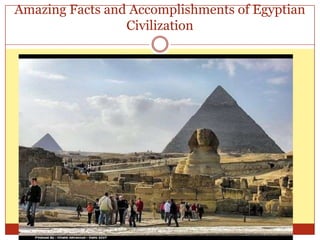
Amazing Facts and Accomplishments of Egyptian Civilization
Early History and Development of Portland CementEver since civilizations first started to build, we've sought a material that would bind stones into a solid, formed mass. The Assyrians and Babylonians used clay for this purposeThe Egyptians advanced to the discovery of lime and gypsum mortar as a binding agent for building such structures as the Pyramids.
Egypt Fun Facts-Egypt was an advanced civilization-Egypt's population tops 74 million-popular religion is Muslim-Egyptians were the first to invent writing-Egyptian were the first to practise holistic health
Egypt Fun Factsthe 365 calendar year and 24hrs in a day are egyptian inventions-cement was invented in egypt-egyptians held the first labor strike-earliest known wine cellars were discovered in Egypt-hieroglyphics was the egyptians kind of writing
Some other interesting facts about Egypt:It is said that Egyptians used to shave most of the hair off their bodies. They did this to keep away lice and other insects!Which God guided people to their afterlife? That was the jackal-headed god Anubis. He would guide them into the judgment halls of Osiris.The outside layer of Tutankhamen's wrap was melted paraffin-wax. During the removal of the layers there were 97 groups of items removed!What did the Egyptians use to build their homes? They used mud brick.
Egyptian Factspharaohs never let thier hair be seen-men and women wore makeup- it was said to be protectant from the sun-children wore no clothes until they were teens-Egyptians believed the earth was flat and round-Ramses had 8 wives and 100 concubines and died at over 90 yrs of age
the Egyptians were quite advanced in thier culture. In fact they invented eye liner and toilet seats. Along with that they were the first to use anesthesia and set broken bones.They also invented scissors, toothpaste, potters wheel and the calendar. However, it doesn't stop there they were also responsible for key, clock, loom, ink, egg hatchery, carpentry joints and metal pipes.So along with thier great inventions they also had some gross and disgusting practises. Can you guess what they used for a contraceptive? They actually used crocodile dung!
Some people killed themselves with asps. It was thought dying from a snake bite would bring them immortality. Somehow I don't think so.They treated balness in a strange manner by the fats of crocodile, hippo, lion, snake, goose and ibex.Egyptians ground up mummies bodies and drank it in a potion thinking they were medicinal in some way. 
Major AccomplishmentThe ancient Egyptians were possibly the first civilization to practice the scientific arts. Indeed, the word chemistry is derived from the word Alchemy which is the ancient name for Egypt.
Major Accomplishment and MysteriesWhere the Egyptians really excelled was in medicine and applied mathematics. But although there is a large body of papyrus literature describing their achievements in medicineThere are no records of how they reached their mathematical conclusions. Of course they must have had an advanced understanding of the subject because their exploits in engineering, astronomy and administration would not have been possible without it. 
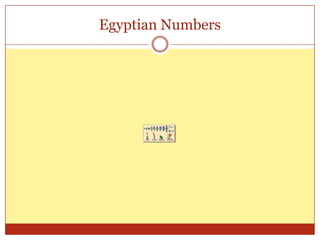
Egyptian Numbers
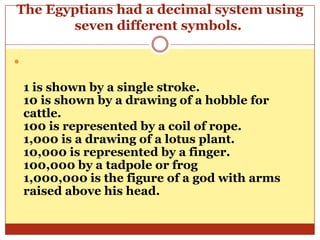
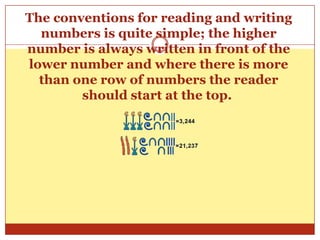
The Egyptians had a decimal system using seven different symbols. 1 is shown by a single stroke. 10 is shown by a drawing of a hobble for cattle. 100 is represented by a coil of rope. 1,000 is a drawing of a lotus plant. 10,000 is represented by a finger. 100,000 by a tadpole or frog 1,000,000 is the figure of a god with arms raised above his head. 
The conventions for reading and writing numbers is quite simple; the higher number is always written in front of the lower number and where there is more than one row of numbers the reader should start at the top. 
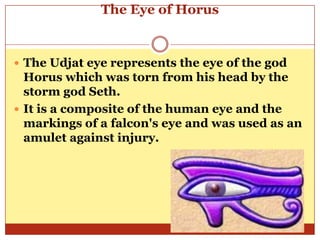
The Eye of HorusThe Udjat eye represents the eye of the god Horus which was torn from his head by the storm god Seth. It is a composite of the human eye and the markings of a falcon's eye and was used as an amulet against injury. 
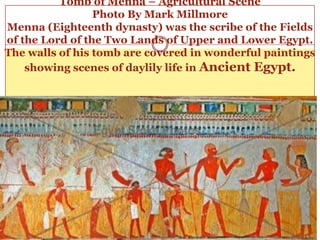
Tomb of Menna – Agricultural ScenePhoto By Mark MillmoreMenna (Eighteenth dynasty) was the scribe of the Fields of the Lord of the Two Lands of Upper and Lower Egypt. The walls of his tomb are covered in wonderful paintings showing scenes of daylily life in Ancient Egypt.
Medical knowledgeMedical knowledge in ancient Egypt had an excellent reputation, and rulers of other empires would ask the Egyptian pharaoh to send them their best physician to treat their loved ones.
Egyptian MedicineEgyptian physicians were aware of the existence of the pulse and of a connection between pulse and heart.The author of the Smith Papyrus even had a vague idea of a cardiac system, although not of blood circulation and he was unable, or deemed it unimportant, to distinguish between blood vessels, tendons, and nerves. They developed their theory of "channels" that carried air, water and blood to the body by analogies with the River Nile; If it became blocked, crops became unhealthy and they applied this principle to the body: If a person was unwell, they would use laxatives to unblock the "channels".[
Medicine in Egypt

Egyptian History Class 8

  • 2.
    Amazing Facts andAccomplishments of Egyptian Civilization
  • 3.
    Early History andDevelopment of Portland CementEver since civilizations first started to build, we've sought a material that would bind stones into a solid, formed mass. The Assyrians and Babylonians used clay for this purposeThe Egyptians advanced to the discovery of lime and gypsum mortar as a binding agent for building such structures as the Pyramids.
  • 4.
    Egypt Fun Facts-Egyptwas an advanced civilization-Egypt's population tops 74 million-popular religion is Muslim-Egyptians were the first to invent writing-Egyptian were the first to practise holistic health
  • 5.
    Egypt Fun Factsthe365 calendar year and 24hrs in a day are egyptian inventions-cement was invented in egypt-egyptians held the first labor strike-earliest known wine cellars were discovered in Egypt-hieroglyphics was the egyptians kind of writing
  • 6.
    Some other interestingfacts about Egypt:It is said that Egyptians used to shave most of the hair off their bodies. They did this to keep away lice and other insects!Which God guided people to their afterlife? That was the jackal-headed god Anubis. He would guide them into the judgment halls of Osiris.The outside layer of Tutankhamen's wrap was melted paraffin-wax. During the removal of the layers there were 97 groups of items removed!What did the Egyptians use to build their homes? They used mud brick.
  • 7.
    Egyptian Factspharaohs neverlet thier hair be seen-men and women wore makeup- it was said to be protectant from the sun-children wore no clothes until they were teens-Egyptians believed the earth was flat and round-Ramses had 8 wives and 100 concubines and died at over 90 yrs of age
  • 8.
    the Egyptians werequite advanced in thier culture. In fact they invented eye liner and toilet seats. Along with that they were the first to use anesthesia and set broken bones.They also invented scissors, toothpaste, potters wheel and the calendar. However, it doesn't stop there they were also responsible for key, clock, loom, ink, egg hatchery, carpentry joints and metal pipes.So along with thier great inventions they also had some gross and disgusting practises. Can you guess what they used for a contraceptive? They actually used crocodile dung!
  • 9.
    Some people killedthemselves with asps. It was thought dying from a snake bite would bring them immortality. Somehow I don't think so.They treated balness in a strange manner by the fats of crocodile, hippo, lion, snake, goose and ibex.Egyptians ground up mummies bodies and drank it in a potion thinking they were medicinal in some way. 
  • 10.
    Major AccomplishmentThe ancientEgyptians were possibly the first civilization to practice the scientific arts. Indeed, the word chemistry is derived from the word Alchemy which is the ancient name for Egypt.
  • 11.
    Major Accomplishment andMysteriesWhere the Egyptians really excelled was in medicine and applied mathematics. But although there is a large body of papyrus literature describing their achievements in medicineThere are no records of how they reached their mathematical conclusions. Of course they must have had an advanced understanding of the subject because their exploits in engineering, astronomy and administration would not have been possible without it. 
  • 12.
  • 13.
    The Egyptians hada decimal system using seven different symbols. 1 is shown by a single stroke. 10 is shown by a drawing of a hobble for cattle. 100 is represented by a coil of rope. 1,000 is a drawing of a lotus plant. 10,000 is represented by a finger. 100,000 by a tadpole or frog 1,000,000 is the figure of a god with arms raised above his head. 
  • 14.
    The conventions forreading and writing numbers is quite simple; the higher number is always written in front of the lower number and where there is more than one row of numbers the reader should start at the top. 
  • 15.
    The Eye ofHorusThe Udjat eye represents the eye of the god Horus which was torn from his head by the storm god Seth. It is a composite of the human eye and the markings of a falcon's eye and was used as an amulet against injury. 
  • 16.
    Tomb of Menna– Agricultural ScenePhoto By Mark MillmoreMenna (Eighteenth dynasty) was the scribe of the Fields of the Lord of the Two Lands of Upper and Lower Egypt. The walls of his tomb are covered in wonderful paintings showing scenes of daylily life in Ancient Egypt.
  • 17.
    Medical knowledgeMedical knowledgein ancient Egypt had an excellent reputation, and rulers of other empires would ask the Egyptian pharaoh to send them their best physician to treat their loved ones.
  • 18.
    Egyptian MedicineEgyptian physicianswere aware of the existence of the pulse and of a connection between pulse and heart.The author of the Smith Papyrus even had a vague idea of a cardiac system, although not of blood circulation and he was unable, or deemed it unimportant, to distinguish between blood vessels, tendons, and nerves. They developed their theory of "channels" that carried air, water and blood to the body by analogies with the River Nile; If it became blocked, crops became unhealthy and they applied this principle to the body: If a person was unwell, they would use laxatives to unblock the "channels".[
  • 19.