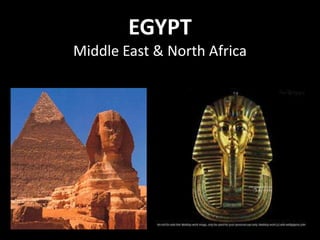
EGYPT
Middle East & North Africa
EGYPT’S LOCATION
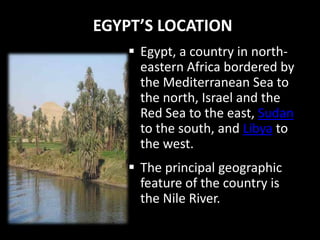
     Egypt, a country in north-
      eastern Africa bordered by
      the Mediterranean Sea to
      the north, Israel and the
      Red Sea to the east, Sudan
      to the south, and Libya to
      the west.
     The principal geographic
      feature of the country is
      the Nile River.
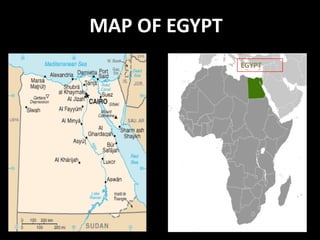
MAP OF EGYPT
               EGYPT
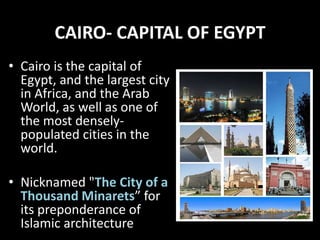
CAIRO- CAPITAL OF EGYPT
• Cairo is the capital of
  Egypt, and the largest city
  in Africa, and the Arab
  World, as well as one of
  the most densely-
  populated cities in the
  world.

• Nicknamed "The City of a
  Thousand Minarets” for
  its preponderance of
  Islamic architecture
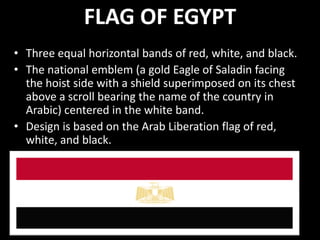
FLAG OF EGYPT
• Three equal horizontal bands of red, white, and black.
• The national emblem (a gold Eagle of Saladin facing
  the hoist side with a shield superimposed on its chest
  above a scroll bearing the name of the country in
  Arabic) centered in the white band.
• Design is based on the Arab Liberation flag of red,
  white, and black.
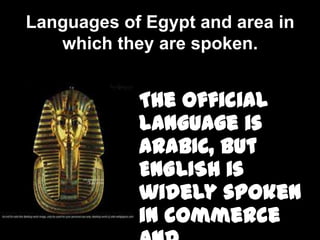
Languages of Egypt and area in
   which they are spoken.


            The official
            language is
            ARABIC, but
            ENGLISH is
            widely spoken
            in commerce
COMMUNICATIONS

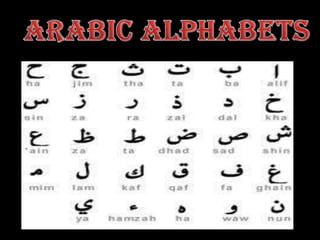
Arabic is read from right to left.

Nearly all Egyptians speak Arabic.

Most international business people will speak
English, French or both.

If locating in Egypt, business cards should be
printed in English on one side and Arabic on the
other.
POPULATION
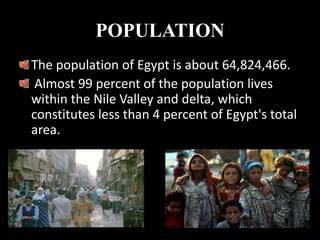
The population of Egypt is about 64,824,466.
 Almost 99 percent of the population lives
within the Nile Valley and delta, which
constitutes less than 4 percent of Egypt's total
area.
CURRENCY

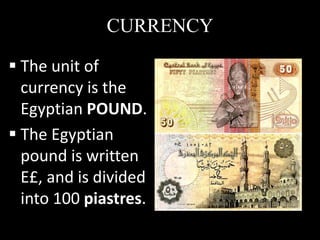
 The unit of
  currency is the
  Egyptian POUND.
 The Egyptian
  pound is written
  E£, and is divided
  into 100 piastres.
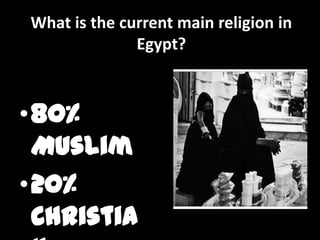
What is the current main religion in
              Egypt?


•80%
 Muslim
•20%
 Christia
The main crops grown in Egypt

           • Cereals
         • Sugar crops
       • Food legumes.
        • Forage crops.
            • Fruits.
         • Vegetables
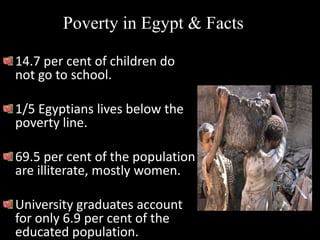
Poverty in Egypt & Facts

14.7 per cent of children do
not go to school.

1/5 Egyptians lives below the
poverty line.

69.5 per cent of the population
are illiterate, mostly women.

University graduates account
for only 6.9 per cent of the
educated population.
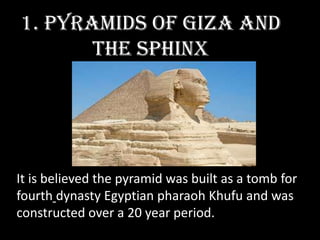
1. Pyramids of Giza and
       the Sphinx


It is believed the pyramid was built as a tomb for
fourth dynasty Egyptian pharaoh Khufu and was
constructed over a 20 year period.
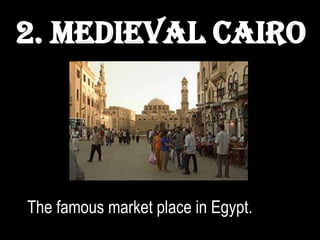
2. Medieval Cairo


The famous market place in Egypt.
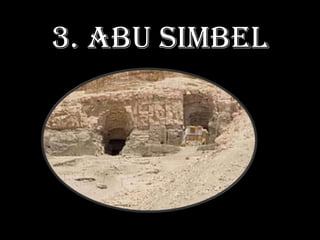
3. Abu Simbel
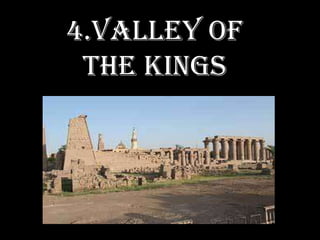
4.Valley of
 the Kings
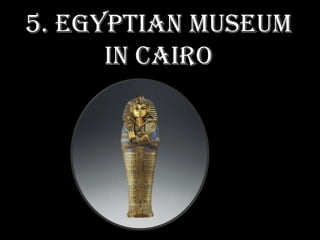
5. Egyptian Museum
      in Cairo
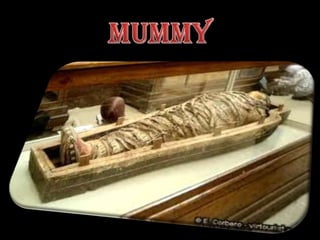
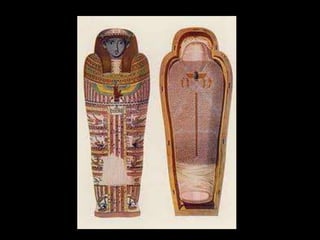
A Mummy is a body of human whose skin and organs have
been preserved by either intentional or incidental exposure to
chemicals, or being exposed to very low humidity.

  The Egyptians believed that preserving the dead bodies of
the emperors or their peers they can keep them alive even after
their death.

  Anubis was the god of mummification. He had a human
body and the
head of a jackal. His job was to prepare the bodies of the dead
to be
received by Osiris.
Egyptian Honor
 Respect and esteem for people is both a right
and an obligation.

  An individual's honor is intricately entwined with
the reputation and honor of everyone in their
family.

 Honor requires that Egyptians demonstrate
hospitality to friends and guests.

  It also dictates that people dress as well as their
financial circumstances allow, and show proper
respect and deference to their elders.
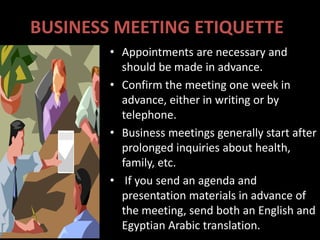
BUSINESS MEETING ETIQUETTE
        • Appointments are necessary and
          should be made in advance.
        • Confirm the meeting one week in
          advance, either in writing or by
          telephone.
        • Business meetings generally start after
          prolonged inquiries about health,
          family, etc.
        • If you send an agenda and
          presentation materials in advance of
          the meeting, send both an English and
          Egyptian Arabic translation.
Dress Etiquette
  Business attire is formal and conservative.
Dress well if you want to make a good
impression.

  Men should wear dark colored, lightweight,
conservative business suits, at least to the first
meeting.

  Men should avoid wearing visible jewellery,
especially around the face and neck.

  Women must be careful to cover themselves
appropriately.
Dining Etiquette

 If you are invited into an Egyptian's
house.
 You would normally remove your
shoes before entering.
 Dress well and conservatively.
Appearances are important to
Egyptians.
 Compliment the host on the house.
Egypt assign (final)

Egypt assign (final)

  • 2.
    EGYPT Middle East &North Africa
  • 3.
    EGYPT’S LOCATION  Egypt, a country in north- eastern Africa bordered by the Mediterranean Sea to the north, Israel and the Red Sea to the east, Sudan to the south, and Libya to the west.  The principal geographic feature of the country is the Nile River.
  • 4.
  • 5.
    CAIRO- CAPITAL OFEGYPT • Cairo is the capital of Egypt, and the largest city in Africa, and the Arab World, as well as one of the most densely- populated cities in the world. • Nicknamed "The City of a Thousand Minarets” for its preponderance of Islamic architecture
  • 6.
    FLAG OF EGYPT •Three equal horizontal bands of red, white, and black. • The national emblem (a gold Eagle of Saladin facing the hoist side with a shield superimposed on its chest above a scroll bearing the name of the country in Arabic) centered in the white band. • Design is based on the Arab Liberation flag of red, white, and black.
  • 7.
    Languages of Egyptand area in which they are spoken. The official language is ARABIC, but ENGLISH is widely spoken in commerce
  • 9.
    COMMUNICATIONS Arabic is readfrom right to left. Nearly all Egyptians speak Arabic. Most international business people will speak English, French or both. If locating in Egypt, business cards should be printed in English on one side and Arabic on the other.
  • 10.
    POPULATION The population ofEgypt is about 64,824,466. Almost 99 percent of the population lives within the Nile Valley and delta, which constitutes less than 4 percent of Egypt's total area.
  • 11.
    CURRENCY  The unitof currency is the Egyptian POUND.  The Egyptian pound is written E£, and is divided into 100 piastres.
  • 12.
    What is thecurrent main religion in Egypt? •80% Muslim •20% Christia
  • 13.
    The main cropsgrown in Egypt • Cereals • Sugar crops • Food legumes. • Forage crops. • Fruits. • Vegetables
  • 14.
    Poverty in Egypt& Facts 14.7 per cent of children do not go to school. 1/5 Egyptians lives below the poverty line. 69.5 per cent of the population are illiterate, mostly women. University graduates account for only 6.9 per cent of the educated population.
  • 16.
    1. Pyramids ofGiza and the Sphinx It is believed the pyramid was built as a tomb for fourth dynasty Egyptian pharaoh Khufu and was constructed over a 20 year period.
  • 17.
    2. Medieval Cairo Thefamous market place in Egypt.
  • 18.
  • 19.
  • 20.
  • 23.
    A Mummy isa body of human whose skin and organs have been preserved by either intentional or incidental exposure to chemicals, or being exposed to very low humidity. The Egyptians believed that preserving the dead bodies of the emperors or their peers they can keep them alive even after their death. Anubis was the god of mummification. He had a human body and the head of a jackal. His job was to prepare the bodies of the dead to be received by Osiris.
  • 24.
    Egyptian Honor Respectand esteem for people is both a right and an obligation. An individual's honor is intricately entwined with the reputation and honor of everyone in their family. Honor requires that Egyptians demonstrate hospitality to friends and guests. It also dictates that people dress as well as their financial circumstances allow, and show proper respect and deference to their elders.
  • 25.
    BUSINESS MEETING ETIQUETTE • Appointments are necessary and should be made in advance. • Confirm the meeting one week in advance, either in writing or by telephone. • Business meetings generally start after prolonged inquiries about health, family, etc. • If you send an agenda and presentation materials in advance of the meeting, send both an English and Egyptian Arabic translation.
  • 26.
    Dress Etiquette Business attire is formal and conservative. Dress well if you want to make a good impression. Men should wear dark colored, lightweight, conservative business suits, at least to the first meeting. Men should avoid wearing visible jewellery, especially around the face and neck. Women must be careful to cover themselves appropriately.
  • 27.
    Dining Etiquette Ifyou are invited into an Egyptian's house. You would normally remove your shoes before entering. Dress well and conservatively. Appearances are important to Egyptians. Compliment the host on the house.