PAYMENTS
ELECTRONIC FUNDS
TRANSFER
& ASSOCIATED RISKS
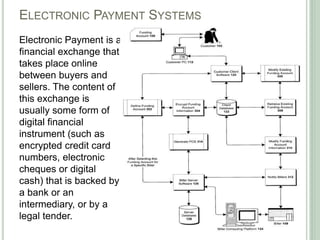
ELECTRONIC PAYMENT SYSTEMS
Electronic Payment is a
financial exchange that
takes place online
between buyers and
sellers. The content of
this exchange is
usually some form of
digital financial
instrument (such as
encrypted credit card
numbers, electronic
cheques or digital
cash) that is backed by
a bank or an
intermediary, or by a
legal tender.
B2B ELECTRONIC PAYMENTS
• CURRENT B2B PAYMENT PRACTICES
– The goal of financial supply chain management is to
optimize:
• Accounts payable (A/P)
• Accounts receivable (A/R)
• Cash management
• Working capital
• Transaction costs
• Financial risks
• Financial administration
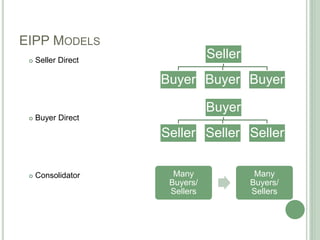
EIPP MODELS
 Seller Direct
 Buyer Direct
 Consolidator
Seller
Buyer Buyer Buyer
Buyer
Seller Seller Seller
Many
Buyers/
Sellers
Many
Buyers/
Sellers
B2B ELECTRONIC PAYMENTS
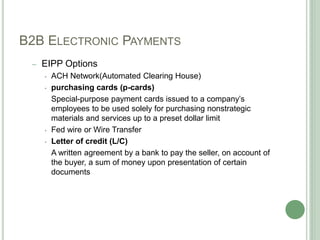
– EIPP Options
• ACH Network(Automated Clearing House)
• purchasing cards (p-cards)
Special-purpose payment cards issued to a company’s
employees to be used solely for purchasing nonstrategic
materials and services up to a preset dollar limit
• Fed wire or Wire Transfer
• Letter of credit (L/C)
A written agreement by a bank to pay the seller, on account of
the buyer, a sum of money upon presentation of certain
documents
THE GARTNER RESEARCH GROUP ESTIMATES THAT B2B COMPANIES CAN
SAVE $7.25 PER INVOICE USING WEB-BASED BILLING AND PAYMENT.
[DESHMUKH, 2006]
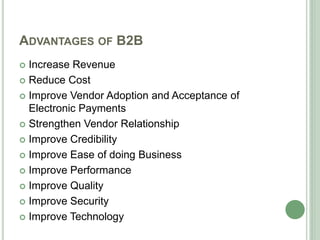
ADVANTAGES OF B2B
 Increase Revenue
 Reduce Cost
 Improve Vendor Adoption and Acceptance of
Electronic Payments
 Strengthen Vendor Relationship
 Improve Credibility
 Improve Ease of doing Business
 Improve Performance
 Improve Quality
 Improve Security
 Improve Technology
ELECTRONIC FUNDS TRANSFER
Electronic Funds Transfer
 Electronic funds transfer, often abbreviated as EFT, is a
system for moving money from one account to another
without the use of checks. Instead, money is transferred
through such electronic systems as computers (mainly
through the Internet) and ATMs.
TRANSACTION TYPES
 Sale:
 Refund:
 Withdrawal:
 Deposit:
 Cash back:
 Inter-account transfer:
 Payment:
 Enquiry:
 Mini-statement:
ELECTRONIC FUNDS TRANSFER
Advantages:
 save money- some banks charge money for checks
 easy to use- simple instructions and format
 convenient- easy to find places in which to operate EFT
processes
 not time consuming- some EFT processes are automatic
Disadvantages:
 release of private information
 no human interaction
 few EFT devices in certain areas of the world
 EFTs such as an ATM are not fully secure and can be broken
into
TECHNOLOGIES AND SERVICES
 Automated Teller Machines
 Point-of-Sale
 Credit Card Authorization and Check Validation
 Debit Cards
 Telephone Bill Payment
 Wire Transfer
 Check Truncation
 Automated Clearing Houses
ISSUES OF EFT:
 Reliability- someone can put the wrong numbers into
an EFT and possibly not know it
 Integrity- tampered EFT systems can begin to work
improperly, breakdown, and cause other problems
 Security- unauthorized access can result in lost or
stolen information and money
 Privacy- becomes lessened when giving someone your
ABA number for EFT use
 Authenticity- an EFT such as an ATM does not know if
the person using it is truly who they say they are
 Equality of Access- EFTs are hard to access in some
third world countries
 Control- EFTs improve the rate at which business
transactions are done
 People and Machines- possible loss of bankers and
other jobs because of EFTs
RISK ASSOCIATED WITH EP
 Operational Risk: A risk incurred by an organization’s internal activities.
Operational risk can also arise from customer’s misuse, and from
inadequately designed electronic banking and electronic money system.
 Credit Risk: Refers to the risk that a borrower will default on any type of
debt by failing to make payments which it is obligated to do.
For example:
-A consumer may fail to make a payment due on a credit card, line of credit,
or other loan
-A company is unable to repay amounts secured by a fixed or floating
charge over the assets of the company, etc.
 Legal Risk: Legal risk arises from violations of, or non-conformance with
laws, rules, regulations, or when the legal rights and obligations of parties to a
transaction are not well established.
RISK MANAGEMENT OPTIONS FOR E-
PAYMENT
A risk management process that includes the three basic
elements of assessing risks, controlling risk exposure, and
monitoring risks will help banks and supervisors attain these
goals.
 Assessing Risk
Assessing risks is an ongoing process. It typically involves three
steps…….
First, a bank may engage in a rigorous analytic process to
identify risks and, where possible, to quantify them.
A second step in assessing risk is for the board of directors or
senior management to determine the bank’s risk tolerance,
based on an assessment of the losses the bank can afford to
sustain in the event a given problem materializes
Finally, management can compare its risk tolerance with its
assessment of the magnitude of a risk to ascertain if the risk
exposure fits within the tolerance limits.
 Managing and Controlling Risks
This phase of a risk management process includes
activities such as implementing security policies and
measures, co-ordinating internal communication,
evaluating and upgrading products and services,
implementing measures to ensure that outsourcing risks
are controlled and managed, providing disclosures and
customer education, and developing contingency plans.
 Security Policies and Measures
 Internal communication
 Evaluating and upgrading
 Outsourcing
 Monitoring Risks
Ongoing monitoring is an important aspect of any risk
management process. For electronic banking and
electronic money activities, monitoring is particularly
important both because the nature of the activities are
likely to change rapidly as innovations occur, and
because of the reliance of some products on the use of
open networks such as the Internet.
 System Testing and Surveillance
 Auditing
ISSUES OF ELECTRONIC PAYMENT
TECHNOLOGY
 Online Payment Processing Basics
 The Payment Processing Network
 How Payment Processing Works
 What you should know about fraud
ONLINE PAYMENT PROCESSING
BASICS
Purchasing online may seem to be quick and easy,
but most consumers give little thought to the
process that appears to work instantaneously. For it
to work correctly, merchants must connect to a
network of bands, processors, and other financial
institutions so that payment information provided by
the customers can be routed securely and reliably.
THE PAYMENT PROCESSING
NETWORK
The payment processing network is made up of individuals, institutions,
processes, and services. Sellers need an internet merchant account with an
acquiring bank so that they can accept customer credit cards electronically.
Customers need a bank that issues credit cards and verifies the customer’s
credit limit and available cash balance for proposed purchases.
components of the payment processing network
 Acquiring Bank
 Authorization
 Credit and Association
 Customer
 Customer Issuing Bank
 Internet Merchant Account
 Merchant
 Payment Gateway
 Processor
 Settlement
HOW PAYMENTS PROCESSING
WORKS
 Payment Processing – Authorization and
Settlement
 Authorization: Online
 Payment Processing – Settlement
Authorization:- it is verified that the card is active
and that the customer has sufficient credit available
to make transaction or not.
Settlement:- it involves transferring money from the
customer’s account to the merchant’s account
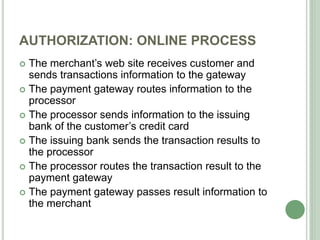
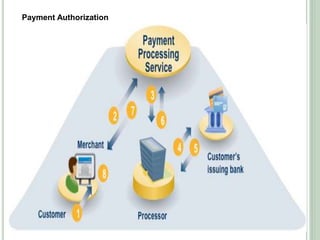
AUTHORIZATION: ONLINE PROCESS
 The merchant’s web site receives customer and
sends transactions information to the gateway
 The payment gateway routes information to the
processor
 The processor sends information to the issuing
bank of the customer’s credit card
 The issuing bank sends the transaction results to
the processor
 The processor routes the transaction result to the
payment gateway
 The payment gateway passes result information to
the merchant
Payment Authorization
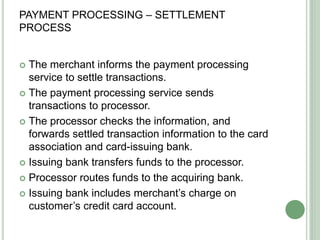
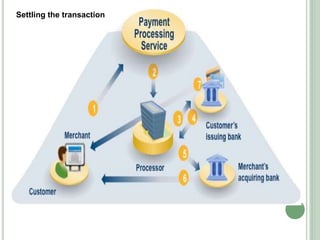
PAYMENT PROCESSING – SETTLEMENT
PROCESS
 The merchant informs the payment processing
service to settle transactions.
 The payment processing service sends
transactions to processor.
 The processor checks the information, and
forwards settled transaction information to the card
association and card-issuing bank.
 Issuing bank transfers funds to the processor.
 Processor routes funds to the acquiring bank.
 Issuing bank includes merchant’s charge on
customer’s credit card account.
Settling the transaction
WHAT YOU SHOULD KNOW ABOUT
FRAUD & HOW TO PREVENT
 Choose a payment service provider that is well-
establish and credible.
 Make sure your payment gateway provider offers real
time credit card authorization results.
 One of the simplest ways to reduce the risk of a
fraudulent transaction is to use Address verification
Service(AVS).
 Use Card Security Codes, known as CVV2 for Visa,
CVVC for MasterCard, and CID for American Express.
 Watch for multiple orders for easily resold items such as
electronic goods purchased on the same credit card.
 Develop a negative card and shipping address list and
cross-check transactions against it.
ISSUE AND IMPLICATION REGARDING EPS
There are issues regarding electronic payment
methods and methodologies and these are :
o Consumer needs
WHAT BROAD FEATURES WILL MAKE ELECTRONIC
PAYMENT CHEAPER AND MORE SECURE FOR
BOTH CONSUMERS AND MERCHANTS
o Corporate processes
how will today’s increasing e-commerce business affect
the way tomorrow’s corporation operates in the market
place ?
o Corporate strategy
will the electronic payment system end up in the hands
of few financial institution or will generate a number of
smaller banks that cater specially to clearing and
processing digital business transactions.
o Regulation of competitions
How the government will they taxes on electronic fund
flow over open networks like the internet, especially with
the growing sophistication of encryption and network
security
o Economics & social processes
will the government pull out of the cash marketing
business ?
THANK
YOU

EFT.ppt

  • 1.
  • 2.
    ELECTRONIC PAYMENT SYSTEMS ElectronicPayment is a financial exchange that takes place online between buyers and sellers. The content of this exchange is usually some form of digital financial instrument (such as encrypted credit card numbers, electronic cheques or digital cash) that is backed by a bank or an intermediary, or by a legal tender.
  • 3.
    B2B ELECTRONIC PAYMENTS •CURRENT B2B PAYMENT PRACTICES – The goal of financial supply chain management is to optimize: • Accounts payable (A/P) • Accounts receivable (A/R) • Cash management • Working capital • Transaction costs • Financial risks • Financial administration
  • 4.
    EIPP MODELS  SellerDirect  Buyer Direct  Consolidator Seller Buyer Buyer Buyer Buyer Seller Seller Seller Many Buyers/ Sellers Many Buyers/ Sellers
  • 5.
    B2B ELECTRONIC PAYMENTS –EIPP Options • ACH Network(Automated Clearing House) • purchasing cards (p-cards) Special-purpose payment cards issued to a company’s employees to be used solely for purchasing nonstrategic materials and services up to a preset dollar limit • Fed wire or Wire Transfer • Letter of credit (L/C) A written agreement by a bank to pay the seller, on account of the buyer, a sum of money upon presentation of certain documents
  • 6.
    THE GARTNER RESEARCHGROUP ESTIMATES THAT B2B COMPANIES CAN SAVE $7.25 PER INVOICE USING WEB-BASED BILLING AND PAYMENT. [DESHMUKH, 2006]
  • 7.
    ADVANTAGES OF B2B Increase Revenue  Reduce Cost  Improve Vendor Adoption and Acceptance of Electronic Payments  Strengthen Vendor Relationship  Improve Credibility  Improve Ease of doing Business  Improve Performance  Improve Quality  Improve Security  Improve Technology
  • 9.
    ELECTRONIC FUNDS TRANSFER ElectronicFunds Transfer  Electronic funds transfer, often abbreviated as EFT, is a system for moving money from one account to another without the use of checks. Instead, money is transferred through such electronic systems as computers (mainly through the Internet) and ATMs.
  • 10.
    TRANSACTION TYPES  Sale: Refund:  Withdrawal:  Deposit:  Cash back:  Inter-account transfer:  Payment:  Enquiry:  Mini-statement:
  • 11.
    ELECTRONIC FUNDS TRANSFER Advantages: save money- some banks charge money for checks  easy to use- simple instructions and format  convenient- easy to find places in which to operate EFT processes  not time consuming- some EFT processes are automatic Disadvantages:  release of private information  no human interaction  few EFT devices in certain areas of the world  EFTs such as an ATM are not fully secure and can be broken into
  • 12.
    TECHNOLOGIES AND SERVICES Automated Teller Machines  Point-of-Sale  Credit Card Authorization and Check Validation  Debit Cards  Telephone Bill Payment  Wire Transfer  Check Truncation  Automated Clearing Houses
  • 13.
    ISSUES OF EFT: Reliability- someone can put the wrong numbers into an EFT and possibly not know it  Integrity- tampered EFT systems can begin to work improperly, breakdown, and cause other problems  Security- unauthorized access can result in lost or stolen information and money  Privacy- becomes lessened when giving someone your ABA number for EFT use  Authenticity- an EFT such as an ATM does not know if the person using it is truly who they say they are  Equality of Access- EFTs are hard to access in some third world countries  Control- EFTs improve the rate at which business transactions are done  People and Machines- possible loss of bankers and other jobs because of EFTs
  • 14.
    RISK ASSOCIATED WITHEP  Operational Risk: A risk incurred by an organization’s internal activities. Operational risk can also arise from customer’s misuse, and from inadequately designed electronic banking and electronic money system.  Credit Risk: Refers to the risk that a borrower will default on any type of debt by failing to make payments which it is obligated to do. For example: -A consumer may fail to make a payment due on a credit card, line of credit, or other loan -A company is unable to repay amounts secured by a fixed or floating charge over the assets of the company, etc.  Legal Risk: Legal risk arises from violations of, or non-conformance with laws, rules, regulations, or when the legal rights and obligations of parties to a transaction are not well established.
  • 15.
    RISK MANAGEMENT OPTIONSFOR E- PAYMENT A risk management process that includes the three basic elements of assessing risks, controlling risk exposure, and monitoring risks will help banks and supervisors attain these goals.  Assessing Risk Assessing risks is an ongoing process. It typically involves three steps……. First, a bank may engage in a rigorous analytic process to identify risks and, where possible, to quantify them. A second step in assessing risk is for the board of directors or senior management to determine the bank’s risk tolerance, based on an assessment of the losses the bank can afford to sustain in the event a given problem materializes Finally, management can compare its risk tolerance with its assessment of the magnitude of a risk to ascertain if the risk exposure fits within the tolerance limits.
  • 16.
     Managing andControlling Risks This phase of a risk management process includes activities such as implementing security policies and measures, co-ordinating internal communication, evaluating and upgrading products and services, implementing measures to ensure that outsourcing risks are controlled and managed, providing disclosures and customer education, and developing contingency plans.  Security Policies and Measures  Internal communication  Evaluating and upgrading  Outsourcing
  • 17.
     Monitoring Risks Ongoingmonitoring is an important aspect of any risk management process. For electronic banking and electronic money activities, monitoring is particularly important both because the nature of the activities are likely to change rapidly as innovations occur, and because of the reliance of some products on the use of open networks such as the Internet.  System Testing and Surveillance  Auditing
  • 18.
    ISSUES OF ELECTRONICPAYMENT TECHNOLOGY  Online Payment Processing Basics  The Payment Processing Network  How Payment Processing Works  What you should know about fraud
  • 19.
    ONLINE PAYMENT PROCESSING BASICS Purchasingonline may seem to be quick and easy, but most consumers give little thought to the process that appears to work instantaneously. For it to work correctly, merchants must connect to a network of bands, processors, and other financial institutions so that payment information provided by the customers can be routed securely and reliably.
  • 20.
    THE PAYMENT PROCESSING NETWORK Thepayment processing network is made up of individuals, institutions, processes, and services. Sellers need an internet merchant account with an acquiring bank so that they can accept customer credit cards electronically. Customers need a bank that issues credit cards and verifies the customer’s credit limit and available cash balance for proposed purchases. components of the payment processing network  Acquiring Bank  Authorization  Credit and Association  Customer  Customer Issuing Bank  Internet Merchant Account  Merchant  Payment Gateway  Processor  Settlement
  • 21.
    HOW PAYMENTS PROCESSING WORKS Payment Processing – Authorization and Settlement  Authorization: Online  Payment Processing – Settlement Authorization:- it is verified that the card is active and that the customer has sufficient credit available to make transaction or not. Settlement:- it involves transferring money from the customer’s account to the merchant’s account
  • 22.
    AUTHORIZATION: ONLINE PROCESS The merchant’s web site receives customer and sends transactions information to the gateway  The payment gateway routes information to the processor  The processor sends information to the issuing bank of the customer’s credit card  The issuing bank sends the transaction results to the processor  The processor routes the transaction result to the payment gateway  The payment gateway passes result information to the merchant
  • 23.
  • 24.
    PAYMENT PROCESSING –SETTLEMENT PROCESS  The merchant informs the payment processing service to settle transactions.  The payment processing service sends transactions to processor.  The processor checks the information, and forwards settled transaction information to the card association and card-issuing bank.  Issuing bank transfers funds to the processor.  Processor routes funds to the acquiring bank.  Issuing bank includes merchant’s charge on customer’s credit card account.
  • 25.
  • 26.
    WHAT YOU SHOULDKNOW ABOUT FRAUD & HOW TO PREVENT  Choose a payment service provider that is well- establish and credible.  Make sure your payment gateway provider offers real time credit card authorization results.  One of the simplest ways to reduce the risk of a fraudulent transaction is to use Address verification Service(AVS).  Use Card Security Codes, known as CVV2 for Visa, CVVC for MasterCard, and CID for American Express.  Watch for multiple orders for easily resold items such as electronic goods purchased on the same credit card.  Develop a negative card and shipping address list and cross-check transactions against it.
  • 27.
    ISSUE AND IMPLICATIONREGARDING EPS There are issues regarding electronic payment methods and methodologies and these are : o Consumer needs WHAT BROAD FEATURES WILL MAKE ELECTRONIC PAYMENT CHEAPER AND MORE SECURE FOR BOTH CONSUMERS AND MERCHANTS o Corporate processes how will today’s increasing e-commerce business affect the way tomorrow’s corporation operates in the market place ?
  • 28.
    o Corporate strategy willthe electronic payment system end up in the hands of few financial institution or will generate a number of smaller banks that cater specially to clearing and processing digital business transactions. o Regulation of competitions How the government will they taxes on electronic fund flow over open networks like the internet, especially with the growing sophistication of encryption and network security o Economics & social processes will the government pull out of the cash marketing business ?
  • 29.