CAES1000
Core University English
Effective Paraphrasing
(Students’ common problems in in-text citations and paraphrasing)
Student Example 1
Original Text:
Unlike classroom situations, real-life situations are often unfamiliar to
students, and in these situations, problems are not easily identifiable or
not well-defined (NUS 2013).
Student Text:
Students are often unfamiliar with the real-life situations, and in these
situations, it can be difficult to identify the problems (Tsui, 2013).
 Wrong citation: should be “(NUS, 2013)”
 Phrases directly copied from the original text
Student Example 2
Original Text:
Dealing with real-life problems requires students to integrate
knowledge within and across disciplines, to go beyond technical
considerations, and to take into account social and human factors…
(NUS, 2013).
Student Text:
Students need to integrate their knowledge within and across
disciplines, go beyond technical considerations and take related social
and human factors into account (Tsui, 2013).  Wrong citation:
should be “(NUS, 2013)”
 Changing the position of some words only
 Same wording as the original text
Student Example 3
Original Text:
In an effort to reduce waste, dine-in customers are served with
reusable plates and utensils. Caterers have introduced a surcharge of
HK$0.5 for each biodegradable take-away container, and customers are
encouraged to opt for “less rice” to reduce food waste (The University
of Hong Kong, 2013)
Student Text:
A report from the University of Hong Kong in 2013 reported that in an
effort to reduce waste, dine-in customers are served with reusable
plates and utensils. Caterers have introduced a surcharge of HK$0.5 for
each biodegradable take-away container…
 A direct
copy from the
original text
 This sounds a little like a spoken citation. A
more suitable version used in written texts: “A
report from the University of Hong Kong (2013)”
Student Example 4
Original Text:
Children in these areas are often forced to enter the labor force to
begin making financial contributions to the family (Morley, 2009).
Student Text:
Therefore, children in those areas are often not given the chance to
learn and being forced to enter the labour force in order to make
financial contribution to the family (Morley A, 2009).
 Changing a few words only; mostly
copied directly from the original text
 Wrong citation style:
should be “(Morley, 2009)”
Student Example 5
Original Text:
Experiential learning refers to the kind of learning that requires student to
tackle real-life issues and problems by drawing on theoretical knowledge
that they have learnt in the formal curriculum. Unlike classroom situations,
real-life situations are identifiable or not well-defined (NUS 2013).
Student Text:
Experiential learning is understood by people in different ways, it “refers to
the kind of learning that requires student to tackle real-life issues and
problems by drawing on theoretical knowledge that they have learnt in the
formal curriculum. Unlike classroom situations, real-life situations are
identifiable or not well-defined” (NUS, 2013).
 Although the student has used quotation marks,
the direct quotation seems too long and unnecessary.
We usually use direct quotations when the source
text contains powerful language or technical terms
that we feel need to be kept in the original words.
Student Example 6
Original Text:
…the price of obtaining convictions and executions ranges from $2.5
million to $5 million per case (in current dollars), compared to less than
$1 million for each killer sentenced to life without parole (Fagan, 2007).
Student Text:
The majority seems to have a misconception that the reintroduction of
capital punishment reduces government expenditure as it cuts the cost
spent on feeding prisoners. However, figures tell us that the actual
administrative cost required by execution of capital punishment is
much more expensive than life sentence (Fagan, 2007).
 A summary of the text with explanation
and elaboration of the data provided
Student Example 7
Original Text:
The rising pressures on the labor supply will, as a result, increasingly
encourage the illegal use of children beacuase of the consequences of
population control (a drastically declining population since the
implementation of the One Child Policy) (Morley, 2009).
Student Text:
Morley (2009) argues that implementation of the “One Child Policy” gives a
downward pressure on population growth; however, it might have also
further enhanced the problem of child labour as a result of workforce
shortage, driven by the economic incentives.
 Keeping the idea of the original text unchanged with a paraphrase
(i.e., without copying the words directly from the original text)
 Good use of the reporting verb “argue”
to indicate the writer’s viewpoint
regarding the idea in the original text
Student Example 8
Original Text:
The tests can also be manipulated by inmates who may purposely try
to tank the test to get a lower score (Alvarez & Schwartz, 2014).
Student Text:
As Alvarez and Schwartz (2014) point out, it is difficult to judge a
person’s intellectual capabilities based solely on their IQ, as convicted
individuals who take IQ tests can deliberately achieve lower scores in
order to avoid death.
 Keeping the idea of the original text unchanged with a paraphrase
(i.e., without copying the words directly from the original text)
Student Example 9
Original Text:
That contrasts with the early to mid 1960s, when violent crime rates were at
historic lows and support for the death penalty was falling. In a May 1966 Gallup
poll, in fact, more Americans opposed (47%) than supported (42%) it, the only time
that’s happened in the many decades Gallup has asked the question. But that
trend reversed as crime began to surge: The violent-crime rate nearly tripled from
1964 (190.6 crimes per 100,000 people) to 1984 (539.9 per 100,000). By 1986,
support for the death penalty topped 70% (DeSilver, 2014).
Student Text:
Controversy over the death penalty can be reflected by the fluctuating support rate
for it in the United States since the 1960s (DeSilver, 2014).
 Summarising the main ideas in the writer’s own words
Student Example 10
Original Text:
According to the girls, they were part of a “labour dispatch system”
that often funnels child laborers to factories during the summer to help
meet a surge in orders that comes just ahead of the fall and winter
shopping seasons in the United States and Europe (Barboza, 2014).
Student Text:
Barboza (2014) reports that the “labour dispatch system” usually
“funnels child laborers to factories during the summer” in order to
handle a large amount of purchase orders.
 Quoting only the important part of the source text
to support the idea you are expressing in your writing
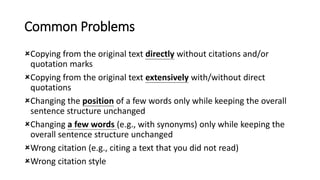
Common Problems
Copying from the original text directly without citations and/or
quotation marks
Copying from the original text extensively with/without direct
quotations
Changing the position of a few words only while keeping the overall
sentence structure unchanged
Changing a few words (e.g., with synonyms) only while keeping the
overall sentence structure unchanged
Wrong citation (e.g., citing a text that you did not read)
Wrong citation style

Effective Paraphrasing (Students' common problems)

  • 1.
    CAES1000 Core University English EffectiveParaphrasing (Students’ common problems in in-text citations and paraphrasing)
  • 2.
    Student Example 1 OriginalText: Unlike classroom situations, real-life situations are often unfamiliar to students, and in these situations, problems are not easily identifiable or not well-defined (NUS 2013). Student Text: Students are often unfamiliar with the real-life situations, and in these situations, it can be difficult to identify the problems (Tsui, 2013).  Wrong citation: should be “(NUS, 2013)”  Phrases directly copied from the original text
  • 3.
    Student Example 2 OriginalText: Dealing with real-life problems requires students to integrate knowledge within and across disciplines, to go beyond technical considerations, and to take into account social and human factors… (NUS, 2013). Student Text: Students need to integrate their knowledge within and across disciplines, go beyond technical considerations and take related social and human factors into account (Tsui, 2013).  Wrong citation: should be “(NUS, 2013)”  Changing the position of some words only  Same wording as the original text
  • 4.
    Student Example 3 OriginalText: In an effort to reduce waste, dine-in customers are served with reusable plates and utensils. Caterers have introduced a surcharge of HK$0.5 for each biodegradable take-away container, and customers are encouraged to opt for “less rice” to reduce food waste (The University of Hong Kong, 2013) Student Text: A report from the University of Hong Kong in 2013 reported that in an effort to reduce waste, dine-in customers are served with reusable plates and utensils. Caterers have introduced a surcharge of HK$0.5 for each biodegradable take-away container…  A direct copy from the original text  This sounds a little like a spoken citation. A more suitable version used in written texts: “A report from the University of Hong Kong (2013)”
  • 5.
    Student Example 4 OriginalText: Children in these areas are often forced to enter the labor force to begin making financial contributions to the family (Morley, 2009). Student Text: Therefore, children in those areas are often not given the chance to learn and being forced to enter the labour force in order to make financial contribution to the family (Morley A, 2009).  Changing a few words only; mostly copied directly from the original text  Wrong citation style: should be “(Morley, 2009)”
  • 6.
    Student Example 5 OriginalText: Experiential learning refers to the kind of learning that requires student to tackle real-life issues and problems by drawing on theoretical knowledge that they have learnt in the formal curriculum. Unlike classroom situations, real-life situations are identifiable or not well-defined (NUS 2013). Student Text: Experiential learning is understood by people in different ways, it “refers to the kind of learning that requires student to tackle real-life issues and problems by drawing on theoretical knowledge that they have learnt in the formal curriculum. Unlike classroom situations, real-life situations are identifiable or not well-defined” (NUS, 2013).  Although the student has used quotation marks, the direct quotation seems too long and unnecessary. We usually use direct quotations when the source text contains powerful language or technical terms that we feel need to be kept in the original words.
  • 7.
    Student Example 6 OriginalText: …the price of obtaining convictions and executions ranges from $2.5 million to $5 million per case (in current dollars), compared to less than $1 million for each killer sentenced to life without parole (Fagan, 2007). Student Text: The majority seems to have a misconception that the reintroduction of capital punishment reduces government expenditure as it cuts the cost spent on feeding prisoners. However, figures tell us that the actual administrative cost required by execution of capital punishment is much more expensive than life sentence (Fagan, 2007).  A summary of the text with explanation and elaboration of the data provided
  • 8.
    Student Example 7 OriginalText: The rising pressures on the labor supply will, as a result, increasingly encourage the illegal use of children beacuase of the consequences of population control (a drastically declining population since the implementation of the One Child Policy) (Morley, 2009). Student Text: Morley (2009) argues that implementation of the “One Child Policy” gives a downward pressure on population growth; however, it might have also further enhanced the problem of child labour as a result of workforce shortage, driven by the economic incentives.  Keeping the idea of the original text unchanged with a paraphrase (i.e., without copying the words directly from the original text)  Good use of the reporting verb “argue” to indicate the writer’s viewpoint regarding the idea in the original text
  • 9.
    Student Example 8 OriginalText: The tests can also be manipulated by inmates who may purposely try to tank the test to get a lower score (Alvarez & Schwartz, 2014). Student Text: As Alvarez and Schwartz (2014) point out, it is difficult to judge a person’s intellectual capabilities based solely on their IQ, as convicted individuals who take IQ tests can deliberately achieve lower scores in order to avoid death.  Keeping the idea of the original text unchanged with a paraphrase (i.e., without copying the words directly from the original text)
  • 10.
    Student Example 9 OriginalText: That contrasts with the early to mid 1960s, when violent crime rates were at historic lows and support for the death penalty was falling. In a May 1966 Gallup poll, in fact, more Americans opposed (47%) than supported (42%) it, the only time that’s happened in the many decades Gallup has asked the question. But that trend reversed as crime began to surge: The violent-crime rate nearly tripled from 1964 (190.6 crimes per 100,000 people) to 1984 (539.9 per 100,000). By 1986, support for the death penalty topped 70% (DeSilver, 2014). Student Text: Controversy over the death penalty can be reflected by the fluctuating support rate for it in the United States since the 1960s (DeSilver, 2014).  Summarising the main ideas in the writer’s own words
  • 11.
    Student Example 10 OriginalText: According to the girls, they were part of a “labour dispatch system” that often funnels child laborers to factories during the summer to help meet a surge in orders that comes just ahead of the fall and winter shopping seasons in the United States and Europe (Barboza, 2014). Student Text: Barboza (2014) reports that the “labour dispatch system” usually “funnels child laborers to factories during the summer” in order to handle a large amount of purchase orders.  Quoting only the important part of the source text to support the idea you are expressing in your writing
  • 12.
    Common Problems Copying fromthe original text directly without citations and/or quotation marks Copying from the original text extensively with/without direct quotations Changing the position of a few words only while keeping the overall sentence structure unchanged Changing a few words (e.g., with synonyms) only while keeping the overall sentence structure unchanged Wrong citation (e.g., citing a text that you did not read) Wrong citation style