

Effective API Design 
Bansi Haudakari
API’s Are 
For the Developers, 
By The Developers 
And 
Of the Developers 
- Bansi Haudakari
Who Am I? 
• An API Developer 
• An API Consumer 
• An API Designer 
• A Seasoned JAVA Programmer 
who has been consuming JAVA 
API’s since JDK 1.0 And Other 
Open Source APIs For Software 
Development
Agenda 
• What is an API? 
• Driving factors Of an API 
• Principles of Effective API Design 
• Value Of Great APIs 
• Pitfalls of mediocre APIs 
• Craft APIs that Developers Love
What is an API? 
Application Programming Interface provides a 
way for developers to interact with and consume a 
service.
Analogy: Electrical Sockets 
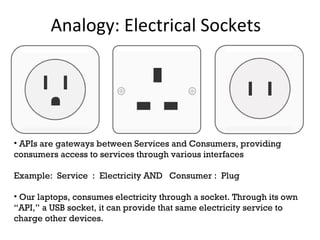
• APIs are gateways between Services and Consumers, providing 
consumers access to services through various interfaces 
Example: Service : Electricity AND Consumer : Plug 
• Our laptops, consumes electricity through a socket. Through its own 
“API,” a USB socket, it can provide that same electricity service to 
charge other devices.
Driving Factors 
• Business Agility : Business Logic is exposed thru 
APIs thereby enabling customers to focus on 
innovations 
• API Economy : Businesses are developing “API 
products” as new sources of revenue. Expedia 
generates over $2 billion thru data made 
available through their API 
• Internet of things: The number of things that 
can be connected is growing fast; everything 
from your coffee pot to your thermostat to 
your car can now be accessed thru APIs
Principle 1 : Design First API 
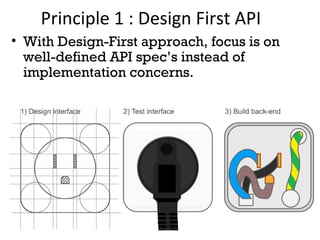
• With Design-First approach, focus is on 
well-defined API spec’s instead of 
implementation concerns.
• With an Design-First API approach, rather 
than implementing an application and then 
building API on top of it, first create the 
interface and then put the back-end logic 
into place - whether it be cloud-based or 
on-premise. 
• An optimal API design enables applications 
developers to easily understand the 
purpose and functionality of the API. 
• It also allows organizations to focus on 
getting API design right before investing in 
back-end implementation,
• The best way to design an API that developers 
want to use is to iteratively define the 
structure of the API in an expressive manner 
and get feedback from developers on its 
usability and functionality 
• As the API is designed, application developers 
can interact with it and test its behavior, 
thanks to an integrated mocking service that 
returns the values a call to the live API would 
produce.
• There is no such thing as a one-size-fits-all API 
• An API should be optimized to fulfill a specific 
business request in a specific context. 
• Optimize API for a specific use case e.g. 
– coarse or fine-grained 
– constraints e.g. network trips, latency and data 
size so API should be designed to limit backend 
calls and minimize the size of data returned
Principle 2 – Runtime API 
• Once an API is designed, created and its back-end 
implemented, it’s time to find the right 
run-time as it affects How successful your API 
strategy will be in terms of service, liability, 
scale and ability to meet future needs. 
• Hybrid support: As more and more businesses 
are moving to the cloud, so it is important to 
find runtime that allows to deploy applications 
both in the cloud as well as on-premise without 
having to modify anything.
• Scalability, reliability, availability: These “-ilities”, 
along with performance, are crucial when 
searching for a solid API runtime. The last thing 
you want is an unstable runtime that crashes or 
experiences outages. Choosing the right 
enterprise grade technology for your API runtime 
is crucial to the success of your API. 
• Strong Orchestration: A successful runtime should 
provide strong orchestration and orchestration 
capabilities. The ability to carry out complex back-end 
orchestration plays a key role in translation 
between the API layer and back-end 
implementation.
Principle 3 – API Design Contract 
• API publishers should offer a way to easily 
create well-defined policies and contracts and 
associate them with the right APIs and 
consumers. 
• API Contracts are crucial for enforcing security 
and managing SLAs with API consumers. 
• In addition, publish API version which helps in 
lifecycle management and allows API publishers 
to assess the impact of retiring a version. 
Example REST API’s
Principle 4 - Monitor API Usage 
• The ability to monitor API usage over a period of 
time and understand usage patterns from both 
technical and business perspectives is valuable as 
it helps business owners and technical teams 
better understand their users and ultimately 
create a better service. 
• You need to see how consumers are using it i.e. 
which parts of your service are being used. 
• With metrics for both overall usage and per 
consumer usage, businesses can closely monitor 
API activity and engagement.
Principle 5 - Continuous Improvement 
• The ability to re-factor your APIs by iterating 
through habits 1-6 multiple times allows you to 
optimize your API over time to improve 
consumer experience and productivity. 
• API is not a static entity – as new use cases are 
identified and use of your API expands, 
enhancements and fixes are inevitable.
Principle 6 -Socialize Your APIs 
• Create a developer portal to establish a 
community around your API is important to its 
success. By making it easy for users to follow 
your API, download documentation and ask 
questions, API publishers can engage with API 
consumers on an ongoing basis. 
• Example create a developer portal for company-wide 
REST services and document it using 
Swagger
• APIs delivers an end-to-end solution to design 
APIs that developers will love; easily connect 
them with backend services; run them in a 
secure, scalable environment; and manage 
them throughout their lifecycle.
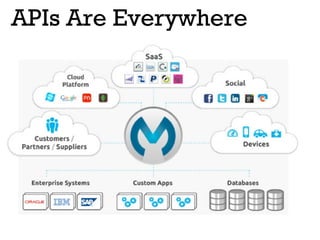
APIs Are Everywhere
Value of Great API’s 
• Is a Product 
• Help Grow a Eco-System of employees, customers 
and Partners 
• Evolve in a way that are mutually beneficial 
• Encourage Adoption 
• Ease Of Use 
• Great APIs aren’t difficult to develop 
– if you design for your users and the business processes 
– if you make it easy for developers to find and consume 
your API, and 
– you actively manage your API developer community as 
an extension of your business.
Pitfalls of a mediocre APIs 
• Doesn’t engage Stake-holders 
• limited adoption by developers and ultimately, a 
failure to meet business objectives 
• Starts with implementation first 
• Design of API is dictated by the constraints of 
internal systems or processes. 
• Too often APIs are modeled after the design of the 
backend services or applications they expose 
instead of the use case they fulfill. This results in 
poor performance of the client application, poor 
user experience, and ultimately, poor adoption.

Effective API Design

  • 1.
    Effective API Design Bansi Haudakari
  • 2.
    API’s Are Forthe Developers, By The Developers And Of the Developers - Bansi Haudakari
  • 3.
    Who Am I? • An API Developer • An API Consumer • An API Designer • A Seasoned JAVA Programmer who has been consuming JAVA API’s since JDK 1.0 And Other Open Source APIs For Software Development
  • 4.
    Agenda • Whatis an API? • Driving factors Of an API • Principles of Effective API Design • Value Of Great APIs • Pitfalls of mediocre APIs • Craft APIs that Developers Love
  • 5.
    What is anAPI? Application Programming Interface provides a way for developers to interact with and consume a service.
  • 6.
    Analogy: Electrical Sockets • APIs are gateways between Services and Consumers, providing consumers access to services through various interfaces Example: Service : Electricity AND Consumer : Plug • Our laptops, consumes electricity through a socket. Through its own “API,” a USB socket, it can provide that same electricity service to charge other devices.
  • 7.
    Driving Factors •Business Agility : Business Logic is exposed thru APIs thereby enabling customers to focus on innovations • API Economy : Businesses are developing “API products” as new sources of revenue. Expedia generates over $2 billion thru data made available through their API • Internet of things: The number of things that can be connected is growing fast; everything from your coffee pot to your thermostat to your car can now be accessed thru APIs
  • 8.
    Principle 1 :Design First API • With Design-First approach, focus is on well-defined API spec’s instead of implementation concerns.
  • 9.
    • With anDesign-First API approach, rather than implementing an application and then building API on top of it, first create the interface and then put the back-end logic into place - whether it be cloud-based or on-premise. • An optimal API design enables applications developers to easily understand the purpose and functionality of the API. • It also allows organizations to focus on getting API design right before investing in back-end implementation,
  • 10.
    • The bestway to design an API that developers want to use is to iteratively define the structure of the API in an expressive manner and get feedback from developers on its usability and functionality • As the API is designed, application developers can interact with it and test its behavior, thanks to an integrated mocking service that returns the values a call to the live API would produce.
  • 11.
    • There isno such thing as a one-size-fits-all API • An API should be optimized to fulfill a specific business request in a specific context. • Optimize API for a specific use case e.g. – coarse or fine-grained – constraints e.g. network trips, latency and data size so API should be designed to limit backend calls and minimize the size of data returned
  • 12.
    Principle 2 –Runtime API • Once an API is designed, created and its back-end implemented, it’s time to find the right run-time as it affects How successful your API strategy will be in terms of service, liability, scale and ability to meet future needs. • Hybrid support: As more and more businesses are moving to the cloud, so it is important to find runtime that allows to deploy applications both in the cloud as well as on-premise without having to modify anything.
  • 13.
    • Scalability, reliability,availability: These “-ilities”, along with performance, are crucial when searching for a solid API runtime. The last thing you want is an unstable runtime that crashes or experiences outages. Choosing the right enterprise grade technology for your API runtime is crucial to the success of your API. • Strong Orchestration: A successful runtime should provide strong orchestration and orchestration capabilities. The ability to carry out complex back-end orchestration plays a key role in translation between the API layer and back-end implementation.
  • 14.
    Principle 3 –API Design Contract • API publishers should offer a way to easily create well-defined policies and contracts and associate them with the right APIs and consumers. • API Contracts are crucial for enforcing security and managing SLAs with API consumers. • In addition, publish API version which helps in lifecycle management and allows API publishers to assess the impact of retiring a version. Example REST API’s
  • 15.
    Principle 4 -Monitor API Usage • The ability to monitor API usage over a period of time and understand usage patterns from both technical and business perspectives is valuable as it helps business owners and technical teams better understand their users and ultimately create a better service. • You need to see how consumers are using it i.e. which parts of your service are being used. • With metrics for both overall usage and per consumer usage, businesses can closely monitor API activity and engagement.
  • 16.
    Principle 5 -Continuous Improvement • The ability to re-factor your APIs by iterating through habits 1-6 multiple times allows you to optimize your API over time to improve consumer experience and productivity. • API is not a static entity – as new use cases are identified and use of your API expands, enhancements and fixes are inevitable.
  • 17.
    Principle 6 -SocializeYour APIs • Create a developer portal to establish a community around your API is important to its success. By making it easy for users to follow your API, download documentation and ask questions, API publishers can engage with API consumers on an ongoing basis. • Example create a developer portal for company-wide REST services and document it using Swagger
  • 18.
    • APIs deliversan end-to-end solution to design APIs that developers will love; easily connect them with backend services; run them in a secure, scalable environment; and manage them throughout their lifecycle.
  • 19.
  • 20.
    Value of GreatAPI’s • Is a Product • Help Grow a Eco-System of employees, customers and Partners • Evolve in a way that are mutually beneficial • Encourage Adoption • Ease Of Use • Great APIs aren’t difficult to develop – if you design for your users and the business processes – if you make it easy for developers to find and consume your API, and – you actively manage your API developer community as an extension of your business.
  • 21.
    Pitfalls of amediocre APIs • Doesn’t engage Stake-holders • limited adoption by developers and ultimately, a failure to meet business objectives • Starts with implementation first • Design of API is dictated by the constraints of internal systems or processes. • Too often APIs are modeled after the design of the backend services or applications they expose instead of the use case they fulfill. This results in poor performance of the client application, poor user experience, and ultimately, poor adoption.

Editor's Notes

  • #13 The ability to develop applications once and deploy them in the cloud or on-premise provides a host of possibilities without complexity