API Development – Complete Guide to
Developing Robust APIs
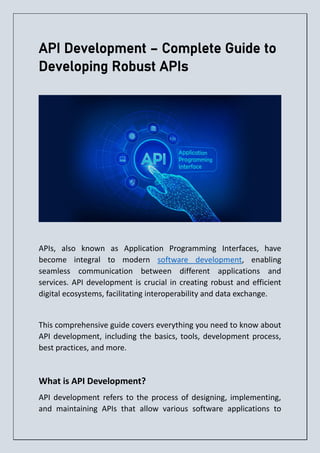
APIs, also known as Application Programming Interfaces, have
become integral to modern software development, enabling
seamless communication between different applications and
services. API development is crucial in creating robust and efficient
digital ecosystems, facilitating interoperability and data exchange.
This comprehensive guide covers everything you need to know about
API development, including the basics, tools, development process,
best practices, and more.
What is API Development?
API development refers to the process of designing, implementing,
and maintaining APIs that allow various software applications to
communicate with each other. They serve as a bridge between
different software components, providing a standardized interface
for developers to access specific functionalities or data, and perhaps
that is the reason why most developers spend 29.5 percent of their
time coding or debugging the API.
APIs also enable developers to create applications that can leverage
services, data, or functionalities other applications or systems
provide. This modularity allows for quicker development, as
developers can build upon existing services rather than starting from
scratch.
Why is API Development Important?
An API streamlines several tasks to facilitate building new apps and
programming interactions. Primary aspects highlighting the
importance of API development are:
Accelerates Development
Developers can quickly build applications that leverage existing
services, data, or functionalities by using APIs. This enables faster
development and shorter time-to-market for new software products.
Encourages Innovation
APIs provide a platform for developers to create novel applications
and services by combining existing functionalities in innovative ways.
Enhances Software Quality
APIs promote modular and decoupled architectures, which improve
software quality by making it easier to maintain, test, and scale
individual components.
Facilitates Interoperability
APIs enable seamless communication between software applications,
fostering interoperability and data exchange across various platforms
and technologies.
API Development Tools
Numerous tools are available for API development, ranging from
integrated development environments (IDEs) and API design tools to
testing and documentation solutions. Some popular API
development tools include:
1. Postman: Postman is a popular API development platform that
offers a comprehensive suite of tools for designing, testing, and
monitoring APIs. The platform supports various API formats,
including REST, GraphQL, and SOAP.
2. Swagger: An open-source API framework, Swagger helps
developers design, build, and document RESTful APIs. It also provides
a user-friendly interface for creating API specifications using the
OpenAPI standard.
3. Insomnia: Insomnia is a powerful REST and GraphQL API client that
enables developers to design, debug, and test APIs. Insomnia offers
environment variables, authentication helpers, and response
validation features.
4. Apigee: A comprehensive API management platform by Google
Cloud, Apigee provides tools for designing, securing, deploying, and
monitoring APIs. Apigee also offers analytics and machine learning
capabilities for optimizing API performance.
5. API Blueprint: API Blueprint is a high-level API description
language that enables developers to design and document APIs using
a simple, Markdown-based syntax. API Blueprint provides various
tools for generating API documentation, mock servers, and testing.
API Software Development Process
If you are wondering how to develop an API, you need to be familiar
with the following stages:
1. Planning: Begin by defining the purpose of the API, identifying
target users, and outlining the desired functionality. Consider the
data or services the API will provide, as and any potential constraints
or limitations.
2. Design: Design the API by specifying the endpoints, resources,
methods, and data models. Use established conventions and best
practices, such as REST or GraphQL, to ensure consistency and ease
of use. Create an API specification using a standard format like
OpenAPI or API Blueprint to facilitate documentation and
collaboration.
3. Implementation: Following the API specification, develop the API
using a suitable programming language and framework. Implement
the desired functionality, keeping performance, scalability, and
security requirements in mind.
4. Testing: Test the API using automated testing tools and techniques,
such as unit testing, integration testing, and load testing. Ensure that
the API meets performance, security, and functional requirements.
5. Deployment: Deploy the API to a suitable hosting environment,
ensuring it is accessible to the intended users and applications.
Monitor the API’s performance and usage, making necessary
adjustments to optimize its efficiency and reliability.
6. Documentation: Create comprehensive and user-friendly
documentation for the API, detailing its endpoints, resources,
methods, data models, and usage examples. Use tools like Swagger
or API Blueprint to generate interactive documentation that enables
developers to explore and test the API easily.
7. Maintenance and versioning: Continuously monitor and maintain
the API, addressing any issues or bugs. When making significant
changes or updates, consider implementing versioning to ensure
backward compatibility for existing users.
Key Features of an API for Seamless Integration and
Functionality
With the increasing demand for interoperability and modularity, an
efficient API can significantly impact the success and adoption of
your software product. Some must-have characteristics of an efficient
application programming interface that ensure smooth integration
and functionality have been discussed below.
Clear and Consistent Design
A well-designed API should be easy to understand and use by
developers. Adopting established conventions, standards, and best
practices can help create a clear and consistent API structure.
Intuitive naming conventions for endpoints, resources, and methods,
along with a logical organization, can significantly improve the overall
user experience and make it easier for developers to navigate and
utilize the API.
Comprehensive Documentation
Thorough and user-friendly documentation is essential for an
efficient API. Detailed documentation should cover all aspects of the
API, including endpoints, resources, methods, data models,
authentication, error handling, and usage examples. Interactive
documentation tools like Swagger or API Blueprint can further
enhance developer experience by allowing them to explore and test
the API easily. Keeping the documentation up-to-date and easily
accessible is crucial for ensuring seamless integration.
Scalability
An efficient API should be designed with scalability, allowing it to
handle increasing loads and accommodate future growth. This
involves considering data storage, processing capacity, and network
resources. Implementing caching, pagination, and rate limiting can
optimize the API’s performance under heavy loads and ensure a
responsive and reliable user experience.
Security
Security is paramount for any API, particularly those handling
sensitive data or critical functionalities. An efficient API should
implement robust security measures such as authentication,
authorization, and encryption to protect against unauthorized access,
data breaches, and other potential threats. Adhering to security best
practices and continuously monitoring for vulnerabilities can help
maintain the API’s integrity and safeguard user data.
Error Handling and Logging
An efficient API should provide meaningful, consistent error
messages to help developers diagnose and fix issues when using the
API. Implementing error handling and logging can significantly
improve the API’s usability and facilitate troubleshooting. Providing
comprehensive error codes and descriptions, and suggestions for
resolving issues can streamline the integration process and minimize
frustration for developers.
Versioning
API versioning is essential for maintaining backward compatibility
and ensuring a smooth transition when introducing significant
changes or updates. An efficient API should have a clear and
consistent versioning scheme that allows developers to access
different API versions as needed. This enables updates to be made
without disrupting existing integrations and ensures that developers
can continue using the API without encountering unexpected issues.
Developer Support
Providing timely and effective support to developers is crucial for an
efficient API. Active engagement with the developer community can
help identify potential issues, gather feedback, and drive
improvements to the API, ultimately contributing to its success and
adoption. This can include offering resources such as forums, FAQs,
tutorials, and dedicated support channels to address questions and
concerns.
Other things you can do to ensure that your API is efficient, secure,
and easy to use are:
• Use meaningful naming conventions: Choose descriptive and
intuitive names for your API’s resources, methods, and
endpoints to improve its readability and usability.
• Optimize your API’s performance by implementing caching,
pagination, and rate limiting. This will ensure your API remains
responsive and efficient, even under heavy loads.
The Bottomline
API development is critical to modern software development,
enabling seamless communication and data exchange between
different applications and services. Developers can create robust and
efficient APIs that facilitate interoperability and innovation in the
digital ecosystem by understanding the basics of API development,
leveraging the right tools and techniques, and following best
practices.
By investing time and effort into API development, businesses can
unlock new opportunities for growth and collaboration, fostering a
more connected and efficient digital landscape. With the growing
importance of APIs in today’s software landscape, mastering API
development has become essential for developers and businesses.
More Details: https://bit.ly/3UBeabW

API Development – Complete Guide to Developing Robust APIs

  • 1.
    API Development –Complete Guide to Developing Robust APIs APIs, also known as Application Programming Interfaces, have become integral to modern software development, enabling seamless communication between different applications and services. API development is crucial in creating robust and efficient digital ecosystems, facilitating interoperability and data exchange. This comprehensive guide covers everything you need to know about API development, including the basics, tools, development process, best practices, and more. What is API Development? API development refers to the process of designing, implementing, and maintaining APIs that allow various software applications to
  • 2.
    communicate with eachother. They serve as a bridge between different software components, providing a standardized interface for developers to access specific functionalities or data, and perhaps that is the reason why most developers spend 29.5 percent of their time coding or debugging the API. APIs also enable developers to create applications that can leverage services, data, or functionalities other applications or systems provide. This modularity allows for quicker development, as developers can build upon existing services rather than starting from scratch. Why is API Development Important? An API streamlines several tasks to facilitate building new apps and programming interactions. Primary aspects highlighting the importance of API development are: Accelerates Development Developers can quickly build applications that leverage existing services, data, or functionalities by using APIs. This enables faster development and shorter time-to-market for new software products. Encourages Innovation APIs provide a platform for developers to create novel applications and services by combining existing functionalities in innovative ways.
  • 3.
    Enhances Software Quality APIspromote modular and decoupled architectures, which improve software quality by making it easier to maintain, test, and scale individual components. Facilitates Interoperability APIs enable seamless communication between software applications, fostering interoperability and data exchange across various platforms and technologies. API Development Tools Numerous tools are available for API development, ranging from integrated development environments (IDEs) and API design tools to testing and documentation solutions. Some popular API development tools include: 1. Postman: Postman is a popular API development platform that offers a comprehensive suite of tools for designing, testing, and monitoring APIs. The platform supports various API formats, including REST, GraphQL, and SOAP. 2. Swagger: An open-source API framework, Swagger helps developers design, build, and document RESTful APIs. It also provides
  • 4.
    a user-friendly interfacefor creating API specifications using the OpenAPI standard. 3. Insomnia: Insomnia is a powerful REST and GraphQL API client that enables developers to design, debug, and test APIs. Insomnia offers environment variables, authentication helpers, and response validation features. 4. Apigee: A comprehensive API management platform by Google Cloud, Apigee provides tools for designing, securing, deploying, and monitoring APIs. Apigee also offers analytics and machine learning capabilities for optimizing API performance. 5. API Blueprint: API Blueprint is a high-level API description language that enables developers to design and document APIs using a simple, Markdown-based syntax. API Blueprint provides various tools for generating API documentation, mock servers, and testing. API Software Development Process If you are wondering how to develop an API, you need to be familiar with the following stages: 1. Planning: Begin by defining the purpose of the API, identifying target users, and outlining the desired functionality. Consider the data or services the API will provide, as and any potential constraints or limitations.
  • 5.
    2. Design: Designthe API by specifying the endpoints, resources, methods, and data models. Use established conventions and best practices, such as REST or GraphQL, to ensure consistency and ease of use. Create an API specification using a standard format like OpenAPI or API Blueprint to facilitate documentation and collaboration. 3. Implementation: Following the API specification, develop the API using a suitable programming language and framework. Implement the desired functionality, keeping performance, scalability, and security requirements in mind. 4. Testing: Test the API using automated testing tools and techniques, such as unit testing, integration testing, and load testing. Ensure that the API meets performance, security, and functional requirements. 5. Deployment: Deploy the API to a suitable hosting environment, ensuring it is accessible to the intended users and applications. Monitor the API’s performance and usage, making necessary adjustments to optimize its efficiency and reliability. 6. Documentation: Create comprehensive and user-friendly documentation for the API, detailing its endpoints, resources, methods, data models, and usage examples. Use tools like Swagger or API Blueprint to generate interactive documentation that enables developers to explore and test the API easily. 7. Maintenance and versioning: Continuously monitor and maintain the API, addressing any issues or bugs. When making significant
  • 6.
    changes or updates,consider implementing versioning to ensure backward compatibility for existing users. Key Features of an API for Seamless Integration and Functionality With the increasing demand for interoperability and modularity, an efficient API can significantly impact the success and adoption of your software product. Some must-have characteristics of an efficient application programming interface that ensure smooth integration and functionality have been discussed below. Clear and Consistent Design A well-designed API should be easy to understand and use by developers. Adopting established conventions, standards, and best practices can help create a clear and consistent API structure. Intuitive naming conventions for endpoints, resources, and methods, along with a logical organization, can significantly improve the overall user experience and make it easier for developers to navigate and utilize the API. Comprehensive Documentation Thorough and user-friendly documentation is essential for an efficient API. Detailed documentation should cover all aspects of the API, including endpoints, resources, methods, data models, authentication, error handling, and usage examples. Interactive documentation tools like Swagger or API Blueprint can further
  • 7.
    enhance developer experienceby allowing them to explore and test the API easily. Keeping the documentation up-to-date and easily accessible is crucial for ensuring seamless integration. Scalability An efficient API should be designed with scalability, allowing it to handle increasing loads and accommodate future growth. This involves considering data storage, processing capacity, and network resources. Implementing caching, pagination, and rate limiting can optimize the API’s performance under heavy loads and ensure a responsive and reliable user experience. Security Security is paramount for any API, particularly those handling sensitive data or critical functionalities. An efficient API should implement robust security measures such as authentication, authorization, and encryption to protect against unauthorized access, data breaches, and other potential threats. Adhering to security best practices and continuously monitoring for vulnerabilities can help maintain the API’s integrity and safeguard user data. Error Handling and Logging An efficient API should provide meaningful, consistent error messages to help developers diagnose and fix issues when using the API. Implementing error handling and logging can significantly
  • 8.
    improve the API’susability and facilitate troubleshooting. Providing comprehensive error codes and descriptions, and suggestions for resolving issues can streamline the integration process and minimize frustration for developers. Versioning API versioning is essential for maintaining backward compatibility and ensuring a smooth transition when introducing significant changes or updates. An efficient API should have a clear and consistent versioning scheme that allows developers to access different API versions as needed. This enables updates to be made without disrupting existing integrations and ensures that developers can continue using the API without encountering unexpected issues. Developer Support Providing timely and effective support to developers is crucial for an efficient API. Active engagement with the developer community can help identify potential issues, gather feedback, and drive improvements to the API, ultimately contributing to its success and adoption. This can include offering resources such as forums, FAQs, tutorials, and dedicated support channels to address questions and concerns. Other things you can do to ensure that your API is efficient, secure, and easy to use are:
  • 9.
    • Use meaningfulnaming conventions: Choose descriptive and intuitive names for your API’s resources, methods, and endpoints to improve its readability and usability. • Optimize your API’s performance by implementing caching, pagination, and rate limiting. This will ensure your API remains responsive and efficient, even under heavy loads. The Bottomline API development is critical to modern software development, enabling seamless communication and data exchange between different applications and services. Developers can create robust and efficient APIs that facilitate interoperability and innovation in the digital ecosystem by understanding the basics of API development, leveraging the right tools and techniques, and following best practices. By investing time and effort into API development, businesses can unlock new opportunities for growth and collaboration, fostering a more connected and efficient digital landscape. With the growing importance of APIs in today’s software landscape, mastering API development has become essential for developers and businesses. More Details: https://bit.ly/3UBeabW