NAME: ELIZABETH N WAWERU


REG NO: D33/OL/7397/2008


UNIT: EET 100


UNIT NAME: MICROECOMICS THEORY 1


DATE SUBMITTED: 24/MAY/2012
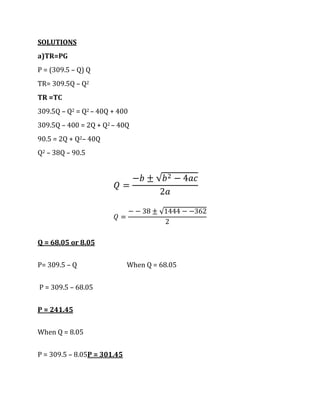
SOLUTIONS
a)TR=PG
P = (309.5 – Q) Q
TR= 309.5Q – Q2
TR =TC
309.5Q – Q2 = Q2 – 40Q + 400
309.5Q – 400 = 2Q + Q2 – 40Q
90.5 = 2Q + Q2– 40Q
Q2 – 38Q – 90.5


Q = 68.05 or 8.05


P= 309.5 – Q                 When Q = 68.05


P = 309.5 – 68.05


P = 241.45


When Q = 8.05


P = 309.5 – 8.05P = 301.45
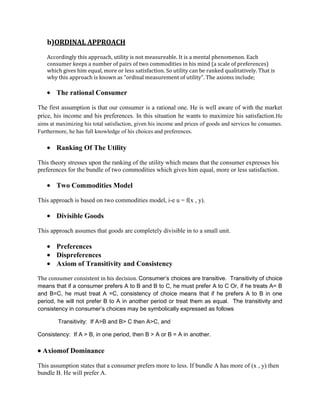
b)ORDINAL APPROACH
    Accordingly this approach, utility is not measureable. It is a mental phenomenon. Each
    consumer keeps a number of pairs of two commodities in his mind (a scale of preferences)
    which gives him equal, more or less satisfaction. So utility can be ranked qualitatively. That is
    why this approach is known as “ordinal measurement of utility”. The axioms include;

        The rational Consumer

The first assumption is that our consumer is a rational one. He is well aware of with the market
price, his income and his preferences. In this situation he wants to maximize his satisfaction.He
aims at maximizing his total satisfaction, given his income and prices of goods and services he consumes.
Furthermore, he has full knowledge of his choices and preferences.

        Ranking Of The Utility

This theory stresses upon the ranking of the utility which means that the consumer expresses his
preferences for the bundle of two commodities which gives him equal, more or less satisfaction.

        Two Commodities Model

This approach is based on two commodities model, i-e u = f(x , y).

        Divisible Goods

This approach assumes that goods are completely divisible in to a small unit.

        Preferences
        Dispreferences
        Axiom of Transitivity and Consistency

The consumer consistent in his decision. Consumer’s choices are transitive. Transitivity of choice
means that if a consumer prefers A to B and B to C, he must prefer A to C Or, if he treats A= B
and B=C, he must treat A =C, consistency of choice means that if he prefers A to B in one
period, he will not prefer B to A in another period or treat them as equal. The transitivity and
consistency in consumer’s choices may be symbolically expressed as follows

        Transitivity: If A>B and B> C then A>C, and

Consistency: If A > B, in one period, then B > A or B = A in another.

  Axiomof Dominance

This assumption states that a consumer prefers more to less. If bundle A has more of (x , y) then
bundle B. He will prefer A.
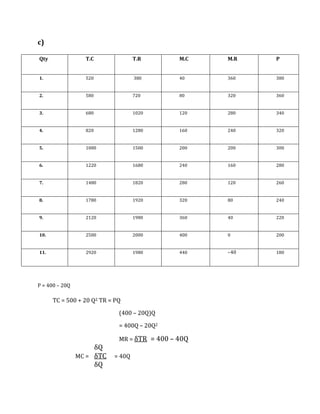
c)

Qty               T.C              T.R        M.C   M.R   P


1.                520              380        40    360   380


2.                580              720        80    320   360


3.                680              1020       120   280   340


4.                820              1280       160   240   320


5.                1000             1500       200   200   300


6.                1220             1680       240   160   280


7.                1480             1820       280   120   260


8.                1780             1920       320   80    240


9.                2120             1980       360   40    220


10.               2500             2000       400   0     200


11.               2920             1980       440   –40   180


P = 400 – 20Q

      TC = 500 + 20 Q2 TR = PQ

                             (400 – 20Q)Q

                             = 400Q – 20Q2

                             MR = δTR = 400 – 40Q
                     δQ
                MC = δTC   = 40Q
                     δQ
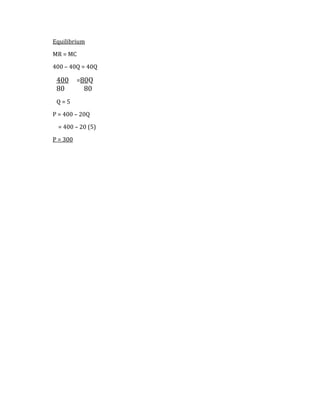
Equilibrium

MR = MC

400 – 40Q = 40Q

 400      =80Q
 80        80
 Q=5

P = 400 – 20Q

 = 400 – 20 (5)

P = 300

Eet1

  • 1.
    NAME: ELIZABETH NWAWERU REG NO: D33/OL/7397/2008 UNIT: EET 100 UNIT NAME: MICROECOMICS THEORY 1 DATE SUBMITTED: 24/MAY/2012
  • 2.
    SOLUTIONS a)TR=PG P = (309.5– Q) Q TR= 309.5Q – Q2 TR =TC 309.5Q – Q2 = Q2 – 40Q + 400 309.5Q – 400 = 2Q + Q2 – 40Q 90.5 = 2Q + Q2– 40Q Q2 – 38Q – 90.5 Q = 68.05 or 8.05 P= 309.5 – Q When Q = 68.05 P = 309.5 – 68.05 P = 241.45 When Q = 8.05 P = 309.5 – 8.05P = 301.45
  • 3.
    b)ORDINAL APPROACH Accordingly this approach, utility is not measureable. It is a mental phenomenon. Each consumer keeps a number of pairs of two commodities in his mind (a scale of preferences) which gives him equal, more or less satisfaction. So utility can be ranked qualitatively. That is why this approach is known as “ordinal measurement of utility”. The axioms include; The rational Consumer The first assumption is that our consumer is a rational one. He is well aware of with the market price, his income and his preferences. In this situation he wants to maximize his satisfaction.He aims at maximizing his total satisfaction, given his income and prices of goods and services he consumes. Furthermore, he has full knowledge of his choices and preferences. Ranking Of The Utility This theory stresses upon the ranking of the utility which means that the consumer expresses his preferences for the bundle of two commodities which gives him equal, more or less satisfaction. Two Commodities Model This approach is based on two commodities model, i-e u = f(x , y). Divisible Goods This approach assumes that goods are completely divisible in to a small unit. Preferences Dispreferences Axiom of Transitivity and Consistency The consumer consistent in his decision. Consumer’s choices are transitive. Transitivity of choice means that if a consumer prefers A to B and B to C, he must prefer A to C Or, if he treats A= B and B=C, he must treat A =C, consistency of choice means that if he prefers A to B in one period, he will not prefer B to A in another period or treat them as equal. The transitivity and consistency in consumer’s choices may be symbolically expressed as follows Transitivity: If A>B and B> C then A>C, and Consistency: If A > B, in one period, then B > A or B = A in another. Axiomof Dominance This assumption states that a consumer prefers more to less. If bundle A has more of (x , y) then bundle B. He will prefer A.
  • 4.
    c) Qty T.C T.R M.C M.R P 1. 520 380 40 360 380 2. 580 720 80 320 360 3. 680 1020 120 280 340 4. 820 1280 160 240 320 5. 1000 1500 200 200 300 6. 1220 1680 240 160 280 7. 1480 1820 280 120 260 8. 1780 1920 320 80 240 9. 2120 1980 360 40 220 10. 2500 2000 400 0 200 11. 2920 1980 440 –40 180 P = 400 – 20Q TC = 500 + 20 Q2 TR = PQ (400 – 20Q)Q = 400Q – 20Q2 MR = δTR = 400 – 40Q δQ MC = δTC = 40Q δQ
  • 5.
    Equilibrium MR = MC 400– 40Q = 40Q 400 =80Q 80 80 Q=5 P = 400 – 20Q = 400 – 20 (5) P = 300