Electrical Engineering 2019-2020/ Ravi Kumar Soni
61
Electrical Energy Conversion & Auditing
UNIT 4 (Energy Efficiency in Electrical Systems & Industrial Systems)
Electrical system: Electricity billing, electrical load management and maximum demand control, power factor
improvement and its benefit, selection and location of capacitors, performance assessment of PF capacitors
Distribution and transformer losses, Overview of grid code technical requirements, Fault ride-through for wind
farms - real and reactive power regulation, voltage and frequency operating limits, solar PV and wind farm
behavior during grid disturbances. Hybrid and isolated operations of solar PV and wind systems.
Electric motors: Types, losses in induction motors, motor efficiency, Factors affecting motor performance,
rewinding and motor replacement issues, Energy saving opportunities with energy efficient motors.
1.1 Introduction to Electric Power Supply Systems
Electric power supply system in a country comprises of generating units that produce electricity; high voltage
transmission lines that transport electricity over long distances; distribution lines that deliver the electricity to
consumers; substations that connect the pieces to each other; and energy control centers to coordinate the
operation of the components.
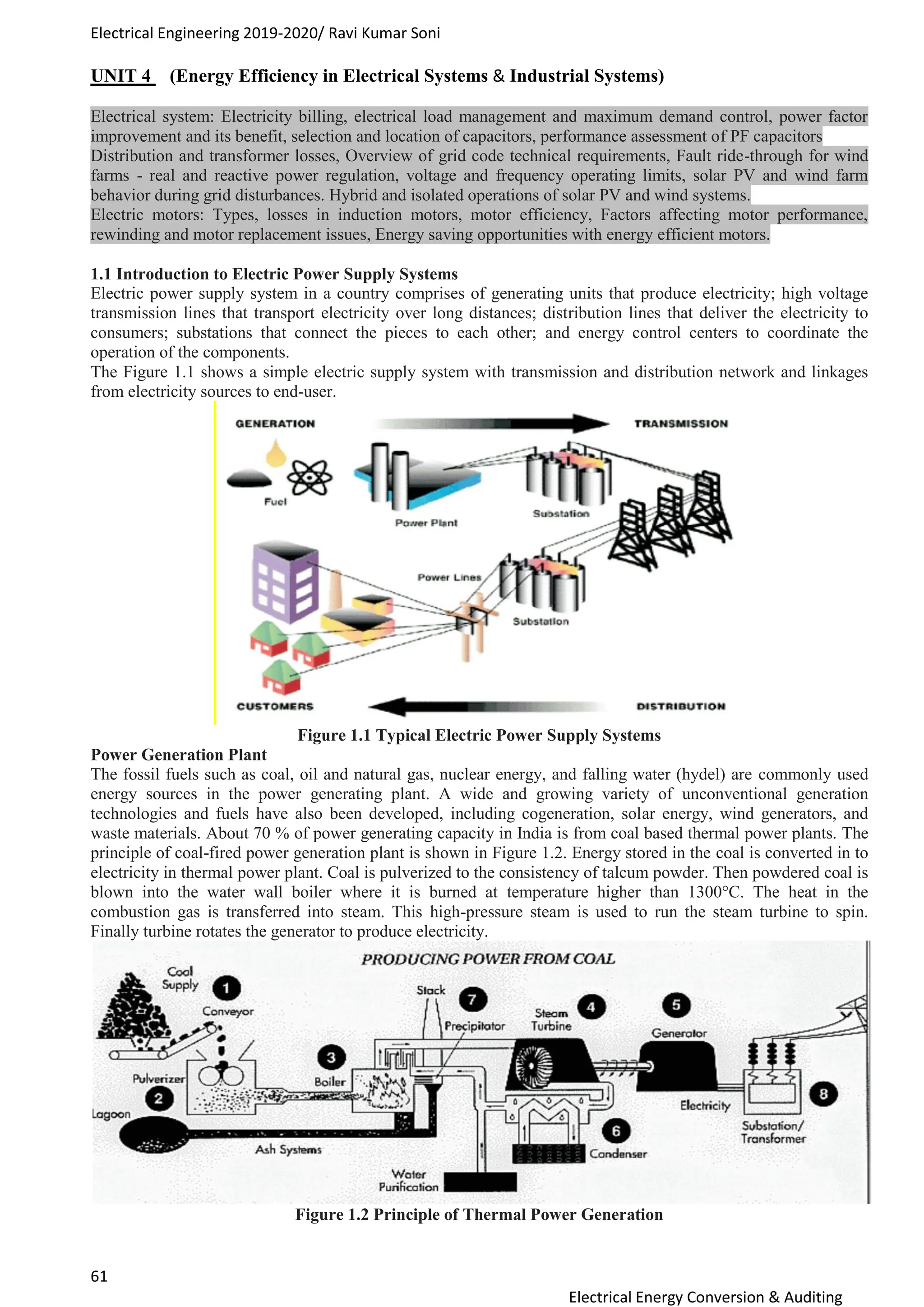
The Figure 1.1 shows a simple electric supply system with transmission and distribution network and linkages
from electricity sources to end-user.
Figure 1.1 Typical Electric Power Supply Systems
Power Generation Plant
The fossil fuels such as coal, oil and natural gas, nuclear energy, and falling water (hydel) are commonly used
energy sources in the power generating plant. A wide and growing variety of unconventional generation
technologies and fuels have also been developed, including cogeneration, solar energy, wind generators, and
waste materials. About 70 % of power generating capacity in India is from coal based thermal power plants. The
principle of coal-fired power generation plant is shown in Figure 1.2. Energy stored in the coal is converted in to
electricity in thermal power plant. Coal is pulverized to the consistency of talcum powder. Then powdered coal is
blown into the water wall boiler where it is burned at temperature higher than 1300°C. The heat in the
combustion gas is transferred into steam. This high-pressure steam is used to run the steam turbine to spin.
Finally turbine rotates the generator to produce electricity.
Figure 1.2 Principle of Thermal Power Generation
Electrical Engineering 2019-2020/ Ravi Kumar Soni
62
Electrical Energy Conversion & Auditing
In India, for the coal based power plants, the overall efficiency ranges from 28% to 35% depending upon the size,
operational practices and capacity utilization. Where fuels are the source of generation, a common term used is
the “HEAT RATE” which reflects the efficiency of generation. “HEAT RATE” is the heat input in kilo Calories
or kilo Joules, for generating ‘one’ kilo Watt-hour of electrical output. One kilo Watt hour of electrical energy
being equivalent to 860 kilo Calories of thermal energy or 3600 kilo Joules of thermal energy. The “HEAT
RATE” expresses in inverse the efficiency of power generation.
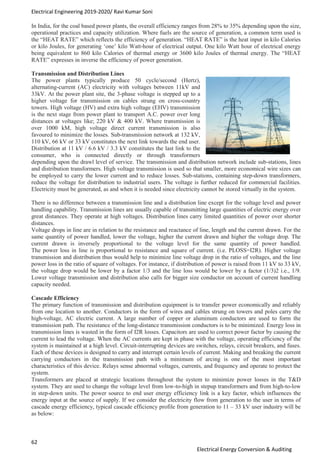
Transmission and Distribution Lines
The power plants typically produce 50 cycle/second (Hertz),
alternating-current (AC) electricity with voltages between 11kV and
33kV. At the power plant site, the 3-phase voltage is stepped up to a
higher voltage for transmission on cables strung on cross-country
towers. High voltage (HV) and extra high voltage (EHV) transmission
is the next stage from power plant to transport A.C. power over long
distances at voltages like; 220 kV & 400 kV. Where transmission is
over 1000 kM, high voltage direct current transmission is also
favoured to minimize the losses. Sub-transmission network at 132 kV,
110 kV, 66 kV or 33 kV constitutes the next link towards the end user.
Distribution at 11 kV / 6.6 kV / 3.3 kV constitutes the last link to the
consumer, who is connected directly or through transformers
depending upon the drawl level of service. The transmission and distribution network include sub-stations, lines
and distribution transformers. High voltage transmission is used so that smaller, more economical wire sizes can
be employed to carry the lower current and to reduce losses. Sub-stations, containing step-down transformers,
reduce the voltage for distribution to industrial users. The voltage is further reduced for commercial facilities.
Electricity must be generated, as and when it is needed since electricity cannot be stored virtually in the system.
There is no difference between a transmission line and a distribution line except for the voltage level and power
handling capability. Transmission lines are usually capable of transmitting large quantities of electric energy over
great distances. They operate at high voltages. Distribution lines carry limited quantities of power over shorter
distances.
Voltage drops in line are in relation to the resistance and reactance of line, length and the current drawn. For the
same quantity of power handled, lower the voltage, higher the current drawn and higher the voltage drop. The
current drawn is inversely proportional to the voltage level for the same quantity of power handled.
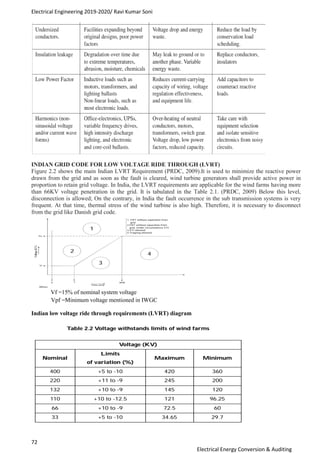
The power loss in line is proportional to resistance and square of current. (i.e. PLOSS=I2R). Higher voltage
transmission and distribution thus would help to minimize line voltage drop in the ratio of voltages, and the line
power loss in the ratio of square of voltages. For instance, if distribution of power is raised from 11 kV to 33 kV,
the voltage drop would be lower by a factor 1/3 and the line loss would be lower by a factor (1/3)2 i.e., 1/9.
Lower voltage transmission and distribution also calls for bigger size conductor on account of current handling
capacity needed.
Cascade Efficiency
The primary function of transmission and distribution equipment is to transfer power economically and reliably
from one location to another. Conductors in the form of wires and cables strung on towers and poles carry the
high-voltage, AC electric current. A large number of copper or aluminum conductors are used to form the
transmission path. The resistance of the long-distance transmission conductors is to be minimized. Energy loss in
transmission lines is wasted in the form of I2R losses. Capacitors are used to correct power factor by causing the
current to lead the voltage. When the AC currents are kept in phase with the voltage, operating efficiency of the
system is maintained at a high level. Circuit-interrupting devices are switches, relays, circuit breakers, and fuses.
Each of these devices is designed to carry and interrupt certain levels of current. Making and breaking the current
carrying conductors in the transmission path with a minimum of arcing is one of the most important
characteristics of this device. Relays sense abnormal voltages, currents, and frequency and operate to protect the
system.
Transformers are placed at strategic locations throughout the system to minimize power losses in the T&D
system. They are used to change the voltage level from low-to-high in stepup transformers and from high-to-low
in step-down units. The power source to end user energy efficiency link is a key factor, which influences the
energy input at the source of supply. If we consider the electricity flow from generation to the user in terms of
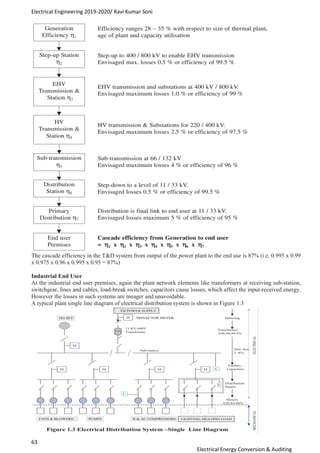
cascade energy efficiency, typical cascade efficiency profile from generation to 11 – 33 kV user industry will be
as below:
Electrical Engineering 2019-2020/ Ravi Kumar Soni
63
Electrical Energy Conversion & Auditing
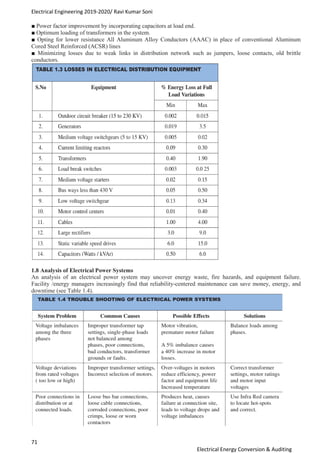
The cascade efficiency in the T&D system from output of the power plant to the end use is 87% (i.e. 0.995 x 0.99
x 0.975 x 0.96 x 0.995 x 0.95 = 87%)
Industrial End User
At the industrial end user premises, again the plant network elements like transformers at receiving sub-station,
switchgear, lines and cables, load-break switches, capacitors cause losses, which affect the input-received energy.
However the losses in such systems are meager and unavoidable.
A typical plant single line diagram of electrical distribution system is shown in Figure 1.3
Electrical Engineering 2019-2020/ Ravi Kumar Soni
64
Electrical Energy Conversion & Auditing
ONE Unit saved = TWO Units Generated
After power generation at the plant it is transmitted and distributed over a wide network. The standard technical
losses are around 17 % in India (Efficiency = 83%). But the figures for many of the states show T & D losses
ranging from 17 – 50 %. All these may not constitute technical losses, since un-metered and pilferage are also
accounted in this loss. When the power reaches the industry, it meets the transformer. The energy efficiency of
the transformer is generally very high. Next, it goes to the motor through internal plant distribution network. A
typical distribution network efficiency including transformer is 95% and motor efficiency is about 90%. Another
30 % (Efficiency =70%)is lost in the mechanical system which includes coupling/ drive train, a driven equipment
such as pump and flow control valves/throttling etc. Thus the overall energy efficiency becomes 50%. (0.83 x
0.95x 0.9 x 0.70 = 0.50, i.e. 50% efficiency) Hence one unit saved in the end user is equivalent to two units
generated in the power plant. (1Unit / 0.5Eff = 2 Units)
1.2 Electricity Billing
The electricity billing by utilities for medium & large enterprises, in High Tension (HT) category, is often done
on two-part tariff structure, i.e. one part for capacity (or demand) drawn and the second part for actual energy
drawn during the billing cycle. Capacity or demand is in kVA (apparent power) or kW terms. The reactive energy
(i.e.) kVArh drawn by the service is also recorded and billed for in some utilities, because this would affect the
load on the utility. Accordingly, utility charges for maximum demand, active energy and reactive power drawn
(as reflected by the power factor) in its billing structure. In addition, other fixed and variable expenses are also
levied.
The tariff structure generally includes the following components:
a) Maximum demand Charges
These charges relate to maximum demand registered during month/billing period and corresponding rate of
utility.
b) Energy Charges
These charges relate to energy (kilowatt hours) consumed during month / billing period and corresponding rates,
often levied in slabs of use rates. Some utilities now charge on the basis of apparent energy (kVAh), which is a
vector sum of kWh and kVArh.
c) Power factor penalty or bonus rates, as levied by most utilities, are to contain reactive power drawn from grid.
d) Fuel cost adjustment charges as levied by some utilities are to adjust the increasing fuel expenses over a base
reference value.
e) Electricity duty charges levied w.r.t units consumed.
f) Meter rentals
g) Lighting and fan power consumption is often at higher rates, levied sometimes on slab basis or on actual
metering basis.
h) Time Of Day (TOD) rates like peak and non-peak hours are also prevalent in tariff structure provisions of some
utilities.
i) Penalty for exceeding contract demand
j) Surcharge if metering is at LT side in some of the utilities
Analysis of utility bill data and monitoring its trends helps energy manager to identify ways for electricity bill
reduction through available provisions in tariff framework, apart from energy budgeting. The utility employs an
electromagnetic or electronic trivector meter, for billing purposes. The minimum outputs from the
electromagnetic meters are
• Maximum demand registered during the month, which is measured in preset time intervals (say of 30 minute
duration) and this is reset at the end of every billing cycle.
• Active energy in kWh during billing cycle
• Reactive energy in kVArh during billing cycle and
• Apparent energy in kVAh during billing cycle
It is important to note that while maximum demand is recorded, it is not the instantaneous demand drawn, as is
often misunderstood, but the time integrated demand over the predefined recording cycle.
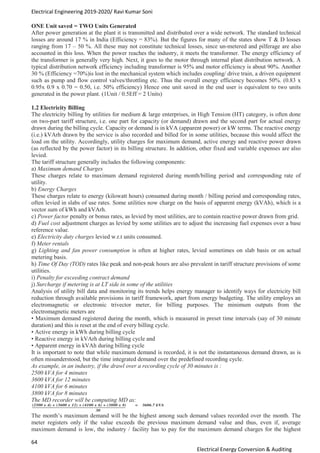
As example, in an industry, if the drawl over a recording cycle of 30 minutes is :
2500 kVA for 4 minutes
3600 kVA for 12 minutes
4100 kVA for 6 minutes
3800 kVA for 8 minutes
The MD recorder will be computing MD as:
The month’s maximum demand will be the highest among such demand values recorded over the month. The
meter registers only if the value exceeds the previous maximum demand value and thus, even if, average
maximum demand is low, the industry / facility has to pay for the maximum demand charges for the highest
Electrical Engineering 2019-2020/ Ravi Kumar Soni
65
Electrical Energy Conversion & Auditing
value registered during the month, even if it occurs for
just one recording cycle duration i.e., 30 minutes during
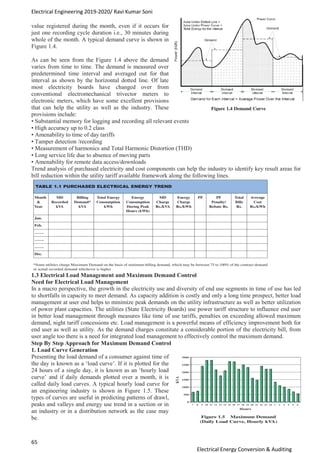
whole of the month. A typical demand curve is shown in
Figure 1.4.
As can be seen from the Figure 1.4 above the demand
varies from time to time. The demand is measured over
predetermined time interval and averaged out for that
interval as shown by the horizontal dotted line. Of late
most electricity boards have changed over from
conventional electromechanical trivector meters to
electronic meters, which have some excellent provisions
that can help the utility as well as the industry. These
provisions include:
• Substantial memory for logging and recording all relevant events
• High accuracy up to 0.2 class
• Amenability to time of day tariffs
• Tamper detection /recording
• Measurement of harmonics and Total Harmonic Distortion (THD)
• Long service life due to absence of moving parts
• Amenability for remote data access/downloads
Trend analysis of purchased electricity and cost components can help the industry to identify key result areas for
bill reduction within the utility tariff available framework along the following lines.
1.3 Electrical Load Management and Maximum Demand Control
Need for Electrical Load Management
In a macro perspective, the growth in the electricity use and diversity of end use segments in time of use has led
to shortfalls in capacity to meet demand. As capacity addition is costly and only a long time prospect, better load
management at user end helps to minimize peak demands on the utility infrastructure as well as better utilization
of power plant capacities. The utilities (State Electricity Boards) use power tariff structure to influence end user
in better load management through measures like time of use tariffs, penalties on exceeding allowed maximum
demand, night tariff concessions etc. Load management is a powerful means of efficiency improvement both for
end user as well as utility. As the demand charges constitute a considerable portion of the electricity bill, from
user angle too there is a need for integrated load management to effectively control the maximum demand.
Step By Step Approach for Maximum Demand Control
1. Load Curve Generation
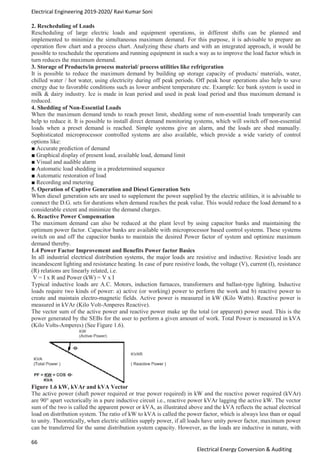
Presenting the load demand of a consumer against time of
the day is known as a ‘load curve’. If it is plotted for the
24 hours of a single day, it is known as an ‘hourly load
curve’ and if daily demands plotted over a month, it is
called daily load curves. A typical hourly load curve for
an engineering industry is shown in Figure 1.5. These
types of curves are useful in predicting patterns of drawl,
peaks and valleys and energy use trend in a section or in
an industry or in a distribution network as the case may
be.
Electrical Engineering 2019-2020/ Ravi Kumar Soni
66
Electrical Energy Conversion & Auditing
2. Rescheduling of Loads
Rescheduling of large electric loads and equipment operations, in different shifts can be planned and
implemented to minimize the simultaneous maximum demand. For this purpose, it is advisable to prepare an
operation flow chart and a process chart. Analyzing these charts and with an integrated approach, it would be
possible to reschedule the operations and running equipment in such a way as to improve the load factor which in
turn reduces the maximum demand.
3. Storage of Products/in process material/ process utilities like refrigeration
It is possible to reduce the maximum demand by building up storage capacity of products/ materials, water,
chilled water / hot water, using electricity during off peak periods. Off peak hour operations also help to save
energy due to favorable conditions such as lower ambient temperature etc. Example: Ice bank system is used in
milk & dairy industry. Ice is made in lean period and used in peak load period and thus maximum demand is
reduced.
4. Shedding of Non-Essential Loads
When the maximum demand tends to reach preset limit, shedding some of non-essential loads temporarily can
help to reduce it. It is possible to install direct demand monitoring systems, which will switch off non-essential
loads when a preset demand is reached. Simple systems give an alarm, and the loads are shed manually.
Sophisticated microprocessor controlled systems are also available, which provide a wide variety of control
options like:
■ Accurate prediction of demand
■ Graphical display of present load, available load, demand limit
■ Visual and audible alarm
■ Automatic load shedding in a predetermined sequence
■ Automatic restoration of load
■ Recording and metering
5. Operation of Captive Generation and Diesel Generation Sets
When diesel generation sets are used to supplement the power supplied by the electric utilities, it is advisable to
connect the D.G. sets for durations when demand reaches the peak value. This would reduce the load demand to a
considerable extent and minimize the demand charges.
6. Reactive Power Compensation
The maximum demand can also be reduced at the plant level by using capacitor banks and maintaining the
optimum power factor. Capacitor banks are available with microprocessor based control systems. These systems
switch on and off the capacitor banks to maintain the desired Power factor of system and optimize maximum
demand thereby.
1.4 Power Factor Improvement and Benefits Power factor Basics
In all industrial electrical distribution systems, the major loads are resistive and inductive. Resistive loads are
incandescent lighting and resistance heating. In case of pure resistive loads, the voltage (V), current (I), resistance
(R) relations are linearly related, i.e.
V = I x R and Power (kW) = V x I
Typical inductive loads are A.C. Motors, induction furnaces, transformers and ballast-type lighting. Inductive
loads require two kinds of power: a) active (or working) power to perform the work and b) reactive power to
create and maintain electro-magnetic fields. Active power is measured in kW (Kilo Watts). Reactive power is
measured in kVAr (Kilo Volt-Amperes Reactive).
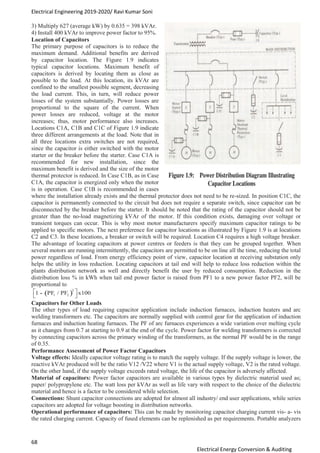
The vector sum of the active power and reactive power make up the total (or apparent) power used. This is the
power generated by the SEBs for the user to perform a given amount of work. Total Power is measured in kVA
(Kilo Volts-Amperes) (See Figure 1.6).
Figure 1.6 kW, kVAr and kVA Vector
The active power (shaft power required or true power required) in kW and the reactive power required (kVAr)
are 90° apart vectorically in a pure inductive circuit i.e., reactive power kVAr lagging the active kW. The vector
sum of the two is called the apparent power or kVA, as illustrated above and the kVA reflects the actual electrical
load on distribution system. The ratio of kW to kVA is called the power factor, which is always less than or equal
to unity. Theoretically, when electric utilities supply power, if all loads have unity power factor, maximum power
can be transferred for the same distribution system capacity. However, as the loads are inductive in nature, with
Electrical Engineering 2019-2020/ Ravi Kumar Soni
67
Electrical Energy Conversion & Auditing
the power factor ranging from 0.2 to 0.9, the electrical distribution network is
stressed for capacity at low power factors.
Improving Power Factor
The solution to improve the power factor is to add power factor correction
capacitors (see Figure 1.7) to the plant power distribution system. They act as
reactive power generators, and provide the needed reactive power to accomplish kW
of work. This reduces the amount of reactive power, and thus total power, generated
by the utilities.
Example:
A chemical industry had installed a 1500 kVA transformer. The initial demand of
the plant was 1160 kVA with power factor of 0.70. The % loading of transformer
was about 78% (116 ~ 0/1500 = 77.3%). To improve the power factor and to avoid
the penalty, the unit had added about 410 kVAr in motor load end. This improved the power factor to 0.89, and
reduced the required kVA to 913, which is the vector sum of kW and kVAr (see Figure 1.8).
Figure 1.8 Power factor before and after Improvement
After improvement the plant had avoided penalty and the 1500 kVA transformer now loaded only to 60% of
capacity. This will allow the addition of more load in the future to be supplied by the transformer.
The advantages of PF improvement by capacitor addition
a) Reactive component of the network is reduced and so also the total current in the system from the source end.
b) I2R power losses are reduced in the system because of reduction in current.
c) Voltage level at the load end is increased.
d) kVA loading on the source generators as also on the transformers and lines upto the capacitors reduces giving
capacity relief. A high power factor can help in utilising the full capacity of your electrical system.
Cost benefits of PF improvement
While costs of PF improvement are in terms of investment needs for capacitor addition the benefits to be
quantified for feasibility analysis are:
a) Reduced kVA (Maximum demand) charges in utility bill
b) Reduced distribution losses (KWH) within the plant network
c) Better voltage at motor terminals and improved performance of motors
d) A high power factor eliminates penalty charges imposed when operating with a low power factor
e) Investment on system facilities such as transformers, cables, switchgears etc for delivering load is reduced.
Selection and location of capacitors
Direct relation for capacitor sizing.
kVAr Rating = kW [tan φ1 – tan φ2]
where kVAr rating is the size of the capacitor needed, kW is the average power drawn, tan φ1 is the
trigonometric ratio for the present power factor, and tan φ2 is the trigonometric ratio for the desired PF.
φ1 = Existing (Cos-1 PF1) and φ2 = Improved (Cos-1 PF2)
Alternatively the Table 1.2 can be used for capacitor sizing.
The figures given in table are the multiplication factors which are to be multiplied with the input power (kW) to
give the kVAr of capacitance required to improve present power factor to a new desired power factor.
Example:
The utility bill shows an average power factor of 0.72 with an average KW of 627. How much kVAr is required
to improve the power factor to .95 ?
Using formula
Cos Φ1 = 0.72 , tan Φ1 = 0.963
Cos Φ2 = 0.95 , tan Φ2 = 0.329
kVAr required = P ( tanφ1 - tanφ2 ) = 627 (0.964 – 0.329) = 398 kVAr
Using table (see Table 1.2)
1) Locate 0.72 (original power factor) in column (1).
2) Read across desired power factor to 0.95 column. We find 0.635 multiplier
Electrical Engineering 2019-2020/ Ravi Kumar Soni
68
Electrical Energy Conversion & Auditing
3) Multiply 627 (average kW) by 0.635 = 398 kVAr.
4) Install 400 kVAr to improve power factor to 95%.
Location of Capacitors
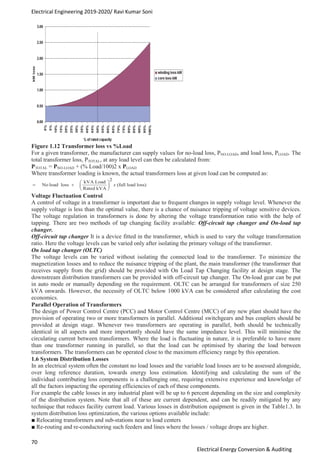
The primary purpose of capacitors is to reduce the
maximum demand. Additional benefits are derived
by capacitor location. The Figure 1.9 indicates
typical capacitor locations. Maximum benefit of
capacitors is derived by locating them as close as
possible to the load. At this location, its kVAr are
confined to the smallest possible segment, decreasing
the load current. This, in turn, will reduce power
losses of the system substantially. Power losses are
proportional to the square of the current. When
power losses are reduced, voltage at the motor
increases; thus, motor performance also increases.
Locations C1A, C1B and C1C of Figure 1.9 indicate
three different arrangements at the load. Note that in
all three locations extra switches are not required,
since the capacitor is either switched with the motor
starter or the breaker before the starter. Case C1A is
recommended for new installation, since the
maximum benefit is derived and the size of the motor
thermal protector is reduced. In Case C1B, as in Case
C1A, the capacitor is energized only when the motor
is in operation. Case C1B is recommended in cases
where the installation already exists and the thermal protector does not need to be re-sized. In position C1C, the
capacitor is permanently connected to the circuit but does not require a separate switch, since capacitor can be
disconnected by the breaker before the starter. It should be noted that the rating of the capacitor should not be
greater than the no-load magnetizing kVAr of the motor. If this condition exists, damaging over voltage or
transient torques can occur. This is why most motor manufacturers specify maximum capacitor ratings to be
applied to specific motors. The next preference for capacitor locations as illustrated by Figure 1.9 is at locations
C2 and C3. In these locations, a breaker or switch will be required. Location C4 requires a high voltage breaker.
The advantage of locating capacitors at power centres or feeders is that they can be grouped together. When
several motors are running intermittently, the capacitors are permitted to be on line all the time, reducing the total
power regardless of load. From energy efficiency point of view, capacitor location at receiving substation only
helps the utility in loss reduction. Locating capacitors at tail end will help to reduce loss reduction within the
plants distribution network as well and directly benefit the user by reduced consumption. Reduction in the
distribution loss % in kWh when tail end power factor is raised from PF1 to a new power factor PF2, will be
proportional to
Capacitors for Other Loads
The other types of load requiring capacitor application include induction furnaces, induction heaters and arc
welding transformers etc. The capacitors are normally supplied with control gear for the application of induction
furnaces and induction heating furnaces. The PF of arc furnaces experiences a wide variation over melting cycle
as it changes from 0.7 at starting to 0.9 at the end of the cycle. Power factor for welding transformers is corrected
by connecting capacitors across the primary winding of the transformers, as the normal PF would be in the range
of 0.35.
Performance Assessment of Power Factor Capacitors
Voltage effects: Ideally capacitor voltage rating is to match the supply voltage. If the supply voltage is lower, the
reactive kVAr produced will be the ratio V12 /V22 where V1 is the actual supply voltage, V2 is the rated voltage.
On the other hand, if the supply voltage exceeds rated voltage, the life of the capacitor is adversely affected.
Material of capacitors: Power factor capacitors are available in various types by dielectric material used as;
paper/ polypropylene etc. The watt loss per kVAr as well as life vary with respect to the choice of the dielectric
material and hence is a factor to be considered while selection.
Connections: Shunt capacitor connections are adopted for almost all industry/ end user applications, while series
capacitors are adopted for voltage boosting in distribution networks.
Operational performance of capacitors: This can be made by monitoring capacitor charging current vis- a- vis
the rated charging current. Capacity of fused elements can be replenished as per requirements. Portable analyzers
Electrical Engineering 2019-2020/ Ravi Kumar Soni
69
Electrical Energy Conversion & Auditing
can be used for measuring kVAr delivered as well as charging current. Capacitors consume 0.2 to 6.0 Watt per
kVAr, which is negligible in comparison to benefits.
Some checks that need to be adopted in use of capacitors are :
i) Nameplates can be misleading with respect to ratings. It is good to check by charging currents.
ii) Capacitor boxes may contain only insulated compound and insulated terminals with no capacitor elements
inside.
iii) Capacitors for single phase motor starting and those used for lighting circuits for voltage boost, are not power
factor capacitor units and these cannot withstand power system conditions.
1.5 Transformers
A transformer can accept energy at one voltage and deliver it at
another voltage. This permits electrical energy to be generated at
relatively low voltages and transmitted at high voltages and low
currents, thus reducing line losses and voltage drop (see Figure
1.10). Transformers consist of two or more coils that are electrically
insulated, but magnetically linked. The primary coil is connected to
the power source and the secondary coil connects to the load. The
turn’s ratio is the ratio between the number of turns on the secondary
to the turns on the primary (See Figure 1.11).
The secondary voltage is equal to the primary voltage times the
turn’s ratio. Ampere-turns are calculated by multiplying the current in the coil times the number of turns. Primary
ampere-turns are equal to secondary ampere-turns. Voltage regulation of a transformer is the percent increase in
voltage from full load to no load.
Types of Transformers
Transformers are classified as two categories: power transformers and
distribution transformers. Power transformers are used in transmission
network of higher voltages, deployed for step-up and step down
transformer application (400 kV, 200 kV, 110 kV, 66 kV, 33kV)
Distribution transformers are used for lower voltage distribution
networks as a means to end user connectivity. (11kV, 6.6 kV, 3.3 kV,
440V, 230V)
Rating of Transformer
Rating of the transformer is calculated based on the connected load and
applying the diversity factor on the connected load, applicable to the
particular industry and arrive at the kVA rating of the Transformer.
Diversity factor is defined as the ratio of overall maximum demand of the plant to the sum of individual
maximum demand of various equipment. Diversity factor varies from industry to industry and depends on
various factors such as individual loads, load factor and future expansion needs of the plant. Diversity factor will
always be less than one.
Location of Transformer
Location of the transformer is very important as far as distribution loss is concerned. Transformer receives HT
voltage from the grid and steps it down to the required voltage. Transformers should be placed close to the load
centre, considering other features like optimisation needs for centralised control, operational flexibility etc. This
will bring down the distribution loss in cables.
Transformer Losses and Efficiency
The efficiency varies anywhere between 96 to 99 percent. The efficiency of the transformers not only depends on
the design, but also, on the effective operating load. Transformer losses consist of two parts: No-load loss and
Load loss
1. No-load loss (also called core loss) is the power consumed to sustain the magnetic field in the transformer's
steel core. Core loss occurs whenever the transformer is energized; core loss does not vary with load. Core losses
are caused by two factors: hysteresis and eddy current losses. Hysteresis loss is that energy lost by reversing the
magnetic field in the core as the magnetizing AC rises and falls and reverses direction. Eddy current loss is a
result of induced currents circulating in the core.
2. Load loss (also called copper loss) is associated with full-load current flow in the transformer windings.
Copper loss is power lost in the primary and secondary windings of a transformer due to the ohmic resistance of
the windings. Copper loss varies with the square of the load current. (P = I2R). Transformer losses as a
percentage of load is given in the Figure 1.12.
Electrical Engineering 2019-2020/ Ravi Kumar Soni
70
Electrical Energy Conversion & Auditing
Figure 1.12 Transformer loss vs %Load
For a given transformer, the manufacturer can supply values for no-load loss, PNO-LOAD, and load loss, PLOAD. The
total transformer loss, PTOTAL, at any load level can then be calculated from:
PTOTAL = PNO-LOAD + (% Load/100)2 x PLOAD
Where transformer loading is known, the actual transformers loss at given load can be computed as:
Voltage Fluctuation Control
A control of voltage in a transformer is important due to frequent changes in supply voltage level. Whenever the
supply voltage is less than the optimal value, there is a chance of nuisance tripping of voltage sensitive devices.
The voltage regulation in transformers is done by altering the voltage transformation ratio with the help of
tapping. There are two methods of tap changing facility available: Off-circuit tap changer and On-load tap
changer.
Off-circuit tap changer It is a device fitted in the transformer, which is used to vary the voltage transformation
ratio. Here the voltage levels can be varied only after isolating the primary voltage of the transformer.
On load tap changer (OLTC)
The voltage levels can be varied without isolating the connected load to the transformer. To minimize the
magnetization losses and to reduce the nuisance tripping of the plant, the main transformer (the transformer that
receives supply from the grid) should be provided with On Load Tap Changing facility at design stage. The
downstream distribution transformers can be provided with off-circuit tap changer. The On-load gear can be put
in auto mode or manually depending on the requirement. OLTC can be arranged for transformers of size 250
kVA onwards. However, the necessity of OLTC below 1000 kVA can be considered after calculating the cost
economics.
Parallel Operation of Transformers
The design of Power Control Centre (PCC) and Motor Control Centre (MCC) of any new plant should have the
provision of operating two or more transformers in parallel. Additional switchgears and bus couplers should be
provided at design stage. Whenever two transformers are operating in parallel, both should be technically
identical in all aspects and more importantly should have the same impedance level. This will minimise the
circulating current between transformers. Where the load is fluctuating in nature, it is preferable to have more
than one transformer running in parallel, so that the load can be optimised by sharing the load between
transformers. The transformers can be operated close to the maximum efficiency range by this operation.
1.6 System Distribution Losses
In an electrical system often the constant no load losses and the variable load losses are to be assessed alongside,
over long reference duration, towards energy loss estimation. Identifying and calculating the sum of the
individual contributing loss components is a challenging one, requiring extensive experience and knowledge of
all the factors impacting the operating efficiencies of each of these components.
For example the cable losses in any industrial plant will be up to 6 percent depending on the size and complexity
of the distribution system. Note that all of these are current dependent, and can be readily mitigated by any
technique that reduces facility current load. Various losses in distribution equipment is given in the Table1.3. In
system distribution loss optimization, the various options available include:
■ Relocating transformers and sub-stations near to load centers
■ Re-routing and re-conductoring such feeders and lines where the losses / voltage drops are higher.
Electrical Engineering 2019-2020/ Ravi Kumar Soni
71
Electrical Energy Conversion & Auditing
■ Power factor improvement by incorporating capacitors at load end.
■ Optimum loading of transformers in the system.
■ Opting for lower resistance All Aluminum Alloy Conductors (AAAC) in place of conventional Aluminum
Cored Steel Reinforced (ACSR) lines
■ Minimizing losses due to weak links in distribution network such as jumpers, loose contacts, old brittle
conductors.
1.8 Analysis of Electrical Power Systems
An analysis of an electrical power system may uncover energy waste, fire hazards, and equipment failure.
Facility /energy managers increasingly find that reliability-centered maintenance can save money, energy, and
downtime (see Table 1.4).
Electrical Engineering 2019-2020/ Ravi Kumar Soni
72
Electrical Energy Conversion & Auditing
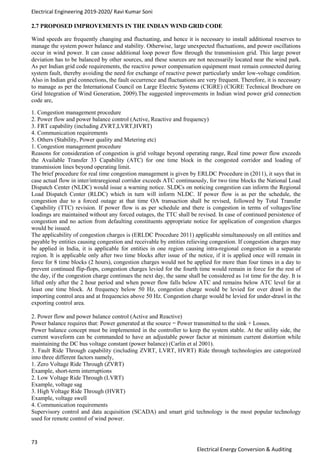
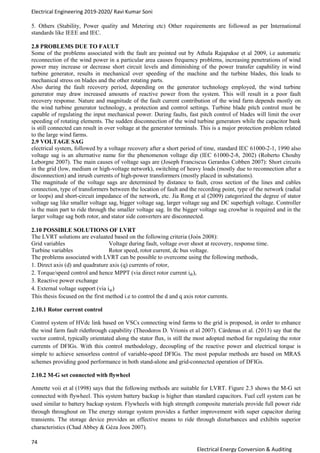
INDIAN GRID CODE FOR LOW VOLTAGE RIDE THROUGH (LVRT)
Figure 2.2 shows the main Indian LVRT Requirement (PRDC, 2009).It is used to minimize the reactive power
drawn from the grid and as soon as the fault is cleared, wind turbine generators shall provide active power in
proportion to retain grid voltage. In India, the LVRT requirements are applicable for the wind farms having more
than 66KV voltage penetration in the grid. It is tabulated in the Table 2.1. (PRDC, 2009) Below this level,
disconnection is allowed; On the contrary, in India the fault occurrence in the sub transmission systems is very
frequent. At that time, thermal stress of the wind turbine is also high. Therefore, it is necessary to disconnect
from the grid like Danish grid code.
Vf =15% of nominal system voltage
Vpf =Minimum voltage mentioned in IWGC
Indian low voltage ride through requirements (LVRT) diagram
Electrical Engineering 2019-2020/ Ravi Kumar Soni
73
Electrical Energy Conversion & Auditing
2.7 PROPOSED IMPROVEMENTS IN THE INDIAN WIND GRID CODE
Wind speeds are frequently changing and fluctuating, and hence it is necessary to install additional reserves to
manage the system power balance and stability. Otherwise, large unexpected fluctuations, and power oscillations
occur in wind power. It can cause additional loop power flow through the transmission grid. This large power
deviation has to be balanced by other sources, and these sources are not necessarily located near the wind park.
As per Indian grid code requirements, the reactive power compensation equipment must remain connected during
system fault, thereby avoiding the need for exchange of reactive power particularly under low-voltage condition.
Also in Indian grid connections, the fault occurrence and fluctuations are very frequent. Therefore, it is necessary
to manage as per the International Council on Large Electric Systems (CIGRE) (CIGRE Technical Brochure on
Grid Integration of Wind Generation, 2009).The suggested improvements in Indian wind power grid connection
code are,
1. Congestion management procedure
2. Power flow and power balance control (Active, Reactive and frequency)
3. FRT capability (including ZVRT,LVRT,HVRT)
4. Communication requirements
5. Others (Stability, Power quality and Metering etc)
1. Congestion management procedure
Reasons for consideration of congestion is grid voltage beyond operating range, Real time power flow exceeds
the Available Transfer 33 Capability (ATC) for one time block in the congested corridor and loading of
transmission lines beyond operating limit.
The brief procedure for real time congestion management is given by ERLDC Procedure in (2011), it says that in
case actual flow in inter/intraregional corridor exceeds ATC continuously, for two time blocks the National Load
Dispatch Center (NLDC) would issue a warning notice. SLDCs on noticing congestion can inform the Regional
Load Dispatch Center (RLDC) which in turn will inform NLDC. If power flow is as per the schedule, the
congestion due to a forced outage at that time OA transaction shall be revised, followed by Total Transfer
Capability (TTC) revision. If power flow is as per schedule and there is congestion in terms of voltages/line
loadings are maintained without any forced outages, the TTC shall be revised. In case of continued persistence of
congestion and no action from defaulting constituents appropriate notice for application of congestion charges
would be issued.
The applicability of congestion charges is (ERLDC Procedure 2011) applicable simultaneously on all entities and
payable by entities causing congestion and receivable by entities relieving congestion. If congestion charges may
be applied in India, it is applicable for entities in one region causing intra-regional congestion in a separate
region. It is applicable only after two time blocks after issue of the notice, if it is applied once will remain in
force for 8 time blocks (2 hours), congestion charges would not be applied for more than four times in a day to
prevent continued flip-flops, congestion charges levied for the fourth time would remain in force for the rest of
the day, if the congestion charge continues the next day, the same shall be considered as 1st time for the day. It is
lifted only after the 2 hour period and when power flow falls below ATC and remains below ATC level for at
least one time block. At frequency below 50 Hz, congestion charge would be levied for over drawl in the
importing control area and at frequencies above 50 Hz. Congestion charge would be levied for under-drawl in the
exporting control area.
2. Power flow and power balance control (Active and Reactive)
Power balance requires that: Power generated at the source = Power transmitted to the sink + Losses.
Power balance concept must be implemented in the controller to keep the system stable. At the utility side, the
current waveform can be commanded to have an adjustable power factor at minimum current distortion while
maintaining the DC bus voltage constant (power balance) (Carlin et al 2001).
3. Fault Ride Through capability (including ZVRT, LVRT, HVRT) Ride through technologies are categorized
into three different factors namely,
1. Zero Voltage Ride Through (ZVRT)
Example, short-term interruptions
2. Low Voltage Ride Through (LVRT)
Example, voltage sag
3. High Voltage Ride Through (HVRT)
Example, voltage swell
4. Communication requirements
Supervisory control and data acquisition (SCADA) and smart grid technology is the most popular technology
used for remote control of wind power.
Electrical Engineering 2019-2020/ Ravi Kumar Soni
74
Electrical Energy Conversion & Auditing
5. Others (Stability, Power quality and Metering etc) Other requirements are followed as per International
standards like IEEE and IEC.
2.8 PROBLEMS DUE TO FAULT
Some of the problems associated with the fault are pointed out by Athula Rajapakse et al 2009, i.e automatic
reconnection of the wind power in a particular area causes frequency problems, increasing penetrations of wind
power may increase or decrease short circuit levels and diminishing of the power transfer capability in wind
turbine generator, results in mechanical over speeding of the machine and the turbine blades, this leads to
mechanical stress on blades and the other rotating parts.
Also during the fault recovery period, depending on the generator technology employed, the wind turbine
generator may draw increased amounts of reactive power from the system. This will result in a poor fault
recovery response. Nature and magnitude of the fault current contribution of the wind farm depends mostly on
the wind turbine generator technology, a protection and control settings. Turbine blade pitch control must be
capable of regulating the input mechanical power. During faults, fast pitch control of blades will limit the over
speeding of rotating elements. The sudden disconnection of the wind turbine generators while the capacitor bank
is still connected can result in over voltage at the generator terminals. This is a major protection problem related
to the large wind farms.
2.9 VOLTAGE SAG
electrical system, followed by a voltage recovery after a short period of time, standard IEC 61000-2-1, 1990 also
voltage sag is an alternative name for the phenomenon voltage dip (IEC 61000-2-8, 2002) (Roberto Chouhy
Leborgne 2007). The main causes of voltage sags are (Joseph Franciscus Gerardus Cobben 2007): Short circuits
in the grid (low, medium or high-voltage network), switching of heavy loads (mostly due to reconnection after a
disconnection) and inrush currents of high-power transformers (mostly placed in substations).
The magnitude of the voltage sags are determined by distance to fault, cross section of the lines and cables
connection, type of transformers between the location of fault and the recording point, type of the network (radial
or loops) and short-circuit impedance of the network, etc. Jia Rong et al (2009) categorized the degree of stator
voltage sag like smaller voltage sag, bigger voltage sag, larger voltage sag and DC superhigh voltage. Controller
is the main part to ride through the smaller voltage sag. In the bigger voltage sag crowbar is required and in the
larger voltage sag both rotor, and stator side converters are disconnected.
2.10 POSSIBLE SOLUTIONS OF LVRT
The LVRT solutions are evaluated based on the following criteria (Joós 2008):
Grid variables Voltage during fault, voltage over shoot at recovery, response time.
Turbine variables Rotor speed, rotor current, dc bus voltage.
The problems associated with LVRT can be possible to overcome using the following methods,
1. Direct axis (d) and quadrature axis (q) currents of rotor,
2. Torque/speed control and hence MPPT (via direct rotor current idr),
3. Reactive power exchange
4. External voltage support (via iqr)
This thesis focused on the first method i.e to control the d and q axis rotor currents.
2.10.1 Rotor current control
Control system of HVdc link based on VSCs connecting wind farms to the grid is proposed, in order to enhance
the wind farm fault ridethrough capability (Theodoros D. Vrionis et al 2007). Cárdenas et al. (2013) say that the
vector control, typically orientated along the stator flux, is still the most adopted method for regulating the rotor
currents of DFIGs. With this control methodology, decoupling of the reactive power and electrical torque is
simple to achieve sensorless control of variable-speed DFIGs. The most popular methods are based on MRAS
schemes providing good performance in both stand-alone and grid-connected operation of DFIGs.
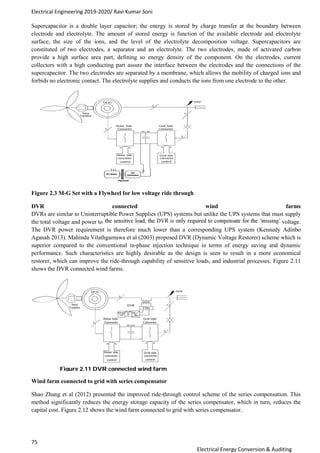
2.10.2 M-G set connected with flywheel
Annette voii et al (1998) says that the following methods are suitable for LVRT. Figure 2.3 shows the M-G set
connected with flywheel. This system battery backup is higher than standard capacitors. Fuel cell system can be
used similar to battery backup system. Flywheels with high strength composite materials provide full power ride
through throughout on The energy storage system provides a further improvement with super capacitor during
transients. The storage device provides an effective means to ride through disturbances and exhibits superior
characteristics (Chad Abbey & Géza Joos 2007).
Electrical Engineering 2019-2020/ Ravi Kumar Soni
75
Electrical Energy Conversion & Auditing
Supercapacitor is a double layer capacitor; the energy is stored by charge transfer at the boundary between
electrode and electrolyte. The amount of stored energy is function of the available electrode and electrolyte
surface, the size of the ions, and the level of the electrolyte decomposition voltage. Supercapacitors are
constituted of two electrodes, a separator and an electrolyte. The two electrodes, made of activated carbon
provide a high surface area part, defining so energy density of the component. On the electrodes, current
collectors with a high conducting part assure the interface between the electrodes and the connections of the
supercapacitor. The two electrodes are separated by a membrane, which allows the mobility of charged ions and
forbids no electronic contact. The electrolyte supplies and conducts the ions from one electrode to the other.
Figure 2.3 M-G Set with a Flywheel for low voltage ride through
DVR connected wind farms
DVRs are similar to Uninterruptible Power Supplies (UPS) systems but unlike the UPS systems that must supply
the total voltage and power to voltage.
The DVR power requirement is therefore much lower than a corresponding UPS system (Kennedy Adinbo
Aganah 2013). Mahinda Vilathgamuwa et al (2003) proposed DVR (Dynamic Voltage Restorer) scheme which is
superior compared to the conventional in-phase injection technique in terms of energy saving and dynamic
performance. Such characteristics are highly desirable as the design is seen to result in a more economical
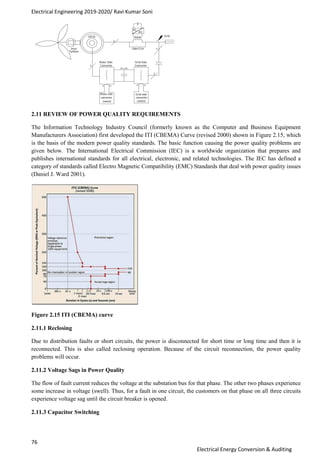
restorer, which can improve the ride-through capability of sensitive loads, and industrial processes. Figure 2.11
shows the DVR connected wind farms.
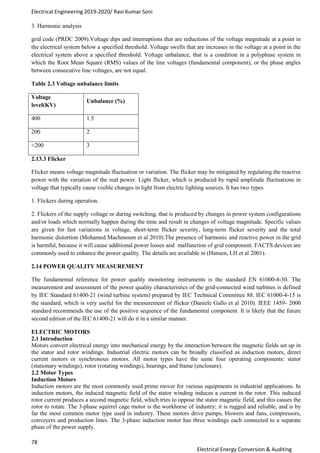
Wind farm connected to grid with series compensator
Shao Zhang et al (2012) presented the improved ride-through control scheme of the series compensation. This
method significantly reduces the energy storage capacity of the series compensator, which in turn, reduces the
capital cost. Figure 2.12 shows the wind farm connected to grid with series compensator.
Electrical Engineering 2019-2020/ Ravi Kumar Soni
76
Electrical Energy Conversion & Auditing
2.11 REVIEW OF POWER QUALITY REQUIREMENTS
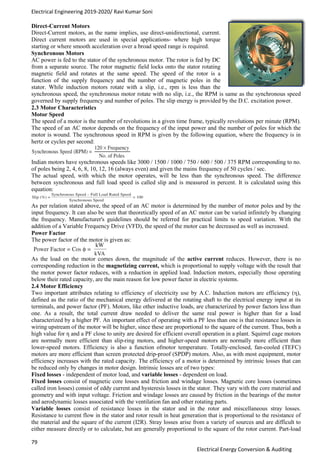
The Information Technology Industry Council (formerly known as the Computer and Business Equipment
Manufacturers Association) first developed the ITI (CBEMA) Curve (revised 2000) shown in Figure 2.15, which
is the basis of the modern power quality standards. The basic function causing the power quality problems are
given below. The International Electrical Commission (IEC) is a worldwide organization that prepares and
publishes international standards for all electrical, electronic, and related technologies. The IEC has defined a
category of standards called Electro Magnetic Compatibility (EMC) Standards that deal with power quality issues
(Daniel J. Ward 2001).
Figure 2.15 ITI (CBEMA) curve
2.11.1 Reclosing
Due to distribution faults or short circuits, the power is disconnected for short time or long time and then it is
reconnected. This is also called reclosing operation. Because of the circuit reconnection, the power quality
problems will occur.
2.11.2 Voltage Sags in Power Quality
The flow of fault current reduces the voltage at the substation bus for that phase. The other two phases experience
some increase in voltage (swell). Thus, for a fault in one circuit, the customers on that phase on all three circuits
experience voltage sag until the circuit breaker is opened.
2.11.3 Capacitor Switching
Electrical Engineering 2019-2020/ Ravi Kumar Soni
77
Electrical Energy Conversion & Auditing
Capacitor switching is an everyday occurrence on a utility system to achieve better voltage control and reduce
loses. Capacitor bank energizing typically results in an oscillatory voltage transient having a natural frequency
somewhere between 300 and 900 Hz.
2.12 STANDARDS
The IEEE, the main standard making body is American National Standards Institute (ANSI) of United States, and
equipment manufacturer organizations, such as the National Electrical Manufacturers Association (NEMA) are
some of the other organization in America. The International Electrical Commission started the work to facilitate
power quality in 1996. As a result, IEC 61400-21 was developed and today most wind turbine manufacturers
provide power quality characteristic data accordingly. It specifies a method that uses current and voltage time
series, measured at the wind turbine terminals (Juan Manuel Carrasco et al 2006).
2.12.1 Reliability Standards
IEEE Standard 1366 is the guide for Power Distribution Reliability Indices (PDRI).
2.12.2 Power Quality Standards
ANSI C84.1 establishes acceptable ranges of steady-state voltages for equipment as well as distribution systems.
IEEE Standard 1100 presents the engineering principles and practices for supplying power and grounding of
sensitive electronic equipment. IEEE Standard 1250 describes the electrical environment along with various
solutions to power quality problems. IEEE Standard 1159 is followed with a more rigorous and in depth set of
definitions for monitoring power quality.
The standard EN 50160 is the most important one for defining the quality of the supply voltage. There is also the
IEC 61000 series of technical norms on electromagnetic compatibility (EMC) (Sjef Cobben 2007).
1. IEC 61000-3-6 (1996 - Electromagnetic compatibility (EMC) Part 3:Limits Section 6: Assessment of emission
limits for distorting loads in MV and HV power
2. IEC 61000-3- Part
3: Limits Section 7: Assessment of emission limits for fluctuating loads in MV and HV Power Systems.
2.12.3 Harmonic Standard
IEEE Standard 519 is the principal harmonic standard used in the United States and it recommends the limits of
the harmonics. High amount of harmonic current leads to capacitor bank failures. The intent of IEEE 519 is to
limit harmonic current injection into power systems and ensure voltage integrity. However, when IEEE 519 is
applied to single-phase system connections, it can become highly impractical. Presently, IEEE Standard 519
1992 addresses harmonic limits at the consumer and service provider interface. IEC61000-3-2 is also used for
harmonic current.
2.12.4 Flicker Standard
The commonly used flicker standard is IEC 61000-3-3 and IEC 61000-3-11.
2.13 POWER QUALITY REQUIREMENTS FOR GRID INTEGRATION
Grid connected wind turbines are considered as potential sources of bad power quality and high amount of
voltage penetration in the grid. It is a serious power quality problem. Variable-speed wind turbines have some
advantages concerning flicker, but the forced-commuted inverters present in the generator causes harmonics and
interharmonics problems (Juan Manuel Carrasco et al 2006). IEC standard consists of three analyses.
1. Flicker
2. Switching operations
Electrical Engineering 2019-2020/ Ravi Kumar Soni
78
Electrical Energy Conversion & Auditing
3. Harmonic analysis
grid code (PRDC 2009).Voltage dips and interruptions that are reductions of the voltage magnitude at a point in
the electrical system below a specified threshold. Voltage swells that are increases in the voltage at a point in the
electrical system above a specified threshold. Voltage unbalance, that is a condition in a polyphase system in
which the Root Mean Square (RMS) values of the line voltages (fundamental component), or the phase angles
between consecutive line voltages, are not equal.
Table 2.3 Voltage unbalance limits
Voltage
level(KV)
Unbalance (%)
400 1.5
200 2
<200 3
2.13.3 Flicker
Flicker means voltage magnitude fluctuation or variation. The flicker may be mitigated by regulating the reactive
power with the variation of the real power. Light flicker, which is produced by rapid amplitude fluctuations in
voltage that typically cause visible changes in light from electric lighting sources. It has two types
1. Flickers during operation.
2. Flickers of the supply voltage or during switching, that is produced by changes in power system configurations
and/or loads which normally happen during the time and result in changes of voltage magnitude. Specific values
are given for fast variations in voltage, short-term flicker severity, long-term flicker severity and the total
harmonic distortion (Mohamed Machmoum et al 2010).The presence of harmonic and reactive power in the grid
is harmful, because it will cause additional power losses and malfunction of grid component. FACTS devices are
commonly used to enhance the power quality. The details are available in (Hansen, LH et al 2001).
2.14 POWER QUALITY MEASUREMENT
The fundamental reference for power quality monitoring instruments is the standard EN 61000-4-30. The
measurement and assessment of the power quality characteristics of the grid-connected wind turbines is defined
by IEC Standard 61400-21 (wind turbine system) prepared by IEC Technical Committee 88. IEC 61000-4-15 is
the standard, which is very useful for the measurement of flicker (Daniele Gallo et al 2010). IEEE 1459- 2000
standard recommends the use of the positive sequence of the fundamental component. It is likely that the future
second edition of the IEC 61400-21 will do it in a similar manner.
ELECTRIC MOTORS
2.1 Introduction
Motors convert electrical energy into mechanical energy by the interaction between the magnetic fields set up in
the stator and rotor windings. Industrial electric motors can be broadly classified as induction motors, direct
current motors or synchronous motors. All motor types have the same four operating components: stator
(stationary windings), rotor (rotating windings), bearings, and frame (enclosure).
2.2 Motor Types
Induction Motors
Induction motors are the most commonly used prime mover for various equipments in industrial applications. In
induction motors, the induced magnetic field of the stator winding induces a current in the rotor. This induced
rotor current produces a second magnetic field, which tries to oppose the stator magnetic field, and this causes the
rotor to rotate. The 3-phase squirrel cage motor is the workhorse of industry; it is rugged and reliable, and is by
far the most common motor type used in industry. These motors drive pumps, blowers and fans, compressors,
conveyers and production lines. The 3-phase induction motor has three windings each connected to a separate
phase of the power supply.
Electrical Engineering 2019-2020/ Ravi Kumar Soni
79
Electrical Energy Conversion & Auditing
Direct-Current Motors
Direct-Current motors, as the name implies, use direct-unidirectional, current.
Direct current motors are used in special applications- where high torque
starting or where smooth acceleration over a broad speed range is required.
Synchronous Motors
AC power is fed to the stator of the synchronous motor. The rotor is fed by DC
from a separate source. The rotor magnetic field locks onto the stator rotating
magnetic field and rotates at the same speed. The speed of the rotor is a
function of the supply frequency and the number of magnetic poles in the
stator. While induction motors rotate with a slip, i.e., rpm is less than the
synchronous speed, the synchronous motor rotate with no slip, i.e., the RPM is same as the synchronous speed
governed by supply frequency and number of poles. The slip energy is provided by the D.C. excitation power.
2.3 Motor Characteristics
Motor Speed
The speed of a motor is the number of revolutions in a given time frame, typically revolutions per minute (RPM).
The speed of an AC motor depends on the frequency of the input power and the number of poles for which the
motor is wound. The synchronous speed in RPM is given by the following equation, where the frequency is in
hertz or cycles per second:
Indian motors have synchronous speeds like 3000 / 1500 / 1000 / 750 / 600 / 500 / 375 RPM corresponding to no.
of poles being 2, 4, 6, 8, 10, 12, 16 (always even) and given the mains frequency of 50 cycles / sec.
The actual speed, with which the motor operates, will be less than the synchronous speed. The difference
between synchronous and full load speed is called slip and is measured in percent. It is calculated using this
equation:
As per relation stated above, the speed of an AC motor is determined by the number of motor poles and by the
input frequency. It can also be seen that theoretically speed of an AC motor can be varied infinitely by changing
the frequency. Manufacturer's guidelines should be referred for practical limits to speed variation. With the
addition of a Variable Frequency Drive (VFD), the speed of the motor can be decreased as well as increased.
Power Factor
The power factor of the motor is given as:
As the load on the motor comes down, the magnitude of the active current reduces. However, there is no
corresponding reduction in the magnetizing current, which is proportional to supply voltage with the result that
the motor power factor reduces, with a reduction in applied load. Induction motors, especially those operating
below their rated capacity, are the main reason for low power factor in electric systems.
2.4 Motor Efficiency
Two important attributes relating to efficiency of electricity use by A.C. Induction motors are efficiency (η),
defined as the ratio of the mechanical energy delivered at the rotating shaft to the electrical energy input at its
terminals, and power factor (PF). Motors, like other inductive loads, are characterized by power factors less than
one. As a result, the total current draw needed to deliver the same real power is higher than for a load
characterized by a higher PF. An important effect of operating with a PF less than one is that resistance losses in
wiring upstream of the motor will be higher, since these are proportional to the square of the current. Thus, both a
high value for η and a PF close to unity are desired for efficient overall operation in a plant. Squirrel cage motors
are normally more efficient than slip-ring motors, and higher-speed motors are normally more efficient than
lower-speed motors. Efficiency is also a function ofmotor temperature. Totally-enclosed, fan-cooled (TEFC)
motors are more efficient than screen protected drip-proof (SPDP) motors. Also, as with most equipment, motor
efficiency increases with the rated capacity. The efficiency of a motor is determined by intrinsic losses that can
be reduced only by changes in motor design. Intrinsic losses are of two types:
Fixed losses - independent of motor load, and variable losses - dependent on load.
Fixed losses consist of magnetic core losses and friction and windage losses. Magnetic core losses (sometimes
called iron losses) consist of eddy current and hysteresis losses in the stator. They vary with the core material and
geometry and with input voltage. Friction and windage losses are caused by friction in the bearings of the motor
and aerodynamic losses associated with the ventilation fan and other rotating parts.
Variable losses consist of resistance losses in the stator and in the rotor and miscellaneous stray losses.
Resistance to current flow in the stator and rotor result in heat generation that is proportional to the resistance of
the material and the square of the current (I2R). Stray losses arise from a variety of sources and are difficult to
either measure directly or to calculate, but are generally proportional to the square of the rotor current. Part-load
Electrical Engineering 2019-2020/ Ravi Kumar Soni
80
Electrical Energy Conversion & Auditing
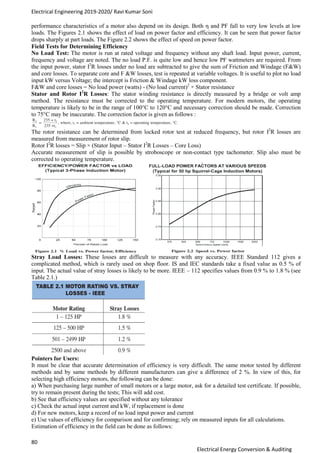
performance characteristics of a motor also depend on its design. Both η and PF fall to very low levels at low
loads. The Figures 2.1 shows the effect of load on power factor and efficiency. It can be seen that power factor
drops sharply at part loads. The Figure 2.2 shows the effect of speed on power factor.
Field Tests for Determining Efficiency
No Load Test: The motor is run at rated voltage and frequency without any shaft load. Input power, current,
frequency and voltage are noted. The no load P.F. is quite low and hence low PF wattmeters are required. From
the input power, stator I2
R losses under no load are subtracted to give the sum of Friction and Windage (F&W)
and core losses. To separate core and F &W losses, test is repeated at variable voltages. It is useful to plot no load
input kW versus Voltage; the intercept is Friction & Windage kW loss component.
F&W and core losses = No load power (watts) - (No load current)2
× Stator resistance
Stator and Rotor I2
R Losses: The stator winding resistance is directly measured by a bridge or volt amp
method. The resistance must be corrected to the operating temperature. For modern motors, the operating
temperature is likely to be in the range of 100°C to 120°C and necessary correction should be made. Correction
to 75°C may be inaccurate. The correction factor is given as follows :
The rotor resistance can be determined from locked rotor test at reduced frequency, but rotor I2
R losses are
measured from measurement of rotor slip.
Rotor I2
R losses = Slip × (Stator Input – Stator I2
R Losses – Core Loss)
Accurate measurement of slip is possible by stroboscope or non-contact type tachometer. Slip also must be
corrected to operating temperature.
Stray Load Losses: These losses are difficult to measure with any accuracy. IEEE Standard 112 gives a
complicated method, which is rarely used on shop floor. IS and IEC standards take a fixed value as 0.5 % of
input. The actual value of stray losses is likely to be more. IEEE – 112 specifies values from 0.9 % to 1.8 % (see
Table 2.1.)
Pointers for Users:
It must be clear that accurate determination of efficiency is very difficult. The same motor tested by different
methods and by same methods by different manufacturers can give a difference of 2 %. In view of this, for
selecting high efficiency motors, the following can be done:
a) When purchasing large number of small motors or a large motor, ask for a detailed test certificate. If possible,
try to remain present during the tests; This will add cost.
b) See that efficiency values are specified without any tolerance
c) Check the actual input current and kW, if replacement is done
d) For new motors, keep a record of no load input power and current
e) Use values of efficiency for comparison and for confirming; rely on measured inputs for all calculations.
Estimation of efficiency in the field can be done as follows:
Electrical Engineering 2019-2020/ Ravi Kumar Soni
81
Electrical Energy Conversion & Auditing
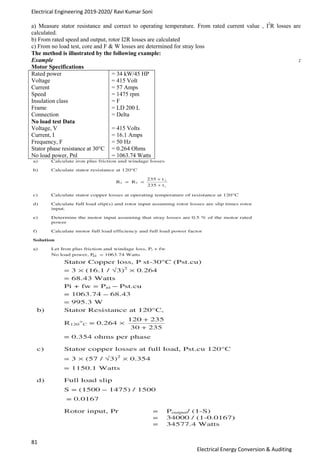
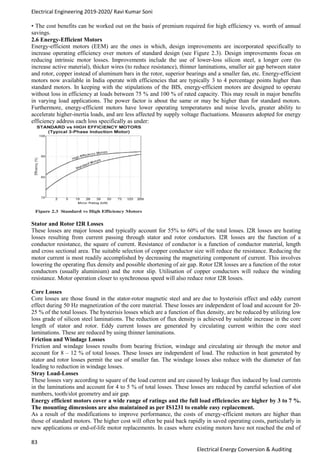
a) Measure stator resistance and correct to operating temperature. From rated current value , I2
R losses are
calculated.
b) From rated speed and output, rotor I2R losses are calculated
c) From no load test, core and F & W losses are determined for stray loss
The method is illustrated by the following example:
Example :
Motor Specifications
Rated power
Voltage
Current
Speed
Insulation class
Frame
Connection
No load test Data
Voltage, V
Current, I
Frequency, F
Stator phase resistance at 30°C
No load power, Pnl
= 34 kW/45 HP
= 415 Volt
= 57 Amps
= 1475 rpm
= F
= LD 200 L
= Delta
= 415 Volts
= 16.1 Amps
= 50 Hz
= 0.264 Ohms
= 1063.74 Watts
Electrical Engineering 2019-2020/ Ravi Kumar Soni
82
Electrical Energy Conversion & Auditing
2.5 Motor Selection
The primary technical consideration defining the motor choice for any particular application is the torque
required by the load, especially the relationship between the maximum torque generated by the motor (break
down torque) and the torque requirements for start-up (locked rotor torque) and during acceleration periods. The
duty / load cycle determines the thermal loading on the motor. One consideration with totally enclosed fan cooled
(TEFC) motors is that the cooling may be insufficient when the motor is operated at speeds below its rated value.
Ambient operating conditions affect motor choice; special motor designs are available for corrosive or dusty
atmospheres, high temperatures, restricted physical space, etc. An estimate of the switching frequency (usually
dictated by the process), whether automatic or manually controlled, can help in selecting the appropriate motor
for the duty cycle.
The demand a motor will place on the balance of the plant electrical system is another consideration - if the load
variations are large, for example as a result of frequent starts and stops of large components like compressors, the
resulting large voltage drops could be detrimental to other equipment. Reliability is of prime importance – in
many cases, however, designers and process engineers seeking reliability will grossly oversize equipment,
leading to sub-optimal energy performance. Good knowledge of process parameters and a better understanding of
the plant power system can aid in reducing oversizing with no loss of reliability. Inventory is another
consideration - Many large industries use standard equipment, which can be easily serviced or replaced, thereby
reducing the stock of spare parts that must be maintained and minimizing shut-down time. This practice affects
the choice of motors that might provide better energy performance in specific applications. Shorter lead times for
securing individual motors from suppliers would help reduce the need for this practice.
Price is another issue - Many users are first-cost sensitive, leading to the purchase of less expensive motors that
may be more costly on a lifecycle basis because of lower efficiency. For example, energy efficient motors or
other specially designed motors typically save within a few years an amount of money equal to several times the
incremental cost for an energy efficient motor, over a standard-efficiency motor. Few of salient selection issues
are given below:
• In the selection process, the power drawn at 75 % of loading can be a meaningful indicator of energy efficiency.
• Reactive power drawn (kVAR) by the motor.
• Indian Standard 325 for standard motors allows 15 % tolerance on efficiency for motors upto 50 kW rating and
10 % for motors over 50 kW rating.
• The Indian Standard IS 8789 addresses technical performance of Standard Motors while IS 12615 addresses the
efficiency criteria of High Efficiency Motors. Both follow IEC 34-2 test methodology wherein, stray losses are
assumed as 0.5 % of input power. By the IEC test method, the losses are understated and if one goes by IEEE test
methodology, the motor efficiency values would be further lowered.
• It would be prudent for buyers to procure motors based on test certificates rather than labeled values.
• The energy savings by motor replacement can be worked out by the simple relation : kW
savings = kW output × [ 1/ηold – 1/ ηnew ] where ηold and ηnew are the existing and proposed motor efficiency
values.
Electrical Engineering 2019-2020/ Ravi Kumar Soni
83
Electrical Energy Conversion & Auditing
• The cost benefits can be worked out on the basis of premium required for high efficiency vs. worth of annual
savings.
2.6 Energy-Efficient Motors
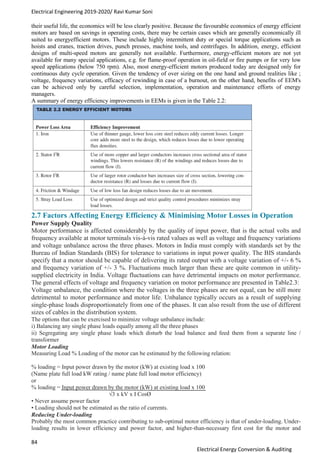
Energy-efficient motors (EEM) are the ones in which, design improvements are incorporated specifically to
increase operating efficiency over motors of standard design (see Figure 2.3). Design improvements focus on
reducing intrinsic motor losses. Improvements include the use of lower-loss silicon steel, a longer core (to
increase active material), thicker wires (to reduce resistance), thinner laminations, smaller air gap between stator
and rotor, copper instead of aluminum bars in the rotor, superior bearings and a smaller fan, etc. Energy-efficient
motors now available in India operate with efficiencies that are typically 3 to 4 percentage points higher than
standard motors. In keeping with the stipulations of the BIS, energy-efficient motors are designed to operate
without loss in efficiency at loads between 75 % and 100 % of rated capacity. This may result in major benefits
in varying load applications. The power factor is about the same or may be higher than for standard motors.
Furthermore, energy-efficient motors have lower operating temperatures and noise levels, greater ability to
accelerate higher-inertia loads, and are less affected by supply voltage fluctuations. Measures adopted for energy
efficiency address each loss specifically as under:
Stator and Rotor I2R Losses
These losses are major losses and typically account for 55% to 60% of the total losses. I2R losses are heating
losses resulting from current passing through stator and rotor conductors. I2R losses are the function of a
conductor resistance, the square of current. Resistance of conductor is a function of conductor material, length
and cross sectional area. The suitable selection of copper conductor size will reduce the resistance. Reducing the
motor current is most readily accomplished by decreasing the magnetizing component of current. This involves
lowering the operating flux density and possible shortening of air gap. Rotor I2R losses are a function of the rotor
conductors (usually aluminium) and the rotor slip. Utilisation of copper conductors will reduce the winding
resistance. Motor operation closer to synchronous speed will also reduce rotor I2R losses.
Core Losses
Core losses are those found in the stator-rotor magnetic steel and are due to hysterisis effect and eddy current
effect during 50 Hz magnetization of the core material. These losses are independent of load and account for 20-
25 % of the total losses. The hysterisis losses which are a function of flux density, are be reduced by utilizing low
loss grade of silicon steel laminations. The reduction of flux density is achieved by suitable increase in the core
length of stator and rotor. Eddy current losses are generated by circulating current within the core steel
laminations. These are reduced by using thinner laminations.
Friction and Windage Losses
Friction and windage losses results from bearing friction, windage and circulating air through the motor and
account for 8 – 12 % of total losses. These losses are independent of load. The reduction in heat generated by
stator and rotor losses permit the use of smaller fan. The windage losses also reduce with the diameter of fan
leading to reduction in windage losses.
Stray Load-Losses
These losses vary according to square of the load current and are caused by leakage flux induced by load currents
in the laminations and account for 4 to 5 % of total losses. These losses are reduced by careful selection of slot
numbers, tooth/slot geometry and air gap.
Energy efficient motors cover a wide range of ratings and the full load efficiencies are higher by 3 to 7 %.
The mounting dimensions are also maintained as per IS1231 to enable easy replacement.
As a result of the modifications to improve performance, the costs of energy-efficient motors are higher than
those of standard motors. The higher cost will often be paid back rapidly in saved operating costs, particularly in
new applications or end-of-life motor replacements. In cases where existing motors have not reached the end of
Electrical Engineering 2019-2020/ Ravi Kumar Soni
84
Electrical Energy Conversion & Auditing
their useful life, the economics will be less clearly positive. Because the favourable economics of energy efficient
motors are based on savings in operating costs, there may be certain cases which are generally economically ill
suited to energyefficient motors. These include highly intermittent duty or special torque applications such as
hoists and cranes, traction drives, punch presses, machine tools, and centrifuges. In addition, energy, efficient
designs of multi-speed motors are generally not available. Furthermore, energy-efficient motors are not yet
available for many special applications, e.g. for flame-proof operation in oil-field or fire pumps or for very low
speed applications (below 750 rpm). Also, most energy-efficient motors produced today are designed only for
continuous duty cycle operation. Given the tendency of over sizing on the one hand and ground realities like ;
voltage, frequency variations, efficacy of rewinding in case of a burnout, on the other hand, benefits of EEM's
can be achieved only by careful selection, implementation, operation and maintenance efforts of energy
managers.
A summary of energy efficiency improvements in EEMs is given in the Table 2.2:
2.7 Factors Affecting Energy Efficiency & Minimising Motor Losses in Operation
Power Supply Quality
Motor performance is affected considerably by the quality of input power, that is the actual volts and
frequency available at motor terminals vis-à-vis rated values as well as voltage and frequency variations
and voltage unbalance across the three phases. Motors in India must comply with standards set by the
Bureau of Indian Standards (BIS) for tolerance to variations in input power quality. The BIS standards
specify that a motor should be capable of delivering its rated output with a voltage variation of +/- 6 %
and frequency variation of +/- 3 %. Fluctuations much larger than these are quite common in utility-
supplied electricity in India. Voltage fluctuations can have detrimental impacts on motor performance.
The general effects of voltage and frequency variation on motor performance are presented in Table2.3:
Voltage unbalance, the condition where the voltages in the three phases are not equal, can be still more
detrimental to motor performance and motor life. Unbalance typically occurs as a result of supplying
single-phase loads disproportionately from one of the phases. It can also result from the use of different
sizes of cables in the distribution system.
The options that can be exercised to minimize voltage unbalance include:
i) Balancing any single phase loads equally among all the three phases
ii) Segregating any single phase loads which disturb the load balance and feed them from a separate line /
transformer
Motor Loading
Measuring Load % Loading of the motor can be estimated by the following relation:
% loading = Input power drawn by the motor (kW) at existing load x 100
(Name plate full load kW rating / name plate full load motor efficiency)
or
% loading = Input power drawn by the motor (kW) at existing load x 100
√3 x kV x I CosØ
• Never assume power factor
• Loading should not be estimated as the ratio of currents.
Reducing Under-loading
Probably the most common practice contributing to sub-optimal motor efficiency is that of under-loading. Under-
loading results in lower efficiency and power factor, and higher-than-necessary first cost for the motor and
Electrical Engineering 2019-2020/ Ravi Kumar Soni
85
Electrical Energy Conversion & Auditing
related control equipment. Under-loading is common for several reasons. Original equipment manufacturers tend
to use a large safety factor in motors they select. Under-loading of the motor may also occur from under-
utilisation of the equipment. For example, machine tool equipment manufacturers provide for a motor rated for
the full capacity load of the equipment ex. depth of cut in a lathe machine. The user may need this full capacity
rarely, resulting in under-loaded operation most of the time. Another common reason for underloading is
selection of a larger motor to enable the output to be maintained at the desired level even when input voltages are
abnormally low. Finally, under-loading also results from selecting a large motor for an application requiring high
starting torque where a special motor, designed for high torque, would have been suitable.
A careful evaluation of the load would determine the capacity of the motor that should be selected. Another
aspect to consider is the incremental gain in efficiency achievable by changing the motor. Larger motors have
inherently higher rated efficiencies than smaller motors. Therefore, the replacement of motors operating at 60 –
70 % of capacity or higher is generally not recommended. However, there are no rigid rules governing motor
selection; the savings potential needs to be evaluated on a case-to-case basis. When downsizing, it may be
preferable to select an energy-efficient motor, the efficiency of which may be higher than that of a standard
motor of higher capacity.
* Percent unbalance in voltage is defined as 100 (Vmax – Vavg) / Vavg, Where Vmax and Vavg are the largest
and the average of the three phase voltages, respectively. For motors, which consistently operate at loads below
40 % of rated capacity, an inexpensive and effective measure might be to operate in star mode. A change from
the standard delta operation to star operation involves re-configuring the wiring of the three phases of power
input at the terminal box.
Sizing to Variable Load
Industrial motors frequently operate under varying load conditions due to process requirements. A common
practice in cases where such variable-loads are found is to select a motor based on the highest anticipated load. In
many instances, an alternative approach is typically less costly, more efficient, and provides equally satisfactory
operation. With this approach, the optimum rating for the motor is selected on the basis of the load duration curve
for the particular application. Thus, rather than selecting a motor of high rating that would operate at full capacity
for only a short period, a motor would be selected with a rating slightly lower than the peak anticipated load and
would operate at overload for a short period of time. Since operating within the thermal capacity of the motor
Electrical Engineering 2019-2020/ Ravi Kumar Soni
86
Electrical Energy Conversion & Auditing
insulation is of greatest concern in a motor operating at higher than its rated load, the motor rating is selected as
that which would result in the same temperature rise under continuous full-load operation as the weighted
average temperature rise over the actual operating cycle. Under extreme load changes, e.g. frequent starts / stops,
or high inertial loads, this method of calculating the motor rating is unsuitable since it would underestimate the
heating that would occur. Where loads vary substantially with time, in addition to proper motor sizing, the
control strategy employed can have a significant impact on motor electricity use. Traditionally, mechanical
means (e.g. throttle valves in piping systems) have been used when lower output is required. More efficient speed
control mechanisms include multi-speed motors, eddy-current couplings, fluid couplings, and solid-state
electronic variable speed drives.
Power Factor Correction
As noted earlier, induction motors are characterized by power factors less than unity, leading to lower overall
efficiency (and higher overall operating cost) associated with a plant's electrical system. Capacitors connected in
parallel (shunted) with the motor are typically used to improve the power factor. The impacts of PF correction
include reduced kVA demand (and hence reduced utility demand charges), reduced I2R losses in cables upstream
of the capacitor (and hence reduced energy charges), reduced voltage drop in the cables (leading to improved
voltage regulation), and an increase in the overall efficiency of the plant electrical system. It should be noted that
PF capacitor improves power factor from the point of installation back to the generating side. It means that, if a
PF capacitor is installed at the starter terminals of the motor, it won't improve the operating PF of the motor, but
the PF from starter terminals to the power generating side will improve, i.e., the benefits of PF would be only on
upstream side.
The size of capacitor required for a particular motor depends upon the no-load reactive kVA (kVAR) drawn by
the motor, which can be determined only from no-load testing of the motor. In general, the capacitor is then
selected to not exceed 90 % of the no-load kVAR of the motor. (Higher capacitors could result in over-voltages
and motor burn-outs). Alternatively, typical power factors of standard motors can provide the basis for
conservative estimates of capacitor ratings to use for different size motors. The capacitor rating for power
connection by direct connection to induction motors is shown in Table 2.5. From the above table, it may be noted
that required capacitive kVAr increases with decrease in speed of the motor, as the magnetizing current
requirement of a low speed motor is more in comparison to the high speed motor for the same HP of the
motor. Since a reduction in line current, and associated energy efficiency gains, are reflected backwards
from the point of application of the capacitor, the maximum improvement in overall system efficiency
is achieved when the capacitor is connected across the motor terminals, as compared to somewhere
further upstream in the plant's electrical system. However, economies of scale associated with the cost
of capacitors and the labor required to install them will place an economic limit on the lowest desirable
capacitor size.
Electrical Engineering 2019-2020/ Ravi Kumar Soni
87
Electrical Energy Conversion & Auditing
Maintenance
Inadequate maintenance of motors can significantly increase losses and lead to unreliable operation. For example,
improper lubrication can cause increased friction in both the motor and associated drive transmission equipment.
Resistance losses in the motor, which rise with temperature, would increase. Providing adequate ventilation and
keeping motor cooling ducts clean can help dissipate heat to reduce excessive losses. The life of the insulation in
the motor would also be longer : for every 10°C increase in motor operating temperature over the recommended
peak, the time before rewinding would be needed is estimated to be halved A checklist of good maintenance
practices to help insure proper motor operation would include:
• Inspecting motors regularly for wear in bearings and housings (to reduce frictional losses) and for dirt/dust in
motor ventilating ducts (to ensure proper heat dissipation).
• Checking load conditions to ensure that the motor is not over or under loaded. A change in motor load from the
last test indicates a change in the driven load, the cause of which should be understood.
• Lubricating appropriately. Manufacturers generally give recommendations for how and when to lubricate their
motors. Inadequate lubrication can cause problems, as noted above. Overlubrication can also create problems,
e.g. excess oil or grease from the motor bearings can enter the motor and saturate the motor insulation, causing
premature failure or creating a fire risk.
• Checking periodically for proper alignment of the motor and the driven equipment. Improper alignment can
cause shafts and bearings to wear quickly, resulting in damage to both the motor and the driven equipment.
• Ensuring that supply wiring and terminal box are properly sized and installed. Inspect regularly the connections
at the motor and starter to be sure that they are clean and tight.
Age
Most motor cores in India are manufactured from silicon steel or de-carbonized cold-rolled steel, the electrical
properties of which do not change measurably with age. However, poor maintenance (inadequate lubrication of
bearings, insufficient cleaning of air cooling passages, etc.) can cause a deterioration in motor efficiency over
time. Ambient conditions can also have a detrimental effect on motor performance. For example, excessively
high temperatures, high dust loading, corrosive atmosphere, and humidity can impair insulation properties;
mechanical stresses due to load cycling can lead to misalignment. However, with adequate care, motor
performance can be maintained.
2.8 Rewinding Effects on Energy Efficiency
It is common practice in industry to rewind burnt-out motors. The population of rewound motors in some
industries exceed 50 % of the total population. Careful rewinding can sometimes maintain motor efficiency at
previous levels, but in most cases, losses in efficiency result. Rewinding can affect a number of factors that
contribute to deteriorated motor efficiency :
winding and slot design, winding material, insulation performance, and operating temperature. For example, a
common problem occurs when heat is applied to strip old windings : the insulation between laminations can be
damaged, thereby increasing eddy current losses. A change in the air gap may affect power factor and output
torque.
However, if proper measures are taken, motor efficiency can be maintained, and in some cases increased, after
rewinding. Efficiency can be improved by changing the winding design, though the power factor could be
affected in the process. Using wires of greater cross section, slot size permitting, would reduce stator losses
thereby increasing efficiency. However, it is generally recommended that the original design of the motor be
preserved during the rewind, unless there are specific, load-related reasons for redesign.
The impact of rewinding on motor efficiency and power factor can be easily assessed if the no-load losses of a
motor are known before and after rewinding. Maintaining documentation of no-load losses and no-load speed
from the time of purchase of each motor can facilitate assessing this impact.
For example, comparison of no load current and stator resistance per phase of a rewound motor with the original
no-load current and stator resistance at the same voltage can be one of the indicators to assess the efficacy of
rewinding.
2.9 Speed Control of AC Induction Motors
Traditionally, DC motors have been employed when variable speed capability was desired. By controlling the
armature (rotor) voltage and field current of a separately excited DC motor, a wide range of output speeds can be
obtained. DC motors are available in a wide range of sizes, but their use is generally restricted to a few low
speed, low-to-medium power applications like machine tools and rolling mills because of problems with
mechanical commutation at large sizes. Also, they are restricted for use only in clean, non-hazardous areas
because of the risk of sparking at the brushes. DC motors are also expensive relative to AC motors. Because of
the limitations of DC systems, AC motors are increasingly the focus for variable speed applications. Both AC
synchronous and induction motors are suitable for variable speed control. Induction motors are generally more
popular, however, because of their ruggedness and lower maintenance requirements. AC induction motors are
inexpensive (half or less of the cost of a DC motor) and also provide a high power to weight ratio (about twice
Electrical Engineering 2019-2020/ Ravi Kumar Soni
88
Electrical Energy Conversion & Auditing
that of a DC motor). An induction motor is an asynchronous motor, the speed of which can be varied by changing
the supply frequency. The control strategy to be adopted in any particular case will depend on a number of
factors including investment cost, load reliability and any special control requirements. Thus, for any particular
application, a detailed review of the load characteristics, historical data on process flows, the features required of
the speed control system, the electricity tariffs and the investment costs would be a prerequisite to the selection of
a speed control system.
The characteristics of the load are particularly important. Load refers essentially to the torque output and
corresponding speed required. Loads can be broadly classified as either constant power or Constant torque.
Constant torque loads are those for which the output power requirement may vary with the speed of operation but
the torque does not vary. Conveyors, rotary kilns, and constant-displacement pumps are typical examples of
constant torque loads.
Variable torque loads are those for which the torque required varies with the speed of operation. Centrifugal
pumps and fans are typical examples of variable torque loads (torque varies as the square of the speed). Constant
power loads are those for which the torque requirements typically change inversely with speed. Machine tools are
a typical example of a constant power load.
The largest potential for electricity savings with variable speed drives is generally in variable torque applications,
for example centrifugal pumps and fans, where the power requirement changes as the cube of speed. Constant
torque loads are also suitable for VSD application.
Motor Speed Control Systems
Multi-speed motors
Motors can be wound such that two speeds, in the ratio of 2:1, can be obtained. Motors can also be wound with
two separate windings, each giving 2 operating speeds, for a total of four speeds. Multi-speed motors can be
designed for applications involving constant torque, variable torque, or for constant output power. Multi-speed
motors are suitable for applications, which require limited speed control (two or four fixed speeds instead of
continuously variable speed), in which cases they tend to be very economical. They have lower efficiency than
single-speed motors
Adjustable Frequency AC Drives
Adjustable frequency drives are also commonly called inverters. They are available in a range of kW rating from
fractional to 750 kW. They are designed to operate standard induction motors. This allows them to be easily
added to an existing system. The inverters are often sold separately because the motor may already be in place. If
necessary, a motor can be included with the drive or supplied separately. The basic drive consists of the inverter
itself which coverts the 50 Hz incoming power to a variable frequency and variable voltage. The variable
frequency is the actual requirement, which will control the motor speed.
There are three major types of inverters designs available today. These are known as Current Source Inverters
(CSI), Variable Voltage Inverters (VVI), and Pulse Width Modulated Inverters (PWM).
Direct Current Drives (DC)
The DC drive technology is the oldest form of electrical speed control. The drive system consists of a DC motor
and a controller. The motor is constructed with armature and field windings. Both of these windings require a DC
excitation for motor operation. Usually the field winding is excited with a constant level voltage from the
controller.
Then, applying a DC voltage from the controller to the armature of the motor will operate the motor. The
armature connections are made through a brush and commutator assembly. The speed of the motor is directly
proportional to the applied voltage. The controller is a phase controlled bridge rectifier with logic circuits to
control the DC voltage delivered to the motor armature. Speed control is achieved by regulating the armature
voltage to the motor. Often a tacho generator is included to achieve good speed regulation. The tacho would be
mounted on the motor and produces a speed feedback signal that is used within the controller.
Wound Rotor AC Motor Drives (Slip Ring Induction Motors)
Wound rotor motor drives use a specially constructed motor to accomplish speed control. The motor rotor is
constructed with windings which are brought out of the motor through slip rings on the motor shaft. These
windings are connected to a controller which places variable resistors in series with the windings. The torque
performance of the motor can be controlled using these variable resistors. Wound rotor motors are most common
in the range of 300 HP and above.
2.10 Motor Load Survey: Methodology
Large industries have a massive population of LT motors. Load survey of LT motors can be taken-up
methodically to identify improvement options as illustrated in following case study.
i) Sampling Criteria
Towards the objective of selecting representative LT motor drives among the motor population, for analysis, the
criteria considered are:– Utilization factor i.e., hours of operation with preference given to continuously operated
drive motors.
Electrical Engineering 2019-2020/ Ravi Kumar Soni
89
Electrical Energy Conversion & Auditing
– Sample representative basis, where one drive motor analysis can be reasoned as representative for the
population. Ex : Cooling Tower Fans, Air Washer Units, etc.
– Conservation potential basis, where drive motors with inefficient capacity controls on the machine side,
fluctuating load drive systems, etc., are looked into.
ii) Measurements
Studies on selected LT motors involve measurement of electrical load parameters namely volts, amperes, power
factor, kW drawn. Observations on machine side parameters such as speed, load, pressure, temperature, etc., (as
relevant) are also taken. Availability of online instruments for routine measurements, availability of tail-end
capacitors for PF correction, energy meters for monitoring is also looked into for each case.
iii) Analysis
Analysis of observations on representative LT motors and connected drives is carried out towards following
outputs:
– Motor load on kW basis and estimated energy consumption.
– Scope for improving monitoring systems to enable sustenance of a regular in-house Energy Audit function.
– Scope areas for energy conservation with related cost benefits and source information. The observations are to
indicate:
% loading on kW, % voltage unbalance if any, voltage, current, frequency, power factor, machine side conditions
like load / unload condition, pressure, flow, temperature, damper / throttle operation, whether it is a rewound
motor, idle operations, metering provisions, etc.
The findings / recommendations may include:
• Identified motors with less than 50 % loading, 50 – 75 % loading, 75 – 100 % loading, over 100 % loading.
• Identified motors with low voltage / power factor / voltage imbalance for needed improvement measures.
• Identified motors with machine side losses / inefficiencies like idle operations, throttling /damper operations for
avenues like automatic controls / interlocks, variable speed drives, etc.
Motor load survey is aimed not only as a measure to identify motor efficiency areas but equally importantly, as
a means to check combined efficiency of the motor, driven machine and controller if any. The margins in
motor efficiency may be less than 10 % of consumption often, but the load survey would help to bring out
savings in driven machines / systems, which can give 30 – 40 % energy savings.
Electrical Engineering 2019-2020/ Ravi Kumar Soni
90
Electrical Energy Conversion & Auditing
Electrical Engineering 2019-2020/ Ravi Kumar Soni
91
Electrical Energy Conversion & Auditing

EECA unit 4.pdf notes for electrical engineering

  • 1.
    Electrical Engineering 2019-2020/Ravi Kumar Soni 61 Electrical Energy Conversion & Auditing UNIT 4 (Energy Efficiency in Electrical Systems & Industrial Systems) Electrical system: Electricity billing, electrical load management and maximum demand control, power factor improvement and its benefit, selection and location of capacitors, performance assessment of PF capacitors Distribution and transformer losses, Overview of grid code technical requirements, Fault ride-through for wind farms - real and reactive power regulation, voltage and frequency operating limits, solar PV and wind farm behavior during grid disturbances. Hybrid and isolated operations of solar PV and wind systems. Electric motors: Types, losses in induction motors, motor efficiency, Factors affecting motor performance, rewinding and motor replacement issues, Energy saving opportunities with energy efficient motors. 1.1 Introduction to Electric Power Supply Systems Electric power supply system in a country comprises of generating units that produce electricity; high voltage transmission lines that transport electricity over long distances; distribution lines that deliver the electricity to consumers; substations that connect the pieces to each other; and energy control centers to coordinate the operation of the components. The Figure 1.1 shows a simple electric supply system with transmission and distribution network and linkages from electricity sources to end-user. Figure 1.1 Typical Electric Power Supply Systems Power Generation Plant The fossil fuels such as coal, oil and natural gas, nuclear energy, and falling water (hydel) are commonly used energy sources in the power generating plant. A wide and growing variety of unconventional generation technologies and fuels have also been developed, including cogeneration, solar energy, wind generators, and waste materials. About 70 % of power generating capacity in India is from coal based thermal power plants. The principle of coal-fired power generation plant is shown in Figure 1.2. Energy stored in the coal is converted in to electricity in thermal power plant. Coal is pulverized to the consistency of talcum powder. Then powdered coal is blown into the water wall boiler where it is burned at temperature higher than 1300°C. The heat in the combustion gas is transferred into steam. This high-pressure steam is used to run the steam turbine to spin. Finally turbine rotates the generator to produce electricity. Figure 1.2 Principle of Thermal Power Generation
  • 2.
    Electrical Engineering 2019-2020/Ravi Kumar Soni 62 Electrical Energy Conversion & Auditing In India, for the coal based power plants, the overall efficiency ranges from 28% to 35% depending upon the size, operational practices and capacity utilization. Where fuels are the source of generation, a common term used is the “HEAT RATE” which reflects the efficiency of generation. “HEAT RATE” is the heat input in kilo Calories or kilo Joules, for generating ‘one’ kilo Watt-hour of electrical output. One kilo Watt hour of electrical energy being equivalent to 860 kilo Calories of thermal energy or 3600 kilo Joules of thermal energy. The “HEAT RATE” expresses in inverse the efficiency of power generation. Transmission and Distribution Lines The power plants typically produce 50 cycle/second (Hertz), alternating-current (AC) electricity with voltages between 11kV and 33kV. At the power plant site, the 3-phase voltage is stepped up to a higher voltage for transmission on cables strung on cross-country towers. High voltage (HV) and extra high voltage (EHV) transmission is the next stage from power plant to transport A.C. power over long distances at voltages like; 220 kV & 400 kV. Where transmission is over 1000 kM, high voltage direct current transmission is also favoured to minimize the losses. Sub-transmission network at 132 kV, 110 kV, 66 kV or 33 kV constitutes the next link towards the end user. Distribution at 11 kV / 6.6 kV / 3.3 kV constitutes the last link to the consumer, who is connected directly or through transformers depending upon the drawl level of service. The transmission and distribution network include sub-stations, lines and distribution transformers. High voltage transmission is used so that smaller, more economical wire sizes can be employed to carry the lower current and to reduce losses. Sub-stations, containing step-down transformers, reduce the voltage for distribution to industrial users. The voltage is further reduced for commercial facilities. Electricity must be generated, as and when it is needed since electricity cannot be stored virtually in the system. There is no difference between a transmission line and a distribution line except for the voltage level and power handling capability. Transmission lines are usually capable of transmitting large quantities of electric energy over great distances. They operate at high voltages. Distribution lines carry limited quantities of power over shorter distances. Voltage drops in line are in relation to the resistance and reactance of line, length and the current drawn. For the same quantity of power handled, lower the voltage, higher the current drawn and higher the voltage drop. The current drawn is inversely proportional to the voltage level for the same quantity of power handled. The power loss in line is proportional to resistance and square of current. (i.e. PLOSS=I2R). Higher voltage transmission and distribution thus would help to minimize line voltage drop in the ratio of voltages, and the line power loss in the ratio of square of voltages. For instance, if distribution of power is raised from 11 kV to 33 kV, the voltage drop would be lower by a factor 1/3 and the line loss would be lower by a factor (1/3)2 i.e., 1/9. Lower voltage transmission and distribution also calls for bigger size conductor on account of current handling capacity needed. Cascade Efficiency The primary function of transmission and distribution equipment is to transfer power economically and reliably from one location to another. Conductors in the form of wires and cables strung on towers and poles carry the high-voltage, AC electric current. A large number of copper or aluminum conductors are used to form the transmission path. The resistance of the long-distance transmission conductors is to be minimized. Energy loss in transmission lines is wasted in the form of I2R losses. Capacitors are used to correct power factor by causing the current to lead the voltage. When the AC currents are kept in phase with the voltage, operating efficiency of the system is maintained at a high level. Circuit-interrupting devices are switches, relays, circuit breakers, and fuses. Each of these devices is designed to carry and interrupt certain levels of current. Making and breaking the current carrying conductors in the transmission path with a minimum of arcing is one of the most important characteristics of this device. Relays sense abnormal voltages, currents, and frequency and operate to protect the system. Transformers are placed at strategic locations throughout the system to minimize power losses in the T&D system. They are used to change the voltage level from low-to-high in stepup transformers and from high-to-low in step-down units. The power source to end user energy efficiency link is a key factor, which influences the energy input at the source of supply. If we consider the electricity flow from generation to the user in terms of cascade energy efficiency, typical cascade efficiency profile from generation to 11 – 33 kV user industry will be as below:
  • 3.
    Electrical Engineering 2019-2020/Ravi Kumar Soni 63 Electrical Energy Conversion & Auditing The cascade efficiency in the T&D system from output of the power plant to the end use is 87% (i.e. 0.995 x 0.99 x 0.975 x 0.96 x 0.995 x 0.95 = 87%) Industrial End User At the industrial end user premises, again the plant network elements like transformers at receiving sub-station, switchgear, lines and cables, load-break switches, capacitors cause losses, which affect the input-received energy. However the losses in such systems are meager and unavoidable. A typical plant single line diagram of electrical distribution system is shown in Figure 1.3
  • 4.
    Electrical Engineering 2019-2020/Ravi Kumar Soni 64 Electrical Energy Conversion & Auditing ONE Unit saved = TWO Units Generated After power generation at the plant it is transmitted and distributed over a wide network. The standard technical losses are around 17 % in India (Efficiency = 83%). But the figures for many of the states show T & D losses ranging from 17 – 50 %. All these may not constitute technical losses, since un-metered and pilferage are also accounted in this loss. When the power reaches the industry, it meets the transformer. The energy efficiency of the transformer is generally very high. Next, it goes to the motor through internal plant distribution network. A typical distribution network efficiency including transformer is 95% and motor efficiency is about 90%. Another 30 % (Efficiency =70%)is lost in the mechanical system which includes coupling/ drive train, a driven equipment such as pump and flow control valves/throttling etc. Thus the overall energy efficiency becomes 50%. (0.83 x 0.95x 0.9 x 0.70 = 0.50, i.e. 50% efficiency) Hence one unit saved in the end user is equivalent to two units generated in the power plant. (1Unit / 0.5Eff = 2 Units) 1.2 Electricity Billing The electricity billing by utilities for medium & large enterprises, in High Tension (HT) category, is often done on two-part tariff structure, i.e. one part for capacity (or demand) drawn and the second part for actual energy drawn during the billing cycle. Capacity or demand is in kVA (apparent power) or kW terms. The reactive energy (i.e.) kVArh drawn by the service is also recorded and billed for in some utilities, because this would affect the load on the utility. Accordingly, utility charges for maximum demand, active energy and reactive power drawn (as reflected by the power factor) in its billing structure. In addition, other fixed and variable expenses are also levied. The tariff structure generally includes the following components: a) Maximum demand Charges These charges relate to maximum demand registered during month/billing period and corresponding rate of utility. b) Energy Charges These charges relate to energy (kilowatt hours) consumed during month / billing period and corresponding rates, often levied in slabs of use rates. Some utilities now charge on the basis of apparent energy (kVAh), which is a vector sum of kWh and kVArh. c) Power factor penalty or bonus rates, as levied by most utilities, are to contain reactive power drawn from grid. d) Fuel cost adjustment charges as levied by some utilities are to adjust the increasing fuel expenses over a base reference value. e) Electricity duty charges levied w.r.t units consumed. f) Meter rentals g) Lighting and fan power consumption is often at higher rates, levied sometimes on slab basis or on actual metering basis. h) Time Of Day (TOD) rates like peak and non-peak hours are also prevalent in tariff structure provisions of some utilities. i) Penalty for exceeding contract demand j) Surcharge if metering is at LT side in some of the utilities Analysis of utility bill data and monitoring its trends helps energy manager to identify ways for electricity bill reduction through available provisions in tariff framework, apart from energy budgeting. The utility employs an electromagnetic or electronic trivector meter, for billing purposes. The minimum outputs from the electromagnetic meters are • Maximum demand registered during the month, which is measured in preset time intervals (say of 30 minute duration) and this is reset at the end of every billing cycle. • Active energy in kWh during billing cycle • Reactive energy in kVArh during billing cycle and • Apparent energy in kVAh during billing cycle It is important to note that while maximum demand is recorded, it is not the instantaneous demand drawn, as is often misunderstood, but the time integrated demand over the predefined recording cycle. As example, in an industry, if the drawl over a recording cycle of 30 minutes is : 2500 kVA for 4 minutes 3600 kVA for 12 minutes 4100 kVA for 6 minutes 3800 kVA for 8 minutes The MD recorder will be computing MD as: The month’s maximum demand will be the highest among such demand values recorded over the month. The meter registers only if the value exceeds the previous maximum demand value and thus, even if, average maximum demand is low, the industry / facility has to pay for the maximum demand charges for the highest
  • 5.
    Electrical Engineering 2019-2020/Ravi Kumar Soni 65 Electrical Energy Conversion & Auditing value registered during the month, even if it occurs for just one recording cycle duration i.e., 30 minutes during whole of the month. A typical demand curve is shown in Figure 1.4. As can be seen from the Figure 1.4 above the demand varies from time to time. The demand is measured over predetermined time interval and averaged out for that interval as shown by the horizontal dotted line. Of late most electricity boards have changed over from conventional electromechanical trivector meters to electronic meters, which have some excellent provisions that can help the utility as well as the industry. These provisions include: • Substantial memory for logging and recording all relevant events • High accuracy up to 0.2 class • Amenability to time of day tariffs • Tamper detection /recording • Measurement of harmonics and Total Harmonic Distortion (THD) • Long service life due to absence of moving parts • Amenability for remote data access/downloads Trend analysis of purchased electricity and cost components can help the industry to identify key result areas for bill reduction within the utility tariff available framework along the following lines. 1.3 Electrical Load Management and Maximum Demand Control Need for Electrical Load Management In a macro perspective, the growth in the electricity use and diversity of end use segments in time of use has led to shortfalls in capacity to meet demand. As capacity addition is costly and only a long time prospect, better load management at user end helps to minimize peak demands on the utility infrastructure as well as better utilization of power plant capacities. The utilities (State Electricity Boards) use power tariff structure to influence end user in better load management through measures like time of use tariffs, penalties on exceeding allowed maximum demand, night tariff concessions etc. Load management is a powerful means of efficiency improvement both for end user as well as utility. As the demand charges constitute a considerable portion of the electricity bill, from user angle too there is a need for integrated load management to effectively control the maximum demand. Step By Step Approach for Maximum Demand Control 1. Load Curve Generation Presenting the load demand of a consumer against time of the day is known as a ‘load curve’. If it is plotted for the 24 hours of a single day, it is known as an ‘hourly load curve’ and if daily demands plotted over a month, it is called daily load curves. A typical hourly load curve for an engineering industry is shown in Figure 1.5. These types of curves are useful in predicting patterns of drawl, peaks and valleys and energy use trend in a section or in an industry or in a distribution network as the case may be.
  • 6.
    Electrical Engineering 2019-2020/Ravi Kumar Soni 66 Electrical Energy Conversion & Auditing 2. Rescheduling of Loads Rescheduling of large electric loads and equipment operations, in different shifts can be planned and implemented to minimize the simultaneous maximum demand. For this purpose, it is advisable to prepare an operation flow chart and a process chart. Analyzing these charts and with an integrated approach, it would be possible to reschedule the operations and running equipment in such a way as to improve the load factor which in turn reduces the maximum demand. 3. Storage of Products/in process material/ process utilities like refrigeration It is possible to reduce the maximum demand by building up storage capacity of products/ materials, water, chilled water / hot water, using electricity during off peak periods. Off peak hour operations also help to save energy due to favorable conditions such as lower ambient temperature etc. Example: Ice bank system is used in milk & dairy industry. Ice is made in lean period and used in peak load period and thus maximum demand is reduced. 4. Shedding of Non-Essential Loads When the maximum demand tends to reach preset limit, shedding some of non-essential loads temporarily can help to reduce it. It is possible to install direct demand monitoring systems, which will switch off non-essential loads when a preset demand is reached. Simple systems give an alarm, and the loads are shed manually. Sophisticated microprocessor controlled systems are also available, which provide a wide variety of control options like: ■ Accurate prediction of demand ■ Graphical display of present load, available load, demand limit ■ Visual and audible alarm ■ Automatic load shedding in a predetermined sequence ■ Automatic restoration of load ■ Recording and metering 5. Operation of Captive Generation and Diesel Generation Sets When diesel generation sets are used to supplement the power supplied by the electric utilities, it is advisable to connect the D.G. sets for durations when demand reaches the peak value. This would reduce the load demand to a considerable extent and minimize the demand charges. 6. Reactive Power Compensation The maximum demand can also be reduced at the plant level by using capacitor banks and maintaining the optimum power factor. Capacitor banks are available with microprocessor based control systems. These systems switch on and off the capacitor banks to maintain the desired Power factor of system and optimize maximum demand thereby. 1.4 Power Factor Improvement and Benefits Power factor Basics In all industrial electrical distribution systems, the major loads are resistive and inductive. Resistive loads are incandescent lighting and resistance heating. In case of pure resistive loads, the voltage (V), current (I), resistance (R) relations are linearly related, i.e. V = I x R and Power (kW) = V x I Typical inductive loads are A.C. Motors, induction furnaces, transformers and ballast-type lighting. Inductive loads require two kinds of power: a) active (or working) power to perform the work and b) reactive power to create and maintain electro-magnetic fields. Active power is measured in kW (Kilo Watts). Reactive power is measured in kVAr (Kilo Volt-Amperes Reactive). The vector sum of the active power and reactive power make up the total (or apparent) power used. This is the power generated by the SEBs for the user to perform a given amount of work. Total Power is measured in kVA (Kilo Volts-Amperes) (See Figure 1.6). Figure 1.6 kW, kVAr and kVA Vector The active power (shaft power required or true power required) in kW and the reactive power required (kVAr) are 90° apart vectorically in a pure inductive circuit i.e., reactive power kVAr lagging the active kW. The vector sum of the two is called the apparent power or kVA, as illustrated above and the kVA reflects the actual electrical load on distribution system. The ratio of kW to kVA is called the power factor, which is always less than or equal to unity. Theoretically, when electric utilities supply power, if all loads have unity power factor, maximum power can be transferred for the same distribution system capacity. However, as the loads are inductive in nature, with
  • 7.
    Electrical Engineering 2019-2020/Ravi Kumar Soni 67 Electrical Energy Conversion & Auditing the power factor ranging from 0.2 to 0.9, the electrical distribution network is stressed for capacity at low power factors. Improving Power Factor The solution to improve the power factor is to add power factor correction capacitors (see Figure 1.7) to the plant power distribution system. They act as reactive power generators, and provide the needed reactive power to accomplish kW of work. This reduces the amount of reactive power, and thus total power, generated by the utilities. Example: A chemical industry had installed a 1500 kVA transformer. The initial demand of the plant was 1160 kVA with power factor of 0.70. The % loading of transformer was about 78% (116 ~ 0/1500 = 77.3%). To improve the power factor and to avoid the penalty, the unit had added about 410 kVAr in motor load end. This improved the power factor to 0.89, and reduced the required kVA to 913, which is the vector sum of kW and kVAr (see Figure 1.8). Figure 1.8 Power factor before and after Improvement After improvement the plant had avoided penalty and the 1500 kVA transformer now loaded only to 60% of capacity. This will allow the addition of more load in the future to be supplied by the transformer. The advantages of PF improvement by capacitor addition a) Reactive component of the network is reduced and so also the total current in the system from the source end. b) I2R power losses are reduced in the system because of reduction in current. c) Voltage level at the load end is increased. d) kVA loading on the source generators as also on the transformers and lines upto the capacitors reduces giving capacity relief. A high power factor can help in utilising the full capacity of your electrical system. Cost benefits of PF improvement While costs of PF improvement are in terms of investment needs for capacitor addition the benefits to be quantified for feasibility analysis are: a) Reduced kVA (Maximum demand) charges in utility bill b) Reduced distribution losses (KWH) within the plant network c) Better voltage at motor terminals and improved performance of motors d) A high power factor eliminates penalty charges imposed when operating with a low power factor e) Investment on system facilities such as transformers, cables, switchgears etc for delivering load is reduced. Selection and location of capacitors Direct relation for capacitor sizing. kVAr Rating = kW [tan φ1 – tan φ2] where kVAr rating is the size of the capacitor needed, kW is the average power drawn, tan φ1 is the trigonometric ratio for the present power factor, and tan φ2 is the trigonometric ratio for the desired PF. φ1 = Existing (Cos-1 PF1) and φ2 = Improved (Cos-1 PF2) Alternatively the Table 1.2 can be used for capacitor sizing. The figures given in table are the multiplication factors which are to be multiplied with the input power (kW) to give the kVAr of capacitance required to improve present power factor to a new desired power factor. Example: The utility bill shows an average power factor of 0.72 with an average KW of 627. How much kVAr is required to improve the power factor to .95 ? Using formula Cos Φ1 = 0.72 , tan Φ1 = 0.963 Cos Φ2 = 0.95 , tan Φ2 = 0.329 kVAr required = P ( tanφ1 - tanφ2 ) = 627 (0.964 – 0.329) = 398 kVAr Using table (see Table 1.2) 1) Locate 0.72 (original power factor) in column (1). 2) Read across desired power factor to 0.95 column. We find 0.635 multiplier
  • 8.
    Electrical Engineering 2019-2020/Ravi Kumar Soni 68 Electrical Energy Conversion & Auditing 3) Multiply 627 (average kW) by 0.635 = 398 kVAr. 4) Install 400 kVAr to improve power factor to 95%. Location of Capacitors The primary purpose of capacitors is to reduce the maximum demand. Additional benefits are derived by capacitor location. The Figure 1.9 indicates typical capacitor locations. Maximum benefit of capacitors is derived by locating them as close as possible to the load. At this location, its kVAr are confined to the smallest possible segment, decreasing the load current. This, in turn, will reduce power losses of the system substantially. Power losses are proportional to the square of the current. When power losses are reduced, voltage at the motor increases; thus, motor performance also increases. Locations C1A, C1B and C1C of Figure 1.9 indicate three different arrangements at the load. Note that in all three locations extra switches are not required, since the capacitor is either switched with the motor starter or the breaker before the starter. Case C1A is recommended for new installation, since the maximum benefit is derived and the size of the motor thermal protector is reduced. In Case C1B, as in Case C1A, the capacitor is energized only when the motor is in operation. Case C1B is recommended in cases where the installation already exists and the thermal protector does not need to be re-sized. In position C1C, the capacitor is permanently connected to the circuit but does not require a separate switch, since capacitor can be disconnected by the breaker before the starter. It should be noted that the rating of the capacitor should not be greater than the no-load magnetizing kVAr of the motor. If this condition exists, damaging over voltage or transient torques can occur. This is why most motor manufacturers specify maximum capacitor ratings to be applied to specific motors. The next preference for capacitor locations as illustrated by Figure 1.9 is at locations C2 and C3. In these locations, a breaker or switch will be required. Location C4 requires a high voltage breaker. The advantage of locating capacitors at power centres or feeders is that they can be grouped together. When several motors are running intermittently, the capacitors are permitted to be on line all the time, reducing the total power regardless of load. From energy efficiency point of view, capacitor location at receiving substation only helps the utility in loss reduction. Locating capacitors at tail end will help to reduce loss reduction within the plants distribution network as well and directly benefit the user by reduced consumption. Reduction in the distribution loss % in kWh when tail end power factor is raised from PF1 to a new power factor PF2, will be proportional to Capacitors for Other Loads The other types of load requiring capacitor application include induction furnaces, induction heaters and arc welding transformers etc. The capacitors are normally supplied with control gear for the application of induction furnaces and induction heating furnaces. The PF of arc furnaces experiences a wide variation over melting cycle as it changes from 0.7 at starting to 0.9 at the end of the cycle. Power factor for welding transformers is corrected by connecting capacitors across the primary winding of the transformers, as the normal PF would be in the range of 0.35. Performance Assessment of Power Factor Capacitors Voltage effects: Ideally capacitor voltage rating is to match the supply voltage. If the supply voltage is lower, the reactive kVAr produced will be the ratio V12 /V22 where V1 is the actual supply voltage, V2 is the rated voltage. On the other hand, if the supply voltage exceeds rated voltage, the life of the capacitor is adversely affected. Material of capacitors: Power factor capacitors are available in various types by dielectric material used as; paper/ polypropylene etc. The watt loss per kVAr as well as life vary with respect to the choice of the dielectric material and hence is a factor to be considered while selection. Connections: Shunt capacitor connections are adopted for almost all industry/ end user applications, while series capacitors are adopted for voltage boosting in distribution networks. Operational performance of capacitors: This can be made by monitoring capacitor charging current vis- a- vis the rated charging current. Capacity of fused elements can be replenished as per requirements. Portable analyzers
  • 9.
    Electrical Engineering 2019-2020/Ravi Kumar Soni 69 Electrical Energy Conversion & Auditing can be used for measuring kVAr delivered as well as charging current. Capacitors consume 0.2 to 6.0 Watt per kVAr, which is negligible in comparison to benefits. Some checks that need to be adopted in use of capacitors are : i) Nameplates can be misleading with respect to ratings. It is good to check by charging currents. ii) Capacitor boxes may contain only insulated compound and insulated terminals with no capacitor elements inside. iii) Capacitors for single phase motor starting and those used for lighting circuits for voltage boost, are not power factor capacitor units and these cannot withstand power system conditions. 1.5 Transformers A transformer can accept energy at one voltage and deliver it at another voltage. This permits electrical energy to be generated at relatively low voltages and transmitted at high voltages and low currents, thus reducing line losses and voltage drop (see Figure 1.10). Transformers consist of two or more coils that are electrically insulated, but magnetically linked. The primary coil is connected to the power source and the secondary coil connects to the load. The turn’s ratio is the ratio between the number of turns on the secondary to the turns on the primary (See Figure 1.11). The secondary voltage is equal to the primary voltage times the turn’s ratio. Ampere-turns are calculated by multiplying the current in the coil times the number of turns. Primary ampere-turns are equal to secondary ampere-turns. Voltage regulation of a transformer is the percent increase in voltage from full load to no load. Types of Transformers Transformers are classified as two categories: power transformers and distribution transformers. Power transformers are used in transmission network of higher voltages, deployed for step-up and step down transformer application (400 kV, 200 kV, 110 kV, 66 kV, 33kV) Distribution transformers are used for lower voltage distribution networks as a means to end user connectivity. (11kV, 6.6 kV, 3.3 kV, 440V, 230V) Rating of Transformer Rating of the transformer is calculated based on the connected load and applying the diversity factor on the connected load, applicable to the particular industry and arrive at the kVA rating of the Transformer. Diversity factor is defined as the ratio of overall maximum demand of the plant to the sum of individual maximum demand of various equipment. Diversity factor varies from industry to industry and depends on various factors such as individual loads, load factor and future expansion needs of the plant. Diversity factor will always be less than one. Location of Transformer Location of the transformer is very important as far as distribution loss is concerned. Transformer receives HT voltage from the grid and steps it down to the required voltage. Transformers should be placed close to the load centre, considering other features like optimisation needs for centralised control, operational flexibility etc. This will bring down the distribution loss in cables. Transformer Losses and Efficiency The efficiency varies anywhere between 96 to 99 percent. The efficiency of the transformers not only depends on the design, but also, on the effective operating load. Transformer losses consist of two parts: No-load loss and Load loss 1. No-load loss (also called core loss) is the power consumed to sustain the magnetic field in the transformer's steel core. Core loss occurs whenever the transformer is energized; core loss does not vary with load. Core losses are caused by two factors: hysteresis and eddy current losses. Hysteresis loss is that energy lost by reversing the magnetic field in the core as the magnetizing AC rises and falls and reverses direction. Eddy current loss is a result of induced currents circulating in the core. 2. Load loss (also called copper loss) is associated with full-load current flow in the transformer windings. Copper loss is power lost in the primary and secondary windings of a transformer due to the ohmic resistance of the windings. Copper loss varies with the square of the load current. (P = I2R). Transformer losses as a percentage of load is given in the Figure 1.12.
  • 10.
    Electrical Engineering 2019-2020/Ravi Kumar Soni 70 Electrical Energy Conversion & Auditing Figure 1.12 Transformer loss vs %Load For a given transformer, the manufacturer can supply values for no-load loss, PNO-LOAD, and load loss, PLOAD. The total transformer loss, PTOTAL, at any load level can then be calculated from: PTOTAL = PNO-LOAD + (% Load/100)2 x PLOAD Where transformer loading is known, the actual transformers loss at given load can be computed as: Voltage Fluctuation Control A control of voltage in a transformer is important due to frequent changes in supply voltage level. Whenever the supply voltage is less than the optimal value, there is a chance of nuisance tripping of voltage sensitive devices. The voltage regulation in transformers is done by altering the voltage transformation ratio with the help of tapping. There are two methods of tap changing facility available: Off-circuit tap changer and On-load tap changer. Off-circuit tap changer It is a device fitted in the transformer, which is used to vary the voltage transformation ratio. Here the voltage levels can be varied only after isolating the primary voltage of the transformer. On load tap changer (OLTC) The voltage levels can be varied without isolating the connected load to the transformer. To minimize the magnetization losses and to reduce the nuisance tripping of the plant, the main transformer (the transformer that receives supply from the grid) should be provided with On Load Tap Changing facility at design stage. The downstream distribution transformers can be provided with off-circuit tap changer. The On-load gear can be put in auto mode or manually depending on the requirement. OLTC can be arranged for transformers of size 250 kVA onwards. However, the necessity of OLTC below 1000 kVA can be considered after calculating the cost economics. Parallel Operation of Transformers The design of Power Control Centre (PCC) and Motor Control Centre (MCC) of any new plant should have the provision of operating two or more transformers in parallel. Additional switchgears and bus couplers should be provided at design stage. Whenever two transformers are operating in parallel, both should be technically identical in all aspects and more importantly should have the same impedance level. This will minimise the circulating current between transformers. Where the load is fluctuating in nature, it is preferable to have more than one transformer running in parallel, so that the load can be optimised by sharing the load between transformers. The transformers can be operated close to the maximum efficiency range by this operation. 1.6 System Distribution Losses In an electrical system often the constant no load losses and the variable load losses are to be assessed alongside, over long reference duration, towards energy loss estimation. Identifying and calculating the sum of the individual contributing loss components is a challenging one, requiring extensive experience and knowledge of all the factors impacting the operating efficiencies of each of these components. For example the cable losses in any industrial plant will be up to 6 percent depending on the size and complexity of the distribution system. Note that all of these are current dependent, and can be readily mitigated by any technique that reduces facility current load. Various losses in distribution equipment is given in the Table1.3. In system distribution loss optimization, the various options available include: ■ Relocating transformers and sub-stations near to load centers ■ Re-routing and re-conductoring such feeders and lines where the losses / voltage drops are higher.
  • 11.
    Electrical Engineering 2019-2020/Ravi Kumar Soni 71 Electrical Energy Conversion & Auditing ■ Power factor improvement by incorporating capacitors at load end. ■ Optimum loading of transformers in the system. ■ Opting for lower resistance All Aluminum Alloy Conductors (AAAC) in place of conventional Aluminum Cored Steel Reinforced (ACSR) lines ■ Minimizing losses due to weak links in distribution network such as jumpers, loose contacts, old brittle conductors. 1.8 Analysis of Electrical Power Systems An analysis of an electrical power system may uncover energy waste, fire hazards, and equipment failure. Facility /energy managers increasingly find that reliability-centered maintenance can save money, energy, and downtime (see Table 1.4).
  • 12.
    Electrical Engineering 2019-2020/Ravi Kumar Soni 72 Electrical Energy Conversion & Auditing INDIAN GRID CODE FOR LOW VOLTAGE RIDE THROUGH (LVRT) Figure 2.2 shows the main Indian LVRT Requirement (PRDC, 2009).It is used to minimize the reactive power drawn from the grid and as soon as the fault is cleared, wind turbine generators shall provide active power in proportion to retain grid voltage. In India, the LVRT requirements are applicable for the wind farms having more than 66KV voltage penetration in the grid. It is tabulated in the Table 2.1. (PRDC, 2009) Below this level, disconnection is allowed; On the contrary, in India the fault occurrence in the sub transmission systems is very frequent. At that time, thermal stress of the wind turbine is also high. Therefore, it is necessary to disconnect from the grid like Danish grid code. Vf =15% of nominal system voltage Vpf =Minimum voltage mentioned in IWGC Indian low voltage ride through requirements (LVRT) diagram
  • 13.
    Electrical Engineering 2019-2020/Ravi Kumar Soni 73 Electrical Energy Conversion & Auditing 2.7 PROPOSED IMPROVEMENTS IN THE INDIAN WIND GRID CODE Wind speeds are frequently changing and fluctuating, and hence it is necessary to install additional reserves to manage the system power balance and stability. Otherwise, large unexpected fluctuations, and power oscillations occur in wind power. It can cause additional loop power flow through the transmission grid. This large power deviation has to be balanced by other sources, and these sources are not necessarily located near the wind park. As per Indian grid code requirements, the reactive power compensation equipment must remain connected during system fault, thereby avoiding the need for exchange of reactive power particularly under low-voltage condition. Also in Indian grid connections, the fault occurrence and fluctuations are very frequent. Therefore, it is necessary to manage as per the International Council on Large Electric Systems (CIGRE) (CIGRE Technical Brochure on Grid Integration of Wind Generation, 2009).The suggested improvements in Indian wind power grid connection code are, 1. Congestion management procedure 2. Power flow and power balance control (Active, Reactive and frequency) 3. FRT capability (including ZVRT,LVRT,HVRT) 4. Communication requirements 5. Others (Stability, Power quality and Metering etc) 1. Congestion management procedure Reasons for consideration of congestion is grid voltage beyond operating range, Real time power flow exceeds the Available Transfer 33 Capability (ATC) for one time block in the congested corridor and loading of transmission lines beyond operating limit. The brief procedure for real time congestion management is given by ERLDC Procedure in (2011), it says that in case actual flow in inter/intraregional corridor exceeds ATC continuously, for two time blocks the National Load Dispatch Center (NLDC) would issue a warning notice. SLDCs on noticing congestion can inform the Regional Load Dispatch Center (RLDC) which in turn will inform NLDC. If power flow is as per the schedule, the congestion due to a forced outage at that time OA transaction shall be revised, followed by Total Transfer Capability (TTC) revision. If power flow is as per schedule and there is congestion in terms of voltages/line loadings are maintained without any forced outages, the TTC shall be revised. In case of continued persistence of congestion and no action from defaulting constituents appropriate notice for application of congestion charges would be issued. The applicability of congestion charges is (ERLDC Procedure 2011) applicable simultaneously on all entities and payable by entities causing congestion and receivable by entities relieving congestion. If congestion charges may be applied in India, it is applicable for entities in one region causing intra-regional congestion in a separate region. It is applicable only after two time blocks after issue of the notice, if it is applied once will remain in force for 8 time blocks (2 hours), congestion charges would not be applied for more than four times in a day to prevent continued flip-flops, congestion charges levied for the fourth time would remain in force for the rest of the day, if the congestion charge continues the next day, the same shall be considered as 1st time for the day. It is lifted only after the 2 hour period and when power flow falls below ATC and remains below ATC level for at least one time block. At frequency below 50 Hz, congestion charge would be levied for over drawl in the importing control area and at frequencies above 50 Hz. Congestion charge would be levied for under-drawl in the exporting control area. 2. Power flow and power balance control (Active and Reactive) Power balance requires that: Power generated at the source = Power transmitted to the sink + Losses. Power balance concept must be implemented in the controller to keep the system stable. At the utility side, the current waveform can be commanded to have an adjustable power factor at minimum current distortion while maintaining the DC bus voltage constant (power balance) (Carlin et al 2001). 3. Fault Ride Through capability (including ZVRT, LVRT, HVRT) Ride through technologies are categorized into three different factors namely, 1. Zero Voltage Ride Through (ZVRT) Example, short-term interruptions 2. Low Voltage Ride Through (LVRT) Example, voltage sag 3. High Voltage Ride Through (HVRT) Example, voltage swell 4. Communication requirements Supervisory control and data acquisition (SCADA) and smart grid technology is the most popular technology used for remote control of wind power.
  • 14.
    Electrical Engineering 2019-2020/Ravi Kumar Soni 74 Electrical Energy Conversion & Auditing 5. Others (Stability, Power quality and Metering etc) Other requirements are followed as per International standards like IEEE and IEC. 2.8 PROBLEMS DUE TO FAULT Some of the problems associated with the fault are pointed out by Athula Rajapakse et al 2009, i.e automatic reconnection of the wind power in a particular area causes frequency problems, increasing penetrations of wind power may increase or decrease short circuit levels and diminishing of the power transfer capability in wind turbine generator, results in mechanical over speeding of the machine and the turbine blades, this leads to mechanical stress on blades and the other rotating parts. Also during the fault recovery period, depending on the generator technology employed, the wind turbine generator may draw increased amounts of reactive power from the system. This will result in a poor fault recovery response. Nature and magnitude of the fault current contribution of the wind farm depends mostly on the wind turbine generator technology, a protection and control settings. Turbine blade pitch control must be capable of regulating the input mechanical power. During faults, fast pitch control of blades will limit the over speeding of rotating elements. The sudden disconnection of the wind turbine generators while the capacitor bank is still connected can result in over voltage at the generator terminals. This is a major protection problem related to the large wind farms. 2.9 VOLTAGE SAG electrical system, followed by a voltage recovery after a short period of time, standard IEC 61000-2-1, 1990 also voltage sag is an alternative name for the phenomenon voltage dip (IEC 61000-2-8, 2002) (Roberto Chouhy Leborgne 2007). The main causes of voltage sags are (Joseph Franciscus Gerardus Cobben 2007): Short circuits in the grid (low, medium or high-voltage network), switching of heavy loads (mostly due to reconnection after a disconnection) and inrush currents of high-power transformers (mostly placed in substations). The magnitude of the voltage sags are determined by distance to fault, cross section of the lines and cables connection, type of transformers between the location of fault and the recording point, type of the network (radial or loops) and short-circuit impedance of the network, etc. Jia Rong et al (2009) categorized the degree of stator voltage sag like smaller voltage sag, bigger voltage sag, larger voltage sag and DC superhigh voltage. Controller is the main part to ride through the smaller voltage sag. In the bigger voltage sag crowbar is required and in the larger voltage sag both rotor, and stator side converters are disconnected. 2.10 POSSIBLE SOLUTIONS OF LVRT The LVRT solutions are evaluated based on the following criteria (Joós 2008): Grid variables Voltage during fault, voltage over shoot at recovery, response time. Turbine variables Rotor speed, rotor current, dc bus voltage. The problems associated with LVRT can be possible to overcome using the following methods, 1. Direct axis (d) and quadrature axis (q) currents of rotor, 2. Torque/speed control and hence MPPT (via direct rotor current idr), 3. Reactive power exchange 4. External voltage support (via iqr) This thesis focused on the first method i.e to control the d and q axis rotor currents. 2.10.1 Rotor current control Control system of HVdc link based on VSCs connecting wind farms to the grid is proposed, in order to enhance the wind farm fault ridethrough capability (Theodoros D. Vrionis et al 2007). Cárdenas et al. (2013) say that the vector control, typically orientated along the stator flux, is still the most adopted method for regulating the rotor currents of DFIGs. With this control methodology, decoupling of the reactive power and electrical torque is simple to achieve sensorless control of variable-speed DFIGs. The most popular methods are based on MRAS schemes providing good performance in both stand-alone and grid-connected operation of DFIGs. 2.10.2 M-G set connected with flywheel Annette voii et al (1998) says that the following methods are suitable for LVRT. Figure 2.3 shows the M-G set connected with flywheel. This system battery backup is higher than standard capacitors. Fuel cell system can be used similar to battery backup system. Flywheels with high strength composite materials provide full power ride through throughout on The energy storage system provides a further improvement with super capacitor during transients. The storage device provides an effective means to ride through disturbances and exhibits superior characteristics (Chad Abbey & Géza Joos 2007).
  • 15.
    Electrical Engineering 2019-2020/Ravi Kumar Soni 75 Electrical Energy Conversion & Auditing Supercapacitor is a double layer capacitor; the energy is stored by charge transfer at the boundary between electrode and electrolyte. The amount of stored energy is function of the available electrode and electrolyte surface, the size of the ions, and the level of the electrolyte decomposition voltage. Supercapacitors are constituted of two electrodes, a separator and an electrolyte. The two electrodes, made of activated carbon provide a high surface area part, defining so energy density of the component. On the electrodes, current collectors with a high conducting part assure the interface between the electrodes and the connections of the supercapacitor. The two electrodes are separated by a membrane, which allows the mobility of charged ions and forbids no electronic contact. The electrolyte supplies and conducts the ions from one electrode to the other. Figure 2.3 M-G Set with a Flywheel for low voltage ride through DVR connected wind farms DVRs are similar to Uninterruptible Power Supplies (UPS) systems but unlike the UPS systems that must supply the total voltage and power to voltage. The DVR power requirement is therefore much lower than a corresponding UPS system (Kennedy Adinbo Aganah 2013). Mahinda Vilathgamuwa et al (2003) proposed DVR (Dynamic Voltage Restorer) scheme which is superior compared to the conventional in-phase injection technique in terms of energy saving and dynamic performance. Such characteristics are highly desirable as the design is seen to result in a more economical restorer, which can improve the ride-through capability of sensitive loads, and industrial processes. Figure 2.11 shows the DVR connected wind farms. Wind farm connected to grid with series compensator Shao Zhang et al (2012) presented the improved ride-through control scheme of the series compensation. This method significantly reduces the energy storage capacity of the series compensator, which in turn, reduces the capital cost. Figure 2.12 shows the wind farm connected to grid with series compensator.
  • 16.
    Electrical Engineering 2019-2020/Ravi Kumar Soni 76 Electrical Energy Conversion & Auditing 2.11 REVIEW OF POWER QUALITY REQUIREMENTS The Information Technology Industry Council (formerly known as the Computer and Business Equipment Manufacturers Association) first developed the ITI (CBEMA) Curve (revised 2000) shown in Figure 2.15, which is the basis of the modern power quality standards. The basic function causing the power quality problems are given below. The International Electrical Commission (IEC) is a worldwide organization that prepares and publishes international standards for all electrical, electronic, and related technologies. The IEC has defined a category of standards called Electro Magnetic Compatibility (EMC) Standards that deal with power quality issues (Daniel J. Ward 2001). Figure 2.15 ITI (CBEMA) curve 2.11.1 Reclosing Due to distribution faults or short circuits, the power is disconnected for short time or long time and then it is reconnected. This is also called reclosing operation. Because of the circuit reconnection, the power quality problems will occur. 2.11.2 Voltage Sags in Power Quality The flow of fault current reduces the voltage at the substation bus for that phase. The other two phases experience some increase in voltage (swell). Thus, for a fault in one circuit, the customers on that phase on all three circuits experience voltage sag until the circuit breaker is opened. 2.11.3 Capacitor Switching
  • 17.
    Electrical Engineering 2019-2020/Ravi Kumar Soni 77 Electrical Energy Conversion & Auditing Capacitor switching is an everyday occurrence on a utility system to achieve better voltage control and reduce loses. Capacitor bank energizing typically results in an oscillatory voltage transient having a natural frequency somewhere between 300 and 900 Hz. 2.12 STANDARDS The IEEE, the main standard making body is American National Standards Institute (ANSI) of United States, and equipment manufacturer organizations, such as the National Electrical Manufacturers Association (NEMA) are some of the other organization in America. The International Electrical Commission started the work to facilitate power quality in 1996. As a result, IEC 61400-21 was developed and today most wind turbine manufacturers provide power quality characteristic data accordingly. It specifies a method that uses current and voltage time series, measured at the wind turbine terminals (Juan Manuel Carrasco et al 2006). 2.12.1 Reliability Standards IEEE Standard 1366 is the guide for Power Distribution Reliability Indices (PDRI). 2.12.2 Power Quality Standards ANSI C84.1 establishes acceptable ranges of steady-state voltages for equipment as well as distribution systems. IEEE Standard 1100 presents the engineering principles and practices for supplying power and grounding of sensitive electronic equipment. IEEE Standard 1250 describes the electrical environment along with various solutions to power quality problems. IEEE Standard 1159 is followed with a more rigorous and in depth set of definitions for monitoring power quality. The standard EN 50160 is the most important one for defining the quality of the supply voltage. There is also the IEC 61000 series of technical norms on electromagnetic compatibility (EMC) (Sjef Cobben 2007). 1. IEC 61000-3-6 (1996 - Electromagnetic compatibility (EMC) Part 3:Limits Section 6: Assessment of emission limits for distorting loads in MV and HV power 2. IEC 61000-3- Part 3: Limits Section 7: Assessment of emission limits for fluctuating loads in MV and HV Power Systems. 2.12.3 Harmonic Standard IEEE Standard 519 is the principal harmonic standard used in the United States and it recommends the limits of the harmonics. High amount of harmonic current leads to capacitor bank failures. The intent of IEEE 519 is to limit harmonic current injection into power systems and ensure voltage integrity. However, when IEEE 519 is applied to single-phase system connections, it can become highly impractical. Presently, IEEE Standard 519 1992 addresses harmonic limits at the consumer and service provider interface. IEC61000-3-2 is also used for harmonic current. 2.12.4 Flicker Standard The commonly used flicker standard is IEC 61000-3-3 and IEC 61000-3-11. 2.13 POWER QUALITY REQUIREMENTS FOR GRID INTEGRATION Grid connected wind turbines are considered as potential sources of bad power quality and high amount of voltage penetration in the grid. It is a serious power quality problem. Variable-speed wind turbines have some advantages concerning flicker, but the forced-commuted inverters present in the generator causes harmonics and interharmonics problems (Juan Manuel Carrasco et al 2006). IEC standard consists of three analyses. 1. Flicker 2. Switching operations
  • 18.
    Electrical Engineering 2019-2020/Ravi Kumar Soni 78 Electrical Energy Conversion & Auditing 3. Harmonic analysis grid code (PRDC 2009).Voltage dips and interruptions that are reductions of the voltage magnitude at a point in the electrical system below a specified threshold. Voltage swells that are increases in the voltage at a point in the electrical system above a specified threshold. Voltage unbalance, that is a condition in a polyphase system in which the Root Mean Square (RMS) values of the line voltages (fundamental component), or the phase angles between consecutive line voltages, are not equal. Table 2.3 Voltage unbalance limits Voltage level(KV) Unbalance (%) 400 1.5 200 2 <200 3 2.13.3 Flicker Flicker means voltage magnitude fluctuation or variation. The flicker may be mitigated by regulating the reactive power with the variation of the real power. Light flicker, which is produced by rapid amplitude fluctuations in voltage that typically cause visible changes in light from electric lighting sources. It has two types 1. Flickers during operation. 2. Flickers of the supply voltage or during switching, that is produced by changes in power system configurations and/or loads which normally happen during the time and result in changes of voltage magnitude. Specific values are given for fast variations in voltage, short-term flicker severity, long-term flicker severity and the total harmonic distortion (Mohamed Machmoum et al 2010).The presence of harmonic and reactive power in the grid is harmful, because it will cause additional power losses and malfunction of grid component. FACTS devices are commonly used to enhance the power quality. The details are available in (Hansen, LH et al 2001). 2.14 POWER QUALITY MEASUREMENT The fundamental reference for power quality monitoring instruments is the standard EN 61000-4-30. The measurement and assessment of the power quality characteristics of the grid-connected wind turbines is defined by IEC Standard 61400-21 (wind turbine system) prepared by IEC Technical Committee 88. IEC 61000-4-15 is the standard, which is very useful for the measurement of flicker (Daniele Gallo et al 2010). IEEE 1459- 2000 standard recommends the use of the positive sequence of the fundamental component. It is likely that the future second edition of the IEC 61400-21 will do it in a similar manner. ELECTRIC MOTORS 2.1 Introduction Motors convert electrical energy into mechanical energy by the interaction between the magnetic fields set up in the stator and rotor windings. Industrial electric motors can be broadly classified as induction motors, direct current motors or synchronous motors. All motor types have the same four operating components: stator (stationary windings), rotor (rotating windings), bearings, and frame (enclosure). 2.2 Motor Types Induction Motors Induction motors are the most commonly used prime mover for various equipments in industrial applications. In induction motors, the induced magnetic field of the stator winding induces a current in the rotor. This induced rotor current produces a second magnetic field, which tries to oppose the stator magnetic field, and this causes the rotor to rotate. The 3-phase squirrel cage motor is the workhorse of industry; it is rugged and reliable, and is by far the most common motor type used in industry. These motors drive pumps, blowers and fans, compressors, conveyers and production lines. The 3-phase induction motor has three windings each connected to a separate phase of the power supply.
  • 19.
    Electrical Engineering 2019-2020/Ravi Kumar Soni 79 Electrical Energy Conversion & Auditing Direct-Current Motors Direct-Current motors, as the name implies, use direct-unidirectional, current. Direct current motors are used in special applications- where high torque starting or where smooth acceleration over a broad speed range is required. Synchronous Motors AC power is fed to the stator of the synchronous motor. The rotor is fed by DC from a separate source. The rotor magnetic field locks onto the stator rotating magnetic field and rotates at the same speed. The speed of the rotor is a function of the supply frequency and the number of magnetic poles in the stator. While induction motors rotate with a slip, i.e., rpm is less than the synchronous speed, the synchronous motor rotate with no slip, i.e., the RPM is same as the synchronous speed governed by supply frequency and number of poles. The slip energy is provided by the D.C. excitation power. 2.3 Motor Characteristics Motor Speed The speed of a motor is the number of revolutions in a given time frame, typically revolutions per minute (RPM). The speed of an AC motor depends on the frequency of the input power and the number of poles for which the motor is wound. The synchronous speed in RPM is given by the following equation, where the frequency is in hertz or cycles per second: Indian motors have synchronous speeds like 3000 / 1500 / 1000 / 750 / 600 / 500 / 375 RPM corresponding to no. of poles being 2, 4, 6, 8, 10, 12, 16 (always even) and given the mains frequency of 50 cycles / sec. The actual speed, with which the motor operates, will be less than the synchronous speed. The difference between synchronous and full load speed is called slip and is measured in percent. It is calculated using this equation: As per relation stated above, the speed of an AC motor is determined by the number of motor poles and by the input frequency. It can also be seen that theoretically speed of an AC motor can be varied infinitely by changing the frequency. Manufacturer's guidelines should be referred for practical limits to speed variation. With the addition of a Variable Frequency Drive (VFD), the speed of the motor can be decreased as well as increased. Power Factor The power factor of the motor is given as: As the load on the motor comes down, the magnitude of the active current reduces. However, there is no corresponding reduction in the magnetizing current, which is proportional to supply voltage with the result that the motor power factor reduces, with a reduction in applied load. Induction motors, especially those operating below their rated capacity, are the main reason for low power factor in electric systems. 2.4 Motor Efficiency Two important attributes relating to efficiency of electricity use by A.C. Induction motors are efficiency (η), defined as the ratio of the mechanical energy delivered at the rotating shaft to the electrical energy input at its terminals, and power factor (PF). Motors, like other inductive loads, are characterized by power factors less than one. As a result, the total current draw needed to deliver the same real power is higher than for a load characterized by a higher PF. An important effect of operating with a PF less than one is that resistance losses in wiring upstream of the motor will be higher, since these are proportional to the square of the current. Thus, both a high value for η and a PF close to unity are desired for efficient overall operation in a plant. Squirrel cage motors are normally more efficient than slip-ring motors, and higher-speed motors are normally more efficient than lower-speed motors. Efficiency is also a function ofmotor temperature. Totally-enclosed, fan-cooled (TEFC) motors are more efficient than screen protected drip-proof (SPDP) motors. Also, as with most equipment, motor efficiency increases with the rated capacity. The efficiency of a motor is determined by intrinsic losses that can be reduced only by changes in motor design. Intrinsic losses are of two types: Fixed losses - independent of motor load, and variable losses - dependent on load. Fixed losses consist of magnetic core losses and friction and windage losses. Magnetic core losses (sometimes called iron losses) consist of eddy current and hysteresis losses in the stator. They vary with the core material and geometry and with input voltage. Friction and windage losses are caused by friction in the bearings of the motor and aerodynamic losses associated with the ventilation fan and other rotating parts. Variable losses consist of resistance losses in the stator and in the rotor and miscellaneous stray losses. Resistance to current flow in the stator and rotor result in heat generation that is proportional to the resistance of the material and the square of the current (I2R). Stray losses arise from a variety of sources and are difficult to either measure directly or to calculate, but are generally proportional to the square of the rotor current. Part-load
  • 20.
    Electrical Engineering 2019-2020/Ravi Kumar Soni 80 Electrical Energy Conversion & Auditing performance characteristics of a motor also depend on its design. Both η and PF fall to very low levels at low loads. The Figures 2.1 shows the effect of load on power factor and efficiency. It can be seen that power factor drops sharply at part loads. The Figure 2.2 shows the effect of speed on power factor. Field Tests for Determining Efficiency No Load Test: The motor is run at rated voltage and frequency without any shaft load. Input power, current, frequency and voltage are noted. The no load P.F. is quite low and hence low PF wattmeters are required. From the input power, stator I2 R losses under no load are subtracted to give the sum of Friction and Windage (F&W) and core losses. To separate core and F &W losses, test is repeated at variable voltages. It is useful to plot no load input kW versus Voltage; the intercept is Friction & Windage kW loss component. F&W and core losses = No load power (watts) - (No load current)2 × Stator resistance Stator and Rotor I2 R Losses: The stator winding resistance is directly measured by a bridge or volt amp method. The resistance must be corrected to the operating temperature. For modern motors, the operating temperature is likely to be in the range of 100°C to 120°C and necessary correction should be made. Correction to 75°C may be inaccurate. The correction factor is given as follows : The rotor resistance can be determined from locked rotor test at reduced frequency, but rotor I2 R losses are measured from measurement of rotor slip. Rotor I2 R losses = Slip × (Stator Input – Stator I2 R Losses – Core Loss) Accurate measurement of slip is possible by stroboscope or non-contact type tachometer. Slip also must be corrected to operating temperature. Stray Load Losses: These losses are difficult to measure with any accuracy. IEEE Standard 112 gives a complicated method, which is rarely used on shop floor. IS and IEC standards take a fixed value as 0.5 % of input. The actual value of stray losses is likely to be more. IEEE – 112 specifies values from 0.9 % to 1.8 % (see Table 2.1.) Pointers for Users: It must be clear that accurate determination of efficiency is very difficult. The same motor tested by different methods and by same methods by different manufacturers can give a difference of 2 %. In view of this, for selecting high efficiency motors, the following can be done: a) When purchasing large number of small motors or a large motor, ask for a detailed test certificate. If possible, try to remain present during the tests; This will add cost. b) See that efficiency values are specified without any tolerance c) Check the actual input current and kW, if replacement is done d) For new motors, keep a record of no load input power and current e) Use values of efficiency for comparison and for confirming; rely on measured inputs for all calculations. Estimation of efficiency in the field can be done as follows:
  • 21.
    Electrical Engineering 2019-2020/Ravi Kumar Soni 81 Electrical Energy Conversion & Auditing a) Measure stator resistance and correct to operating temperature. From rated current value , I2 R losses are calculated. b) From rated speed and output, rotor I2R losses are calculated c) From no load test, core and F & W losses are determined for stray loss The method is illustrated by the following example: Example : Motor Specifications Rated power Voltage Current Speed Insulation class Frame Connection No load test Data Voltage, V Current, I Frequency, F Stator phase resistance at 30°C No load power, Pnl = 34 kW/45 HP = 415 Volt = 57 Amps = 1475 rpm = F = LD 200 L = Delta = 415 Volts = 16.1 Amps = 50 Hz = 0.264 Ohms = 1063.74 Watts
  • 22.
    Electrical Engineering 2019-2020/Ravi Kumar Soni 82 Electrical Energy Conversion & Auditing 2.5 Motor Selection The primary technical consideration defining the motor choice for any particular application is the torque required by the load, especially the relationship between the maximum torque generated by the motor (break down torque) and the torque requirements for start-up (locked rotor torque) and during acceleration periods. The duty / load cycle determines the thermal loading on the motor. One consideration with totally enclosed fan cooled (TEFC) motors is that the cooling may be insufficient when the motor is operated at speeds below its rated value. Ambient operating conditions affect motor choice; special motor designs are available for corrosive or dusty atmospheres, high temperatures, restricted physical space, etc. An estimate of the switching frequency (usually dictated by the process), whether automatic or manually controlled, can help in selecting the appropriate motor for the duty cycle. The demand a motor will place on the balance of the plant electrical system is another consideration - if the load variations are large, for example as a result of frequent starts and stops of large components like compressors, the resulting large voltage drops could be detrimental to other equipment. Reliability is of prime importance – in many cases, however, designers and process engineers seeking reliability will grossly oversize equipment, leading to sub-optimal energy performance. Good knowledge of process parameters and a better understanding of the plant power system can aid in reducing oversizing with no loss of reliability. Inventory is another consideration - Many large industries use standard equipment, which can be easily serviced or replaced, thereby reducing the stock of spare parts that must be maintained and minimizing shut-down time. This practice affects the choice of motors that might provide better energy performance in specific applications. Shorter lead times for securing individual motors from suppliers would help reduce the need for this practice. Price is another issue - Many users are first-cost sensitive, leading to the purchase of less expensive motors that may be more costly on a lifecycle basis because of lower efficiency. For example, energy efficient motors or other specially designed motors typically save within a few years an amount of money equal to several times the incremental cost for an energy efficient motor, over a standard-efficiency motor. Few of salient selection issues are given below: • In the selection process, the power drawn at 75 % of loading can be a meaningful indicator of energy efficiency. • Reactive power drawn (kVAR) by the motor. • Indian Standard 325 for standard motors allows 15 % tolerance on efficiency for motors upto 50 kW rating and 10 % for motors over 50 kW rating. • The Indian Standard IS 8789 addresses technical performance of Standard Motors while IS 12615 addresses the efficiency criteria of High Efficiency Motors. Both follow IEC 34-2 test methodology wherein, stray losses are assumed as 0.5 % of input power. By the IEC test method, the losses are understated and if one goes by IEEE test methodology, the motor efficiency values would be further lowered. • It would be prudent for buyers to procure motors based on test certificates rather than labeled values. • The energy savings by motor replacement can be worked out by the simple relation : kW savings = kW output × [ 1/ηold – 1/ ηnew ] where ηold and ηnew are the existing and proposed motor efficiency values.
  • 23.
    Electrical Engineering 2019-2020/Ravi Kumar Soni 83 Electrical Energy Conversion & Auditing • The cost benefits can be worked out on the basis of premium required for high efficiency vs. worth of annual savings. 2.6 Energy-Efficient Motors Energy-efficient motors (EEM) are the ones in which, design improvements are incorporated specifically to increase operating efficiency over motors of standard design (see Figure 2.3). Design improvements focus on reducing intrinsic motor losses. Improvements include the use of lower-loss silicon steel, a longer core (to increase active material), thicker wires (to reduce resistance), thinner laminations, smaller air gap between stator and rotor, copper instead of aluminum bars in the rotor, superior bearings and a smaller fan, etc. Energy-efficient motors now available in India operate with efficiencies that are typically 3 to 4 percentage points higher than standard motors. In keeping with the stipulations of the BIS, energy-efficient motors are designed to operate without loss in efficiency at loads between 75 % and 100 % of rated capacity. This may result in major benefits in varying load applications. The power factor is about the same or may be higher than for standard motors. Furthermore, energy-efficient motors have lower operating temperatures and noise levels, greater ability to accelerate higher-inertia loads, and are less affected by supply voltage fluctuations. Measures adopted for energy efficiency address each loss specifically as under: Stator and Rotor I2R Losses These losses are major losses and typically account for 55% to 60% of the total losses. I2R losses are heating losses resulting from current passing through stator and rotor conductors. I2R losses are the function of a conductor resistance, the square of current. Resistance of conductor is a function of conductor material, length and cross sectional area. The suitable selection of copper conductor size will reduce the resistance. Reducing the motor current is most readily accomplished by decreasing the magnetizing component of current. This involves lowering the operating flux density and possible shortening of air gap. Rotor I2R losses are a function of the rotor conductors (usually aluminium) and the rotor slip. Utilisation of copper conductors will reduce the winding resistance. Motor operation closer to synchronous speed will also reduce rotor I2R losses. Core Losses Core losses are those found in the stator-rotor magnetic steel and are due to hysterisis effect and eddy current effect during 50 Hz magnetization of the core material. These losses are independent of load and account for 20- 25 % of the total losses. The hysterisis losses which are a function of flux density, are be reduced by utilizing low loss grade of silicon steel laminations. The reduction of flux density is achieved by suitable increase in the core length of stator and rotor. Eddy current losses are generated by circulating current within the core steel laminations. These are reduced by using thinner laminations. Friction and Windage Losses Friction and windage losses results from bearing friction, windage and circulating air through the motor and account for 8 – 12 % of total losses. These losses are independent of load. The reduction in heat generated by stator and rotor losses permit the use of smaller fan. The windage losses also reduce with the diameter of fan leading to reduction in windage losses. Stray Load-Losses These losses vary according to square of the load current and are caused by leakage flux induced by load currents in the laminations and account for 4 to 5 % of total losses. These losses are reduced by careful selection of slot numbers, tooth/slot geometry and air gap. Energy efficient motors cover a wide range of ratings and the full load efficiencies are higher by 3 to 7 %. The mounting dimensions are also maintained as per IS1231 to enable easy replacement. As a result of the modifications to improve performance, the costs of energy-efficient motors are higher than those of standard motors. The higher cost will often be paid back rapidly in saved operating costs, particularly in new applications or end-of-life motor replacements. In cases where existing motors have not reached the end of
  • 24.
    Electrical Engineering 2019-2020/Ravi Kumar Soni 84 Electrical Energy Conversion & Auditing their useful life, the economics will be less clearly positive. Because the favourable economics of energy efficient motors are based on savings in operating costs, there may be certain cases which are generally economically ill suited to energyefficient motors. These include highly intermittent duty or special torque applications such as hoists and cranes, traction drives, punch presses, machine tools, and centrifuges. In addition, energy, efficient designs of multi-speed motors are generally not available. Furthermore, energy-efficient motors are not yet available for many special applications, e.g. for flame-proof operation in oil-field or fire pumps or for very low speed applications (below 750 rpm). Also, most energy-efficient motors produced today are designed only for continuous duty cycle operation. Given the tendency of over sizing on the one hand and ground realities like ; voltage, frequency variations, efficacy of rewinding in case of a burnout, on the other hand, benefits of EEM's can be achieved only by careful selection, implementation, operation and maintenance efforts of energy managers. A summary of energy efficiency improvements in EEMs is given in the Table 2.2: 2.7 Factors Affecting Energy Efficiency & Minimising Motor Losses in Operation Power Supply Quality Motor performance is affected considerably by the quality of input power, that is the actual volts and frequency available at motor terminals vis-à-vis rated values as well as voltage and frequency variations and voltage unbalance across the three phases. Motors in India must comply with standards set by the Bureau of Indian Standards (BIS) for tolerance to variations in input power quality. The BIS standards specify that a motor should be capable of delivering its rated output with a voltage variation of +/- 6 % and frequency variation of +/- 3 %. Fluctuations much larger than these are quite common in utility- supplied electricity in India. Voltage fluctuations can have detrimental impacts on motor performance. The general effects of voltage and frequency variation on motor performance are presented in Table2.3: Voltage unbalance, the condition where the voltages in the three phases are not equal, can be still more detrimental to motor performance and motor life. Unbalance typically occurs as a result of supplying single-phase loads disproportionately from one of the phases. It can also result from the use of different sizes of cables in the distribution system. The options that can be exercised to minimize voltage unbalance include: i) Balancing any single phase loads equally among all the three phases ii) Segregating any single phase loads which disturb the load balance and feed them from a separate line / transformer Motor Loading Measuring Load % Loading of the motor can be estimated by the following relation: % loading = Input power drawn by the motor (kW) at existing load x 100 (Name plate full load kW rating / name plate full load motor efficiency) or % loading = Input power drawn by the motor (kW) at existing load x 100 √3 x kV x I CosØ • Never assume power factor • Loading should not be estimated as the ratio of currents. Reducing Under-loading Probably the most common practice contributing to sub-optimal motor efficiency is that of under-loading. Under- loading results in lower efficiency and power factor, and higher-than-necessary first cost for the motor and
  • 25.
    Electrical Engineering 2019-2020/Ravi Kumar Soni 85 Electrical Energy Conversion & Auditing related control equipment. Under-loading is common for several reasons. Original equipment manufacturers tend to use a large safety factor in motors they select. Under-loading of the motor may also occur from under- utilisation of the equipment. For example, machine tool equipment manufacturers provide for a motor rated for the full capacity load of the equipment ex. depth of cut in a lathe machine. The user may need this full capacity rarely, resulting in under-loaded operation most of the time. Another common reason for underloading is selection of a larger motor to enable the output to be maintained at the desired level even when input voltages are abnormally low. Finally, under-loading also results from selecting a large motor for an application requiring high starting torque where a special motor, designed for high torque, would have been suitable. A careful evaluation of the load would determine the capacity of the motor that should be selected. Another aspect to consider is the incremental gain in efficiency achievable by changing the motor. Larger motors have inherently higher rated efficiencies than smaller motors. Therefore, the replacement of motors operating at 60 – 70 % of capacity or higher is generally not recommended. However, there are no rigid rules governing motor selection; the savings potential needs to be evaluated on a case-to-case basis. When downsizing, it may be preferable to select an energy-efficient motor, the efficiency of which may be higher than that of a standard motor of higher capacity. * Percent unbalance in voltage is defined as 100 (Vmax – Vavg) / Vavg, Where Vmax and Vavg are the largest and the average of the three phase voltages, respectively. For motors, which consistently operate at loads below 40 % of rated capacity, an inexpensive and effective measure might be to operate in star mode. A change from the standard delta operation to star operation involves re-configuring the wiring of the three phases of power input at the terminal box. Sizing to Variable Load Sizing to Variable Load Industrial motors frequently operate under varying load conditions due to process requirements. A common practice in cases where such variable-loads are found is to select a motor based on the highest anticipated load. In many instances, an alternative approach is typically less costly, more efficient, and provides equally satisfactory operation. With this approach, the optimum rating for the motor is selected on the basis of the load duration curve for the particular application. Thus, rather than selecting a motor of high rating that would operate at full capacity for only a short period, a motor would be selected with a rating slightly lower than the peak anticipated load and would operate at overload for a short period of time. Since operating within the thermal capacity of the motor
  • 26.
    Electrical Engineering 2019-2020/Ravi Kumar Soni 86 Electrical Energy Conversion & Auditing insulation is of greatest concern in a motor operating at higher than its rated load, the motor rating is selected as that which would result in the same temperature rise under continuous full-load operation as the weighted average temperature rise over the actual operating cycle. Under extreme load changes, e.g. frequent starts / stops, or high inertial loads, this method of calculating the motor rating is unsuitable since it would underestimate the heating that would occur. Where loads vary substantially with time, in addition to proper motor sizing, the control strategy employed can have a significant impact on motor electricity use. Traditionally, mechanical means (e.g. throttle valves in piping systems) have been used when lower output is required. More efficient speed control mechanisms include multi-speed motors, eddy-current couplings, fluid couplings, and solid-state electronic variable speed drives. Power Factor Correction As noted earlier, induction motors are characterized by power factors less than unity, leading to lower overall efficiency (and higher overall operating cost) associated with a plant's electrical system. Capacitors connected in parallel (shunted) with the motor are typically used to improve the power factor. The impacts of PF correction include reduced kVA demand (and hence reduced utility demand charges), reduced I2R losses in cables upstream of the capacitor (and hence reduced energy charges), reduced voltage drop in the cables (leading to improved voltage regulation), and an increase in the overall efficiency of the plant electrical system. It should be noted that PF capacitor improves power factor from the point of installation back to the generating side. It means that, if a PF capacitor is installed at the starter terminals of the motor, it won't improve the operating PF of the motor, but the PF from starter terminals to the power generating side will improve, i.e., the benefits of PF would be only on upstream side. The size of capacitor required for a particular motor depends upon the no-load reactive kVA (kVAR) drawn by the motor, which can be determined only from no-load testing of the motor. In general, the capacitor is then selected to not exceed 90 % of the no-load kVAR of the motor. (Higher capacitors could result in over-voltages and motor burn-outs). Alternatively, typical power factors of standard motors can provide the basis for conservative estimates of capacitor ratings to use for different size motors. The capacitor rating for power connection by direct connection to induction motors is shown in Table 2.5. From the above table, it may be noted that required capacitive kVAr increases with decrease in speed of the motor, as the magnetizing current requirement of a low speed motor is more in comparison to the high speed motor for the same HP of the motor. Since a reduction in line current, and associated energy efficiency gains, are reflected backwards from the point of application of the capacitor, the maximum improvement in overall system efficiency is achieved when the capacitor is connected across the motor terminals, as compared to somewhere further upstream in the plant's electrical system. However, economies of scale associated with the cost of capacitors and the labor required to install them will place an economic limit on the lowest desirable capacitor size.
  • 27.
    Electrical Engineering 2019-2020/Ravi Kumar Soni 87 Electrical Energy Conversion & Auditing Maintenance Inadequate maintenance of motors can significantly increase losses and lead to unreliable operation. For example, improper lubrication can cause increased friction in both the motor and associated drive transmission equipment. Resistance losses in the motor, which rise with temperature, would increase. Providing adequate ventilation and keeping motor cooling ducts clean can help dissipate heat to reduce excessive losses. The life of the insulation in the motor would also be longer : for every 10°C increase in motor operating temperature over the recommended peak, the time before rewinding would be needed is estimated to be halved A checklist of good maintenance practices to help insure proper motor operation would include: • Inspecting motors regularly for wear in bearings and housings (to reduce frictional losses) and for dirt/dust in motor ventilating ducts (to ensure proper heat dissipation). • Checking load conditions to ensure that the motor is not over or under loaded. A change in motor load from the last test indicates a change in the driven load, the cause of which should be understood. • Lubricating appropriately. Manufacturers generally give recommendations for how and when to lubricate their motors. Inadequate lubrication can cause problems, as noted above. Overlubrication can also create problems, e.g. excess oil or grease from the motor bearings can enter the motor and saturate the motor insulation, causing premature failure or creating a fire risk. • Checking periodically for proper alignment of the motor and the driven equipment. Improper alignment can cause shafts and bearings to wear quickly, resulting in damage to both the motor and the driven equipment. • Ensuring that supply wiring and terminal box are properly sized and installed. Inspect regularly the connections at the motor and starter to be sure that they are clean and tight. Age Most motor cores in India are manufactured from silicon steel or de-carbonized cold-rolled steel, the electrical properties of which do not change measurably with age. However, poor maintenance (inadequate lubrication of bearings, insufficient cleaning of air cooling passages, etc.) can cause a deterioration in motor efficiency over time. Ambient conditions can also have a detrimental effect on motor performance. For example, excessively high temperatures, high dust loading, corrosive atmosphere, and humidity can impair insulation properties; mechanical stresses due to load cycling can lead to misalignment. However, with adequate care, motor performance can be maintained. 2.8 Rewinding Effects on Energy Efficiency It is common practice in industry to rewind burnt-out motors. The population of rewound motors in some industries exceed 50 % of the total population. Careful rewinding can sometimes maintain motor efficiency at previous levels, but in most cases, losses in efficiency result. Rewinding can affect a number of factors that contribute to deteriorated motor efficiency : winding and slot design, winding material, insulation performance, and operating temperature. For example, a common problem occurs when heat is applied to strip old windings : the insulation between laminations can be damaged, thereby increasing eddy current losses. A change in the air gap may affect power factor and output torque. However, if proper measures are taken, motor efficiency can be maintained, and in some cases increased, after rewinding. Efficiency can be improved by changing the winding design, though the power factor could be affected in the process. Using wires of greater cross section, slot size permitting, would reduce stator losses thereby increasing efficiency. However, it is generally recommended that the original design of the motor be preserved during the rewind, unless there are specific, load-related reasons for redesign. The impact of rewinding on motor efficiency and power factor can be easily assessed if the no-load losses of a motor are known before and after rewinding. Maintaining documentation of no-load losses and no-load speed from the time of purchase of each motor can facilitate assessing this impact. For example, comparison of no load current and stator resistance per phase of a rewound motor with the original no-load current and stator resistance at the same voltage can be one of the indicators to assess the efficacy of rewinding. 2.9 Speed Control of AC Induction Motors Traditionally, DC motors have been employed when variable speed capability was desired. By controlling the armature (rotor) voltage and field current of a separately excited DC motor, a wide range of output speeds can be obtained. DC motors are available in a wide range of sizes, but their use is generally restricted to a few low speed, low-to-medium power applications like machine tools and rolling mills because of problems with mechanical commutation at large sizes. Also, they are restricted for use only in clean, non-hazardous areas because of the risk of sparking at the brushes. DC motors are also expensive relative to AC motors. Because of the limitations of DC systems, AC motors are increasingly the focus for variable speed applications. Both AC synchronous and induction motors are suitable for variable speed control. Induction motors are generally more popular, however, because of their ruggedness and lower maintenance requirements. AC induction motors are inexpensive (half or less of the cost of a DC motor) and also provide a high power to weight ratio (about twice
  • 28.
    Electrical Engineering 2019-2020/Ravi Kumar Soni 88 Electrical Energy Conversion & Auditing that of a DC motor). An induction motor is an asynchronous motor, the speed of which can be varied by changing the supply frequency. The control strategy to be adopted in any particular case will depend on a number of factors including investment cost, load reliability and any special control requirements. Thus, for any particular application, a detailed review of the load characteristics, historical data on process flows, the features required of the speed control system, the electricity tariffs and the investment costs would be a prerequisite to the selection of a speed control system. The characteristics of the load are particularly important. Load refers essentially to the torque output and corresponding speed required. Loads can be broadly classified as either constant power or Constant torque. Constant torque loads are those for which the output power requirement may vary with the speed of operation but the torque does not vary. Conveyors, rotary kilns, and constant-displacement pumps are typical examples of constant torque loads. Variable torque loads are those for which the torque required varies with the speed of operation. Centrifugal pumps and fans are typical examples of variable torque loads (torque varies as the square of the speed). Constant power loads are those for which the torque requirements typically change inversely with speed. Machine tools are a typical example of a constant power load. The largest potential for electricity savings with variable speed drives is generally in variable torque applications, for example centrifugal pumps and fans, where the power requirement changes as the cube of speed. Constant torque loads are also suitable for VSD application. Motor Speed Control Systems Multi-speed motors Motors can be wound such that two speeds, in the ratio of 2:1, can be obtained. Motors can also be wound with two separate windings, each giving 2 operating speeds, for a total of four speeds. Multi-speed motors can be designed for applications involving constant torque, variable torque, or for constant output power. Multi-speed motors are suitable for applications, which require limited speed control (two or four fixed speeds instead of continuously variable speed), in which cases they tend to be very economical. They have lower efficiency than single-speed motors Adjustable Frequency AC Drives Adjustable frequency drives are also commonly called inverters. They are available in a range of kW rating from fractional to 750 kW. They are designed to operate standard induction motors. This allows them to be easily added to an existing system. The inverters are often sold separately because the motor may already be in place. If necessary, a motor can be included with the drive or supplied separately. The basic drive consists of the inverter itself which coverts the 50 Hz incoming power to a variable frequency and variable voltage. The variable frequency is the actual requirement, which will control the motor speed. There are three major types of inverters designs available today. These are known as Current Source Inverters (CSI), Variable Voltage Inverters (VVI), and Pulse Width Modulated Inverters (PWM). Direct Current Drives (DC) The DC drive technology is the oldest form of electrical speed control. The drive system consists of a DC motor and a controller. The motor is constructed with armature and field windings. Both of these windings require a DC excitation for motor operation. Usually the field winding is excited with a constant level voltage from the controller. Then, applying a DC voltage from the controller to the armature of the motor will operate the motor. The armature connections are made through a brush and commutator assembly. The speed of the motor is directly proportional to the applied voltage. The controller is a phase controlled bridge rectifier with logic circuits to control the DC voltage delivered to the motor armature. Speed control is achieved by regulating the armature voltage to the motor. Often a tacho generator is included to achieve good speed regulation. The tacho would be mounted on the motor and produces a speed feedback signal that is used within the controller. Wound Rotor AC Motor Drives (Slip Ring Induction Motors) Wound rotor motor drives use a specially constructed motor to accomplish speed control. The motor rotor is constructed with windings which are brought out of the motor through slip rings on the motor shaft. These windings are connected to a controller which places variable resistors in series with the windings. The torque performance of the motor can be controlled using these variable resistors. Wound rotor motors are most common in the range of 300 HP and above. 2.10 Motor Load Survey: Methodology Large industries have a massive population of LT motors. Load survey of LT motors can be taken-up methodically to identify improvement options as illustrated in following case study. i) Sampling Criteria Towards the objective of selecting representative LT motor drives among the motor population, for analysis, the criteria considered are:– Utilization factor i.e., hours of operation with preference given to continuously operated drive motors.
  • 29.
    Electrical Engineering 2019-2020/Ravi Kumar Soni 89 Electrical Energy Conversion & Auditing – Sample representative basis, where one drive motor analysis can be reasoned as representative for the population. Ex : Cooling Tower Fans, Air Washer Units, etc. – Conservation potential basis, where drive motors with inefficient capacity controls on the machine side, fluctuating load drive systems, etc., are looked into. ii) Measurements Studies on selected LT motors involve measurement of electrical load parameters namely volts, amperes, power factor, kW drawn. Observations on machine side parameters such as speed, load, pressure, temperature, etc., (as relevant) are also taken. Availability of online instruments for routine measurements, availability of tail-end capacitors for PF correction, energy meters for monitoring is also looked into for each case. iii) Analysis Analysis of observations on representative LT motors and connected drives is carried out towards following outputs: – Motor load on kW basis and estimated energy consumption. – Scope for improving monitoring systems to enable sustenance of a regular in-house Energy Audit function. – Scope areas for energy conservation with related cost benefits and source information. The observations are to indicate: % loading on kW, % voltage unbalance if any, voltage, current, frequency, power factor, machine side conditions like load / unload condition, pressure, flow, temperature, damper / throttle operation, whether it is a rewound motor, idle operations, metering provisions, etc. The findings / recommendations may include: • Identified motors with less than 50 % loading, 50 – 75 % loading, 75 – 100 % loading, over 100 % loading. • Identified motors with low voltage / power factor / voltage imbalance for needed improvement measures. • Identified motors with machine side losses / inefficiencies like idle operations, throttling /damper operations for avenues like automatic controls / interlocks, variable speed drives, etc. Motor load survey is aimed not only as a measure to identify motor efficiency areas but equally importantly, as a means to check combined efficiency of the motor, driven machine and controller if any. The margins in motor efficiency may be less than 10 % of consumption often, but the load survey would help to bring out savings in driven machines / systems, which can give 30 – 40 % energy savings.
  • 30.
    Electrical Engineering 2019-2020/Ravi Kumar Soni 90 Electrical Energy Conversion & Auditing
  • 31.
    Electrical Engineering 2019-2020/Ravi Kumar Soni 91 Electrical Energy Conversion & Auditing