Tales from a Master Data Management Road Trip March 17, 20101:30 – 2:30 pm Jaime FitzgeraldArt GaranichArchitects of Fact-Based Decisions™
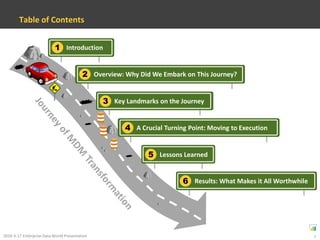
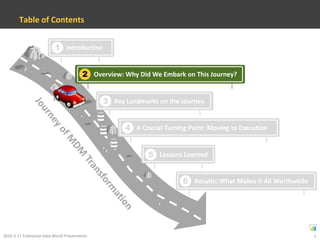
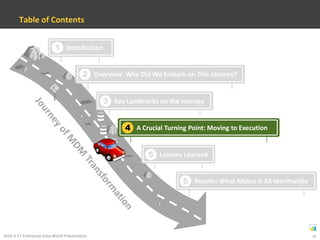
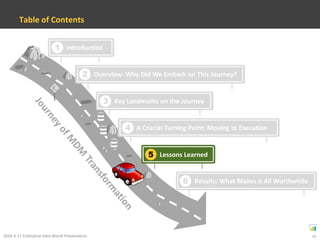
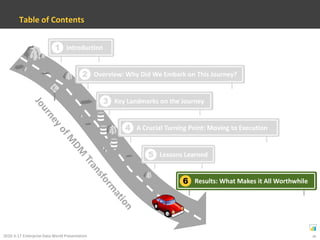
Table of ContentsIntroduction1Overview: Why Did We Embark on This Journey?2Key Landmarks on the Journey3A Crucial Turning Point: Moving to Execution4Journey of MDM TransformationLessons Learned5Results: What Makes it All Worthwhile6
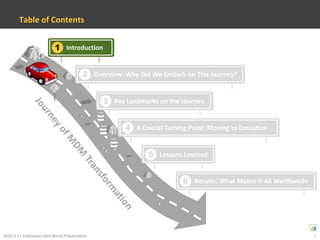
Introduction1Overview: Why Did We Embark on This Journey?2Table of ContentsKey Landmarks on the Journey3A Crucial Turning Point: Moving to Execution4Journey of MDM TransformationLessons Learned5Results: What Makes it All Worthwhile6
Introduction:What Are We Going to Cover Today?Today, we would like to:Introduce ourselvesShare our experiences on the “Journey of MDM Transformation”Share the lessons we’ve learned – what worked well, what didn’tAnswer questions you may haveEncourage others to start their own transformation!
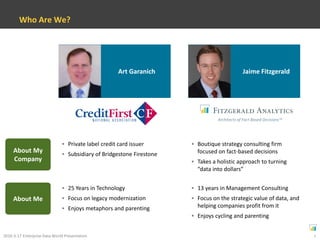
Art GaranichWho Are We?Jaime FitzgeraldArchitects of Fact-Based Decisions™Private label credit card issuer
Subsidiary of Bridgestone Firestone
Boutique strategy consulting firm focused on fact-based decisions
Takes a holistic approach to turning “data into dollars”About My Company25 Years in Technology
Focus on legacy modernization
Enjoys metaphors and parenting
13 years in Management Consulting
Focus on the strategic value of data, and helping companies profit from it
Enjoys cycling and parentingAbout Me
Table of ContentsIntroduction1Overview: Why Did We Embark on This Journey?2Key Landmarks on the Journey3A Crucial Turning Point: Moving to Execution4Journey of MDM TransformationLessons Learned5Results: What Makes it All Worthwhile6
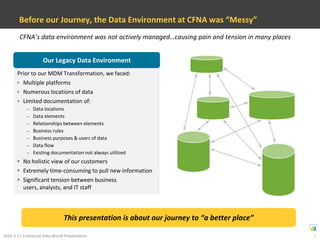
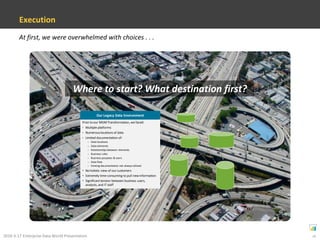
Before our Journey, the Data Environment at CFNA was “Messy”CFNA’s data environment was not actively managed…causing pain and tension in many placesOur Legacy Data EnvironmentPrior to our MDM Transformation, we faced:Multiple platformsNumerous locations of dataLimited documentation of:Data locations
Data elements
Relationships between elements
Business rules
Business purposes & users of data
Data flow
Existing documentation not always utilizedNo holistic view of our customersExtremely time-consuming to pull new informationSignificant tension between business users, analysts, and IT staffThis presentation is about our journey to “a better place”
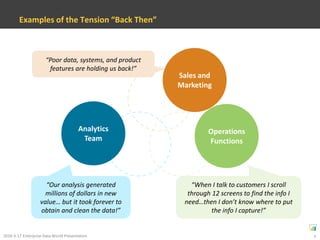
Examples of the Tension “Back Then”Sales and Marketing“Poor data, systems, and product features are holding us back!”Analytics TeamOperations Functions“Our analysis generated millions of dollars in new value… but it took forever to obtain and clean the data!”“When I talk to customers I scroll through 12 screens to find the info I need…then I don’t know where to put the info I capture!”
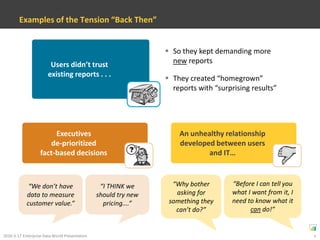
Examples of the Tension “Back Then”So they kept demanding more new reports
They created “homegrown” reports with “surprising results”Users didn’t trustexisting reports . . .Executivesde-prioritizedfact-based decisionsAn unhealthy relationship developed between usersand IT…“We don’t have data to measure customer value.”“Why bother asking for something they can’t do?”“Before I can tell you what I want from it, I need to know what it can do!”“I THINK we should try new pricing….”
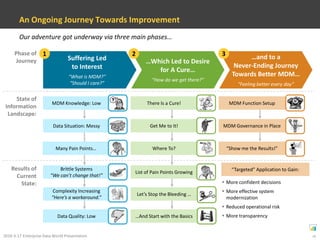
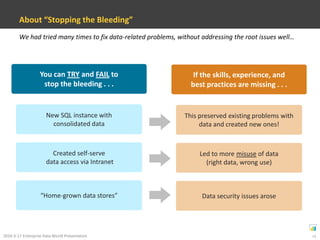
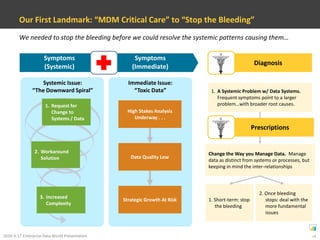
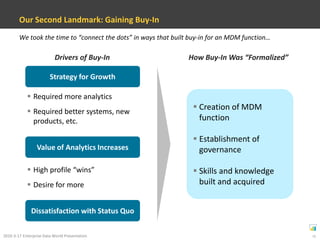
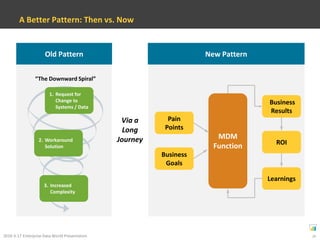
An Ongoing Journey Towards ImprovementOur adventure got underway via three main phases…Phase of Journey123Suffering Ledto Interest“What is MDM?”“Should I care?”…Which Led to Desire for A Cure…“How do we get there?”…and to a Never-Ending JourneyTowards Better MDM…“Feeling better every day”State of Information Landscape:MDM Knowledge: LowThere Is a Cure!MDM Function SetupGet Me to It!MDM Governance in PlaceData Situation: MessyWhere To?“Show me the Results!”Many Pain Points…“Targeted” Application to Gain:Results ofCurrent State:Brittle Systems“We can’t change that!”List of Pain Points GrowingMore confident decisions
More effective system modernization
Reduced operational risk
More transparencyComplexity Increasing“Here’s a workaround.”Let’s Stop the Bleeding …Data Quality: Low…And Start with the Basics
Table of ContentsIntroduction1Overview: Why Did We Embark on This Journey?2Key Landmarks on the Journey3A Crucial Turning Point: Moving to Execution4Journey of MDM TransformationLessons Learned5Results: What Makes it All Worthwhile6
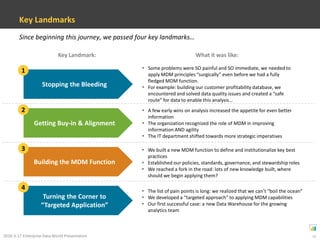
Key LandmarksSince beginning this journey, we passed four key landmarks…Key Landmark:What it was like:Some problems were SO painful and SO immediate, we needed to apply MDM principles “surgically” even before we had a fully fledged MDM function.
For example: building our customer profitability database, we encountered and solved data quality issues and created a “safe route” for data to enable this analysis…1Stopping the Bleeding2A few early wins on analysis increased the appetite for even better information

Jaime Fitzgerald: A Master Data Management Road-Trip - Presented Enterprise Data World 2010

  • 1.
    Tales from aMaster Data Management Road Trip March 17, 20101:30 – 2:30 pm Jaime FitzgeraldArt GaranichArchitects of Fact-Based Decisions™
  • 2.
    Table of ContentsIntroduction1Overview:Why Did We Embark on This Journey?2Key Landmarks on the Journey3A Crucial Turning Point: Moving to Execution4Journey of MDM TransformationLessons Learned5Results: What Makes it All Worthwhile6
  • 3.
    Introduction1Overview: Why DidWe Embark on This Journey?2Table of ContentsKey Landmarks on the Journey3A Crucial Turning Point: Moving to Execution4Journey of MDM TransformationLessons Learned5Results: What Makes it All Worthwhile6
  • 4.
    Introduction:What Are WeGoing to Cover Today?Today, we would like to:Introduce ourselvesShare our experiences on the “Journey of MDM Transformation”Share the lessons we’ve learned – what worked well, what didn’tAnswer questions you may haveEncourage others to start their own transformation!
  • 5.
    Art GaranichWho AreWe?Jaime FitzgeraldArchitects of Fact-Based Decisions™Private label credit card issuer
  • 6.
  • 7.
    Boutique strategy consultingfirm focused on fact-based decisions
  • 8.
    Takes a holisticapproach to turning “data into dollars”About My Company25 Years in Technology
  • 9.
    Focus on legacymodernization
  • 10.
  • 11.
    13 years inManagement Consulting
  • 12.
    Focus on thestrategic value of data, and helping companies profit from it
  • 13.
    Enjoys cycling andparentingAbout Me
  • 14.
    Table of ContentsIntroduction1Overview:Why Did We Embark on This Journey?2Key Landmarks on the Journey3A Crucial Turning Point: Moving to Execution4Journey of MDM TransformationLessons Learned5Results: What Makes it All Worthwhile6
  • 15.
    Before our Journey,the Data Environment at CFNA was “Messy”CFNA’s data environment was not actively managed…causing pain and tension in many placesOur Legacy Data EnvironmentPrior to our MDM Transformation, we faced:Multiple platformsNumerous locations of dataLimited documentation of:Data locations
  • 16.
  • 17.
  • 18.
  • 19.
    Business purposes &users of data
  • 20.
  • 21.
    Existing documentation notalways utilizedNo holistic view of our customersExtremely time-consuming to pull new informationSignificant tension between business users, analysts, and IT staffThis presentation is about our journey to “a better place”
  • 22.
    Examples of theTension “Back Then”Sales and Marketing“Poor data, systems, and product features are holding us back!”Analytics TeamOperations Functions“Our analysis generated millions of dollars in new value… but it took forever to obtain and clean the data!”“When I talk to customers I scroll through 12 screens to find the info I need…then I don’t know where to put the info I capture!”
  • 23.
    Examples of theTension “Back Then”So they kept demanding more new reports
  • 24.
    They created “homegrown”reports with “surprising results”Users didn’t trustexisting reports . . .Executivesde-prioritizedfact-based decisionsAn unhealthy relationship developed between usersand IT…“We don’t have data to measure customer value.”“Why bother asking for something they can’t do?”“Before I can tell you what I want from it, I need to know what it can do!”“I THINK we should try new pricing….”
  • 25.
    An Ongoing JourneyTowards ImprovementOur adventure got underway via three main phases…Phase of Journey123Suffering Ledto Interest“What is MDM?”“Should I care?”…Which Led to Desire for A Cure…“How do we get there?”…and to a Never-Ending JourneyTowards Better MDM…“Feeling better every day”State of Information Landscape:MDM Knowledge: LowThere Is a Cure!MDM Function SetupGet Me to It!MDM Governance in PlaceData Situation: MessyWhere To?“Show me the Results!”Many Pain Points…“Targeted” Application to Gain:Results ofCurrent State:Brittle Systems“We can’t change that!”List of Pain Points GrowingMore confident decisions
  • 26.
  • 27.
  • 28.
    More transparencyComplexity Increasing“Here’sa workaround.”Let’s Stop the Bleeding …Data Quality: Low…And Start with the Basics
  • 29.
    Table of ContentsIntroduction1Overview:Why Did We Embark on This Journey?2Key Landmarks on the Journey3A Crucial Turning Point: Moving to Execution4Journey of MDM TransformationLessons Learned5Results: What Makes it All Worthwhile6
  • 30.
    Key LandmarksSince beginningthis journey, we passed four key landmarks…Key Landmark:What it was like:Some problems were SO painful and SO immediate, we needed to apply MDM principles “surgically” even before we had a fully fledged MDM function.
  • 31.
    For example: buildingour customer profitability database, we encountered and solved data quality issues and created a “safe route” for data to enable this analysis…1Stopping the Bleeding2A few early wins on analysis increased the appetite for even better information

Editor's Notes

  • #2 Next steps: Art by EOD or Wed am – notesJF add his by Wed PMMark: why would you do this? Art: 1) get out of comfort zone, 2) Meet others who help us, 3) JF: get extra value via our thought-partnershipWalk through with equipment…
  • #3 Art
  • #5 JF to prepare succinct talking points re setup:Our goals, there goalsTime Keeper = Shannon
  • #6 Both presents:CFNA: division of BS – highly regulated….25 years with Enterprise work, now doing legacy modernization….Have enough experience to share, but lots also to lean….Art notes:Focus on legacy modernization – have been working on this for a long time, have recognized the need for itOver time it has become apparent how essential data management will be to enable legacy modernization….Art’s background:Started at Anicom out of colleage – built system for Aramco oil----global mainframe-based purchasing system. Used technology in ways “ahead of our time” – process maturity, standards, etcAfter several years, were pursuing contract w Exxon, but Exxon was not comfortable hiring Anicom’s small size….EDW wanted relationship w Exxon, so they acruired this division of Anicom…..landed Exxon clientCareer changed when Art become lead on new software development for – enterprise software handling end to end purchasing – “bill to payment” – WertonStell = client. Leadership role managing customer and team – sseveray years, and very successful project.Others companies were interested in this purchasing product, but wanted new architectures and software (it was COBOL mainframe) – EDW not able to find resources or partners to make this happen. Current was in IMS, goal was more relational….there was concern about what would happen to the division, so they turned it into internal resources /staff aug plus advisory consulting org (internal). Supported GM customers throughout NE OHIO…..With Mark Kula, did a Data Warehouse for Benjamin Moore Paints….Y2K was crazy time…..lots of involvement there~ 2000, opportunity arose in the credit card processing unit (where Art’s wife also works) – new role, new little about infrastructure needed in this function (telco, wide-area networks, txn processing)After 1 year, EDW centralized this function – Art become title = Service Delivery Executive – in charge of managing relationship between EDS and clients…..”reach out person”Got to the point where EDS was trying to sell capabilities they were not able to support…for example, bringing in outsourcing contracts, committing to SLAs not currently being achieved, NOT improving the infrastructureJF to package this into useful document!When Art was hired on, there was a guy named Bob Porter – visionary – of how a solution could be developed / should be developed – standards were remarkable – example: if you generated cobol code, 95% of code was “generated” – even on maintenance programs, 50-60% were Met Tawney when he stared….she was part of that team that developed that capability….she was very technical back the…..the structure and standards…..System consisted of 500-600 problems. If you had a problem….if happened in the same part of the program……so making the fix was very efficient…..Realized that to be successful, you didn’t need to be a technical GURU….felt this became a potential liability…..Arlene: let’s get you into the system…..realized needed good people……trustworthy people…..realized the importantce of people skills…..staff loyalty and retention a passion and a strength….EDS developed a career progression that fit this profile (art’s profile_ -== developed two career paths (technical vs leadership) --
  • #7 Art presents this section
  • #8 Art presents this sectionFor many years, complexity ruledIncreased commitment to analyticsEarly efforts around Data Integration had “unintended consequences”Documentation minimal – working with eyes haff closed/IT/Biz Unhappy…..needed to get to a better place
  • #9 Art: A few examples of the tension we saw back then….1) First hit the quotes2) Then talk about the Business Case for Fixing the “Analytics Pain Point”
  • #10 Art: favorite Quote is on right…..JF: comment on universality of these perspectives….
  • #11 Art: bc of the pain….we realized we needed to change….The suffering that led to interest…..Tee up the “essential moment of truth….” – preview how seriously we’re going to address that in more detail in the project…..JF prep thoughts….
  • #12 Jaime presents this section
  • #13 JF riff is on causal links between these items….Highlight examples: fixing data as precondition to customer profitability databaseEarly wins increased appetite
  • #15 Diagnosis at BOTH the Enterprise/Holistic POV….One key element of stopping the bleeding…..BUYING TIME….(buy time)
  • #16 Compliance and risk
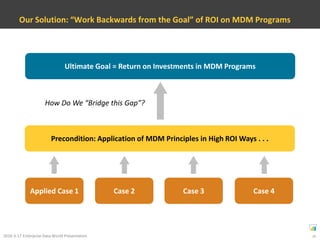
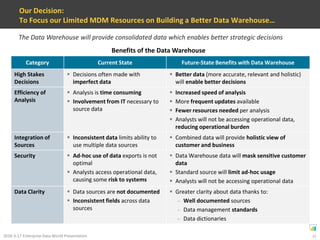
  • #17 Focus is on Data Warehouse, business case is on Data WarehouseNote upon return: messaging and communication around1) Needed to build the function to gain the benefits…..Now that it has been built, we have the ability to apply MDM principles in a structured way……2) In terms of applying the function in high value ways, we had to start somewhere, and that first project is the Data Warehouse….But over time we’ll be applying it to a variety of high-stakes legacy system modernization initiatives (where data management is a key precondition to success in these initiatives)
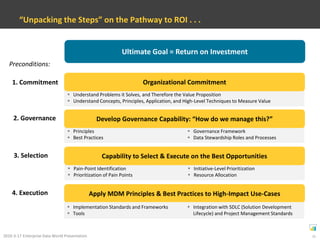
  • #18 Key preconditions to applicationIntegrate principles and best practices and standards into existing process and core capabilities as an organizationIf you have these core capabilities, you can plug MDM in. If you don’t have those capabilities, MDM will be harder to apply….
  • #20 If you can’t read this, don’t worrym, bc it ‘s the same picture of current state before we started our journey….
  • #22 Resource allocation =Pain point ID…..a bundle are being solvedNote to JF – pain points back in the building
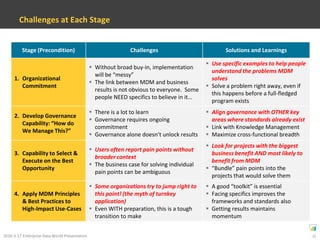
  • #23 Stage 1 – buy in based in Paiin pointPoint 3 – opportunity to be engagedIt will never be turnkey BC it’s a more of a discipline than a tangible application
  • #25 Art
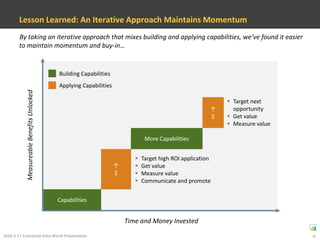
  • #26 To maintain buy in we realized that while building the capabilities we needed to show the value….Started w Data Warehouse…..iterative…..Fortunately, leads nicely into next projects
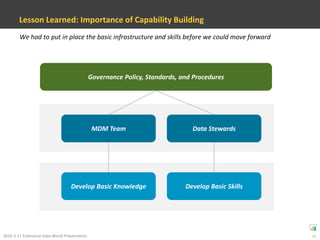
  • #27 Right people in right rolesStructure in place – find right people….
  • #28 Initiave must have structure in place….