Educational Opportunities in Cuba
Compliance, Legalities +
Preparations for Travel
This presentation is copyrighted by PaperClip Communications 2015.
This presentation may not be reproduced without permission from PaperClip Communications and its
presenters. This presentation and all materials provided during the presentation may not be altered.
This presentation is not intended as legal advice and should be considered general information only. The
answers to legal questions generally hinge upon the specific facts and circumstances of an institution.
Individuals with specific questions should contact their institution’s legal counsel.
Follow on Twitter:
#ppclpwebinar
December 3, 2015
2:00 – 3:30 PM ET
Panelist
The opinions expressed during today’s event are not
necessarily those of PaperClip Communications
Luis Manuel Alcalde
Global Business Attorney
Kegler Brown Hill + Ritter
lalcalde@keglerbrown.com
Vinita Bahri-Mehra
Panelist
The opinions expressed during today’s event are not
necessarily those of PaperClip Communications
Global Business Attorney
Kegler Brown Hill + Ritter
vmehra@keglerbrown.com
Let’s Define
the PROBLEM
Cuba is subject to
a U.S. Embargo
So how can U.S. academic institutions, faculty, staff +
students legally and safely take advantage of available
educational opportunities involving Cuba?
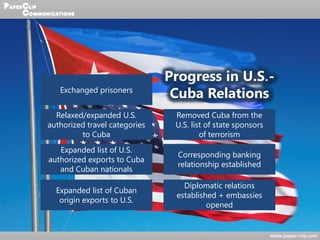
Progress in U.S.-
Cuba RelationsExchanged prisoners
Relaxed/expanded U.S.
authorized travel categories
to Cuba
Expanded list of U.S.
authorized exports to Cuba
and Cuban nationals
Expanded list of Cuban
origin exports to U.S.
Removed Cuba from the
U.S. list of state sponsors
of terrorism
Corresponding banking
relationship established
Diplomatic relations
established + embassies
opened
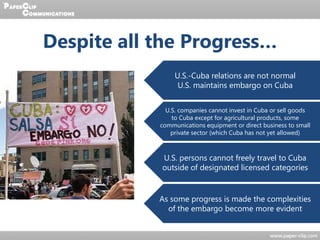
Despite all the Progress…
U.S.-Cuba relations are not normal
U.S. maintains embargo on Cuba
U.S. companies cannot invest in Cuba or sell goods
to Cuba except for agricultural products, some
communications equipment or direct business to small
private sector (which Cuba has not yet allowed)
U.S. persons cannot freely travel to Cuba
outside of designated licensed categories
As some progress is made the complexities
of the embargo become more evident
What is the
Cuban Embargo?
U.S. policy to isolate Cuba which commenced
in the early 1960s
Comprehensive economic sanctions that include an
embargo on travel, trade and financial transactions
Legal underpinning of the embargo is executive orders
+ series of laws and regulations
Legislative/Regulatory
Basis of Cuban Embargo
Legislative/Regulatory
Basis of Cuban Embargo
Trading with the Enemy Act (1917)
Allows President to restrict trade
with countries hostile to U.S.
in time of war
Foreign Assistance Act of 1961
Allows President to deny assistance to
Cuba and impose trade embargo.
U.S. Treasury Cuban Import Regulations
and subsequent Cuban Asset Control
Regulations (“CACR”) prohibit imports from
and exports to Cuba and restrict travel to
and financial transactions with Cuba
Department of Commerce
Regulations
prohibit or restrict exports to Cuba
Cuban Democracy Act of 1992
Prohibits U.S. subsidiaries from trading with
Cuba and entry of vessels that have been to
Cuba for trade to come to U.S. for 6 mos.
Cuban Liberty and Democratic Solidarity
Act of 1996 (Helms-Burton) – codified
embargo and CACR Regs., but President
retains broad power to modify CACR.
Prohibits President from eliminating
embargo until specified conditions are met.
Principal Agencies
Enforcing Embargo
U.S. Department of the Treasury, Office
of Foreign Assets Controls (“OFAC”)
issues and enforces the Cuban
Assets Control Regulations (“CACR”) –
authorized travel, activities and
financial transactions
U.S. Department of
Commerce, Bureau of
Industry and Security (“BIS”)
authorized exports to Cuba
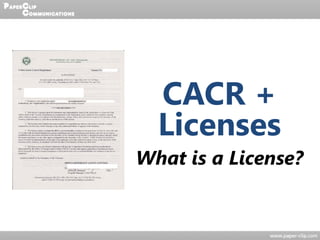
CACR +
Licenses
What is a License?
CACR +
Licenses
What is a License?
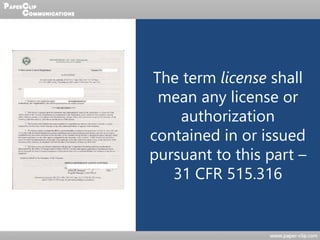
The term license shall
mean any license or
authorization
contained in or issued
pursuant to this part –
31 CFR 515.316
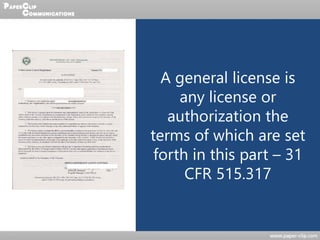
A general license is
any license or
authorization the
terms of which are set
forth in this part – 31
CFR 515.317
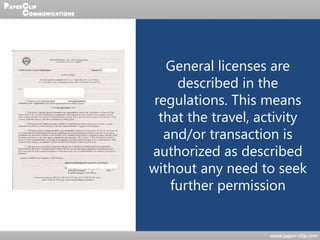
General licenses are
described in the
regulations. This means
that the travel, activity
and/or transaction is
authorized as described
without any need to seek
further permission
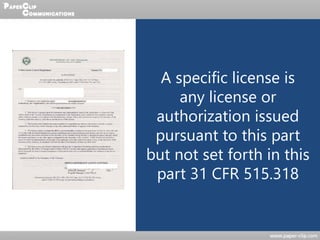
A specific license is
any license or
authorization issued
pursuant to this part
but not set forth in this
part 31 CFR 515.318
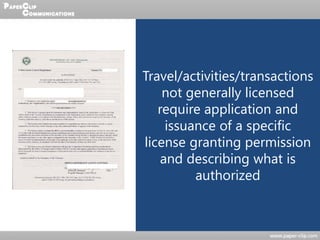
Travel/activities/transactions
not generally licensed
require application and
issuance of a specific
license granting permission
and describing what is
authorized
General License for
Accredited Degree Granting
Academic Institutions
accredited U.S.
graduate and
undergraduate
degree-granting
academic
institutions
including faculty,
staff + students
of such
institutions
available to:
1
Participating in a structured educational
program in Cuba that is part of a course offered
for credit by the U.S. institution;
2
Engaging in non-commercial academic
research in Cuba specifically related to Cuba for
purpose of obtaining undergraduate or
graduate degree from a U.S. institution
(Note: Prior to January 2015, only applied to graduate students)
Educational Activities
Subject to General License
Educational Activities
Subject to General License
3
Participation in formal course of study at a Cuban
academic institution provided U.S. institution will
accept formal course of study for credit towards
student’s graduate or undergraduate degree
4
Teaching at Cuban academic institution for any
length of time, academic program related to Cuban
institution provided teacher is regularly employed
by a U.S. or non-Cuban academic institution
(Note: Prior to January 2015, teaching engagement had to be at least 10 weeks)
Educational Activities
Subject to General License
5
Sponsoring (including paying stipend/salary) to
Cuban scholar to teach or engage in other scholarly
activity at U.S. academic institution
Such earnings may be remitted to Cuba as provided in §515.570 or carried on
the person of Cuban scholar returning to Cuba as provided in §515.560(d)(3)
6
Cuban or U.S. sponsored secondary school
academic exchanges for secondary school students
participating in structured study or program led by
teacher or other official + adult chaperones
Educational Activities
Subject to General License
7
Sponsorships of non-commercial academic
seminars, conference + attendance at such events
by faculty, staff, and students of a participating U.S.
academic institution and workshops in Cuba related
to Cuba or global issues involving Cuba
8
Establishment of academic exchanges and joint
non-commercial academic research projects with
universities or academic institutions in Cuba
Educational Activities
Subject to General License
9
Providing standardized testing services, including
professional certificate examinations, university
entrance examinations, and language examinations,
and related preparatory services for such exams to
Cuban nationals, wherever located
10
Providing internet based courses, including
distance learning and Massive Open Online
Courses (“MOOC”), to Cuban Nationals, wherever
located, provided course content is at
undergraduate level or below
11
Organization of, and preparation for, activities
described in paragraphs (a)(1) through (10) of this
section by employees or contractors of the
sponsoring organization that is a person subject to
U.S. jurisdiction
12
Facilitation by an organization that is a person
subject to U.S. jurisdiction, or a member of the staff
of such an organization, of licensed educational
activities in Cuba on behalf of U.S. academic
institutions or secondary schools, provided that:
Organization is directly affiliated
with one or more U.S. academic
institutions or secondary schools
Organization facilitates educational
activities that meet requirements of 1 or
more of the general licenses set forth in
§515.565(a)(1), (2), (3), and (6).
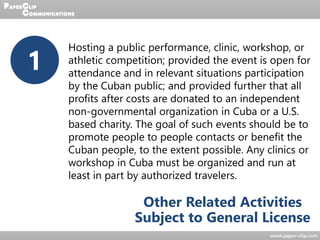
1
Hosting a public performance, clinic, workshop, or
athletic competition; provided the event is open for
attendance and in relevant situations participation
by the Cuban public; and provided further that all
profits after costs are donated to an independent
non-governmental organization in Cuba or a U.S.
based charity. The goal of such events should be to
promote people to people contacts or benefit the
Cuban people, to the extent possible. Any clinics or
workshop in Cuba must be organized and run at
least in part by authorized travelers.
Other Related Activities
Subject to General License
General License
Professional Research
 Purpose of the research directly relates to the traveler's
profession, professional background, or area of expertise,
including area of graduate-level full-time study
 Traveler does not engage in recreational travel, tourist
travel, travel in pursuit of a hobby, or research for
personal satisfaction only
 Traveler's schedule of activities does not include free time
or recreation in excess of that consistent with a full-time
schedule of professional research
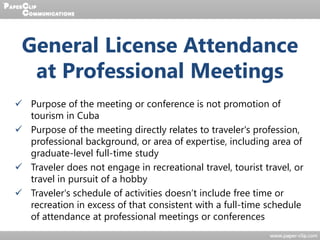
General License Attendance
at Professional Meetings
 Purpose of the meeting or conference is not promotion of
tourism in Cuba
 Purpose of the meeting directly relates to traveler's profession,
professional background, or area of expertise, including area of
graduate-level full-time study
 Traveler does not engage in recreational travel, tourist travel, or
travel in pursuit of a hobby
 Traveler's schedule of activities doesn’t include free time or
recreation in excess of that consistent with a full-time schedule
of attendance at professional meetings or conferences
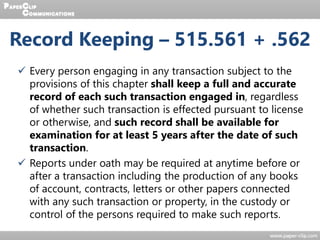
 Every person engaging in any transaction subject to the
provisions of this chapter shall keep a full and accurate
record of each such transaction engaged in, regardless
of whether such transaction is effected pursuant to license
or otherwise, and such record shall be available for
examination for at least 5 years after the date of such
transaction.
 Reports under oath may be required at anytime before or
after a transaction including the production of any books
of account, contracts, letters or other papers connected
with any such transaction or property, in the custody or
control of the persons required to make such reports.
Record Keeping – 515.561 + .562
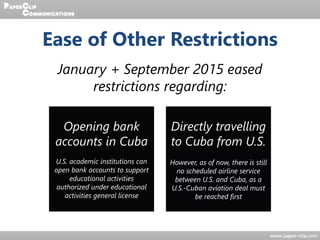
Ease of Other Restrictions
January + September 2015 eased
restrictions regarding:
Opening bank
accounts in Cuba
U.S. academic institutions can
open bank accounts to support
educational activities
authorized under educational
activities general license
Directly travelling
to Cuba from U.S.
2015 regulations no longer
requires U.S. citizens to book
through pre-authorized travel
agencies and travel only on
charter planes
However, as of now, there is still
no scheduled airline service
between U.S. and Cuba, as a
U.S.-Cuban aviation deal must
be reached first
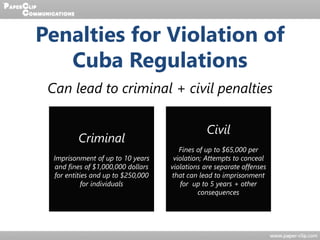
Penalties for Violation of
Cuba Regulations
Can lead to criminal + civil penalties
Criminal
Imprisonment of up to 10 years
and fines of $1,000,000 dollars
for entities and up to $250,000
for individuals
Civil
Fines of up to $65,000 per
violation; Attempts to conceal
violations are separate offenses
that can lead to imprisonment
for up to 5 years + other
consequences
Penalties for Violation of
Cuba Regulations
Can lead to criminal + civil penalties
Criminal
Imprisonment of up to 10 years
and fines of $1,000,000 dollars
for entities and up to $250,000
for individuals
Civil
Fines of up to $65,000 per
violation; Attempts to conceal
violations are separate offenses
that can lead to imprisonment
for up to 5 years + other
consequences
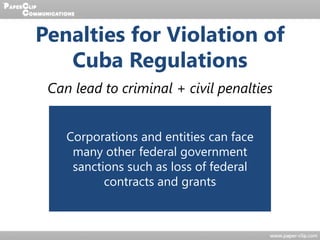
Corporations and entities can face
many other federal government
sanctions such as loss of federal
contracts and grants
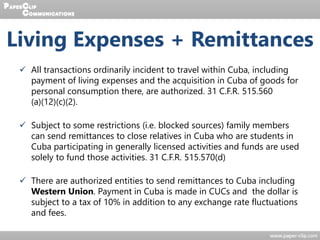
Living Expenses + Remittances
 All transactions ordinarily incident to travel within Cuba, including
payment of living expenses and the acquisition in Cuba of goods for
personal consumption there, are authorized. 31 C.F.R. 515.560
(a)(12)(c)(2).
 Subject to some restrictions (i.e. blocked sources) family members
can send remittances to close relatives in Cuba who are students in
Cuba participating in generally licensed activities and funds are used
solely to fund those activities. 31 C.F.R. 515.570(d)
 There are authorized entities to send remittances to Cuba including
Western Union. Payment in Cuba is made in CUCs and the dollar is
subject to a tax of 10% in addition to any exchange rate fluctuations
and fees.
Business Travel To Cuba
 Verify legality of travel
under U.S. law
 Identify what is needed
pursuant to Cuban law
(i.e. business visa, student visa,
event visa, tourist visa)
 OFAC authorized travel
providers are often able to
assist in obtaining visas
from the Cuban Embassy if
all required information is
provided to them
 Business visas required to
travel to Cuba to engage in
formal business meetings +
discussions with Cuban
officials
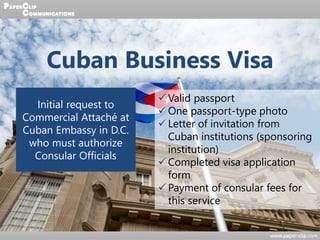
Cuban Business Visa
Initial request to
Commercial Attaché at
Cuban Embassy in D.C.
who must authorize
Consular Officials
 Valid passport
 One passport-type photo
 Letter of invitation from
Cuban institutions (sponsoring
institution)
 Completed visa application
form
 Payment of consular fees for
this service
Cuba Travel: Crime + Safety
 Ensure Compliance with Institution’s International Travel Policy
 Check State Department Travel Advisories & Current Events
 Most crime involves non-confrontational petit thefts,
pickpocketing, scams involving counterfeit items
 Sex trade is open and obvious in certain tourist areas
 Violent crime is not common
 Illegal drugs severely penalized
Vehicular accidents: a leading
source of injuries
Leave the driving to Cubans!
Cuba Travel: Health Issues
 There are no specific Health Notices for Cuba
 Health concerns focus on contaminated drinking water,
food washed with contaminated water and sexual activity
with strangers
 Travelers to Cuba must purchase health insurance from
Cuba but should have U.S. based insurance
cdc.gov/travel/destinations/traveler/none/cuba
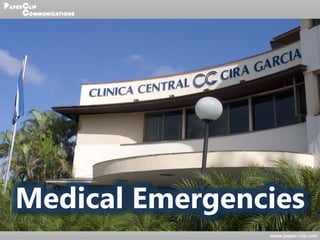
Medical Emergencies
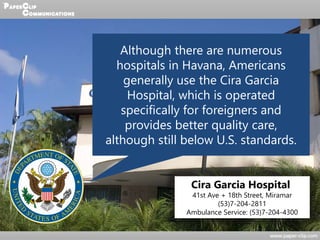
Although there are numerous
hospitals in Havana, Americans
generally use the Cira Garcia
Hospital, which is operated
specifically for foreigners and
provides better quality care,
although still below U.S. standards.
Cira Garcia Hospital
41st Ave + 18th Street, Miramar
(53)7-204-2811
Ambulance Service: (53)7-204-4300
Export Control Issues
 The export and reexport to Cuba of all items subject to the Export
Administration Regulations (EAR) require a BIS license, unless
authorized by a license exception in Section 746.2(a)(1) of the EAR.
 A license exception is an authorization to export or reexport under
stated conditions certain items without a license that would
otherwise require a license.
 So if an item is not described in Section 746.2(a)(1), it cannot be
taken to Cuba without first applying for and being granted a license.
Check with counsel for any item not described therein.
What can be taken
to Cuba traveling
on educational
license?
EAR 740.14 BAG
Personal + household effects
Tools of trade such as computers
+ software owned by person
and for personal use
Must take reasonable security
precautions with technology
EAR 740.14(g)
Use secure connections, passwords,
firewalls, etc.
All items must come back to
U.S. unless consumed/destroyed
Agreements with
Cuban Universities
Macro
Agreement
Collaboration
Agreement
an umbrella or master
agreement to be followed
by specific project
agreements
agreement to collaborate
on specific areas in the
future
Specific Agreements
Visiting
Student
Agreements
Joint
Research
Agreements
Faculty
Exchange
Agreements
Student
Recruitment
Agreements
Educational
Services
Agreement
Testing, Certification Programs,
Preparatory Services
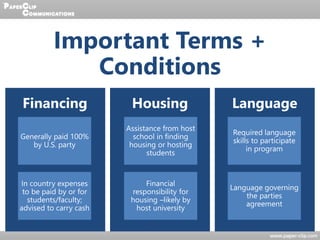
Important Terms +
Conditions
Financing Housing Language
Generally paid 100%
by U.S. party
In country expenses
to be paid by or for
students/faculty;
advised to carry cash
Assistance from host
school in finding
housing or hosting
students
Financial
responsibility for
housing –likely by
host university
Required language
skills to participate
in program
Language governing
the parties
agreement
Important Terms +
Conditions
Calendar Admission Expectations
Dates of program
Milestone for
completion, grades,
etc.
Eligibility criteria to
participate
Criteria for choosing
and permissible
numbers of students
Expected level of
participation by
students/faculty
Applicable academic
and national law
jurisdictions
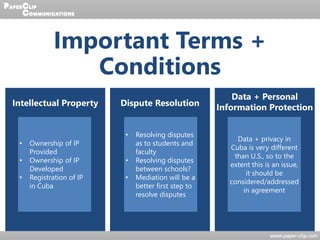
Important Terms +
Conditions
Intellectual Property Dispute Resolution
Data + Personal
Information Protection
• Ownership of IP
Provided
• Ownership of IP
Developed
• Registration of IP
in Cuba
• Resolving disputes
as to students and
faculty
• Resolving disputes
between schools?
• Mediation will be a
better first step to
resolve disputes
Data + privacy in
Cuba is very different
than U.S., so to the
extent this is an issue,
it should be
considered/addressed
in agreement
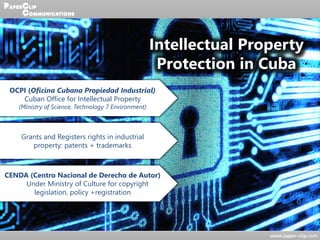
Intellectual Property
Protection in Cuba
OCPI (Oficina Cubana Propiedad Industrial)
Cuban Office for Intellectual Property
(Ministry of Science, Technology 7 Environment)
Grants and Registers rights in industrial
property: patents + trademarks
CENDA (Centro Nacional de Derecho de Autor)
Under Ministry of Culture for copyright
legislation, policy +registration
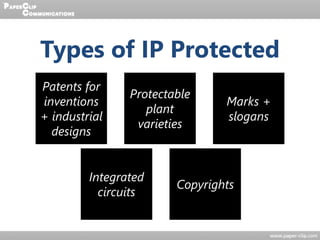
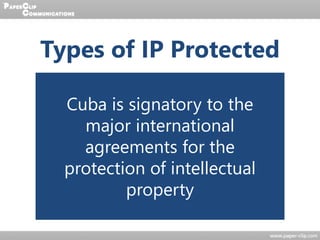
Types of IP Protected
Patents for
inventions
+ industrial
designs
Protectable
plant
varieties
Marks +
slogans
Integrated
circuits
Copyrights
Types of IP Protected
Patents for
inventions
+ industrial
designs
Protectable
plant
varieties
Marks +
slogans
Integrated
circuits
Copyrights
Cuba is signatory to the
major international
agreements for the
protection of intellectual
property
Best
Practices
7
Best
Practices7
Have Cuba-focused (OFAC) compliance policy + procedures
Have a successful training program
Financial and accounting systems: flagging + screening
Third parties: due diligence + contract clauses
Reporting a violation: voluntary disclosure
Monitoring compliance
Most important: mechanism for solving problems abroad
1
2
3
4
5
6
7
Thank You
Vinita Bahri-Mehra
Global Business Attorney
Kegler Brown Hill + Ritter
vmehra@keglerbrown.com
Luis Manuel Alcalde
Global Business Attorney
Kegler Brown Hill + Ritter
lalcalde@keglerbrown.com
Q+A
How Do I Call-in with a Question?
If you would like to ask a question of our panelist(s) please
press *1 and you will be put in a call queue
until it is your turn to ask your question.
OR
You can write in a question or comment anytime during the event by
clicking on the “Chat” Bubble in the left hand corner of your
screen.
For Questions that Arise After the Conference
If you have a question that you were unable to ask of our presenter(s),
please feel free to email us at:
Info@paper-clip.com
…and we will be happy to forward it to our panelists!
We want your feedback on today’s event!
If you would like to provide suggestions for
improvement and/or ideas for future event
topics, please email us at:
info@paper-clip.com
and she will send you the link to our brief online survey.
Thank you for your participation,
PaperClip Communications
Feedback
Thank you for your participation in today's webinar.
Please note that we do offer certificates of completion
to our webinar participants.
If you and/or your colleagues would like to a certificate,
please go to the link below and complete the
information requested – by selecting the webinar you
are seeking a certificate for and using the password
provided in your registration information – then simply
click submit and your certificate will arrive shortly.
http://paperclipwebinars.com/
Certificate of Completion
Join Our Community:
Sign up for any of the FREE weekly electronic newswires we offer. Go to
www.paper-clip.com , scroll down and click on the link at the bottom of
our homepage. You can also follow us on Facebook and Twitter.
Upcoming Webinar Conferences:
PaperClip Resources

Educational Opportunities in Cuba

  • 1.
    Educational Opportunities inCuba Compliance, Legalities + Preparations for Travel This presentation is copyrighted by PaperClip Communications 2015. This presentation may not be reproduced without permission from PaperClip Communications and its presenters. This presentation and all materials provided during the presentation may not be altered. This presentation is not intended as legal advice and should be considered general information only. The answers to legal questions generally hinge upon the specific facts and circumstances of an institution. Individuals with specific questions should contact their institution’s legal counsel. Follow on Twitter: #ppclpwebinar December 3, 2015 2:00 – 3:30 PM ET
  • 2.
    Panelist The opinions expressedduring today’s event are not necessarily those of PaperClip Communications Luis Manuel Alcalde Global Business Attorney Kegler Brown Hill + Ritter lalcalde@keglerbrown.com
  • 3.
    Vinita Bahri-Mehra Panelist The opinionsexpressed during today’s event are not necessarily those of PaperClip Communications Global Business Attorney Kegler Brown Hill + Ritter vmehra@keglerbrown.com
  • 4.
  • 5.
    Cuba is subjectto a U.S. Embargo So how can U.S. academic institutions, faculty, staff + students legally and safely take advantage of available educational opportunities involving Cuba?
  • 6.
    Progress in U.S.- CubaRelationsExchanged prisoners Relaxed/expanded U.S. authorized travel categories to Cuba Expanded list of U.S. authorized exports to Cuba and Cuban nationals Expanded list of Cuban origin exports to U.S. Removed Cuba from the U.S. list of state sponsors of terrorism Corresponding banking relationship established Diplomatic relations established + embassies opened
  • 7.
    Despite all theProgress… U.S.-Cuba relations are not normal U.S. maintains embargo on Cuba U.S. companies cannot invest in Cuba or sell goods to Cuba except for agricultural products, some communications equipment or direct business to small private sector (which Cuba has not yet allowed) U.S. persons cannot freely travel to Cuba outside of designated licensed categories As some progress is made the complexities of the embargo become more evident
  • 8.
    What is the CubanEmbargo? U.S. policy to isolate Cuba which commenced in the early 1960s Comprehensive economic sanctions that include an embargo on travel, trade and financial transactions Legal underpinning of the embargo is executive orders + series of laws and regulations
  • 9.
  • 10.
    Legislative/Regulatory Basis of CubanEmbargo Trading with the Enemy Act (1917) Allows President to restrict trade with countries hostile to U.S. in time of war Foreign Assistance Act of 1961 Allows President to deny assistance to Cuba and impose trade embargo. U.S. Treasury Cuban Import Regulations and subsequent Cuban Asset Control Regulations (“CACR”) prohibit imports from and exports to Cuba and restrict travel to and financial transactions with Cuba Department of Commerce Regulations prohibit or restrict exports to Cuba Cuban Democracy Act of 1992 Prohibits U.S. subsidiaries from trading with Cuba and entry of vessels that have been to Cuba for trade to come to U.S. for 6 mos. Cuban Liberty and Democratic Solidarity Act of 1996 (Helms-Burton) – codified embargo and CACR Regs., but President retains broad power to modify CACR. Prohibits President from eliminating embargo until specified conditions are met.
  • 11.
  • 12.
    U.S. Department ofthe Treasury, Office of Foreign Assets Controls (“OFAC”) issues and enforces the Cuban Assets Control Regulations (“CACR”) – authorized travel, activities and financial transactions U.S. Department of Commerce, Bureau of Industry and Security (“BIS”) authorized exports to Cuba
  • 13.
  • 14.
    CACR + Licenses What isa License? The term license shall mean any license or authorization contained in or issued pursuant to this part – 31 CFR 515.316
  • 15.
    A general licenseis any license or authorization the terms of which are set forth in this part – 31 CFR 515.317
  • 16.
    General licenses are describedin the regulations. This means that the travel, activity and/or transaction is authorized as described without any need to seek further permission
  • 17.
    A specific licenseis any license or authorization issued pursuant to this part but not set forth in this part 31 CFR 515.318
  • 18.
    Travel/activities/transactions not generally licensed requireapplication and issuance of a specific license granting permission and describing what is authorized
  • 19.
    General License for AccreditedDegree Granting Academic Institutions accredited U.S. graduate and undergraduate degree-granting academic institutions including faculty, staff + students of such institutions available to:
  • 20.
    1 Participating in astructured educational program in Cuba that is part of a course offered for credit by the U.S. institution; 2 Engaging in non-commercial academic research in Cuba specifically related to Cuba for purpose of obtaining undergraduate or graduate degree from a U.S. institution (Note: Prior to January 2015, only applied to graduate students) Educational Activities Subject to General License
  • 21.
    Educational Activities Subject toGeneral License 3 Participation in formal course of study at a Cuban academic institution provided U.S. institution will accept formal course of study for credit towards student’s graduate or undergraduate degree 4 Teaching at Cuban academic institution for any length of time, academic program related to Cuban institution provided teacher is regularly employed by a U.S. or non-Cuban academic institution (Note: Prior to January 2015, teaching engagement had to be at least 10 weeks)
  • 22.
    Educational Activities Subject toGeneral License 5 Sponsoring (including paying stipend/salary) to Cuban scholar to teach or engage in other scholarly activity at U.S. academic institution Such earnings may be remitted to Cuba as provided in §515.570 or carried on the person of Cuban scholar returning to Cuba as provided in §515.560(d)(3) 6 Cuban or U.S. sponsored secondary school academic exchanges for secondary school students participating in structured study or program led by teacher or other official + adult chaperones
  • 23.
    Educational Activities Subject toGeneral License 7 Sponsorships of non-commercial academic seminars, conference + attendance at such events by faculty, staff, and students of a participating U.S. academic institution and workshops in Cuba related to Cuba or global issues involving Cuba 8 Establishment of academic exchanges and joint non-commercial academic research projects with universities or academic institutions in Cuba
  • 24.
    Educational Activities Subject toGeneral License 9 Providing standardized testing services, including professional certificate examinations, university entrance examinations, and language examinations, and related preparatory services for such exams to Cuban nationals, wherever located 10 Providing internet based courses, including distance learning and Massive Open Online Courses (“MOOC”), to Cuban Nationals, wherever located, provided course content is at undergraduate level or below
  • 25.
    11 Organization of, andpreparation for, activities described in paragraphs (a)(1) through (10) of this section by employees or contractors of the sponsoring organization that is a person subject to U.S. jurisdiction 12 Facilitation by an organization that is a person subject to U.S. jurisdiction, or a member of the staff of such an organization, of licensed educational activities in Cuba on behalf of U.S. academic institutions or secondary schools, provided that: Organization is directly affiliated with one or more U.S. academic institutions or secondary schools Organization facilitates educational activities that meet requirements of 1 or more of the general licenses set forth in §515.565(a)(1), (2), (3), and (6).
  • 26.
    1 Hosting a publicperformance, clinic, workshop, or athletic competition; provided the event is open for attendance and in relevant situations participation by the Cuban public; and provided further that all profits after costs are donated to an independent non-governmental organization in Cuba or a U.S. based charity. The goal of such events should be to promote people to people contacts or benefit the Cuban people, to the extent possible. Any clinics or workshop in Cuba must be organized and run at least in part by authorized travelers. Other Related Activities Subject to General License
  • 27.
    General License Professional Research Purpose of the research directly relates to the traveler's profession, professional background, or area of expertise, including area of graduate-level full-time study  Traveler does not engage in recreational travel, tourist travel, travel in pursuit of a hobby, or research for personal satisfaction only  Traveler's schedule of activities does not include free time or recreation in excess of that consistent with a full-time schedule of professional research
  • 28.
    General License Attendance atProfessional Meetings  Purpose of the meeting or conference is not promotion of tourism in Cuba  Purpose of the meeting directly relates to traveler's profession, professional background, or area of expertise, including area of graduate-level full-time study  Traveler does not engage in recreational travel, tourist travel, or travel in pursuit of a hobby  Traveler's schedule of activities doesn’t include free time or recreation in excess of that consistent with a full-time schedule of attendance at professional meetings or conferences
  • 29.
     Every personengaging in any transaction subject to the provisions of this chapter shall keep a full and accurate record of each such transaction engaged in, regardless of whether such transaction is effected pursuant to license or otherwise, and such record shall be available for examination for at least 5 years after the date of such transaction.  Reports under oath may be required at anytime before or after a transaction including the production of any books of account, contracts, letters or other papers connected with any such transaction or property, in the custody or control of the persons required to make such reports. Record Keeping – 515.561 + .562
  • 30.
    Ease of OtherRestrictions January + September 2015 eased restrictions regarding: Opening bank accounts in Cuba U.S. academic institutions can open bank accounts to support educational activities authorized under educational activities general license Directly travelling to Cuba from U.S. 2015 regulations no longer requires U.S. citizens to book through pre-authorized travel agencies and travel only on charter planes However, as of now, there is still no scheduled airline service between U.S. and Cuba, as a U.S.-Cuban aviation deal must be reached first
  • 31.
    Penalties for Violationof Cuba Regulations Can lead to criminal + civil penalties Criminal Imprisonment of up to 10 years and fines of $1,000,000 dollars for entities and up to $250,000 for individuals Civil Fines of up to $65,000 per violation; Attempts to conceal violations are separate offenses that can lead to imprisonment for up to 5 years + other consequences
  • 32.
    Penalties for Violationof Cuba Regulations Can lead to criminal + civil penalties Criminal Imprisonment of up to 10 years and fines of $1,000,000 dollars for entities and up to $250,000 for individuals Civil Fines of up to $65,000 per violation; Attempts to conceal violations are separate offenses that can lead to imprisonment for up to 5 years + other consequences Corporations and entities can face many other federal government sanctions such as loss of federal contracts and grants
  • 33.
    Living Expenses +Remittances  All transactions ordinarily incident to travel within Cuba, including payment of living expenses and the acquisition in Cuba of goods for personal consumption there, are authorized. 31 C.F.R. 515.560 (a)(12)(c)(2).  Subject to some restrictions (i.e. blocked sources) family members can send remittances to close relatives in Cuba who are students in Cuba participating in generally licensed activities and funds are used solely to fund those activities. 31 C.F.R. 515.570(d)  There are authorized entities to send remittances to Cuba including Western Union. Payment in Cuba is made in CUCs and the dollar is subject to a tax of 10% in addition to any exchange rate fluctuations and fees.
  • 34.
    Business Travel ToCuba  Verify legality of travel under U.S. law  Identify what is needed pursuant to Cuban law (i.e. business visa, student visa, event visa, tourist visa)  OFAC authorized travel providers are often able to assist in obtaining visas from the Cuban Embassy if all required information is provided to them  Business visas required to travel to Cuba to engage in formal business meetings + discussions with Cuban officials
  • 35.
    Cuban Business Visa Initialrequest to Commercial Attaché at Cuban Embassy in D.C. who must authorize Consular Officials  Valid passport  One passport-type photo  Letter of invitation from Cuban institutions (sponsoring institution)  Completed visa application form  Payment of consular fees for this service
  • 36.
    Cuba Travel: Crime+ Safety  Ensure Compliance with Institution’s International Travel Policy  Check State Department Travel Advisories & Current Events  Most crime involves non-confrontational petit thefts, pickpocketing, scams involving counterfeit items  Sex trade is open and obvious in certain tourist areas  Violent crime is not common  Illegal drugs severely penalized
  • 37.
    Vehicular accidents: aleading source of injuries Leave the driving to Cubans!
  • 38.
    Cuba Travel: HealthIssues  There are no specific Health Notices for Cuba  Health concerns focus on contaminated drinking water, food washed with contaminated water and sexual activity with strangers  Travelers to Cuba must purchase health insurance from Cuba but should have U.S. based insurance cdc.gov/travel/destinations/traveler/none/cuba
  • 39.
  • 40.
    Although there arenumerous hospitals in Havana, Americans generally use the Cira Garcia Hospital, which is operated specifically for foreigners and provides better quality care, although still below U.S. standards. Cira Garcia Hospital 41st Ave + 18th Street, Miramar (53)7-204-2811 Ambulance Service: (53)7-204-4300
  • 41.
    Export Control Issues The export and reexport to Cuba of all items subject to the Export Administration Regulations (EAR) require a BIS license, unless authorized by a license exception in Section 746.2(a)(1) of the EAR.  A license exception is an authorization to export or reexport under stated conditions certain items without a license that would otherwise require a license.  So if an item is not described in Section 746.2(a)(1), it cannot be taken to Cuba without first applying for and being granted a license. Check with counsel for any item not described therein.
  • 42.
    What can betaken to Cuba traveling on educational license?
  • 43.
    EAR 740.14 BAG Personal+ household effects Tools of trade such as computers + software owned by person and for personal use Must take reasonable security precautions with technology EAR 740.14(g) Use secure connections, passwords, firewalls, etc. All items must come back to U.S. unless consumed/destroyed
  • 44.
    Agreements with Cuban Universities Macro Agreement Collaboration Agreement anumbrella or master agreement to be followed by specific project agreements agreement to collaborate on specific areas in the future
  • 45.
  • 46.
    Important Terms + Conditions FinancingHousing Language Generally paid 100% by U.S. party In country expenses to be paid by or for students/faculty; advised to carry cash Assistance from host school in finding housing or hosting students Financial responsibility for housing –likely by host university Required language skills to participate in program Language governing the parties agreement
  • 47.
    Important Terms + Conditions CalendarAdmission Expectations Dates of program Milestone for completion, grades, etc. Eligibility criteria to participate Criteria for choosing and permissible numbers of students Expected level of participation by students/faculty Applicable academic and national law jurisdictions
  • 48.
    Important Terms + Conditions IntellectualProperty Dispute Resolution Data + Personal Information Protection • Ownership of IP Provided • Ownership of IP Developed • Registration of IP in Cuba • Resolving disputes as to students and faculty • Resolving disputes between schools? • Mediation will be a better first step to resolve disputes Data + privacy in Cuba is very different than U.S., so to the extent this is an issue, it should be considered/addressed in agreement
  • 49.
    Intellectual Property Protection inCuba OCPI (Oficina Cubana Propiedad Industrial) Cuban Office for Intellectual Property (Ministry of Science, Technology 7 Environment) Grants and Registers rights in industrial property: patents + trademarks CENDA (Centro Nacional de Derecho de Autor) Under Ministry of Culture for copyright legislation, policy +registration
  • 50.
    Types of IPProtected Patents for inventions + industrial designs Protectable plant varieties Marks + slogans Integrated circuits Copyrights
  • 51.
    Types of IPProtected Patents for inventions + industrial designs Protectable plant varieties Marks + slogans Integrated circuits Copyrights Cuba is signatory to the major international agreements for the protection of intellectual property
  • 52.
  • 53.
    Best Practices7 Have Cuba-focused (OFAC)compliance policy + procedures Have a successful training program Financial and accounting systems: flagging + screening Third parties: due diligence + contract clauses Reporting a violation: voluntary disclosure Monitoring compliance Most important: mechanism for solving problems abroad 1 2 3 4 5 6 7
  • 54.
    Thank You Vinita Bahri-Mehra GlobalBusiness Attorney Kegler Brown Hill + Ritter vmehra@keglerbrown.com Luis Manuel Alcalde Global Business Attorney Kegler Brown Hill + Ritter lalcalde@keglerbrown.com
  • 55.
    Q+A How Do ICall-in with a Question? If you would like to ask a question of our panelist(s) please press *1 and you will be put in a call queue until it is your turn to ask your question. OR You can write in a question or comment anytime during the event by clicking on the “Chat” Bubble in the left hand corner of your screen. For Questions that Arise After the Conference If you have a question that you were unable to ask of our presenter(s), please feel free to email us at: Info@paper-clip.com …and we will be happy to forward it to our panelists!
  • 56.
    We want yourfeedback on today’s event! If you would like to provide suggestions for improvement and/or ideas for future event topics, please email us at: info@paper-clip.com and she will send you the link to our brief online survey. Thank you for your participation, PaperClip Communications Feedback
  • 57.
    Thank you foryour participation in today's webinar. Please note that we do offer certificates of completion to our webinar participants. If you and/or your colleagues would like to a certificate, please go to the link below and complete the information requested – by selecting the webinar you are seeking a certificate for and using the password provided in your registration information – then simply click submit and your certificate will arrive shortly. http://paperclipwebinars.com/ Certificate of Completion
  • 58.
    Join Our Community: Signup for any of the FREE weekly electronic newswires we offer. Go to www.paper-clip.com , scroll down and click on the link at the bottom of our homepage. You can also follow us on Facebook and Twitter. Upcoming Webinar Conferences: PaperClip Resources