Study notebook
LDM2-SDO-Binan-G3-028
Republic of the Philippines
DEPARTMENT OF EDUCATION
Region IV-A CALABARZON
SCHOOLS DIVISION OF BIÑAN CITY
STO. TOMAS ELEMENTARY SCHOOL
Purok 5 Brgy. Sto. Tomas, Biñan City, Laguna/School ID: 108230
ELEMENTARY
MERRY ANN A. QUINTILLANO
Master Teacher I
LAC LEADER
GRACE P. HUFALAR
Principal I
Coach
RON ANGELO A. DRONA
Teacher II
LESSON 1
Understanding the
Different LDMs
Lesson Design and
Assessment in the
Modalities
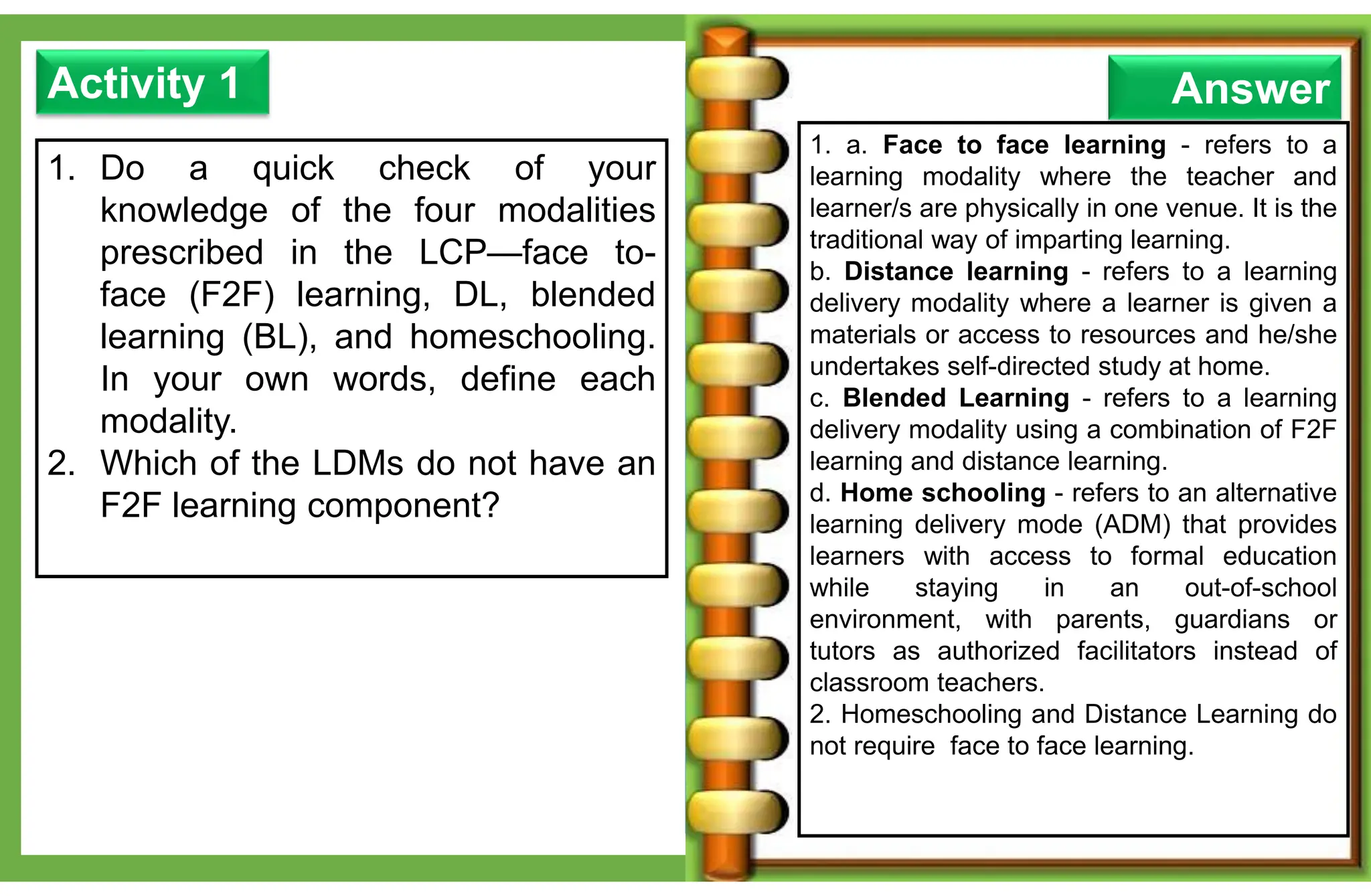
1. Do a quick check of your
knowledge of the four modalities
prescribed in the LCP—face to-
face (F2F) learning, DL, blended
learning (BL), and homeschooling.
In your own words, define each
modality.
2. Which of the LDMs do not have an
F2F learning component?
Activity 1
1. a. Face to face learning - refers to a
learning modality where the teacher and
learner/s are physically in one venue. It is the
traditional way of imparting learning.
b. Distance learning - refers to a learning
delivery modality where a learner is given a
materials or access to resources and he/she
undertakes self-directed study at home.
c. Blended Learning - refers to a learning
delivery modality using a combination of F2F
learning and distance learning.
d. Home schooling - refers to an alternative
learning delivery mode (ADM) that provides
learners with access to formal education
while staying in an out-of-school
environment, with parents, guardians or
tutors as authorized facilitators instead of
classroom teachers.
2. Homeschooling and Distance Learning do
not require face to face learning.
Answer
Activity 2
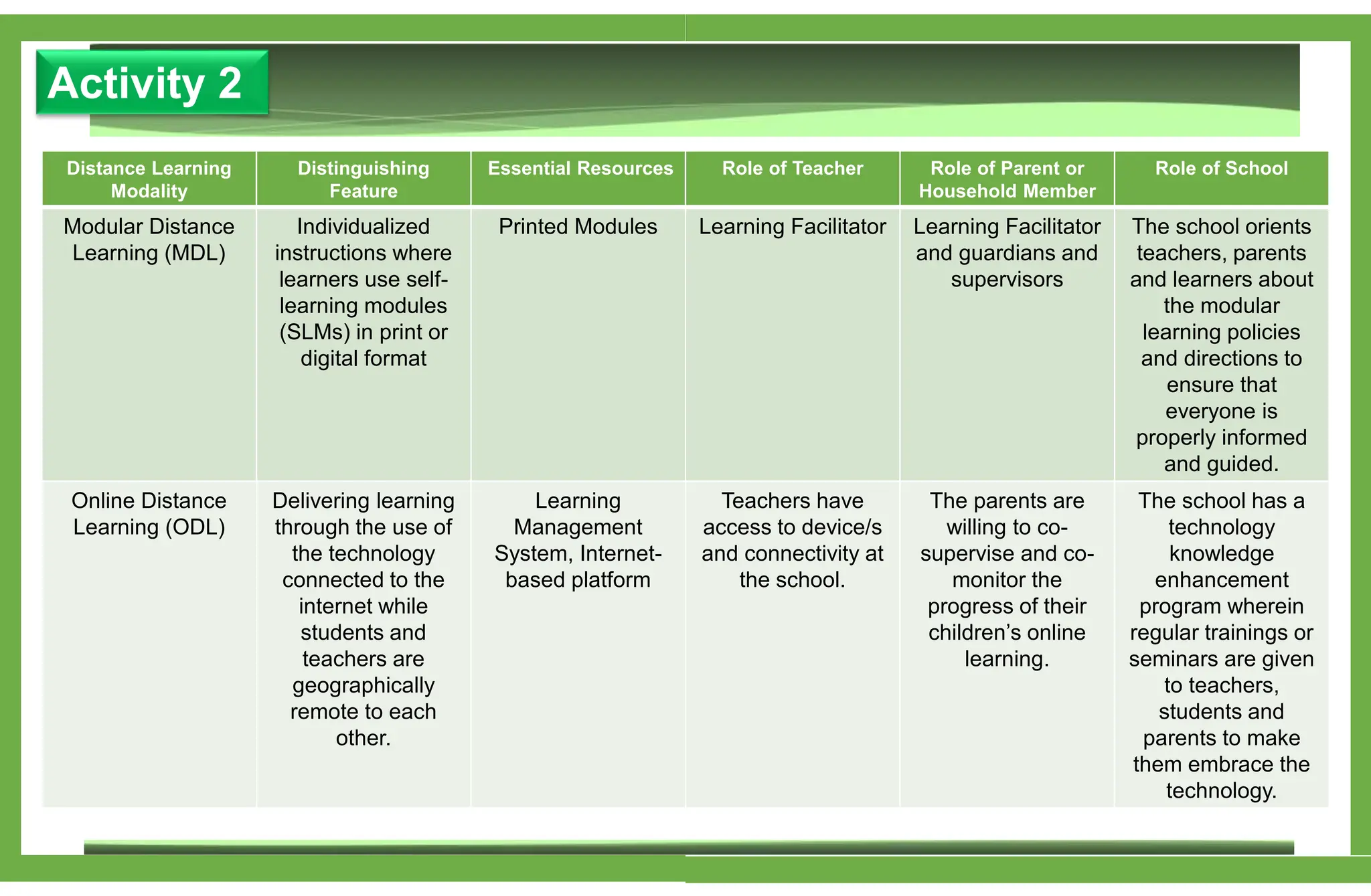
Distance Learning
Modality
Distinguishing
Feature
Essential Resources Role of Teacher Role of Parent or
Household Member
Role of School
Modular Distance
Learning (MDL)
Individualized
instructions where
learners use self-
learning modules
(SLMs) in print or
digital format
Printed Modules Learning Facilitator Learning Facilitator
and guardians and
supervisors
The school orients
teachers, parents
and learners about
the modular
learning policies
and directions to
ensure that
everyone is
properly informed
and guided.
Online Distance
Learning (ODL)
Delivering learning
through the use of
the technology
connected to the
internet while
students and
teachers are
geographically
remote to each
other.
Learning
Management
System, Internet-
based platform
Teachers have
access to device/s
and connectivity at
the school.
The parents are
willing to co-
supervise and co-
monitor the
progress of their
children’s online
learning.
The school has a
technology
knowledge
enhancement
program wherein
regular trainings or
seminars are given
to teachers,
students and
parents to make
them embrace the
technology.
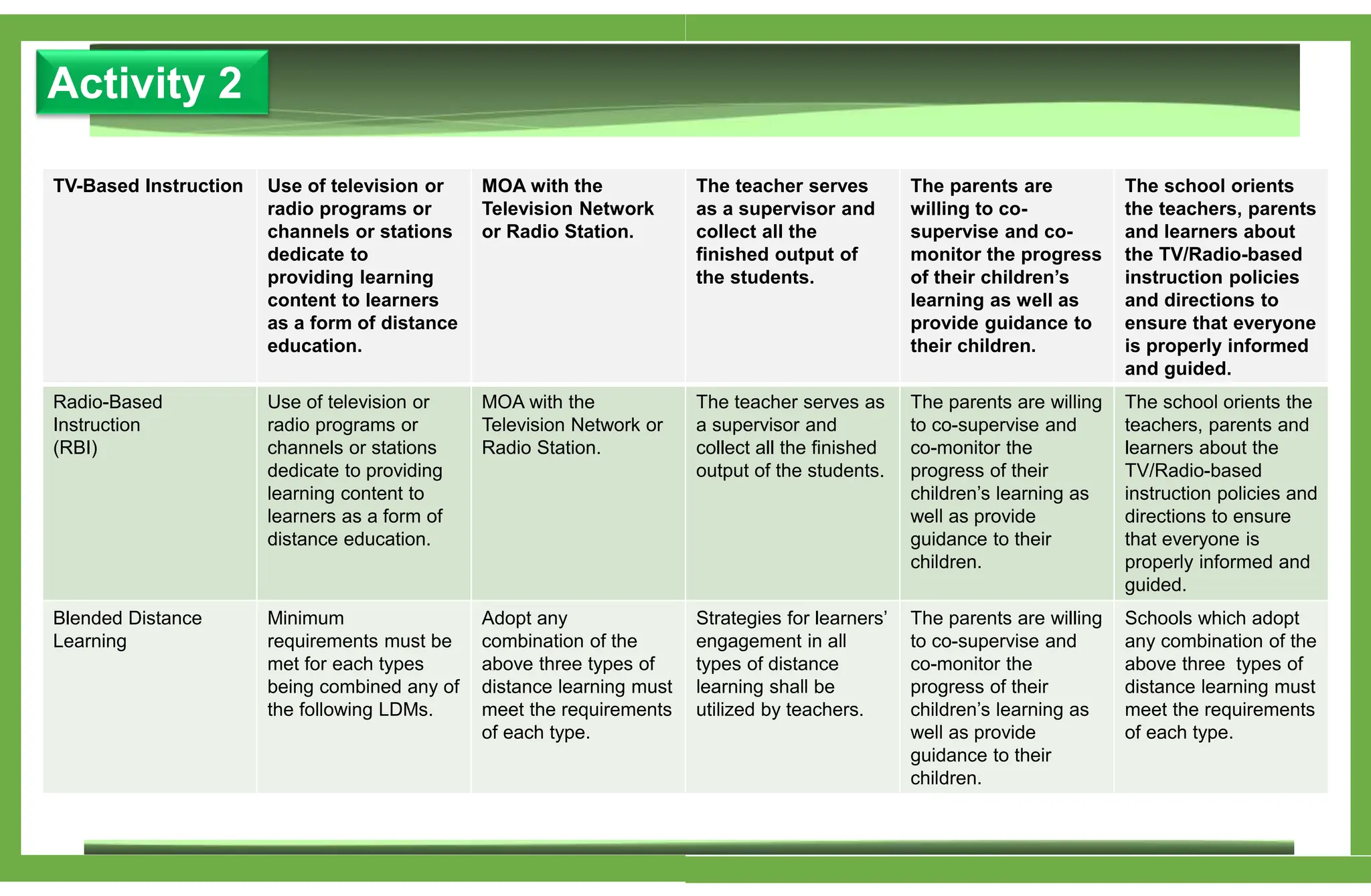
Activity 2
TV-Based Instruction Use of television or
radio programs or
channels or stations
dedicate to
providing learning
content to learners
as a form of distance
education.
MOA with the
Television Network
or Radio Station.
The teacher serves
as a supervisor and
collect all the
finished output of
the students.
The parents are
willing to co-
supervise and co-
monitor the progress
of their children’s
learning as well as
provide guidance to
their children.
The school orients
the teachers, parents
and learners about
the TV/Radio-based
instruction policies
and directions to
ensure that everyone
is properly informed
and guided.
Radio-Based
Instruction
(RBI)
Use of television or
radio programs or
channels or stations
dedicate to providing
learning content to
learners as a form of
distance education.
MOA with the
Television Network or
Radio Station.
The teacher serves as
a supervisor and
collect all the finished
output of the students.
The parents are willing
to co-supervise and
co-monitor the
progress of their
children’s learning as
well as provide
guidance to their
children.
The school orients the
teachers, parents and
learners about the
TV/Radio-based
instruction policies and
directions to ensure
that everyone is
properly informed and
guided.
Blended Distance
Learning
Minimum
requirements must be
met for each types
being combined any of
the following LDMs.
Adopt any
combination of the
above three types of
distance learning must
meet the requirements
of each type.
Strategies for learners’
engagement in all
types of distance
learning shall be
utilized by teachers.
The parents are willing
to co-supervise and
co-monitor the
progress of their
children’s learning as
well as provide
guidance to their
children.
Schools which adopt
any combination of the
above three types of
distance learning must
meet the requirements
of each type.
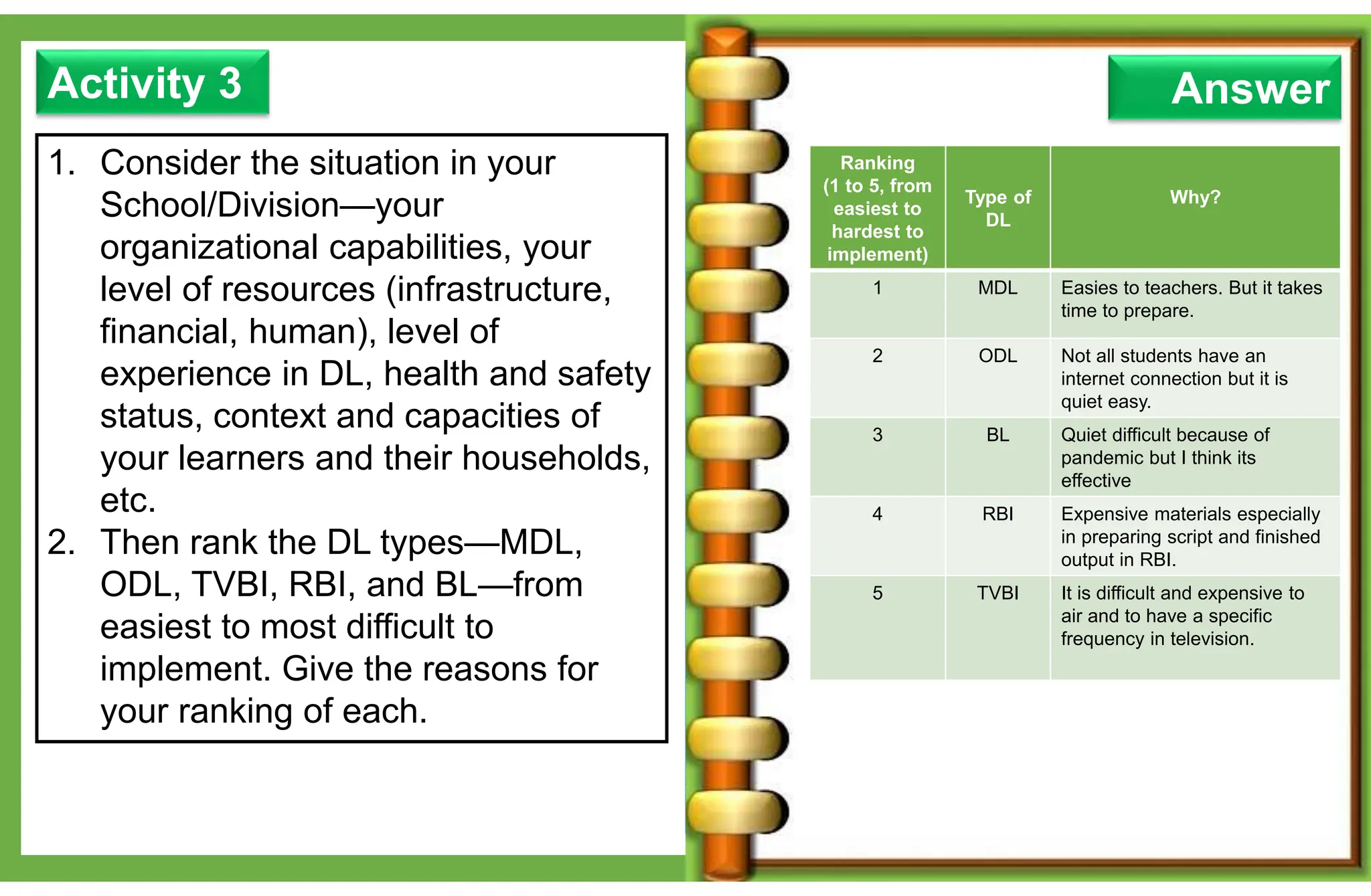
Activity 3 Answer
1. Consider the situation in your
School/Division—your
organizational capabilities, your
level of resources (infrastructure,
financial, human), level of
experience in DL, health and safety
status, context and capacities of
your learners and their households,
etc.
2. Then rank the DL types—MDL,
ODL, TVBI, RBI, and BL—from
easiest to most difficult to
implement. Give the reasons for
your ranking of each.
Ranking
(1 to 5, from
easiest to
hardest to
implement)
Type of
DL
Why?
1 MDL Easies to teachers. But it takes
time to prepare.
2 ODL Not all students have an
internet connection but it is
quiet easy.
3 BL Quiet difficult because of
pandemic but I think its
effective
4 RBI Expensive materials especially
in preparing script and finished
output in RBI.
5 TVBI It is difficult and expensive to
air and to have a specific
frequency in television.
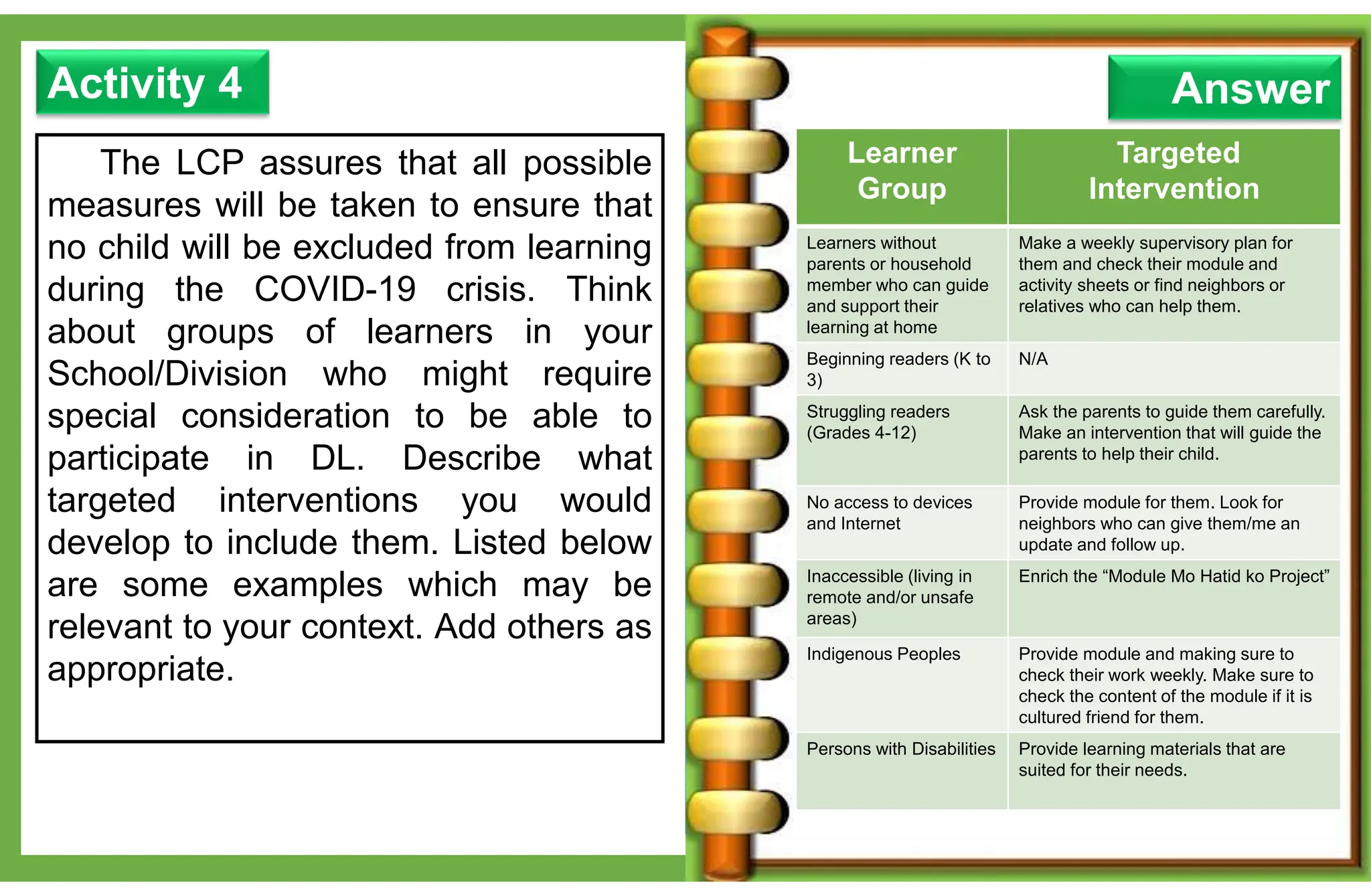
Activity 4 Answer
The LCP assures that all possible
measures will be taken to ensure that
no child will be excluded from learning
during the COVID-19 crisis. Think
about groups of learners in your
School/Division who might require
special consideration to be able to
participate in DL. Describe what
targeted interventions you would
develop to include them. Listed below
are some examples which may be
relevant to your context. Add others as
appropriate.
Learner
Group
Targeted
Intervention
Learners without
parents or household
member who can guide
and support their
learning at home
Make a weekly supervisory plan for
them and check their module and
activity sheets or find neighbors or
relatives who can help them.
Beginning readers (K to
3)
N/A
Struggling readers
(Grades 4-12)
Ask the parents to guide them carefully.
Make an intervention that will guide the
parents to help their child.
No access to devices
and Internet
Provide module for them. Look for
neighbors who can give them/me an
update and follow up.
Inaccessible (living in
remote and/or unsafe
areas)
Enrich the “Module Mo Hatid ko Project”
Indigenous Peoples Provide module and making sure to
check their work weekly. Make sure to
check the content of the module if it is
cultured friend for them.
Persons with Disabilities Provide learning materials that are
suited for their needs.
LESSON 2
Designing Lessons and
Assessments in the
Different LDMs
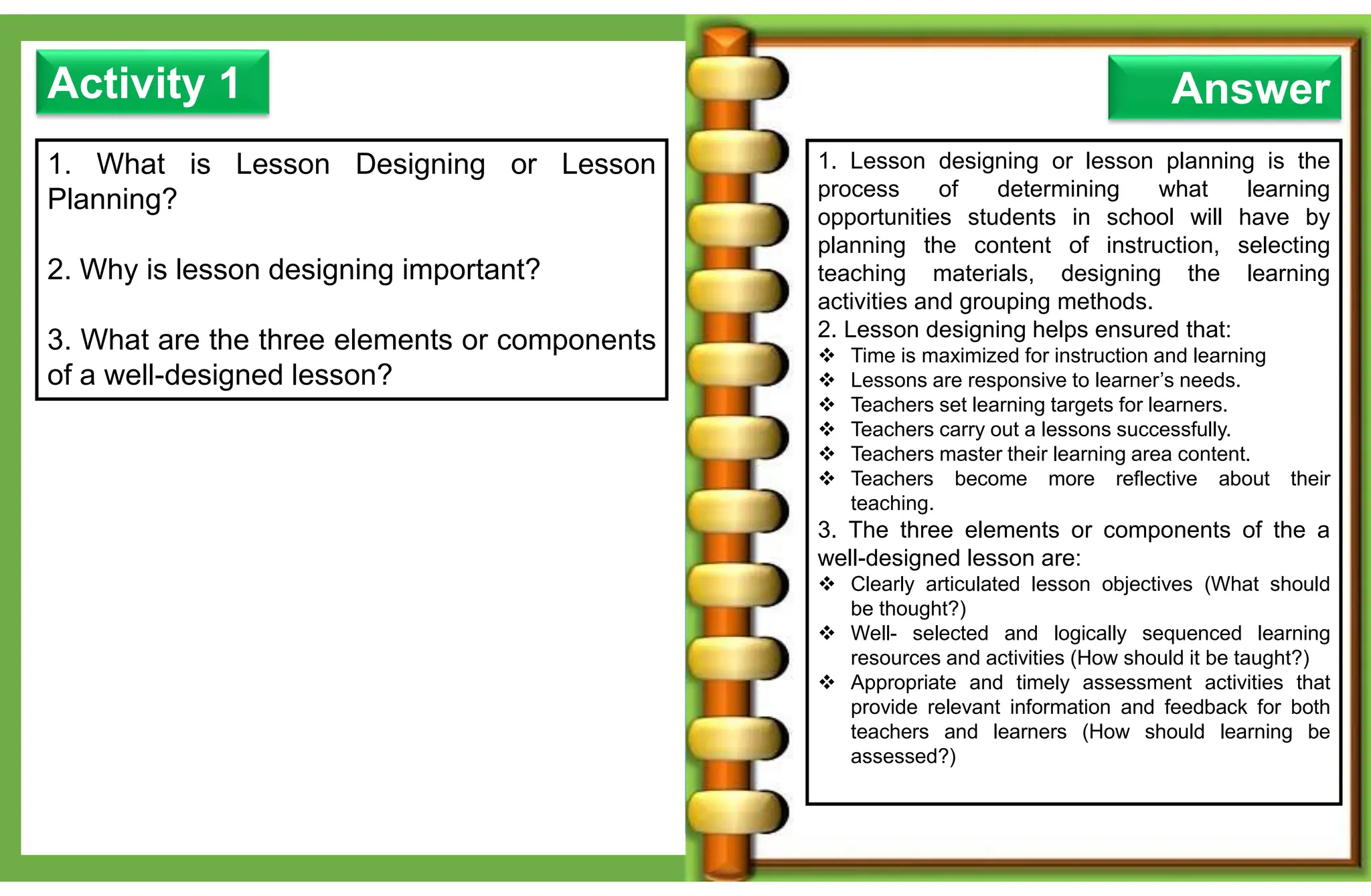
1. What is Lesson Designing or Lesson
Planning?
2. Why is lesson designing important?
3. What are the three elements or components
of a well-designed lesson?
Activity 1
1. Lesson designing or lesson planning is the
process of determining what learning
opportunities students in school will have by
planning the content of instruction, selecting
teaching materials, designing the learning
activities and grouping methods.
2. Lesson designing helps ensured that:
 Time is maximized for instruction and learning
 Lessons are responsive to learner’s needs.
 Teachers set learning targets for learners.
 Teachers carry out a lessons successfully.
 Teachers master their learning area content.
 Teachers become more reflective about their
teaching.
3. The three elements or components of the a
well-designed lesson are:
 Clearly articulated lesson objectives (What should
be thought?)
 Well- selected and logically sequenced learning
resources and activities (How should it be taught?)
 Appropriate and timely assessment activities that
provide relevant information and feedback for both
teachers and learners (How should learning be
assessed?)
Answer
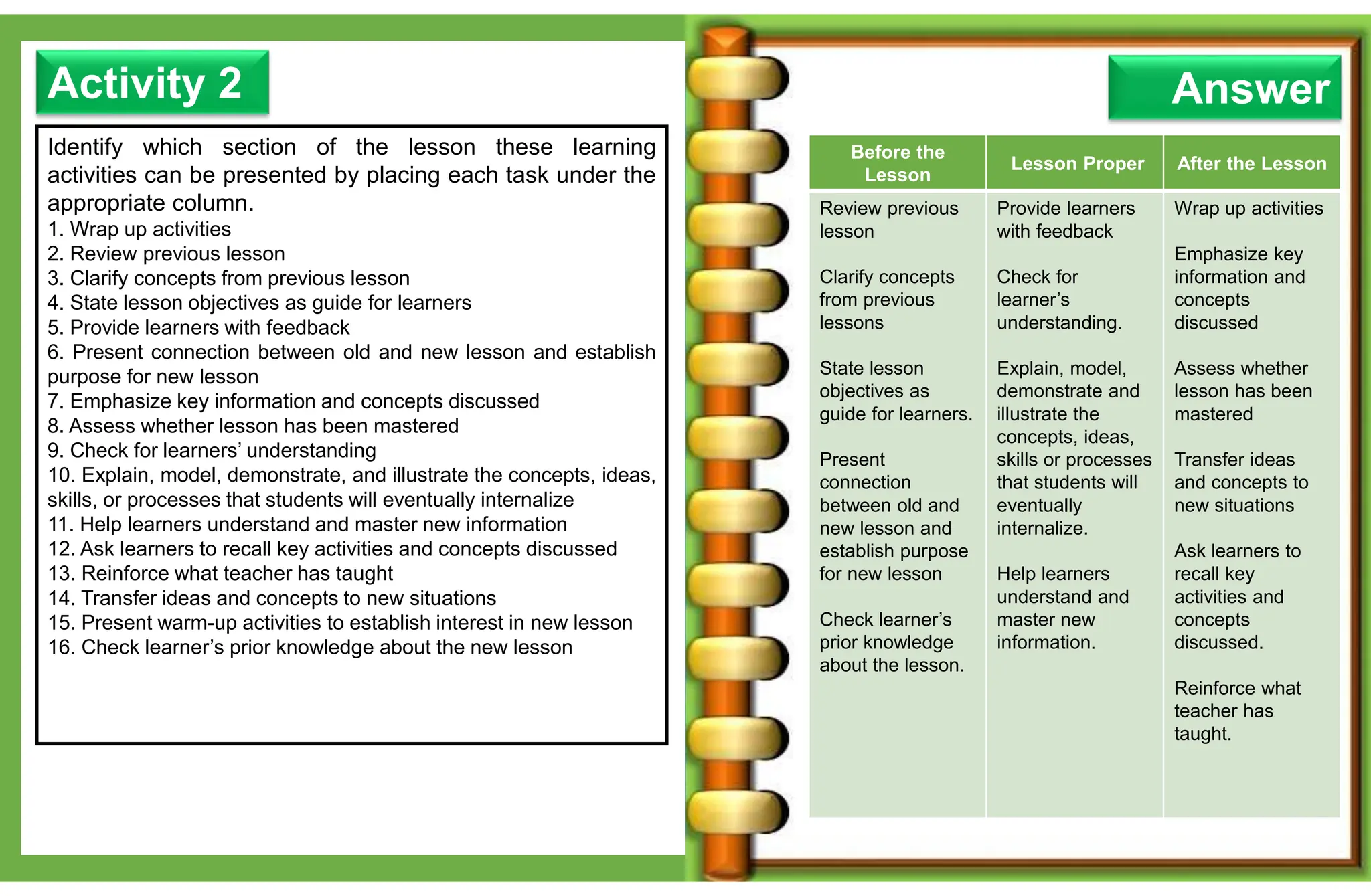
Identify which section of the lesson these learning
activities can be presented by placing each task under the
appropriate column.
1. Wrap up activities
2. Review previous lesson
3. Clarify concepts from previous lesson
4. State lesson objectives as guide for learners
5. Provide learners with feedback
6. Present connection between old and new lesson and establish
purpose for new lesson
7. Emphasize key information and concepts discussed
8. Assess whether lesson has been mastered
9. Check for learners’ understanding
10. Explain, model, demonstrate, and illustrate the concepts, ideas,
skills, or processes that students will eventually internalize
11. Help learners understand and master new information
12. Ask learners to recall key activities and concepts discussed
13. Reinforce what teacher has taught
14. Transfer ideas and concepts to new situations
15. Present warm-up activities to establish interest in new lesson
16. Check learner’s prior knowledge about the new lesson
Activity 2 Answer
Before the
Lesson
Lesson Proper After the Lesson
Review previous
lesson
Clarify concepts
from previous
lessons
State lesson
objectives as
guide for learners.
Present
connection
between old and
new lesson and
establish purpose
for new lesson
Check learner’s
prior knowledge
about the lesson.
Provide learners
with feedback
Check for
learner’s
understanding.
Explain, model,
demonstrate and
illustrate the
concepts, ideas,
skills or processes
that students will
eventually
internalize.
Help learners
understand and
master new
information.
Wrap up activities
Emphasize key
information and
concepts
discussed
Assess whether
lesson has been
mastered
Transfer ideas
and concepts to
new situations
Ask learners to
recall key
activities and
concepts
discussed.
Reinforce what
teacher has
taught.
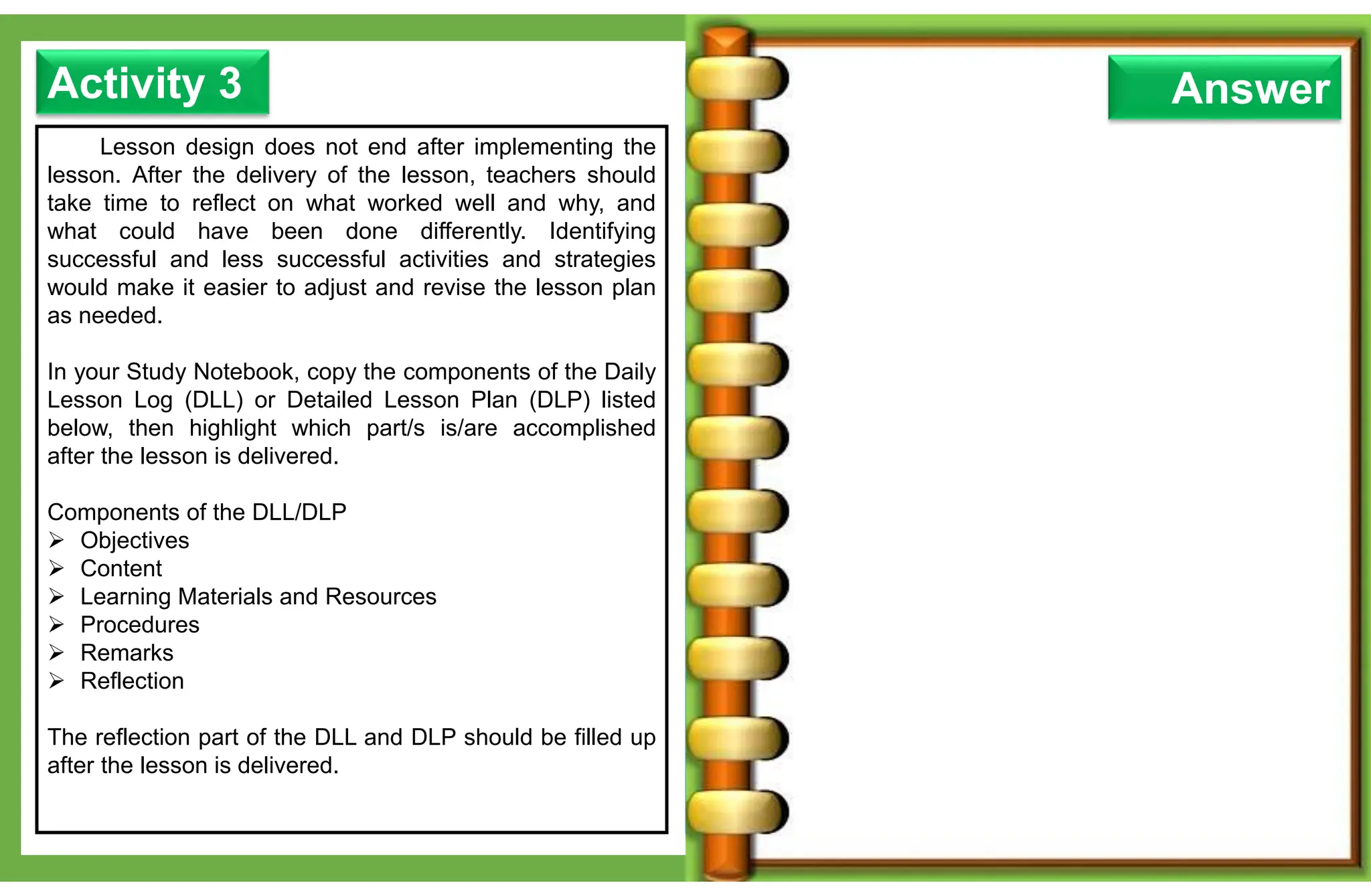
Lesson design does not end after implementing the
lesson. After the delivery of the lesson, teachers should
take time to reflect on what worked well and why, and
what could have been done differently. Identifying
successful and less successful activities and strategies
would make it easier to adjust and revise the lesson plan
as needed.
In your Study Notebook, copy the components of the Daily
Lesson Log (DLL) or Detailed Lesson Plan (DLP) listed
below, then highlight which part/s is/are accomplished
after the lesson is delivered.
Components of the DLL/DLP
 Objectives
 Content
 Learning Materials and Resources
 Procedures
 Remarks
 Reflection
The reflection part of the DLL and DLP should be filled up
after the lesson is delivered.
Activity 3 Answer
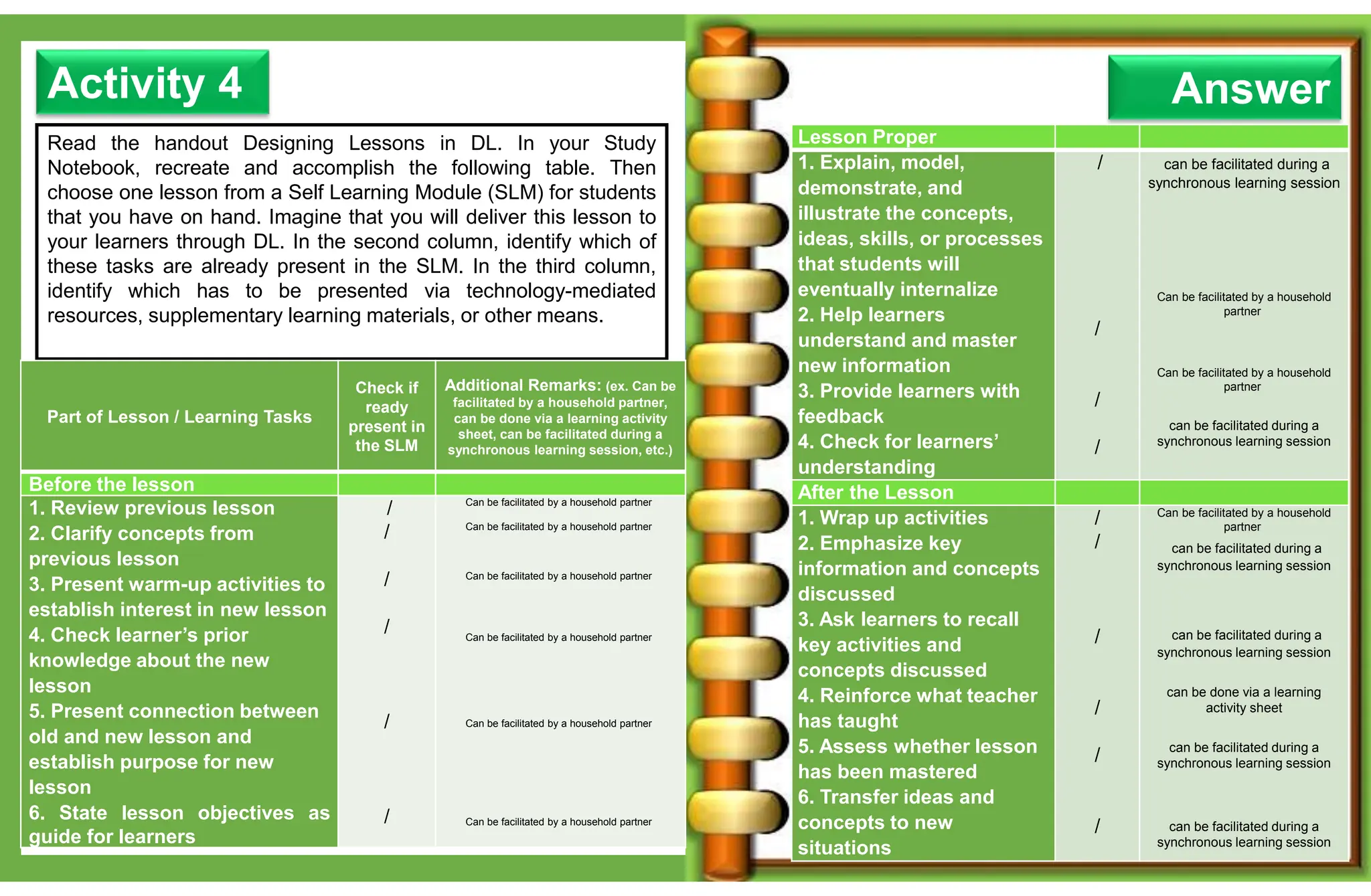
Read the handout Designing Lessons in DL. In your Study
Notebook, recreate and accomplish the following table. Then
choose one lesson from a Self Learning Module (SLM) for students
that you have on hand. Imagine that you will deliver this lesson to
your learners through DL. In the second column, identify which of
these tasks are already present in the SLM. In the third column,
identify which has to be presented via technology-mediated
resources, supplementary learning materials, or other means.
Activity 4 Answer
Part of Lesson / Learning Tasks
Check if
ready
present in
the SLM
Additional Remarks: (ex. Can be
facilitated by a household partner,
can be done via a learning activity
sheet, can be facilitated during a
synchronous learning session, etc.)
Before the lesson
1. Review previous lesson
2. Clarify concepts from
previous lesson
3. Present warm-up activities to
establish interest in new lesson
4. Check learner’s prior
knowledge about the new
lesson
5. Present connection between
old and new lesson and
establish purpose for new
lesson
6. State lesson objectives as
guide for learners
/
/
/
/
/
/
Can be facilitated by a household partner
Lesson Proper
1. Explain, model,
demonstrate, and
illustrate the concepts,
ideas, skills, or processes
that students will
eventually internalize
2. Help learners
understand and master
new information
3. Provide learners with
feedback
4. Check for learners’
understanding
/
/
/
/
can be facilitated during a
synchronous learning session
Can be facilitated by a household
partner
Can be facilitated by a household
partner
can be facilitated during a
synchronous learning session
After the Lesson
1. Wrap up activities
2. Emphasize key
information and concepts
discussed
3. Ask learners to recall
key activities and
concepts discussed
4. Reinforce what teacher
has taught
5. Assess whether lesson
has been mastered
6. Transfer ideas and
concepts to new
situations
/
/
/
/
/
/
Can be facilitated by a household
partner
can be facilitated during a
synchronous learning session
can be facilitated during a
synchronous learning session
can be done via a learning
activity sheet
can be facilitated during a
synchronous learning session
can be facilitated during a
synchronous learning session
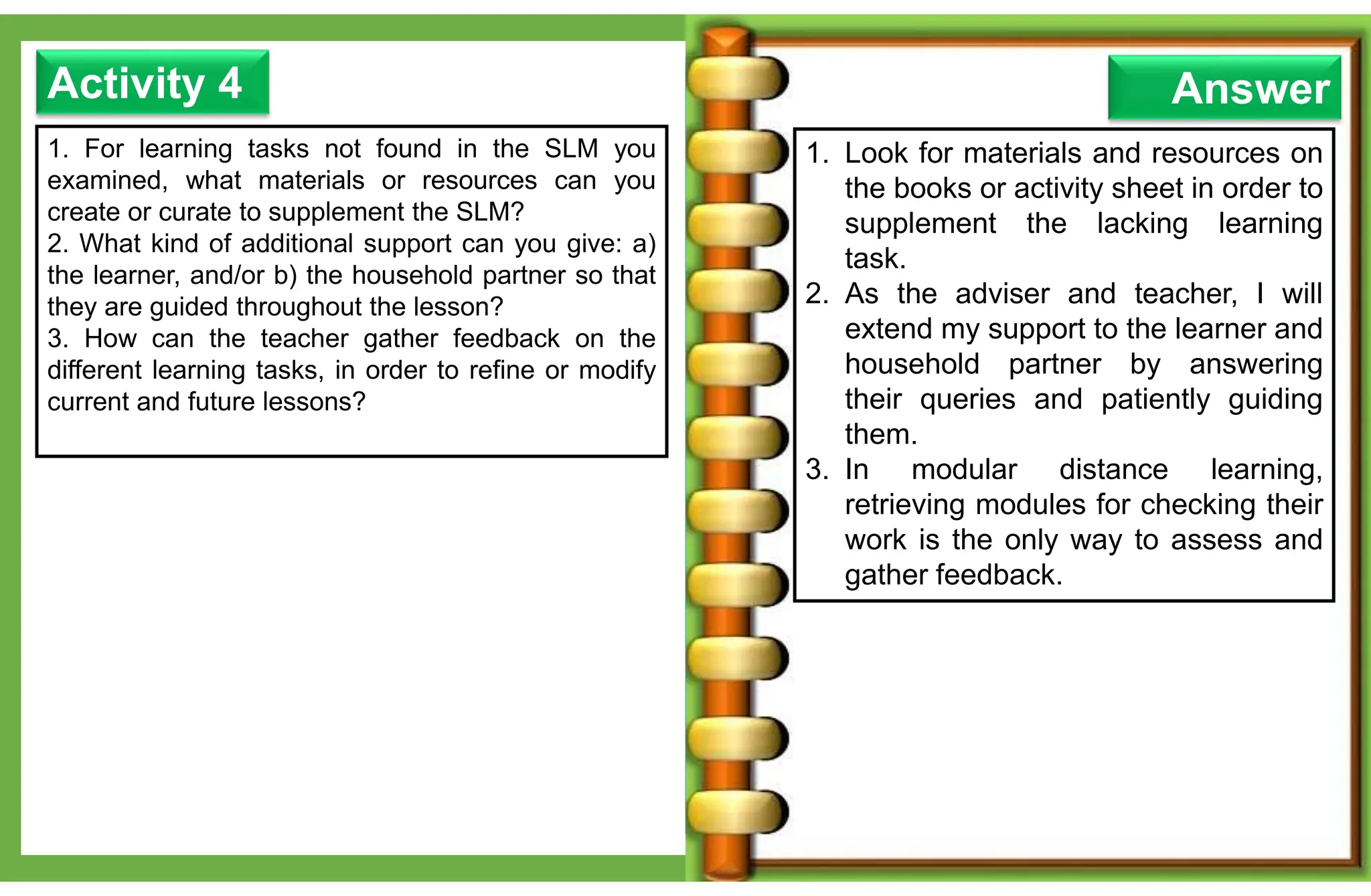
1. For learning tasks not found in the SLM you
examined, what materials or resources can you
create or curate to supplement the SLM?
2. What kind of additional support can you give: a)
the learner, and/or b) the household partner so that
they are guided throughout the lesson?
3. How can the teacher gather feedback on the
different learning tasks, in order to refine or modify
current and future lessons?
Activity 4 Answer
1. Look for materials and resources on
the books or activity sheet in order to
supplement the lacking learning
task.
2. As the adviser and teacher, I will
extend my support to the learner and
household partner by answering
their queries and patiently guiding
them.
3. In modular distance learning,
retrieving modules for checking their
work is the only way to assess and
gather feedback.
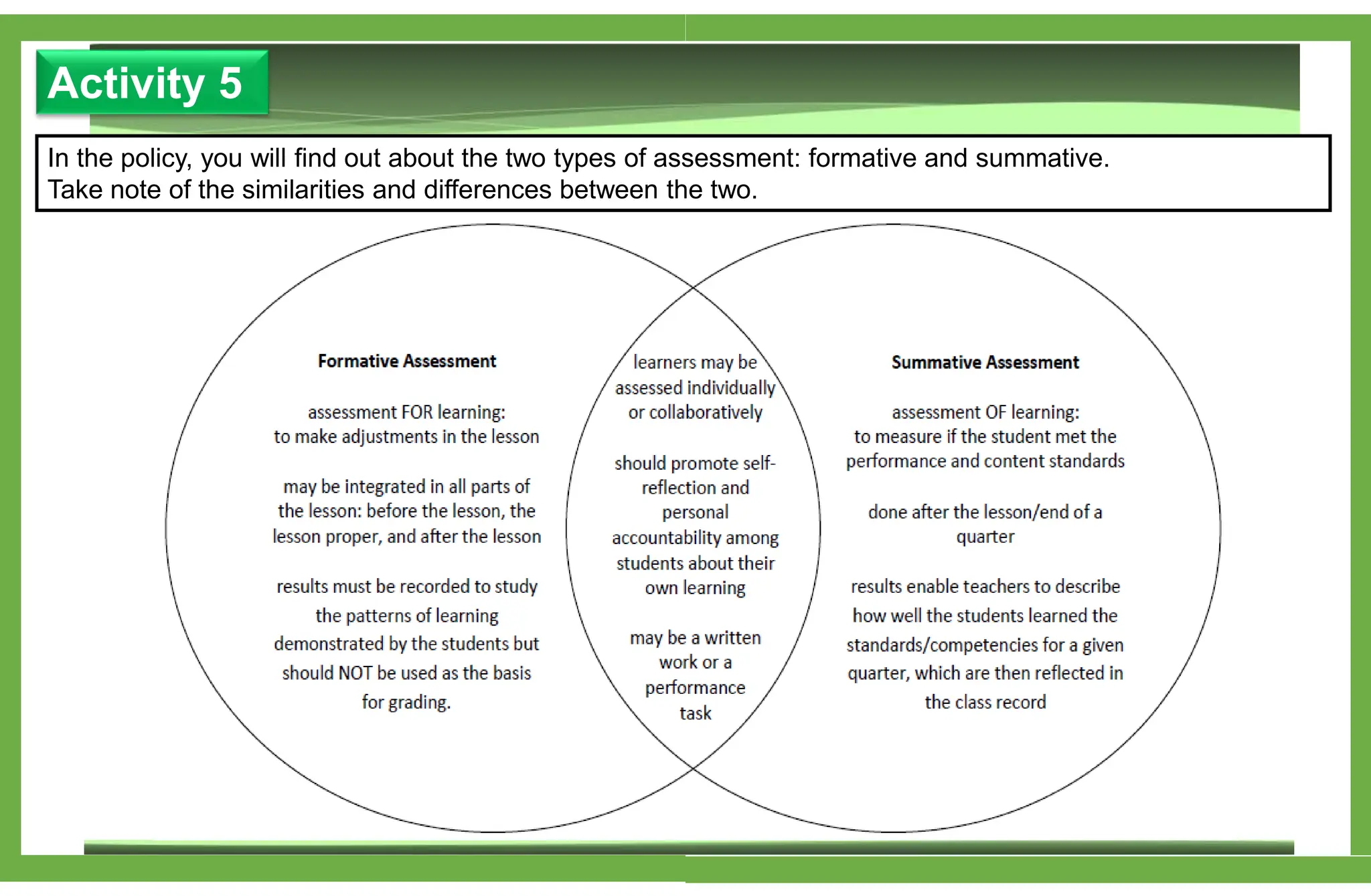
Activity 5
In the policy, you will find out about the two types of assessment: formative and summative.
Take note of the similarities and differences between the two.
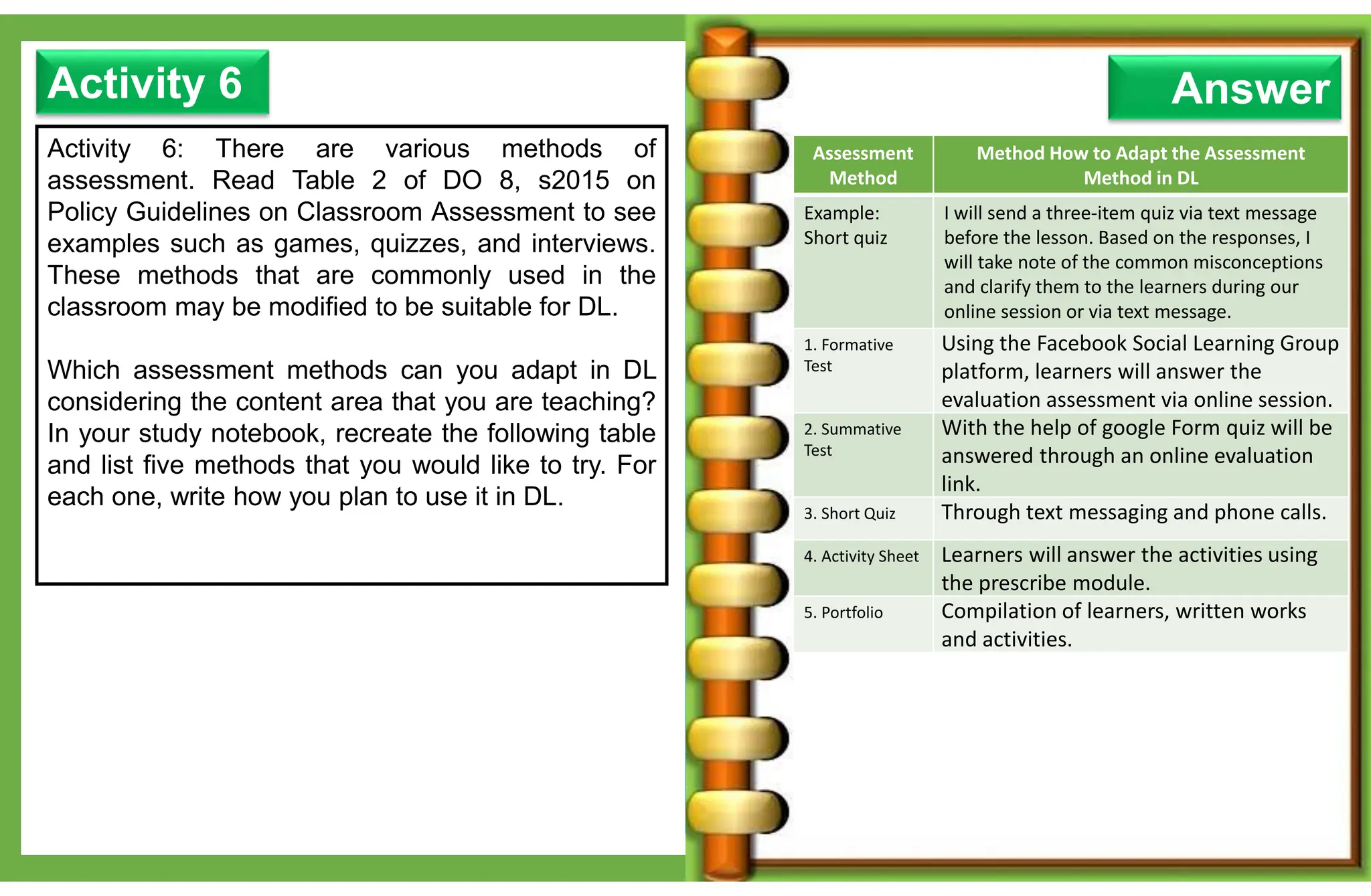
Activity 6: There are various methods of
assessment. Read Table 2 of DO 8, s2015 on
Policy Guidelines on Classroom Assessment to see
examples such as games, quizzes, and interviews.
These methods that are commonly used in the
classroom may be modified to be suitable for DL.
Which assessment methods can you adapt in DL
considering the content area that you are teaching?
In your study notebook, recreate the following table
and list five methods that you would like to try. For
each one, write how you plan to use it in DL.
Activity 6 Answer
Assessment
Method
Method How to Adapt the Assessment
Method in DL
Example:
Short quiz
I will send a three-item quiz via text message
before the lesson. Based on the responses, I
will take note of the common misconceptions
and clarify them to the learners during our
online session or via text message.
1. Formative
Test
Using the Facebook Social Learning Group
platform, learners will answer the
evaluation assessment via online session.
2. Summative
Test
With the help of google Form quiz will be
answered through an online evaluation
link.
3. Short Quiz Through text messaging and phone calls.
4. Activity Sheet Learners will answer the activities using
the prescribe module.
5. Portfolio Compilation of learners, written works
and activities.
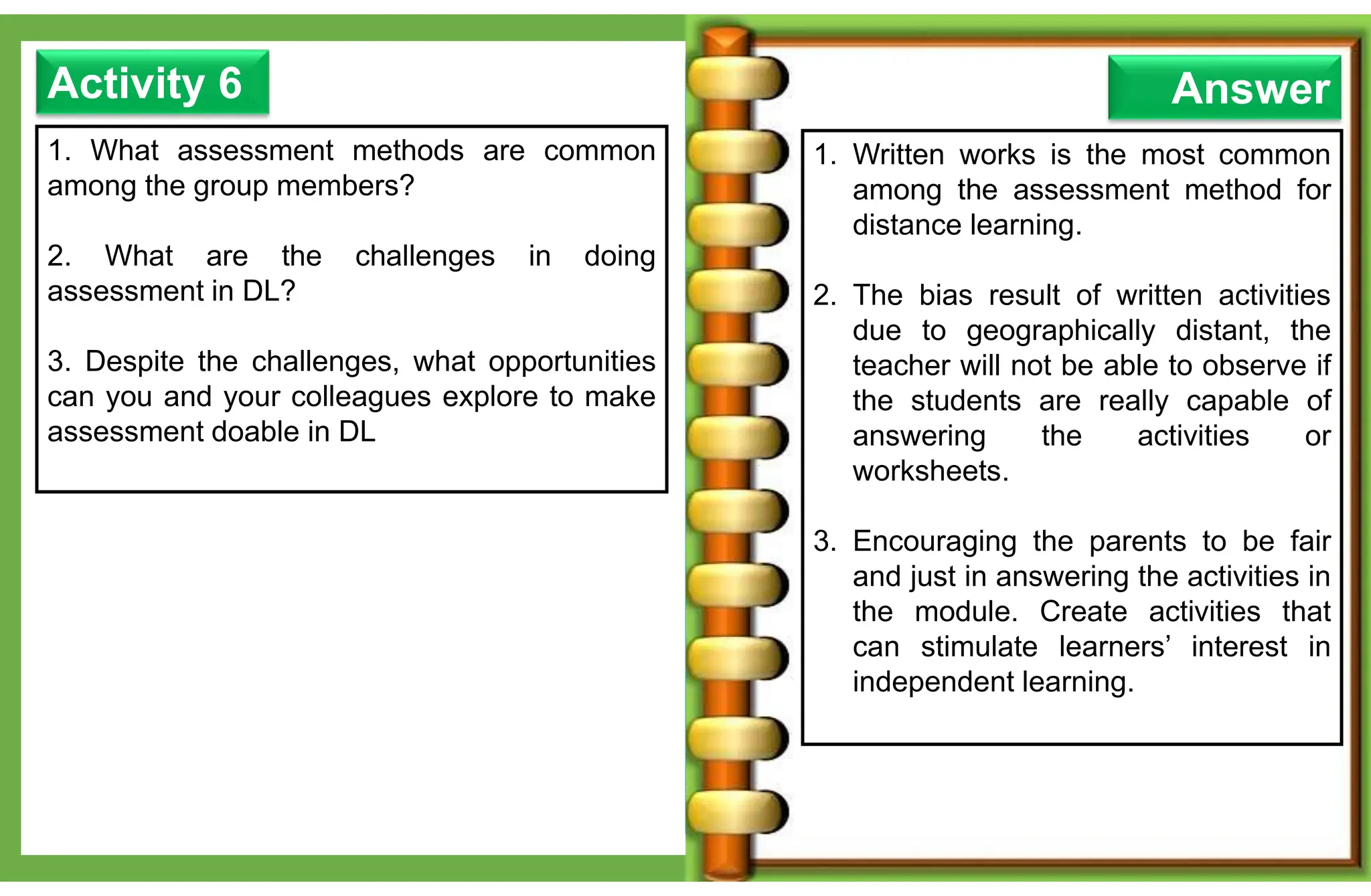
1. What assessment methods are common
among the group members?
2. What are the challenges in doing
assessment in DL?
3. Despite the challenges, what opportunities
can you and your colleagues explore to make
assessment doable in DL
Activity 6 Answer
1. Written works is the most common
among the assessment method for
distance learning.
2. The bias result of written activities
due to geographically distant, the
teacher will not be able to observe if
the students are really capable of
answering the activities or
worksheets.
3. Encouraging the parents to be fair
and just in answering the activities in
the module. Create activities that
can stimulate learners’ interest in
independent learning.
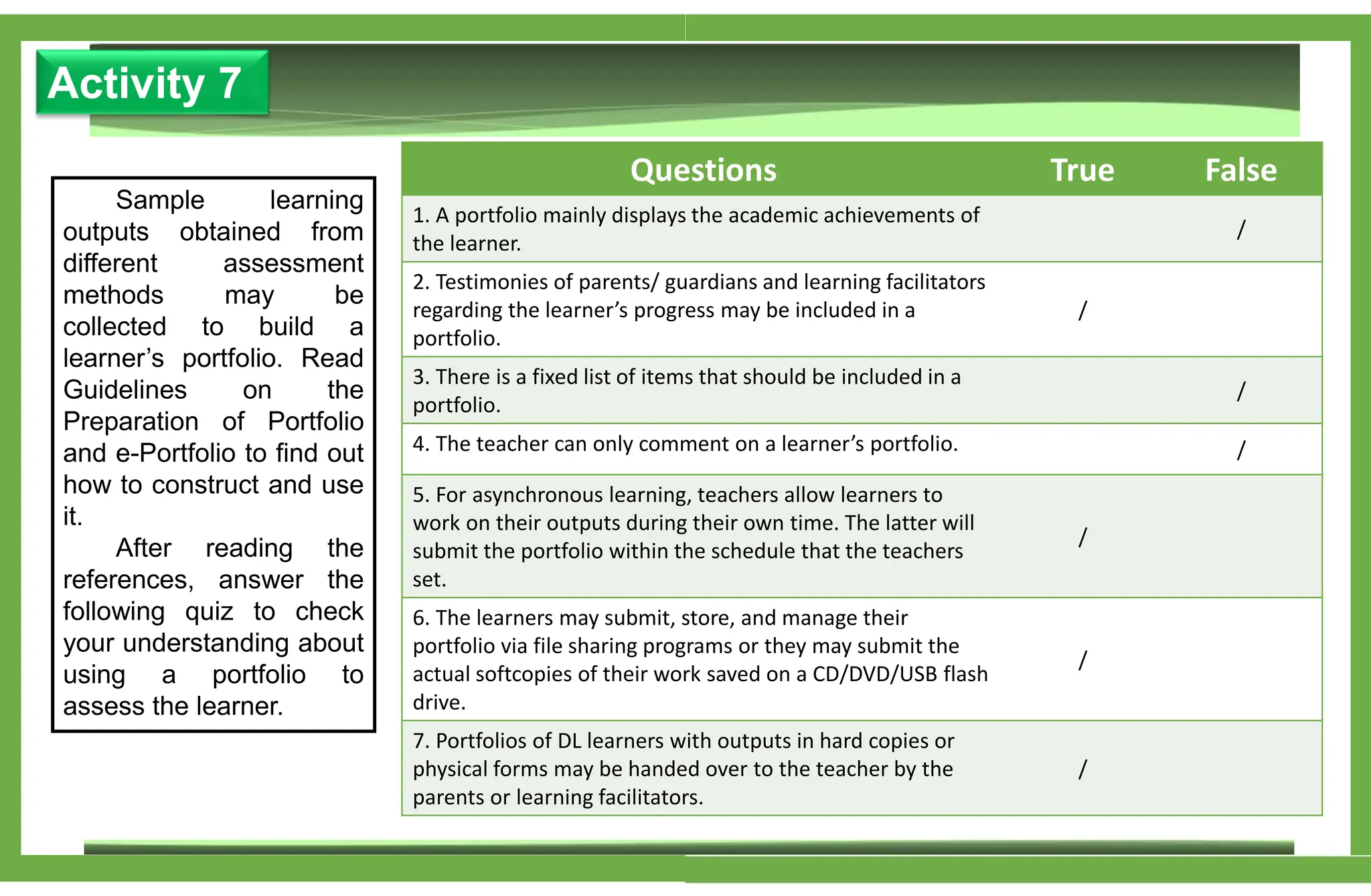
Activity 7
Sample learning
outputs obtained from
different assessment
methods may be
collected to build a
learner’s portfolio. Read
Guidelines on the
Preparation of Portfolio
and e-Portfolio to find out
how to construct and use
it.
After reading the
references, answer the
following quiz to check
your understanding about
using a portfolio to
assess the learner.
Questions True False
1. A portfolio mainly displays the academic achievements of
the learner.
/
2. Testimonies of parents/ guardians and learning facilitators
regarding the learner’s progress may be included in a
portfolio.
/
3. There is a fixed list of items that should be included in a
portfolio.
/
4. The teacher can only comment on a learner’s portfolio. /
5. For asynchronous learning, teachers allow learners to
work on their outputs during their own time. The latter will
submit the portfolio within the schedule that the teachers
set.
/
6. The learners may submit, store, and manage their
portfolio via file sharing programs or they may submit the
actual softcopies of their work saved on a CD/DVD/USB flash
drive.
/
7. Portfolios of DL learners with outputs in hard copies or
physical forms may be handed over to the teacher by the
parents or learning facilitators.
/
LESSON 3
Guiding and Monitoring
Learners in the Different
LDMs
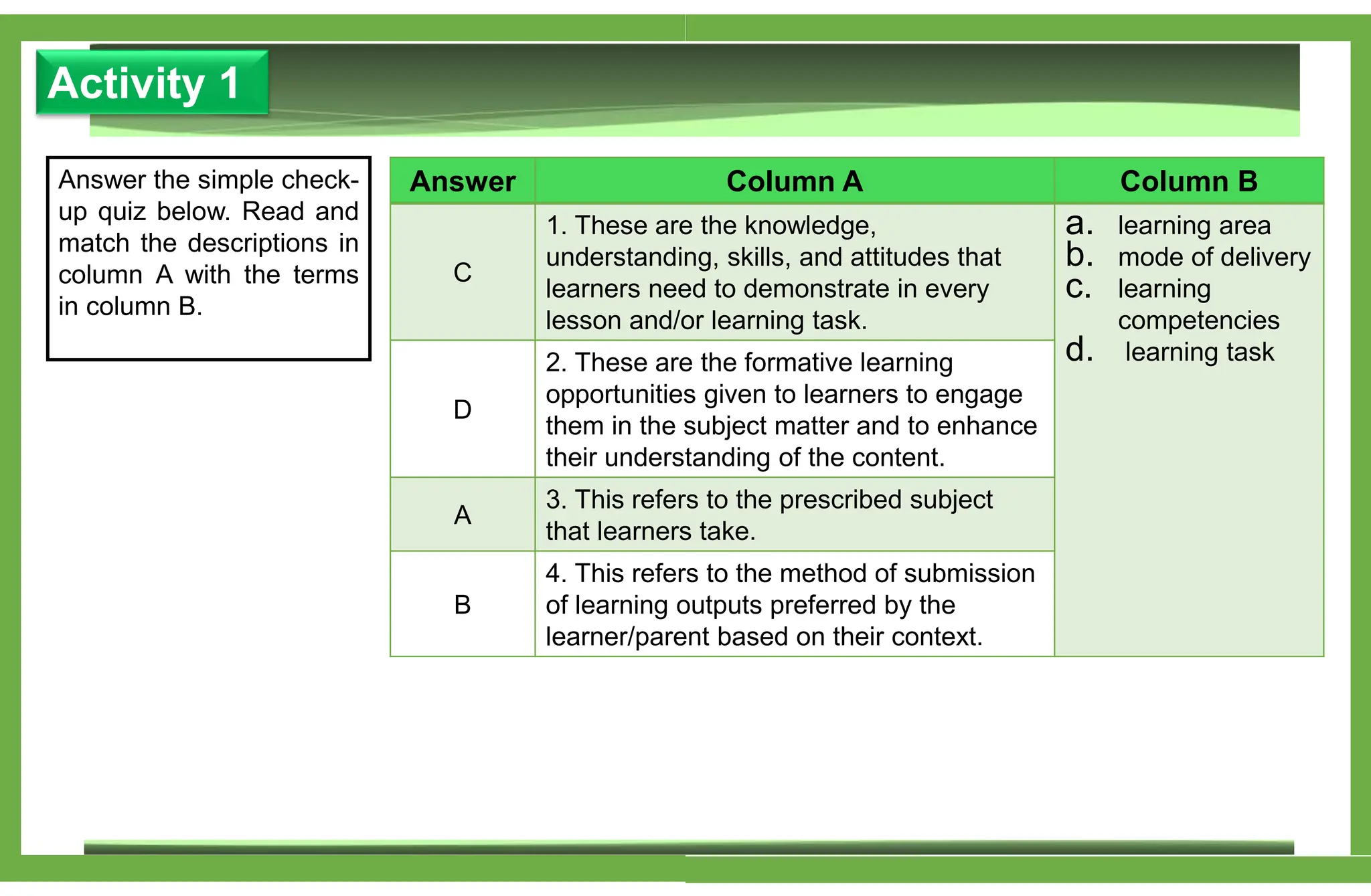
Activity 1
Answer the simple check-
up quiz below. Read and
match the descriptions in
column A with the terms
in column B.
Answer Column A Column B
C
1. These are the knowledge,
understanding, skills, and attitudes that
learners need to demonstrate in every
lesson and/or learning task.
a. learning area
b. mode of delivery
c. learning
competencies
d. learning task
D
2. These are the formative learning
opportunities given to learners to engage
them in the subject matter and to enhance
their understanding of the content.
A
3. This refers to the prescribed subject
that learners take.
B
4. This refers to the method of submission
of learning outputs preferred by the
learner/parent based on their context.
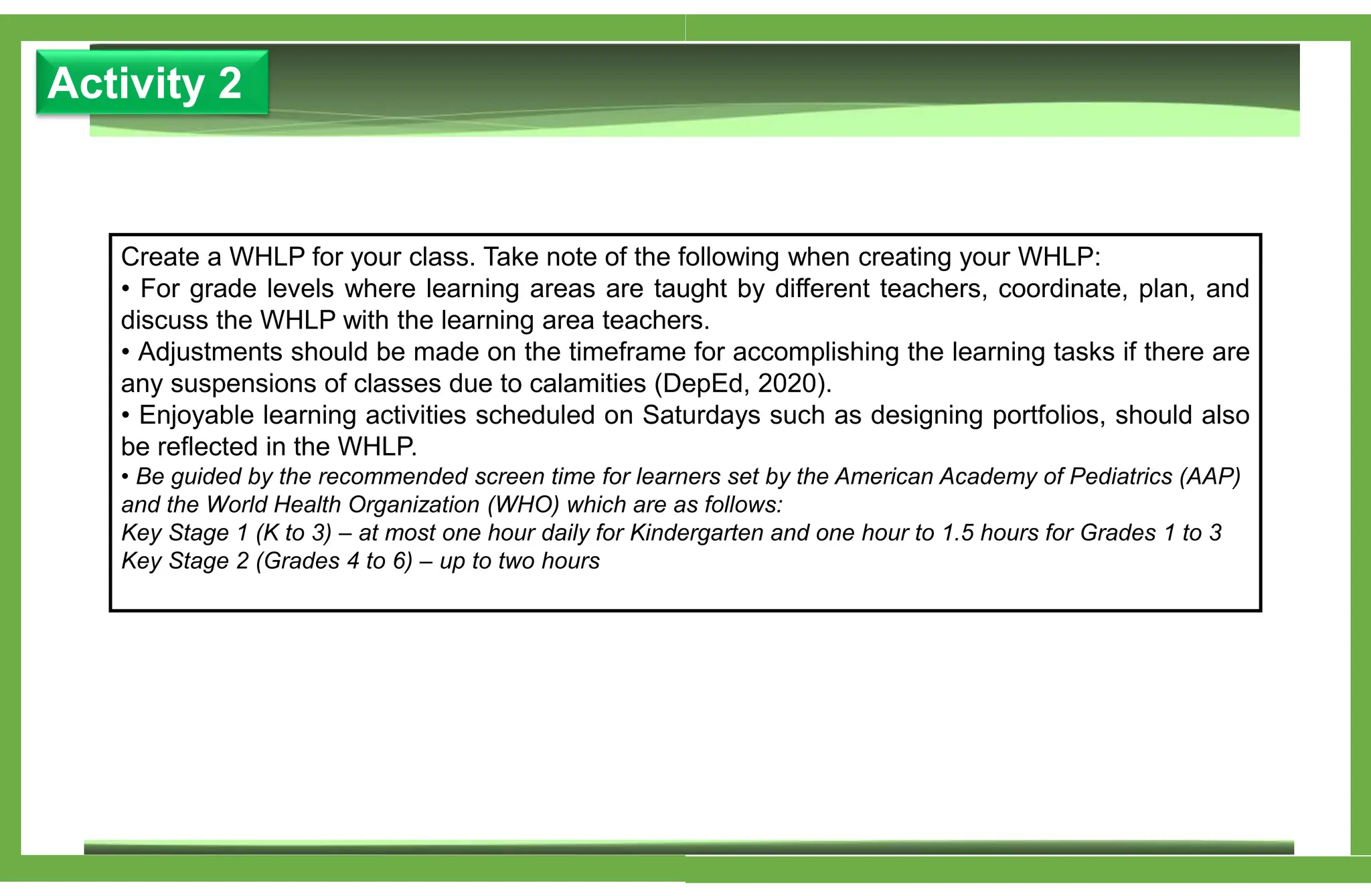
Activity 2
Create a WHLP for your class. Take note of the following when creating your WHLP:
• For grade levels where learning areas are taught by different teachers, coordinate, plan, and
discuss the WHLP with the learning area teachers.
• Adjustments should be made on the timeframe for accomplishing the learning tasks if there are
any suspensions of classes due to calamities (DepEd, 2020).
• Enjoyable learning activities scheduled on Saturdays such as designing portfolios, should also
be reflected in the WHLP.
• Be guided by the recommended screen time for learners set by the American Academy of Pediatrics (AAP)
and the World Health Organization (WHO) which are as follows:
Key Stage 1 (K to 3) – at most one hour daily for Kindergarten and one hour to 1.5 hours for Grades 1 to 3
Key Stage 2 (Grades 4 to 6) – up to two hours
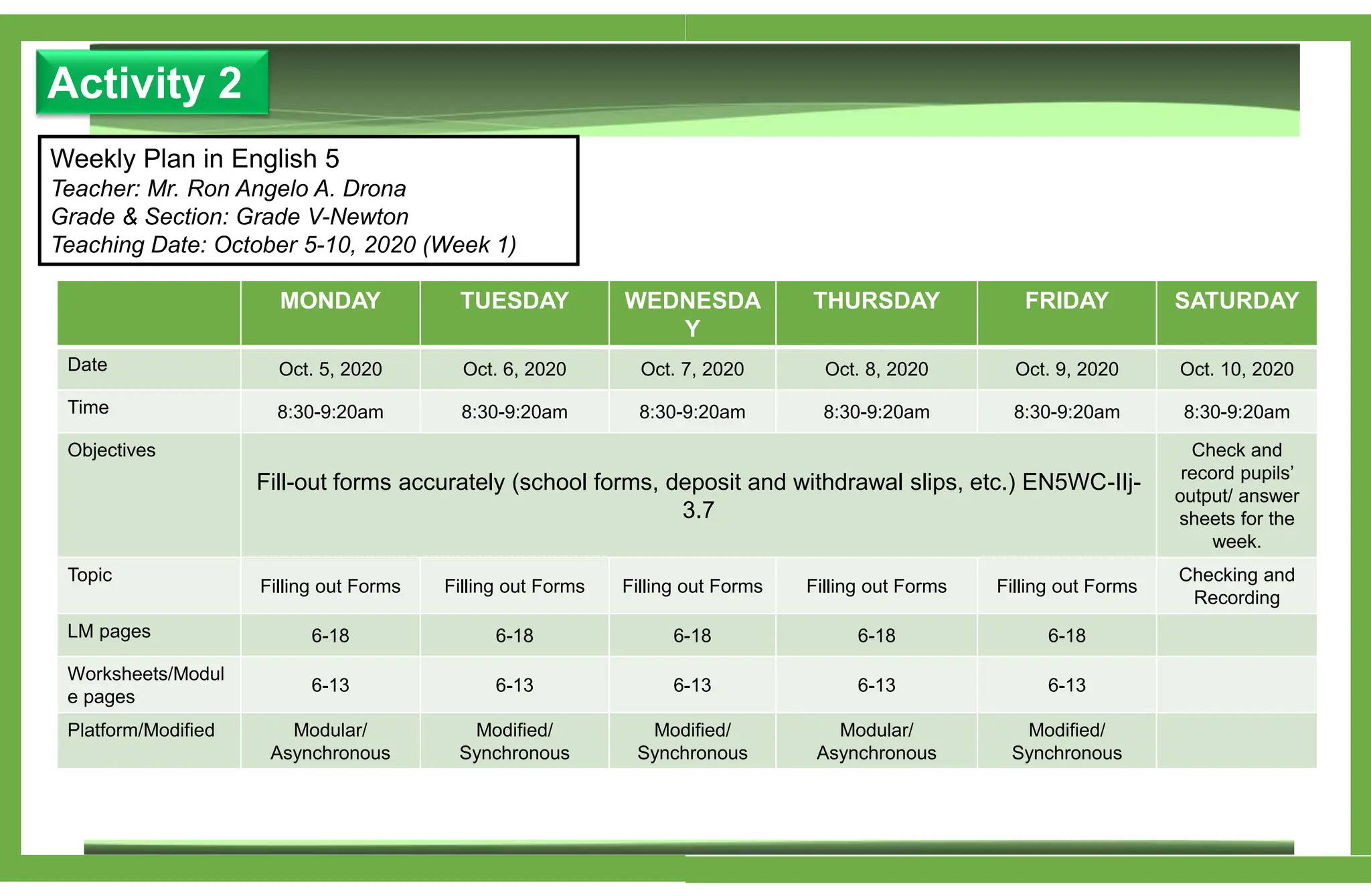
Activity 2
Weekly Plan in English 5
Teacher: Mr. Ron Angelo A. Drona
Grade & Section: Grade V-Newton
Teaching Date: October 5-10, 2020 (Week 1)
MONDAY TUESDAY WEDNESDA
Y
THURSDAY FRIDAY SATURDAY
Date Oct. 5, 2020 Oct. 6, 2020 Oct. 7, 2020 Oct. 8, 2020 Oct. 9, 2020 Oct. 10, 2020
Time 8:30-9:20am 8:30-9:20am 8:30-9:20am 8:30-9:20am 8:30-9:20am 8:30-9:20am
Objectives
Fill-out forms accurately (school forms, deposit and withdrawal slips, etc.) EN5WC-IIj-
3.7
Check and
record pupils’
output/ answer
sheets for the
week.
Topic
Filling out Forms Filling out Forms Filling out Forms Filling out Forms Filling out Forms
Checking and
Recording
LM pages 6-18 6-18 6-18 6-18 6-18
Worksheets/Modul
e pages
6-13 6-13 6-13 6-13 6-13
Platform/Modified Modular/
Asynchronous
Modified/
Synchronous
Modified/
Synchronous
Modular/
Asynchronous
Modified/
Synchronous
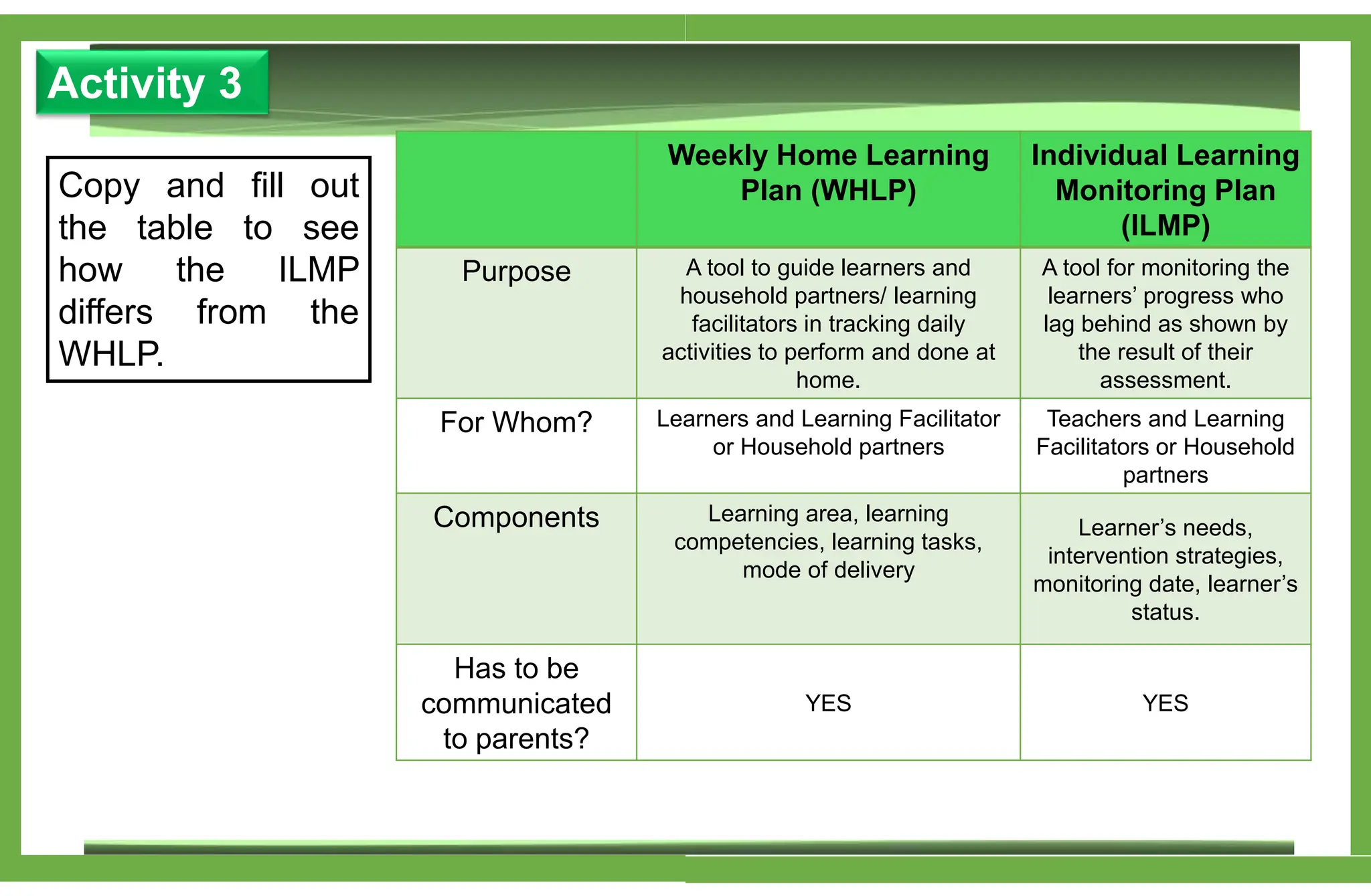
Activity 3
Copy and fill out
the table to see
how the ILMP
differs from the
WHLP.
Weekly Home Learning
Plan (WHLP)
Individual Learning
Monitoring Plan
(ILMP)
Purpose A tool to guide learners and
household partners/ learning
facilitators in tracking daily
activities to perform and done at
home.
A tool for monitoring the
learners’ progress who
lag behind as shown by
the result of their
assessment.
For Whom? Learners and Learning Facilitator
or Household partners
Teachers and Learning
Facilitators or Household
partners
Components Learning area, learning
competencies, learning tasks,
mode of delivery
Learner’s needs,
intervention strategies,
monitoring date, learner’s
status.
Has to be
communicated
to parents?
YES YES
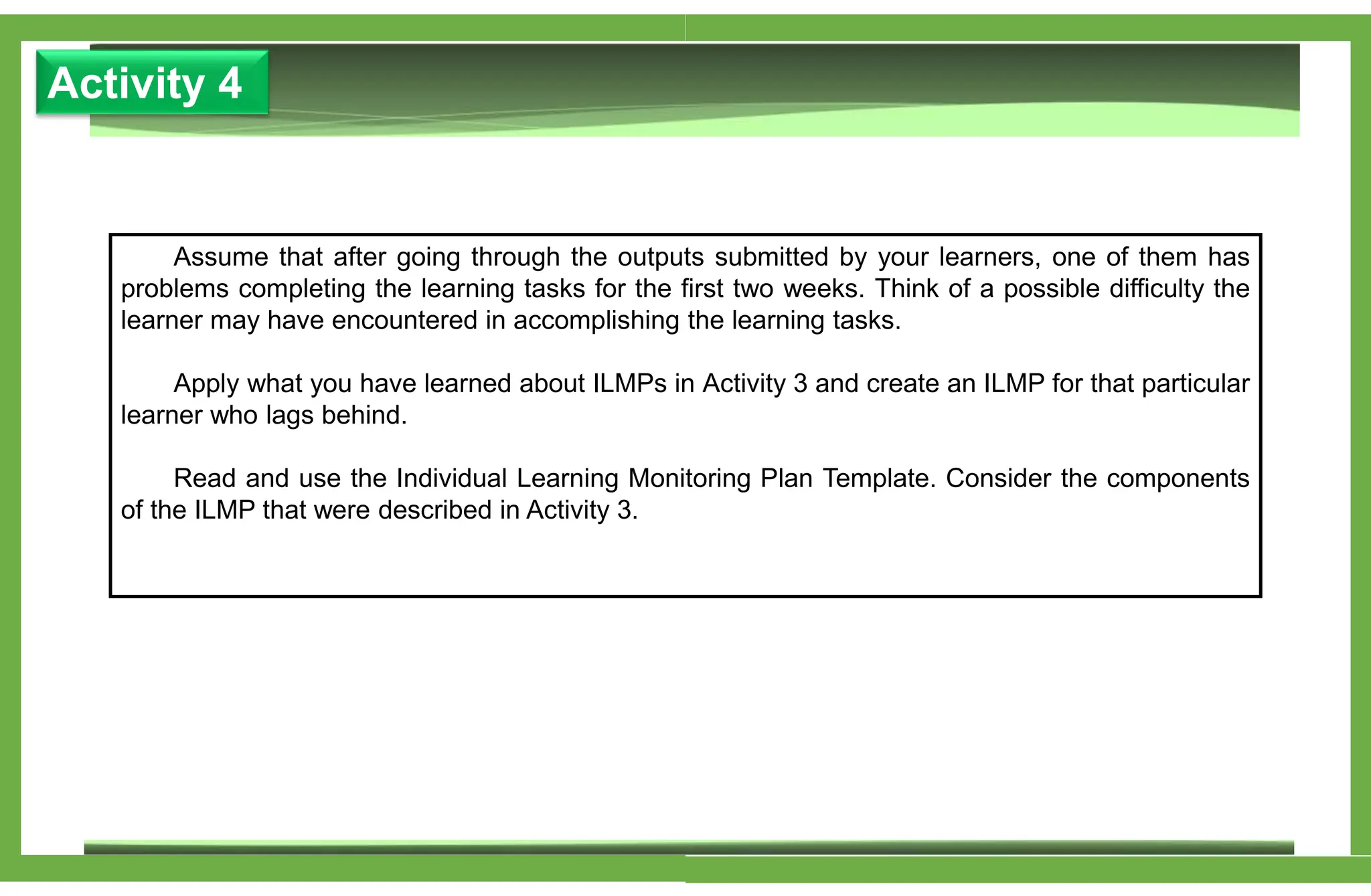
Activity 4
Assume that after going through the outputs submitted by your learners, one of them has
problems completing the learning tasks for the first two weeks. Think of a possible difficulty the
learner may have encountered in accomplishing the learning tasks.
Apply what you have learned about ILMPs in Activity 3 and create an ILMP for that particular
learner who lags behind.
Read and use the Individual Learning Monitoring Plan Template. Consider the components
of the ILMP that were described in Activity 3.
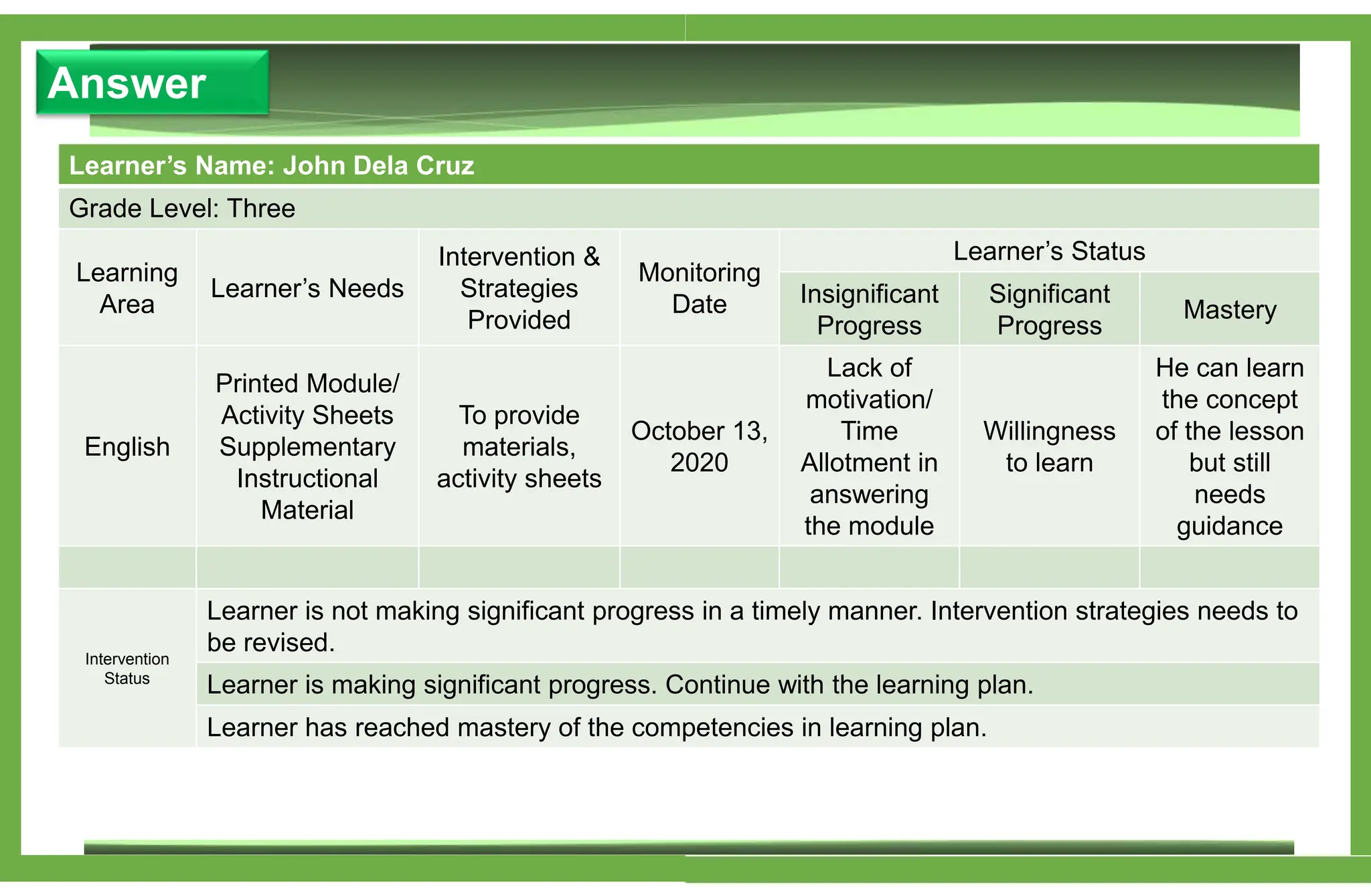
Answer
Learner’s Name: John Dela Cruz
Grade Level: Three
Learning
Area
Learner’s Needs
Intervention &
Strategies
Provided
Monitoring
Date
Learner’s Status
Insignificant
Progress
Significant
Progress
Mastery
English
Printed Module/
Activity Sheets
Supplementary
Instructional
Material
To provide
materials,
activity sheets
October 13,
2020
Lack of
motivation/
Time
Allotment in
answering
the module
Willingness
to learn
He can learn
the concept
of the lesson
but still
needs
guidance
Intervention
Status
Learner is not making significant progress in a timely manner. Intervention strategies needs to
be revised.
Learner is making significant progress. Continue with the learning plan.
Learner has reached mastery of the competencies in learning plan.

Education Module lesson design assessment

  • 1.
    Study notebook LDM2-SDO-Binan-G3-028 Republic ofthe Philippines DEPARTMENT OF EDUCATION Region IV-A CALABARZON SCHOOLS DIVISION OF BIÑAN CITY STO. TOMAS ELEMENTARY SCHOOL Purok 5 Brgy. Sto. Tomas, Biñan City, Laguna/School ID: 108230 ELEMENTARY MERRY ANN A. QUINTILLANO Master Teacher I LAC LEADER GRACE P. HUFALAR Principal I Coach RON ANGELO A. DRONA Teacher II
  • 2.
    LESSON 1 Understanding the DifferentLDMs Lesson Design and Assessment in the Modalities
  • 3.
    1. Do aquick check of your knowledge of the four modalities prescribed in the LCP—face to- face (F2F) learning, DL, blended learning (BL), and homeschooling. In your own words, define each modality. 2. Which of the LDMs do not have an F2F learning component? Activity 1 1. a. Face to face learning - refers to a learning modality where the teacher and learner/s are physically in one venue. It is the traditional way of imparting learning. b. Distance learning - refers to a learning delivery modality where a learner is given a materials or access to resources and he/she undertakes self-directed study at home. c. Blended Learning - refers to a learning delivery modality using a combination of F2F learning and distance learning. d. Home schooling - refers to an alternative learning delivery mode (ADM) that provides learners with access to formal education while staying in an out-of-school environment, with parents, guardians or tutors as authorized facilitators instead of classroom teachers. 2. Homeschooling and Distance Learning do not require face to face learning. Answer
  • 4.
    Activity 2 Distance Learning Modality Distinguishing Feature EssentialResources Role of Teacher Role of Parent or Household Member Role of School Modular Distance Learning (MDL) Individualized instructions where learners use self- learning modules (SLMs) in print or digital format Printed Modules Learning Facilitator Learning Facilitator and guardians and supervisors The school orients teachers, parents and learners about the modular learning policies and directions to ensure that everyone is properly informed and guided. Online Distance Learning (ODL) Delivering learning through the use of the technology connected to the internet while students and teachers are geographically remote to each other. Learning Management System, Internet- based platform Teachers have access to device/s and connectivity at the school. The parents are willing to co- supervise and co- monitor the progress of their children’s online learning. The school has a technology knowledge enhancement program wherein regular trainings or seminars are given to teachers, students and parents to make them embrace the technology.
  • 5.
    Activity 2 TV-Based InstructionUse of television or radio programs or channels or stations dedicate to providing learning content to learners as a form of distance education. MOA with the Television Network or Radio Station. The teacher serves as a supervisor and collect all the finished output of the students. The parents are willing to co- supervise and co- monitor the progress of their children’s learning as well as provide guidance to their children. The school orients the teachers, parents and learners about the TV/Radio-based instruction policies and directions to ensure that everyone is properly informed and guided. Radio-Based Instruction (RBI) Use of television or radio programs or channels or stations dedicate to providing learning content to learners as a form of distance education. MOA with the Television Network or Radio Station. The teacher serves as a supervisor and collect all the finished output of the students. The parents are willing to co-supervise and co-monitor the progress of their children’s learning as well as provide guidance to their children. The school orients the teachers, parents and learners about the TV/Radio-based instruction policies and directions to ensure that everyone is properly informed and guided. Blended Distance Learning Minimum requirements must be met for each types being combined any of the following LDMs. Adopt any combination of the above three types of distance learning must meet the requirements of each type. Strategies for learners’ engagement in all types of distance learning shall be utilized by teachers. The parents are willing to co-supervise and co-monitor the progress of their children’s learning as well as provide guidance to their children. Schools which adopt any combination of the above three types of distance learning must meet the requirements of each type.
  • 6.
    Activity 3 Answer 1.Consider the situation in your School/Division—your organizational capabilities, your level of resources (infrastructure, financial, human), level of experience in DL, health and safety status, context and capacities of your learners and their households, etc. 2. Then rank the DL types—MDL, ODL, TVBI, RBI, and BL—from easiest to most difficult to implement. Give the reasons for your ranking of each. Ranking (1 to 5, from easiest to hardest to implement) Type of DL Why? 1 MDL Easies to teachers. But it takes time to prepare. 2 ODL Not all students have an internet connection but it is quiet easy. 3 BL Quiet difficult because of pandemic but I think its effective 4 RBI Expensive materials especially in preparing script and finished output in RBI. 5 TVBI It is difficult and expensive to air and to have a specific frequency in television.
  • 7.
    Activity 4 Answer TheLCP assures that all possible measures will be taken to ensure that no child will be excluded from learning during the COVID-19 crisis. Think about groups of learners in your School/Division who might require special consideration to be able to participate in DL. Describe what targeted interventions you would develop to include them. Listed below are some examples which may be relevant to your context. Add others as appropriate. Learner Group Targeted Intervention Learners without parents or household member who can guide and support their learning at home Make a weekly supervisory plan for them and check their module and activity sheets or find neighbors or relatives who can help them. Beginning readers (K to 3) N/A Struggling readers (Grades 4-12) Ask the parents to guide them carefully. Make an intervention that will guide the parents to help their child. No access to devices and Internet Provide module for them. Look for neighbors who can give them/me an update and follow up. Inaccessible (living in remote and/or unsafe areas) Enrich the “Module Mo Hatid ko Project” Indigenous Peoples Provide module and making sure to check their work weekly. Make sure to check the content of the module if it is cultured friend for them. Persons with Disabilities Provide learning materials that are suited for their needs.
  • 8.
    LESSON 2 Designing Lessonsand Assessments in the Different LDMs
  • 9.
    1. What isLesson Designing or Lesson Planning? 2. Why is lesson designing important? 3. What are the three elements or components of a well-designed lesson? Activity 1 1. Lesson designing or lesson planning is the process of determining what learning opportunities students in school will have by planning the content of instruction, selecting teaching materials, designing the learning activities and grouping methods. 2. Lesson designing helps ensured that:  Time is maximized for instruction and learning  Lessons are responsive to learner’s needs.  Teachers set learning targets for learners.  Teachers carry out a lessons successfully.  Teachers master their learning area content.  Teachers become more reflective about their teaching. 3. The three elements or components of the a well-designed lesson are:  Clearly articulated lesson objectives (What should be thought?)  Well- selected and logically sequenced learning resources and activities (How should it be taught?)  Appropriate and timely assessment activities that provide relevant information and feedback for both teachers and learners (How should learning be assessed?) Answer
  • 10.
    Identify which sectionof the lesson these learning activities can be presented by placing each task under the appropriate column. 1. Wrap up activities 2. Review previous lesson 3. Clarify concepts from previous lesson 4. State lesson objectives as guide for learners 5. Provide learners with feedback 6. Present connection between old and new lesson and establish purpose for new lesson 7. Emphasize key information and concepts discussed 8. Assess whether lesson has been mastered 9. Check for learners’ understanding 10. Explain, model, demonstrate, and illustrate the concepts, ideas, skills, or processes that students will eventually internalize 11. Help learners understand and master new information 12. Ask learners to recall key activities and concepts discussed 13. Reinforce what teacher has taught 14. Transfer ideas and concepts to new situations 15. Present warm-up activities to establish interest in new lesson 16. Check learner’s prior knowledge about the new lesson Activity 2 Answer Before the Lesson Lesson Proper After the Lesson Review previous lesson Clarify concepts from previous lessons State lesson objectives as guide for learners. Present connection between old and new lesson and establish purpose for new lesson Check learner’s prior knowledge about the lesson. Provide learners with feedback Check for learner’s understanding. Explain, model, demonstrate and illustrate the concepts, ideas, skills or processes that students will eventually internalize. Help learners understand and master new information. Wrap up activities Emphasize key information and concepts discussed Assess whether lesson has been mastered Transfer ideas and concepts to new situations Ask learners to recall key activities and concepts discussed. Reinforce what teacher has taught.
  • 11.
    Lesson design doesnot end after implementing the lesson. After the delivery of the lesson, teachers should take time to reflect on what worked well and why, and what could have been done differently. Identifying successful and less successful activities and strategies would make it easier to adjust and revise the lesson plan as needed. In your Study Notebook, copy the components of the Daily Lesson Log (DLL) or Detailed Lesson Plan (DLP) listed below, then highlight which part/s is/are accomplished after the lesson is delivered. Components of the DLL/DLP  Objectives  Content  Learning Materials and Resources  Procedures  Remarks  Reflection The reflection part of the DLL and DLP should be filled up after the lesson is delivered. Activity 3 Answer
  • 12.
    Read the handoutDesigning Lessons in DL. In your Study Notebook, recreate and accomplish the following table. Then choose one lesson from a Self Learning Module (SLM) for students that you have on hand. Imagine that you will deliver this lesson to your learners through DL. In the second column, identify which of these tasks are already present in the SLM. In the third column, identify which has to be presented via technology-mediated resources, supplementary learning materials, or other means. Activity 4 Answer Part of Lesson / Learning Tasks Check if ready present in the SLM Additional Remarks: (ex. Can be facilitated by a household partner, can be done via a learning activity sheet, can be facilitated during a synchronous learning session, etc.) Before the lesson 1. Review previous lesson 2. Clarify concepts from previous lesson 3. Present warm-up activities to establish interest in new lesson 4. Check learner’s prior knowledge about the new lesson 5. Present connection between old and new lesson and establish purpose for new lesson 6. State lesson objectives as guide for learners / / / / / / Can be facilitated by a household partner Can be facilitated by a household partner Can be facilitated by a household partner Can be facilitated by a household partner Can be facilitated by a household partner Can be facilitated by a household partner Lesson Proper 1. Explain, model, demonstrate, and illustrate the concepts, ideas, skills, or processes that students will eventually internalize 2. Help learners understand and master new information 3. Provide learners with feedback 4. Check for learners’ understanding / / / / can be facilitated during a synchronous learning session Can be facilitated by a household partner Can be facilitated by a household partner can be facilitated during a synchronous learning session After the Lesson 1. Wrap up activities 2. Emphasize key information and concepts discussed 3. Ask learners to recall key activities and concepts discussed 4. Reinforce what teacher has taught 5. Assess whether lesson has been mastered 6. Transfer ideas and concepts to new situations / / / / / / Can be facilitated by a household partner can be facilitated during a synchronous learning session can be facilitated during a synchronous learning session can be done via a learning activity sheet can be facilitated during a synchronous learning session can be facilitated during a synchronous learning session
  • 13.
    1. For learningtasks not found in the SLM you examined, what materials or resources can you create or curate to supplement the SLM? 2. What kind of additional support can you give: a) the learner, and/or b) the household partner so that they are guided throughout the lesson? 3. How can the teacher gather feedback on the different learning tasks, in order to refine or modify current and future lessons? Activity 4 Answer 1. Look for materials and resources on the books or activity sheet in order to supplement the lacking learning task. 2. As the adviser and teacher, I will extend my support to the learner and household partner by answering their queries and patiently guiding them. 3. In modular distance learning, retrieving modules for checking their work is the only way to assess and gather feedback.
  • 14.
    Activity 5 In thepolicy, you will find out about the two types of assessment: formative and summative. Take note of the similarities and differences between the two.
  • 15.
    Activity 6: Thereare various methods of assessment. Read Table 2 of DO 8, s2015 on Policy Guidelines on Classroom Assessment to see examples such as games, quizzes, and interviews. These methods that are commonly used in the classroom may be modified to be suitable for DL. Which assessment methods can you adapt in DL considering the content area that you are teaching? In your study notebook, recreate the following table and list five methods that you would like to try. For each one, write how you plan to use it in DL. Activity 6 Answer Assessment Method Method How to Adapt the Assessment Method in DL Example: Short quiz I will send a three-item quiz via text message before the lesson. Based on the responses, I will take note of the common misconceptions and clarify them to the learners during our online session or via text message. 1. Formative Test Using the Facebook Social Learning Group platform, learners will answer the evaluation assessment via online session. 2. Summative Test With the help of google Form quiz will be answered through an online evaluation link. 3. Short Quiz Through text messaging and phone calls. 4. Activity Sheet Learners will answer the activities using the prescribe module. 5. Portfolio Compilation of learners, written works and activities.
  • 16.
    1. What assessmentmethods are common among the group members? 2. What are the challenges in doing assessment in DL? 3. Despite the challenges, what opportunities can you and your colleagues explore to make assessment doable in DL Activity 6 Answer 1. Written works is the most common among the assessment method for distance learning. 2. The bias result of written activities due to geographically distant, the teacher will not be able to observe if the students are really capable of answering the activities or worksheets. 3. Encouraging the parents to be fair and just in answering the activities in the module. Create activities that can stimulate learners’ interest in independent learning.
  • 17.
    Activity 7 Sample learning outputsobtained from different assessment methods may be collected to build a learner’s portfolio. Read Guidelines on the Preparation of Portfolio and e-Portfolio to find out how to construct and use it. After reading the references, answer the following quiz to check your understanding about using a portfolio to assess the learner. Questions True False 1. A portfolio mainly displays the academic achievements of the learner. / 2. Testimonies of parents/ guardians and learning facilitators regarding the learner’s progress may be included in a portfolio. / 3. There is a fixed list of items that should be included in a portfolio. / 4. The teacher can only comment on a learner’s portfolio. / 5. For asynchronous learning, teachers allow learners to work on their outputs during their own time. The latter will submit the portfolio within the schedule that the teachers set. / 6. The learners may submit, store, and manage their portfolio via file sharing programs or they may submit the actual softcopies of their work saved on a CD/DVD/USB flash drive. / 7. Portfolios of DL learners with outputs in hard copies or physical forms may be handed over to the teacher by the parents or learning facilitators. /
  • 18.
    LESSON 3 Guiding andMonitoring Learners in the Different LDMs
  • 19.
    Activity 1 Answer thesimple check- up quiz below. Read and match the descriptions in column A with the terms in column B. Answer Column A Column B C 1. These are the knowledge, understanding, skills, and attitudes that learners need to demonstrate in every lesson and/or learning task. a. learning area b. mode of delivery c. learning competencies d. learning task D 2. These are the formative learning opportunities given to learners to engage them in the subject matter and to enhance their understanding of the content. A 3. This refers to the prescribed subject that learners take. B 4. This refers to the method of submission of learning outputs preferred by the learner/parent based on their context.
  • 20.
    Activity 2 Create aWHLP for your class. Take note of the following when creating your WHLP: • For grade levels where learning areas are taught by different teachers, coordinate, plan, and discuss the WHLP with the learning area teachers. • Adjustments should be made on the timeframe for accomplishing the learning tasks if there are any suspensions of classes due to calamities (DepEd, 2020). • Enjoyable learning activities scheduled on Saturdays such as designing portfolios, should also be reflected in the WHLP. • Be guided by the recommended screen time for learners set by the American Academy of Pediatrics (AAP) and the World Health Organization (WHO) which are as follows: Key Stage 1 (K to 3) – at most one hour daily for Kindergarten and one hour to 1.5 hours for Grades 1 to 3 Key Stage 2 (Grades 4 to 6) – up to two hours
  • 21.
    Activity 2 Weekly Planin English 5 Teacher: Mr. Ron Angelo A. Drona Grade & Section: Grade V-Newton Teaching Date: October 5-10, 2020 (Week 1) MONDAY TUESDAY WEDNESDA Y THURSDAY FRIDAY SATURDAY Date Oct. 5, 2020 Oct. 6, 2020 Oct. 7, 2020 Oct. 8, 2020 Oct. 9, 2020 Oct. 10, 2020 Time 8:30-9:20am 8:30-9:20am 8:30-9:20am 8:30-9:20am 8:30-9:20am 8:30-9:20am Objectives Fill-out forms accurately (school forms, deposit and withdrawal slips, etc.) EN5WC-IIj- 3.7 Check and record pupils’ output/ answer sheets for the week. Topic Filling out Forms Filling out Forms Filling out Forms Filling out Forms Filling out Forms Checking and Recording LM pages 6-18 6-18 6-18 6-18 6-18 Worksheets/Modul e pages 6-13 6-13 6-13 6-13 6-13 Platform/Modified Modular/ Asynchronous Modified/ Synchronous Modified/ Synchronous Modular/ Asynchronous Modified/ Synchronous
  • 22.
    Activity 3 Copy andfill out the table to see how the ILMP differs from the WHLP. Weekly Home Learning Plan (WHLP) Individual Learning Monitoring Plan (ILMP) Purpose A tool to guide learners and household partners/ learning facilitators in tracking daily activities to perform and done at home. A tool for monitoring the learners’ progress who lag behind as shown by the result of their assessment. For Whom? Learners and Learning Facilitator or Household partners Teachers and Learning Facilitators or Household partners Components Learning area, learning competencies, learning tasks, mode of delivery Learner’s needs, intervention strategies, monitoring date, learner’s status. Has to be communicated to parents? YES YES
  • 23.
    Activity 4 Assume thatafter going through the outputs submitted by your learners, one of them has problems completing the learning tasks for the first two weeks. Think of a possible difficulty the learner may have encountered in accomplishing the learning tasks. Apply what you have learned about ILMPs in Activity 3 and create an ILMP for that particular learner who lags behind. Read and use the Individual Learning Monitoring Plan Template. Consider the components of the ILMP that were described in Activity 3.
  • 24.
    Answer Learner’s Name: JohnDela Cruz Grade Level: Three Learning Area Learner’s Needs Intervention & Strategies Provided Monitoring Date Learner’s Status Insignificant Progress Significant Progress Mastery English Printed Module/ Activity Sheets Supplementary Instructional Material To provide materials, activity sheets October 13, 2020 Lack of motivation/ Time Allotment in answering the module Willingness to learn He can learn the concept of the lesson but still needs guidance Intervention Status Learner is not making significant progress in a timely manner. Intervention strategies needs to be revised. Learner is making significant progress. Continue with the learning plan. Learner has reached mastery of the competencies in learning plan.