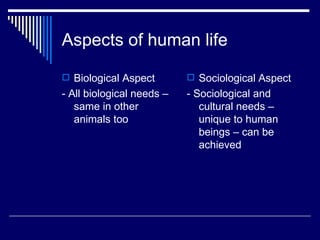


Aspects of human life Biological Aspect - All biological needs – same in other animals too Sociological Aspect - Sociological and cultural needs – unique to human beings – can be achieved
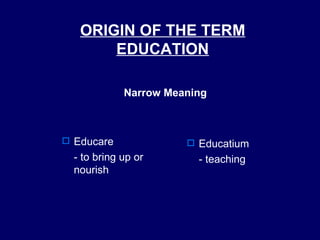
ORIGIN OF THE TERM EDUCATION Educare  - to bring up or nourish Educatium  - teaching Narrow Meaning
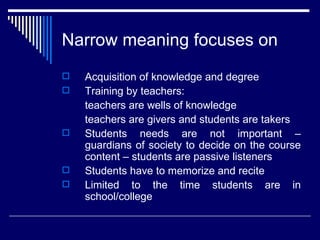
Narrow meaning focuses on Acquisition of knowledge and degree Training by teachers:  teachers are wells of knowledge teachers are givers and students are takers Students needs are not important – guardians of society to decide on the course content – students are passive listeners Students have to memorize and recite Limited to the time students are in school/college
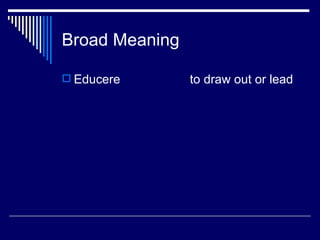
Broad Meaning Educere  to draw out or lead
Broad Meaning focuses on All round development of the child Students are active participants depending on their needs Life-long activity Teachers are friends, philosophers and guides
Old tradition: Bipolar process Recent Tradition: Tripolar Process
fË¡Q£e i¡la£u d¡lZ¡: Old Indian Tradition
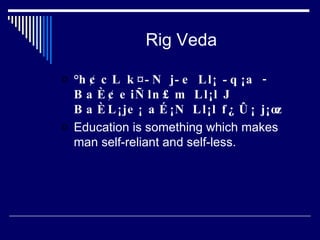
Rig Veda °h¢cL k¤­N j­e Ll¡ ­q¡a - BaÈ¢eiÑln£m Ll¡l J BaÈL¡je¡ aÉ¡N Ll¡l f¿Û¡ j¡œz Education is something which makes man self-reliant and self-less.
Upanishads ¢nr¡ j¡e¤o­L pwú¡lj¤š² L­l z interested more in the result of education than its nature. The end product of education is salvation.
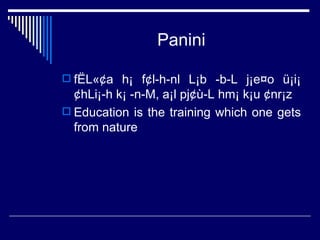
Panini fËL«¢a h¡ f¢l­h­nl L¡b ­b­L j¡e¤o ü¡i¡¢hLi¡­h k¡ ­n­M, a¡l pj¢ù­L hm¡ k¡u ¢nr¡z   Education is the training which one gets from nature
Kannad ¢nr¡l fËL«a a¡vfkÑ qm Hl à¡l¡ j¡e¤­ol BaÈa«¢çl ( Self contentment ) kb¡bÑ ¢hL¡n pñh quz   Development of self-consciousness.
Yajnavalkya fËQ£e i¡la£u ¢Q¿¹¡¢hc k¡‘hóÉ h­m­Re, ¢nr¡ pvQ¢lœ NW­el Hhw pj¡S Ef­k¡N£ hÉ¡¢š²aÆ NW­el pq¡uL ­L±nmz Education is the means to the development of character and usefulness in an individual.
Kautilya ­L±¢V­mÉl j­a ¢nr¡ qm ­cn J k¡¢a­L i¡mh¡p¡l fË¢nrZ j¡œz Education is the training for patriotism.
Shankaracharya nˆl¡Q¡­kÑl j­a, ¢nr¡ qm BaÈ‘¡e h¡ B­aÈ¡fm¢ì ( self-realization )z Education as tantamount to self-realization.
Bd¤¢eL i¡la£u d¡lZ¡ Modern Indian Tradition  Education according to Indian tradition is initiation into the life of spirit, a training of human souls in pursuit of truth and the practice of virtue. It is a second birth. – Education for liberation.
Swami Vivekananda Education is the manifestation of perfection that is already in man. We need an education that quickens, that vivifies, that kindles the urge of spirituality.
Sri Aurobindo Helping the young soul to draw out that is in itself.
M. K. Gandhi By education I mean an all round drawing of the best in child and man – body, mind and spirit. ­cq-je J BaÈ¡l p¤¤oj ¢hL¡­nl fËu¡pz
Dr Radhakrishnan Commission (1948) : Education according to Indian tradition, is not merely a means to earning a living nor is it only a nursery of thought or a school for citizenship. It is an institution into the life of spirit, a training of human souls in the pursuit of truth and the practice of virtue. It is a second birth. –‘dvitiyam janma’.
õÌ[ýçWýçEÊõbÕX i¡la£u pj¡­Sl S£he J je­el ¢cL ­­bL ¢h­nÔoZ Ll­m HC Lb¡C hm­a qu, '¢nr¡' Lb¡l fËL«a a¡vfkÑ S£¢hL¡ ASÑ­el h¡ e¡N¢lLa¡l fË¢nr­Zl Nä£l jd¡H p£j¡hÜ euz '¢nr¡' qm ¢àa£u SeÈz Eæaal S£h­e fË­h­nl fËbj ­p¡f¡e qm '¢nr¡' z
Western Philosophers
Plato It (education) develops in the body and soul of the pupil all the beauty and all the perfection he is capable of. ¢nr¡ ¢nöl ¢e­Sl rja¡ Ae¤k¡u£ ­cq j­el p¡¢hÑL ¢hL¡n p¡de L­lz
Aristotle Education is the creation of a sound mind in a sound body. It develops man’s faculty, especially his mind, so that he may be able to enjoy the contemplation of supreme truth, goodness and beauty in which perfect happiness essentially consists. ¢nr¡ ­cq-j­el p¤¤oj Hhw f¢lf§ZÑ ¢hL¡­nl j¡dÉ­j hÉ¡¢š²aÆ­L S£h­el fËL«a j¡d¤kÑÉ J Qlj paÉ Efm¢ì­a pq¡ua¡ Ll¡z
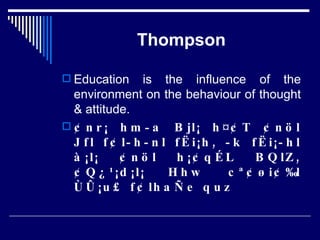
Thompson Education is the influence of the environment on the behaviour of thought & attitude.  ¢nr¡ hm­a Bjl¡ h¤¢T ¢nöl Jfl f¢l­h­nl fËi¡h, ­k fËi¡­hl à¡l¡ ¢nöl h¡¢qÉL BQlZ, ¢Q¿¹¡d¡l¡ Hhw cª¢øi¢‰l ÙÛ¡u£ f¢lhaÑe quz
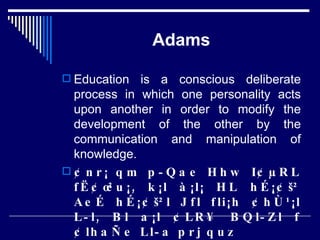
Adams Education is a conscious deliberate process in which one personality acts upon another in order to modify the development of the other by the communication and manipulation of knowledge. ¢nr¡ qm p­Qae Hhw I¢µRL fË¢œ²u¡, k¡l à¡l¡ HL hÉ¡¢š² AeÉ hÉ¡¢š²l Jfl fli¡h ¢hÙ¹¡l L­l, Bl a¡l ¢LR¥ BQl­Zl f¢lhaÑe Ll­a prj quz
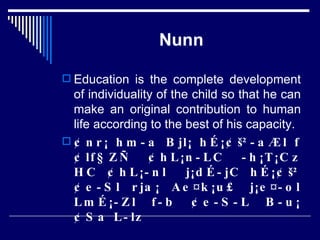
Nunn Education is the complete development of individuality of the child so that he can make an original contribution to human life according to the best of his capacity. ¢nr¡ hm­a Bjl¡ hÉ¡¢š²­aÆl f¢lf§ZÑ ¢hL¡n­LC ­h¡T¡Cz HC ¢hL¡­nl  j¡dÉ­jC hÉ¡¢š² ¢e­Sl rja¡ Ae¤k¡u£ j¡e¤­ol LmÉ¡­Zl f­b ¢e­S­L B­u¡¢Sa L­lz
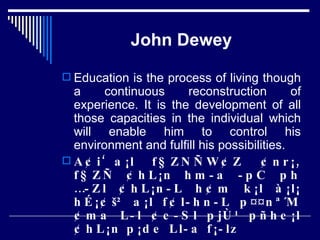
John Dewey Education is the process of living though a continuous reconstruction of experience. It is the development of all those capacities in the individual which will enable him to control his environment and fulfill his possibilities. A¢i‘a¡l f§ZNÑW¢Z ¢nr¡, f§ZÑ ¢hL¡n hm­a ­pC ph …­Zl ¢hL¡n­L h¢m k¡l à¡l¡ hÉ¡¢š² a¡l f¢l­hn­L p¤¤nª´M¢ma L­l ¢e­Sl pjÙ¹ pñhe¡l ¢hL¡n p¡de Ll­a f¡­lz
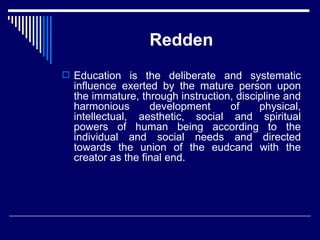
Redden Education is the deliberate and systematic influence exerted by the mature person upon the immature, through instruction, discipline and harmonious development of physical, intellectual, aesthetic, social and spiritual powers of human being according to the individual and social needs and directed towards the union of the eudcand with the creator as the final end.
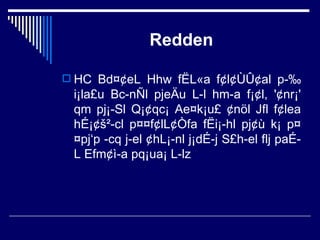
Redden HC Bd¤¢eL Hhw fËL«a f¢l¢ÙÛ¢al p­‰ i¡la£u Bc­nÑl pjeÄu L­l hm­a f¡¢l, '¢nr¡' qm pj¡­Sl Q¡¢qc¡ Ae¤k¡u£ ¢nöl Jfl f¢lea hÉ¡¢š²­cl p¤¤f¢lL¢Òfa fËi¡­hl pj¢ù k¡ p¤¤pj‘p ­cq j­el ¢hL¡­nl j¡dÉ­j S£h­el flj paÉ­L Efm¢ì­a pq¡ua¡ L­lz

Education

  • 1.
    Aspects of humanlife Biological Aspect - All biological needs – same in other animals too Sociological Aspect - Sociological and cultural needs – unique to human beings – can be achieved
  • 2.
    ORIGIN OF THETERM EDUCATION Educare - to bring up or nourish Educatium - teaching Narrow Meaning
  • 3.
    Narrow meaning focuseson Acquisition of knowledge and degree Training by teachers: teachers are wells of knowledge teachers are givers and students are takers Students needs are not important – guardians of society to decide on the course content – students are passive listeners Students have to memorize and recite Limited to the time students are in school/college
  • 4.
    Broad Meaning Educere to draw out or lead
  • 5.
    Broad Meaning focuseson All round development of the child Students are active participants depending on their needs Life-long activity Teachers are friends, philosophers and guides
  • 6.
    Old tradition: Bipolarprocess Recent Tradition: Tripolar Process
  • 7.
    fË¡Q£e i¡la£u d¡lZ¡:Old Indian Tradition
  • 8.
    Rig Veda °h¢cLk¤­N j­e Ll¡ ­q¡a - BaÈ¢eiÑln£m Ll¡l J BaÈL¡je¡ aÉ¡N Ll¡l f¿Û¡ j¡œz Education is something which makes man self-reliant and self-less.
  • 9.
    Upanishads ¢nr¡ j¡e¤o­Lpwú¡lj¤š² L­l z interested more in the result of education than its nature. The end product of education is salvation.
  • 10.
    Panini fËL«¢a h¡f¢l­h­nl L¡b ­b­L j¡e¤o ü¡i¡¢hLi¡­h k¡ ­n­M, a¡l pj¢ù­L hm¡ k¡u ¢nr¡z Education is the training which one gets from nature
  • 11.
    Kannad ¢nr¡l fËL«aa¡vfkÑ qm Hl à¡l¡ j¡e¤­ol BaÈa«¢çl ( Self contentment ) kb¡bÑ ¢hL¡n pñh quz Development of self-consciousness.
  • 12.
    Yajnavalkya fËQ£e i¡la£u¢Q¿¹¡¢hc k¡‘hóÉ h­m­Re, ¢nr¡ pvQ¢lœ NW­el Hhw pj¡S Ef­k¡N£ hÉ¡¢š²aÆ NW­el pq¡uL ­L±nmz Education is the means to the development of character and usefulness in an individual.
  • 13.
    Kautilya ­L±¢V­mÉl j­a¢nr¡ qm ­cn J k¡¢a­L i¡mh¡p¡l fË¢nrZ j¡œz Education is the training for patriotism.
  • 14.
    Shankaracharya nˆl¡Q¡­kÑl j­a,¢nr¡ qm BaÈ‘¡e h¡ B­aÈ¡fm¢ì ( self-realization )z Education as tantamount to self-realization.
  • 15.
    Bd¤¢eL i¡la£u d¡lZ¡Modern Indian Tradition Education according to Indian tradition is initiation into the life of spirit, a training of human souls in pursuit of truth and the practice of virtue. It is a second birth. – Education for liberation.
  • 16.
    Swami Vivekananda Educationis the manifestation of perfection that is already in man. We need an education that quickens, that vivifies, that kindles the urge of spirituality.
  • 17.
    Sri Aurobindo Helpingthe young soul to draw out that is in itself.
  • 18.
    M. K. GandhiBy education I mean an all round drawing of the best in child and man – body, mind and spirit. ­cq-je J BaÈ¡l p¤¤oj ¢hL¡­nl fËu¡pz
  • 19.
    Dr Radhakrishnan Commission(1948) : Education according to Indian tradition, is not merely a means to earning a living nor is it only a nursery of thought or a school for citizenship. It is an institution into the life of spirit, a training of human souls in the pursuit of truth and the practice of virtue. It is a second birth. –‘dvitiyam janma’.
  • 20.
    õÌ[ýçWýçEÊõbÕX i¡la£u pj¡­SlS£he J je­el ¢cL ­­bL ¢h­nÔoZ Ll­m HC Lb¡C hm­a qu, '¢nr¡' Lb¡l fËL«a a¡vfkÑ S£¢hL¡ ASÑ­el h¡ e¡N¢lLa¡l fË¢nr­Zl Nä£l jd¡H p£j¡hÜ euz '¢nr¡' qm ¢àa£u SeÈz Eæaal S£h­e fË­h­nl fËbj ­p¡f¡e qm '¢nr¡' z
  • 21.
  • 22.
    Plato It (education)develops in the body and soul of the pupil all the beauty and all the perfection he is capable of. ¢nr¡ ¢nöl ¢e­Sl rja¡ Ae¤k¡u£ ­cq j­el p¡¢hÑL ¢hL¡n p¡de L­lz
  • 23.
    Aristotle Education isthe creation of a sound mind in a sound body. It develops man’s faculty, especially his mind, so that he may be able to enjoy the contemplation of supreme truth, goodness and beauty in which perfect happiness essentially consists. ¢nr¡ ­cq-j­el p¤¤oj Hhw f¢lf§ZÑ ¢hL¡­nl j¡dÉ­j hÉ¡¢š²aÆ­L S£h­el fËL«a j¡d¤kÑÉ J Qlj paÉ Efm¢ì­a pq¡ua¡ Ll¡z
  • 24.
    Thompson Education isthe influence of the environment on the behaviour of thought & attitude. ¢nr¡ hm­a Bjl¡ h¤¢T ¢nöl Jfl f¢l­h­nl fËi¡h, ­k fËi¡­hl à¡l¡ ¢nöl h¡¢qÉL BQlZ, ¢Q¿¹¡d¡l¡ Hhw cª¢øi¢‰l ÙÛ¡u£ f¢lhaÑe quz
  • 25.
    Adams Education isa conscious deliberate process in which one personality acts upon another in order to modify the development of the other by the communication and manipulation of knowledge. ¢nr¡ qm p­Qae Hhw I¢µRL fË¢œ²u¡, k¡l à¡l¡ HL hÉ¡¢š² AeÉ hÉ¡¢š²l Jfl fli¡h ¢hÙ¹¡l L­l, Bl a¡l ¢LR¥ BQl­Zl f¢lhaÑe Ll­a prj quz
  • 26.
    Nunn Education isthe complete development of individuality of the child so that he can make an original contribution to human life according to the best of his capacity. ¢nr¡ hm­a Bjl¡ hÉ¡¢š²­aÆl f¢lf§ZÑ ¢hL¡n­LC ­h¡T¡Cz HC ¢hL¡­nl  j¡dÉ­jC hÉ¡¢š² ¢e­Sl rja¡ Ae¤k¡u£ j¡e¤­ol LmÉ¡­Zl f­b ¢e­S­L B­u¡¢Sa L­lz
  • 27.
    John Dewey Educationis the process of living though a continuous reconstruction of experience. It is the development of all those capacities in the individual which will enable him to control his environment and fulfill his possibilities. A¢i‘a¡l f§ZNÑW¢Z ¢nr¡, f§ZÑ ¢hL¡n hm­a ­pC ph …­Zl ¢hL¡n­L h¢m k¡l à¡l¡ hÉ¡¢š² a¡l f¢l­hn­L p¤¤nª´M¢ma L­l ¢e­Sl pjÙ¹ pñhe¡l ¢hL¡n p¡de Ll­a f¡­lz
  • 28.
    Redden Education isthe deliberate and systematic influence exerted by the mature person upon the immature, through instruction, discipline and harmonious development of physical, intellectual, aesthetic, social and spiritual powers of human being according to the individual and social needs and directed towards the union of the eudcand with the creator as the final end.
  • 29.
    Redden HC Bd¤¢eLHhw fËL«a f¢l¢ÙÛ¢al p­‰ i¡la£u Bc­nÑl pjeÄu L­l hm­a f¡¢l, '¢nr¡' qm pj¡­Sl Q¡¢qc¡ Ae¤k¡u£ ¢nöl Jfl f¢lea hÉ¡¢š²­cl p¤¤f¢lL¢Òfa fËi¡­hl pj¢ù k¡ p¤¤pj‘p ­cq j­el ¢hL¡­nl j¡dÉ­j S£h­el flj paÉ­L Efm¢ì­a pq¡ua¡ L­lz