
www.nvcc.edu/workfo
EDUC 1816: Teaching Content ESL

American Culture & Language Institute, TESOL Certificate Program
Northern Virginia Community College

www.nvcc.edu/workfo
Overview
•
•
•
•
•

What is Content ESL/ESP?
Origins of ESP
ESL Course Design
Materials Adaptation
Putting it into Practice

www.nvcc.edu/workfo
What is Content ESL?
“ESP is an approach to language teaching in
which all decisions as to content and method
are based on the learner’s reason for learning.”
Hutchinson & Walters, 1987

www.nvcc.edu/workfo
What is Content ESL?
• Focus on learner’s needs on the job
• Content specific – pragmatics, speech
acts, jargon
• Most often used with adult learners
• Designed for intermediate to advanced level
students
• Often called English for Specific Purposes
(ESP)
www.nvcc.edu/workfo
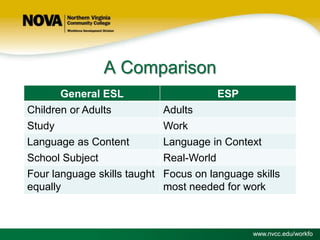
A Comparison
General ESL
Children or Adults
Study

ESP
Adults
Work

Language as Content
School Subject
Four language skills taught
equally

Language in Context
Real-World
Focus on language skills
most needed for work

www.nvcc.edu/workfo
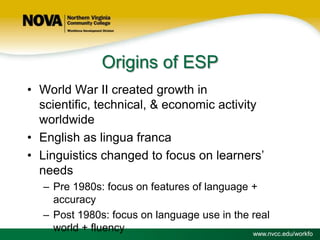
Origins of ESP
• World War II created growth in
scientific, technical, & economic activity
worldwide
• English as lingua franca
• Linguistics changed to focus on learners’
needs
– Pre 1980s: focus on features of language +
accuracy
– Post 1980s: focus on language use in the real
world + fluency
www.nvcc.edu/workfo
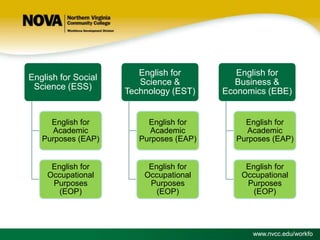
English for Social
Science (ESS)

English for
Science &
Technology (EST)

English for
Business &
Economics (EBE)

English for
Academic
Purposes (EAP)

English for
Academic
Purposes (EAP)

English for
Academic
Purposes (EAP)

English for
Occupational
Purposes
(EOP)

English for
Occupational
Purposes
(EOP)

English for
Occupational
Purposes
(EOP)

www.nvcc.edu/workfo
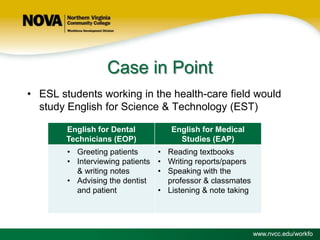
Case in Point
• ESL students working in the health-care field would
study English for Science & Technology (EST)
English for Dental
Technicians (EOP)
• Greeting patients
• Interviewing patients
& writing notes
• Advising the dentist
and patient

English for Medical
Studies (EAP)
• Reading textbooks
• Writing reports/papers
• Speaking with the
professor & classmates
• Listening & note taking

www.nvcc.edu/workfo
Try It!
• Choose a type of ESP
– Social Science (ESS), Science & Tech. (EST), or
Business & Economics (EBE)

• Choose a subtype
– English for Occupational Purposes
– English for Academic Purposes

• List three pragmatic acts or speech acts
• Present to the class
www.nvcc.edu/workfo
ESP Course Design
• Observe the worksite/educational institution
to identify pragmatics, speech acts, &
vocabulary.
• Conduct a needs assessment of major
stakeholders.
• Identify a methodology to promote real-world
practice.
– TBLT or TPR for example
www.nvcc.edu/workfo
ESP Course Design (cont.)
• Design activities so that students practice
–
–
–
–

Productive and receptive skills
Rehearsed and spontaneous speech acts
Problem solving
Correct vocabulary (register) for the workplace

• Assess students’ success in meeting their
goals.

www.nvcc.edu/workfo
Materials Adaptation
“ ESP teachers find themselves in a situation
where they are expected to produce a course
that exactly matches the needs of a group of
learners, but are expected to do so with no, or
very limited, preparation time.”
Johns, 1990

www.nvcc.edu/workfo
Materials Adaptation (cont.)
• Create a resource bank of job-related realia
– Forms
– Pamphlets or brochures
– Instruction manuals

• Adapt ESL textbook activities
• Search YouTube for Dos & Don’ts of
workplace or institutional behavior

www.nvcc.edu/workfo
Put it into Practice
• In pairs:
– Choose a field and subfield of ESP.
– Go to a local business and observe the
pragmatics, speech acts, and vocabulary.
– Collect any job-related realia
– Create a 10 minute ESP mini lesson.
– Teach the class.

www.nvcc.edu/workfo
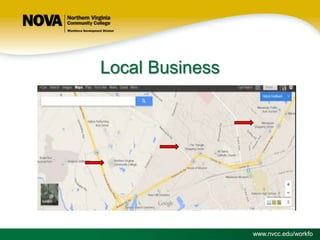
Local Business

www.nvcc.edu/workfo

Educ 1816 content esl new

  • 1.
  • 2.
    EDUC 1816: TeachingContent ESL American Culture & Language Institute, TESOL Certificate Program Northern Virginia Community College www.nvcc.edu/workfo
  • 3.
    Overview • • • • • What is ContentESL/ESP? Origins of ESP ESL Course Design Materials Adaptation Putting it into Practice www.nvcc.edu/workfo
  • 4.
    What is ContentESL? “ESP is an approach to language teaching in which all decisions as to content and method are based on the learner’s reason for learning.” Hutchinson & Walters, 1987 www.nvcc.edu/workfo
  • 5.
    What is ContentESL? • Focus on learner’s needs on the job • Content specific – pragmatics, speech acts, jargon • Most often used with adult learners • Designed for intermediate to advanced level students • Often called English for Specific Purposes (ESP) www.nvcc.edu/workfo
  • 6.
    A Comparison General ESL Childrenor Adults Study ESP Adults Work Language as Content School Subject Four language skills taught equally Language in Context Real-World Focus on language skills most needed for work www.nvcc.edu/workfo
  • 7.
    Origins of ESP •World War II created growth in scientific, technical, & economic activity worldwide • English as lingua franca • Linguistics changed to focus on learners’ needs – Pre 1980s: focus on features of language + accuracy – Post 1980s: focus on language use in the real world + fluency www.nvcc.edu/workfo
  • 8.
    English for Social Science(ESS) English for Science & Technology (EST) English for Business & Economics (EBE) English for Academic Purposes (EAP) English for Academic Purposes (EAP) English for Academic Purposes (EAP) English for Occupational Purposes (EOP) English for Occupational Purposes (EOP) English for Occupational Purposes (EOP) www.nvcc.edu/workfo
  • 9.
    Case in Point •ESL students working in the health-care field would study English for Science & Technology (EST) English for Dental Technicians (EOP) • Greeting patients • Interviewing patients & writing notes • Advising the dentist and patient English for Medical Studies (EAP) • Reading textbooks • Writing reports/papers • Speaking with the professor & classmates • Listening & note taking www.nvcc.edu/workfo
  • 10.
    Try It! • Choosea type of ESP – Social Science (ESS), Science & Tech. (EST), or Business & Economics (EBE) • Choose a subtype – English for Occupational Purposes – English for Academic Purposes • List three pragmatic acts or speech acts • Present to the class www.nvcc.edu/workfo
  • 11.
    ESP Course Design •Observe the worksite/educational institution to identify pragmatics, speech acts, & vocabulary. • Conduct a needs assessment of major stakeholders. • Identify a methodology to promote real-world practice. – TBLT or TPR for example www.nvcc.edu/workfo
  • 12.
    ESP Course Design(cont.) • Design activities so that students practice – – – – Productive and receptive skills Rehearsed and spontaneous speech acts Problem solving Correct vocabulary (register) for the workplace • Assess students’ success in meeting their goals. www.nvcc.edu/workfo
  • 13.
    Materials Adaptation “ ESPteachers find themselves in a situation where they are expected to produce a course that exactly matches the needs of a group of learners, but are expected to do so with no, or very limited, preparation time.” Johns, 1990 www.nvcc.edu/workfo
  • 14.
    Materials Adaptation (cont.) •Create a resource bank of job-related realia – Forms – Pamphlets or brochures – Instruction manuals • Adapt ESL textbook activities • Search YouTube for Dos & Don’ts of workplace or institutional behavior www.nvcc.edu/workfo
  • 15.
    Put it intoPractice • In pairs: – Choose a field and subfield of ESP. – Go to a local business and observe the pragmatics, speech acts, and vocabulary. – Collect any job-related realia – Create a 10 minute ESP mini lesson. – Teach the class. www.nvcc.edu/workfo
  • 16.