

EDI-TA
           Addressing Real Challenges in Post-editing
           ETP - International Workshop on Expertise in Translation
           and Post-editing Research and Application
           Copenhagen Business School
           August 17 - 18, 2012                                       Celia Rico (Universidad Europea de Madrid)
                                                                               Pedro L. Díez Orzas (Linguaserve)


Dra. Celia Rico, UEM                                                                   Dr. Pedro L. Díez Orzas (Linguaserve)
go         about
                                           do     you
                              How                                         (PE)
                       
                                          ng P    ost-editing
                       im p l e m e n t i       ur compan
                                                                  y as an
                                             yo
                       processes in
                        LSP?
                                                                           from
                                             es    PE differ
                         How do                             atches?
                         reviewing        TM fuzzy m
                                                                             role
                                               the p  o s t - e d it o r ’s
                          What is                   i t f i t in
                                                                              the
                                              can
                          and how
                                            workflow?
                          c o m p a n y ’s
                                                                  ssessed?
                                                lity to be a
                            How is qua
                                        ctivit          y?
                             And produ
                                                               ibutes           to
                                                th at PE contr
                             Is i t t r u e
                                               sts?
                            r e d u c in g c o


Dra. Celia Rico, UEM                                                            Dr. Pedro L. Díez Orzas (Linguaserve)
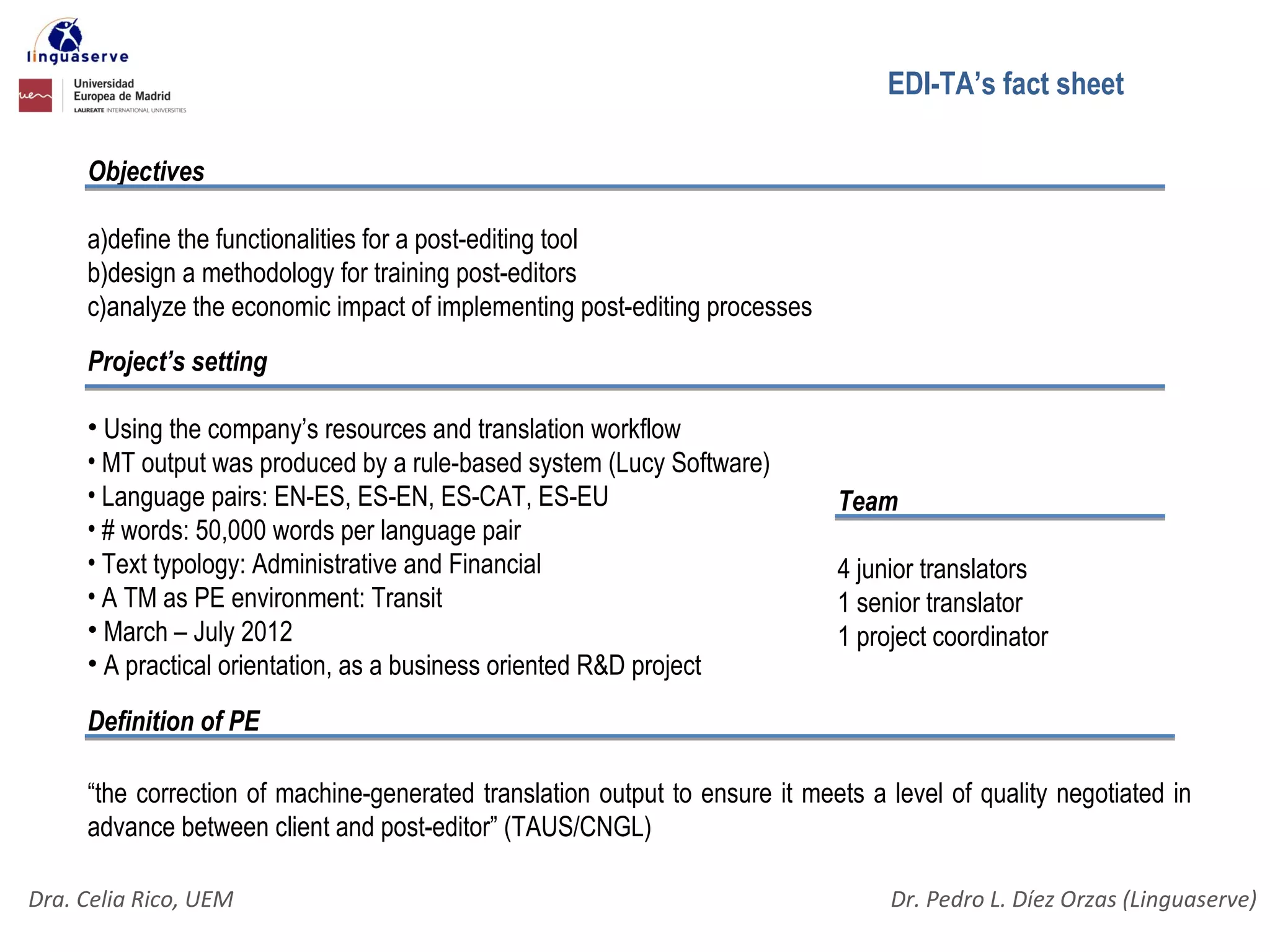
EDI-TA’s fact sheet

     Objectives

     a)define the functionalities for a post-editing tool
     b)design a methodology for training post-editors
     c)analyze the economic impact of implementing post-editing processes
     Project’s setting

     • Using the company’s resources and translation workflow
     • MT output was produced by a rule-based system (Lucy Software)
     • Language pairs: EN-ES, ES-EN, ES-CAT, ES-EU                           Team
     • # words: 50,000 words per language pair
     • Text typology: Administrative and Financial                           4 junior translators
     • A TM as PE environment: Transit                                       1 senior translator
     • March – July 2012                                                     1 project coordinator
     • A practical orientation, as a business oriented R&D project

     Definition of PE

     “the correction of machine-generated translation output to ensure it meets a level of quality negotiated in
     advance between client and post-editor” (TAUS/CNGL)

Dra. Celia Rico, UEM                                                              Dr. Pedro L. Díez Orzas (Linguaserve)
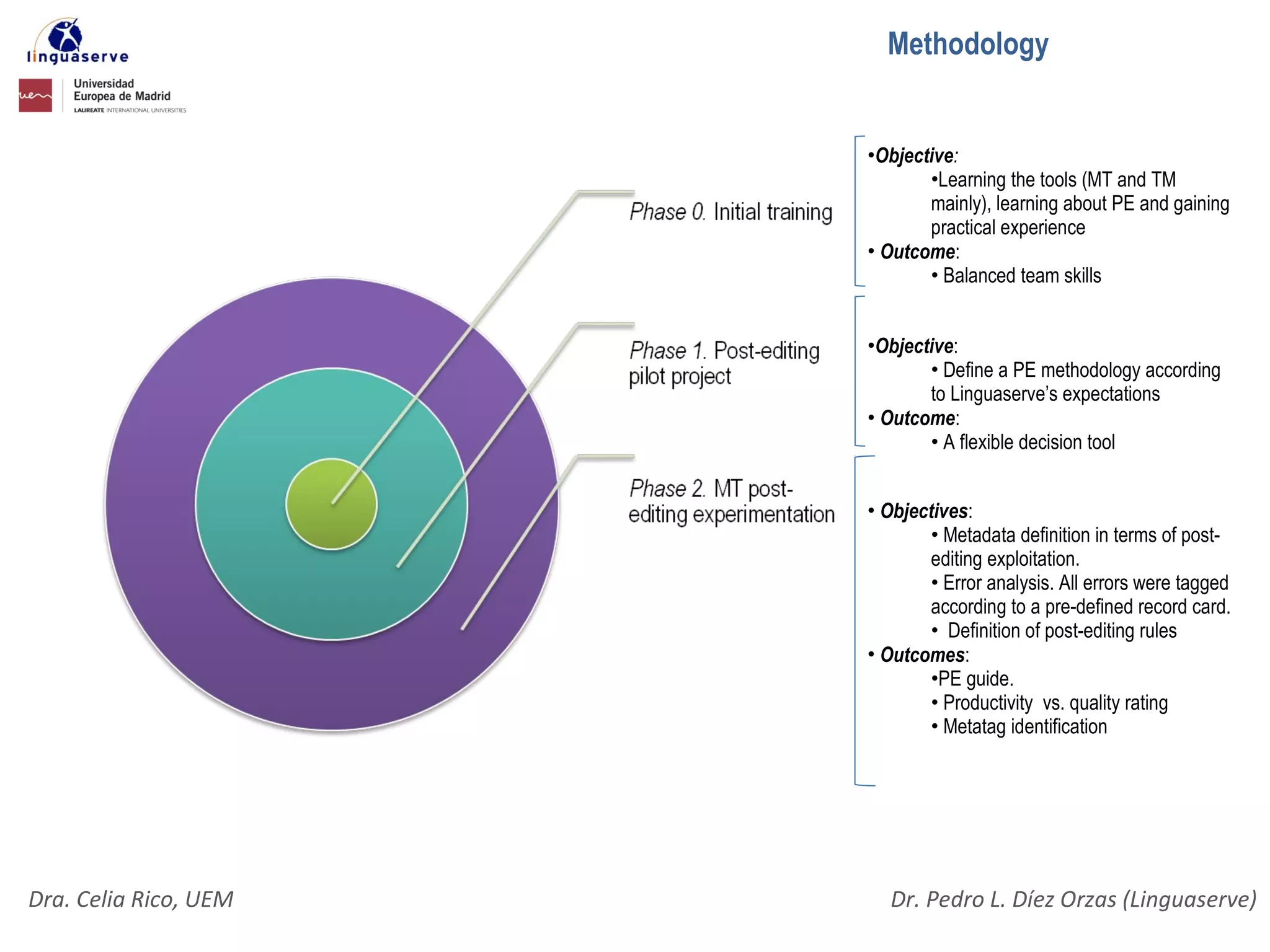
Methodology


                       •Objective:
                              •Learning the tools (MT and TM
                              mainly), learning about PE and gaining
                              practical experience
                       • Outcome:
                              • Balanced team skills


                       •Objective:
                              • Define a PE methodology according
                              to Linguaserve’s expectations
                       • Outcome:
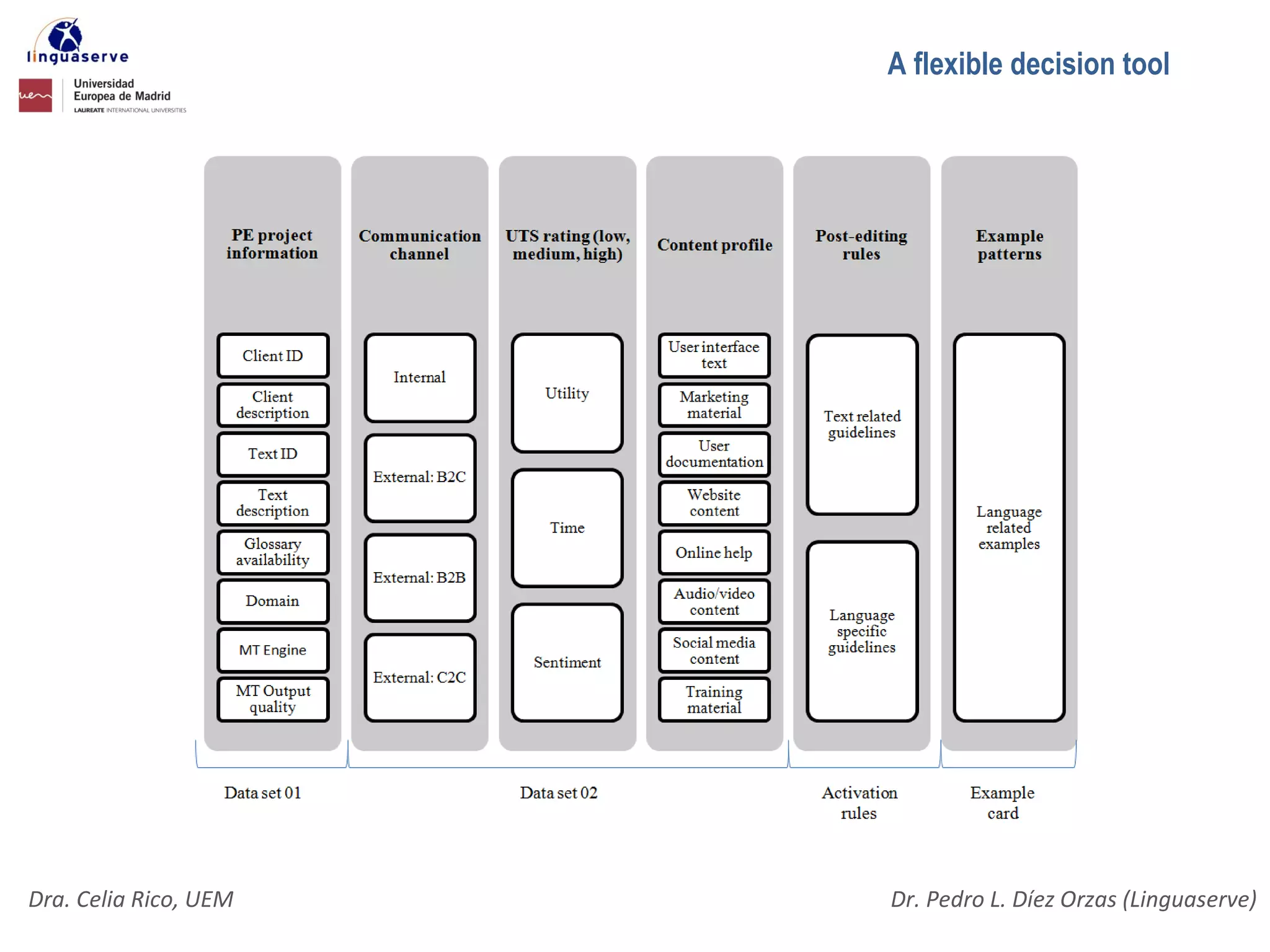
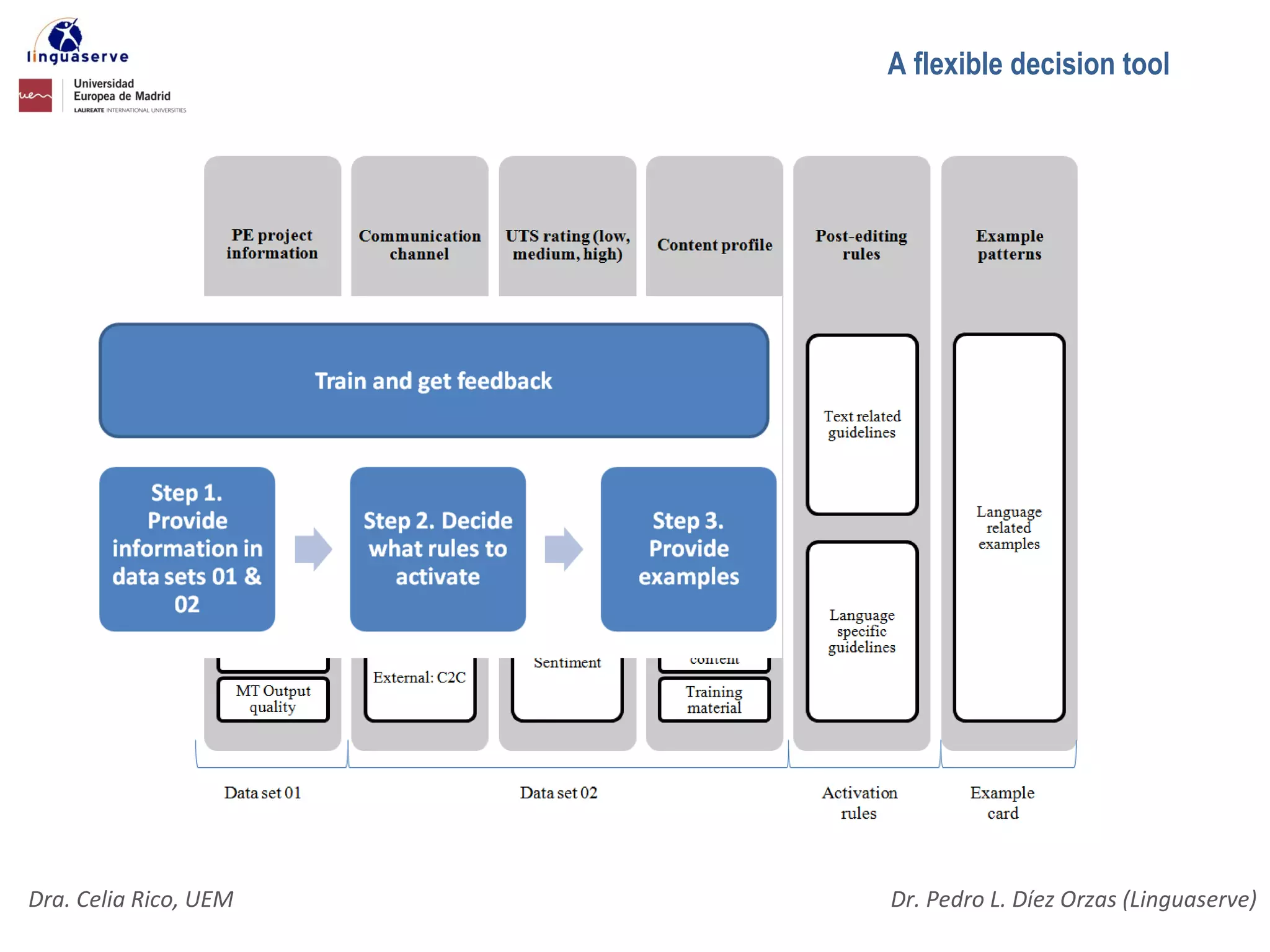
                              • A flexible decision tool


                       • Objectives:
                               • Metadata definition in terms of post-
                               editing exploitation.
                               • Error analysis. All errors were tagged
                               according to a pre-defined record card.
                               • Definition of post-editing rules
                       • Outcomes:
                               •PE guide.
                               • Productivity vs. quality rating
                               • Metatag identification


Dra. Celia Rico, UEM      Dr. Pedro L. Díez Orzas (Linguaserve)
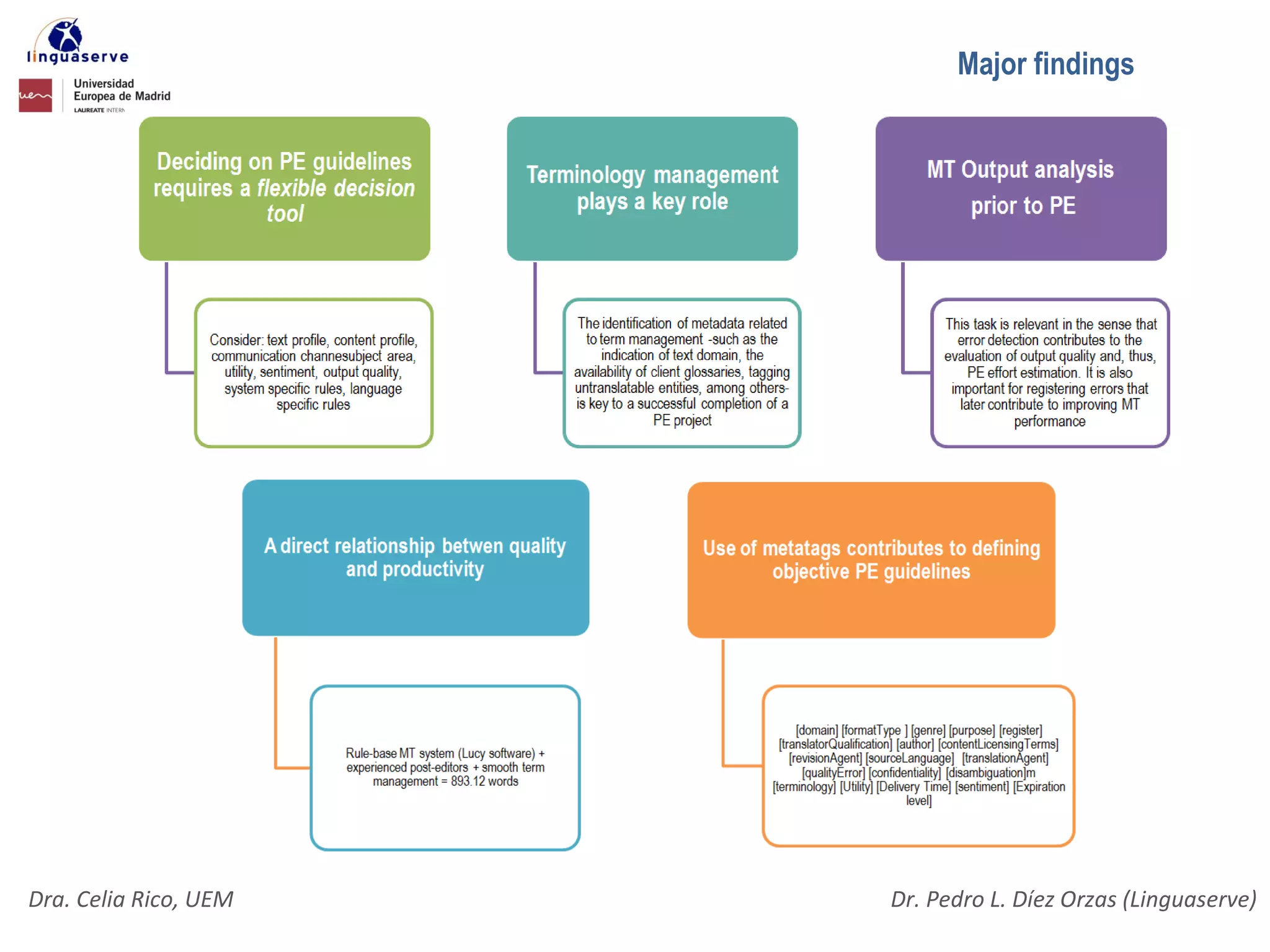
Major findings


Dra. Celia Rico, UEM   Dr. Pedro L. Díez Orzas (Linguaserve)
A flexible decision tool


Dra. Celia Rico, UEM   Dr. Pedro L. Díez Orzas (Linguaserve)
A flexible decision tool


Dra. Celia Rico, UEM   Dr. Pedro L. Díez Orzas (Linguaserve)
By way of conclusion…


Dra. Celia Rico, UEM                    Dr. Pedro L. Díez Orzas (Linguaserve)
Dra. Celia Rico, UEM   Dr. Pedro L. Díez Orzas (Linguaserve)

EDI-TA: Addressing Real Challenges in Post-editing

  • 1.
    EDI-TA Addressing Real Challenges in Post-editing ETP - International Workshop on Expertise in Translation and Post-editing Research and Application Copenhagen Business School August 17 - 18, 2012 Celia Rico (Universidad Europea de Madrid) Pedro L. Díez Orzas (Linguaserve) Dra. Celia Rico, UEM Dr. Pedro L. Díez Orzas (Linguaserve)
  • 2.
    go about do you How (PE)  ng P ost-editing im p l e m e n t i ur compan y as an yo processes in LSP? from es PE differ  How do atches? reviewing TM fuzzy m role the p o s t - e d it o r ’s  What is i t f i t in the can and how workflow? c o m p a n y ’s ssessed? lity to be a  How is qua ctivit y?  And produ ibutes to th at PE contr  Is i t t r u e sts? r e d u c in g c o Dra. Celia Rico, UEM Dr. Pedro L. Díez Orzas (Linguaserve)
  • 3.
    EDI-TA’s fact sheet Objectives a)define the functionalities for a post-editing tool b)design a methodology for training post-editors c)analyze the economic impact of implementing post-editing processes Project’s setting • Using the company’s resources and translation workflow • MT output was produced by a rule-based system (Lucy Software) • Language pairs: EN-ES, ES-EN, ES-CAT, ES-EU Team • # words: 50,000 words per language pair • Text typology: Administrative and Financial 4 junior translators • A TM as PE environment: Transit 1 senior translator • March – July 2012 1 project coordinator • A practical orientation, as a business oriented R&D project Definition of PE “the correction of machine-generated translation output to ensure it meets a level of quality negotiated in advance between client and post-editor” (TAUS/CNGL) Dra. Celia Rico, UEM Dr. Pedro L. Díez Orzas (Linguaserve)
  • 4.
    Methodology •Objective: •Learning the tools (MT and TM mainly), learning about PE and gaining practical experience • Outcome: • Balanced team skills •Objective: • Define a PE methodology according to Linguaserve’s expectations • Outcome: • A flexible decision tool • Objectives: • Metadata definition in terms of post- editing exploitation. • Error analysis. All errors were tagged according to a pre-defined record card. • Definition of post-editing rules • Outcomes: •PE guide. • Productivity vs. quality rating • Metatag identification Dra. Celia Rico, UEM Dr. Pedro L. Díez Orzas (Linguaserve)
  • 5.
    Major findings Dra. CeliaRico, UEM Dr. Pedro L. Díez Orzas (Linguaserve)
  • 6.
    A flexible decisiontool Dra. Celia Rico, UEM Dr. Pedro L. Díez Orzas (Linguaserve)
  • 7.
    A flexible decisiontool Dra. Celia Rico, UEM Dr. Pedro L. Díez Orzas (Linguaserve)
  • 8.
    By way ofconclusion… Dra. Celia Rico, UEM Dr. Pedro L. Díez Orzas (Linguaserve)
  • 9.
    Dra. Celia Rico,UEM Dr. Pedro L. Díez Orzas (Linguaserve)

Editor's Notes

  • #5 Objective : Learning the tools (MT and TM mainly), learning about PE and gaining practical experience Outcome : Balanced team skills Objective : Define a PE methodology according to Linguaserve’s expectations Outcome : A flexible decision tool Objective : Metadata definition in terms of post-editing exploitation. Outcome : Error analysis. MT output was evaluated so as to detect possible errors (lexical, syntactic, terminological). These were identified and handed over to Lucy software for codification. All errors were tagged according to a pre-defined record card.   Definition of post-editing rules. PE guidelines were specified with the help of the dynamic model as mentioned above. These included explicit reference on what to expect from the MT output in terms of quality and how to proceed in each case. A PE guide was also prepared containing all details.   Analysis of metadata contribution to improving pos-editing processes. An exhaustive analysis of metadata was carried out, following directions from The MultilingualWeb-LT (Language Technologies) Working Group. Each of them was evaluated towards determining its possible effect in a PE project, whether it would contribute to a better quality in the PE output and/or whether it would have an impact on PE productivity in terms of cost and turnaround time.
  • #6 PE guide. A guide containing practical information on how to approach a PE project has been designed and successfully tested. Productivity tests. First tests on productivity account for an improvement in time and quality. Metatag identification. The list of meta tags identified as relevant for PE purposes is as follows: localization note. language information. readiness . progress-indicator . cacheStatus . domain .formatType . genre . purpose . register translatorQualification author contentLicensingTerms revisionAgent sourceLanguage translationAgent qualityError qualityProfile confidentiality context externalPlaceholder languageResource mtConfidence specialRequirements disambiguation namedEntity terminology textAnalysisAnnotation To these, EDIT-TA suggest adding the following UTS Ratings (Utility, Time and Sentiment): Utility (relative importance of the functionality of the translated content). Delivery Time (speed with which the translation is required). Sentiment (importance on brand image). Expiration level. connection to the MultilingualWeb-LT Working Group (which receives funding from the European Commission --project name LT-Web-- through the Seventh Framework Programme (FP7) Grant Agreement No. 287815), serving the purpose of a test-bed of how metadata contributes to improving manual intervention in PE, and contributing to defining relevant metadata for PE purposes in a real scenario.
  • #7 This tool is part of a PE guide which is internally used bu the company Training and methodology (EDI-TA ’ s phase 3) At the time of writing this report, this phase has just started so no concluding results are yet to be reported. Work will concentrate in the following tasks: Training method for language independent post-editing aspects Training method for language dependent post-editing aspects Evaluation of training method and use of metadata in post-editing training contexts
  • #8 This tool is part of a PE guide which is internally used bu the company Training and methodology (EDI-TA ’ s phase 3) At the time of writing this report, this phase has just started so no concluding results are yet to be reported. Work will concentrate in the following tasks: Training method for language independent post-editing aspects Training method for language dependent post-editing aspects Evaluation of training method and use of metadata in post-editing training contexts