Edge
Computing
C0NTENT
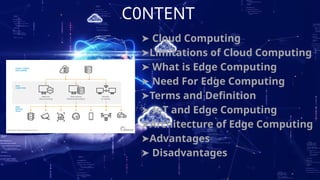
➤ Cloud Computing
➤Limitations of Cloud Computing
➤ What is Edge Computing
➤ Need For Edge Computing
➤Terms and Definition
➤ IoT and Edge Computing
➤Architecture of Edge Computing
➤Advantages
➤ Disadvantages
Cloud
Computing
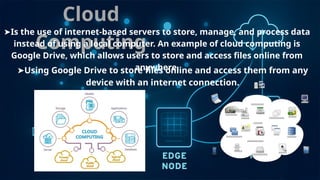
➤Is the use of internet-based servers to store, manage, and process data
instead of using a local computer. An example of cloud computing is
Google Drive, which allows users to store and access files online from
anywhere.
➤Using Google Drive to store files online and access them from any
device with an internet connection.
Limitations of Cloud
Computing
➤ Latency: In the traditional cloud computing model applications
send data to the data Centre and obtain a response, which
increases the system latency. For e.g. High speed autonomous
driving vehicles require milliseconds of response time.
➤ Bandwidth: Transmitting large amount of data generated
by edge devices to the cloud in real time manner will cause
great pressure on bandwidth..
Limitations of Cloud
Computing
➤ Availability: As more and more Internet services are deployed
on the cloud, the availability of the services has become an
integral part of daily life.. Therefore, it is a big challenge for
cloud service providers to keep the 24*7 promise.
➤Energy: With the increasing amount of computation and
transmission, energy consumption will become a bottleneck
restricting the development: of cloud computing centres.
What is Edge
Computing?
➤ Edge computing is a distributed information technology (IT)
architecture in which client data is processed at the periphery of the
network, as close to the originating source as possible.
➤ No need to move to and fro from cloud
centre.
➤ Here, rather than transmitting data to a central data center for
processing and analysis, the work is performed where the data is
actually generated whether it's a retail store, a factory floor or across a
smart city.
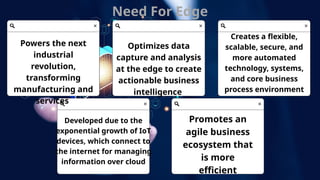
Need For Edge
Computing
Powers the next
industrial
revolution,
transforming
manufacturing and
services
Optimizes data
capture and analysis
at the edge to create
actionable business
intelligence
Creates a flexible,
scalable, secure, and
more automated
technology, systems,
and core business
process environment
Developed due to the
exponential growth of IoT
devices, which connect to
the internet for managing
information over cloud
Promotes an
agile business
ecosystem that
is more
efficient
Terms and
Definition
➤ It highly depends on the use cases.
➤ Like in telecommunication, it may be a cell phone or
cell tower.
➤ Similarly, in the automotive example, it could be a
car.
➤ In manufacturing, it could be a machine, and
➤ In the Information Technology field, it could be a
laptop.
Edg
e
Terms and
Definition
Edge Devices
A device which produces data is edge
devices like machines and sensors, or any
devices through which information is
collected and delivered.
Edge Gateways
➤ It's a buffer where edge computing processing is done:
➤ The gateway is the window into the environment
beyond the edge of the network.
Edge
Server
A computer located in a facility close to the edge device. These
machines run application workloads and shared services, so
they need more computing power than edge devices
Edge
node
An edge node is a computer that acts as an end
user portal for communication with other
nodes in cluster computing.
Cloud
• A public or private cloud that acts as
a repository for containerized
workloads like applications and
machine learning models. The cloud
also hosts and runs apps that
manage edge nodes
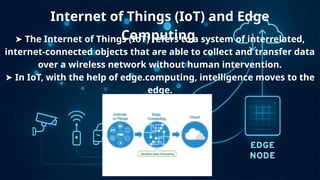
Internet of Things (IoT) and Edge
Computing
➤ The Internet of Things (IoT) refers to a system of interrelated,
internet-connected objects that are able to collect and transfer data
over a wireless network without human intervention.
➤ In IoT, with the help of edge.computing, intelligence moves to the
edge.
Architecture of Edge
Computing
Edge solutions are usually multi-layered
distributed architectures encompassing and
balancing the workload between the Edge
layer, the Edge cloud or Edge network, and the
enterprise layer. Furthermore, when we talk
about the edge, there are the Edge devices and
the local Edge servers.
THANK
YOU

Edge Computing presentation for the class ppt

  • 1.
  • 2.
    C0NTENT ➤ Cloud Computing ➤Limitationsof Cloud Computing ➤ What is Edge Computing ➤ Need For Edge Computing ➤Terms and Definition ➤ IoT and Edge Computing ➤Architecture of Edge Computing ➤Advantages ➤ Disadvantages
  • 3.
    Cloud Computing ➤Is the useof internet-based servers to store, manage, and process data instead of using a local computer. An example of cloud computing is Google Drive, which allows users to store and access files online from anywhere. ➤Using Google Drive to store files online and access them from any device with an internet connection.
  • 4.
    Limitations of Cloud Computing ➤Latency: In the traditional cloud computing model applications send data to the data Centre and obtain a response, which increases the system latency. For e.g. High speed autonomous driving vehicles require milliseconds of response time. ➤ Bandwidth: Transmitting large amount of data generated by edge devices to the cloud in real time manner will cause great pressure on bandwidth..
  • 5.
    Limitations of Cloud Computing ➤Availability: As more and more Internet services are deployed on the cloud, the availability of the services has become an integral part of daily life.. Therefore, it is a big challenge for cloud service providers to keep the 24*7 promise. ➤Energy: With the increasing amount of computation and transmission, energy consumption will become a bottleneck restricting the development: of cloud computing centres.
  • 6.
    What is Edge Computing? ➤Edge computing is a distributed information technology (IT) architecture in which client data is processed at the periphery of the network, as close to the originating source as possible. ➤ No need to move to and fro from cloud centre. ➤ Here, rather than transmitting data to a central data center for processing and analysis, the work is performed where the data is actually generated whether it's a retail store, a factory floor or across a smart city.
  • 7.
    Need For Edge Computing Powersthe next industrial revolution, transforming manufacturing and services Optimizes data capture and analysis at the edge to create actionable business intelligence Creates a flexible, scalable, secure, and more automated technology, systems, and core business process environment Developed due to the exponential growth of IoT devices, which connect to the internet for managing information over cloud Promotes an agile business ecosystem that is more efficient
  • 8.
    Terms and Definition ➤ Ithighly depends on the use cases. ➤ Like in telecommunication, it may be a cell phone or cell tower. ➤ Similarly, in the automotive example, it could be a car. ➤ In manufacturing, it could be a machine, and ➤ In the Information Technology field, it could be a laptop. Edg e
  • 9.
    Terms and Definition Edge Devices Adevice which produces data is edge devices like machines and sensors, or any devices through which information is collected and delivered.
  • 10.
    Edge Gateways ➤ It'sa buffer where edge computing processing is done: ➤ The gateway is the window into the environment beyond the edge of the network. Edge Server A computer located in a facility close to the edge device. These machines run application workloads and shared services, so they need more computing power than edge devices
  • 11.
    Edge node An edge nodeis a computer that acts as an end user portal for communication with other nodes in cluster computing.
  • 12.
    Cloud • A publicor private cloud that acts as a repository for containerized workloads like applications and machine learning models. The cloud also hosts and runs apps that manage edge nodes
  • 13.
    Internet of Things(IoT) and Edge Computing ➤ The Internet of Things (IoT) refers to a system of interrelated, internet-connected objects that are able to collect and transfer data over a wireless network without human intervention. ➤ In IoT, with the help of edge.computing, intelligence moves to the edge.
  • 14.
    Architecture of Edge Computing Edgesolutions are usually multi-layered distributed architectures encompassing and balancing the workload between the Edge layer, the Edge cloud or Edge network, and the enterprise layer. Furthermore, when we talk about the edge, there are the Edge devices and the local Edge servers.
  • 15.