ECTODERMAL DYSPLASIAS
Mapping Of Autosomal Recessive Genes Involved
In Human Hereditary Genodermatosis In Azad
Jammu And Kashmir.
BY : TAQDEES FATIMA
M.Phil In BIOTECHNOLOGY
CONTENTS
 INTRODUCTION SLIDES
 CLASSIFICATION
 RESEARCH OBJECTIVES
 RESEARCH PROTOCOL
 PEDIGREES DESCRIPTION
 PICTURES PRESENTATION
 RESULTS
 CONCLUSION
HEREDITARY GENODERMATOSIS
 Genetically inherited monogenic and polygenic skin
disorders.
 One third part of monogenic disorders are associated to
skin and appendages.
 560 unique disorders affecting the skin and its associated
appendages
 501 distinctive protein encoding genes and their
phenotypic representations .
ECTODERMAL DYSPLASIAS
Are developmental disorders
Skin anomalies of hair, teeth, nail and sweat glands
Congenital disorders demonstrating
• Sparse and thin hair
• Missing or abnormal teeth
• Dystrophic finger and toenails
• Abnormal sweating pattern.
CLASSIFICATION
 Syndromic and non-syndromic EDs
 EDs Caused by Genes Encoding Cell-Cell Communication and
Signaling
• EDA1
• EDAR
• EDARADD
 Mutant EDA, EDAR and EDARADD gene results severe EDs as
• sparse scalp hair
• sparse to absent eyebrows and eye lashes
• prominent lips
• dental anomalies of severe oligodontia, hypodontia and conical
teeth
• reduced or nonfunctional sweat glands and dry thin skin.
 Hypohidrotic Ectodermal Dysplasia (HED)
• Abnormal hair teeth and sweat glands development.
 Modes Of Inheritance
• X-linked HED
• ADHED
• ARHED
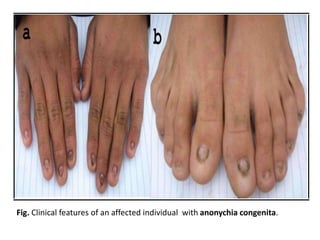
 Anonychia Congenita
• Total absence of nails from hands and feet.
• Occurs in both autosomal dominant and autosomal recessive
fashion.
• RSPO4 - first gene for autosomal recessive non-syndromic nail
dysplasia.
• Wnt/β-catenin - regulates formation of ectodermal appendages.
Fig. Affected individuals with ARHED showing Sparse hairs ,prominent lips ,absent
eye brows and lashes.
Fig. Clinical features of an affected individual with anonychia congenita.
 Ectodermal Dysplasias Caused by Genes
Encoding Cell-Cell Adhesion and Cytoskeleton
• Plakophilin-1 (PKP1)
• poliovirus receptor-like 1 (PVRL1)
• P-cadherin 3 (CDH3)
• are well known desmosomal cadherins genes causing different
Ectodermal Dysplasias.
 Common examples include
• Ectodermal Dysplasia Skin Fragility Syndrome.
• Hypotrichosis with Juvenile Macular Dystrophy Syndrome.
 TGM1, TGM2 and TGM3 are other ED related genes that I have
worked upon.
RESEARCH OBJECTIVES
Explore genotypic and phenotypic differences among
the families under study.
Identification of specific genes involved in ED.
Mutations detection within the families under study.
RESEARCH PROTOCOL
 Sampling
 Phenol chloroform _ DNA EXTRACTION
 Agarose Gel Electrophoresis
 PCR _ DNA Amplification
PAGE
Gel Documentation
• PEDIGREE
• ECTODERMAL DYSPLASIA FAMILY 01
 DESCRIPTION OF ED FAMILY 01
• From Village Chaliana,Neelum Valley Azad Jammu and
Kashmir.
• Affected skin and hands along with normal teeth, nails and
sweating pattern
• Pedigree consisting of 44 members within seven
generations.
• Total one carrier and four effected members are there in the
pedigree.
• Autosomal recessive pattern of inheritance.
PICTURE PRESENTATION OF ED FAMILY 01
RESEARCH RESULTS
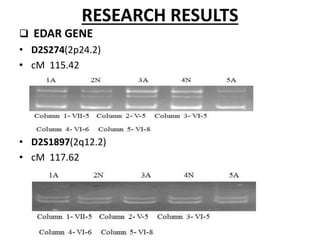
 EDAR GENE
• D2S274(2p24.2)
• cM 115.42
• D2S1897(2q12.2)
• cM 117.62
• D2S293(2q12.2)
• cM 118.16
• D2S1893(2q13)
• cM 120.29
• D2S2269(2q13)
• cM 122.96
• D2S1892(2q13)
• cM 122.97
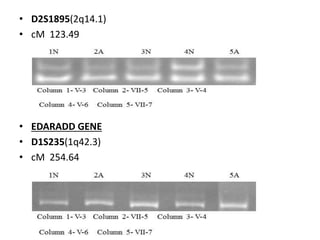
• D2S1895(2q14.1)
• cM 123.49
• EDARADD GENE
• D1S235(1q42.3)
• cM 254.64
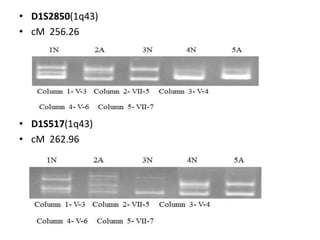
• D1S2850(1q43)
• cM 256.26
• D1S517(1q43)
• cM 262.96
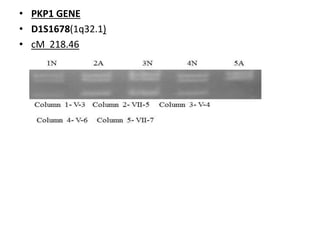
• PKP1 GENE
• D1S1678(1q32.1)
• cM 218.46
• D1S1725(1q32.1)
• cM 219.92
• D1S456(1q32.1)
• cM 222.65
• PEDIGREE
• ECTODERMAL DYSPLASIA FAMILY 02
 DESCRIPTION OF ED FAMILY 02
• From Village Shardah, Neelum Valley Azad Jammu and
Kashmir.
• Affected skin and hair along with normal teeth, nails and
sweating pattern
• Pedigree consisting of 42 members within five generations.
• Total two affected members and three normal were taken
under examination.
• Considered minor skin dysplasia
• Autosomal recessive pattern of inheritance.

PICTURE PRESENTATION OF ED FAMILY 02
RESULTS FAMILY-02
 EDAR GENE
• D2S274(2p24.2)
• cM 115.42
• D2S1897(2q12.2)
• cM 117.62
• D2S293(2q12.2)
• cM 118.16
• D2S1893(2q13)
• cM 120.29
• D2S2269(2q13)
• cM 122.96
• D2S1892(2q13)
• cM 122.97
• D2S1895(2q14.1)
• cM 123.49
• EDARADD GENE
• D1S235(1q42.3)
• cM 254.64
• D1S2850(1q43)
• cM 256.26
• D1S517(1q43)
• cM 262.96
• PKP1 GENE
• D1S1678(1q32.1)
• cM 218.46
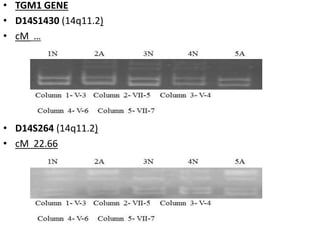
• TGM1 GENE
• D14S1430 (14q11.2)
• cM …
• D14S264 (14q11.2)
• cM 22.66
• D14S280 (14q12)
• cM 25.87
• D14S275 (14q11.2)
• cM 28.01
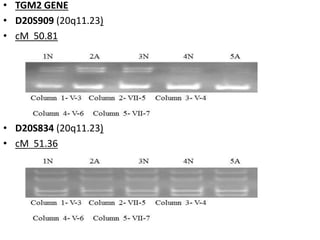
• TGM2 GENE
• D20S909 (20q11.23)
• cM 50.81
• D20S834 (20q11.23)
• cM 51.36
• D20S881 (20q11.23)
• cM 54.09
• D20S107 (20q11.23)
• cM 55.74
• TGM3 GENE
• D20S906 (20p13)
• cM 7.61
• D20S113 (20p13)
• cM 8.97
• TGM3 GENE
• D20S181 (20p13)
• cM 9.53
• D20S179 (20p13)
• cM 11.20
Conclusion
• This study will be beneficial for potential
genetic counselling of families to reduce or in
some extent eliminate these disorders from
Azad Jammu and Kashmir. The identification
of the genes and mutations will enable us to
establish a population specific diagnostic
strategy to screen the entire selected
populations at great risk of transmitting
disease gene in future generations.
ECTODERMAL DYSPLASIAS | Genetic Disorder

ECTODERMAL DYSPLASIAS | Genetic Disorder

  • 2.
    ECTODERMAL DYSPLASIAS Mapping OfAutosomal Recessive Genes Involved In Human Hereditary Genodermatosis In Azad Jammu And Kashmir. BY : TAQDEES FATIMA M.Phil In BIOTECHNOLOGY
  • 3.
    CONTENTS  INTRODUCTION SLIDES CLASSIFICATION  RESEARCH OBJECTIVES  RESEARCH PROTOCOL  PEDIGREES DESCRIPTION  PICTURES PRESENTATION  RESULTS  CONCLUSION
  • 4.
    HEREDITARY GENODERMATOSIS  Geneticallyinherited monogenic and polygenic skin disorders.  One third part of monogenic disorders are associated to skin and appendages.  560 unique disorders affecting the skin and its associated appendages  501 distinctive protein encoding genes and their phenotypic representations .
  • 5.
    ECTODERMAL DYSPLASIAS Are developmentaldisorders Skin anomalies of hair, teeth, nail and sweat glands Congenital disorders demonstrating • Sparse and thin hair • Missing or abnormal teeth • Dystrophic finger and toenails • Abnormal sweating pattern.
  • 6.
    CLASSIFICATION  Syndromic andnon-syndromic EDs  EDs Caused by Genes Encoding Cell-Cell Communication and Signaling • EDA1 • EDAR • EDARADD  Mutant EDA, EDAR and EDARADD gene results severe EDs as • sparse scalp hair • sparse to absent eyebrows and eye lashes • prominent lips • dental anomalies of severe oligodontia, hypodontia and conical teeth • reduced or nonfunctional sweat glands and dry thin skin.
  • 7.
     Hypohidrotic EctodermalDysplasia (HED) • Abnormal hair teeth and sweat glands development.  Modes Of Inheritance • X-linked HED • ADHED • ARHED  Anonychia Congenita • Total absence of nails from hands and feet. • Occurs in both autosomal dominant and autosomal recessive fashion. • RSPO4 - first gene for autosomal recessive non-syndromic nail dysplasia. • Wnt/β-catenin - regulates formation of ectodermal appendages.
  • 8.
    Fig. Affected individualswith ARHED showing Sparse hairs ,prominent lips ,absent eye brows and lashes.
  • 9.
    Fig. Clinical featuresof an affected individual with anonychia congenita.
  • 10.
     Ectodermal DysplasiasCaused by Genes Encoding Cell-Cell Adhesion and Cytoskeleton • Plakophilin-1 (PKP1) • poliovirus receptor-like 1 (PVRL1) • P-cadherin 3 (CDH3) • are well known desmosomal cadherins genes causing different Ectodermal Dysplasias.  Common examples include • Ectodermal Dysplasia Skin Fragility Syndrome. • Hypotrichosis with Juvenile Macular Dystrophy Syndrome.  TGM1, TGM2 and TGM3 are other ED related genes that I have worked upon.
  • 11.
    RESEARCH OBJECTIVES Explore genotypicand phenotypic differences among the families under study. Identification of specific genes involved in ED. Mutations detection within the families under study.
  • 12.
    RESEARCH PROTOCOL  Sampling Phenol chloroform _ DNA EXTRACTION  Agarose Gel Electrophoresis  PCR _ DNA Amplification PAGE Gel Documentation
  • 13.
    • PEDIGREE • ECTODERMALDYSPLASIA FAMILY 01
  • 14.
     DESCRIPTION OFED FAMILY 01 • From Village Chaliana,Neelum Valley Azad Jammu and Kashmir. • Affected skin and hands along with normal teeth, nails and sweating pattern • Pedigree consisting of 44 members within seven generations. • Total one carrier and four effected members are there in the pedigree. • Autosomal recessive pattern of inheritance.
  • 15.
  • 16.
    RESEARCH RESULTS  EDARGENE • D2S274(2p24.2) • cM 115.42 • D2S1897(2q12.2) • cM 117.62
  • 17.
    • D2S293(2q12.2) • cM118.16 • D2S1893(2q13) • cM 120.29
  • 18.
    • D2S2269(2q13) • cM122.96 • D2S1892(2q13) • cM 122.97
  • 19.
    • D2S1895(2q14.1) • cM123.49 • EDARADD GENE • D1S235(1q42.3) • cM 254.64
  • 20.
    • D1S2850(1q43) • cM256.26 • D1S517(1q43) • cM 262.96
  • 21.
    • PKP1 GENE •D1S1678(1q32.1) • cM 218.46 • D1S1725(1q32.1) • cM 219.92
  • 22.
  • 23.
    • PEDIGREE • ECTODERMALDYSPLASIA FAMILY 02
  • 24.
     DESCRIPTION OFED FAMILY 02 • From Village Shardah, Neelum Valley Azad Jammu and Kashmir. • Affected skin and hair along with normal teeth, nails and sweating pattern • Pedigree consisting of 42 members within five generations. • Total two affected members and three normal were taken under examination. • Considered minor skin dysplasia • Autosomal recessive pattern of inheritance.
  • 25.
  • 26.
    RESULTS FAMILY-02  EDARGENE • D2S274(2p24.2) • cM 115.42 • D2S1897(2q12.2) • cM 117.62
  • 27.
    • D2S293(2q12.2) • cM118.16 • D2S1893(2q13) • cM 120.29
  • 28.
    • D2S2269(2q13) • cM122.96 • D2S1892(2q13) • cM 122.97
  • 29.
    • D2S1895(2q14.1) • cM123.49 • EDARADD GENE • D1S235(1q42.3) • cM 254.64
  • 30.
    • D1S2850(1q43) • cM256.26 • D1S517(1q43) • cM 262.96
  • 31.
    • PKP1 GENE •D1S1678(1q32.1) • cM 218.46
  • 32.
    • TGM1 GENE •D14S1430 (14q11.2) • cM … • D14S264 (14q11.2) • cM 22.66
  • 33.
    • D14S280 (14q12) •cM 25.87 • D14S275 (14q11.2) • cM 28.01
  • 34.
    • TGM2 GENE •D20S909 (20q11.23) • cM 50.81 • D20S834 (20q11.23) • cM 51.36
  • 35.
    • D20S881 (20q11.23) •cM 54.09 • D20S107 (20q11.23) • cM 55.74
  • 36.
    • TGM3 GENE •D20S906 (20p13) • cM 7.61 • D20S113 (20p13) • cM 8.97
  • 37.
    • TGM3 GENE •D20S181 (20p13) • cM 9.53 • D20S179 (20p13) • cM 11.20
  • 38.
    Conclusion • This studywill be beneficial for potential genetic counselling of families to reduce or in some extent eliminate these disorders from Azad Jammu and Kashmir. The identification of the genes and mutations will enable us to establish a population specific diagnostic strategy to screen the entire selected populations at great risk of transmitting disease gene in future generations.