Why Heuristics Work
An Introduction to Folk Epistemology
María G. Navarro
maria.navarro@cchs.csic.es
How can we define ‘heuristics’?
Do we know more than one type of heuristic?
What role do they play in epistemology?
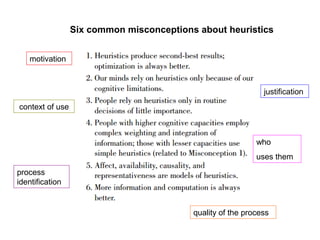
Six common misconceptions about heuristics
motivation
justification
context of use
who
uses them
process
identification
quality of the process
Ecological rationality
Recognition
Fluency Take the best
Satisficing
Tit-for-tat
Imitate the majority
Imitate the successful
If one of two
alternatives is
recognized, infer that it
has the higher value
on the criterion
If one alternative is
recognized faster than
another, infer that it has
the higher value on the
criterion
Infer which of
two
alternatives
has the higher
value by…
a) searching
through cues
in order of
validity
c) choosing the
alternative this
cue favors
b) stopping the
search as soon
as a cue
discriminates
Search through
alternatives, and
choose the first one
that exceeds your
aspiration level
Cooperate first, keep a memory of
Size 1, and then imitate your
partner’s last behavior
Look at a majority of people
in your peer group, and
imitate their behavior
Look for the most
successful person
and imitate his or
her behavior
Behavior is often called rational if and only if it follows the laws of logic or probability
theory. From a Darwinian perspective, however, the goal of an organism is not to
follow logic.
The study of ecological rationality analyzes which heuristics match with which
environmental structures that will permit more general conclusions about the match
between cognitive processes and environments.
The study of heuristics aspires to this objective by improving strategies and/or
enviroments to support better decisions. For that, an adaptative system needs to
know when to ignore information, even when it is free, and cognitive theories need
to model how information is ignored.
For Gigerenzer the answer to the question Why do heuristics work is that heuristics
can provide solutions to problems that are different from strategies of logic and
probability. For him the systematic study of the environments in which heuristics
work is in its infancy. Heuristics can contribute to understanding how cognition
works.
Heuristics
When there is a problem to solve, we usually face several possibilities
(hypotheses) and we have to create or select the suitable one. In this
situation we can rely on heuristics, that are for example rules of thumb
expressed in sentential therms and that help us reach satisfactory
choices without considering all the possibilities.
Lorenzo Magnani
Abductive Cognition, p. 464
Heuristics
Problem-solving procedure that involves conceiving a
hypothetical answer to a problem at the outset of an inquiry for
purposes of giving guidance or direction to the inquiry. It
consists of:
(a) developing a conception of what one expects to discover;
(b) using that conception to guide one in seeking, selecting, and
assigning meaning to facts;
(c) continually developing new, more adequate conceptions as
the discovery and interpretation of facts proceed.
Advocates of procedure contend that all scientific knowledge is
acquired in this manner and that all knowledge is relative,
tentative, dubitable, and ever subject to change, there being no
end to the heuristic process.
Folk epistemology
Uncovering the nature of folk
epistemology is a matter of
empirical investigationOur capacity to
ascribe and reason
about knowledge
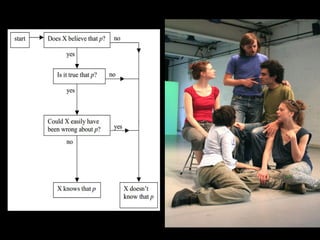
Ascribing knowledge is a cognitive
process that ends in a judgement
that X knows that p
Knowledge ascription is typically
mediated by our folk
epistemological competence
which contains heuristics for
ascribing knowledge
We possess a folk epistemology module that contains tacitly
represented principiples about knowledge and which employs fast and
frugal heuristics for ascribing knowledge.
We do not know much about how folk epistemology is realised cognitively
(about it´s structure, development, operation, etc.)
We do no have a guarantee that the folk epistemological processes that
give rise to epistemic intuitions are guided by information that is
guaranteed to be true of its referent-knowledge
Thanks.
Let’s talk!

Why Heuristics Work | María G. Navarro | European Centre for Soft Computing

  • 1.
    Why Heuristics Work AnIntroduction to Folk Epistemology María G. Navarro maria.navarro@cchs.csic.es
  • 2.
    How can wedefine ‘heuristics’? Do we know more than one type of heuristic? What role do they play in epistemology?
  • 3.
    Six common misconceptionsabout heuristics motivation justification context of use who uses them process identification quality of the process
  • 6.
    Ecological rationality Recognition Fluency Takethe best Satisficing Tit-for-tat Imitate the majority Imitate the successful If one of two alternatives is recognized, infer that it has the higher value on the criterion If one alternative is recognized faster than another, infer that it has the higher value on the criterion Infer which of two alternatives has the higher value by… a) searching through cues in order of validity c) choosing the alternative this cue favors b) stopping the search as soon as a cue discriminates Search through alternatives, and choose the first one that exceeds your aspiration level Cooperate first, keep a memory of Size 1, and then imitate your partner’s last behavior Look at a majority of people in your peer group, and imitate their behavior Look for the most successful person and imitate his or her behavior
  • 7.
    Behavior is oftencalled rational if and only if it follows the laws of logic or probability theory. From a Darwinian perspective, however, the goal of an organism is not to follow logic. The study of ecological rationality analyzes which heuristics match with which environmental structures that will permit more general conclusions about the match between cognitive processes and environments. The study of heuristics aspires to this objective by improving strategies and/or enviroments to support better decisions. For that, an adaptative system needs to know when to ignore information, even when it is free, and cognitive theories need to model how information is ignored. For Gigerenzer the answer to the question Why do heuristics work is that heuristics can provide solutions to problems that are different from strategies of logic and probability. For him the systematic study of the environments in which heuristics work is in its infancy. Heuristics can contribute to understanding how cognition works.
  • 8.
    Heuristics When there isa problem to solve, we usually face several possibilities (hypotheses) and we have to create or select the suitable one. In this situation we can rely on heuristics, that are for example rules of thumb expressed in sentential therms and that help us reach satisfactory choices without considering all the possibilities. Lorenzo Magnani Abductive Cognition, p. 464
  • 9.
    Heuristics Problem-solving procedure thatinvolves conceiving a hypothetical answer to a problem at the outset of an inquiry for purposes of giving guidance or direction to the inquiry. It consists of: (a) developing a conception of what one expects to discover; (b) using that conception to guide one in seeking, selecting, and assigning meaning to facts; (c) continually developing new, more adequate conceptions as the discovery and interpretation of facts proceed. Advocates of procedure contend that all scientific knowledge is acquired in this manner and that all knowledge is relative, tentative, dubitable, and ever subject to change, there being no end to the heuristic process.
  • 10.
    Folk epistemology Uncovering thenature of folk epistemology is a matter of empirical investigationOur capacity to ascribe and reason about knowledge Ascribing knowledge is a cognitive process that ends in a judgement that X knows that p Knowledge ascription is typically mediated by our folk epistemological competence which contains heuristics for ascribing knowledge
  • 11.
    We possess afolk epistemology module that contains tacitly represented principiples about knowledge and which employs fast and frugal heuristics for ascribing knowledge.
  • 13.
    We do notknow much about how folk epistemology is realised cognitively (about it´s structure, development, operation, etc.) We do no have a guarantee that the folk epistemological processes that give rise to epistemic intuitions are guided by information that is guaranteed to be true of its referent-knowledge
  • 14.