Meaning
of ECRIF The ECRIF is a framework system of a way of
looking at how students learn a language. By
means of this framework system the teachers
can understand how they do the effective
foreign language learning, the object of this
method is to supply what to do or what not to
do, and in which style students can learn better.
By means of ECRIF, teachers can notice that to
what extent the teaching is fruitful and they
observe the approach of the students to the
target language.
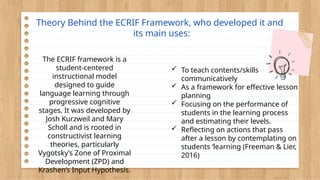
Theory Behind the ECRIF Framework, who developed it and
its main uses:
The ECRIF framework is a
student-centered
instructional model
designed to guide
language learning through
progressive cognitive
stages. It was developed by
Josh Kurzweil and Mary
Scholl and is rooted in
constructivist learning
theories, particularly
Vygotsky’s Zone of Proximal
Development (ZPD) and
Krashen’s Input Hypothesis.
 To teach contents/skills
communicatively
 As a framework for effective lesson
planning
 Focusing on the performance of
students in the learning process
and estimating their levels.
 Reflecting on actions that pass
after a lesson by contemplating on
students ‘learning (Freeman & Lier,
2016)
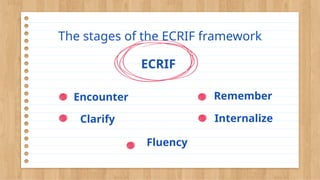
The stages of the ECRIF framework
Encounter Remember
Clarify Internalize
Fluency
ECRIF
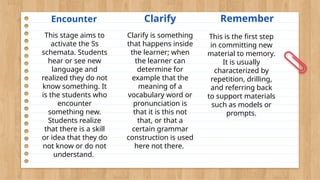
Encounter
This stage aims to
activate the Ss
schemata. Students
hear or see new
language and
realized they do not
know something. It
is the students who
encounter
something new.
Students realize
that there is a skill
or idea that they do
not know or do not
understand.
Clarify
Clarify is something
that happens inside
the learner; when
the learner can
determine for
example that the
meaning of a
vocabulary word or
pronunciation is
that it is this not
that, or that a
certain grammar
construction is used
here not there.
Remember
This is the first step
in committing new
material to memory.
It is usually
characterized by
repetition, drilling,
and referring back
to support materials
such as models or
prompts.
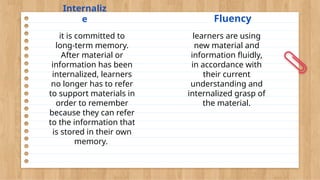
Internaliz
e
it is committed to
long-term memory.
After material or
information has been
internalized, learners
no longer has to refer
to support materials in
order to remember
because they can refer
to the information that
is stored in their own
memory.
Fluency
learners are using
new material and
information fluidly,
in accordance with
their current
understanding and
internalized grasp of
the material.
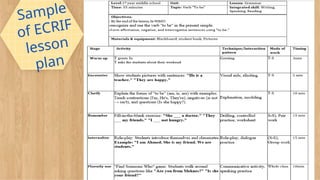
Sample
of ECRIF
lesson
plan
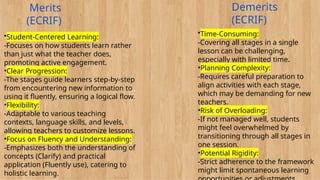
Merits
(ECRIF)
Demerits
(ECRIF)
•Student-Centered Learning:
-Focuses on how students learn rather
than just what the teacher does,
promoting active engagement.
•Clear Progression:
-The stages guide learners step-by-step
from encountering new information to
using it fluently, ensuring a logical flow.
•Flexibility:
-Adaptable to various teaching
contexts, language skills, and levels,
allowing teachers to customize lessons.
•Focus on Fluency and Understanding:
-Emphasizes both the understanding of
concepts (Clarify) and practical
application (Fluently use), catering to
holistic learning.
•Time-Consuming:
-Covering all stages in a single
lesson can be challenging,
especially with limited time.
•Planning Complexity:
-Requires careful preparation to
align activities with each stage,
which may be demanding for new
teachers.
•Risk of Overloading:
-If not managed well, students
might feel overwhelmed by
transitioning through all stages in
one session.
•Potential Rigidity:
-Strict adherence to the framework
might limit spontaneous learning
Thank you
for your
attention

Ecrif Framework to lesson planning English language

  • 1.
    Meaning of ECRIF TheECRIF is a framework system of a way of looking at how students learn a language. By means of this framework system the teachers can understand how they do the effective foreign language learning, the object of this method is to supply what to do or what not to do, and in which style students can learn better. By means of ECRIF, teachers can notice that to what extent the teaching is fruitful and they observe the approach of the students to the target language.
  • 2.
    Theory Behind theECRIF Framework, who developed it and its main uses: The ECRIF framework is a student-centered instructional model designed to guide language learning through progressive cognitive stages. It was developed by Josh Kurzweil and Mary Scholl and is rooted in constructivist learning theories, particularly Vygotsky’s Zone of Proximal Development (ZPD) and Krashen’s Input Hypothesis.  To teach contents/skills communicatively  As a framework for effective lesson planning  Focusing on the performance of students in the learning process and estimating their levels.  Reflecting on actions that pass after a lesson by contemplating on students ‘learning (Freeman & Lier, 2016)
  • 3.
    The stages ofthe ECRIF framework Encounter Remember Clarify Internalize Fluency ECRIF
  • 4.
    Encounter This stage aimsto activate the Ss schemata. Students hear or see new language and realized they do not know something. It is the students who encounter something new. Students realize that there is a skill or idea that they do not know or do not understand. Clarify Clarify is something that happens inside the learner; when the learner can determine for example that the meaning of a vocabulary word or pronunciation is that it is this not that, or that a certain grammar construction is used here not there. Remember This is the first step in committing new material to memory. It is usually characterized by repetition, drilling, and referring back to support materials such as models or prompts.
  • 5.
    Internaliz e it is committedto long-term memory. After material or information has been internalized, learners no longer has to refer to support materials in order to remember because they can refer to the information that is stored in their own memory. Fluency learners are using new material and information fluidly, in accordance with their current understanding and internalized grasp of the material.
  • 6.
  • 7.
    Merits (ECRIF) Demerits (ECRIF) •Student-Centered Learning: -Focuses onhow students learn rather than just what the teacher does, promoting active engagement. •Clear Progression: -The stages guide learners step-by-step from encountering new information to using it fluently, ensuring a logical flow. •Flexibility: -Adaptable to various teaching contexts, language skills, and levels, allowing teachers to customize lessons. •Focus on Fluency and Understanding: -Emphasizes both the understanding of concepts (Clarify) and practical application (Fluently use), catering to holistic learning. •Time-Consuming: -Covering all stages in a single lesson can be challenging, especially with limited time. •Planning Complexity: -Requires careful preparation to align activities with each stage, which may be demanding for new teachers. •Risk of Overloading: -If not managed well, students might feel overwhelmed by transitioning through all stages in one session. •Potential Rigidity: -Strict adherence to the framework might limit spontaneous learning
  • 8.