Pay attention to the figures below
Figure 1 Figure 2 Figure 3 Figure 4
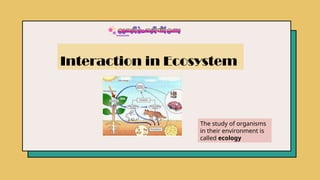
Interaction in Ecosystem
The study of organisms
in their environment is
called ecology
Two components in ecosystem
Biotic component = living things
-
Bacteria
-
Plankton
-
Fungi
-
Plants
-
Animals
-
Human
A-biotic component = non living
things
-
Sunlight
-
The soils
-
Water
-
Temperature
-
Humidity
-
pH
Do living things affect non living things? Or does it
happen in reverse order?
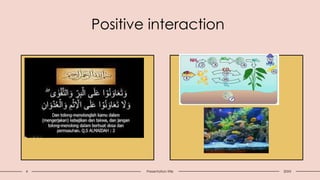
Positive interaction
4 Presentation title 20XX
Activity 1: Observing ecosystem
1. School garden
2. Pond
3. Parking area
4. TPA Mekarsari
Interaction Pattern
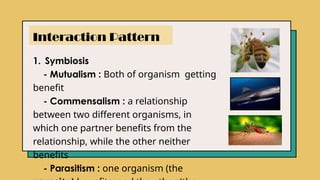
1. Symbiosis
- Mutualism : Both of organism getting
benefit
- Commensalism : a relationship
between two different organisms, in
which one partner benefits from the
relationship, while the other neither
benefits
- Parasitism : one organism (the
The examples of symbiosis
A B C D F
7 Presentation title 20XX
A : mutualism C : Parasitism E :
Commensalism
B : Parasitism D : Mutualism
Interaction Pattern
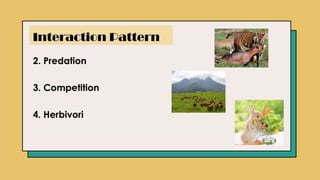
2. Predation
3. Competition
4. Herbivori
Food Chain and Food Web
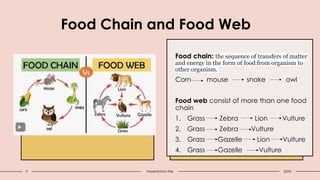
Food chain: the sequence of transfers of matter
and energy in the form of food from organism to
other organism.
Corn mouse snake owl
Food web consist of more than one food
chain
1. Grass Zebra Lion Vulture
2. Grass Zebra Vulture
3. Grass Gazelle Lion Vulture
4. Grass Gazelle Vulture
9 Presentation title 20XX
The role of organisms in ecosystem
• The first organism in a food chain is a
producer (plants)
• All the other organisms in a food chain
are consumers.
• Consumer that consume only plants
are herbivores.
• Consumers that consume other animals
are carnivores.
• Animals that catch, kill, and eat other
animals are predators. The animals they
eat are their prey.
• Organisms that make things decay are
called decomposers. Bacteria and
microscopic fungi are decomposers.
10 Presentation title 20XX
Telah tampak kerusakan di darat dan di laut
disebabkan karena perbuatan tangan
manusia; Allah menghendaki agar mereka
merasakan sebagian dari (akibat)
perbuatan mereka, agar mereka kembali
(ke jalan yang benar). (Q.S Ar Rum: 41)
“
”
12 Presentation title 20XX
Air pollution
Gases which are included as air pollution
are CO, CO2, NO, NO2, SO2.
those gases can cause various damage
in nature, some of them are acid rain,
ozone depletion, and global warming
13 Presentation title 20XX
Global Warming
Global Warming is the
increase in temperature of
earth surface caused by the
excessive discharge of CO2
and other gases (emission).
The effect of GW
• Climate change
• Temperature rise
• Loss of species
• More health risks
• Melting ice, rising ocean
14 Presentation title 20XX
Acid Rain
Gases such as SO2 and NO2 which
released to the atmosphere can
join with other particles can form to
acid. When they fall with the rain, it
is called acid rain.
The effect of acid rain
• Can kill plants, soil microorganism,
and poisons aquatic animals
• Can cause irritation on the skin,
eyes, and other parts of the body.
15 Presentation title 20XX
Ozone Depletion
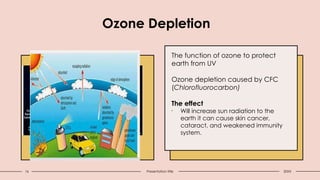
The function of ozone to protect
earth from UV
Ozone depletion caused by CFC
(Chlorofluorocarbon)
The effect
• Will increase sun radiation to the
earth it can cause skin cancer,
cataract, and weakened immunity
system.
16 Presentation title 20XX
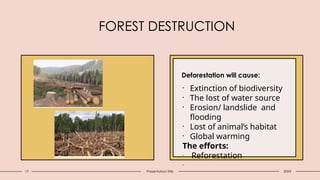
FOREST DESTRUCTION
Deforestation will cause:
• Extinction of biodiversity
• The lost of water source
• Erosion/ landslide and
flooding
• Lost of animal’s habitat
• Global warming
The efforts:
- Reforestation
-
17 Presentation title 20XX
What the efforts to solve
the environmental problems?
18 Presentation title 20XX
Check your progress
1. Mention abiotic factors that make up an ecosystem?
2. Mention the abiotic components that affect biotic component.
3. Give some examples of aquatic and land ecosystem around you.
4. Give an example of mutualism involving human beings.
5. What is the type of interaction between a louse and its host?
6. Explain how can the interaction between an orchid and a tree change from commensalism to
parasitism?
7. If one component of an ecosystem changes, the balance of the ecosystem will also change. Why?
19 Presentation title 20XX

ECOSYSTEM Interaction Science Grade 8 - 2024.pptx

  • 1.
    Pay attention tothe figures below Figure 1 Figure 2 Figure 3 Figure 4
  • 2.
    Interaction in Ecosystem Thestudy of organisms in their environment is called ecology
  • 3.
    Two components inecosystem Biotic component = living things - Bacteria - Plankton - Fungi - Plants - Animals - Human A-biotic component = non living things - Sunlight - The soils - Water - Temperature - Humidity - pH Do living things affect non living things? Or does it happen in reverse order?
  • 4.
  • 5.
    Activity 1: Observingecosystem 1. School garden 2. Pond 3. Parking area 4. TPA Mekarsari
  • 6.
    Interaction Pattern 1. Symbiosis -Mutualism : Both of organism getting benefit - Commensalism : a relationship between two different organisms, in which one partner benefits from the relationship, while the other neither benefits - Parasitism : one organism (the
  • 7.
    The examples ofsymbiosis A B C D F 7 Presentation title 20XX A : mutualism C : Parasitism E : Commensalism B : Parasitism D : Mutualism
  • 8.
    Interaction Pattern 2. Predation 3.Competition 4. Herbivori
  • 9.
    Food Chain andFood Web Food chain: the sequence of transfers of matter and energy in the form of food from organism to other organism. Corn mouse snake owl Food web consist of more than one food chain 1. Grass Zebra Lion Vulture 2. Grass Zebra Vulture 3. Grass Gazelle Lion Vulture 4. Grass Gazelle Vulture 9 Presentation title 20XX
  • 10.
    The role oforganisms in ecosystem • The first organism in a food chain is a producer (plants) • All the other organisms in a food chain are consumers. • Consumer that consume only plants are herbivores. • Consumers that consume other animals are carnivores. • Animals that catch, kill, and eat other animals are predators. The animals they eat are their prey. • Organisms that make things decay are called decomposers. Bacteria and microscopic fungi are decomposers. 10 Presentation title 20XX
  • 12.
    Telah tampak kerusakandi darat dan di laut disebabkan karena perbuatan tangan manusia; Allah menghendaki agar mereka merasakan sebagian dari (akibat) perbuatan mereka, agar mereka kembali (ke jalan yang benar). (Q.S Ar Rum: 41) “ ” 12 Presentation title 20XX
  • 13.
    Air pollution Gases whichare included as air pollution are CO, CO2, NO, NO2, SO2. those gases can cause various damage in nature, some of them are acid rain, ozone depletion, and global warming 13 Presentation title 20XX
  • 14.
    Global Warming Global Warmingis the increase in temperature of earth surface caused by the excessive discharge of CO2 and other gases (emission). The effect of GW • Climate change • Temperature rise • Loss of species • More health risks • Melting ice, rising ocean 14 Presentation title 20XX
  • 15.
    Acid Rain Gases suchas SO2 and NO2 which released to the atmosphere can join with other particles can form to acid. When they fall with the rain, it is called acid rain. The effect of acid rain • Can kill plants, soil microorganism, and poisons aquatic animals • Can cause irritation on the skin, eyes, and other parts of the body. 15 Presentation title 20XX
  • 16.
    Ozone Depletion The functionof ozone to protect earth from UV Ozone depletion caused by CFC (Chlorofluorocarbon) The effect • Will increase sun radiation to the earth it can cause skin cancer, cataract, and weakened immunity system. 16 Presentation title 20XX
  • 17.
    FOREST DESTRUCTION Deforestation willcause: • Extinction of biodiversity • The lost of water source • Erosion/ landslide and flooding • Lost of animal’s habitat • Global warming The efforts: - Reforestation - 17 Presentation title 20XX
  • 18.
    What the effortsto solve the environmental problems? 18 Presentation title 20XX
  • 19.
    Check your progress 1.Mention abiotic factors that make up an ecosystem? 2. Mention the abiotic components that affect biotic component. 3. Give some examples of aquatic and land ecosystem around you. 4. Give an example of mutualism involving human beings. 5. What is the type of interaction between a louse and its host? 6. Explain how can the interaction between an orchid and a tree change from commensalism to parasitism? 7. If one component of an ecosystem changes, the balance of the ecosystem will also change. Why? 19 Presentation title 20XX