ECO PALS
137 Secondary school ‘Angel Kanchev’, Sofia, Bulgaria
COMENIUS PROJECT
BULGARIAN TRADITIONS
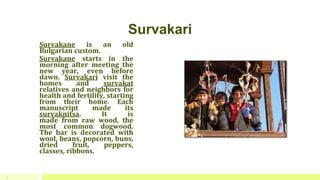
Survakari
Survakane is an old
Bulgarian custom.
Survakane starts in the
morning after meeting the
new year, even before
dawn. Survakari visit the
homes and survakat
relatives and neighbors for
health and fertility, starting
from their home. Each
manuscript made ​​its
survaknitsa. It is
made ​​from raw wood, the
most common dogwood.
The bar is decorated with
wool, beans, popcorn, buns,
dried fruit, peppers,
classes, ribbons.
2
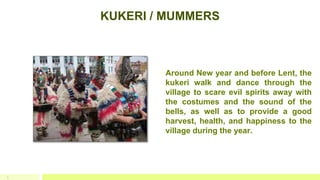
KUKERI / MUMMERS
3
 Around New year and before Lent, the
kukeri walk and dance through the
village to scare evil spirits away with
the costumes and the sound of the
bells, as well as to provide a good
harvest, health, and happiness to the
village during the year.
KUKERI FROM BANSKO – 2014, you tube
4
• http://youtu.be/z5Vbw3lfdPo
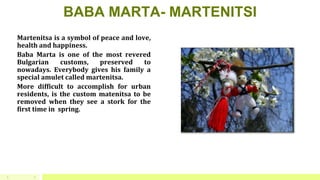
BABA MARTA- MARTENITSI
Martenitsa is a symbol of peace and love,
health and happiness.
Baba Marta is one of the most revered
Bulgarian customs, preserved to
nowadays. Everybody gives his family a
special amulet called martenitsa.
More difficult to accomplish for urban
residents, is the custom matenitsa to be
removed when they see a stork for the
first time in spring.
J5
LEGEND
This is only one of the many legends, and perhaps not even the
best known one, attempting to offer an explanation of how the
tradition of creating and wearing martenitsa arose.
Khan Kubrat's five sons went hunting accompanied by their
sister Huba. When they reached the River Danube they saw a
silver stag. Mesmerized, the men did not dare to shoot at it.
The stag crossed over to the opposite bank of the river showing
them that there was a ford.
A bird flew to them bringing bad tidings. Their father, the
founder of Old Great Bulgaria was on his deathbed. In his last
hours Kubrat wanted to tell his offspring—Bayan, Kotrag,
Asparukh, Kuber and Altsek—not to break the link between the
different Bulgarian tribes. His sons vowed to defend Bulgaria.
6
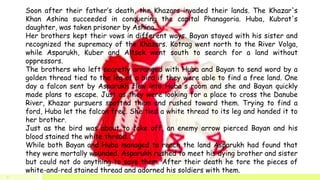
Soon after their father’s death, the Khazars invaded their lands. The Khazar's
Khan Ashina succeeded in conquering the capital Phanagoria. Huba, Kubrat's
daughter, was taken prisoner by Ashina.
Her brothers kept their vows in different ways. Bayan stayed with his sister and
recognized the supremacy of the Khazars. Kotrag went north to the River Volga,
while Asparukh, Kuber and Altsek went south to search for a land without
oppressors.
The brothers who left secretly arranged with Huba and Bayan to send word by a
golden thread tied to the leg of a bird if they were able to find a free land. One
day a falcon sent by Asparukh flew into Huba's room and she and Bayan quickly
made plans to escape. Just as they were looking for a place to cross the Danube
River, Khazar pursuers spotted them and rushed toward them. Trying to find a
ford, Huba let the falcon free. She tied a white thread to its leg and handed it to
her brother.
Just as the bird was about to take off, an enemy arrow pierced Bayan and his
blood stained the white thread.
While both Bayan and Huba managed to reach the land Asparukh had found that
they were mortally wounded. Asparukh rushed to meet his dying brother and sister
but could not do anything to save them. After their death he tore the pieces of
white-and-red stained thread and adorned his soldiers with them.
7
LAZARUVANE
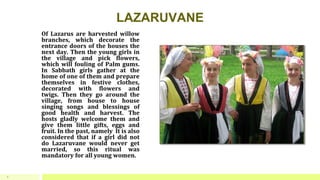
Of Lazarus are harvested willow
branches, which decorate the
entrance doors of the houses the
next day. Then the young girls in
the village and pick flowers,
which will fouling of Palm gums.
In Sabbath girls gather at the
home of one of them and prepare
themselves in festive clothes,
decorated with flowers and
twigs. Then they go around the
village, from house to house
singing songs and blessings of
good health and harvest. The
hosts gladly welcome them and
give them little gifts, eggs and
fruit. In the past, namely It is also
considered that if a girl did not
do Lazaruvane would never get
married, so this ritual was
mandatory for all young women.
8
NESTINARSTVO
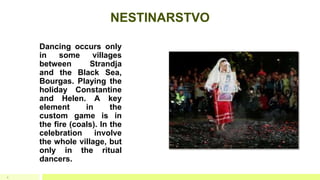
Dancing occurs only
in some villages
between Strandja
and the Black Sea,
Bourgas. Playing the
holiday Constantine
and Helen. A key
element in the
custom game is in
the fire (coals). In the
celebration involve
the whole village, but
only in the ritual
dancers.
9
HORO
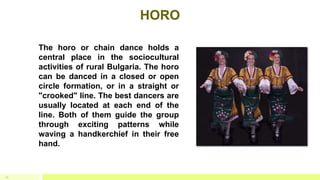
The horo or chain dance holds a
central place in the sociocultural
activities of rural Bulgaria. The horo
can be danced in a closed or open
circle formation, or in a straight or
"crooked" line. The best dancers are
usually located at each end of the
line. Both of them guide the group
through exciting patterns while
waving a handkerchief in their free
hand.
10
ENSEMBLE BULGARE – THIS IS BULGARIA
11
• http://youtu.be/jlNmxV9J2xs
WEDDING BULGARIA 2012
12
• http://youtu.be/GC-0CHpOL1I
BORYANO, BORYANKE
13
Presentation prepared : Rositsa Dimova
Irena Zazdrova - installation
INTERNET

Ecopals bg+links video copy

  • 1.
    ECO PALS 137 Secondaryschool ‘Angel Kanchev’, Sofia, Bulgaria COMENIUS PROJECT BULGARIAN TRADITIONS
  • 2.
    Survakari Survakane is anold Bulgarian custom. Survakane starts in the morning after meeting the new year, even before dawn. Survakari visit the homes and survakat relatives and neighbors for health and fertility, starting from their home. Each manuscript made ​​its survaknitsa. It is made ​​from raw wood, the most common dogwood. The bar is decorated with wool, beans, popcorn, buns, dried fruit, peppers, classes, ribbons. 2
  • 3.
    KUKERI / MUMMERS 3 Around New year and before Lent, the kukeri walk and dance through the village to scare evil spirits away with the costumes and the sound of the bells, as well as to provide a good harvest, health, and happiness to the village during the year.
  • 4.
    KUKERI FROM BANSKO– 2014, you tube 4 • http://youtu.be/z5Vbw3lfdPo
  • 5.
    BABA MARTA- MARTENITSI Martenitsais a symbol of peace and love, health and happiness. Baba Marta is one of the most revered Bulgarian customs, preserved to nowadays. Everybody gives his family a special amulet called martenitsa. More difficult to accomplish for urban residents, is the custom matenitsa to be removed when they see a stork for the first time in spring. J5
  • 6.
    LEGEND This is onlyone of the many legends, and perhaps not even the best known one, attempting to offer an explanation of how the tradition of creating and wearing martenitsa arose. Khan Kubrat's five sons went hunting accompanied by their sister Huba. When they reached the River Danube they saw a silver stag. Mesmerized, the men did not dare to shoot at it. The stag crossed over to the opposite bank of the river showing them that there was a ford. A bird flew to them bringing bad tidings. Their father, the founder of Old Great Bulgaria was on his deathbed. In his last hours Kubrat wanted to tell his offspring—Bayan, Kotrag, Asparukh, Kuber and Altsek—not to break the link between the different Bulgarian tribes. His sons vowed to defend Bulgaria. 6
  • 7.
    Soon after theirfather’s death, the Khazars invaded their lands. The Khazar's Khan Ashina succeeded in conquering the capital Phanagoria. Huba, Kubrat's daughter, was taken prisoner by Ashina. Her brothers kept their vows in different ways. Bayan stayed with his sister and recognized the supremacy of the Khazars. Kotrag went north to the River Volga, while Asparukh, Kuber and Altsek went south to search for a land without oppressors. The brothers who left secretly arranged with Huba and Bayan to send word by a golden thread tied to the leg of a bird if they were able to find a free land. One day a falcon sent by Asparukh flew into Huba's room and she and Bayan quickly made plans to escape. Just as they were looking for a place to cross the Danube River, Khazar pursuers spotted them and rushed toward them. Trying to find a ford, Huba let the falcon free. She tied a white thread to its leg and handed it to her brother. Just as the bird was about to take off, an enemy arrow pierced Bayan and his blood stained the white thread. While both Bayan and Huba managed to reach the land Asparukh had found that they were mortally wounded. Asparukh rushed to meet his dying brother and sister but could not do anything to save them. After their death he tore the pieces of white-and-red stained thread and adorned his soldiers with them. 7
  • 8.
    LAZARUVANE Of Lazarus areharvested willow branches, which decorate the entrance doors of the houses the next day. Then the young girls in the village and pick flowers, which will fouling of Palm gums. In Sabbath girls gather at the home of one of them and prepare themselves in festive clothes, decorated with flowers and twigs. Then they go around the village, from house to house singing songs and blessings of good health and harvest. The hosts gladly welcome them and give them little gifts, eggs and fruit. In the past, namely It is also considered that if a girl did not do Lazaruvane would never get married, so this ritual was mandatory for all young women. 8
  • 9.
    NESTINARSTVO Dancing occurs only insome villages between Strandja and the Black Sea, Bourgas. Playing the holiday Constantine and Helen. A key element in the custom game is in the fire (coals). In the celebration involve the whole village, but only in the ritual dancers. 9
  • 10.
    HORO The horo orchain dance holds a central place in the sociocultural activities of rural Bulgaria. The horo can be danced in a closed or open circle formation, or in a straight or "crooked" line. The best dancers are usually located at each end of the line. Both of them guide the group through exciting patterns while waving a handkerchief in their free hand. 10
  • 11.
    ENSEMBLE BULGARE –THIS IS BULGARIA 11 • http://youtu.be/jlNmxV9J2xs
  • 12.
    WEDDING BULGARIA 2012 12 •http://youtu.be/GC-0CHpOL1I
  • 13.
  • 14.
    Presentation prepared :Rositsa Dimova Irena Zazdrova - installation INTERNET