The economics of
shared mobility
Karolina Chachulska
The Business of Autonomous Vehicles: An Intensive Bootcamp, Nov 2019
The author is self proclaimed skeptical AV
enthusiast...
Management Consulting & Performance Improvement Financial AuditMobility & Growth
Background
Education
AVs will most
probably be
shared
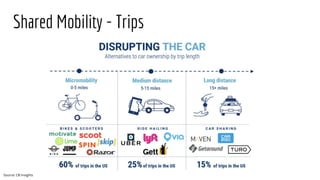
Shared Mobility - Trips
Source: CB Insights
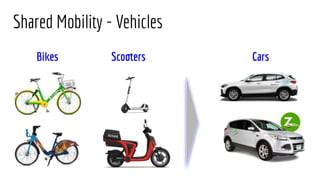
Shared Mobility - Vehicles
Bikes Scooters Cars
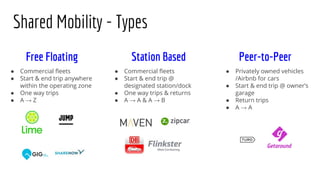
Shared Mobility - Types
Free Floating Station Based Peer-to-Peer
● Commercial fleets
● Start & end trip anywhere
within the operating zone
● One way trips
● A → Z
● Commercial fleets
● Start & end trip @
designated station/dock
● One way trips & returns
● A → A & A → B
● Privately owned vehicles
/Airbnb for cars
● Start & end trip @ owner’s
garage
● Return trips
● A → A
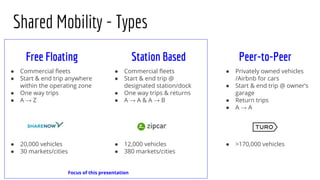
Shared Mobility - Types
Free Floating Station Based Peer-to-Peer
● Commercial fleets
● Start & end trip anywhere
within the operating zone
● One way trips
● A → Z
● Commercial fleets
● Start & end trip @
designated station/dock
● One way trips & returns
● A → A & A → B
● Privately owned vehicles
/Airbnb for cars
● Start & end trip @ owner’s
garage
● Return trips
● A → A
● 20,000 vehicles
● 30 markets/cities
● 12,000 vehicles
● 380 markets/cities
● >170,000 vehicles
Focus of this presentation
UTILIZATION(as a key metric)
Operator key
challenge:
How do I assure
great mobility
experience?
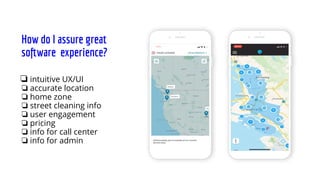
How do I assure great
software experience?
❏intuitive UX/UI
❏ accurate location
❏ home zone
❏ street cleaning info
❏ user engagement
❏ pricing
❏ info for call center
❏ info for admin
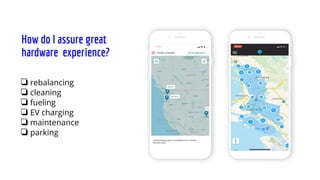
How do I assure great
hardware experience?
❏rebalancing
❏cleaning
❏fueling
❏EV charging
❏maintenance
❏parking
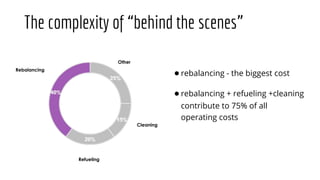
The complexity of “behind the scenes”
●rebalancing - the biggest cost
●rebalancing + refueling +cleaning
contribute to 75% of all
operating costs
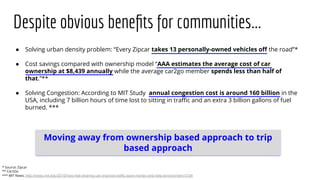
Despite obvious benefits for communities...
● Solving urban density problem: “Every Zipcar takes 13 personally-owned vehicles off the road”*
● Cost savings compared with ownership model “AAA estimates the average cost of car
ownership at $8,439 annually while the average car2go member spends less than half of
that.”**
● Solving Congestion: According to MIT Study annual congestion cost is around 160 billion in the
USA, including 7 billion hours of time lost to sitting in traffic and an extra 3 billion gallons of fuel
burned. ***
* Source: Zipcar
** Car2Go
*** MIT News: http://news.mit.edu/2016/how-ride-sharing-can-improve-traffic-save-money-and-help-environment-0104
Moving away from ownership based approach to trip
based approach
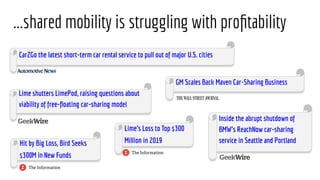
...shared mobility is struggling with profitability
Car2Go the latest short-term car rental service to pull out of major U.S. cities
GM Scales Back Maven Car-Sharing Business
Lime shutters LimePod, raising questions about
viability of free-floating car-sharing model
Inside the abrupt shutdown of
BMW’s ReachNow car-sharing
service in Seattle and PortlandHit by Big Loss, Bird Seeks
$300M in New Funds
Lime’s Loss to Top $300
Million in 2019
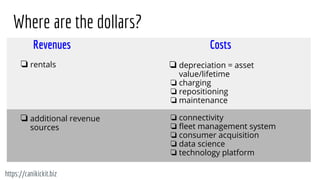
Where are the dollars?
Revenues Costs
❏rentals ❏depreciation = asset
value/lifetime
❏ charging
❏ repositioning
❏ maintenance
https://canikickit.biz
❏ connectivity
❏ fleet management system
❏ consumer acquisition
❏ data science
❏ technology platform
❏additional revenue
sources
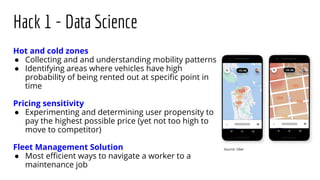
Hack 1 - Data Science
Source: Uber
Hot and cold zones
● Collecting and and understanding mobility patterns
● Identifying areas where vehicles have high
probability of being rented out at specific point in
time
Pricing sensitivity
● Experimenting and determining user propensity to
pay the highest possible price (yet not too high to
move to competitor)
Fleet Management Solution
● Most efficient ways to navigate a worker to a
maintenance job
Hack 2 - User incentives
Vehicle condition based
● Location based - price incentive for user to move the vehicle out of the low
utilization
● Battery level - price incentive for user to drop off the vehicle near charging
stations for vehicles with low battery level
Credits for fuelling
● Incentivising users to fuel the vehicle while on the go in exchange of $5
credit resulted in 30% decrease in fueling cost
More ideas on using incentives to optimize operations: https://player.fm/series/merge-now/ep-14-tarani-duncan-of-shared-on-scooter-20
Hack 3 - Adjacent Revenue Sources
Longer-term rentals
Example: Bird
● Monthly personal rental of the scooters (i.e. as a way to start operating
and collecting data in the cities where scooter sharing is not allowed)
Example: MAVEN
● Weekly mini-leases aimed at gig economy workers
Platform Sales
Example: Bird
● Sales of hardware + software (operating platform) for anyone who would
like to run the scooter fleets operations in their area
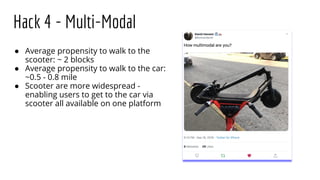
Hack 4 - Multi-Modal
● Average propensity to walk to the
scooter: ~ 2 blocks
● Average propensity to walk to the car:
~0.5 - 0.8 mile
● Scooter are more widespread -
enabling users to get to the car via
scooter all available on one platform
Hack 5 - Battery enhancements
Reusable battery
Example: WIND
● 40% of scooter value is the battery
● 80km (~50 miles) on one charge
● battery lifetime ~ 1000 charges
● “Battery can be easily extracted from a used/broken scooter and re-used
on other scooter” Eric Wang, WIND CEO
Swappable battery
Example: Revel mopeds
● Bat-swap: no need for taking the mopeds charging, a van with batteries
drives through during low utilization time and exchange the batteries
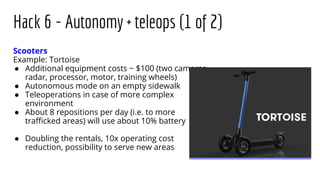
Hack 6 - Autonomy + teleops (1 of 2)
Scooters
Example: Tortoise
● Additional equipment costs ~ $100 (two cameras,
radar, processor, motor, training wheels)
● Autonomous mode on an empty sidewalk
● Teleoperations in case of more complex
environment
● About 8 repositions per day (i.e. to more
trafficked areas) will use about 10% battery
● Doubling the rentals, 10x operating cost
reduction, possibility to serve new areas
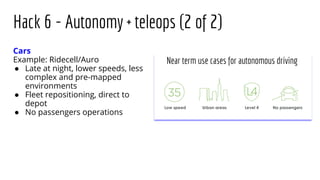
Hack 6 - Autonomy + teleops (2 of 2)
Cars
Example: Ridecell/Auro
● Late at night, lower speeds, less
complex and pre-mapped
environments
● Fleet repositioning, direct to
depot
● No passengers operations
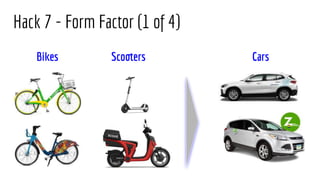
Hack 7 - Form Factor (1 of 4)
Bikes Scooters Cars
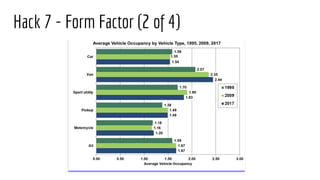
Hack 7 - Form Factor (2 of 4)
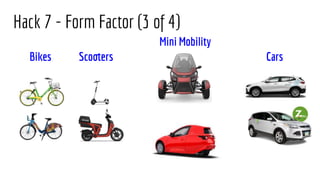
Hack 7 - Form Factor (3 of 4)
Bikes Scooters Cars
Mini Mobility
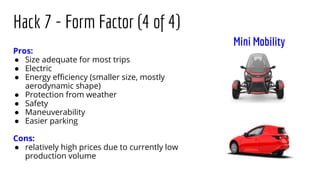
Hack 7 - Form Factor (4 of 4)
Mini Mobility
Pros:
● Size adequate for most trips
● Electric
● Energy efficiency (smaller size, mostly
aerodynamic shape)
● Protection from weather
● Safety
● Maneuverability
● Easier parking
Cons:
● relatively high prices due to currently low
production volume
The sector is relatively
young, new hacks will
emerge soon

Economics of shared mobility

  • 1.
    The economics of sharedmobility Karolina Chachulska The Business of Autonomous Vehicles: An Intensive Bootcamp, Nov 2019
  • 2.
    The author isself proclaimed skeptical AV enthusiast... Management Consulting & Performance Improvement Financial AuditMobility & Growth Background Education
  • 3.
  • 4.
    Shared Mobility -Trips Source: CB Insights
  • 5.
    Shared Mobility -Vehicles Bikes Scooters Cars
  • 6.
    Shared Mobility -Types Free Floating Station Based Peer-to-Peer ● Commercial fleets ● Start & end trip anywhere within the operating zone ● One way trips ● A → Z ● Commercial fleets ● Start & end trip @ designated station/dock ● One way trips & returns ● A → A & A → B ● Privately owned vehicles /Airbnb for cars ● Start & end trip @ owner’s garage ● Return trips ● A → A
  • 7.
    Shared Mobility -Types Free Floating Station Based Peer-to-Peer ● Commercial fleets ● Start & end trip anywhere within the operating zone ● One way trips ● A → Z ● Commercial fleets ● Start & end trip @ designated station/dock ● One way trips & returns ● A → A & A → B ● Privately owned vehicles /Airbnb for cars ● Start & end trip @ owner’s garage ● Return trips ● A → A ● 20,000 vehicles ● 30 markets/cities ● 12,000 vehicles ● 380 markets/cities ● >170,000 vehicles Focus of this presentation
  • 8.
  • 9.
    Operator key challenge: How doI assure great mobility experience?
  • 10.
    How do Iassure great software experience? ❏intuitive UX/UI ❏ accurate location ❏ home zone ❏ street cleaning info ❏ user engagement ❏ pricing ❏ info for call center ❏ info for admin
  • 11.
    How do Iassure great hardware experience? ❏rebalancing ❏cleaning ❏fueling ❏EV charging ❏maintenance ❏parking
  • 12.
    The complexity of“behind the scenes” ●rebalancing - the biggest cost ●rebalancing + refueling +cleaning contribute to 75% of all operating costs
  • 13.
    Despite obvious benefitsfor communities... ● Solving urban density problem: “Every Zipcar takes 13 personally-owned vehicles off the road”* ● Cost savings compared with ownership model “AAA estimates the average cost of car ownership at $8,439 annually while the average car2go member spends less than half of that.”** ● Solving Congestion: According to MIT Study annual congestion cost is around 160 billion in the USA, including 7 billion hours of time lost to sitting in traffic and an extra 3 billion gallons of fuel burned. *** * Source: Zipcar ** Car2Go *** MIT News: http://news.mit.edu/2016/how-ride-sharing-can-improve-traffic-save-money-and-help-environment-0104 Moving away from ownership based approach to trip based approach
  • 14.
    ...shared mobility isstruggling with profitability Car2Go the latest short-term car rental service to pull out of major U.S. cities GM Scales Back Maven Car-Sharing Business Lime shutters LimePod, raising questions about viability of free-floating car-sharing model Inside the abrupt shutdown of BMW’s ReachNow car-sharing service in Seattle and PortlandHit by Big Loss, Bird Seeks $300M in New Funds Lime’s Loss to Top $300 Million in 2019
  • 15.
    Where are thedollars? Revenues Costs ❏rentals ❏depreciation = asset value/lifetime ❏ charging ❏ repositioning ❏ maintenance https://canikickit.biz ❏ connectivity ❏ fleet management system ❏ consumer acquisition ❏ data science ❏ technology platform ❏additional revenue sources
  • 16.
    Hack 1 -Data Science Source: Uber Hot and cold zones ● Collecting and and understanding mobility patterns ● Identifying areas where vehicles have high probability of being rented out at specific point in time Pricing sensitivity ● Experimenting and determining user propensity to pay the highest possible price (yet not too high to move to competitor) Fleet Management Solution ● Most efficient ways to navigate a worker to a maintenance job
  • 17.
    Hack 2 -User incentives Vehicle condition based ● Location based - price incentive for user to move the vehicle out of the low utilization ● Battery level - price incentive for user to drop off the vehicle near charging stations for vehicles with low battery level Credits for fuelling ● Incentivising users to fuel the vehicle while on the go in exchange of $5 credit resulted in 30% decrease in fueling cost More ideas on using incentives to optimize operations: https://player.fm/series/merge-now/ep-14-tarani-duncan-of-shared-on-scooter-20
  • 18.
    Hack 3 -Adjacent Revenue Sources Longer-term rentals Example: Bird ● Monthly personal rental of the scooters (i.e. as a way to start operating and collecting data in the cities where scooter sharing is not allowed) Example: MAVEN ● Weekly mini-leases aimed at gig economy workers Platform Sales Example: Bird ● Sales of hardware + software (operating platform) for anyone who would like to run the scooter fleets operations in their area
  • 19.
    Hack 4 -Multi-Modal ● Average propensity to walk to the scooter: ~ 2 blocks ● Average propensity to walk to the car: ~0.5 - 0.8 mile ● Scooter are more widespread - enabling users to get to the car via scooter all available on one platform
  • 20.
    Hack 5 -Battery enhancements Reusable battery Example: WIND ● 40% of scooter value is the battery ● 80km (~50 miles) on one charge ● battery lifetime ~ 1000 charges ● “Battery can be easily extracted from a used/broken scooter and re-used on other scooter” Eric Wang, WIND CEO Swappable battery Example: Revel mopeds ● Bat-swap: no need for taking the mopeds charging, a van with batteries drives through during low utilization time and exchange the batteries
  • 21.
    Hack 6 -Autonomy + teleops (1 of 2) Scooters Example: Tortoise ● Additional equipment costs ~ $100 (two cameras, radar, processor, motor, training wheels) ● Autonomous mode on an empty sidewalk ● Teleoperations in case of more complex environment ● About 8 repositions per day (i.e. to more trafficked areas) will use about 10% battery ● Doubling the rentals, 10x operating cost reduction, possibility to serve new areas
  • 22.
    Hack 6 -Autonomy + teleops (2 of 2) Cars Example: Ridecell/Auro ● Late at night, lower speeds, less complex and pre-mapped environments ● Fleet repositioning, direct to depot ● No passengers operations
  • 23.
    Hack 7 -Form Factor (1 of 4) Bikes Scooters Cars
  • 24.
    Hack 7 -Form Factor (2 of 4)
  • 25.
    Hack 7 -Form Factor (3 of 4) Bikes Scooters Cars Mini Mobility
  • 26.
    Hack 7 -Form Factor (4 of 4) Mini Mobility Pros: ● Size adequate for most trips ● Electric ● Energy efficiency (smaller size, mostly aerodynamic shape) ● Protection from weather ● Safety ● Maneuverability ● Easier parking Cons: ● relatively high prices due to currently low production volume
  • 27.
    The sector isrelatively young, new hacks will emerge soon