The Three Economic Questions
And
The Four Economic Systems
Economic Systems
Every society must answer three
economic questions:
•What goods and services
should be produced?
•How should these goods
and services be produced?
•Who consumes these
goods and services?
Four Economic Systems
Traditional
Command
Market
Mixed
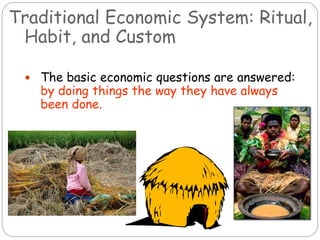
Traditional Economic System: Ritual,
Habit, and Custom
 The basic economic questions are answered:
by doing things the way they have always
been done.
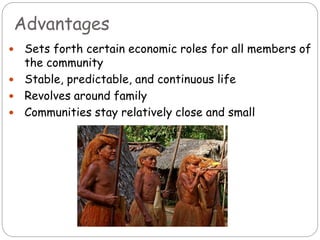
Advantages
 Sets forth certain economic roles for all members of
the community
 Stable, predictable, and continuous life
 Revolves around family
 Communities stay relatively close and small
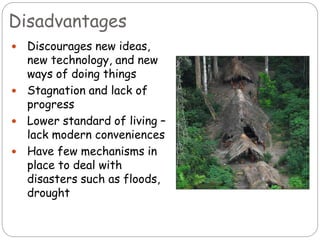
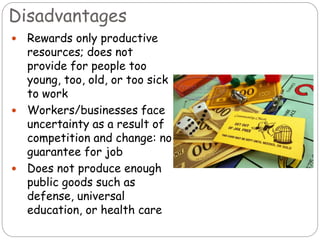
Disadvantages
 Discourages new ideas,
new technology, and new
ways of doing things
 Stagnation and lack of
progress
 Lower standard of living –
lack modern conveniences
 Have few mechanisms in
place to deal with
disasters such as floods,
drought
Command or Centrally Planned
Economic System
Basic economic questions of
what, how and for whom
to produce are answered:
by a central planning
authority.
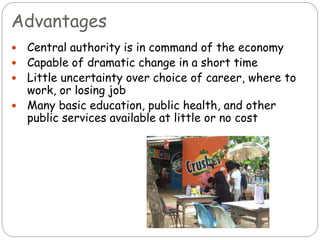
Advantages
 Central authority is in command of the economy
 Capable of dramatic change in a short time
 Little uncertainty over choice of career, where to
work, or losing job
 Many basic education, public health, and other
public services available at little or no cost
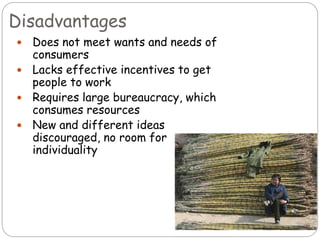
Disadvantages
 Does not meet wants and needs of
consumers
 Lacks effective incentives to get
people to work
 Requires large bureaucracy, which
consumes resources
 New and different ideas
discouraged, no room for
individuality
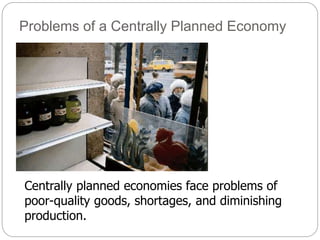
Problems of a Centrally Planned Economy
Centrally planned economies face problems of
poor-quality goods, shortages, and diminishing
production.
Market Economic System:
(Free Market, Capitalism)
Buyers and Sellers: Dollars “Vote”
The Basic economic questions are answered: by having
buyers and sellers make economic decisions.
Advantages
 Overtime, can adjust to change
 Individual freedom for
everyone
 Little government interference
 Decentralized – not
concentrated in the hands of a
few
 Variety of goods and services
 High degree of consumer
satisfaction
Disadvantages
 Rewards only productive
resources; does not
provide for people too
young, too, old, or too sick
to work
 Workers/businesses face
uncertainty as a result of
competition and change: no
guarantee for job
 Does not produce enough
public goods such as
defense, universal
education, or health care
Mixed Economic System
The basic economic questions are answered:
by combining traditional, state-run, and
private enterprises.
Mixed Economic System: No real
disadvantages
 A combination a traditional, market, and
command economies.
 Need government intervention – create
laws protecting property rights and
enforcing contracts
 Governments provide for national defense,
roads and highway systems, conservation,
environmental protection, education
 Key is to balance control and freedom
The degree of government involvement
in the economy varies among nations,
and can affect its society.
Continuum of Mixed Economies
Centrally planned Free market
Iran
North Korea
Cuba
China
Russia Greece Peru United States
South Africa France United Kingdom
Botswana Canada Singapore
Hong Kong
Essential Questions/Ideas
 How do societies provide the necessary items for
their people?
 Who gets to decide?
 Which economic system fails to worry about its
people’s wants?
 How does each system assign roles to play in the
economy?
 When should government intervene in the
economy?
 Which economic system do you think is most
beneficial for everyone?

Economic Systems.ppt

  • 1.
    The Three EconomicQuestions And The Four Economic Systems Economic Systems
  • 2.
    Every society mustanswer three economic questions: •What goods and services should be produced? •How should these goods and services be produced? •Who consumes these goods and services?
  • 3.
  • 4.
    Traditional Economic System:Ritual, Habit, and Custom  The basic economic questions are answered: by doing things the way they have always been done.
  • 5.
    Advantages  Sets forthcertain economic roles for all members of the community  Stable, predictable, and continuous life  Revolves around family  Communities stay relatively close and small
  • 6.
    Disadvantages  Discourages newideas, new technology, and new ways of doing things  Stagnation and lack of progress  Lower standard of living – lack modern conveniences  Have few mechanisms in place to deal with disasters such as floods, drought
  • 7.
    Command or CentrallyPlanned Economic System Basic economic questions of what, how and for whom to produce are answered: by a central planning authority.
  • 8.
    Advantages  Central authorityis in command of the economy  Capable of dramatic change in a short time  Little uncertainty over choice of career, where to work, or losing job  Many basic education, public health, and other public services available at little or no cost
  • 9.
    Disadvantages  Does notmeet wants and needs of consumers  Lacks effective incentives to get people to work  Requires large bureaucracy, which consumes resources  New and different ideas discouraged, no room for individuality
  • 10.
    Problems of aCentrally Planned Economy Centrally planned economies face problems of poor-quality goods, shortages, and diminishing production.
  • 11.
    Market Economic System: (FreeMarket, Capitalism) Buyers and Sellers: Dollars “Vote” The Basic economic questions are answered: by having buyers and sellers make economic decisions.
  • 12.
    Advantages  Overtime, canadjust to change  Individual freedom for everyone  Little government interference  Decentralized – not concentrated in the hands of a few  Variety of goods and services  High degree of consumer satisfaction
  • 13.
    Disadvantages  Rewards onlyproductive resources; does not provide for people too young, too, old, or too sick to work  Workers/businesses face uncertainty as a result of competition and change: no guarantee for job  Does not produce enough public goods such as defense, universal education, or health care
  • 14.
    Mixed Economic System Thebasic economic questions are answered: by combining traditional, state-run, and private enterprises.
  • 15.
    Mixed Economic System:No real disadvantages  A combination a traditional, market, and command economies.  Need government intervention – create laws protecting property rights and enforcing contracts  Governments provide for national defense, roads and highway systems, conservation, environmental protection, education  Key is to balance control and freedom
  • 16.
    The degree ofgovernment involvement in the economy varies among nations, and can affect its society. Continuum of Mixed Economies Centrally planned Free market Iran North Korea Cuba China Russia Greece Peru United States South Africa France United Kingdom Botswana Canada Singapore Hong Kong
  • 17.
    Essential Questions/Ideas  Howdo societies provide the necessary items for their people?  Who gets to decide?  Which economic system fails to worry about its people’s wants?  How does each system assign roles to play in the economy?  When should government intervene in the economy?  Which economic system do you think is most beneficial for everyone?