Economic Outlook

Analyzing the forces shaping the
 economy at home and abroad
        Ayse Somersan
           Fall 2011
The Outlook
• The economy has lost steam. GDP
  growth is anemic, at best. Unemployment
  is stuck at historic highs, with little
  indication that it will come down soon.
• Even this anemic recovery is threatened
  by outside forces. The European
  sovereign debt crisis could easily push the
  US and the global economy into
  recession.
Gross Domestic Product
Value of all goods and services produced in
  one year. Also the sum total of spending
  in one year.
Components:
• Consumer spending
• Investment
• Government spending
• Net exports
GDP Growth
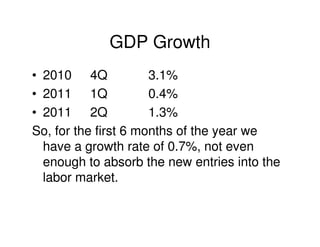
• 2010 4Q             3.1%
• 2011 1Q             0.4%
• 2011 2Q             1.3%
So, for the first 6 months of the year we
  have a growth rate of 0.7%, not even
  enough to absorb the new entries into the
  labor market.
Consumer Spending
• Consumer spending is the single most
  important component of GDP (70%).
  Without robust demand from consumers,
  GDP growth cannot be robust.
• Consumer sentiment about the future is
  negative. There is little good news to turn
  this around in the near term. Let us
  analyze the particulars.
Why isn’t consumption robust?
Before the Great Recession, consumers
 were on a shopping spree using two
 sources: Equity in their homes and credit
 card debt.
Equity is gone. In fact, of the 51 million
 mortgages, 14.6 million are under water,
 3.7 million are seriously delinquent and 5.2
 million have been foreclosed. Home
 prices have still not stabilized.
Consumption Cont.d
• Credit card debt has declined. Saving has
  increased and debt reduction has brought
  household balance sheets to a more
  sustainable level. There is some hope
  here. Holiday shopping season may yet
  pull GDP growth to a slightly better level.
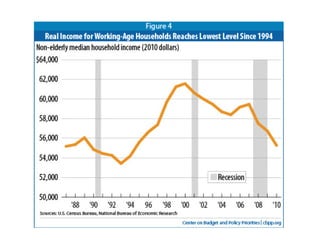
• Unemployment is a major drag on the
  system. Almost 26 million people are
  barely subsisting.
Consumption Cont.d
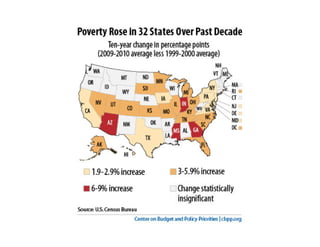
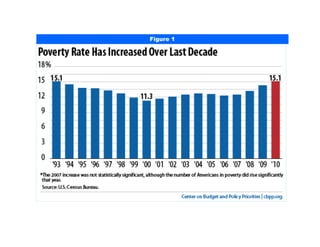
• Poverty has increased, continuing the long
  term trend.
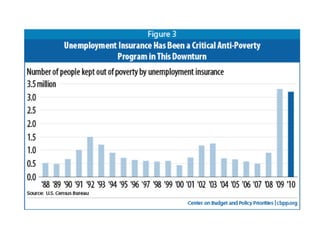
• If the unemployment insurance payment
  extension which expires at the end of 2011
  is not further extended into 2012, an
  additional 5 million people will join the
  ranks of people in poverty.
Figure 1
Income Inequality
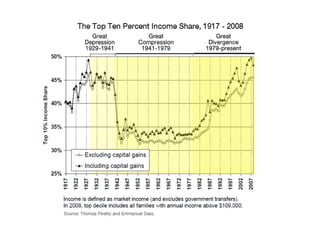
• The income distribution has changed.
  Most of the GDP growth since 1980 has
  gone to the top 1% of earners (80%).
• The share of the top 1% in total income
  has gone from almost 9% in 1979 to 24%
  in 2010.
• The average income of the top 0.01% has
  risen by 480%, from an annual average
  income of $4.2 to $24.3 million.
Income cut-off for the top 1%
•   99th percentile          $506,553
•   99.5th percentile        $815,868
•   99.9th percentile       $2,075,574
•   When you look at the wealth distribution,
    inequality increases. Top 1% holds about
    a third of American wealth. The cut-off for
    the 99th percentile in net worth was
    $19,167,600 in 2007.
Income Inequality Cont.d
• On the other hand, the average annual income
  of the lower 90% of the earners has hovered
  around $29,000 for almost 30 years.
• CEO pay has gone from 42 times the average
  worker(’80) to 185 times average worker(’05).
• The US has the most inequality in its income
  distribution of any developed country and is
  worse than many “banana republics”.
Investment
• Businesses have $2 trillion in cash on their
  balance sheets at home, plus another
  trillion abroad. While nonresidential
  investment spending increased during Q2
  over Q1, there appears to be no rush to
  expand capacity and increase hiring.
• There is still ample excess capacity in the
  system and demand is less than robust.
Investment Cont.d
• Large US business is investing and hiring
  abroad. In the first two years after the start of
  the Great Recession, large business cut US
  workers by 500,000 and increased foreign
  workers by 729,000. Since half of profits are
  made abroad, and since growth is there….
• US tax code encourages offshoring. You can
  deduct the cost of closing a US plant from your
  taxable income!!!
Government
• Government spending is a drag on the
  system. Any increases in Federal
  spending are being offset by declines at
  the state and local levels.
• If, by some miracle, the American Jobs Act
  were to pass, it would provide a much
  needed small boost to demand.
Net Exports
• Net Exports is always negative. We buy
  more than we sell to the rest of the world.
• During the second quarter, exports
  increased but imports increased more.
  The deficit was $145 billion, up from $140
  in the first quarter.
• No help for GDP growth from this item.
Unemployment
• Worst unemployment picture since the
  Great Depression.
14.5 million unemployed.
 8.8 million underemployed.
 2.6 million dropped out.
Average duration of unemployment - 40 wks
6.4 million unemployed more than 6 months.
1.4 million unemployed more than 2 yrs.
Unemployment Cont.d
• The three groups—unemployed,
  underemployed and drop outs make up
  16.2% of working age Americans.
• The figure is 26% for Blacks and 22% for
  Hispanics.
• Job growth will stay weak for 2-3 years
  even if all else goes well.
Where Did the Jobs Go?

Consider four factors:
• Shortfall of demand.
• Technology
• Structural impediments
• Globalization: Offshoring
Offshoring
• Lower labor costs
• Sidestep more stringent US workplace and
  environmental regulations
• Take advantage of foreign government
  subsidies
• Tap a labor pool that is in many cases
  better versed in math and science
What is to come?
Scenario 1: We muddle through with slow
  growth and high unemployment for this
  year and next, the European debt crisis is
  stabilized and we cross our fingers for
  some positive external and internal
  shocks.
Scenario 2: Greece defaults.
A. Best scenario: Greece pulls out of the
  Euro, devalues currency, growth and
Competitiveness is restored. European
  banks suffer but are shored up. Funds not
  spent on Greece go to at-risk countries
  like Spain and Italy. Markets stabilize.
  growth resumes.
B. Worst Scenario: Greece exits the Euro.
  Euro zone banks are hit hard, stop
  lending. Money flows out of weak
  European countries. Countries can’t get
financing and also default or pull out of the
   Euro. Market unrest. Growth collapses.
   We have a global double dip recession.

Economic outlook 2011 12

  • 1.
    Economic Outlook Analyzing theforces shaping the economy at home and abroad Ayse Somersan Fall 2011
  • 2.
    The Outlook • Theeconomy has lost steam. GDP growth is anemic, at best. Unemployment is stuck at historic highs, with little indication that it will come down soon. • Even this anemic recovery is threatened by outside forces. The European sovereign debt crisis could easily push the US and the global economy into recession.
  • 3.
    Gross Domestic Product Valueof all goods and services produced in one year. Also the sum total of spending in one year. Components: • Consumer spending • Investment • Government spending • Net exports
  • 4.
    GDP Growth • 20104Q 3.1% • 2011 1Q 0.4% • 2011 2Q 1.3% So, for the first 6 months of the year we have a growth rate of 0.7%, not even enough to absorb the new entries into the labor market.
  • 5.
    Consumer Spending • Consumerspending is the single most important component of GDP (70%). Without robust demand from consumers, GDP growth cannot be robust. • Consumer sentiment about the future is negative. There is little good news to turn this around in the near term. Let us analyze the particulars.
  • 6.
    Why isn’t consumptionrobust? Before the Great Recession, consumers were on a shopping spree using two sources: Equity in their homes and credit card debt. Equity is gone. In fact, of the 51 million mortgages, 14.6 million are under water, 3.7 million are seriously delinquent and 5.2 million have been foreclosed. Home prices have still not stabilized.
  • 7.
    Consumption Cont.d • Creditcard debt has declined. Saving has increased and debt reduction has brought household balance sheets to a more sustainable level. There is some hope here. Holiday shopping season may yet pull GDP growth to a slightly better level. • Unemployment is a major drag on the system. Almost 26 million people are barely subsisting.
  • 8.
    Consumption Cont.d • Povertyhas increased, continuing the long term trend. • If the unemployment insurance payment extension which expires at the end of 2011 is not further extended into 2012, an additional 5 million people will join the ranks of people in poverty.
  • 10.
  • 14.
    Income Inequality • Theincome distribution has changed. Most of the GDP growth since 1980 has gone to the top 1% of earners (80%). • The share of the top 1% in total income has gone from almost 9% in 1979 to 24% in 2010. • The average income of the top 0.01% has risen by 480%, from an annual average income of $4.2 to $24.3 million.
  • 16.
    Income cut-off forthe top 1% • 99th percentile $506,553 • 99.5th percentile $815,868 • 99.9th percentile $2,075,574 • When you look at the wealth distribution, inequality increases. Top 1% holds about a third of American wealth. The cut-off for the 99th percentile in net worth was $19,167,600 in 2007.
  • 17.
    Income Inequality Cont.d •On the other hand, the average annual income of the lower 90% of the earners has hovered around $29,000 for almost 30 years. • CEO pay has gone from 42 times the average worker(’80) to 185 times average worker(’05). • The US has the most inequality in its income distribution of any developed country and is worse than many “banana republics”.
  • 18.
    Investment • Businesses have$2 trillion in cash on their balance sheets at home, plus another trillion abroad. While nonresidential investment spending increased during Q2 over Q1, there appears to be no rush to expand capacity and increase hiring. • There is still ample excess capacity in the system and demand is less than robust.
  • 19.
    Investment Cont.d • LargeUS business is investing and hiring abroad. In the first two years after the start of the Great Recession, large business cut US workers by 500,000 and increased foreign workers by 729,000. Since half of profits are made abroad, and since growth is there…. • US tax code encourages offshoring. You can deduct the cost of closing a US plant from your taxable income!!!
  • 20.
    Government • Government spendingis a drag on the system. Any increases in Federal spending are being offset by declines at the state and local levels. • If, by some miracle, the American Jobs Act were to pass, it would provide a much needed small boost to demand.
  • 21.
    Net Exports • NetExports is always negative. We buy more than we sell to the rest of the world. • During the second quarter, exports increased but imports increased more. The deficit was $145 billion, up from $140 in the first quarter. • No help for GDP growth from this item.
  • 22.
    Unemployment • Worst unemploymentpicture since the Great Depression. 14.5 million unemployed. 8.8 million underemployed. 2.6 million dropped out. Average duration of unemployment - 40 wks 6.4 million unemployed more than 6 months. 1.4 million unemployed more than 2 yrs.
  • 23.
    Unemployment Cont.d • Thethree groups—unemployed, underemployed and drop outs make up 16.2% of working age Americans. • The figure is 26% for Blacks and 22% for Hispanics. • Job growth will stay weak for 2-3 years even if all else goes well.
  • 24.
    Where Did theJobs Go? Consider four factors: • Shortfall of demand. • Technology • Structural impediments • Globalization: Offshoring
  • 25.
    Offshoring • Lower laborcosts • Sidestep more stringent US workplace and environmental regulations • Take advantage of foreign government subsidies • Tap a labor pool that is in many cases better versed in math and science
  • 26.
    What is tocome? Scenario 1: We muddle through with slow growth and high unemployment for this year and next, the European debt crisis is stabilized and we cross our fingers for some positive external and internal shocks. Scenario 2: Greece defaults. A. Best scenario: Greece pulls out of the Euro, devalues currency, growth and
  • 27.
    Competitiveness is restored.European banks suffer but are shored up. Funds not spent on Greece go to at-risk countries like Spain and Italy. Markets stabilize. growth resumes. B. Worst Scenario: Greece exits the Euro. Euro zone banks are hit hard, stop lending. Money flows out of weak European countries. Countries can’t get
  • 28.
    financing and alsodefault or pull out of the Euro. Market unrest. Growth collapses. We have a global double dip recession.