For updated information, please visit www.ibef.org
January 2021
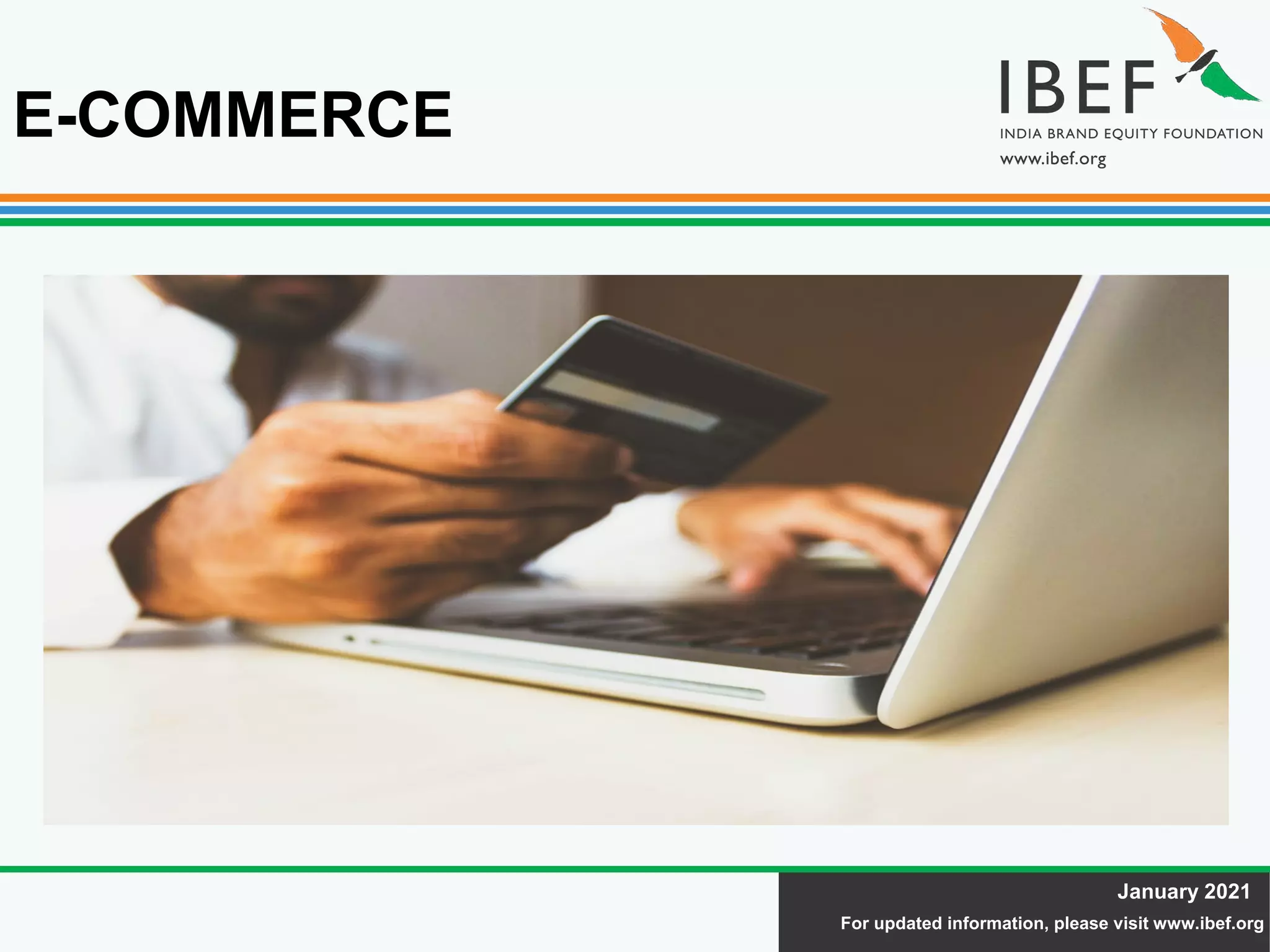
E-COMMERCE
2
Executive Summary 3
Advantage India 4
Market Overview 6
Recent Trends and Strategies 13
Growth Drivers 17
Key Industry Contacts 24
Appendix 26
Table of Contents
3
Executive summary
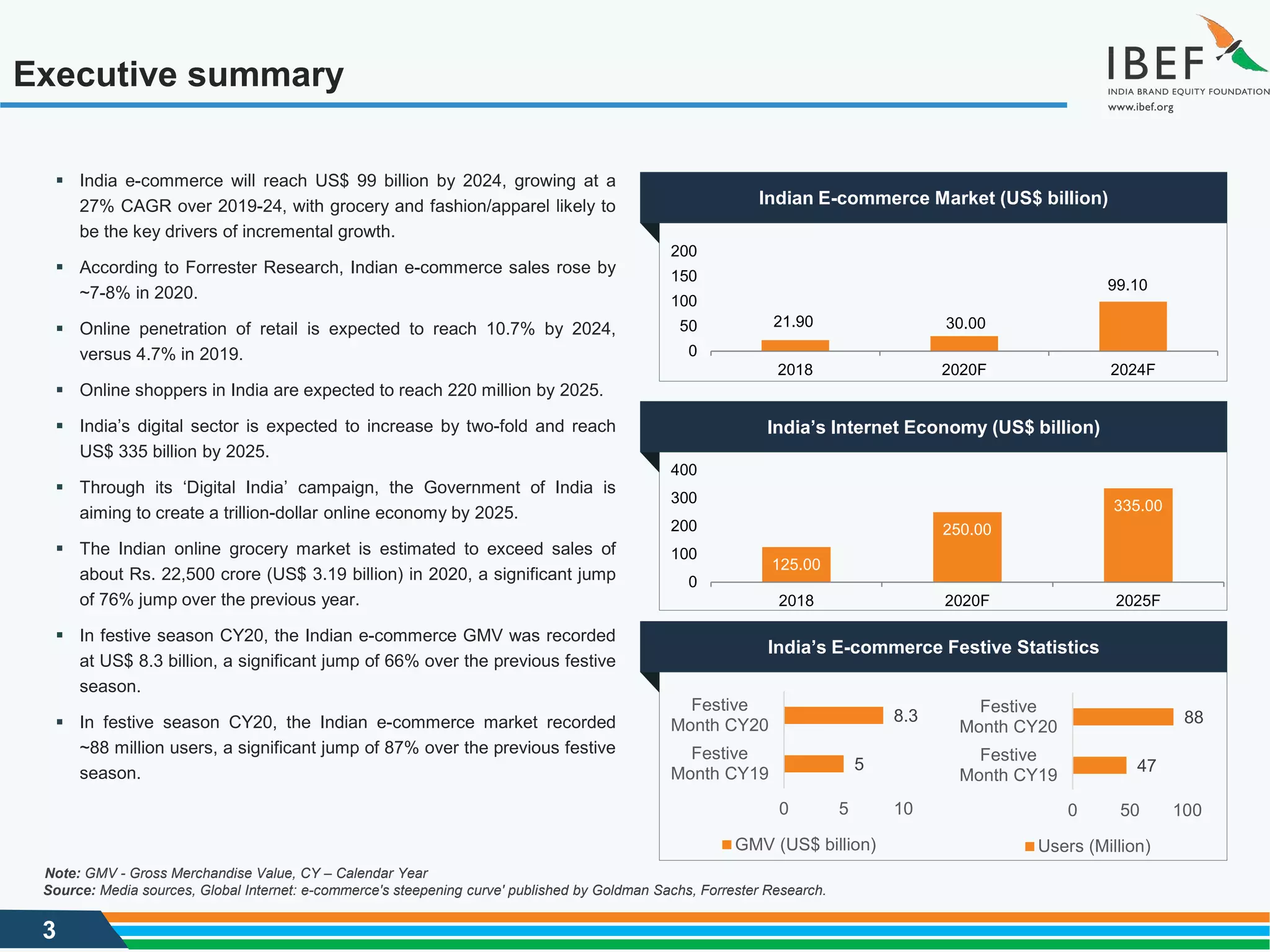
21.90 30.00
99.10
0
50
100
150
200
2018 2020F 2024F
India’s Internet Economy (US$ billion)
125.00
250.00
335.00
0
100
200
300
400
2018 2020F 2025F
Indian E-commerce Market (US$ billion)
Source: Media sources, Global Internet: e-commerce's steepening curve' published by Goldman Sachs, Forrester Research.
 India e-commerce will reach US$ 99 billion by 2024, growing at a
27% CAGR over 2019-24, with grocery and fashion/apparel likely to
be the key drivers of incremental growth.
 According to Forrester Research, Indian e-commerce sales rose by
~7-8% in 2020.
 Online penetration of retail is expected to reach 10.7% by 2024,
versus 4.7% in 2019.
 Online shoppers in India are expected to reach 220 million by 2025.
 India’s digital sector is expected to increase by two-fold and reach
US$ 335 billion by 2025.
 Through its ‘Digital India’ campaign, the Government of India is
aiming to create a trillion-dollar online economy by 2025.
 The Indian online grocery market is estimated to exceed sales of
about Rs. 22,500 crore (US$ 3.19 billion) in 2020, a significant jump
of 76% jump over the previous year.
 In festive season CY20, the Indian e-commerce GMV was recorded
at US$ 8.3 billion, a significant jump of 66% over the previous festive
season.
 In festive season CY20, the Indian e-commerce market recorded
~88 million users, a significant jump of 87% over the previous festive
season. 5
8.3
0 5 10
Festive
Month CY19
Festive
Month CY20
GMV (US$ billion)
India’s E-commerce Festive Statistics
47
88
0 50 100
Festive
Month CY19
Festive
Month CY20
Users (Million)
Note: GMV - Gross Merchandise Value, CY – Calendar Year
4
Advantage India
5
Advantage India
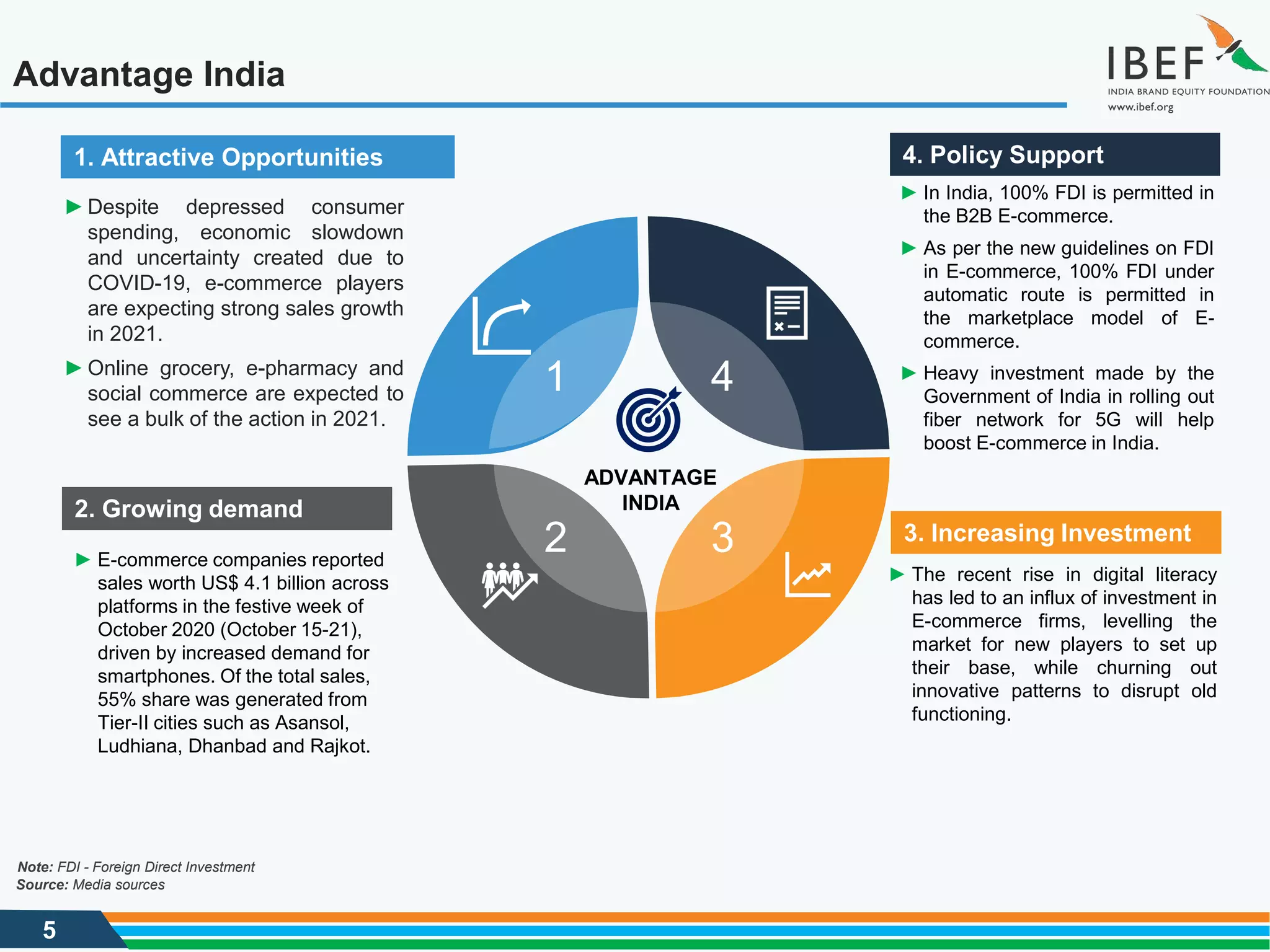
►Despite depressed consumer
spending, economic slowdown
and uncertainty created due to
COVID-19, e-commerce players
are expecting strong sales growth
in 2021.
►Online grocery, e-pharmacy and
social commerce are expected to
see a bulk of the action in 2021.
1. Attractive Opportunities
► In India, 100% FDI is permitted in
the B2B E-commerce.
► As per the new guidelines on FDI
in E-commerce, 100% FDI under
automatic route is permitted in
the marketplace model of E-
commerce.
► Heavy investment made by the
Government of India in rolling out
fiber network for 5G will help
boost E-commerce in India.
4. Policy Support
► The recent rise in digital literacy
has led to an influx of investment in
E-commerce firms, levelling the
market for new players to set up
their base, while churning out
innovative patterns to disrupt old
functioning.
3. Increasing Investment
► E-commerce companies reported
sales worth US$ 4.1 billion across
platforms in the festive week of
October 2020 (October 15-21),
driven by increased demand for
smartphones. Of the total sales,
55% share was generated from
Tier-II cities such as Asansol,
Ludhiana, Dhanbad and Rajkot.
2. Growing demand
ADVANTAGE
INDIA
1 4
3
2
Source: Media sources
Note: FDI - Foreign Direct Investment
6
Market Overview
MARKET OVERVIEW
7
Growth of e-commerce in India
 India's e-commerce festive sale season from October 15 to November
15 (2020) recorded gross sales worth Rs. 58,000 crore (US$ 8.3
billion) for brands and sellers, up 65% from Rs. 35,000 crore (US$ 5
billion) last year.
 The Indian e-commerce sector is ranked 9th in cross-border growth in
the world, according to Payoneer report.
 Indian e-commerce is projected to increase from 4% of the total food
and grocery, apparel and consumer electronics retail trade in 2020 to
8% by 2025.
 As most Indians have started shopping online rather than stepping
outside their houses, the Indian e-commerce sector witnessed an
increase.
 Huge investments from global players—such as Facebook, which is
investing in Reliance Jio—are being recorded in the e-commerce
market. Google also reported its first investment worth US$ 4.5 billion
in Jio Platforms. This deal was followed by the purchase of Future
Group by Reliance Retail, expanding the presence of the Ambani
Group in the e-commerce space.
 In October 2020, Minister of Commerce and Industry, Mr. Piyush
Goyal invited start-ups to register at public procurement portal, GeM,
and offer goods and services to government organisations and PSUs.
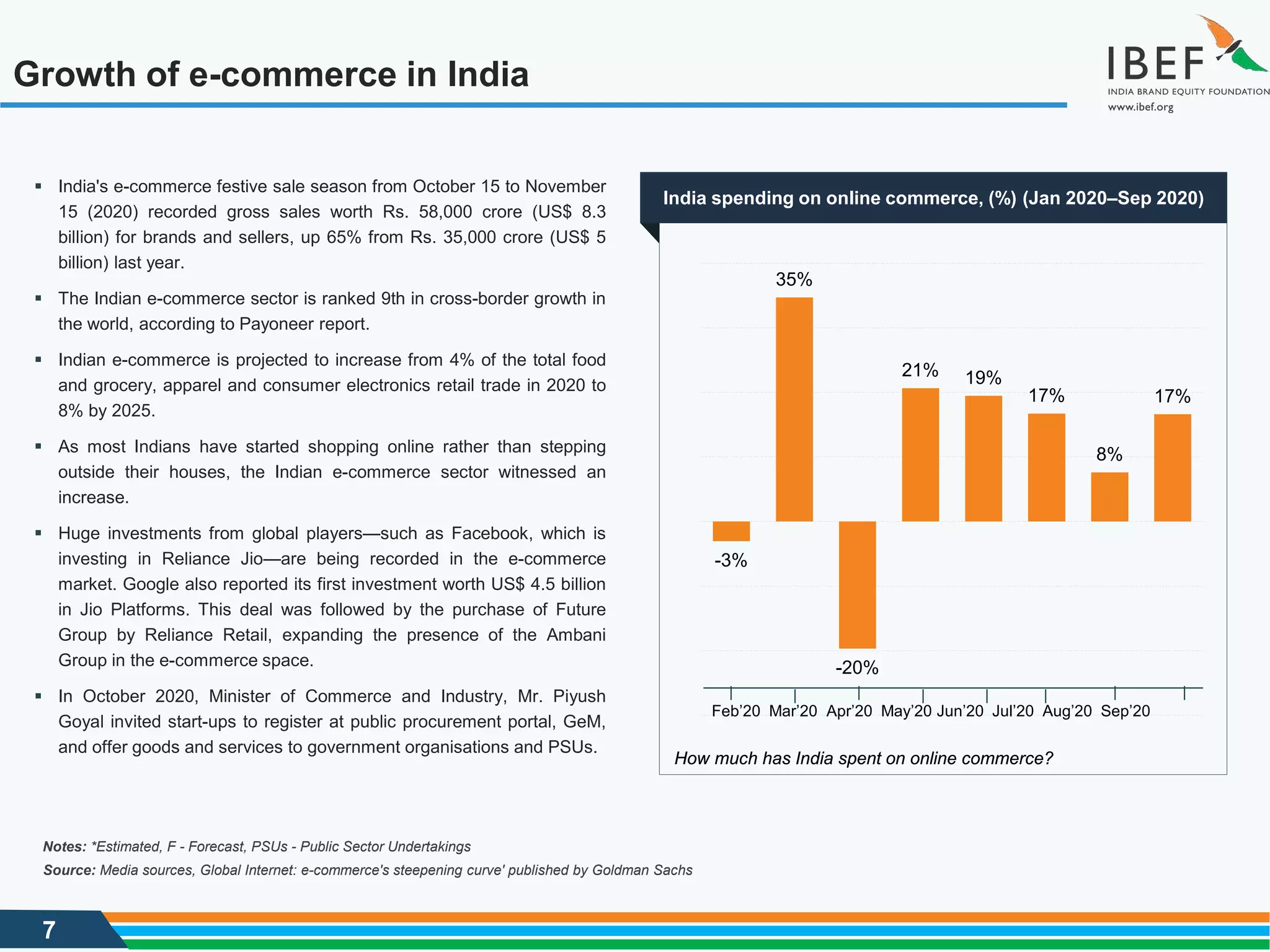
India spending on online commerce, (%) (Jan 2020–Sep 2020)
Notes: *Estimated, F - Forecast, PSUs - Public Sector Undertakings
Source: Media sources, Global Internet: e-commerce's steepening curve' published by Goldman Sachs
How much has India spent on online commerce?
-3%
35%
-20%
21% 19%
17%
8%
17%
Feb’20 Mar’20 Apr’20 May’20 Jun’20 Jul’20 Aug’20 Sep’20
8
Rising internet users in India
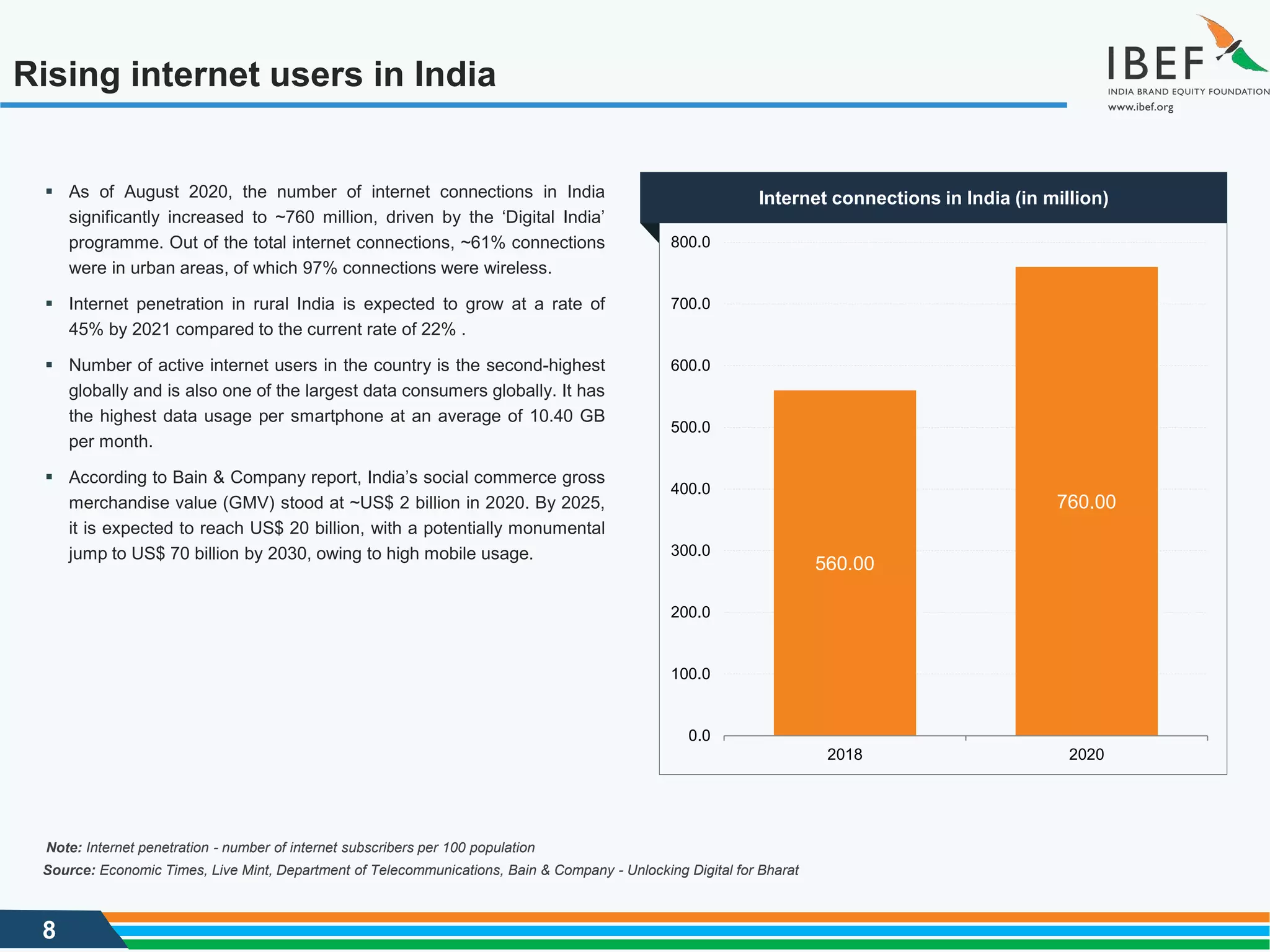
560.00
760.00
0.0
100.0
200.0
300.0
400.0
500.0
600.0
700.0
800.0
2018 2020
Source: Economic Times, Live Mint, Department of Telecommunications, Bain & Company - Unlocking Digital for Bharat
Internet connections in India (in million)
Note: Internet penetration - number of internet subscribers per 100 population
 As of August 2020, the number of internet connections in India
significantly increased to ~760 million, driven by the ‘Digital India’
programme. Out of the total internet connections, ~61% connections
were in urban areas, of which 97% connections were wireless.
 Internet penetration in rural India is expected to grow at a rate of
45% by 2021 compared to the current rate of 22% .
 Number of active internet users in the country is the second-highest
globally and is also one of the largest data consumers globally. It has
the highest data usage per smartphone at an average of 10.40 GB
per month.
 According to Bain & Company report, India’s social commerce gross
merchandise value (GMV) stood at ~US$ 2 billion in 2020. By 2025,
it is expected to reach US$ 20 billion, with a potentially monumental
jump to US$ 70 billion by 2030, owing to high mobile usage.
9
Online retail market
 The online retail market in India is estimated to be 25% of the total organized retail market and is expected to reach 37% by 2030.
 E-retail market is expected to continue its strong growth and will nearly be Rs. 1.8 trillion (US$ 25.75 billion) by FY20.
 Over the next five years, the Indian e-retail industry is projected to exceed ~300-350 million shoppers, propelling the online Gross Merchandise Value
(GMV) to US$ 100-120 billion by 2025.
 Driven by lower data rates and investments to enhance customer experience, the Indian e-retail witnessed a rapid increase in shopper penetration, as
online platforms are innovating to onboard the next billion of shoppers.
Source: Report by eMarketer, Kalaari Capital - Imagining Trillion Dollar India, ATKearney
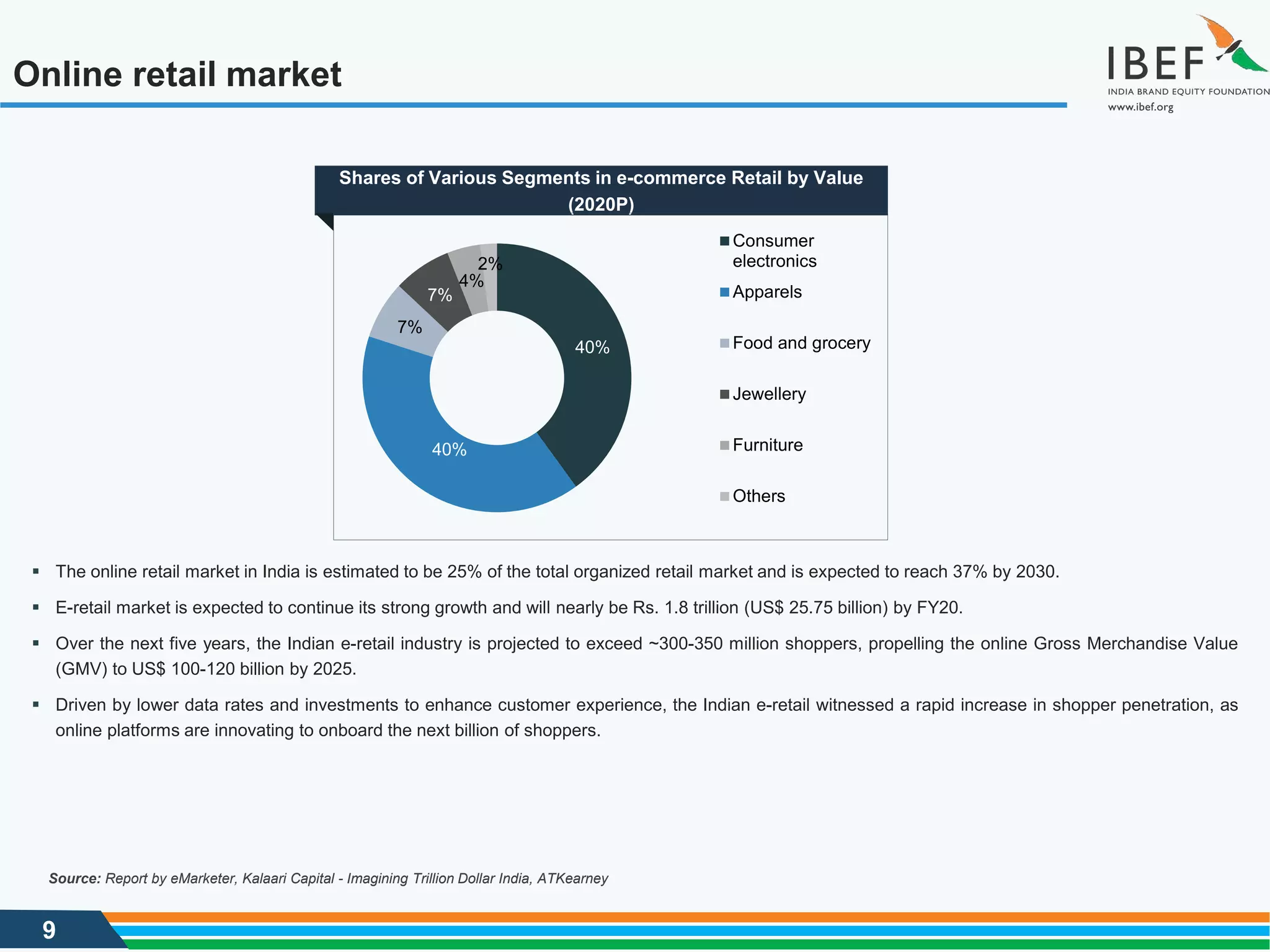
Shares of Various Segments in e-commerce Retail by Value
(2020P)
40%
40%
7%
7%
4%
2%
Consumer
electronics
Apparels
Food and grocery
Jewellery
Furniture
Others
10
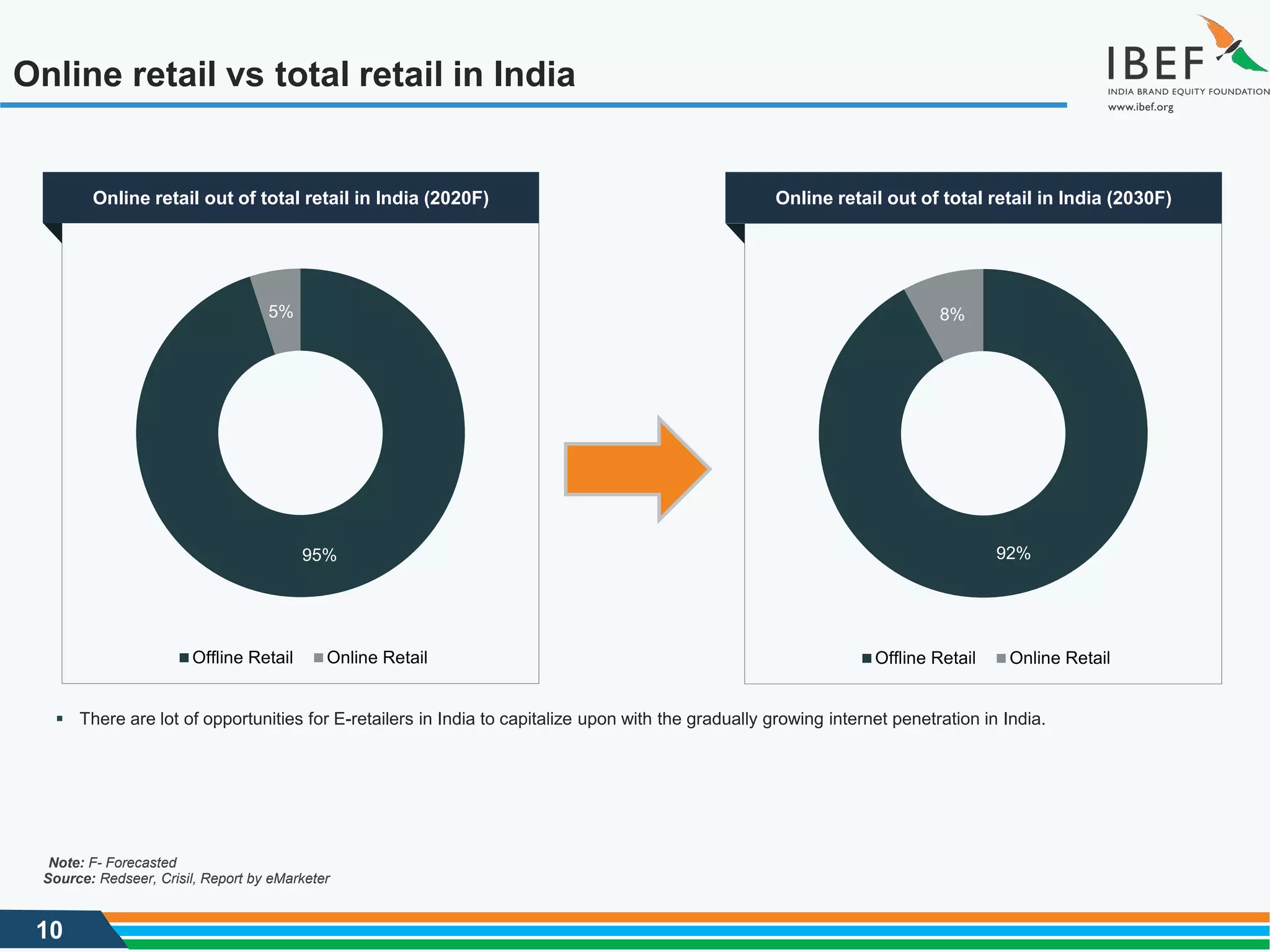
Online retail vs total retail in India
92%
8%
Offline Retail Online Retail
Online retail out of total retail in India (2030F)
95%
5%
Offline Retail Online Retail
Online retail out of total retail in India (2020F)
 There are lot of opportunities for E-retailers in India to capitalize upon with the gradually growing internet penetration in India.
Source: Redseer, Crisil, Report by eMarketer
Note: F- Forecasted
11
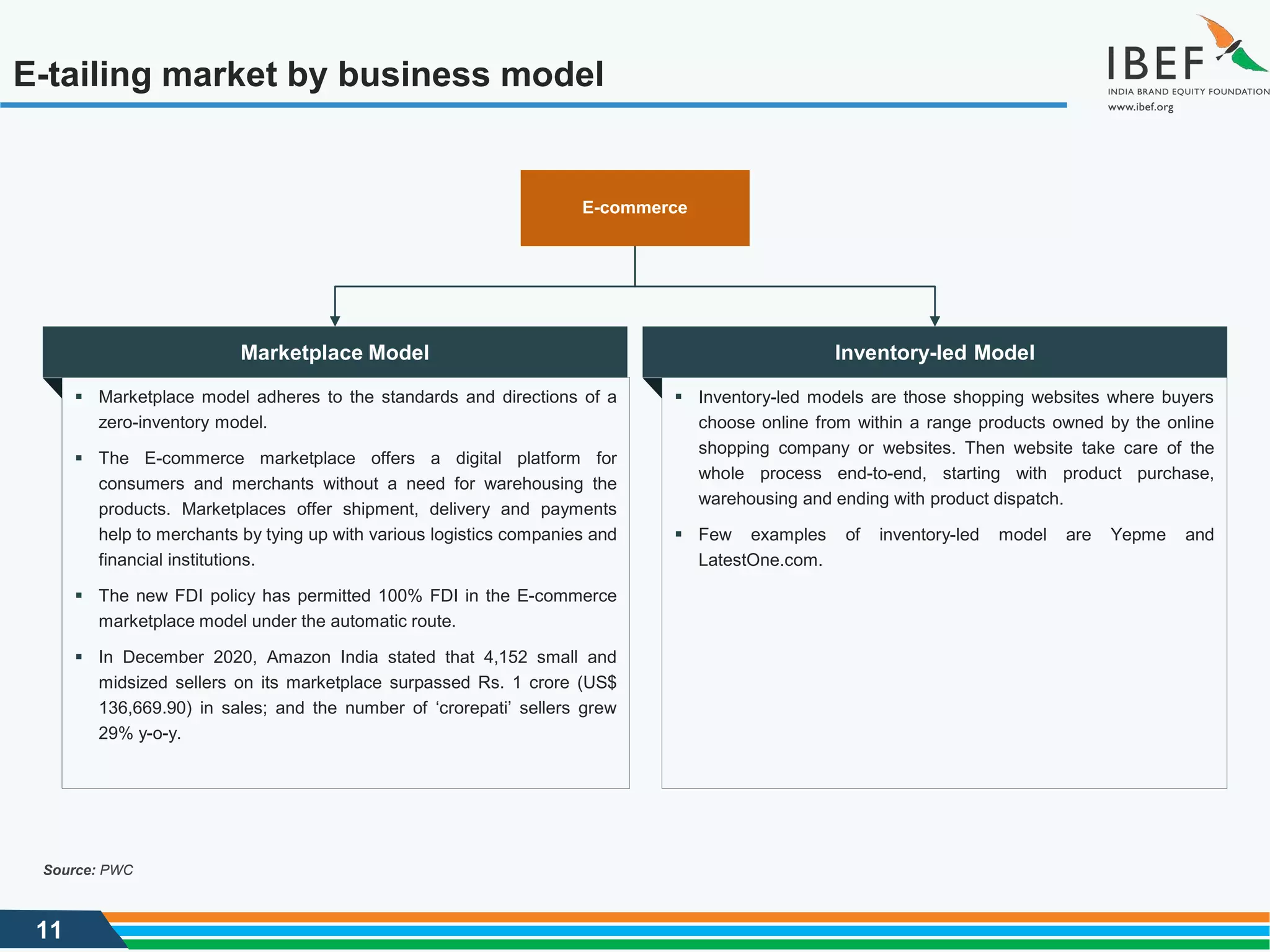
E-tailing market by business model
E-commerce
Marketplace Model
 Marketplace model adheres to the standards and directions of a
zero-inventory model.
 The E-commerce marketplace offers a digital platform for
consumers and merchants without a need for warehousing the
products. Marketplaces offer shipment, delivery and payments
help to merchants by tying up with various logistics companies and
financial institutions.
 The new FDI policy has permitted 100% FDI in the E-commerce
marketplace model under the automatic route.
 In December 2020, Amazon India stated that 4,152 small and
midsized sellers on its marketplace surpassed Rs. 1 crore (US$
136,669.90) in sales; and the number of ‘crorepati’ sellers grew
29% y-o-y.
Inventory-led Model
 Inventory-led models are those shopping websites where buyers
choose online from within a range products owned by the online
shopping company or websites. Then website take care of the
whole process end-to-end, starting with product purchase,
warehousing and ending with product dispatch.
 Few examples of inventory-led model are Yepme and
LatestOne.com.
Source: PWC
12
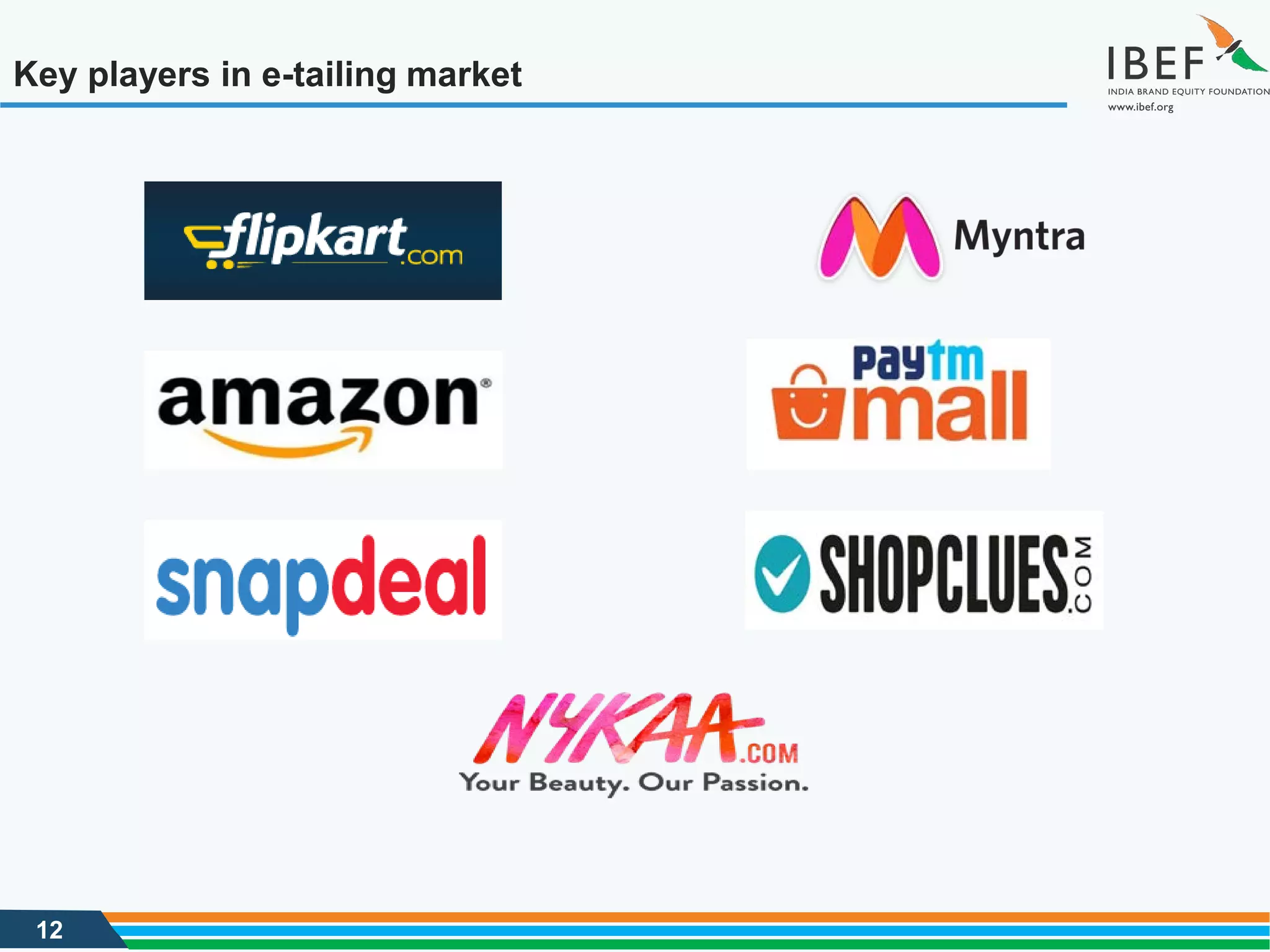
Key players in e-tailing market
13
Recent Trends and Strategies
RECENT TRENDS AND STRATEGIES
14
Policy and initiatives give a boost to the industry… (1/3)
1
ANCILLARY SERVICES
• In October 2020, Walmart introduced training to support and grow microbusinesses SMB in India.
• In November 2020, Amazon India has opened 'Made in India' toy store, in line with the government's
‘Atmanirbhar Bharat’ vision. The store will allow thousands of manufacturers and vendors to sell toys
driven by the Indian culture, folk tales and toys that promote creative thinking and are locally crafted &
manufactured.
• In October 2020, Amazon India collaborated with the Indian Railway Catering and Tourism Corporation
(IRCTC) to enable users to book and reserve train tickets on Amazon.
• In January 2021, Flipkart introduced SuperCoin Pay to strengthen its SuperCoin rewards programme by
allowing customers to pay through SuperCoins at >5,000 retail outlets across the country.
2
EXPANSION
• In January 2021, according to a Mint report, Reliance has set a plan to embed its e-commerce app,
JioMart, into WhatsApp within six months.
• In January 2021, The Khadi and Village Industries Commission (KVIC) unveiled eKhadiIndia.com, an e-
commerce portal, which will comprise >50,000 products, ranging from apparel to home décor.
3
MERGER & ACQUISITION
• In November 2020, Reliance Retail Ventures Ltd. (RRVL), a subsidiary of Reliance Industries (RIL),
acquired a minority stake of Urban Ladder Home Decor Solutions Pvt. Ltd. for Rs. 182.12 crore (US$
24.67 million).
• In November 2020, Flipkart acquired Scapic, an Augmented Reality (AR) firm, to boost user experience.
• In December 2020, according to Forbes India, Tata Group is likely to buy a controlling stake of 51% in
BigBasket.
Source: Media sources, Company websites
15
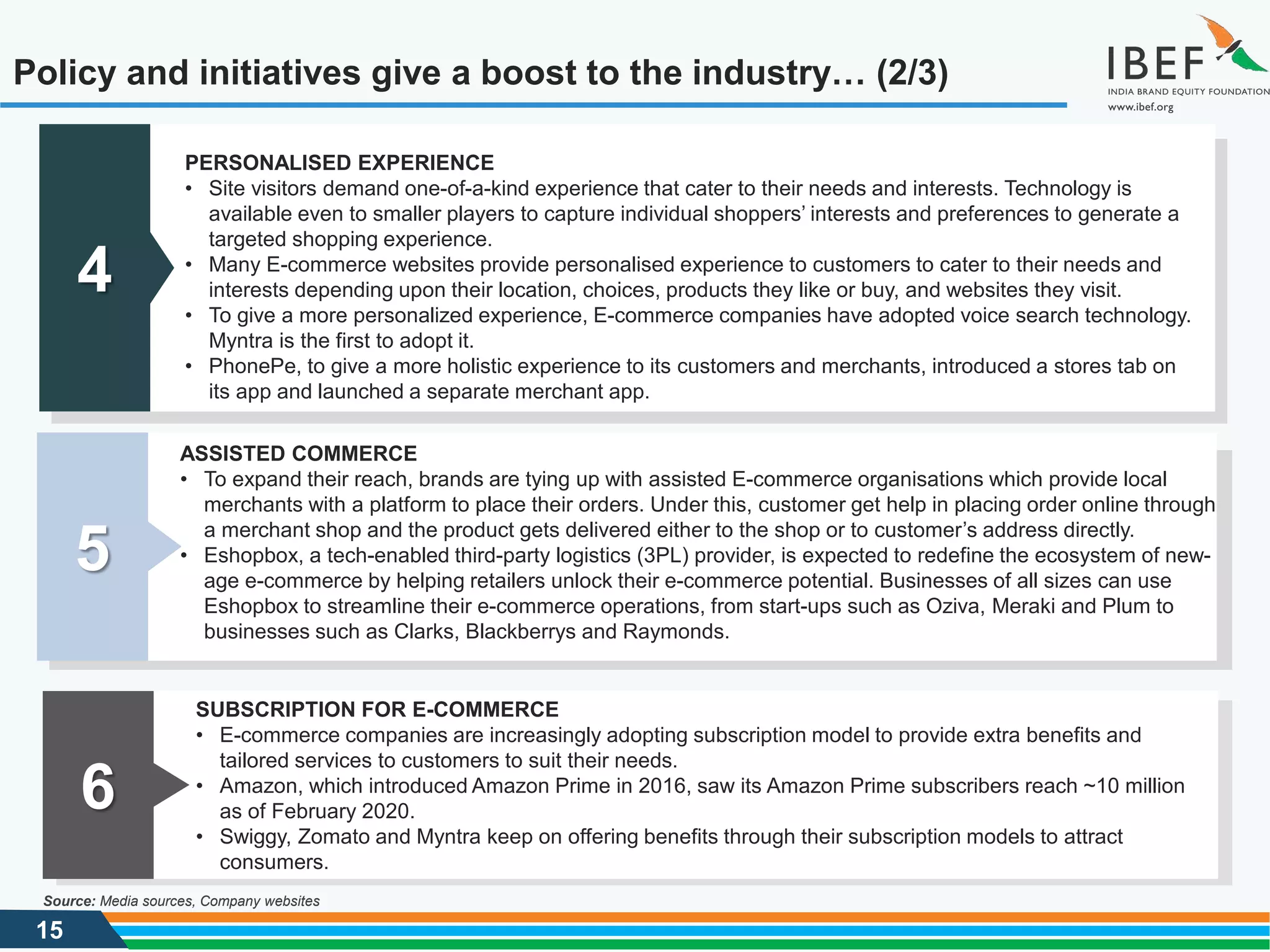
Policy and initiatives give a boost to the industry… (2/3)
4
PERSONALISED EXPERIENCE
• Site visitors demand one-of-a-kind experience that cater to their needs and interests. Technology is
available even to smaller players to capture individual shoppers’ interests and preferences to generate a
targeted shopping experience.
• Many E-commerce websites provide personalised experience to customers to cater to their needs and
interests depending upon their location, choices, products they like or buy, and websites they visit.
• To give a more personalized experience, E-commerce companies have adopted voice search technology.
Myntra is the first to adopt it.
• PhonePe, to give a more holistic experience to its customers and merchants, introduced a stores tab on
its app and launched a separate merchant app.
5
ASSISTED COMMERCE
• To expand their reach, brands are tying up with assisted E-commerce organisations which provide local
merchants with a platform to place their orders. Under this, customer get help in placing order online through
a merchant shop and the product gets delivered either to the shop or to customer’s address directly.
• Eshopbox, a tech-enabled third-party logistics (3PL) provider, is expected to redefine the ecosystem of new-
age e-commerce by helping retailers unlock their e-commerce potential. Businesses of all sizes can use
Eshopbox to streamline their e-commerce operations, from start-ups such as Oziva, Meraki and Plum to
businesses such as Clarks, Blackberrys and Raymonds.
6
SUBSCRIPTION FOR E-COMMERCE
• E-commerce companies are increasingly adopting subscription model to provide extra benefits and
tailored services to customers to suit their needs.
• Amazon, which introduced Amazon Prime in 2016, saw its Amazon Prime subscribers reach ~10 million
as of February 2020.
• Swiggy, Zomato and Myntra keep on offering benefits through their subscription models to attract
consumers.
Source: Media sources, Company websites
16
Policy and initiatives give a boost to the industry… (2/3)
7
PRODUCT CATEGORIES
• Brands are adapting to the change in consumption habits towards essentials, electronics, home furnishing
and other comfort-related product categories. This shift has happened since the pandemic and is forecast
to stay in the near future. Inventory stocking of fashion and accessories has recorded an all-time low this
year.
8
DIGITAL MARKETING
• 2020 has witnessed a shift in the consumer basket towards essentials and a drastic change in shopping
modality towards e-commerce platforms. Brands and companies are adapting to this consumer behaviour
change by increasing their marketing spends on digital media to acquire market share and tap target
audiences.
• As per the report, 34% business respondents have increased digital media budgets while 23% have
focused more on eCommerce selling.
9
GEOGRAPHIC FOCUS
• Companies are increasingly focusing their sights on Tier II and Tier III cities this year, as the demographic
landscape and pocket spends of these cities are evolving. The revenue share of Tier II+ cities has been
growing and digital marketing efforts can be targeted directly to these potential customers. This year’s
festive season recorded 88% customer growth from last year, which was driven by about 40 million
shoppers from Tier II+ cities.
Source: Media sources, Company websites, Modern Marketer Reckoner Report by GroupM and MMA
10
FUND RAISING
• In January 2021, the B2B e-commerce platform, Udaan raised US$ 280 million (~Rs. 2,048 crore) in
additional financing from new investors—Octahedron Capital and Moonstone Capital. Prior to this, in October
2019, the company raised US$ 585 million (~Rs. 4,280 crore) from Tencent, Altimeter, Footpath Ventures,
Hillhouse, GGV Capital and Citi Ventures. It is likely to deploy the latest fund towards continued market
creation of B2B e-commerce in India and digitise more small businesses across the country.
17
Growth Drivers
GROWTH DRIVERS
18
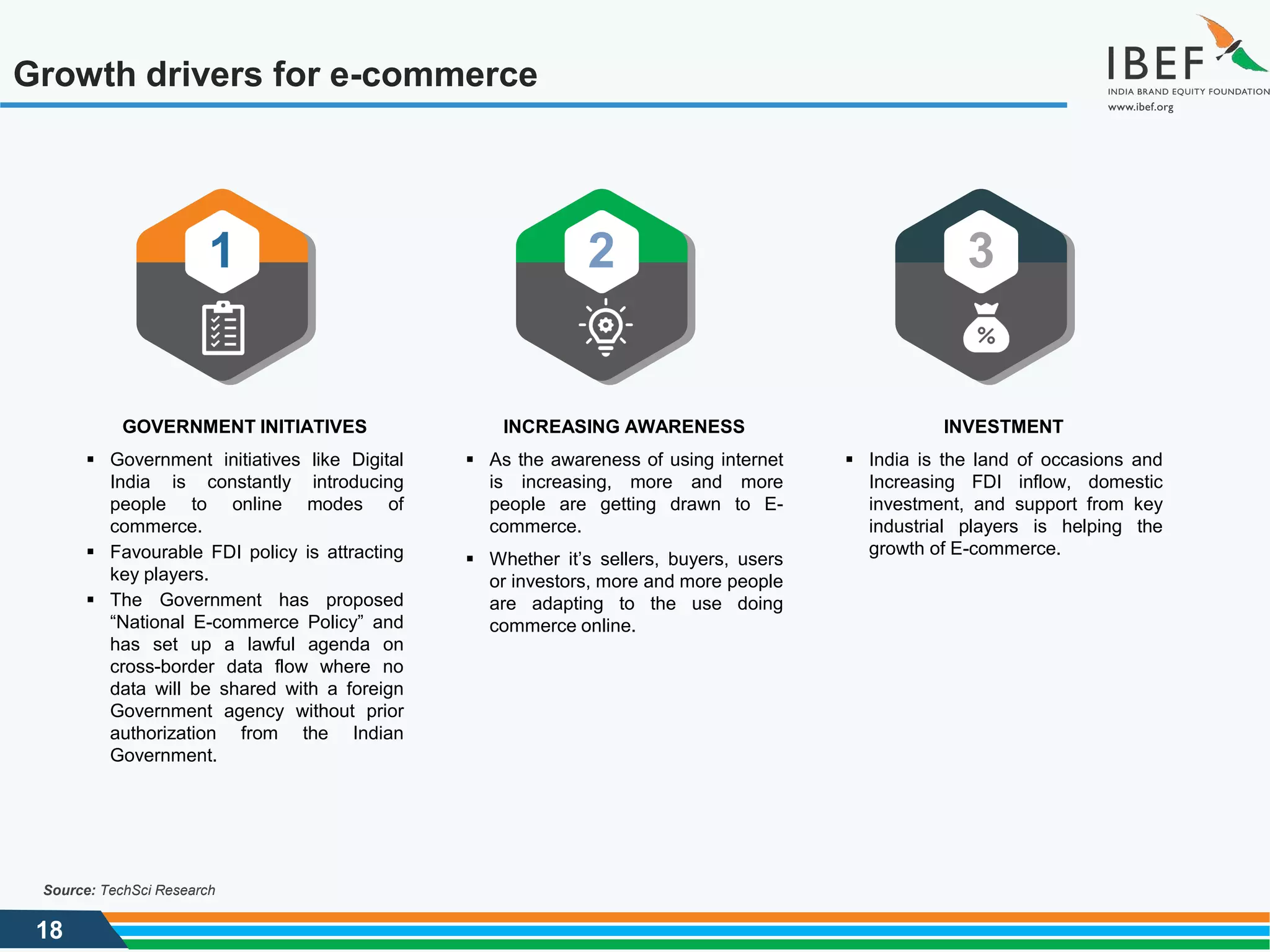
Growth drivers for e-commerce
1
GOVERNMENT INITIATIVES
 Government initiatives like Digital
India is constantly introducing
people to online modes of
commerce.
 Favourable FDI policy is attracting
key players.
 The Government has proposed
“National E-commerce Policy” and
has set up a lawful agenda on
cross-border data flow where no
data will be shared with a foreign
Government agency without prior
authorization from the Indian
Government.
2
INCREASING AWARENESS
 As the awareness of using internet
is increasing, more and more
people are getting drawn to E-
commerce.
 Whether it’s sellers, buyers, users
or investors, more and more people
are adapting to the use doing
commerce online.
3
INVESTMENT
 India is the land of occasions and
Increasing FDI inflow, domestic
investment, and support from key
industrial players is helping the
growth of E-commerce.
Source: TechSci Research
19
Demographic factors
Tier II and tier III
cities provide major
sales
Metro cities like Bengaluru, Mumbai and
Delhi has accounted for most of the online
shopping in absolute numbers.
Less densely populated regions have
generated a larger proportion of online
sales.
E-commerce companies in India reported a
55% increase in sales at US$ 4.1 billion
(Rs. 29,000 crore) across platforms in the
first week of festive sales in October 2020
(October 15-21), driven by increased
demand for smartphones and rise in
demand from Tier-II cities.
Convenience of E-
commerce
Online retailers now deliver to 15,000-
20,000 pin codes out of nearly 100,000
pin codes in the country.
With logistics and warehouses attracting
an estimated investment of nearly US$ 2
billion by 2020, the reach of online
retailers to remote locations is set to
increase.
In July 2020, Amazon's India unit
announced its plans to open 10 new
warehouses in the country.
In October 2020, Flipkart acquired a
140-acre land at Rs. 432 crore (US$
58.87 million) to establish their largest
fulfilling centre in Asia, in Manesar,
Gurgaon, in a bid to scale their fulfilment
infrastructure to cater to increased
demand post COVID-19.
Millennials are the
most active
Although shoppers between 25 and 34 years of
age have been the most active on E-commerce
portals, a surprising number of older people have
increasingly started to shop online.
However, the age group of 15-34 years are the
major consumers of E-commerce.
The popularity of web series among millenials is
growing immensely.
Source: Economic Times, Media sources
20
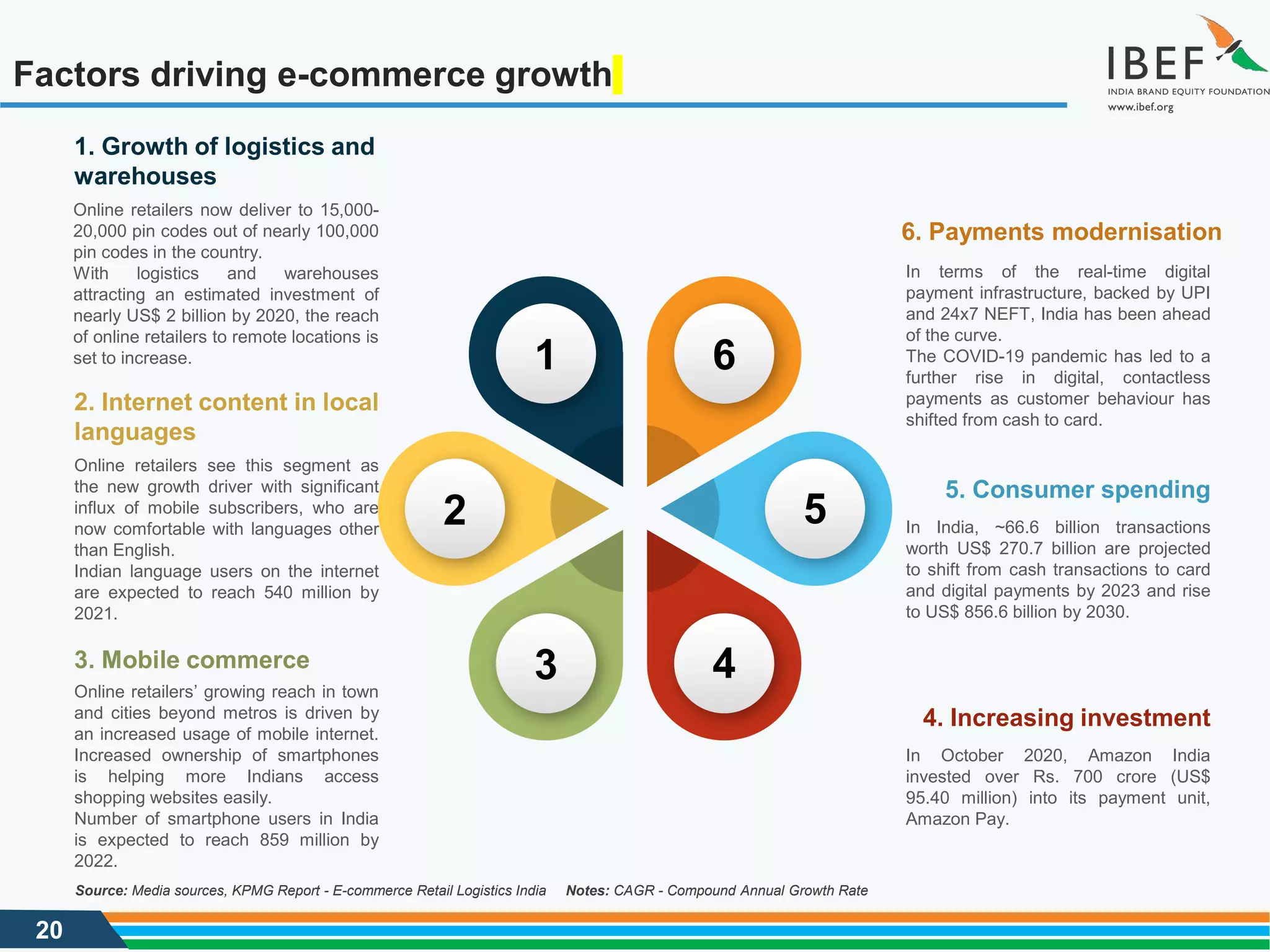
Factors driving e-commerce growth
2. Internet content in local
languages
Online retailers see this segment as
the new growth driver with significant
influx of mobile subscribers, who are
now comfortable with languages other
than English.
Indian language users on the internet
are expected to reach 540 million by
2021.
3. Mobile commerce
Online retailers’ growing reach in town
and cities beyond metros is driven by
an increased usage of mobile internet.
Increased ownership of smartphones
is helping more Indians access
shopping websites easily.
Number of smartphone users in India
is expected to reach 859 million by
2022.
5. Consumer spending
In India, ~66.6 billion transactions
worth US$ 270.7 billion are projected
to shift from cash transactions to card
and digital payments by 2023 and rise
to US$ 856.6 billion by 2030.
4. Increasing investment
In October 2020, Amazon India
invested over Rs. 700 crore (US$
95.40 million) into its payment unit,
Amazon Pay.
1. Growth of logistics and
warehouses
Online retailers now deliver to 15,000-
20,000 pin codes out of nearly 100,000
pin codes in the country.
With logistics and warehouses
attracting an estimated investment of
nearly US$ 2 billion by 2020, the reach
of online retailers to remote locations is
set to increase.
6. Payments modernisation
In terms of the real-time digital
payment infrastructure, backed by UPI
and 24x7 NEFT, India has been ahead
of the curve.
The COVID-19 pandemic has led to a
further rise in digital, contactless
payments as customer behaviour has
shifted from cash to card.
5
4
1 6
3
2
Source: Media sources, KPMG Report - E-commerce Retail Logistics India Notes: CAGR - Compound Annual Growth Rate
21
Increase in smartphones driving e-commerce growth
India’s Smartphone Shipments (million)
46.2
50.0
44
45
46
47
48
49
50
51
Q3 2019 Q3 2020
 The proliferation of mobile devices combined with internet access via affordable broadband solutions and mobile data is a key factor driving the
tremendous growth in India’s E-commerce sector.
 Smartphone users in India is expected to reach at 859 million by 2022.
 Smartphone shipments in India increased by~8% y-o-y to reach 50.0 million units in the first-quarter of 2020, driven by positive shipments of all
smartphone vendors in the market. Samsung led the Indian smartphone market with 24% shipping share, followed by Xiaomi at 23%.
 The Indian government is emphasising on increasing the local value-addition on the manufacturing front. As the government’s schemes—such as
Production Related Incentive (PLI) progress to impact the overall electronic manufacturing ecosystem—mobile phone production is expected to
increase in the coming years. Brands such as Micromax and Lava are expected to take advantage of the 'Atmanirbhar Bharat' initiative and
schedule their comeback.
Source: IMF, World Bank, International Data Corporation (IDC), Counterpoint Research, Media Sources
Smartphone User Base in India (million)
502
859
0
100
200
300
400
500
600
700
800
900
1,000
2019 2022F
22
Government and private initiatives influencing e-commerce (1/2)
Source: Bain & Company - Unlocking Digital for India, Union Budget 2019-20, Media Sources
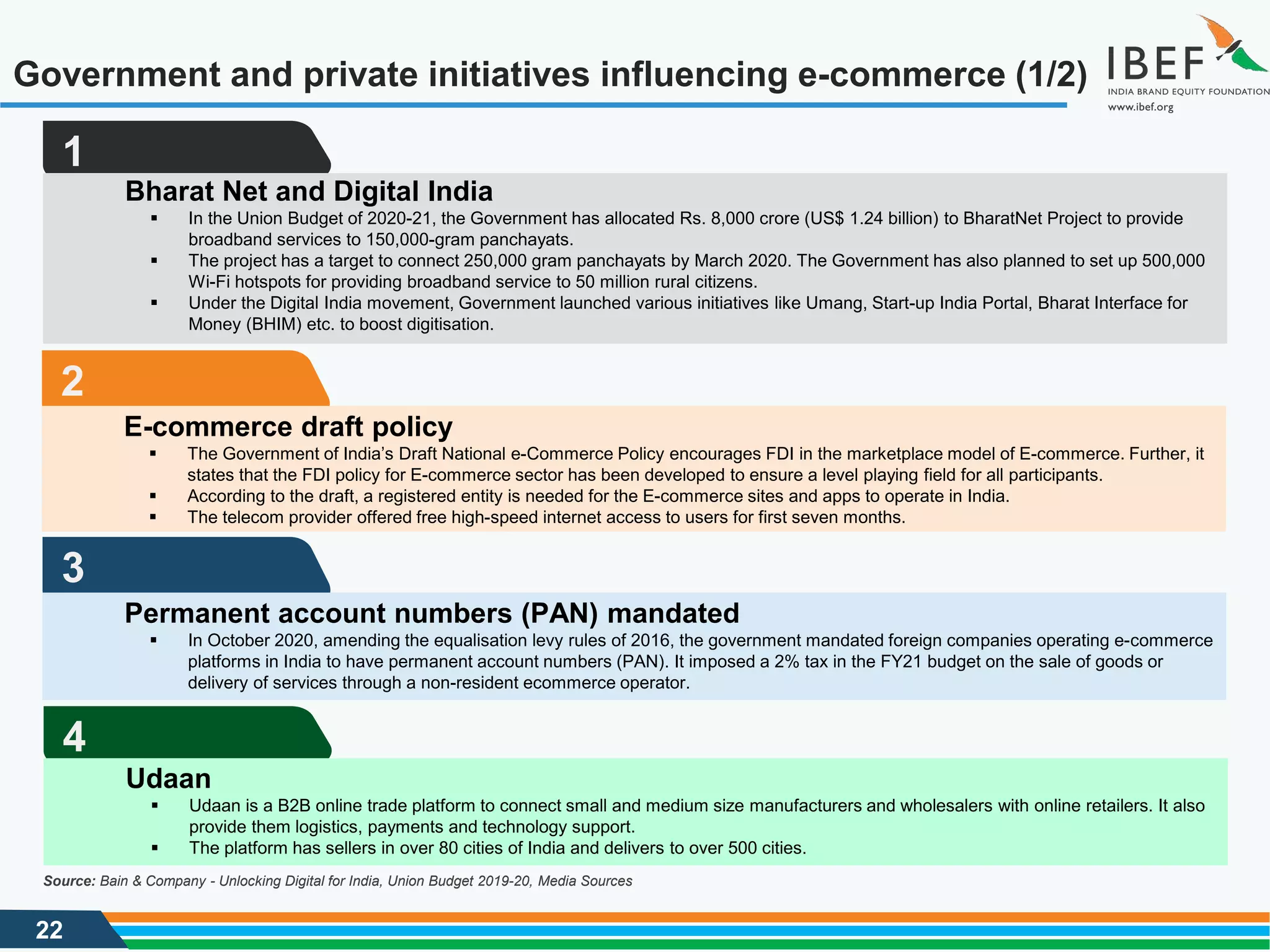
1
Bharat Net and Digital India
 In the Union Budget of 2020-21, the Government has allocated Rs. 8,000 crore (US$ 1.24 billion) to BharatNet Project to provide
broadband services to 150,000-gram panchayats.
 The project has a target to connect 250,000 gram panchayats by March 2020. The Government has also planned to set up 500,000
Wi-Fi hotspots for providing broadband service to 50 million rural citizens.
 Under the Digital India movement, Government launched various initiatives like Umang, Start-up India Portal, Bharat Interface for
Money (BHIM) etc. to boost digitisation.
2
E-commerce draft policy
 The Government of India’s Draft National e-Commerce Policy encourages FDI in the marketplace model of E-commerce. Further, it
states that the FDI policy for E-commerce sector has been developed to ensure a level playing field for all participants.
 According to the draft, a registered entity is needed for the E-commerce sites and apps to operate in India.
 The telecom provider offered free high-speed internet access to users for first seven months.
3
Permanent account numbers (PAN) mandated
 In October 2020, amending the equalisation levy rules of 2016, the government mandated foreign companies operating e-commerce
platforms in India to have permanent account numbers (PAN). It imposed a 2% tax in the FY21 budget on the sale of goods or
delivery of services through a non-resident ecommerce operator.
4
Udaan
 Udaan is a B2B online trade platform to connect small and medium size manufacturers and wholesalers with online retailers. It also
provide them logistics, payments and technology support.
 The platform has sellers in over 80 cities of India and delivers to over 500 cities.
23
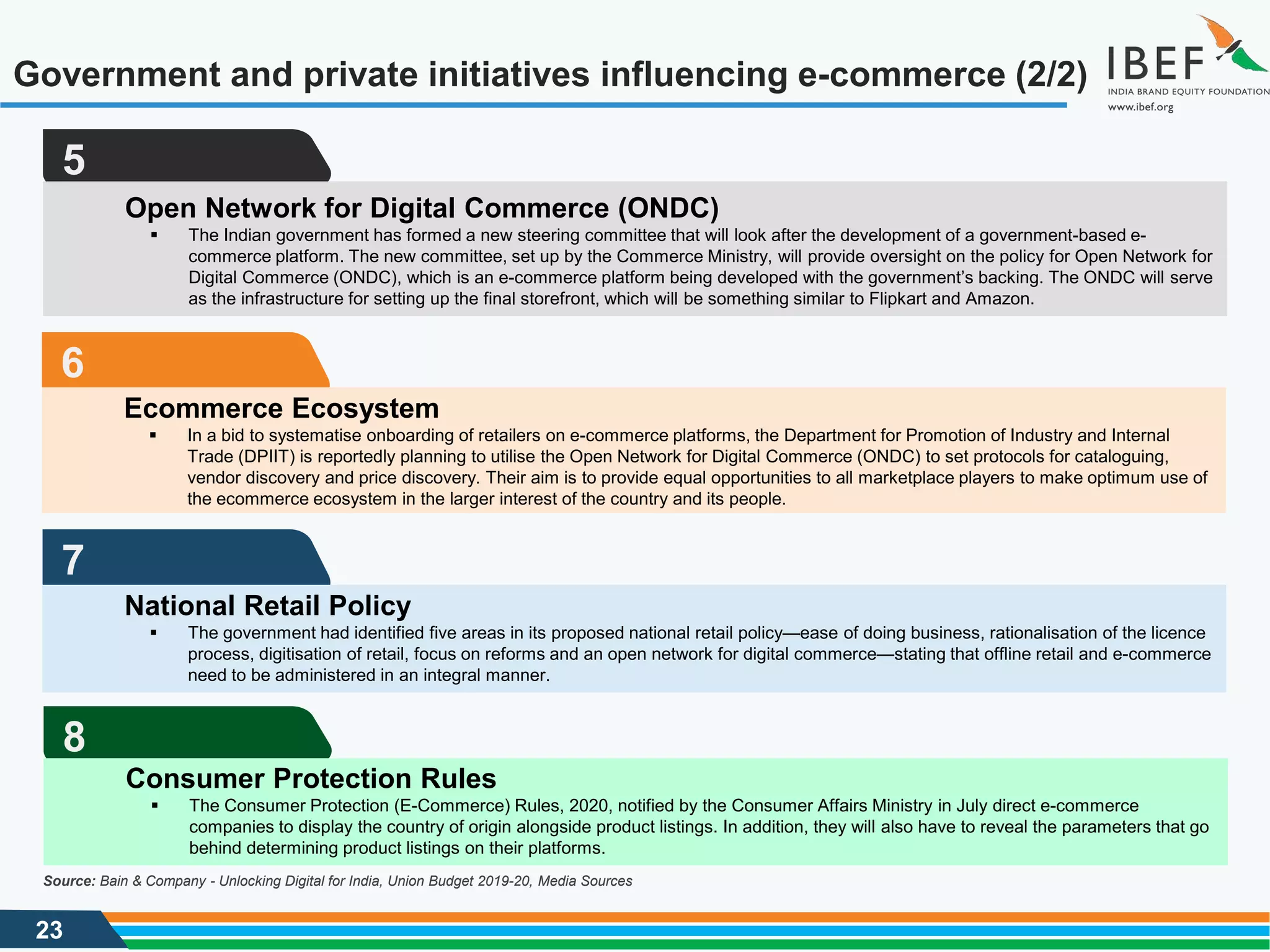
Government and private initiatives influencing e-commerce (2/2)
Source: Bain & Company - Unlocking Digital for India, Union Budget 2019-20, Media Sources
5
Open Network for Digital Commerce (ONDC)
 The Indian government has formed a new steering committee that will look after the development of a government-based e-
commerce platform. The new committee, set up by the Commerce Ministry, will provide oversight on the policy for Open Network for
Digital Commerce (ONDC), which is an e-commerce platform being developed with the government’s backing. The ONDC will serve
as the infrastructure for setting up the final storefront, which will be something similar to Flipkart and Amazon.
6
Ecommerce Ecosystem
 In a bid to systematise onboarding of retailers on e-commerce platforms, the Department for Promotion of Industry and Internal
Trade (DPIIT) is reportedly planning to utilise the Open Network for Digital Commerce (ONDC) to set protocols for cataloguing,
vendor discovery and price discovery. Their aim is to provide equal opportunities to all marketplace players to make optimum use of
the ecommerce ecosystem in the larger interest of the country and its people.
7
National Retail Policy
 The government had identified five areas in its proposed national retail policy—ease of doing business, rationalisation of the licence
process, digitisation of retail, focus on reforms and an open network for digital commerce—stating that offline retail and e-commerce
need to be administered in an integral manner.
8
Consumer Protection Rules
 The Consumer Protection (E-Commerce) Rules, 2020, notified by the Consumer Affairs Ministry in July direct e-commerce
companies to display the country of origin alongside product listings. In addition, they will also have to reveal the parameters that go
behind determining product listings on their platforms.
24
Key Industry Contacts
25
Key industry Contacts
Agency Contact Information
E-commerce Association of India
Address: 122, 1st Floor, Devika Tower
Corporate Business District, Nehru Place
New Delhi -110 019
Phone: +91 011 41582722
Fax : +91 011 41582722
Email: info@ecai.co.in
Website: www.ecai.co.in/
Retailers Association of India (RAI)
111/112, Ascot Centre, Next to Hotel Le Royal Meridien,
Sahar Road, Sahar, Andheri (E), Mumbai-400099.
Tel: 91-22-28269527—28
Fax: 91-22-28269536
E-mail: info@rai.net.in
Website: www.rai.net.in
26
Appendix
27
Glossary
 CAGR: Compound Annual Growth Rate
 GMV: Gross Merchandise Value
 FDI: Foreign Direct Investment
 FY: Indian Financial Year (April to March)
 GOI: Government of India
 Rs: Indian Rupee
 US$: US Dollar
 Numbers have been rounded off to the nearest whole number, wherever applicable.
28
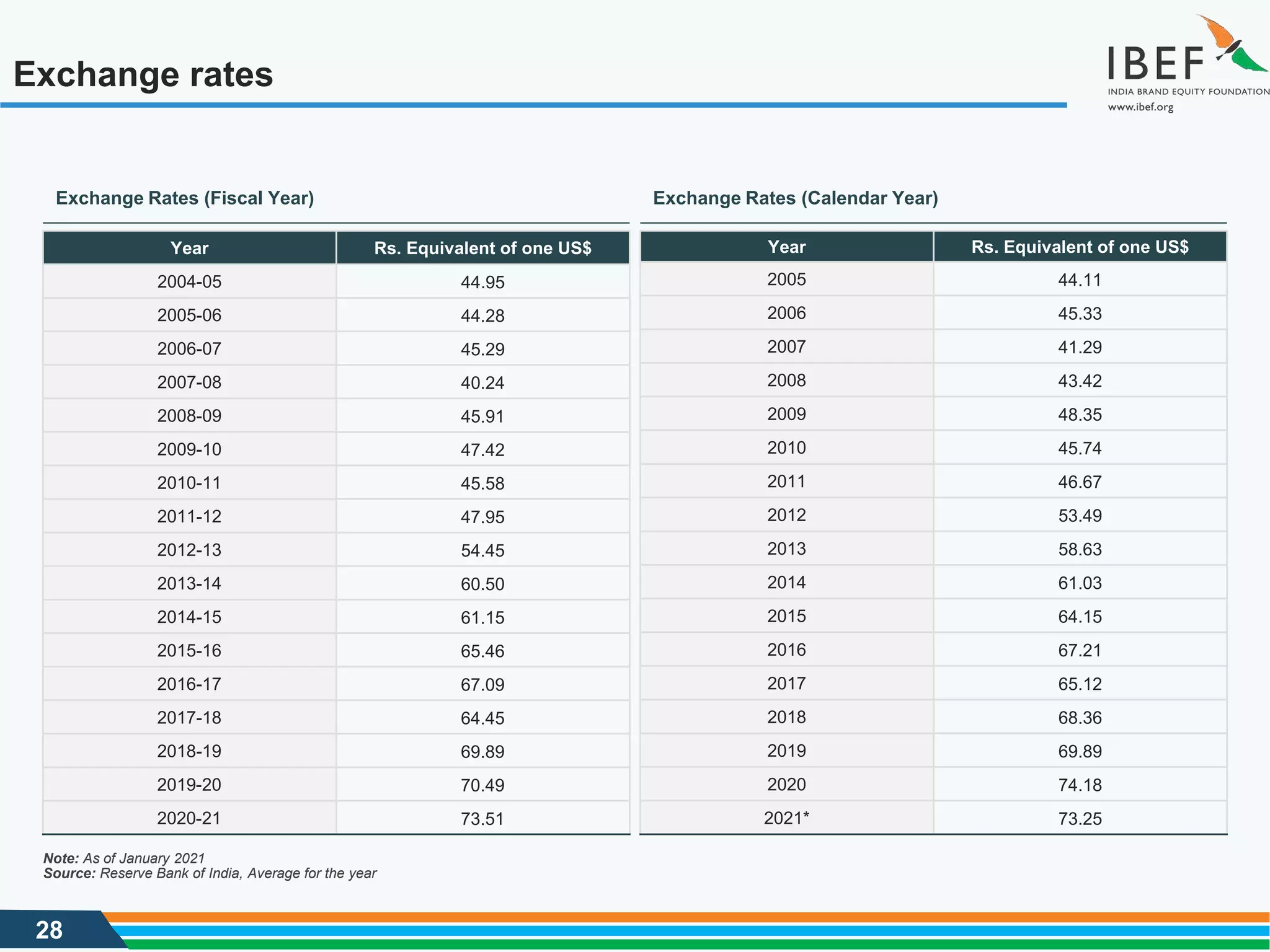
Exchange rates
Exchange Rates (Fiscal Year) Exchange Rates (Calendar Year)
Year Rs. Equivalent of one US$
2004-05 44.95
2005-06 44.28
2006-07 45.29
2007-08 40.24
2008-09 45.91
2009-10 47.42
2010-11 45.58
2011-12 47.95
2012-13 54.45
2013-14 60.50
2014-15 61.15
2015-16 65.46
2016-17 67.09
2017-18 64.45
2018-19 69.89
2019-20 70.49
2020-21 73.51
Source: Reserve Bank of India, Average for the year
Note: As of January 2021
Year Rs. Equivalent of one US$
2005 44.11
2006 45.33
2007 41.29
2008 43.42
2009 48.35
2010 45.74
2011 46.67
2012 53.49
2013 58.63
2014 61.03
2015 64.15
2016 67.21
2017 65.12
2018 68.36
2019 69.89
2020 74.18
2021* 73.25
29
Disclaimer
India Brand Equity Foundation (IBEF) engaged Sutherland Global Services private Limited to prepare/update this presentation.
All rights reserved. All copyright in this presentation and related works is solely and exclusively owned by IBEF, delivered during the course of
engagement under the Professional Service Agreement signed by the Parties. The same may not be reproduced, wholly or in part in any material
form (including photocopying or storing it in any medium by electronic means and whether or not transiently or incidentally to some other use of this
presentation), modified or in any manner communicated to any third party except with the written approval of IBEF.
This presentation is for information purposes only. While due care has been taken during the compilation of this presentation to ensure that the
information is accurate to the best of Sutherland Global Services’ Private Limited and IBEF’s knowledge and belief, the content is not to be construed
in any manner whatsoever as a substitute for professional advice.
Sutherland Global Services Private Limited and IBEF neither recommend nor endorse any specific products or services that may have been
mentioned in this presentation and nor do they assume any liability, damages or responsibility for the outcome of decisions taken as a result of any
reliance placed on this presentation.
Neither Sutherland Global Services Private Limited nor IBEF shall be liable for any special, direct, indirect or consequential damages that may arise
due to any act or omission on the part of the user due to any reliance placed or guidance taken from any portion of this presentation.

E-Commerce-January-2021.pdf

  • 1.
    For updated information,please visit www.ibef.org January 2021 E-COMMERCE
  • 2.
    2 Executive Summary 3 AdvantageIndia 4 Market Overview 6 Recent Trends and Strategies 13 Growth Drivers 17 Key Industry Contacts 24 Appendix 26 Table of Contents
  • 3.
    3 Executive summary 21.90 30.00 99.10 0 50 100 150 200 20182020F 2024F India’s Internet Economy (US$ billion) 125.00 250.00 335.00 0 100 200 300 400 2018 2020F 2025F Indian E-commerce Market (US$ billion) Source: Media sources, Global Internet: e-commerce's steepening curve' published by Goldman Sachs, Forrester Research.  India e-commerce will reach US$ 99 billion by 2024, growing at a 27% CAGR over 2019-24, with grocery and fashion/apparel likely to be the key drivers of incremental growth.  According to Forrester Research, Indian e-commerce sales rose by ~7-8% in 2020.  Online penetration of retail is expected to reach 10.7% by 2024, versus 4.7% in 2019.  Online shoppers in India are expected to reach 220 million by 2025.  India’s digital sector is expected to increase by two-fold and reach US$ 335 billion by 2025.  Through its ‘Digital India’ campaign, the Government of India is aiming to create a trillion-dollar online economy by 2025.  The Indian online grocery market is estimated to exceed sales of about Rs. 22,500 crore (US$ 3.19 billion) in 2020, a significant jump of 76% jump over the previous year.  In festive season CY20, the Indian e-commerce GMV was recorded at US$ 8.3 billion, a significant jump of 66% over the previous festive season.  In festive season CY20, the Indian e-commerce market recorded ~88 million users, a significant jump of 87% over the previous festive season. 5 8.3 0 5 10 Festive Month CY19 Festive Month CY20 GMV (US$ billion) India’s E-commerce Festive Statistics 47 88 0 50 100 Festive Month CY19 Festive Month CY20 Users (Million) Note: GMV - Gross Merchandise Value, CY – Calendar Year
  • 4.
  • 5.
    5 Advantage India ►Despite depressedconsumer spending, economic slowdown and uncertainty created due to COVID-19, e-commerce players are expecting strong sales growth in 2021. ►Online grocery, e-pharmacy and social commerce are expected to see a bulk of the action in 2021. 1. Attractive Opportunities ► In India, 100% FDI is permitted in the B2B E-commerce. ► As per the new guidelines on FDI in E-commerce, 100% FDI under automatic route is permitted in the marketplace model of E- commerce. ► Heavy investment made by the Government of India in rolling out fiber network for 5G will help boost E-commerce in India. 4. Policy Support ► The recent rise in digital literacy has led to an influx of investment in E-commerce firms, levelling the market for new players to set up their base, while churning out innovative patterns to disrupt old functioning. 3. Increasing Investment ► E-commerce companies reported sales worth US$ 4.1 billion across platforms in the festive week of October 2020 (October 15-21), driven by increased demand for smartphones. Of the total sales, 55% share was generated from Tier-II cities such as Asansol, Ludhiana, Dhanbad and Rajkot. 2. Growing demand ADVANTAGE INDIA 1 4 3 2 Source: Media sources Note: FDI - Foreign Direct Investment
  • 6.
  • 7.
    7 Growth of e-commercein India  India's e-commerce festive sale season from October 15 to November 15 (2020) recorded gross sales worth Rs. 58,000 crore (US$ 8.3 billion) for brands and sellers, up 65% from Rs. 35,000 crore (US$ 5 billion) last year.  The Indian e-commerce sector is ranked 9th in cross-border growth in the world, according to Payoneer report.  Indian e-commerce is projected to increase from 4% of the total food and grocery, apparel and consumer electronics retail trade in 2020 to 8% by 2025.  As most Indians have started shopping online rather than stepping outside their houses, the Indian e-commerce sector witnessed an increase.  Huge investments from global players—such as Facebook, which is investing in Reliance Jio—are being recorded in the e-commerce market. Google also reported its first investment worth US$ 4.5 billion in Jio Platforms. This deal was followed by the purchase of Future Group by Reliance Retail, expanding the presence of the Ambani Group in the e-commerce space.  In October 2020, Minister of Commerce and Industry, Mr. Piyush Goyal invited start-ups to register at public procurement portal, GeM, and offer goods and services to government organisations and PSUs. India spending on online commerce, (%) (Jan 2020–Sep 2020) Notes: *Estimated, F - Forecast, PSUs - Public Sector Undertakings Source: Media sources, Global Internet: e-commerce's steepening curve' published by Goldman Sachs How much has India spent on online commerce? -3% 35% -20% 21% 19% 17% 8% 17% Feb’20 Mar’20 Apr’20 May’20 Jun’20 Jul’20 Aug’20 Sep’20
  • 8.
    8 Rising internet usersin India 560.00 760.00 0.0 100.0 200.0 300.0 400.0 500.0 600.0 700.0 800.0 2018 2020 Source: Economic Times, Live Mint, Department of Telecommunications, Bain & Company - Unlocking Digital for Bharat Internet connections in India (in million) Note: Internet penetration - number of internet subscribers per 100 population  As of August 2020, the number of internet connections in India significantly increased to ~760 million, driven by the ‘Digital India’ programme. Out of the total internet connections, ~61% connections were in urban areas, of which 97% connections were wireless.  Internet penetration in rural India is expected to grow at a rate of 45% by 2021 compared to the current rate of 22% .  Number of active internet users in the country is the second-highest globally and is also one of the largest data consumers globally. It has the highest data usage per smartphone at an average of 10.40 GB per month.  According to Bain & Company report, India’s social commerce gross merchandise value (GMV) stood at ~US$ 2 billion in 2020. By 2025, it is expected to reach US$ 20 billion, with a potentially monumental jump to US$ 70 billion by 2030, owing to high mobile usage.
  • 9.
    9 Online retail market The online retail market in India is estimated to be 25% of the total organized retail market and is expected to reach 37% by 2030.  E-retail market is expected to continue its strong growth and will nearly be Rs. 1.8 trillion (US$ 25.75 billion) by FY20.  Over the next five years, the Indian e-retail industry is projected to exceed ~300-350 million shoppers, propelling the online Gross Merchandise Value (GMV) to US$ 100-120 billion by 2025.  Driven by lower data rates and investments to enhance customer experience, the Indian e-retail witnessed a rapid increase in shopper penetration, as online platforms are innovating to onboard the next billion of shoppers. Source: Report by eMarketer, Kalaari Capital - Imagining Trillion Dollar India, ATKearney Shares of Various Segments in e-commerce Retail by Value (2020P) 40% 40% 7% 7% 4% 2% Consumer electronics Apparels Food and grocery Jewellery Furniture Others
  • 10.
    10 Online retail vstotal retail in India 92% 8% Offline Retail Online Retail Online retail out of total retail in India (2030F) 95% 5% Offline Retail Online Retail Online retail out of total retail in India (2020F)  There are lot of opportunities for E-retailers in India to capitalize upon with the gradually growing internet penetration in India. Source: Redseer, Crisil, Report by eMarketer Note: F- Forecasted
  • 11.
    11 E-tailing market bybusiness model E-commerce Marketplace Model  Marketplace model adheres to the standards and directions of a zero-inventory model.  The E-commerce marketplace offers a digital platform for consumers and merchants without a need for warehousing the products. Marketplaces offer shipment, delivery and payments help to merchants by tying up with various logistics companies and financial institutions.  The new FDI policy has permitted 100% FDI in the E-commerce marketplace model under the automatic route.  In December 2020, Amazon India stated that 4,152 small and midsized sellers on its marketplace surpassed Rs. 1 crore (US$ 136,669.90) in sales; and the number of ‘crorepati’ sellers grew 29% y-o-y. Inventory-led Model  Inventory-led models are those shopping websites where buyers choose online from within a range products owned by the online shopping company or websites. Then website take care of the whole process end-to-end, starting with product purchase, warehousing and ending with product dispatch.  Few examples of inventory-led model are Yepme and LatestOne.com. Source: PWC
  • 12.
    12 Key players ine-tailing market
  • 13.
    13 Recent Trends andStrategies RECENT TRENDS AND STRATEGIES
  • 14.
    14 Policy and initiativesgive a boost to the industry… (1/3) 1 ANCILLARY SERVICES • In October 2020, Walmart introduced training to support and grow microbusinesses SMB in India. • In November 2020, Amazon India has opened 'Made in India' toy store, in line with the government's ‘Atmanirbhar Bharat’ vision. The store will allow thousands of manufacturers and vendors to sell toys driven by the Indian culture, folk tales and toys that promote creative thinking and are locally crafted & manufactured. • In October 2020, Amazon India collaborated with the Indian Railway Catering and Tourism Corporation (IRCTC) to enable users to book and reserve train tickets on Amazon. • In January 2021, Flipkart introduced SuperCoin Pay to strengthen its SuperCoin rewards programme by allowing customers to pay through SuperCoins at >5,000 retail outlets across the country. 2 EXPANSION • In January 2021, according to a Mint report, Reliance has set a plan to embed its e-commerce app, JioMart, into WhatsApp within six months. • In January 2021, The Khadi and Village Industries Commission (KVIC) unveiled eKhadiIndia.com, an e- commerce portal, which will comprise >50,000 products, ranging from apparel to home décor. 3 MERGER & ACQUISITION • In November 2020, Reliance Retail Ventures Ltd. (RRVL), a subsidiary of Reliance Industries (RIL), acquired a minority stake of Urban Ladder Home Decor Solutions Pvt. Ltd. for Rs. 182.12 crore (US$ 24.67 million). • In November 2020, Flipkart acquired Scapic, an Augmented Reality (AR) firm, to boost user experience. • In December 2020, according to Forbes India, Tata Group is likely to buy a controlling stake of 51% in BigBasket. Source: Media sources, Company websites
  • 15.
    15 Policy and initiativesgive a boost to the industry… (2/3) 4 PERSONALISED EXPERIENCE • Site visitors demand one-of-a-kind experience that cater to their needs and interests. Technology is available even to smaller players to capture individual shoppers’ interests and preferences to generate a targeted shopping experience. • Many E-commerce websites provide personalised experience to customers to cater to their needs and interests depending upon their location, choices, products they like or buy, and websites they visit. • To give a more personalized experience, E-commerce companies have adopted voice search technology. Myntra is the first to adopt it. • PhonePe, to give a more holistic experience to its customers and merchants, introduced a stores tab on its app and launched a separate merchant app. 5 ASSISTED COMMERCE • To expand their reach, brands are tying up with assisted E-commerce organisations which provide local merchants with a platform to place their orders. Under this, customer get help in placing order online through a merchant shop and the product gets delivered either to the shop or to customer’s address directly. • Eshopbox, a tech-enabled third-party logistics (3PL) provider, is expected to redefine the ecosystem of new- age e-commerce by helping retailers unlock their e-commerce potential. Businesses of all sizes can use Eshopbox to streamline their e-commerce operations, from start-ups such as Oziva, Meraki and Plum to businesses such as Clarks, Blackberrys and Raymonds. 6 SUBSCRIPTION FOR E-COMMERCE • E-commerce companies are increasingly adopting subscription model to provide extra benefits and tailored services to customers to suit their needs. • Amazon, which introduced Amazon Prime in 2016, saw its Amazon Prime subscribers reach ~10 million as of February 2020. • Swiggy, Zomato and Myntra keep on offering benefits through their subscription models to attract consumers. Source: Media sources, Company websites
  • 16.
    16 Policy and initiativesgive a boost to the industry… (2/3) 7 PRODUCT CATEGORIES • Brands are adapting to the change in consumption habits towards essentials, electronics, home furnishing and other comfort-related product categories. This shift has happened since the pandemic and is forecast to stay in the near future. Inventory stocking of fashion and accessories has recorded an all-time low this year. 8 DIGITAL MARKETING • 2020 has witnessed a shift in the consumer basket towards essentials and a drastic change in shopping modality towards e-commerce platforms. Brands and companies are adapting to this consumer behaviour change by increasing their marketing spends on digital media to acquire market share and tap target audiences. • As per the report, 34% business respondents have increased digital media budgets while 23% have focused more on eCommerce selling. 9 GEOGRAPHIC FOCUS • Companies are increasingly focusing their sights on Tier II and Tier III cities this year, as the demographic landscape and pocket spends of these cities are evolving. The revenue share of Tier II+ cities has been growing and digital marketing efforts can be targeted directly to these potential customers. This year’s festive season recorded 88% customer growth from last year, which was driven by about 40 million shoppers from Tier II+ cities. Source: Media sources, Company websites, Modern Marketer Reckoner Report by GroupM and MMA 10 FUND RAISING • In January 2021, the B2B e-commerce platform, Udaan raised US$ 280 million (~Rs. 2,048 crore) in additional financing from new investors—Octahedron Capital and Moonstone Capital. Prior to this, in October 2019, the company raised US$ 585 million (~Rs. 4,280 crore) from Tencent, Altimeter, Footpath Ventures, Hillhouse, GGV Capital and Citi Ventures. It is likely to deploy the latest fund towards continued market creation of B2B e-commerce in India and digitise more small businesses across the country.
  • 17.
  • 18.
    18 Growth drivers fore-commerce 1 GOVERNMENT INITIATIVES  Government initiatives like Digital India is constantly introducing people to online modes of commerce.  Favourable FDI policy is attracting key players.  The Government has proposed “National E-commerce Policy” and has set up a lawful agenda on cross-border data flow where no data will be shared with a foreign Government agency without prior authorization from the Indian Government. 2 INCREASING AWARENESS  As the awareness of using internet is increasing, more and more people are getting drawn to E- commerce.  Whether it’s sellers, buyers, users or investors, more and more people are adapting to the use doing commerce online. 3 INVESTMENT  India is the land of occasions and Increasing FDI inflow, domestic investment, and support from key industrial players is helping the growth of E-commerce. Source: TechSci Research
  • 19.
    19 Demographic factors Tier IIand tier III cities provide major sales Metro cities like Bengaluru, Mumbai and Delhi has accounted for most of the online shopping in absolute numbers. Less densely populated regions have generated a larger proportion of online sales. E-commerce companies in India reported a 55% increase in sales at US$ 4.1 billion (Rs. 29,000 crore) across platforms in the first week of festive sales in October 2020 (October 15-21), driven by increased demand for smartphones and rise in demand from Tier-II cities. Convenience of E- commerce Online retailers now deliver to 15,000- 20,000 pin codes out of nearly 100,000 pin codes in the country. With logistics and warehouses attracting an estimated investment of nearly US$ 2 billion by 2020, the reach of online retailers to remote locations is set to increase. In July 2020, Amazon's India unit announced its plans to open 10 new warehouses in the country. In October 2020, Flipkart acquired a 140-acre land at Rs. 432 crore (US$ 58.87 million) to establish their largest fulfilling centre in Asia, in Manesar, Gurgaon, in a bid to scale their fulfilment infrastructure to cater to increased demand post COVID-19. Millennials are the most active Although shoppers between 25 and 34 years of age have been the most active on E-commerce portals, a surprising number of older people have increasingly started to shop online. However, the age group of 15-34 years are the major consumers of E-commerce. The popularity of web series among millenials is growing immensely. Source: Economic Times, Media sources
  • 20.
    20 Factors driving e-commercegrowth 2. Internet content in local languages Online retailers see this segment as the new growth driver with significant influx of mobile subscribers, who are now comfortable with languages other than English. Indian language users on the internet are expected to reach 540 million by 2021. 3. Mobile commerce Online retailers’ growing reach in town and cities beyond metros is driven by an increased usage of mobile internet. Increased ownership of smartphones is helping more Indians access shopping websites easily. Number of smartphone users in India is expected to reach 859 million by 2022. 5. Consumer spending In India, ~66.6 billion transactions worth US$ 270.7 billion are projected to shift from cash transactions to card and digital payments by 2023 and rise to US$ 856.6 billion by 2030. 4. Increasing investment In October 2020, Amazon India invested over Rs. 700 crore (US$ 95.40 million) into its payment unit, Amazon Pay. 1. Growth of logistics and warehouses Online retailers now deliver to 15,000- 20,000 pin codes out of nearly 100,000 pin codes in the country. With logistics and warehouses attracting an estimated investment of nearly US$ 2 billion by 2020, the reach of online retailers to remote locations is set to increase. 6. Payments modernisation In terms of the real-time digital payment infrastructure, backed by UPI and 24x7 NEFT, India has been ahead of the curve. The COVID-19 pandemic has led to a further rise in digital, contactless payments as customer behaviour has shifted from cash to card. 5 4 1 6 3 2 Source: Media sources, KPMG Report - E-commerce Retail Logistics India Notes: CAGR - Compound Annual Growth Rate
  • 21.
    21 Increase in smartphonesdriving e-commerce growth India’s Smartphone Shipments (million) 46.2 50.0 44 45 46 47 48 49 50 51 Q3 2019 Q3 2020  The proliferation of mobile devices combined with internet access via affordable broadband solutions and mobile data is a key factor driving the tremendous growth in India’s E-commerce sector.  Smartphone users in India is expected to reach at 859 million by 2022.  Smartphone shipments in India increased by~8% y-o-y to reach 50.0 million units in the first-quarter of 2020, driven by positive shipments of all smartphone vendors in the market. Samsung led the Indian smartphone market with 24% shipping share, followed by Xiaomi at 23%.  The Indian government is emphasising on increasing the local value-addition on the manufacturing front. As the government’s schemes—such as Production Related Incentive (PLI) progress to impact the overall electronic manufacturing ecosystem—mobile phone production is expected to increase in the coming years. Brands such as Micromax and Lava are expected to take advantage of the 'Atmanirbhar Bharat' initiative and schedule their comeback. Source: IMF, World Bank, International Data Corporation (IDC), Counterpoint Research, Media Sources Smartphone User Base in India (million) 502 859 0 100 200 300 400 500 600 700 800 900 1,000 2019 2022F
  • 22.
    22 Government and privateinitiatives influencing e-commerce (1/2) Source: Bain & Company - Unlocking Digital for India, Union Budget 2019-20, Media Sources 1 Bharat Net and Digital India  In the Union Budget of 2020-21, the Government has allocated Rs. 8,000 crore (US$ 1.24 billion) to BharatNet Project to provide broadband services to 150,000-gram panchayats.  The project has a target to connect 250,000 gram panchayats by March 2020. The Government has also planned to set up 500,000 Wi-Fi hotspots for providing broadband service to 50 million rural citizens.  Under the Digital India movement, Government launched various initiatives like Umang, Start-up India Portal, Bharat Interface for Money (BHIM) etc. to boost digitisation. 2 E-commerce draft policy  The Government of India’s Draft National e-Commerce Policy encourages FDI in the marketplace model of E-commerce. Further, it states that the FDI policy for E-commerce sector has been developed to ensure a level playing field for all participants.  According to the draft, a registered entity is needed for the E-commerce sites and apps to operate in India.  The telecom provider offered free high-speed internet access to users for first seven months. 3 Permanent account numbers (PAN) mandated  In October 2020, amending the equalisation levy rules of 2016, the government mandated foreign companies operating e-commerce platforms in India to have permanent account numbers (PAN). It imposed a 2% tax in the FY21 budget on the sale of goods or delivery of services through a non-resident ecommerce operator. 4 Udaan  Udaan is a B2B online trade platform to connect small and medium size manufacturers and wholesalers with online retailers. It also provide them logistics, payments and technology support.  The platform has sellers in over 80 cities of India and delivers to over 500 cities.
  • 23.
    23 Government and privateinitiatives influencing e-commerce (2/2) Source: Bain & Company - Unlocking Digital for India, Union Budget 2019-20, Media Sources 5 Open Network for Digital Commerce (ONDC)  The Indian government has formed a new steering committee that will look after the development of a government-based e- commerce platform. The new committee, set up by the Commerce Ministry, will provide oversight on the policy for Open Network for Digital Commerce (ONDC), which is an e-commerce platform being developed with the government’s backing. The ONDC will serve as the infrastructure for setting up the final storefront, which will be something similar to Flipkart and Amazon. 6 Ecommerce Ecosystem  In a bid to systematise onboarding of retailers on e-commerce platforms, the Department for Promotion of Industry and Internal Trade (DPIIT) is reportedly planning to utilise the Open Network for Digital Commerce (ONDC) to set protocols for cataloguing, vendor discovery and price discovery. Their aim is to provide equal opportunities to all marketplace players to make optimum use of the ecommerce ecosystem in the larger interest of the country and its people. 7 National Retail Policy  The government had identified five areas in its proposed national retail policy—ease of doing business, rationalisation of the licence process, digitisation of retail, focus on reforms and an open network for digital commerce—stating that offline retail and e-commerce need to be administered in an integral manner. 8 Consumer Protection Rules  The Consumer Protection (E-Commerce) Rules, 2020, notified by the Consumer Affairs Ministry in July direct e-commerce companies to display the country of origin alongside product listings. In addition, they will also have to reveal the parameters that go behind determining product listings on their platforms.
  • 24.
  • 25.
    25 Key industry Contacts AgencyContact Information E-commerce Association of India Address: 122, 1st Floor, Devika Tower Corporate Business District, Nehru Place New Delhi -110 019 Phone: +91 011 41582722 Fax : +91 011 41582722 Email: info@ecai.co.in Website: www.ecai.co.in/ Retailers Association of India (RAI) 111/112, Ascot Centre, Next to Hotel Le Royal Meridien, Sahar Road, Sahar, Andheri (E), Mumbai-400099. Tel: 91-22-28269527—28 Fax: 91-22-28269536 E-mail: info@rai.net.in Website: www.rai.net.in
  • 26.
  • 27.
    27 Glossary  CAGR: CompoundAnnual Growth Rate  GMV: Gross Merchandise Value  FDI: Foreign Direct Investment  FY: Indian Financial Year (April to March)  GOI: Government of India  Rs: Indian Rupee  US$: US Dollar  Numbers have been rounded off to the nearest whole number, wherever applicable.
  • 28.
    28 Exchange rates Exchange Rates(Fiscal Year) Exchange Rates (Calendar Year) Year Rs. Equivalent of one US$ 2004-05 44.95 2005-06 44.28 2006-07 45.29 2007-08 40.24 2008-09 45.91 2009-10 47.42 2010-11 45.58 2011-12 47.95 2012-13 54.45 2013-14 60.50 2014-15 61.15 2015-16 65.46 2016-17 67.09 2017-18 64.45 2018-19 69.89 2019-20 70.49 2020-21 73.51 Source: Reserve Bank of India, Average for the year Note: As of January 2021 Year Rs. Equivalent of one US$ 2005 44.11 2006 45.33 2007 41.29 2008 43.42 2009 48.35 2010 45.74 2011 46.67 2012 53.49 2013 58.63 2014 61.03 2015 64.15 2016 67.21 2017 65.12 2018 68.36 2019 69.89 2020 74.18 2021* 73.25
  • 29.
    29 Disclaimer India Brand EquityFoundation (IBEF) engaged Sutherland Global Services private Limited to prepare/update this presentation. All rights reserved. All copyright in this presentation and related works is solely and exclusively owned by IBEF, delivered during the course of engagement under the Professional Service Agreement signed by the Parties. The same may not be reproduced, wholly or in part in any material form (including photocopying or storing it in any medium by electronic means and whether or not transiently or incidentally to some other use of this presentation), modified or in any manner communicated to any third party except with the written approval of IBEF. This presentation is for information purposes only. While due care has been taken during the compilation of this presentation to ensure that the information is accurate to the best of Sutherland Global Services’ Private Limited and IBEF’s knowledge and belief, the content is not to be construed in any manner whatsoever as a substitute for professional advice. Sutherland Global Services Private Limited and IBEF neither recommend nor endorse any specific products or services that may have been mentioned in this presentation and nor do they assume any liability, damages or responsibility for the outcome of decisions taken as a result of any reliance placed on this presentation. Neither Sutherland Global Services Private Limited nor IBEF shall be liable for any special, direct, indirect or consequential damages that may arise due to any act or omission on the part of the user due to any reliance placed or guidance taken from any portion of this presentation.