ADDITIONAL ASSIGNMENT
1. CYBER CRIME AND SECURITY
2. ACING THE RISE OF E-
COMMERCE
3. RISING E-COMMERCE
TOPICS COVERED
Team
1. Himanshu Mulani 2202674 MBA Regular
2. Navjoth Singh 2202698 MBA Regular
3. Nupur Bhatnagar 2202701 MBA Regular
4. Pragya Agarwal 2101708 MBA Integrated
5. Isha Anand 2202678 MBA (Regular)
6. Tanya Verma 2202728 MBA REGULAR
7. Vijay Verma 2202732 MBA Regular
8. Sani jha 2202715 MBA Regular
9. Parul Sharma 2202704 MBA (Regular)
10.Damini Chaudhary 2202666 MBA REGULAR
11.Somil Upadhyay 2202722 MBA Regular
12.Komal verma 2202688 MBA Regular
13.Pavan Singh 2202705 MBA Regular
14.Ankit Chaudhary 2202660 MBA Regular
15.Aman 2202656 MBA Regular
16.Anjali Nayak 2202658 MBA Regular
Cyber Crime is a
criminal activity that is
carried out using the
internet or other digital
means. It is a growing
problem that affects the
individual, Businesses,
and Governments
around the world. In
order to protect against
cybercrime it’s important
to understand the
different types of attacks
and how to prevent
them.
01 Cyber security refers
to every aspect of
protecting an
organization and its
employees and assets
against cyber threats. As
cyber attacks become
more common and
sophisticated and
corporate networks grow
more complex, a variety
of cyber security
solutions are required to
mitigate corporate cyber
risk.
02
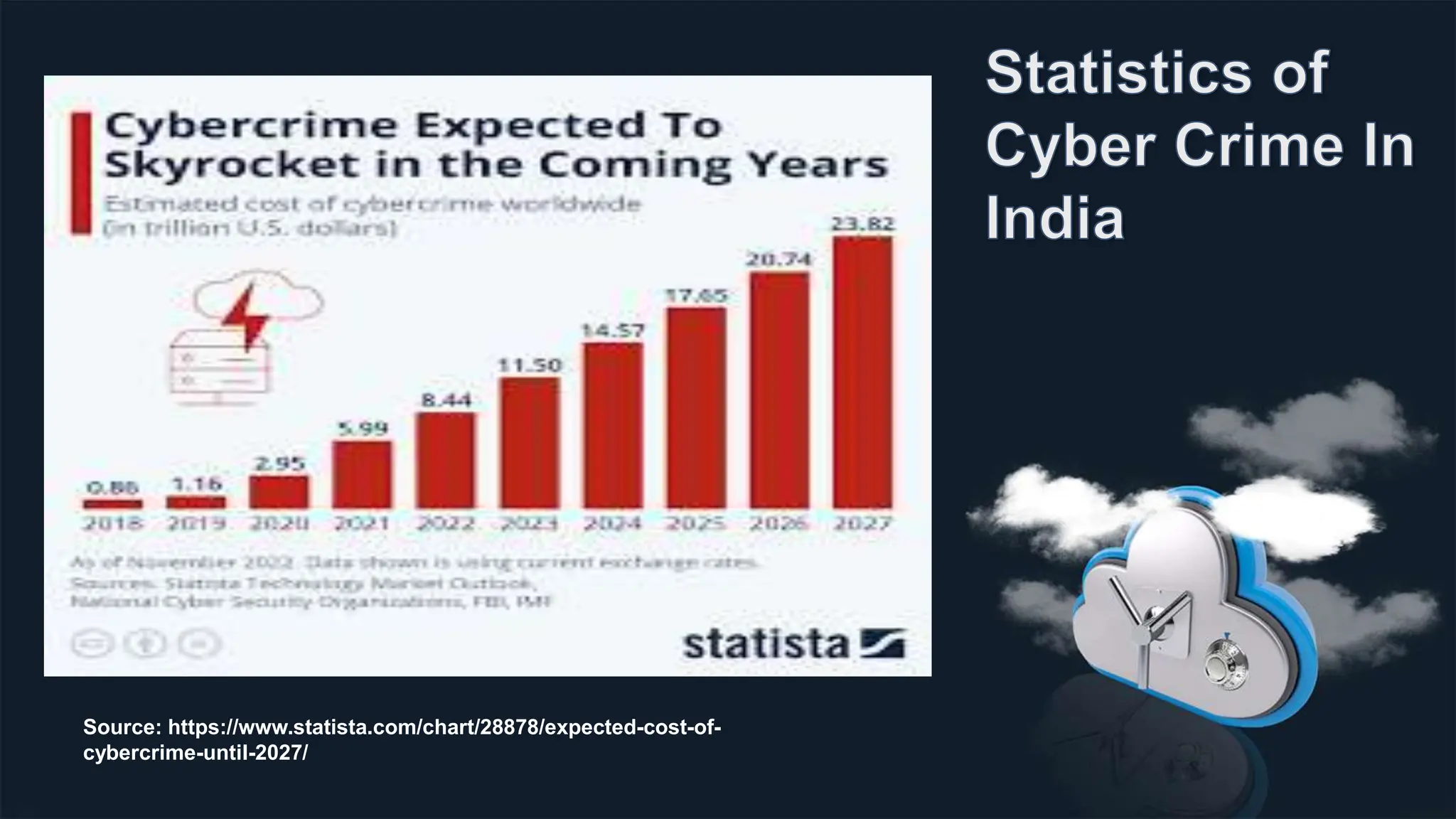
Source: https://www.statista.com/chart/28878/expected-cost-of-
cybercrime-until-2027/
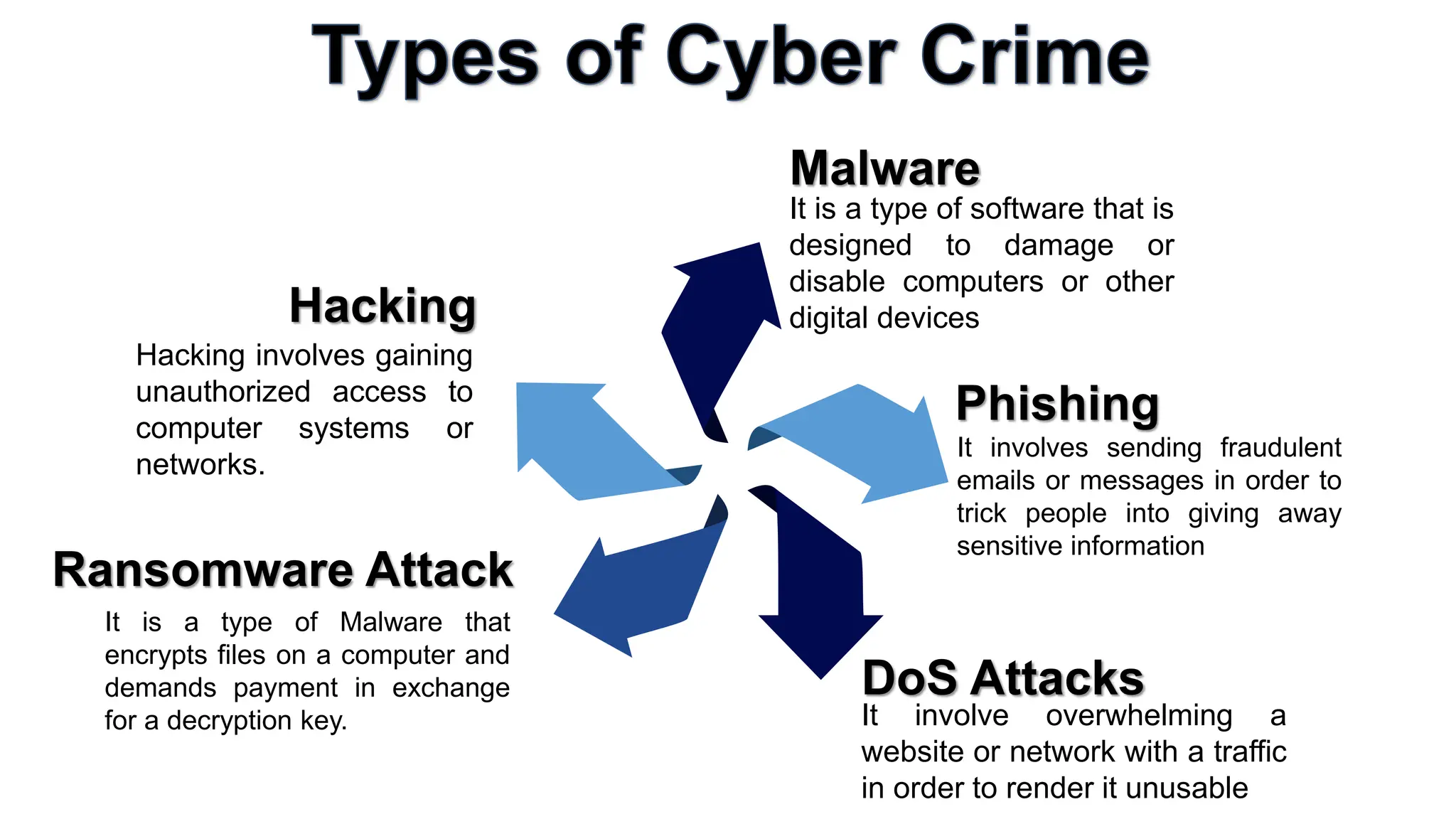
Malware
It is a type of software that is
designed to damage or
disable computers or other
digital devices
Phishing
It involves sending fraudulent
emails or messages in order to
trick people into giving away
sensitive information
Hacking
Hacking involves gaining
unauthorized access to
computer systems or
networks.
Ransomware Attack
It is a type of Malware that
encrypts files on a computer and
demands payment in exchange
for a decryption key.
DoS Attacks
It involve overwhelming a
website or network with a traffic
in order to render it unusable
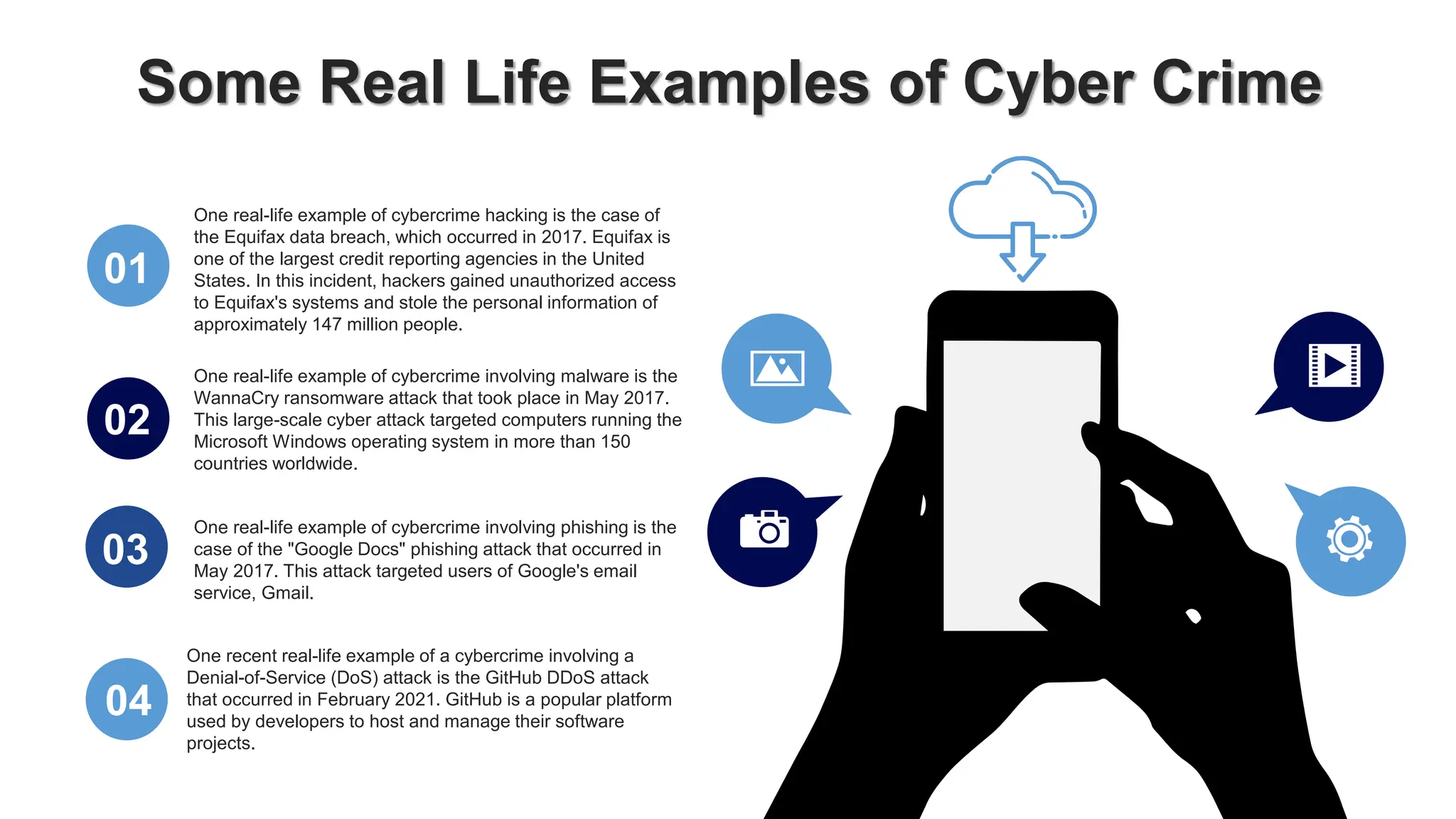
Some Real Life Examples of Cyber Crime
One real-life example of cybercrime hacking is the case of
the Equifax data breach, which occurred in 2017. Equifax is
one of the largest credit reporting agencies in the United
States. In this incident, hackers gained unauthorized access
to Equifax's systems and stole the personal information of
approximately 147 million people.
01
One real-life example of cybercrime involving malware is the
WannaCry ransomware attack that took place in May 2017.
This large-scale cyber attack targeted computers running the
Microsoft Windows operating system in more than 150
countries worldwide.
02
One real-life example of cybercrime involving phishing is the
case of the "Google Docs" phishing attack that occurred in
May 2017. This attack targeted users of Google's email
service, Gmail.
03
One recent real-life example of a cybercrime involving a
Denial-of-Service (DoS) attack is the GitHub DDoS attack
that occurred in February 2021. GitHub is a popular platform
used by developers to host and manage their software
projects.
04
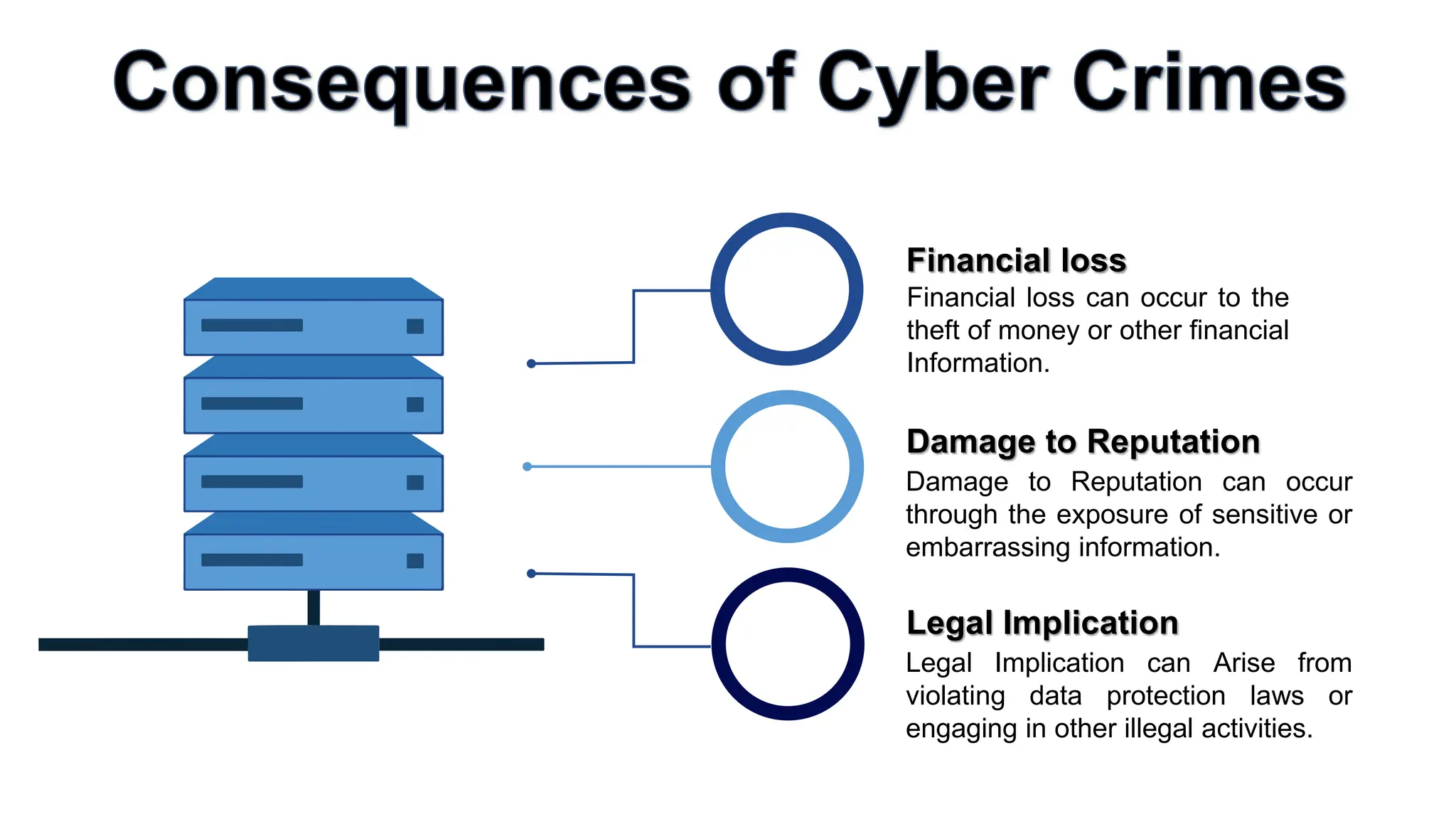
Financial loss can occur to the
theft of money or other financial
Information.
Financial loss
Damage to Reputation can occur
through the exposure of sensitive or
embarrassing information.
Damage to Reputation
Legal Implication can Arise from
violating data protection laws or
engaging in other illegal activities.
Legal Implication
Daily incremental back-
ups to a portable device
and/or cloud storage
Steps to Prevent Cyber
Attacks
Install security software
Daily incremental back-
ups to a portable device
and/or cloud storage
Ensure you use multi-
factor authentication
(MFA)
Train your staff to be
safe online
Consider cyber security
insurance
Encrypt important
information
Put policies in place to
guide your staff
Get updates on the latest
risks
Get cyber security advice
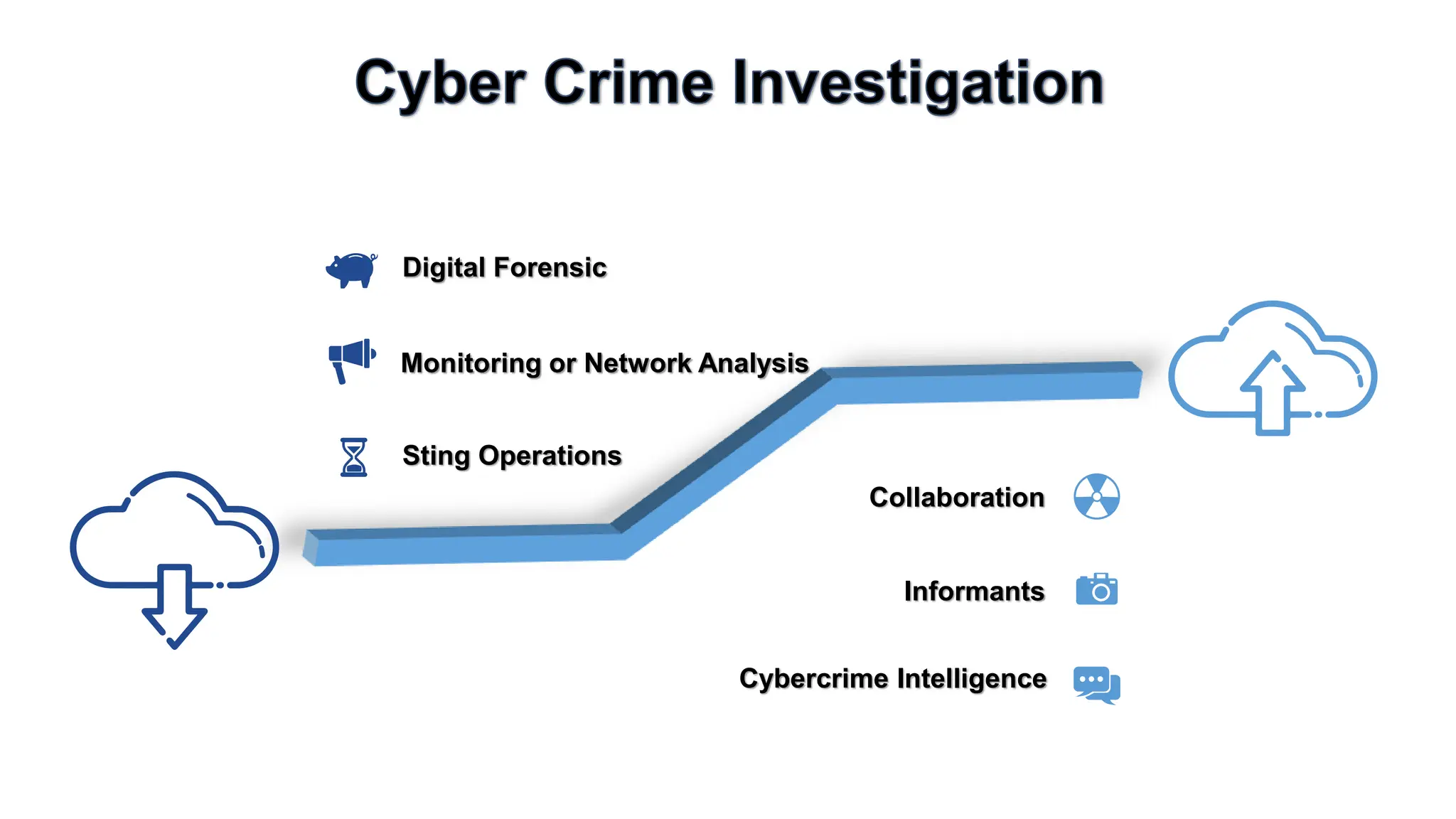
Collaboration
Informants
Cybercrime Intelligence
Digital Forensic
Monitoring or Network Analysis
Sting Operations
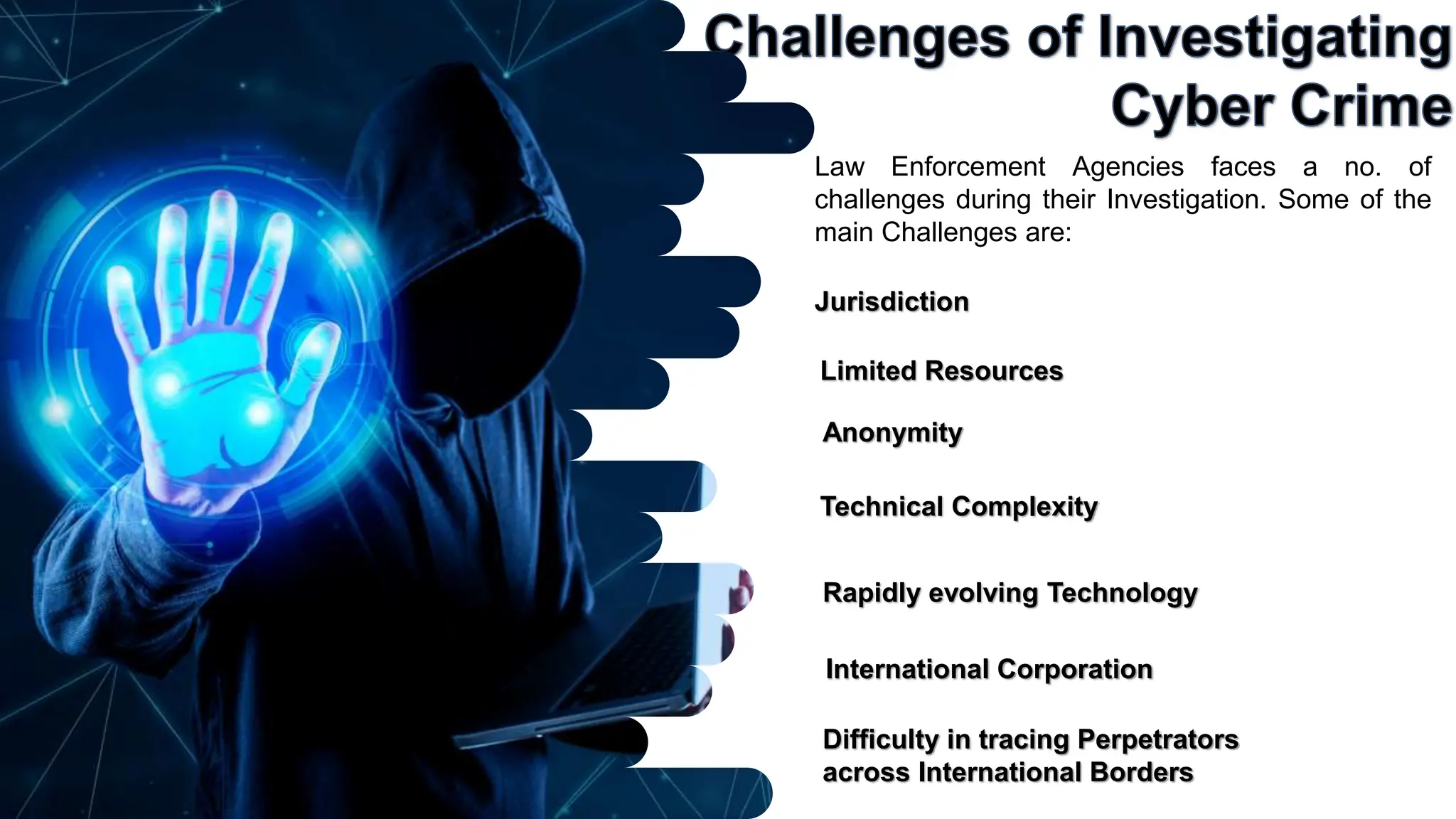
Jurisdiction
Law Enforcement Agencies faces a no. of
challenges during their Investigation. Some of the
main Challenges are:
Anonymity
Technical Complexity
Rapidly evolving Technology
Limited Resources
International Corporation
Difficulty in tracing Perpetrators
across International Borders
Conclusion
It is important to stay
vigilant and aware of the
latest threats, as
cybercriminals are
constantly evolving their
tactics. By staying
informed and taking
proactive steps to protect
ourselves, we can help
ensure a safer and more
secure online
environment for everyone.
Thank you for your
attention and please don't
hesitate to reach out if
you have any questions or
concerns.
In conclusion, cybercrime
is a real threat that can
have devastating
consequences for
individuals and
organizations alike. As we
have seen in this
presentation,
cybercriminals use a
variety of tactics to gain
access to sensitive
information and wreak
havoc on computer
systems.
THANK YOU
RISING
E-COMMERCE
E-COMMERCE
• INTRODUCTION
• DEFINITION
• TYPES OF E-COMMERCE
• BENEFITS
18
Introduction
Hello everyone, Today we are going to discuss
E-commerce and E-banking. These are two of
the most significant developments in the
world of technology and have transformed the
way we conduct business and handle our
finances. Let's dive deeper into these topics.
19
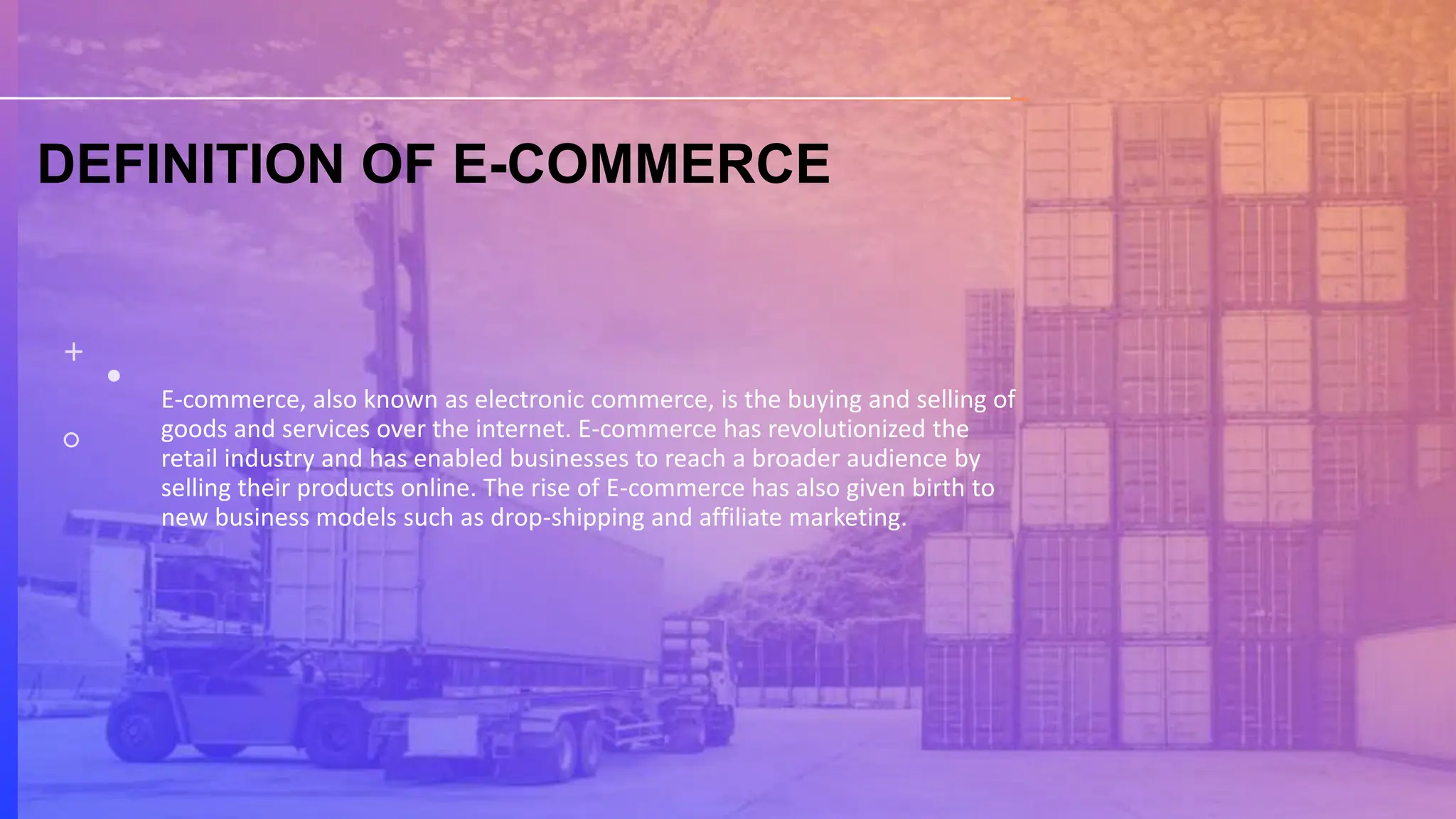
DEFINITION OF E-COMMERCE
E-commerce, also known as electronic commerce, is the buying and selling of
goods and services over the internet. E-commerce has revolutionized the
retail industry and has enabled businesses to reach a broader audience by
selling their products online. The rise of E-commerce has also given birth to
new business models such as drop-shipping and affiliate marketing.
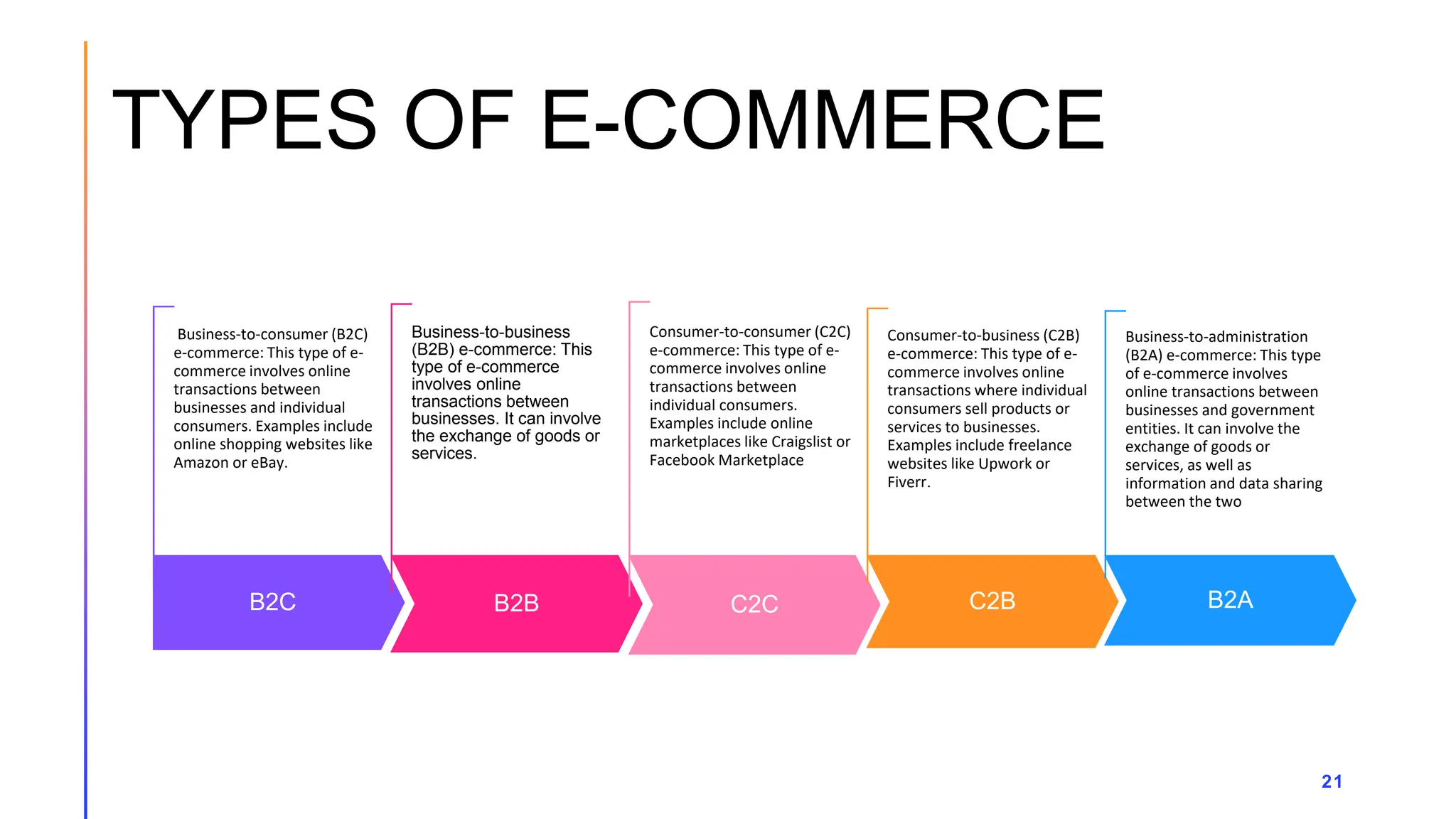
TYPES OF E-COMMERCE
B2C
Business-to-consumer (B2C)
e-commerce: This type of e-
commerce involves online
transactions between
businesses and individual
consumers. Examples include
online shopping websites like
Amazon or eBay.
B2B
Business-to-business
(B2B) e-commerce: This
type of e-commerce
involves online
transactions between
businesses. It can involve
the exchange of goods or
services.
C2C
Consumer-to-consumer (C2C)
e-commerce: This type of e-
commerce involves online
transactions between
individual consumers.
Examples include online
marketplaces like Craigslist or
Facebook Marketplace
C2B
Consumer-to-business (C2B)
e-commerce: This type of e-
commerce involves online
transactions where individual
consumers sell products or
services to businesses.
Examples include freelance
websites like Upwork or
Fiverr.
B2A
Business-to-administration
(B2A) e-commerce: This type
of e-commerce involves
online transactions between
businesses and government
entities. It can involve the
exchange of goods or
services, as well as
information and data sharing
between the two
21
Benefits of E-commerce
• Global Reach: E-commerce allows
businesses to reach customers all around
the world, breaking down geographical
barriers.
• Lower Costs: E-commerce businesses can
save on overhead costs such as rent,
utilities, and staffing, making it more cost-
effective than traditional brick-and-mortar
stores.
• 24/7 Availability: E-commerce stores are
open 24/7, providing customers with the
convenience of shopping anytime they want.
• Personalized Experience: E-commerce businesses
can use customer data to provide personalized
recommendations and offers, enhancing the
customer experience
22
CONCLUSION
In conclusion, E-commerce is the technologies that
have transformed the way we do business and
manage our finances. E-commerce has enabled
businesses to reach a global audience. As
technology continues to evolve, we can expect
these two fields to continue to grow and change
the way we interact with the world around
SAMPLE FOOTER TEXT
23
THANK YOU
24
Acing the Rise of E-Commerce
• Introduction
• Definition
• Types
• Benefits
1.E-Commerce:
Definition & Importance
E-Commerce is an increasingly popular business model that
has revolutionized how people carry out commercial
transactions in the digital era. In this presentation, we shall
look into its de nition, di erent types, as well as its various
bene ts.
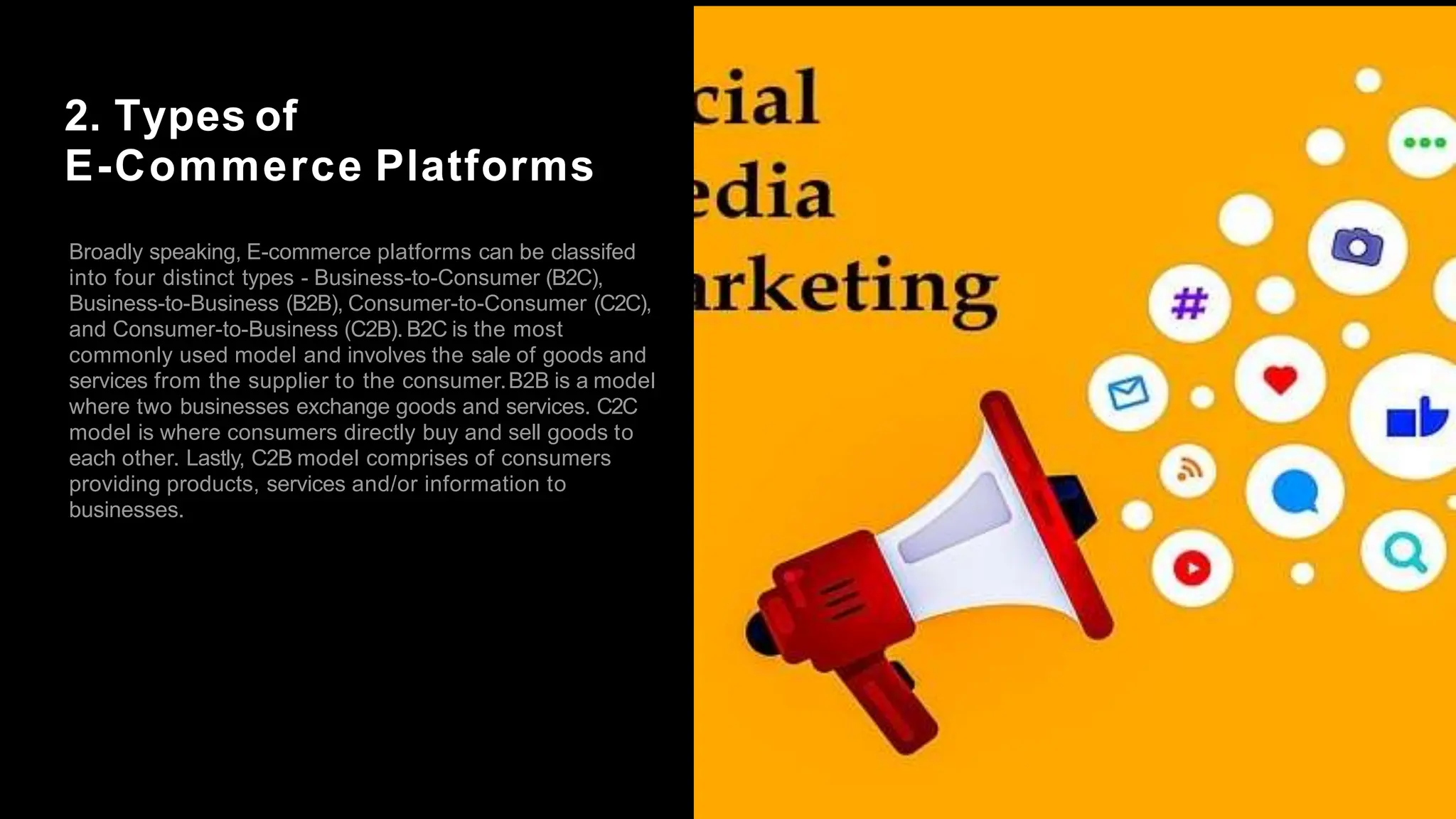
2. Types of
E-Commerce Platforms
Broadly speaking, E-commerce platforms can be classifed
into four distinct types - Business-to-Consumer (B2C),
Business-to-Business (B2B), Consumer-to-Consumer (C2C),
and Consumer-to-Business (C2B). B2C is the most
commonly used model and involves the sale of goods and
services from the supplier to the consumer.B2B is a model
where two businesses exchange goods and services. C2C
model is where consumers directly buy and sell goods to
each other. Lastly, C2B model comprises of consumers
providing products, services and/or information to
businesses.
3. Advantages: Online
Buying & Selling
Advantages of E-Commerce
Online buying and selling can bene t from lower cost,
automated processes, improved browsing and search
capabilities, and greater convenience for customers.
Merchants also bene t from being able to provide a
superior customer experience, as well as access to new
markets. With fast and safe delivery, buyers can nd great
deals and have a memorable shopping experience.
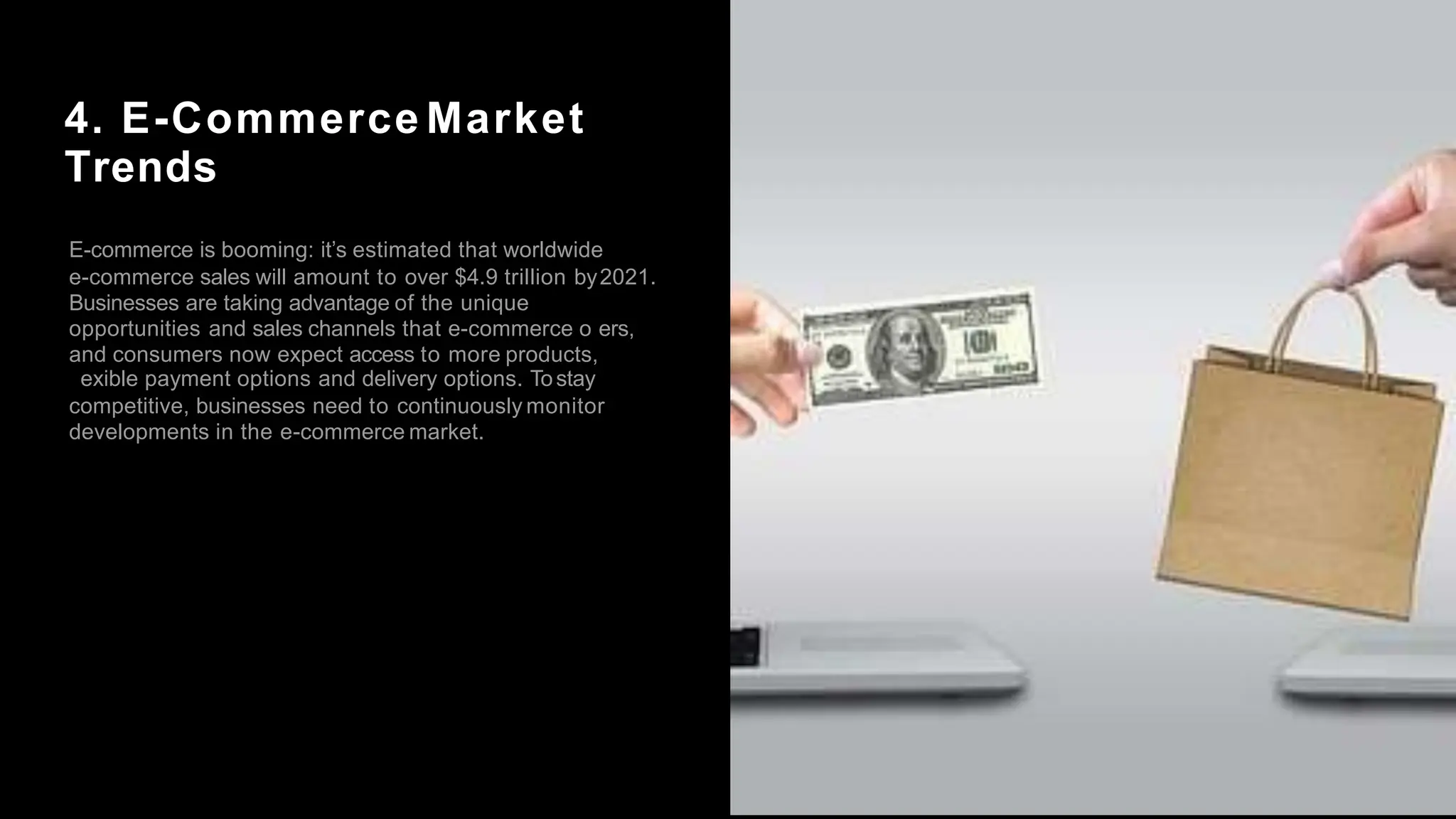
4. E-Commerce Market
Trends
E-commerce is booming: it’s estimated that worldwide
e-commerce sales will amount to over $4.9 trillion by2021.
Businesses are taking advantage of the unique
opportunities and sales channels that e-commerce o ers,
and consumers now expect access to more products,
exible payment options and delivery options. Tostay
competitive, businesses need to continuously monitor
developments in the e-commerce market.
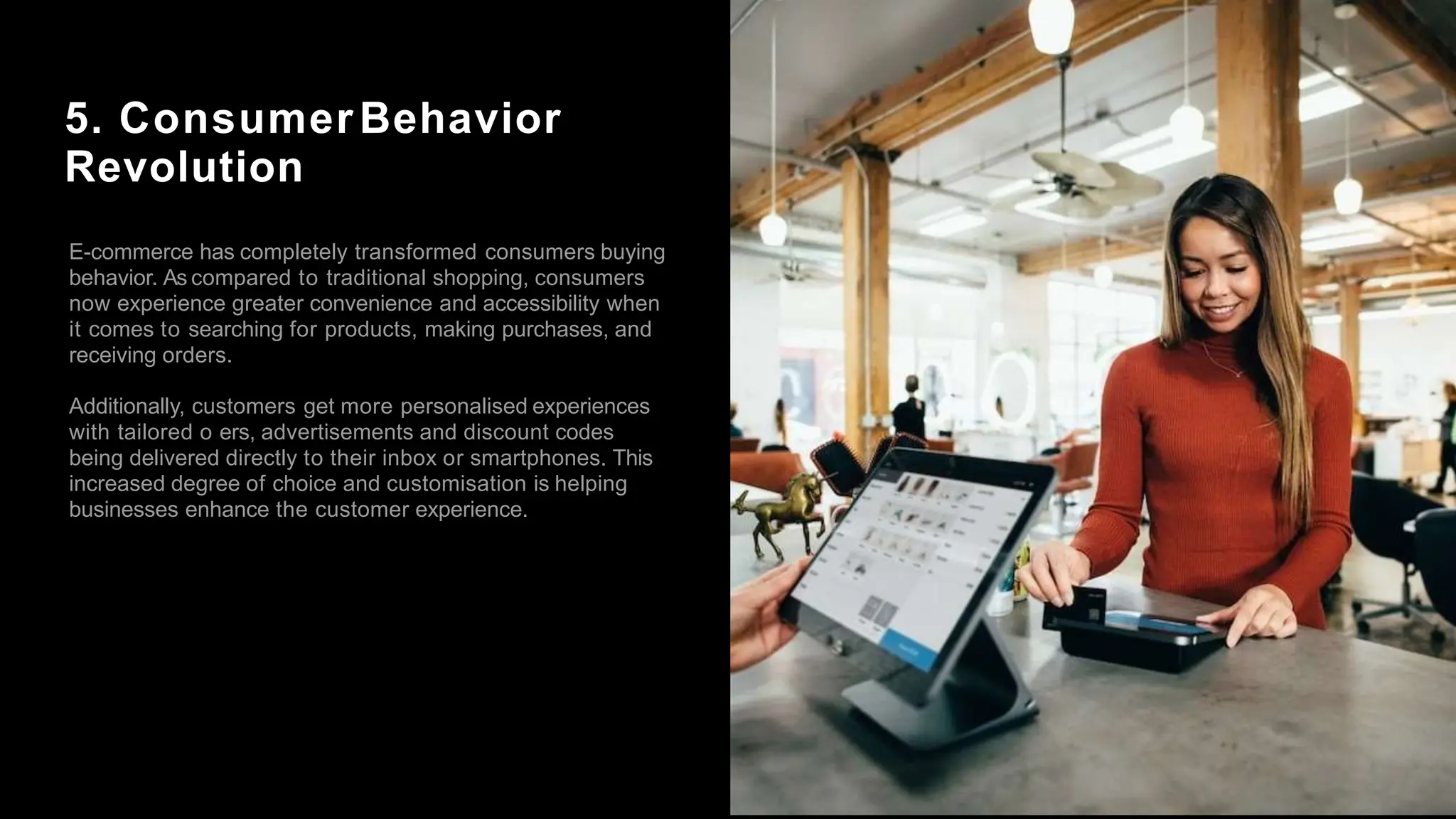
5. ConsumerBehavior
Revolution
E-commerce has completely transformed consumers buying
behavior. As compared to traditional shopping, consumers
now experience greater convenience and accessibility when
it comes to searching for products, making purchases, and
receiving orders.
Additionally, customers get more personalised experiences
with tailored o ers, advertisements and discount codes
being delivered directly to their inbox or smartphones. This
increased degree of choice and customisation is helping
businesses enhance the customer experience.
6. Cutting-Edge
Technologies
E-commerce businesses can leverage cutting-edge
technologies such as Machine Learning, Arti cial
Intelligence, Augmented Reality, Virtual Reality, and
Blockchain to improve customer experiences andoptimize
internal operations.
These technologies help companies analyse customer data
to develop personalized product recommendations,
automate their marketing campaigns, and securely store
their nancial andcustomer information. Thus, encouraging
forward-thinking businesses to explore and adopt these
technologies is essential to reach the next level of success in
the e-commerce industry.
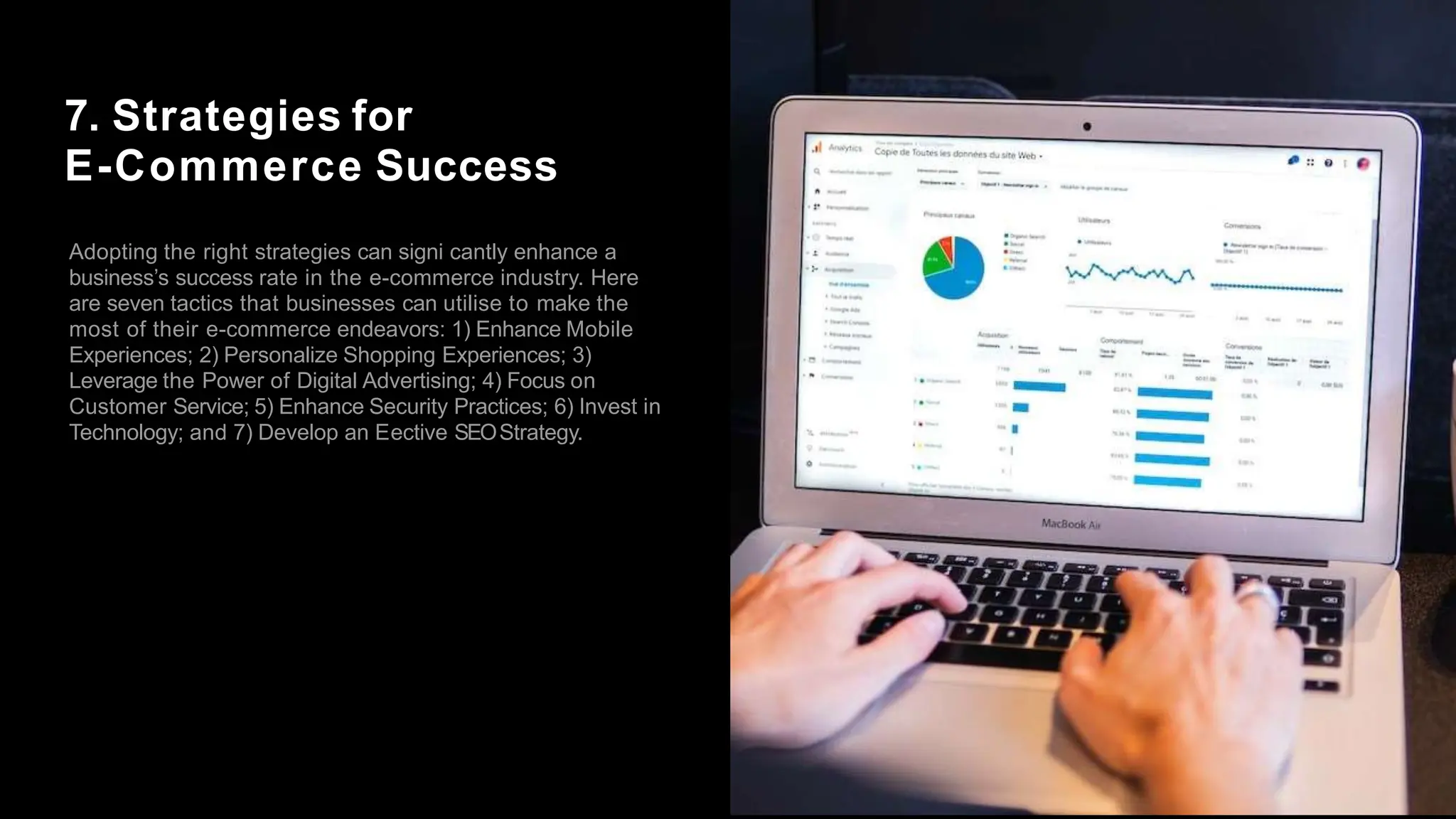
7. Strategies for
E-Commerce Success
Adopting the right strategies can signi cantly enhance a
business’s success rate in the e-commerce industry. Here
are seven tactics that businesses can utilise to make the
most of their e-commerce endeavors: 1) Enhance Mobile
Experiences; 2) Personalize Shopping Experiences; 3)
Leverage the Power of Digital Advertising; 4) Focus on
Customer Service; 5) Enhance Security Practices; 6) Invest in
Technology; and 7) Develop an Eective SEOStrategy.
THANK YOU!

E-commerce Additional Assignment Presentation Group No- 13.pptx

  • 1.
    ADDITIONAL ASSIGNMENT 1. CYBERCRIME AND SECURITY 2. ACING THE RISE OF E- COMMERCE 3. RISING E-COMMERCE TOPICS COVERED
  • 2.
    Team 1. Himanshu Mulani2202674 MBA Regular 2. Navjoth Singh 2202698 MBA Regular 3. Nupur Bhatnagar 2202701 MBA Regular 4. Pragya Agarwal 2101708 MBA Integrated 5. Isha Anand 2202678 MBA (Regular) 6. Tanya Verma 2202728 MBA REGULAR 7. Vijay Verma 2202732 MBA Regular 8. Sani jha 2202715 MBA Regular 9. Parul Sharma 2202704 MBA (Regular) 10.Damini Chaudhary 2202666 MBA REGULAR 11.Somil Upadhyay 2202722 MBA Regular 12.Komal verma 2202688 MBA Regular 13.Pavan Singh 2202705 MBA Regular 14.Ankit Chaudhary 2202660 MBA Regular 15.Aman 2202656 MBA Regular 16.Anjali Nayak 2202658 MBA Regular
  • 5.
    Cyber Crime isa criminal activity that is carried out using the internet or other digital means. It is a growing problem that affects the individual, Businesses, and Governments around the world. In order to protect against cybercrime it’s important to understand the different types of attacks and how to prevent them. 01 Cyber security refers to every aspect of protecting an organization and its employees and assets against cyber threats. As cyber attacks become more common and sophisticated and corporate networks grow more complex, a variety of cyber security solutions are required to mitigate corporate cyber risk. 02
  • 6.
  • 8.
    Malware It is atype of software that is designed to damage or disable computers or other digital devices Phishing It involves sending fraudulent emails or messages in order to trick people into giving away sensitive information Hacking Hacking involves gaining unauthorized access to computer systems or networks. Ransomware Attack It is a type of Malware that encrypts files on a computer and demands payment in exchange for a decryption key. DoS Attacks It involve overwhelming a website or network with a traffic in order to render it unusable
  • 9.
    Some Real LifeExamples of Cyber Crime One real-life example of cybercrime hacking is the case of the Equifax data breach, which occurred in 2017. Equifax is one of the largest credit reporting agencies in the United States. In this incident, hackers gained unauthorized access to Equifax's systems and stole the personal information of approximately 147 million people. 01 One real-life example of cybercrime involving malware is the WannaCry ransomware attack that took place in May 2017. This large-scale cyber attack targeted computers running the Microsoft Windows operating system in more than 150 countries worldwide. 02 One real-life example of cybercrime involving phishing is the case of the "Google Docs" phishing attack that occurred in May 2017. This attack targeted users of Google's email service, Gmail. 03 One recent real-life example of a cybercrime involving a Denial-of-Service (DoS) attack is the GitHub DDoS attack that occurred in February 2021. GitHub is a popular platform used by developers to host and manage their software projects. 04
  • 10.
    Financial loss canoccur to the theft of money or other financial Information. Financial loss Damage to Reputation can occur through the exposure of sensitive or embarrassing information. Damage to Reputation Legal Implication can Arise from violating data protection laws or engaging in other illegal activities. Legal Implication
  • 12.
    Daily incremental back- upsto a portable device and/or cloud storage Steps to Prevent Cyber Attacks Install security software Daily incremental back- ups to a portable device and/or cloud storage Ensure you use multi- factor authentication (MFA) Train your staff to be safe online Consider cyber security insurance Encrypt important information Put policies in place to guide your staff Get updates on the latest risks Get cyber security advice
  • 13.
  • 14.
    Jurisdiction Law Enforcement Agenciesfaces a no. of challenges during their Investigation. Some of the main Challenges are: Anonymity Technical Complexity Rapidly evolving Technology Limited Resources International Corporation Difficulty in tracing Perpetrators across International Borders
  • 15.
    Conclusion It is importantto stay vigilant and aware of the latest threats, as cybercriminals are constantly evolving their tactics. By staying informed and taking proactive steps to protect ourselves, we can help ensure a safer and more secure online environment for everyone. Thank you for your attention and please don't hesitate to reach out if you have any questions or concerns. In conclusion, cybercrime is a real threat that can have devastating consequences for individuals and organizations alike. As we have seen in this presentation, cybercriminals use a variety of tactics to gain access to sensitive information and wreak havoc on computer systems.
  • 16.
  • 17.
  • 18.
    E-COMMERCE • INTRODUCTION • DEFINITION •TYPES OF E-COMMERCE • BENEFITS 18
  • 19.
    Introduction Hello everyone, Todaywe are going to discuss E-commerce and E-banking. These are two of the most significant developments in the world of technology and have transformed the way we conduct business and handle our finances. Let's dive deeper into these topics. 19
  • 20.
    DEFINITION OF E-COMMERCE E-commerce,also known as electronic commerce, is the buying and selling of goods and services over the internet. E-commerce has revolutionized the retail industry and has enabled businesses to reach a broader audience by selling their products online. The rise of E-commerce has also given birth to new business models such as drop-shipping and affiliate marketing.
  • 21.
    TYPES OF E-COMMERCE B2C Business-to-consumer(B2C) e-commerce: This type of e- commerce involves online transactions between businesses and individual consumers. Examples include online shopping websites like Amazon or eBay. B2B Business-to-business (B2B) e-commerce: This type of e-commerce involves online transactions between businesses. It can involve the exchange of goods or services. C2C Consumer-to-consumer (C2C) e-commerce: This type of e- commerce involves online transactions between individual consumers. Examples include online marketplaces like Craigslist or Facebook Marketplace C2B Consumer-to-business (C2B) e-commerce: This type of e- commerce involves online transactions where individual consumers sell products or services to businesses. Examples include freelance websites like Upwork or Fiverr. B2A Business-to-administration (B2A) e-commerce: This type of e-commerce involves online transactions between businesses and government entities. It can involve the exchange of goods or services, as well as information and data sharing between the two 21
  • 22.
    Benefits of E-commerce •Global Reach: E-commerce allows businesses to reach customers all around the world, breaking down geographical barriers. • Lower Costs: E-commerce businesses can save on overhead costs such as rent, utilities, and staffing, making it more cost- effective than traditional brick-and-mortar stores. • 24/7 Availability: E-commerce stores are open 24/7, providing customers with the convenience of shopping anytime they want. • Personalized Experience: E-commerce businesses can use customer data to provide personalized recommendations and offers, enhancing the customer experience 22
  • 23.
    CONCLUSION In conclusion, E-commerceis the technologies that have transformed the way we do business and manage our finances. E-commerce has enabled businesses to reach a global audience. As technology continues to evolve, we can expect these two fields to continue to grow and change the way we interact with the world around SAMPLE FOOTER TEXT 23
  • 24.
  • 25.
    Acing the Riseof E-Commerce • Introduction • Definition • Types • Benefits
  • 26.
    1.E-Commerce: Definition & Importance E-Commerceis an increasingly popular business model that has revolutionized how people carry out commercial transactions in the digital era. In this presentation, we shall look into its de nition, di erent types, as well as its various bene ts.
  • 27.
    2. Types of E-CommercePlatforms Broadly speaking, E-commerce platforms can be classifed into four distinct types - Business-to-Consumer (B2C), Business-to-Business (B2B), Consumer-to-Consumer (C2C), and Consumer-to-Business (C2B). B2C is the most commonly used model and involves the sale of goods and services from the supplier to the consumer.B2B is a model where two businesses exchange goods and services. C2C model is where consumers directly buy and sell goods to each other. Lastly, C2B model comprises of consumers providing products, services and/or information to businesses.
  • 28.
    3. Advantages: Online Buying& Selling Advantages of E-Commerce Online buying and selling can bene t from lower cost, automated processes, improved browsing and search capabilities, and greater convenience for customers. Merchants also bene t from being able to provide a superior customer experience, as well as access to new markets. With fast and safe delivery, buyers can nd great deals and have a memorable shopping experience.
  • 29.
    4. E-Commerce Market Trends E-commerceis booming: it’s estimated that worldwide e-commerce sales will amount to over $4.9 trillion by2021. Businesses are taking advantage of the unique opportunities and sales channels that e-commerce o ers, and consumers now expect access to more products, exible payment options and delivery options. Tostay competitive, businesses need to continuously monitor developments in the e-commerce market.
  • 30.
    5. ConsumerBehavior Revolution E-commerce hascompletely transformed consumers buying behavior. As compared to traditional shopping, consumers now experience greater convenience and accessibility when it comes to searching for products, making purchases, and receiving orders. Additionally, customers get more personalised experiences with tailored o ers, advertisements and discount codes being delivered directly to their inbox or smartphones. This increased degree of choice and customisation is helping businesses enhance the customer experience.
  • 31.
    6. Cutting-Edge Technologies E-commerce businessescan leverage cutting-edge technologies such as Machine Learning, Arti cial Intelligence, Augmented Reality, Virtual Reality, and Blockchain to improve customer experiences andoptimize internal operations. These technologies help companies analyse customer data to develop personalized product recommendations, automate their marketing campaigns, and securely store their nancial andcustomer information. Thus, encouraging forward-thinking businesses to explore and adopt these technologies is essential to reach the next level of success in the e-commerce industry.
  • 32.
    7. Strategies for E-CommerceSuccess Adopting the right strategies can signi cantly enhance a business’s success rate in the e-commerce industry. Here are seven tactics that businesses can utilise to make the most of their e-commerce endeavors: 1) Enhance Mobile Experiences; 2) Personalize Shopping Experiences; 3) Leverage the Power of Digital Advertising; 4) Focus on Customer Service; 5) Enhance Security Practices; 6) Invest in Technology; and 7) Develop an Eective SEOStrategy.
  • 33.