CHINA	GLOBAL	ANALYSIS	INC.	
	
	 	
E-COMMERCE: A GOLDEN BUSINESS FOR CHINA
Introduction to Global and Chinese e-
Commerce
As online transactions have drastically spread
globally, the worldwide scenery is briskly
transforming and developing nations are
taking on a more outstanding position.
Due to an on-line population of over 600
million users, China undoubtedly has the
potential to exploit all the benefits that e-
Commerce provides to both sellers and
consumers.
The on-line markets are already well
developed and appreciated in the Tier-1 cities
of China (Shanghai, Beijing, Guangzhou and
Shenzhen), but they are expected to outrun
the long-established retailing even in the
smaller and developing areas of the country.
If we look at total incomes, Alibaba Group is
the Chinese and global leader, while its most
fierce opponent is the US based Amazon.
0.3%	 0.6%	 1.1%	
2.0%	
3.7%	
5.7%	
8.1%	
10.3%	
12.8%	
15.6%	
18.1%	
20.1%	
21.0%	
21.9%	
22.7%	
0%	
5%	
10%	
15%	
20%	
25%	
2006	 2007	 2008	 2009	 2010	 2011	 2012	 2013	 2014	 2015e	 2016e	 2017e	 2018e	 2019e	 2020e	
0	
2000	
4000	
6000	
8000	
10000	
12000	
e-Commerce	Volume	(Billion	RMB)	 e-Commerce	vs.	Total	Retail		
IN BRIEF
• China is the global leader in terms of
transaction values
• China lacks physical retail industry
• A total e-Commerce volume of RMB
10,000 Billion it is expected for 2020
• In 2020 e-Commerce will account for
22.7% of total retail
• M-Commerce growth 51.4% in 2016 YoY.
• Further expansion of B2C: from 35.1% to
52% in 2017
• High Concentration in China: Alibaba 75%
(Amazon 29% in US)
Development of Chinese e-Commerce, iResearch.
CHINA	GLOBAL	ANALYSIS	INC.	
	
	 	
E-COMMERCE: COMPARING US AND CHINA
The online retail market is dominated by the two top economies in the world: US and China.
In fact, together these markets account for more than 55% of worldwide e-commerce. However, it
must be stressed that the Chinese presence is almost 40% larger than the US one. China’s gross
merchandize volume (GMV) in e-commerce in 2014 is 60x 2007 GMV, reaching a peak of USD
425 billion in the last year analyzed.
E-commerce is resisting the “New Normal” better than any other sector, and overall retail is still
increasing quite a lot faster than Gross Domestic Product. Indeed, we register a significant increase
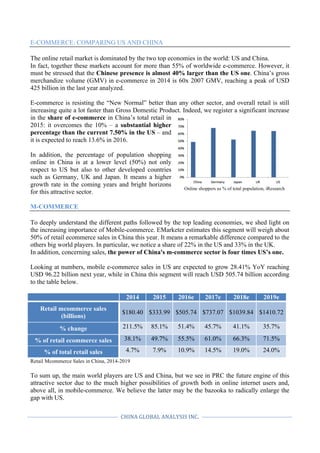
in the share of e-commerce in China’s total retail in
2015: it overcomes the 10% – a substantial higher
percentage than the current 7.50% in the US – and
it is expected to reach 13.6% in 2016.
In addition, the percentage of population shopping
online in China is at a lower level (50%) not only
respect to US but also to other developed countries
such as Germany, UK and Japan. It means a higher
growth rate in the coming years and bright horizons
for this attractive sector.
M-COMMERCE
To deeply understand the different paths followed by the top leading economies, we shed light on
the increasing importance of Mobile-commerce. EMarketer estimates this segment will weigh about
50% of retail ecommerce sales in China this year. It means a remarkable difference compared to the
others big world players. In particular, we notice a share of 22% in the US and 33% in the UK.
In addition, concerning sales, the power of China's m-commerce sector is four times US’s one.
Looking at numbers, mobile e-commerce sales in US are expected to grow 28.41% YoY reaching
USD 96.22 billion next year, while in China this segment will reach USD 505.74 billion according
to the table below.
2014 2015 2016e 2017e 2018e 2019e
Retail mcommerce sales
(billions)
$180.40 $333.99 $505.74 $737.07 $1039.84 $1410.72
% change 211.5% 85.1% 51.4% 45.7% 41.1% 35.7%
% of retail ecommerce sales 38.1% 49.7% 55.5% 61.0% 66.3% 71.5%
% of total retail sales 4.7% 7.9% 10.9% 14.5% 19.0% 24.0%
Retail Mcommerce Sales in China, 2014-2019
To sum up, the main world players are US and China, but we see in PRC the future engine of this
attractive sector due to the much higher possibilities of growth both in online internet users and,
above all, in mobile-commerce. We believe the latter may be the bazooka to radically enlarge the
gap with US.
Online shoppers as % of total population, iResearch
CHINA	GLOBAL	ANALYSIS	INC.	
	
	 	
E-COMMERCE CHANCES: CHINA VS. USA
E-Commerce sector in China is full of potential, leaning on world’s largest consumer base of 1.4B
people. Given future aim to shift China from an investment-led country to be a consumption-led
nation, it unlocks plenty of chances to be exploited, trying to reach much more citizens as possible.
High growth rates are sustainable, since e-commerce is tied to technology development. There is
a great gap among Tier 1 cities and the others; as technology penetration into people continues, also
thanks to mobile connection, e-commerce will keep rising at a high pace. Unlike US, where
physical network is highly efficient, China has weak network infrastructures but a unique pace of
smartphone adoption, providing foundation for e-commerce business model.
We could understand how mobile e-commerce will move in US if we look at how it goes in China.
Great chance for e-com in China derives from its lack of physical retail industry with respect to
US. Established distribution brands are missing, leaving new online players to operate freely with
not much competition from physical opponents. It took longer to gain traction in China, but now as
leaders begin organizing, e-commerce can grow without constraints. We also expect China to
become world’s leader in O2O (Offline to Online) model.
Online advertising developed quite similarly both in China and US. They can experience upsides
from mobile monetization; its full potential is known, ready to be exploited by firms. We expect
mobile payments to be disruptive in China, whereas their future in US is not so clear.
Payment methods are different. US are dominated by incumbent networks Visa and Mastercard, in
China government-sponsored China UnionPay was slow to fill the gap of e-com, so internet
platforms have developed their own payment method, shaping the landscape, creating new chances.
Keep in mind that Chinese customers don’t trust advertisement. Building a strong presence on
social media, enhancing brand reputation through word-of-mouth advice is vital, as people trust
peers review. It allows early players to get substantial advantage, if they move early to social media.
Current market structure leaves room for
companies’ growth: B2C sector is expected
to grow from 35.1% (2013) to 52% of total
e-com (2017), lowering C2C share. Also
O2O market (Offline to Online) hides a
huge potential for service Industry. B2B
sector could benefit from this new chance of
growth, since it’s now stable and mature in
most cases; new online canals will offer new
ways to grow outside its current dimensions.
Logistics related to e-commerce leaves even more room, also for foreign entrepreneurship. Present
companies only offer a basic shipment service, which covers most of China; however, they do not
offer tailored services and specific shipments, and this void could be filled by foreign investors.
CHINA	GLOBAL	ANALYSIS	INC.	
	
	 	
E-COMMERCE RISKS IN CHINA AND US
Current twofolded growth expectations on China are relying on predicted strong development of
further Internet lines. If local governments from Tier 2, 3 and 4 cities miss the chance to link
themselves to the net, economies of scale will loose value and establishment of new platforms
could become costly for new competitors (even if mobile penetration could offset this problem).
On the contrary, we expect US long-term penetration to be structurally lower, because of the scale
of offline incumbents, which limits the rate of expansion for online commerce. The maturity of
sector limits profitability of new ideas and new platforms.
Western companies are exposed to the risk of misunderstanding local culture and differences, so
vital for operating in China. Lack of flexibility in operational model (like Amazon China) and
wrong positioning on social media could kill every chance of business. They will need people who
know well Chinese environment to fully deploy its activity.
Entering the market presents many barriers, as some sectors are heavily regulated. B2B sector for
example, where 50% of market is held by three main players, is close to be a state monopoly. Even
if companies are not SOEs, the heavy regulation makes difficult for a foreign company to enter
Chinese B2B online sector. In addition, a lot of lobbying is necessary to operate into the market,
requiring good relationship with the right people, which is obviously quite difficult to obtain.
Chinese market is far more concentrated than US one: Alibaba owns 75% share vs. Amazon’s
29%. Chinese e-commerce is expected to become more fragmented, but is still difficult to face such
a giant when establishing a new platform, with a risk of de facto monopoly.
CHINA GLOBAL ANALYSIS INC.
THE INDUSTRY ANALYSIS TEAM
Enrico Astegiano Andrea D’Oro Filippo Cattabiani
16 March 2016

E-Commerce

  • 1.
    CHINA GLOBAL ANALYSIS INC. E-COMMERCE: AGOLDEN BUSINESS FOR CHINA Introduction to Global and Chinese e- Commerce As online transactions have drastically spread globally, the worldwide scenery is briskly transforming and developing nations are taking on a more outstanding position. Due to an on-line population of over 600 million users, China undoubtedly has the potential to exploit all the benefits that e- Commerce provides to both sellers and consumers. The on-line markets are already well developed and appreciated in the Tier-1 cities of China (Shanghai, Beijing, Guangzhou and Shenzhen), but they are expected to outrun the long-established retailing even in the smaller and developing areas of the country. If we look at total incomes, Alibaba Group is the Chinese and global leader, while its most fierce opponent is the US based Amazon. 0.3% 0.6% 1.1% 2.0% 3.7% 5.7% 8.1% 10.3% 12.8% 15.6% 18.1% 20.1% 21.0% 21.9% 22.7% 0% 5% 10% 15% 20% 25% 2006 2007 2008 2009 2010 2011 2012 2013 2014 2015e 2016e 2017e 2018e 2019e 2020e 0 2000 4000 6000 8000 10000 12000 e-Commerce Volume (Billion RMB) e-Commerce vs. Total Retail IN BRIEF • China is the global leader in terms of transaction values • China lacks physical retail industry • A total e-Commerce volume of RMB 10,000 Billion it is expected for 2020 • In 2020 e-Commerce will account for 22.7% of total retail • M-Commerce growth 51.4% in 2016 YoY. • Further expansion of B2C: from 35.1% to 52% in 2017 • High Concentration in China: Alibaba 75% (Amazon 29% in US) Development of Chinese e-Commerce, iResearch.
  • 2.
    CHINA GLOBAL ANALYSIS INC. E-COMMERCE: COMPARINGUS AND CHINA The online retail market is dominated by the two top economies in the world: US and China. In fact, together these markets account for more than 55% of worldwide e-commerce. However, it must be stressed that the Chinese presence is almost 40% larger than the US one. China’s gross merchandize volume (GMV) in e-commerce in 2014 is 60x 2007 GMV, reaching a peak of USD 425 billion in the last year analyzed. E-commerce is resisting the “New Normal” better than any other sector, and overall retail is still increasing quite a lot faster than Gross Domestic Product. Indeed, we register a significant increase in the share of e-commerce in China’s total retail in 2015: it overcomes the 10% – a substantial higher percentage than the current 7.50% in the US – and it is expected to reach 13.6% in 2016. In addition, the percentage of population shopping online in China is at a lower level (50%) not only respect to US but also to other developed countries such as Germany, UK and Japan. It means a higher growth rate in the coming years and bright horizons for this attractive sector. M-COMMERCE To deeply understand the different paths followed by the top leading economies, we shed light on the increasing importance of Mobile-commerce. EMarketer estimates this segment will weigh about 50% of retail ecommerce sales in China this year. It means a remarkable difference compared to the others big world players. In particular, we notice a share of 22% in the US and 33% in the UK. In addition, concerning sales, the power of China's m-commerce sector is four times US’s one. Looking at numbers, mobile e-commerce sales in US are expected to grow 28.41% YoY reaching USD 96.22 billion next year, while in China this segment will reach USD 505.74 billion according to the table below. 2014 2015 2016e 2017e 2018e 2019e Retail mcommerce sales (billions) $180.40 $333.99 $505.74 $737.07 $1039.84 $1410.72 % change 211.5% 85.1% 51.4% 45.7% 41.1% 35.7% % of retail ecommerce sales 38.1% 49.7% 55.5% 61.0% 66.3% 71.5% % of total retail sales 4.7% 7.9% 10.9% 14.5% 19.0% 24.0% Retail Mcommerce Sales in China, 2014-2019 To sum up, the main world players are US and China, but we see in PRC the future engine of this attractive sector due to the much higher possibilities of growth both in online internet users and, above all, in mobile-commerce. We believe the latter may be the bazooka to radically enlarge the gap with US. Online shoppers as % of total population, iResearch
  • 3.
    CHINA GLOBAL ANALYSIS INC. E-COMMERCE CHANCES:CHINA VS. USA E-Commerce sector in China is full of potential, leaning on world’s largest consumer base of 1.4B people. Given future aim to shift China from an investment-led country to be a consumption-led nation, it unlocks plenty of chances to be exploited, trying to reach much more citizens as possible. High growth rates are sustainable, since e-commerce is tied to technology development. There is a great gap among Tier 1 cities and the others; as technology penetration into people continues, also thanks to mobile connection, e-commerce will keep rising at a high pace. Unlike US, where physical network is highly efficient, China has weak network infrastructures but a unique pace of smartphone adoption, providing foundation for e-commerce business model. We could understand how mobile e-commerce will move in US if we look at how it goes in China. Great chance for e-com in China derives from its lack of physical retail industry with respect to US. Established distribution brands are missing, leaving new online players to operate freely with not much competition from physical opponents. It took longer to gain traction in China, but now as leaders begin organizing, e-commerce can grow without constraints. We also expect China to become world’s leader in O2O (Offline to Online) model. Online advertising developed quite similarly both in China and US. They can experience upsides from mobile monetization; its full potential is known, ready to be exploited by firms. We expect mobile payments to be disruptive in China, whereas their future in US is not so clear. Payment methods are different. US are dominated by incumbent networks Visa and Mastercard, in China government-sponsored China UnionPay was slow to fill the gap of e-com, so internet platforms have developed their own payment method, shaping the landscape, creating new chances. Keep in mind that Chinese customers don’t trust advertisement. Building a strong presence on social media, enhancing brand reputation through word-of-mouth advice is vital, as people trust peers review. It allows early players to get substantial advantage, if they move early to social media. Current market structure leaves room for companies’ growth: B2C sector is expected to grow from 35.1% (2013) to 52% of total e-com (2017), lowering C2C share. Also O2O market (Offline to Online) hides a huge potential for service Industry. B2B sector could benefit from this new chance of growth, since it’s now stable and mature in most cases; new online canals will offer new ways to grow outside its current dimensions. Logistics related to e-commerce leaves even more room, also for foreign entrepreneurship. Present companies only offer a basic shipment service, which covers most of China; however, they do not offer tailored services and specific shipments, and this void could be filled by foreign investors.
  • 4.
    CHINA GLOBAL ANALYSIS INC. E-COMMERCE RISKSIN CHINA AND US Current twofolded growth expectations on China are relying on predicted strong development of further Internet lines. If local governments from Tier 2, 3 and 4 cities miss the chance to link themselves to the net, economies of scale will loose value and establishment of new platforms could become costly for new competitors (even if mobile penetration could offset this problem). On the contrary, we expect US long-term penetration to be structurally lower, because of the scale of offline incumbents, which limits the rate of expansion for online commerce. The maturity of sector limits profitability of new ideas and new platforms. Western companies are exposed to the risk of misunderstanding local culture and differences, so vital for operating in China. Lack of flexibility in operational model (like Amazon China) and wrong positioning on social media could kill every chance of business. They will need people who know well Chinese environment to fully deploy its activity. Entering the market presents many barriers, as some sectors are heavily regulated. B2B sector for example, where 50% of market is held by three main players, is close to be a state monopoly. Even if companies are not SOEs, the heavy regulation makes difficult for a foreign company to enter Chinese B2B online sector. In addition, a lot of lobbying is necessary to operate into the market, requiring good relationship with the right people, which is obviously quite difficult to obtain. Chinese market is far more concentrated than US one: Alibaba owns 75% share vs. Amazon’s 29%. Chinese e-commerce is expected to become more fragmented, but is still difficult to face such a giant when establishing a new platform, with a risk of de facto monopoly. CHINA GLOBAL ANALYSIS INC. THE INDUSTRY ANALYSIS TEAM Enrico Astegiano Andrea D’Oro Filippo Cattabiani 16 March 2016