Development of managerial andentrepreneurial skills of young eco-farmersviajoint VET curricula, enhanced
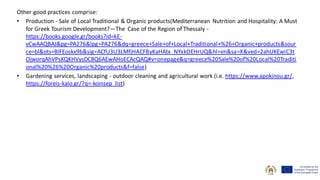
qualificationprofile, assessmentstandardandsustainable cooperationsynergies (ecoFAR)
597256-EPP-1-2018-1-BG-EPPKA3-VET-JQ
WP5: Joint qualification curricula for acquisition of managerial
and entrepreneurial skills by farmers at eco-farm SME
Module 7:
SOCIAL COMMERCIAL ENTREPRENEURSHIP
Authors: CPI, UM, Slovenia
Aims and overarching objectives of the
module
• To define and provide knowledge about social commercial
entrepreneurship concept
• To provide informationabout the implementation of social
commercial entrepreneurship
in organic-farming
Table of content
7.0 Social Entrepreneurship
7.0.1 Whatis Social Entrepreneurship?
7.0.2 Legaldefinition of Social Entrepreneurship
7.0.3 SocialEntrepreneurship vs SocialResponsibility
7.0.4 Key principles and requirements in social entrepreneurship
7.0.5 Who is social entrepreneur and whatare the key characteristics for success?
7.1 Social commercial entrepreneurship concept
7.1.1 How to understand socialcommercialentrepreneurship concept?
7.1.2 RelevantEU legislation on social entrepreneurship
7.1.3Relevantnationallegislation on social entrepreneurship
7.2 Setting upa social enterprise
7.2.1 Steps to establish a social enterprise
7.2.2 Identify your mission
7.2.3 Bring an idea to scale
7.2.4Theory of change
7.2.5 Plan for sustainability
7.2.6 Ensurethe sustainability in time of crisis
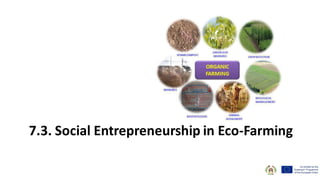
7.3 Social entrepreneurship ineco-farming
7.3.1 How to establish a socialenterprise in organic farming
7.3.2 Good practices of eco-farming
7.3.3 Therole of stakeholders
7.3.4 Networking
7.3.4.1 Opportunities of networking
7.3.4.2 Specialised fairs for farmers
7.0 Social Entrepreneurship
7.0.1 What is Social Entrepreneurship?
• Is a form of entrepreneurship with a pronounced sense of responsibility for the society and
people;
• Is characterized by motive for business - is directed towards resolving social, economic,
environmental, and other issues in the society in an innovative way;
• Is an alternative form of entrepreneurship that takes into account the non-profit principle;
• Is a spectrum of economic activities that are neither part of the public nor the private
sector;
• Social entrepreneurship encourages collaboration, joint ventures, volunteering; it promotes
social solidarity;
• By creating additional jobs where the private sector has no interest due to low profits, and
by employing vulnerable groups in the labor market (the long-term unemployed, the
disabled, the elderly unemployed, etc.), it ensures increased social well-being and gross
national happiness.
7.0.2 Legal definition of Social Entrepreneurship in Slovenia (Social
Entrepreneurship Act, ZSocP-A)
• Refers to "the permanent pursuit of an entrepreneurial activity through the production and
sale of products or the provision of services in a market where profit generation is not the
main goal of entrepreneurial activity, but rather the achievement of social impact.„;
• Can be practiced in all areas of economic and non-economic activities;
• Usually, social enterprises are a kind of "hybrid" between the public and the private, and
usually engage in activities that the public and private sectors cannot or do not want to
undertake to a sufficient extent for various reasons, such as lack of public funds or lack of
profitability;
• The implementation of social entrepreneurship is not limited only to the integration of
vulnerable groups in the labour market and the provision of social services of general
interest – the crucial point is that it provides a (broader) social impact;
• Is a non-profit legal entity that acquires the status of a social enterprise (in a form
of association, institute, institution, company, cooperative, European cooperative or
other legal person governed by private law) – profit is invested into new social
entrepreneurship ventures
The statusof social enterprise can be acquired by any non-profit legal entity, which
undertakes to act according to the eleven principles of social entrepreneurship:
autonomous initiative, non-profitability, market orientation, involvement of volunteer
work, equality of members, participation of stakeholders in management, transparent
business and socially useful functioning.
Sources:
https://www.managementstudyguide.com/social-entrepreneurship.htm
https://www.toppr.com/guides/business-management-and-entrepreneurship/social-entrepreneurship/meaning-and-concept-
social-entrepreneurship/
Video:
https://www.youtube.com/watch?v=9_g5RqwW51I&list=PL6HxSyThhJKcEyEqOTRRVuj1QoqaYY7xI
• Although there are active Turkish social enterprises, the term «Social Entrepreneurship» is
relatively new for Turkey.
• Unfortunately, at present there is no legal legislation for social entrepreneurship in Turkey.
• On the other hand, current research shows that there are about 9 000 social enterprises in
Turkey.
• Taking into consideration the increasing necessity for social entrepreneurship legislation,
the Ministry of Economic (now Ministry of Trade) included in the Strategic Plan for 2018-
2022 the setting up and empowering the visibility of social entrepreneurship.
Source:
https://www.britishcouncil.org.tr/sites/default/files/20190702_se_research_report_the_state_of_social_enterprise_in_turkey_tr_
double_page.pdf
7.0.2 Legal definition of Social Entrepreneurship in Turkey
7.0.2 Legal definition of Social Entrepreneurship in Bulgaria
“Social entrepreneurship” is a form of entrepreneurship which incorporates profit activity with
social objectives, which results in production of social value added, under a specific
methodology.
By the Law On Enterprises Of The Social And Solidarity Economy:
• The main objective of the law is the legal regulation of the way social enterprises must exist
and state measures for their establishment and development.
• Subject to social and solidarity economy are cooperatives, non-profit legal entities for social
welfare activities, and social entities.
• Social enterprises are class A and class A+.
• Social enterprises are to be registered in the list of social enterprises under the conditions of
this Law and the regulations of the application of the Law, adopted by the Council of
Ministers.
• Entry in the register of the social enterprises is to be made by a stakeholder’s claim, and the
deletion – by the social enterprise’s claim or officially.
Source: https://lex.bg/bg/laws/ldoc/2137187968
7.0.2 Legal definition of Social Entrepreneurship in Greece
• Social Entrepreneurship is a distinct form of entrepreneurship that aims to
achieve a social purpose through the creation of social value and aims to
solve pressing social problems such as environmental protection, education. ,
the provision of health services, poverty, energy, water resources, etc. The
treatment of the problem undertaken is at the center of the company's social
activities and its solution often comes through the implementation of
innovative approaches.
• Social entrepreneurship can take both speculative and non-profit form
without changing its ultimate goal, namely achieving a social goal. Social
enterprises start with people with a vision and perseverance to achieve the
goal of social change and achieving lasting solutions and who apply basic
principles of entrepreneurship in the functioning of their organizations.
7.0.2 Legal definition of Social Entrepreneurship in Greece
• A crucial element that separates the "social" from the "traditional"
entrepreneurship is the fact that the former aim to solve specific social
problems and not to achieve an economic result, which they use as a
means to the success of their purpose.
• Legal framework for social entrepreneurship:
– Law 4019/2011 - Government Gazette 216 / A / 30-9-2011 (https://www.e-
nomothesia.gr/kat-epikheireseis/n-4019-2011.html )
– Law 4430/2016 - Government Gazette 205 / A / 31-10-2016 (https://www.e-
nomothesia.gr/kat-oikonomia/nomos-4430-2016.html)
7.0.3 Social Entrepreneurship vs Social Responsibility
However, Corporate Social Responsibility companies are not necessarily social
enterprises. The main purpose of a social enterprise is to create social change, while
socially responsible companies only react to social change with a part of their
entrepreneurial activity within the so-called "quality-of-life management", by taking
into account broader social interests, while generating profit remains the primary
purpose of the business.
Source: https://socialbusinessearth.org/our-social-business-projects/
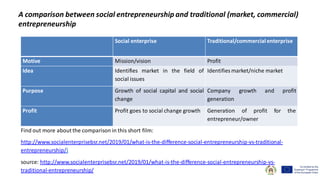
A comparison between social entrepreneurship and traditional (market, commercial)
entrepreneurship
Social enterprise Traditional/commercialenterprise
Motive Mission/vision Profit
Idea Identifies market in the field of
social issues
Identifies market/niche market
Purpose Growth of social capital and social
change
Company growth and profit
generation
Profit Profit goes to social change growth Generation of profit for the
entrepreneur/owner
Find out more about the comparison in this short film:
http://www.socialenterprisebsr.net/2019/01/what-is-the-difference-social-entrepreneurship-vs-traditional-
entrepreneurship/)
source: http://www.socialenterprisebsr.net/2019/01/what-is-the-difference-social-entrepreneurship-vs-
traditional-entrepreneurship/
7.0.4 Key principles and requirements in social entrepreneurship
• Social enterprises may be established by non-profit legal entities that were established and
are operating according to the principles and requirements that demonstrate their publicly
beneficial and social character;
• They are established on the basis of a voluntary decision of the founders (autonomous
initiative);
• The purpose of establishing is not profit exclusively (non profit-making purpose);
• They are established predominantly for the purpose of pursuing social entrepreneurship or
other activities on a permanent basis with a view to employing the most vulnerable groups
of people in the labour market, thereby achieving public interest (exercise of activities in the
public interest);
• Their members act voluntarily (voluntary action);
• They are autonomous in management (independence);
• By producing and selling products or providing services on the market, they mainly operate
in accordance with market laws (market orientation);
• As a rule, they involve volunteer work (involvement of volunteer work);
• Individual founders or owners do not have a dominant influence in decision-making;
decisions are made by all members following the principle of one member - one vote,
regardless of the share of invested capital (equality of membership);
• They involve stakeholders in decision-making (stakeholder involvement in management);
• Wealth, profit and excess of income over expenditure are used for social entrepreneurship
purposes and other non-profit purposes, while the sharing of profit or excess of income is
not permissible or is restricted under the Social Entrepreneurship Act (non-profit activity);
• Ensure transparency of financial operations and internal control over material and financial
operations (transparency of operations);
• Act permanently for the benefit of their members, users and the wider community (activity
in the public interest).
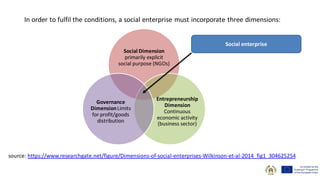
In order to fulfil the conditions, a social enterprise must incorporate three dimensions:
source: https://www.researchgate.net/figure/Dimensions-of-social-enterprises-Wilkinson-et-al-2014_fig1_304625254
Social Dimension
primarily explicit
social purpose (NGOs)
Entrepreneurship
Dimension
Continuous
economic activity
(business sector)
Governance
DimensionLimits
for profit/goods
distribution
Social enterprise
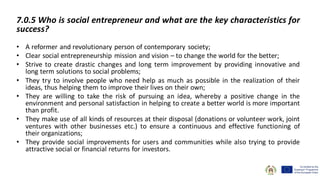
7.0.5 Who is social entrepreneur and what are the key characteristics for
success?
• A reformer and revolutionary person of contemporary society;
• Clear social entrepreneurship mission and vision – to change the world for the better;
• Strive to create drastic changes and long term improvement by providing innovative and
long term solutions to social problems;
• They try to involve people who need help as much as possible in the realization of their
ideas, thus helping them to improve their lives on their own;
• They are willing to take the risk of pursuing an idea, whereby a positive change in the
environment and personal satisfaction in helping to create a better world is more important
than profit.
• They make use of all kinds of resources at their disposal (donations or volunteer work, joint
ventures with other businesses etc.) to ensure a continuous and effective functioning of
their organizations;
• They provide social improvements for users and communities while also trying to provide
attractive social or financial returns for investors.
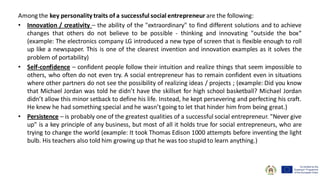
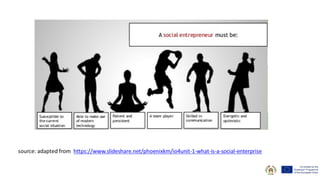
Among the key personality traits of a successful social entrepreneur are the following:
• Innovation / creativity – the ability of the "extraordinary" to find different solutions and to achieve
changes that others do not believe to be possible - thinking and innovating "outside the box“
(example: The electronics company LG introduced a new type of screen that is flexible enough to roll
up like a newspaper. This is one of the clearest invention and innovation examples as it solves the
problem of portability)
• Self-confidence – confident people follow their intuition and realize things that seem impossible to
others, who often do not even try. A social entrepreneur has to remain confident even in situations
where other partners do not see the possibility of realizing ideas / projects ; (example: Did you know
that Michael Jordan was told he didn’t have the skillset for high school basketball? Michael Jordan
didn’t allow this minor setback to define his life. Instead, he kept persevering and perfecting his craft.
He knew he had something special and he wasn’tgoing to let that hinder him from being great.)
• Persistence – is probably one of the greatest qualities of a successful social entrepreneur. "Never give
up" is a key principle of any business, but most of all it holds true for social entrepreneurs, who are
trying to change the world (example: It took Thomas Edison 1000 attempts before inventing the light
bulb. His teachers also told him growing up that he was too stupid to learn anything.)
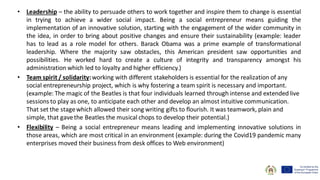
• Leadership – the ability to persuade others to work together and inspire them to change is essential
in trying to achieve a wider social impact. Being a social entrepreneur means guiding the
implementation of an innovative solution, starting with the engagement of the wider community in
the idea, in order to bring about positive changes and ensure their sustainability (example: leader
has to lead as a role model for others. Barack Obama was a prime example of transformational
leadership. Where the majority saw obstacles, this American president saw opportunities and
possibilities. He worked hard to create a culture of integrity and transparency amongst his
administration which led to loyalty and higher efficiency.)
• Team spirit / solidarity:working with different stakeholders is essential for the realization of any
social entrepreneurship project, which is why fostering a team spirit is necessary and important.
(example: The magic of the Beatles is that four individuals learned through intense and extended live
sessions to play as one, to anticipate each other and develop an almost intuitive communication.
That set the stagewhich allowed their song writing gifts to flourish. It was teamwork, plain and
simple, that gavethe Beatles the musical chops to develop their potential.)
• Flexibility – Being a social entrepreneur means leading and implementing innovative solutions in
those areas, which are most critical in an environment (example: during the Covid19 pandemic many
enterprises moved their business from desk offices to Web environment)
7.1. Social Commercial Entrepreneurship concept
7.1.1 How to understand social commercial entrepreneurship concept?
• Social entrepreneurship is regarded as one of the leading points in increasing the
employment of people with some impediments such as people with disabilities,
poor people, minorities, etc. who need to be incorporated in labour force as well;
• Like commercial entrepreneurship, social entrepreneurship refers to the
identification, evaluation and exploitation of opportunities that mostly results in
social value. Thus social entrepreneurs may be viewed as social innovators who are
more concerned in social then a profit value. Consequently the performance
measurement of social enterprise differs from commercial enterprise. But even in
social enterprises we can‘t ignore profitability orientation when thinking about long-
term sustainability of social business and it‘s development.
7.1.2 Relevant EU legislation on social entrepreneurship
• In addition to the above, we are moving closer to European practices that address the broader
context of social economy, which includes social entrepreneurship, by making certain concepts
clearly defined. This means extending the Social Entrepreneurship Council into the Social Economy
Council, and extending the Social Entrepreneurship Development Strategy into the Social Economy
Development Strategy.
• A full (100%) restriction on profit distribution, in order to further emphasize the principle of non-
profitability and the fact that the status of social enterprise is truly chosen by those non-profit legal
entities whose main activity is the achievement of social impact rather than profit distribution
(which, of course, does not mean that they are not market oriented, on the contrary – social
enterprises are essentially companies that operate according to market principles and generate
revenue in the market).
• Introducing Social Impact Measurement, which social enterprises will have to publish and report
annually to the competent authorities.
Source: https://ec.europa.eu/growth/sectors/social-economy/enterprises_en
7.1.3 Relevant national legislation on social entrepreneurship in Slovenia
• The Social Entrepreneurship Act (ZSocP) (Official Gazette of the Republic of Slovenia,
No. 20/2011), was passed in March 2011 and entered into force in January 2012. In
the period from the adoption of the act until December 2014, the field of social
entrepreneurship was the responsibility of the Ministry of Labour, Family, Social
Affairs and Equal Opportunities. From 1 January 2015, it became the responsibility
of the Ministry of EconomicDevelopment and Technology.
• Since the act has entered into force, the need arose to supplement or amend in
particular those provisions of the act, which in practice discouraged legal entities
from registering to acquire the status of a social enterprise, or made it difficult to
maintain that status. For this reason, the Act Amending the Social Entrepreneurship
Act (ZSocP-A) (Official Gazette RS, No. 20/11, 90/14 – ZDU-1I and 13/18), which was
adopted by the National Assembly of the Republic of Slovenia at its 38th session on
15 February 2018 and entered into force on 15 March 2018.
The key amendments to the Social Entrepreneurship Act of Slovenia are:
• Elimination of type A and B social enterprises, which have so far differentiated social
enterprises according to whether they acquired the status by way of implementation of
statutory activities (type A), or whether they acquired the status by way of employing a
certain share of hard-to-place unemployed persons (type B).
• Facilitating the implementation of social entrepreneurship in all areas of economic and non-
economic activities, which goes beyond the integration of vulnerable target groups and the
provision of social services of general interest, and provides more opportunities for
generating social innovation.
• Elimination of restrictions related to social enterprise status registration for legal persons
with the status of a sheltered company and/or work centre, because these too are part of
social economy.
Source: Http://www.pisrs.si/Pis.web/pregledPredpisa?id=ZAKO6175
7.1.3 Relevant legislation on social entrepreneurship in Turkey
In Turkey, usually social enterprises are established as:
• Foundations
• Associations
• Private companies
• Cooperatives
• Non-profit organisations
Source:
https://www.britishcouncil.org.tr/sites/default/files/20190702_se_research_report_the_state_of_social_enterprise_in_turkey_en
g_single_page.pdf
Women Cooperatives
• With the Circular No. 2011/3 of the Ministry of Industry and Trade (now Ministry of
Trade), the definition of Women's Environment Culture and Business Cooperative was
introduced stating that “In order to encourage and support the economic, social and
cultural development of its partners (the majority of which are women) and to ensure
that they live in a healthy environment by meeting their partners' economic, social and
cultural needs and their needs for the production and marketing of goods and services
within their economic initiatives”.
• This model is encouraging in terms of empowering women's cooperatives, but it is still
considered inadequate in terms of not covering other disadvantaged groups.
Source:
http://hukuk.gtb.gov.tr/data/5440c4d7f293704d6c39e7c5/Kad%C4%B1n%20%C3%87evre%20K%C3%BClt%C3%BCr%20ve%20%C4
%B0%C5%9Fletme%20Kooperatifi%20%C3%96rnek%20Anas%C3%B6zle%C5%9Fmesi%20ve%20Kurulu%C5%9F%20%C4%B0%C5%
9Flemlerine%20%C4%B0li%C5%9Fkin%20Genelge.pdf
7.1.3 Relevant legislation on social entrepreneurship in Bulgaria
• “Social entrepreneurship” is a form of entrepreneurship which incorporates profit activity with social
objectives, which results in production of social value added, under a specific methodology.
• LAW ON ENTERPRISES OF THE SOCIAL AND SOLIDARITYECONOMY
• https://lex.bg/bg/laws/ldoc/2137187968
• The main objective of the law is the legal regulation of the way social enterprises must exist and state
measures for their establishmentand development.
• Subject to social and solidarity economy are cooperatives, non-profit legal entities for social welfare
activities, and social entities.
• Social enterprises are class A and class A+.
• Social enterprises are to be registered in the list of social enterprises under the conditions of this Law
and the regulations of the application of the Law, adopted by the Council of Ministers.
• Entry in the register of the social enterprises is to be made by a stakeholder’s claim, and the deletion
– by the social enterprise’s claim or officially.
7.1.3 Relevant legislation on social entrepreneurship in Greece
• Legal framework for social entrepreneurship:
– Law 4019/2011 - Government Gazette 216 / A / 30-9-2011
(https://www.e-nomothesia.gr/kat-epikheireseis/n-4019-2011.html )
– Law 4430/2016 - Government Gazette 205 / A / 31-10-2016
(https://www.e-nomothesia.gr/kat-oikonomia/nomos-4430-2016.html)
• In Greece, social enterprises are established as:
– Foundations
– Associations
– Private companies (koinsep / ΚοινΣΕπ) Social Cooperatives
– Cooperatives (women and agriculture)
– Non-profit organisations
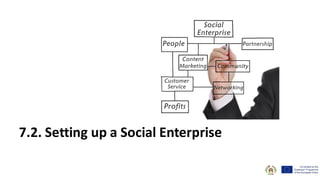
7.2. Setting up a Social Enterprise
The status of a social enterprise can be acquired by a non-profit legal entity, e.g. association, institute,
institution, cooperative, European cooperative, employment centre, disability company, corporation,
etc., which complies with the principles of social entrepreneurship and the following conditions:
• performs economic and non-economic activities,
• does not share assets or excess of income over expenditure,
• is autonomous and organizationally independent in relation to commercial companies, legal entities
of public law or local communities,
• ensures an inclusive form of management based on co-decision and democratic decision-making,
and
• meets the other conditions laid down in this Act and the law governing the legal organization of each
type of non-profit legal entity.
An individual non-profit legal entity that is already established may register as a social enterprise
subsequently, or it may do so simultaneously with the time of its establishment with the competent
registration authority. The registration authorities and the registration procedure for a social enterprise
are defined in the section on the registration procedure. Only a legal entity (of various legal forms) can
register a social enterprise, while a natural person (e.g. self-employed entrepreneur, farmer) cannot
acquire this status.
When to embark on social entrepreneurship?
• Typically, social entrepreneurs engage in areas that are not of interest to
traditional entrepreneurs because they do not generate high financial returns.
They often also approach areas that could be addressed by the state;
however, the stateis either unable, incapable or even unwilling to do so.
Social entrepreneurs often address environmental issues, fight
unemployment, educate in personalized and innovative ways, create
affordable tourism products, and promote healthy lifestyles and a local supply
of food and other goods.
• Ecological / organic farming can be placed in the field of local goods supply
and addressing unemployment issues.
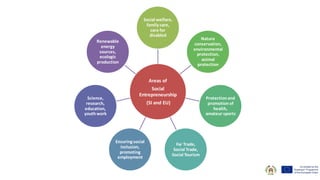
Areas of
Social
Entrepreneurship
(SI and EU)
Social welfare,
family care,
care for
disabled
Nature
conservation,
environmental
protection,
animal
protection
Protectionand
promotionof
health,
amateur sports
Far Trade,
Social Trade,
Social Tourism
Ensuring social
inclusion,
promoting
employment
Science,
research,
education,
youthwork
Renewable
energy
sources,
ecologic
production
7.2.1 Steps to establish a social enterprise in SIovenia
Establishing a non-profit legal entity / non-profit enterprise:
• Application for acquiring a social enterprise status,
• Application to register an amendment of the instrument of constitution,
• Public record registration,
• The procedure of establishing a non-profit enterprise and acquiring the status of a social
enterprise may take place at the same time.
Source:
http://www.invel.si/ostalo/gradiva-podjetnistvo/socialno-podjetnistvo_gradivo.pdf
Other sources:
https://www.the-sse.org/resources/starting/start-social-enterprise-10-steps/
7.2.1 Steps to establish a social enterprise in Turkey
• Key steps to establish non-profit enterprise in Turkey :
• Establishment of Associations
– In Turkey, associations are established accordingto the Associations Law and Associations Regulation
– Associations Law: https://www.mevzuat.gov.tr/MevzuatMetin/1.5.5253.pdf
– Associations Regulation:
https://www.mevzuat.gov.tr/mevzuat?MevzuatNo=8038&MevzuatTur=7&MevzuatTertip=5
– The basic steps for establishing association in Turkey:
• Firstof all, you should have a specific purpose to establish an association and at least 7 people should be
gathered together.
• Your association should have a name. There are some words that you cannot use directly. By obeying on the
rules, you can name your association.
• Association charter should be written accordingto the directives statedin the Association Regulation.
• Association address is at least as importantas the other stages.If the building you choose as an association
address also has other residents, you should ask all of them to allow the establishment of an association in
this building.
• List of the documents required to establish an association are as follows: Charter, Association Establishment
Notice, Rent Contractor Consent and Notification List. You need to prepare all these documents. All founding
members should sign the documents.
• Finally, the documents are submitted to the Provincial Directorateof the Office of the Associations where the
association will be established.
• For more information:
https://sivilalan.com/2018/09/19/derneknasilkurulur/?gclid=EAIaIQobChMIlIPU_rPw6QIV1LLVCh3adwQvEAAY
ASAAEgIeyPD_BwE
7.2.1 Steps to establish a social enterprise in Bulgaria
Key steps to establish new non profit enterprise in Bulgaria
(https://www.lex.bg/laws/ldoc/2134942720)
1. Submission of an application form for registering in the legal entity in the Commercial
register and the register of non-profit organizations
2. Additional documents along with the application form:
• Statute or founding Act of the organization;
• Protocol from the founders for the establishment of the organization;
• Notarized samples of the signs of founders or representatives of the organization
• A bank document for donation, in case a foundation is registered;
• Declaration of veracity of the stated circumstances;
• Power of attorney for a lawyer, if one is used for submitting the documents;
• Document for paid state fee, if not paid electronically at the time of submission.
7.2.1 Steps to establish a social enterprise in Greece
• Guide to set-up a social enterprise in Greece (in Greek): http://koinsep.org/wp-
content/uploads/2014/02/info-about-KoinSEp.pdf
• Steps to establish the enterprise:
Stage 1
– Formulate the Statute
– Submission of a request for registration in the Department of the Register of Social
Economy
– Affirmed statement, signed separately by each founding member, on whether or not is
already participating in another Coin.S.Ep.,
– (Only for the Inclusion types of company) Affirmed statement on compliance with the
employment criterion of individuals by vulnerable groups of the population by at least
40%.
Stage 1 – response
The Registry Department checks the submitted data and proceeds to:
– registration of the enterprise in the Register,
– Issuance of a Registration Certificate which is valid only for starting-up its activity by the
Tax Office
– signing of the Statute and dispatching it to the enterprise.
Stage 2
– Application for registration of additional data (exact address of its headquarters, the Tax
Office to which it belongs, VAT number and K.A.D. (Activity Code Numbers), the annual
program of activities and the composition of the Steering Committee)
– Certificate of Commencement of Activity at the Tax Office.
– Minutes of the formation of a body of the Steering Committee.
Stage 2 - response
– Approval of the request for registration (or requests additional data)
– Issuance of a Certificate of Registration (valid until the submission of the first Annual
Program of Activities and Report, when it is replaced by the Certificate of Membership
of the Register).
In the case the Register shall not require any additional data, registration process ends
here.
7.2.2 Identify your mission
Mission, vision and values ​​are the fundamental elements of every organization, including social
enterprises. These notions are interpreted very differently in literature, and here is one possible
interpretation:
• Values ​​are beliefs about what an organization and its individuals appreciate, what they regard as
positive, desirable and worth the effort (e.g., diligence, honesty, ethics, empathy…); something that
drives people's behaviour in the organization.
• Mission defines / identifies the purpose of the existence of an organization or company. The mission
is usually written in the form of a brief statement, which should cover all those basic concepts that
most succinctly describe the organization, its features, services, "products" and "marketplace", core
philosophy and goals. (e.g., our mission is to provide healthy, organically produced food at an
affordable cost to local people, thereby improving the quality of their health.)
• Vision – in simple terms, a vision is a desire regarding the future of the company, a goal towards
which the company is supposed to be striving. It expresses the desired image of the company in the
future (e.g., our vision is to become the largest provider of quality local organic food.)
Source:
https://courses.lumenlearning.com/wm-principlesofmanagement/chapter/reading-mission-vision-and-values/
https://www.ipsos.si/VodenjeVIZ_VI_kaj_je_poslanstvo_vrednote_vizija.html,
https://courses.lumenlearning.com/wm-principlesofmanagement/chapter/reading-mission-vision-and-values/
7.2.3 Bring an idea to scale
Business ideas in all areas are found everywhere. Where to find ideas for a social enterprise?
• Working environment (former and current workplaces),
• Domestic and international fairs,
• Keeping up with trends and changes in the environment (local, international),
• Articles, literature,
• Events (seminars, conferences, meetings of various associations and clubs…),
• Research,
• Hobbies and other leisure time activities, etc.
You can also find some tips for generating ideas at:
https://www.entrepreneur.com/article/74184
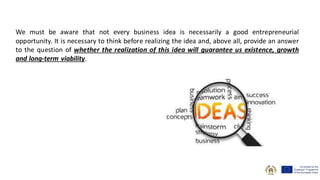
We must be aware that not every business idea is necessarily a good entrepreneurial
opportunity. It is necessary to think before realizing the idea and, above all, provide an answer
to the question of whether the realization of this idea will guarantee us existence, growth
and long-term viability.
7.2.4 Theory of change
Typically, social entrepreneurs engage in areas that are not of interest to traditional entrepreneurs
because they do not generate high financial returns. They often also approach areas that could be
addressed by the state; however, the state is either unable, incapable or even unwilling to do so. Social
entrepreneurs often address environmental issues, fight unemployment, educate in personalized and
innovative ways, create affordable tourism products, and promote healthy lifestyles and a local supply of
food and other goods.
One of the main results of organizing the agricultural production system is the construction of its
structures. Structuring refers to the creation and maintenance of an optimal ratio between the elements
in a system in order to ensure its normal functioning (see module 3 and 4 for more information about
the “business plan”)
Ecological / organic farming can be placed in the field of local goods supply and addressing
unemploymentissues.
7.2.5 Plan for sustainability
• By investing profit back to the company, so it can develop and expand;
• Sustainable development meets the needs of the present without compromising the possibility of
future generations to meet their needs;
• Social enterprises address problems of a certain social community, they originate from that
community, and grow together with the people from the very beginning. Together with their
employees and customers, they plan and build the company, and invest profits back into
development – once the customers become aware of the social enterprise's contribution to the
environment they live in, they start respecting, rewarding and supporting the company and its work.
At some point, the environment will come to realize that the more it helps the social enterprise, the
more it really helps itself.
Source:
https://www.inspire2enterprise.org/2017/04/18/the-5-building-blocks-of-social-enterprise-sustainability/
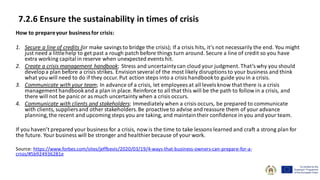
7.2.6 Ensure the sustainability in times of crisis
How to prepareyour businessfor crisis:
1. Secure a line of credits (or make savings to bridge the crisis); If a crisis hits, it’s not necessarily the end. You might
just need a littlehelp to get past a rough patch before things turn around. Secure a line of credit so you have
extra working capitalin reserve when unexpected events hit.
2. Create a crisis management handbook; Stress and uncertaintycan cloud your judgment. That’s why you should
developa plan before a crisis strikes. Envisionseveral of the most likely disruptions to your business and think
what you will need to do if they occur. Put action steps into a crisis handbookto guide you in a crisis.
3. Communicate with your team; In advance of a crisis, let employees at all levels know that there is a crisis
management handbookand a plan in place. Reinforce to all that this will be the path to follow in a crisis, and
there will not be panic or as much uncertainty when a crisis occurs.
4. Communicate with clients and stakeholders; Immediately when a crisis occurs, be prepared to communicate
with clients, suppliers and other stakeholders.Be proactiveto advise and reassure them of your advance
planning,the recent and upcoming steps you are taking, and maintaintheir confidence in you and your team.
If you haven’t prepared your business for a crisis, now is the time to take lessons learned and craft a strong plan for
the future. Your business will be stronger and healthier because of your work.
Source: https://www.forbes.com/sites/jeffbevis/2020/03/19/4-ways-that-business-owners-can-prepare-for-a-
crisis/#5b924936281e
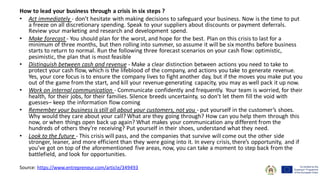
How to lead your business through a crisis in six steps ?
• Act immediately - don’t hesitate with making decisions to safeguard your business. Now is the time to put
a freeze on all discretionary spending. Speak to your suppliers about discounts or payment deferrals.
Review your marketing and research and development spend.
• Make forecast - You should plan for the worst, and hope for the best. Plan on this crisis to last for a
minimum of three months, but then rolling into summer, so assume it will be six months before business
starts to return to normal. Run the following three forecast scenarios on your cash flow: optimistic,
pesimistic, the plan that is most feasible
• Distinguish between cash and revenue - Make a clear distinction between actions you need to take to
protect your cash flow, which is the lifeblood of the company, and actions you take to generate revenue.
Yes, your core focus is to ensure the company lives to fight another day, but if the moves you make put you
out of the game from the start, and kill your revenue-generating capacity, you may as well pack it up now.
• Work on internal communication - Communicate confidently and frequently. Your team is worried, for their
health, for their jobs, for their families. Silence breeds uncertainty, so don’t let them fill the void with
guesses– keep the information flow coming
• Remember your business is still all about your customers, not you - put yourself in the customer’s shoes.
Why would they care about your call? What are they going through? How can you help them through this
now, or when things open back up again? What makes your communication any different from the
hundreds of others they’re receiving? Put yourself in their shoes, understand what they need.
• Look to the future - This crisis will pass, and the companies that survive will come out the other side
stronger, leaner, and more efficient than they were going into it. In every crisis,there’s opportunity, and if
you’ve got on top of the aforementioned five areas, now, you can take a moment to step back from the
battlefield, and look for opportunities.
Source: https://www.entrepreneur.com/article/349493
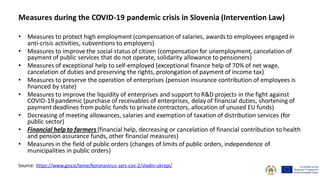
Measures during the COVID-19 pandemic crisis in Slovenia (Intervention Law)
• Measures to protect high employment (compensation of salaries, awards to employees engaged in
anti-crisis activities, subventions to employers)
• Measures to improve the social status of citizen (compensation for unemployment, cancelation of
payment of public services that do not operate, solidarity allowance to pensioners)
• Measures of exceptional help to self-employed (exceptional finance help of 70% of net wage,
cancelation of duties and preserving the rights, prolongation of payment of income tax)
• Measures to preserve the operation of enterprises (pension insurance contribution of employees is
financed by state)
• Measures to improve the liquidity of enterprises and support to R&D projects in the fight against
COVID-19 pandemic (purchase of receivables of enterprises, delay of financial duties, shortening of
payment deadlines from public funds to private contractors, allocation of unused EU funds)
• Decreasing of meeting allowances, salaries and exemption of taxationof distribution services (for
public sector)
• Financial help to farmers (financial help, decreasing or cancelation of financial contribution to health
and pension assurance funds, other financial measures)
• Measures in the field of public orders (changes of limits of public orders, independence of
municipalities in public orders)
Source: https://www.gov.si/teme/koronavirus-sars-cov-2/vladni-ukrepi/
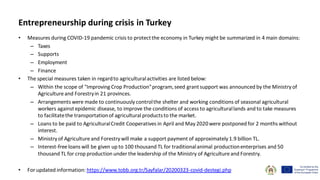
Entrepreneurship during crisis in Turkey
• Measures during COVID-19 pandemic crisis to protectthe economy in Turkey might be summarized in 4 main domains:
– Taxes
– Supports
– Employment
– Finance
• The special measures taken in regardto agriculturalactivities are listed below:
– Within the scope of "Improving Crop Production"program,seed grantsupport was announced by the Ministry of
Agriculture and Forestryin 21 provinces.
– Arrangements were made to continuously controlthe shelter and working conditions of seasonal agricultural
workers againstepidemic disease, to improve the conditions of access to agriculturallands and to take measures
to facilitatethe transportationof agricultural productsto the market.
– Loans to be paid to AgriculturalCredit Cooperatives in April and May 2020were postponed for 2 months without
interest.
– Ministry of Agriculture and Forestry will make a support payment of approximately 1.9 billion TL.
– Interest-free loans will be given up to 100 thousand TL for traditionalanimal productionenterprises and 50
thousand TL for crop production under the leadership of the Ministry of Agriculture and Forestry.
• For updated information: https://www.tobb.org.tr/Sayfalar/20200323-covid-destegi.php
• The special measures taken in regard to entrepreneurs are listed below:
– Within the scope of KOSGEB's (Small and Medium Enterprises Development
Organization of Turkey) loan support programs, the debts of the companies using loans
from banks until 30 June 2020 were postponed for 3 months without interest (7 April
2020).
– The loans of KOSGEB that will be accrued to 30 June 2020 will be postponed until 2021
(23 March 2020).
• All measures taken in regard to business are regularly updated at the website of the Union
of Chambers and Commodity Exchanges of Turkey.
• For updated information: https://www.tobb.org.tr/Sayfalar/20200323-covid-destegi.php
Entrepreneurship during crisis in Bulgaria
• Fund of funds credits up to 50 000 BGN (ap. 25000 euro), for micro enterprise, self-
employed persons, and entrepreneurs of vulnerable groups. Credits are made with grace
period up to 10 years. The budget of this tool is 24 million BGN (app 12 m euro)
(https://www.economic.bg/bg/news/12/kakvi-sa-konkretnite-ikonomicheski-merki-na-
darzhavata-sreshtu-krizata.html)
• Employers of agriculture sector may hire on a second employment contract employees who
are at unpaid leave (http://www.gli.government.bg/page.php?c=13&d=4933)
• There is no need for permission from the employer when hiring on a second employment
contract , unless there is a specific prohibition. There are, as well, no limitations for the
period employees might work upon the second employer contract, while at unpaid leave.
The employer must guarantee the intraday and weekly breaks.
Entrepreneurship during crisis in Greece
• The 3 challenges during periods of crisis:
– “Freezing" of investments as the market is characterized by stagnation
– Difficulties in transactions with foreign markets, as a result of the (poor)
economic situation and the unstable banking-economic-political
environment as foreign suppliers put pressure on the Greek market
demanding payment of a larger deposit or cash payment as they no longer
accepted checks / credit
– The paralysis of the public sector services, which has always been a
problem in times of crisis, has been exacerbated by major bureaucratic
and public payment problems
• Other issues / barriers:
– Reduction in the demand for products and services in the domestic and
international market.
– The increase of bounced cheques (with insufficient funds). This causes
numerous problems for businesses and seriously undermines business
confidence in their transactions.
– The high uncertainty exacerbates the inability of companies to service
their programs due to the lack of business access in financing due to the
financial systemalteration. Already, a large number of businesses have had
their funding cut, and bank lending has stalled since capital controls took
effect in July 2015.
7.3. Social Entrepreneurship in Eco-Farming
7.3.1 How to establish a social enterprise in organic farming
Types of social enterprises – how to choose the suitable type of company in the field of
ecological/organic farming
Before setting up a social enterprise, you need to decide on the legal form of your company, prepare the
requested specific information, and meet certain conditions. The type of activity you want to perform
determines the conditions (e.g., required education, occupational safety courses, HACCP, craft business
permit, etc.). The decision about the type of company you want to start is influenced by various factors,
such as the type of activity, the extent of individual responsibility, employment opportunities, applying
for co-financing sources, etc.
The existing register of social enterprises includes the following types:
• Association,
• Foundation (institution),
• Private institute,
• Cooperative,
• Limited liability company(LLC).
For a more detailed look at the ways of establishing a social enterprise in Slovenia and the
specific advantages of particular types, please visit:
https://www.program-podezelja.si/sl/knjiznica/32-podjetniski-prirocnik-z-delovnim-zvezkom-
za-socialne-podjetnike-od-ideje-do-socialnega-podjetja-z-druzbenim-ucinkom-avtor-stritar-
tomaz/file
7.3.2 Good Practices of Eco farming in Slovenia
1. Eko kmetija Brinjevka (https://www.brinjevka.si/): a farm is located in rural area of
Slovenian Karst. The main product of farm is eco grown vegetable, that is sold at the farm
and distributed to wider community. Farm is social enterprise, that employs individuals
with psychological and physical difficulties. They are involved in different European and
national projects and networks. The farm organizes „farm open days“ for all, who want to
spend a day in pure natural environment.
1. Korenika (https://www.korenika.si/): Korenika has already become recognizable in a wider
geographical area. The professional public recognizes it as an example of good practice in
social entrepreneurship, employing people with disabilities and other vulnerable social
groups, as well as sheltered employment. They produce and sell own brand of herbal teas,
cold-pressed oils, dried and pickled fruit and vegetables, food for the winter, juices, syrups
and much more. They regularly host schools and child-care groups for excursions. The farm
is one of the most popular touristic farms in Slovenia.
• Cooperative Zemlja-morje (https://www.zemljainmorje.si/): Is a cooperative of 5 eco
farmers and a fisherman from Slovene Istria. Farms grow eco vegetables and other farming
products. The fisherman grows different kind of molluscs. They distribute their product
under the brand „Box from Land&Sea“, that you can order online, via e-mail or phone. They
also have a small series of gifts (olive oil and vine) and are open for visitors.
• Examples of international eco-farming social enterprises:
https://socialenterprise.org.hk/en/sedb/cats/se-business-organic-farm
7.3.2 Good Practices of EcoFarming Social Enterprises in Turkey
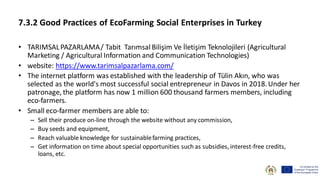
• TARIMSALPAZARLAMA/ Tabit Tarımsal Bilişim Ve İletişim Teknolojileri (Agricultural
Marketing / Agricultural Information and Communication Technologies)
• website: https://www.tarimsalpazarlama.com/
• The internet platform was established with the leadership of Tülin Akın, who was
selected as the world's most successful social entrepreneur in Davos in 2018.Under her
patronage, the platform has now 1 million 600 thousand farmers members, including
eco-farmers.
• Small eco-farmer members are able to:
– Sell their produce on-line through the website without any commission,
– Buy seeds and equipment,
– Reach valuable knowledge for sustainablefarming practices,
– Get information on time about special opportunities such as subsidies, interest-free credits,
loans, etc.
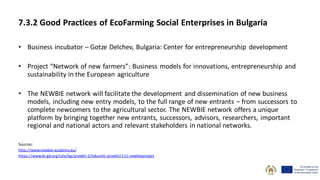
• Business incubator – Gotze Delchev, Bulgaria: Center for entrepreneurship development
• Project “Network of new farmers”: Business models for innovations, entrepreneurship and
sustainability in the European agriculture
• The NEWBIE network will facilitate the development and dissemination of new business
models, including new entry models, to the full range of new entrants – from successors to
complete newcomers to the agricultural sector. The NEWBIE network offers a unique
platform by bringing together new entrants, successors, advisors, researchers, important
regional and national actors and relevant stakeholders in national networks.
Sources:
http://www.newbie-academy.eu/
https://www.bi-gd.org/site/bg/proekti-2/tekushti-proekti/111-newbieproject
7.3.2 Good Practices of EcoFarming Social Enterprises in Bulgaria
7.3.2 Good Practices of EcoFarming Social Enterprises in Greece
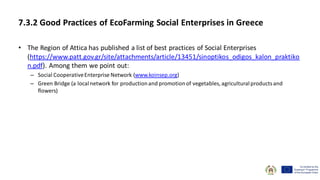
• The Region of Attica has published a list of best practices of Social Enterprises
(https://www.patt.gov.gr/site/attachments/article/13451/sinoptikos_odigos_kalon_praktiko
n.pdf). Among them we point out:
– Social CooperativeEnterprise Network (www.koinsep.org)
– Green Bridge (a localnetwork for productionand promotionof vegetables, agriculturalproductsand
flowers)
Other good practices comprise:
• Production - Sale of Local Traditional & Organic products(Mediterranean Nutrition and Hospitality: A Must
for Greek Tourism Development?—The Case of the Region of Thessaly -
https://books.google.gr/books?id=kE-
vCwAAQBAJ&pg=PA276&lpg=PA276&dq=greece+Sale+of+Local+Traditional+%26+Organic+products&sour
ce=bl&ots=BIFEoskx9b&sig=ACfU3U3LMfjHACFByKaHAtx_NYxkOEHrUQ&hl=en&sa=X&ved=2ahUKEwiC3t
OjworqAhVPsKQKHVysDC8Q6AEwAHoECAcQAQ#v=onepage&q=greece%20Sale%20of%20Local%20Traditi
onal%20%26%20Organic%20products&f=false)
• Gardening services, landscaping - outdoor cleaning and agricultural work (i.e. https://www.apokinou.gr/,
https://foreis-kalo.gr/?q=-koinsep_list)
7.3.3 The role of stakeholders
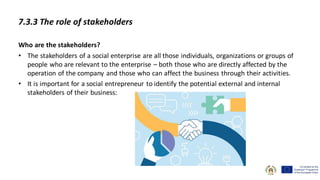
Who are the stakeholders?
• The stakeholders of a social enterprise are all those individuals, organizations or groups of
people who are relevant to the enterprise – both those who are directly affected by the
operation of the company and those who can affect the business through their activities.
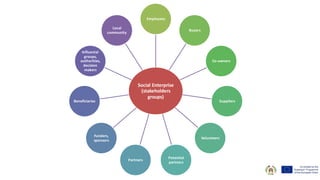
• It is important for a social entrepreneur to identify the potential external and internal
stakeholders of their business:
Social Enterprise
(stakeholders
groups)
Employees
Buyers
Co-owners
Suppliers
Volunteers
Potential
partners
Partners
Funders,
sponsors
Beneficiaries
Influental
groups,
authorities,
decision
makers
Local
community
• In the “business life cycle”, the entrepreneur interacts with different stakeholders -
individuals / groups / institutions. Some of those who are not yet stakeholders of the
company at the start-up stage may become crucial in the later stages of creating a
“successful social entrepreneurship story”.
• Why is it important for an entrepreneur to recognize the company's stakeholders?
– To understand the impact of your business on different audiences.
– To allow stakeholders (when and if necessary) to express their opinions and influence
the operation of the business.
– To increase community awareness and responsiveness to specific problems.
– To establish suitable ways of communication with individual stakeholder groups.
• Just like considering how the performance of the company will affect different stakeholder
groups, the entrepreneur should also consider how the stakeholders could affect the
performance of the business.
• With their feedback, opinions, suggestions, support, etc., they can make a significant
contribution to the success and sustainable development of a social enterprise.
• Different stakeholders have different roles in the business of the company, different levels of
involvement and, of course, different interests. The entrepreneur must be careful that the
interests of different stakeholders are not in conflict, which can affect the business of the
company.
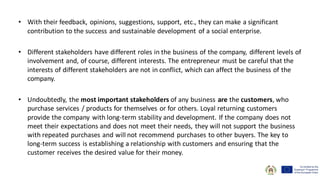
• Undoubtedly, the most important stakeholders of any business are the customers, who
purchase services / products for themselves or for others. Loyal returning customers
provide the company with long-term stability and development. If the company does not
meet their expectations and does not meet their needs, they will not support the business
with repeated purchases and will not recommend purchases to other buyers. The key to
long-term success is establishing a relationship with customers and ensuring that the
customer receives the desired value for their money.
• Another important group is beneficiaries. How do we distinguish customers from
beneficiaries? Beneficiaries are a group that directly uses and benefits from the products /
services. It is important for a social enterprise to consider this important stakeholder group
when planning and implementing their activity. This is the group for which the social
enterprise service / product is actually intended, the reason why the company exists in the
first place, and even acquires funding / donations.
• The third important group are the decision-makers / influencers. They influence the
awareness and opinion of the customers and thereby their buying habits. It is important
that we appropriately position a social enterprise within this group and build a successful
business through their support. We need to be aware that our customers and beneficiaries
can become influencers over time, and that their recommendations of the company to the
general public can influence the success of our operations. When an influencer
recommends a purchase in our company, this “lowers the risk” for a potential buyer, who
makes the decision to purchase more easily. And a positive experience leads to repeating
the purchase.
You can read more: https://www.youtube.com/watch?v=WjxvP5eitzk
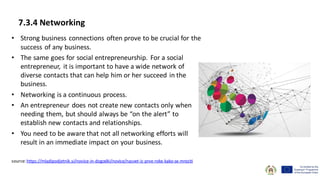
• Strong business connections often prove to be crucial for the
success of any business.
• The same goes for social entrepreneurship. For a social
entrepreneur, it is important to have a wide network of
diverse contacts that can help him or her succeed in the
business.
• Networking is a continuous process.
• An entrepreneur does not create new contacts only when
needing them, but should always be “on the alert” to
establish new contacts and relationships.
• You need to be aware that not all networking efforts will
result in an immediate impact on your business.
source: https://mladipodjetnik.si/novice-in-dogodki/novice/nasvet-iz-prve-roke-kako-se-mreziti
7.3.4 Networking
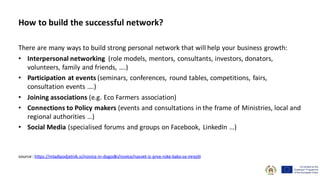
How to build the successful network?
There are many ways to build strong personal network that will help your business growth:
• Interpersonal networking (role models, mentors, consultants, investors, donators,
volunteers, family and friends, ….)
• Participation at events (seminars, conferences, round tables, competitions, fairs,
consultation events ….)
• Joining associations (e.g. Eco Farmers association)
• Connections to Policy makers (events and consultations in the frame of Ministries, local and
regional authorities …)
• Social Media (specialised forums and groups on Facebook, LinkedIn …)
source: https://mladipodjetnik.si/novice-in-dogodki/novice/nasvet-iz-prve-roke-kako-se-mreziti
7.3.4.1 Opportunities of networking in Slovenia
Support in the field of entrepreneurship and eco-farming:
• SPIRIT Slovenia (https://www.spiritslovenia.si/): Slovenian Business Development Agency - organizes
different networking and other events, offers consultancy and support to all forms of entrepreneurial
activity; they provide general information on social entrepreneurship
• UMANOTERA (https://www.umanotera.org/): Slovene Foundation for Sustainable Development –
offers education, support and networking events (e.g. eco - entrepreneurial mornings)
• Regional Development Agencies (in each Slovene region): they offer networking and other events for
different groups, educational events, possibilities of funding through projects etc.
• Chamber of Agriculture and Forestry (https://www.kgzs.si/): they offer support and education
through local units, possibilities of funding etc.
• Association of Eco-Farmers (http://www.zdruzenje-zekzz.si/): merging together more than 30 eco-
farmers in Zasavje region; offer events, education, support at marketing etc.
• The Union of Eco_Farmers Associations of Slovenia (https://www.zdeks.si/): support eco farmers
with education and networking events, help with promotion (eco farm open days, promotion
through different media, etc)
Opportunities of networking in Slovenia
Specialised social-entrepreneurship organizations:
• Slovene forum of Social Entrepreneurship (http://fsp.si/)
• Foundation for Improvement of Employment Possibilities (https://www.fundacija-
prizma.si/index.php)
• Social Incubator (https://www.socialni-inkubator.si/
7.3.4.1 Opportunities of networking in Turkey
National networking organizations for eco-farming
Buğday Association for Supporting EcologicalLiving (Buğday Ekolojik
Yaşamı DesteklemeDerneği): https://bugday.org/english/?page_id=2
Buğday, as a non-profit non-governmentalorganization,is one of the initiativesof organic
farming in Turkey by raising awareness of organic farming and products through different
communicationchannelssuch as magazines, TV and radioprograms, articles, radio,internet
portal, e-bulletins,etc.
The associationis the pioneer in the foundationsof open organic markets in big cities in Turkey
(http://ekolojikpazarlar.org/).
Ecological Agriculture Organisation Association (Ekolojik Tarım Organizasyonu
Derneği, ETO): http://www.eto.org.tr/
ETO was establishedin 1992, with the aim to ensure that ecologicalproduction fits into a
certain system and to bring together the stakeholdersin organic agriculture.
• National networking organizations for eco-farming
• Çiftçiden eve (From Farmer to Home): www.ciftcideneve.com
• Ciftcideneve.com is a successfulorganic agriculture marketplace
initiative that aims to deliver farmers' products directly to
consumers.
• Tarımsal Pazarlama (Agricultural Marketing):
https://www.tarimsalpazarlama.com/
• The Agricultural Marketing platform offers the following opportunities:
– providingfarmers practicalknowledge related to farming
– providinginformation about crop protection
– small farmers can sell their products faster and without commission
7.3.4.1 Opportunities of networking in Bulgaria
• “With care and love from the farm to your home” – Products of 48 Bulgarian farms
producing natural food, drinks and supplements -
https://www.ebag.bg/categories/fermerski-produkti/1161
• “Hrankoop” - Hrankoop is developing for five years already, in Bulgaria:
https://www.hrankoop.com/
The main activity of the group is direct contact and dialogue with producers of organic, eco and
organic (abbreviated BEO) food.
7.3.4.1 Opportunities of networking in Greece
• ENTERPRISE GREECE- Invest and Trade https://www.enterprisegreece.gov.gr/en/invest-in-
greece/sectors-for-growth/food-agriculture
• DIONET (is a public benefit organizationand has the legal form of the Civil Non-Profit Companyin the
field of Organic Products) http://www.dionet.gr
• BIOCLUSTER: Organic Products Cluster (O.P.C.)is a non profit, nationwide organizationthat has been
set up by the Federation of Industries of Northern Greece (F.I.N.G.) on March of 2006. and supports
all actors involved to the supply and marketing chain of the organic sector. https://www.biocluster.gr
Social EntrepreneurshipNetworks:
• Panhellenic Official Center for the Support of the Social and Solidarity Economy https://koinsep.org
• Social Entrepreneurship Forum https://seforum.gr
• Impact Hub Athens https://athens.impacthub.net
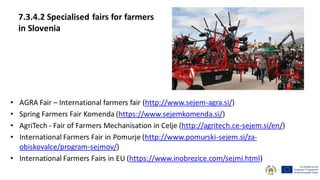
7.3.4.2 Specialised fairs for farmers
in Slovenia
• AGRA Fair – International farmers fair (http://www.sejem-agra.si/)
• Spring Farmers Fair Komenda (https://www.sejemkomenda.si/)
• AgriTech - Fair of Farmers Mechanisation in Celje (http://agritech.ce-sejem.si/en/)
• International Farmers Fair in Pomurje (http://www.pomurski-sejem.si/za-
obiskovalce/program-sejmov/)
• International Farmers Fairs in EU (https://www.inobrezice.com/sejmi.html)
7.3.4.2 Specialised fairs for farmers in Turkey
National and International Fairs:
Expo Natura, Natural, Organic and Healthy Product Exhibition (Doğal, Organik ve Sağlıklı
Ürünler Fuarı)
Website: https://exponatura.net/
Annuallyorganisedin Istanbul,Turkey
Ecology Izmir Fair (Ekoloji Izmir Fuarı)
Website: https://ekolojiizmir.izfas.com.tr/index.php/tr/
Annuallyorganisedin Izmir, Turkey
Agroexpo International Agriculture & Livestock Exhibition
Website: https://en.agroexpo.com.tr/
Annuallyorganisedin Izmir, Turkey
Agrotec, International Agriculture Fair
Website: http://www.infofair.com.tr/en/home
Organised in Ankara,Turkey
Local Fairs
Municipalitiesorganise local«Seed Exchange Fairs» where localsmall eco-farmers can exchange local seeds
and promote their organic and ecologicalproduce.
7.3.4.2 Specialised fairs for farmers in Bulgaria
• Inter Expo Center organises range of annual exposition in Sofia, Bulgaria:
– “Mesomania” - https://food-exhibitions.bg/index.php/bg/mesomania
– “World of milk” - https://food-exhibitions.bg/index.php/bg/mliako
– “Bulpek” - https://food-exhibitions.bg/index.php/bg/bulpek
– “Wine salon” - https://food-exhibitions.bg/index.php/bg/vino
– “Interfood and drinks” – https://food-exhibitions.bg/index.php/bg/inter-food
– „Vinaria” - https://www.fair.bg/bg/event/2020/vinariia-2020
7.3.4.2 Specialised fairs for farmers in Greece
• AGROTICA: One of the largest exhibition brands in the agriculture sector in the Balkan and
the European markets, is still a clear leader after 28 years, hosted at the Thessaloniki
International Exhibition with more than 140,000 visitors https://agrotica.helexpo.gr
• Pan-Cretan Exhibition of Agriculture, Livestock & Traditional Products:
https://www.georgiki-ekthesi-mesaras.gr
• PELOPONNISOSEXPO: https://www.peloponnisosexpo.gr
• FILIATRA AGROVISION: https://www.facebook.com/FiliatraAgroVision/
• AGROEXPO Ierapetra: http://agroexpoierapetra.gr,
https://www.facebook.com/agroexpoierapetra/
• PELLA AGRO:
https://www.facebook.com/Hellenic.Ministry.of.Rural.Development.and.Food/posts/75753
5888041003/
• BIOFESTIVAL: https://biofestival.gr/
• HERBAL CONGRESS: https://www.helexpo.gr/herbalexpo
• BIOLOGICA: https://foodexpo.gr/en/new-organic-products-section
• Detrop Boutique: https://detropboutique.helexpo.gr
• National Tourism Fair – Gastronomy and Wine World: https://ttgw.gr
Disclaimer
For further information, relatedto the ECO AGRI project, please visit the project’swebsite at www.ecofarm-
manager.eu or visit us at https://www.facebook.com/Ecofar2018/.
Downloadour mobile app at https://play.google.com/store/apps/details?id=com.ecofar.mobile.
The EuropeanCommission's support for the production of this publicationdoes not constitutean endorsement of
the contents, which reflect the views only of the authors, and the Commission cannot be held responsible for any
use which may be made of the information containedtherein.

Ecofar wp5 module 7 English

  • 1.
    Development of managerialandentrepreneurial skills of young eco-farmersviajoint VET curricula, enhanced qualificationprofile, assessmentstandardandsustainable cooperationsynergies (ecoFAR) 597256-EPP-1-2018-1-BG-EPPKA3-VET-JQ WP5: Joint qualification curricula for acquisition of managerial and entrepreneurial skills by farmers at eco-farm SME Module 7: SOCIAL COMMERCIAL ENTREPRENEURSHIP Authors: CPI, UM, Slovenia
  • 2.
    Aims and overarchingobjectives of the module • To define and provide knowledge about social commercial entrepreneurship concept • To provide informationabout the implementation of social commercial entrepreneurship in organic-farming
  • 3.
    Table of content 7.0Social Entrepreneurship 7.0.1 Whatis Social Entrepreneurship? 7.0.2 Legaldefinition of Social Entrepreneurship 7.0.3 SocialEntrepreneurship vs SocialResponsibility 7.0.4 Key principles and requirements in social entrepreneurship 7.0.5 Who is social entrepreneur and whatare the key characteristics for success? 7.1 Social commercial entrepreneurship concept 7.1.1 How to understand socialcommercialentrepreneurship concept? 7.1.2 RelevantEU legislation on social entrepreneurship 7.1.3Relevantnationallegislation on social entrepreneurship 7.2 Setting upa social enterprise 7.2.1 Steps to establish a social enterprise 7.2.2 Identify your mission 7.2.3 Bring an idea to scale 7.2.4Theory of change 7.2.5 Plan for sustainability 7.2.6 Ensurethe sustainability in time of crisis 7.3 Social entrepreneurship ineco-farming 7.3.1 How to establish a socialenterprise in organic farming 7.3.2 Good practices of eco-farming 7.3.3 Therole of stakeholders 7.3.4 Networking 7.3.4.1 Opportunities of networking 7.3.4.2 Specialised fairs for farmers
  • 4.
  • 5.
    7.0.1 What isSocial Entrepreneurship? • Is a form of entrepreneurship with a pronounced sense of responsibility for the society and people; • Is characterized by motive for business - is directed towards resolving social, economic, environmental, and other issues in the society in an innovative way; • Is an alternative form of entrepreneurship that takes into account the non-profit principle; • Is a spectrum of economic activities that are neither part of the public nor the private sector; • Social entrepreneurship encourages collaboration, joint ventures, volunteering; it promotes social solidarity; • By creating additional jobs where the private sector has no interest due to low profits, and by employing vulnerable groups in the labor market (the long-term unemployed, the disabled, the elderly unemployed, etc.), it ensures increased social well-being and gross national happiness.
  • 6.
    7.0.2 Legal definitionof Social Entrepreneurship in Slovenia (Social Entrepreneurship Act, ZSocP-A) • Refers to "the permanent pursuit of an entrepreneurial activity through the production and sale of products or the provision of services in a market where profit generation is not the main goal of entrepreneurial activity, but rather the achievement of social impact.„; • Can be practiced in all areas of economic and non-economic activities; • Usually, social enterprises are a kind of "hybrid" between the public and the private, and usually engage in activities that the public and private sectors cannot or do not want to undertake to a sufficient extent for various reasons, such as lack of public funds or lack of profitability; • The implementation of social entrepreneurship is not limited only to the integration of vulnerable groups in the labour market and the provision of social services of general interest – the crucial point is that it provides a (broader) social impact;
  • 7.
    • Is anon-profit legal entity that acquires the status of a social enterprise (in a form of association, institute, institution, company, cooperative, European cooperative or other legal person governed by private law) – profit is invested into new social entrepreneurship ventures The statusof social enterprise can be acquired by any non-profit legal entity, which undertakes to act according to the eleven principles of social entrepreneurship: autonomous initiative, non-profitability, market orientation, involvement of volunteer work, equality of members, participation of stakeholders in management, transparent business and socially useful functioning. Sources: https://www.managementstudyguide.com/social-entrepreneurship.htm https://www.toppr.com/guides/business-management-and-entrepreneurship/social-entrepreneurship/meaning-and-concept- social-entrepreneurship/ Video: https://www.youtube.com/watch?v=9_g5RqwW51I&list=PL6HxSyThhJKcEyEqOTRRVuj1QoqaYY7xI
  • 8.
    • Although thereare active Turkish social enterprises, the term «Social Entrepreneurship» is relatively new for Turkey. • Unfortunately, at present there is no legal legislation for social entrepreneurship in Turkey. • On the other hand, current research shows that there are about 9 000 social enterprises in Turkey. • Taking into consideration the increasing necessity for social entrepreneurship legislation, the Ministry of Economic (now Ministry of Trade) included in the Strategic Plan for 2018- 2022 the setting up and empowering the visibility of social entrepreneurship. Source: https://www.britishcouncil.org.tr/sites/default/files/20190702_se_research_report_the_state_of_social_enterprise_in_turkey_tr_ double_page.pdf 7.0.2 Legal definition of Social Entrepreneurship in Turkey
  • 9.
    7.0.2 Legal definitionof Social Entrepreneurship in Bulgaria “Social entrepreneurship” is a form of entrepreneurship which incorporates profit activity with social objectives, which results in production of social value added, under a specific methodology. By the Law On Enterprises Of The Social And Solidarity Economy: • The main objective of the law is the legal regulation of the way social enterprises must exist and state measures for their establishment and development. • Subject to social and solidarity economy are cooperatives, non-profit legal entities for social welfare activities, and social entities. • Social enterprises are class A and class A+. • Social enterprises are to be registered in the list of social enterprises under the conditions of this Law and the regulations of the application of the Law, adopted by the Council of Ministers. • Entry in the register of the social enterprises is to be made by a stakeholder’s claim, and the deletion – by the social enterprise’s claim or officially. Source: https://lex.bg/bg/laws/ldoc/2137187968
  • 10.
    7.0.2 Legal definitionof Social Entrepreneurship in Greece • Social Entrepreneurship is a distinct form of entrepreneurship that aims to achieve a social purpose through the creation of social value and aims to solve pressing social problems such as environmental protection, education. , the provision of health services, poverty, energy, water resources, etc. The treatment of the problem undertaken is at the center of the company's social activities and its solution often comes through the implementation of innovative approaches. • Social entrepreneurship can take both speculative and non-profit form without changing its ultimate goal, namely achieving a social goal. Social enterprises start with people with a vision and perseverance to achieve the goal of social change and achieving lasting solutions and who apply basic principles of entrepreneurship in the functioning of their organizations.
  • 11.
    7.0.2 Legal definitionof Social Entrepreneurship in Greece • A crucial element that separates the "social" from the "traditional" entrepreneurship is the fact that the former aim to solve specific social problems and not to achieve an economic result, which they use as a means to the success of their purpose. • Legal framework for social entrepreneurship: – Law 4019/2011 - Government Gazette 216 / A / 30-9-2011 (https://www.e- nomothesia.gr/kat-epikheireseis/n-4019-2011.html ) – Law 4430/2016 - Government Gazette 205 / A / 31-10-2016 (https://www.e- nomothesia.gr/kat-oikonomia/nomos-4430-2016.html)
  • 12.
    7.0.3 Social Entrepreneurshipvs Social Responsibility However, Corporate Social Responsibility companies are not necessarily social enterprises. The main purpose of a social enterprise is to create social change, while socially responsible companies only react to social change with a part of their entrepreneurial activity within the so-called "quality-of-life management", by taking into account broader social interests, while generating profit remains the primary purpose of the business. Source: https://socialbusinessearth.org/our-social-business-projects/
  • 13.
    A comparison betweensocial entrepreneurship and traditional (market, commercial) entrepreneurship Social enterprise Traditional/commercialenterprise Motive Mission/vision Profit Idea Identifies market in the field of social issues Identifies market/niche market Purpose Growth of social capital and social change Company growth and profit generation Profit Profit goes to social change growth Generation of profit for the entrepreneur/owner Find out more about the comparison in this short film: http://www.socialenterprisebsr.net/2019/01/what-is-the-difference-social-entrepreneurship-vs-traditional- entrepreneurship/) source: http://www.socialenterprisebsr.net/2019/01/what-is-the-difference-social-entrepreneurship-vs- traditional-entrepreneurship/
  • 14.
    7.0.4 Key principlesand requirements in social entrepreneurship • Social enterprises may be established by non-profit legal entities that were established and are operating according to the principles and requirements that demonstrate their publicly beneficial and social character; • They are established on the basis of a voluntary decision of the founders (autonomous initiative); • The purpose of establishing is not profit exclusively (non profit-making purpose); • They are established predominantly for the purpose of pursuing social entrepreneurship or other activities on a permanent basis with a view to employing the most vulnerable groups of people in the labour market, thereby achieving public interest (exercise of activities in the public interest); • Their members act voluntarily (voluntary action); • They are autonomous in management (independence); • By producing and selling products or providing services on the market, they mainly operate in accordance with market laws (market orientation);
  • 15.
    • As arule, they involve volunteer work (involvement of volunteer work); • Individual founders or owners do not have a dominant influence in decision-making; decisions are made by all members following the principle of one member - one vote, regardless of the share of invested capital (equality of membership); • They involve stakeholders in decision-making (stakeholder involvement in management); • Wealth, profit and excess of income over expenditure are used for social entrepreneurship purposes and other non-profit purposes, while the sharing of profit or excess of income is not permissible or is restricted under the Social Entrepreneurship Act (non-profit activity); • Ensure transparency of financial operations and internal control over material and financial operations (transparency of operations); • Act permanently for the benefit of their members, users and the wider community (activity in the public interest).
  • 16.
    In order tofulfil the conditions, a social enterprise must incorporate three dimensions: source: https://www.researchgate.net/figure/Dimensions-of-social-enterprises-Wilkinson-et-al-2014_fig1_304625254 Social Dimension primarily explicit social purpose (NGOs) Entrepreneurship Dimension Continuous economic activity (business sector) Governance DimensionLimits for profit/goods distribution Social enterprise
  • 17.
    7.0.5 Who issocial entrepreneur and what are the key characteristics for success? • A reformer and revolutionary person of contemporary society; • Clear social entrepreneurship mission and vision – to change the world for the better; • Strive to create drastic changes and long term improvement by providing innovative and long term solutions to social problems; • They try to involve people who need help as much as possible in the realization of their ideas, thus helping them to improve their lives on their own; • They are willing to take the risk of pursuing an idea, whereby a positive change in the environment and personal satisfaction in helping to create a better world is more important than profit. • They make use of all kinds of resources at their disposal (donations or volunteer work, joint ventures with other businesses etc.) to ensure a continuous and effective functioning of their organizations; • They provide social improvements for users and communities while also trying to provide attractive social or financial returns for investors.
  • 18.
    Among the keypersonality traits of a successful social entrepreneur are the following: • Innovation / creativity – the ability of the "extraordinary" to find different solutions and to achieve changes that others do not believe to be possible - thinking and innovating "outside the box“ (example: The electronics company LG introduced a new type of screen that is flexible enough to roll up like a newspaper. This is one of the clearest invention and innovation examples as it solves the problem of portability) • Self-confidence – confident people follow their intuition and realize things that seem impossible to others, who often do not even try. A social entrepreneur has to remain confident even in situations where other partners do not see the possibility of realizing ideas / projects ; (example: Did you know that Michael Jordan was told he didn’t have the skillset for high school basketball? Michael Jordan didn’t allow this minor setback to define his life. Instead, he kept persevering and perfecting his craft. He knew he had something special and he wasn’tgoing to let that hinder him from being great.) • Persistence – is probably one of the greatest qualities of a successful social entrepreneur. "Never give up" is a key principle of any business, but most of all it holds true for social entrepreneurs, who are trying to change the world (example: It took Thomas Edison 1000 attempts before inventing the light bulb. His teachers also told him growing up that he was too stupid to learn anything.)
  • 19.
    • Leadership –the ability to persuade others to work together and inspire them to change is essential in trying to achieve a wider social impact. Being a social entrepreneur means guiding the implementation of an innovative solution, starting with the engagement of the wider community in the idea, in order to bring about positive changes and ensure their sustainability (example: leader has to lead as a role model for others. Barack Obama was a prime example of transformational leadership. Where the majority saw obstacles, this American president saw opportunities and possibilities. He worked hard to create a culture of integrity and transparency amongst his administration which led to loyalty and higher efficiency.) • Team spirit / solidarity:working with different stakeholders is essential for the realization of any social entrepreneurship project, which is why fostering a team spirit is necessary and important. (example: The magic of the Beatles is that four individuals learned through intense and extended live sessions to play as one, to anticipate each other and develop an almost intuitive communication. That set the stagewhich allowed their song writing gifts to flourish. It was teamwork, plain and simple, that gavethe Beatles the musical chops to develop their potential.) • Flexibility – Being a social entrepreneur means leading and implementing innovative solutions in those areas, which are most critical in an environment (example: during the Covid19 pandemic many enterprises moved their business from desk offices to Web environment)
  • 21.
    7.1. Social CommercialEntrepreneurship concept
  • 22.
    7.1.1 How tounderstand social commercial entrepreneurship concept? • Social entrepreneurship is regarded as one of the leading points in increasing the employment of people with some impediments such as people with disabilities, poor people, minorities, etc. who need to be incorporated in labour force as well; • Like commercial entrepreneurship, social entrepreneurship refers to the identification, evaluation and exploitation of opportunities that mostly results in social value. Thus social entrepreneurs may be viewed as social innovators who are more concerned in social then a profit value. Consequently the performance measurement of social enterprise differs from commercial enterprise. But even in social enterprises we can‘t ignore profitability orientation when thinking about long- term sustainability of social business and it‘s development.
  • 23.
    7.1.2 Relevant EUlegislation on social entrepreneurship • In addition to the above, we are moving closer to European practices that address the broader context of social economy, which includes social entrepreneurship, by making certain concepts clearly defined. This means extending the Social Entrepreneurship Council into the Social Economy Council, and extending the Social Entrepreneurship Development Strategy into the Social Economy Development Strategy. • A full (100%) restriction on profit distribution, in order to further emphasize the principle of non- profitability and the fact that the status of social enterprise is truly chosen by those non-profit legal entities whose main activity is the achievement of social impact rather than profit distribution (which, of course, does not mean that they are not market oriented, on the contrary – social enterprises are essentially companies that operate according to market principles and generate revenue in the market). • Introducing Social Impact Measurement, which social enterprises will have to publish and report annually to the competent authorities. Source: https://ec.europa.eu/growth/sectors/social-economy/enterprises_en
  • 24.
    7.1.3 Relevant nationallegislation on social entrepreneurship in Slovenia • The Social Entrepreneurship Act (ZSocP) (Official Gazette of the Republic of Slovenia, No. 20/2011), was passed in March 2011 and entered into force in January 2012. In the period from the adoption of the act until December 2014, the field of social entrepreneurship was the responsibility of the Ministry of Labour, Family, Social Affairs and Equal Opportunities. From 1 January 2015, it became the responsibility of the Ministry of EconomicDevelopment and Technology. • Since the act has entered into force, the need arose to supplement or amend in particular those provisions of the act, which in practice discouraged legal entities from registering to acquire the status of a social enterprise, or made it difficult to maintain that status. For this reason, the Act Amending the Social Entrepreneurship Act (ZSocP-A) (Official Gazette RS, No. 20/11, 90/14 – ZDU-1I and 13/18), which was adopted by the National Assembly of the Republic of Slovenia at its 38th session on 15 February 2018 and entered into force on 15 March 2018.
  • 25.
    The key amendmentsto the Social Entrepreneurship Act of Slovenia are: • Elimination of type A and B social enterprises, which have so far differentiated social enterprises according to whether they acquired the status by way of implementation of statutory activities (type A), or whether they acquired the status by way of employing a certain share of hard-to-place unemployed persons (type B). • Facilitating the implementation of social entrepreneurship in all areas of economic and non- economic activities, which goes beyond the integration of vulnerable target groups and the provision of social services of general interest, and provides more opportunities for generating social innovation. • Elimination of restrictions related to social enterprise status registration for legal persons with the status of a sheltered company and/or work centre, because these too are part of social economy. Source: Http://www.pisrs.si/Pis.web/pregledPredpisa?id=ZAKO6175
  • 26.
    7.1.3 Relevant legislationon social entrepreneurship in Turkey In Turkey, usually social enterprises are established as: • Foundations • Associations • Private companies • Cooperatives • Non-profit organisations Source: https://www.britishcouncil.org.tr/sites/default/files/20190702_se_research_report_the_state_of_social_enterprise_in_turkey_en g_single_page.pdf
  • 27.
    Women Cooperatives • Withthe Circular No. 2011/3 of the Ministry of Industry and Trade (now Ministry of Trade), the definition of Women's Environment Culture and Business Cooperative was introduced stating that “In order to encourage and support the economic, social and cultural development of its partners (the majority of which are women) and to ensure that they live in a healthy environment by meeting their partners' economic, social and cultural needs and their needs for the production and marketing of goods and services within their economic initiatives”. • This model is encouraging in terms of empowering women's cooperatives, but it is still considered inadequate in terms of not covering other disadvantaged groups. Source: http://hukuk.gtb.gov.tr/data/5440c4d7f293704d6c39e7c5/Kad%C4%B1n%20%C3%87evre%20K%C3%BClt%C3%BCr%20ve%20%C4 %B0%C5%9Fletme%20Kooperatifi%20%C3%96rnek%20Anas%C3%B6zle%C5%9Fmesi%20ve%20Kurulu%C5%9F%20%C4%B0%C5% 9Flemlerine%20%C4%B0li%C5%9Fkin%20Genelge.pdf
  • 28.
    7.1.3 Relevant legislationon social entrepreneurship in Bulgaria • “Social entrepreneurship” is a form of entrepreneurship which incorporates profit activity with social objectives, which results in production of social value added, under a specific methodology. • LAW ON ENTERPRISES OF THE SOCIAL AND SOLIDARITYECONOMY • https://lex.bg/bg/laws/ldoc/2137187968 • The main objective of the law is the legal regulation of the way social enterprises must exist and state measures for their establishmentand development. • Subject to social and solidarity economy are cooperatives, non-profit legal entities for social welfare activities, and social entities. • Social enterprises are class A and class A+. • Social enterprises are to be registered in the list of social enterprises under the conditions of this Law and the regulations of the application of the Law, adopted by the Council of Ministers. • Entry in the register of the social enterprises is to be made by a stakeholder’s claim, and the deletion – by the social enterprise’s claim or officially.
  • 29.
    7.1.3 Relevant legislationon social entrepreneurship in Greece • Legal framework for social entrepreneurship: – Law 4019/2011 - Government Gazette 216 / A / 30-9-2011 (https://www.e-nomothesia.gr/kat-epikheireseis/n-4019-2011.html ) – Law 4430/2016 - Government Gazette 205 / A / 31-10-2016 (https://www.e-nomothesia.gr/kat-oikonomia/nomos-4430-2016.html) • In Greece, social enterprises are established as: – Foundations – Associations – Private companies (koinsep / ΚοινΣΕπ) Social Cooperatives – Cooperatives (women and agriculture) – Non-profit organisations
  • 30.
    7.2. Setting upa Social Enterprise
  • 31.
    The status ofa social enterprise can be acquired by a non-profit legal entity, e.g. association, institute, institution, cooperative, European cooperative, employment centre, disability company, corporation, etc., which complies with the principles of social entrepreneurship and the following conditions: • performs economic and non-economic activities, • does not share assets or excess of income over expenditure, • is autonomous and organizationally independent in relation to commercial companies, legal entities of public law or local communities, • ensures an inclusive form of management based on co-decision and democratic decision-making, and • meets the other conditions laid down in this Act and the law governing the legal organization of each type of non-profit legal entity. An individual non-profit legal entity that is already established may register as a social enterprise subsequently, or it may do so simultaneously with the time of its establishment with the competent registration authority. The registration authorities and the registration procedure for a social enterprise are defined in the section on the registration procedure. Only a legal entity (of various legal forms) can register a social enterprise, while a natural person (e.g. self-employed entrepreneur, farmer) cannot acquire this status.
  • 32.
    When to embarkon social entrepreneurship? • Typically, social entrepreneurs engage in areas that are not of interest to traditional entrepreneurs because they do not generate high financial returns. They often also approach areas that could be addressed by the state; however, the stateis either unable, incapable or even unwilling to do so. Social entrepreneurs often address environmental issues, fight unemployment, educate in personalized and innovative ways, create affordable tourism products, and promote healthy lifestyles and a local supply of food and other goods. • Ecological / organic farming can be placed in the field of local goods supply and addressing unemployment issues.
  • 33.
    Areas of Social Entrepreneurship (SI andEU) Social welfare, family care, care for disabled Nature conservation, environmental protection, animal protection Protectionand promotionof health, amateur sports Far Trade, Social Trade, Social Tourism Ensuring social inclusion, promoting employment Science, research, education, youthwork Renewable energy sources, ecologic production
  • 34.
    7.2.1 Steps toestablish a social enterprise in SIovenia Establishing a non-profit legal entity / non-profit enterprise: • Application for acquiring a social enterprise status, • Application to register an amendment of the instrument of constitution, • Public record registration, • The procedure of establishing a non-profit enterprise and acquiring the status of a social enterprise may take place at the same time. Source: http://www.invel.si/ostalo/gradiva-podjetnistvo/socialno-podjetnistvo_gradivo.pdf Other sources: https://www.the-sse.org/resources/starting/start-social-enterprise-10-steps/
  • 35.
    7.2.1 Steps toestablish a social enterprise in Turkey • Key steps to establish non-profit enterprise in Turkey : • Establishment of Associations – In Turkey, associations are established accordingto the Associations Law and Associations Regulation – Associations Law: https://www.mevzuat.gov.tr/MevzuatMetin/1.5.5253.pdf – Associations Regulation: https://www.mevzuat.gov.tr/mevzuat?MevzuatNo=8038&MevzuatTur=7&MevzuatTertip=5 – The basic steps for establishing association in Turkey: • Firstof all, you should have a specific purpose to establish an association and at least 7 people should be gathered together. • Your association should have a name. There are some words that you cannot use directly. By obeying on the rules, you can name your association. • Association charter should be written accordingto the directives statedin the Association Regulation. • Association address is at least as importantas the other stages.If the building you choose as an association address also has other residents, you should ask all of them to allow the establishment of an association in this building. • List of the documents required to establish an association are as follows: Charter, Association Establishment Notice, Rent Contractor Consent and Notification List. You need to prepare all these documents. All founding members should sign the documents. • Finally, the documents are submitted to the Provincial Directorateof the Office of the Associations where the association will be established. • For more information: https://sivilalan.com/2018/09/19/derneknasilkurulur/?gclid=EAIaIQobChMIlIPU_rPw6QIV1LLVCh3adwQvEAAY ASAAEgIeyPD_BwE
  • 36.
    7.2.1 Steps toestablish a social enterprise in Bulgaria Key steps to establish new non profit enterprise in Bulgaria (https://www.lex.bg/laws/ldoc/2134942720) 1. Submission of an application form for registering in the legal entity in the Commercial register and the register of non-profit organizations 2. Additional documents along with the application form: • Statute or founding Act of the organization; • Protocol from the founders for the establishment of the organization; • Notarized samples of the signs of founders or representatives of the organization • A bank document for donation, in case a foundation is registered; • Declaration of veracity of the stated circumstances; • Power of attorney for a lawyer, if one is used for submitting the documents; • Document for paid state fee, if not paid electronically at the time of submission.
  • 37.
    7.2.1 Steps toestablish a social enterprise in Greece • Guide to set-up a social enterprise in Greece (in Greek): http://koinsep.org/wp- content/uploads/2014/02/info-about-KoinSEp.pdf • Steps to establish the enterprise: Stage 1 – Formulate the Statute – Submission of a request for registration in the Department of the Register of Social Economy – Affirmed statement, signed separately by each founding member, on whether or not is already participating in another Coin.S.Ep., – (Only for the Inclusion types of company) Affirmed statement on compliance with the employment criterion of individuals by vulnerable groups of the population by at least 40%.
  • 38.
    Stage 1 –response The Registry Department checks the submitted data and proceeds to: – registration of the enterprise in the Register, – Issuance of a Registration Certificate which is valid only for starting-up its activity by the Tax Office – signing of the Statute and dispatching it to the enterprise. Stage 2 – Application for registration of additional data (exact address of its headquarters, the Tax Office to which it belongs, VAT number and K.A.D. (Activity Code Numbers), the annual program of activities and the composition of the Steering Committee) – Certificate of Commencement of Activity at the Tax Office. – Minutes of the formation of a body of the Steering Committee.
  • 39.
    Stage 2 -response – Approval of the request for registration (or requests additional data) – Issuance of a Certificate of Registration (valid until the submission of the first Annual Program of Activities and Report, when it is replaced by the Certificate of Membership of the Register). In the case the Register shall not require any additional data, registration process ends here.
  • 40.
    7.2.2 Identify yourmission Mission, vision and values ​​are the fundamental elements of every organization, including social enterprises. These notions are interpreted very differently in literature, and here is one possible interpretation: • Values ​​are beliefs about what an organization and its individuals appreciate, what they regard as positive, desirable and worth the effort (e.g., diligence, honesty, ethics, empathy…); something that drives people's behaviour in the organization. • Mission defines / identifies the purpose of the existence of an organization or company. The mission is usually written in the form of a brief statement, which should cover all those basic concepts that most succinctly describe the organization, its features, services, "products" and "marketplace", core philosophy and goals. (e.g., our mission is to provide healthy, organically produced food at an affordable cost to local people, thereby improving the quality of their health.) • Vision – in simple terms, a vision is a desire regarding the future of the company, a goal towards which the company is supposed to be striving. It expresses the desired image of the company in the future (e.g., our vision is to become the largest provider of quality local organic food.) Source: https://courses.lumenlearning.com/wm-principlesofmanagement/chapter/reading-mission-vision-and-values/ https://www.ipsos.si/VodenjeVIZ_VI_kaj_je_poslanstvo_vrednote_vizija.html, https://courses.lumenlearning.com/wm-principlesofmanagement/chapter/reading-mission-vision-and-values/
  • 41.
    7.2.3 Bring anidea to scale Business ideas in all areas are found everywhere. Where to find ideas for a social enterprise? • Working environment (former and current workplaces), • Domestic and international fairs, • Keeping up with trends and changes in the environment (local, international), • Articles, literature, • Events (seminars, conferences, meetings of various associations and clubs…), • Research, • Hobbies and other leisure time activities, etc. You can also find some tips for generating ideas at: https://www.entrepreneur.com/article/74184
  • 42.
    We must beaware that not every business idea is necessarily a good entrepreneurial opportunity. It is necessary to think before realizing the idea and, above all, provide an answer to the question of whether the realization of this idea will guarantee us existence, growth and long-term viability.
  • 43.
    7.2.4 Theory ofchange Typically, social entrepreneurs engage in areas that are not of interest to traditional entrepreneurs because they do not generate high financial returns. They often also approach areas that could be addressed by the state; however, the state is either unable, incapable or even unwilling to do so. Social entrepreneurs often address environmental issues, fight unemployment, educate in personalized and innovative ways, create affordable tourism products, and promote healthy lifestyles and a local supply of food and other goods. One of the main results of organizing the agricultural production system is the construction of its structures. Structuring refers to the creation and maintenance of an optimal ratio between the elements in a system in order to ensure its normal functioning (see module 3 and 4 for more information about the “business plan”) Ecological / organic farming can be placed in the field of local goods supply and addressing unemploymentissues.
  • 44.
    7.2.5 Plan forsustainability • By investing profit back to the company, so it can develop and expand; • Sustainable development meets the needs of the present without compromising the possibility of future generations to meet their needs; • Social enterprises address problems of a certain social community, they originate from that community, and grow together with the people from the very beginning. Together with their employees and customers, they plan and build the company, and invest profits back into development – once the customers become aware of the social enterprise's contribution to the environment they live in, they start respecting, rewarding and supporting the company and its work. At some point, the environment will come to realize that the more it helps the social enterprise, the more it really helps itself. Source: https://www.inspire2enterprise.org/2017/04/18/the-5-building-blocks-of-social-enterprise-sustainability/
  • 45.
    7.2.6 Ensure thesustainability in times of crisis How to prepareyour businessfor crisis: 1. Secure a line of credits (or make savings to bridge the crisis); If a crisis hits, it’s not necessarily the end. You might just need a littlehelp to get past a rough patch before things turn around. Secure a line of credit so you have extra working capitalin reserve when unexpected events hit. 2. Create a crisis management handbook; Stress and uncertaintycan cloud your judgment. That’s why you should developa plan before a crisis strikes. Envisionseveral of the most likely disruptions to your business and think what you will need to do if they occur. Put action steps into a crisis handbookto guide you in a crisis. 3. Communicate with your team; In advance of a crisis, let employees at all levels know that there is a crisis management handbookand a plan in place. Reinforce to all that this will be the path to follow in a crisis, and there will not be panic or as much uncertainty when a crisis occurs. 4. Communicate with clients and stakeholders; Immediately when a crisis occurs, be prepared to communicate with clients, suppliers and other stakeholders.Be proactiveto advise and reassure them of your advance planning,the recent and upcoming steps you are taking, and maintaintheir confidence in you and your team. If you haven’t prepared your business for a crisis, now is the time to take lessons learned and craft a strong plan for the future. Your business will be stronger and healthier because of your work. Source: https://www.forbes.com/sites/jeffbevis/2020/03/19/4-ways-that-business-owners-can-prepare-for-a- crisis/#5b924936281e
  • 46.
    How to leadyour business through a crisis in six steps ? • Act immediately - don’t hesitate with making decisions to safeguard your business. Now is the time to put a freeze on all discretionary spending. Speak to your suppliers about discounts or payment deferrals. Review your marketing and research and development spend. • Make forecast - You should plan for the worst, and hope for the best. Plan on this crisis to last for a minimum of three months, but then rolling into summer, so assume it will be six months before business starts to return to normal. Run the following three forecast scenarios on your cash flow: optimistic, pesimistic, the plan that is most feasible • Distinguish between cash and revenue - Make a clear distinction between actions you need to take to protect your cash flow, which is the lifeblood of the company, and actions you take to generate revenue. Yes, your core focus is to ensure the company lives to fight another day, but if the moves you make put you out of the game from the start, and kill your revenue-generating capacity, you may as well pack it up now. • Work on internal communication - Communicate confidently and frequently. Your team is worried, for their health, for their jobs, for their families. Silence breeds uncertainty, so don’t let them fill the void with guesses– keep the information flow coming • Remember your business is still all about your customers, not you - put yourself in the customer’s shoes. Why would they care about your call? What are they going through? How can you help them through this now, or when things open back up again? What makes your communication any different from the hundreds of others they’re receiving? Put yourself in their shoes, understand what they need. • Look to the future - This crisis will pass, and the companies that survive will come out the other side stronger, leaner, and more efficient than they were going into it. In every crisis,there’s opportunity, and if you’ve got on top of the aforementioned five areas, now, you can take a moment to step back from the battlefield, and look for opportunities. Source: https://www.entrepreneur.com/article/349493
  • 47.
    Measures during theCOVID-19 pandemic crisis in Slovenia (Intervention Law) • Measures to protect high employment (compensation of salaries, awards to employees engaged in anti-crisis activities, subventions to employers) • Measures to improve the social status of citizen (compensation for unemployment, cancelation of payment of public services that do not operate, solidarity allowance to pensioners) • Measures of exceptional help to self-employed (exceptional finance help of 70% of net wage, cancelation of duties and preserving the rights, prolongation of payment of income tax) • Measures to preserve the operation of enterprises (pension insurance contribution of employees is financed by state) • Measures to improve the liquidity of enterprises and support to R&D projects in the fight against COVID-19 pandemic (purchase of receivables of enterprises, delay of financial duties, shortening of payment deadlines from public funds to private contractors, allocation of unused EU funds) • Decreasing of meeting allowances, salaries and exemption of taxationof distribution services (for public sector) • Financial help to farmers (financial help, decreasing or cancelation of financial contribution to health and pension assurance funds, other financial measures) • Measures in the field of public orders (changes of limits of public orders, independence of municipalities in public orders) Source: https://www.gov.si/teme/koronavirus-sars-cov-2/vladni-ukrepi/
  • 48.
    Entrepreneurship during crisisin Turkey • Measures during COVID-19 pandemic crisis to protectthe economy in Turkey might be summarized in 4 main domains: – Taxes – Supports – Employment – Finance • The special measures taken in regardto agriculturalactivities are listed below: – Within the scope of "Improving Crop Production"program,seed grantsupport was announced by the Ministry of Agriculture and Forestryin 21 provinces. – Arrangements were made to continuously controlthe shelter and working conditions of seasonal agricultural workers againstepidemic disease, to improve the conditions of access to agriculturallands and to take measures to facilitatethe transportationof agricultural productsto the market. – Loans to be paid to AgriculturalCredit Cooperatives in April and May 2020were postponed for 2 months without interest. – Ministry of Agriculture and Forestry will make a support payment of approximately 1.9 billion TL. – Interest-free loans will be given up to 100 thousand TL for traditionalanimal productionenterprises and 50 thousand TL for crop production under the leadership of the Ministry of Agriculture and Forestry. • For updated information: https://www.tobb.org.tr/Sayfalar/20200323-covid-destegi.php
  • 49.
    • The specialmeasures taken in regard to entrepreneurs are listed below: – Within the scope of KOSGEB's (Small and Medium Enterprises Development Organization of Turkey) loan support programs, the debts of the companies using loans from banks until 30 June 2020 were postponed for 3 months without interest (7 April 2020). – The loans of KOSGEB that will be accrued to 30 June 2020 will be postponed until 2021 (23 March 2020). • All measures taken in regard to business are regularly updated at the website of the Union of Chambers and Commodity Exchanges of Turkey. • For updated information: https://www.tobb.org.tr/Sayfalar/20200323-covid-destegi.php
  • 50.
    Entrepreneurship during crisisin Bulgaria • Fund of funds credits up to 50 000 BGN (ap. 25000 euro), for micro enterprise, self- employed persons, and entrepreneurs of vulnerable groups. Credits are made with grace period up to 10 years. The budget of this tool is 24 million BGN (app 12 m euro) (https://www.economic.bg/bg/news/12/kakvi-sa-konkretnite-ikonomicheski-merki-na- darzhavata-sreshtu-krizata.html) • Employers of agriculture sector may hire on a second employment contract employees who are at unpaid leave (http://www.gli.government.bg/page.php?c=13&d=4933) • There is no need for permission from the employer when hiring on a second employment contract , unless there is a specific prohibition. There are, as well, no limitations for the period employees might work upon the second employer contract, while at unpaid leave. The employer must guarantee the intraday and weekly breaks.
  • 51.
    Entrepreneurship during crisisin Greece • The 3 challenges during periods of crisis: – “Freezing" of investments as the market is characterized by stagnation – Difficulties in transactions with foreign markets, as a result of the (poor) economic situation and the unstable banking-economic-political environment as foreign suppliers put pressure on the Greek market demanding payment of a larger deposit or cash payment as they no longer accepted checks / credit – The paralysis of the public sector services, which has always been a problem in times of crisis, has been exacerbated by major bureaucratic and public payment problems
  • 52.
    • Other issues/ barriers: – Reduction in the demand for products and services in the domestic and international market. – The increase of bounced cheques (with insufficient funds). This causes numerous problems for businesses and seriously undermines business confidence in their transactions. – The high uncertainty exacerbates the inability of companies to service their programs due to the lack of business access in financing due to the financial systemalteration. Already, a large number of businesses have had their funding cut, and bank lending has stalled since capital controls took effect in July 2015.
  • 53.
  • 54.
    7.3.1 How toestablish a social enterprise in organic farming Types of social enterprises – how to choose the suitable type of company in the field of ecological/organic farming Before setting up a social enterprise, you need to decide on the legal form of your company, prepare the requested specific information, and meet certain conditions. The type of activity you want to perform determines the conditions (e.g., required education, occupational safety courses, HACCP, craft business permit, etc.). The decision about the type of company you want to start is influenced by various factors, such as the type of activity, the extent of individual responsibility, employment opportunities, applying for co-financing sources, etc. The existing register of social enterprises includes the following types: • Association, • Foundation (institution), • Private institute, • Cooperative, • Limited liability company(LLC).
  • 55.
    For a moredetailed look at the ways of establishing a social enterprise in Slovenia and the specific advantages of particular types, please visit: https://www.program-podezelja.si/sl/knjiznica/32-podjetniski-prirocnik-z-delovnim-zvezkom- za-socialne-podjetnike-od-ideje-do-socialnega-podjetja-z-druzbenim-ucinkom-avtor-stritar- tomaz/file
  • 56.
    7.3.2 Good Practicesof Eco farming in Slovenia 1. Eko kmetija Brinjevka (https://www.brinjevka.si/): a farm is located in rural area of Slovenian Karst. The main product of farm is eco grown vegetable, that is sold at the farm and distributed to wider community. Farm is social enterprise, that employs individuals with psychological and physical difficulties. They are involved in different European and national projects and networks. The farm organizes „farm open days“ for all, who want to spend a day in pure natural environment. 1. Korenika (https://www.korenika.si/): Korenika has already become recognizable in a wider geographical area. The professional public recognizes it as an example of good practice in social entrepreneurship, employing people with disabilities and other vulnerable social groups, as well as sheltered employment. They produce and sell own brand of herbal teas, cold-pressed oils, dried and pickled fruit and vegetables, food for the winter, juices, syrups and much more. They regularly host schools and child-care groups for excursions. The farm is one of the most popular touristic farms in Slovenia.
  • 57.
    • Cooperative Zemlja-morje(https://www.zemljainmorje.si/): Is a cooperative of 5 eco farmers and a fisherman from Slovene Istria. Farms grow eco vegetables and other farming products. The fisherman grows different kind of molluscs. They distribute their product under the brand „Box from Land&Sea“, that you can order online, via e-mail or phone. They also have a small series of gifts (olive oil and vine) and are open for visitors. • Examples of international eco-farming social enterprises: https://socialenterprise.org.hk/en/sedb/cats/se-business-organic-farm
  • 58.
    7.3.2 Good Practicesof EcoFarming Social Enterprises in Turkey • TARIMSALPAZARLAMA/ Tabit Tarımsal Bilişim Ve İletişim Teknolojileri (Agricultural Marketing / Agricultural Information and Communication Technologies) • website: https://www.tarimsalpazarlama.com/ • The internet platform was established with the leadership of Tülin Akın, who was selected as the world's most successful social entrepreneur in Davos in 2018.Under her patronage, the platform has now 1 million 600 thousand farmers members, including eco-farmers. • Small eco-farmer members are able to: – Sell their produce on-line through the website without any commission, – Buy seeds and equipment, – Reach valuable knowledge for sustainablefarming practices, – Get information on time about special opportunities such as subsidies, interest-free credits, loans, etc.
  • 59.
    • Business incubator– Gotze Delchev, Bulgaria: Center for entrepreneurship development • Project “Network of new farmers”: Business models for innovations, entrepreneurship and sustainability in the European agriculture • The NEWBIE network will facilitate the development and dissemination of new business models, including new entry models, to the full range of new entrants – from successors to complete newcomers to the agricultural sector. The NEWBIE network offers a unique platform by bringing together new entrants, successors, advisors, researchers, important regional and national actors and relevant stakeholders in national networks. Sources: http://www.newbie-academy.eu/ https://www.bi-gd.org/site/bg/proekti-2/tekushti-proekti/111-newbieproject 7.3.2 Good Practices of EcoFarming Social Enterprises in Bulgaria
  • 60.
    7.3.2 Good Practicesof EcoFarming Social Enterprises in Greece • The Region of Attica has published a list of best practices of Social Enterprises (https://www.patt.gov.gr/site/attachments/article/13451/sinoptikos_odigos_kalon_praktiko n.pdf). Among them we point out: – Social CooperativeEnterprise Network (www.koinsep.org) – Green Bridge (a localnetwork for productionand promotionof vegetables, agriculturalproductsand flowers)
  • 61.
    Other good practicescomprise: • Production - Sale of Local Traditional & Organic products(Mediterranean Nutrition and Hospitality: A Must for Greek Tourism Development?—The Case of the Region of Thessaly - https://books.google.gr/books?id=kE- vCwAAQBAJ&pg=PA276&lpg=PA276&dq=greece+Sale+of+Local+Traditional+%26+Organic+products&sour ce=bl&ots=BIFEoskx9b&sig=ACfU3U3LMfjHACFByKaHAtx_NYxkOEHrUQ&hl=en&sa=X&ved=2ahUKEwiC3t OjworqAhVPsKQKHVysDC8Q6AEwAHoECAcQAQ#v=onepage&q=greece%20Sale%20of%20Local%20Traditi onal%20%26%20Organic%20products&f=false) • Gardening services, landscaping - outdoor cleaning and agricultural work (i.e. https://www.apokinou.gr/, https://foreis-kalo.gr/?q=-koinsep_list)
  • 62.
    7.3.3 The roleof stakeholders Who are the stakeholders? • The stakeholders of a social enterprise are all those individuals, organizations or groups of people who are relevant to the enterprise – both those who are directly affected by the operation of the company and those who can affect the business through their activities. • It is important for a social entrepreneur to identify the potential external and internal stakeholders of their business:
  • 63.
  • 64.
    • In the“business life cycle”, the entrepreneur interacts with different stakeholders - individuals / groups / institutions. Some of those who are not yet stakeholders of the company at the start-up stage may become crucial in the later stages of creating a “successful social entrepreneurship story”. • Why is it important for an entrepreneur to recognize the company's stakeholders? – To understand the impact of your business on different audiences. – To allow stakeholders (when and if necessary) to express their opinions and influence the operation of the business. – To increase community awareness and responsiveness to specific problems. – To establish suitable ways of communication with individual stakeholder groups. • Just like considering how the performance of the company will affect different stakeholder groups, the entrepreneur should also consider how the stakeholders could affect the performance of the business.
  • 65.
    • With theirfeedback, opinions, suggestions, support, etc., they can make a significant contribution to the success and sustainable development of a social enterprise. • Different stakeholders have different roles in the business of the company, different levels of involvement and, of course, different interests. The entrepreneur must be careful that the interests of different stakeholders are not in conflict, which can affect the business of the company. • Undoubtedly, the most important stakeholders of any business are the customers, who purchase services / products for themselves or for others. Loyal returning customers provide the company with long-term stability and development. If the company does not meet their expectations and does not meet their needs, they will not support the business with repeated purchases and will not recommend purchases to other buyers. The key to long-term success is establishing a relationship with customers and ensuring that the customer receives the desired value for their money.
  • 66.
    • Another importantgroup is beneficiaries. How do we distinguish customers from beneficiaries? Beneficiaries are a group that directly uses and benefits from the products / services. It is important for a social enterprise to consider this important stakeholder group when planning and implementing their activity. This is the group for which the social enterprise service / product is actually intended, the reason why the company exists in the first place, and even acquires funding / donations. • The third important group are the decision-makers / influencers. They influence the awareness and opinion of the customers and thereby their buying habits. It is important that we appropriately position a social enterprise within this group and build a successful business through their support. We need to be aware that our customers and beneficiaries can become influencers over time, and that their recommendations of the company to the general public can influence the success of our operations. When an influencer recommends a purchase in our company, this “lowers the risk” for a potential buyer, who makes the decision to purchase more easily. And a positive experience leads to repeating the purchase. You can read more: https://www.youtube.com/watch?v=WjxvP5eitzk
  • 67.
    • Strong businessconnections often prove to be crucial for the success of any business. • The same goes for social entrepreneurship. For a social entrepreneur, it is important to have a wide network of diverse contacts that can help him or her succeed in the business. • Networking is a continuous process. • An entrepreneur does not create new contacts only when needing them, but should always be “on the alert” to establish new contacts and relationships. • You need to be aware that not all networking efforts will result in an immediate impact on your business. source: https://mladipodjetnik.si/novice-in-dogodki/novice/nasvet-iz-prve-roke-kako-se-mreziti 7.3.4 Networking
  • 68.
    How to buildthe successful network? There are many ways to build strong personal network that will help your business growth: • Interpersonal networking (role models, mentors, consultants, investors, donators, volunteers, family and friends, ….) • Participation at events (seminars, conferences, round tables, competitions, fairs, consultation events ….) • Joining associations (e.g. Eco Farmers association) • Connections to Policy makers (events and consultations in the frame of Ministries, local and regional authorities …) • Social Media (specialised forums and groups on Facebook, LinkedIn …) source: https://mladipodjetnik.si/novice-in-dogodki/novice/nasvet-iz-prve-roke-kako-se-mreziti
  • 69.
    7.3.4.1 Opportunities ofnetworking in Slovenia Support in the field of entrepreneurship and eco-farming: • SPIRIT Slovenia (https://www.spiritslovenia.si/): Slovenian Business Development Agency - organizes different networking and other events, offers consultancy and support to all forms of entrepreneurial activity; they provide general information on social entrepreneurship • UMANOTERA (https://www.umanotera.org/): Slovene Foundation for Sustainable Development – offers education, support and networking events (e.g. eco - entrepreneurial mornings) • Regional Development Agencies (in each Slovene region): they offer networking and other events for different groups, educational events, possibilities of funding through projects etc. • Chamber of Agriculture and Forestry (https://www.kgzs.si/): they offer support and education through local units, possibilities of funding etc. • Association of Eco-Farmers (http://www.zdruzenje-zekzz.si/): merging together more than 30 eco- farmers in Zasavje region; offer events, education, support at marketing etc. • The Union of Eco_Farmers Associations of Slovenia (https://www.zdeks.si/): support eco farmers with education and networking events, help with promotion (eco farm open days, promotion through different media, etc)
  • 70.
    Opportunities of networkingin Slovenia Specialised social-entrepreneurship organizations: • Slovene forum of Social Entrepreneurship (http://fsp.si/) • Foundation for Improvement of Employment Possibilities (https://www.fundacija- prizma.si/index.php) • Social Incubator (https://www.socialni-inkubator.si/
  • 71.
    7.3.4.1 Opportunities ofnetworking in Turkey National networking organizations for eco-farming Buğday Association for Supporting EcologicalLiving (Buğday Ekolojik Yaşamı DesteklemeDerneği): https://bugday.org/english/?page_id=2 Buğday, as a non-profit non-governmentalorganization,is one of the initiativesof organic farming in Turkey by raising awareness of organic farming and products through different communicationchannelssuch as magazines, TV and radioprograms, articles, radio,internet portal, e-bulletins,etc. The associationis the pioneer in the foundationsof open organic markets in big cities in Turkey (http://ekolojikpazarlar.org/). Ecological Agriculture Organisation Association (Ekolojik Tarım Organizasyonu Derneği, ETO): http://www.eto.org.tr/ ETO was establishedin 1992, with the aim to ensure that ecologicalproduction fits into a certain system and to bring together the stakeholdersin organic agriculture.
  • 72.
    • National networkingorganizations for eco-farming • Çiftçiden eve (From Farmer to Home): www.ciftcideneve.com • Ciftcideneve.com is a successfulorganic agriculture marketplace initiative that aims to deliver farmers' products directly to consumers. • Tarımsal Pazarlama (Agricultural Marketing): https://www.tarimsalpazarlama.com/ • The Agricultural Marketing platform offers the following opportunities: – providingfarmers practicalknowledge related to farming – providinginformation about crop protection – small farmers can sell their products faster and without commission
  • 73.
    7.3.4.1 Opportunities ofnetworking in Bulgaria • “With care and love from the farm to your home” – Products of 48 Bulgarian farms producing natural food, drinks and supplements - https://www.ebag.bg/categories/fermerski-produkti/1161 • “Hrankoop” - Hrankoop is developing for five years already, in Bulgaria: https://www.hrankoop.com/ The main activity of the group is direct contact and dialogue with producers of organic, eco and organic (abbreviated BEO) food.
  • 74.
    7.3.4.1 Opportunities ofnetworking in Greece • ENTERPRISE GREECE- Invest and Trade https://www.enterprisegreece.gov.gr/en/invest-in- greece/sectors-for-growth/food-agriculture • DIONET (is a public benefit organizationand has the legal form of the Civil Non-Profit Companyin the field of Organic Products) http://www.dionet.gr • BIOCLUSTER: Organic Products Cluster (O.P.C.)is a non profit, nationwide organizationthat has been set up by the Federation of Industries of Northern Greece (F.I.N.G.) on March of 2006. and supports all actors involved to the supply and marketing chain of the organic sector. https://www.biocluster.gr Social EntrepreneurshipNetworks: • Panhellenic Official Center for the Support of the Social and Solidarity Economy https://koinsep.org • Social Entrepreneurship Forum https://seforum.gr • Impact Hub Athens https://athens.impacthub.net
  • 75.
    7.3.4.2 Specialised fairsfor farmers in Slovenia • AGRA Fair – International farmers fair (http://www.sejem-agra.si/) • Spring Farmers Fair Komenda (https://www.sejemkomenda.si/) • AgriTech - Fair of Farmers Mechanisation in Celje (http://agritech.ce-sejem.si/en/) • International Farmers Fair in Pomurje (http://www.pomurski-sejem.si/za- obiskovalce/program-sejmov/) • International Farmers Fairs in EU (https://www.inobrezice.com/sejmi.html)
  • 76.
    7.3.4.2 Specialised fairsfor farmers in Turkey National and International Fairs: Expo Natura, Natural, Organic and Healthy Product Exhibition (Doğal, Organik ve Sağlıklı Ürünler Fuarı) Website: https://exponatura.net/ Annuallyorganisedin Istanbul,Turkey Ecology Izmir Fair (Ekoloji Izmir Fuarı) Website: https://ekolojiizmir.izfas.com.tr/index.php/tr/ Annuallyorganisedin Izmir, Turkey Agroexpo International Agriculture & Livestock Exhibition Website: https://en.agroexpo.com.tr/ Annuallyorganisedin Izmir, Turkey Agrotec, International Agriculture Fair Website: http://www.infofair.com.tr/en/home Organised in Ankara,Turkey Local Fairs Municipalitiesorganise local«Seed Exchange Fairs» where localsmall eco-farmers can exchange local seeds and promote their organic and ecologicalproduce.
  • 77.
    7.3.4.2 Specialised fairsfor farmers in Bulgaria • Inter Expo Center organises range of annual exposition in Sofia, Bulgaria: – “Mesomania” - https://food-exhibitions.bg/index.php/bg/mesomania – “World of milk” - https://food-exhibitions.bg/index.php/bg/mliako – “Bulpek” - https://food-exhibitions.bg/index.php/bg/bulpek – “Wine salon” - https://food-exhibitions.bg/index.php/bg/vino – “Interfood and drinks” – https://food-exhibitions.bg/index.php/bg/inter-food – „Vinaria” - https://www.fair.bg/bg/event/2020/vinariia-2020
  • 78.
    7.3.4.2 Specialised fairsfor farmers in Greece • AGROTICA: One of the largest exhibition brands in the agriculture sector in the Balkan and the European markets, is still a clear leader after 28 years, hosted at the Thessaloniki International Exhibition with more than 140,000 visitors https://agrotica.helexpo.gr • Pan-Cretan Exhibition of Agriculture, Livestock & Traditional Products: https://www.georgiki-ekthesi-mesaras.gr • PELOPONNISOSEXPO: https://www.peloponnisosexpo.gr • FILIATRA AGROVISION: https://www.facebook.com/FiliatraAgroVision/ • AGROEXPO Ierapetra: http://agroexpoierapetra.gr, https://www.facebook.com/agroexpoierapetra/ • PELLA AGRO: https://www.facebook.com/Hellenic.Ministry.of.Rural.Development.and.Food/posts/75753 5888041003/
  • 79.
    • BIOFESTIVAL: https://biofestival.gr/ •HERBAL CONGRESS: https://www.helexpo.gr/herbalexpo • BIOLOGICA: https://foodexpo.gr/en/new-organic-products-section • Detrop Boutique: https://detropboutique.helexpo.gr • National Tourism Fair – Gastronomy and Wine World: https://ttgw.gr
  • 80.
    Disclaimer For further information,relatedto the ECO AGRI project, please visit the project’swebsite at www.ecofarm- manager.eu or visit us at https://www.facebook.com/Ecofar2018/. Downloadour mobile app at https://play.google.com/store/apps/details?id=com.ecofar.mobile. The EuropeanCommission's support for the production of this publicationdoes not constitutean endorsement of the contents, which reflect the views only of the authors, and the Commission cannot be held responsible for any use which may be made of the information containedtherein.