ECO-02


        Bachelor’s Degree Programme
                    (BDP)


                  ASSIGNMENT
                     2012-13


           Elective Course in Commerce
           ECO-02: ACCOUNTANCY–1


For July 2012 and January 2013 admission cycle


            School of Management Studies
       Indira Gandhi National Open University
         Maidan Garhi, New Delhi-110 068
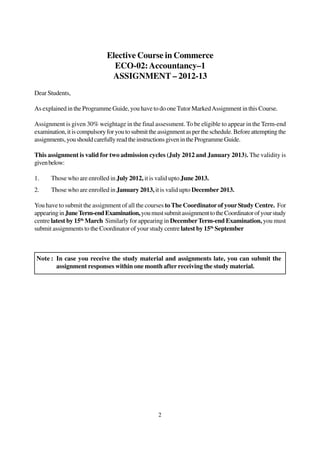
Elective Course in Commerce
                                ECO-02: Accountancy–1
                               ASSIGNMENT – 2012-13
Dear Students,

As explained in the Programme Guide, you have to do one Tutor Marked Assignment in this Course.

Assignment is given 30% weightage in the final assessment. To be eligible to appear in the Term-end
examination, it is compulsory for you to submit the assignment as per the schedule. Before attempting the
assignments, you should carefully read the instructions given in the Programme Guide.

This assignment is valid for two admission cycles (July 2012 and January 2013). The validity is
given below:

1.     Those who are enrolled in July 2012, it is valid upto June 2013.
2.     Those who are enrolled in January 2013, it is valid upto December 2013.

You have to submit the assignment of all the courses to The Coordinator of your Study Centre. For
appearing in June Term-end Examination, you must submit assignment to the Coordinator of your study
centre latest by 15th March Similarly for appearing in December Term-end Examination, you must
submit assignments to the Coordinator of your study centre latest by 15th September


Note : In case you receive the study material and assignments late, you can submit the
       assignment responses within one month after receiving the study material.


                                                   2
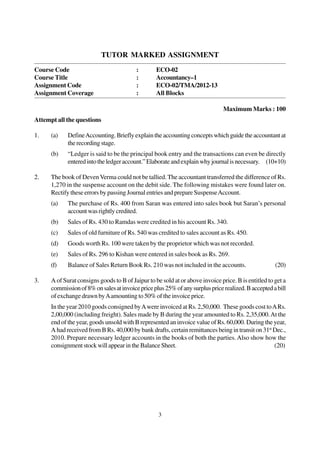
TUTOR MARKED ASSIGNMENT
Course Code                               :        ECO-02
Course Title                              :        Accountancy–1
Assignment Code                           :        ECO-02/TMA/2012-13
Assignment Coverage                       :        All Blocks

                                                                                Maximum Marks : 100
Attempt all the questions

1.    (a)    Define Accounting. Briefly explain the accounting concepts which guide the accountant at
             the recording stage.
      (b)    “Ledger is said to be the principal book entry and the transactions can even be directly
             entered into the ledger account.” Elaborate and explain why journal is necessary. (10+10)

2.    The book of Deven Verma could not be tallied. The accountant transferred the difference of Rs.
      1,270 in the suspense account on the debit side. The following mistakes were found later on.
      Rectify these errors by passing Journal entries and prepare Suspense Account.
      (a)    The purchase of Rs. 400 from Saran was entered into sales book but Saran’s personal
             account was rightly credited.
      (b)    Sales of Rs. 430 to Ramdas were credited in his account Rs. 340.
      (c)    Sales of old furniture of Rs. 540 was credited to sales account as Rs. 450.
      (d)    Goods worth Rs. 100 were taken by the proprietor which was not recorded.
      (e)    Sales of Rs. 296 to Kishan were entered in sales book as Rs. 269.
      (f)    Balance of Sales Return Book Rs. 210 was not included in the accounts.                   (20)

3.    A of Surat consigns goods to B of Jaipur to be sold at or above invoice price. B is entitled to get a
      commission of 8% on sales at invoice price plus 25% of any surplus price realized. B accepted a bill
      of exchange drawn by A amounting to 50% of the invoice price.
      In the year 2010 goods consigned by A were invoiced at Rs. 2,50,000. These goods cost to A Rs.
      2,00,000 (including freight). Sales made by B during the year amounted to Rs. 2,35,000. At the
      end of the year, goods unsold with B represented an invoice value of Rs. 60,000. During the year,
      A had received from B Rs. 40,000 by bank drafts, certain remittances being in transit on 31st Dec.,
      2010. Prepare necessary ledger accounts in the books of both the parties. Also show how the
      consignment stock will appear in the Balance Sheet.                                           (20)


                                                    3
4.   A merchant keeps incomplete records. During 2010 the analysis of his cash book was as under:

                                               Rs.                                              Rs.
       Receipts from Debtors                 4,000       Bank overdraft (1-1-2010)             600
       Additional Capital Introduced                     Payments to Creditors               2,700
       on 1-9-2010                             300       General Expenses                      900
       Loan from C on 1-7 - 2010                         Salaries                              300
       @ 6% interest p.a.                    1,500       Drawings                              400
                                                         Bank Balance (31-12-2010)             900
                                             5,800                                           5,800

     On 1st January, 2010 the following balances were recorded: Building Rs. 2,500; Stock Rs. 1,800;
     Debtors Rs 5,300 and Creditors Rs. 1,500

     The Balances on 31st Dec. 2010 were: Debtors Rs. 6,000; Building Rs. 2,500; Creditors Rs 1,900
     and Stock Rs. 2,600.

     Allow 5% depreciation on Building. Provide interest on C’s loan for six months. Prepare trading,
     Profit and Loss Account and Balance Sheet on 31-12-2010.                                    (20)

5.   (a)   What do you mean by Income & Expenditure Account? How does it differ from Receipts &
           Payments Account?
     (b)   Describe the methods of recording depreciation in books of accounts. How is the balance of
           the provisions for depreciation account shown in the Balance Sheet?              (10+10)


                                                4

Eco 02 assignment question papers

  • 1.
    ECO-02 Bachelor’s Degree Programme (BDP) ASSIGNMENT 2012-13 Elective Course in Commerce ECO-02: ACCOUNTANCY–1 For July 2012 and January 2013 admission cycle School of Management Studies Indira Gandhi National Open University Maidan Garhi, New Delhi-110 068
  • 2.
    Elective Course inCommerce ECO-02: Accountancy–1 ASSIGNMENT – 2012-13 Dear Students, As explained in the Programme Guide, you have to do one Tutor Marked Assignment in this Course. Assignment is given 30% weightage in the final assessment. To be eligible to appear in the Term-end examination, it is compulsory for you to submit the assignment as per the schedule. Before attempting the assignments, you should carefully read the instructions given in the Programme Guide. This assignment is valid for two admission cycles (July 2012 and January 2013). The validity is given below: 1. Those who are enrolled in July 2012, it is valid upto June 2013. 2. Those who are enrolled in January 2013, it is valid upto December 2013. You have to submit the assignment of all the courses to The Coordinator of your Study Centre. For appearing in June Term-end Examination, you must submit assignment to the Coordinator of your study centre latest by 15th March Similarly for appearing in December Term-end Examination, you must submit assignments to the Coordinator of your study centre latest by 15th September Note : In case you receive the study material and assignments late, you can submit the assignment responses within one month after receiving the study material. 2
  • 3.
    TUTOR MARKED ASSIGNMENT CourseCode : ECO-02 Course Title : Accountancy–1 Assignment Code : ECO-02/TMA/2012-13 Assignment Coverage : All Blocks Maximum Marks : 100 Attempt all the questions 1. (a) Define Accounting. Briefly explain the accounting concepts which guide the accountant at the recording stage. (b) “Ledger is said to be the principal book entry and the transactions can even be directly entered into the ledger account.” Elaborate and explain why journal is necessary. (10+10) 2. The book of Deven Verma could not be tallied. The accountant transferred the difference of Rs. 1,270 in the suspense account on the debit side. The following mistakes were found later on. Rectify these errors by passing Journal entries and prepare Suspense Account. (a) The purchase of Rs. 400 from Saran was entered into sales book but Saran’s personal account was rightly credited. (b) Sales of Rs. 430 to Ramdas were credited in his account Rs. 340. (c) Sales of old furniture of Rs. 540 was credited to sales account as Rs. 450. (d) Goods worth Rs. 100 were taken by the proprietor which was not recorded. (e) Sales of Rs. 296 to Kishan were entered in sales book as Rs. 269. (f) Balance of Sales Return Book Rs. 210 was not included in the accounts. (20) 3. A of Surat consigns goods to B of Jaipur to be sold at or above invoice price. B is entitled to get a commission of 8% on sales at invoice price plus 25% of any surplus price realized. B accepted a bill of exchange drawn by A amounting to 50% of the invoice price. In the year 2010 goods consigned by A were invoiced at Rs. 2,50,000. These goods cost to A Rs. 2,00,000 (including freight). Sales made by B during the year amounted to Rs. 2,35,000. At the end of the year, goods unsold with B represented an invoice value of Rs. 60,000. During the year, A had received from B Rs. 40,000 by bank drafts, certain remittances being in transit on 31st Dec., 2010. Prepare necessary ledger accounts in the books of both the parties. Also show how the consignment stock will appear in the Balance Sheet. (20) 3
  • 4.
    4. A merchant keeps incomplete records. During 2010 the analysis of his cash book was as under: Rs. Rs. Receipts from Debtors 4,000 Bank overdraft (1-1-2010) 600 Additional Capital Introduced Payments to Creditors 2,700 on 1-9-2010 300 General Expenses 900 Loan from C on 1-7 - 2010 Salaries 300 @ 6% interest p.a. 1,500 Drawings 400 Bank Balance (31-12-2010) 900 5,800 5,800 On 1st January, 2010 the following balances were recorded: Building Rs. 2,500; Stock Rs. 1,800; Debtors Rs 5,300 and Creditors Rs. 1,500 The Balances on 31st Dec. 2010 were: Debtors Rs. 6,000; Building Rs. 2,500; Creditors Rs 1,900 and Stock Rs. 2,600. Allow 5% depreciation on Building. Provide interest on C’s loan for six months. Prepare trading, Profit and Loss Account and Balance Sheet on 31-12-2010. (20) 5. (a) What do you mean by Income & Expenditure Account? How does it differ from Receipts & Payments Account? (b) Describe the methods of recording depreciation in books of accounts. How is the balance of the provisions for depreciation account shown in the Balance Sheet? (10+10) 4