ECN211 Chapter 9 Worksheet – Inflation
1. Define inflation.
Section 9.1 – Tracking Inflation
2. What is meant by the basket of goods and services?
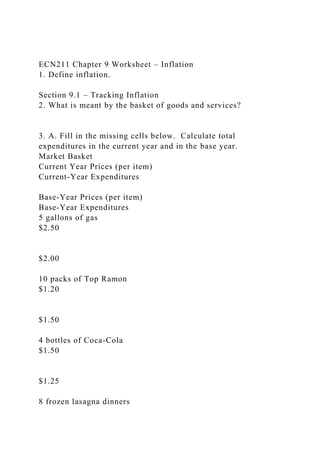
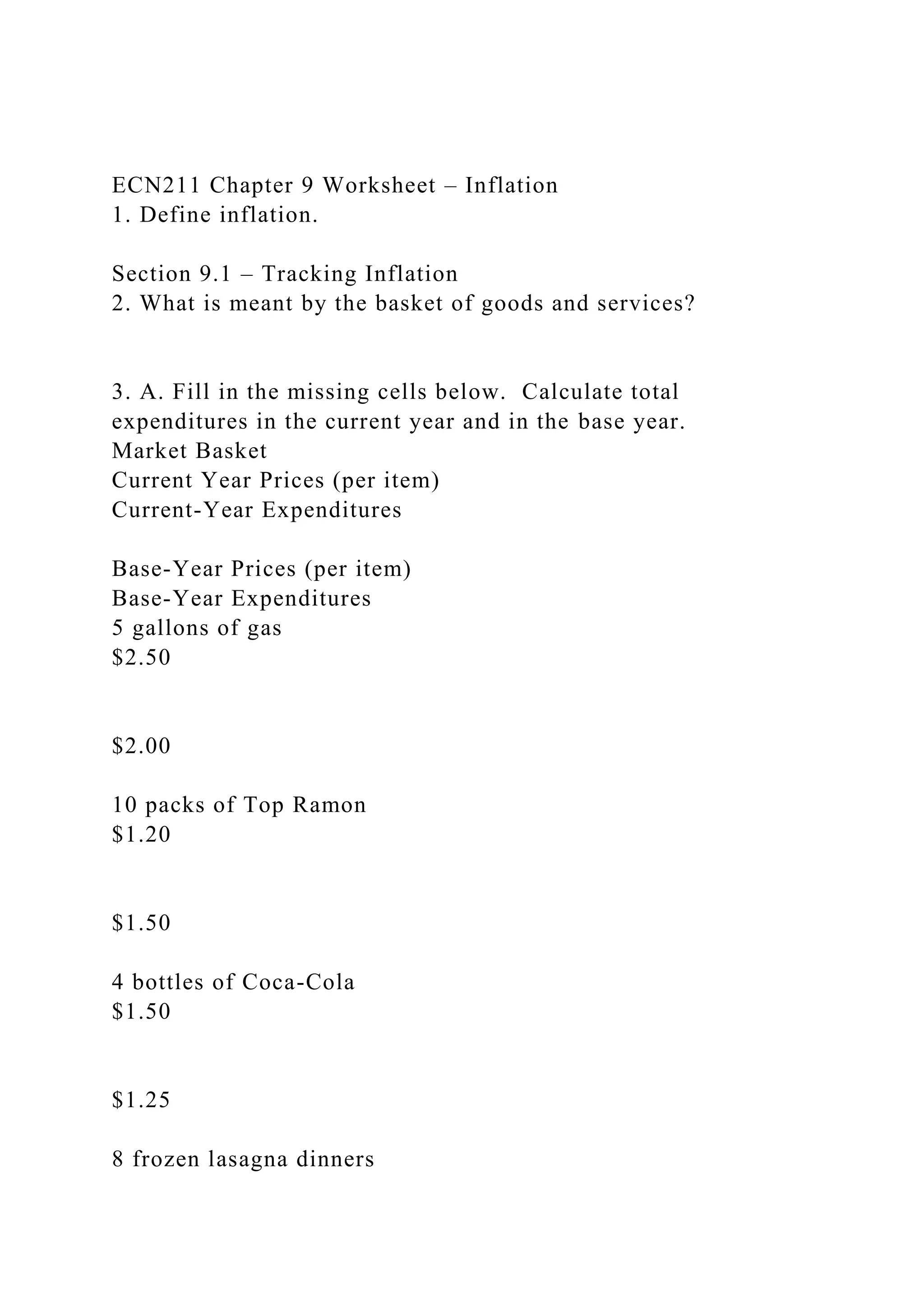
3. A. Fill in the missing cells below. Calculate total
expenditures in the current year and in the base year.
Market Basket
Current Year Prices (per item)
Current-Year Expenditures
Base-Year Prices (per item)
Base-Year Expenditures
5 gallons of gas
$2.50
$2.00
10 packs of Top Ramon
$1.20
$1.50
4 bottles of Coca-Cola
$1.50
$1.25
8 frozen lasagna dinners
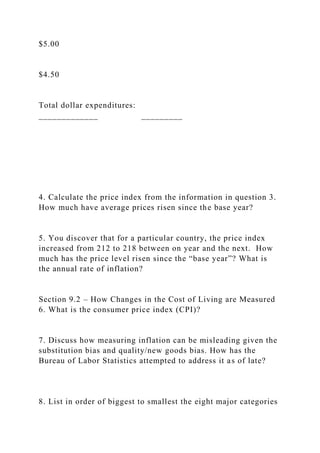
$5.00
$4.50
Total dollar expenditures:
_____________ _________
4. Calculate the price index from the information in question 3.
How much have average prices risen since the base year?
5. You discover that for a particular country, the price index
increased from 212 to 218 between on year and the next. How
much has the price level risen since the “base year”? What is
the annual rate of inflation?
Section 9.2 – How Changes in the Cost of Living are Measured
6. What is the consumer price index (CPI)?
7. Discuss how measuring inflation can be misleading given the
substitution bias and quality/new goods bias. How has the
Bureau of Labor Statistics attempted to address it as of late?
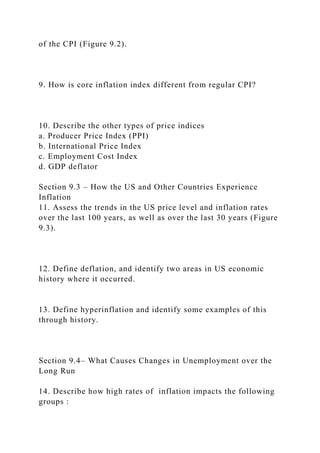
8. List in order of biggest to smallest the eight major categories
of the CPI (Figure 9.2).
9. How is core inflation index different from regular CPI?
10. Describe the other types of price indices
a. Producer Price Index (PPI)
b. International Price Index
c. Employment Cost Index
d. GDP deflator
Section 9.3 – How the US and Other Countries Experience
Inflation
11. Assess the trends in the US price level and inflation rates
over the last 100 years, as well as over the last 30 years (Figure
9.3).
12. Define deflation, and identify two areas in US economic
history where it occurred.
13. Define hyperinflation and identify some examples of this
through history.
Section 9.4– What Causes Changes in Unemployment over the
Long Run
14. Describe how high rates of inflation impacts the following
groups :
a. Between those who save and lend money and those that
borrow money
b. Employers and employees?
c. Retirees living on a fixed income?
15. Describe the trend in the minimum wage over the last 50
years (Figure 9.6).
16. How can high rates of inflation “blur” price signals for both
buyers and sellers in an economy?
17. How can inflation make long-term planning more difficult
for both workers/households and firms?
18. Why are low rates of inflation preferred to deflation?
19. How can inflation “oil the gears" or make the labor market
for flexible?
Section 9.5– Indexing and its Limitations
20. What does it mean for price, wages, or interest rates to be
“indexed”?
21. Describe “cost-of-living-adjustments” (COLAs) and
adjustable-rate mortgages (ARMs) as examples of indexing.
3. How does the US government use indexing for
a. Tax brackets
b. Social Security
c. Indexed Bonds
4. Summarize the “Preview of Policy Discussions of Inflation”.
Where are we headed in this course?
4
ECN211 Chapter 8 Worksheet – Unemployment
Section 8.1– How the Unemployment Rate is Defined and
Computed
1. Give examples of those individuals in the population who are
not interested in working, and thus are considered out of the
labor force.
2. Who is considered part of the labor force?
3. Give the formula for calculating the unemployment rate.
Consider Table 8.1. What was the unemployment rate in
February 2015 (or the date presented in your text)? How does
that compare to the current unemployment rate?
4. Give two examples of those who are the hidden unemployed.
5. Give the formula for calculating the labor force participation
rate. Consider Table 8.1 What was the labor force participation
rate in February 2015 (or the date presented in your text)? How
does that compare to the current labor force participation rate i?
6. What is the difference between the unemployment rate and
labor force participation rate?
7. How is US unemployment data collected?
8. What are some criticisms of the way the unemployment rate
is measured?
Section 8.2– Patterns of Unemployment
9. Describe the historical pattern of US Unemployment (Figure
8.3). What tends to be the range of unemployment rates over
time?
10. Describe the differences in unemployment rates by sex, age,
and by race and ethnicity (Figure 8.4).
11. Analyze the reasons for reported unemployment and the
length of time unemployed (Tables 8.2 and 8.3).
12. Describe trends in US unemployment relative to other high
income countries. Why is it more difficult to compare
unemployment rates between rich countries and developing
(poorer) countries?
Section 8.3– What Causes Changes in Unemployment over the
Short Run
13. Define cyclical unemployment, and describe how the
presence of it challenges the presumption of efficient labor
markets (i.e., wages return to equilibrium quickly and all
workers supplied are demanded, leaving a 0% unemployment
rate).
14. Why might wages be sticky downwards? Describe the
various arguments for why this may be:
a. Implicit contract
b. Efficiency wage theory
c. Adverse selection of wage cuts argument
d. Insider-outsider model
e. Relative wage coordination argument
15. Graph the impact of a labor market experiencing a surplus
and sticky wages downwards. Should we expect wages to fall
and thus more employers to hire?
Section 8.4– What Causes Changes in Unemployment over the
Long Run
16. Describe what is meant by the natural unemployment rate.
17. Contrast frictional unemployment from structural
unemployment, and how together they determine the natural
unemployment rate.
18. Relate the natural unemployment rate with the idea of
potential real GDP.
19. How could changes in labor productivity levels, and
corresponding increases in wages, lead to unemployment? What
will need to happen to productivity to solve the labor surplus
(Figure 8.8)?
20. How can public policy impact the natural rate of
unemployment?
21. The natural rate of unemployment is argued to be lower in
the 21st Century than in previous decades. Give 3 reasons to
account for this.
22. Compare the US natural rate of unemployment to many
countries in Europe. Why might countries differ in their natural
rates of unemployment?
4
CHAPTER 13: Assignments for mastering KEY IDEAS
Assignment 13.3
Key Idea: The Fed uses open market operation to control the
amount of money that is created by the banking system.
1. Explain how banks create money under a fractional reserve
banking system.
2. Define the term open market operation.
3. Describe how the Fed pays for the government securities
that it buys.
4. Explain how the Fed uses open market operations to
increase the money supply.
5. Explain how the Fed uses open market operations to
decrease the money supply.
6. Write the formula used to calculate the maximum amount
of new money that may be created from any new money.
7. Explain what might limit the banking system’s ability to
create money.
Assignment 13.4
Key Idea: The Fed also uses other tools to control the money
supply.
1. Explain how the Fed uses the required reserve ratio to
increase the money supply.
2. Define discount rate and federal funds rate.
3. Explain how the Fed uses the discount rate to increase the
money supply.
4. Explain how the Fed uses open market operations to
achieve its federal funds rate target.
5. List three steps the Fed took to deal with the 2007-2009
financial crisis.
6. Explain how the Temporary Auction Facility (TAF) works.
Assignment 13.5
Key Idea: [Appendix] Monetary policy can be conducted in
various ways.
1. Explain why the demand for reserves curve is downward
sloping.
2. Explain where the supply of reserves comes from.
3. Explain why the supply of reserves curve is kinked.
4. Explain what actions the Fed can take to move the federal
funds rate to its target.
Homework Chapter 12
Assignment 12.1
Key Idea: John Maynard Keynes challenged all four of the
beliefs on which the classical position of the economy was
based and concluded that the economy could get stuck in a
recessionary gap.
1. Explain why Keynes believed that Say’s law might not
hold in a money economy.
2. Explain why Keynes believed that wage rates might be
inflexible.
3. Describe the New Keynesian economists’ arguments as to
why wage rates might be inflexible.
4. Explain how inflexible wages can keep the economy from
recovering from a recessionary gap.
5. Describe why Keynes believed that the price level might
not fall.
6. State the position taken by many economists today
concerning wage and price flexibility.
Assignment 12.2 (Located in Appendix of textbook)
Key Idea: The simple Keynesian model is a prominent
macroeconomics model.
1. List the basic assumptions of the simple Keynesian model.
2. State why Keynes was so concerned about consumption
and define these terms:
a. Autonomous consumption
b. MPC
c. The consumption function
3. List the three ways in which consumption can change.
4. Describe the link between consumption and saving in the
simple Keynesian model.
5. Describe the multiplier process.
6. State the formula for calculating the size of a multiplier
effect.
7. Describe the shortcomings of the multiplier.
Assignment 12.3
Key Idea: The simple Keynesian model can be analyzed in terms
of the aggregate demand and aggregate supply framework, and
can be used to show why Keynes believed that government has
an economic role to play.
1. List the variables that shift the AD curve in the simple
Keynesian model.
2. Describe the Keynesian AS curve.
3. Use the AD-AS framework to depict an economy in
equilibrium with a recessionary gap.
4. Tell why Keynes believed that the government may have a
management role to play in the economy.
Assignment 12.4 (Open Stax Textbook calls this Aggregate
Expenditure Model in Appendix B)
Key Idea: The simple Keynesian model can be analyzed in terms
of the TE-TP framework.
1. List the different names for the TE-TP framework.
2. Explain how a total expenditures curve is derived, and
what causes it to shift.
3. Describe the three possible states of the economy in the
TE-TP framework.
4. Describe the role of business inventories in moving the
economy from disequilibrium to equilibrium in the TE-TP
framework.
5. Use the TE-TP framework to graphically illustrate an
economy in a recessionary gap.

ECN211 Chapter 9 Worksheet – Inflation1. Define inflation.Se.docx

  • 1.
    ECN211 Chapter 9Worksheet – Inflation 1. Define inflation. Section 9.1 – Tracking Inflation 2. What is meant by the basket of goods and services? 3. A. Fill in the missing cells below. Calculate total expenditures in the current year and in the base year. Market Basket Current Year Prices (per item) Current-Year Expenditures Base-Year Prices (per item) Base-Year Expenditures 5 gallons of gas $2.50 $2.00 10 packs of Top Ramon $1.20 $1.50 4 bottles of Coca-Cola $1.50 $1.25 8 frozen lasagna dinners
  • 2.
    $5.00 $4.50 Total dollar expenditures: ______________________ 4. Calculate the price index from the information in question 3. How much have average prices risen since the base year? 5. You discover that for a particular country, the price index increased from 212 to 218 between on year and the next. How much has the price level risen since the “base year”? What is the annual rate of inflation? Section 9.2 – How Changes in the Cost of Living are Measured 6. What is the consumer price index (CPI)? 7. Discuss how measuring inflation can be misleading given the substitution bias and quality/new goods bias. How has the Bureau of Labor Statistics attempted to address it as of late? 8. List in order of biggest to smallest the eight major categories
  • 3.
    of the CPI(Figure 9.2). 9. How is core inflation index different from regular CPI? 10. Describe the other types of price indices a. Producer Price Index (PPI) b. International Price Index c. Employment Cost Index d. GDP deflator Section 9.3 – How the US and Other Countries Experience Inflation 11. Assess the trends in the US price level and inflation rates over the last 100 years, as well as over the last 30 years (Figure 9.3). 12. Define deflation, and identify two areas in US economic history where it occurred. 13. Define hyperinflation and identify some examples of this through history. Section 9.4– What Causes Changes in Unemployment over the Long Run 14. Describe how high rates of inflation impacts the following groups :
  • 4.
    a. Between thosewho save and lend money and those that borrow money b. Employers and employees? c. Retirees living on a fixed income? 15. Describe the trend in the minimum wage over the last 50 years (Figure 9.6). 16. How can high rates of inflation “blur” price signals for both buyers and sellers in an economy? 17. How can inflation make long-term planning more difficult for both workers/households and firms? 18. Why are low rates of inflation preferred to deflation? 19. How can inflation “oil the gears" or make the labor market for flexible? Section 9.5– Indexing and its Limitations 20. What does it mean for price, wages, or interest rates to be “indexed”?
  • 5.
    21. Describe “cost-of-living-adjustments”(COLAs) and adjustable-rate mortgages (ARMs) as examples of indexing. 3. How does the US government use indexing for a. Tax brackets b. Social Security c. Indexed Bonds 4. Summarize the “Preview of Policy Discussions of Inflation”. Where are we headed in this course? 4 ECN211 Chapter 8 Worksheet – Unemployment Section 8.1– How the Unemployment Rate is Defined and Computed 1. Give examples of those individuals in the population who are not interested in working, and thus are considered out of the labor force. 2. Who is considered part of the labor force?
  • 6.
    3. Give theformula for calculating the unemployment rate. Consider Table 8.1. What was the unemployment rate in February 2015 (or the date presented in your text)? How does that compare to the current unemployment rate? 4. Give two examples of those who are the hidden unemployed. 5. Give the formula for calculating the labor force participation rate. Consider Table 8.1 What was the labor force participation rate in February 2015 (or the date presented in your text)? How does that compare to the current labor force participation rate i? 6. What is the difference between the unemployment rate and labor force participation rate? 7. How is US unemployment data collected? 8. What are some criticisms of the way the unemployment rate is measured? Section 8.2– Patterns of Unemployment
  • 7.
    9. Describe thehistorical pattern of US Unemployment (Figure 8.3). What tends to be the range of unemployment rates over time? 10. Describe the differences in unemployment rates by sex, age, and by race and ethnicity (Figure 8.4). 11. Analyze the reasons for reported unemployment and the length of time unemployed (Tables 8.2 and 8.3). 12. Describe trends in US unemployment relative to other high income countries. Why is it more difficult to compare unemployment rates between rich countries and developing (poorer) countries? Section 8.3– What Causes Changes in Unemployment over the Short Run 13. Define cyclical unemployment, and describe how the presence of it challenges the presumption of efficient labor markets (i.e., wages return to equilibrium quickly and all workers supplied are demanded, leaving a 0% unemployment rate).
  • 8.
    14. Why mightwages be sticky downwards? Describe the various arguments for why this may be: a. Implicit contract b. Efficiency wage theory c. Adverse selection of wage cuts argument d. Insider-outsider model e. Relative wage coordination argument 15. Graph the impact of a labor market experiencing a surplus and sticky wages downwards. Should we expect wages to fall and thus more employers to hire? Section 8.4– What Causes Changes in Unemployment over the Long Run 16. Describe what is meant by the natural unemployment rate. 17. Contrast frictional unemployment from structural unemployment, and how together they determine the natural unemployment rate. 18. Relate the natural unemployment rate with the idea of potential real GDP. 19. How could changes in labor productivity levels, and corresponding increases in wages, lead to unemployment? What will need to happen to productivity to solve the labor surplus
  • 9.
    (Figure 8.8)? 20. Howcan public policy impact the natural rate of unemployment? 21. The natural rate of unemployment is argued to be lower in the 21st Century than in previous decades. Give 3 reasons to account for this. 22. Compare the US natural rate of unemployment to many countries in Europe. Why might countries differ in their natural rates of unemployment? 4 CHAPTER 13: Assignments for mastering KEY IDEAS Assignment 13.3 Key Idea: The Fed uses open market operation to control the amount of money that is created by the banking system. 1. Explain how banks create money under a fractional reserve banking system. 2. Define the term open market operation. 3. Describe how the Fed pays for the government securities that it buys. 4. Explain how the Fed uses open market operations to increase the money supply. 5. Explain how the Fed uses open market operations to decrease the money supply. 6. Write the formula used to calculate the maximum amount of new money that may be created from any new money. 7. Explain what might limit the banking system’s ability to create money.
  • 10.
    Assignment 13.4 Key Idea:The Fed also uses other tools to control the money supply. 1. Explain how the Fed uses the required reserve ratio to increase the money supply. 2. Define discount rate and federal funds rate. 3. Explain how the Fed uses the discount rate to increase the money supply. 4. Explain how the Fed uses open market operations to achieve its federal funds rate target. 5. List three steps the Fed took to deal with the 2007-2009 financial crisis. 6. Explain how the Temporary Auction Facility (TAF) works. Assignment 13.5 Key Idea: [Appendix] Monetary policy can be conducted in various ways. 1. Explain why the demand for reserves curve is downward sloping. 2. Explain where the supply of reserves comes from. 3. Explain why the supply of reserves curve is kinked. 4. Explain what actions the Fed can take to move the federal funds rate to its target. Homework Chapter 12 Assignment 12.1 Key Idea: John Maynard Keynes challenged all four of the beliefs on which the classical position of the economy was based and concluded that the economy could get stuck in a recessionary gap. 1. Explain why Keynes believed that Say’s law might not hold in a money economy. 2. Explain why Keynes believed that wage rates might be inflexible. 3. Describe the New Keynesian economists’ arguments as to
  • 11.
    why wage ratesmight be inflexible. 4. Explain how inflexible wages can keep the economy from recovering from a recessionary gap. 5. Describe why Keynes believed that the price level might not fall. 6. State the position taken by many economists today concerning wage and price flexibility. Assignment 12.2 (Located in Appendix of textbook) Key Idea: The simple Keynesian model is a prominent macroeconomics model. 1. List the basic assumptions of the simple Keynesian model. 2. State why Keynes was so concerned about consumption and define these terms: a. Autonomous consumption b. MPC c. The consumption function 3. List the three ways in which consumption can change. 4. Describe the link between consumption and saving in the simple Keynesian model. 5. Describe the multiplier process. 6. State the formula for calculating the size of a multiplier effect. 7. Describe the shortcomings of the multiplier. Assignment 12.3 Key Idea: The simple Keynesian model can be analyzed in terms of the aggregate demand and aggregate supply framework, and can be used to show why Keynes believed that government has an economic role to play. 1. List the variables that shift the AD curve in the simple Keynesian model. 2. Describe the Keynesian AS curve. 3. Use the AD-AS framework to depict an economy in equilibrium with a recessionary gap. 4. Tell why Keynes believed that the government may have a
  • 12.
    management role toplay in the economy. Assignment 12.4 (Open Stax Textbook calls this Aggregate Expenditure Model in Appendix B) Key Idea: The simple Keynesian model can be analyzed in terms of the TE-TP framework. 1. List the different names for the TE-TP framework. 2. Explain how a total expenditures curve is derived, and what causes it to shift. 3. Describe the three possible states of the economy in the TE-TP framework. 4. Describe the role of business inventories in moving the economy from disequilibrium to equilibrium in the TE-TP framework. 5. Use the TE-TP framework to graphically illustrate an economy in a recessionary gap.