PUNJAB COLLEGE OF TECHNICAL EDUCATION, LUDHIANA
                              COURSE PLAN
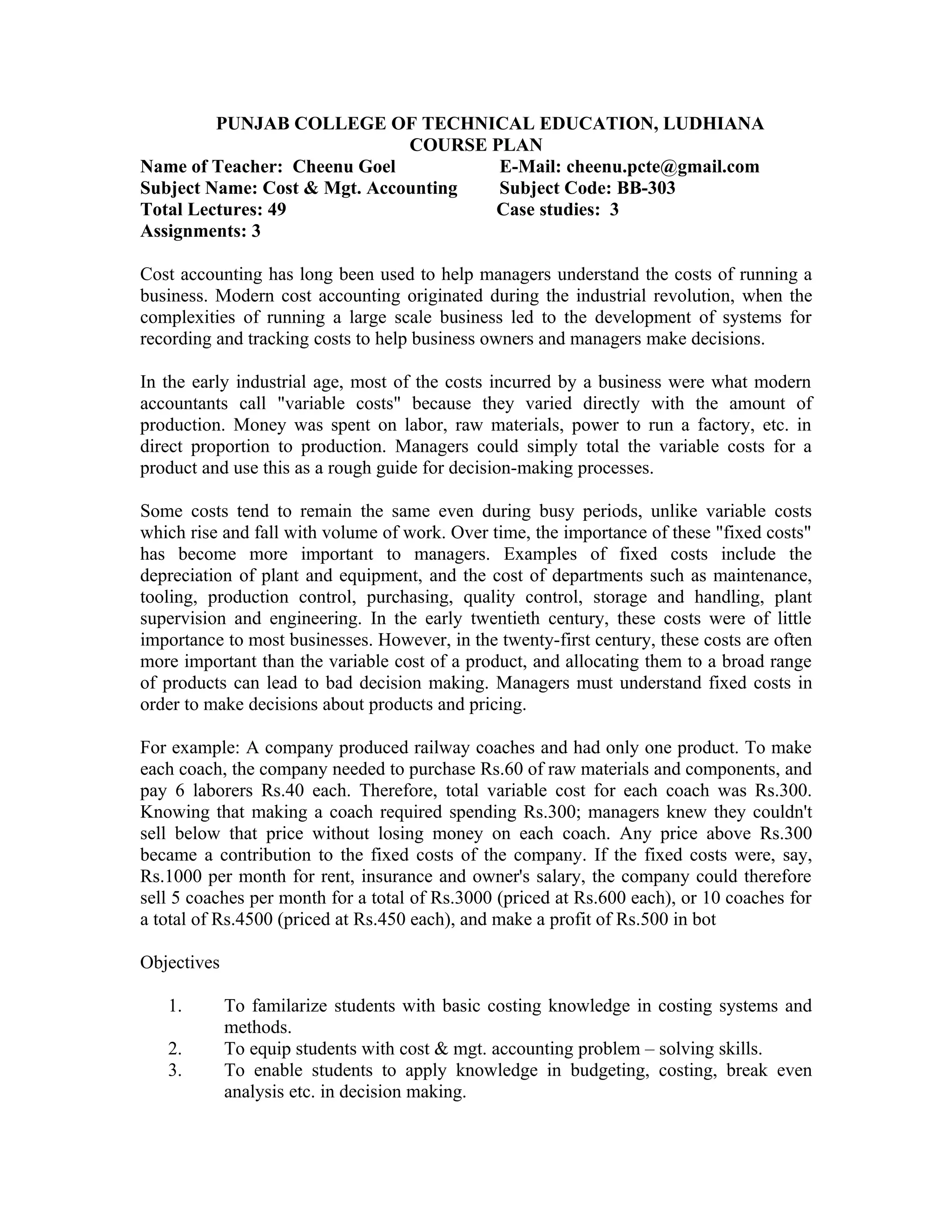
Name of Teacher: Cheenu Goel          E-Mail: cheenu.pcte@gmail.com
Subject Name: Cost & Mgt. Accounting  Subject Code: BB-303
Total Lectures: 49                   Case studies: 3
Assignments: 3

Cost accounting has long been used to help managers understand the costs of running a
business. Modern cost accounting originated during the industrial revolution, when the
complexities of running a large scale business led to the development of systems for
recording and tracking costs to help business owners and managers make decisions.

In the early industrial age, most of the costs incurred by a business were what modern
accountants call "variable costs" because they varied directly with the amount of
production. Money was spent on labor, raw materials, power to run a factory, etc. in
direct proportion to production. Managers could simply total the variable costs for a
product and use this as a rough guide for decision-making processes.

Some costs tend to remain the same even during busy periods, unlike variable costs
which rise and fall with volume of work. Over time, the importance of these "fixed costs"
has become more important to managers. Examples of fixed costs include the
depreciation of plant and equipment, and the cost of departments such as maintenance,
tooling, production control, purchasing, quality control, storage and handling, plant
supervision and engineering. In the early twentieth century, these costs were of little
importance to most businesses. However, in the twenty-first century, these costs are often
more important than the variable cost of a product, and allocating them to a broad range
of products can lead to bad decision making. Managers must understand fixed costs in
order to make decisions about products and pricing.

For example: A company produced railway coaches and had only one product. To make
each coach, the company needed to purchase Rs.60 of raw materials and components, and
pay 6 laborers Rs.40 each. Therefore, total variable cost for each coach was Rs.300.
Knowing that making a coach required spending Rs.300; managers knew they couldn't
sell below that price without losing money on each coach. Any price above Rs.300
became a contribution to the fixed costs of the company. If the fixed costs were, say,
Rs.1000 per month for rent, insurance and owner's salary, the company could therefore
sell 5 coaches per month for a total of Rs.3000 (priced at Rs.600 each), or 10 coaches for
a total of Rs.4500 (priced at Rs.450 each), and make a profit of Rs.500 in bot

Objectives

   1.        To familarize students with basic costing knowledge in costing systems and
             methods.
   2.        To equip students with cost & mgt. accounting problem – solving skills.
   3.        To enable students to apply knowledge in budgeting, costing, break even
             analysis etc. in decision making.
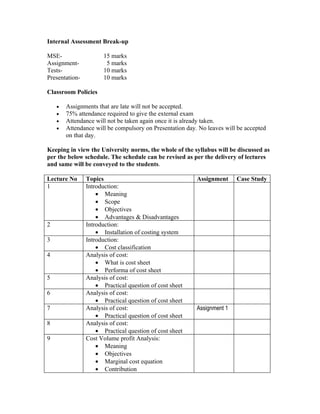
Internal Assessment Break-up

MSE-                  15 marks
Assignment-            5 marks
Tests-                10 marks
Presentation-         10 marks

Classroom Policies

    •   Assignments that are late will not be accepted.
    •   75% attendance required to give the external exam
    •   Attendance will not be taken again once it is already taken.
    •   Attendance will be compulsory on Presentation day. No leaves will be accepted
        on that day.

Keeping in view the University norms, the whole of the syllabus will be discussed as
per the below schedule. The schedule can be revised as per the delivery of lectures
and same will be conveyed to the students.

Lecture No      Topics                                    Assignment     Case Study
1               Introduction:
                    • Meaning
                    • Scope
                    • Objectives
                    • Advantages & Disadvantages
2               Introduction:
                    • Installation of costing system
3               Introduction:
                    • Cost classification
4               Analysis of cost:
                    • What is cost sheet
                    • Performa of cost sheet
5               Analysis of cost:
                    • Practical question of cost sheet
6               Analysis of cost:
                    • Practical question of cost sheet
7               Analysis of cost:                         Assignment 1
                    • Practical question of cost sheet
8               Analysis of cost:
                    • Practical question of cost sheet
9               Cost Volume profit Analysis:
                    • Meaning
                    • Objectives
                    • Marginal cost equation
                    • Contribution
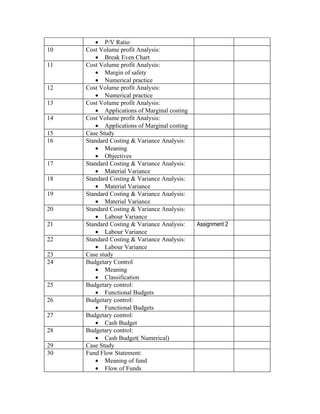
• P/V Ratio
10   Cost Volume profit Analysis:
        • Break Even Chart
11   Cost Volume profit Analysis:
        • Margin of safety
        • Numerical practice
12   Cost Volume profit Analysis:
        • Numerical practice
13   Cost Volume profit Analysis:
        • Applications of Marginal costing
14   Cost Volume profit Analysis:
        • Applications of Marginal costing
15   Case Study
16   Standard Costing & Variance Analysis:
        • Meaning
        • Objectives
17   Standard Costing & Variance Analysis:
        • Material Variance
18   Standard Costing & Variance Analysis:
        • Material Variance
19   Standard Costing & Variance Analysis:
        • Material Variance
20   Standard Costing & Variance Analysis:
        • Labour Variance
21   Standard Costing & Variance Analysis:   Assignment 2
        • Labour Variance
22   Standard Costing & Variance Analysis:
        • Labour Variance
23   Case study
24   Budgetary Control
        • Meaning
        • Classification
25   Budgetary control:
        • Functional Budgets
26   Budgetary control:
        • Functional Budgets
27   Budgetary control:
        • Cash Budget
28   Budgetary control:
        • Cash Budget( Numerical)
29   Case Study
30   Fund Flow Statement:
        • Meaning of fund
        • Flow of Funds
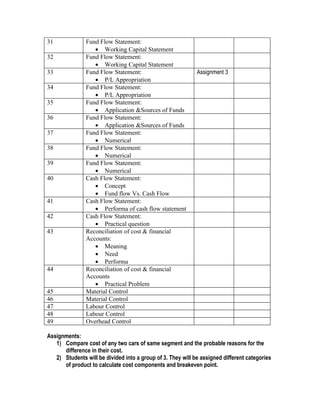
31             Fund Flow Statement:
                  • Working Capital Statement
32             Fund Flow Statement:
                  • Working Capital Statement
33             Fund Flow Statement:                          Assignment 3
                  • P/L Appropriation
34             Fund Flow Statement:
                  • P/L Appropriation
35             Fund Flow Statement:
                  • Application &Sources of Funds
36             Fund Flow Statement:
                  • Application &Sources of Funds
37             Fund Flow Statement:
                  • Numerical
38             Fund Flow Statement:
                  • Numerical
39             Fund Flow Statement:
                  • Numerical
40             Cash Flow Statement:
                  • Concept
                  • Fund flow Vs. Cash Flow
41             Cash Flow Statement:
                  • Performa of cash flow statement
42             Cash Flow Statement:
                  • Practical question
43             Reconciliation of cost & financial
               Accounts:
                  • Meaning
                  • Need
                  • Performa
44             Reconciliation of cost & financial
               Accounts
                  • Practical Problem
45             Material Control
46             Material Control
47             Labour Control
48             Labour Control
49             Overhead Control

Assignments:
   1) Compare cost of any two cars of same segment and the probable reasons for the
      difference in their cost.
   2) Students will be divided into a group of 3. They will be assigned different categories
      of product to calculate cost components and breakeven point.
3) Prepare a budget of your house and compare it with the actual one. Find out the
      reasons for deviations.

Activity:
   Students will visit hotel management department and will be asked to calculate the cost
of a particular dish and then compare cost of that particular dish with the cost prevailing in
the market. Also classify and justify the same into fixed and variable expenses.

Presentations:
   1) Small Cars: A revolution on Indian roads.
   2) Are we prepared for Common Wealth Games?
   3) Euro crisis.
   4) Indian business houses: Performance at international level.
   5) India or China: Low cost Advantage?
   6) A twist in IPL’s Success-A story
   7) Micro Finance: A concept
   8) Various investment options: Risk Analysis
   9) Are we prepared for incoming foreign investments?
   10) Fiscal Consolidation: Need of an hour
   11) Challenges faced by Indian manufacturing sector.
   12) Tax exempted organizations: A bane or boon on Indian Economy.
   13) Problems being faced by Indian Agricultural sector.
   14) Indian Stock Market
   15) Emergence of ETF’s in India.
E:\Cheenu Pcte\Course Module\Cost Accounting

E:\Cheenu Pcte\Course Module\Cost Accounting

  • 1.
    PUNJAB COLLEGE OFTECHNICAL EDUCATION, LUDHIANA COURSE PLAN Name of Teacher: Cheenu Goel E-Mail: cheenu.pcte@gmail.com Subject Name: Cost & Mgt. Accounting Subject Code: BB-303 Total Lectures: 49 Case studies: 3 Assignments: 3 Cost accounting has long been used to help managers understand the costs of running a business. Modern cost accounting originated during the industrial revolution, when the complexities of running a large scale business led to the development of systems for recording and tracking costs to help business owners and managers make decisions. In the early industrial age, most of the costs incurred by a business were what modern accountants call "variable costs" because they varied directly with the amount of production. Money was spent on labor, raw materials, power to run a factory, etc. in direct proportion to production. Managers could simply total the variable costs for a product and use this as a rough guide for decision-making processes. Some costs tend to remain the same even during busy periods, unlike variable costs which rise and fall with volume of work. Over time, the importance of these "fixed costs" has become more important to managers. Examples of fixed costs include the depreciation of plant and equipment, and the cost of departments such as maintenance, tooling, production control, purchasing, quality control, storage and handling, plant supervision and engineering. In the early twentieth century, these costs were of little importance to most businesses. However, in the twenty-first century, these costs are often more important than the variable cost of a product, and allocating them to a broad range of products can lead to bad decision making. Managers must understand fixed costs in order to make decisions about products and pricing. For example: A company produced railway coaches and had only one product. To make each coach, the company needed to purchase Rs.60 of raw materials and components, and pay 6 laborers Rs.40 each. Therefore, total variable cost for each coach was Rs.300. Knowing that making a coach required spending Rs.300; managers knew they couldn't sell below that price without losing money on each coach. Any price above Rs.300 became a contribution to the fixed costs of the company. If the fixed costs were, say, Rs.1000 per month for rent, insurance and owner's salary, the company could therefore sell 5 coaches per month for a total of Rs.3000 (priced at Rs.600 each), or 10 coaches for a total of Rs.4500 (priced at Rs.450 each), and make a profit of Rs.500 in bot Objectives 1. To familarize students with basic costing knowledge in costing systems and methods. 2. To equip students with cost & mgt. accounting problem – solving skills. 3. To enable students to apply knowledge in budgeting, costing, break even analysis etc. in decision making.
  • 2.
    Internal Assessment Break-up MSE- 15 marks Assignment- 5 marks Tests- 10 marks Presentation- 10 marks Classroom Policies • Assignments that are late will not be accepted. • 75% attendance required to give the external exam • Attendance will not be taken again once it is already taken. • Attendance will be compulsory on Presentation day. No leaves will be accepted on that day. Keeping in view the University norms, the whole of the syllabus will be discussed as per the below schedule. The schedule can be revised as per the delivery of lectures and same will be conveyed to the students. Lecture No Topics Assignment Case Study 1 Introduction: • Meaning • Scope • Objectives • Advantages & Disadvantages 2 Introduction: • Installation of costing system 3 Introduction: • Cost classification 4 Analysis of cost: • What is cost sheet • Performa of cost sheet 5 Analysis of cost: • Practical question of cost sheet 6 Analysis of cost: • Practical question of cost sheet 7 Analysis of cost: Assignment 1 • Practical question of cost sheet 8 Analysis of cost: • Practical question of cost sheet 9 Cost Volume profit Analysis: • Meaning • Objectives • Marginal cost equation • Contribution
  • 3.
    • P/V Ratio 10 Cost Volume profit Analysis: • Break Even Chart 11 Cost Volume profit Analysis: • Margin of safety • Numerical practice 12 Cost Volume profit Analysis: • Numerical practice 13 Cost Volume profit Analysis: • Applications of Marginal costing 14 Cost Volume profit Analysis: • Applications of Marginal costing 15 Case Study 16 Standard Costing & Variance Analysis: • Meaning • Objectives 17 Standard Costing & Variance Analysis: • Material Variance 18 Standard Costing & Variance Analysis: • Material Variance 19 Standard Costing & Variance Analysis: • Material Variance 20 Standard Costing & Variance Analysis: • Labour Variance 21 Standard Costing & Variance Analysis: Assignment 2 • Labour Variance 22 Standard Costing & Variance Analysis: • Labour Variance 23 Case study 24 Budgetary Control • Meaning • Classification 25 Budgetary control: • Functional Budgets 26 Budgetary control: • Functional Budgets 27 Budgetary control: • Cash Budget 28 Budgetary control: • Cash Budget( Numerical) 29 Case Study 30 Fund Flow Statement: • Meaning of fund • Flow of Funds
  • 4.
    31 Fund Flow Statement: • Working Capital Statement 32 Fund Flow Statement: • Working Capital Statement 33 Fund Flow Statement: Assignment 3 • P/L Appropriation 34 Fund Flow Statement: • P/L Appropriation 35 Fund Flow Statement: • Application &Sources of Funds 36 Fund Flow Statement: • Application &Sources of Funds 37 Fund Flow Statement: • Numerical 38 Fund Flow Statement: • Numerical 39 Fund Flow Statement: • Numerical 40 Cash Flow Statement: • Concept • Fund flow Vs. Cash Flow 41 Cash Flow Statement: • Performa of cash flow statement 42 Cash Flow Statement: • Practical question 43 Reconciliation of cost & financial Accounts: • Meaning • Need • Performa 44 Reconciliation of cost & financial Accounts • Practical Problem 45 Material Control 46 Material Control 47 Labour Control 48 Labour Control 49 Overhead Control Assignments: 1) Compare cost of any two cars of same segment and the probable reasons for the difference in their cost. 2) Students will be divided into a group of 3. They will be assigned different categories of product to calculate cost components and breakeven point.
  • 5.
    3) Prepare abudget of your house and compare it with the actual one. Find out the reasons for deviations. Activity: Students will visit hotel management department and will be asked to calculate the cost of a particular dish and then compare cost of that particular dish with the cost prevailing in the market. Also classify and justify the same into fixed and variable expenses. Presentations: 1) Small Cars: A revolution on Indian roads. 2) Are we prepared for Common Wealth Games? 3) Euro crisis. 4) Indian business houses: Performance at international level. 5) India or China: Low cost Advantage? 6) A twist in IPL’s Success-A story 7) Micro Finance: A concept 8) Various investment options: Risk Analysis 9) Are we prepared for incoming foreign investments? 10) Fiscal Consolidation: Need of an hour 11) Challenges faced by Indian manufacturing sector. 12) Tax exempted organizations: A bane or boon on Indian Economy. 13) Problems being faced by Indian Agricultural sector. 14) Indian Stock Market 15) Emergence of ETF’s in India.